1900 Barber Half Dollar Coin Value: How Much Is It Worth?
A 1900 Barber Half Dollar can range from about $44 in well-worn G4 condition to roughly $3,519 at the MS63 grade level, depending on which mint produced it. Those figures come from a USA Coin Book guide snapshot and reflect numismatic retail estimates, not guaranteed sale prices.
Philadelphia, New Orleans, and San Francisco all struck business issues this year, and Philadelphia also produced Proofs. Condition and originality of surfaces matter enormously with these coins.
Fast Way to Identify Your 1900 Barber Half Dollar
The quickest way to get a preliminary read on your 1900 Barber Half Dollar is to upload clear photos of the front and back. That lets us check the date, mintmark location, and overall wear in one pass.
Snap both sides in good lighting, and you will have a solid starting point for figuring out what you are holding.
1900 Barber Half Dollar Value
Upload both sides of your 1900 Barber Half Dollar.
Front Obverse
Upload photo
Back Reverse
Upload photo
Which 1900 Barber Half Dollar Versions Are Worth Money?
- The 1900-O (New Orleans) commands the highest guide estimate in upper grades, listed around $3,519 at MS63 versus $1,145 for Philadelphia at the same grade.
- San Francisco issues (1900-S) carry a guide value near $2,747 at MS63, making them the second-strongest business strike version this year.
- Philadelphia Proof strikes are listed at about $1,363 in PR63 and are a distinct collectible finish separate from business issues.
- A repunched date variety exists for 1900 and can add collector interest when the extra impression is clearly visible.
- Original, problem-free coins in upper circulated or Mint State condition are far more valuable than heavily worn or cleaned examples.
Step 1: Identify Your 1900 Barber Half Dollar Mint Mark and Version
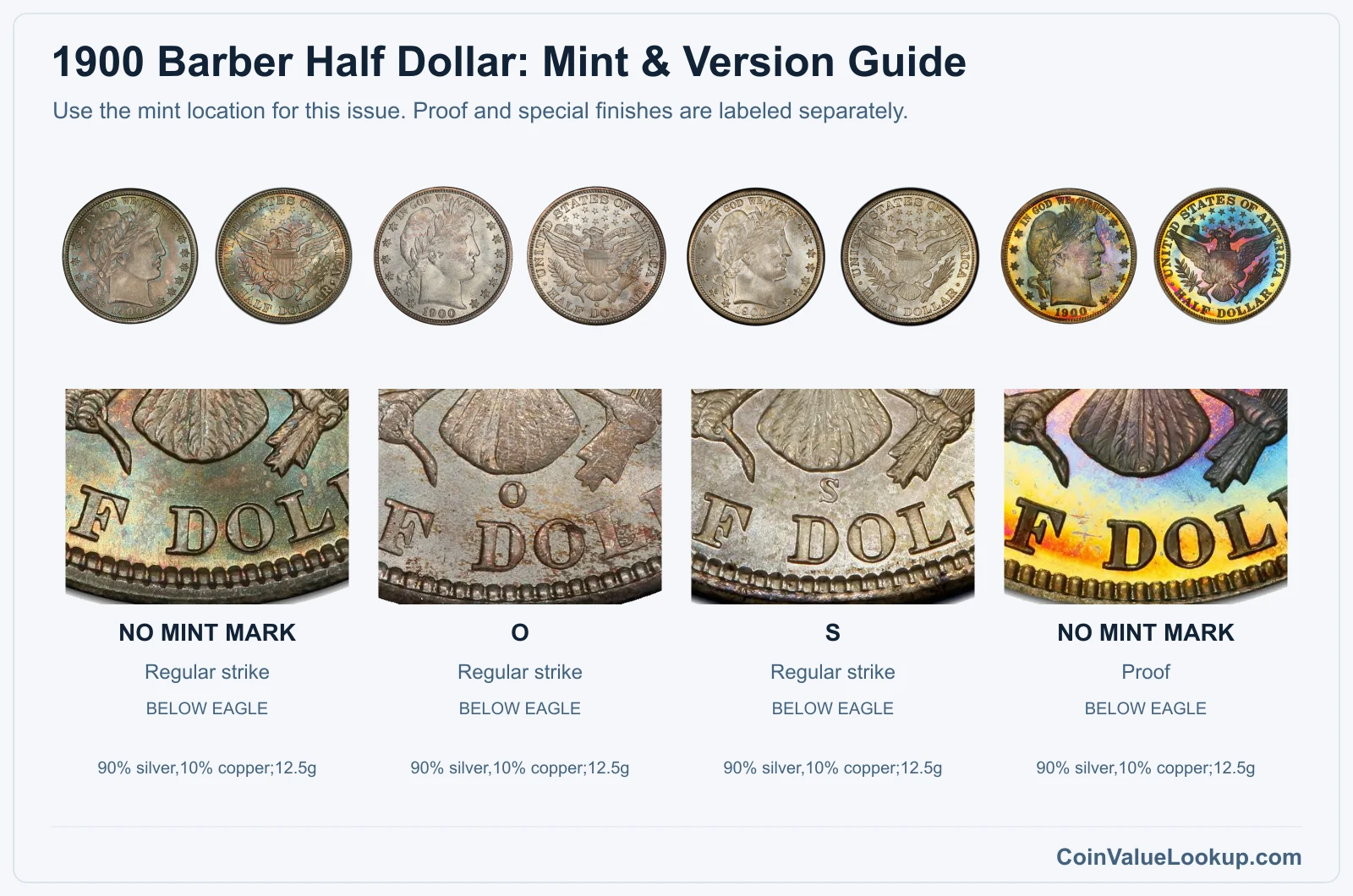
The 1900 Barber Half Dollar shows Charles Barber's Liberty head facing right on the obverse and a heraldic eagle on the reverse. The denomination HALF DOLLAR appears below the eagle.
All regular-issue versions are struck in 90% silver and 10% copper, weigh about 12.5 grams, measure 30.6 mm across, and have a reeded edge.
Three business-strike mints operated this year. Philadelphia coins carry no mintmark at all.
New Orleans pieces have an O, and San Francisco coins show an S. The mintmark sits on the reverse, below the eagle's tail feathers and above the words HALF DOLLAR.
Philadelphia also produced Proof strikes, which are a special manufacturing finish, not a higher grade than Mint State. Proofs display deeply mirrored fields and sharp rim detail that no amount of polishing can replicate on a business strike.
One recognized date variety for this year is a repunched date, sometimes noted in shorthand as 19/900. That refers to the date punch being applied more than once in slightly different positions, not to an overdate combining two different years.
Confirming the actual mintmark and finish is the essential first step before looking up any value chart.
Step 2: Check Your 1900 Barber Half Dollar Grade
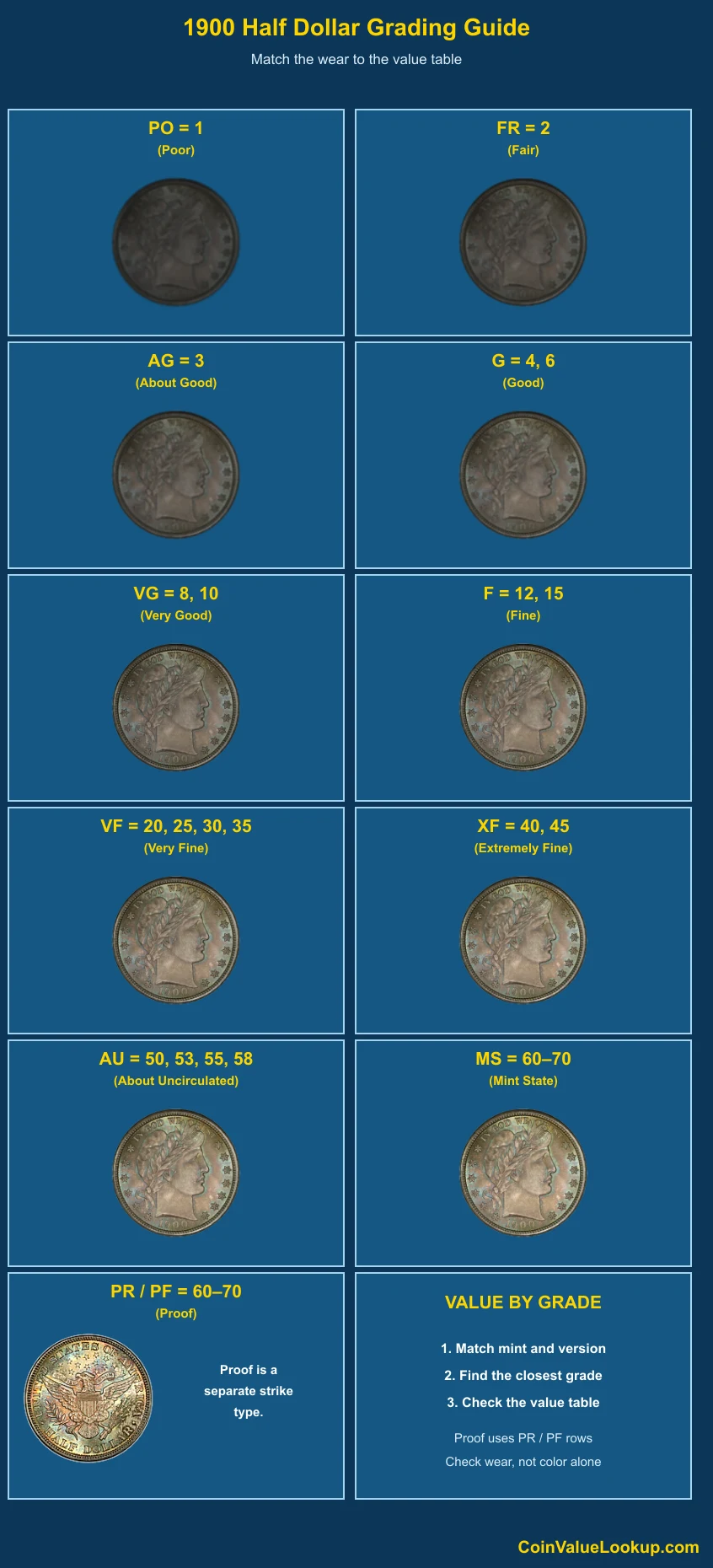
Start by examining Liberty's cheek, the hair above her ear, and the letters in the LIBERTY headband. On the reverse, check the eagle's head, wing tips, and tail feathers.
Compare your coin side-by-side with the grade comparison image to see where metal has actually worn away versus where it was simply struck softly.
New Orleans coins are notorious for soft strikes, especially at the eagle's claw and arrow feathers. That mushiness is not the same as wear from circulation.
A weak strike still retains underlying luster in protected areas; genuine wear flattens and dulls those spots.
Luster loss is your best friend for honest grading. Tilt the coin under a single light source.
A coin that has lost its cartwheel luster across the high points but retains it in recesses is circulated. One that never had sharp luster may just have a weaker strike.
Do not rely solely on how many letters of LIBERTY are visible. Hub changes in the series can affect how quickly those letters wear, so they are only one data point among several.
A genuine Proof is a finish, not a grade above Mint State, and polished business strikes do not become Proofs no matter how shiny they look.
Step 3: Check 1900 Barber Half Dollar Value by Mint and Version
1900 Barber Half Dollar — No Mint Mark — Regular Issue
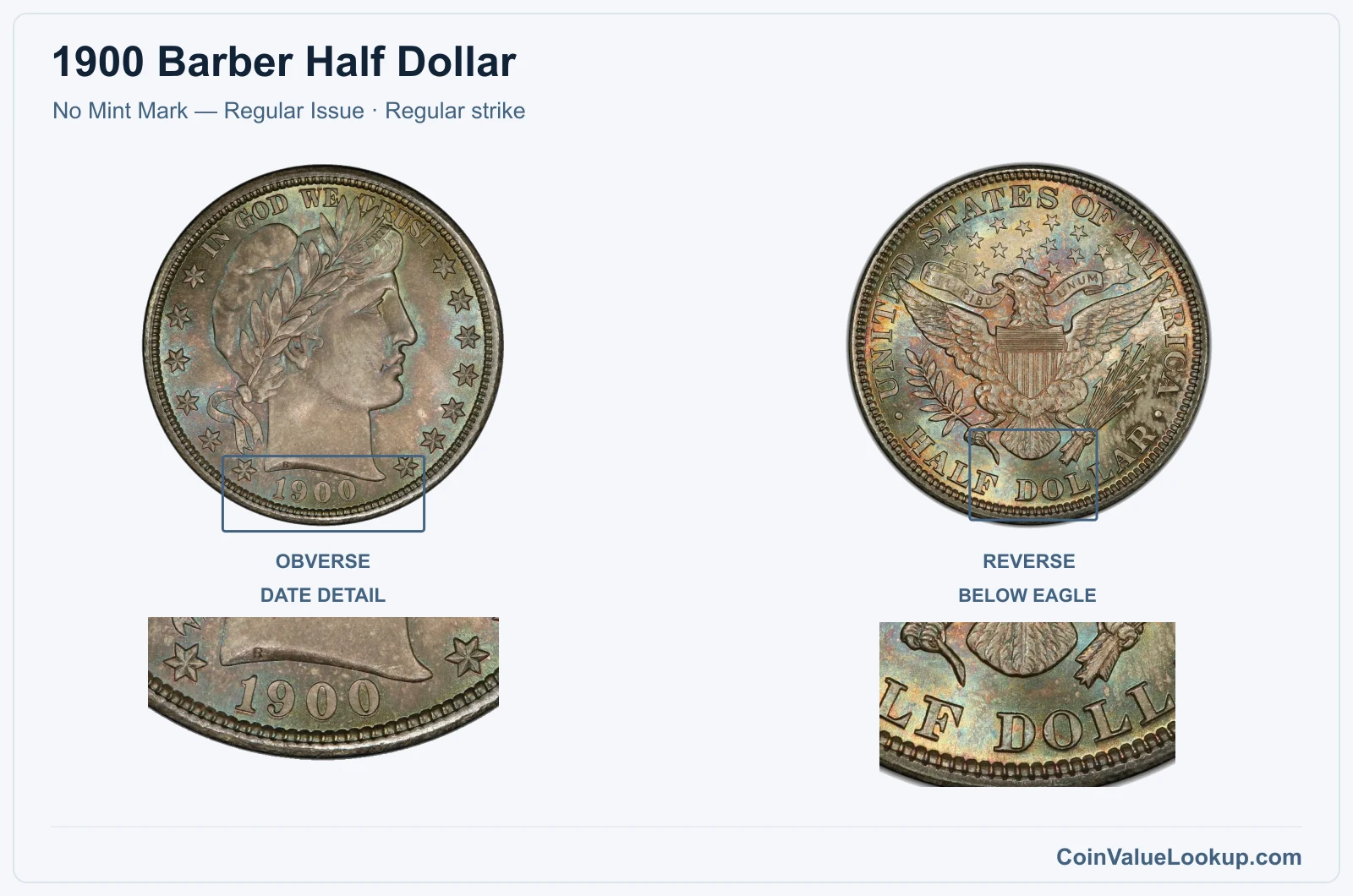
The Philadelphia issue carries no mintmark. In well-worn G4 condition a USA Coin Book guide estimate places it around $44, climbing to about $1,145 at MS63.
That is the lowest premium among the three business-strike mints this year, which makes sense given that Philadelphia generally produced the largest quantities of Barber halves.
Look for original silver-gray surfaces and undisturbed luster in the protected areas around the stars and headband. Cleaning or heavy polishing undercuts value quickly with these coins.
A repunched date variety (19/900) has been reported for 1900 Philadelphia strikes, so examine the numerals closely for traces of a second impression before assuming you have a plain-date coin.
Range Grade
Price Auction Records Appraisal PO PO 1
—
Coin Identifier FR FR 2
Coin Identifier AG AG 3
—
Coin Identifier G G 4
—
Coin Identifier
G 6
—
Coin Identifier VG VG 8
Coin Identifier
VG 10
Coin Identifier F F 12
Coin Identifier
F 15
Coin Identifier VF VF 20
Coin Identifier
VF 25
Coin Identifier
VF 30
Coin Identifier
VF 35
Coin Identifier XF XF 40
Coin Identifier
XF 45
Coin Identifier AU AU 50
Coin Identifier
AU 53
Coin Identifier
AU 55
Coin Identifier
AU 58
Coin Identifier MS MS 60
Coin Identifier
MS 61
Coin Identifier
MS 62
Coin Identifier
MS 63
Coin Identifier
MS 64
Coin Identifier
MS 65
Coin Identifier
MS 66
Coin Identifier
MS 67
Coin Identifier
MS 68
—
—
—
MS 69
—
—
—
MS 70
—
—
—
1900 Barber Half Dollar — O — Regular Issue
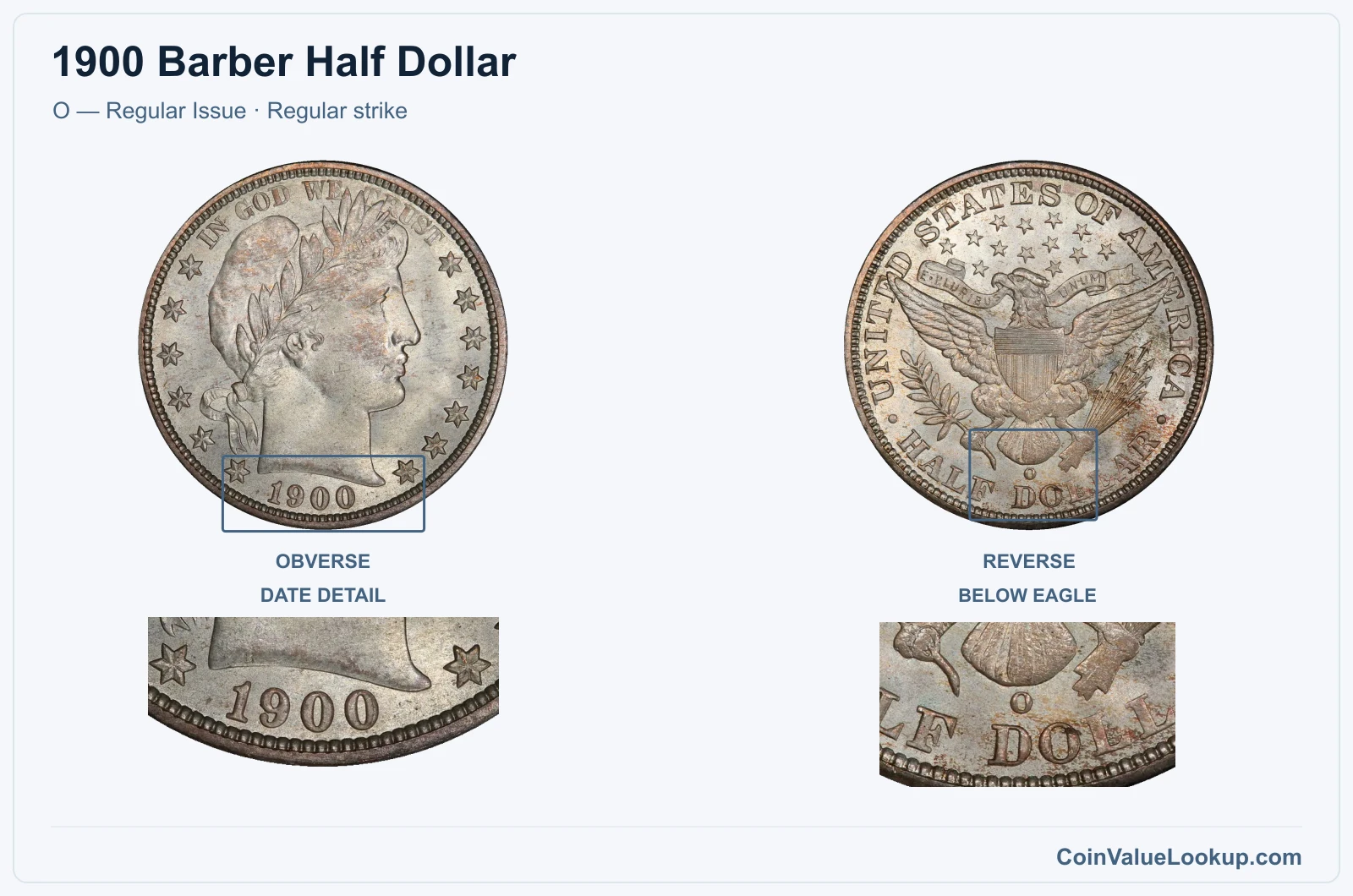
New Orleans coins show a small O mintmark on the reverse, below the eagle's tail and above HALF DOLLAR. The guide estimate starts around $57 at G4 and reaches approximately $3,519 at MS63, the highest business-strike figure for any 1900 Barber half.
Why the premium? Surviving examples in high grade are scarce, and the New Orleans mint was known for inconsistent strike quality.
Soft details on the eagle's claws and arrow feathers do not automatically mean wear. Compare luster in the fields before downgrading the coin.
Coin Value Lookup is a useful place to look up Barber half dollar guides by year and mint, so you can compare your coin's details against specific value ranges without guessing.
Range Grade
Price Auction Records Appraisal PO PO 1
—
Coin Identifier FR FR 2
—
Coin Identifier AG AG 3
—
Coin Identifier G G 4
—
Coin Identifier
G 6
—
Coin Identifier VG VG 8
—
Coin Identifier
VG 10
Coin Identifier F F 12
Coin Identifier
F 15
Coin Identifier VF VF 20
Coin Identifier
VF 25
Coin Identifier
VF 30
Coin Identifier
VF 35
Coin Identifier XF XF 40
Coin Identifier
XF 45
Coin Identifier AU AU 50
Coin Identifier
AU 53
Coin Identifier
AU 55
Coin Identifier
AU 58
Coin Identifier MS MS 60
—
Coin Identifier
MS 61
—
Coin Identifier
MS 62
Coin Identifier
MS 63
Coin Identifier
MS 64
Coin Identifier
MS 65
Coin Identifier
MS 66
Coin Identifier
MS 67
Coin Identifier
MS 68
—
—
—
MS 69
—
—
—
MS 70
—
—
—
1900 Barber Half Dollar — S — Regular Issue
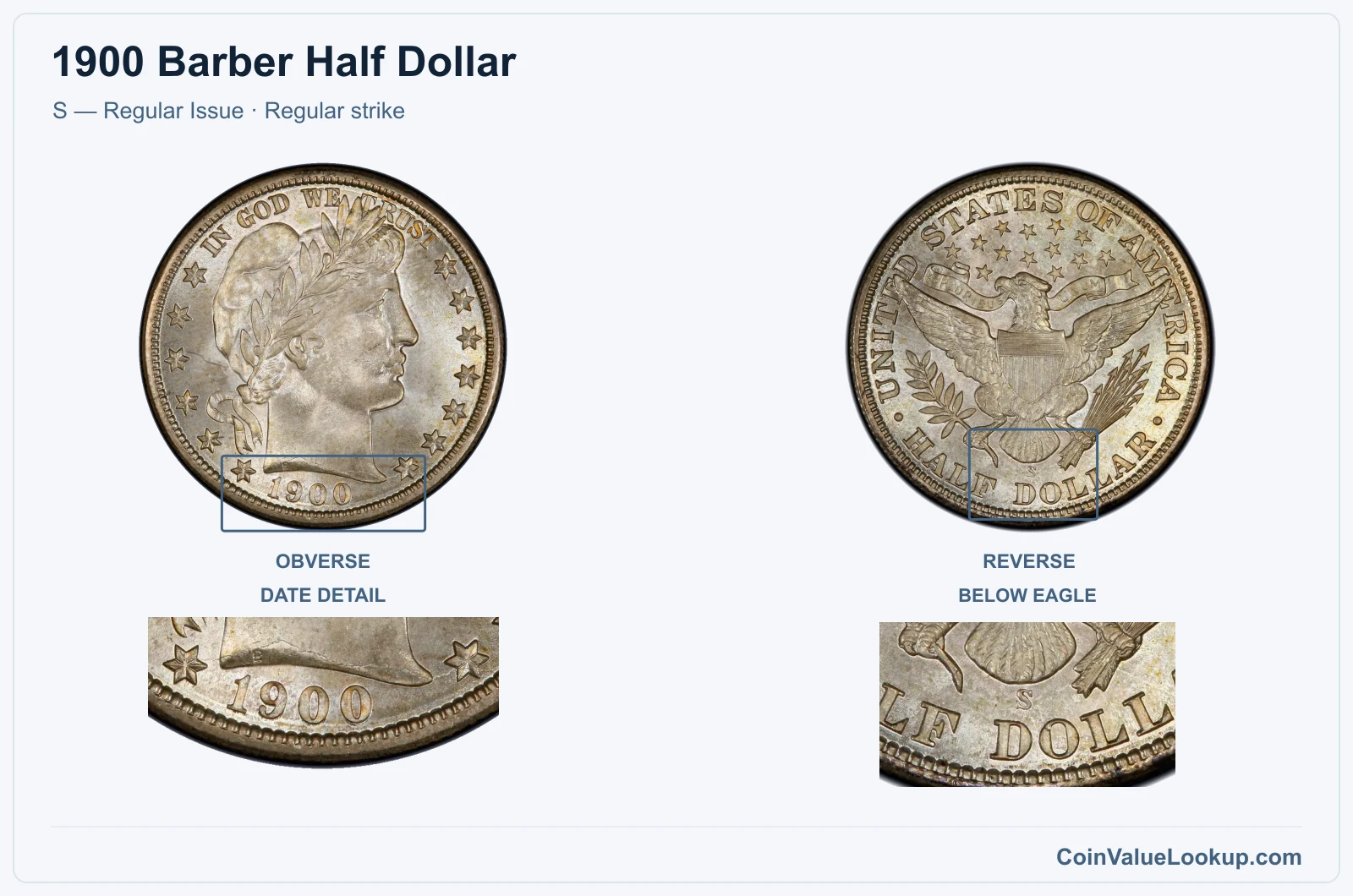
San Francisco strikes carry an S mintmark in the same reverse location. A USA Coin Book guide estimate puts the 1900-S at about $52 in G4 and around $2,747 at MS63.
That middle-tier premium reflects the reality that nice surviving examples are harder to locate than Philadelphia coins but somewhat more available than top-condition New Orleans pieces.
Check the mintmark clarity carefully. A mushy or partially filled S can sometimes be mistaken for damage.
The letter should sit centered below the tail feathers. Original toning and intact luster are strong positives when evaluating this version.
Range Grade
Price Auction Records Appraisal PO PO 1
—
Coin Identifier FR FR 2
—
Coin Identifier AG AG 3
—
Coin Identifier G G 4
—
Coin Identifier
G 6
Coin Identifier VG VG 8
—
Coin Identifier
VG 10
Coin Identifier F F 12
Coin Identifier
F 15
Coin Identifier VF VF 20
Coin Identifier
VF 25
Coin Identifier
VF 30
Coin Identifier
VF 35
Coin Identifier XF XF 40
Coin Identifier
XF 45
Coin Identifier AU AU 50
Coin Identifier
AU 53
Coin Identifier
AU 55
Coin Identifier
AU 58
Coin Identifier MS MS 60
—
Coin Identifier
MS 61
Coin Identifier
MS 62
Coin Identifier
MS 63
Coin Identifier
MS 64
Coin Identifier
MS 65
Coin Identifier
MS 66
Coin Identifier
MS 67
Coin Identifier
MS 68
—
—
—
MS 69
—
—
—
MS 70
—
—
—
1900 Barber Half Dollar — No Mint Mark — Proof
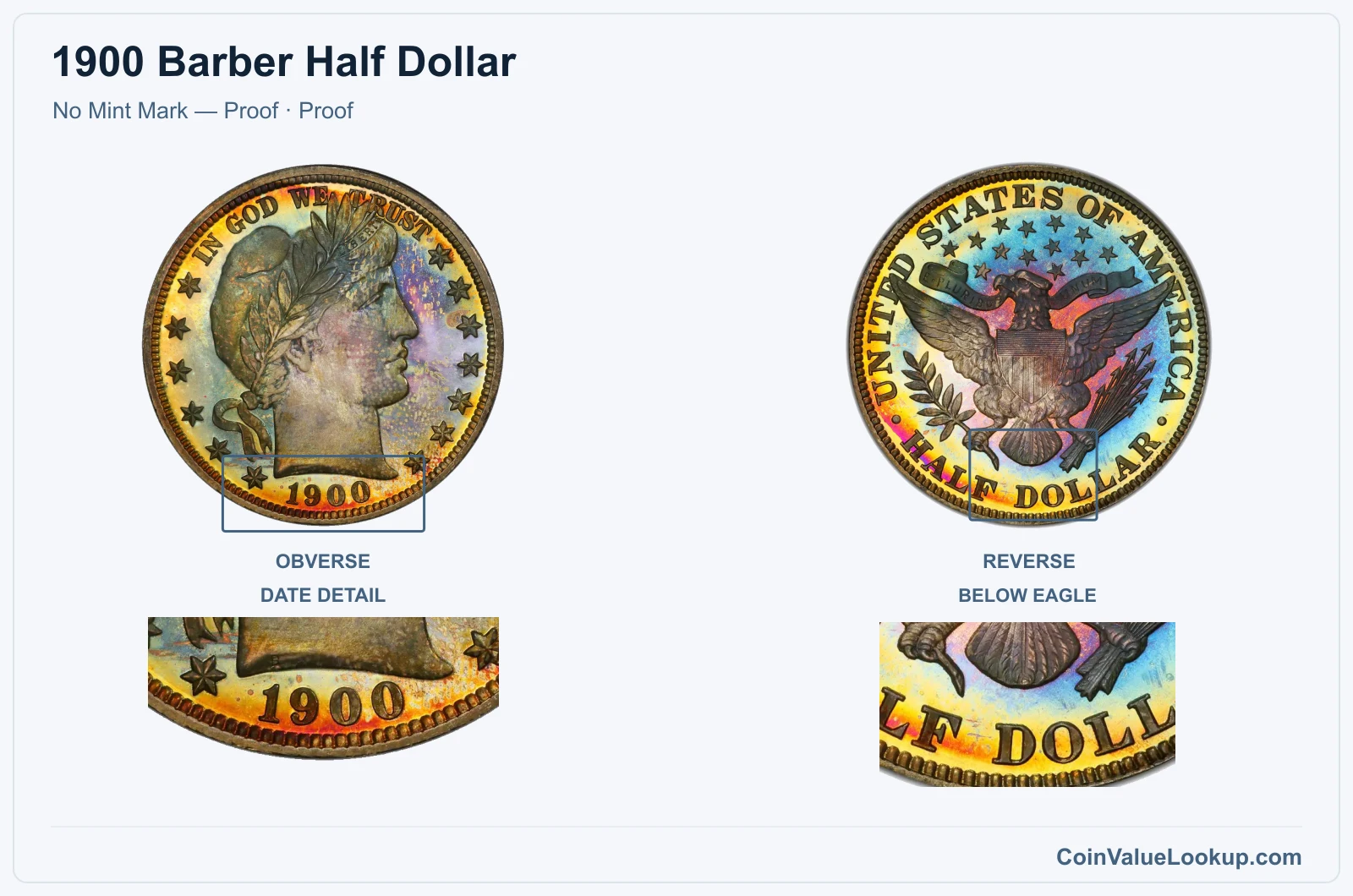
Philadelphia Proofs from 1900 are identified by deeply mirrored fields, knife-sharp rim detail, and precise design elements that business strikes simply cannot match. The guide estimate is about $1,363 at PR63.
Proofs are a special manufacturing finish struck with polished dies on prepared planchets.
No amount of polishing a business strike will create the liquid-mirror surface of a genuine Proof. If your coin has hairlines and reflectivity but the rims look rounded or soft, you are likely looking at a cleaned business strike.
Genuine Proofs also tend to show sharper denticles and fuller letter edges than even the best uncirculated business issues. Third-party authentication is the safest way to confirm Proof status.
Range Grade
Price Auction Records Appraisal PR PR 1
—
Coin Identifier
PR 2
—
Coin Identifier
PR 3
—
Coin Identifier
PR 4
—
Coin Identifier
PR 6
—
Coin Identifier
PR 8
—
Coin Identifier
PR 10
—
Coin Identifier
PR 12
—
Coin Identifier
PR 15
—
Coin Identifier
PR 20
—
Coin Identifier
PR 25
—
Coin Identifier
PR 30
—
Coin Identifier
PR 35
—
Coin Identifier
PR 40
—
Coin Identifier
PR 45
—
Coin Identifier
PR 50
Coin Identifier
PR 53
—
Coin Identifier
PR 55
—
Coin Identifier
PR 58
—
Coin Identifier
PR 60
Coin Identifier
PR 61
Coin Identifier
PR 62
Coin Identifier
PR 63
Coin Identifier
PR 64
Coin Identifier
PR 65
Coin Identifier
PR 66
Coin Identifier
PR 67
Coin Identifier
PR 68
Coin Identifier
PR 69
—
—
—
PR 70
—
—
—
1900 Barber Half Dollar Error List
1. 1900 Barber Half Dollar — Repunched Date
A repunched date on the 1900 Barber Half Dollar means the four-digit date punch was impressed into the die more than once, with the second blow landing slightly off from the first. Look for faint remnants of earlier numeral positions beside or beneath the final date digits, particularly around the 9 and the two zeroes.
This is not an overdate. An overdate would involve one year's digit punched over another year's digit, such as an 1899 turning into 1900.
The repunched date variety, sometimes noted as 19/900, is simply a misalignment during the date-punching step for the same year. The extra impression may be subtle, so magnification helps.
Machine doubling and post-strike damage can mimic repunching to the untrained eye. Machine doubling typically produces flat, shelf-like outlines rather than the rounded secondary impression of a genuine repunched date.
No specific price range has been adopted for this variety; value depends on the clarity of the repunching and overall coin condition.
2. 1900 Barber Half Dollar — Off-Center Strike
An off-center strike occurs when the planchet is not seated properly between the dies, shifting the entire design toward one side and leaving an unstruck crescent of blank metal on the opposite edge. At least one 1900-O example struck roughly 10% off-center has appeared in a published dealer catalog, graded AU50 by PCGS.
The key diagnostic is a displaced design that remains consistent on both sides, with a visible blank crescent. The date should still be readable for the coin to retain strong collector appeal.
A coin missing its date due to the misalignment loses much of its attribution value.
Do not confuse an off-center strike with a clipped planchet, which shows a curved bite out of the edge, or with post-mint flattening from a vise or similar pressure. One-sided die misalignment, where only one side shifts, also looks different from a true off-center error.
No numerical price range has been adopted for this variety; the specific percentage of off-center shift, date visibility, and overall condition all influence what a collector will pay.