1900 Barber Dime Coin Value: How Much Is It Worth?
The 1900 Barber Dime was struck at three mints and also produced as a proof at Philadelphia. Guide estimates for ordinary business strikes range from about $12.26 at G4 to $1,247 at MS63, depending on the mint.
Proofs, hub varieties, and error coins each carry their own value considerations.
Fast Way to Identify Your 1900 Barber Dime
The quickest way to start is to upload clear photos of both sides of your coin. A front-and-back image lets us provide a preliminary identification of your mint, general condition, and any obvious variety or error features.
That is not a substitute for professional authentication, but it points you in the right direction fast.
1900 Barber Dime Value
Upload both sides of your 1900 Barber Dime.
Front Obverse
Upload photo
Back Reverse
Upload photo
Which 1900 Barber Dime Versions Are Worth Money?
- The 1900-O (New Orleans) mint carries the highest guide value among business strikes, reaching about $1,247 at MS63 versus $253 for Philadelphia at the same grade.
- San Francisco (1900-S) business strikes guide around $501 at MS63, making unworn examples notably more valuable than Philadelphia issues.
- Philadelphia proofs from 1900 guide at roughly $616 in PR63 and are a separate manufacturing finish, not simply a high-grade business strike.
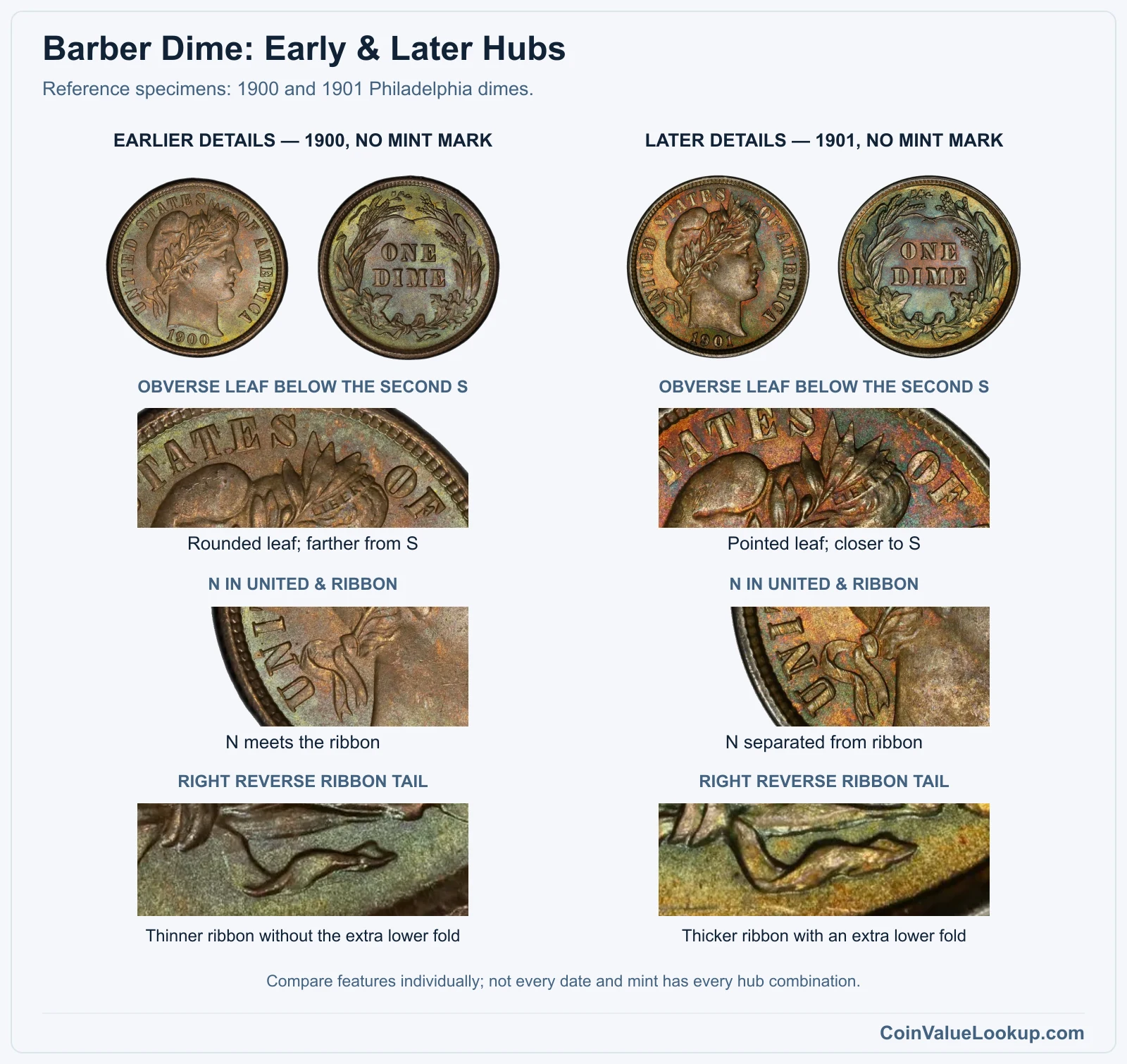
- The obverse leaf-tip hub transition appears on 1900-dated coins; check the leaf below the second S in STATES to identify which hub your coin received.
- Certain error categories such as repunched mintmarks, off-center strikes, and die breaks have been reported for 1900 Barber Dimes and can add value depending on visibility and condition.
Step 1: Identify Your 1900 Barber Dime Mint Mark and Version
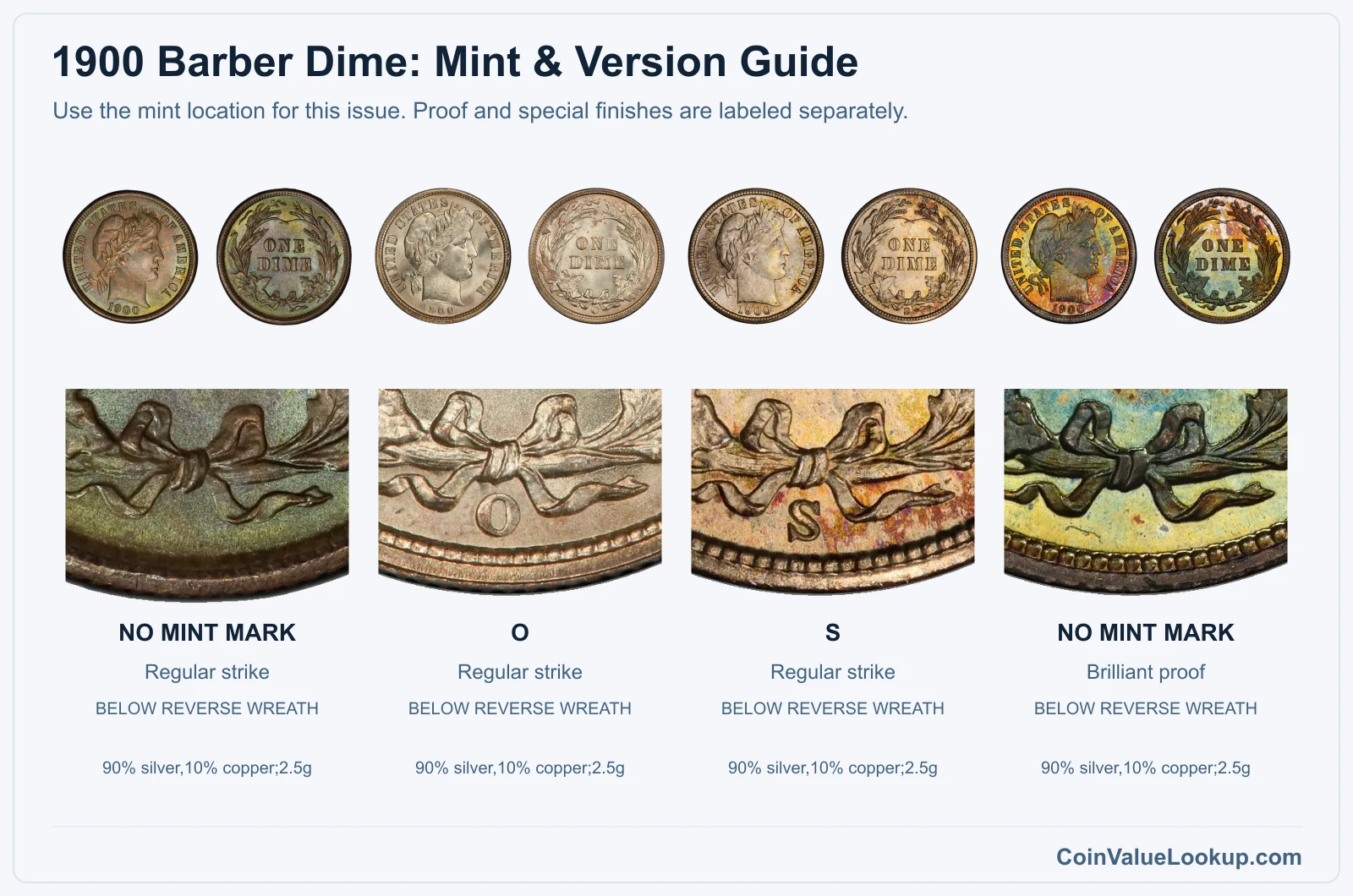
The 1900 Barber Dime shows Liberty facing right on the obverse, with UNITED STATES OF AMERICA around the top. The reverse displays ONE DIME inside a cereal wreath tied with a bow at the bottom.
Three mints produced business strikes this year: Philadelphia, New Orleans, and San Francisco. Philadelphia coins carry no mintmark.
For New Orleans and San Francisco, look for a small O or S just below the wreath bow on the reverse.
All standard examples are 90% silver and 10% copper, weighing 2.5 grams with a 17.9 mm diameter and a reeded edge. If your coin is magnetic, unusually light, or has a smooth edge, it may be counterfeit.
One design detail worth checking: the 1900 date sits at a hub transition point. On the obverse, look at the leaf tip below the second S in STATES.
Earlier hubs show a rounded leaf tip sitting farther from the letter; later hubs have a pointed leaf tip positioned closer. This is a known hub modification, not a doubled die.
Inspect your actual coin carefully under magnification before jumping to conclusions.
Step 2: Check Your 1900 Barber Dime Grade
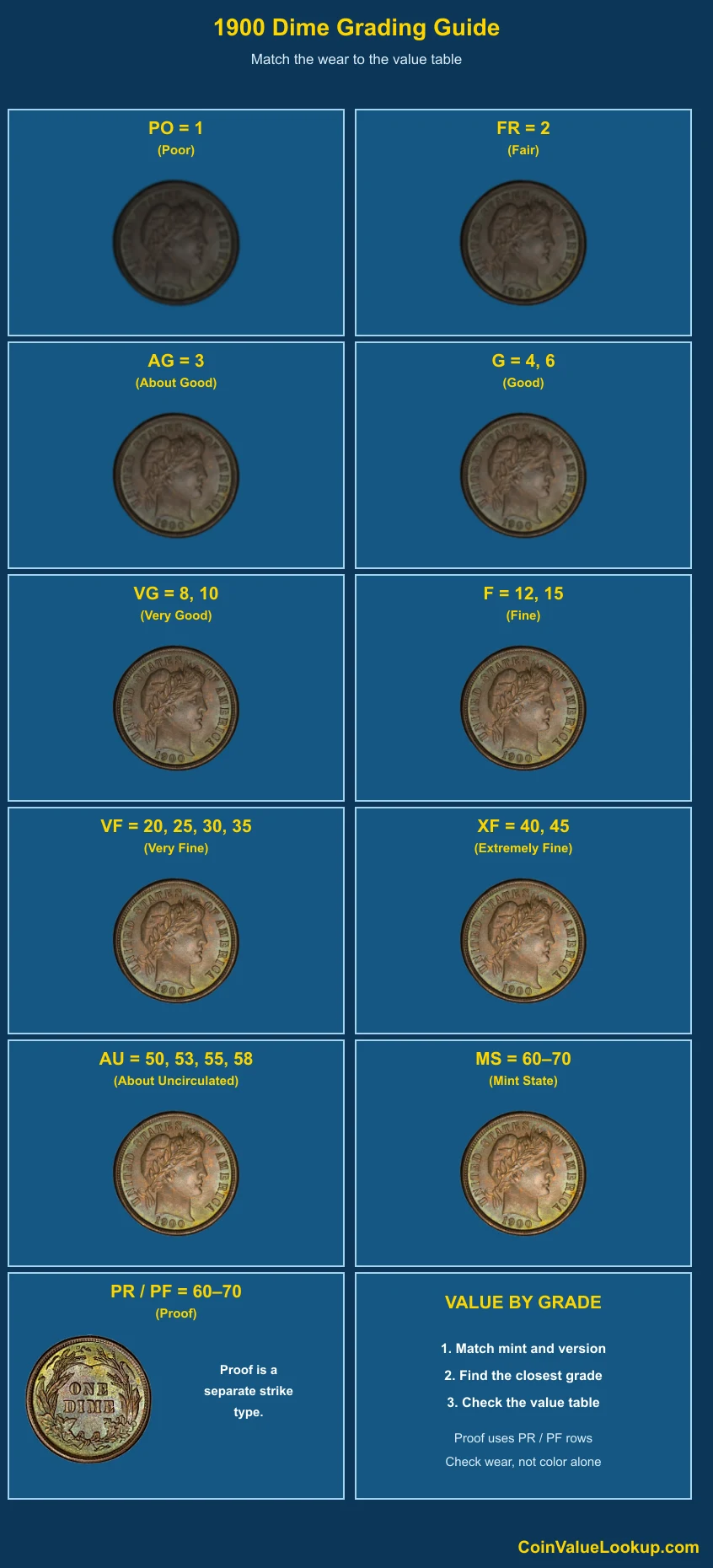
Grading a Barber Dime means looking at several areas together, not just counting letters in LIBERTY. Start with the headband.
On a well-worn coin, the letters L-I-B-E-R-T-Y in the headband merge into each other or disappear entirely. A G4 coin may show only a trace.
Next, check the hair above the ear and the cheek. These are the highest relief points and wear first.
If you can still see individual hair strands and the cheek is rounded with no flat spots, you are in the VF range or better.
On the reverse, look at the wreath leaves. Worn coins lose the vein detail in the leaves before the rim legends start to weaken.
Mint State means unbroken, original luster across both sides. Use the comparison image to match your coin against known grade benchmarks.
Hairlines from cleaning or dull, washed-out surfaces knock a coin out of true uncirculated territory even if no wear is visible.
New Orleans strikes can appear soft even on higher-grade coins because the dies were not always fully impressed. Do not mistake a weak strike for wear.
Compare the sharpness on the highest points against the luster pattern to separate the two.
Step 3: Check 1900 Barber Dime Value by Mint and Version
1900 Barber Dime — No Mint Mark — Silver Circulation
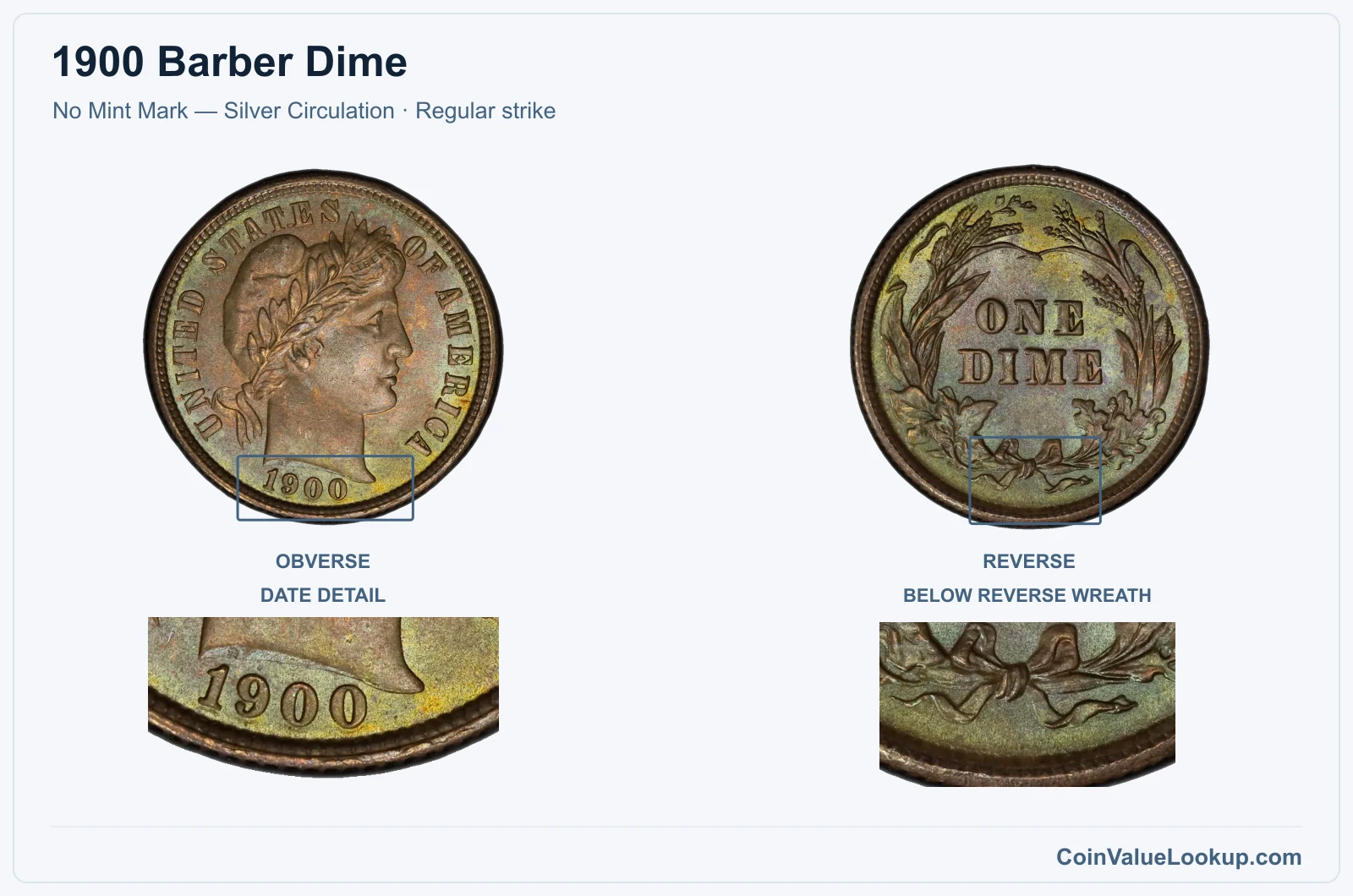
Philadelphia struck the most 1900 Barber Dimes and used no mintmark. You will see a blank space below the reverse wreath bow.
Guide estimates place this version at about $12.26 in G4 and around $253 in MS63.
Because Philadelphia output was high, circulated examples are common. The premium really kicks in at uncirculated grades with clean, original surfaces.
Check whether your coin shows the earlier rounded leaf tip or the later pointed leaf tip below the second S in STATES, as this hub transition occurred around this date.
Range Grade
Price Auction Records Appraisal PO PO 1
—
Coin Identifier FR FR 2
—
Coin Identifier AG AG 3
—
Coin Identifier G G 4
—
Coin Identifier
G 6
—
Coin Identifier VG VG 8
—
Coin Identifier
VG 10
Coin Identifier F F 12
—
Coin Identifier
F 15
—
Coin Identifier VF VF 20
—
Coin Identifier
VF 25
—
Coin Identifier
VF 30
—
Coin Identifier
VF 35
Coin Identifier XF XF 40
Coin Identifier
XF 45
—
Coin Identifier AU AU 50
Coin Identifier
AU 53
Coin Identifier
AU 55
Coin Identifier
AU 58
Coin Identifier MS MS 60
—
Coin Identifier
MS 61
Coin Identifier
MS 62
Coin Identifier
MS 63
Coin Identifier
MS 64
Coin Identifier
MS 65
Coin Identifier
MS 66
Coin Identifier
MS 67
Coin Identifier
MS 68
—
—
—
MS 69
—
—
—
MS 70
—
—
—
1900 Barber Dime — O — Silver Circulation
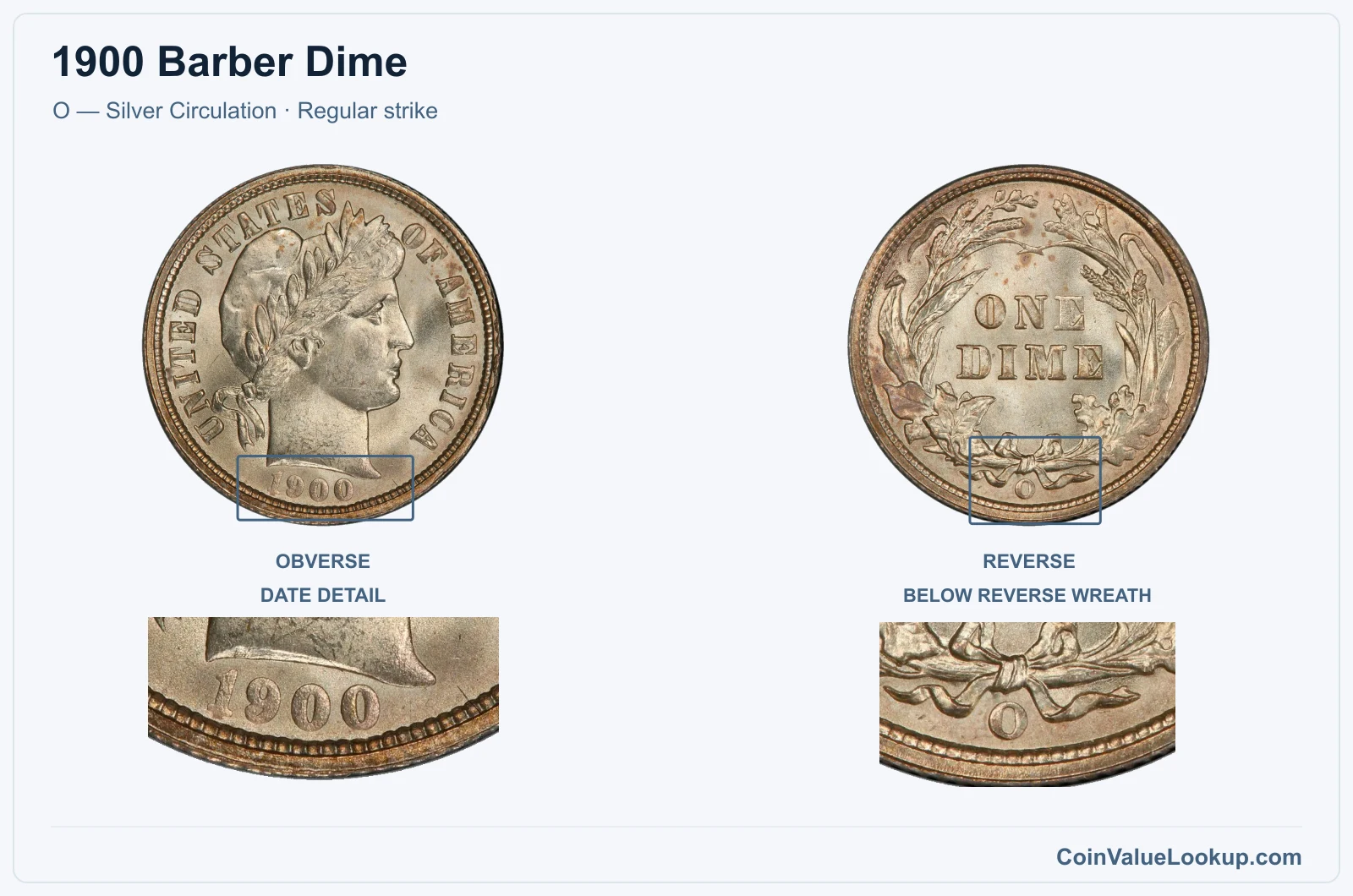
The New Orleans mint used an O mintmark below the wreath bow. This is the priciest business-strike version for 1900, with guide values of about $29 at G4 and roughly $1,247 at MS63.
That steep jump from low grade to uncirculated tells you something: many survived in worn condition, but clean Mint State survivors are scarce. New Orleans coins are also known for softer strikes, so do not confuse mushy headband lettering or flat wreath veins with heavy wear.
Compare the luster pattern before downgrading. The same obverse leaf-tip hub transition applies here; inspect the leaf below the second S in STATES on your actual coin.
Range Grade
Price Auction Records Appraisal PO PO 1
—
Coin Identifier FR FR 2
—
Coin Identifier AG AG 3
—
Coin Identifier G G 4
—
Coin Identifier
G 6
—
Coin Identifier VG VG 8
Coin Identifier
VG 10
—
Coin Identifier F F 12
Coin Identifier
F 15
Coin Identifier VF VF 20
Coin Identifier
VF 25
Coin Identifier
VF 30
Coin Identifier
VF 35
Coin Identifier XF XF 40
Coin Identifier
XF 45
Coin Identifier AU AU 50
Coin Identifier
AU 53
Coin Identifier
AU 55
Coin Identifier
AU 58
Coin Identifier MS MS 60
Coin Identifier
MS 61
Coin Identifier
MS 62
Coin Identifier
MS 63
Coin Identifier
MS 64
Coin Identifier
MS 65
Coin Identifier
MS 66
Coin Identifier
MS 67
Coin Identifier
MS 68
—
—
—
MS 69
—
—
—
MS 70
—
—
—
1900 Barber Dime — S — Silver Circulation
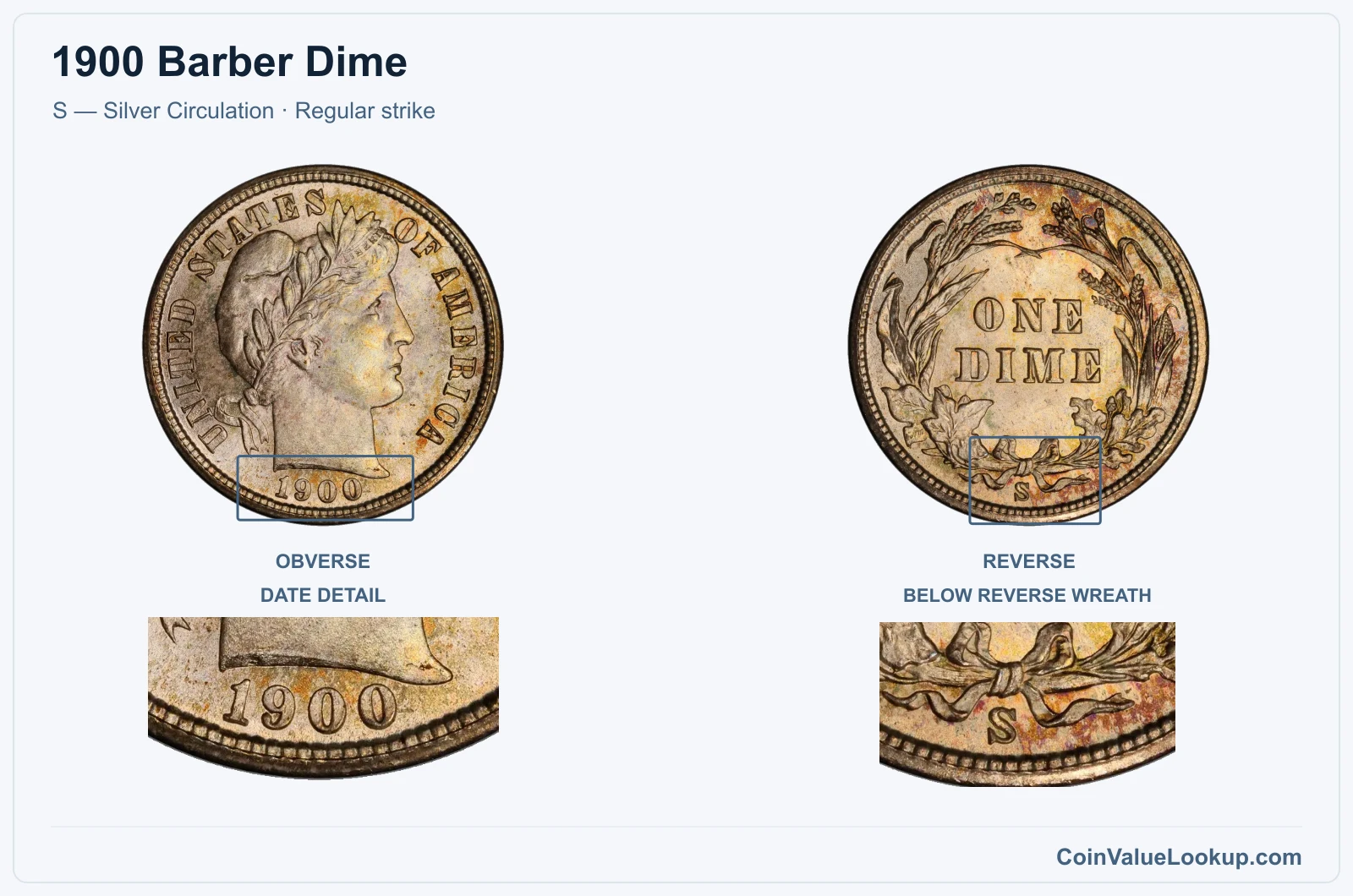
San Francisco coins carry a small S below the wreath bow. Guide estimates run about $15 at G4 and around $501 at MS63.
S-mint Barber Dimes from this era often survived in lower grades, so finding one with full original luster is a genuine find. As with all three mints this year, check the leaf tip below the second S in STATES to identify the hub used on your example.
If you are building a date set across mints, the 1900-S sits squarely between the common Philadelphia and scarce New Orleans issues in both availability and price.
Coin Value Lookup is a useful starting point if you want to compare this coin against other Barber Dime dates or look up values for different series entirely.
Range Grade
Price Auction Records Appraisal PO PO 1
—
Coin Identifier FR FR 2
—
Coin Identifier AG AG 3
—
Coin Identifier G G 4
—
Coin Identifier
G 6
—
Coin Identifier VG VG 8
—
Coin Identifier
VG 10
—
Coin Identifier F F 12
—
Coin Identifier
F 15
—
Coin Identifier VF VF 20
—
Coin Identifier
VF 25
—
Coin Identifier
VF 30
—
Coin Identifier
VF 35
—
Coin Identifier XF XF 40
—
Coin Identifier
XF 45
Coin Identifier AU AU 50
Coin Identifier
AU 53
Coin Identifier
AU 55
Coin Identifier
AU 58
Coin Identifier MS MS 60
Coin Identifier
MS 61
Coin Identifier
MS 62
Coin Identifier
MS 63
Coin Identifier
MS 64
Coin Identifier
MS 65
Coin Identifier
MS 66
Coin Identifier
MS 67
Coin Identifier
MS 68
—
—
—
MS 69
—
—
—
MS 70
—
—
—
1900 Barber Dime — No Mint Mark — Brilliant Silver Proof
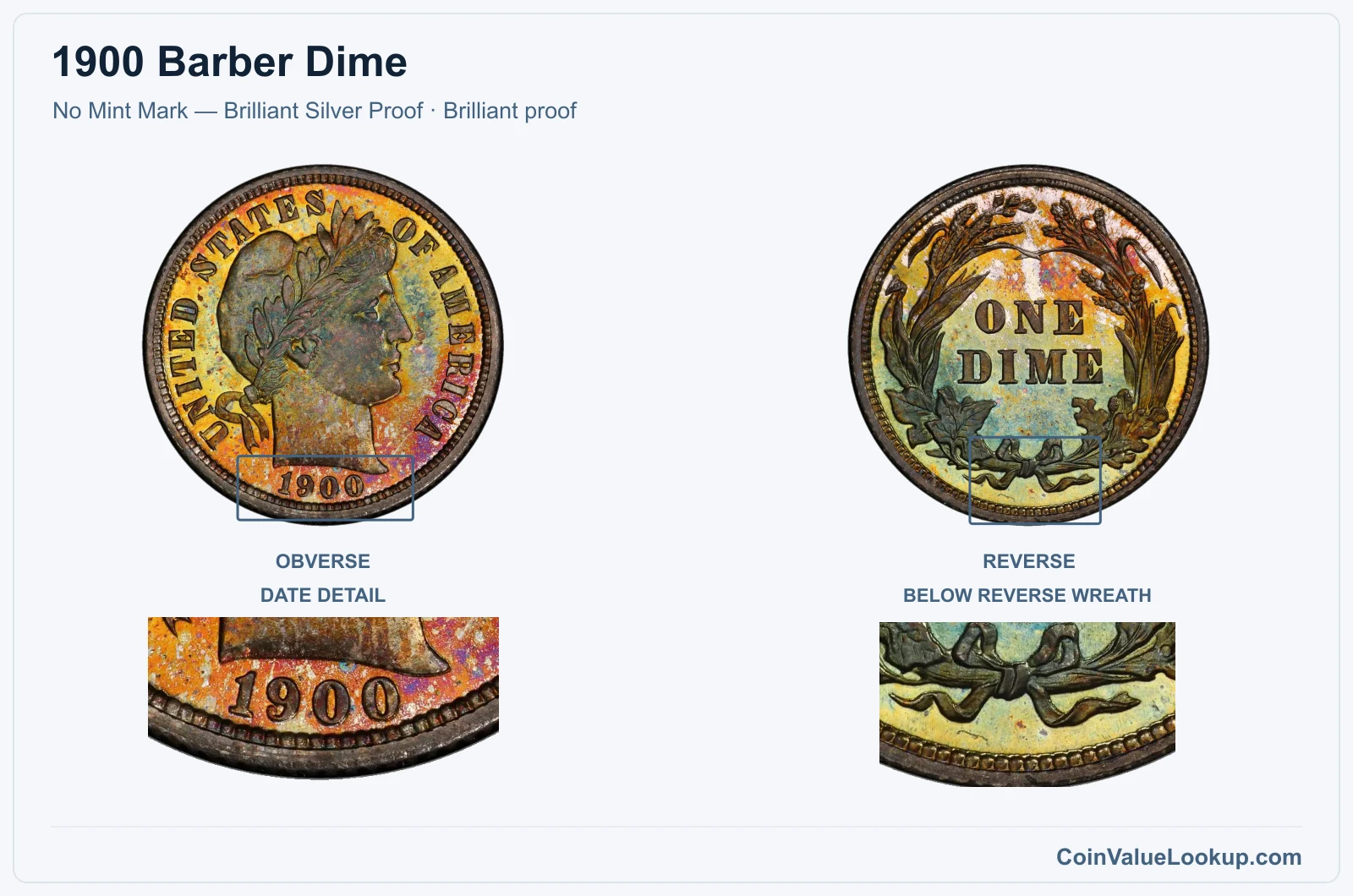
Philadelphia produced brilliant proof Barber Dimes in 1900 for collectors. These coins have mirrored fields and sharply struck rims that are visibly different from any business strike.
A PR63 example guides at about $616.
Proof is a manufacturing method, not a grade above Mint State. A proof can still have hairlines, spots, or contact marks that lower its numeric grade.
Cameo and Deep Cameo designations reflect contrast between the fields and devices; do not assume a shiny proof automatically qualifies, and do not apply the standard PR63 guide figure to a contrast-designated coin, as those trade differently.
Range Grade
Price Auction Records Appraisal PR PR 1
—
Coin Identifier
PR 2
—
Coin Identifier
PR 3
—
Coin Identifier
PR 4
—
Coin Identifier
PR 6
—
Coin Identifier
PR 8
—
Coin Identifier
PR 10
—
Coin Identifier
PR 12
—
Coin Identifier
PR 15
—
Coin Identifier
PR 20
—
Coin Identifier
PR 25
—
Coin Identifier
PR 30
—
Coin Identifier
PR 35
—
Coin Identifier
PR 40
—
Coin Identifier
PR 45
—
Coin Identifier
PR 50
—
Coin Identifier
PR 53
—
Coin Identifier
PR 55
—
Coin Identifier
PR 58
—
Coin Identifier
PR 60
Coin Identifier
PR 61
Coin Identifier
PR 62
Coin Identifier
PR 63
Coin Identifier
PR 64
Coin Identifier
PR 65
Coin Identifier
PR 66
Coin Identifier
PR 67
Coin Identifier
PR 68
Coin Identifier
PR 69
—
—
—
PR 70
—
—
—
1900 Barber Dime Error List
1. 1900 Barber Dime — Repunched Mintmark
A repunched mintmark occurs when the mintmark punch was applied more than once in slightly different positions on the working die. On a 1900 Barber Dime, look at the O or S below the wreath bow under magnification.
You may see a ghost image, a second serif, or a shadow of the letter offset from the primary impression.
This only applies to mintmarked coins since Philadelphia had no separate punch to double. Do not confuse machine doubling, which produces flat shelf-like displacement, with a true repunched mintmark that shows rounded, raised remnants.
Die chips or corrosion around the letter can also mimic the look. Condition, the degree of visibility, and the specific mintmark shift all affect what a repunched mintmark example is worth.
2. 1900 Barber Dime — Off-Center Strike
An off-center strike happens when the planchet is not properly seated between the dies at the moment of striking. The result is a crescent-shaped blank area on one side with the design shifted in the opposite direction.
For a 1900 Barber Dime, the key to value is whether the date remains fully visible. A dramatic off-center percentage with a readable date is far more desirable than a slight shift or one where the date is clipped away.
Do not confuse a clipped planchet, which has a curved bite out of the edge, with an off-center strike. Post-mint flattening from a vise or similar tool can also look odd but will not produce the characteristic unstruck crescent.
The specific percentage, date visibility, and overall condition all factor into value.
3. 1900 Barber Dime — Die Break / Cud
A die break or cud appears when a chunk of the die cracks away, leaving a raised, featureless blob on the struck coin. A true cud connects to the rim; interior die breaks that do not reach the rim are sometimes called retained breaks.
On a 1900 Barber Dime, examine the rim area on both sides. A cud will look like a smooth, raised lump that interrupts the normal design and meets the edge.
It is easy to confuse a rim dent or post-mint damage with a cud, but damage is incuse (pushed in), while a cud is raised. Corrosion buildup can also create bumpy surfaces near the rim.
The size, location, and sharpness of the break all influence how much a die break example is worth.
4. 1900 Barber Dime — Struck-Through Error
A struck-through error occurs when foreign material sits between the die and the planchet during striking. The result is a localized depression or incomplete area in the design where the obstruction blocked the metal flow.
Grease fills are the most common variety. They leave a smooth, slightly depressed patch where detail is missing.
Retained foreign objects, like wire or thread fragments, create a more dramatic impression. On a 1900 Barber Dime, look for any area where the design simply stops in a way that does not match normal wear patterns.
Wear tends to hit high points uniformly, while a struck-through affects a random patch. Scratches, cleaning marks, and ordinary weak strikes can look similar to the untrained eye.
The type of obstruction, size of the affected area, and overall coin condition all influence value.
5. 1900 Barber Dime — Misaligned Die
A misaligned die error shows up when one die is shifted laterally relative to the other, so the obverse and reverse designs do not line up with each other or with the planchet. The coin will have a normal full strike on one side but a noticeably off-center rim on the other.
This is different from a true off-center strike, where the entire planchet misses the die pair. With a misaligned die, both sides are fully struck, but one face is shifted.
On a 1900 Barber Dime, compare the rim width on both sides. If one side has an even rim and the other has a distinctly wider rim on one edge, that is the tell.
Do not confuse this with a tilted photograph, post-mint rim damage, or rotational misalignment. Condition and the degree of shift determine value.