2012 Roosevelt Dime Coin Value: How Much Is It Worth?
Most 2012 Roosevelt dimes pulled from circulation are worth face value — ten cents. The collectible premium starts when you can confirm mint state or proof condition.
A USA Coin Book guide lists the 2012-P or 2012-D business strike at about $2.50 in MS65, the S clad proof at roughly $3.08 in PR65, and the S silver proof at around $28 in PR65. Your coin's actual worth depends on its mint, metal, finish and condition.
Fast Way to Identify Your 2012 Roosevelt Dime
The quickest way to start is to upload clear photos of both sides of your 2012 dime. Our identifier can give you a preliminary read on the mintmark, finish and general type.
It works from front and back images, so good lighting and a steady hand help. This is not a substitute for professional authentication, but it narrows down what you have before you dig deeper.
2012 Roosevelt Dime Value
Upload both sides of your 2012 Roosevelt Dime.
Front Obverse
Upload photo
Back Reverse
Upload photo
Which 2012 Roosevelt Dime Versions Are Worth Money?
- Mint-state 2012-P or 2012-D dimes with well-separated Full Torch Bands can carry a small premium over typical uncirculated examples.
- 2012-S silver proofs, confirmed by weight (2.50 g) and edge color, are listed around $28 at PR65 in the USA Coin Book guide — well above the clad versions.
- A 2012-S clad proof with a reverse die crack has been documented and may carry a collector premium once authenticated.
Step 1: Identify Your 2012 Roosevelt Dime Mint Mark and Version
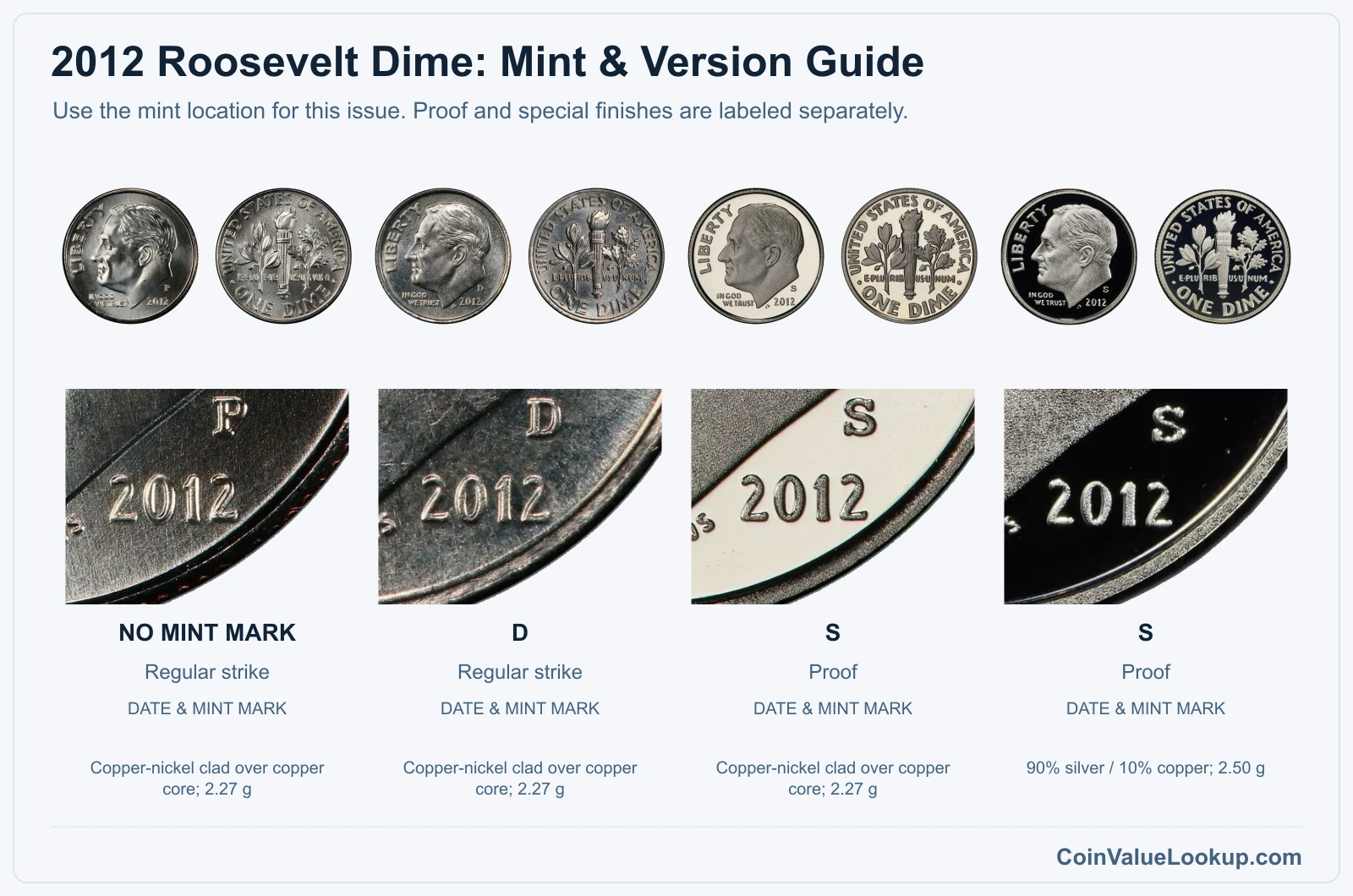
Start with the basics: confirm the 2012 date on the obverse, Roosevelt's portrait facing left, and the torch-with-branches reverse. Next, find the mintmark.
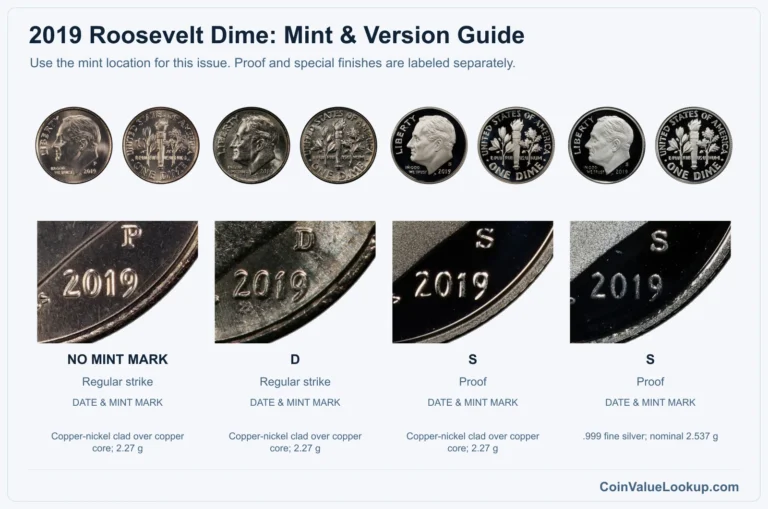
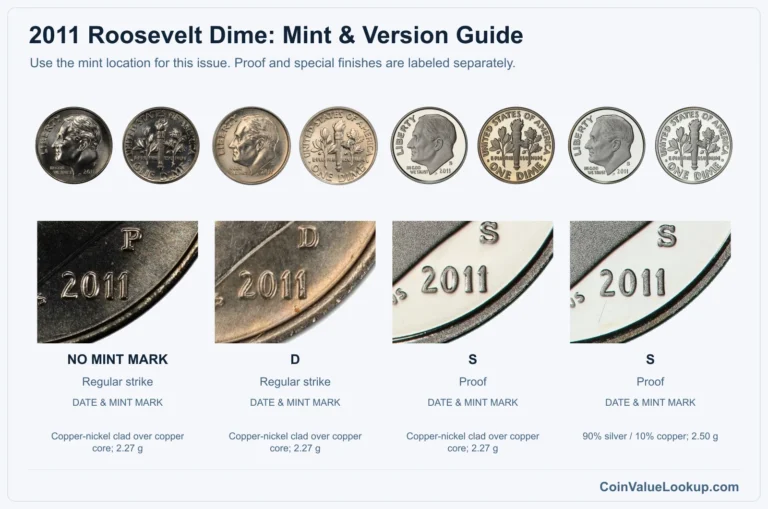
It sits on the obverse just above the date — look for a P (Philadelphia), D (Denver) or S (San Francisco).
An S mintmark does not automatically mean silver. San Francisco struck both clad proofs and 90% silver proofs in 2012, and they look similar at first glance.
Weigh the coin if you can: the clad version comes in at 2.27 grams, while the silver proof weighs 2.50 grams. Edge color helps too — a clad dime shows a visible copper-colored stripe along the edge, while the silver proof does not.
Original proof packaging is the easiest confirmation, but loose coins need the weight-and-edge check. Both versions measure about 17.9 mm in diameter, so size alone won't separate them.
Step 2: Check Your 2012 Roosevelt Dime Grade
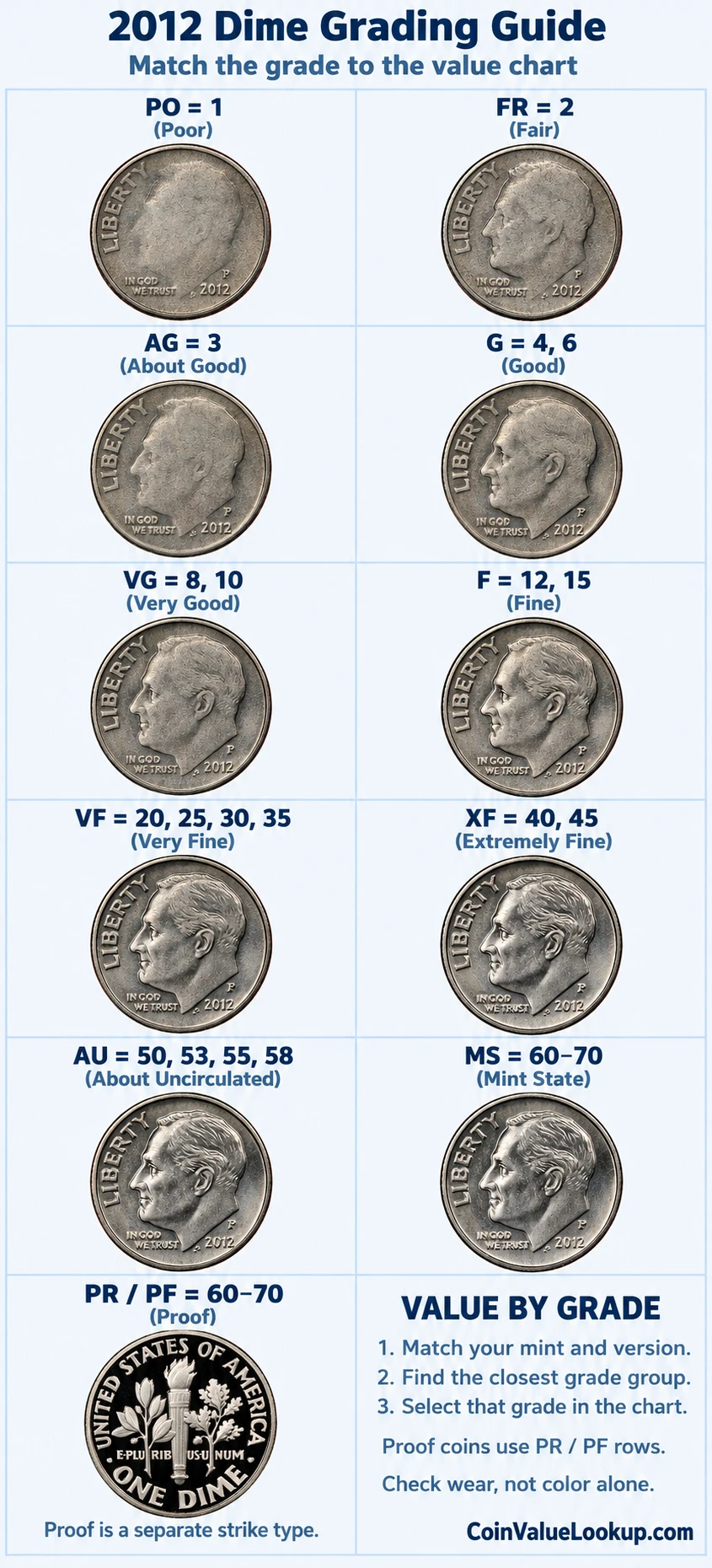
Focus on four zones: Roosevelt's cheekbone and jawline on the obverse, the hair detail above and behind the ear, and the torch bands and branch leaves on the reverse. Wear shows first as a loss of fine lines on the cheek and a flattening of the hair waves.
Original mint luster has a cartwheel effect when you tilt the coin under a single light source. A cleaned coin can look bright but won't have that rotating glow.
Don't confuse the two.
For business strikes, check the horizontal torch bands. When both pairs of bands show clear separation, the coin qualifies for the Full Bands designation — that is about strike quality, not a separate error.
Compare your coin against the reference image using the same finish type, because proof surfaces reflect light differently than business strikes.
Proof coins should be compared only to other proofs. Their mirror fields and frosted devices are intentional manufacturing features, not signs of superior grade.
Step 3: Check 2012 Roosevelt Dime Value by Mint and Version
2012 Roosevelt Dime — P Business Strike
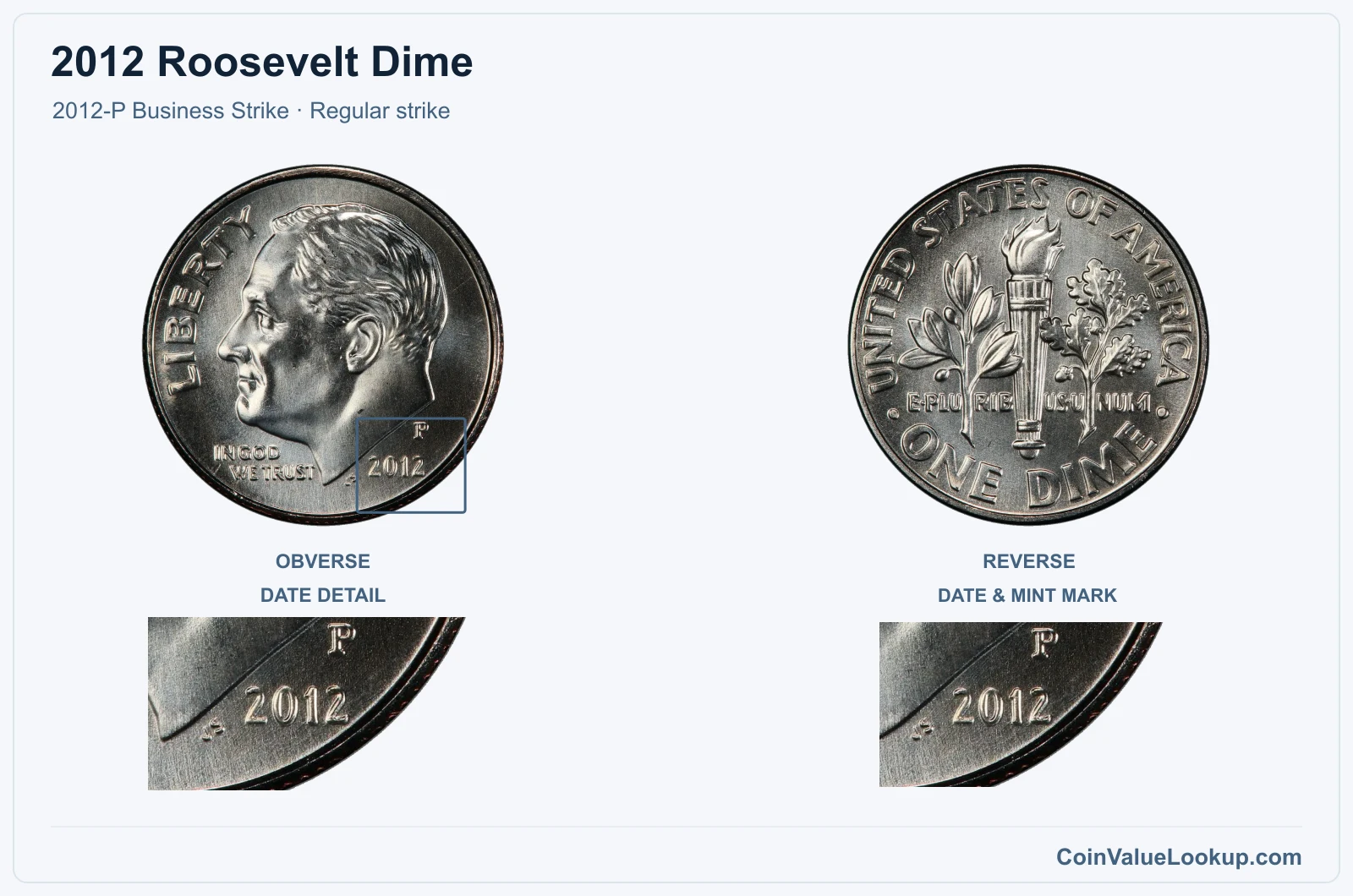
The 2012-P business strike is the Philadelphia issue, bearing a small P mintmark above the date. It is copper-nickel clad over a copper core and weighs 2.27 grams.
Huge mintages mean circulated examples are worth face value.
In uncirculated condition, a USA Coin Book guide estimate puts the MS65 grade at about $2.50. Look for full original luster and strong separation of the horizontal torch bands on the reverse — coins with sharp Full Bands detail tend to attract more collector interest than softly struck examples at the same grade.
Range Grade
Price Auction Records Appraisal PO PO 1
—
Coin Identifier FR FR 2
—
Coin Identifier AG AG 3
—
Coin Identifier G G 4
—
Coin Identifier
G 6
—
Coin Identifier VG VG 8
—
Coin Identifier
VG 10
—
Coin Identifier F F 12
—
Coin Identifier
F 15
—
Coin Identifier VF VF 20
—
Coin Identifier
VF 25
—
Coin Identifier
VF 30
—
Coin Identifier
VF 35
—
Coin Identifier XF XF 40
—
Coin Identifier
XF 45
—
Coin Identifier AU AU 50
—
Coin Identifier
AU 53
—
Coin Identifier
AU 55
—
Coin Identifier
AU 58
—
Coin Identifier MS MS 60
—
Coin Identifier
MS 61
—
Coin Identifier
MS 62
—
Coin Identifier
MS 63
—
Coin Identifier
MS 64
—
Coin Identifier
MS 65
—
Coin Identifier
MS 66
—
Coin Identifier
MS 67
Coin Identifier
MS 68
—
Coin Identifier
MS 69
—
—
—
MS 70
—
—
—
2012 Roosevelt Dime — D Business Strike
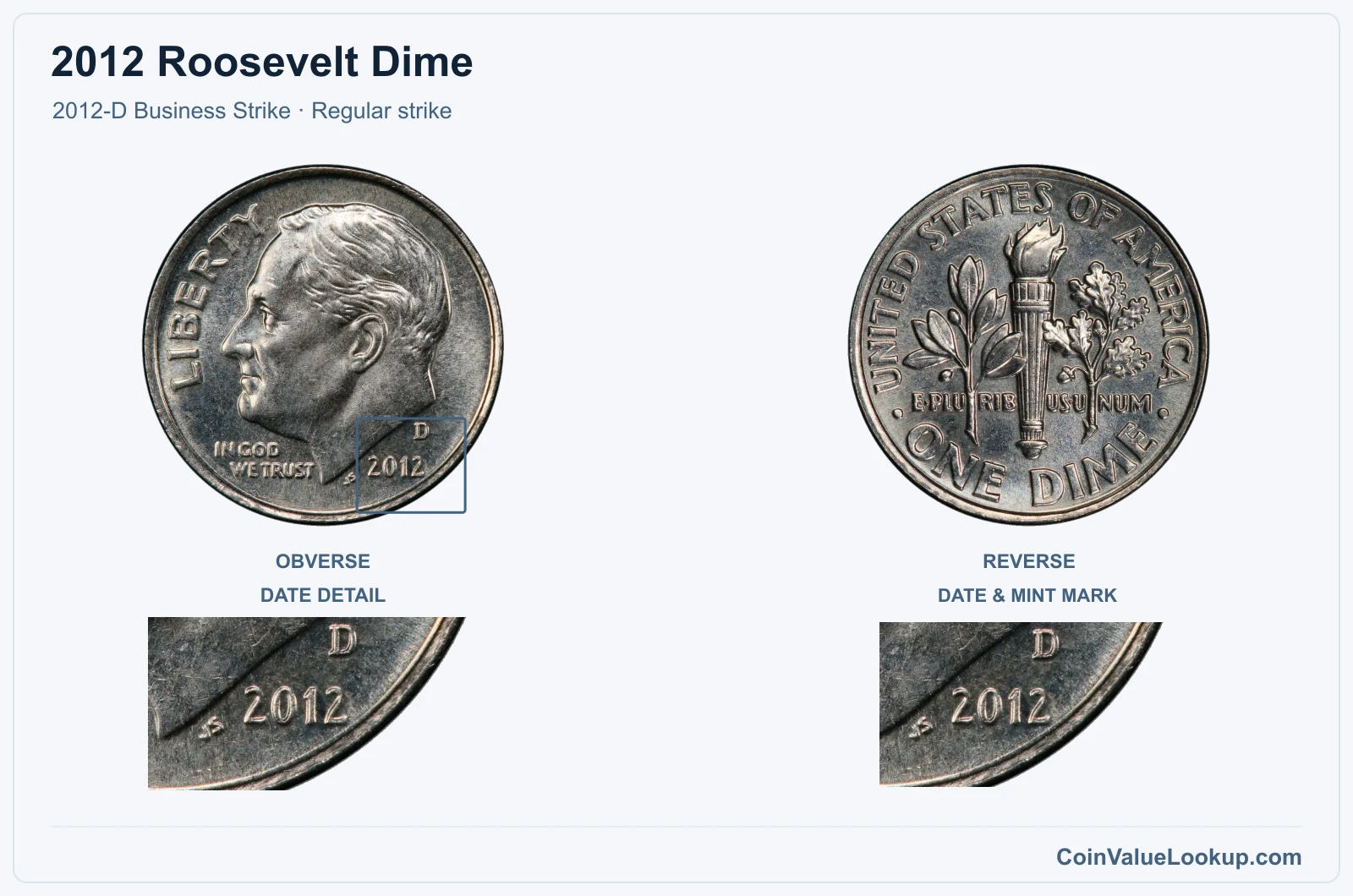
Denver's 2012-D dime mirrors the Philadelphia issue in composition and weight — copper-nickel clad, 2.27 grams. The D mintmark sits in the same spot above the date.
Like the P, circulated pieces trade at ten cents.
The USA Coin Book guide lists MS65 at approximately $2.50. When you're sorting through rolls, the torch bands are the detail to watch.
Well-struck coins with fully separated bands stand out and can be worth setting aside, even if the premium at MS65 is modest.
Range Grade
Price Auction Records Appraisal PO PO 1
—
Coin Identifier FR FR 2
—
Coin Identifier AG AG 3
—
Coin Identifier G G 4
—
Coin Identifier
G 6
—
Coin Identifier VG VG 8
—
Coin Identifier
VG 10
—
Coin Identifier F F 12
—
Coin Identifier
F 15
—
Coin Identifier VF VF 20
—
Coin Identifier
VF 25
—
Coin Identifier
VF 30
—
Coin Identifier
VF 35
—
Coin Identifier XF XF 40
—
Coin Identifier
XF 45
—
Coin Identifier AU AU 50
—
Coin Identifier
AU 53
—
Coin Identifier
AU 55
—
Coin Identifier
AU 58
—
Coin Identifier MS MS 60
—
Coin Identifier
MS 61
—
Coin Identifier
MS 62
—
Coin Identifier
MS 63
—
Coin Identifier
MS 64
—
Coin Identifier
MS 65
—
Coin Identifier
MS 66
—
Coin Identifier
MS 67
—
Coin Identifier
MS 68
—
Coin Identifier
MS 69
—
—
—
MS 70
—
—
—
2012 Roosevelt Dime — S Clad Proof
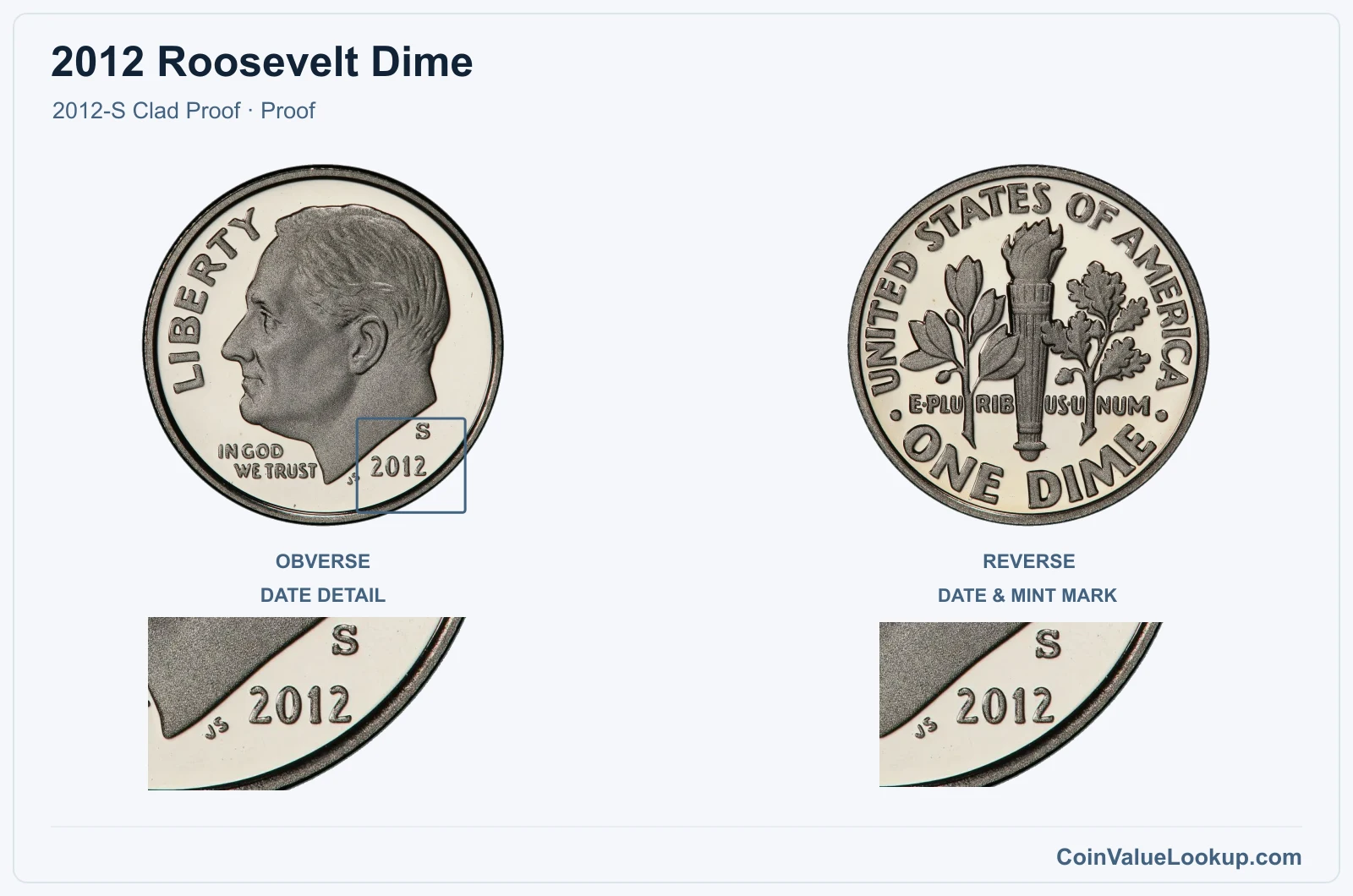
The 2012-S clad proof was struck at San Francisco for collector sets. It carries an S mintmark and is made from the same copper-nickel clad as business strikes, weighing 2.27 grams.
Mirror fields and frosted devices distinguish it from circulation coins.
A USA Coin Book guide estimate places PR65 at roughly $3.08. That is not a dramatic premium, but higher grades or coins showing strong contrast between fields and devices may bring more.
Remember, an S mintmark alone does not guarantee silver — check the edge and weight before jumping to conclusions.
Coin Value Lookup is a handy starting point when you need to compare values across different Roosevelt Dime years and mints.
Range Grade
Price Auction Records Appraisal PR PR 1
—
Coin Identifier
PR 2
—
Coin Identifier
PR 3
—
Coin Identifier
PR 4
—
Coin Identifier
PR 6
—
Coin Identifier
PR 8
—
Coin Identifier
PR 10
—
Coin Identifier
PR 12
—
Coin Identifier
PR 15
—
Coin Identifier
PR 20
—
Coin Identifier
PR 25
—
Coin Identifier
PR 30
—
Coin Identifier
PR 35
—
Coin Identifier
PR 40
—
Coin Identifier
PR 45
—
Coin Identifier
PR 50
—
Coin Identifier
PR 53
—
Coin Identifier
PR 55
—
Coin Identifier
PR 58
—
Coin Identifier
PR 60
—
Coin Identifier
PR 61
—
Coin Identifier
PR 62
—
Coin Identifier
PR 63
—
Coin Identifier
PR 64
—
Coin Identifier
PR 65
—
Coin Identifier
PR 66
—
Coin Identifier
PR 67
—
Coin Identifier
PR 68
—
Coin Identifier
PR 69
Coin Identifier
PR 70
Coin Identifier
2012 Roosevelt Dime — S Silver Proof
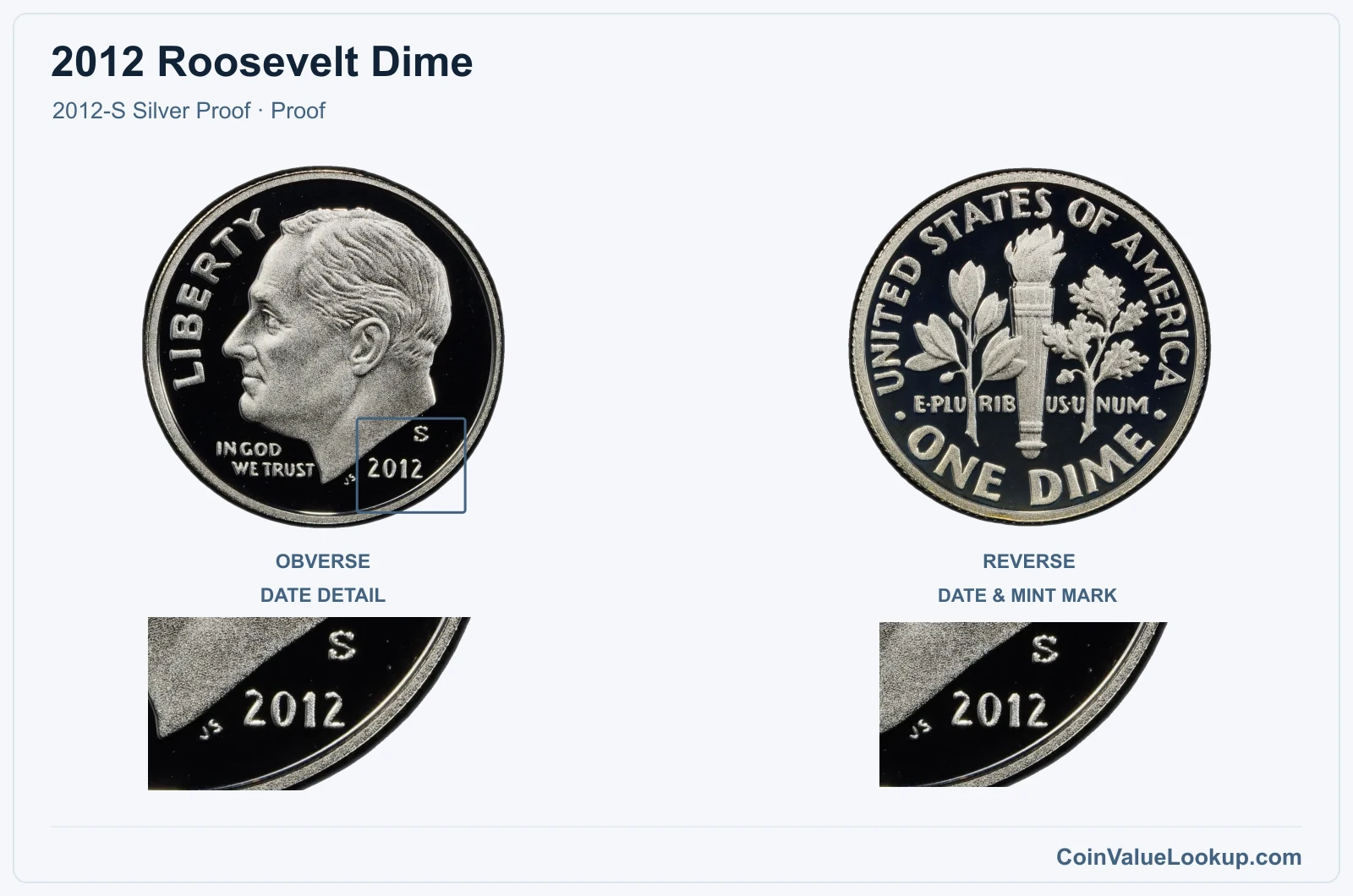
This is the version that gets people's attention. The 2012-S silver proof is struck in 90% silver and 10% copper, pushing the weight up to 2.50 grams.
The edge will appear uniformly silver-white rather than showing the copper stripe of a clad coin.
At PR65 the USA Coin Book guide lists it around $28 — significantly more than the clad proof. These were sold in silver proof sets, so original government packaging is the simplest way to confirm the metal.
Without packaging, a precise scale and an edge inspection are your best friends. Do not rely on the mintmark alone, because the clad proof also carries an S.
Range Grade
Price Auction Records Appraisal PR PR 1
—
Coin Identifier
PR 2
—
Coin Identifier
PR 3
—
Coin Identifier
PR 4
—
Coin Identifier
PR 6
—
Coin Identifier
PR 8
—
Coin Identifier
PR 10
—
Coin Identifier
PR 12
—
Coin Identifier
PR 15
—
Coin Identifier
PR 20
—
Coin Identifier
PR 25
—
Coin Identifier
PR 30
—
Coin Identifier
PR 35
—
Coin Identifier
PR 40
—
Coin Identifier
PR 45
—
Coin Identifier
PR 50
—
Coin Identifier
PR 53
—
Coin Identifier
PR 55
—
Coin Identifier
PR 58
—
Coin Identifier
PR 60
—
Coin Identifier
PR 61
—
Coin Identifier
PR 62
—
Coin Identifier
PR 63
—
Coin Identifier
PR 64
—
Coin Identifier
PR 65
—
Coin Identifier
PR 66
—
Coin Identifier
PR 67
—
Coin Identifier
PR 68
—
Coin Identifier
PR 69
Coin Identifier
PR 70
Coin Identifier
2012 Roosevelt Dime Error List
1. 2012 Roosevelt Dime — Reverse Die Crack
A reverse die crack has been documented on the 2012-S clad proof. It appears as a raised line near the 6 o'clock position on the reverse — roughly the bottom of the torch area.
Because it originates from a fracture in the die itself, the resulting line is raised above the coin's surface, not incised into it.
Don't confuse this with a scratch. A scratch in the mirror field is incuse (sunk into the surface) and usually has a different texture under magnification.
A crack in the physical coin — actual metal fracture — is also a different animal entirely. The die crack will follow a consistent path and appear on every coin struck from that die.
No firm price range is supported for this error. Value depends on the severity of the crack, the coin's overall condition and professional authentication.
If you think you have one, compare it carefully against a normal 2012-S clad proof and consider third-party certification.
2. 2012 Roosevelt Dime — Off-Center Strike
Off-center strikes happen when the planchet isn't seated properly in the collar before the dies come together. The result is a design shifted to one side with an unstruck crescent of blank metal on the opposite edge.
The farther off-center the strike, and the more of the date that remains visible, the more collector interest it typically generates.
Don't mistake a clipped planchet or one-sided die misalignment for an off-center error — those produce different shapes and metal-flow patterns. Post-mint flattening from a vise or hammer can also mimic some visual features, but it won't produce the telltale blank crescent with original edge texture.
No specific price range is supported for a 2012 off-center dime. The coin's condition, the degree of misalignment and whether the date is fully readable all factor into what a buyer will pay.
Authentication is recommended.
3. 2012 Roosevelt Dime — Doubled Die Obverse
A Doubled Die Obverse on a 2012 dime would show consistent doubling on obverse design elements — letters, the date or Roosevelt's profile. The key word is consistent: the separation or notching should appear in the same direction and magnitude across the affected area, not randomly scattered.
Machine doubling is the usual lookalike. It produces a flat, shelf-like distortion rather than the rounded, separated contours of a true doubled die.
Reflections from proof surfaces can also trick you under certain lighting angles. Compare your coin to a normal 2012 dime under the same magnification and light before drawing conclusions.
No numerical price range is supported for this variety. Value depends on the strength and location of the doubling, overall condition and professional verification.
4. 2012 Roosevelt Dime — Doubled Die Reverse
A Doubled Die Reverse involves doubling on the reverse design — the torch, branches, lettering or denomination. Like its obverse counterpart, genuine hub doubling produces rounded, separated contours that are consistent across the affected elements.
Machine doubling on the reverse is common and looks different: it tends to flatten and shelf lettering rather than creating distinct secondary images. Random nicks, die wear and lighting reflections can also create an illusion of doubling, especially on well-worn coins.
Compare the reverse legends and torch details of your coin against a known normal example at the same magnification. No specific price is supported for a 2012 doubled die reverse.
The doubling's prominence, the coin's grade and authentication all influence what the coin might bring.
5. 2012 Roosevelt Dime — Broadstrike
A broadstruck dime was struck without the retaining collar that normally confines the planchet and forms the reeded edge. The result is a coin that spreads outward, appearing slightly larger than normal, with a smooth or distorted rim instead of clean reeding.
The full design is usually present but may appear slightly stretched toward the edges. This distinguishes a broadstrike from an off-center strike, which shifts the design and leaves a blank crescent.
Post-mint damage — like a coin smashed flat in a vise — can look vaguely similar, but it won't show the characteristic even metal flow of a genuine broadstrike.
No firm price range is supported for a 2012 broadstruck dime. The degree of spread, the condition of the design and third-party authentication all matter when determining value.
6. 2012 Roosevelt Dime — Clipped Planchet
A clipped planchet error means the coin blank was incompletely punched from the metal strip before striking. The result is a missing curved, straight or irregular section along the edge.
Genuine clips often produce a corresponding area of weakness in the design on the opposite side, because metal couldn't flow evenly during the strike.
Check the edge texture at the clip boundary — it should look like original planchet metal, not a filed or cut surface. An edge that has been deliberately notched or corroded away after minting will lack the smooth, natural contour and the opposing-side weakness that typify a real clip.
No specific price is supported for a 2012 clipped planchet dime. The size of the clip, whether the date remains visible and overall coin condition all affect desirability.
Professional authentication helps confirm the error.
7. 2012 Roosevelt Dime — Missing Clad Layer
A missing clad layer error means one of the outer copper-nickel layers was absent from the planchet before the coin was struck. The affected side may appear a different color — often with the copper core exposed — and the coin's weight will be noticeably below the standard 2.27 grams for a clad dime.
Weigh the coin and compare the suspect face, edge profile and color against a normal 2012 dime. Toning, environmental damage, acid treatment or deliberate stripping of surface metal after minting can all mimic the appearance, but they won't produce the consistent weight reduction and even surface texture of a genuine missing-clad error.
No numerical price range is supported for this variety. The coin's condition, whether one or both clad layers are missing and professional authentication all influence value.