2012 Quarter Coin Value: How Much Is It Worth?
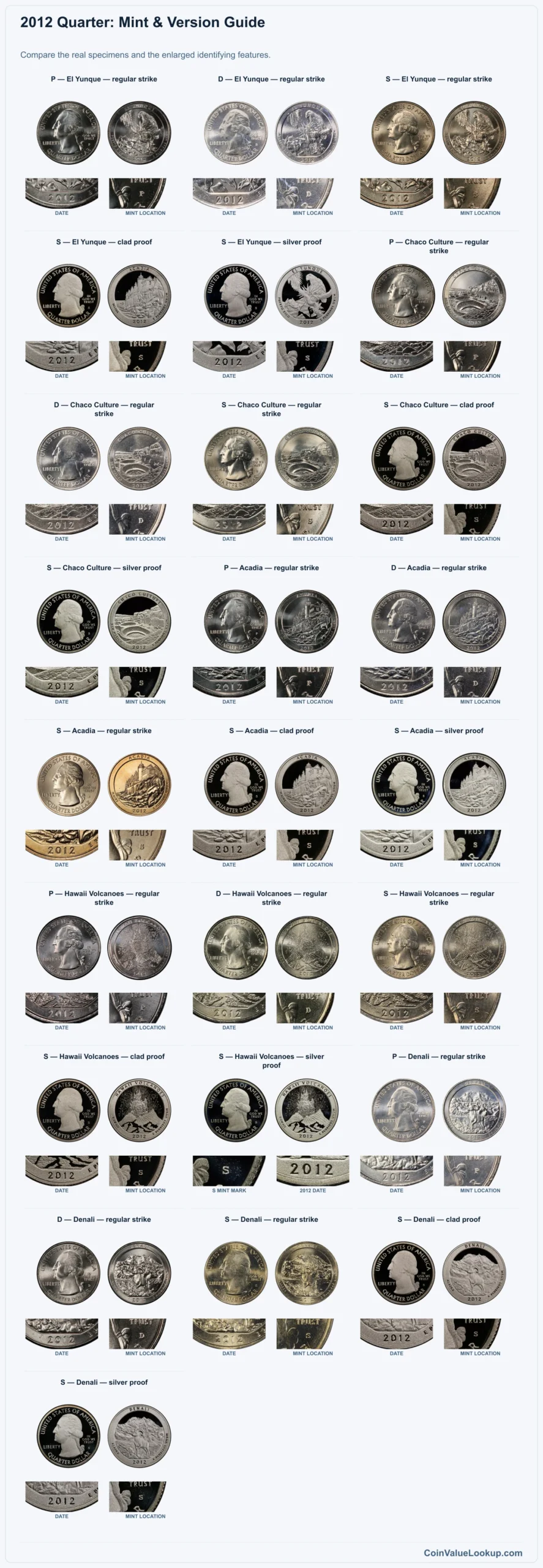
The 2012 quarter belongs to the America the Beautiful series, and five different reverse designs were struck that year: El Yunque, Chaco Culture, Acadia, Hawaii Volcanoes and Denali. Guide estimates from USA Coin Book range from about $0.61 to $24.00 depending on which mint, reverse, finish and grade you have.
Most circulated examples are worth face value, but certain San Francisco issues — especially silver proofs — sit at the top of that range.
Fast Way to Identify Your 2012 Quarter
The quickest way to start figuring out what you have is to upload clear photos of both the front and back of your coin. That lets us offer a preliminary identification of the mint, reverse design and finish.
Snap both sides in even lighting, and make sure the mintmark area near Washington's portrait is in focus.
2012 Quarter Value
Upload both sides of your 2012 Quarter.
Front Obverse
Upload photo
Back Reverse
Upload photo
Which 2012 Quarter Versions Are Worth Money?
- S-mint silver proofs (El Yunque, Chaco Culture, Acadia, Hawaii Volcanoes, Denali) each carry a USA Coin Book guide estimate of $24.00 in PR65 — the highest listed values for 2012 quarters.
- S-mint uncirculated regular strikes for El Yunque, Chaco Culture, Acadia and Denali are listed at $10.00 in MS65, well above their P or D counterparts.
- Clad proofs from San Francisco are estimated at $5.63 in PR65 for each reverse design — worth separating from your loose change pile.
- Confirm mint, finish and composition before assuming value; a cleaned or damaged coin and a bright proof are not the same thing.
Step 1: Identify Your 2012 Quarter Mint Mark and Version
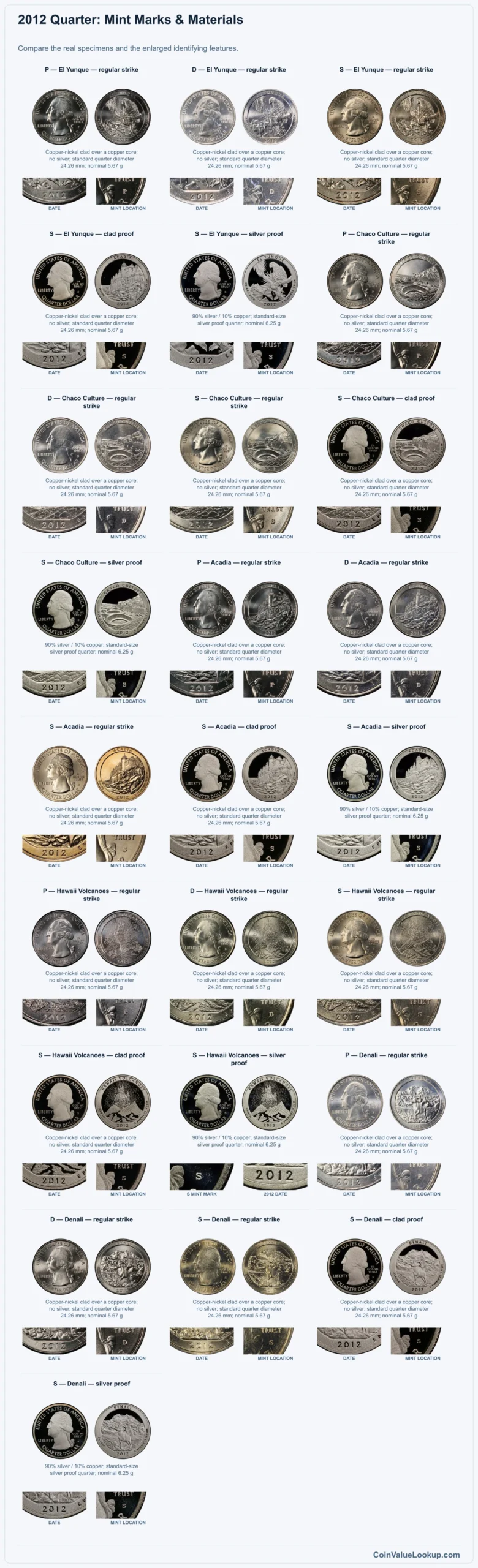
Start on the obverse. Look near Washington's ponytail for a small letter: P for Philadelphia, D for Denver, or S for San Francisco.
No mintmark at all on a 2012 quarter means Philadelphia.
Flip the coin over and identify the reverse design. The five 2012 subjects are El Yunque (Puerto Rico rainforest), Chaco Culture (New Mexico ruins), Acadia (Maine lighthouse and coast), Hawaii Volcanoes (eruption scene) and Denali (Dall sheep with Alaskan mountain).
Get the design right before you look up a value — each has its own price line.
Ordinary business-strike quarters are copper-nickel clad over a copper core, weigh about 5.67 grams and measure 24.26 mm across. Silver proofs from 2012 are 90% silver and 10% copper, weighing roughly 6.25 grams.
You cannot reliably tell silver from clad by color alone; check the edge. A silver proof has a uniform grey edge, while a clad coin shows visible layering.
An S mintmark does not automatically mean proof. San Francisco also struck non-proof collector issues in copper-nickel clad.
If the fields are not mirror-like and the devices lack frosting, you probably have the regular-strike S-mint version.
This guide covers standard 24.26 mm quarters only. Five-ounce silver collector and bullion pieces share these designs but are a completely different format with different values.
Step 2: Check Your 2012 Quarter Grade
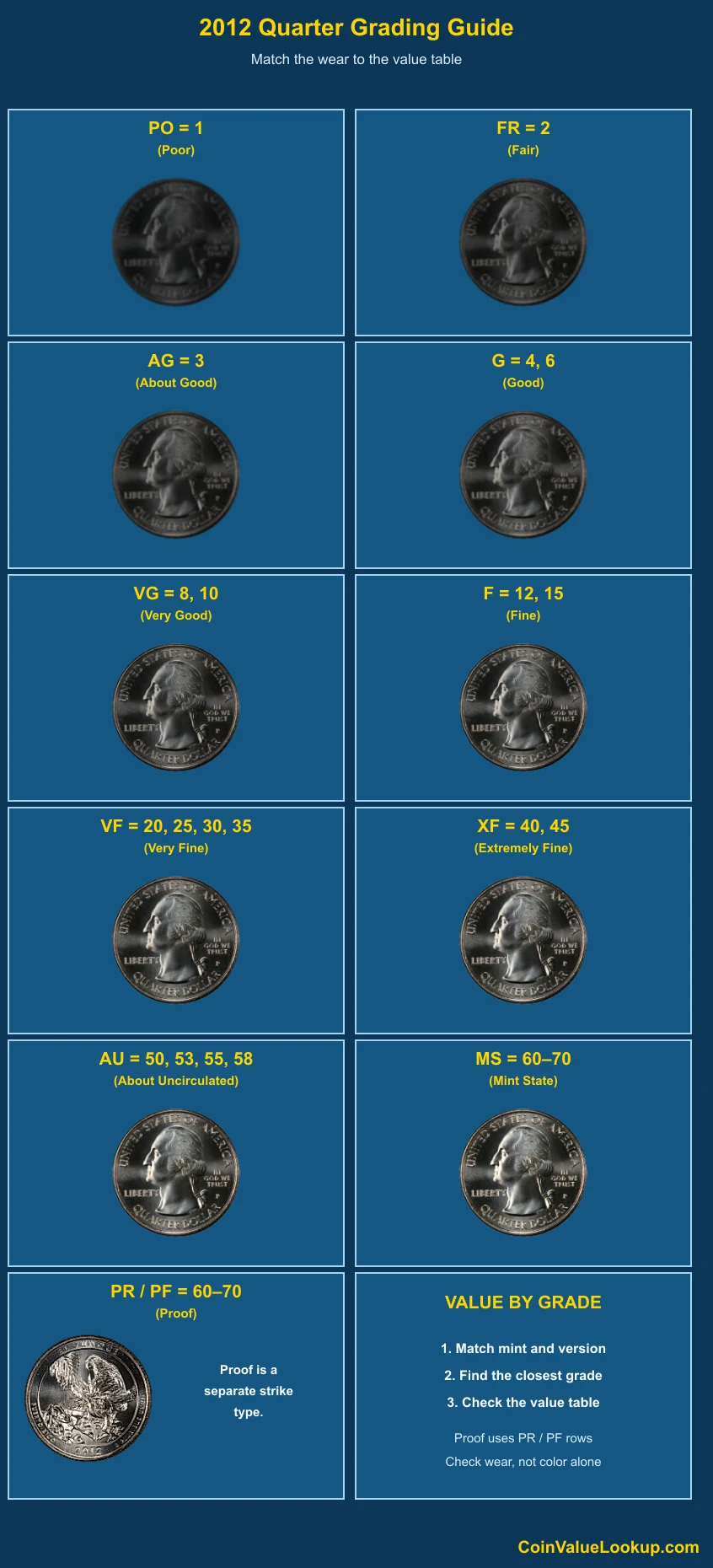
For business strikes, check Washington's cheek first — it is the highest point on the obverse and shows friction before anything else. Then look at the hair detail above the ear.
On the reverse, examine whatever high-relief element your design has (the parrot on El Yunque, the kiva walls on Chaco Culture, and so on).
Luster matters as much as wear. A coin can have full detail but dull, washed-out surfaces from cleaning, and that kills the grade.
Compare your coin to the reference image, paying attention to the original mint frost.
For proofs, tilt the coin under a single light source. Hairlines in the mirror fields and any haze over the frosted devices are the main grade reducers.
A proof with obvious scuffs or fingerprints drops fast.
Don't confuse a weak strike with wear. Some 2012 quarters left the press with soft detail in specific spots.
If the surrounding luster is intact and unbroken, the coin may grade higher than you think.
Step 3: Check 2012 Quarter Value by Mint and Version
2012 Quarter — P — El Yunque — regular strike
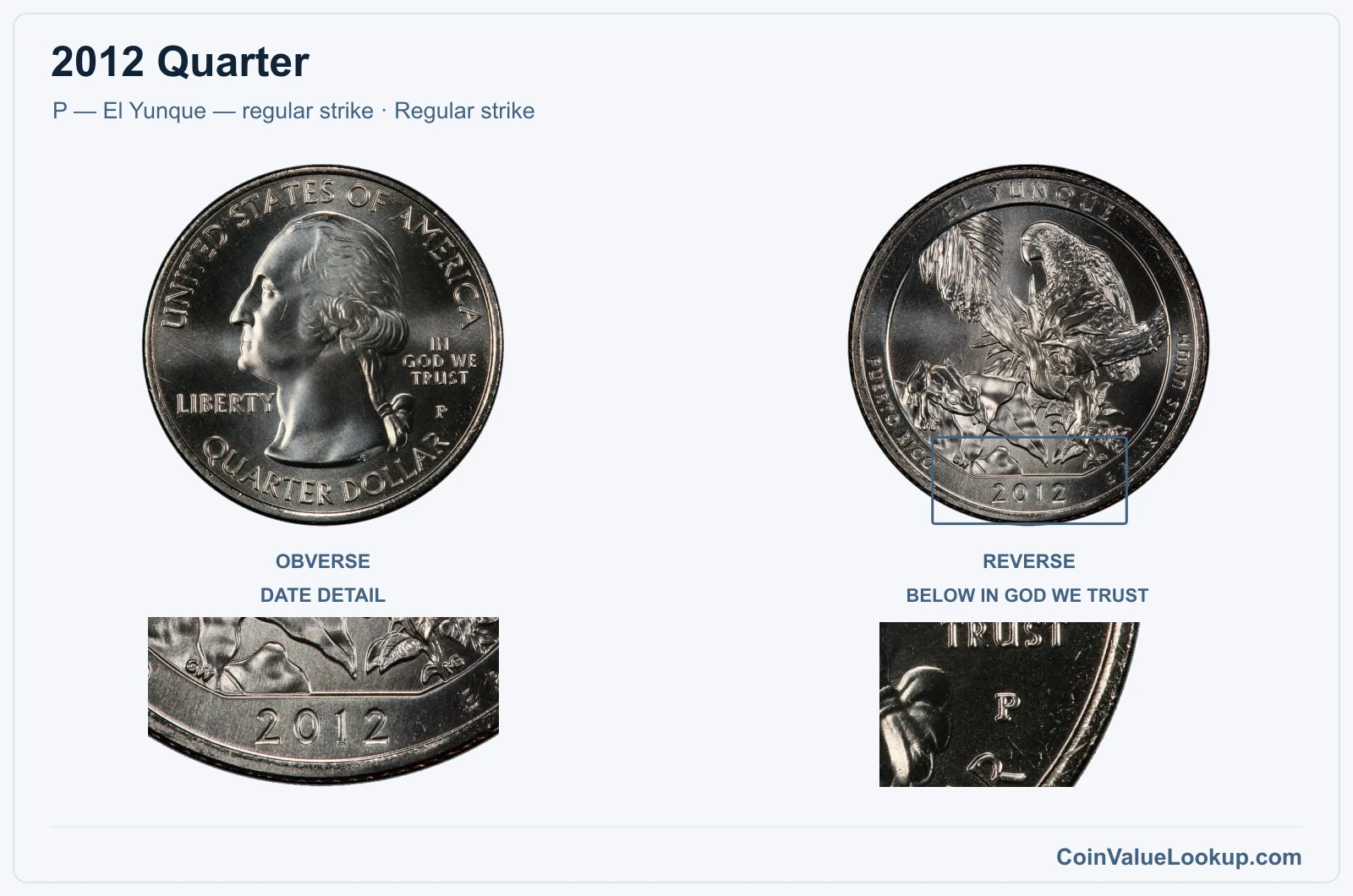
This is the Philadelphia-mint El Yunque quarter, struck in copper-nickel clad. The reverse shows a coquí frog in the Puerto Rican rainforest.
Look for the P mintmark on the obverse near Washington's ponytail.
Worn examples from pocket change are worth face value. In uncirculated condition, USA Coin Book estimates about $0.74 at MS60 and $2.50 at MS65.
These are guide estimates, not guaranteed offers. To reach the higher figure your coin needs full original luster with no contact marks visible at arm's length.
Range Grade
Price Auction Records Appraisal PO PO 1
—
Coin Identifier FR FR 2
—
Coin Identifier AG AG 3
—
Coin Identifier G G 4
—
Coin Identifier
G 6
—
Coin Identifier VG VG 8
—
Coin Identifier
VG 10
—
Coin Identifier F F 12
—
Coin Identifier
F 15
—
Coin Identifier VF VF 20
—
Coin Identifier
VF 25
—
Coin Identifier
VF 30
—
Coin Identifier
VF 35
—
Coin Identifier XF XF 40
—
Coin Identifier
XF 45
—
Coin Identifier AU AU 50
—
Coin Identifier
AU 53
—
Coin Identifier
AU 55
—
Coin Identifier
AU 58
—
Coin Identifier MS MS 60
—
Coin Identifier
MS 61
—
Coin Identifier
MS 62
—
Coin Identifier
MS 63
—
Coin Identifier
MS 64
—
Coin Identifier
MS 65
—
Coin Identifier
MS 66
—
Coin Identifier
MS 67
—
Coin Identifier
MS 68
Coin Identifier
MS 69
—
—
—
MS 70
—
—
—
2012 Quarter — D — El Yunque — regular strike
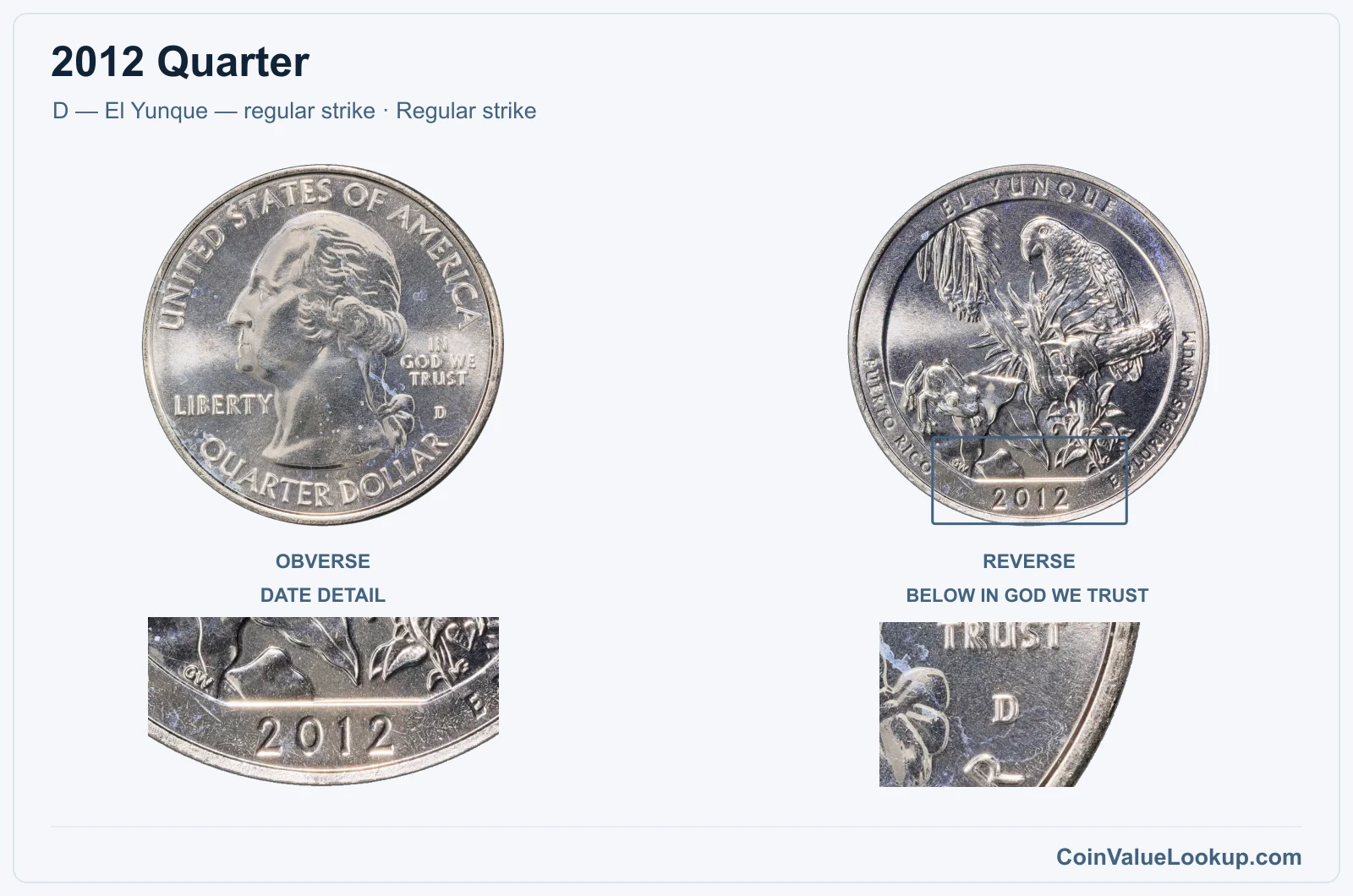
The Denver-mint El Yunque quarter is also copper-nickel clad and shows the same rainforest reverse. Confirm the D mintmark on the obverse before checking prices.
Circulated pieces trade at face value. USA Coin Book lists guide estimates of $0.74 at MS60 and $2.50 at MS65.
Mintages for both P and D business strikes were large, so pristine rolls are still around. The key is original surfaces — no cleaning, no bag marks through the main design elements.
Range Grade
Price Auction Records Appraisal PO PO 1
—
Coin Identifier FR FR 2
—
Coin Identifier AG AG 3
—
Coin Identifier G G 4
—
Coin Identifier
G 6
—
Coin Identifier VG VG 8
—
Coin Identifier
VG 10
—
Coin Identifier F F 12
—
Coin Identifier
F 15
—
Coin Identifier VF VF 20
—
Coin Identifier
VF 25
—
Coin Identifier
VF 30
—
Coin Identifier
VF 35
—
Coin Identifier XF XF 40
—
Coin Identifier
XF 45
—
Coin Identifier AU AU 50
—
Coin Identifier
AU 53
—
Coin Identifier
AU 55
—
Coin Identifier
AU 58
—
Coin Identifier MS MS 60
—
Coin Identifier
MS 61
—
Coin Identifier
MS 62
—
Coin Identifier
MS 63
—
Coin Identifier
MS 64
—
Coin Identifier
MS 65
—
Coin Identifier
MS 66
—
Coin Identifier
MS 67
Coin Identifier
MS 68
Coin Identifier
MS 69
—
Coin Identifier
MS 70
—
—
—
2012 Quarter — S — El Yunque — regular strike
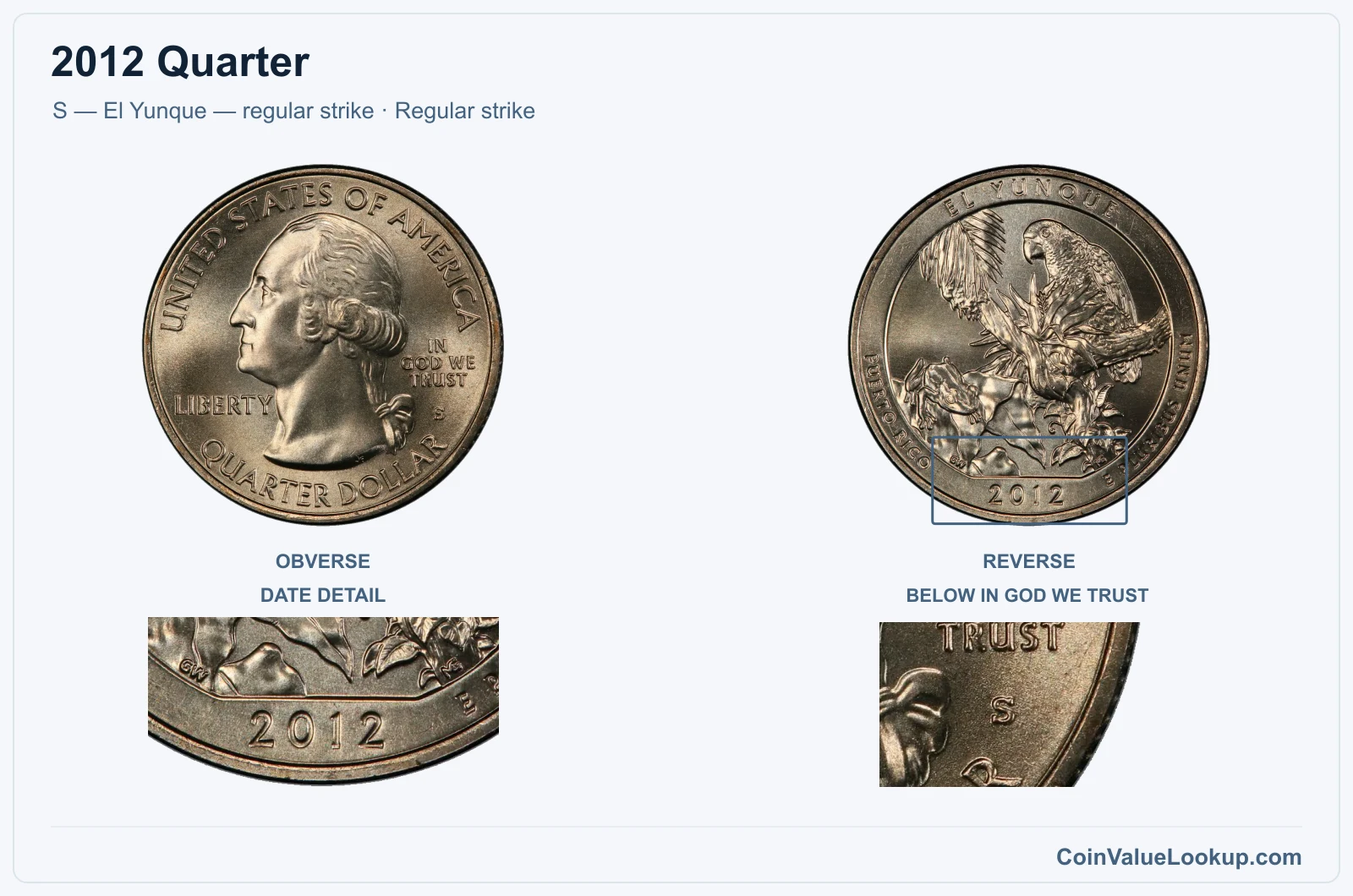
San Francisco struck a small run of non-proof El Yunque quarters in copper-nickel clad for collector sets. The S mintmark does not mean proof here.
Check the fields: if they are satiny rather than mirror-reflective, you have the regular strike.
USA Coin Book estimates $10.00 at MS65, significantly above the P and D versions. That premium exists because these were never released into circulation and had a much smaller production run.
Handle them carefully — any marks will show on the original satin finish.
Range Grade
Price Auction Records Appraisal PO PO 1
—
Coin Identifier FR FR 2
—
Coin Identifier AG AG 3
—
Coin Identifier G G 4
—
Coin Identifier
G 6
—
Coin Identifier VG VG 8
—
Coin Identifier
VG 10
—
Coin Identifier F F 12
—
Coin Identifier
F 15
—
Coin Identifier VF VF 20
—
Coin Identifier
VF 25
—
Coin Identifier
VF 30
—
Coin Identifier
VF 35
—
Coin Identifier XF XF 40
—
Coin Identifier
XF 45
—
Coin Identifier AU AU 50
—
Coin Identifier
AU 53
—
Coin Identifier
AU 55
—
Coin Identifier
AU 58
—
Coin Identifier MS MS 60
—
Coin Identifier
MS 61
—
Coin Identifier
MS 62
—
Coin Identifier
MS 63
—
Coin Identifier
MS 64
—
Coin Identifier
MS 65
—
Coin Identifier
MS 66
Coin Identifier
MS 67
Coin Identifier
MS 68
Coin Identifier
MS 69
—
—
—
MS 70
—
—
—
2012 Quarter — S — El Yunque — clad proof
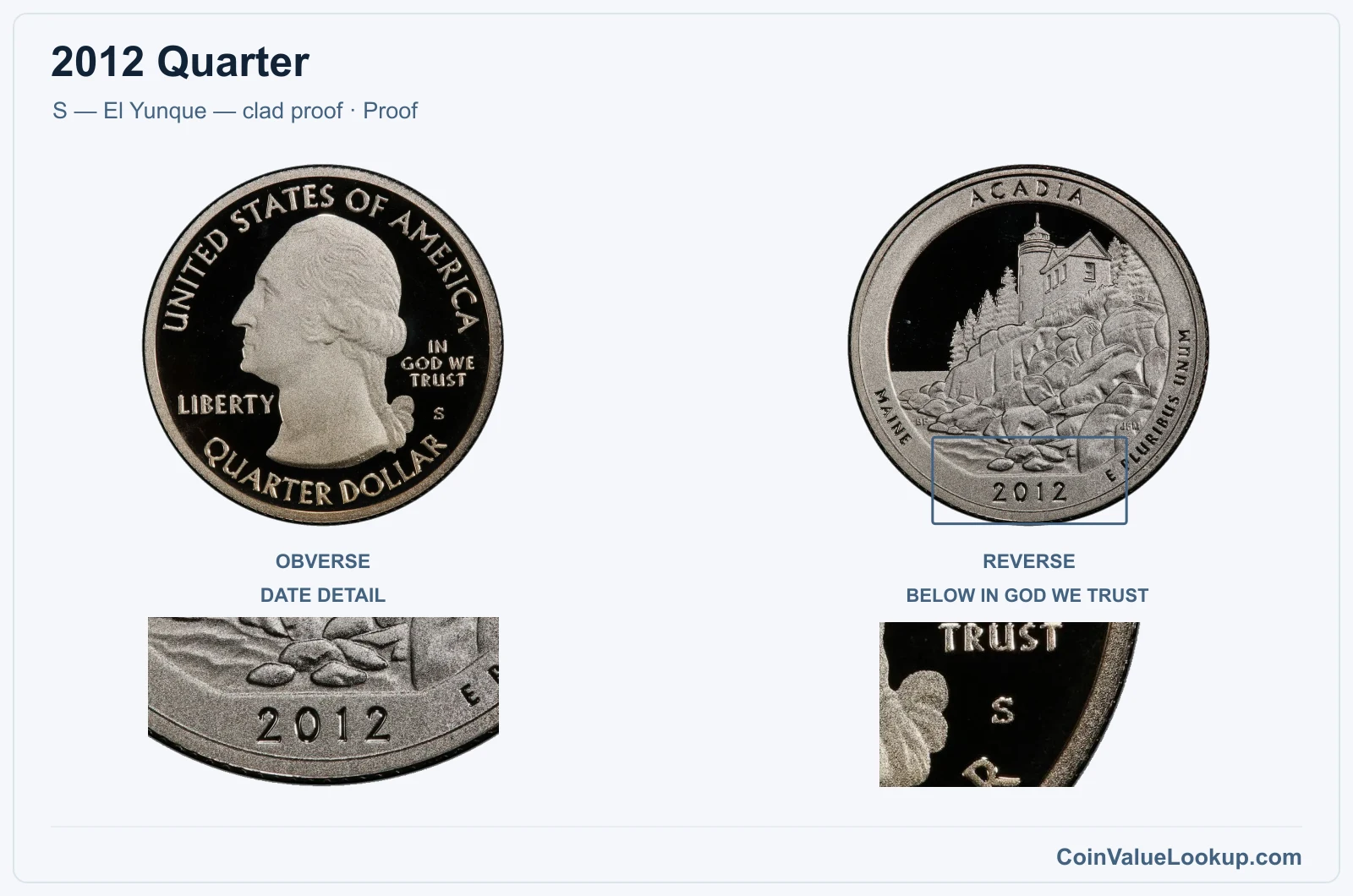
The clad proof El Yunque quarter was struck at San Francisco in copper-nickel clad with mirror fields and frosted raised devices. Confirm composition by checking the edge for visible clad layering, or weigh the coin (about 5.67 grams for clad versus 6.25 grams for silver).
USA Coin Book lists a guide estimate of $5.63 in PR65. Keep this value separate from the silver proof — they look similar face-on but the composition difference changes the price substantially.
Most came in sealed proof sets, so if yours is loose, inspect carefully for hairlines.
Range Grade
Price Auction Records Appraisal PR PR 1
—
Coin Identifier
PR 2
—
Coin Identifier
PR 3
—
Coin Identifier
PR 4
—
Coin Identifier
PR 6
—
Coin Identifier
PR 8
—
Coin Identifier
PR 10
—
Coin Identifier
PR 12
—
Coin Identifier
PR 15
—
Coin Identifier
PR 20
—
Coin Identifier
PR 25
—
Coin Identifier
PR 30
—
Coin Identifier
PR 35
—
Coin Identifier
PR 40
—
Coin Identifier
PR 45
—
Coin Identifier
PR 50
—
Coin Identifier
PR 53
—
Coin Identifier
PR 55
—
Coin Identifier
PR 58
—
Coin Identifier
PR 60
—
Coin Identifier
PR 61
—
Coin Identifier
PR 62
—
Coin Identifier
PR 63
—
Coin Identifier
PR 64
—
Coin Identifier
PR 65
—
Coin Identifier
PR 66
—
Coin Identifier
PR 67
—
Coin Identifier
PR 68
—
Coin Identifier
PR 69
Coin Identifier
PR 70
Coin Identifier
2012 Quarter — S — El Yunque — silver proof
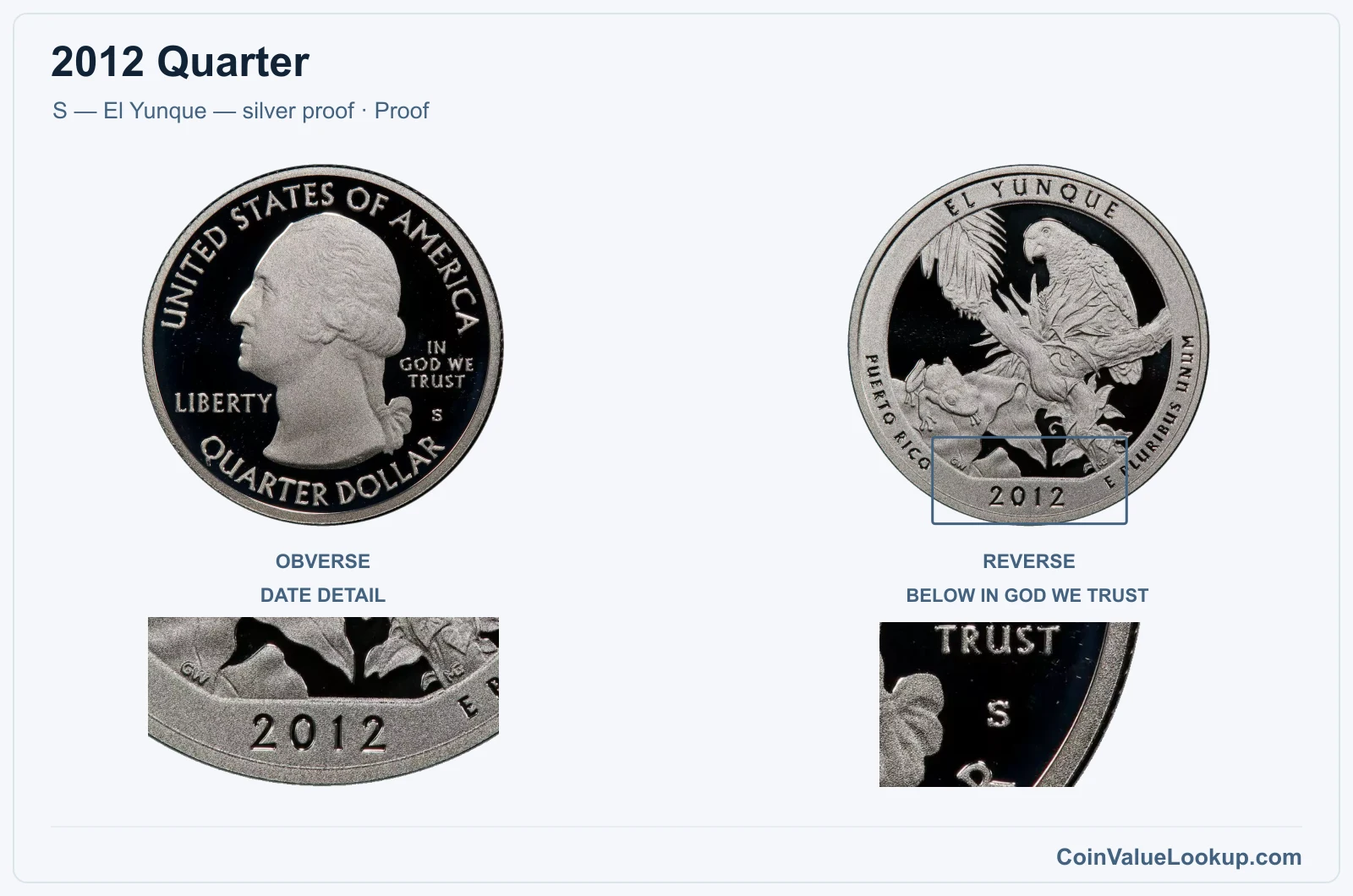
The silver proof El Yunque quarter is 90% silver and 10% copper, weighing about 6.25 grams. It carries the S mintmark and has the same mirror-field, frosted-device proof finish as the clad version, so weight or edge inspection is the way to tell them apart.
USA Coin Book places this at $24.00 in PR65. That is the joint highest guide estimate among all 2012 quarter versions listed.
Silver proofs were sold in separate silver proof sets. If yours came from original government packaging, that helps confirm the composition without guesswork.
Coin Value Lookup is a good starting point if you want to compare values across different quarter years and series before deciding whether to send a coin for professional grading.
Range Grade
Price Auction Records Appraisal PR PR 1
—
Coin Identifier
PR 2
—
Coin Identifier
PR 3
—
Coin Identifier
PR 4
—
Coin Identifier
PR 6
—
Coin Identifier
PR 8
—
Coin Identifier
PR 10
—
Coin Identifier
PR 12
—
Coin Identifier
PR 15
—
Coin Identifier
PR 20
—
Coin Identifier
PR 25
—
Coin Identifier
PR 30
—
Coin Identifier
PR 35
—
Coin Identifier
PR 40
—
Coin Identifier
PR 45
—
Coin Identifier
PR 50
—
Coin Identifier
PR 53
—
Coin Identifier
PR 55
—
Coin Identifier
PR 58
—
Coin Identifier
PR 60
—
Coin Identifier
PR 61
—
Coin Identifier
PR 62
—
Coin Identifier
PR 63
—
Coin Identifier
PR 64
—
Coin Identifier
PR 65
—
Coin Identifier
PR 66
—
Coin Identifier
PR 67
—
Coin Identifier
PR 68
—
Coin Identifier
PR 69
Coin Identifier
PR 70
Coin Identifier
2012 Quarter — P — Chaco Culture — regular strike
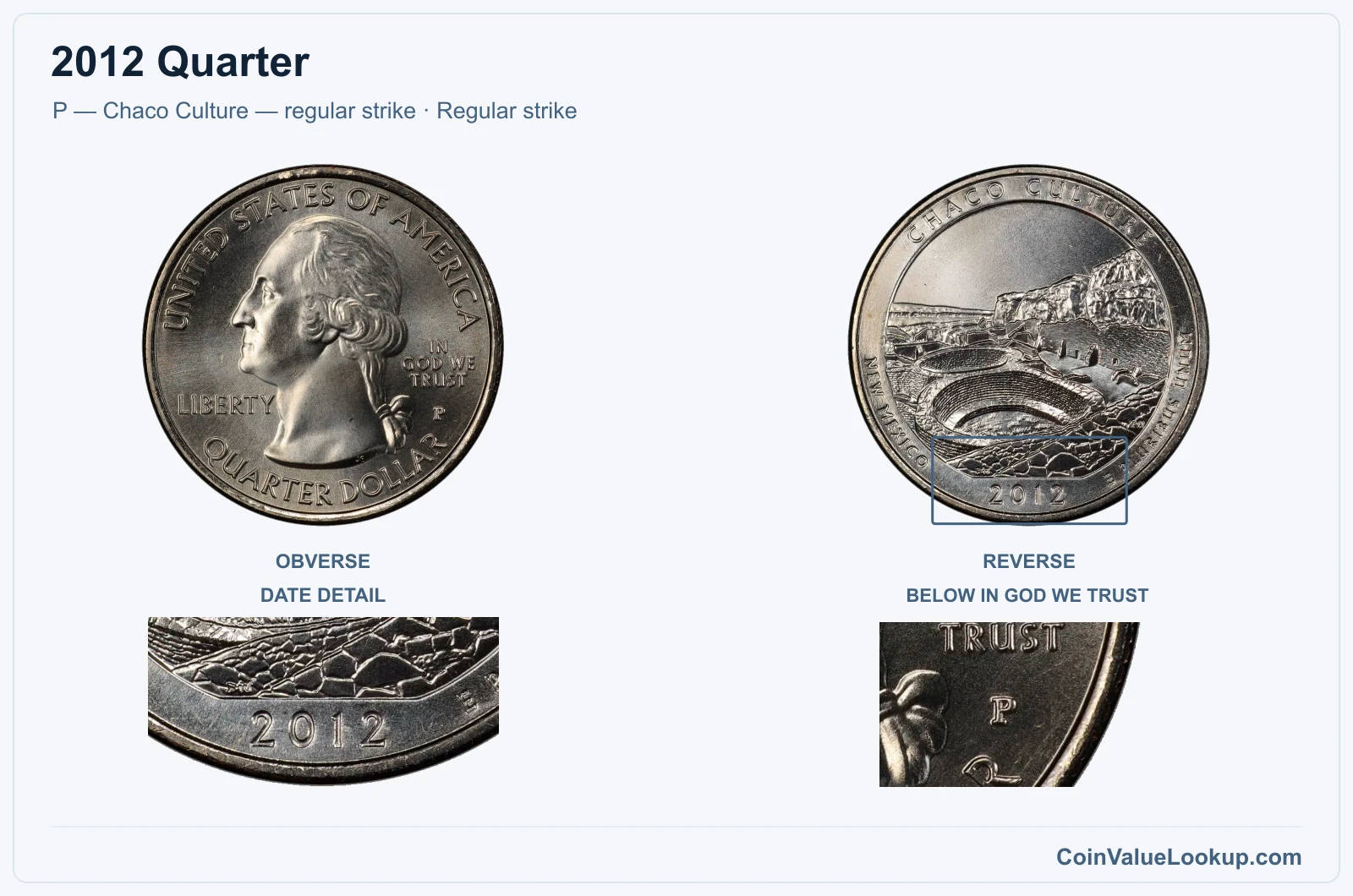
The Philadelphia Chaco Culture quarter depicts the ancient ruins of Chaco Canyon in New Mexico. It is copper-nickel clad, 24.26 mm, with a P mintmark.
Circulated examples are worth 25 cents. USA Coin Book estimates $0.74 at MS60 and $2.50 at MS65 for original uncirculated pieces.
The detailed masonry walls on the reverse can look soft even on unworn coins if the strike was slightly weak, so check the surrounding luster before downgrading.
Range Grade
Price Auction Records Appraisal PO PO 1
—
Coin Identifier FR FR 2
—
Coin Identifier AG AG 3
—
Coin Identifier G G 4
—
Coin Identifier
G 6
—
Coin Identifier VG VG 8
—
Coin Identifier
VG 10
—
Coin Identifier F F 12
—
Coin Identifier
F 15
—
Coin Identifier VF VF 20
—
Coin Identifier
VF 25
—
Coin Identifier
VF 30
—
Coin Identifier
VF 35
—
Coin Identifier XF XF 40
—
Coin Identifier
XF 45
—
Coin Identifier AU AU 50
—
Coin Identifier
AU 53
—
Coin Identifier
AU 55
—
Coin Identifier
AU 58
—
Coin Identifier MS MS 60
—
Coin Identifier
MS 61
—
Coin Identifier
MS 62
—
Coin Identifier
MS 63
—
Coin Identifier
MS 64
—
Coin Identifier
MS 65
—
Coin Identifier
MS 66
—
Coin Identifier
MS 67
—
Coin Identifier
MS 68
Coin Identifier
MS 69
—
—
—
MS 70
—
—
—
2012 Quarter — D — Chaco Culture — regular strike
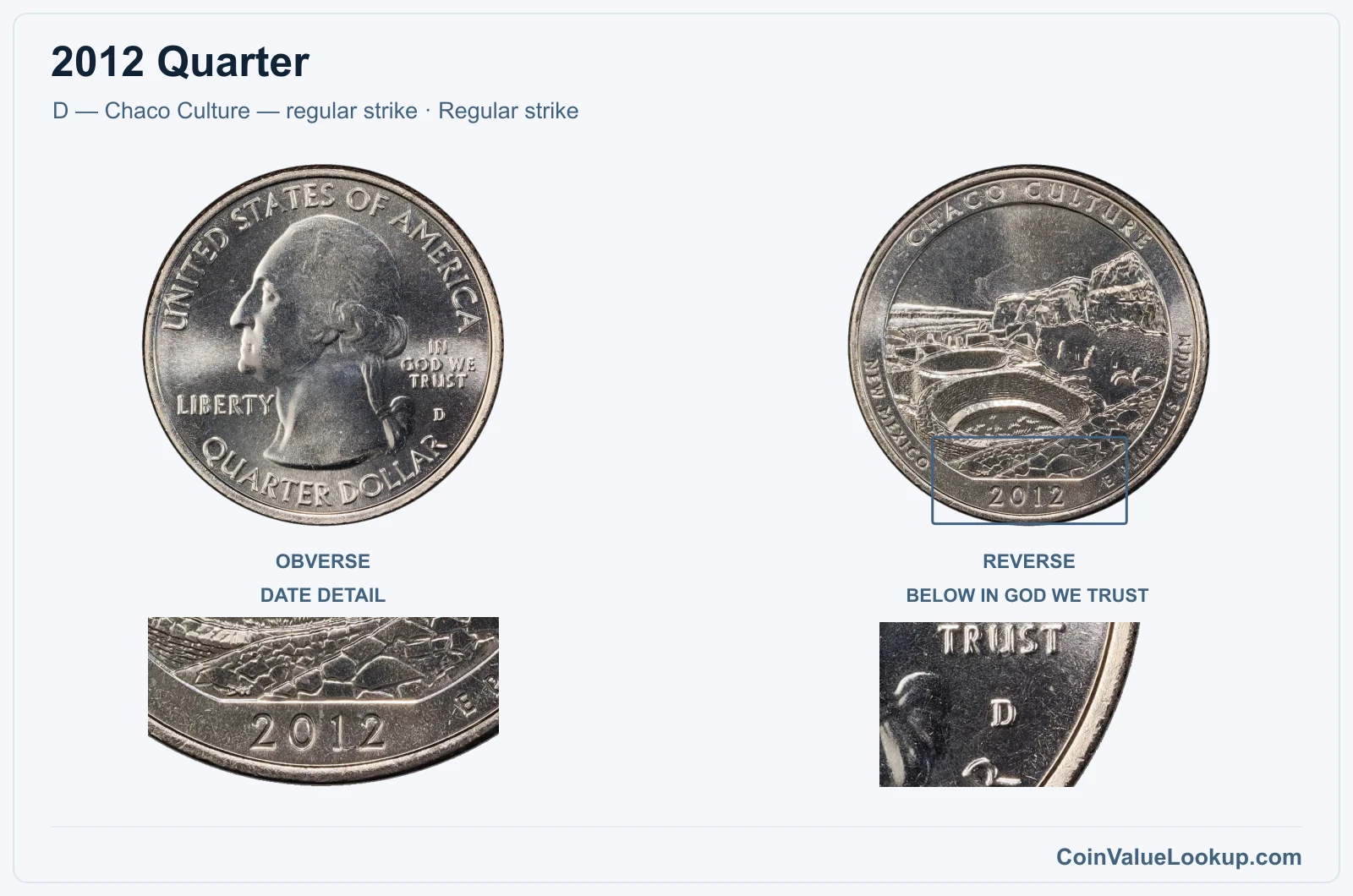
Denver's Chaco Culture quarter is the D-mint counterpart, same clad composition and design. Verify the D mintmark and the Chaco Culture reverse before pricing.
Guide estimates from USA Coin Book are $0.74 at MS60 and $2.50 at MS65. Both the P and D mints produced these in large quantities, so finding one in change is easy.
Finding one truly free of contact marks in MS65 territory is the harder part. Roll-hunting is probably your best bet for quality examples.
Range Grade
Price Auction Records Appraisal PO PO 1
—
Coin Identifier FR FR 2
—
Coin Identifier AG AG 3
—
Coin Identifier G G 4
—
Coin Identifier
G 6
—
Coin Identifier VG VG 8
—
Coin Identifier
VG 10
—
Coin Identifier F F 12
—
Coin Identifier
F 15
—
Coin Identifier VF VF 20
—
Coin Identifier
VF 25
—
Coin Identifier
VF 30
—
Coin Identifier
VF 35
—
Coin Identifier XF XF 40
—
Coin Identifier
XF 45
—
Coin Identifier AU AU 50
—
Coin Identifier
AU 53
—
Coin Identifier
AU 55
—
Coin Identifier
AU 58
—
Coin Identifier MS MS 60
—
Coin Identifier
MS 61
—
Coin Identifier
MS 62
—
Coin Identifier
MS 63
—
Coin Identifier
MS 64
—
Coin Identifier
MS 65
—
Coin Identifier
MS 66
—
Coin Identifier
MS 67
Coin Identifier
MS 68
—
Coin Identifier
MS 69
—
—
—
MS 70
—
—
—
2012 Quarter — S — Chaco Culture — regular strike
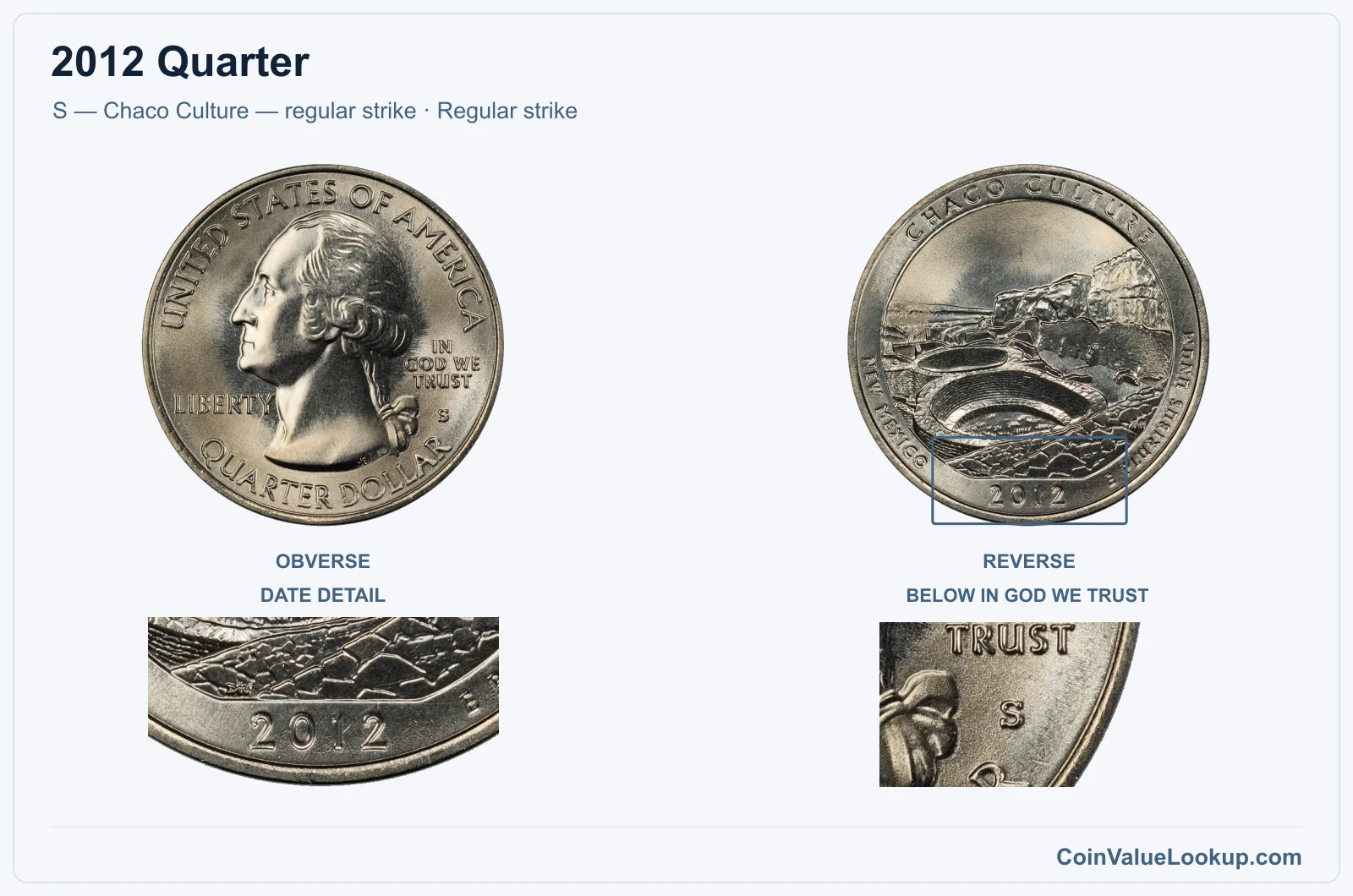
San Francisco's regular-strike Chaco Culture quarter is copper-nickel clad but was not released into general circulation. It went into collector sets.
The S mintmark alone does not make it a proof — look for satiny rather than mirrored surfaces.
USA Coin Book estimates $10.00 at MS65. The limited distribution gives it a clear premium over the P and D strikes.
Because these were handled less, many survive in high grades, but even light friction from improper storage can drop the grade.
Range Grade
Price Auction Records Appraisal PO PO 1
—
Coin Identifier FR FR 2
—
Coin Identifier AG AG 3
—
Coin Identifier G G 4
—
Coin Identifier
G 6
—
Coin Identifier VG VG 8
—
Coin Identifier
VG 10
—
Coin Identifier F F 12
—
Coin Identifier
F 15
—
Coin Identifier VF VF 20
—
Coin Identifier
VF 25
—
Coin Identifier
VF 30
—
Coin Identifier
VF 35
—
Coin Identifier XF XF 40
—
Coin Identifier
XF 45
—
Coin Identifier AU AU 50
—
Coin Identifier
AU 53
—
Coin Identifier
AU 55
—
Coin Identifier
AU 58
—
Coin Identifier MS MS 60
—
Coin Identifier
MS 61
—
Coin Identifier
MS 62
—
Coin Identifier
MS 63
—
Coin Identifier
MS 64
—
Coin Identifier
MS 65
—
Coin Identifier
MS 66
—
Coin Identifier
MS 67
Coin Identifier
MS 68
Coin Identifier
MS 69
—
—
—
MS 70
—
—
—
2012 Quarter — S — Chaco Culture — clad proof
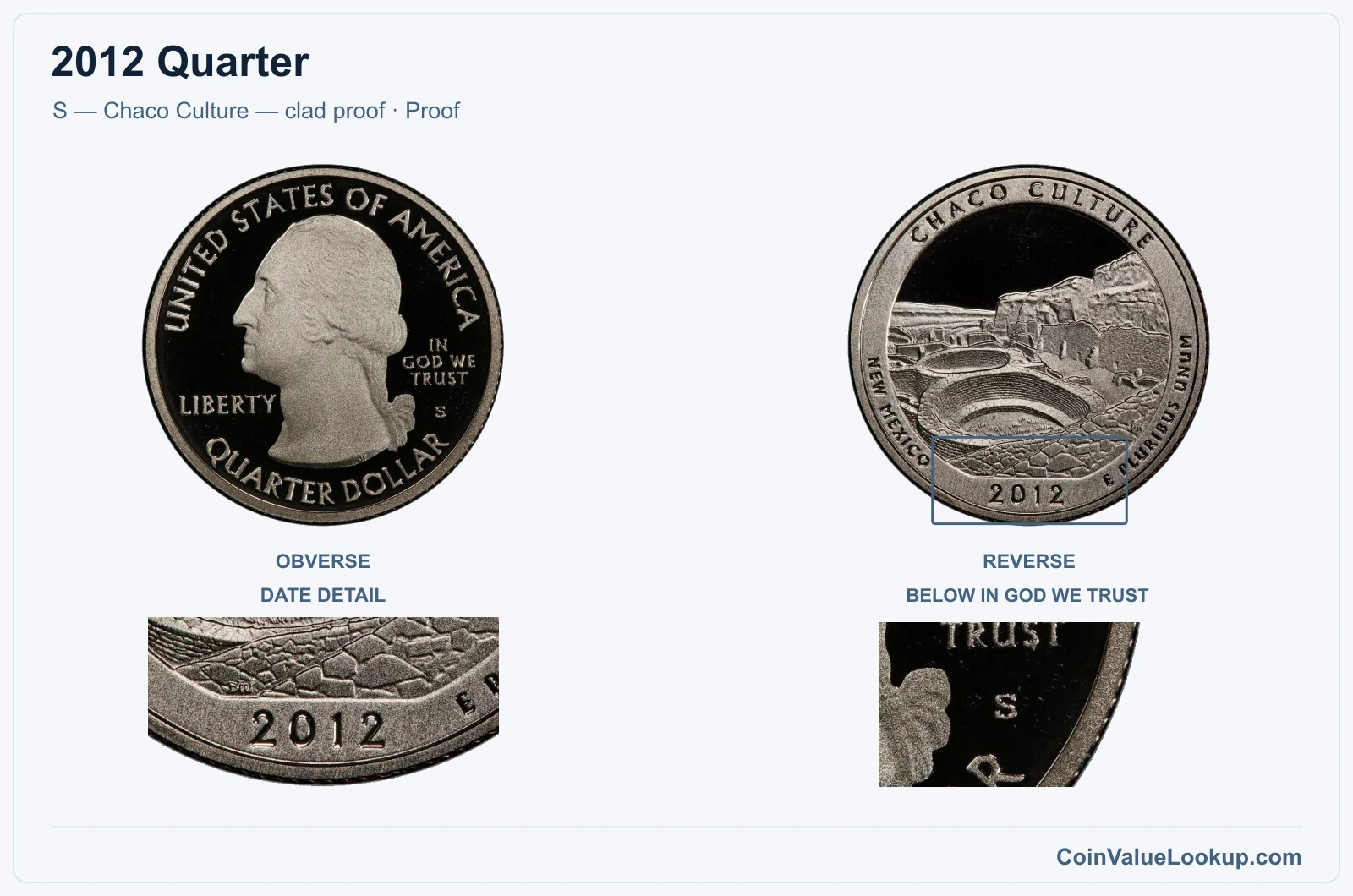
The clad proof Chaco Culture quarter has San Francisco's mirror finish over a copper-nickel clad planchet. The edge will show the familiar clad layering if you look closely.
USA Coin Book lists a guide estimate of $5.63 in PR65. Proof coins grade on the severity of hairlines and any haze.
A coin that has been removed from its original holder and handled will show contact quickly. If you are trying to distinguish this from the silver proof, weigh it — clad runs about 5.67 grams.
Range Grade
Price Auction Records Appraisal PR PR 1
—
Coin Identifier
PR 2
—
Coin Identifier
PR 3
—
Coin Identifier
PR 4
—
Coin Identifier
PR 6
—
Coin Identifier
PR 8
—
Coin Identifier
PR 10
—
Coin Identifier
PR 12
—
Coin Identifier
PR 15
—
Coin Identifier
PR 20
—
Coin Identifier
PR 25
—
Coin Identifier
PR 30
—
Coin Identifier
PR 35
—
Coin Identifier
PR 40
—
Coin Identifier
PR 45
—
Coin Identifier
PR 50
—
Coin Identifier
PR 53
—
Coin Identifier
PR 55
—
Coin Identifier
PR 58
—
Coin Identifier
PR 60
—
Coin Identifier
PR 61
—
Coin Identifier
PR 62
—
Coin Identifier
PR 63
—
Coin Identifier
PR 64
—
Coin Identifier
PR 65
—
Coin Identifier
PR 66
—
Coin Identifier
PR 67
—
Coin Identifier
PR 68
—
Coin Identifier
PR 69
—
Coin Identifier
PR 70
Coin Identifier
2012 Quarter — S — Chaco Culture — silver proof
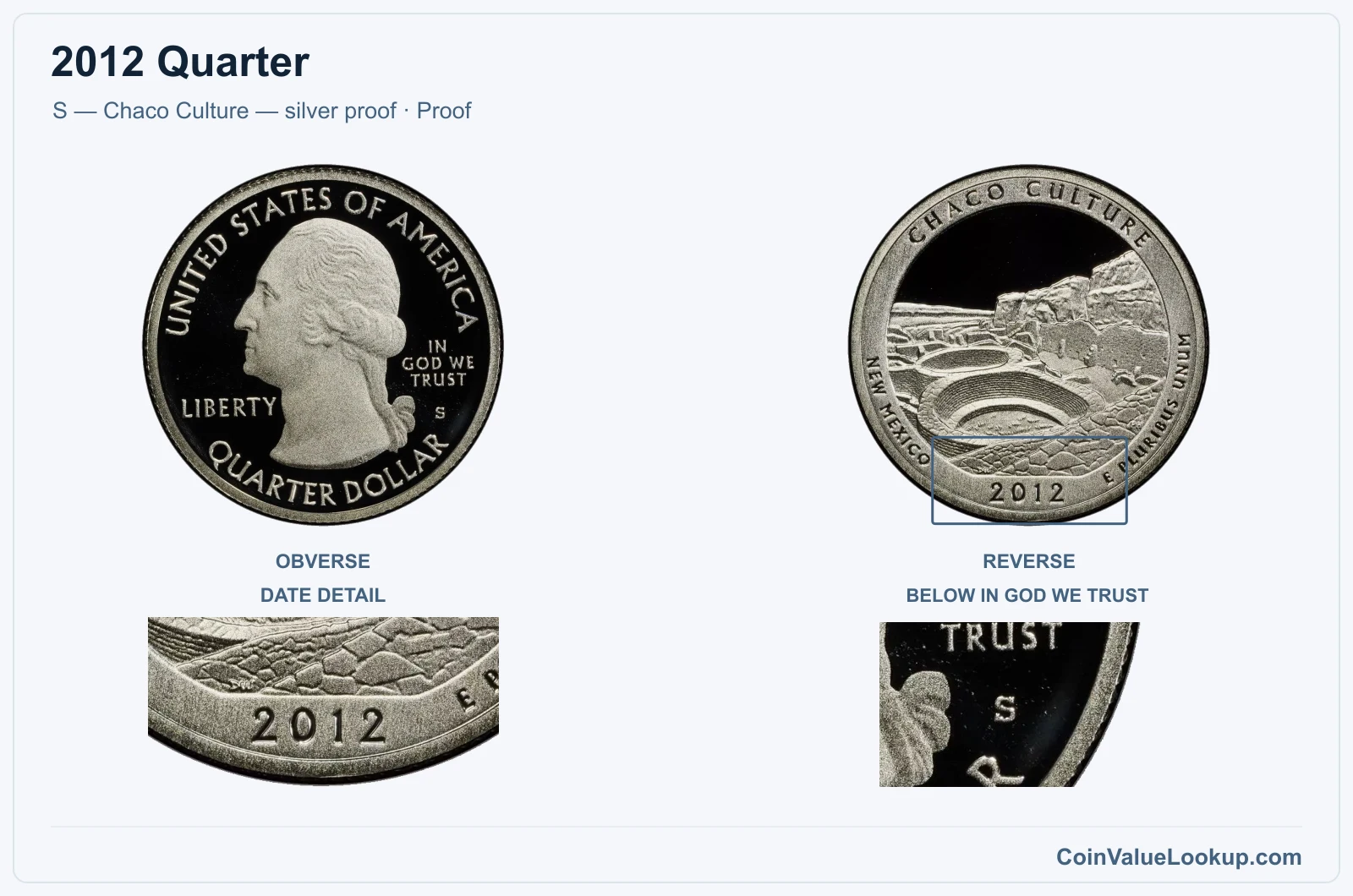
The silver proof Chaco Culture quarter is 90% silver and weighs approximately 6.25 grams. It shares the mirror-over-frost proof finish with the clad version but carries a significantly higher guide estimate: $24.00 in PR65 according to USA Coin Book.
Silver proofs were issued in dedicated silver proof sets. If you have a loose one without packaging, the edge will appear uniformly grey without a visible copper stripe.
Weight is the most reliable quick test. These are among the top-valued versions for any 2012 quarter in this guide.
Range Grade
Price Auction Records Appraisal PR PR 1
—
Coin Identifier
PR 2
—
Coin Identifier
PR 3
—
Coin Identifier
PR 4
—
Coin Identifier
PR 6
—
Coin Identifier
PR 8
—
Coin Identifier
PR 10
—
Coin Identifier
PR 12
—
Coin Identifier
PR 15
—
Coin Identifier
PR 20
—
Coin Identifier
PR 25
—
Coin Identifier
PR 30
—
Coin Identifier
PR 35
—
Coin Identifier
PR 40
—
Coin Identifier
PR 45
—
Coin Identifier
PR 50
—
Coin Identifier
PR 53
—
Coin Identifier
PR 55
—
Coin Identifier
PR 58
—
Coin Identifier
PR 60
—
Coin Identifier
PR 61
—
Coin Identifier
PR 62
—
Coin Identifier
PR 63
—
Coin Identifier
PR 64
—
Coin Identifier
PR 65
—
Coin Identifier
PR 66
—
Coin Identifier
PR 67
—
Coin Identifier
PR 68
—
Coin Identifier
PR 69
—
Coin Identifier
PR 70
Coin Identifier
2012 Quarter — P — Acadia — regular strike
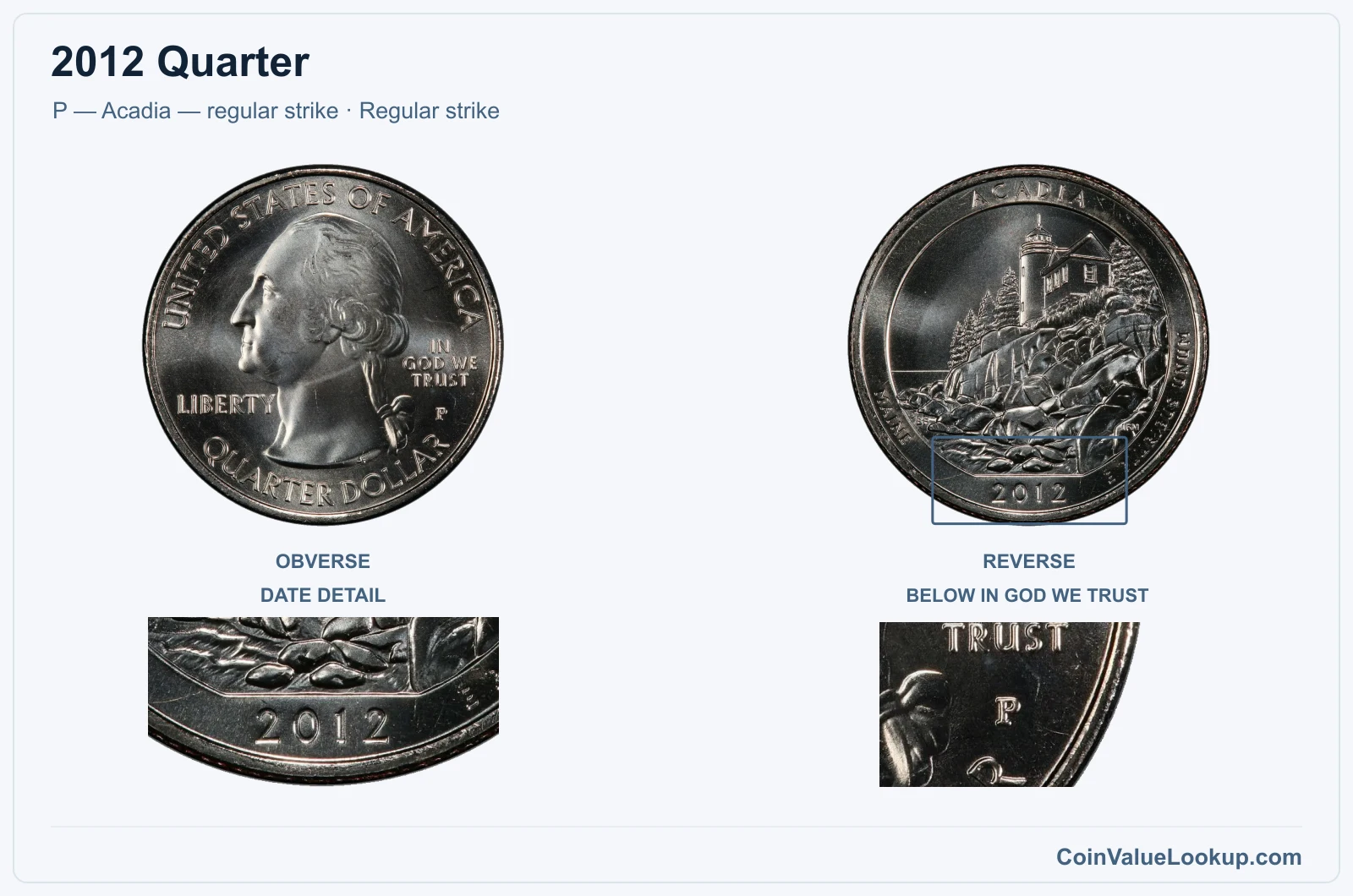
The Philadelphia Acadia quarter shows a lighthouse and the rocky Maine coastline. It is copper-nickel clad with the P mintmark.
Circulated examples are face value. USA Coin Book estimates $0.74 at MS60 and $2.50 at MS65.
The lighthouse detail is a natural focal point, so bag marks in that area stand out. For an MS65 grade, the main design elements need to be clean under 5x magnification.
Range Grade
Price Auction Records Appraisal PO PO 1
—
Coin Identifier FR FR 2
—
Coin Identifier AG AG 3
—
Coin Identifier G G 4
—
Coin Identifier
G 6
—
Coin Identifier VG VG 8
—
Coin Identifier
VG 10
—
Coin Identifier F F 12
—
Coin Identifier
F 15
—
Coin Identifier VF VF 20
—
Coin Identifier
VF 25
—
Coin Identifier
VF 30
—
Coin Identifier
VF 35
—
Coin Identifier XF XF 40
—
Coin Identifier
XF 45
—
Coin Identifier AU AU 50
—
Coin Identifier
AU 53
—
Coin Identifier
AU 55
—
Coin Identifier
AU 58
—
Coin Identifier MS MS 60
—
Coin Identifier
MS 61
—
Coin Identifier
MS 62
—
Coin Identifier
MS 63
—
Coin Identifier
MS 64
—
Coin Identifier
MS 65
—
Coin Identifier
MS 66
—
Coin Identifier
MS 67
—
Coin Identifier
MS 68
—
Coin Identifier
MS 69
—
—
—
MS 70
—
—
—
2012 Quarter — D — Acadia — regular strike
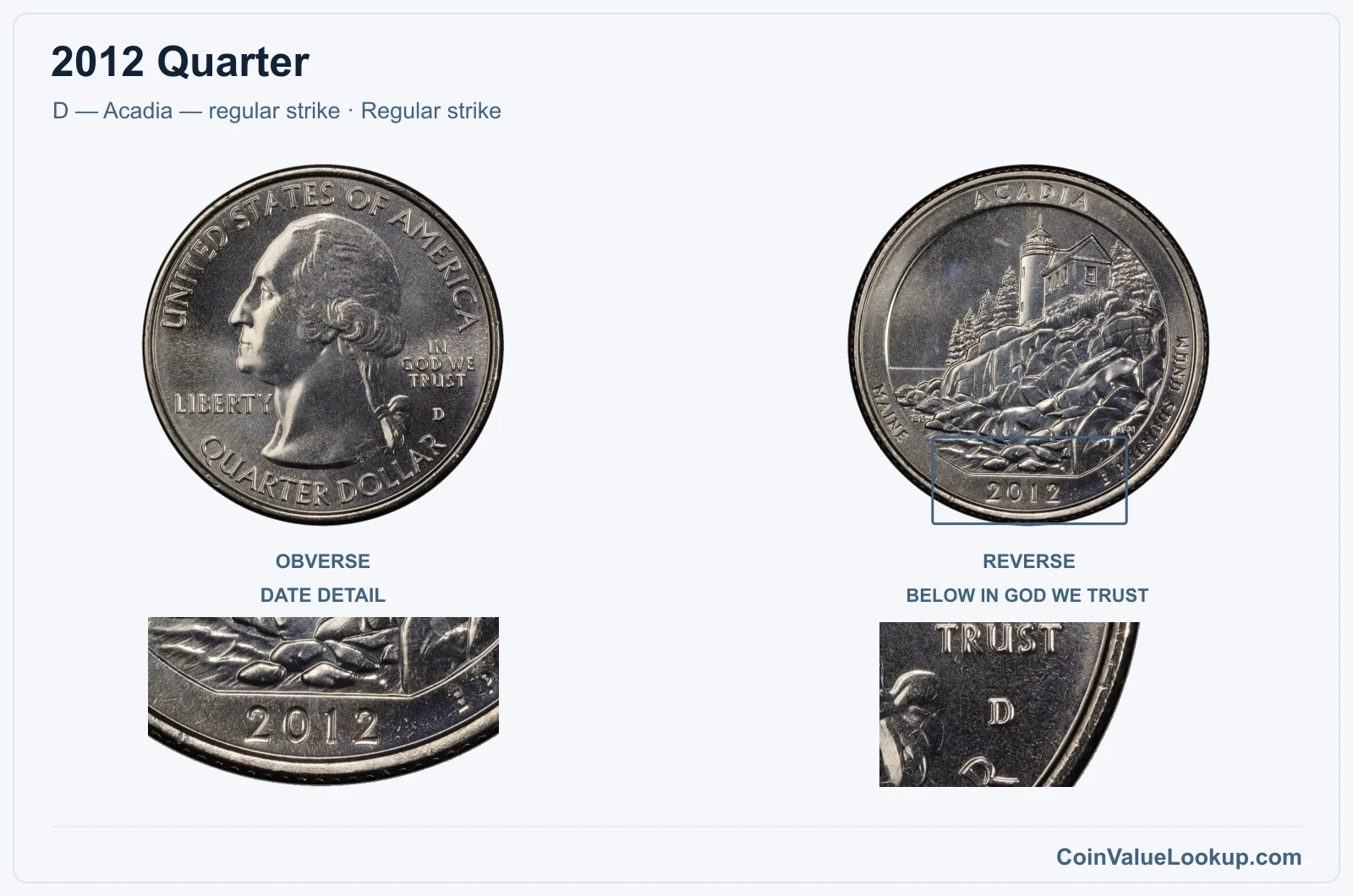
Denver's Acadia quarter is the same copper-nickel clad design with a D mintmark. Confirm both the mintmark and reverse before looking up the price.
USA Coin Book estimates $0.74 at MS60 and $2.50 at MS65. Like the other 2012 business strikes, these were produced in large numbers and circulated widely.
A coin pulled from a roll may look uncirculated but still carry subtle contact marks. Compare against the reference image to judge.
Range Grade
Price Auction Records Appraisal PO PO 1
—
Coin Identifier FR FR 2
—
Coin Identifier AG AG 3
—
Coin Identifier G G 4
—
Coin Identifier
G 6
—
Coin Identifier VG VG 8
—
Coin Identifier
VG 10
—
Coin Identifier F F 12
—
Coin Identifier
F 15
—
Coin Identifier VF VF 20
—
Coin Identifier
VF 25
—
Coin Identifier
VF 30
—
Coin Identifier
VF 35
—
Coin Identifier XF XF 40
—
Coin Identifier
XF 45
—
Coin Identifier AU AU 50
—
Coin Identifier
AU 53
—
Coin Identifier
AU 55
—
Coin Identifier
AU 58
—
Coin Identifier MS MS 60
—
Coin Identifier
MS 61
—
Coin Identifier
MS 62
—
Coin Identifier
MS 63
—
Coin Identifier
MS 64
—
Coin Identifier
MS 65
—
Coin Identifier
MS 66
—
Coin Identifier
MS 67
—
Coin Identifier
MS 68
—
—
—
MS 69
—
—
—
MS 70
—
—
—
2012 Quarter — S — Acadia — regular strike
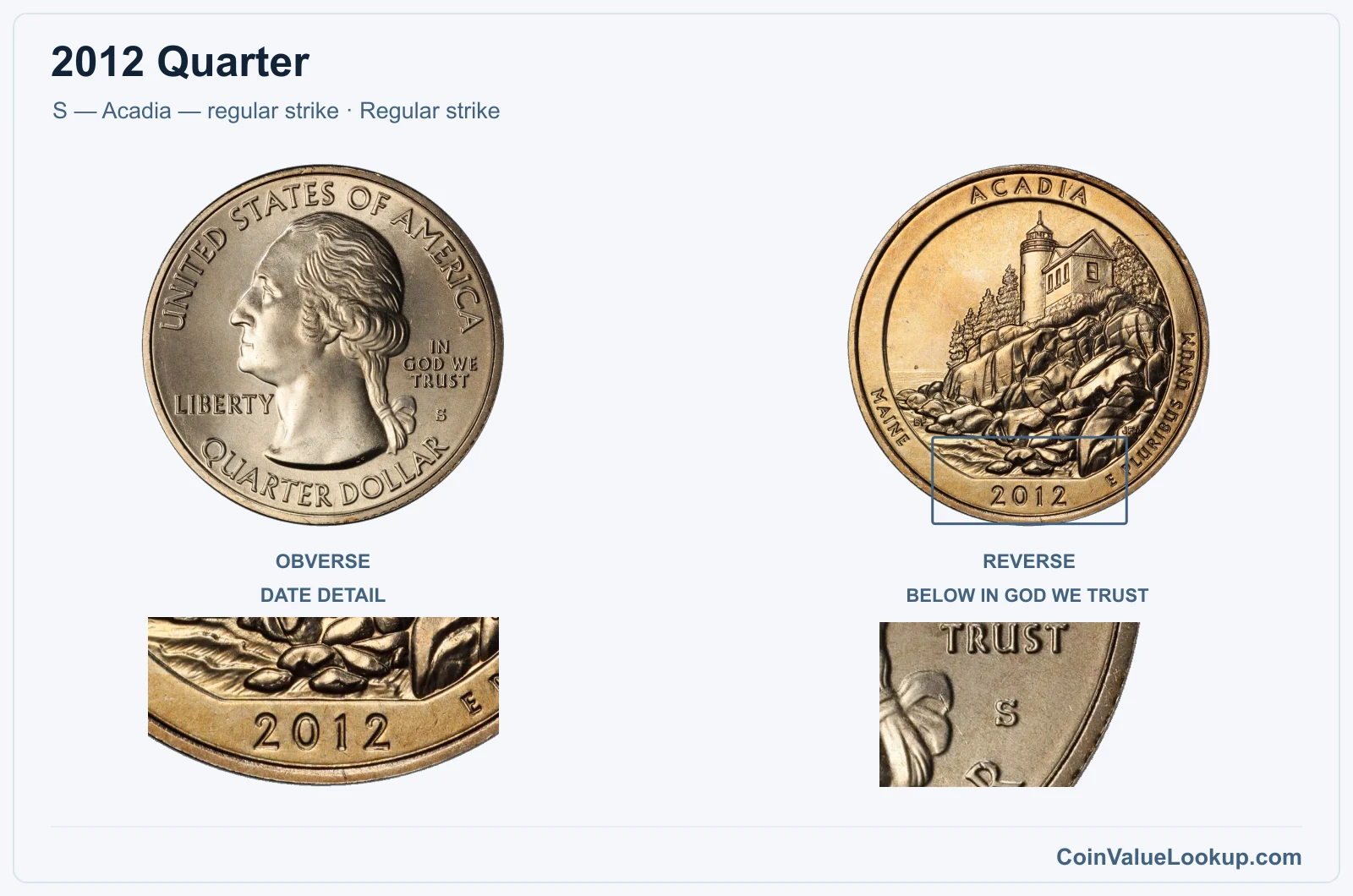
The S-mint regular-strike Acadia quarter is copper-nickel clad and was produced for collector sets, not for circulation. It has a satin or business-strike finish, not the mirror fields of a proof.
USA Coin Book estimates $10.00 at MS65. That premium over the P and D strikes reflects its limited mintage and collector-only distribution.
Handle it by the edges — any fingerprint on the field will be visible under light and can reduce the grade.
Range Grade
Price Auction Records Appraisal PO PO 1
—
Coin Identifier FR FR 2
—
Coin Identifier AG AG 3
—
Coin Identifier G G 4
—
Coin Identifier
G 6
—
Coin Identifier VG VG 8
—
Coin Identifier
VG 10
—
Coin Identifier F F 12
—
Coin Identifier
F 15
—
Coin Identifier VF VF 20
—
Coin Identifier
VF 25
—
Coin Identifier
VF 30
—
Coin Identifier
VF 35
—
Coin Identifier XF XF 40
—
Coin Identifier
XF 45
—
Coin Identifier AU AU 50
—
Coin Identifier
AU 53
—
Coin Identifier
AU 55
—
Coin Identifier
AU 58
—
Coin Identifier MS MS 60
—
Coin Identifier
MS 61
—
Coin Identifier
MS 62
—
Coin Identifier
MS 63
—
Coin Identifier
MS 64
—
Coin Identifier
MS 65
—
Coin Identifier
MS 66
Coin Identifier
MS 67
Coin Identifier
MS 68
—
Coin Identifier
MS 69
—
—
—
MS 70
—
—
—
2012 Quarter — S — Acadia — clad proof
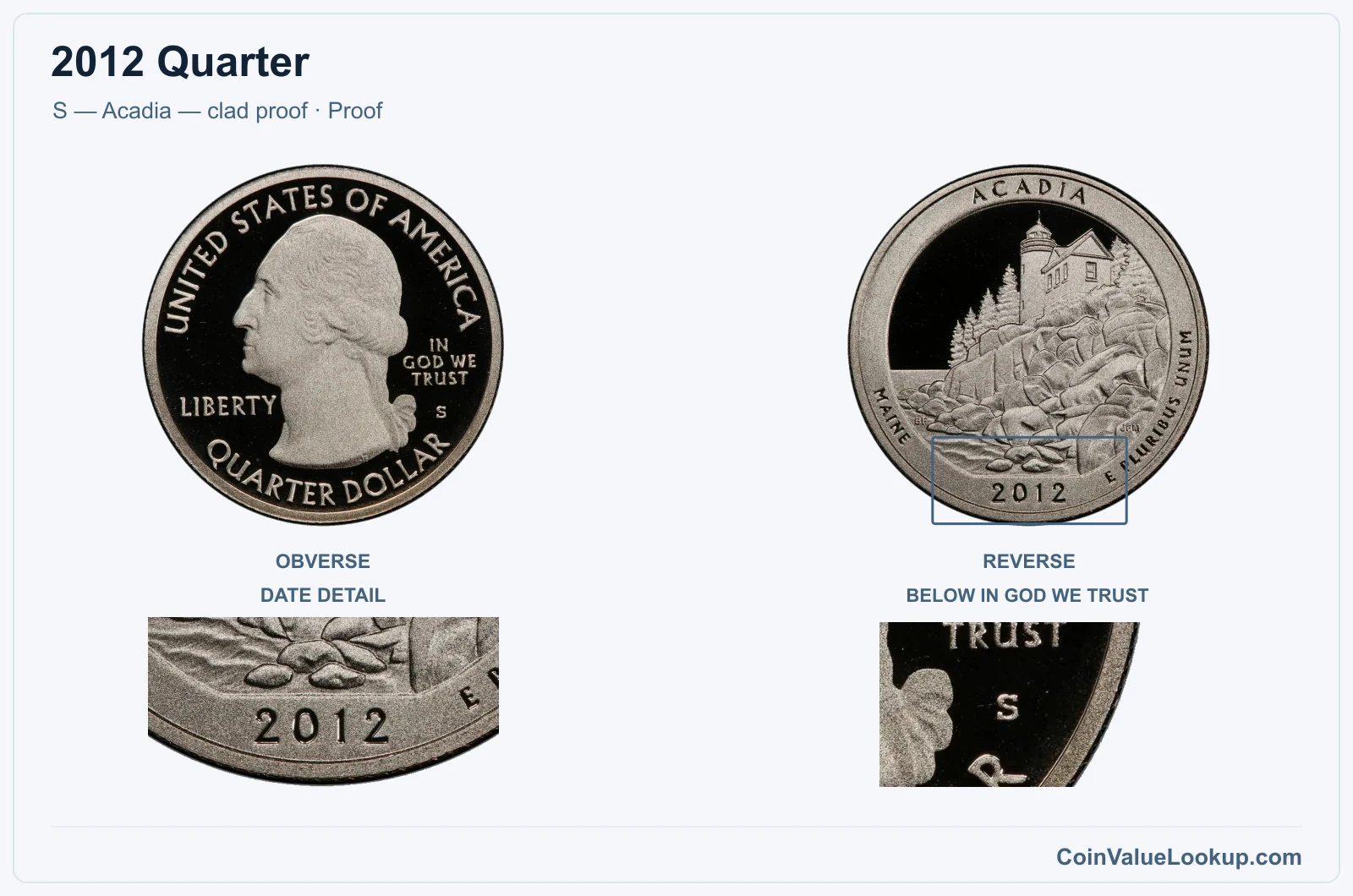
The clad proof Acadia quarter was struck at San Francisco with mirror fields and frosted devices on a copper-nickel clad planchet. Check the edge for clad layering to separate it from the silver proof.
USA Coin Book lists $5.63 in PR65 as a guide estimate. Proof coins are graded largely on the condition of the mirror fields.
Even faint hairlines from a soft cloth can knock a coin below PR65. If yours is still sealed in the original proof set, it is likely in better shape than one that has been handled.
Range Grade
Price Auction Records Appraisal PR PR 1
—
Coin Identifier
PR 2
—
Coin Identifier
PR 3
—
Coin Identifier
PR 4
—
Coin Identifier
PR 6
—
Coin Identifier
PR 8
—
Coin Identifier
PR 10
—
Coin Identifier
PR 12
—
Coin Identifier
PR 15
—
Coin Identifier
PR 20
—
Coin Identifier
PR 25
—
Coin Identifier
PR 30
—
Coin Identifier
PR 35
—
Coin Identifier
PR 40
—
Coin Identifier
PR 45
—
Coin Identifier
PR 50
—
Coin Identifier
PR 53
—
Coin Identifier
PR 55
—
Coin Identifier
PR 58
—
Coin Identifier
PR 60
—
Coin Identifier
PR 61
—
Coin Identifier
PR 62
—
Coin Identifier
PR 63
—
Coin Identifier
PR 64
—
Coin Identifier
PR 65
—
Coin Identifier
PR 66
—
Coin Identifier
PR 67
—
Coin Identifier
PR 68
—
Coin Identifier
PR 69
—
Coin Identifier
PR 70
Coin Identifier
2012 Quarter — S — Acadia — silver proof
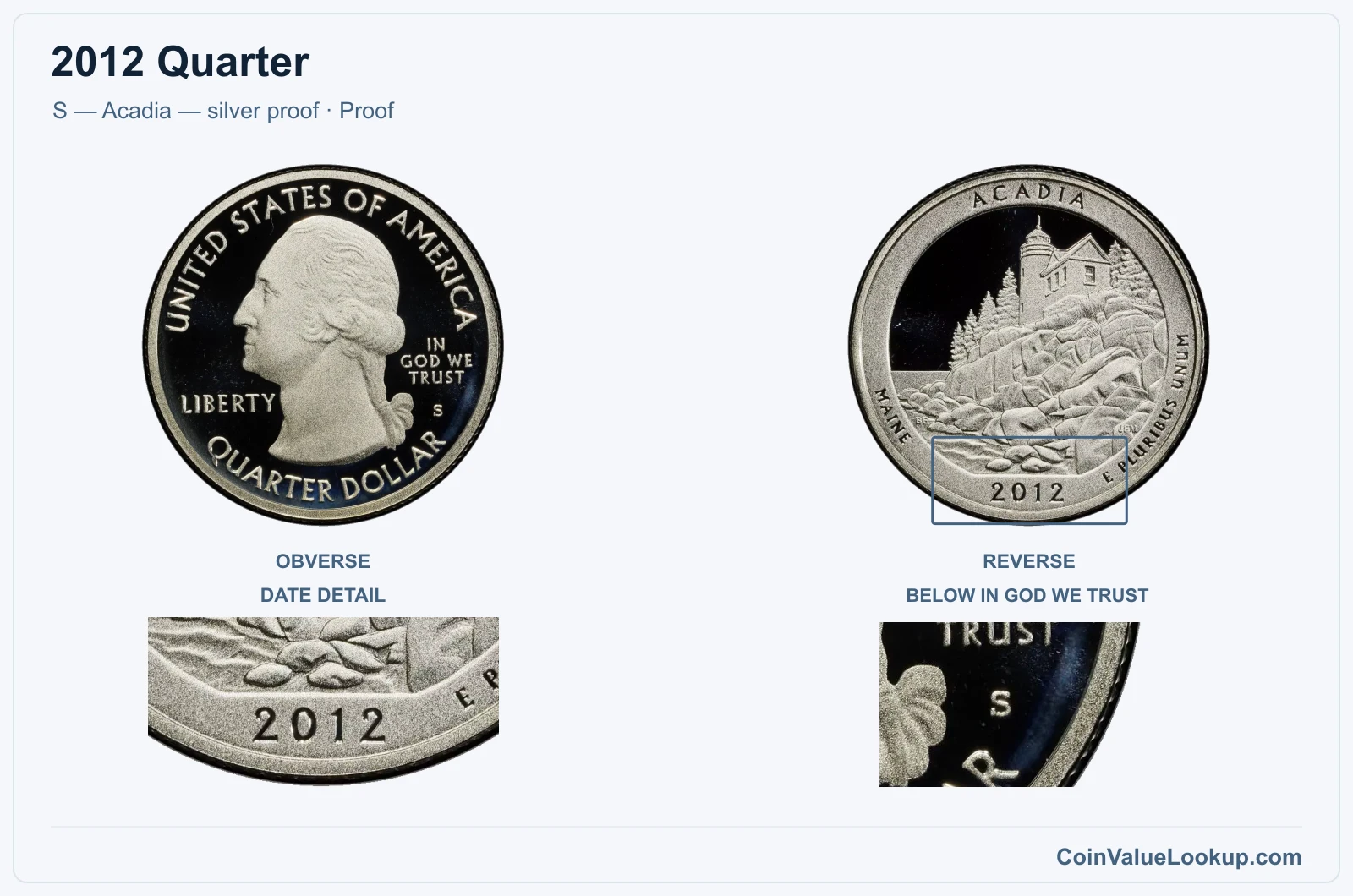
The silver proof Acadia quarter weighs about 6.25 grams and is composed of 90% silver and 10% copper. It looks almost identical to the clad proof face-on, so you need to check the edge or weigh it.
USA Coin Book estimates $24.00 in PR65. This is tied with the other 2012 silver proofs for the highest guide value among the year's quarters.
The silver composition and limited mintage are what set it apart. Keep it in a capsule or original holder to preserve the mirror surfaces.
Range Grade
Price Auction Records Appraisal PR PR 1
—
Coin Identifier
PR 2
—
Coin Identifier
PR 3
—
Coin Identifier
PR 4
—
Coin Identifier
PR 6
—
Coin Identifier
PR 8
—
Coin Identifier
PR 10
—
Coin Identifier
PR 12
—
Coin Identifier
PR 15
—
Coin Identifier
PR 20
—
Coin Identifier
PR 25
—
Coin Identifier
PR 30
—
Coin Identifier
PR 35
—
Coin Identifier
PR 40
—
Coin Identifier
PR 45
—
Coin Identifier
PR 50
—
Coin Identifier
PR 53
—
Coin Identifier
PR 55
—
Coin Identifier
PR 58
—
Coin Identifier
PR 60
—
Coin Identifier
PR 61
—
Coin Identifier
PR 62
—
Coin Identifier
PR 63
—
Coin Identifier
PR 64
—
Coin Identifier
PR 65
—
Coin Identifier
PR 66
—
Coin Identifier
PR 67
—
Coin Identifier
PR 68
—
Coin Identifier
PR 69
—
Coin Identifier
PR 70
Coin Identifier
2012 Quarter — P — Hawaii Volcanoes — regular strike
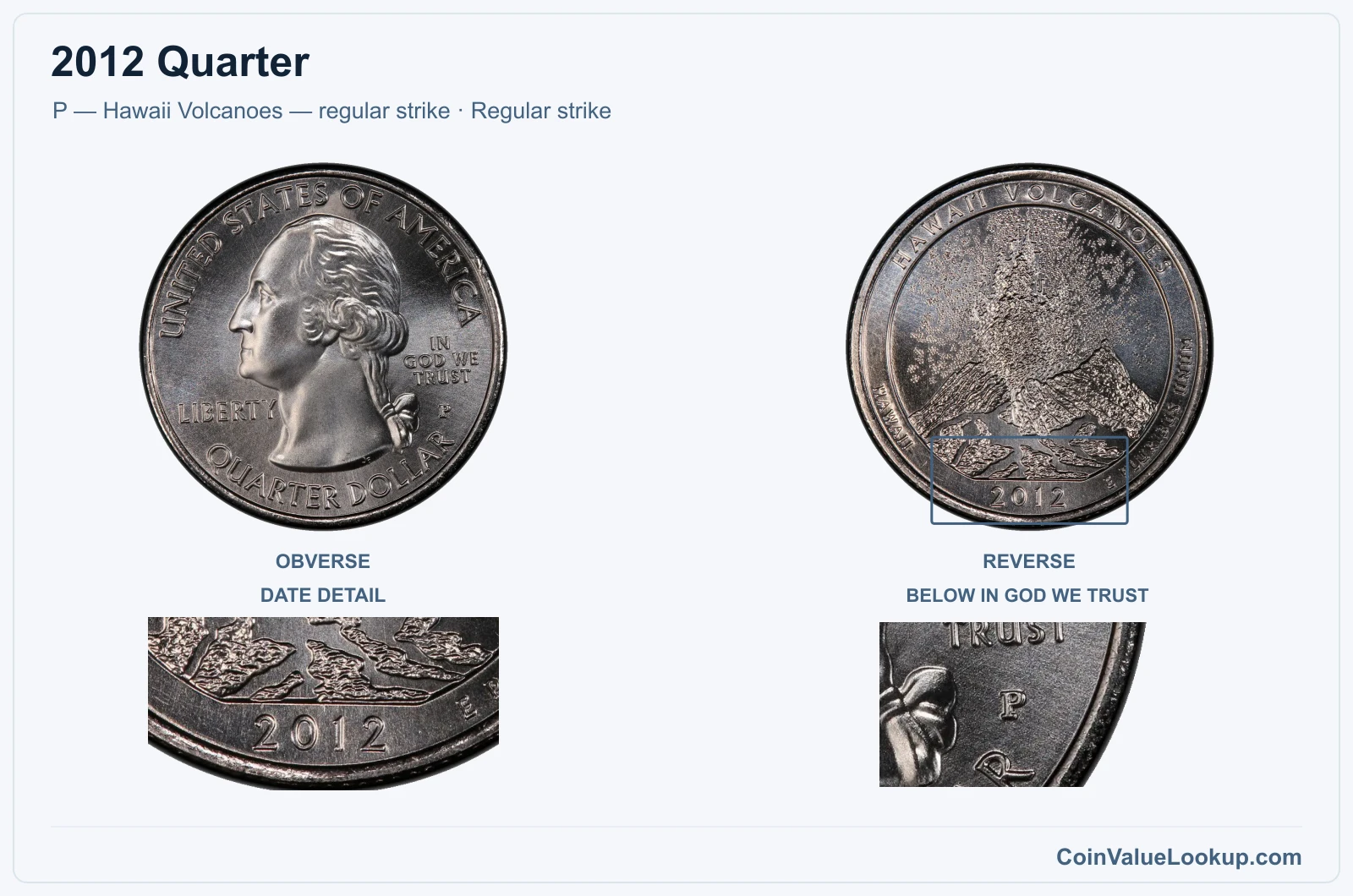
The Philadelphia Hawaii Volcanoes quarter features an eruption scene from Kilauea. Copper-nickel clad, P mintmark, standard 24.26 mm diameter.
From circulation, it is worth 25 cents. USA Coin Book estimates $0.74 at MS60 and $2.50 at MS65 for uncirculated examples.
The volcanic plume area on the reverse can attract the eye, so marks there are especially noticeable when grading. Look for unbroken luster across the full obverse cheek as well.
Range Grade
Price Auction Records Appraisal PO PO 1
—
Coin Identifier FR FR 2
—
Coin Identifier AG AG 3
—
Coin Identifier G G 4
—
Coin Identifier
G 6
—
Coin Identifier VG VG 8
—
Coin Identifier
VG 10
—
Coin Identifier F F 12
—
Coin Identifier
F 15
—
Coin Identifier VF VF 20
—
Coin Identifier
VF 25
—
Coin Identifier
VF 30
—
Coin Identifier
VF 35
—
Coin Identifier XF XF 40
—
Coin Identifier
XF 45
—
Coin Identifier AU AU 50
—
Coin Identifier
AU 53
—
Coin Identifier
AU 55
—
Coin Identifier
AU 58
—
Coin Identifier MS MS 60
—
Coin Identifier
MS 61
—
Coin Identifier
MS 62
—
Coin Identifier
MS 63
—
Coin Identifier
MS 64
—
Coin Identifier
MS 65
—
Coin Identifier
MS 66
—
Coin Identifier
MS 67
Coin Identifier
MS 68
Coin Identifier
MS 69
—
Coin Identifier
MS 70
—
—
—
2012 Quarter — D — Hawaii Volcanoes — regular strike
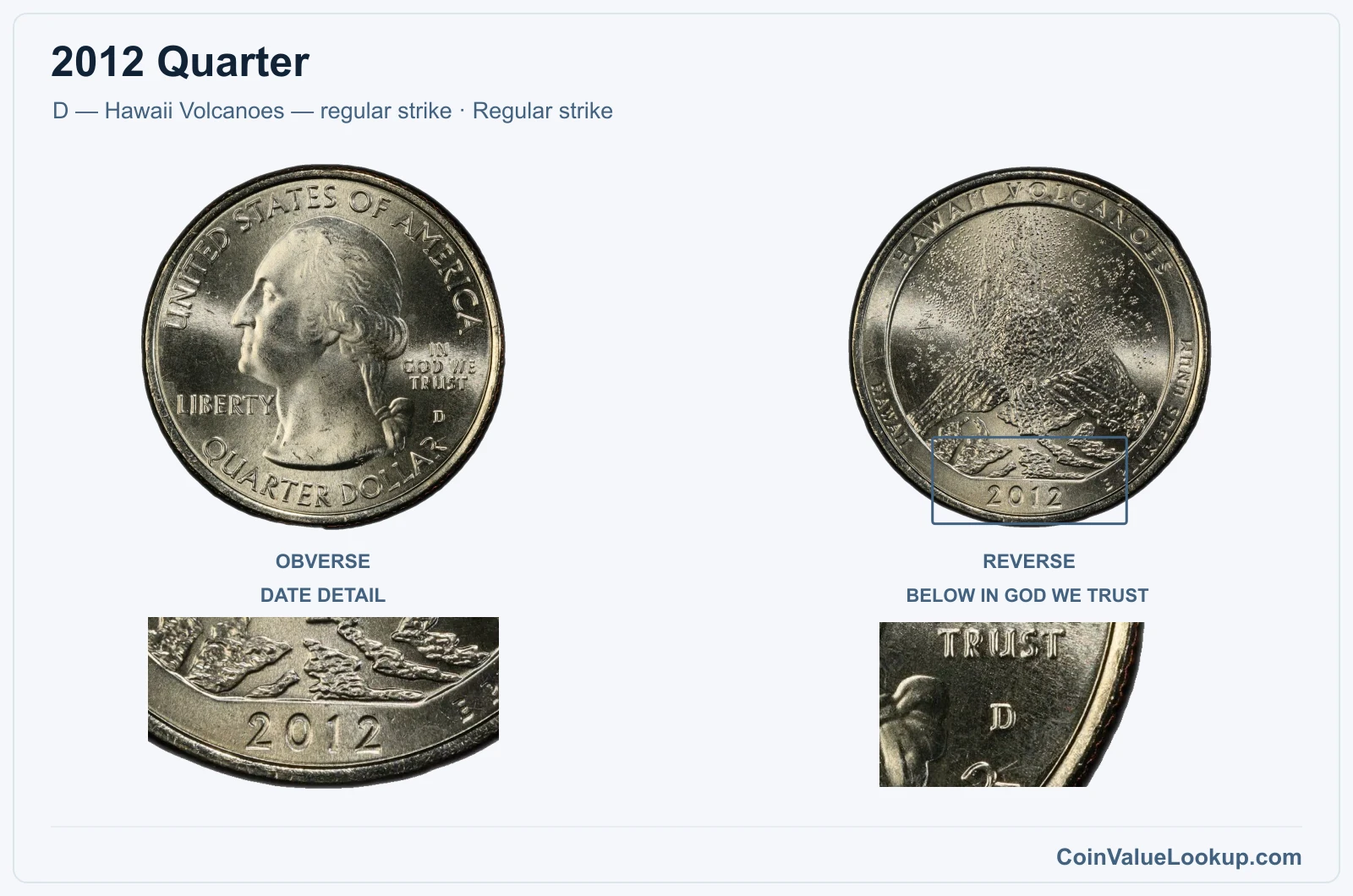
Denver's Hawaii Volcanoes quarter is the D-mint clad version. USA Coin Book lists slightly different guide estimates here: $0.68 at MS60 and $2.50 at MS65.
The MS60 figure is a few cents lower than the P-mint, but at MS65 they converge.
Circulated pieces are worth face value. Original uncirculated coins from rolls or mint sets are where the small premium lives.
Confirm the D mintmark and the Hawaii Volcanoes reverse before checking the price chart.
Range Grade
Price Auction Records Appraisal PO PO 1
—
Coin Identifier FR FR 2
—
Coin Identifier AG AG 3
—
Coin Identifier G G 4
—
Coin Identifier
G 6
—
Coin Identifier VG VG 8
—
Coin Identifier
VG 10
—
Coin Identifier F F 12
—
Coin Identifier
F 15
—
Coin Identifier VF VF 20
—
Coin Identifier
VF 25
—
Coin Identifier
VF 30
—
Coin Identifier
VF 35
—
Coin Identifier XF XF 40
—
Coin Identifier
XF 45
—
Coin Identifier AU AU 50
—
Coin Identifier
AU 53
—
Coin Identifier
AU 55
—
Coin Identifier
AU 58
—
Coin Identifier MS MS 60
—
Coin Identifier
MS 61
—
Coin Identifier
MS 62
—
Coin Identifier
MS 63
—
Coin Identifier
MS 64
—
Coin Identifier
MS 65
—
Coin Identifier
MS 66
—
Coin Identifier
MS 67
—
Coin Identifier
MS 68
Coin Identifier
MS 69
—
—
—
MS 70
—
—
—
2012 Quarter — S — Hawaii Volcanoes — regular strike
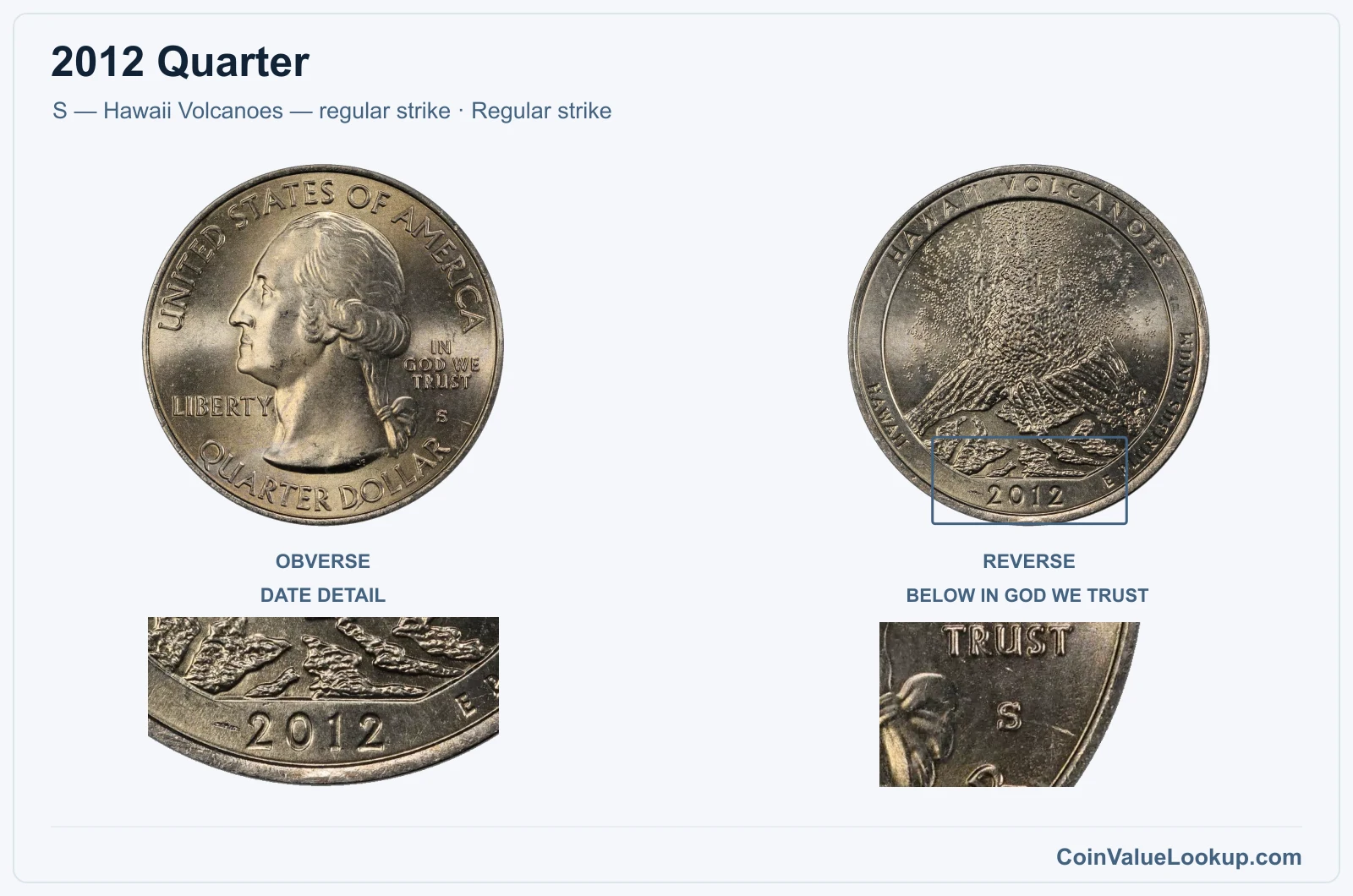
San Francisco's regular-strike Hawaii Volcanoes quarter is copper-nickel clad and was distributed in collector sets. The S mintmark alone does not indicate a proof — look at the surface finish.
USA Coin Book estimates $2.50 at MS65. This is lower than the S-mint regular strikes of some other 2012 reverses.
Still, it carries a premium over a worn P or D coin. Handle it carefully and store it properly to preserve the original surfaces.
Range Grade
Price Auction Records Appraisal PO PO 1
—
Coin Identifier FR FR 2
—
Coin Identifier AG AG 3
—
Coin Identifier G G 4
—
Coin Identifier
G 6
—
Coin Identifier VG VG 8
—
Coin Identifier
VG 10
—
Coin Identifier F F 12
—
Coin Identifier
F 15
—
Coin Identifier VF VF 20
—
Coin Identifier
VF 25
—
Coin Identifier
VF 30
—
Coin Identifier
VF 35
—
Coin Identifier XF XF 40
—
Coin Identifier
XF 45
—
Coin Identifier AU AU 50
—
Coin Identifier
AU 53
—
Coin Identifier
AU 55
—
Coin Identifier
AU 58
—
Coin Identifier MS MS 60
—
Coin Identifier
MS 61
—
Coin Identifier
MS 62
—
Coin Identifier
MS 63
—
Coin Identifier
MS 64
—
Coin Identifier
MS 65
—
Coin Identifier
MS 66
—
Coin Identifier
MS 67
Coin Identifier
MS 68
—
—
—
MS 69
—
—
—
MS 70
—
—
—
2012 Quarter — S — Hawaii Volcanoes — clad proof
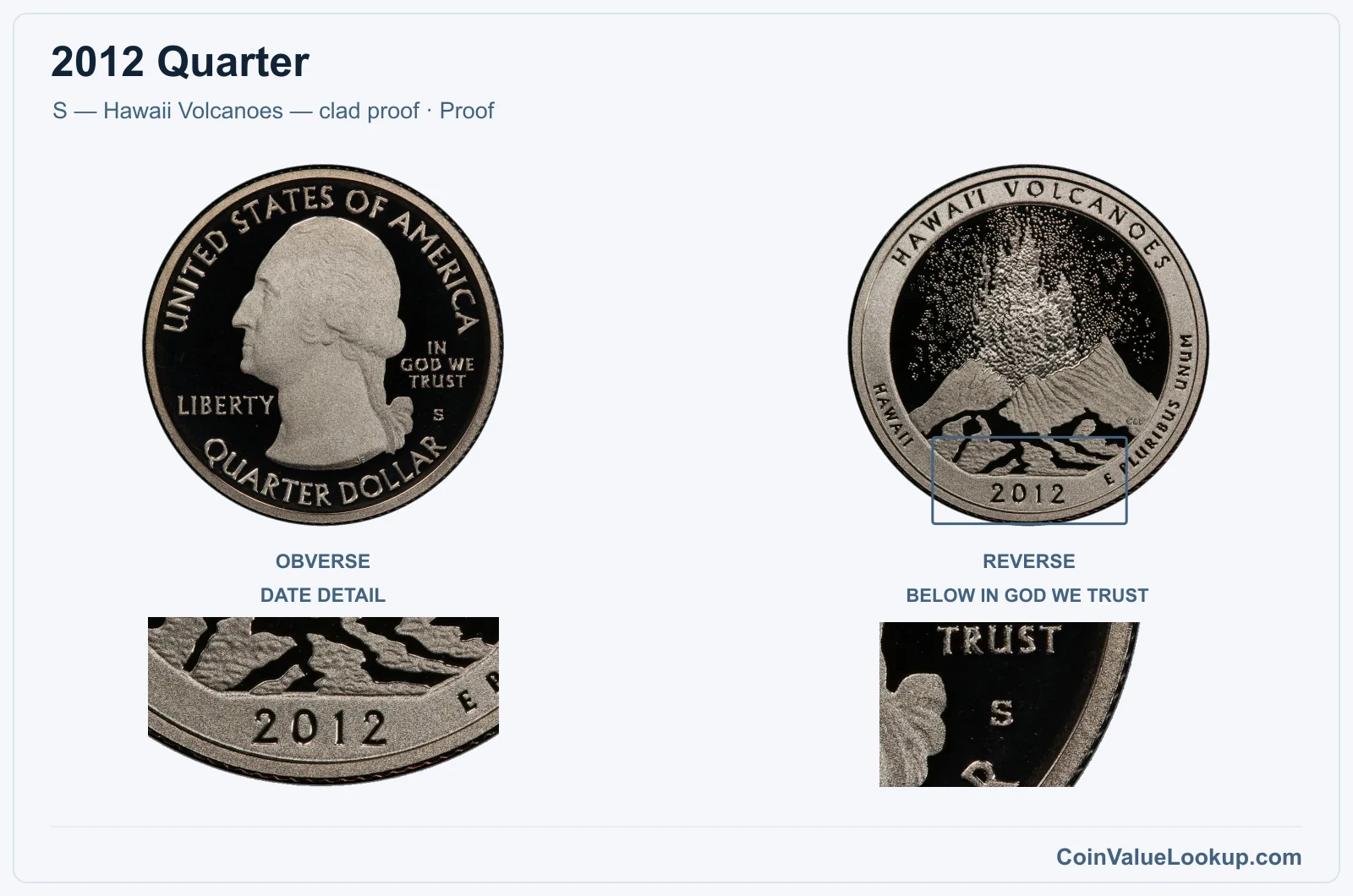
The clad proof Hawaii Volcanoes quarter has mirror fields and frosted devices, struck at San Francisco on a copper-nickel clad planchet. The eruption design looks particularly dramatic with the proof contrast.
USA Coin Book estimates $5.63 at PR65. This is a guide figure, not a guaranteed offer.
To separate it from the silver proof, check the edge or weigh it. Clad runs about 5.67 grams; silver is closer to 6.25 grams.
Range Grade
Price Auction Records Appraisal PR PR 1
—
Coin Identifier
PR 2
—
Coin Identifier
PR 3
—
Coin Identifier
PR 4
—
Coin Identifier
PR 6
—
Coin Identifier
PR 8
—
Coin Identifier
PR 10
—
Coin Identifier
PR 12
—
Coin Identifier
PR 15
—
Coin Identifier
PR 20
—
Coin Identifier
PR 25
—
Coin Identifier
PR 30
—
Coin Identifier
PR 35
—
Coin Identifier
PR 40
—
Coin Identifier
PR 45
—
Coin Identifier
PR 50
—
Coin Identifier
PR 53
—
Coin Identifier
PR 55
—
Coin Identifier
PR 58
—
Coin Identifier
PR 60
—
Coin Identifier
PR 61
—
Coin Identifier
PR 62
—
Coin Identifier
PR 63
—
Coin Identifier
PR 64
—
Coin Identifier
PR 65
—
Coin Identifier
PR 66
—
Coin Identifier
PR 67
—
Coin Identifier
PR 68
—
Coin Identifier
PR 69
Coin Identifier
PR 70
Coin Identifier
2012 Quarter — S — Hawaii Volcanoes — silver proof
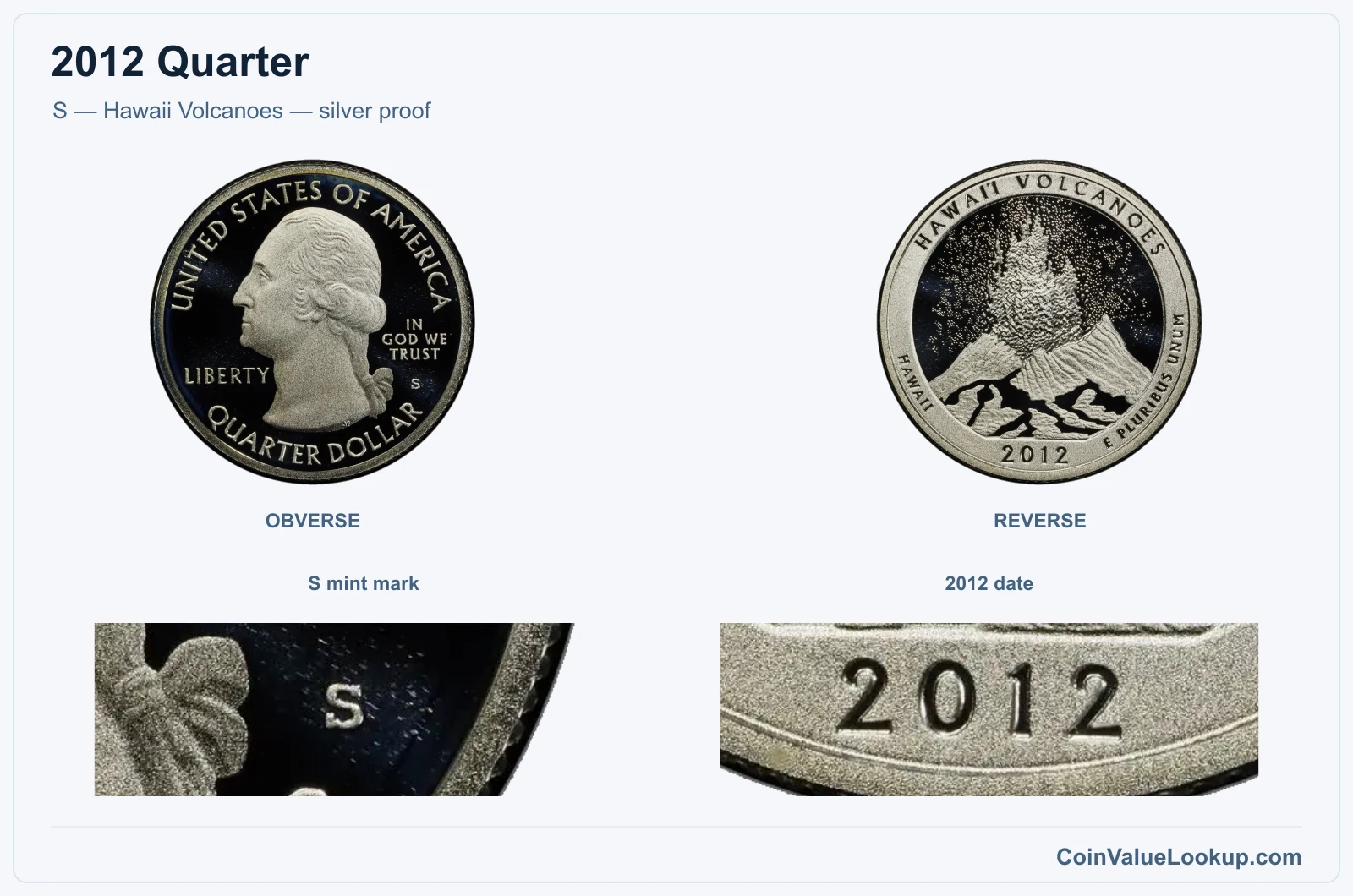
The silver proof Hawaii Volcanoes quarter is 90% silver, weighing roughly 6.25 grams. It shares the proof finish with the clad version but the composition bumps the guide value significantly.
USA Coin Book estimates $24.00 at PR65. Silver proofs were sold in separate silver proof sets from the US Mint.
If you have one loose without packaging, checking the edge is the quickest way to confirm silver — no copper stripe visible. Weight on a precision scale settles it definitively.
Range Grade
Price Auction Records Appraisal PR PR 1
—
Coin Identifier
PR 2
—
Coin Identifier
PR 3
—
Coin Identifier
PR 4
—
Coin Identifier
PR 6
—
Coin Identifier
PR 8
—
Coin Identifier
PR 10
—
Coin Identifier
PR 12
—
Coin Identifier
PR 15
—
Coin Identifier
PR 20
—
Coin Identifier
PR 25
—
Coin Identifier
PR 30
—
Coin Identifier
PR 35
—
Coin Identifier
PR 40
—
Coin Identifier
PR 45
—
Coin Identifier
PR 50
—
Coin Identifier
PR 53
—
Coin Identifier
PR 55
—
Coin Identifier
PR 58
—
Coin Identifier
PR 60
—
Coin Identifier
PR 61
—
Coin Identifier
PR 62
—
Coin Identifier
PR 63
—
Coin Identifier
PR 64
—
Coin Identifier
PR 65
—
Coin Identifier
PR 66
—
Coin Identifier
PR 67
—
Coin Identifier
PR 68
—
Coin Identifier
PR 69
Coin Identifier
PR 70
Coin Identifier
2012 Quarter — P — Denali — regular strike
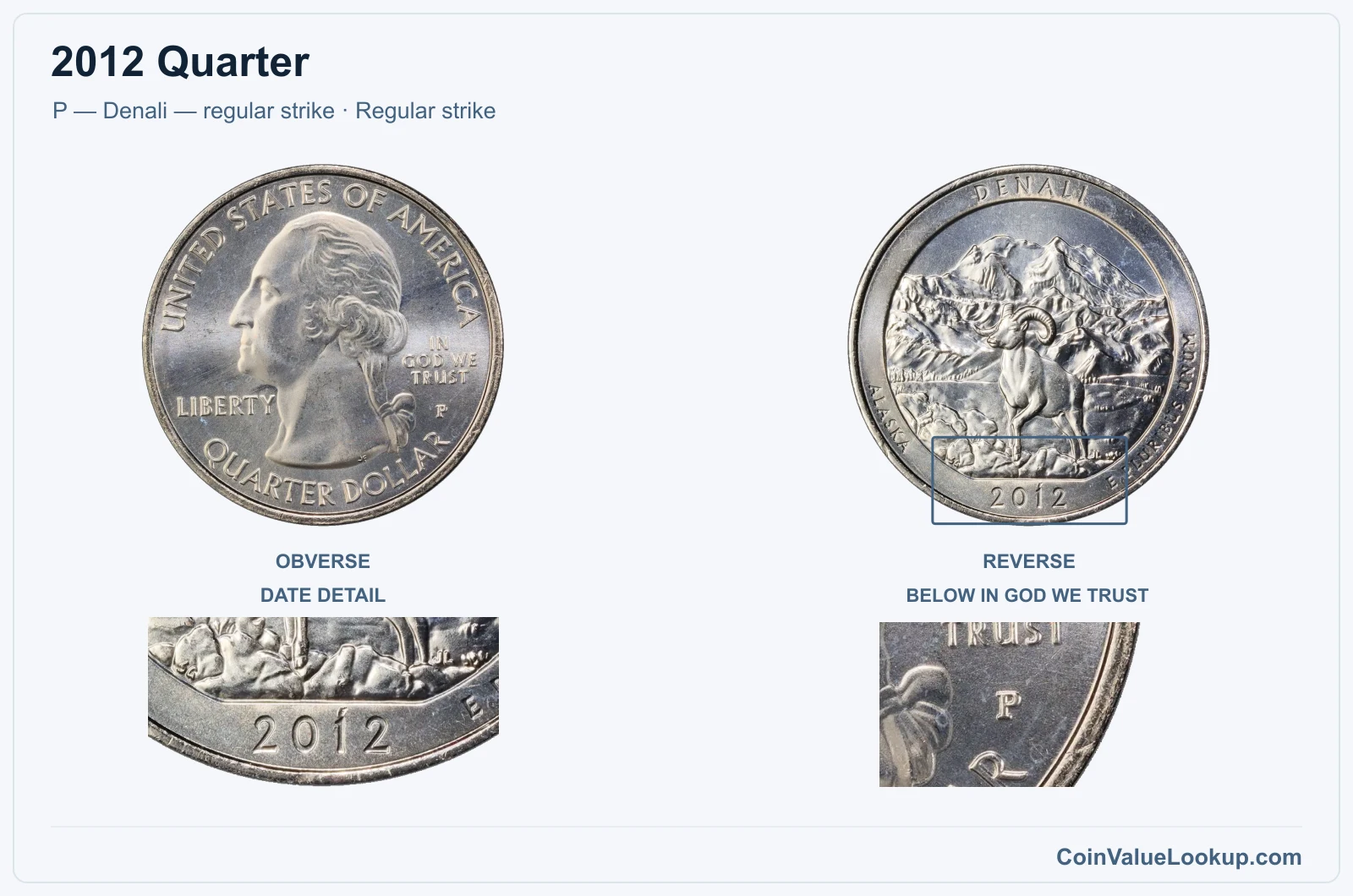
The Philadelphia Denali quarter shows a Dall sheep against the backdrop of Alaska's Denali. Copper-nickel clad, P mintmark.
USA Coin Book estimates $0.61 at MS60 and $2.50 at MS65. The MS60 figure is the lowest among all 2012 P-mint business strikes in this guide.
Circulated examples are face value. For the MS65 premium, your coin needs original luster and minimal contact marks, especially across the sheep's body and Washington's cheek.
Range Grade
Price Auction Records Appraisal PO PO 1
—
Coin Identifier FR FR 2
—
Coin Identifier AG AG 3
—
Coin Identifier G G 4
—
Coin Identifier
G 6
—
Coin Identifier VG VG 8
—
Coin Identifier
VG 10
—
Coin Identifier F F 12
—
Coin Identifier
F 15
—
Coin Identifier VF VF 20
—
Coin Identifier
VF 25
—
Coin Identifier
VF 30
—
Coin Identifier
VF 35
—
Coin Identifier XF XF 40
—
Coin Identifier
XF 45
—
Coin Identifier AU AU 50
—
Coin Identifier
AU 53
—
Coin Identifier
AU 55
—
Coin Identifier
AU 58
—
Coin Identifier MS MS 60
—
Coin Identifier
MS 61
—
Coin Identifier
MS 62
—
Coin Identifier
MS 63
—
Coin Identifier
MS 64
—
Coin Identifier
MS 65
—
Coin Identifier
MS 66
—
Coin Identifier
MS 67
Coin Identifier
MS 68
—
—
—
MS 69
—
—
—
MS 70
—
—
—
2012 Quarter — D — Denali — regular strike
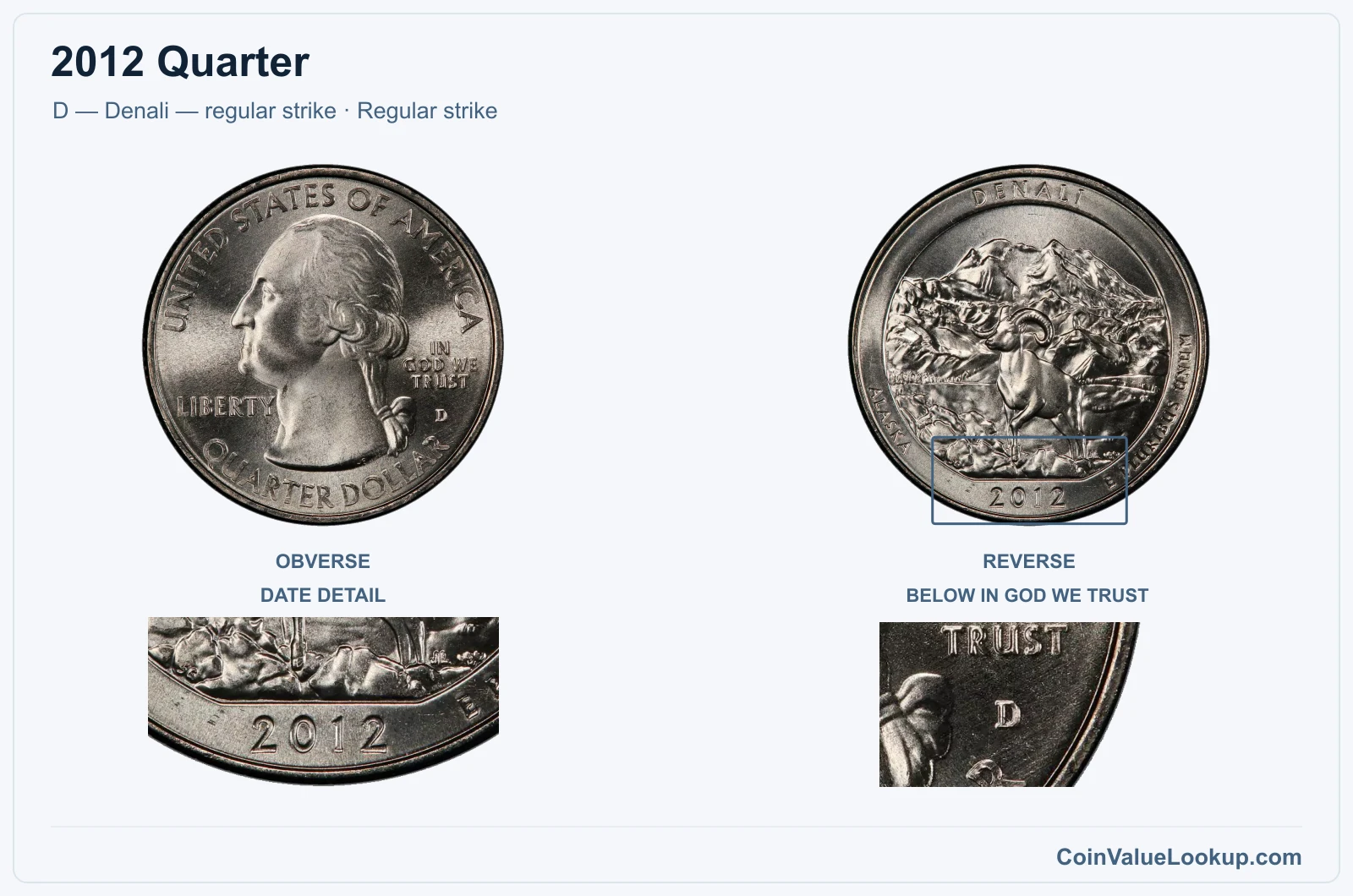
The Denver Denali quarter matches the P-mint version in composition and design, just with a D mintmark. USA Coin Book lists $0.61 at MS60 and $2.50 at MS65.
These were struck in large quantities, so finding one in change is common. Finding one that qualifies as MS65 is another story.
Any scuff across the sheep or the open field behind it will be visible and may limit the grade. Check rolls if you want the best shot at a clean example.
Range Grade
Price Auction Records Appraisal PO PO 1
—
Coin Identifier FR FR 2
—
Coin Identifier AG AG 3
—
Coin Identifier G G 4
—
Coin Identifier
G 6
—
Coin Identifier VG VG 8
—
Coin Identifier
VG 10
—
Coin Identifier F F 12
—
Coin Identifier
F 15
—
Coin Identifier VF VF 20
—
Coin Identifier
VF 25
—
Coin Identifier
VF 30
—
Coin Identifier
VF 35
—
Coin Identifier XF XF 40
—
Coin Identifier
XF 45
—
Coin Identifier AU AU 50
—
Coin Identifier
AU 53
—
Coin Identifier
AU 55
—
Coin Identifier
AU 58
—
Coin Identifier MS MS 60
—
Coin Identifier
MS 61
—
Coin Identifier
MS 62
—
Coin Identifier
MS 63
—
Coin Identifier
MS 64
—
Coin Identifier
MS 65
—
Coin Identifier
MS 66
—
Coin Identifier
MS 67
Coin Identifier
MS 68
—
—
—
MS 69
—
—
—
MS 70
—
—
—
2012 Quarter — S — Denali — regular strike
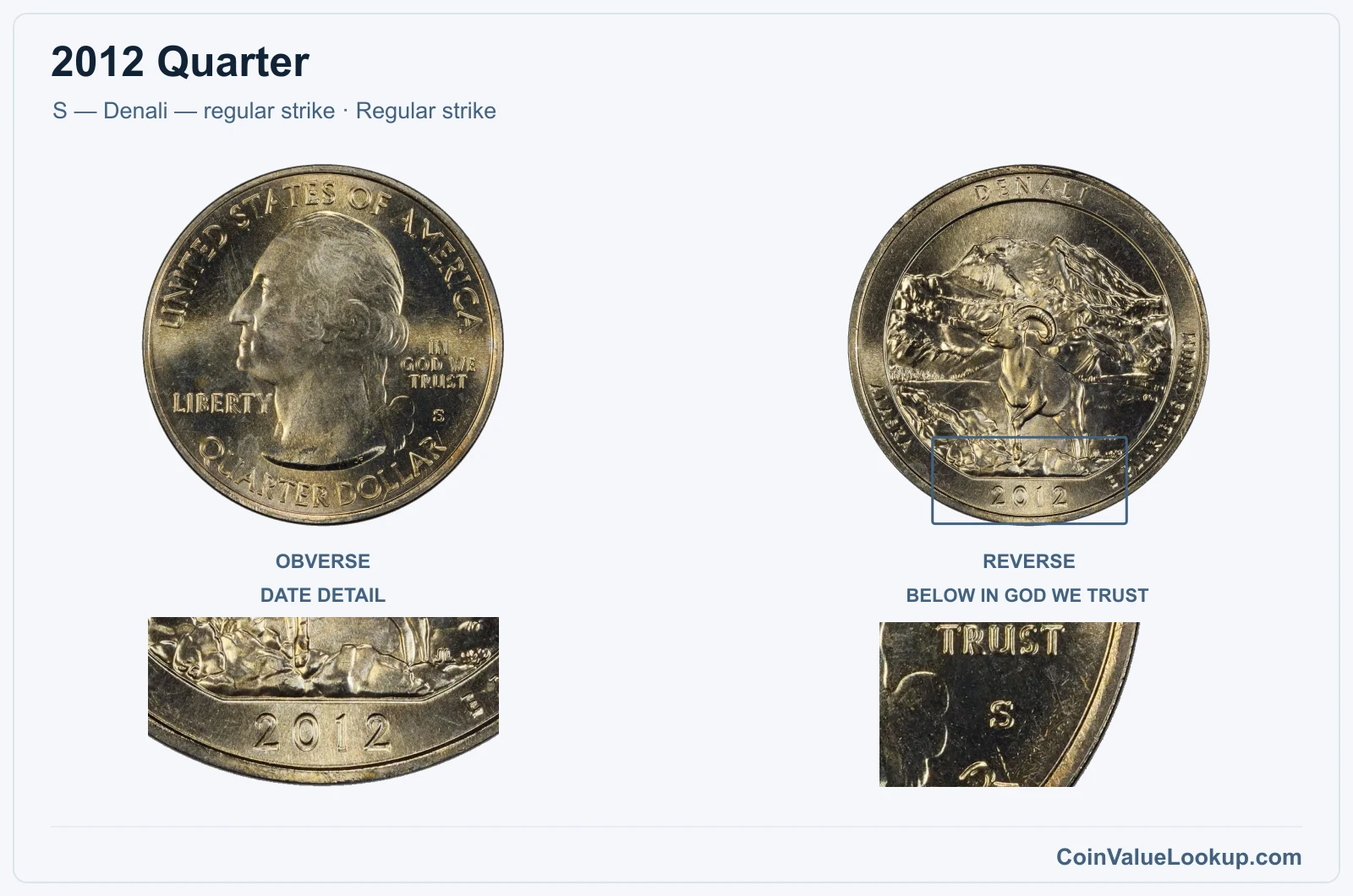
San Francisco's regular-strike Denali quarter is copper-nickel clad, produced for collector sets rather than circulation. Look for satiny surfaces, not mirror fields, to distinguish it from the proof.
USA Coin Book estimates $10.00 at MS65. That is a meaningful jump above the P and D versions and reflects the collector-only distribution.
As with the other S-mint regular strikes, careful handling is essential — these were never intended for pockets.
Range Grade
Price Auction Records Appraisal PO PO 1
—
Coin Identifier FR FR 2
—
Coin Identifier AG AG 3
—
Coin Identifier G G 4
—
Coin Identifier
G 6
—
Coin Identifier VG VG 8
—
Coin Identifier
VG 10
—
Coin Identifier F F 12
—
Coin Identifier
F 15
—
Coin Identifier VF VF 20
—
Coin Identifier
VF 25
—
Coin Identifier
VF 30
—
Coin Identifier
VF 35
—
Coin Identifier XF XF 40
—
Coin Identifier
XF 45
—
Coin Identifier AU AU 50
—
Coin Identifier
AU 53
—
Coin Identifier
AU 55
—
Coin Identifier
AU 58
—
Coin Identifier MS MS 60
—
Coin Identifier
MS 61
—
Coin Identifier
MS 62
—
Coin Identifier
MS 63
—
Coin Identifier
MS 64
—
Coin Identifier
MS 65
—
Coin Identifier
MS 66
Coin Identifier
MS 67
Coin Identifier
MS 68
—
Coin Identifier
MS 69
—
—
—
MS 70
—
—
—
2012 Quarter — S — Denali — clad proof
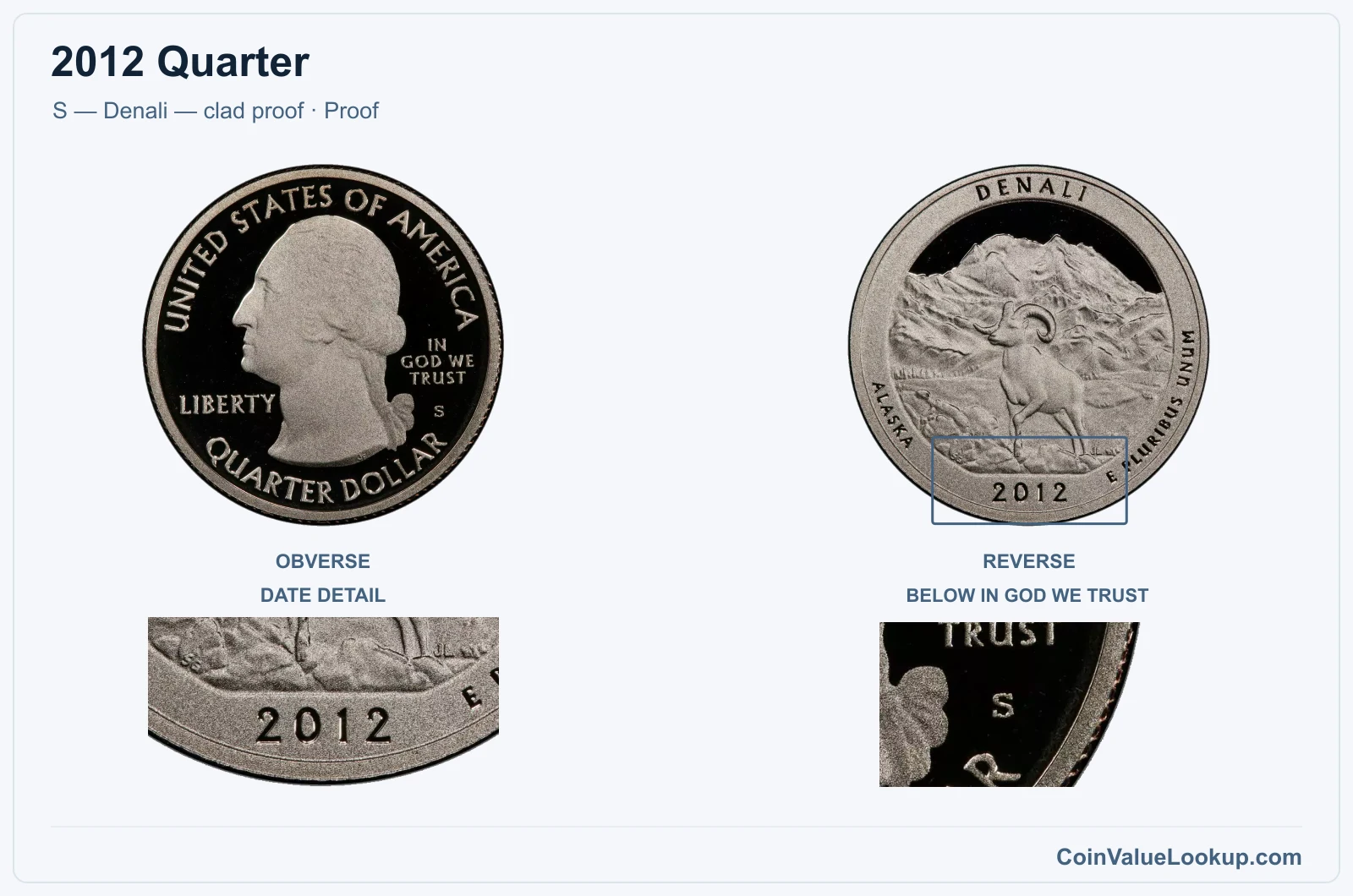
The clad proof Denali quarter was struck at San Francisco with mirrored fields and frosted devices on a copper-nickel clad planchet. The Dall sheep design shows nice contrast in proof format.
USA Coin Book places this at $5.63 in PR65. Confirm it is clad and not silver by checking the edge or weighing the coin.
A clad proof weighs about 5.67 grams. Hairlines in the open field areas behind the sheep are the most common grade-reducing feature.
Range Grade
Price Auction Records Appraisal PR PR 1
—
Coin Identifier
PR 2
—
Coin Identifier
PR 3
—
Coin Identifier
PR 4
—
Coin Identifier
PR 6
—
Coin Identifier
PR 8
—
Coin Identifier
PR 10
—
Coin Identifier
PR 12
—
Coin Identifier
PR 15
—
Coin Identifier
PR 20
—
Coin Identifier
PR 25
—
Coin Identifier
PR 30
—
Coin Identifier
PR 35
—
Coin Identifier
PR 40
—
Coin Identifier
PR 45
—
Coin Identifier
PR 50
—
Coin Identifier
PR 53
—
Coin Identifier
PR 55
—
Coin Identifier
PR 58
—
Coin Identifier
PR 60
—
Coin Identifier
PR 61
—
Coin Identifier
PR 62
—
Coin Identifier
PR 63
—
Coin Identifier
PR 64
—
Coin Identifier
PR 65
—
Coin Identifier
PR 66
—
Coin Identifier
PR 67
—
Coin Identifier
PR 68
—
Coin Identifier
PR 69
—
Coin Identifier
PR 70
Coin Identifier
2012 Quarter — S — Denali — silver proof
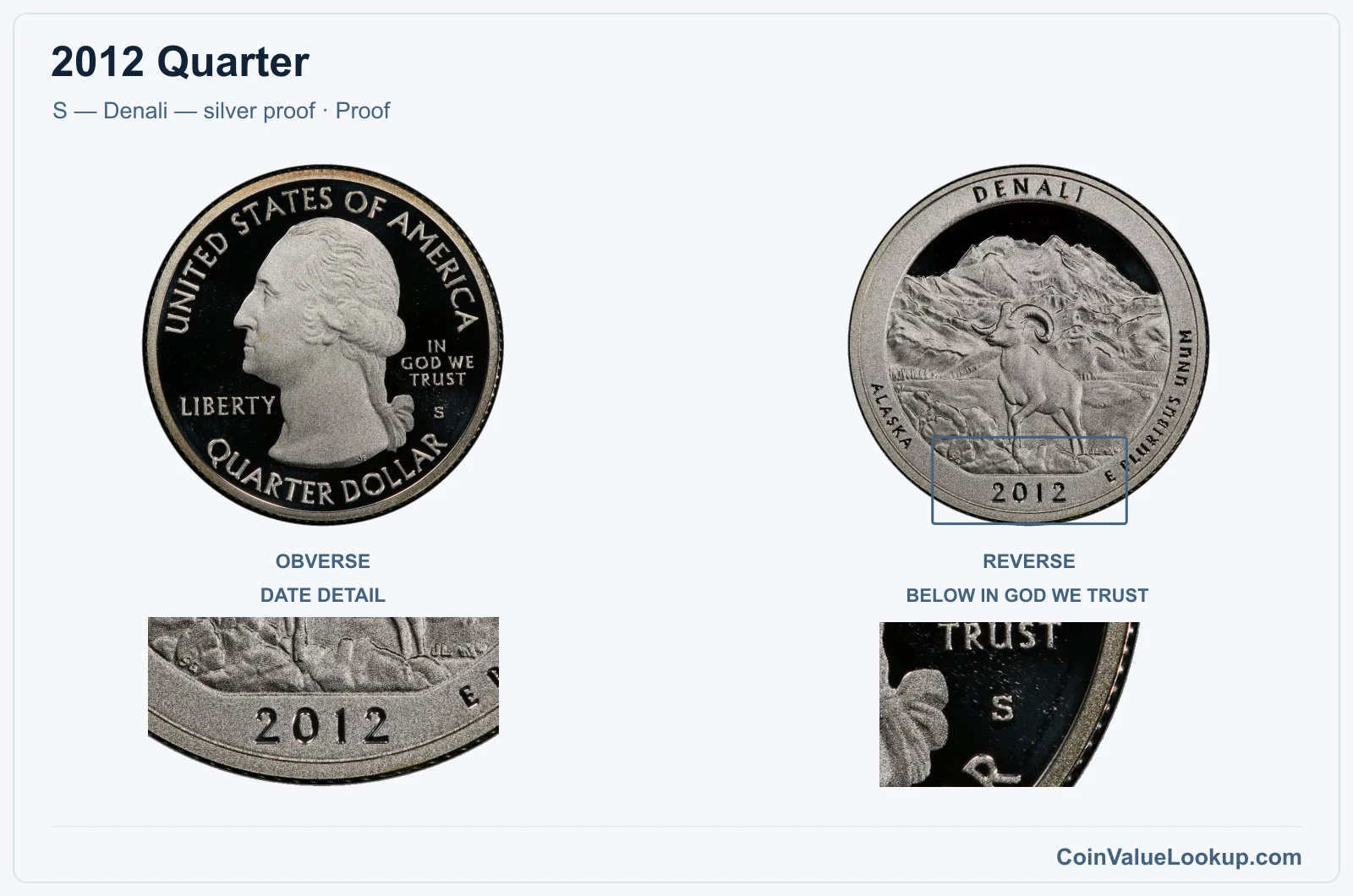
The silver proof Denali quarter is 90% silver, nominally 6.25 grams, with the S mintmark and full proof finish. USA Coin Book estimates $24.00 at PR65, tying it with the other four 2012 silver proofs for the highest listed guide value this year.
Silver proofs came in silver proof sets from the US Mint. If you are unsure of composition, weigh it or examine the edge — silver shows a solid grey cross-section.
Keeping it in the original capsule protects the mirror fields from the hairlines that can erode a proof grade quickly.
Range Grade
Price Auction Records Appraisal PR PR 1
—
Coin Identifier
PR 2
—
Coin Identifier
PR 3
—
Coin Identifier
PR 4
—
Coin Identifier
PR 6
—
Coin Identifier
PR 8
—
Coin Identifier
PR 10
—
Coin Identifier
PR 12
—
Coin Identifier
PR 15
—
Coin Identifier
PR 20
—
Coin Identifier
PR 25
—
Coin Identifier
PR 30
—
Coin Identifier
PR 35
—
Coin Identifier
PR 40
—
Coin Identifier
PR 45
—
Coin Identifier
PR 50
—
Coin Identifier
PR 53
—
Coin Identifier
PR 55
—
Coin Identifier
PR 58
—
Coin Identifier
PR 60
—
Coin Identifier
PR 61
—
Coin Identifier
PR 62
—
Coin Identifier
PR 63
—
Coin Identifier
PR 64
—
Coin Identifier
PR 65
—
Coin Identifier
PR 66
—
Coin Identifier
PR 67
—
Coin Identifier
PR 68
—
Coin Identifier
PR 69
—
Coin Identifier
PR 70
Coin Identifier
2012 Quarter Error List
1. 2012 Quarter — Doubled Die Obverse
A doubled die obverse on a 2012 quarter shows consistent doubling in the obverse lettering or design elements. This is a die variety, meaning every coin struck from that particular die carries the same doubling.
Under magnification, look for separation or notching in letters like LIBERTY or IN GOD WE TRUST, especially along the serifs.
The key word is consistent. Machine doubling — a far more common manufacturing byproduct — tends to produce a flat, shelf-like appearance rather than the rounded secondary image of a true doubled die.
Tilting the coin under a single directional light can help you see whether the doubling is raised and defined or just a flat smear. Condition, the strength of the doubling and collector demand all influence value for this type of error, so individual assessment is important.
2. 2012 Quarter — Denali — Struck-Through Error
A struck-through error on the 2012 P Denali quarter occurs when foreign material — grease, a metal fragment, cloth fiber or something else — sits between the die and the planchet during striking. The result is a localized depression or incomplete area in the design where the obstruction blocked the full impression.
Look for a defined area of missing or weakened detail that does not match normal wear. Grease fill-ins tend to produce a smooth, slightly sunken patch, while a retained foreign object may leave a distinct impression of its shape.
Do not confuse ordinary wear, post-mint scratches or a weak strike with a struck-through. The value depends on the size, visibility and type of obstruction, plus the coin's overall condition.
3. 2012 Quarter — Improper Annealing
Improper annealing means the planchet was not heated correctly before striking. On a 2012 quarter, this can show up as unusual surface discoloration, a different texture or abnormal color compared to a normal coin.
The coin may look darker, streaky or have a woodgrain-like pattern.
Compare the suspect coin's surface and edge to a known normal example under the same lighting. The appearance alone is a screening clue, not proof of the cause.
Environmental toning, corrosion from burial or moisture and post-mint heat exposure can all mimic an annealing error. Value depends on how dramatic the effect is and the coin's overall condition.
Professional attribution helps confirm this type of error because the visual overlap with damage is significant.
4. 2012 Quarter — El Yunque — Die Crack / Die Chip
Die cracks and die chips have been reported on the 2012 D El Yunque quarter. A die crack appears as a raised line on the coin's surface — it is raised because the crack in the die is recessed, and metal flows into it during striking.
A die chip is a small raised blob where a piece of the die broke away.
To identify these, look for thin raised lines running across the design or small raised lumps, especially near letters or the rim. An interior chip stays within the design area.
If a crack extends to the rim and a chunk of the die is missing, that is called a cud, which is a different category. Do not confuse incuse scratches, corrosion spots or foreign material stuck to the surface with die cracks — those are damage, not errors.
Value varies with size and location.
5. 2012 Quarter — Doubled Die Reverse
A doubled die reverse on a 2012 quarter shows doubling in the reverse lettering or design elements that was created during the die-making process. Every coin from that die shares the same doubling pattern.
Look closely at the reverse legends and the main design contours, comparing them to a known normal coin under matching magnification.
True doubled die doubling has a rounded, three-dimensional quality — a secondary image that looks like a shadow of the primary design. Machine doubling, by contrast, produces flat shelf-like distortion and is far more common.
Reflections from proof surfaces can also mimic doubling to the untrained eye. Visibility and the specific area affected drive collector interest.
Individual assessment is needed to establish value for any DDR, as no adopted price range applies broadly.
6. 2012 Quarter — Overdate
An overdate occurs when a die originally hubbed with one date is re-hubbed or re-engraved with a different date, leaving traces of the earlier numerals visible beneath the final date. This is a die variety, not post-mint damage.
On a 2012 quarter, look carefully at each digit in the date for remnants of a different numeral — curved lines, extra serifs or ghost outlines that do not belong to the final 2-0-1-2. A loupe at 10x or higher helps.
Ordinary machine doubling of the date can look similar at first glance but shows flat, mechanical displacement rather than a distinctly different numeral underneath. Damage to individual digits from contact or corrosion can also create misleading shapes.
Value depends on confirmation and visibility of the underlying date.
7. 2012 Quarter — Chaco Culture — Clashed Dies
Clashed dies have been reported on the 2012 P Chaco Culture quarter. A die clash happens when the obverse and reverse dies strike each other without a planchet between them.
The impact transfers faint traces of one die's design onto the opposing die, and those ghost images then appear on subsequent coins.
Look for faint outlines of Washington's portrait in the reverse fields, or traces of the Chaco Culture design on the obverse. These transferred images will align with where the opposing die would have contacted.
Scratches, random raised lines or a brockage (where a struck coin gets stuck and acts as a die) can look similar but have different patterns. Value depends on the strength of the clash and overall coin condition.
8. 2012 Quarter — Chaco Culture — Off-Center Strike
An off-center strike on the 2012 Chaco Culture quarter means the planchet was not properly seated between the dies when struck. The result is a design that is shifted to one side, leaving an unstruck crescent of blank metal on the opposite edge.
The percentage off-center matters. A 5% shift is minor; a 50% shift with a visible date is significantly more collectible.
Check that the date on the obverse is still readable — that is an important factor for desirability. Do not confuse a clipped planchet (a missing piece of the blank before striking), a misaligned die (where the design is shifted but the coin is fully struck) or post-mint flattening with a true off-center error.
Value depends on the degree of misalignment, date visibility and overall condition.
9. 2012 Quarter — Chaco Culture — Die Crack / Die Chip
Die cracks and die chips have been reported on the 2012 Chaco Culture quarter. These appear as raised features on the coin because the corresponding defect in the steel die is recessed, allowing metal to fill the gap during striking.
Raised lines that run across the surface are die cracks. Small raised blobs, often near letters or fine design elements, are die chips.
An interior chip stays within the field; a crack that extends to the rim and involves a missing chunk of die becomes a cud — a distinct category. Incuse scratches (which are pressed into the surface), corrosion and foreign material stuck to the coin are not die cracks.
Examining the feature under magnification and comparing it to a normal example is the best approach. Size, location and visual impact affect value.
10. 2012 Quarter — Chaco Culture — Clipped Planchet
A clipped planchet error on the 2012 Chaco Culture quarter means a portion of the metal blank was missing before the coin was struck. The clip may be curved (from overlapping punches on the strip), straight (from the edge of the strip) or ragged.
Look for a section of the rim and adjacent design that is absent, with the surrounding metal showing flow or thinning rather than a sharp cut. There is often a slight weakness in the design directly opposite the clip, called the Blakesley effect, which can help confirm authenticity.
An edge that has been filed, cut or corroded after minting will look different — the metal will show tool marks or pitting rather than the smooth, natural contour of a clip. Value depends on the size of the missing area and overall condition.
11. 2012 Quarter — Die Break / Cud
A rim cud on a 2012 quarter is a specific type of die break where a chunk of the die along the rim breaks away completely. Because that piece of die is gone, the corresponding area on the coin is a raised, flat blob of metal that merges with the rim and obliterates part of the design.
To identify one, look for a raised, featureless lump connected to the rim. It will have a distinct boundary on the side facing the coin's center.
Interior die breaks — which do not connect to the rim — are related but different in collector terminology. Rim dents, corrosion and die chips can all mimic a cud at first glance.
The raised nature of the feature and its connection to the rim are the distinguishing characteristics. Larger cuds that displace significant design elements tend to attract more collector interest.
12. 2012 Quarter — Missing Clad Layer
A missing clad layer error on a 2012 quarter means one of the outer copper-nickel clad layers was absent from the planchet before striking. The exposed side may show a distinctly different color and texture compared to the normal clad surface.
Compare the affected face to a normal quarter. Then check the edge — on a normal clad coin you can see the copper-nickel layers sandwiching the core.
On a missing-clad coin, one layer will be absent and the edge profile will look wrong. Weight is another useful test; a missing layer means the coin should weigh noticeably less than the standard 5.67 grams.
Toning, plating experiments, corrosion and deliberate surface removal after minting can all produce a similar visual effect. Professional attribution is helpful to confirm this error.
13. 2012 Quarter — Denali — Die Crack / Die Chip
Die cracks and die chips have been reported on the 2012 D Denali quarter. A die crack shows up as a raised line across the coin's surface, tracing the path of a crack in the steel die.
A die chip is a small raised lump where a fragment of the die surface broke away.
Examine the coin under magnification, looking for raised lines that cross design elements or fields. Compare to a normal example to see if the feature is consistent with die deterioration.
If a crack reaches the rim and a larger section of the die has failed, that becomes a cud — a separate and generally more valuable error type. Incuse scratches, surface corrosion and stuck debris are not die cracks.
The size, placement and visual prominence of the crack or chip all influence how much collector interest it generates.