2012 Kennedy Half Dollar Coin Value: How Much Is It Worth?
The 2012 Kennedy half dollar carries a face value of 50 cents, and most ordinary clad examples are worth exactly that. Collector guide estimates for specific mint, finish and grade combinations range from about $3.62 to $78.00 according to USA Coin Book.
Before assuming yours is special, you need to identify the mint, material and finish — proofs and silver issues are a different story from the standard clad coins.
If you have a 2012 half dollar sitting in a drawer, keep reading. Knowing whether it came from Philadelphia, Denver or San Francisco, and whether it is clad or silver, determines everything.
Fast Way to Identify Your 2012 Kennedy Half Dollar
Want a quick starting point? Upload clear photos of both the front and back of your 2012 Kennedy half dollar using the identifier on this page.
It provides a preliminary identification based on what it can see in your images — mint, design type and general version. It does not authenticate errors, assign an exact grade or guarantee a price, but it can point you in the right direction before you dig deeper.
2012 Kennedy Half Dollar Value
Upload both sides of your 2012 Kennedy Half Dollar.
Front Obverse
Upload photo
Back Reverse
Upload photo
Which 2012 Kennedy Half Dollar Versions Are Worth Money?
- The 2012-S silver proof (90% silver, about 12.50 g) carries the highest guide estimate at $78.00 in PR65 — confirm silver content before assuming you have one.
- The 2012-S clad proof is worth checking at an estimated $6.25 in PR65, well above face value for a half dollar.
- Business strikes from P and D are estimated around $3.62 in MS65 — still above face value for well-preserved examples.
- Mint-made errors such as off-center strikes, doubled dies and wrong planchets have been reported for 2012 Kennedy halves and can carry premiums depending on severity and condition.
Step 1: Identify Your 2012 Kennedy Half Dollar Mint Mark and Version
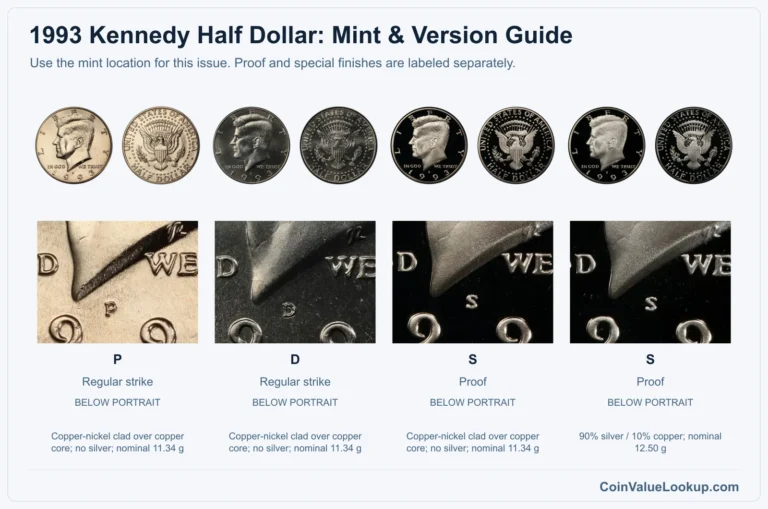
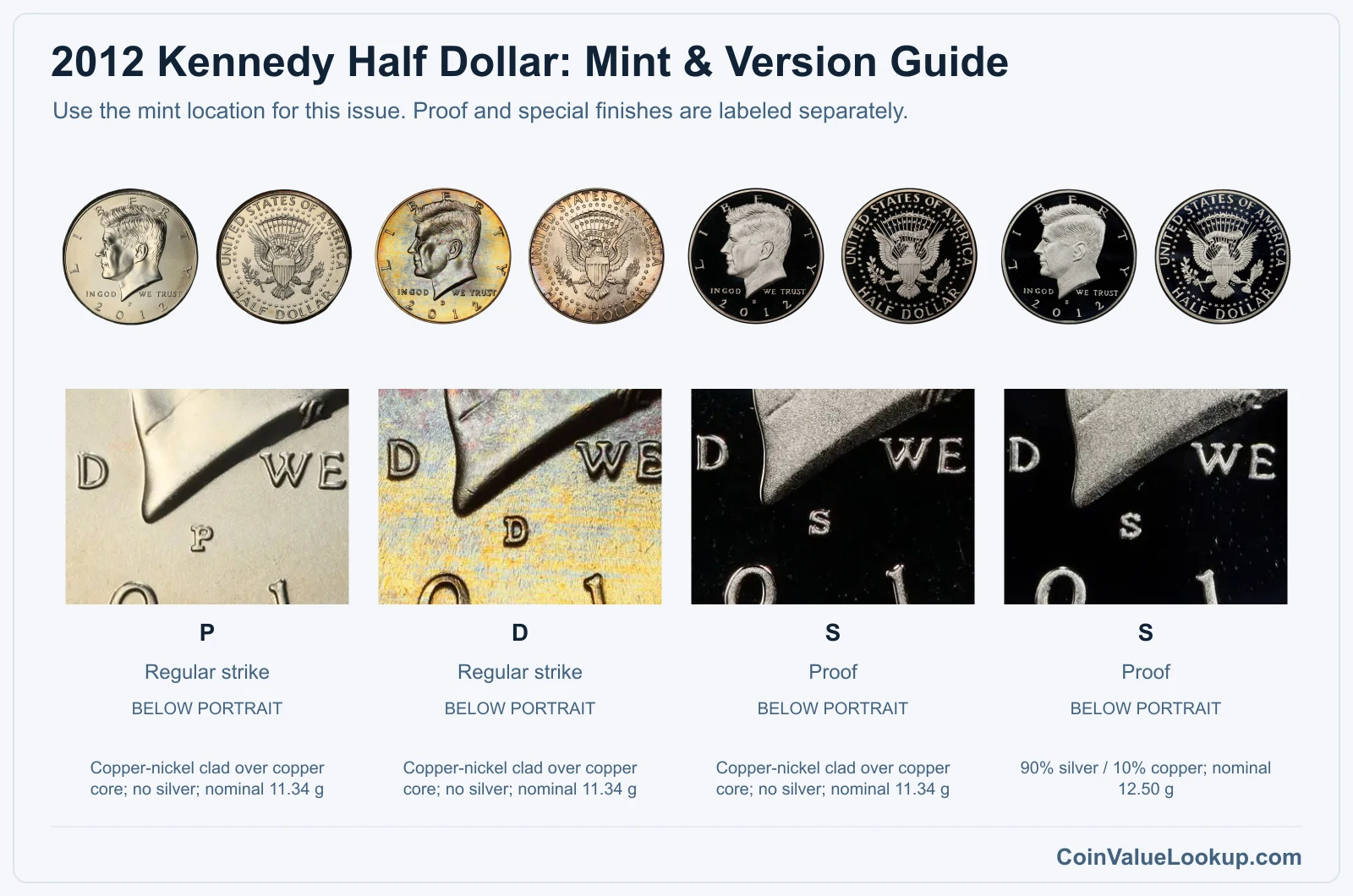
Flip your coin to the obverse — Kennedy's portrait side. Look just below the portrait, above the date, for a small mintmark letter.
A "P" means Philadelphia, "D" means Denver, and "S" means San Francisco.
Philadelphia coins minted before 1980 carry no mintmark at all, but from 1980 onward you should see a "P" on standard strikes. If you see an "S," you have either a clad proof or a silver proof, and that distinction matters a lot for value.
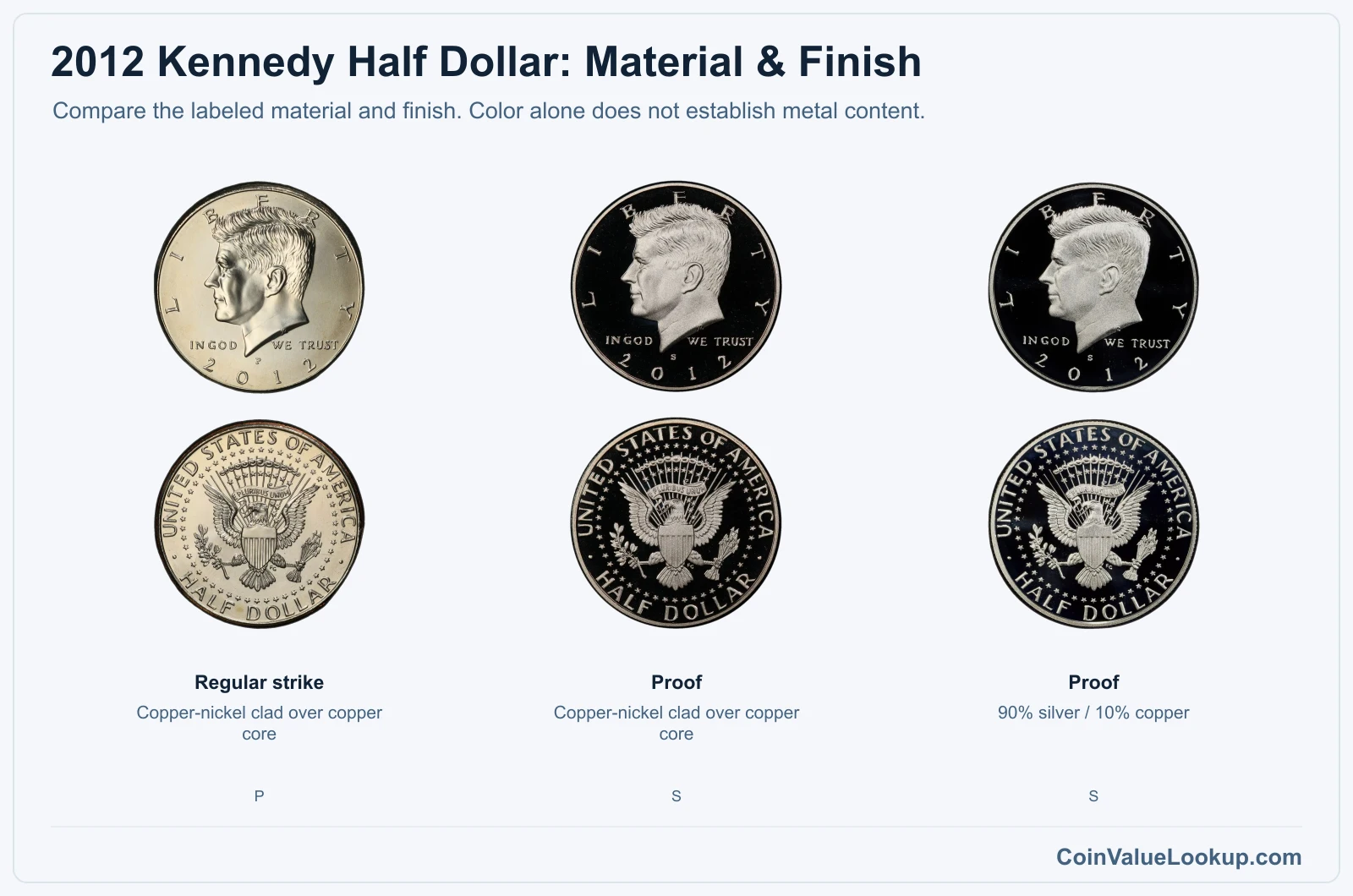
The easiest way to separate the two S-mint versions is weight and edge examination. A standard clad coin weighs about 11.34 grams; the 90% silver proof weighs about 12.50 grams.
If you do not have a precision scale, check the edge — clad coins show a visible copper-colored stripe between outer layers, while the silver proof edge is uniformly silver-toned.
Original packaging also helps. Silver proofs ship in distinct US Mint sets.
Plating, toning and lighting tricks can make a clad coin look silvery or golden, so do not rely on appearance alone.
Both the P and D business strikes from 2012 were distributed primarily through collector channels rather than routine bank circulation. That means many survivors are in original mint-set condition, and truly worn examples were likely broken out of sets and spent.
Step 2: Check Your 2012 Kennedy Half Dollar Grade
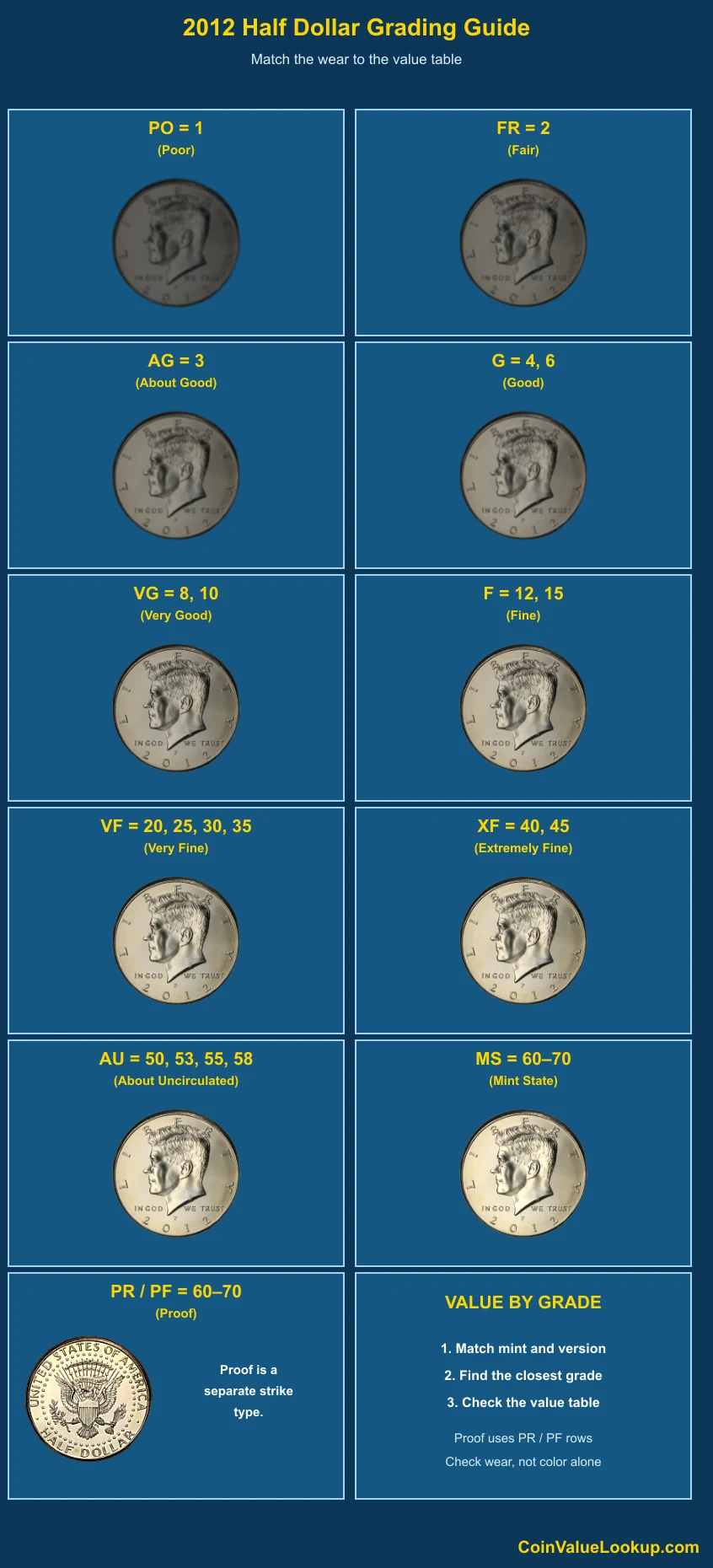
Start at Kennedy's cheek and jawline on the obverse. On a fresh Mint State coin these areas show full luster and no smoothing.
As a coin wears, the cheek flattens first, followed by the hair above the ear.
On the reverse, check the eagle's breast feathers and wing tips. Early wear shows as a loss of fine feather detail that blends into smooth patches.
Bag marks — tiny nicks from contact with other coins — can lower the grade of an uncirculated coin without being actual circulation wear. Compare your coin to the grading image on this page to see the difference between honest wear and storage damage.
Proofs get graded on a separate scale. Look for hairlines from cleaning, haze across the mirror fields and contact marks on frosted devices.
A proof with obvious hairlines is still a proof — it is just a lower-grade one.
Step 3: Check 2012 Kennedy Half Dollar Value by Mint and Version
2012 Kennedy Half Dollar — P — clad business
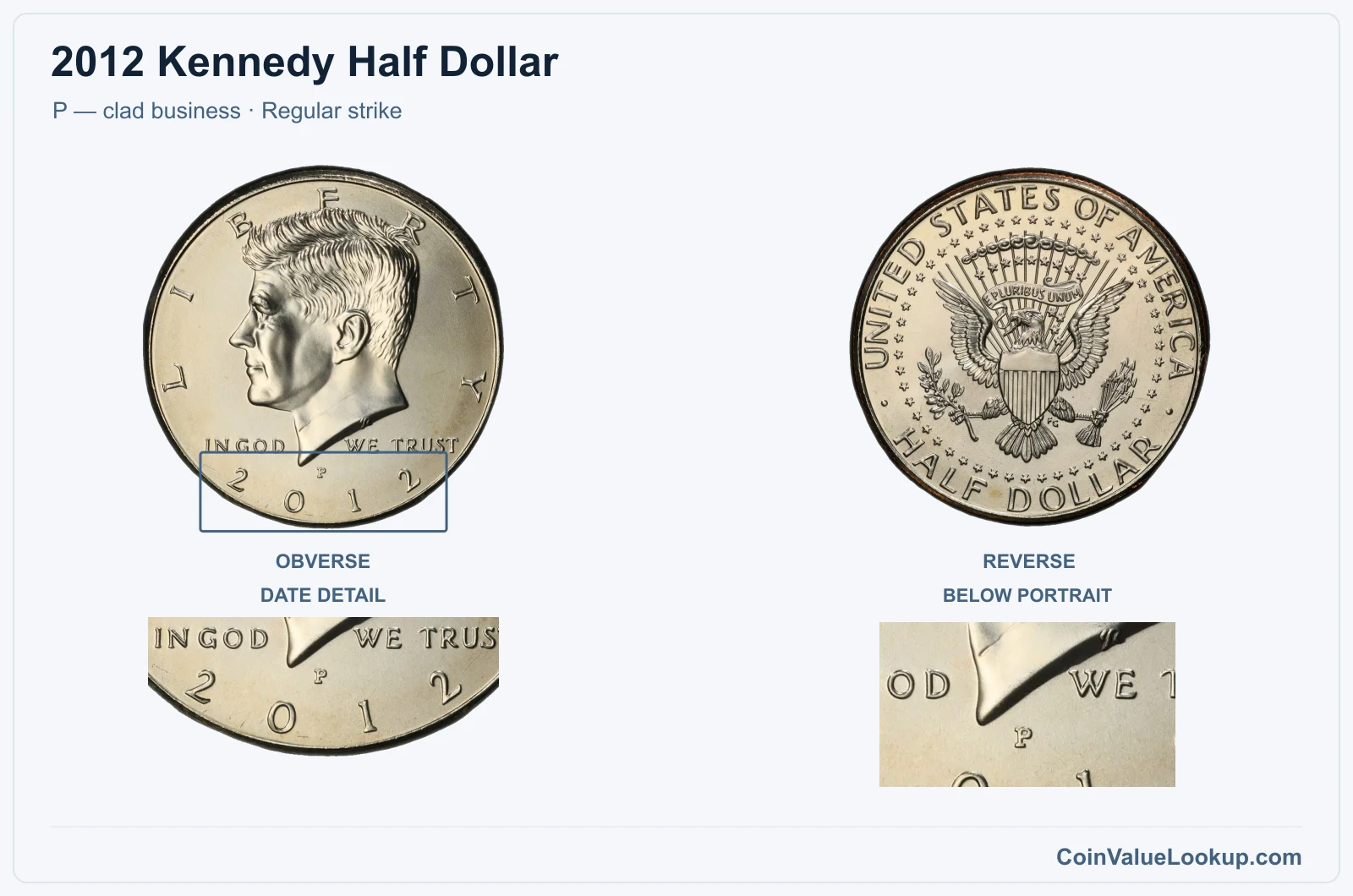
The 2012-P Kennedy half dollar is a copper-nickel clad business strike weighing about 11.34 grams. Look for the "P" mintmark beneath Kennedy's portrait, above the date.
These were sold through US Mint sets rather than dumped into everyday bank circulation, so many examples survive in original uncirculated condition. A USA Coin Book guide estimate places an MS65 example at about $3.62.
Worn pieces — those broken out of sets and spent — are generally worth face value. If yours still has full original luster and minimal bag marks, it sits in the collectible range.
Coin Value Lookup is a good starting point if you are sorting through other dates or denominations alongside your 2012 halves. You can look up guides for the full Kennedy series and compare values across years.
Range Grade
Price Auction Records Appraisal PO PO 1
—
Coin Identifier FR FR 2
—
Coin Identifier AG AG 3
—
Coin Identifier G G 4
—
Coin Identifier
G 6
—
Coin Identifier VG VG 8
—
Coin Identifier
VG 10
—
Coin Identifier F F 12
—
Coin Identifier
F 15
—
Coin Identifier VF VF 20
—
Coin Identifier
VF 25
—
Coin Identifier
VF 30
—
Coin Identifier
VF 35
—
Coin Identifier XF XF 40
—
Coin Identifier
XF 45
—
Coin Identifier AU AU 50
—
Coin Identifier
AU 53
—
Coin Identifier
AU 55
—
Coin Identifier
AU 58
—
Coin Identifier MS MS 60
—
Coin Identifier
MS 61
—
Coin Identifier
MS 62
—
Coin Identifier
MS 63
—
Coin Identifier
MS 64
—
Coin Identifier
MS 65
—
Coin Identifier
MS 66
—
Coin Identifier
MS 67
Coin Identifier
MS 68
Coin Identifier
MS 69
—
—
—
MS 70
—
—
—
2012 Kennedy Half Dollar — D — clad business
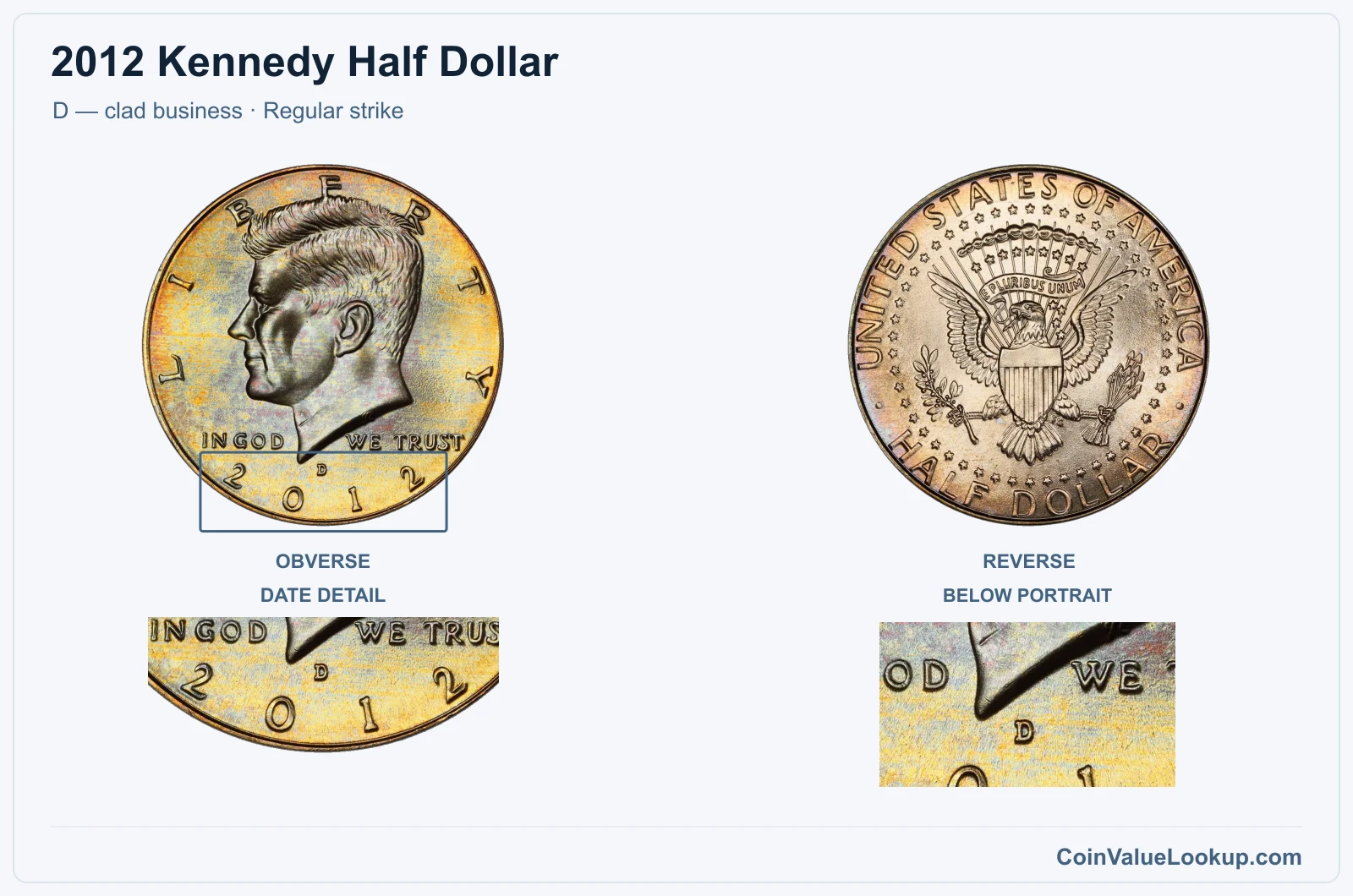
The 2012-D is the Denver Mint's copper-nickel clad business strike, also weighing about 11.34 grams. The "D" mintmark sits in the same spot beneath Kennedy's portrait.
Like the Philadelphia version, these were distributed mainly to collectors through mint sets. A USA Coin Book guide estimate puts an MS65 example at roughly $3.62.
Circulated examples that show wear on the cheek and hair are face-value coins. The key is original mint-set quality: strong luster, sharp hair detail and minimal contact marks push a coin into the collectible tier.
Range Grade
Price Auction Records Appraisal PO PO 1
—
Coin Identifier FR FR 2
—
Coin Identifier AG AG 3
—
Coin Identifier G G 4
—
Coin Identifier
G 6
—
Coin Identifier VG VG 8
—
Coin Identifier
VG 10
—
Coin Identifier F F 12
—
Coin Identifier
F 15
—
Coin Identifier VF VF 20
—
Coin Identifier
VF 25
—
Coin Identifier
VF 30
—
Coin Identifier
VF 35
—
Coin Identifier XF XF 40
—
Coin Identifier
XF 45
—
Coin Identifier AU AU 50
—
Coin Identifier
AU 53
—
Coin Identifier
AU 55
—
Coin Identifier
AU 58
—
Coin Identifier MS MS 60
—
Coin Identifier
MS 61
—
Coin Identifier
MS 62
—
Coin Identifier
MS 63
—
Coin Identifier
MS 64
—
Coin Identifier
MS 65
—
Coin Identifier
MS 66
—
Coin Identifier
MS 67
Coin Identifier
MS 68
Coin Identifier
MS 69
—
—
—
MS 70
—
—
—
2012 Kennedy Half Dollar — S — clad proof
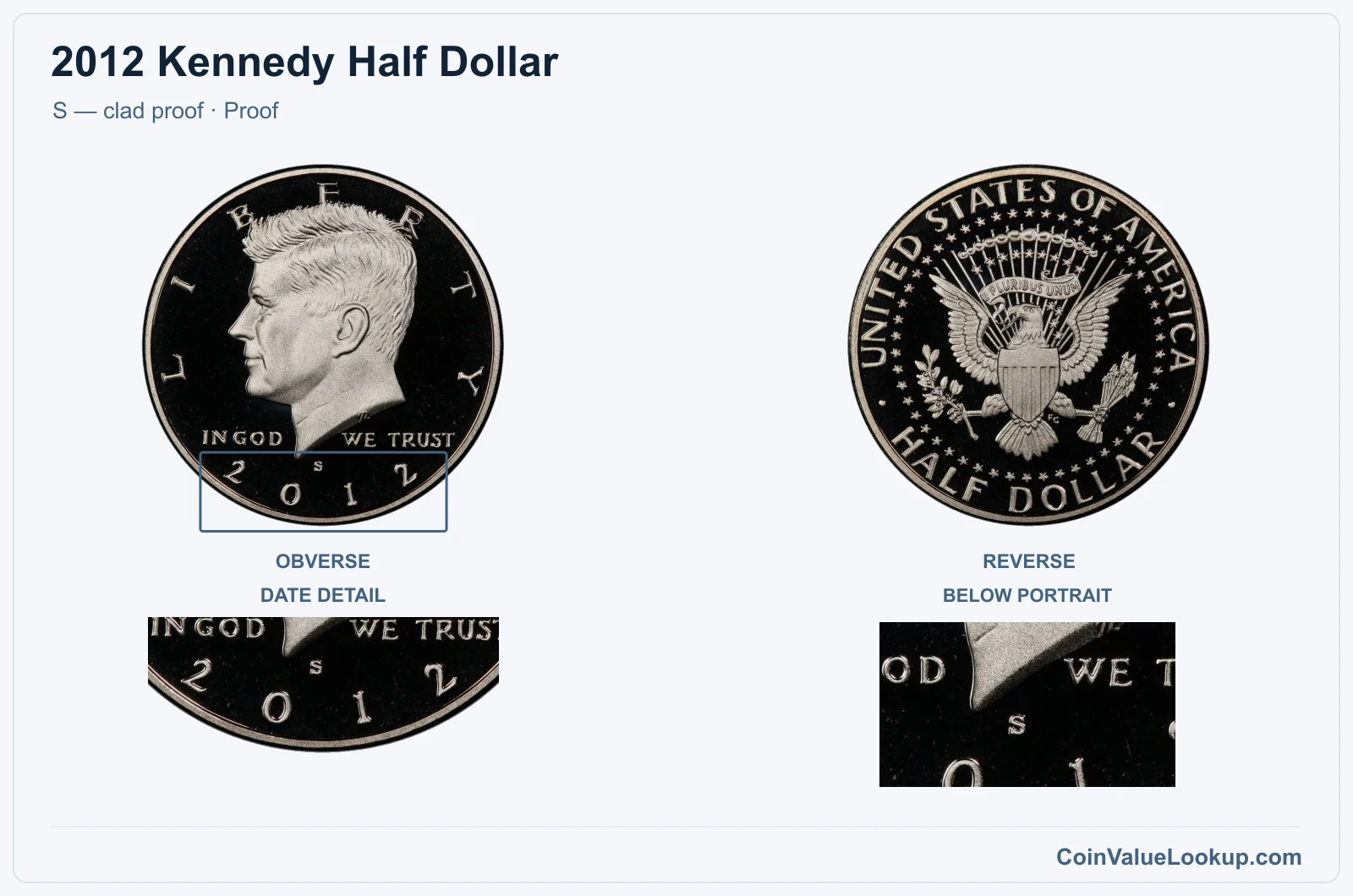
The 2012-S clad proof was struck at San Francisco on a copper-nickel clad planchet, same material as the business strikes. It weighs about 11.34 grams.
Do not confuse it with the silver proof — both carry an "S" mintmark.
Proofs show mirror-like fields and frosted raised devices when properly preserved. A USA Coin Book guide estimate lists a PR65 clad proof at about $6.25.
Grade it by checking for hairlines across the flat mirror surfaces and any haze or contact marks on Kennedy's portrait. The edge will show the copper stripe typical of clad composition, which is the fastest way to separate it from the silver version.
Range Grade
Price Auction Records Appraisal PR PR 1
—
Coin Identifier
PR 2
—
Coin Identifier
PR 3
—
Coin Identifier
PR 4
—
Coin Identifier
PR 6
—
Coin Identifier
PR 8
—
Coin Identifier
PR 10
—
Coin Identifier
PR 12
—
Coin Identifier
PR 15
—
Coin Identifier
PR 20
—
Coin Identifier
PR 25
—
Coin Identifier
PR 30
—
Coin Identifier
PR 35
—
Coin Identifier
PR 40
—
Coin Identifier
PR 45
—
Coin Identifier
PR 50
—
Coin Identifier
PR 53
—
Coin Identifier
PR 55
—
Coin Identifier
PR 58
—
Coin Identifier
PR 60
—
Coin Identifier
PR 61
—
Coin Identifier
PR 62
—
Coin Identifier
PR 63
—
Coin Identifier
PR 64
—
Coin Identifier
PR 65
—
Coin Identifier
PR 66
—
Coin Identifier
PR 67
—
Coin Identifier
PR 68
—
Coin Identifier
PR 69
Coin Identifier
PR 70
Coin Identifier
2012 Kennedy Half Dollar — S — silver proof
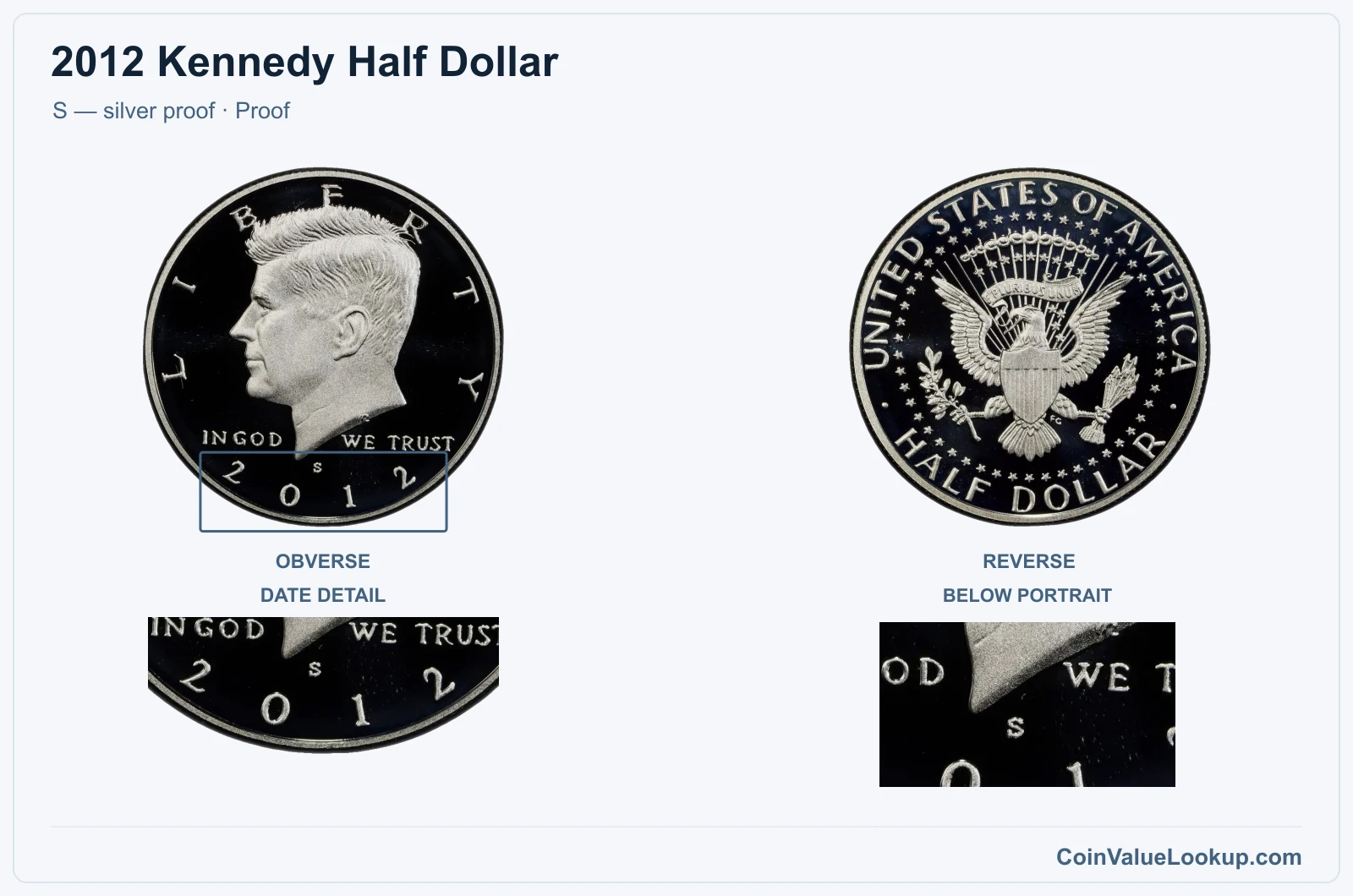
This is the one to look for. The 2012-S silver proof is struck on a 90% silver, 10% copper planchet weighing about 12.50 grams — noticeably heavier than the 11.34-gram clad versions.
A USA Coin Book guide estimate places this coin at $78.00 in PR65, the highest of any 2012 Kennedy half dollar branch at that grade level. Confirm the composition before celebrating: weigh it on a precision scale and examine the edge for a uniform silver-colored cross-section with no copper stripe.
Silver proofs were sold in dedicated US Mint silver proof sets. If yours came in original government packaging, that is strong supporting evidence.
Starting in 2019 the silver fineness changed to .999, but the 2012 issue is the traditional 90% alloy. Handle it by the edges to preserve those mirror fields.
Range Grade
Price Auction Records Appraisal PR PR 1
—
Coin Identifier
PR 2
—
Coin Identifier
PR 3
—
Coin Identifier
PR 4
—
Coin Identifier
PR 6
—
Coin Identifier
PR 8
—
Coin Identifier
PR 10
—
Coin Identifier
PR 12
—
Coin Identifier
PR 15
—
Coin Identifier
PR 20
—
Coin Identifier
PR 25
—
Coin Identifier
PR 30
—
Coin Identifier
PR 35
—
Coin Identifier
PR 40
—
Coin Identifier
PR 45
—
Coin Identifier
PR 50
—
Coin Identifier
PR 53
—
Coin Identifier
PR 55
—
Coin Identifier
PR 58
—
Coin Identifier
PR 60
—
Coin Identifier
PR 61
—
Coin Identifier
PR 62
—
Coin Identifier
PR 63
—
Coin Identifier
PR 64
—
Coin Identifier
PR 65
—
Coin Identifier
PR 66
—
Coin Identifier
PR 67
—
Coin Identifier
PR 68
—
Coin Identifier
PR 69
Coin Identifier
PR 70
Coin Identifier
2012 Kennedy Half Dollar Error List
1. 2012 Kennedy Half Dollar — Off-Center Strike
An off-center strike happens when the planchet is not properly seated between the dies at the moment of striking. The result is a design that is shifted to one side, leaving an unstruck crescent of blank metal.
On a 2012 Kennedy half, look for the displaced portrait or eagle paired with a flat, featureless arc along one edge. The date should still be visible for the coin to be identifiable and collectible.
Greater displacement percentages generally attract more interest, but only if the date remains readable.
Do not confuse this with a clipped planchet, which removes material before striking, or with a coin that was flattened or bent after leaving the mint. Post-mint damage lacks the clean unstruck crescent and proper design alignment that a genuine off-center strike shows.
Value depends on the degree of the error, the coin's condition and collector demand.
2. 2012 Kennedy Half Dollar — Broadstrike
A broadstrike occurs when the coin is struck without the normal retaining collar that shapes the edge and controls diameter. The result is a coin that spreads outward, appearing slightly wider than normal with a distorted or missing rim.
On a 2012 Kennedy half, the full design is typically present — unlike an off-center strike — but the coin looks "pancaked" with metal extending beyond the standard edge. The rim may be weak or absent.
Watch out for lookalikes. A coin that was flattened by machinery or run over after minting can mimic the spread appearance, but it will show surface damage and distortion that a genuine broadstrike does not.
An off-center strike shifts the design; a broadstrike expands it. Value depends on the severity, condition and how cleanly the error presents.
3. 2012 Kennedy Half Dollar — Clipped Planchet
A clipped planchet error means a piece of the blank was missing before the coin was struck. The clip can be curved (the most common shape), straight or ragged, depending on what went wrong during blank production.
On a 2012 Kennedy half, look for a missing section along the edge where the metal ends cleanly and the design fades into the absent area. There is often a slight weakness in the design directly opposite the clip, caused by uneven metal flow during striking.
That opposite weakness is a useful authenticity marker.
Post-mint damage like a filed notch, deliberate cut or edge corrosion can look similar. The difference is that a genuine clip shows natural metal flow at the boundary and consistent design weakness, while damage shows tool marks or irregular surfaces.
Condition and the size of the clip both influence collectibility.
4. 2012 Kennedy Half Dollar — Doubled Die
A doubled die results from a misalignment during die production, creating a die that imprints a slightly doubled image onto every coin it strikes. This is different from machine doubling, which is a far more common and less valuable striking artifact.
On a 2012 Kennedy half, examine lettering, the date and design elements under magnification. True die doubling shows consistent separation or notching on raised elements — the same doubling appears in the same direction on every coin struck from that die.
Machine doubling, by contrast, tends to produce flat, shelf-like distortion rather than raised separation. Reflections, lighting angles and post-mint impressions can also fool you.
If the doubling looks mushy or inconsistent across different design elements, it is probably not a doubled die. Value depends on which elements are doubled, how visible the effect is, and the coin's overall condition.
5. 2012 Kennedy Half Dollar — Missing Clad Layer
A missing clad layer error means one of the outer copper-nickel layers was absent from the planchet before striking. The exposed surface typically shows a different color — a copper tone on the affected side — and the coin will weigh less than the standard 11.34 grams.
On a 2012 Kennedy half, compare both sides. If one face looks copper-colored while the other appears normal, and the edge shows an asymmetric layer structure, you may have a genuine missing clad layer.
Weigh the coin; a measurably light weight supports the error.
Toning, environmental damage, corrosion and deliberate plating removal can all mimic this look. The key difference is that a genuine missing clad error shows a consistent copper surface with normally struck design detail, while post-mint alterations tend to show uneven color, pitting or loss of detail.
6. 2012 Kennedy Half Dollar — Wrong Planchet / Off-Metal Strike
A wrong planchet error means the 2012 Kennedy half dollar dies struck a blank intended for a different denomination or coin series. The result is a coin that carries the Kennedy design but on the wrong size, weight or metal.
To check, compare your coin's weight, diameter and edge characteristics against the standard half dollar specifications. If something is clearly off — the coin is too small, too light, the wrong color, or the design is incomplete because the planchet could not fill the die — a wrong planchet error is possible.
Lookalikes are common. Plated coins, acid-treated coins, and deliberately altered pieces can mimic an unusual appearance.
Genuine wrong planchet errors will have consistent design detail relative to the smaller or different blank, and the weight will match another known planchet type. Professional authentication is strongly recommended for this category.