2012 Sacagawea Dollar Coin Value: How Much Is It Worth?
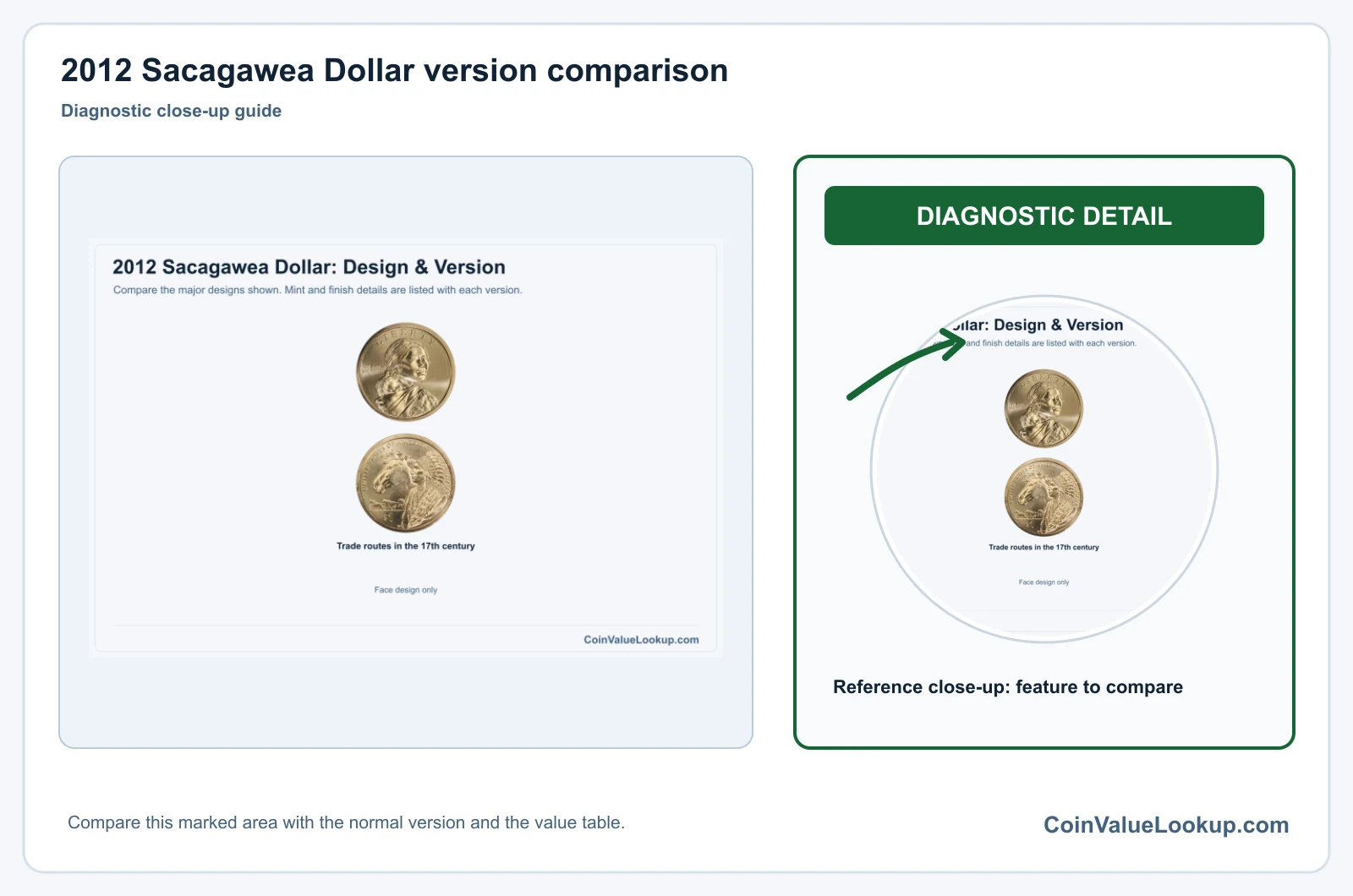
The 2012 Sacagawea Dollar features the "Trade Routes in the 17th Century" reverse design, part of the ongoing Native American Dollar series. Guide estimates for explicitly listed grades and versions range from about $10.00 to $19.00, though these are not guaranteed offers.
Most circulation-strike examples trade close to face value, so the key is confirming your coin's mint, finish and edge-lettering position before assuming any premium.
Fast Way to Identify Your 2012 Sacagawea Dollar
The quickest way to start is to snap clear photos of your coin's front, back and edge, then upload them for a preliminary identification. That step helps confirm the mint, design and whether you have a business strike or proof.
It does not substitute for professional authentication or exact grading, but it gives you a solid starting point.
2012 Sacagawea Dollar Value
Upload both sides of your 2012 Sacagawea Dollar.
Front Obverse
Upload photo
Back Reverse
Upload photo
Which 2012 Sacagawea Dollar Versions Are Worth Money?
- S-mint proof version carries the highest listed guide estimate at $19.00 in PR65, reflecting its collector-only distribution.
- Business strikes from P and D in MS65 list at $10.00 each; most loose examples grade lower and trade near face value.
- Edge-lettering errors, specifically weak or missing lettering, are reported for this year and can carry a premium depending on severity and condition.
- Do not pay a premium for ordinary wear, cleaning, plating, glare or an unverified error claim.
Step 1: Identify Your 2012 Sacagawea Dollar Mint Mark and Version
From 2009 onward, the date and mintmark moved to the edge of the Sacagawea Dollar, so you will not find them on the obverse or reverse. Tilt the coin and read the incuse lettering around the rim.
You are looking for a "P" (Philadelphia), "D" (Denver) or "S" (San Francisco) mintmark.
The 2012 reverse depicts trade routes in the 17th century. All versions are struck in manganese-brass clad, weighing 8.10 grams with an overall composition of 88.5% copper, 6% zinc, 3.5% manganese and 2% nickel.
The golden color is cosmetic, not gold content.
Business strikes from P and D come in two edge-lettering orientations, Position A and Position B. Hold the obverse facing you and check whether the edge lettering reads normally from the bottom (Position A) or from the top (Position B).
The S-mint version is a proof, sold only in collector sets. A coin purchased in a silver proof set is still this same manganese-brass composition; being packaged alongside silver coins does not make the dollar silver.
Coin Value Lookup is a useful starting point when you want to look up guides for other years, mints or denominations in the series. It can help you quickly narrow down what you are holding.
Step 2: Check Your 2012 Sacagawea Dollar Grade
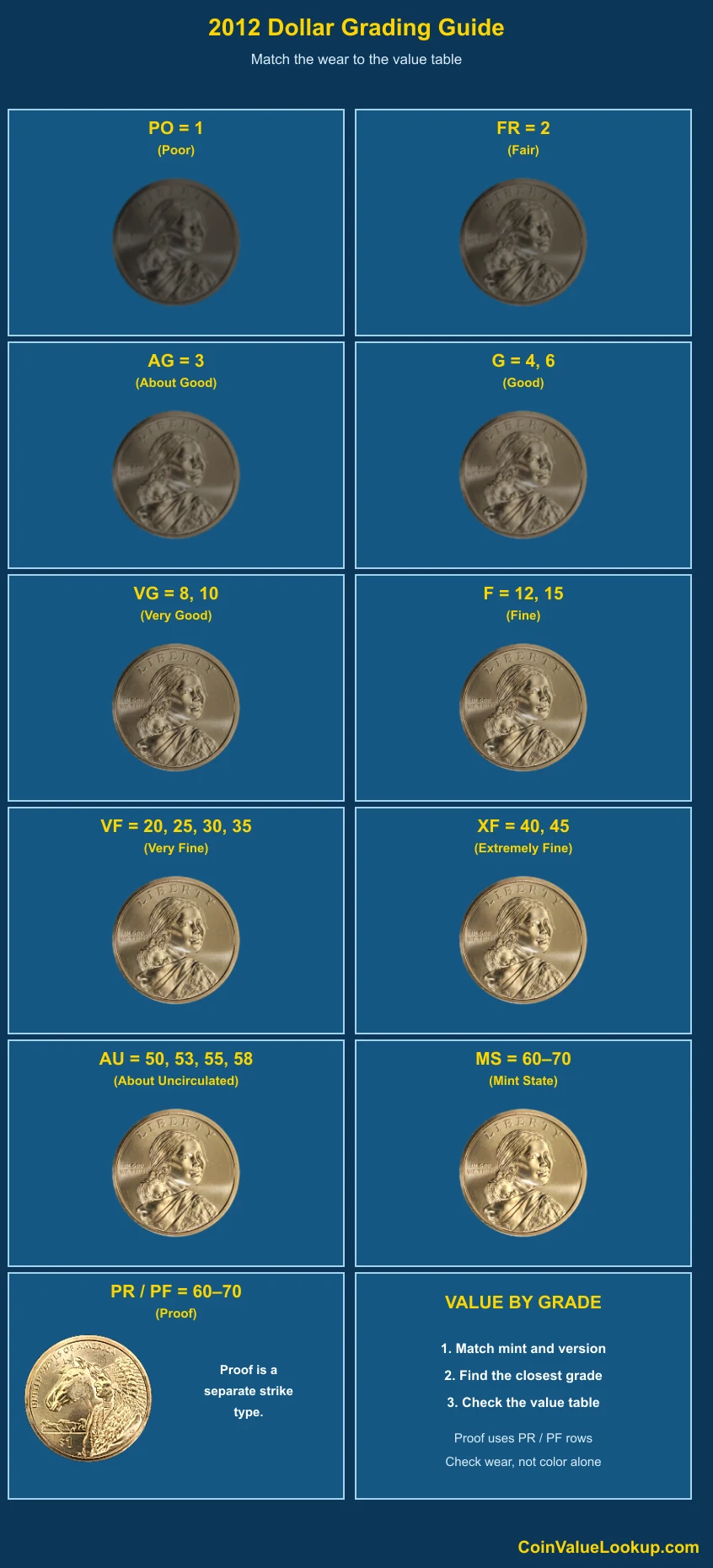
Focus on Sacagawea's cheekbone and the fine hair detail above her forehead. These high points show wear first.
On the reverse, check the raised elements of the trade-route design for any flattening or loss of detail.
A circulated coin will show obvious smoothing on the cheek and a dull, contact-marked surface. An About Uncirculated piece retains most luster but has slight friction on those same high spots.
A true Mint State coin shows full original luster with no wear, only varying degrees of contact marks separating MS60 from MS65 and above.
Proofs are a different animal. They have mirror-like fields and frosted raised devices produced by a special striking process.
Grade a proof against other proofs, not against business strikes. Look for hairlines, haze and handling marks rather than circulation wear.
Compare your coin against a genuine same-type grading image to see these differences side by side. That visual reference is far more useful than any written description.
Step 3: Check 2012 Sacagawea Dollar Value by Mint and Version
2012 Sacagawea Dollar — P — Trade routes in the 17th century — Position A
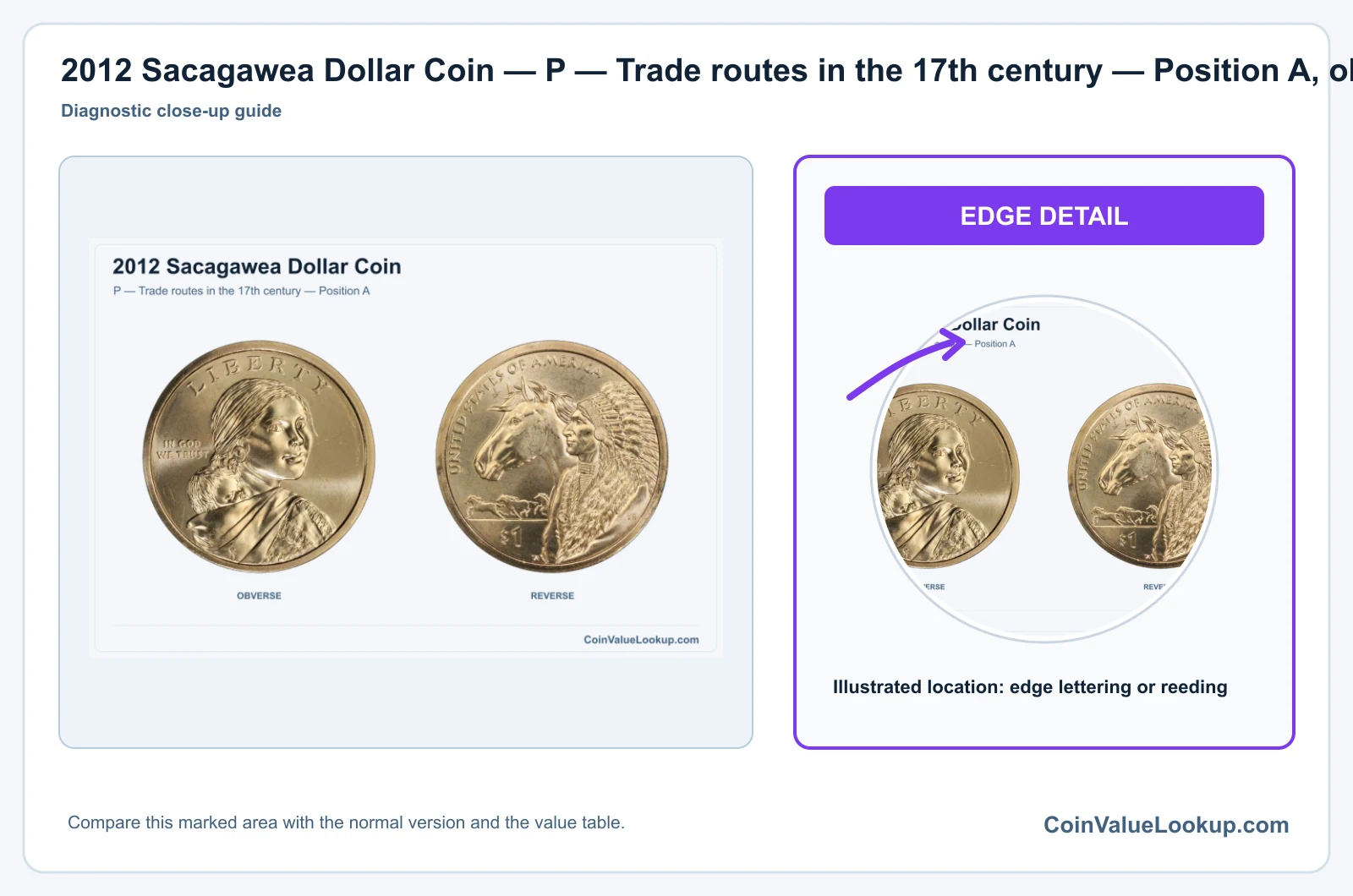
This is the Philadelphia mint business strike with Position A edge lettering. Hold the obverse facing you and read the incuse text along the rim from the bottom up; if it reads normally in that orientation, you have Position A.
At MS65, guide estimates place this version at about $10.00. That is a guide figure, not a guaranteed purchase offer.
In lower circulated grades, these trade at or near face value because Philadelphia struck large quantities. Check the edge carefully to confirm both the mintmark and the lettering orientation before referencing the value chart.
Range Grade
Price Auction Records Appraisal PO PO 1
—
Coin Identifier FR FR 2
—
Coin Identifier AG AG 3
—
Coin Identifier G G 4
—
Coin Identifier
G 6
—
Coin Identifier VG VG 8
—
Coin Identifier
VG 10
—
Coin Identifier F F 12
—
Coin Identifier
F 15
—
Coin Identifier VF VF 20
—
Coin Identifier
VF 25
—
Coin Identifier
VF 30
—
Coin Identifier
VF 35
—
Coin Identifier XF XF 40
—
Coin Identifier
XF 45
—
Coin Identifier AU AU 50
—
Coin Identifier
AU 53
—
Coin Identifier
AU 55
—
Coin Identifier
AU 58
—
Coin Identifier MS MS 60
—
Coin Identifier
MS 61
—
Coin Identifier
MS 62
—
Coin Identifier
MS 63
—
Coin Identifier
MS 64
—
Coin Identifier
MS 65
—
Coin Identifier
MS 66
Coin Identifier
MS 67
Coin Identifier
MS 68
—
Coin Identifier
MS 69
—
—
—
MS 70
—
—
—
2012 Sacagawea Dollar — P — Trade routes in the 17th century — Position B
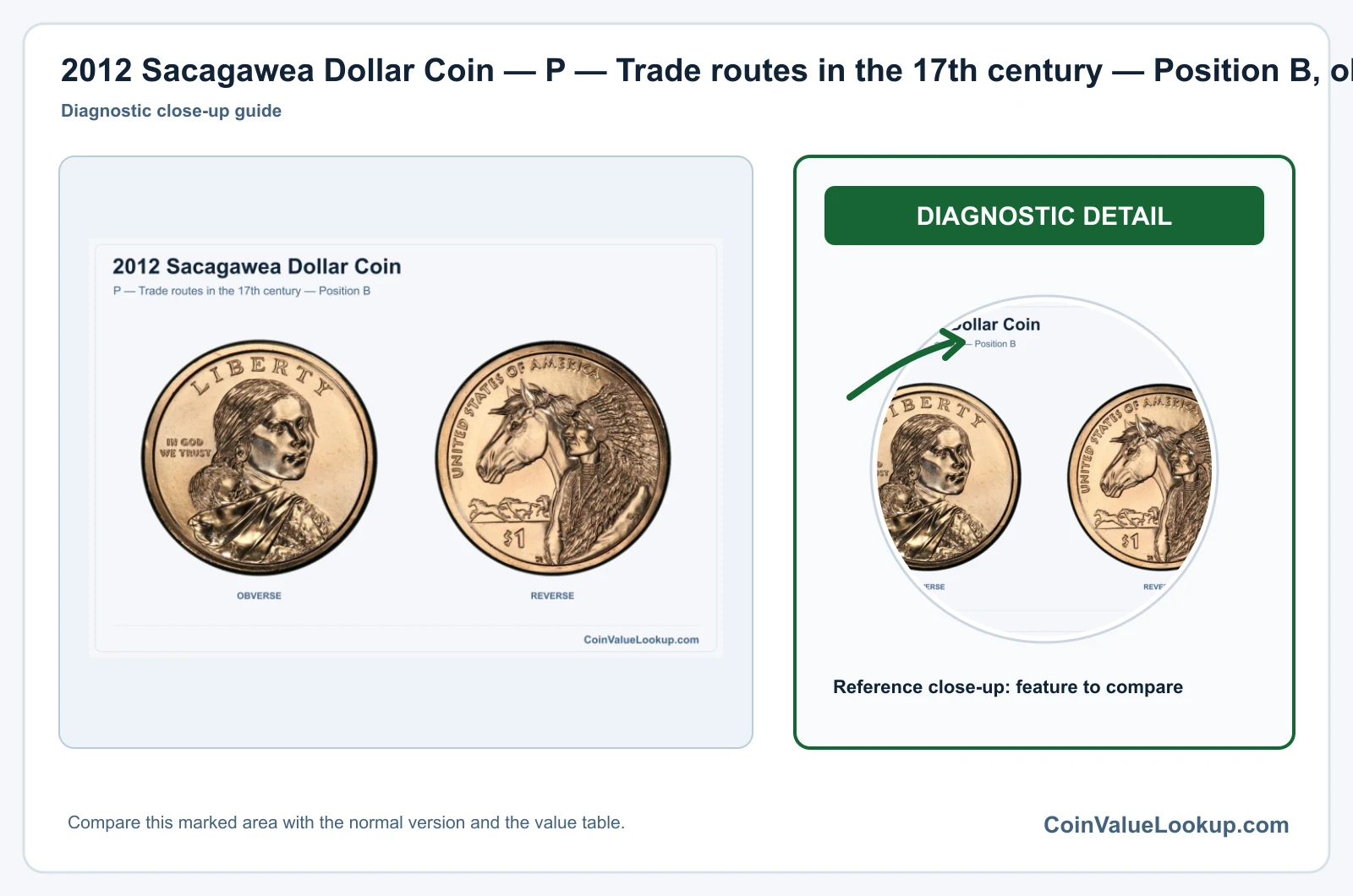
Same Philadelphia mint, same design, but the edge lettering is in Position B. Flip the coin so the obverse faces you and read the edge text from the top down.
If it reads normally that way, you have Position B.
The guide estimate at MS65 is also about $10.00. Neither edge position commands a significant premium over the other for this date.
The distinction matters mainly for proper attribution, so note it if you are submitting the coin for grading or cataloging a collection.
Range Grade
Price Auction Records Appraisal PO PO 1
—
Coin Identifier FR FR 2
—
Coin Identifier AG AG 3
—
Coin Identifier G G 4
—
Coin Identifier
G 6
—
Coin Identifier VG VG 8
—
Coin Identifier
VG 10
—
Coin Identifier F F 12
—
Coin Identifier
F 15
—
Coin Identifier VF VF 20
—
Coin Identifier
VF 25
—
Coin Identifier
VF 30
—
Coin Identifier
VF 35
—
Coin Identifier XF XF 40
—
Coin Identifier
XF 45
—
Coin Identifier AU AU 50
—
Coin Identifier
AU 53
—
Coin Identifier
AU 55
—
Coin Identifier
AU 58
—
Coin Identifier MS MS 60
—
Coin Identifier
MS 61
—
Coin Identifier
MS 62
—
Coin Identifier
MS 63
—
Coin Identifier
MS 64
—
Coin Identifier
MS 65
—
Coin Identifier
MS 66
Coin Identifier
MS 67
Coin Identifier
MS 68
—
Coin Identifier
MS 69
—
—
—
MS 70
—
—
—
2012 Sacagawea Dollar — D — Trade routes in the 17th century — Position A
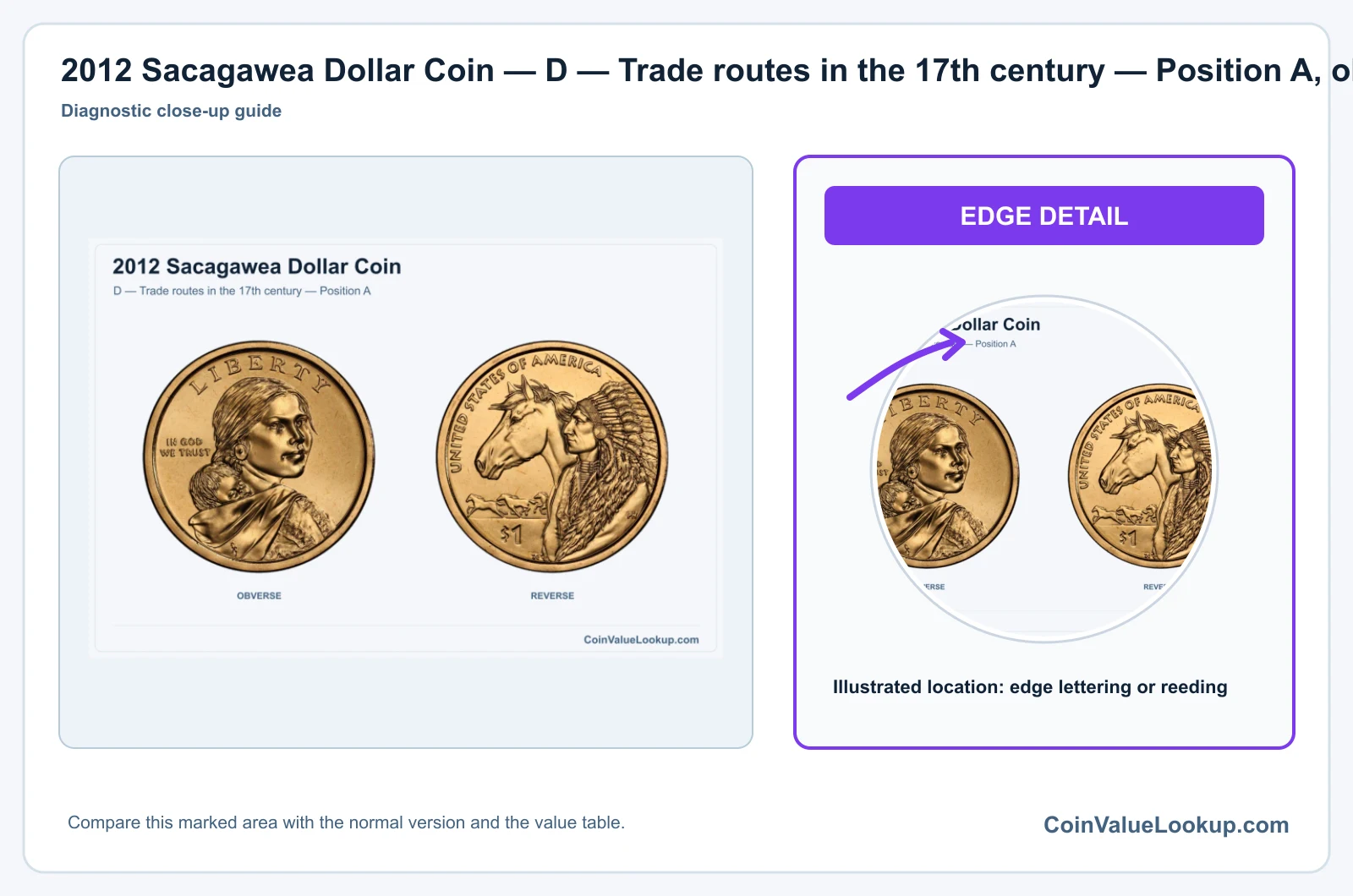
The Denver mint business strike with Position A edge lettering. Look for the "D" mintmark incused along the edge.
Position A means the lettering reads normally from the bottom when the obverse faces you.
Guide estimates put this at roughly $10.00 in MS65. Like its Philadelphia counterpart, circulated examples are essentially face-value coins.
Denver production was substantial, so finding one in change or a roll is not unusual. The value rises only at the higher uncirculated grades where bag marks and luster become the deciding factors.
Range Grade
Price Auction Records Appraisal PO PO 1
—
Coin Identifier FR FR 2
—
Coin Identifier AG AG 3
—
Coin Identifier G G 4
—
Coin Identifier
G 6
—
Coin Identifier VG VG 8
—
Coin Identifier
VG 10
—
Coin Identifier F F 12
—
Coin Identifier
F 15
—
Coin Identifier VF VF 20
—
Coin Identifier
VF 25
—
Coin Identifier
VF 30
—
Coin Identifier
VF 35
—
Coin Identifier XF XF 40
—
Coin Identifier
XF 45
—
Coin Identifier AU AU 50
—
Coin Identifier
AU 53
—
Coin Identifier
AU 55
—
Coin Identifier
AU 58
—
Coin Identifier MS MS 60
—
Coin Identifier
MS 61
—
Coin Identifier
MS 62
—
Coin Identifier
MS 63
—
Coin Identifier
MS 64
—
Coin Identifier
MS 65
—
Coin Identifier
MS 66
Coin Identifier
MS 67
Coin Identifier
MS 68
Coin Identifier
MS 69
—
—
—
MS 70
—
—
—
2012 Sacagawea Dollar — D — Trade routes in the 17th century — Position B
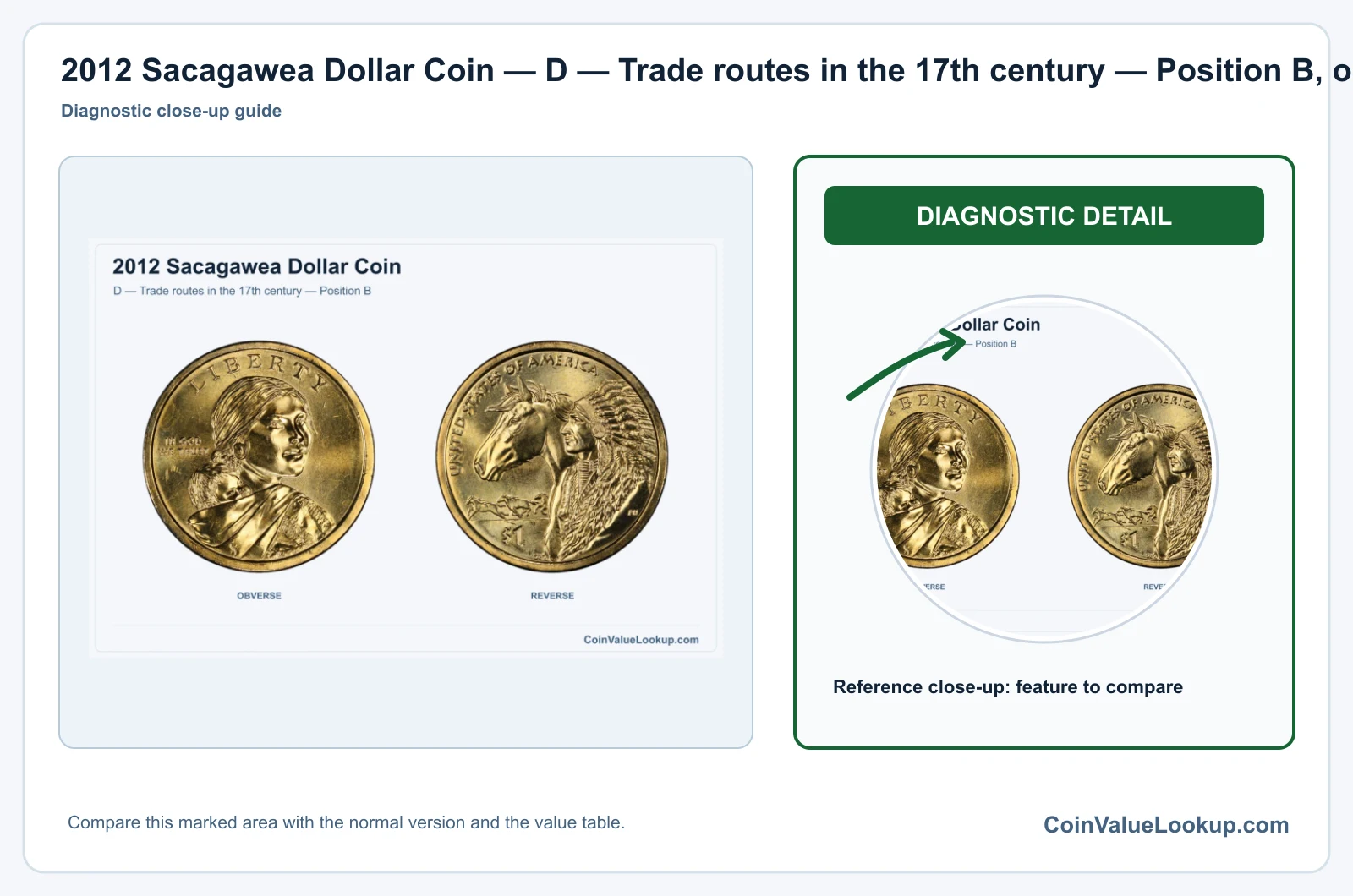
Denver mint, Position B edge lettering. The "D" mintmark sits along the edge alongside the date, motto and Position B orientation.
To confirm, the lettering reads normally from the top when the obverse faces you.
The MS65 guide estimate matches the other business strikes at about $10.00. There is no meaningful price split between Position A and Position B for the 2012 Denver issue.
Your main task is simply confirming the D mintmark and the orientation so you reference the correct line in any price chart.
Range Grade
Price Auction Records Appraisal PO PO 1
—
Coin Identifier FR FR 2
—
Coin Identifier AG AG 3
—
Coin Identifier G G 4
—
Coin Identifier
G 6
—
Coin Identifier VG VG 8
—
Coin Identifier
VG 10
—
Coin Identifier F F 12
—
Coin Identifier
F 15
—
Coin Identifier VF VF 20
—
Coin Identifier
VF 25
—
Coin Identifier
VF 30
—
Coin Identifier
VF 35
—
Coin Identifier XF XF 40
—
Coin Identifier
XF 45
—
Coin Identifier AU AU 50
—
Coin Identifier
AU 53
—
Coin Identifier
AU 55
—
Coin Identifier
AU 58
—
Coin Identifier MS MS 60
—
Coin Identifier
MS 61
—
Coin Identifier
MS 62
—
Coin Identifier
MS 63
—
Coin Identifier
MS 64
—
Coin Identifier
MS 65
—
Coin Identifier
MS 66
Coin Identifier
MS 67
Coin Identifier
MS 68
Coin Identifier
MS 69
—
—
—
MS 70
—
—
—
2012 Sacagawea Dollar — S — Trade routes in the 17th century — proof
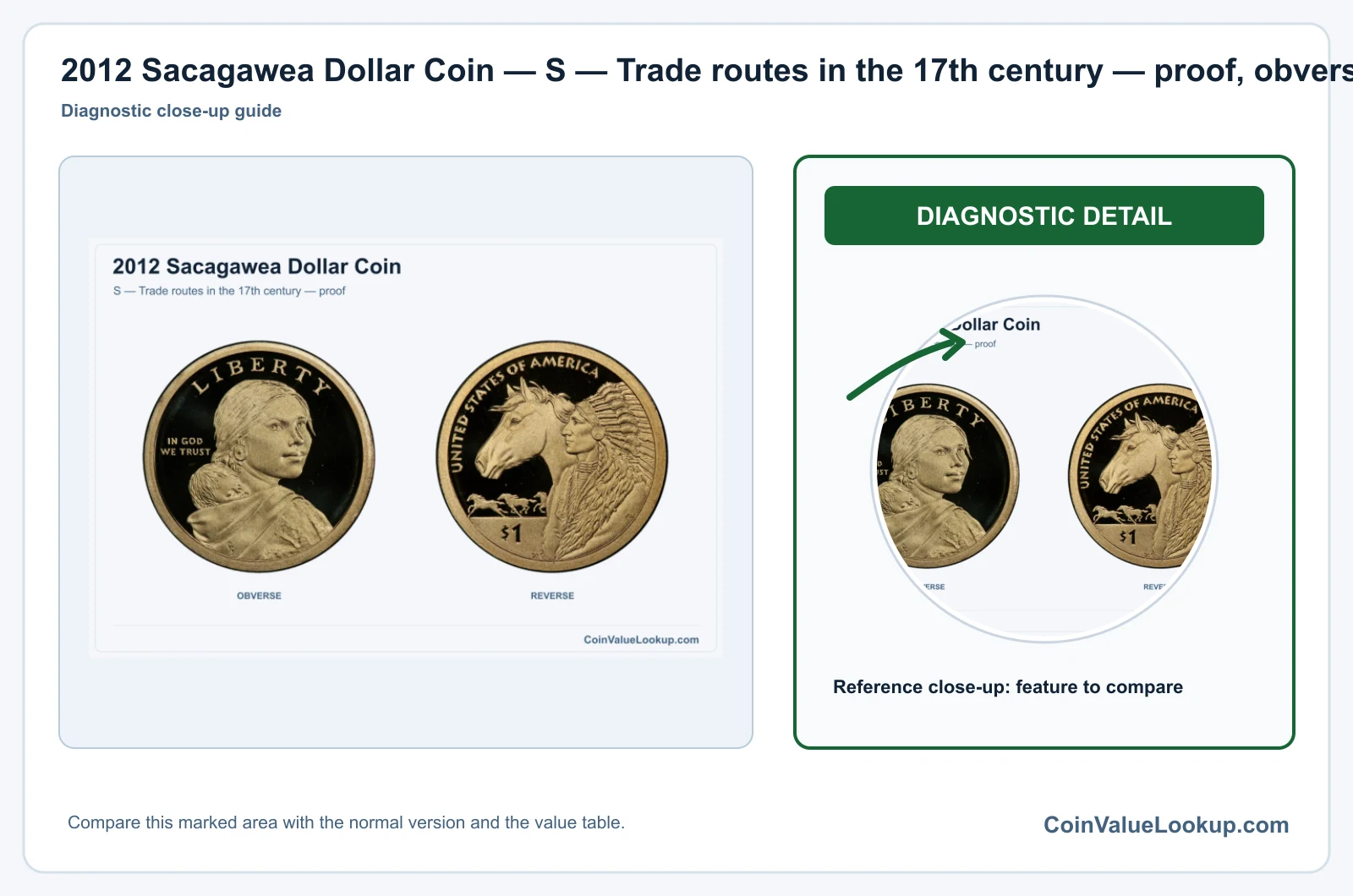
The S-mint proof is the collector piece of the 2012 lineup. Struck at San Francisco, it features deeply mirrored fields and sharply frosted devices, produced by specially prepared dies and planchets.
These were sold in proof sets, not released into circulation.
At PR65, guide estimates sit around $19.00, the highest listed value among the 2012 Sacagawea Dollar versions. Remember that a proof is a manufacturing method, not a grade above Mint State.
You grade proofs on a separate PR scale, looking for hairlines, haze and handling marks rather than circulation wear. Also worth repeating: even if you bought this coin inside a "silver proof set," the dollar itself is the same manganese-brass clad composition as every other version.
Range Grade
Price Auction Records Appraisal PR PR 1
—
Coin Identifier
PR 2
—
Coin Identifier
PR 3
—
Coin Identifier
PR 4
—
Coin Identifier
PR 6
—
Coin Identifier
PR 8
—
Coin Identifier
PR 10
—
Coin Identifier
PR 12
—
Coin Identifier
PR 15
—
Coin Identifier
PR 20
—
Coin Identifier
PR 25
—
Coin Identifier
PR 30
—
Coin Identifier
PR 35
—
Coin Identifier
PR 40
—
Coin Identifier
PR 45
—
Coin Identifier
PR 50
—
Coin Identifier
PR 53
—
Coin Identifier
PR 55
—
Coin Identifier
PR 58
—
Coin Identifier
PR 60
—
Coin Identifier
PR 61
—
Coin Identifier
PR 62
—
Coin Identifier
PR 63
—
Coin Identifier
PR 64
—
Coin Identifier
PR 65
—
Coin Identifier
PR 66
—
Coin Identifier
PR 67
—
Coin Identifier
PR 68
—
Coin Identifier
PR 69
Coin Identifier
PR 70
Coin Identifier
2012 Sacagawea Dollar Error List
1. 2012 Sacagawea Dollar — Weak / Partial Edge Lettering
Weak or partial edge lettering occurs when the incuse text around the rim is struck with less force or incomplete contact, leaving letters that are unusually faint, shallow or partially missing. On a normal 2012 Sacagawea Dollar you should be able to read the full date, mintmark, E PLURIBUS UNUM and IN GOD WE TRUST clearly around the edge.
To check, rotate the coin slowly under good light and compare the depth and clarity of each letter against a known normal example from the same year. If portions are noticeably weaker or interrupted, you may have this variety.
Ordinary shallow lettering from light circulation wear or deliberate filing can mimic the look, so examine whether the surrounding edge surface shows tool marks or unnatural smoothing.
No specific price has been adopted for this error. Value depends on the severity of the weakness, overall coin condition and whether the piece can be properly attributed.
2. 2012 Sacagawea Dollar — Missing Edge Lettering
Missing edge lettering is a more dramatic version of the weak-edge error: all required incuse text, including date, mintmark and mottoes, is completely absent from the edge. The coin's rim appears plain and smooth where lettering should be.
Rotate the entire circumference and compare directly with a normal 2012 issue. Since the date lives on the edge for this series, a truly plain-edge coin can be tricky to attribute to a specific year without the distinctive annual reverse design or a professionally attributed holder.
Watch out for lookalikes. A filed or polished edge can remove the lettering after the fact, leaving tool marks or an unnaturally bright rim.
Also, pre-2009 Sacagawea Dollars had plain edges by design, so make sure you are not confusing an older coin with a 2012 error. No numerical price has been adopted for this variety; value hinges on condition, verification and the completeness of the missing lettering.