1977 Eisenhower Dollar Coin Value: How Much Is It Worth?
A worn 1977 Eisenhower dollar in typical circulated condition is generally worth face value — one dollar. In Mint State 63, a guide estimate from USA Coin Book places the Philadelphia or Denver clad version at about $9.
The San Francisco clad proof carries a guide estimate around $6.25 in PR65. Authenticated mint errors, however, can change the picture dramatically, with certain rarities reaching five figures at auction.
Fast Way to Identify Your 1977 Eisenhower Dollar
Snap clear photos of the front and back of your 1977 Eisenhower dollar and upload them here for a preliminary identification. This can help you figure out which mint version you have and whether the coin shows any obvious characteristics worth investigating further.
Good lighting and a steady hand go a long way.
1977 Eisenhower Dollar Value
Upload both sides of your 1977 Eisenhower Dollar.
Front Obverse
Upload photo
Back Reverse
Upload photo
Which 1977 Eisenhower Dollar Versions Are Worth Money?
- Philadelphia and Denver clad dollars in clean, original high-grade condition can carry condition premiums above face value.
- The 1977-S is a clad proof only — the S mint mark alone is not evidence of silver content.
- A documented 1977-D dollar struck on a 40% silver planchet sold for $26,400, making it an exceptional wrong-planchet rarity.
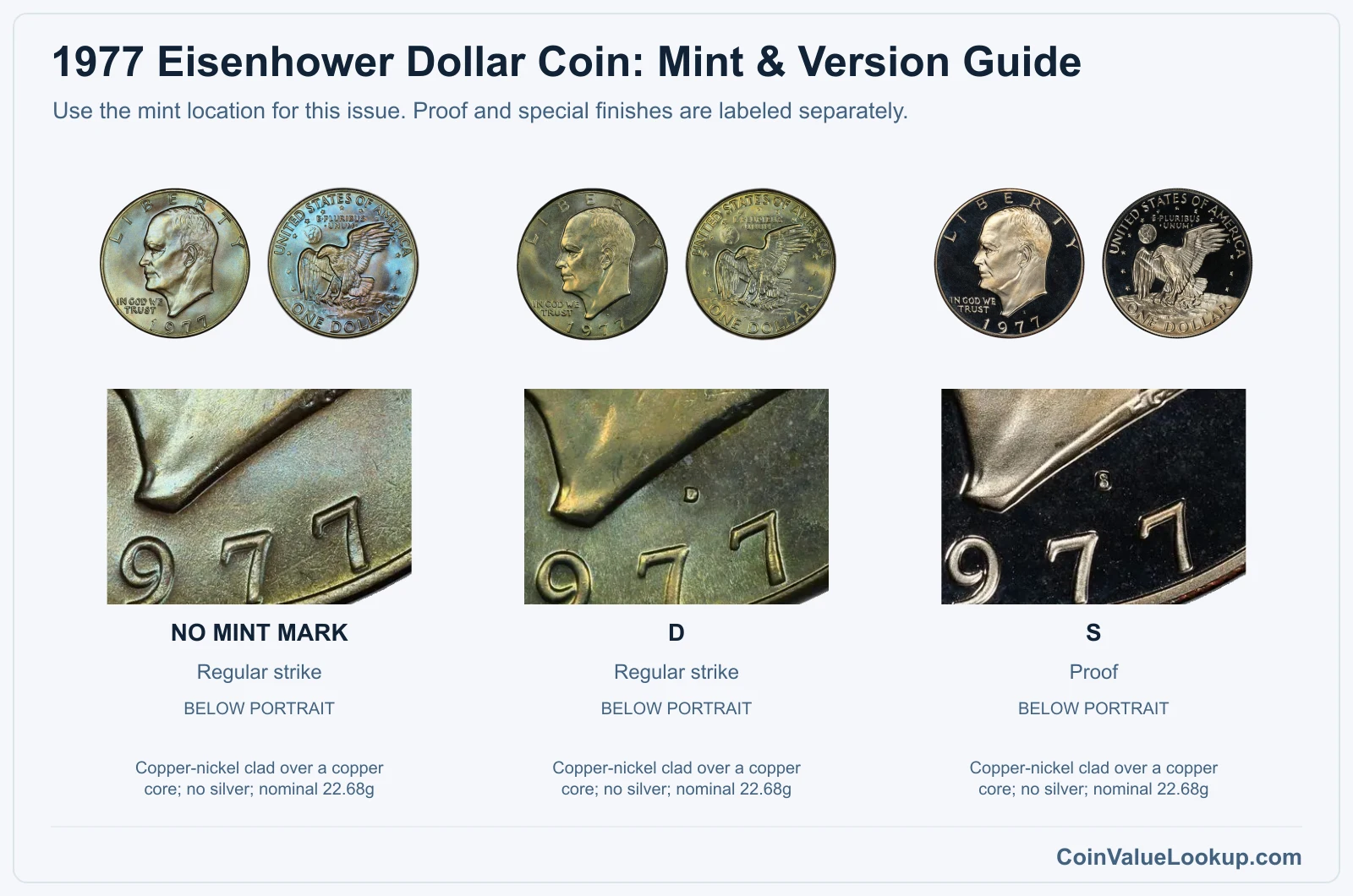
Step 1: Identify Your 1977 Eisenhower Dollar Mint Mark and Version
Start with the date. Confirm you are looking at 1977, not a 1976 Bicentennial reverse.
The eagle-on-Moon design returned for this year after the special 1776–1976 commemorative.
Next, check for a mint mark on the obverse, below Eisenhower's bust and above the date. Philadelphia dollars carry no mint letter at all.
A "D" means Denver, and an "S" means San Francisco.
Mint and finish go together. P and D coins are business strikes meant for circulation.
S coins from 1977 are clad proofs, produced for collectors in special sets. There is no normal 40% silver issue for this date — not business strike, not proof.
Look at the edge. Normal clad Ike dollars show a copper-colored core sandwiched between the outer nickel layers.
Weight is a screening tool (nominal 22.68 grams for clad), but it is not proof of composition on its own. A shiny surface does not mean proof manufacture, and silver color does not mean silver content.
Never clean or polish the coin. Contact marks on the broad cheek and open fields directly affect uncirculated value, and cleaning destroys original surfaces permanently.
Step 2: Check Your 1977 Eisenhower Dollar Grade
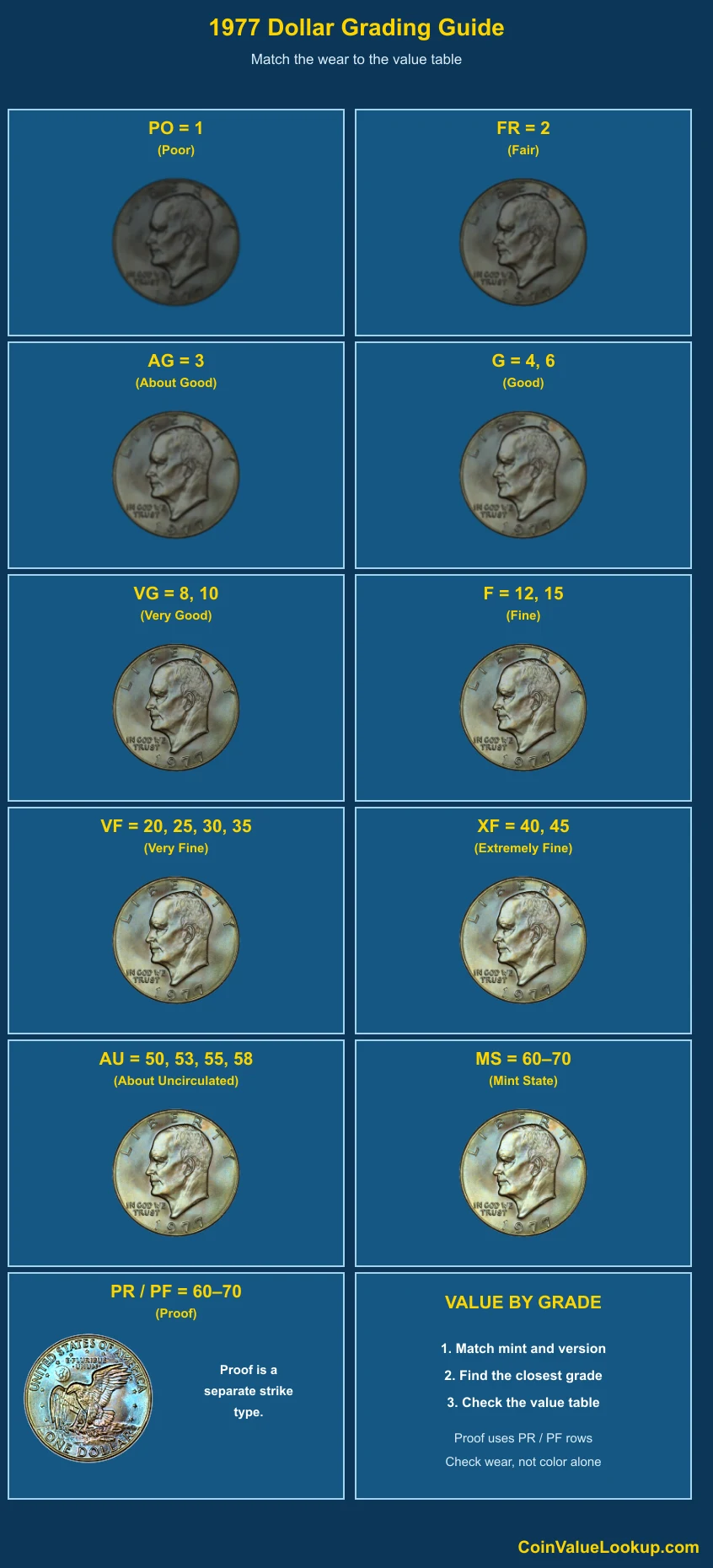
Focus on the cheek, jawline, and the high points of Eisenhower's head first. These are the spots that lose detail earliest as a coin circulates.
Even light cabinet friction on the cheek can drop a coin below the uncirculated threshold.
On the reverse, check the eagle's breast feathers and the high relief of the lunar surface beneath it. Weak detail here can sometimes come from a soft original strike rather than wear, so compare both sides before concluding.
Tilt the coin under a single light source and watch for unbroken cartwheel luster across the fields. If the luster breaks in patches, that usually signals handling or light wear.
Broad open fields on Ike dollars pick up bag marks easily, and even technically uncirculated coins can look rough.
For proofs, grade on a separate scale. Look for hairlines across the mirrored fields, haze, and spotting.
Cameo and Deep Cameo designations describe the contrast between frosted devices and reflective fields — they are visual filters, not different alloys or separate grades. Use the comparison image to calibrate your eye against known examples.
Step 3: Check 1977 Eisenhower Dollar Value by Mint and Version
1977 Eisenhower Dollar — No Mint Mark — Clad
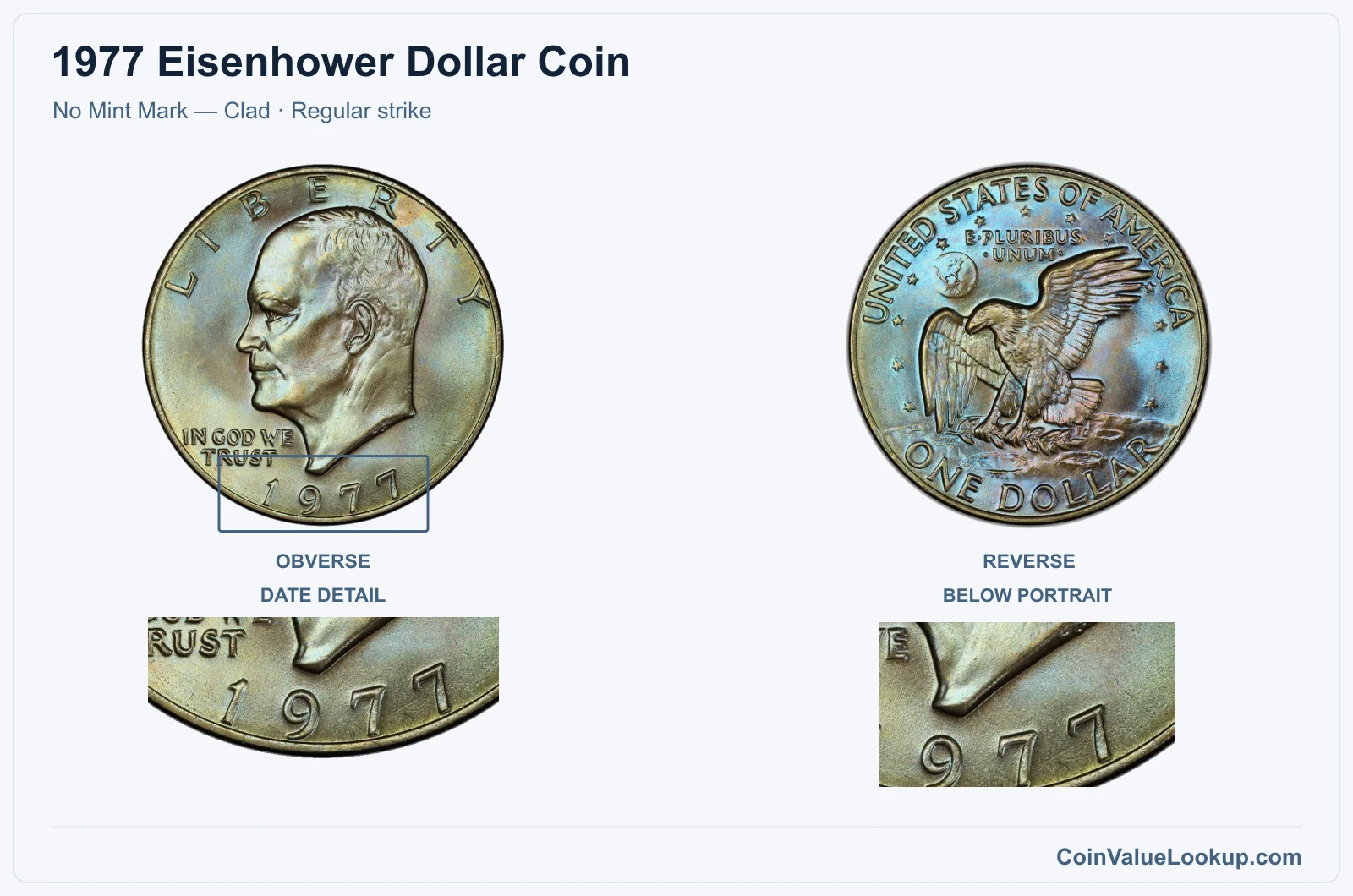
The 1977 Philadelphia Eisenhower dollar has no mint mark on the obverse. It is a copper-nickel clad business strike weighing nominally 22.68 grams, with the standard Eisenhower portrait on the front and the eagle landing on the Moon on the back.
Most circulated examples trade at face value. A USA Coin Book guide estimate places an MS63 example at about $8.64.
Surface preservation matters far more than shine — bag marks and scuffs across those wide open fields are what separate a dollar-bin coin from one worth a small premium.
Coin Value Lookup is a handy starting point if you want to look up guide values for other dates and denominations in the Eisenhower series.
Range Grade
Price Auction Records Appraisal PO PO 1
—
Coin Identifier FR FR 2
—
Coin Identifier AG AG 3
—
Coin Identifier G G 4
—
Coin Identifier
G 6
—
Coin Identifier VG VG 8
—
Coin Identifier
VG 10
—
Coin Identifier F F 12
—
Coin Identifier
F 15
—
Coin Identifier VF VF 20
—
Coin Identifier
VF 25
—
Coin Identifier
VF 30
—
Coin Identifier
VF 35
—
Coin Identifier XF XF 40
—
Coin Identifier
XF 45
—
Coin Identifier AU AU 50
—
Coin Identifier
AU 53
—
Coin Identifier
AU 55
—
Coin Identifier
AU 58
Coin Identifier MS MS 60
—
Coin Identifier
MS 61
—
Coin Identifier
MS 62
—
Coin Identifier
MS 63
Coin Identifier
MS 64
Coin Identifier
MS 65
Coin Identifier
MS 66
Coin Identifier
MS 67
Coin Identifier
MS 68
—
Coin Identifier
MS 69
—
—
—
MS 70
—
—
—
1977 Eisenhower Dollar — D — Clad
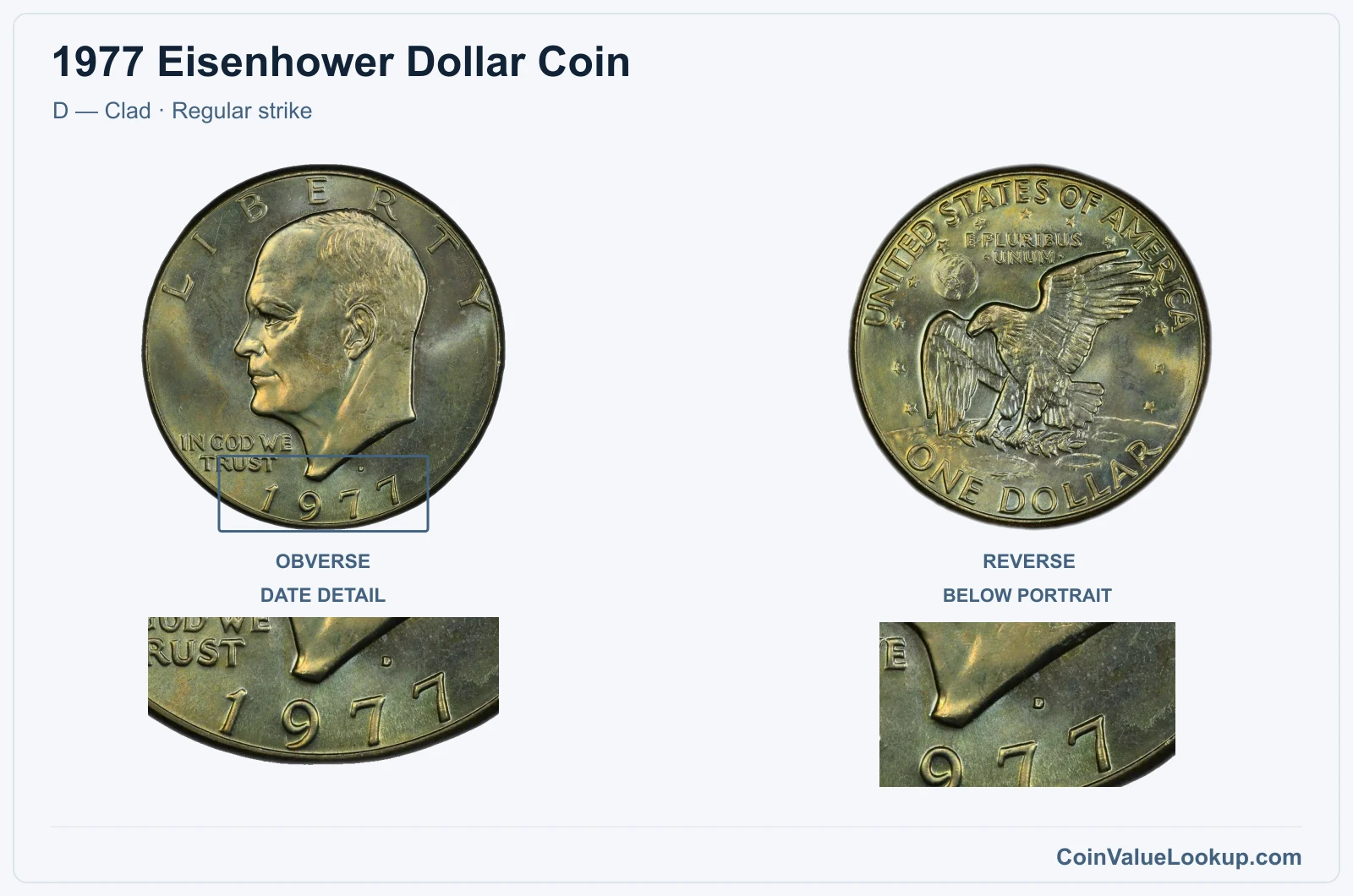
The Denver version carries a small "D" mint mark on the obverse beneath Eisenhower's bust. Like the Philadelphia issue, it is copper-nickel clad over a copper core and weighs about 22.68 grams.
A USA Coin Book guide estimate puts an MS63 Denver dollar at roughly $8.64. The normal Denver composition is clad — do not assume a bright or unusual-looking 1977-D is struck on silver.
That specific wrong-planchet error does exist, but it requires authentication, not wishful thinking. Check the edge for the telltale copper stripe to confirm standard clad composition.
Range Grade
Price Auction Records Appraisal PO PO 1
—
Coin Identifier FR FR 2
—
Coin Identifier AG AG 3
—
Coin Identifier G G 4
—
Coin Identifier
G 6
—
Coin Identifier VG VG 8
—
Coin Identifier
VG 10
—
Coin Identifier F F 12
—
Coin Identifier
F 15
—
Coin Identifier VF VF 20
—
Coin Identifier
VF 25
—
Coin Identifier
VF 30
—
Coin Identifier
VF 35
—
Coin Identifier XF XF 40
—
Coin Identifier
XF 45
—
Coin Identifier AU AU 50
—
Coin Identifier
AU 53
—
Coin Identifier
AU 55
—
Coin Identifier
AU 58
—
Coin Identifier MS MS 60
—
Coin Identifier
MS 61
—
Coin Identifier
MS 62
Coin Identifier
MS 63
Coin Identifier
MS 64
Coin Identifier
MS 65
Coin Identifier
MS 66
Coin Identifier
MS 67
Coin Identifier
MS 68
—
—
—
MS 69
—
—
—
MS 70
—
—
—
1977 Eisenhower Dollar — S — Clad Proof
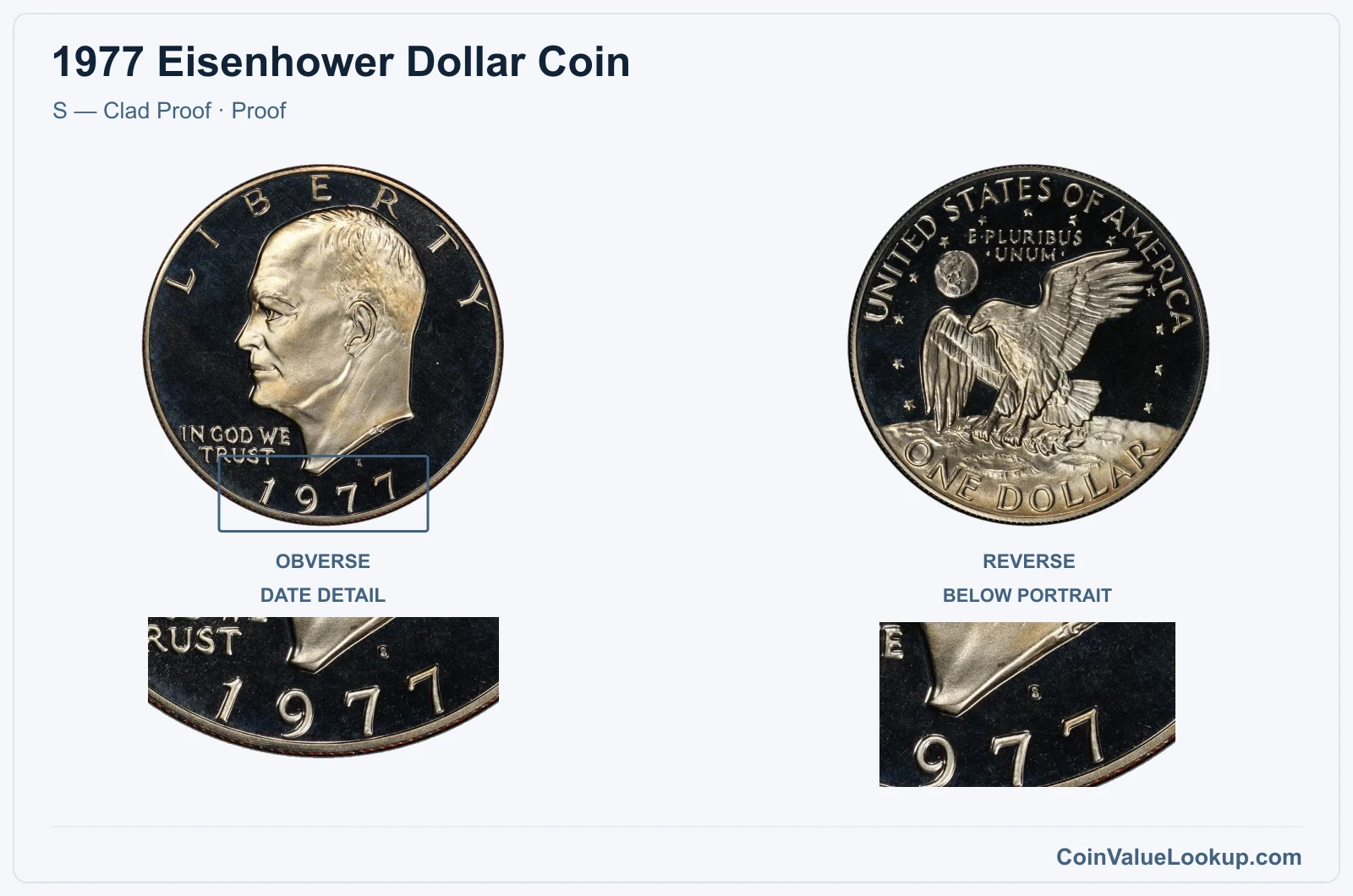
San Francisco produced only clad proofs in 1977. There is no 40% silver collector issue this year.
The S mint mark appears on the obverse in the usual position below the bust.
A USA Coin Book guide estimate places the 1977-S clad proof at about $6.25 in PR65. Hairlines, haze, and spotting on those mirrored fields are the main grade limiters.
Cameo and Deep Cameo designations describe the degree of frosted contrast on the devices — they are visual characteristics, not separate alloy types. Handle proofs by the edges, and store them in original holders when possible.
Range Grade
Price Auction Records Appraisal PR PR 1
—
Coin Identifier
PR 2
—
Coin Identifier
PR 3
—
Coin Identifier
PR 4
—
Coin Identifier
PR 6
—
Coin Identifier
PR 8
—
Coin Identifier
PR 10
—
Coin Identifier
PR 12
—
Coin Identifier
PR 15
—
Coin Identifier
PR 20
—
Coin Identifier
PR 25
—
Coin Identifier
PR 30
—
Coin Identifier
PR 35
—
Coin Identifier
PR 40
—
Coin Identifier
PR 45
—
Coin Identifier
PR 50
—
Coin Identifier
PR 53
—
Coin Identifier
PR 55
—
Coin Identifier
PR 58
—
Coin Identifier
PR 60
—
Coin Identifier
PR 61
—
Coin Identifier
PR 62
—
Coin Identifier
PR 63
—
Coin Identifier
PR 64
—
Coin Identifier
PR 65
—
Coin Identifier
PR 66
Coin Identifier
PR 67
Coin Identifier
PR 68
Coin Identifier
PR 69
Coin Identifier
PR 70
Coin Identifier
1977 Eisenhower Dollar Error List
1. 1977 Eisenhower Dollar — Struck on a 40% Silver Planchet
This is the headliner for 1977 Ike errors. A 1977-D dollar was struck on an unintended 40% silver planchet — a blank left over from earlier silver-clad production that found its way into the Denver press run.
The documented specimen weighs 24.5 grams, noticeably heavier than the standard 22.68-gram clad blank.
The key combination is the D mint mark plus verified silver-clad composition. Screen by checking the edge (no copper stripe) and weighing the coin, but neither test is conclusive on its own.
Professional authentication is essential.
One NGC MS62 example sold for $26,400 in January 2023 at Heritage Auctions. That is a single exceptional sale, not a market range.
Do not mistake silver plating, a normal 1971–76 S silver issue, or an ordinary 1977-S clad proof for this error.
2. 1977 Eisenhower Dollar — Off-Center Proof Strike
A 1977-S proof struck roughly 30% off center is an unusual collision of two worlds — proof manufacture and a significant striking error. The displaced design leaves a blank crescent along one side, cutting into the legends while preserving the proof mirror finish on the struck portion.
One PCGS PR68 Deep Cameo example sold for $26,400 in April 2021 at Heritage Auctions. That is an exceptional proof-error result from a single sale.
To distinguish this from lookalikes, note that a misaligned die produces a more subtle shift without a blank crescent, and a post-mint cut-down coin will show tooling marks at the edge rather than a struck rim. If you think you have one, make sure the date and S mint mark are visible in your photos.
3. 1977 Eisenhower Dollar — Improperly Annealed Planchet
An improperly annealed (or sintered) planchet error means the blank was not heat-treated correctly before striking. On the 1977 no-mint-mark dollar, this can produce unusual original surface coloration that looks different from normal clad.
Here is the catch: visual color alone cannot confirm this error. Heat damage after minting, artificial toning, chemical staining, and plating can all mimic the look.
Attribution depends on mint-origin surface characteristics evaluated by expert inspection, not a quick photo comparison.
One PCGS MS66 example sold for $431.25 in January 2009 at a Heritage Auctions sale. That is a single recorded result.
If your coin has odd coloring but otherwise looks normal, professional certification is the only path to a credible attribution.
4. 1977 Eisenhower Dollar — Struck Through a Retained Staple
A 1977-S proof dollar exists with a copper staple physically embedded in the obverse, running from the LIBERTY area toward the opposite rim. The staple was caught between the die and the planchet during the proof strike, so the metal flowed around it — it is part of the coin, not something stuck on later.
Do not attempt to pry the staple out. Removing it destroys the error and the coin's value.
One NGC PR66 Ultra Cameo example sold for $9,000 in March 2023 at Heritage Auctions. A later scratch from a staple, glued-on wire, or loose foreign material sitting on the surface are all lookalikes.
The genuine article shows metal displacement and strike interaction around the embedded object, visible under magnification.
5. 1977 Eisenhower Dollar — Double Strike with Displaced Second Impression
This 1977 no-mint-mark dollar received two impressions from the dies, with the second strike landing about 95% off the edge of the coin. The result is a normal-looking first strike with a sliver of displaced second-strike design visible near the rim.
Look for the intact original date and a partial overlapping impression at the perimeter. Most of the second strike landed off the planchet, so the visible evidence is subtle.
Show both the full first design and the perimeter distortion in photos.
No specific price range is established for this error. Value depends on authenticated identity, condition, and the severity of the displacement.
Do not confuse this with die doubling (a split-image effect on devices) or machine doubling (flat shelf-like doubling), both of which are far more common and far less valuable.
6. 1977 Eisenhower Dollar — Double Curved Clips
A 1977-D dollar with two curved clips is missing two crescent-shaped portions of the planchet from before the strike. These clips happen when the blanking press punches into an area of strip metal that already had a blank removed, producing an incomplete disc that then gets struck normally.
Both clipped edges should show a smooth, curved boundary without file marks or grinding evidence. The struck metal at the clip boundaries may show a slight fish-tail effect called the Blakesley kick on the opposite rim.
Retain the D mint mark and date in any photographs.
No specific price range is established. Value depends on authentication, size of the clips, and overall condition.
Post-strike cutting or grinding will leave different tool marks and no corresponding weakness at the opposite rim — that is how you spot a fake.
7. 1977 Eisenhower Dollar — Misaligned Obverse Die
A 1977-D dollar with a misaligned obverse die shows the front design shifted slightly off center relative to the rim, while the reverse stays properly centered. The documented shift is about 1% — subtle enough that you might miss it without careful comparison.
Look for uneven rim width on the obverse only. If both sides are shifted together, that is an off-center strike, a different category.
Irregular wear can also create the illusion of misalignment, so compare rim thickness at opposite points.
No specific price range is established for this minor shift. Value depends on authenticated identity, condition, and severity.
A 1% misalignment is slight and should not be expected to carry a large premium.