1776 to 1976 Eisenhower Dollar Coin Value: How Much Is It Worth?
The 1976 Eisenhower dollar carries the dual date 1776–1976 and a special Bicentennial reverse showing the Liberty Bell over the Moon. Ordinary clad circulation strikes in MS63 condition carry guide values around $7–$11 depending on type.
San Francisco 40% silver pieces command more, with guide anchors of $39–$41 at the stated grades. Sorting out which version you have matters a lot.
Fast Way to Identify Your 1976 Eisenhower Dollar
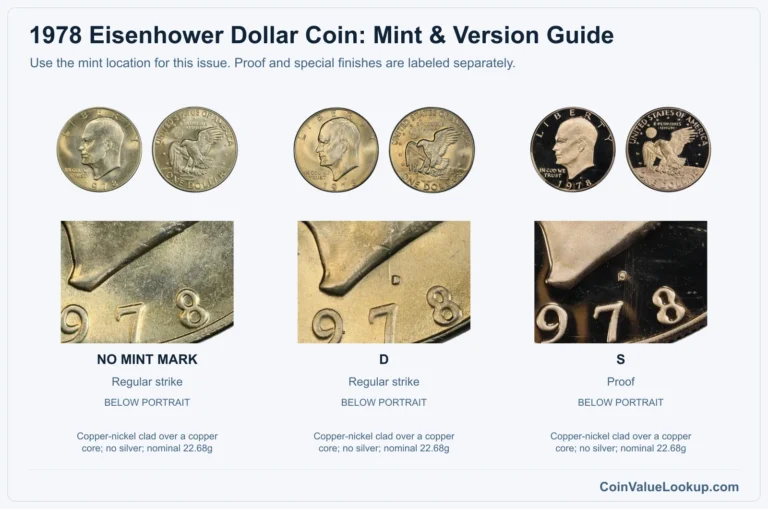
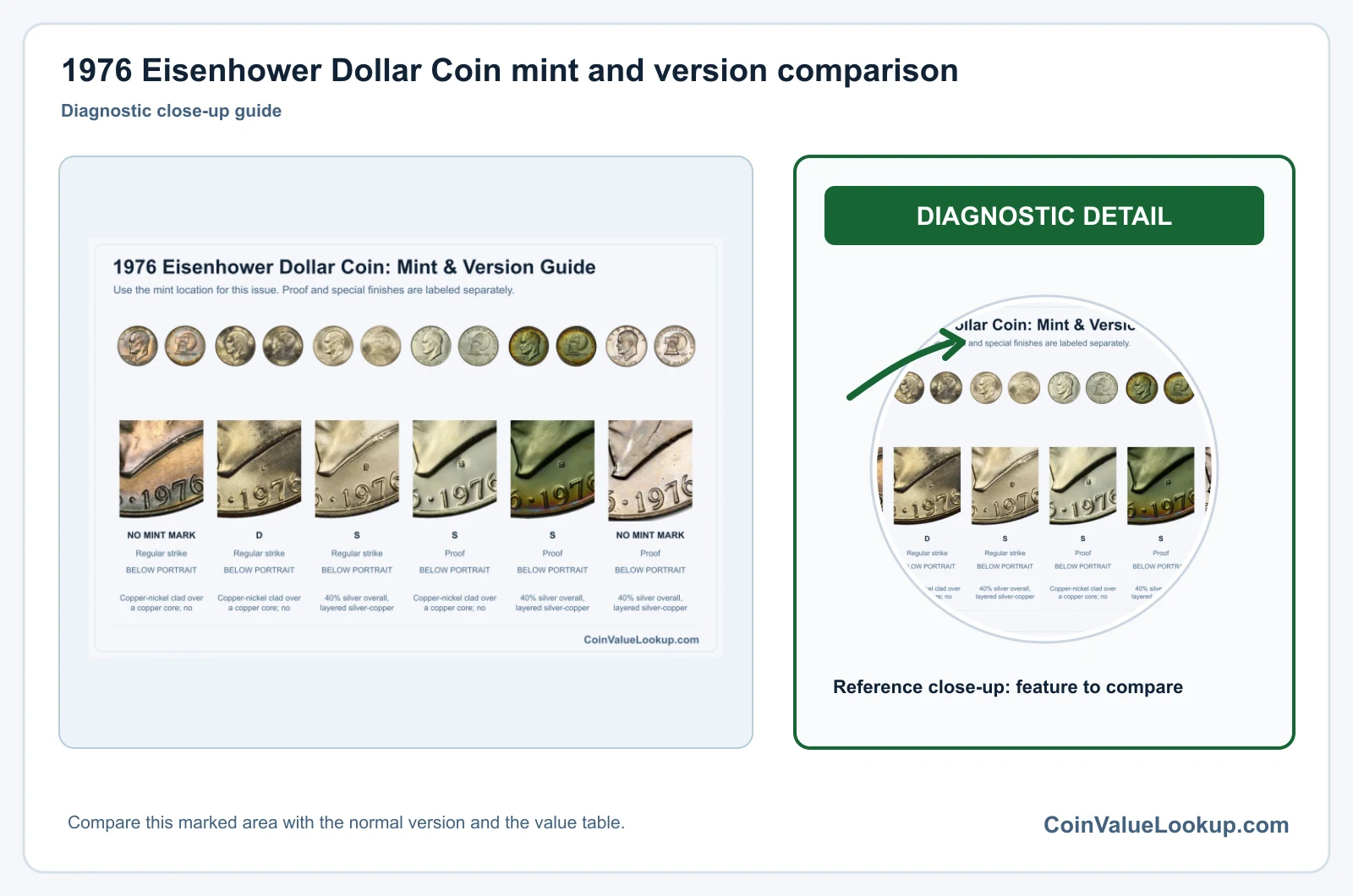
Snap clear photos of both sides of your dollar and upload them here for a preliminary identification. The front shows the mint mark location below Eisenhower's bust, above the date, and the back reveals whether you have Type 1 or Type 2 lettering.
Both details are essential for narrowing down what your coin is worth.
1776 to 1976 Eisenhower Dollar Value
Upload both sides of your 1776 to 1976 Eisenhower Dollar.
Front Obverse
Upload photo
Back Reverse
Upload photo
Which 1976 Eisenhower Dollar Versions Are Worth Money?
- Type 1 versus Type 2 lettering changes the value even within the same mint — Philadelphia Type 1 guides higher than Type 2 at MS63.
- S-mint 40% silver uncirculated Type 1 pieces anchor around $39 at MS63, well above any clad version.
- S-mint 40% silver proof Type 1 coins guide near $41 at PR65, the highest among versions with supported guide figures.
- The No S Type 2 silver proof is an extraordinary authenticated rarity requiring specialist confirmation — not just any dollar missing a mint mark.
- S-mint clad proofs exist in both Type 1 and Type 2 with different guide values; do not assume every S proof is silver.
Step 1: Identify Your 1976 Eisenhower Dollar Mint Mark and Version
Start with the date. Every 1976 Ike dollar reads 1776–1976.
There is no regular 1975-dated Eisenhower dollar; Bicentennial production replaced it.
Next, find the mint mark on the obverse, below Eisenhower's bust and above the date. Philadelphia coins carry no letter.
A D means Denver. An S means San Francisco.
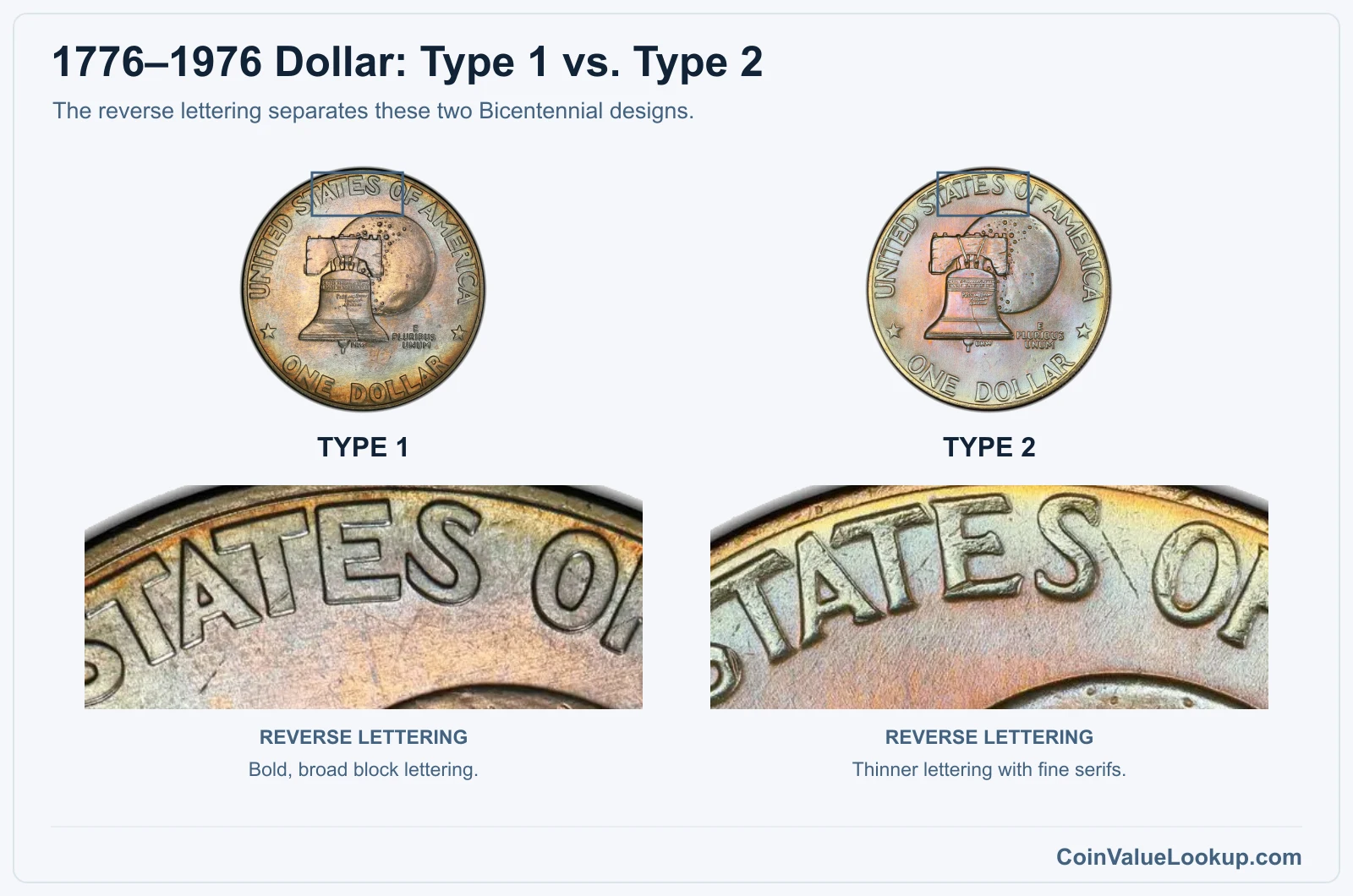
Now flip to the reverse and read the inscription around the rim. Type 1 coins have heavy, blocky lettering in UNITED STATES OF AMERICA and ONE DOLLAR.
Type 2 coins use thinner letters with small serifs. Compare the last S in STATES closely if you are unsure.
Having an S mint mark does not automatically mean silver. San Francisco struck both clad proofs and 40% silver pieces.
Check the edge: a normal clad coin shows a copper-colored stripe through the core. Silver pieces lack that telltale copper band, and they weigh about 24.59 grams versus 22.68 grams for clad.
Weight helps screen, but it does not prove identity on its own.
Never clean or polish the coin. Doing so damages the surfaces permanently and destroys collector value.
Step 2: Check Your 1976 Eisenhower Dollar Grade
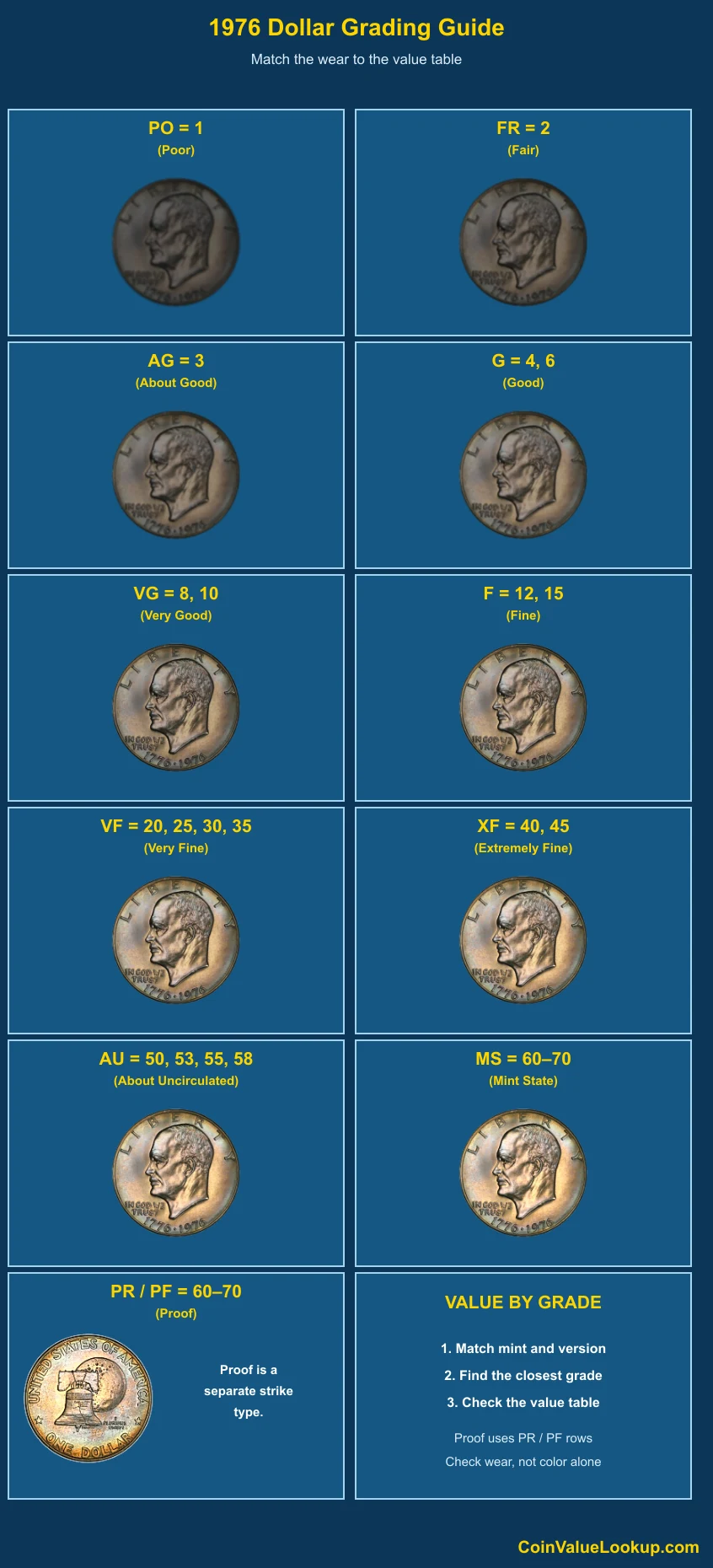
Look at Eisenhower's cheek and the high points along the jawline. These are the first areas to show wear, even light friction.
On an uncirculated coin, full original luster should sweep unbroken across both the portrait and the broad open fields when you tilt the coin under a light.
Contact marks matter on these big dollars. The wide, flat fields act like magnets for bag marks from other coins banging around in storage.
A coin with strong detail but heavy contact marks will grade lower than a cleaner example with the same sharpness.
On the Bicentennial reverse, inspect the relief on the Liberty Bell and the lunar surface below it. Weak detail there can come from a tired die rather than circulation wear, so compare both sides before concluding the coin is worn.
Proof coins get their own scale. Look for hairlines from handling rather than wear, and evaluate cameo contrast, the frosty devices against mirror fields, as a separate quality factor.
Use the comparison image to calibrate your eye against known grade examples.
Step 3: Check 1976 Eisenhower Dollar Value by Mint and Version
1976 Eisenhower Dollar — No Mint Mark — Clad Type 1
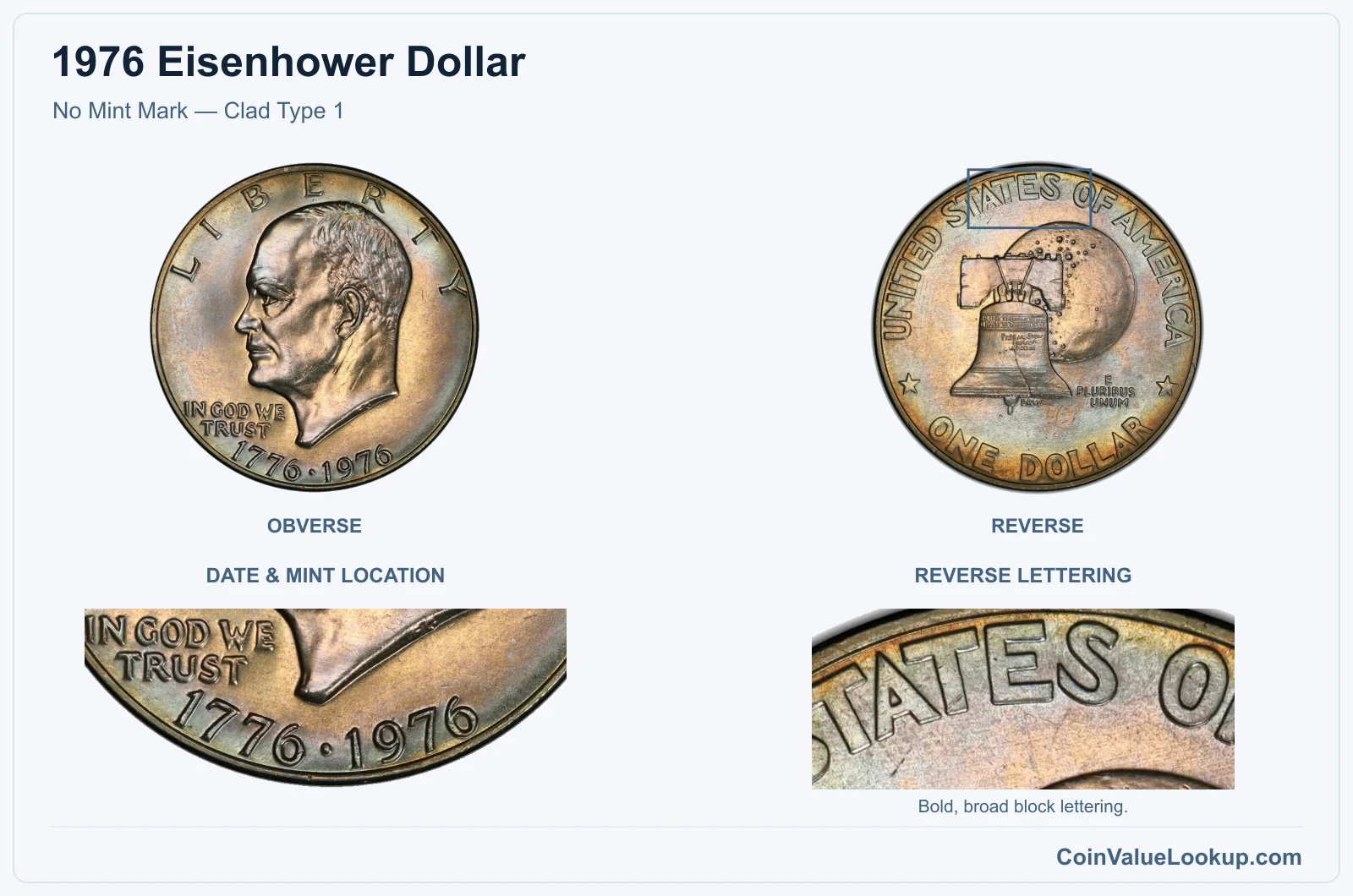
This is a Philadelphia business strike on a copper-nickel clad planchet with no mint mark on the obverse. Turn it over and look at the inscription: heavy, blocky letters identify it as Type 1.
At MS63, the USA Coin Book guide estimate is about $11, making it the higher-valued Philadelphia clad type. Most circulated examples are worth face value.
The premium kicks in only for well-preserved uncirculated pieces with clean fields and full luster.
| Range | Grade | Price | Auction Records | Appraisal |
|---|---|---|---|---|
| PO | PO 1 | — | Coin Identifier | |
| FR | FR 2 | — | Coin Identifier | |
| AG | AG 3 | — | Coin Identifier | |
| G | G 4 | — | Coin Identifier | |
| G 6 | — | Coin Identifier | ||
| VG | VG 8 | — | Coin Identifier | |
| VG 10 | — | Coin Identifier | ||
| F | F 12 | — | Coin Identifier | |
| F 15 | — | Coin Identifier | ||
| VF | VF 20 | — | Coin Identifier | |
| VF 25 | — | Coin Identifier | ||
| VF 30 | — | Coin Identifier | ||
| VF 35 | — | Coin Identifier | ||
| XF | XF 40 | — | Coin Identifier | |
| XF 45 | — | Coin Identifier | ||
| AU | AU 50 | — | Coin Identifier | |
| AU 53 | — | Coin Identifier | ||
| AU 55 | — | Coin Identifier | ||
| AU 58 | — | Coin Identifier | ||
| MS | MS 60 | — | Coin Identifier | |
| MS 61 | — | Coin Identifier | ||
| MS 62 | Coin Identifier | |||
| MS 63 | Coin Identifier | |||
| MS 64 | Coin Identifier | |||
| MS 65 | Coin Identifier | |||
| MS 66 | Coin Identifier | |||
| MS 67 | — | — | — | |
| MS 68 | — | — | — | |
| MS 69 | — | — | — | |
| MS 70 | — | — | — |
1976 Eisenhower Dollar — No Mint Mark — Clad Type 2
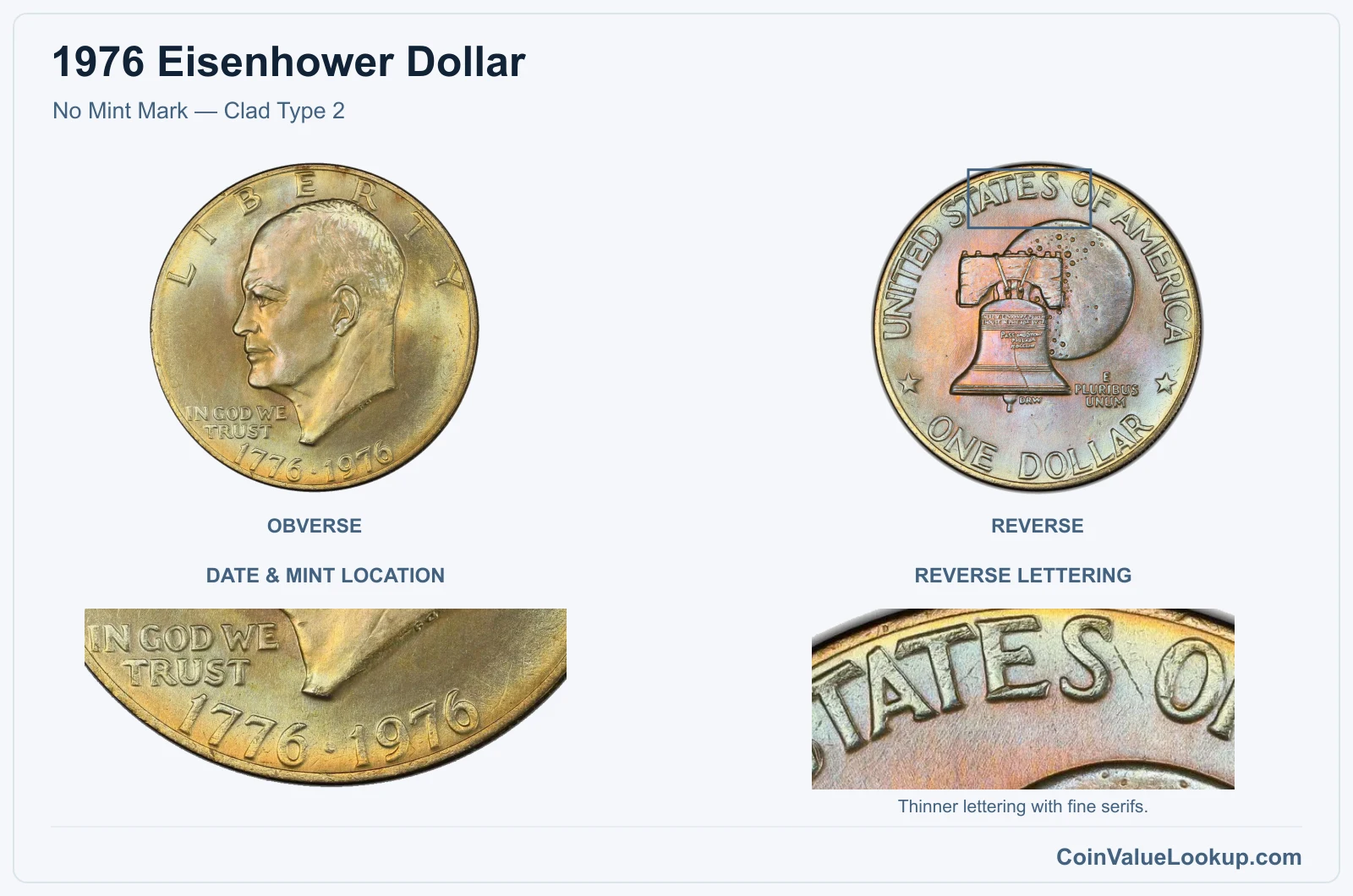
Same Philadelphia clad composition and no mint mark, but the reverse lettering is thinner with small serifs. That is Type 2.
The MS63 guide estimate from USA Coin Book sits around $7.29, a step below the Type 1. These are common coins.
The Type 2 design was used for much of the Bicentennial production run, so survival numbers are high. Value depends almost entirely on condition and the absence of distracting bag marks across those broad fields.
| Range | Grade | Price | Auction Records | Appraisal |
|---|---|---|---|---|
| PO | PO 1 | Coin Identifier | ||
| FR | FR 2 | Coin Identifier | ||
| AG | AG 3 | — | Coin Identifier | |
| G | G 4 | — | Coin Identifier | |
| G 6 | — | Coin Identifier | ||
| VG | VG 8 | — | Coin Identifier | |
| VG 10 | — | Coin Identifier | ||
| F | F 12 | — | Coin Identifier | |
| F 15 | — | Coin Identifier | ||
| VF | VF 20 | — | Coin Identifier | |
| VF 25 | — | Coin Identifier | ||
| VF 30 | — | Coin Identifier | ||
| VF 35 | — | Coin Identifier | ||
| XF | XF 40 | — | Coin Identifier | |
| XF 45 | — | Coin Identifier | ||
| AU | AU 50 | — | Coin Identifier | |
| AU 53 | — | Coin Identifier | ||
| AU 55 | — | Coin Identifier | ||
| AU 58 | Coin Identifier | |||
| MS | MS 60 | — | Coin Identifier | |
| MS 61 | Coin Identifier | |||
| MS 62 | Coin Identifier | |||
| MS 63 | Coin Identifier | |||
| MS 64 | Coin Identifier | |||
| MS 65 | Coin Identifier | |||
| MS 66 | Coin Identifier | |||
| MS 67 | Coin Identifier | |||
| MS 68 | — | — | — | |
| MS 69 | — | — | — | |
| MS 70 | — | — | — |
1976 Eisenhower Dollar — D — Clad Type 1
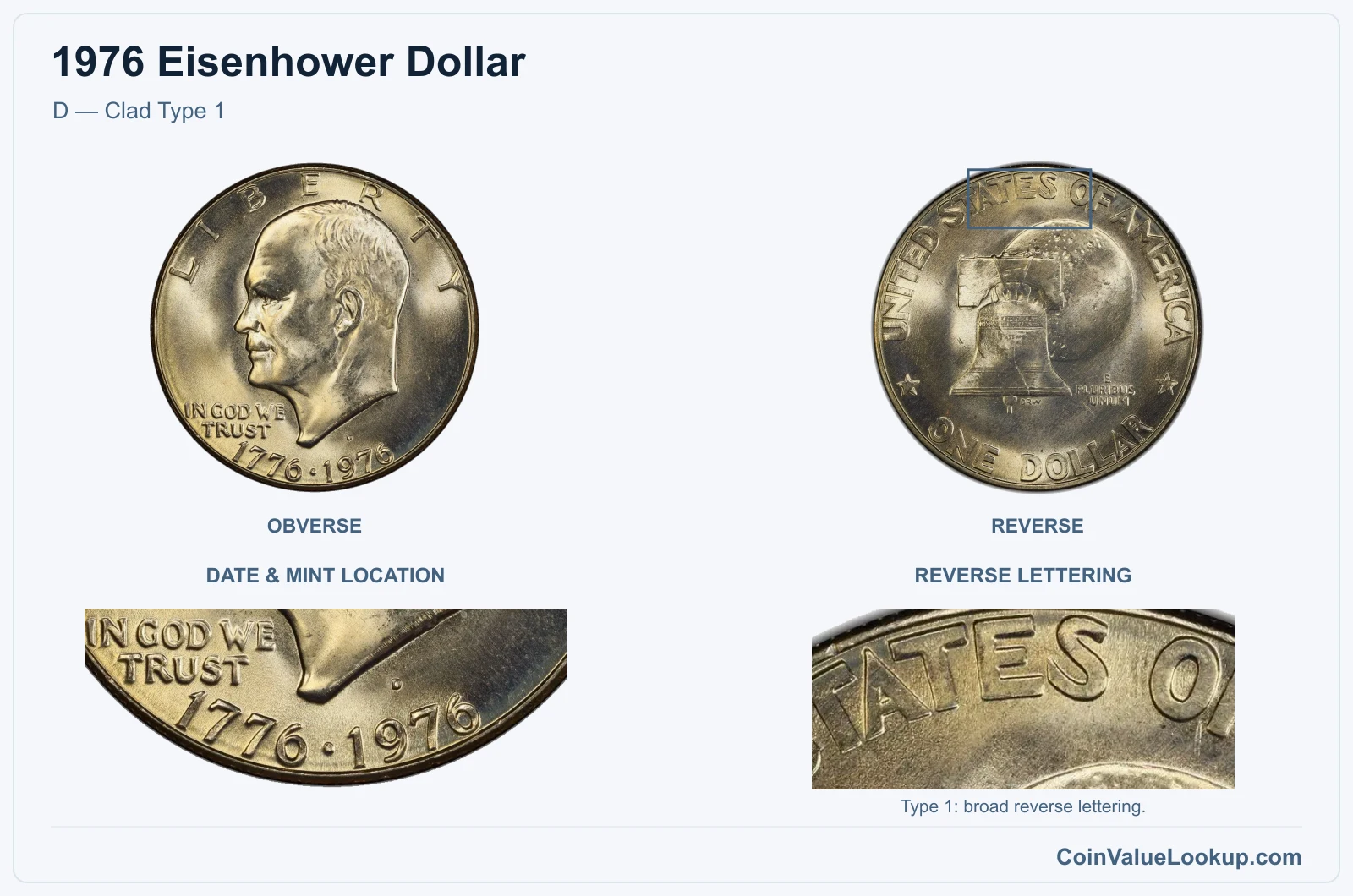
Denver coins carry a D mint mark on the obverse below Eisenhower's bust. Type 1 versions have the same heavy reverse lettering as the Philadelphia Type 1.
The guide estimate at MS63 is about $7.29 per USA Coin Book. Like all clad business strikes, circulated pieces trade at face value.
Look for the copper-colored edge stripe to confirm clad composition.
Coin Value Lookup is a good starting point if you want to compare this version against other Bicentennial denominations or different Ike dollar years.
| Range | Grade | Price | Auction Records | Appraisal |
|---|---|---|---|---|
| PO | PO 1 | — | Coin Identifier | |
| FR | FR 2 | — | Coin Identifier | |
| AG | AG 3 | — | Coin Identifier | |
| G | G 4 | — | Coin Identifier | |
| G 6 | — | Coin Identifier | ||
| VG | VG 8 | — | Coin Identifier | |
| VG 10 | — | Coin Identifier | ||
| F | F 12 | — | Coin Identifier | |
| F 15 | — | Coin Identifier | ||
| VF | VF 20 | — | Coin Identifier | |
| VF 25 | — | Coin Identifier | ||
| VF 30 | — | Coin Identifier | ||
| VF 35 | — | Coin Identifier | ||
| XF | XF 40 | — | Coin Identifier | |
| XF 45 | — | Coin Identifier | ||
| AU | AU 50 | — | Coin Identifier | |
| AU 53 | — | Coin Identifier | ||
| AU 55 | — | Coin Identifier | ||
| AU 58 | Coin Identifier | |||
| MS | MS 60 | — | Coin Identifier | |
| MS 61 | — | Coin Identifier | ||
| MS 62 | Coin Identifier | |||
| MS 63 | Coin Identifier | |||
| MS 64 | Coin Identifier | |||
| MS 65 | Coin Identifier | |||
| MS 66 | Coin Identifier | |||
| MS 67 | Coin Identifier | |||
| MS 68 | — | — | — | |
| MS 69 | — | — | — | |
| MS 70 | — | — | — |
1976 Eisenhower Dollar — D — Clad Type 2
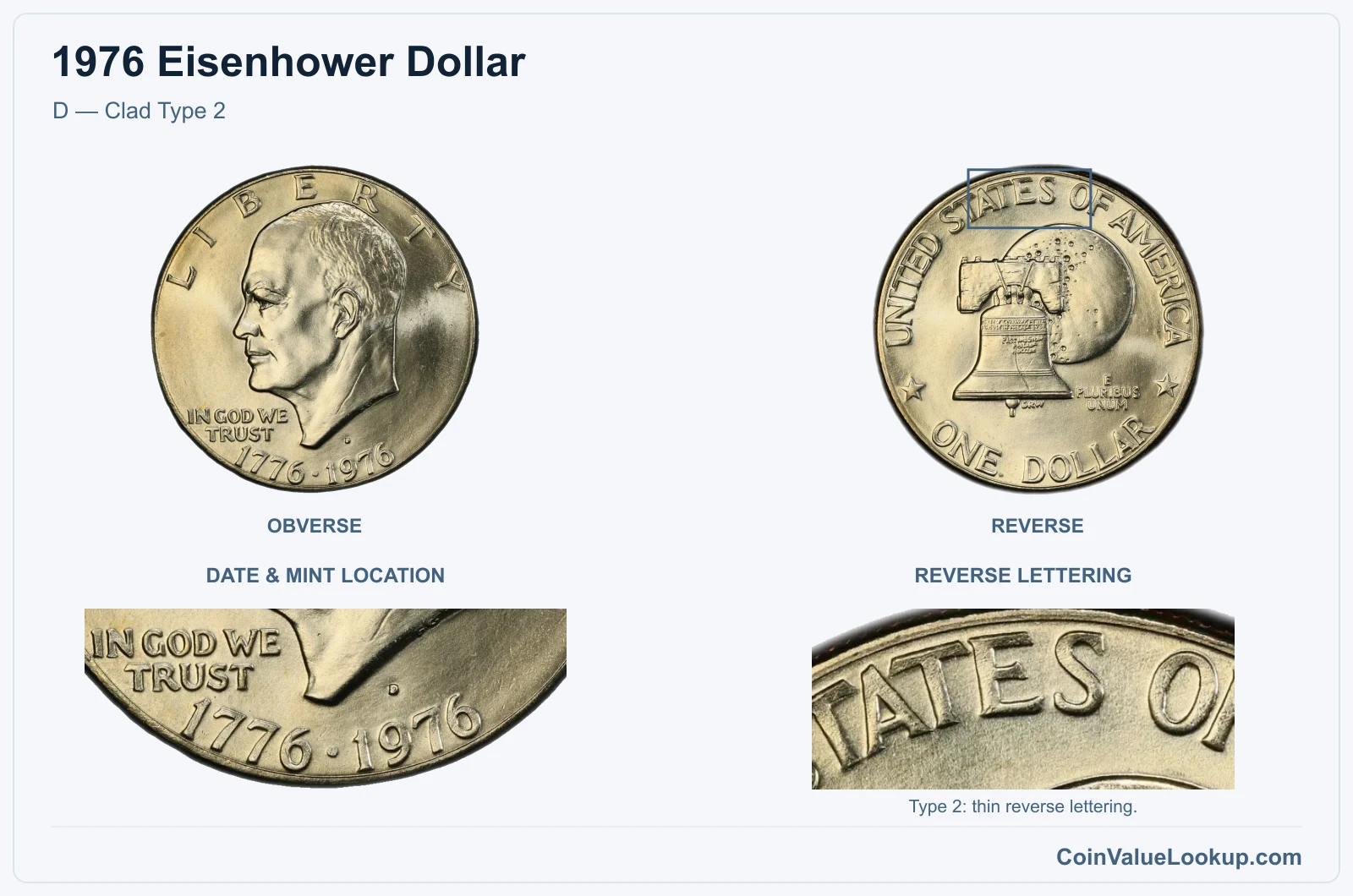
A Denver clad dollar with thin, serifed reverse lettering. The D mint mark confirms Denver, and the lettering style confirms Type 2.
Make sure you match both attributes when comparing values.
USA Coin Book guides this at roughly $7.29 in MS63. Denver produced large quantities of both types, so neither carries a significant rarity premium.
Certified coins with confirmed variety attribution will command a slight edge over raw examples, especially in higher Mint State grades.
| Range | Grade | Price | Auction Records | Appraisal |
|---|---|---|---|---|
| PO | PO 1 | — | Coin Identifier | |
| FR | FR 2 | Coin Identifier | ||
| AG | AG 3 | — | Coin Identifier | |
| G | G 4 | — | Coin Identifier | |
| G 6 | — | Coin Identifier | ||
| VG | VG 8 | — | Coin Identifier | |
| VG 10 | — | Coin Identifier | ||
| F | F 12 | — | Coin Identifier | |
| F 15 | — | Coin Identifier | ||
| VF | VF 20 | — | Coin Identifier | |
| VF 25 | — | Coin Identifier | ||
| VF 30 | — | Coin Identifier | ||
| VF 35 | — | Coin Identifier | ||
| XF | XF 40 | — | Coin Identifier | |
| XF 45 | — | Coin Identifier | ||
| AU | AU 50 | — | Coin Identifier | |
| AU 53 | — | Coin Identifier | ||
| AU 55 | Coin Identifier | |||
| AU 58 | Coin Identifier | |||
| MS | MS 60 | — | Coin Identifier | |
| MS 61 | — | Coin Identifier | ||
| MS 62 | Coin Identifier | |||
| MS 63 | Coin Identifier | |||
| MS 64 | Coin Identifier | |||
| MS 65 | Coin Identifier | |||
| MS 66 | Coin Identifier | |||
| MS 67 | Coin Identifier | |||
| MS 68 | — | — | — | |
| MS 69 | — | — | — | |
| MS 70 | — | — | — |
1976 Eisenhower Dollar — S — Clad Proof Type 1
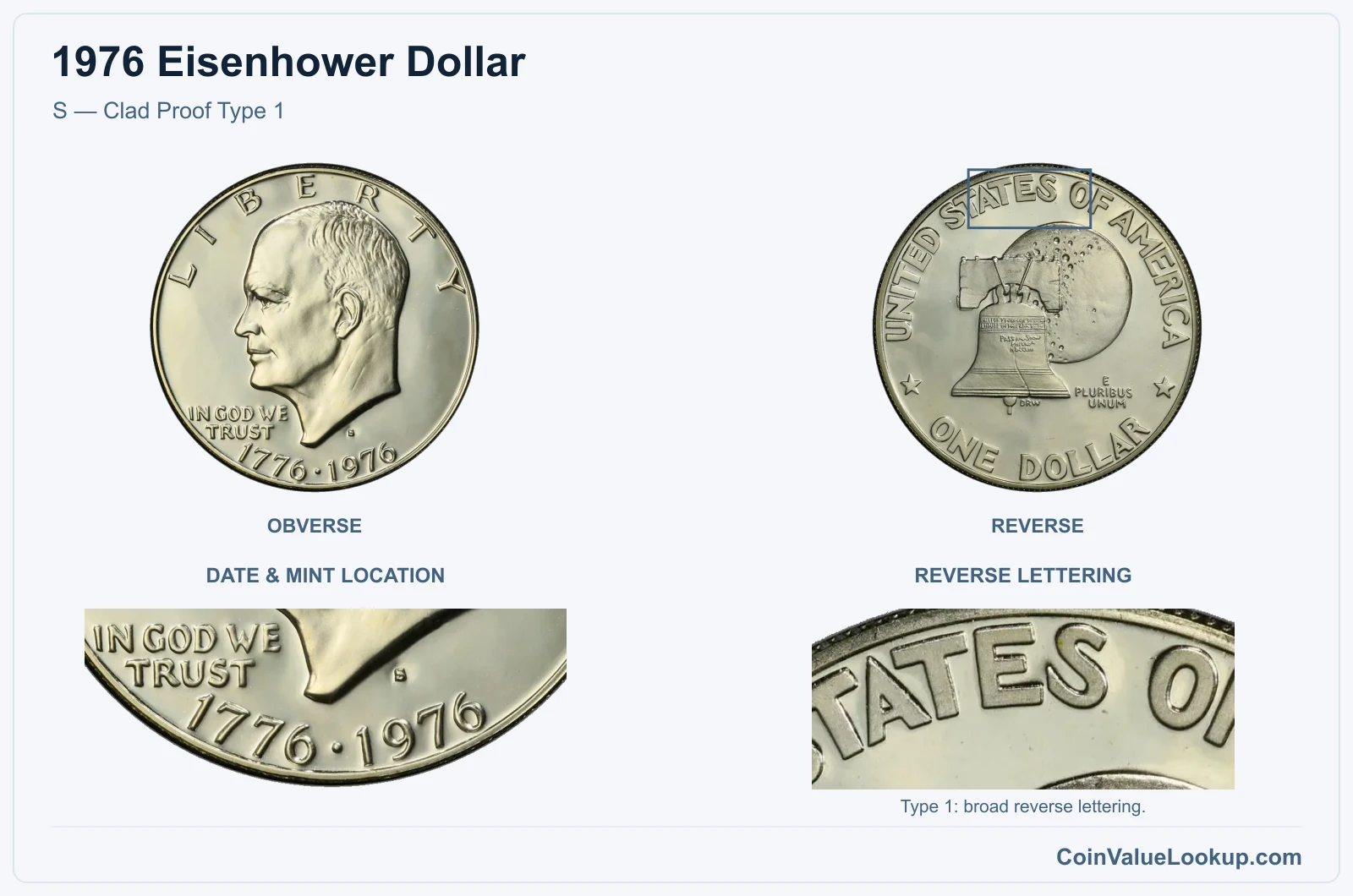
San Francisco struck clad proof dollars as well as silver ones, and this is the clad version. The S mint mark appears on the obverse, and the edge reveals a copper core stripe just like Philadelphia and Denver clad coins.
Type 1 has heavy reverse lettering. An S mint mark alone does not mean silver.
Weight and edge examination help screen, but certified attribution is the definitive answer.
The PR65 guide estimate from USA Coin Book is about $15, the higher of the two clad proof types. Proof finish means mirrored fields and sharply struck devices, not a grade above Mint State.
| Range | Grade | Price | Auction Records | Appraisal |
|---|---|---|---|---|
| PR | PR 1 | — | Coin Identifier | |
| PR 2 | — | Coin Identifier | ||
| PR 3 | — | Coin Identifier | ||
| PR 4 | — | Coin Identifier | ||
| PR 6 | — | Coin Identifier | ||
| PR 8 | — | Coin Identifier | ||
| PR 10 | — | Coin Identifier | ||
| PR 12 | — | Coin Identifier | ||
| PR 15 | — | Coin Identifier | ||
| PR 20 | — | Coin Identifier | ||
| PR 25 | — | Coin Identifier | ||
| PR 30 | — | Coin Identifier | ||
| PR 35 | — | Coin Identifier | ||
| PR 40 | — | Coin Identifier | ||
| PR 45 | — | Coin Identifier | ||
| PR 50 | — | Coin Identifier | ||
| PR 53 | — | Coin Identifier | ||
| PR 55 | — | Coin Identifier | ||
| PR 58 | — | Coin Identifier | ||
| PR 60 | — | Coin Identifier | ||
| PR 61 | — | Coin Identifier | ||
| PR 62 | — | Coin Identifier | ||
| PR 63 | Coin Identifier | |||
| PR 64 | — | Coin Identifier | ||
| PR 65 | Coin Identifier | |||
| PR 66 | Coin Identifier | |||
| PR 67 | Coin Identifier | |||
| PR 68 | Coin Identifier | |||
| PR 69 | Coin Identifier | |||
| PR 70 | — | — | — |
1976 Eisenhower Dollar — S — Clad Proof Type 2
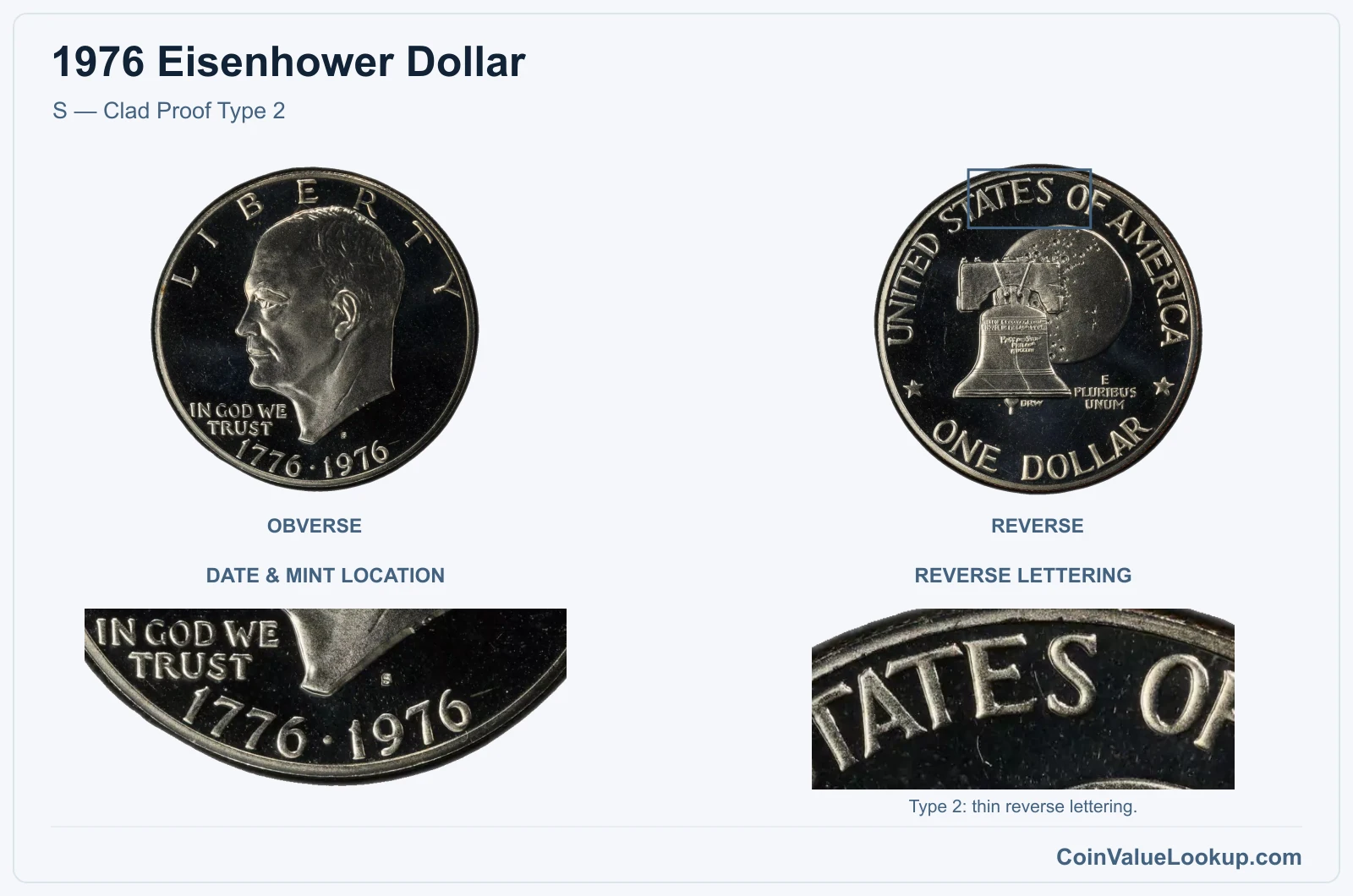
This is the S-mint clad proof with thin, serifed Type 2 reverse lettering. Same copper-nickel clad composition as the Type 1 proof, same S mint mark, different lettering.
USA Coin Book guides it at roughly $10 in PR65. It is a bit less than the Type 1 clad proof.
Cameo contrast, where the devices appear frosty against deep mirror fields, can influence desirability but is a separate quality filter from the numeric proof grade.
| Range | Grade | Price | Auction Records | Appraisal |
|---|---|---|---|---|
| PR | PR 1 | — | Coin Identifier | |
| PR 2 | — | Coin Identifier | ||
| PR 3 | — | Coin Identifier | ||
| PR 4 | — | Coin Identifier | ||
| PR 6 | — | Coin Identifier | ||
| PR 8 | — | Coin Identifier | ||
| PR 10 | — | Coin Identifier | ||
| PR 12 | — | Coin Identifier | ||
| PR 15 | — | Coin Identifier | ||
| PR 20 | — | Coin Identifier | ||
| PR 25 | — | Coin Identifier | ||
| PR 30 | — | Coin Identifier | ||
| PR 35 | — | Coin Identifier | ||
| PR 40 | — | Coin Identifier | ||
| PR 45 | — | Coin Identifier | ||
| PR 50 | — | Coin Identifier | ||
| PR 53 | — | Coin Identifier | ||
| PR 55 | — | Coin Identifier | ||
| PR 58 | — | Coin Identifier | ||
| PR 60 | — | Coin Identifier | ||
| PR 61 | — | Coin Identifier | ||
| PR 62 | — | Coin Identifier | ||
| PR 63 | — | Coin Identifier | ||
| PR 64 | Coin Identifier | |||
| PR 65 | Coin Identifier | |||
| PR 66 | Coin Identifier | |||
| PR 67 | Coin Identifier | |||
| PR 68 | Coin Identifier | |||
| PR 69 | Coin Identifier | |||
| PR 70 | — | — | — |
1976 Eisenhower Dollar — S — 40% Silver Uncirculated Type 1
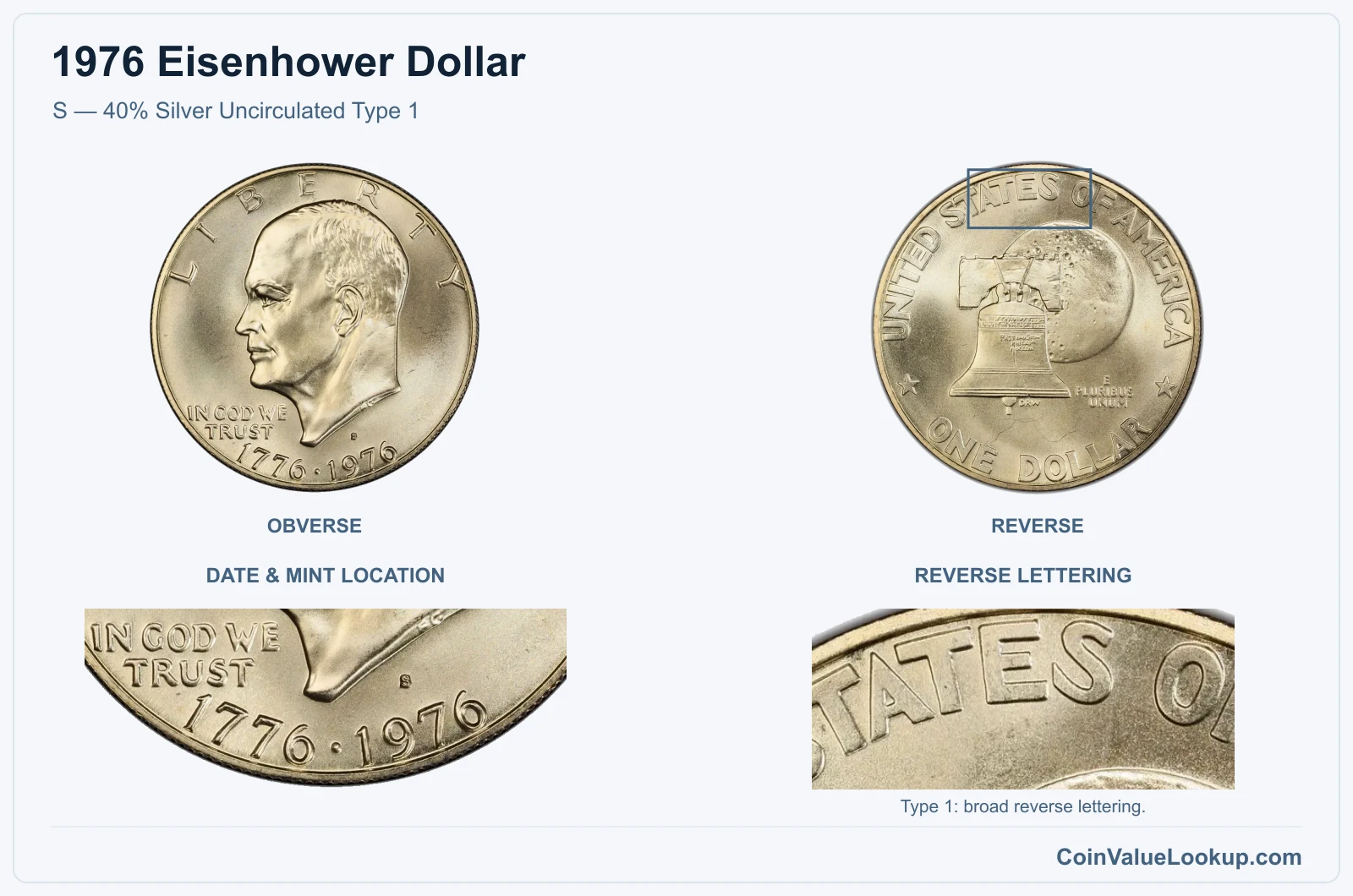
San Francisco produced a collector business-strike version on a 40% silver planchet. These coins have an S mint mark and Type 1 heavy reverse lettering.
The edge will not show the copper stripe seen on clad coins, and the nominal weight is 24.59 grams.
At MS63, the USA Coin Book guide estimate is about $39. That is a significant jump over any clad version.
These were sold in special Mint sets, so most survivors are uncirculated. Still, contact marks from handling and storage affect grade, and higher-grade examples carry proportionally stronger premiums.
| Range | Grade | Price | Auction Records | Appraisal |
|---|---|---|---|---|
| PO | PO 1 | — | Coin Identifier | |
| FR | FR 2 | — | Coin Identifier | |
| AG | AG 3 | — | Coin Identifier | |
| G | G 4 | — | Coin Identifier | |
| G 6 | — | Coin Identifier | ||
| VG | VG 8 | — | Coin Identifier | |
| VG 10 | — | Coin Identifier | ||
| F | F 12 | — | Coin Identifier | |
| F 15 | — | Coin Identifier | ||
| VF | VF 20 | — | Coin Identifier | |
| VF 25 | — | Coin Identifier | ||
| VF 30 | — | Coin Identifier | ||
| VF 35 | — | Coin Identifier | ||
| XF | XF 40 | — | Coin Identifier | |
| XF 45 | — | Coin Identifier | ||
| AU | AU 50 | — | Coin Identifier | |
| AU 53 | — | Coin Identifier | ||
| AU 55 | — | Coin Identifier | ||
| AU 58 | — | Coin Identifier | ||
| MS | MS 60 | Coin Identifier | ||
| MS 61 | — | Coin Identifier | ||
| MS 62 | — | Coin Identifier | ||
| MS 63 | — | Coin Identifier | ||
| MS 64 | Coin Identifier | |||
| MS 65 | Coin Identifier | |||
| MS 66 | Coin Identifier | |||
| MS 67 | Coin Identifier | |||
| MS 68 | Coin Identifier | |||
| MS 69 | Coin Identifier | |||
| MS 70 | — | — | — |
1976 Eisenhower Dollar — S — 40% Silver Proof Type 1
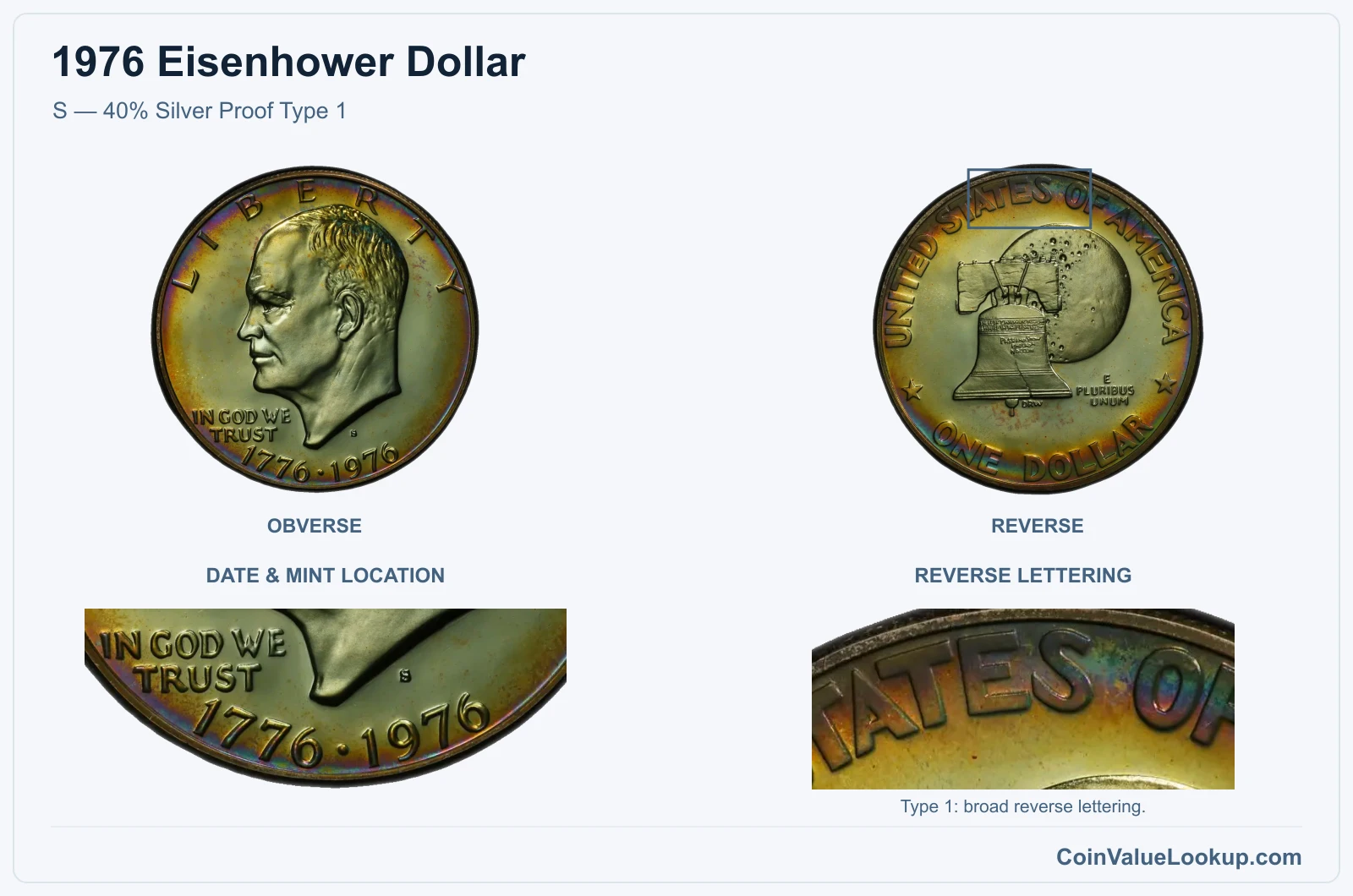
The S-mint 40% silver proof Type 1 is the top guide-valued version among those with supported numeric prices. It combines proof manufacture with the 40% silver composition and heavy Type 1 lettering.
USA Coin Book guides it at about $41 in PR65. These came in individual proof packaging and tend to survive in excellent condition.
Hairlines from improper handling are the main grade limiter. The edge lacks the copper stripe, and weight should be around 24.59 grams.
Keep these separate from S-mint clad proofs, which look similar but are worth considerably less.
| Range | Grade | Price | Auction Records | Appraisal |
|---|---|---|---|---|
| PR | PR 1 | — | Coin Identifier | |
| PR 2 | — | Coin Identifier | ||
| PR 3 | — | Coin Identifier | ||
| PR 4 | — | Coin Identifier | ||
| PR 6 | — | Coin Identifier | ||
| PR 8 | — | Coin Identifier | ||
| PR 10 | — | Coin Identifier | ||
| PR 12 | — | Coin Identifier | ||
| PR 15 | — | Coin Identifier | ||
| PR 20 | — | Coin Identifier | ||
| PR 25 | — | Coin Identifier | ||
| PR 30 | — | Coin Identifier | ||
| PR 35 | — | Coin Identifier | ||
| PR 40 | — | Coin Identifier | ||
| PR 45 | — | Coin Identifier | ||
| PR 50 | — | Coin Identifier | ||
| PR 53 | — | Coin Identifier | ||
| PR 55 | — | Coin Identifier | ||
| PR 58 | — | Coin Identifier | ||
| PR 60 | — | Coin Identifier | ||
| PR 61 | — | Coin Identifier | ||
| PR 62 | — | Coin Identifier | ||
| PR 63 | — | Coin Identifier | ||
| PR 64 | Coin Identifier | |||
| PR 65 | Coin Identifier | |||
| PR 66 | Coin Identifier | |||
| PR 67 | Coin Identifier | |||
| PR 68 | Coin Identifier | |||
| PR 69 | Coin Identifier | |||
| PR 70 | — | — | — |
1976 Eisenhower Dollar — No S — Type 2 Silver Proof, Exceptional Issue
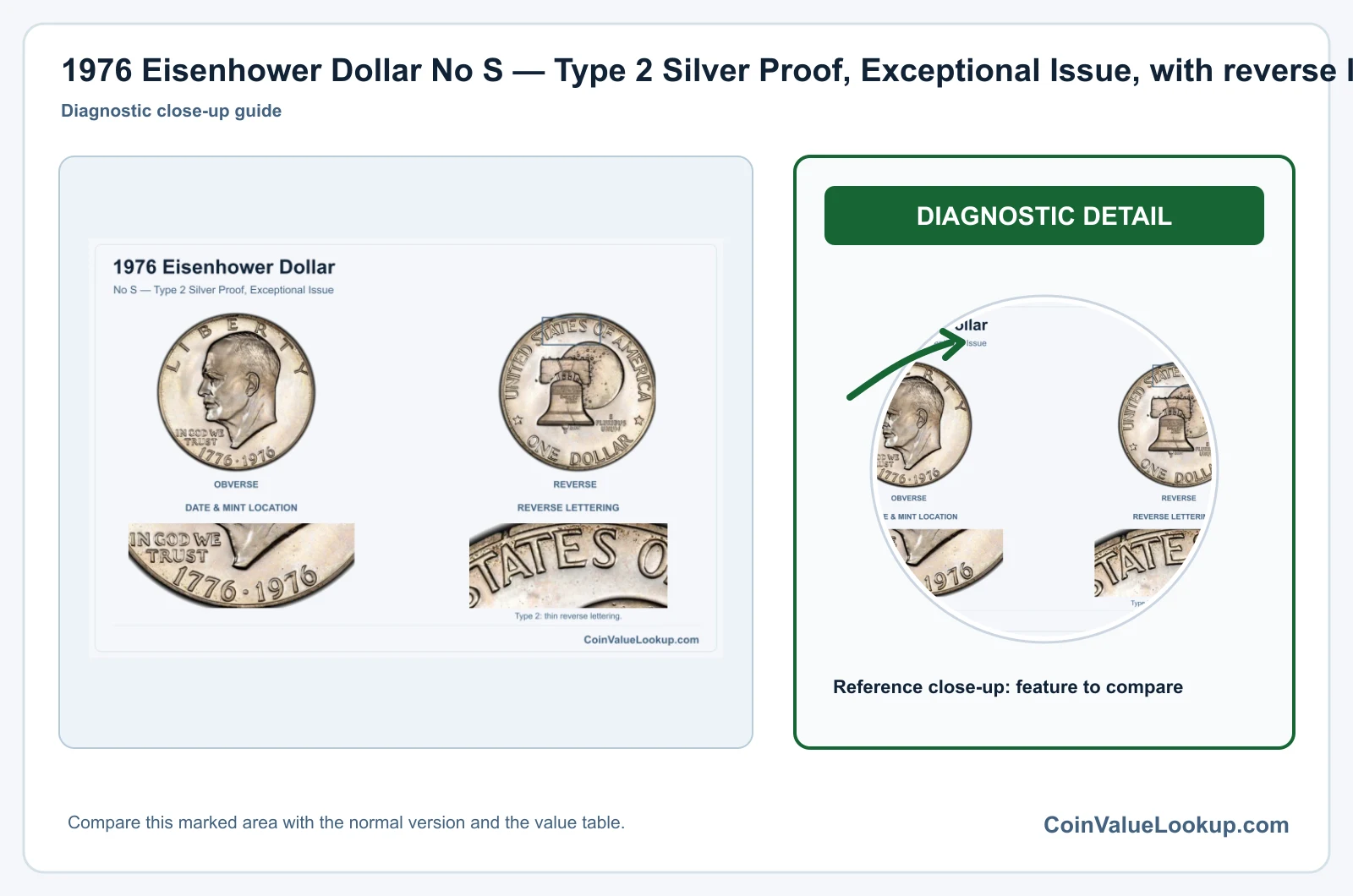
This is an extraordinary authenticated rarity, not an ordinary dollar that happens to lack a mint mark. Every Philadelphia business strike also lacks a mint mark, so the absence of an S means nothing by itself.
What sets this coin apart is the specific combination of four attributes: no mint mark, 40% silver composition, Type 2 thin reverse lettering, and proof manufacture. All four must be confirmed together.
Normal silver proofs are Type 1, and normal no-mark dollars are clad business strikes, so this coin falls outside every standard category.
No supported price range is adopted for this version. Each authenticated example depends on its individual condition, provenance, and specialist confirmation.
If you suspect you have one, professional third-party authentication is essential before drawing any conclusions about value.
| Range | Grade | Price | Auction Records | Appraisal |
|---|---|---|---|---|
| PR | PR 1 | — | Coin Identifier | |
| PR 2 | — | Coin Identifier | ||
| PR 3 | — | Coin Identifier | ||
| PR 4 | — | Coin Identifier | ||
| PR 6 | — | Coin Identifier | ||
| PR 8 | — | Coin Identifier | ||
| PR 10 | — | Coin Identifier | ||
| PR 12 | — | Coin Identifier | ||
| PR 15 | — | Coin Identifier | ||
| PR 20 | — | Coin Identifier | ||
| PR 25 | — | Coin Identifier | ||
| PR 30 | — | Coin Identifier | ||
| PR 35 | — | Coin Identifier | ||
| PR 40 | — | Coin Identifier | ||
| PR 45 | — | Coin Identifier | ||
| PR 50 | — | Coin Identifier | ||
| PR 53 | — | Coin Identifier | ||
| PR 55 | — | Coin Identifier | ||
| PR 58 | — | Coin Identifier | ||
| PR 60 | — | Coin Identifier | ||
| PR 61 | — | Coin Identifier | ||
| PR 62 | — | Coin Identifier | ||
| PR 63 | — | Coin Identifier | ||
| PR 64 | — | Coin Identifier | ||
| PR 65 | — | Coin Identifier | ||
| PR 66 | — | Coin Identifier | ||
| PR 67 | — | — | — | |
| PR 68 | — | — | — | |
| PR 69 | — | — | — | |
| PR 70 | — | — | — |
1976 Eisenhower Dollar Error List
1. 1976 Eisenhower Dollar — Off-Center Strike
An off-center strike happens when the planchet is not properly seated between the dies. On a 1776–1976 no-mark Type 2 dollar struck about 5% off center toward 12 o'clock, the upper portion of the design runs beyond the edge of the blank.
Letter tops along the upper rim are absent or truncated, and a thin crescent of unstruck planchet appears opposite the shift direction.
Both faces will show the displacement because the same misalignment affects obverse and reverse together. Do not confuse this with a single misaligned die, where only one side appears shifted while the other is centered.
A trimmed rim or ordinary weak lettering from a tired die will not produce the matching crescent and displaced design on both sides.
One ANACS MS63 example sold for $224.25 in May 2003. That is a single historical sale, not a current market range.
2. 1976 Eisenhower Dollar — Flipover Double Strike
A flipover double strike means the coin was struck, flipped over inside the press, and struck again. The result is dramatic: traces of Eisenhower's portrait appear on what should be the Bell-and-Moon side, and remnants of the reverse design show up on the portrait side.
The overlapping opposite-face design elements are the key diagnostic.
This is different from a doubled die, which shows doubling within a single impression, or a die clash, where incuse mirror-image marks transfer between dies without a second full strike. A vise job, where someone deliberately presses two coins together outside the Mint, can mimic parts of this look but will lack the force and centering characteristics of a genuine Mint strike.
No supported price range is adopted for this error. Each piece requires individual assessment based on authenticated identity, condition, and the degree of the second impression.
3. 1976 Eisenhower Dollar — Denver Dollar on a Silver-Clad Planchet
A Denver dollar struck on a 40% silver planchet is a wrong-planchet error. Denver was not supposed to use silver blanks; those were allocated to San Francisco.
The D mint mark identifies the coin as Denver production, and alloy verification establishes that it landed on an unintended silver blank.
Screening starts at the edge: silver planchets lack the copper-colored core stripe visible on normal clad coins. Weight should be close to 24.59 grams instead of the standard 22.68 grams.
But screening is not proof. Certified attribution from a major grading service is necessary.
Do not confuse this with a normal S-mint silver dollar, an ordinary clad P or D coin, or a coin that has been silver-plated after leaving the Mint. Plating adds weight unevenly and often shows bubbling or peeling.
The No S silver proof is a completely different issue. No supported price range is adopted; value depends on authenticated identity and condition.
4. 1976 Eisenhower Dollar — Clipped Planchet
A clipped planchet error occurs when the blank is punched from strip metal that overlaps a previously punched hole. The result is a curved missing section.
This particular reported example is a 1776–1976-D Type 2 dollar showing two clips combined with an off-center strike.
Look for two distinct curved absences along the rim, each with a characteristic weakness in the design near the clip called the Blakesley effect. The displaced design from the off-center strike is a separate feature; do not count the missing area from the clips as part of the off-center percentage.
A trimmed coin will show a straight or irregular cut rather than a smooth curve matching the diameter of adjacent blanks. An ordinary off-center strike on an intact blank will have a complete round edge despite the shifted design.
No supported price range is adopted; each example requires individual assessment based on authentication and condition.
5. 1976 Eisenhower Dollar — Missing Obverse Clad Layer
On a normal clad Eisenhower dollar, the obverse and reverse surfaces are copper-nickel layers bonded over a copper core. When the obverse clad layer is missing, the exposed core gives the entire obverse a distinctly copper-colored appearance while the reverse looks normal.
The coin will weigh less than the standard 22.68 grams because an entire layer of metal is absent. The design on the exposed core side may appear slightly mushy or weakly struck because the thinner planchet changes how the die impression transfers.
Do not confuse this with copper-colored toning, which is surface discoloration that can be uneven and does not reduce weight. Plating removal or deliberate scraping after the coin left the Mint will show tool marks or irregular surfaces rather than a uniformly exposed core with struck design detail.
No supported price range is adopted for this error; value depends on certified attribution and condition.
6. 1976 Eisenhower Dollar — Obverse Lamination
A lamination error is a localized separation within the planchet metal, where a thin layer peels away or lifts from the surface. On a 1776–1976 no-mark Type 1 dollar, this appears on the obverse as a flap or missing patch with a visible boundary where the metal tore.
The struck design may continue beneath or beside the separated area, which confirms the flaw existed in the planchet before or during striking. This is different from an entire missing clad layer; a lamination affects only a portion of one face.
Corrosion can eat away at surfaces and leave pitting that superficially resembles a lamination, but corrosion typically lacks the clean boundary and layered metal characteristic. Scratches and post-mint scraping leave directional marks rather than a natural separation plane.
No supported price range is adopted; individual assessment based on authentication, size of the affected area, and overall condition determines value.
7. 1976 Eisenhower Dollar — Double Strike, Second Impression Off Center
This error shows a complete first strike with a second impression displaced about 90% off center. The full dollar design from the initial strike remains visible, and a small arc of a second impression appears near the edge of the coin.
The coin did not flip between strikes, so both impressions show the same orientation, obverse on obverse, reverse on reverse.
This is not the same as the flipover double strike, where opposite-face designs cross over. It also differs from a doubled die, which is a die manufacturing defect producing subtle doubling within a single strike, and from machine doubling, which is flat shelf-like displacement of design elements.
A single off-center strike would not leave a full centered design underneath.
No supported price range is adopted. Value depends on certified authentication, the visual drama of the second impression, and the coin's overall preservation.
8. 1976 Eisenhower Dollar — Partial Collar Strike
During a normal strike, the collar die surrounds the planchet and forms the edge, including the reeding. In a partial collar strike, part of the coin sits inside the collar while another part extends beyond it.
The result is a coin where one section has normal reeded edge and the opposite section has a smooth, slightly expanded rim.
Look at the edge in profile. You should see a clear transition from reeded to smooth, and the coin may appear slightly out-of-round on the unrestrained side.
Both faces may show a slight fin or lip where the metal spread past the collar boundary.
A filed or spooned edge will show tool marks and lack the gradual collar-to-no-collar transition. A completely broadstruck coin has no reeding anywhere and expands in all directions.
No supported price range is adopted for this error; each piece needs individual assessment based on its authenticated identity and condition.