1978 Eisenhower Dollar Coin Value: How Much Is It Worth?
A worn 1978 Eisenhower dollar in typical circulated condition is generally worth its $1 face value. In uncirculated grades around MS63, guide estimates from USA Coin Book place the Philadelphia and Denver issues at roughly $7 each, while the San Francisco clad proof sits near $6.25 at PR65.
Higher preservation or authenticated mint errors can shift these figures considerably.
Fast Way to Identify Your 1978 Eisenhower Dollar
The quickest way to start figuring out what you have is to upload clear photos of both the front and back of your coin. This gives a preliminary identification of the mint, finish and condition so you know which branch of the 1978 Ike dollar you are dealing with.
Sharp, well-lit images help distinguish wear patterns and any potential errors.
1978 Eisenhower Dollar Value
Upload both sides of your 1978 Eisenhower Dollar.
Front Obverse
Upload photo
Back Reverse
Upload photo
Which 1978 Eisenhower Dollar Versions Are Worth Money?
- Philadelphia (no mintmark) and Denver Ike dollars in clean, original uncirculated condition can carry modest premiums above face value, with guide estimates around $7 at MS63.
- The S-mint proof is a clad proof, not silver; its value depends on surface quality, with a PR65 guide estimate near $6.25.
- Authenticated off-center strikes on 1978 Ike dollars have brought over $3,000 at auction for a single high-grade example.
- A 1978-D missing obverse clad layer error sold for $1,320 at a Heritage auction in 2022, showing that verified planchet errors carry significant premiums.
- Defective planchet, double-strike, clipped planchet and copperwash errors have been documented for this date and are worth professional authentication if suspected.
Step 1: Identify Your 1978 Eisenhower Dollar Mint Mark and Version
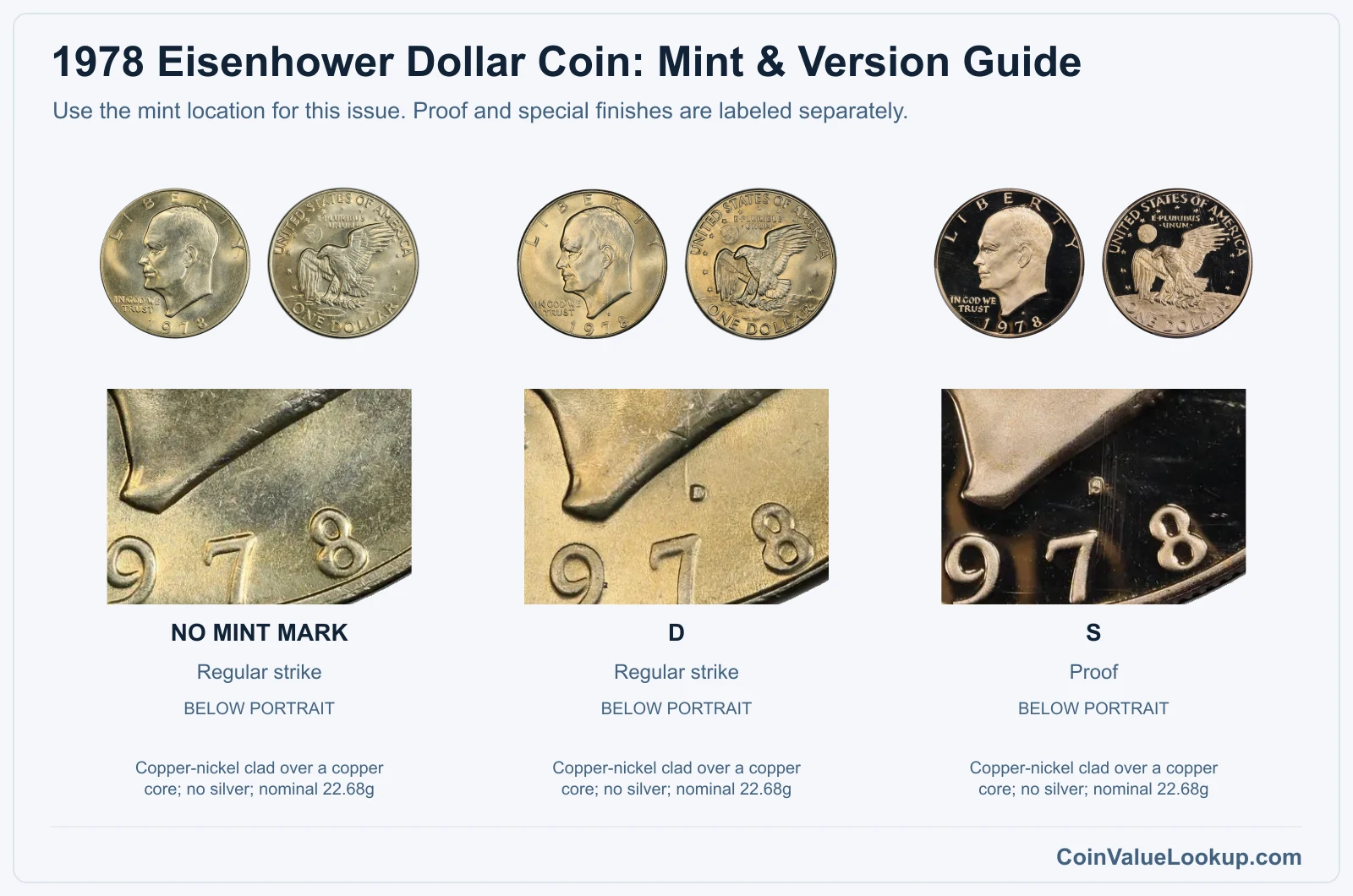
Start by reading the date. It should say 1978, and the reverse shows the eagle landing on the Moon, which returned after the 1975–1976 Bicentennial design.
Philadelphia coins carry no mintmark at all. Denver coins show a small D, and San Francisco proofs show an S, both located on the obverse just below the bust truncation and above the date.
All three versions are copper-nickel clad over a copper core. There is no normal silver issue for 1978, despite what you might hope.
If the edge shows a copper-colored stripe between two silvery layers, that is exactly what a standard clad Ike looks like.
A shiny surface does not prove your coin is a proof or made of silver. Proofs have mirrored fields and sharp squared rims from the specialized striking process.
Weight is a useful screening tool but not definitive by itself; the nominal weight is 22.68 grams.
Never clean or polish the coin. Cleaning destroys original surfaces and almost always reduces collector value.
Step 2: Check Your 1978 Eisenhower Dollar Grade
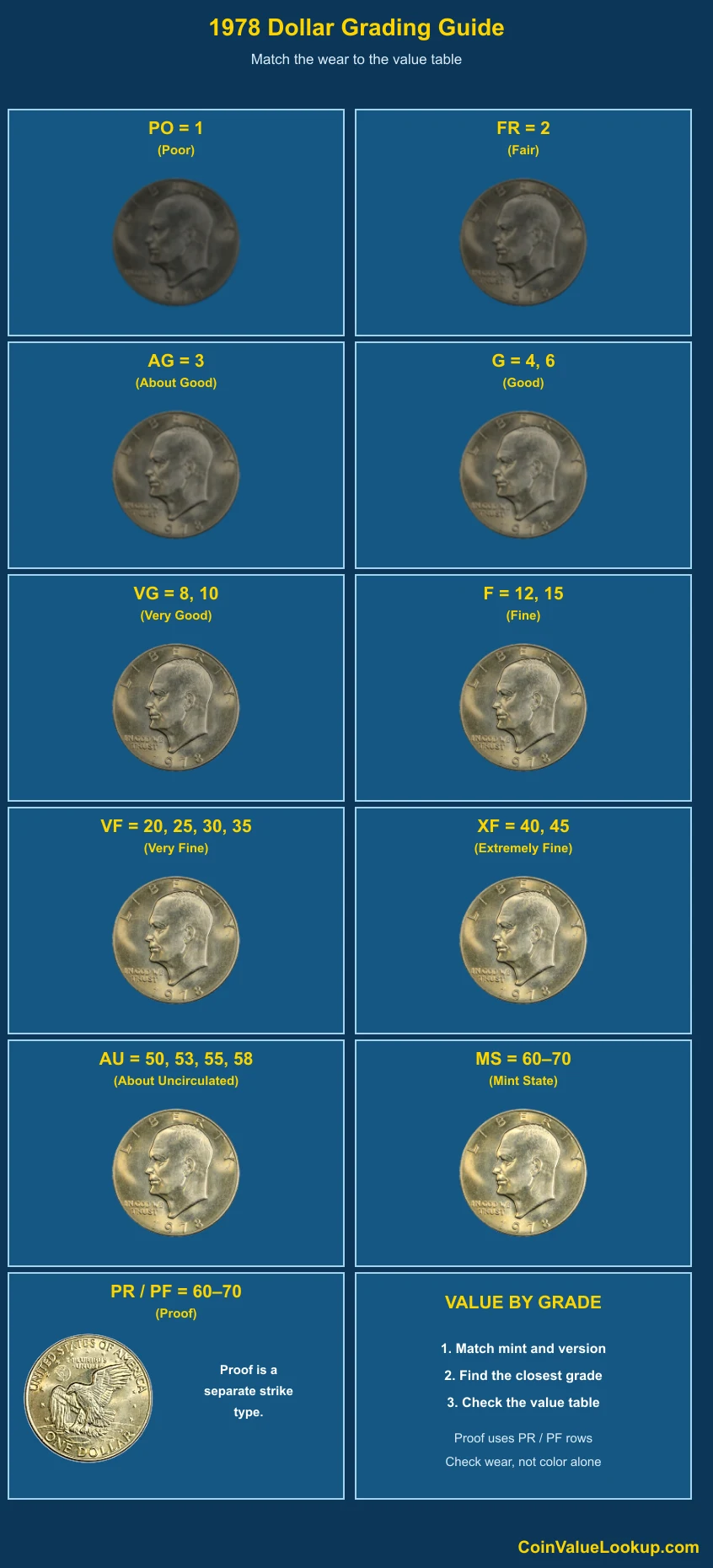
Focus on Eisenhower's cheek, jaw and the high points of his hair first. These are the places where friction shows up earliest.
Even light cabinet wear on these areas drops a coin below uncirculated.
The broad open fields on both sides pick up contact marks easily because these are large, heavy coins that banged around in bags. A technically uncirculated piece with heavy bag marks may grade well below a lightly circulated example in eye appeal.
On the eagle reverse, check the feather detail on the breast and wing tips. Weak detail there can come from a tired die rather than actual wear, so compare it with luster continuity under angled light.
If the luster breaks only on the high points, that is wear; if it is uniformly soft, suspect strike quality.
For proofs, grade separately from business strikes. Look for hairlines from mishandling and any haze or spotting on the mirrored fields.
Cameo or deep cameo contrast refers to frosted devices against mirror fields, a visual characteristic, not a different alloy or higher grade tier. Use the comparison image to calibrate what each condition level looks like on a real coin.
Step 3: Check 1978 Eisenhower Dollar Value by Mint and Version
1978 Eisenhower Dollar — No Mint Mark — Clad
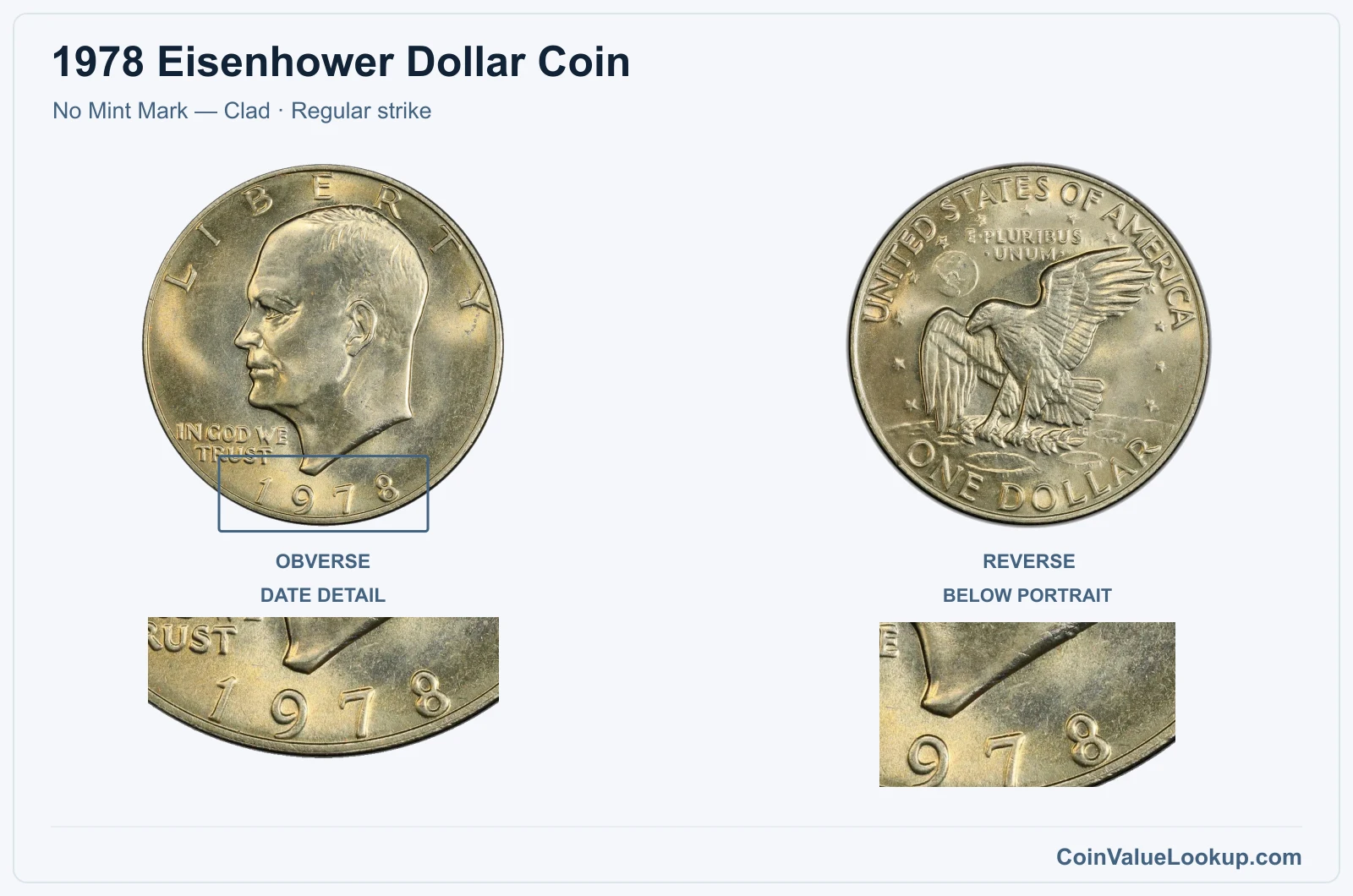
The 1978 Philadelphia Eisenhower dollar carries no mintmark on the obverse. It is a copper-nickel clad business strike weighing about 22.68 grams, with the standard Eisenhower portrait on the front and the eagle-on-Moon reverse.
This is the most commonly encountered version. A USA Coin Book guide estimate places it around $7 at MS63.
Circulated examples are worth face value. What separates a $1 coin from a $7 coin is surface preservation: clean fields, full luster and minimal bag marks.
A shiny coin that has been cleaned or polished does not count.
Range Grade
Price Auction Records Appraisal PO PO 1
—
Coin Identifier FR FR 2
—
Coin Identifier AG AG 3
—
Coin Identifier G G 4
—
Coin Identifier
G 6
—
Coin Identifier VG VG 8
—
Coin Identifier
VG 10
—
Coin Identifier F F 12
—
Coin Identifier
F 15
—
Coin Identifier VF VF 20
—
Coin Identifier
VF 25
—
Coin Identifier
VF 30
—
Coin Identifier
VF 35
—
Coin Identifier XF XF 40
—
Coin Identifier
XF 45
—
Coin Identifier AU AU 50
—
Coin Identifier
AU 53
—
Coin Identifier
AU 55
—
Coin Identifier
AU 58
—
Coin Identifier MS MS 60
—
Coin Identifier
MS 61
—
Coin Identifier
MS 62
Coin Identifier
MS 63
Coin Identifier
MS 64
Coin Identifier
MS 65
Coin Identifier
MS 66
Coin Identifier
MS 67
Coin Identifier
MS 68
—
—
—
MS 69
—
—
—
MS 70
—
—
—
1978 Eisenhower Dollar — D — Clad
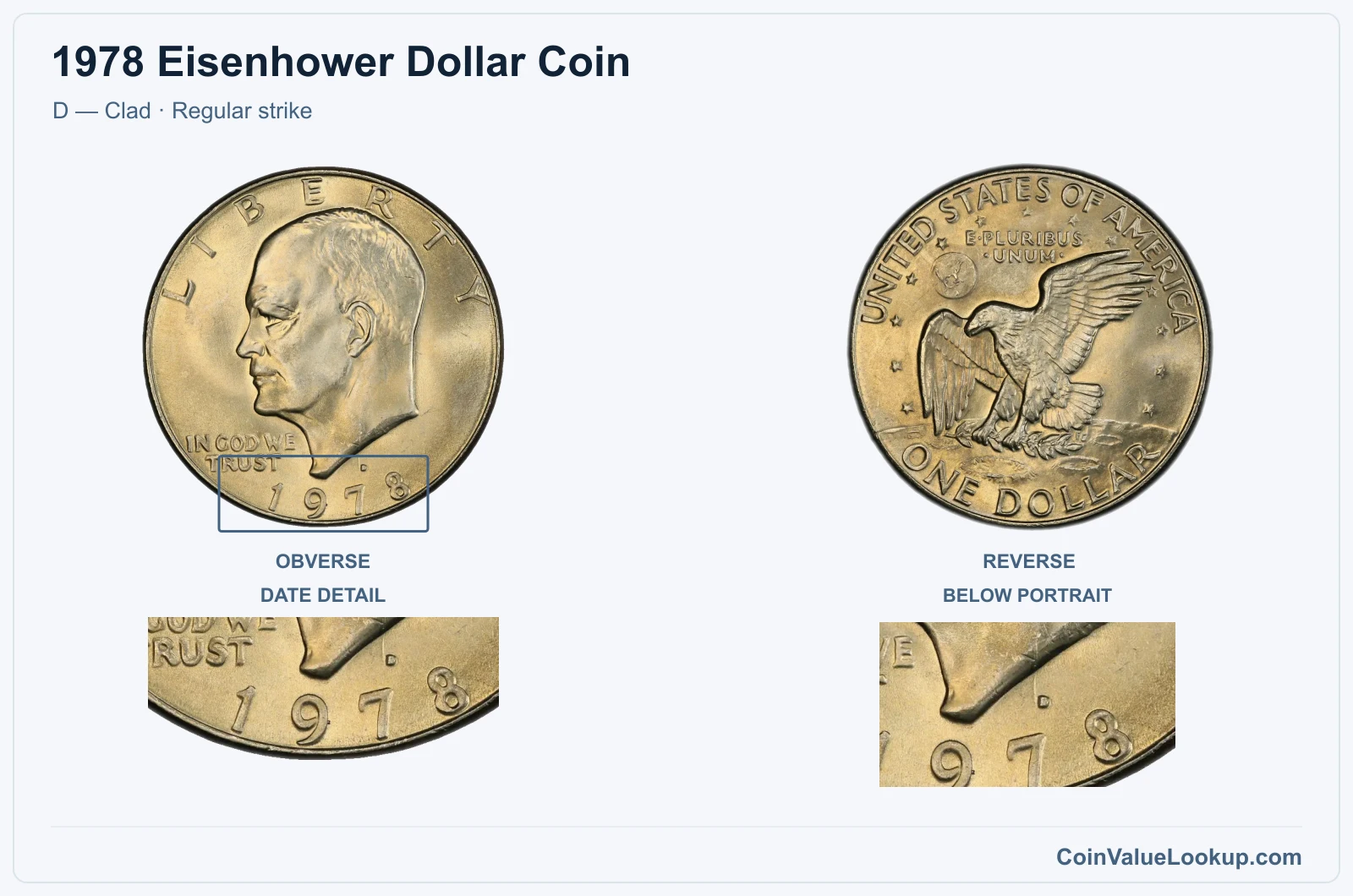
The Denver issue shows a small D mintmark on the obverse below the bust. Same clad composition, same weight, same design as the Philadelphia coin.
At MS63 the USA Coin Book guide estimate is also about $7. Do not mistake a normal Denver clad dollar for a wrong-planchet coin just because the edge looks coppery; that copper stripe between silvery layers is exactly what clad construction looks like.
Coin Value Lookup is a handy place to look up current guide values for Eisenhower dollars and other U.S. coins when you want a quick reference organized by date and mint.
Range Grade
Price Auction Records Appraisal PO PO 1
—
Coin Identifier FR FR 2
—
Coin Identifier AG AG 3
—
Coin Identifier G G 4
—
Coin Identifier
G 6
—
Coin Identifier VG VG 8
—
Coin Identifier
VG 10
—
Coin Identifier F F 12
—
Coin Identifier
F 15
—
Coin Identifier VF VF 20
—
Coin Identifier
VF 25
—
Coin Identifier
VF 30
—
Coin Identifier
VF 35
—
Coin Identifier XF XF 40
—
Coin Identifier
XF 45
—
Coin Identifier AU AU 50
—
Coin Identifier
AU 53
—
Coin Identifier
AU 55
—
Coin Identifier
AU 58
—
Coin Identifier MS MS 60
—
Coin Identifier
MS 61
—
Coin Identifier
MS 62
—
Coin Identifier
MS 63
Coin Identifier
MS 64
Coin Identifier
MS 65
Coin Identifier
MS 66
Coin Identifier
MS 67
Coin Identifier
MS 68
—
—
—
MS 69
—
—
—
MS 70
—
—
—
1978 Eisenhower Dollar — S — Clad Proof
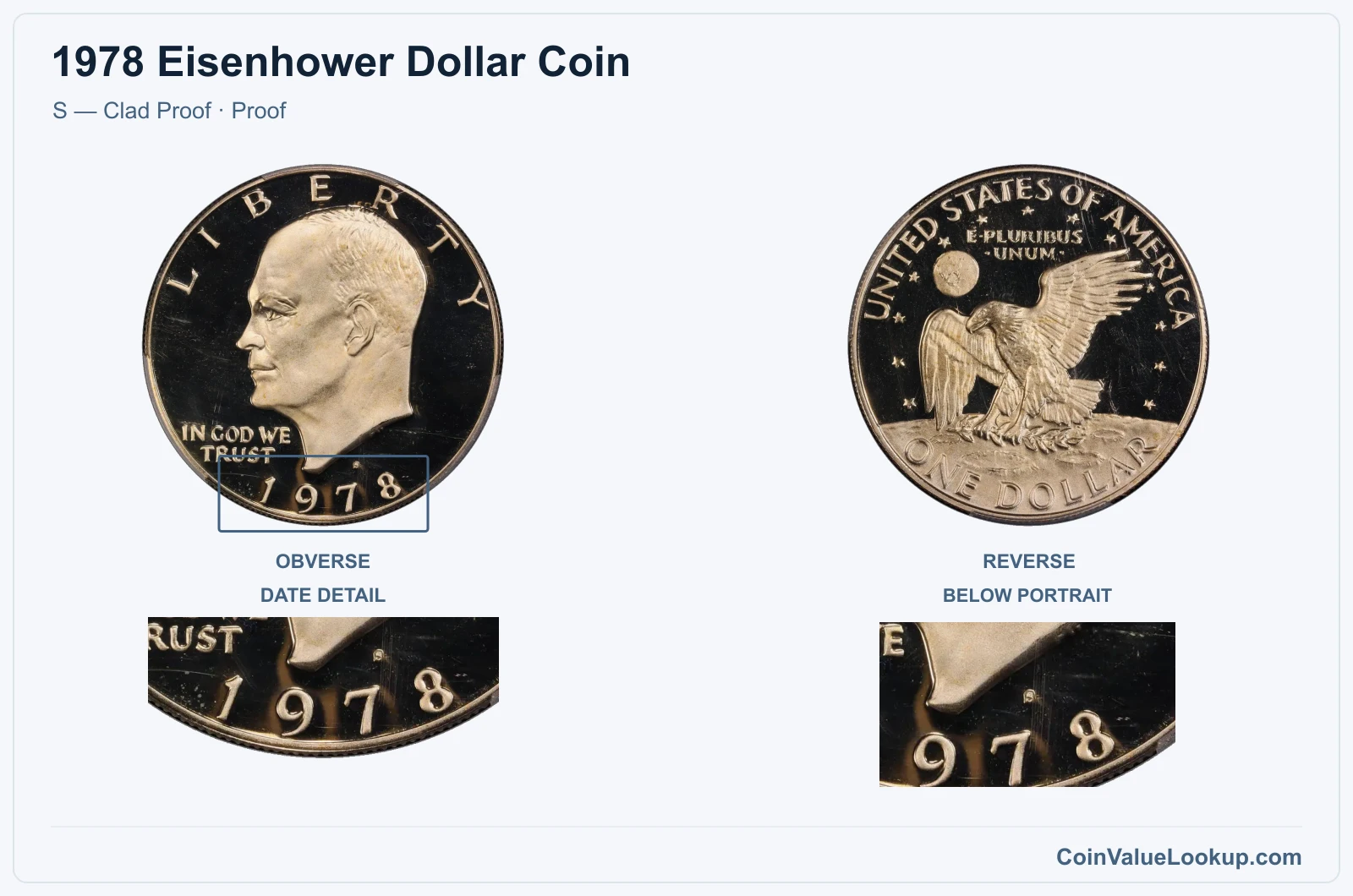
San Francisco struck clad proof Ike dollars in 1978, marked with an S on the obverse. These were sold directly to collectors and were never intended for circulation.
The composition is the same copper-nickel clad as the business strikes. There is no standard silver proof or silver uncirculated version for this date.
A USA Coin Book guide estimate puts the PR65 value near $6.25.
Condition is everything with proofs. Hairlines from improper handling, haze and toning spots reduce the grade quickly.
Cameo and deep cameo designations describe the contrast between frosted devices and mirrored fields. They are visual filters applied during grading, not separate alloy types.
Range Grade
Price Auction Records Appraisal PR PR 1
—
Coin Identifier
PR 2
—
Coin Identifier
PR 3
—
Coin Identifier
PR 4
—
Coin Identifier
PR 6
—
Coin Identifier
PR 8
—
Coin Identifier
PR 10
—
Coin Identifier
PR 12
—
Coin Identifier
PR 15
—
Coin Identifier
PR 20
—
Coin Identifier
PR 25
—
Coin Identifier
PR 30
—
Coin Identifier
PR 35
—
Coin Identifier
PR 40
—
Coin Identifier
PR 45
—
Coin Identifier
PR 50
—
Coin Identifier
PR 53
—
Coin Identifier
PR 55
—
Coin Identifier
PR 58
—
Coin Identifier
PR 60
—
Coin Identifier
PR 61
—
Coin Identifier
PR 62
—
Coin Identifier
PR 63
—
Coin Identifier
PR 64
—
Coin Identifier
PR 65
—
Coin Identifier
PR 66
Coin Identifier
PR 67
Coin Identifier
PR 68
Coin Identifier
PR 69
Coin Identifier
PR 70
Coin Identifier
1978 Eisenhower Dollar Error List
1. 1978 Eisenhower Dollar — Off-Center Strike
An off-center strike happens when the planchet is not properly seated in the collar before the dies come together. On a documented 1978 Philadelphia dollar struck roughly 25 percent off center, the design shifts toward 12 o'clock while the full date remains visible, and a broad crescent of blank metal appears on the opposite side.
Both faces must show matching displacement. If only one side looks shifted, you may be looking at a misaligned die, which is a different and less dramatic error.
Damaged rims and altered coins can also mimic the look.
One PCGS MS65 example sold for $3,003.60 at auction in August 2021. That is a single recorded sale of a high-grade, authenticated piece, not a general market price for every off-center Ike.
2. 1978 Eisenhower Dollar — Missing Obverse Clad Layer
A missing clad layer error means one of the outer nickel-alloy layers was absent before the coin was struck. On a documented 1978-D dollar missing its obverse clad layer, the front of the coin shows exposed copper while the reverse appears normal.
Weight is a key diagnostic. The authenticated example weighed 18.9 grams, well below the normal 22.68 grams, because an entire layer of metal is gone.
Color alone is not enough to confirm this error. Surface stripping, plating removal and heavy copper-toned tarnish can all produce a similar look.
One NGC AU58 specimen sold for $1,320 at a Heritage auction in November 2022. That is a single documented sale.
Professional authentication and accurate weight measurement are necessary to distinguish a genuine missing-clad error from post-mint damage.
3. 1978 Eisenhower Dollar — Defective Planchet / Improperly Bonded Metal
A defective planchet or improperly bonded metal error shows a localized area where the clad layers did not bond correctly to the core before striking. On a documented 1978 Philadelphia dollar, approximately 22 percent of the coin surface is affected by this bonding defect.
The affected zone interrupts the normal surface texture in a way that looks different from ordinary corrosion or scratches. To evaluate a suspected example, examine the full boundary of the defect, its relationship to the struck design and both faces of the coin.
Corrosion, gouges and post-mint metal removal can look similar at a glance. One PCGS MS63 example sold for $705 at a Heritage auction in August 2016.
Individual assessment by a grading service is the practical path to confirming this type of error.
4. 1978 Eisenhower Dollar — Double Strike, Second Strike Off Center
A double-struck coin received two separate impressions from the dies, typically because it failed to eject properly after the first strike. A documented 1978-D dollar shows a second strike approximately 75 percent off center, leaving two distinct design impressions visible on both sides along with areas of unstruck metal.
Look for a complete first-strike date and a clearly separate second impression. This is different from a single off-center strike, which shows only one impression.
It also differs from doubled die varieties and mechanical doubling, which affect design elements within a single strike.
No specific price is adopted for this error category. Value depends on the severity, visual drama and authenticated condition of the individual coin, so professional attribution is the way to establish what a particular specimen is worth.
5. 1978 Eisenhower Dollar — Double Curved Clips with Partial Collar
A clipped planchet occurs when the blank is punched from strip metal that overlaps a previous punch-out, leaving a curved incomplete edge. A documented 1978-D dollar shows two curved clips combined with a partial collar error, meaning the coin was also not fully seated in the collar during striking.
The two curved missing sections and the transition from reeded edge to plain or distorted edge are the diagnostics to look for. Not every clipped coin also has a collar error, so do not assume both are present on your example.
Later edge cutting and generic rim damage can mimic a clip. No specific price is adopted for this combined error.
Each coin needs individual assessment by an authentication service that can verify both the clips and the collar anomaly together.
6. 1978 Eisenhower Dollar — Reverse Copper Wash
A copperwash error describes an abnormal copper-colored surface appearance on what should be a normal silvery clad face. A documented 1978-D dollar has been cataloged with a copperwash reverse, indicating the back of the coin displays this discoloration.
This is distinct from a missing clad layer, which involves a physically absent layer and measurably reduced weight. A copperwash coin retains its full layers but has an unusual surface condition attributed to the minting process.
Artificial plating, environmental toning and heat damage can all produce copper-colored surfaces on clad coins. Attribution requires matched photographs and professional review.
No specific price is adopted for this error. Value depends on authenticated identity, the extent of the wash and overall coin condition.