1877 Trade Dollar Coin Value: How Much Is It Worth?
The 1877 Trade Dollar is a silver dollar struck for international commerce, and surviving examples still turn up in collections and estate finds today. Guide estimates for business strikes range from about $232 in well-worn Good-4 condition up to $7,851 for a high-grade 1877-CC in MS63, according to USA Coin Book.
Those figures depend entirely on which mint produced your coin, its condition and whether it carries original surfaces. A proof finish exists for this date as well, requiring individual assessment rather than a simple lookup.
Fast Way to Identify Your 1877 Trade Dollar
The fastest way to start figuring out what your 1877 Trade Dollar is worth is to upload clear photos of the front and back. That lets us provide a preliminary identification of your coin's mint, finish and approximate condition.
Snap both sides in even, natural light and avoid glare on the surfaces so details come through clearly.
1877 Trade Dollar Value
Upload both sides of your 1877 Trade Dollar.
Front Obverse
Upload photo
Back Reverse
Upload photo
Which 1877 Trade Dollar Versions Are Worth Money?
- The 1877-CC (Carson City) commands the highest guide estimates among business strikes, reaching $7,851 at MS63 per USA Coin Book, because Carson City dollars are scarcer and actively collected by mint.
- The 1877 Proof is a special-finish Philadelphia striking that requires individual assessment by an authenticated example, since no standard guide range was adopted here.
Step 1: Identify Your 1877 Trade Dollar Mint Mark and Version
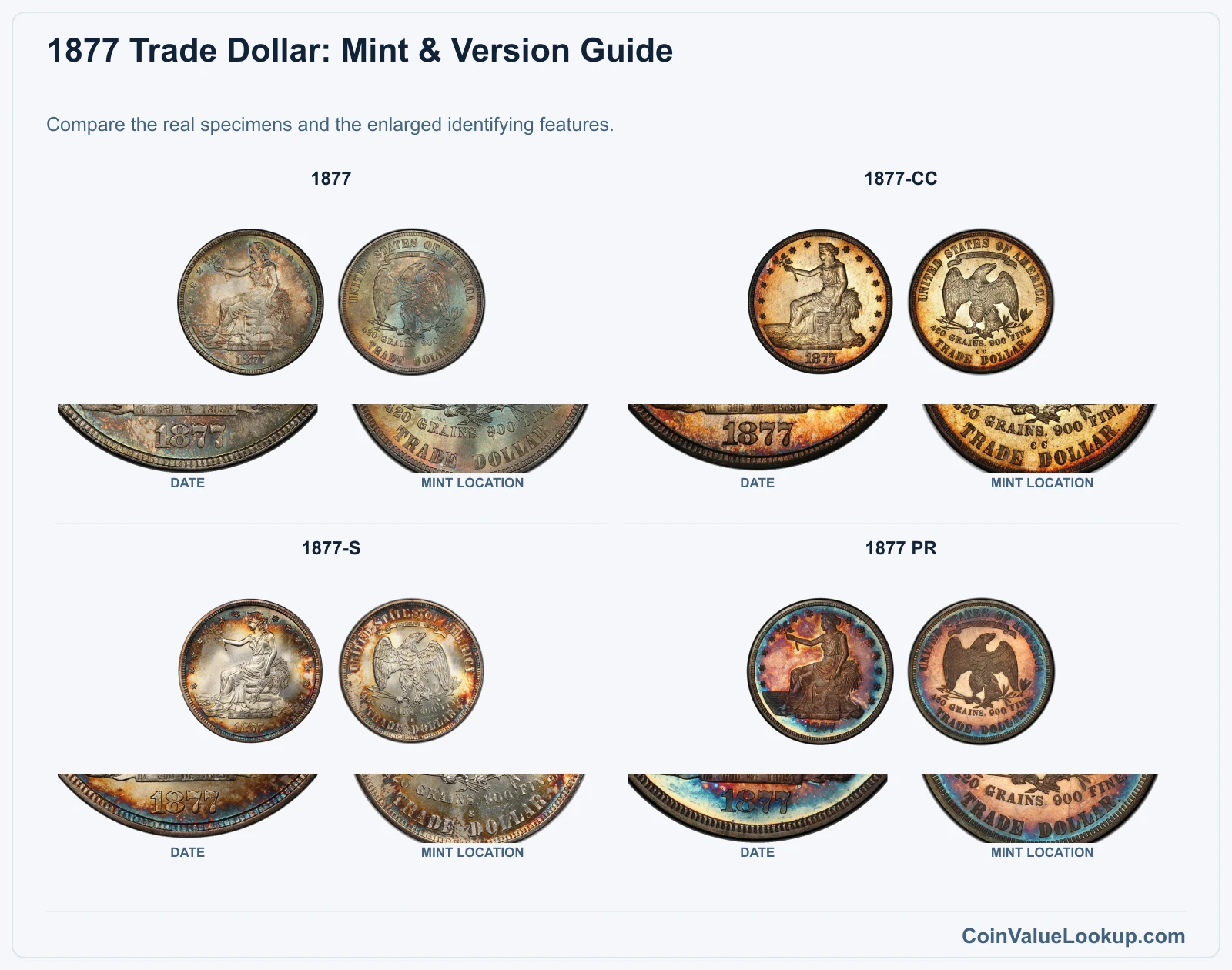
The 1877 Trade Dollar was struck at three mints. Philadelphia coins carry no mintmark.
Carson City pieces show a small "CC" on the reverse below the eagle, and San Francisco dollars display an "S" in the same spot. Flip the coin over and look right beneath the eagle's tail feathers.
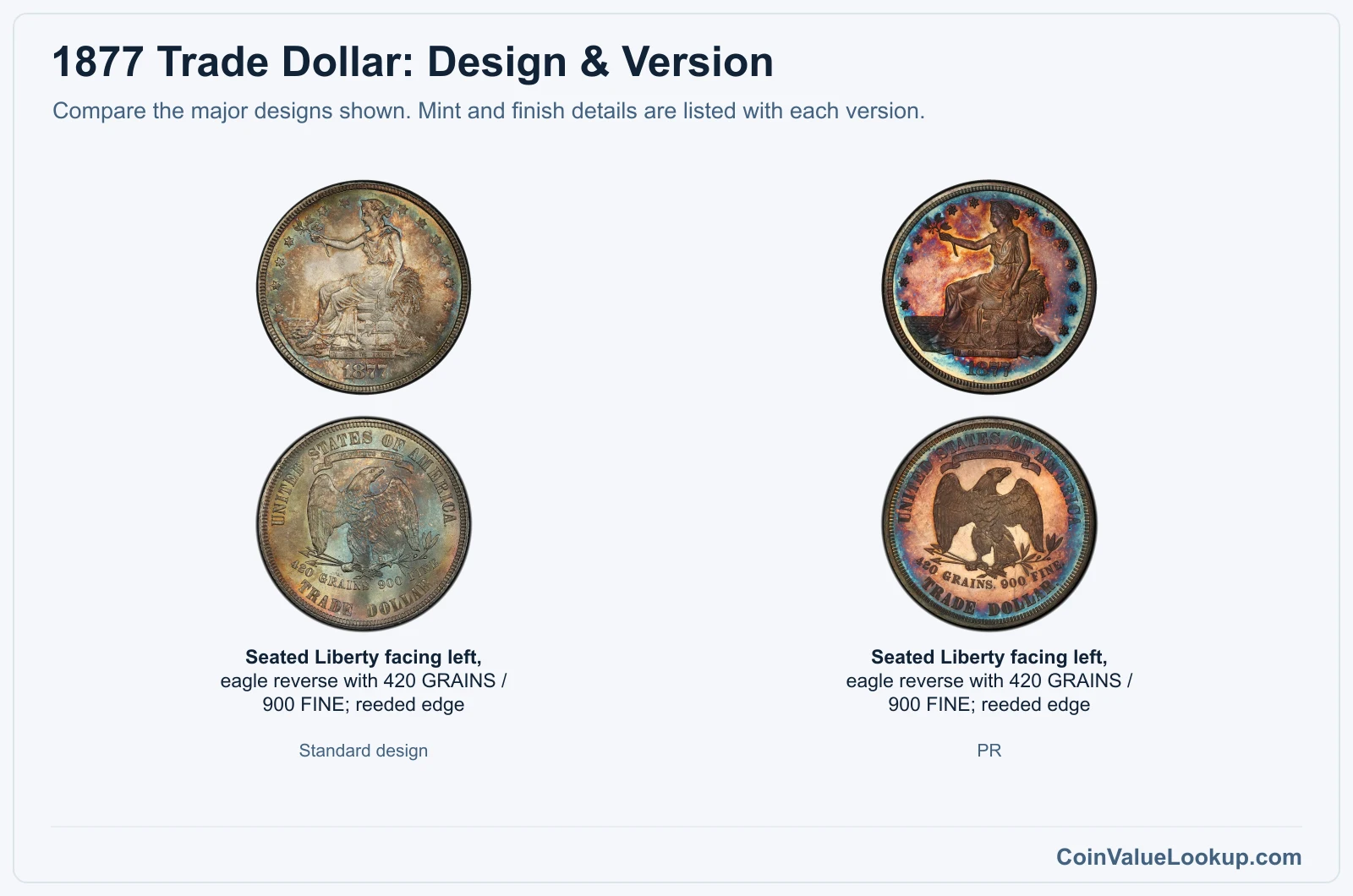
The design shows a seated Liberty facing left on the obverse and an eagle on the reverse surrounded by the inscription 420 GRAINS and 900 FINE. The edge is reeded.
The coin is 90% silver and 10% copper, weighing 27.22 grams.
Some Trade Dollars have small stamped symbols called chopmarks, applied by Asian merchants who tested the silver content. These are not mint errors.
They are later additions and should be evaluated separately from grade.
Proof versions were also struck at Philadelphia. A proof is a special manufacturing finish with mirrored fields, not just a shiny or high-grade coin.
If your coin has deeply reflective surfaces and sharp squared rims, it may be a proof, but authentication matters before assuming so.
Step 2: Check Your 1877 Trade Dollar Grade
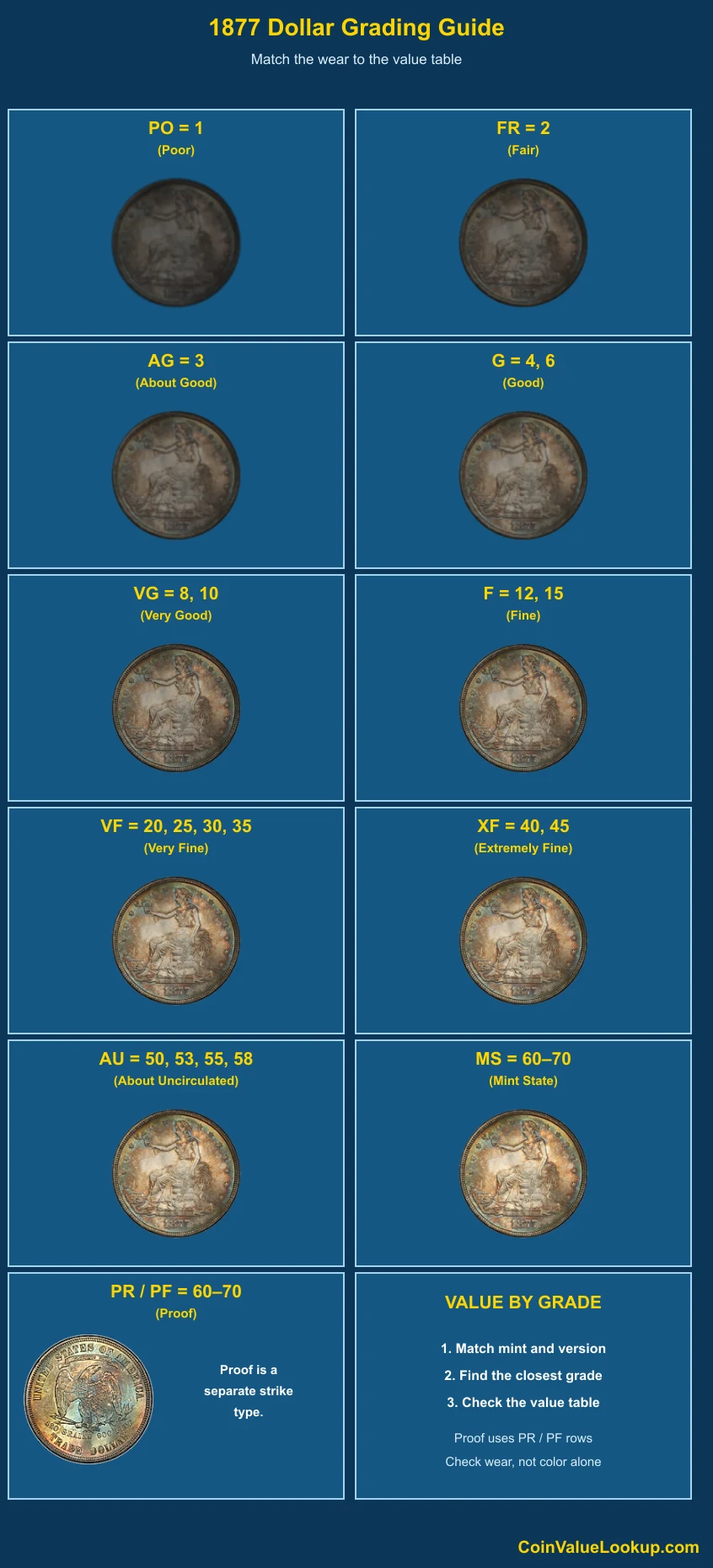
When grading an 1877 Trade Dollar, focus on Liberty's head, shoulder and knee on the obverse, and the eagle's breast feathers and upper wing tips on the reverse. These are the highest-relief areas and the first to show wear.
A coin in Good-4 condition will have a flat, mostly featureless Liberty with the outline still visible. Move up to About Uncirculated and you will see only the slightest friction on those high points, with most original luster remaining.
A Mint State coin should show no wear at all, though contact marks from other coins in bags are common.
Use the comparison image to check your coin against circulated, AU and Mint State examples side by side. Proof coins should be compared only against other proofs, not business strikes.
Cleaning, polishing or heavy damage all reduce a coin's collectibility and market appeal regardless of the underlying wear level. Original, untouched surfaces always bring stronger results.
Step 3: Check 1877 Trade Dollar Value by Mint and Version
1877 Trade Dollar
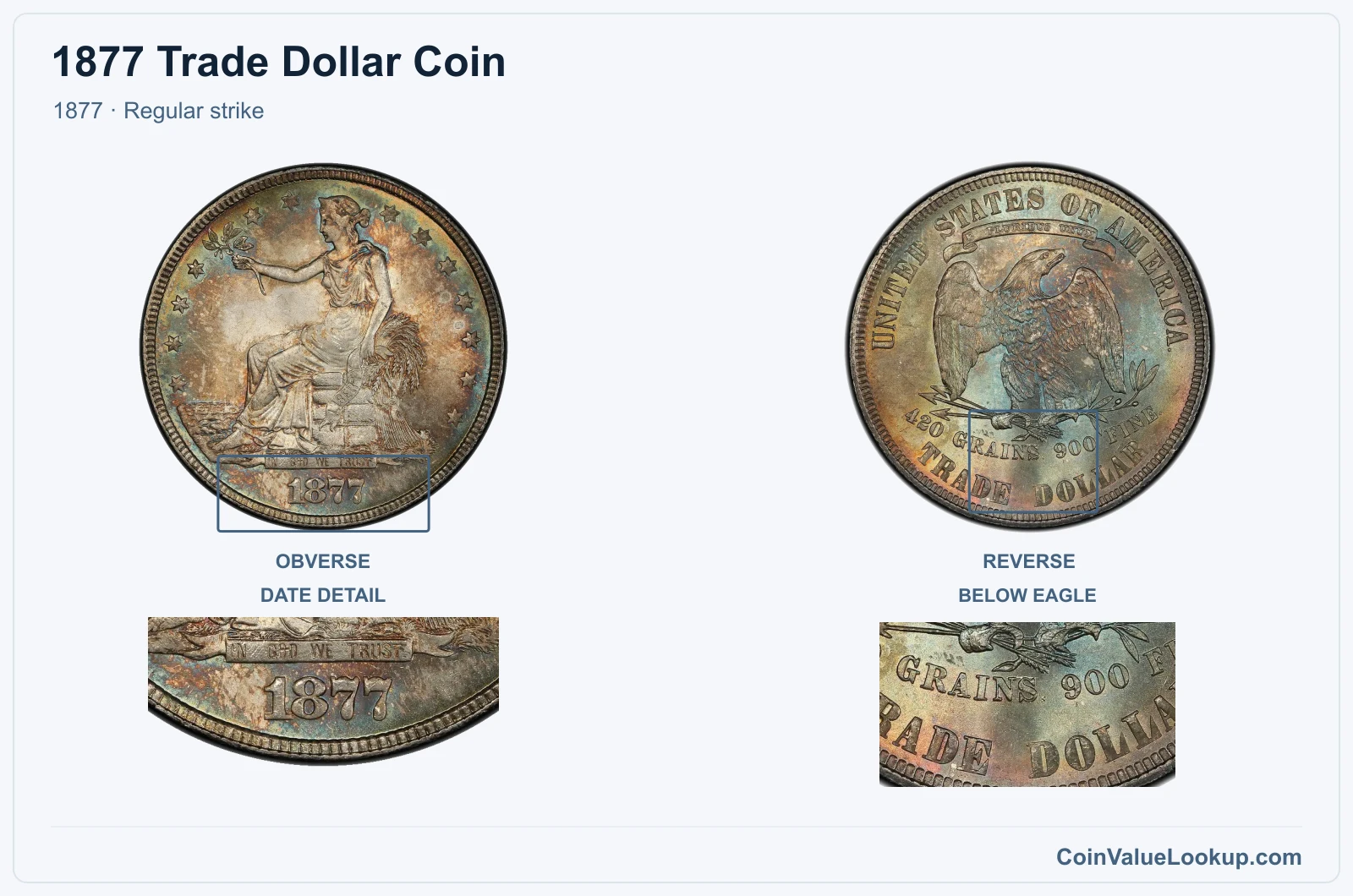
The 1877 Philadelphia Trade Dollar has no mintmark. Look below the eagle on the reverse and confirm the space is empty.
USA Coin Book estimates place this coin at about $232 in Good-4 and around $2,072 in MS63. These are guide figures, not guaranteed offers.
Original surfaces matter a lot here. A cleaned or polished coin loses much of its comparability to guide prices.
Before matching your coin to a value, confirm you are looking at the correct obverse and reverse type by checking the ribbon and hand on Liberty's side and the eagle's arrow details.
Range Grade
Price Auction Records Appraisal PO PO 1
Coin Identifier FR FR 2
—
Coin Identifier AG AG 3
Coin Identifier G G 4
—
Coin Identifier
G 6
Coin Identifier VG VG 8
Coin Identifier
VG 10
Coin Identifier F F 12
Coin Identifier
F 15
Coin Identifier VF VF 20
Coin Identifier
VF 25
Coin Identifier
VF 30
Coin Identifier
VF 35
Coin Identifier XF XF 40
Coin Identifier
XF 45
Coin Identifier AU AU 50
Coin Identifier
AU 53
Coin Identifier
AU 55
Coin Identifier
AU 58
Coin Identifier MS MS 60
Coin Identifier
MS 61
Coin Identifier
MS 62
Coin Identifier
MS 63
Coin Identifier
MS 64
Coin Identifier
MS 65
Coin Identifier
MS 66
Coin Identifier
MS 67
—
—
—
MS 68
—
—
—
MS 69
—
—
—
MS 70
—
—
—
1877 Trade Dollar — CC
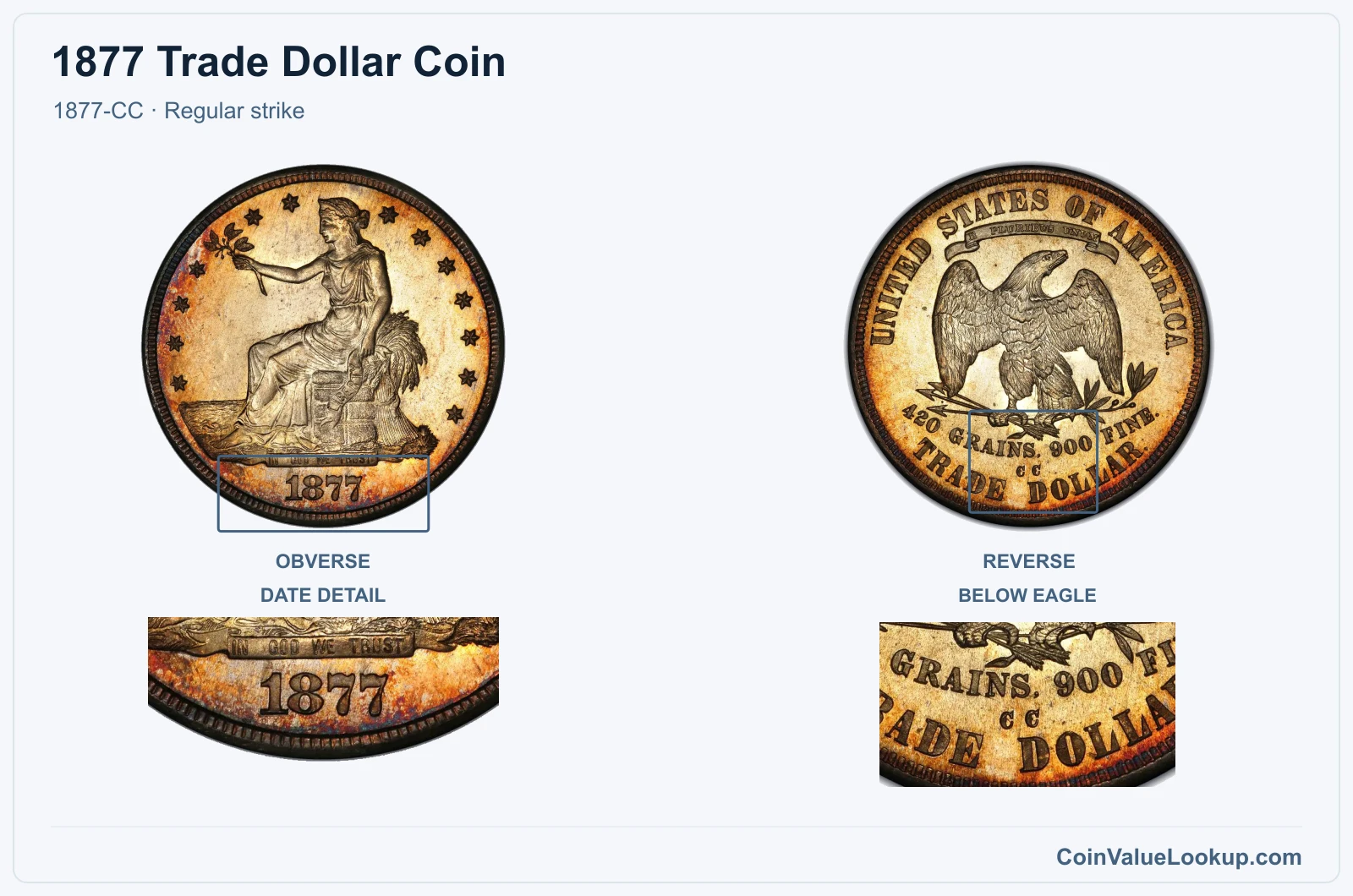
The 1877-CC Trade Dollar was struck at Carson City and carries a "CC" mintmark below the eagle on the reverse. Carson City silver dollars are widely collected by mint alone, so this version consistently brings a premium.
Guide estimates from USA Coin Book put the 1877-CC at roughly $414 in Good-4 and up to $7,851 in MS63. That steep climb reflects how few survive in top condition.
As always, these are guide estimates and not guaranteed sale prices. Cleaned or damaged examples will fall well short of those numbers.
Confirm the CC is sharply struck into the coin and not tooled or added. Counterfeits exist for Carson City trade dollars, so authentication through a major grading service is worth the cost on higher-grade pieces.
Range Grade
Price Auction Records Appraisal PO PO 1
—
Coin Identifier FR FR 2
—
Coin Identifier AG AG 3
—
Coin Identifier G G 4
—
Coin Identifier
G 6
—
Coin Identifier VG VG 8
—
Coin Identifier
VG 10
—
Coin Identifier F F 12
Coin Identifier
F 15
Coin Identifier VF VF 20
Coin Identifier
VF 25
Coin Identifier
VF 30
Coin Identifier
VF 35
Coin Identifier XF XF 40
Coin Identifier
XF 45
Coin Identifier AU AU 50
Coin Identifier
AU 53
Coin Identifier
AU 55
Coin Identifier
AU 58
Coin Identifier MS MS 60
Coin Identifier
MS 61
Coin Identifier
MS 62
Coin Identifier
MS 63
Coin Identifier
MS 64
Coin Identifier
MS 65
Coin Identifier
MS 66
—
Coin Identifier
MS 67
—
—
—
MS 68
—
—
—
MS 69
—
—
—
MS 70
—
—
—
1877 Trade Dollar — S
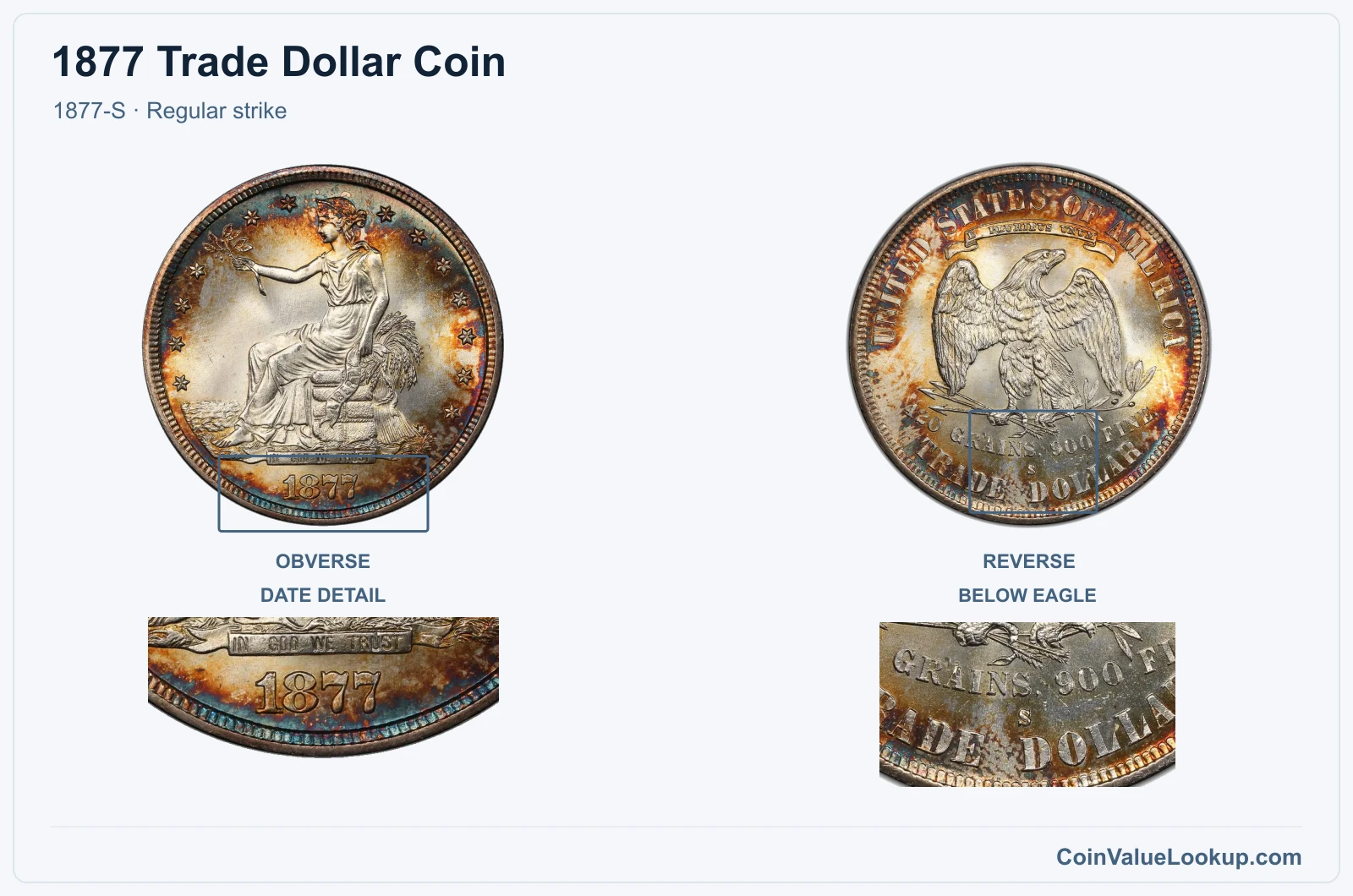
The 1877-S Trade Dollar carries an "S" mintmark below the eagle, identifying it as a San Francisco issue. San Francisco struck large quantities of Trade Dollars for Pacific trade, so these tend to be more available than Carson City examples.
Coin Value Lookup is a useful starting point if you want to compare this coin alongside other dates and denominations in the series.
USA Coin Book estimates place the 1877-S at about $232 in Good-4 and approximately $1,917 in MS63. These are guide-level figures, not sale guarantees.
Original surfaces and accurate grading are essential before matching your coin to any published number.
Range Grade
Price Auction Records Appraisal PO PO 1
—
Coin Identifier FR FR 2
Coin Identifier AG AG 3
Coin Identifier G G 4
Coin Identifier
G 6
Coin Identifier VG VG 8
Coin Identifier
VG 10
Coin Identifier F F 12
Coin Identifier
F 15
Coin Identifier VF VF 20
Coin Identifier
VF 25
Coin Identifier
VF 30
Coin Identifier
VF 35
Coin Identifier XF XF 40
Coin Identifier
XF 45
Coin Identifier AU AU 50
Coin Identifier
AU 53
Coin Identifier
AU 55
Coin Identifier
AU 58
Coin Identifier MS MS 60
Coin Identifier
MS 61
Coin Identifier
MS 62
Coin Identifier
MS 63
Coin Identifier
MS 64
Coin Identifier
MS 65
Coin Identifier
MS 66
Coin Identifier
MS 67
Coin Identifier
MS 68
—
—
—
MS 69
—
—
—
MS 70
—
—
—
1877 Trade Dollar — PR
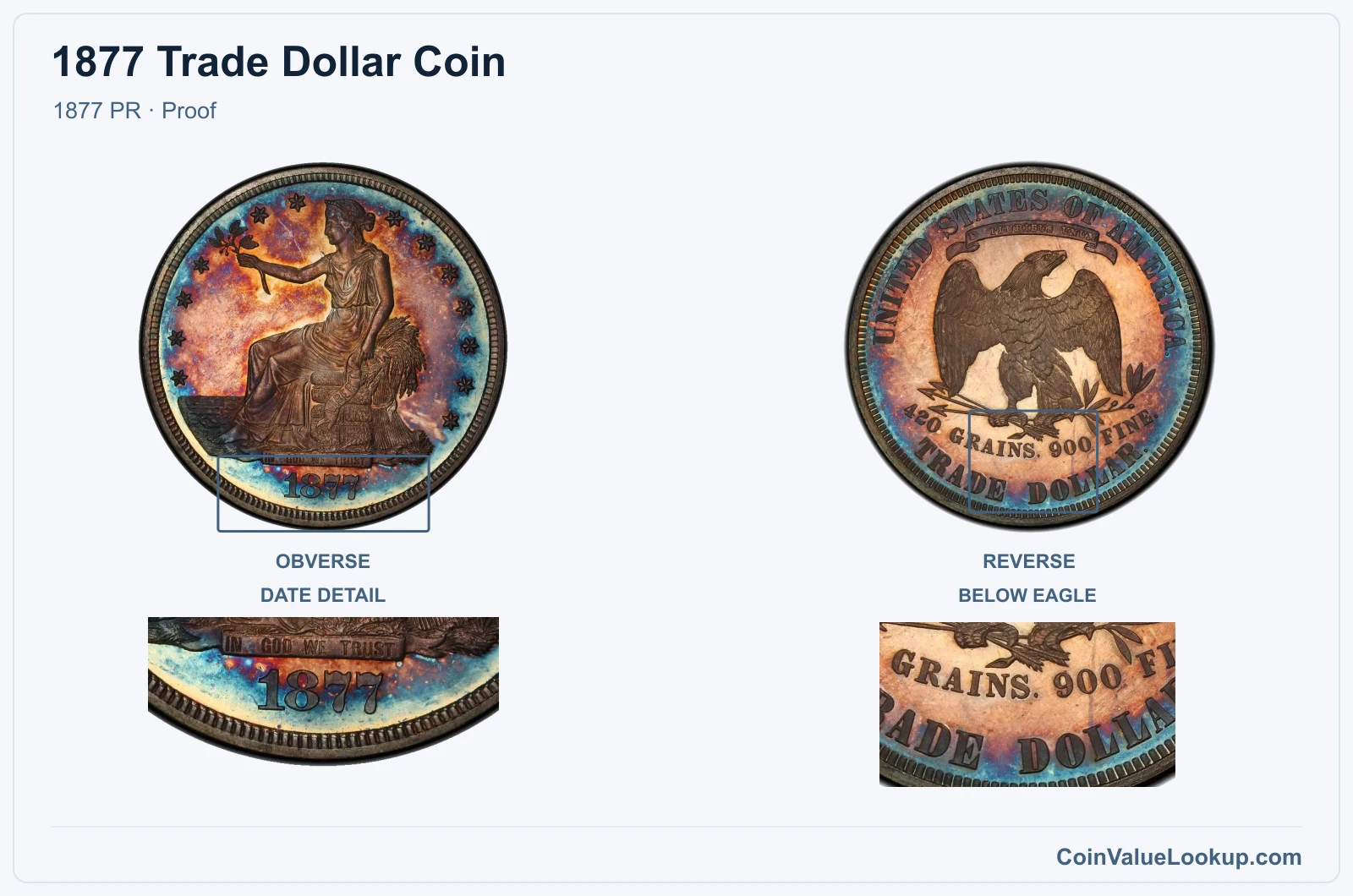
The 1877 Proof Trade Dollar was struck at Philadelphia using specially prepared dies and polished planchets, producing mirrored fields and sharp design details. There is no mintmark.
A proof is a manufacturing method, not a grade above Mint State, so proof coins are evaluated on their own scale.
No standard guide price range was adopted for this version. Value depends on the coin's authenticated identity, its specific condition within the proof grading scale, and whether it retains original surfaces without cleaning or hazing.
Because proof Trade Dollars were produced in small numbers for collectors, each piece really needs individual assessment by a recognized grading service before you can pin down a market value.
Range Grade
Price Auction Records Appraisal PR PR 1
—
Coin Identifier
PR 2
—
Coin Identifier
PR 3
—
Coin Identifier
PR 4
—
Coin Identifier
PR 6
—
Coin Identifier
PR 8
—
Coin Identifier
PR 10
—
Coin Identifier
PR 12
—
Coin Identifier
PR 15
—
Coin Identifier
PR 20
—
Coin Identifier
PR 25
—
Coin Identifier
PR 30
—
Coin Identifier
PR 35
—
Coin Identifier
PR 40
—
Coin Identifier
PR 45
—
Coin Identifier
PR 50
—
Coin Identifier
PR 53
—
Coin Identifier
PR 55
—
Coin Identifier
PR 58
—
Coin Identifier
PR 60
Coin Identifier
PR 61
Coin Identifier
PR 62
Coin Identifier
PR 63
Coin Identifier
PR 64
Coin Identifier
PR 65
Coin Identifier
PR 66
Coin Identifier
PR 67
Coin Identifier
PR 68
—
—
—
PR 69
—
—
—
PR 70
—
—
—
1877 Trade Dollar Error List
1. 1877 Trade Dollar — Partial Collar Strike
A partial collar strike happens when the planchet is not fully seated inside the collar die during striking. The result is a stepped or shelf-like interruption along part of the edge, where one section looks normal and reeded while another fans outward with a smooth or distorted profile.
This error has been reported on the 1877 Trade Dollar. To check, compare your coin's edge all the way around against a normal example.
A partial collar creates a visible ledge that is consistent and raised, not just a flat spot.
Do not confuse this with post-mint edge damage, a flattened rim from a drop, or a complete broadstrike where the collar was entirely absent. Condition, the degree of the malfunction and visual impact all affect what a partial collar example is worth, so individual assessment matters here.
2. 1877 Trade Dollar — Doubled Die Reverse
A doubled die reverse variety has been reported on the 1877-S Trade Dollar. On a genuine doubled die, portions of the reverse lettering or design elements show a consistent, raised secondary image created during die manufacturing.
To look for this, examine the reverse legends and design contours under magnification and compare them closely to a normal 1877-S reverse. True die doubling produces uniform separation or notching on affected elements across the entire area of doubling.
Do not confuse this with machine doubling, which creates a flat, shelf-like distortion rather than raised secondary lettering. Reflections and random contact damage can also mimic doubling at first glance.
No specific price range was adopted for this variety, so value depends on the coin's condition, the visibility of the doubling and professional attribution.
3. 1877 Trade Dollar — Doubled Die Obverse
A doubled die obverse has been reported on the 1877 Philadelphia Trade Dollar. This variety shows consistent separation or notching on obverse design elements, created when the die received a second, slightly misaligned impression during its manufacture.
Check the obverse letters and design details under magnification, comparing them to a known normal 1877 obverse under matching lighting. Genuine hub doubling produces raised, repeated contours that follow a uniform direction.
Machine doubling looks similar at a glance but creates flat, shelf-like distortions rather than raised secondary images. Worn die contours and lighting reflections can also fool you.
No specific price range was adopted for this variety. The coin's overall condition, the strength of the visible doubling and whether the piece has been professionally attributed all factor into its value.
4. 1877 Trade Dollar — Repunched Date
A repunched date variety has been reported on the 1877 Philadelphia Trade Dollar. During production, date numerals were sometimes punched into the die more than once with slight positional differences.
The result is traces of an earlier punch visible alongside the final date digits.
Look at the 1877 date under magnification for remnants of a misplaced or offset numeral beside or beneath the correctly positioned numbers. This is a die variety, distinct from a doubled die, because it involves the individual date punches rather than the entire hub design.
Do not mistake simple date damage, worn digits or machine doubling for a repunched date. Genuine repunching shows crisp secondary outlines that match the shape of the affected numeral.
No specific price was adopted for this variety, so value depends on condition, the clarity of the repunching and professional attribution.