1836 Liberty Seated Dollar Coin Value: How Much Is It Worth?
The 1836 Liberty Seated Dollar is a Gobrecht issue — one of the earliest silver dollars of its era and a coin that commands serious attention from collectors. Guide estimates for explicitly listed versions range from roughly $31,463 to $92,704 at the PR60 grade level, depending on die alignment, edge type and whether the piece is an original or a later restrike.
These are not guaranteed offers, and your coin's actual branch matters enormously. Identifying the exact version is the essential first step before any value comparison.
Fast Way to Identify Your 1836 Liberty Seated Dollar
The fastest way to start figuring out what you have is to upload clear photos of the front and back of your coin. Our identifier can provide a preliminary identification based on those images, helping you narrow down which branch your 1836 dollar might belong to.
It will not authenticate, certify or precisely grade your coin, but it gives you a solid starting point before seeking professional attribution.
1836 Liberty Seated Dollar Value
Upload both sides of your 1836 Liberty Seated Dollar.
Front Obverse
Upload photo
Back Reverse
Upload photo
Which 1836 Liberty Seated Dollar Versions Are Worth Money?
- The 1836 Medal Alignment PR version carries a guide estimate of $92,704 at PR60, tied to the Name Below Base, Starry Reverse, Die Alignment III/IV configuration — making the die alignment check essential.
- The 1836 later restrike shares that same $92,704 PR60 guide estimate but requires separate specialist attribution of edge, die alignment and provenance to confirm.
- The 1836 Gobrecht PR (Name On Base, Starry Reverse, Plain Edge) sits at a $31,463 PR60 guide estimate — still a substantial coin, but roughly a third of the medal-alignment version.
- Original versus restrike attribution directly affects which value applies; the date alone does not resolve this, so professional examination is strongly recommended.
Step 1: Identify Your 1836 Liberty Seated Dollar Mint Mark and Version
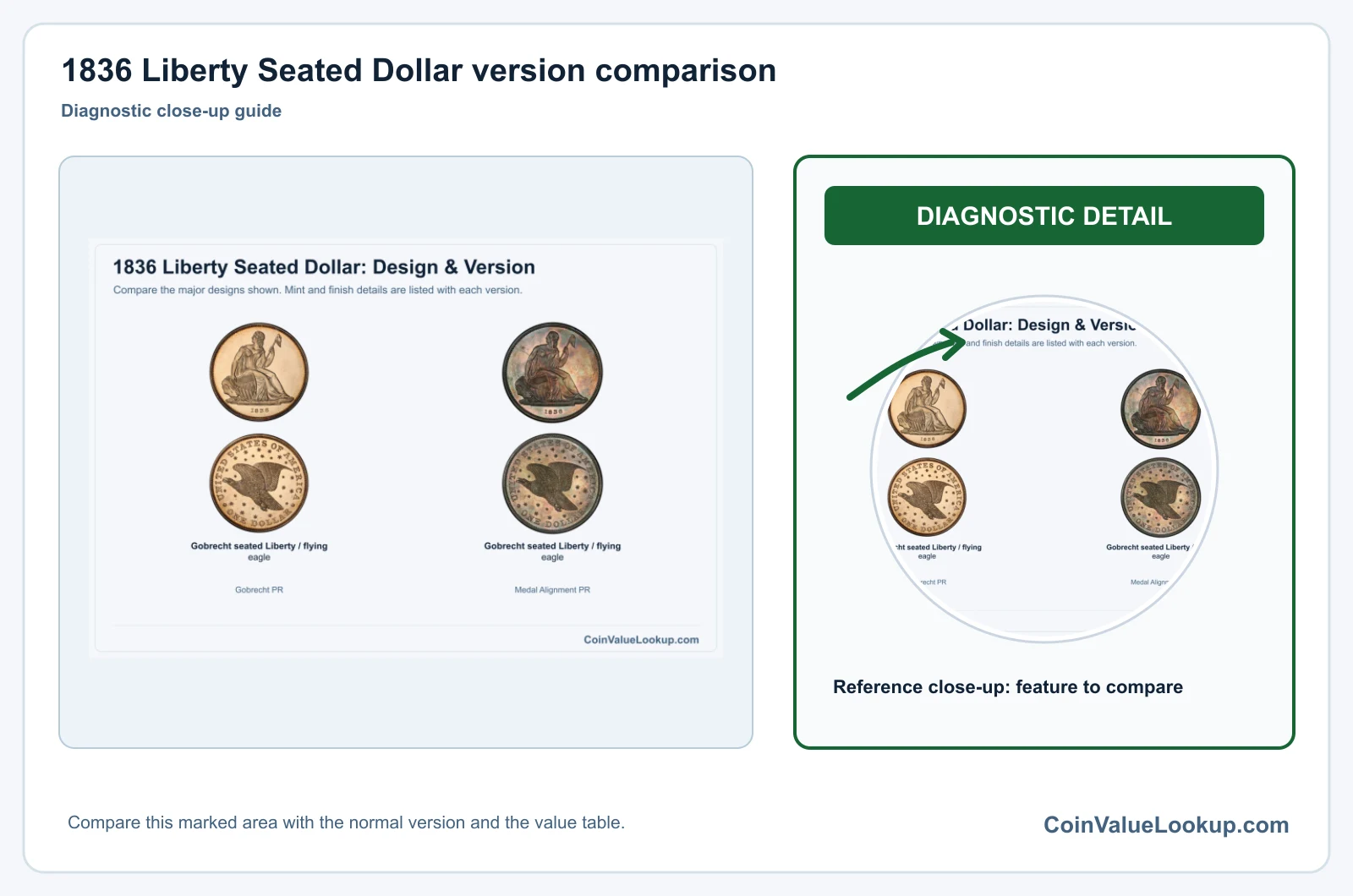
All 1836 Gobrecht dollars were struck at Philadelphia, so there is no mintmark to look for. The obverse features Christian Gobrecht's Seated Liberty design, while the reverse shows a flying eagle — quite different from the later heraldic eagle used on the 1840–1873 seated dollars.
Three distinct branches exist for this date: the 1836 Gobrecht PR, the 1836 Medal Alignment PR, and the 1836 later restrike. Telling them apart requires examining die alignment, edge characteristics, and whether the engraver's name appears on or below the base of Liberty's rock.
The original 1836-dated coins used an .8924 silver standard, though pieces struck subsequently used .900-fine silver. Restrikes carry the same 1836 date but were produced later, so the date on the coin does not tell you when it was actually made.
Die alignment is a critical detail. "Coin alignment" means the reverse is upside down when you flip the coin left to right; "medal alignment" means both sides face the same way when flipped.
Check this carefully — it separates two of the three branches and has a dramatic effect on value.
Coin Value Lookup is a useful place to look up guides for other coin dates and series if you are working through a collection or comparing across types.
Step 2: Check Your 1836 Liberty Seated Dollar Grade
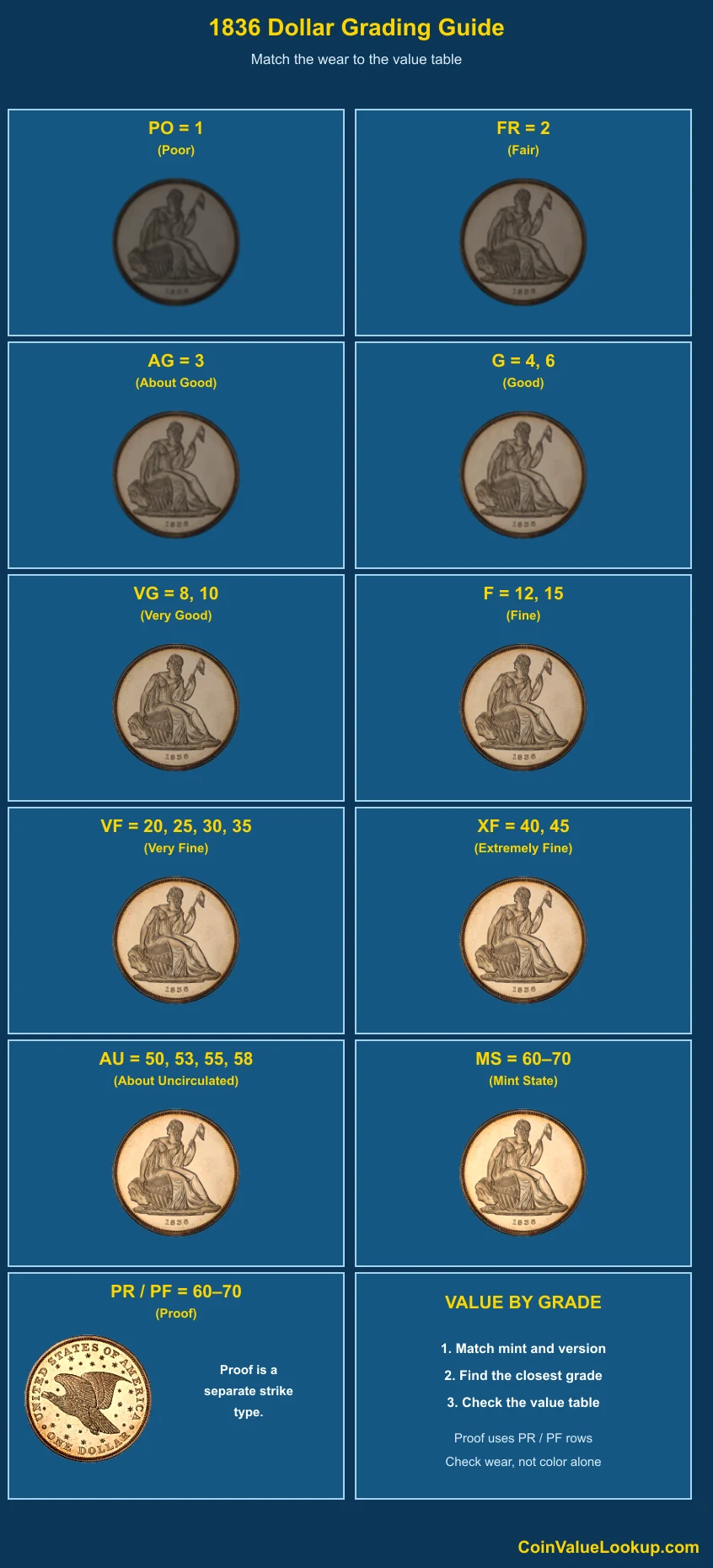
Because all three 1836 branches are proof strikes, grading focuses on surface preservation rather than wear from circulation. A proof is a manufacturing finish produced from specially prepared dies, not simply a grade above Mint State — so do not confuse a shiny, well-preserved regular coin with a proof.
Look at Liberty's head, breast, knee and shield on the obverse, plus the eagle's breast feathers and wing tips on the reverse. Hairlines from old cleanings, contact marks from mishandling, and haze from improper storage all pull the grade down.
A PR60 coin will show noticeable hairlines and marks under good light, while higher proof grades have progressively fewer distractions.
Weak details on the head alone do not necessarily mean wear — some strikes were softer in that area. Judge the entire coin.
Use a genuine same-type Gobrecht dollar grading comparison to see what different proof grade levels actually look like rather than relying on descriptions alone.
Step 3: Check 1836 Liberty Seated Dollar Value by Mint and Version
1836 Liberty Seated Dollar — Gobrecht PR
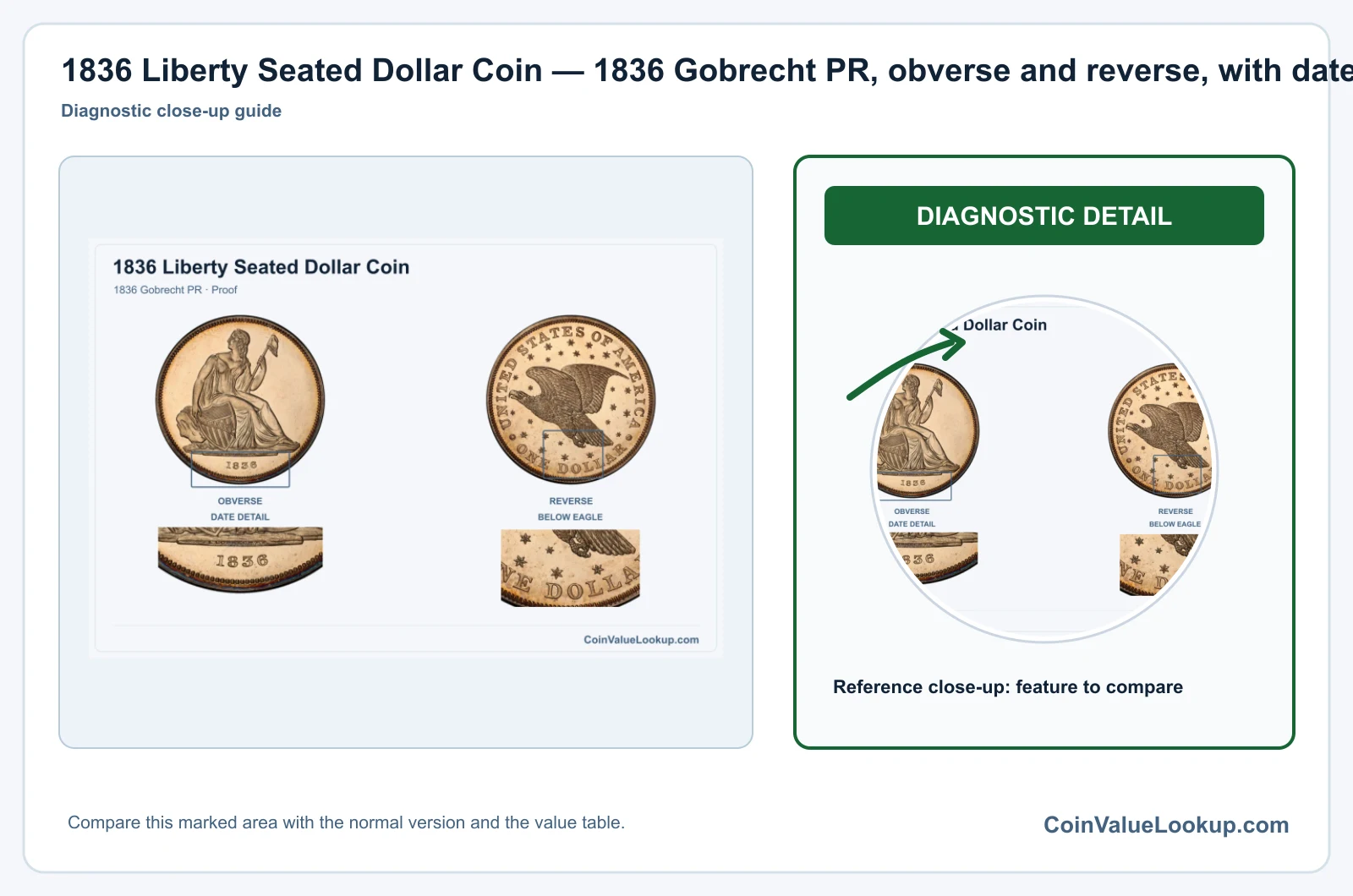
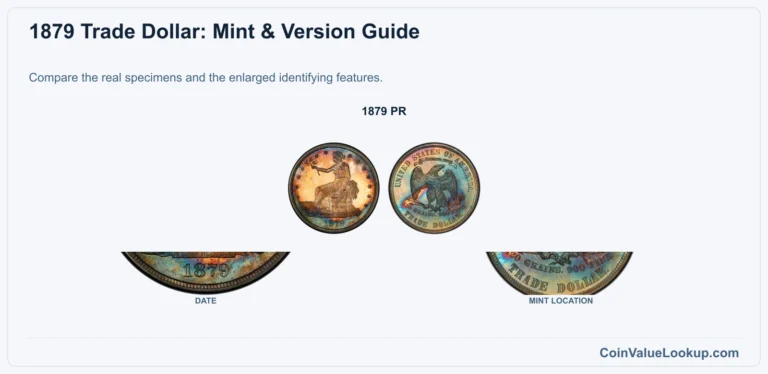
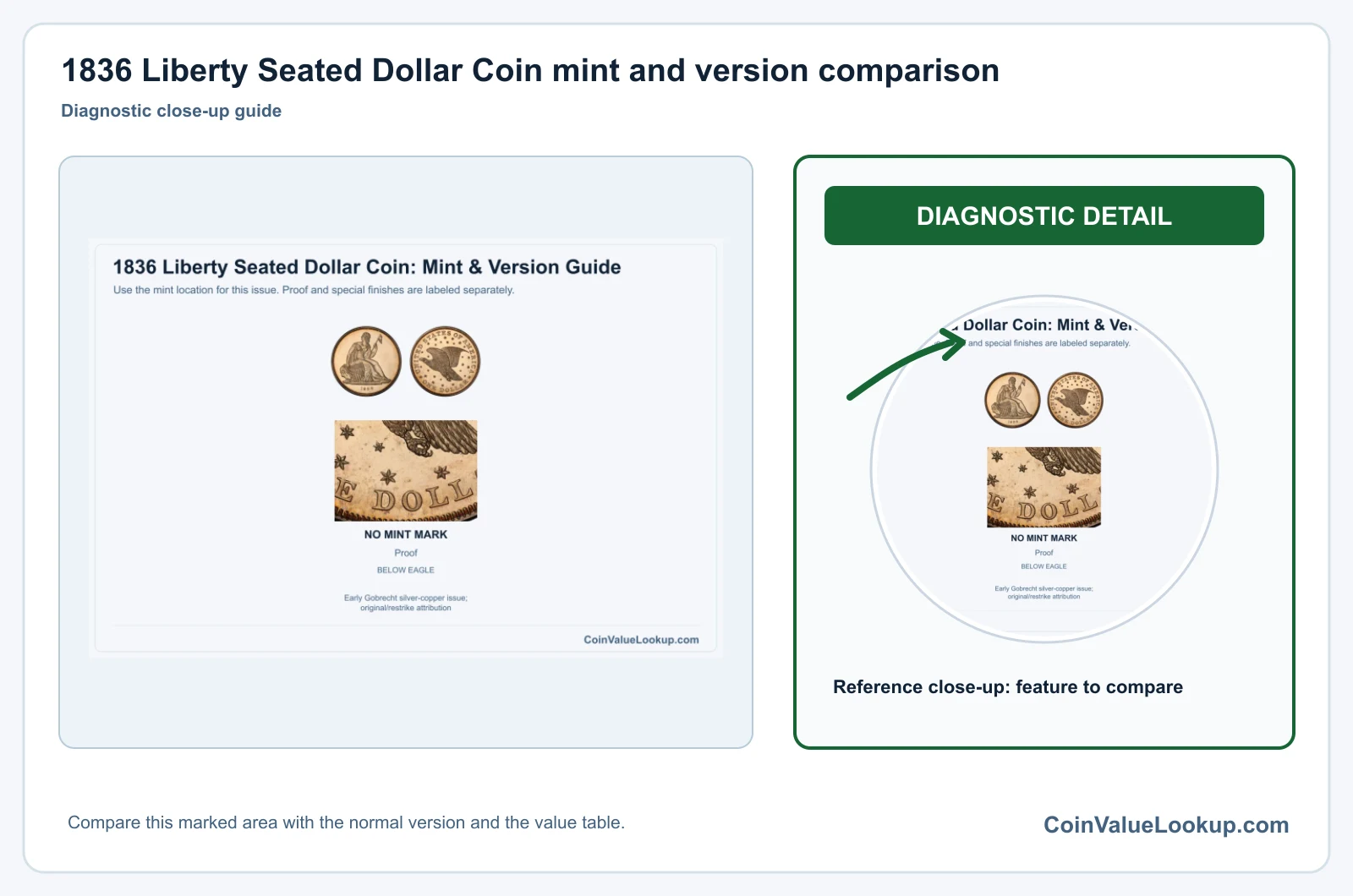
This is the 1836 Gobrecht PR with the engraver's name on the base of Liberty's rock, a starry reverse field, plain edge, and Die Alignment III/IV. It is a proof strike from Philadelphia.
A guide estimate places this version at approximately $31,463 at PR60. That figure comes from USA Coin Book and is not a guaranteed purchase offer.
The "Name On Base" detail is your primary visual diagnostic: look for C. GOBRECHT F.
inscribed directly on the rocky base beneath the seated figure. If the name sits below the base instead, you are looking at a different branch entirely.
All 1836 Gobrecht dollars are scarce, but this particular configuration is the most frequently encountered of the three listed branches. Do not assume a proof finish just because the surfaces are reflective — confirmation of genuine proof manufacture matters.
Range Grade
Price Auction Records Appraisal PR PR 1
—
Coin Identifier
PR 2
—
Coin Identifier
PR 3
—
Coin Identifier
PR 4
Coin Identifier
PR 6
Coin Identifier
PR 8
Coin Identifier
PR 10
Coin Identifier
PR 12
—
Coin Identifier
PR 15
Coin Identifier
PR 20
Coin Identifier
PR 25
Coin Identifier
PR 30
Coin Identifier
PR 35
Coin Identifier
PR 40
Coin Identifier
PR 45
Coin Identifier
PR 50
Coin Identifier
PR 53
Coin Identifier
PR 55
Coin Identifier
PR 58
Coin Identifier
PR 60
Coin Identifier
PR 61
Coin Identifier
PR 62
Coin Identifier
PR 63
Coin Identifier
PR 64
Coin Identifier
PR 65
Coin Identifier
PR 66
—
Coin Identifier
PR 67
—
—
—
PR 68
—
—
—
PR 69
—
—
—
PR 70
—
—
—
1836 Liberty Seated Dollar — Medal Alignment PR
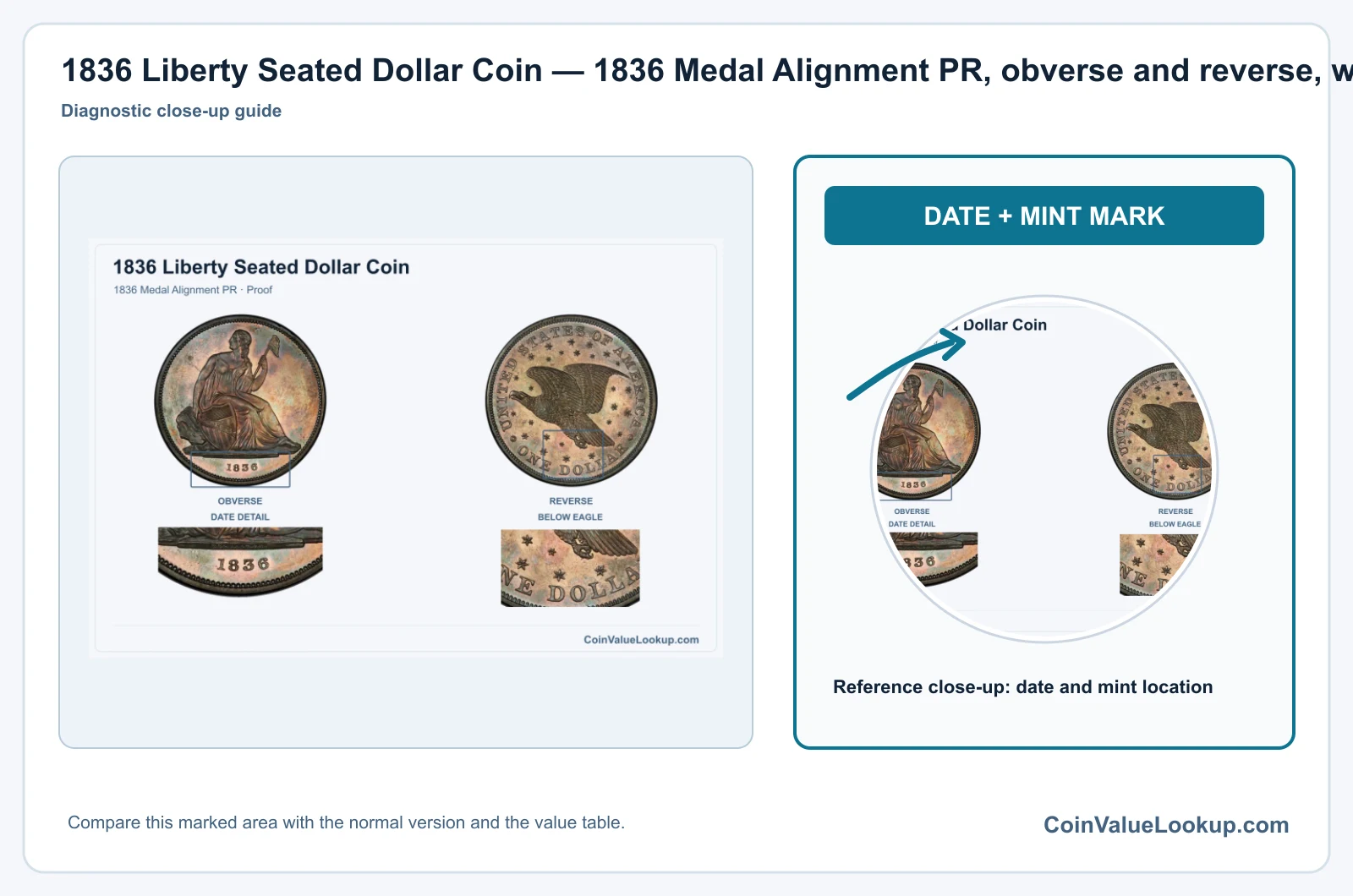
The 1836 Medal Alignment PR is identified by the engraver's name below the base, a starry reverse, and medal-turn die alignment (Die Alignment III/IV). To check alignment, hold the obverse upright and flip the coin top to bottom: if the reverse eagle also appears upright, you have medal alignment.
This version carries a guide estimate of roughly $92,704 at PR60 per USA Coin Book. That is about three times the Gobrecht PR with the name on the base, which tells you how much the die orientation and name placement matter.
The combination of name-below-base and medal alignment is what sets this apart. Both features must be present.
A coin with name on the base but medal alignment, or name below the base with coin alignment, would be a different attribution. Get both details right before drawing any value conclusions.
Range Grade
Price Auction Records Appraisal PR PR 1
—
Coin Identifier
PR 2
—
Coin Identifier
PR 3
—
Coin Identifier
PR 4
—
Coin Identifier
PR 6
—
Coin Identifier
PR 8
—
Coin Identifier
PR 10
—
Coin Identifier
PR 12
—
Coin Identifier
PR 15
Coin Identifier
PR 20
—
Coin Identifier
PR 25
—
Coin Identifier
PR 30
—
Coin Identifier
PR 35
Coin Identifier
PR 40
—
Coin Identifier
PR 45
Coin Identifier
PR 50
Coin Identifier
PR 53
Coin Identifier
PR 55
Coin Identifier
PR 58
Coin Identifier
PR 60
Coin Identifier
PR 61
Coin Identifier
PR 62
Coin Identifier
PR 63
Coin Identifier
PR 64
Coin Identifier
PR 65
—
Coin Identifier
PR 66
—
Coin Identifier
PR 67
—
—
—
PR 68
—
—
—
PR 69
—
—
—
PR 70
—
—
—
1836 Liberty Seated Dollar — later restrike, attributed silver Gobrecht dollar
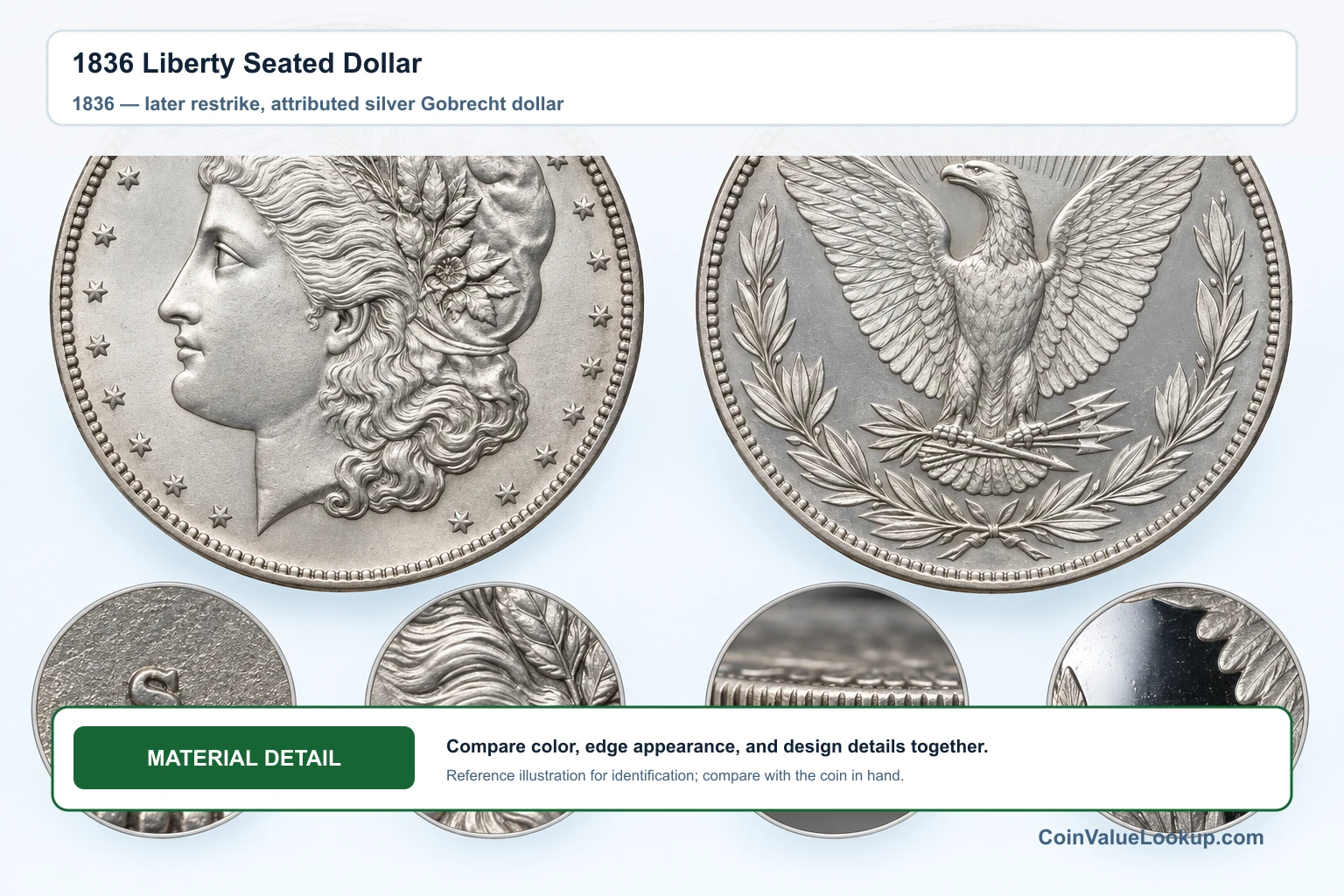
This branch covers 1836-dated Gobrecht silver dollars identified as later restrikes. The coin still bears an 1836 date, but it was actually produced at a later time using original or re-engraved dies.
Specialist die alignment, edge type, metal composition and provenance are all needed to confirm restrike status — the date alone tells you nothing about when the coin was struck.
The guide estimate for this restrike configuration is approximately $92,704 at PR60, matching the Medal Alignment PR version. The table identity is Name Below Base, Starry Reverse, Die Alignment III/IV.
Restrikes are a separate collecting category from originals, and confusing the two is an expensive mistake in either direction. Professional attribution from a major grading service is strongly advisable before buying or selling.
Copper patterns and detailed pattern-number varieties fall outside the scope of this article.
Attributed restrike: The prices below apply specifically to the silver Judd-58 Name Below Base restrike. They are not prices for original strikes or other Gobrecht patterns.
Range Grade
Price Auction Records Appraisal PR PR 1
—
Coin Identifier
PR 2
—
Coin Identifier
PR 3
—
Coin Identifier
PR 4
—
Coin Identifier
PR 6
—
Coin Identifier
PR 8
—
Coin Identifier
PR 10
—
Coin Identifier
PR 12
—
Coin Identifier
PR 15
—
Coin Identifier
PR 20
—
Coin Identifier
PR 25
—
Coin Identifier
PR 30
—
Coin Identifier
PR 35
—
Coin Identifier
PR 40
Coin Identifier
PR 45
Coin Identifier
PR 50
—
Coin Identifier
PR 53
Coin Identifier
PR 55
—
Coin Identifier
PR 58
Coin Identifier
PR 60
—
Coin Identifier
PR 61
Coin Identifier
PR 62
Coin Identifier
PR 63
Coin Identifier
PR 64
Coin Identifier
PR 65
Coin Identifier
PR 66
—
—
—
PR 67
—
—
—
PR 68
—
—
—
PR 69
—
—
—
PR 70
—
—
—