1935 Peace Silver Dollar Coin Value: How Much Is It Worth?
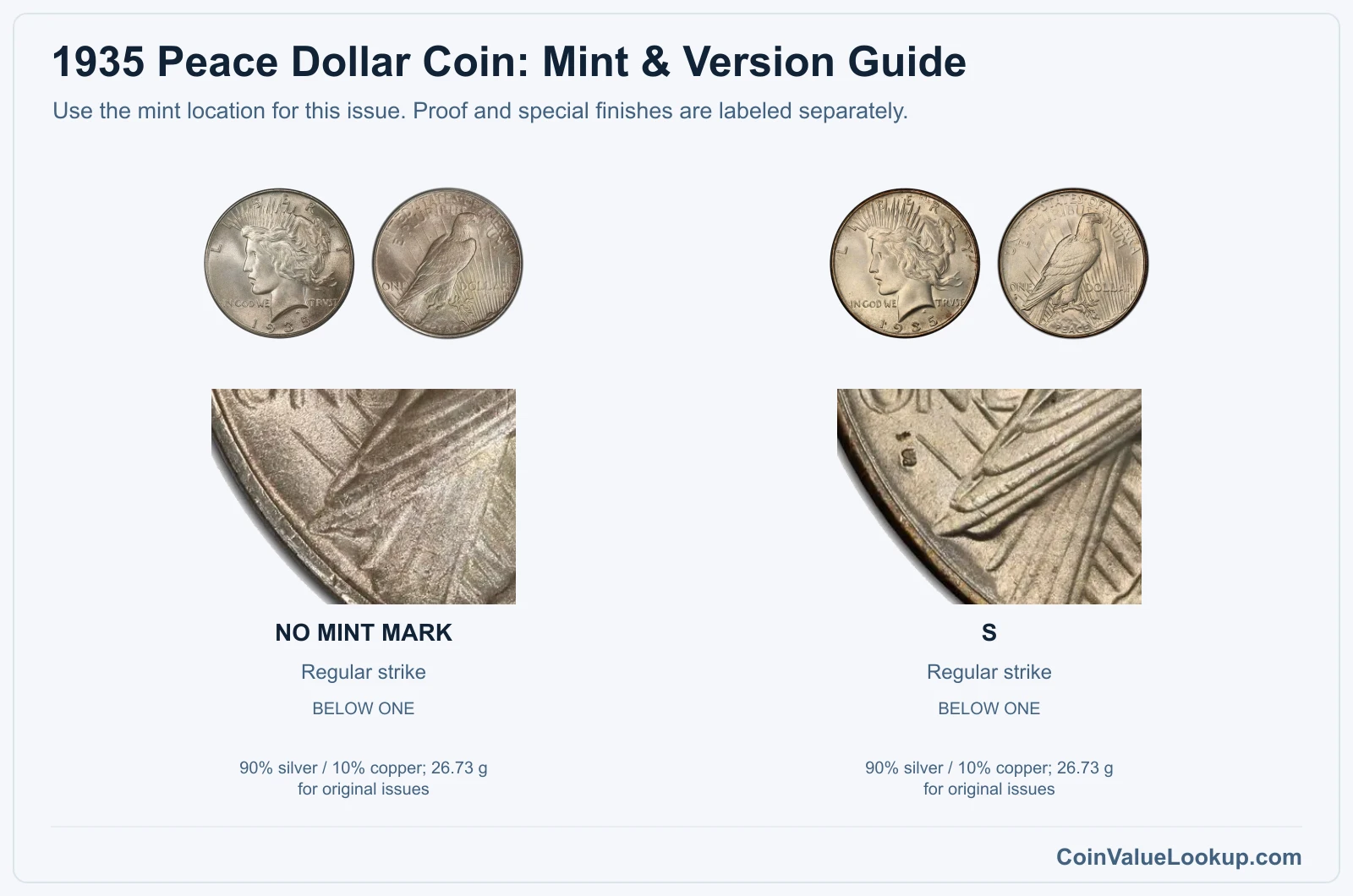
The 1935 Peace Dollar is a 90% silver coin that still turns up in collections and estate finds regularly. Guide estimates for the two mint versions range from about $76 to $1,786 depending on mint and grade, though these are not guaranteed offers for any individual coin.
Before you start dreaming about the top end, you need to confirm your coin's mint, condition and whether it carries original surfaces or has been cleaned.
Fast Way to Identify Your 1935 Peace Silver Dollar
The quickest way to start figuring out what you have is to upload clear photos of both the front and back of your coin. Our identifier can give you a preliminary read on the mint version and general condition.
Good lighting and a steady hand help — try to avoid glare on those silver surfaces, since reflections can hide details that matter.
1935 Peace Silver Dollar Value
Upload both sides of your 1935 Peace Silver Dollar.
Front Obverse
Upload photo
Back Reverse
Upload photo
Which 1935 Peace Silver Dollar Versions Are Worth Money?
- The 1935-S (San Francisco) in gem Mint State condition carries the highest guide estimate at $1,786 in MS65 — much scarcer in top grades than its Philadelphia sibling.
- The 1935 Philadelphia in MS65 is estimated around $968, still a significant step above circulated values for the same coin.
- Mint-made errors such as doubled reverse dies, lamination flaws, clipped planchets, broadstrikes and die breaks can add collector interest beyond standard values.
- Original, uncleaned surfaces matter — a cleaned coin loses much of its market appeal regardless of how sharp the details appear.
Step 1: Identify Your 1935 Peace Silver Dollar Mint Mark and Version
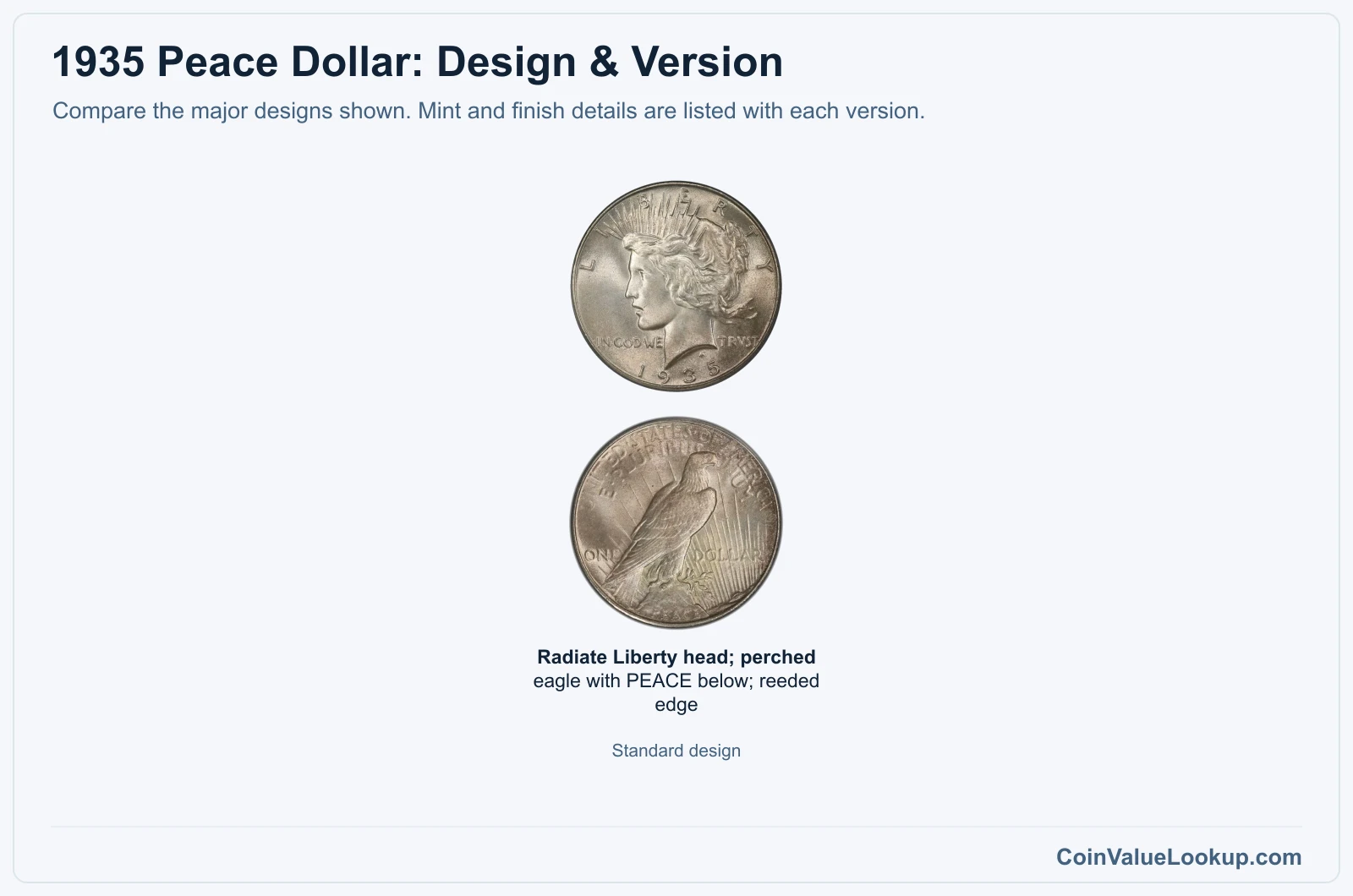
Flip your coin to the reverse side and look below the word ONE, near the base of the eagle's tail feathers. If you see a small "S" there, you have the San Francisco issue.
No mintmark at all means Philadelphia struck your coin. Those are the only two mint versions for 1935.
A common question: the word TRVST on the obverse is not a typo or die error. The V in place of U was a deliberate design choice by Anthony de Francisci, following classical Latin lettering conventions.
The coin should weigh 26.73 grams and be made of 90% silver and 10% copper. If yours is noticeably lighter or doesn't ring like silver, it may be a counterfeit or heavily damaged piece.
The edge should be reeded — tiny parallel grooves running all the way around.
Step 2: Check Your 1935 Peace Silver Dollar Grade
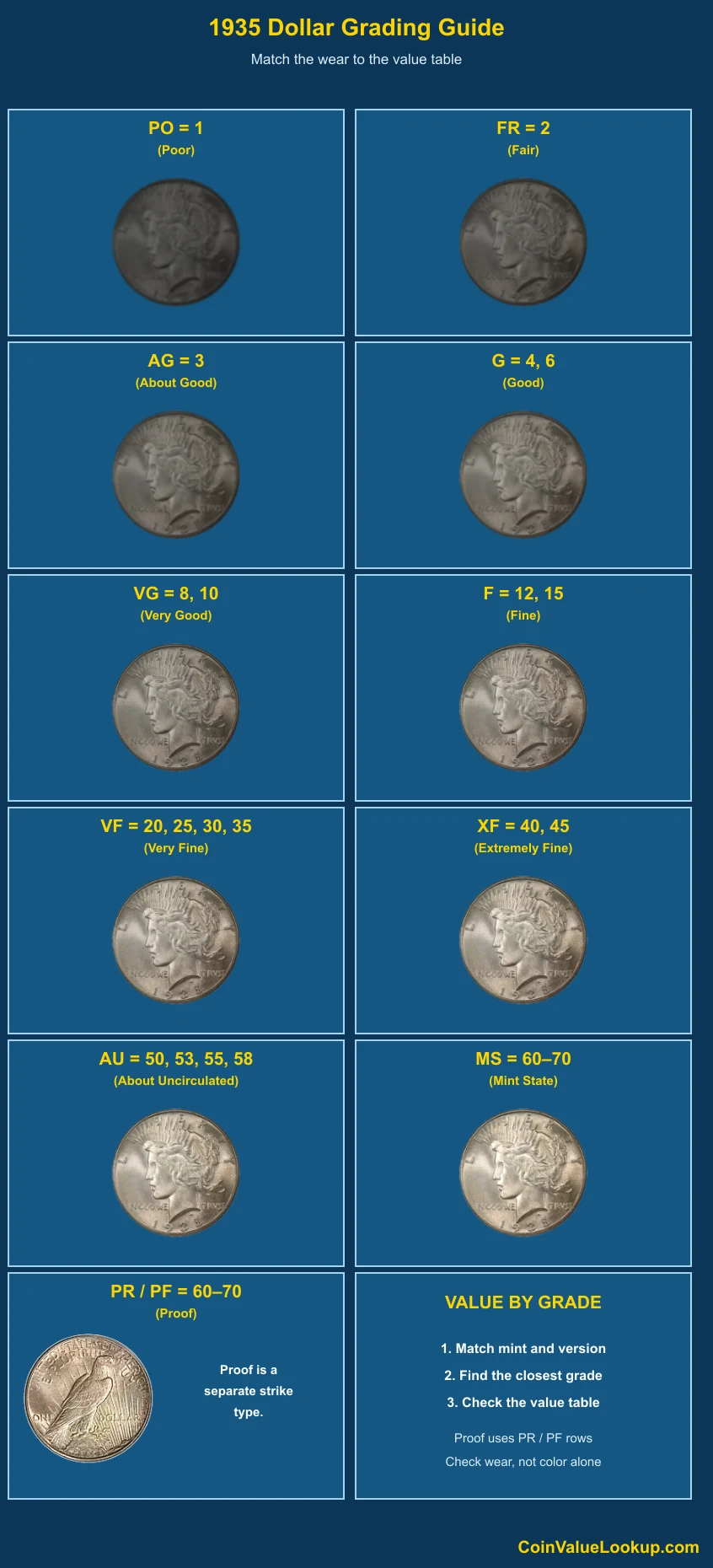
Start with the obverse. The first places to lose detail are Liberty's hair over the ear and the cheek below the tiara.
On well-worn coins, the hair strands merge into a flat mass, and the cheek loses its rounded contour entirely.
On the reverse, the eagle's shoulder and the tops of the wing feathers flatten first. A coin grading around Good (G4) will show a clear outline but very little interior feather detail.
About Uncirculated (AU) pieces still have most of their original luster but show slight friction on the highest points — the cheek and the eagle's breast. Full Mint State coins retain complete luster with no wear, though contact marks from jostling in bags are normal and affect the grade.
One caution: Peace Dollars sometimes show central weakness that is a strike characteristic, not wear. Compare your coin against a same-type grading image to tell the difference.
If the rims and protected areas still have full luster but the center looks soft, that is likely how it left the press.
Step 3: Check 1935 Peace Silver Dollar Value by Mint and Version
1935 Peace Silver Dollar
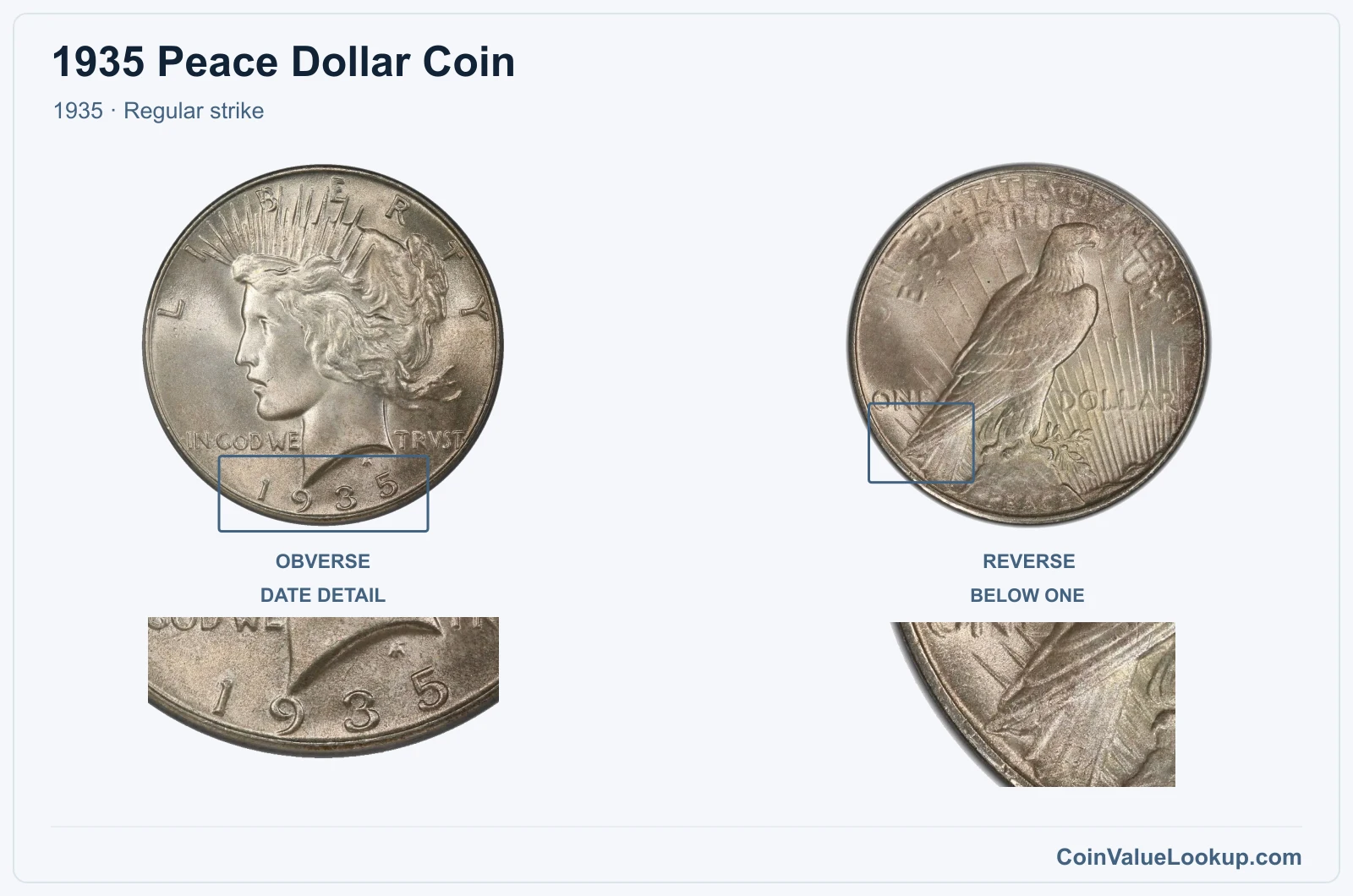
The 1935 Philadelphia Peace Dollar has no mintmark. Look below ONE on the reverse — the space should be empty.
Guide estimates run from about $76 in Good-4 condition up to around $968 in MS65, per USA Coin Book. Those are reference estimates, not standing buy offers.
Most survivors are circulated. A piece with honest wear and original toning is more desirable than one that has been polished to look shiny.
Cleaning strips the natural surface and leaves hairline scratches visible under magnification, which tanks collector value. If your coin has a uniform, unnaturally bright appearance, it was probably cleaned at some point.
Coin Value Lookup is a handy starting point if you want to look up other dates and denominations in this series or compare across your whole collection.
Range Grade
Price Auction Records Appraisal PO PO 1
Coin Identifier FR FR 2
—
Coin Identifier AG AG 3
Coin Identifier G G 4
—
Coin Identifier
G 6
—
Coin Identifier VG VG 8
—
Coin Identifier
VG 10
—
Coin Identifier F F 12
—
Coin Identifier
F 15
—
Coin Identifier VF VF 20
—
Coin Identifier
VF 25
—
Coin Identifier
VF 30
—
Coin Identifier
VF 35
—
Coin Identifier XF XF 40
—
Coin Identifier
XF 45
Coin Identifier AU AU 50
—
Coin Identifier
AU 53
Coin Identifier
AU 55
Coin Identifier
AU 58
Coin Identifier MS MS 60
Coin Identifier
MS 61
Coin Identifier
MS 62
Coin Identifier
MS 63
Coin Identifier
MS 64
Coin Identifier
MS 65
Coin Identifier
MS 66
Coin Identifier
MS 67
Coin Identifier
MS 68
—
—
—
MS 69
—
—
—
MS 70
—
—
—
1935 Peace Silver Dollar — S
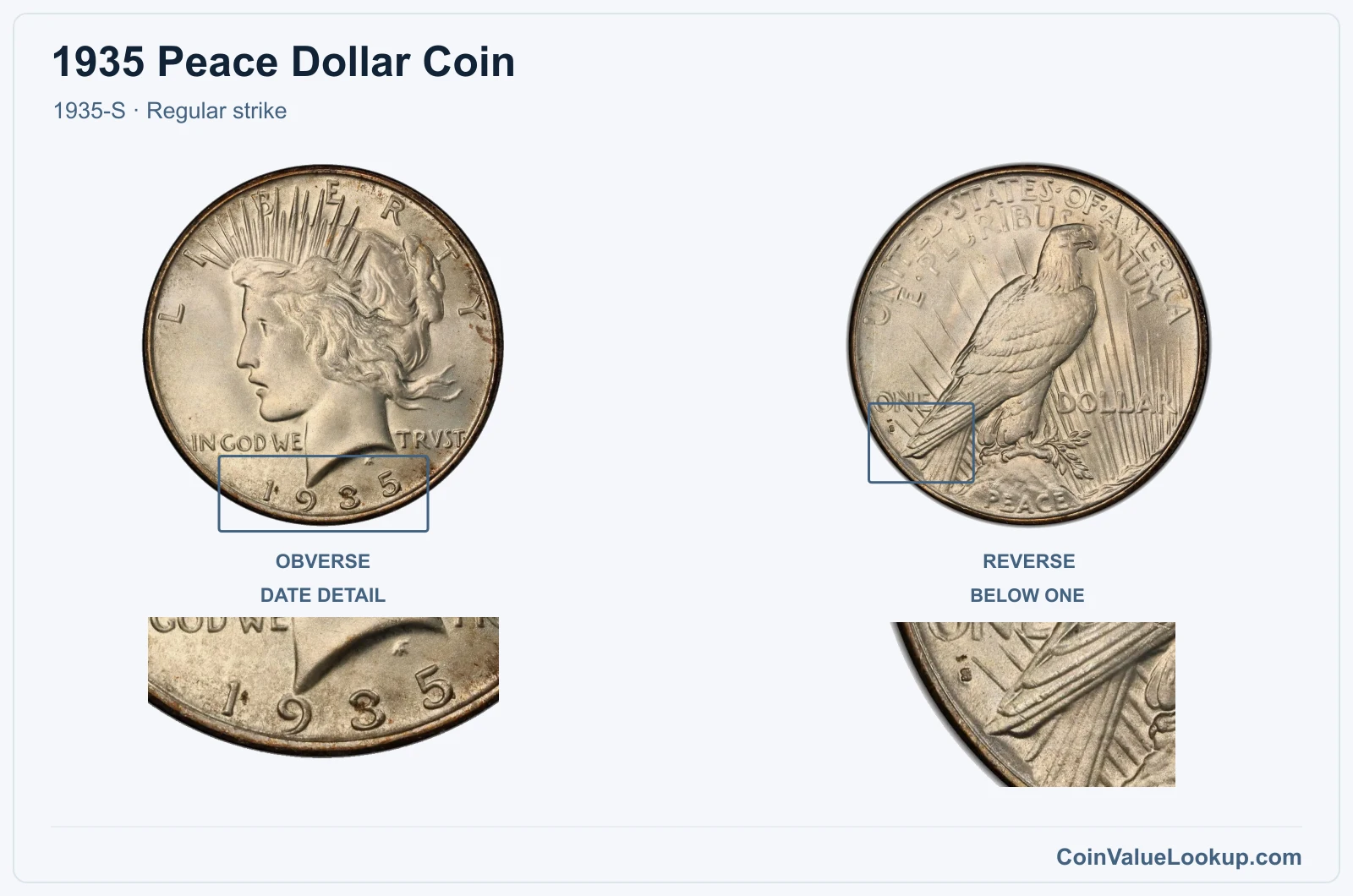
The 1935-S carries a small "S" mintmark on the reverse beneath ONE. San Francisco produced these, and in high grades they are considerably scarcer than the Philadelphia version.
Guide estimates from USA Coin Book place a Good-4 example at about $78 and an MS65 at roughly $1,786 — a steep jump that reflects how few survived in gem condition.
As with any Peace Dollar, original surfaces are essential to realizing strong value. A cleaned or polished 1935-S loses much of its collector premium.
Bag marks are expected on Mint State coins and graders account for them, but deep gouges or rim damage will knock the grade down quickly. If yours looks fully lustrous with minimal marks, it is worth careful evaluation by a professional grading service.
Range Grade
Price Auction Records Appraisal PO PO 1
—
Coin Identifier FR FR 2
—
Coin Identifier AG AG 3
—
Coin Identifier G G 4
—
Coin Identifier
G 6
—
Coin Identifier VG VG 8
—
Coin Identifier
VG 10
Coin Identifier F F 12
—
Coin Identifier
F 15
—
Coin Identifier VF VF 20
—
Coin Identifier
VF 25
—
Coin Identifier
VF 30
—
Coin Identifier
VF 35
—
Coin Identifier XF XF 40
Coin Identifier
XF 45
Coin Identifier AU AU 50
Coin Identifier
AU 53
Coin Identifier
AU 55
Coin Identifier
AU 58
Coin Identifier MS MS 60
Coin Identifier
MS 61
Coin Identifier
MS 62
Coin Identifier
MS 63
Coin Identifier
MS 64
Coin Identifier
MS 65
Coin Identifier
MS 66
Coin Identifier
MS 67
Coin Identifier
MS 68
—
—
—
MS 69
—
—
—
MS 70
—
—
—
1935 Peace Silver Dollar Error List
1. 1935 Peace Silver Dollar — Doubled Die Reverse
A doubled die reverse error has been reported specifically for the 1935-S Peace Dollar. On an affected coin, reverse design elements — lettering, the eagle's feathers or the word PEACE — may show a secondary, slightly offset impression.
The doubling is part of the die itself, so it appears consistent and raised, not flat or shelf-like.
To check, compare your coin's reverse legends letter by letter against a normal 1935-S under magnification. True die doubling will show a uniform secondary image across multiple design elements.
Machine doubling, by contrast, tends to look flat and shiny and usually affects only one side of the raised design. Random contact marks and reflections can also mimic doubling in photos.
No specific price was adopted for this error. Value depends on the strength and visibility of the doubling, overall coin grade and market demand at the time of sale.
2. 1935 Peace Silver Dollar — Lamination / Split Planchet
A lamination error has been reported on the 1935 Peace Dollar. This occurs when impurities or gas pockets within the silver alloy cause layers of metal to separate.
The result is a peeling flap, a missing patch or a crack that exposes a different layer beneath the surface.
Look for a raised or partially detached sliver of metal on either face. Photograph both the affected area and the edge of the coin together, since lamination flaws often extend through the edge profile.
A retained flap — still attached to the coin — is generally more collectible than a missing chunk.
Do not confuse lamination with post-mint scraping, corrosion pitting or a deliberately shaved coin. Genuine lamination follows the contour of the planchet and typically has a natural, uneven boundary.
No specific price was adopted; value depends on size, location, visibility and the coin's overall condition.
3. 1935 Peace Silver Dollar — Clipped Planchet
A clipped planchet error has been reported for the 1935 Peace Dollar. This happens when the blank is punched from strip metal that overlaps a previously punched hole, leaving a missing curved section.
Straight clips from the edge of the strip also exist but are less common on silver dollars.
Look for a concave missing area along the rim. The metal near the clip may show weakness in the design on the opposite side of the coin — this is called the Blakesley effect and helps confirm the clip happened before striking.
The edge at the clip will lack normal reeding.
A filed notch, deliberate cut or corrosion-eaten rim can look similar, but these lack the corresponding design weakness and usually show tool marks or uneven metal loss. No adopted price exists for this error; value hinges on clip size, location, visual appeal and the coin's grade.
4. 1935 Peace Silver Dollar — Broadstrike
A broadstrike error has been reported for the 1935 Peace Dollar. This occurs when the coin is struck without the retaining collar that normally constrains the planchet, allowing the metal to spread outward.
The result is a coin that is wider and thinner than normal, with a full design that extends beyond the usual rim boundary.
The key diagnostic is that the entire design is present but the rim is either missing or very weak, and the coin's diameter exceeds the standard size. The edge will lack proper reeding since no collar was in place during the strike.
Do not confuse a broadstrike with an off-center strike, which shifts the design and leaves a blank crescent, or with a coin that was flattened after minting by external pressure. Post-mint damage will show irregular distortion rather than uniform spread.
No price was adopted for this error; value depends on the degree of spread, eye appeal and overall condition.
5. 1935 Peace Silver Dollar — Die Break / Cud
Die break and cud errors have been reported on the 1935 Peace Dollar. A die break happens when a crack or chunk breaks away from the steel die, leaving a raised irregular feature on the struck coin.
When the break connects to the rim, it is called a cud — a raised blob of featureless metal that replaces part of the normal design.
To identify one, look for a raised lump or line that does not correspond to any intended design element. A true cud will be attached to the rim and will interrupt the design cleanly where the die piece broke away.
Interior die cracks appear as thin raised lines crossing design elements.
Rim dents, corrosion bumps and interior die chips can mimic these errors. Dents are depressed into the surface rather than raised, and corrosion has a pitted, irregular texture.
No specific price was adopted; value depends on the size and location of the break, how dramatically it displaces the design and the coin's overall grade.