1928 Peace Silver Dollar Coin Value: How Much Is It Worth?
The 1928 Peace Dollar is one of the lower-mintage dates in the series, and that scarcity shows in the prices. Adopted guide estimates range from about $76.00 in well-worn grades to $15,292.00 for top Mint State examples, depending on the specific mint and condition.
Before you get excited, you need to confirm which mint struck your coin, whether it carries original surfaces, and whether it belongs to a recognized variety like the 1928-S Doubled Motto.
Fast Way to Identify Your 1928 Peace Silver Dollar
Snap a clear photo of both the front and back of your coin and upload them here for a preliminary identification. This helps pin down the mint, general condition, and whether your piece might be one of the more collectible branches.
Good lighting and a steady hand go a long way — blurry shots make it tough to spot the details that matter.
1928 Peace Silver Dollar Value
Upload both sides of your 1928 Peace Silver Dollar.
Front Obverse
Upload photo
Back Reverse
Upload photo
Which 1928 Peace Silver Dollar Versions Are Worth Money?
- 1928 Philadelphia — the key business-strike issue this year, with guide estimates from $288.00 in G4 to $4,287.00 in MS65.
- 1928-S — more available in lower grades (G4 around $76.00), but a gem MS65 example carries a guide estimate of $15,292.00.
- 1928-S Doubled Motto — a recognized variety showing doubling on the reverse motto; value depends on authenticated identity and condition.
- The V in TRVST is standard design lettering, not an error — do not pay a premium for it.
- Cleaning, polishing, or plating reduces a coin's collectible value regardless of its date or mint.
Step 1: Identify Your 1928 Peace Silver Dollar Mint Mark and Version
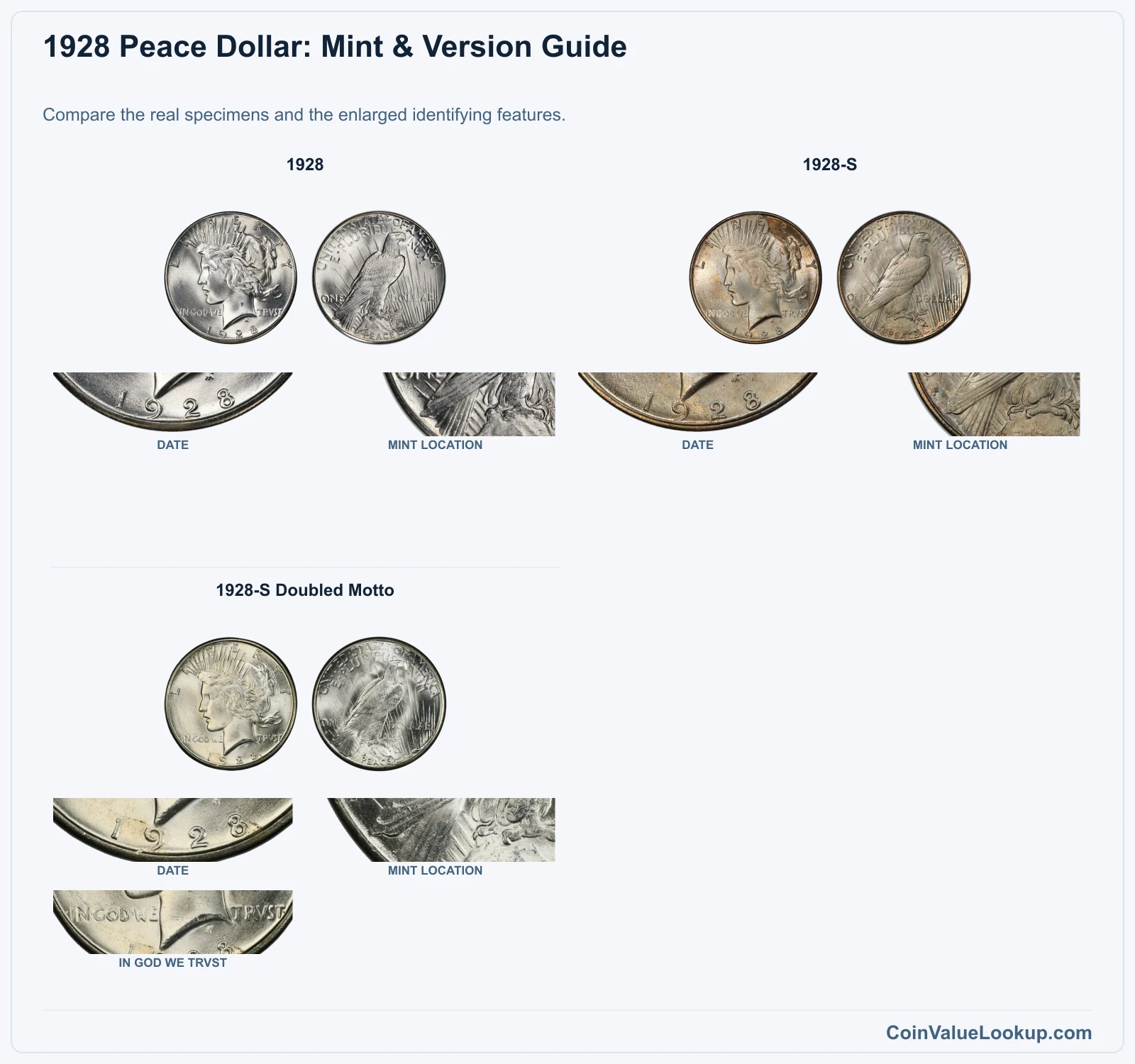
Flip the coin over and look at the reverse, just below the word ONE and near the eagle's tail feathers. A small "S" means San Francisco.
A "D" would mean Denver, but there is no 1928-D Peace Dollar, so if you see a D, double-check — you may be misreading the date. No mint mark at all means Philadelphia struck it.
The "V" in TRVST on the obverse is intentional Latin-style lettering, not a mistake. Every Peace Dollar has it.
All genuine 1928 Peace Dollars are composed of 90% silver and 10% copper, weighing 26.73 grams. The obverse shows a radiate Liberty head, and the reverse features a perched eagle with PEACE inscribed below.
The edge is reeded.
For this year, three collectible branches exist: the 1928 (Philadelphia), the 1928-S (San Francisco), and the 1928-S Doubled Motto variety.
Step 2: Check Your 1928 Peace Silver Dollar Grade
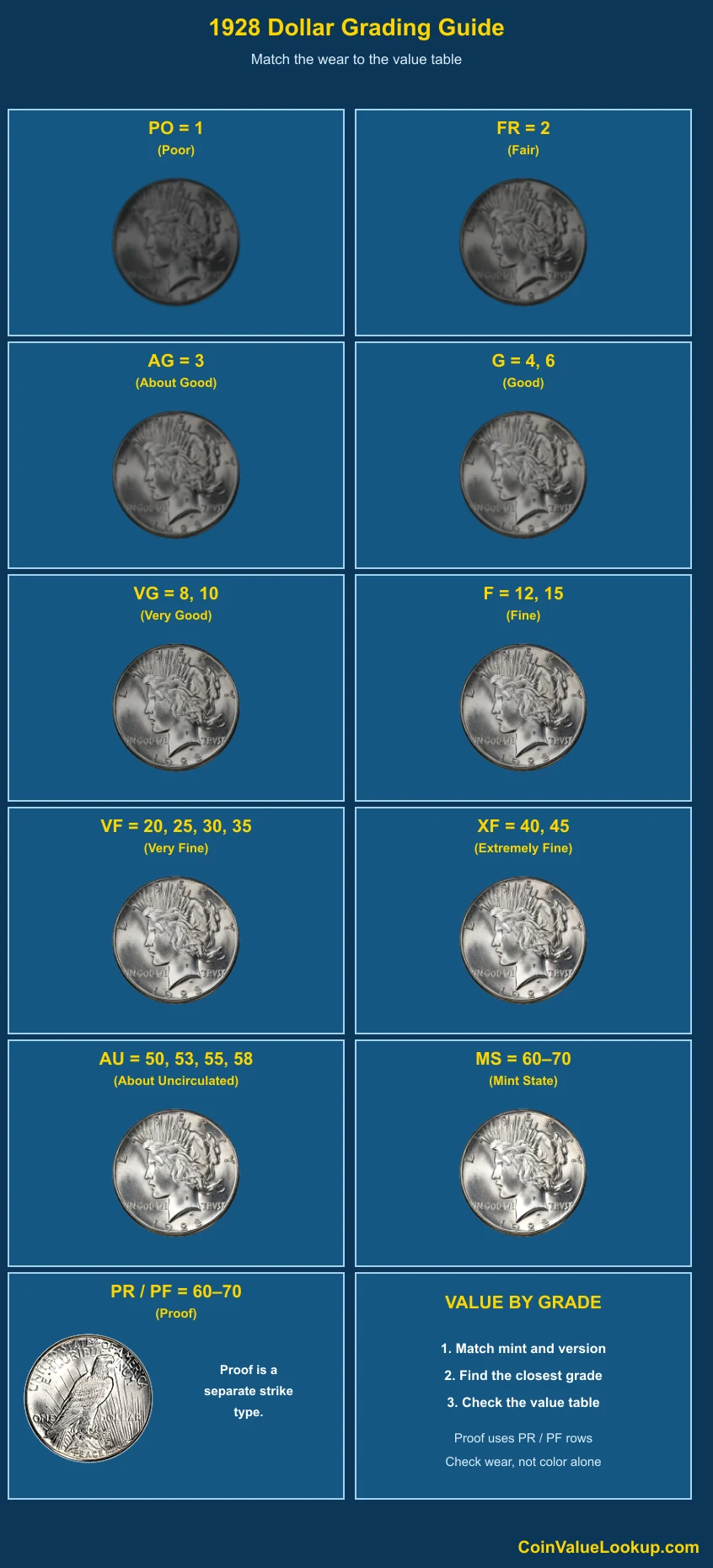
Focus on the hair above Liberty's ear and across the cheek on the obverse — these are the first spots to lose detail. On the reverse, check the eagle's shoulder and the tops of the wing feathers for flatness.
Some Peace Dollars show weakness in the central design even on uncirculated coins. That is a strike characteristic, not wear.
Actual wear will also dull the original luster and leave the surfaces looking flat and lifeless.
Use the grading comparison image to see how a circulated example differs from an About Uncirculated or Mint State coin of the same type. AU coins retain most luster but show slight rub on the highest points.
Mint State pieces have no wear at all, though they may have contact marks from being jostled in bags.
Cleaned or polished coins lose their natural surface texture and typically grade lower than they otherwise would. If your coin has a harsh, unnaturally bright look, that is a red flag.
Step 3: Check 1928 Peace Silver Dollar Value by Mint and Version
1928 Peace Silver Dollar
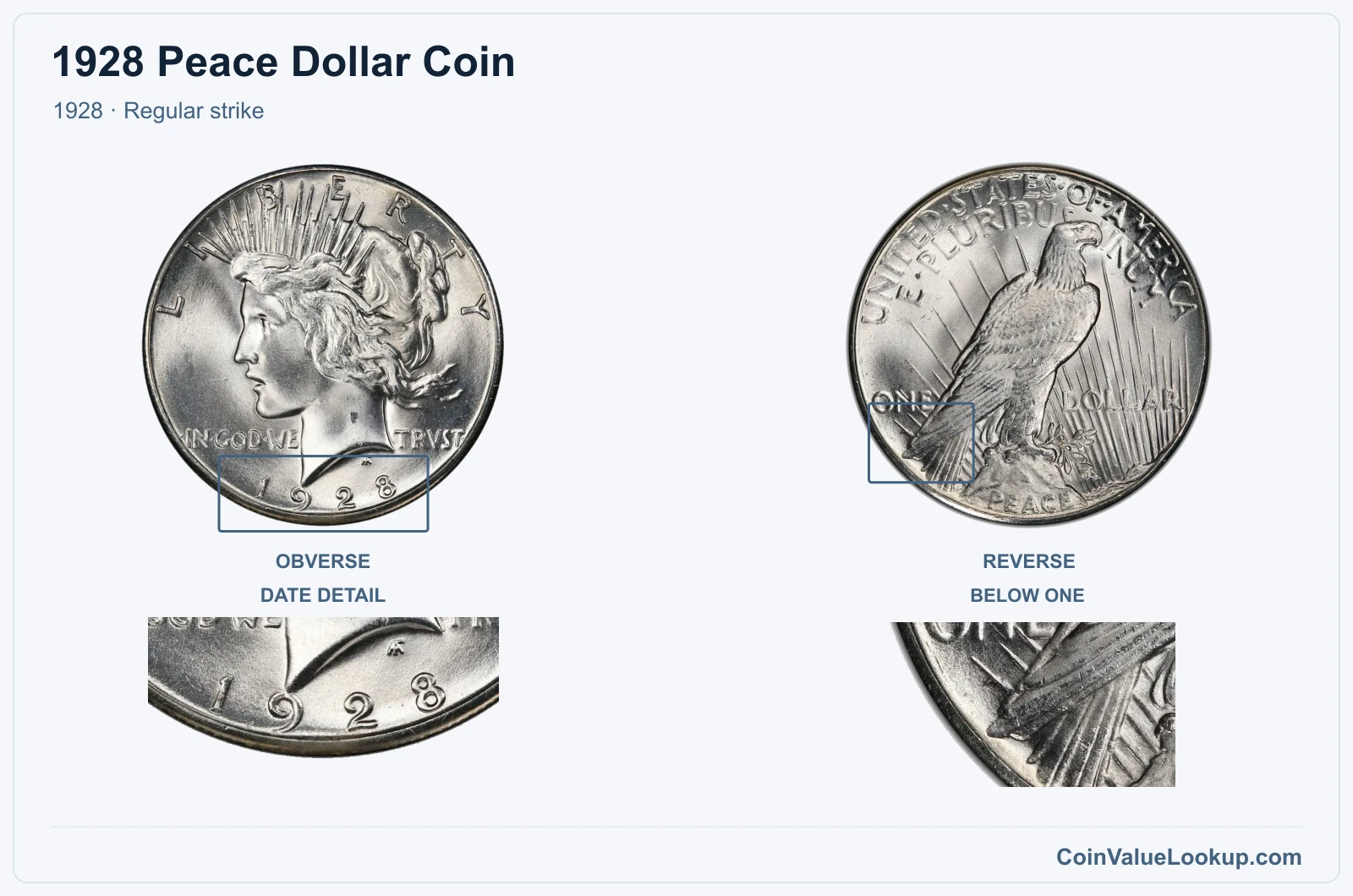
The 1928 Philadelphia Peace Dollar carries no mint mark. It had a modest production run, which makes it one of the scarcer regular-issue dates in the entire Peace Dollar series.
USA Coin Book guide estimates place a worn G4 example at about $288.00 and a gem MS65 at roughly $4,287.00. These are guide estimates, not guaranteed sale prices.
Condition and originality of surfaces matter enormously — a cleaned coin will not command full guide value even if it technically has the right amount of remaining detail.
Confirm there is no letter below ONE on the reverse before calling it a Philadelphia strike.
Range Grade
Price Auction Records Appraisal PO PO 1
—
Coin Identifier FR FR 2
Coin Identifier AG AG 3
Coin Identifier G G 4
Coin Identifier
G 6
Coin Identifier VG VG 8
Coin Identifier
VG 10
Coin Identifier F F 12
Coin Identifier
F 15
Coin Identifier VF VF 20
Coin Identifier
VF 25
Coin Identifier
VF 30
Coin Identifier
VF 35
Coin Identifier XF XF 40
Coin Identifier
XF 45
Coin Identifier AU AU 50
Coin Identifier
AU 53
Coin Identifier
AU 55
Coin Identifier
AU 58
Coin Identifier MS MS 60
Coin Identifier
MS 61
Coin Identifier
MS 62
Coin Identifier
MS 63
Coin Identifier
MS 64
Coin Identifier
MS 65
Coin Identifier
MS 66
Coin Identifier
MS 67
—
—
—
MS 68
—
—
—
MS 69
—
—
—
MS 70
—
—
—
1928 Peace Silver Dollar — S
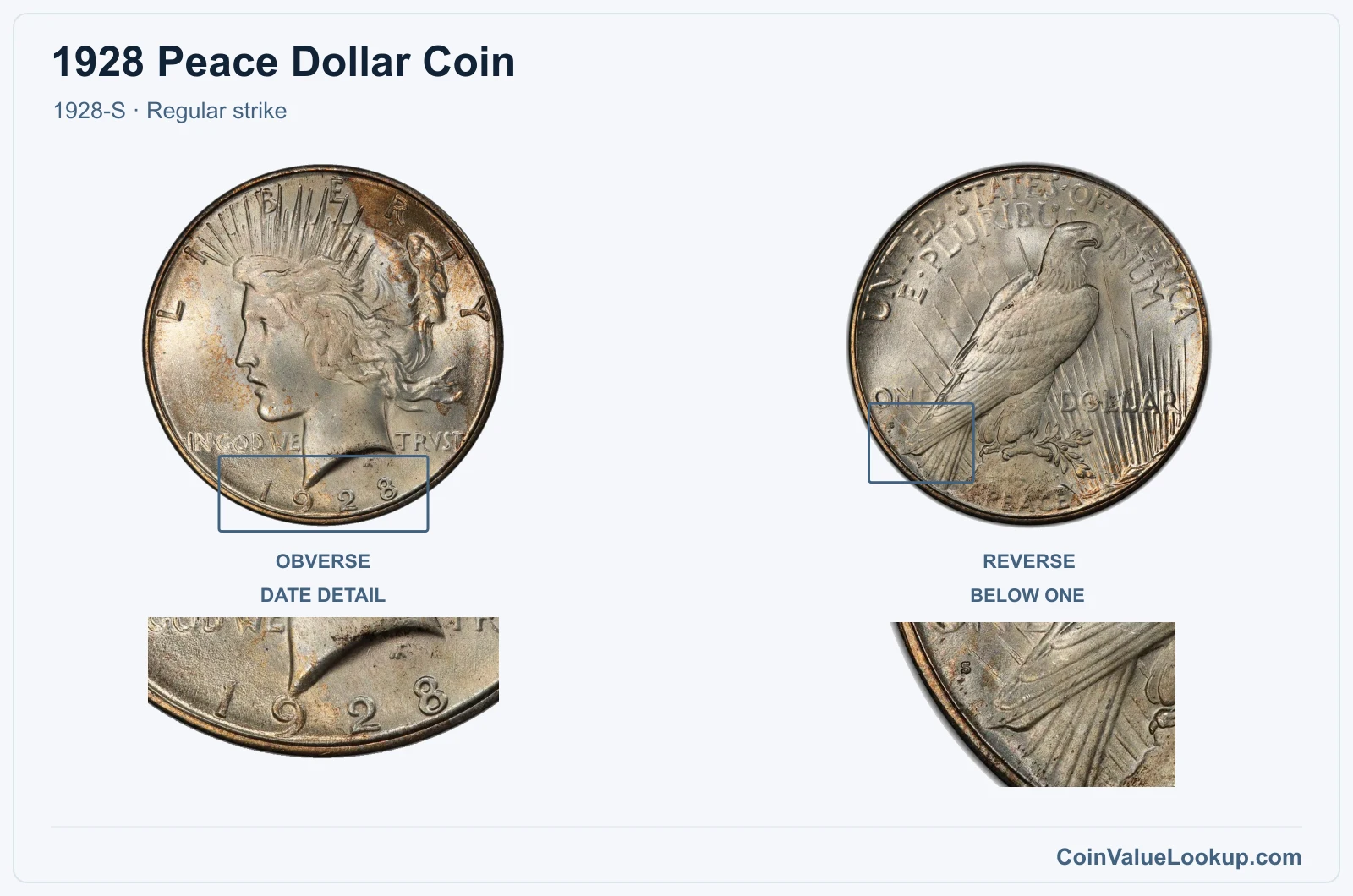
The 1928-S was struck at San Francisco and is identified by the small "S" mint mark on the reverse, below ONE near the eagle's tail. It is considerably more common than the Philadelphia issue in circulated grades.
Guide estimates from USA Coin Book put a G4 at about $76.00, while an MS65 jumps to approximately $15,292.00. That enormous spread tells you something: survivors in gem condition are genuinely scarce.
Most 1928-S dollars saw heavy circulation, so finding one with full original luster is no small feat.
Coin Value Lookup is a handy starting point if you want to look up guide values for other dates and mints in the Peace Dollar series, or for different coin types entirely.
Range Grade
Price Auction Records Appraisal PO PO 1
—
Coin Identifier FR FR 2
—
Coin Identifier AG AG 3
—
Coin Identifier G G 4
—
Coin Identifier
G 6
—
Coin Identifier VG VG 8
—
Coin Identifier
VG 10
—
Coin Identifier F F 12
—
Coin Identifier
F 15
Coin Identifier VF VF 20
Coin Identifier
VF 25
—
Coin Identifier
VF 30
—
Coin Identifier
VF 35
—
Coin Identifier XF XF 40
Coin Identifier
XF 45
Coin Identifier AU AU 50
Coin Identifier
AU 53
Coin Identifier
AU 55
Coin Identifier
AU 58
Coin Identifier MS MS 60
Coin Identifier
MS 61
Coin Identifier
MS 62
Coin Identifier
MS 63
Coin Identifier
MS 64
Coin Identifier
MS 65
Coin Identifier
MS 66
Coin Identifier
MS 67
—
—
—
MS 68
—
—
—
MS 69
—
—
—
MS 70
—
—
—
1928 Peace Silver Dollar — S Doubled Motto
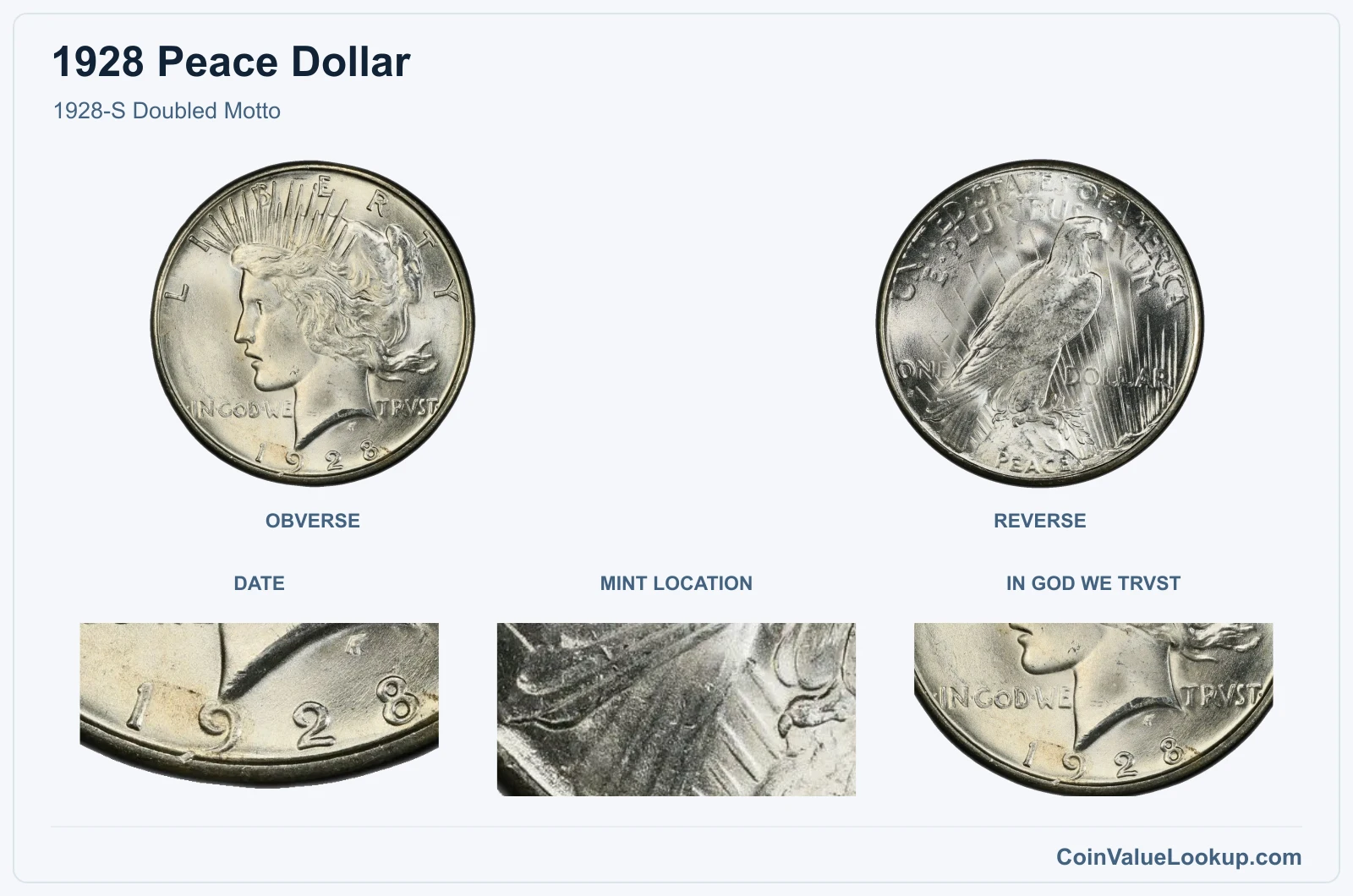
The 1928-S Doubled Motto is a recognized die variety from the San Francisco mint. It shows visible doubling on the reverse motto — compare the lettering carefully against a normal 1928-S to spot the difference.
This variety carries the "S" mint mark like any other San Francisco strike. The doubling affects the motto area specifically, so that is where to concentrate your examination under magnification.
No supported price range is available for this variety. Value depends on authenticated identity, the strength and visibility of the doubling, and overall coin condition.
If you believe you have one, professional authentication through a recognized grading service is the practical next step.
Range Grade
Price Auction Records Appraisal PO PO 1
—
Coin Identifier FR FR 2
—
Coin Identifier AG AG 3
—
Coin Identifier G G 4
—
Coin Identifier
G 6
—
Coin Identifier VG VG 8
—
Coin Identifier
VG 10
—
Coin Identifier F F 12
—
Coin Identifier
F 15
—
Coin Identifier VF VF 20
—
Coin Identifier
VF 25
—
Coin Identifier
VF 30
—
Coin Identifier
VF 35
—
Coin Identifier XF XF 40
—
Coin Identifier
XF 45
—
Coin Identifier AU AU 50
—
Coin Identifier
AU 53
Coin Identifier
AU 55
Coin Identifier
AU 58
Coin Identifier MS MS 60
—
Coin Identifier
MS 61
—
Coin Identifier
MS 62
Coin Identifier
MS 63
Coin Identifier
MS 64
Coin Identifier
MS 65
—
Coin Identifier
MS 66
—
—
—
MS 67
—
—
—
MS 68
—
—
—
MS 69
—
—
—
MS 70
—
—
—
1928 Peace Silver Dollar Error List
1. 1928 Peace Silver Dollar — Doubled Die Reverse
A Doubled Die Reverse has been reported for the 1928 Peace Dollar series, specifically on the 1928-S mint issue — the 1928-S Doubled Motto. This variety displays doubling in the reverse lettering, particularly in the motto area.
To check, compare your coin's reverse legends and design contours side by side with a confirmed normal 1928-S under magnification.
Not every funny-looking letter is a doubled die. Machine doubling, light reflections, and random post-mint damage can all mimic genuine hub doubling.
Machine doubling tends to look flat and shelf-like, while a true doubled die usually shows rounded, separated design elements.
This reported variety applies to the San Francisco mint; other mints for 1928 are not implied to have this error. No numerical price range is available — value depends on the visibility of the doubling, overall coin condition, and confirmed authentication.
A source-reported listing is not the same as independent authentication of your specific coin.