1896 Morgan Silver Dollar Coin Value: How Much Is It Worth?
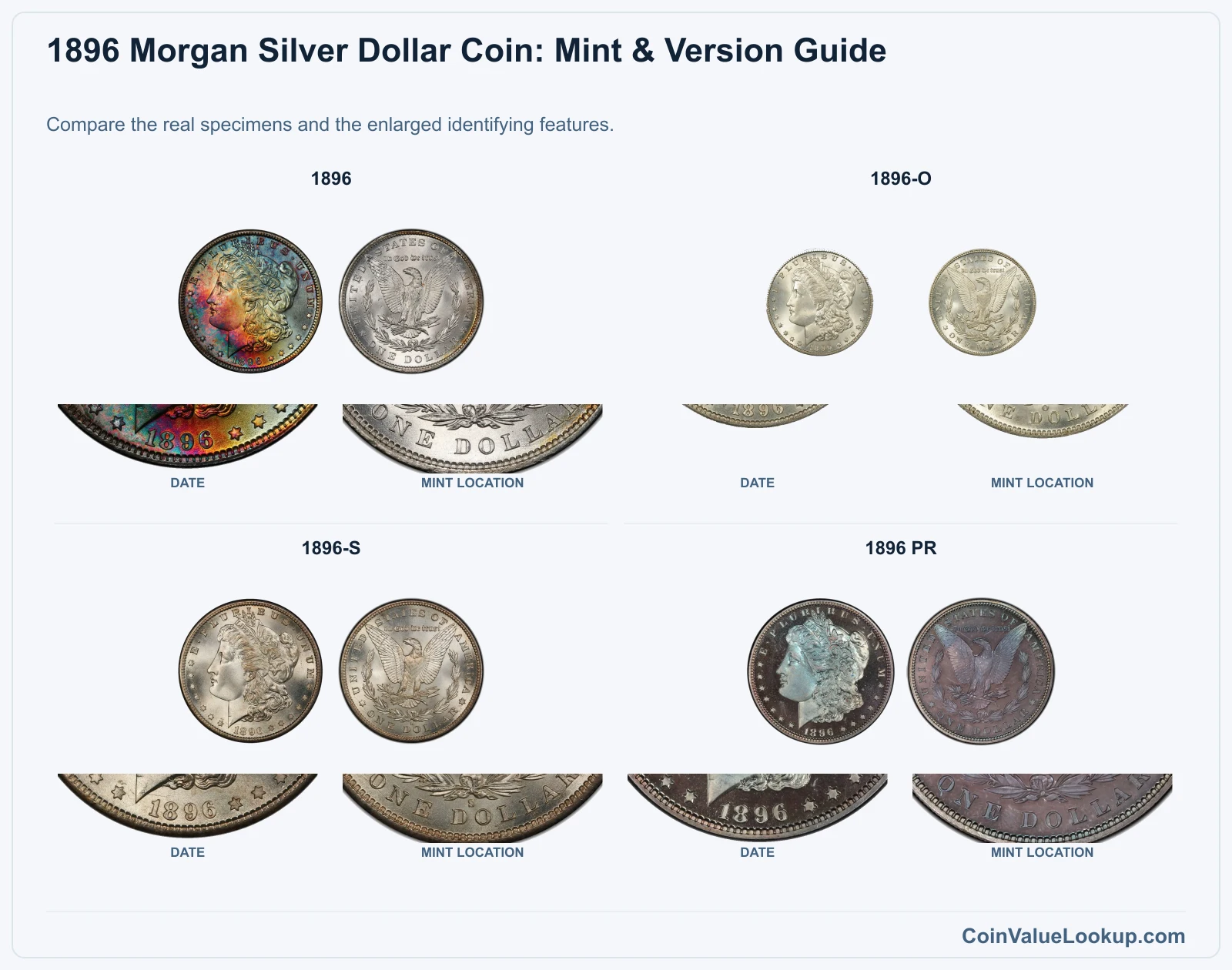
The 1896 Morgan Silver Dollar is a coin that draws collector attention for good reason. Struck in 90% silver and weighing 26.73 grams, its value depends entirely on which mint produced it, its condition, and whether it carries any unusual manufacturing characteristics.
Three mints and a proof issue exist for this date, so pinning down exactly what you have is the first step before any valuation.
Fast Way to Identify Your 1896 Morgan Silver Dollar
The quickest way to start figuring out what your 1896 Morgan Dollar is worth is to snap clear photos of both the front and back, then upload them for preliminary identification. Good lighting and a steady hand help.
This gives you a starting point for mint, design match, and general condition before diving deeper into grading.
1896 Morgan Silver Dollar Value
Upload both sides of your 1896 Morgan Silver Dollar.
Front Obverse
Upload photo
Back Reverse
Upload photo
Which 1896 Morgan Silver Dollar Versions Are Worth Money?
- The 1896 Proof (PR) is a low-mintage Philadelphia issue made for collectors, not commerce, making authenticated examples particularly sought after.
- The 1896-S carries the San Francisco mintmark and is one of the scarcer business-strike options for this date, with condition playing a major role in value.
- The 1896-O from New Orleans can command attention in higher grades, where surviving examples with original surfaces become harder to find.
- A reported 1896-S S/S repunched mintmark error exists and may carry added value depending on visibility and authentication.
- PL or DMPL surface designations on eligible business strikes can affect pricing, but require professional attribution rather than casual identification.
Step 1: Identify Your 1896 Morgan Silver Dollar Mint Mark and Version
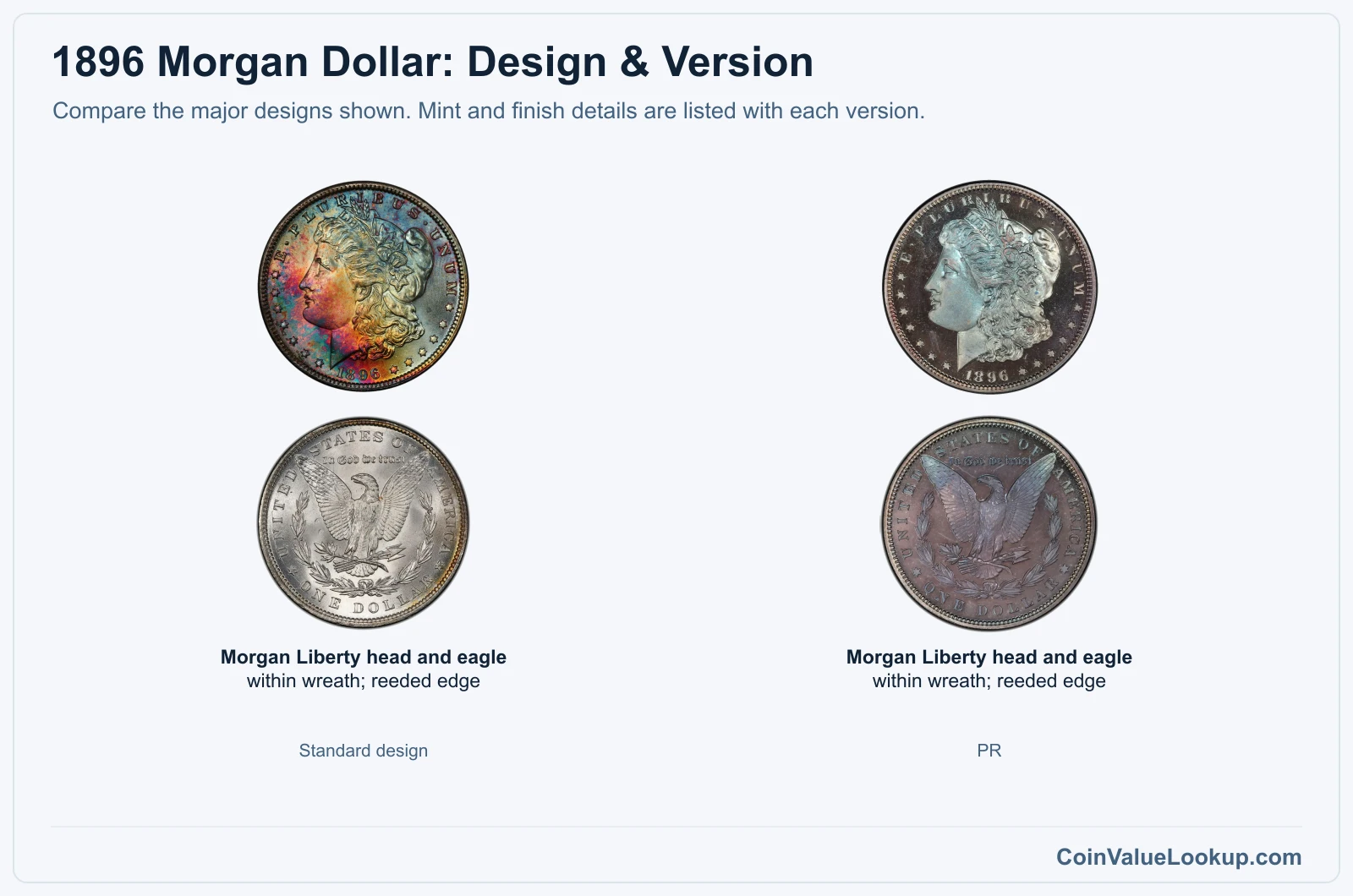
Flip your coin to the reverse and look directly below the bow that ties the wreath together. That small area is where the mintmark lives.
No letter at all means Philadelphia. An "O" means New Orleans, and an "S" means San Francisco.
There is no Carson City or Denver issue for 1896, so if you see a CC or D, you have a different date or a problem.
The obverse shows Liberty's head with a Phrygian cap and wheat stalks, designed by George T. Morgan.
The reverse features an eagle with outstretched wings clutching arrows and an olive branch, surrounded by a wreath. The edge is reeded, meaning it has fine vertical lines all the way around.
All genuine 1896 Morgan Dollars are 90% silver and 10% copper, weighing 26.73 grams. If your coin feels light or doesn't ring right, that could indicate a problem.
A proof version also exists for this year, struck at Philadelphia with no mintmark, but it is a special manufacturing finish, not simply a high-grade or shiny regular coin.
Be cautious about assuming a shiny surface means you have a proof or a prooflike coin. PL (Prooflike) and DMPL (Deep Mirror Prooflike) are surface designations applied to eligible business strikes that happen to show mirror-like fields.
They are not the same as proof manufacture. Cleaning and polishing can also create a misleading shine that actually lowers a coin's collector appeal.
Step 2: Check Your 1896 Morgan Silver Dollar Grade
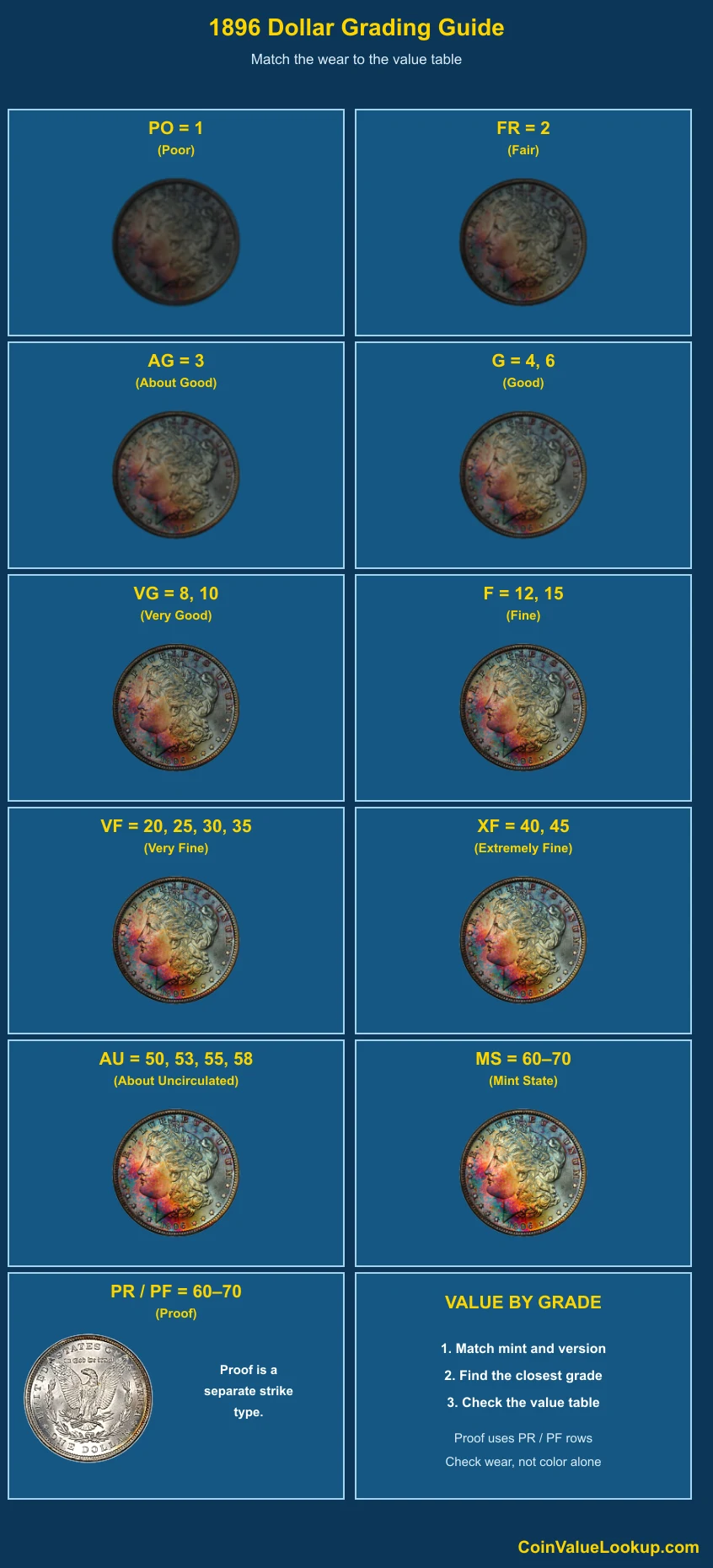
Start by examining the hair detail above Liberty's ear on the obverse. In lower circulated grades, this area goes flat first.
The cheek is next; once it shows visible wear or flattening, the coin has seen real use. On the reverse, the eagle's breast feathers lose definition early.
Bag marks are a separate issue from circulation wear. Morgan Dollars were stored in heavy canvas bags at the mint, and even uncirculated coins can show nicks and scrapes from contact with other coins.
These marks reduce the Mint State grade without meaning the coin ever spent a day in someone's pocket.
Use the comparison image to gauge where your coin falls. Look at circulated examples, then AU (About Uncirculated, where only the highest points show trace wear), and then Mint State coins with full original luster.
Proof coins should be compared only against other proofs, since their manufacturing finish is fundamentally different from business strikes.
Cleaned or polished coins grade differently from original-surface examples. If your coin has hairline scratches visible under light or an unnaturally bright, uniform shine, it may have been cleaned, and that matters for valuation.
Step 3: Check 1896 Morgan Silver Dollar Value by Mint and Version
1896 Morgan Silver Dollar
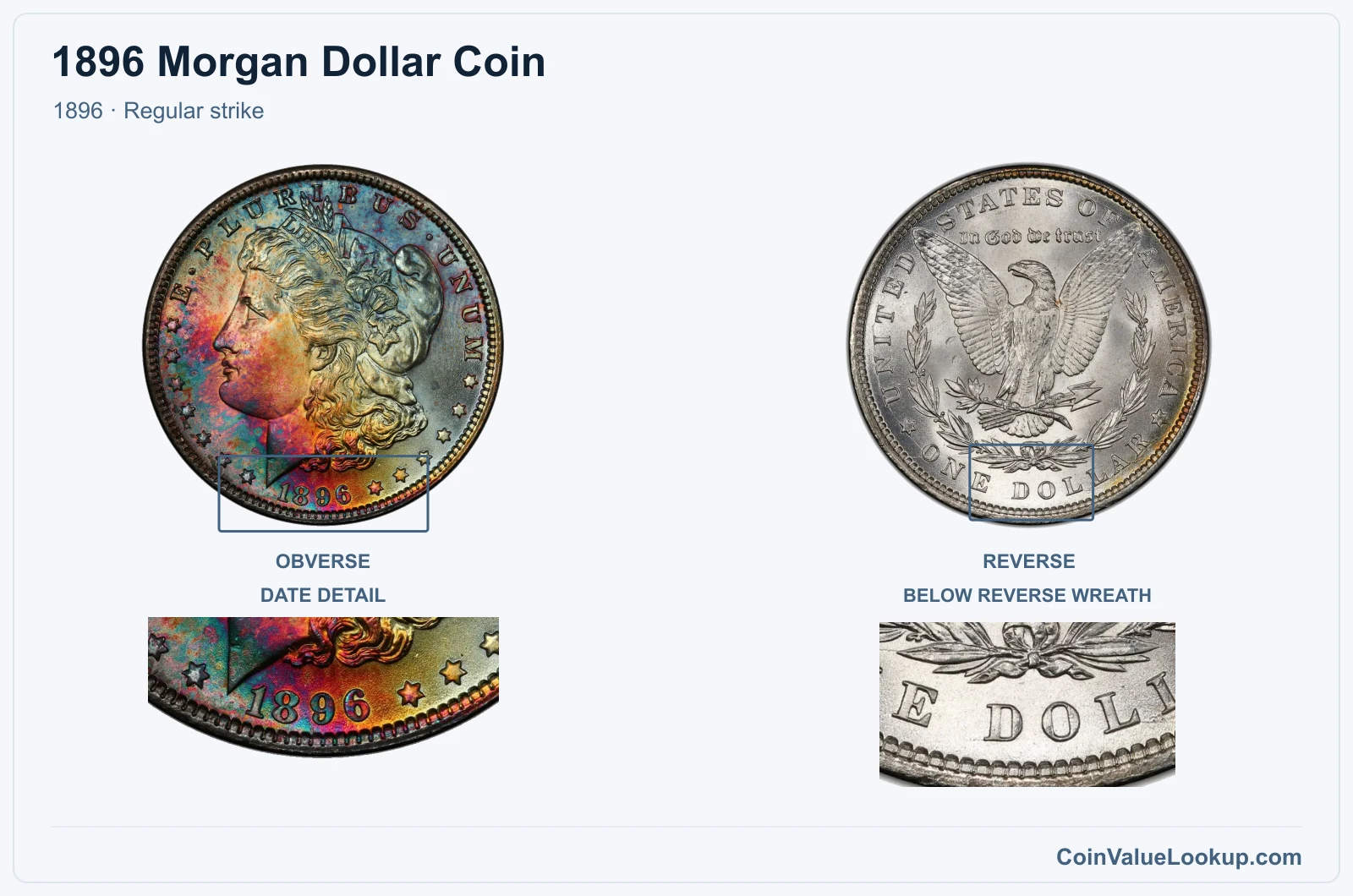
The 1896 Philadelphia issue carries no mintmark. It is the most commonly encountered version of this date, which means condition and originality drive its collector appeal.
Look below the wreath bow on the reverse and confirm the space is empty.
Value depends on authenticated grade and surface quality. PL and DMPL designations can apply to business strikes that exhibit mirror-like fields, and these surface qualities function as price filters when confirmed by a grading service.
Cleaned or polished coins lose that premium. Because no supported price range is available for this guide, individual assessment based on authenticated identity, grade, and any confirmed error is the right approach.
Range Grade
Price Auction Records Appraisal PO PO 1
—
Coin Identifier FR FR 2
—
Coin Identifier AG AG 3
—
Coin Identifier G G 4
—
Coin Identifier
G 6
—
Coin Identifier VG VG 8
—
Coin Identifier
VG 10
—
Coin Identifier F F 12
—
Coin Identifier
F 15
—
Coin Identifier VF VF 20
Coin Identifier
VF 25
—
Coin Identifier
VF 30
—
Coin Identifier
VF 35
—
Coin Identifier XF XF 40
—
Coin Identifier
XF 45
—
Coin Identifier AU AU 50
Coin Identifier
AU 53
Coin Identifier
AU 55
Coin Identifier
AU 58
Coin Identifier MS MS 60
Coin Identifier
MS 61
Coin Identifier
MS 62
Coin Identifier
MS 63
Coin Identifier
MS 64
Coin Identifier
MS 65
Coin Identifier
MS 66
Coin Identifier
MS 67
Coin Identifier
MS 68
Coin Identifier
MS 69
—
—
—
MS 70
—
—
—
1896 Morgan Silver Dollar — O
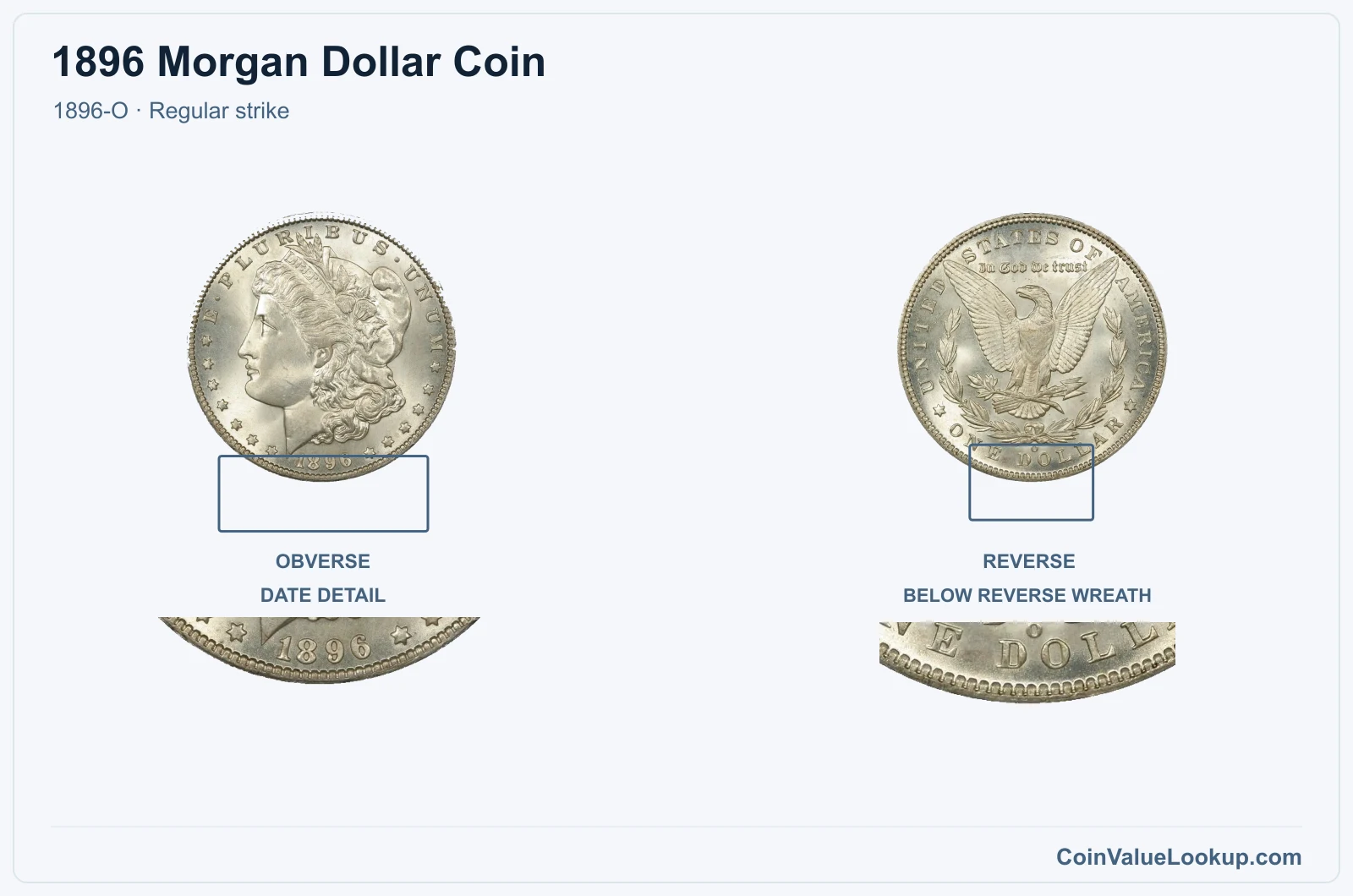
The 1896-O was struck at the New Orleans Mint. You will see a small "O" below the wreath bow on the reverse.
New Orleans Morgan Dollars are popular with collectors who pursue the full mint set, and this date can be genuinely scarce in higher Mint State grades.
Original surfaces matter here. Cleaning or dipping, common with old silver, reduces collector comparability.
PL and DMPL surfaces are possible on eligible strikes and serve as price filters when professionally attributed. No specific price range is adopted for this guide, so value should be assessed individually based on authenticated condition and originality.
Coin Value Lookup is a good place to start when you want to look up guides for different Morgan Dollar dates and mints, all organized for quick reference.
Range Grade
Price Auction Records Appraisal PO PO 1
Coin Identifier FR FR 2
Coin Identifier AG AG 3
—
Coin Identifier G G 4
—
Coin Identifier
G 6
Coin Identifier VG VG 8
Coin Identifier
VG 10
Coin Identifier F F 12
—
Coin Identifier
F 15
Coin Identifier VF VF 20
—
Coin Identifier
VF 25
Coin Identifier
VF 30
Coin Identifier
VF 35
Coin Identifier XF XF 40
Coin Identifier
XF 45
Coin Identifier AU AU 50
Coin Identifier
AU 53
Coin Identifier
AU 55
Coin Identifier
AU 58
Coin Identifier MS MS 60
Coin Identifier
MS 61
Coin Identifier
MS 62
Coin Identifier
MS 63
Coin Identifier
MS 64
Coin Identifier
MS 65
Coin Identifier
MS 66
Coin Identifier
MS 67
—
—
—
MS 68
—
—
—
MS 69
—
—
—
MS 70
—
—
—
1896 Morgan Silver Dollar — S
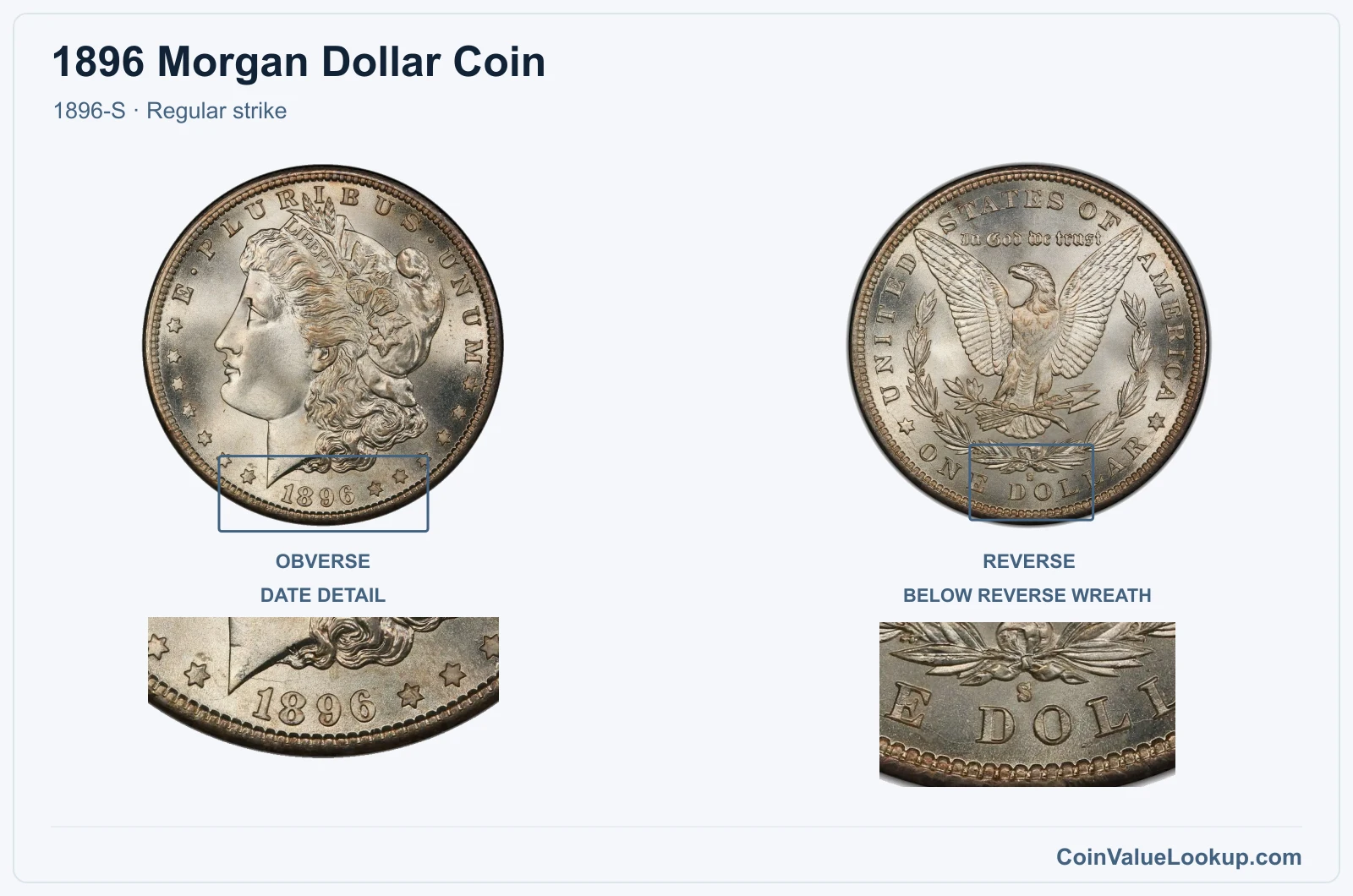
The 1896-S bears an "S" mintmark below the reverse wreath bow, confirming it was struck at San Francisco. This is generally considered the scarcer business-strike issue among the three mints for 1896, so grade matters even more than usual.
San Francisco Morgans often came with stronger strikes than their New Orleans counterparts, but each coin is different. Surface preservation and the absence of cleaning are key.
PL and DMPL surface designations can apply when professionally confirmed. No supported price range is adopted here; each coin should be assessed individually by its authenticated identity, condition, and whether any error is present.
Range Grade
Price Auction Records Appraisal PO PO 1
Coin Identifier FR FR 2
—
Coin Identifier AG AG 3
—
Coin Identifier G G 4
—
Coin Identifier
G 6
—
Coin Identifier VG VG 8
Coin Identifier
VG 10
Coin Identifier F F 12
Coin Identifier
F 15
Coin Identifier VF VF 20
Coin Identifier
VF 25
Coin Identifier
VF 30
Coin Identifier
VF 35
Coin Identifier XF XF 40
Coin Identifier
XF 45
Coin Identifier AU AU 50
Coin Identifier
AU 53
Coin Identifier
AU 55
Coin Identifier
AU 58
Coin Identifier MS MS 60
Coin Identifier
MS 61
Coin Identifier
MS 62
Coin Identifier
MS 63
Coin Identifier
MS 64
Coin Identifier
MS 65
Coin Identifier
MS 66
Coin Identifier
MS 67
Coin Identifier
MS 68
—
—
—
MS 69
Coin Identifier
MS 70
—
—
—
1896 Morgan Silver Dollar — PR
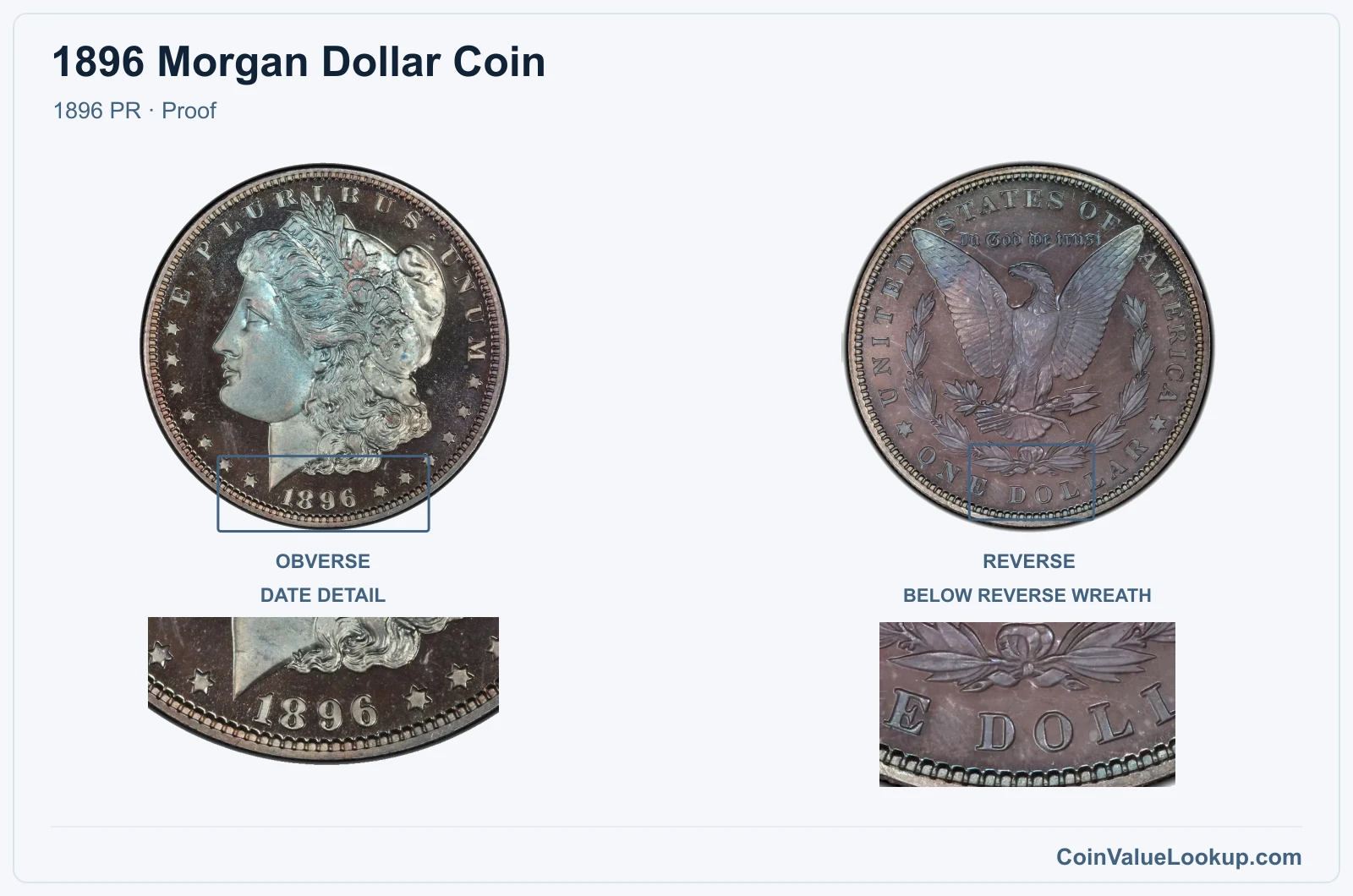
The 1896 Proof was produced at Philadelphia for collectors and carries no mintmark, just like the regular Philadelphia business strike. The difference is manufacturing: proofs were struck on specially prepared planchets with polished dies, often multiple times, producing sharp detail and mirror-like fields by design.
Do not confuse a proof with a high-grade Mint State coin that happens to look shiny. Proof is a method of manufacture, not a grade above MS-65 or MS-67.
Authentication by a major grading service is essentially mandatory if you believe you have a proof, since the premium over a business strike can be significant.
No specific price range is adopted for this guide. Value depends on the authenticated proof grade, surface quality, and any toning or handling marks.
These were produced in small numbers, so genuine authenticated examples are uncommon in the marketplace.
Range Grade
Price Auction Records Appraisal PR PR 1
—
Coin Identifier
PR 2
—
Coin Identifier
PR 3
—
Coin Identifier
PR 4
—
Coin Identifier
PR 6
—
Coin Identifier
PR 8
—
Coin Identifier
PR 10
—
Coin Identifier
PR 12
—
Coin Identifier
PR 15
—
Coin Identifier
PR 20
—
Coin Identifier
PR 25
—
Coin Identifier
PR 30
—
Coin Identifier
PR 35
—
Coin Identifier
PR 40
—
Coin Identifier
PR 45
—
Coin Identifier
PR 50
Coin Identifier
PR 53
—
Coin Identifier
PR 55
—
Coin Identifier
PR 58
Coin Identifier
PR 60
Coin Identifier
PR 61
Coin Identifier
PR 62
Coin Identifier
PR 63
Coin Identifier
PR 64
Coin Identifier
PR 65
Coin Identifier
PR 66
Coin Identifier
PR 67
Coin Identifier
PR 68
Coin Identifier
PR 69
—
—
—
PR 70
—
—
—
1896 Morgan Silver Dollar Error List
1. 1896 Morgan Silver Dollar — Repunched Mintmark
A repunched mintmark (RPM) has been reported on the 1896-S Morgan Dollar, described as an S/S error. This means the "S" mintmark was punched into the working die more than once, with the second impression slightly offset from the first.
The result is visible traces of the earlier punch position beneath or beside the final mintmark.
To check for this, examine the mintmark area below the wreath bow under magnification. You are looking for a shadow, notch, or partial outline of a second "S" that does not align perfectly with the primary letter.
Compare your coin to a normal 1896-S mintmark at the same magnification so you know what baseline looks like.
Be careful not to confuse machine doubling, die chips, or simple corrosion around the mintmark for a true RPM. Machine doubling tends to produce flat, shelf-like traces rather than the rounded remnants of a separate punch.
No specific price is adopted for this error; value depends on the visibility of the repunch, overall coin condition, and professional authentication.
2. 1896 Morgan Silver Dollar — Off-Center Strike
Off-center strikes have been reported for the 1896 Morgan Dollar. This error occurs when the planchet is not properly seated between the dies at the moment of striking, causing the design to be displaced to one side.
The telltale sign is an unstruck crescent of blank metal on one edge, with the design shifted in the opposite direction.
The percentage of off-center displacement and whether the date remains fully visible are the two biggest factors collectors care about. A coin that is 5% off-center with a full date is collectible; one that is 50% off-center but missing the date is far less desirable to most buyers.
Do not mistake a clipped planchet, which shows a curved bite out of the edge, or post-mint damage like a flattened rim for a genuine off-center strike. One-sided die misalignment can also mimic the look at first glance.
No numerical price range is adopted; value depends on the degree of the error, the coin's condition, and whether the piece has been professionally authenticated.