1836 Capped Bust Dime Coin Value: How Much Is It Worth?
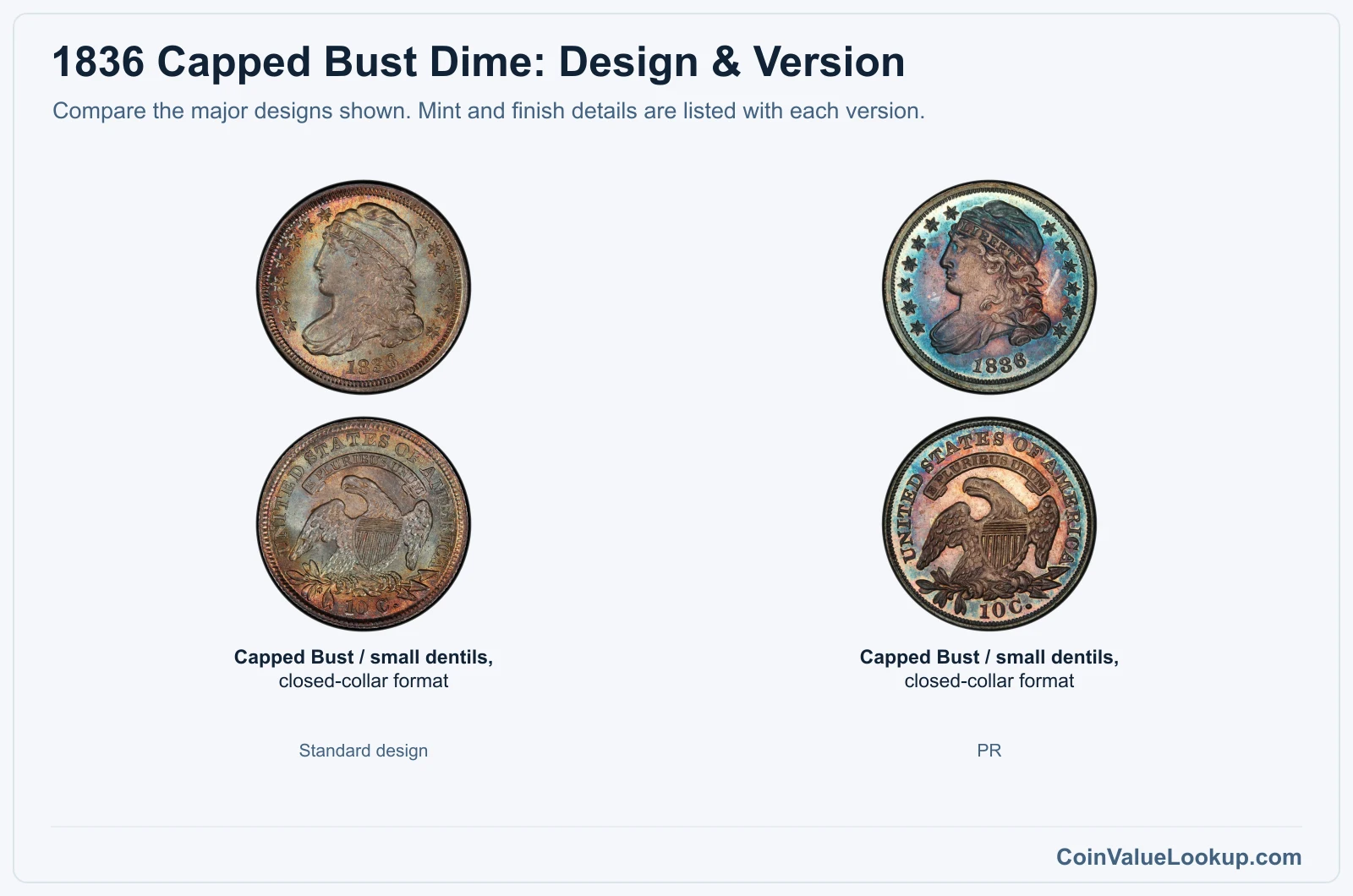
The 1836 Capped Bust Dime is a genuine piece of early American silver coinage, struck at Philadelphia during the era of hand-operated presses. Guide estimates for this date range from roughly $54.00 in well-worn Good-4 condition to around $2,344.00 for a choice Mint State 63 example, depending on the exact branch and grade.
These anchors reflect specific conditions and are not guaranteed offers for every coin.
Fast Way to Identify Your 1836 Capped Bust Dime
If you have an 1836 dime and want a quick preliminary identification, upload clear photos of both the front and back of your coin. That lets us compare your piece against the known design details, date style, and surface characteristics for this year.
It is not a substitute for professional authentication, but it is a solid starting point.
1836 Capped Bust Dime Value
Upload both sides of your 1836 Capped Bust Dime.
Front Obverse
Upload photo
Back Reverse
Upload photo
Which 1836 Capped Bust Dime Versions Are Worth Money?
- The 1836 business strike ranges from about $54.00 in Good-4 to $2,344.00 in MS63 per guide estimates, making higher-grade survivors especially worth checking.
- The 1836 Proof is an extremely scarce early proof issue whose value requires individual professional assessment based on authenticated identity and condition.
Step 1: Identify Your 1836 Capped Bust Dime Mint Mark and Version
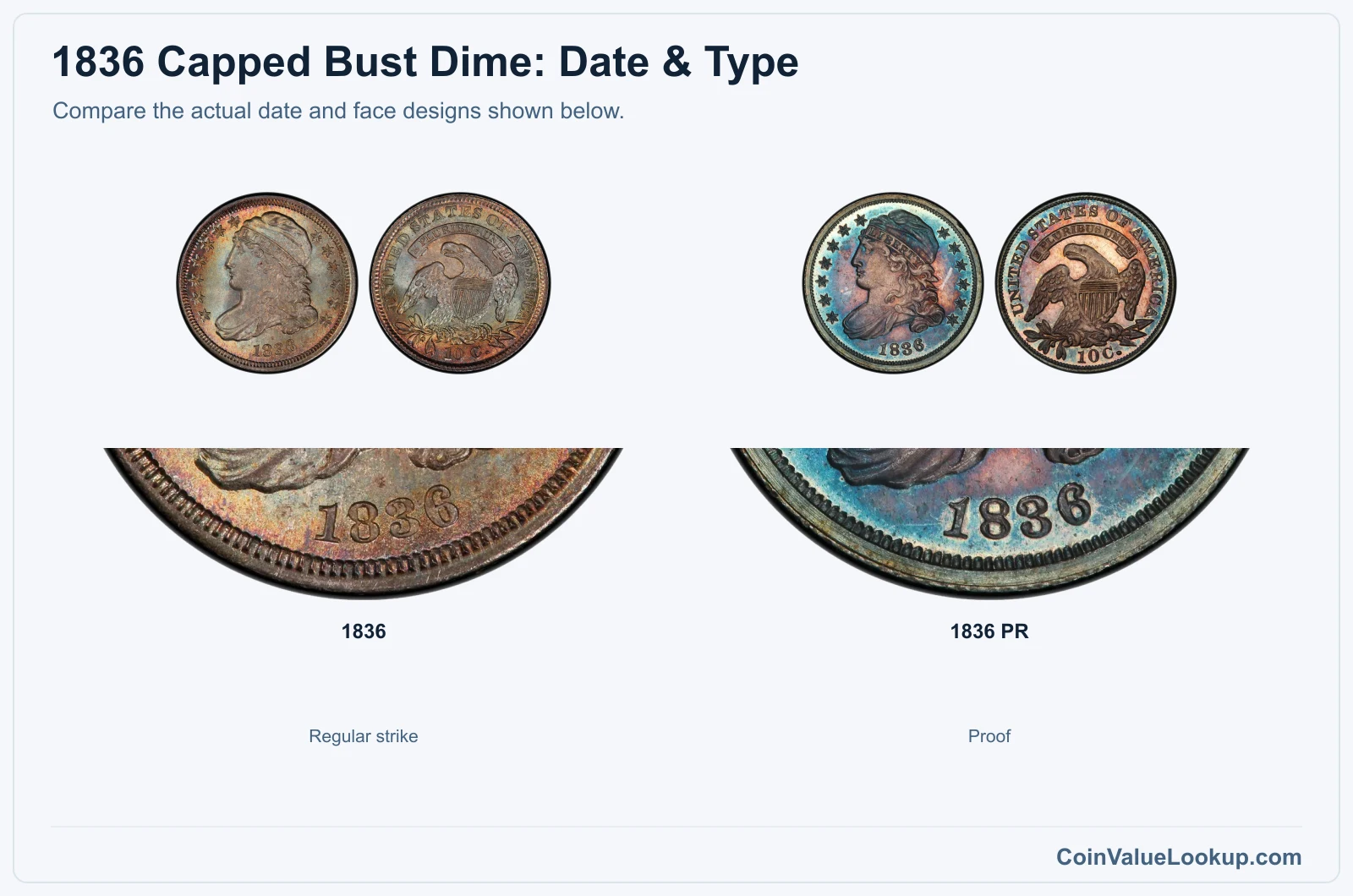
All 1836 Capped Bust Dimes were struck at Philadelphia. There is no mintmark to look for on this issue.
The coin is made from a silver-copper alloy, approximately 89.24% silver. It has the closed-collar, small-dentils format that distinguishes later Capped Bust dimes from the earlier large-dentils style.
On the obverse, Liberty faces left wearing a cloth cap with the word LIBERTY on the headband. Stars surround the portrait, with the date below.
On the reverse, a heraldic eagle holds arrows and an olive branch beneath the legend UNITED STATES OF AMERICA and the denomination.
Two branches exist for this date: the regular 1836 business strike and the extremely scarce 1836 Proof. Do not confuse a half dime, which is a smaller denomination entirely, with this coin.
If you are trying to sort out what you have, Coin Value Lookup is a useful place to look up guides for this series and other early U.S. coins.
Step 2: Check Your 1836 Capped Bust Dime Grade
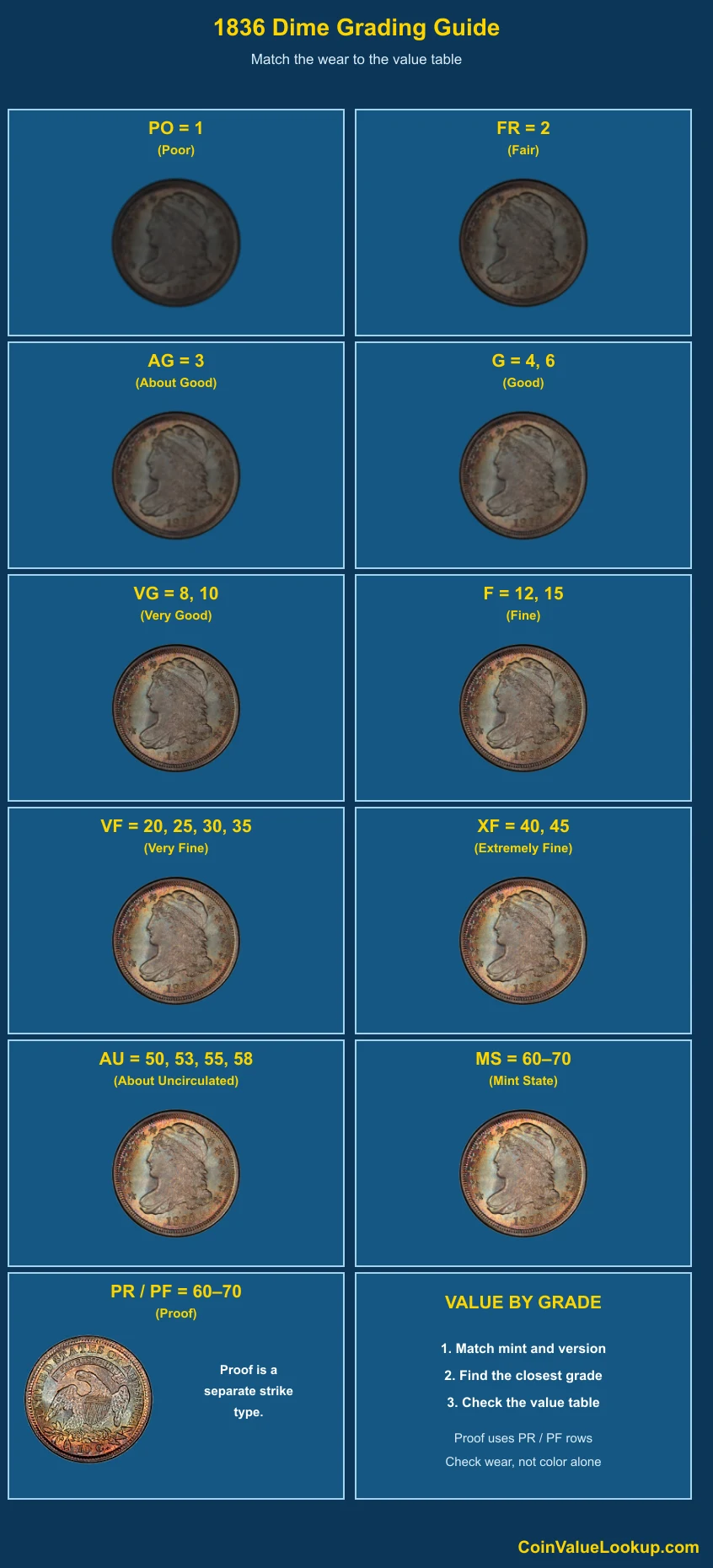
Focus on Liberty's hair curls just above the forehead and ear, the cheek, and the drapery near the shoulder clasp. These are the first areas to show friction.
On the reverse, check the eagle's breast feathers and the tops of the wings.
A coin in Good-4 will have a flat portrait with the outline and date still readable but most interior detail gone. At Mint State 63, you should see full luster with only minor contact marks or small distractions.
Here is the catch with early dimes: hand-operated presses sometimes produced uneven strikes, so a genuinely unworn coin can still look soft in spots. Compare your coin to the reference image and look at luster flow and contact marks together rather than just detail sharpness.
Cleaning, polishing, or artificial brightening will reduce a coin's desirability and comparability to guide values.
Step 3: Check 1836 Capped Bust Dime Value by Mint and Version
1836 Capped Bust Dime
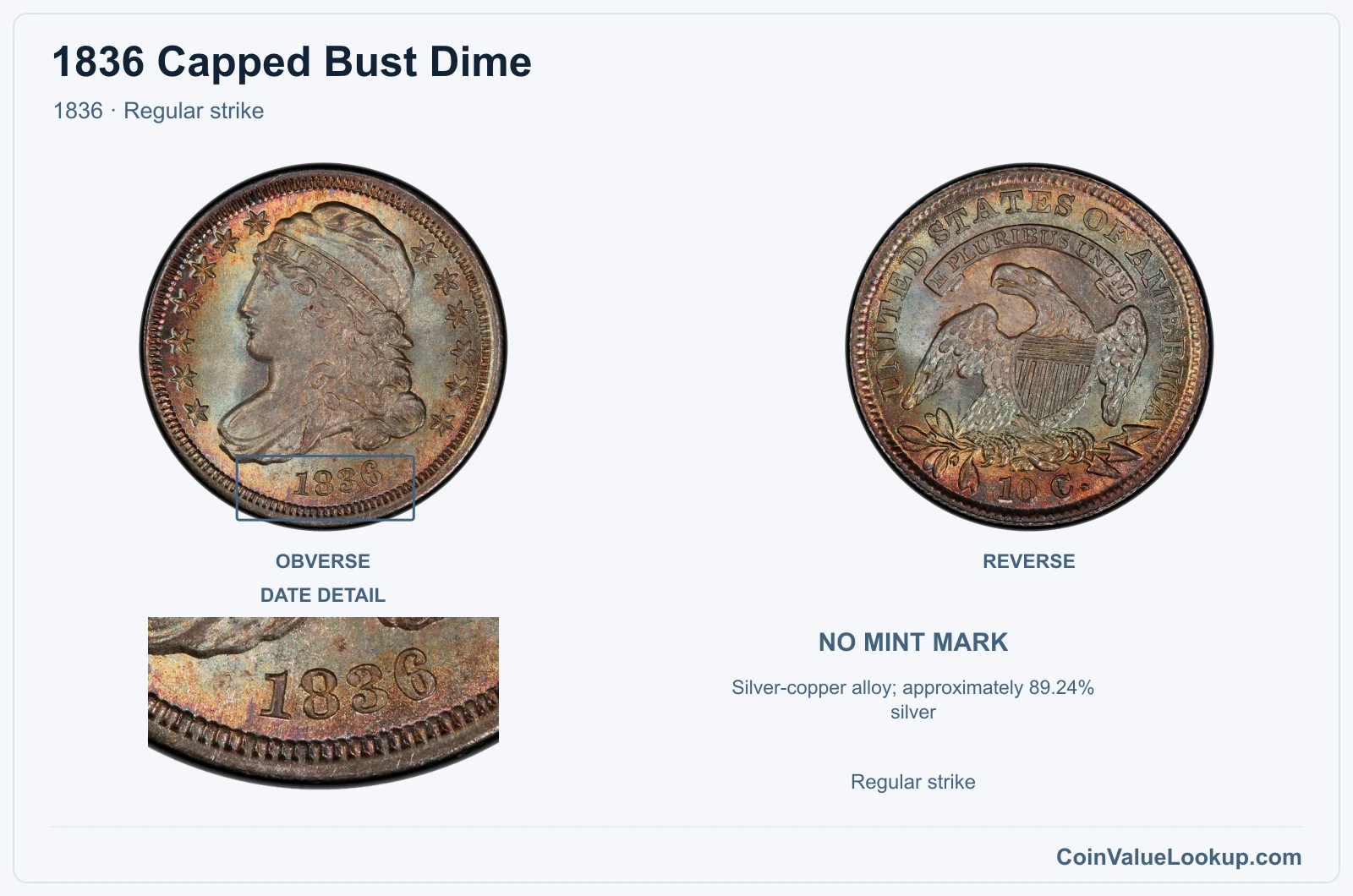
The regular 1836 Capped Bust Dime is the issue most collectors will encounter. It was struck for circulation at Philadelphia using the closed-collar, small-dentils die format.
Look for the date style and the overall design match before comparing grades.
Guide estimates place this coin at approximately $54.00 in Good-4 and around $2,344.00 in Mint State 63, per USA Coin Book. These are reference anchors for those specific grades, not blanket offers.
Original, problem-free surfaces matter more than raw brightness, so a lightly toned coin with honest wear will typically compare more favorably than a cleaned example that looks shiny.
Range Grade
Price Auction Records Appraisal PO PO 1
—
Coin Identifier FR FR 2
Coin Identifier AG AG 3
—
Coin Identifier G G 4
—
Coin Identifier
G 6
Coin Identifier VG VG 8
Coin Identifier
VG 10
Coin Identifier F F 12
—
Coin Identifier
F 15
Coin Identifier VF VF 20
Coin Identifier
VF 25
Coin Identifier
VF 30
Coin Identifier
VF 35
Coin Identifier XF XF 40
Coin Identifier
XF 45
Coin Identifier AU AU 50
Coin Identifier
AU 53
Coin Identifier
AU 55
Coin Identifier
AU 58
Coin Identifier MS MS 60
—
Coin Identifier
MS 61
Coin Identifier
MS 62
Coin Identifier
MS 63
Coin Identifier
MS 64
Coin Identifier
MS 65
Coin Identifier
MS 66
Coin Identifier
MS 67
—
Coin Identifier
MS 68
—
—
—
MS 69
—
—
—
MS 70
—
—
—
1836 Capped Bust Dime — PR
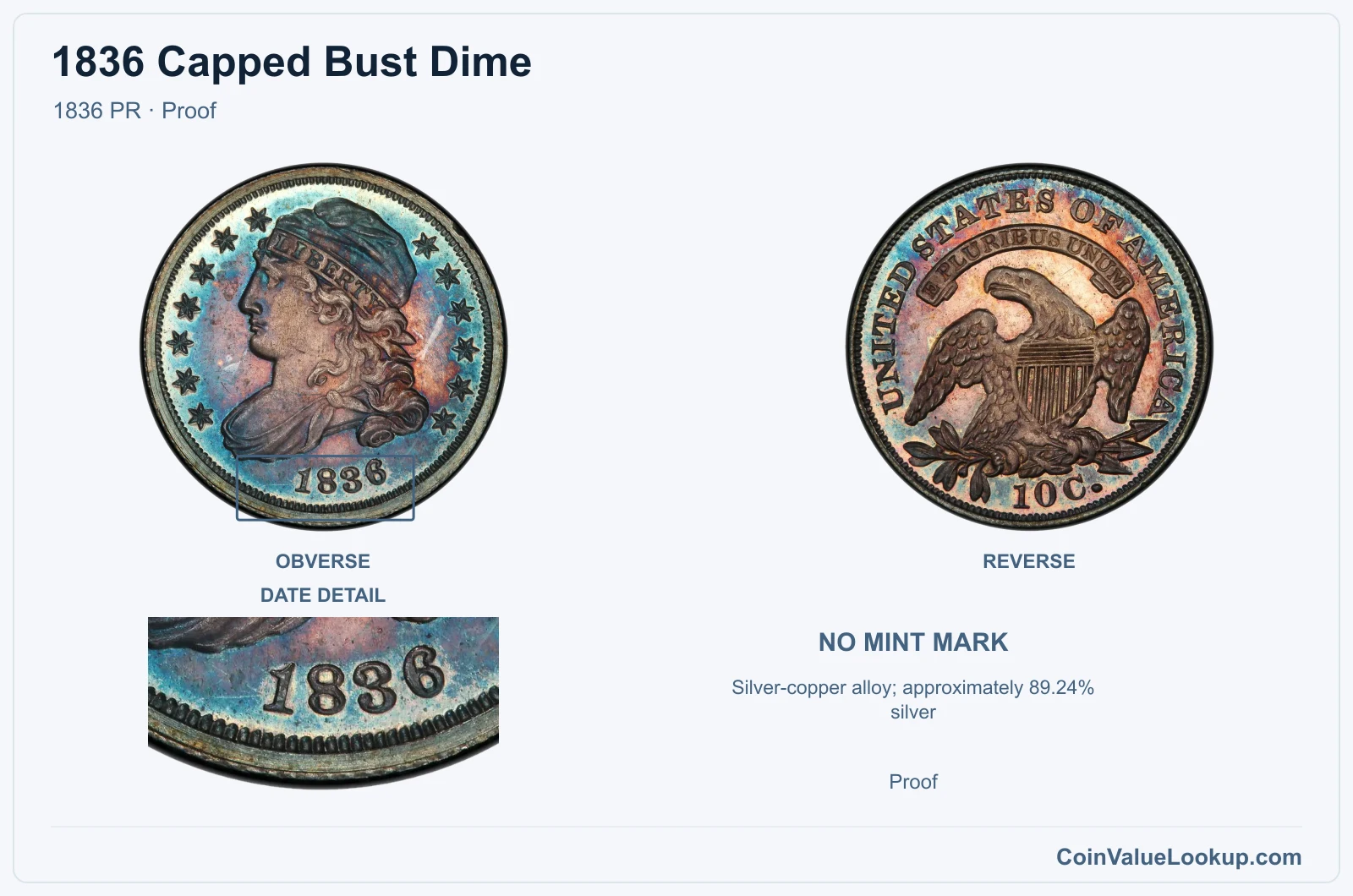
The 1836 Proof is an extremely scarce early proof striking. Proof in this era means the coin was specially manufactured on polished planchets with prepared dies, producing deeply mirrored fields and sharp detail.
It does not simply mean "really nice."
A reflective, strongly struck, or well-preserved business strike is not automatically a proof. Genuine proofs from this period require professional attribution and authentication, because the visual differences can be subtle and the stakes are high.
No supported numeric price range is adopted for this branch. Value depends entirely on the individual coin's authenticated identity, condition, and provenance, so professional evaluation is essential before drawing any conclusions about what a specific specimen might bring.
Range Grade
Price Auction Records Appraisal PR PR 1
—
Coin Identifier
PR 2
—
Coin Identifier
PR 3
—
Coin Identifier
PR 4
—
Coin Identifier
PR 6
—
Coin Identifier
PR 8
—
Coin Identifier
PR 10
—
Coin Identifier
PR 12
—
Coin Identifier
PR 15
—
Coin Identifier
PR 20
—
Coin Identifier
PR 25
—
Coin Identifier
PR 30
—
Coin Identifier
PR 35
—
Coin Identifier
PR 40
—
Coin Identifier
PR 45
—
Coin Identifier
PR 50
—
Coin Identifier
PR 53
—
Coin Identifier
PR 55
—
Coin Identifier
PR 58
—
Coin Identifier
PR 60
—
Coin Identifier
PR 61
—
Coin Identifier
PR 62
—
Coin Identifier
PR 63
—
Coin Identifier
PR 64
—
Coin Identifier
PR 65
—
Coin Identifier
PR 66
—
—
—
PR 67
—
—
—
PR 68
—
—
—
PR 69
—
—
—
PR 70
—
—
—