1836 Capped Bust Half Dollar Coin Value: How Much Is It Worth?
A typical 1836 Capped Bust Half Dollar in well-worn Good-4 condition carries a guide estimate around $92, climbing to roughly $487 near About Uncirculated-50 for the standard lettered-edge version. But 1836 is a transitional year with two distinct edge types, several die varieties, and extremely rare Proofs, so the exact version you hold matters enormously.
Fast Way to Identify Your 1836 Capped Bust Half Dollar
The fastest way to start figuring out what you have is to upload clear photos of the front and back of your coin. Our identifier can give you a preliminary read on the design type and general condition, which helps you zero in on the right value branch before digging deeper into edge type and variety details.
1836 Capped Bust Half Dollar Value
Upload both sides of your 1836 Capped Bust Half Dollar.
Front Obverse
Upload photo
Back Reverse
Upload photo
Which 1836 Capped Bust Half Dollar Versions Are Worth Money?
- The Reeded Edge — 50 CENTS variety is the scarcest regular-strike type, with guide values starting around $1,146 in G4 and reaching $5,640 near AU50, because it represents the new smaller format produced in limited numbers during the 1836 transition.
- The Lettered Edge — 50/00 denomination correction carries a meaningful premium, estimated around $173 in G4 and $1,176 in AU50, due to the visible punch error beneath the denomination.
- The 1836/1336 overdate and the Beaded Reverse Border each command moderate premiums over the normal lettered-edge date, particularly in higher grades.
- Authenticated Proofs in any edge type are extremely rare specialist coins; a Reeded Edge Proof graded PR66 sold individually for $88,125 at a 2016 Stack's Bowers auction.
- Lettered Edge Proofs with the 50/00 or 1836/1336 variety combine two collectible attributes, making professional attribution essential for accurate valuation.
Step 1: Identify Your 1836 Capped Bust Half Dollar Mint Mark and Version
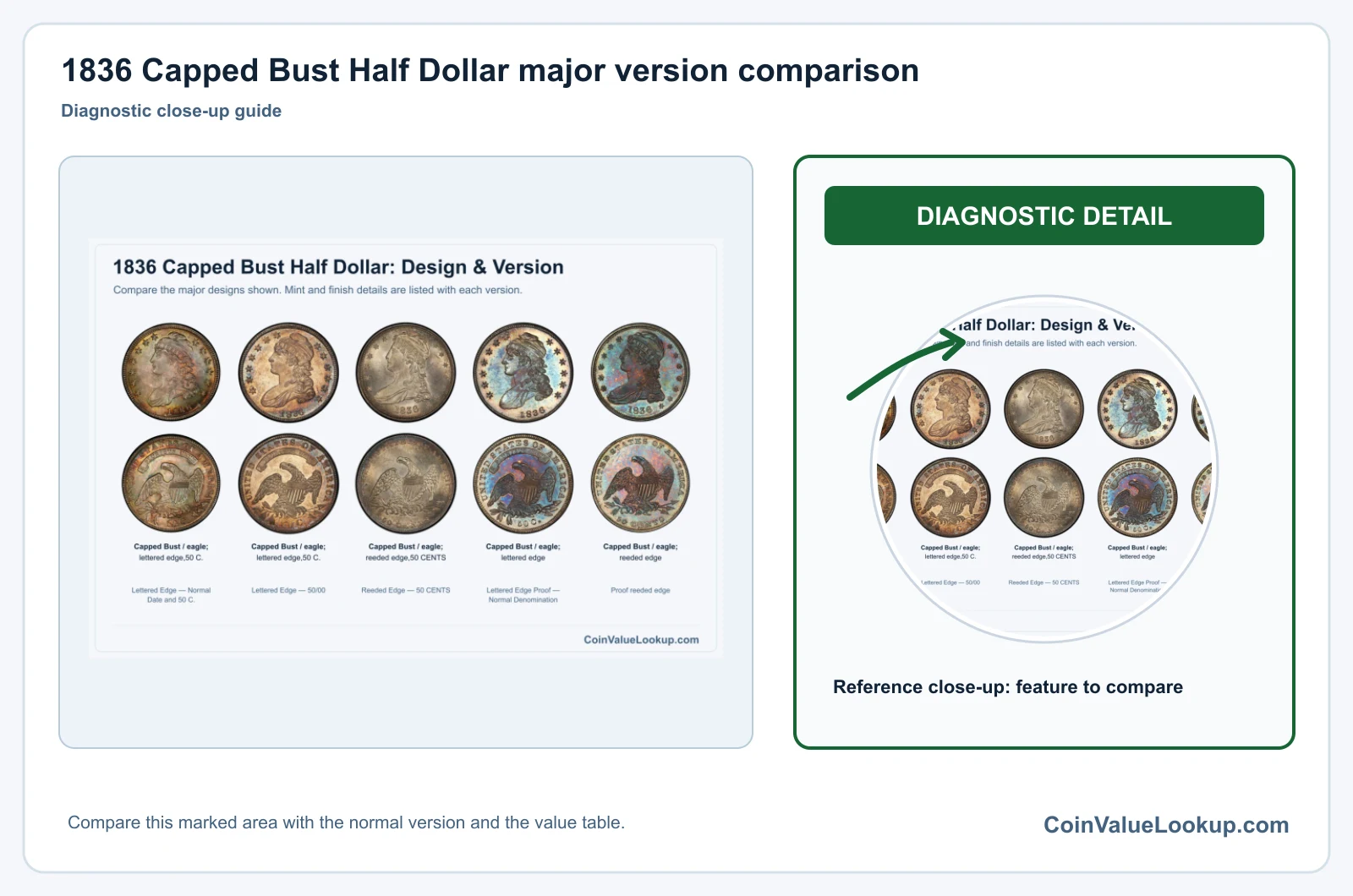
Every 1836 Capped Bust Half Dollar was struck at the Philadelphia Mint, so no mintmark is expected on any version.
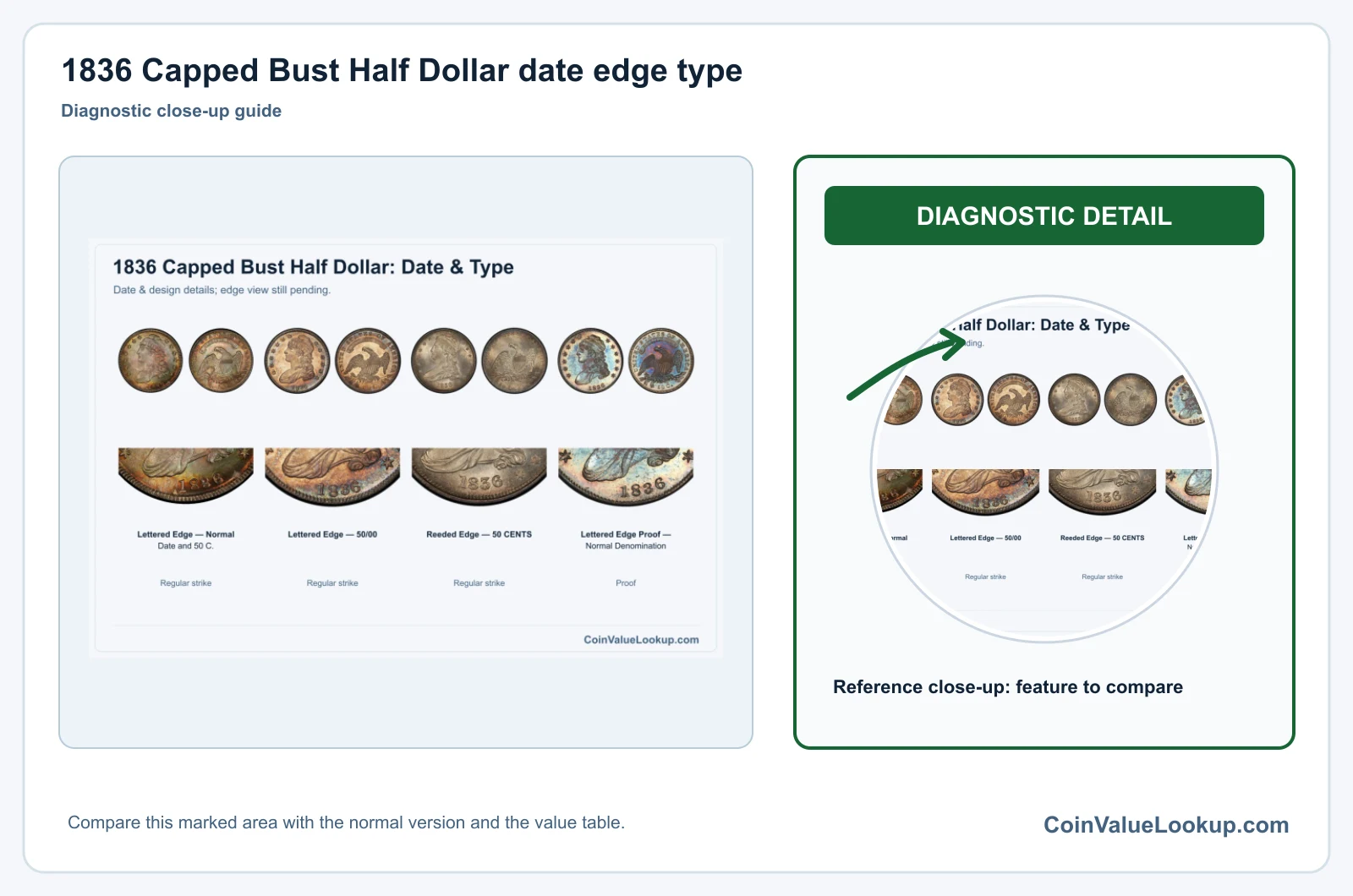
The critical first step is checking the edge. The older, larger format (about 32.5 mm) has lettered edge text and a reverse denomination reading "50 C." The newer, smaller format (about 30 mm) has a reeded edge and reads "50 CENTS" on the reverse.
These are genuinely different coin types, not varieties of one another.
Once you know the edge, look at the date and denomination closely. A remnant "3" visible beneath the "8" in the date identifies the 1836/1336 overdate.
Traces of a wrong "0" punch beneath the "5" in "50 C." point to the 50/00 denomination correction. If the reverse border shows distinct round beading instead of the usual denticles, you have the Beaded Reverse Border variety.
All of these lettered-edge versions share the same approximate silver composition of 89.24%. The reeded-edge coin is also about 89.2% silver but weighs 13.48 grams and is a distinctly smaller coin.
Proof status is a manufacturing finish, not a higher grade than Mint State. A shiny coin is not automatically a Proof.
Professional attribution from a major grading service is the only reliable way to confirm Proof manufacture on these early issues.
Step 2: Check Your 1836 Capped Bust Half Dollar Grade
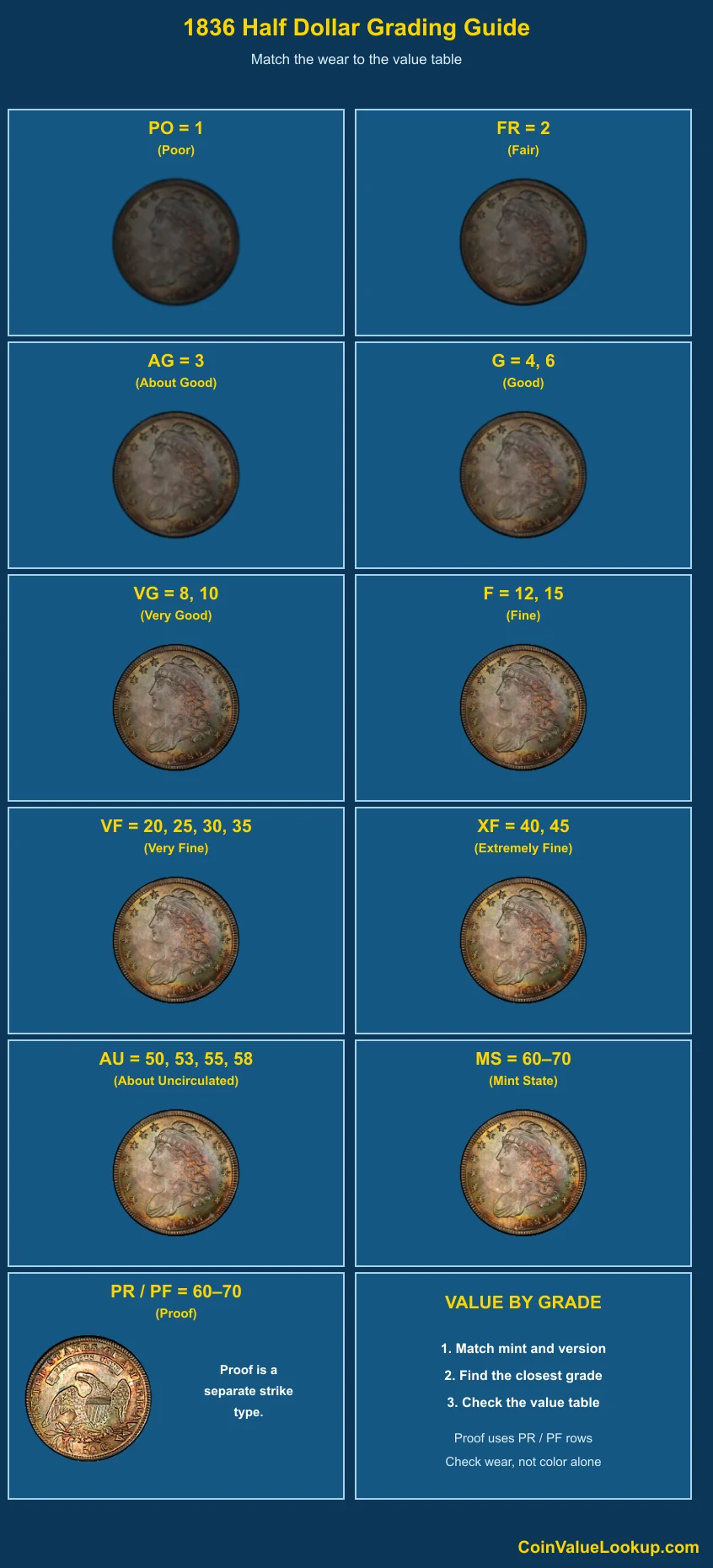
Start by examining the highest points of the design, where wear shows first. On the obverse, check the hair above Liberty's forehead, her cheek, and the top of the cap.
On the reverse, look at the eagle's breast feathers and the tops of the wings.
A coin in Good condition will have a clear outline and date but most fine detail will be gone. By Very Fine, you should see partial hair curls and moderate feather detail.
An About Uncirculated piece retains nearly full luster with only the slightest friction on the highest points.
Separate genuinely weak original strikes from coins that once had full detail and lost it through circulation. A weakly struck coin may look worn but still show undisturbed luster in protected areas.
Compare your coin against the type-matched grading image to calibrate your eye.
Also note any cleaning, scratches, holes, or tooling. These problems reduce value significantly regardless of how much detail remains.
Proofs are graded on their own PR scale and should not be compared directly against the circulated grade ladder.
Step 3: Check 1836 Capped Bust Half Dollar Value by Mint and Version
1836 Capped Bust Half Dollar — Lettered Edge — Normal Date and 50 C.
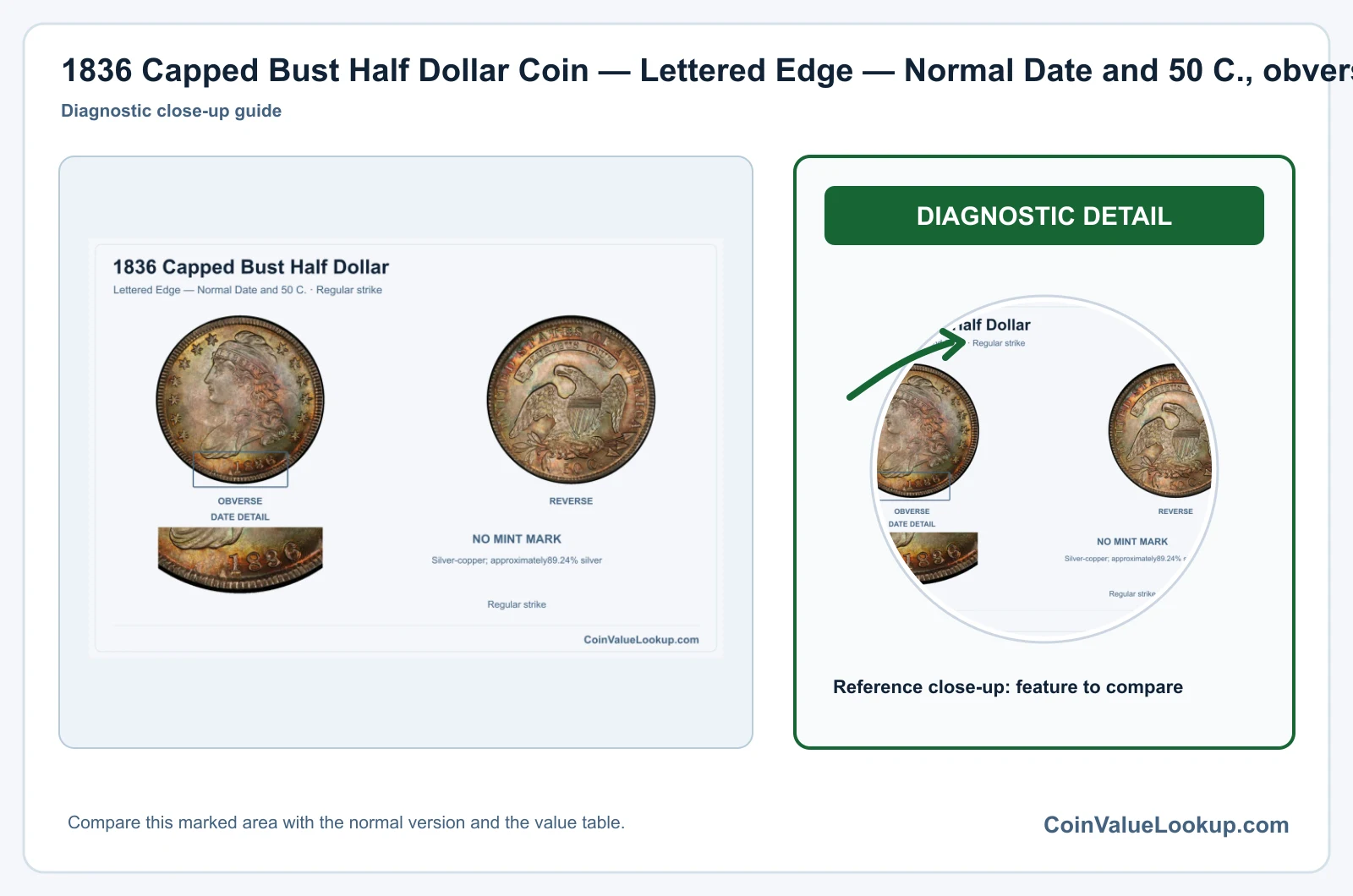
This is the baseline 1836 Capped Bust Half Dollar: the larger 32.5 mm format with lettered edge inscription and "50 C." on the reverse. It was struck in silver-copper alloy of approximately 89.24% silver at Philadelphia.
Before assigning a value, confirm the edge has raised lettering and the reverse reads "50 C." rather than "50 CENTS." Also check that the date shows no overdate remnants and the denomination has no underlying wrong punch. USA Coin Book guide estimates place this version around $92 in G4, about $152 in VF20, and near $487 in AU50.
These are retail reference points, not guaranteed sale prices.
Range Grade
Price Auction Records Appraisal PO PO 1
—
Coin Identifier FR FR 2
—
Coin Identifier AG AG 3
—
Coin Identifier G G 4
Coin Identifier
G 6
—
Coin Identifier VG VG 8
Coin Identifier
VG 10
Coin Identifier F F 12
Coin Identifier
F 15
Coin Identifier VF VF 20
Coin Identifier
VF 25
Coin Identifier
VF 30
Coin Identifier
VF 35
Coin Identifier XF XF 40
Coin Identifier
XF 45
Coin Identifier AU AU 50
Coin Identifier
AU 53
Coin Identifier
AU 55
Coin Identifier
AU 58
Coin Identifier MS MS 60
Coin Identifier
MS 61
Coin Identifier
MS 62
Coin Identifier
MS 63
Coin Identifier
MS 64
Coin Identifier
MS 65
Coin Identifier
MS 66
Coin Identifier
MS 67
—
—
—
MS 68
—
—
—
MS 69
—
—
—
MS 70
—
—
—
1836 Capped Bust Half Dollar — Lettered Edge — 50/00
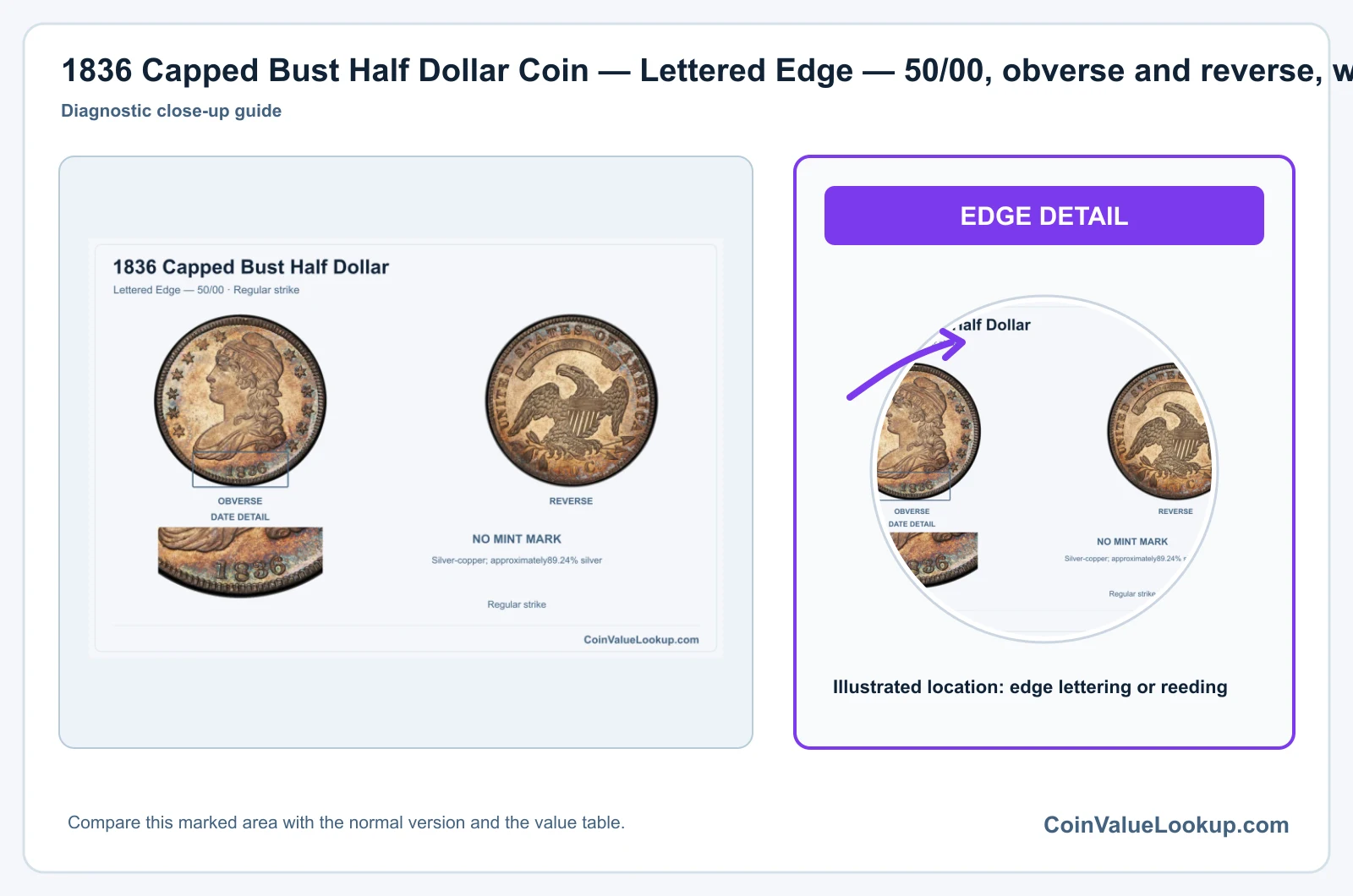
Look closely at the denomination on the reverse. Beneath the "5" in "50 C." you should see traces of an underlying "0" that was incorrectly punched first.
This is a die-preparation correction, not an off-metal or striking error. The wrong punch was partially ground away before the correct "5" was added, but remnants remain visible, especially under magnification.
This variety carries a solid premium. USA Coin Book estimates put it around $173 in G4, $457 in VF20, and approximately $1,176 in AU50.
Sharpness of the underlying "0" affects both attribution confidence and desirability. A loupe and good lighting are your friends here.
Range Grade
Price Auction Records Appraisal PO PO 1
—
Coin Identifier FR FR 2
—
Coin Identifier AG AG 3
—
Coin Identifier G G 4
—
Coin Identifier
G 6
—
Coin Identifier VG VG 8
Coin Identifier
VG 10
—
Coin Identifier F F 12
—
Coin Identifier
F 15
Coin Identifier VF VF 20
Coin Identifier
VF 25
Coin Identifier
VF 30
Coin Identifier
VF 35
Coin Identifier XF XF 40
Coin Identifier
XF 45
Coin Identifier AU AU 50
Coin Identifier
AU 53
Coin Identifier
AU 55
Coin Identifier
AU 58
Coin Identifier MS MS 60
—
Coin Identifier
MS 61
Coin Identifier
MS 62
Coin Identifier
MS 63
Coin Identifier
MS 64
Coin Identifier
MS 65
—
Coin Identifier
MS 66
—
—
—
MS 67
—
—
—
MS 68
—
—
—
MS 69
—
—
—
MS 70
—
—
—
1836 Capped Bust Half Dollar — Lettered Edge — 1836/1336
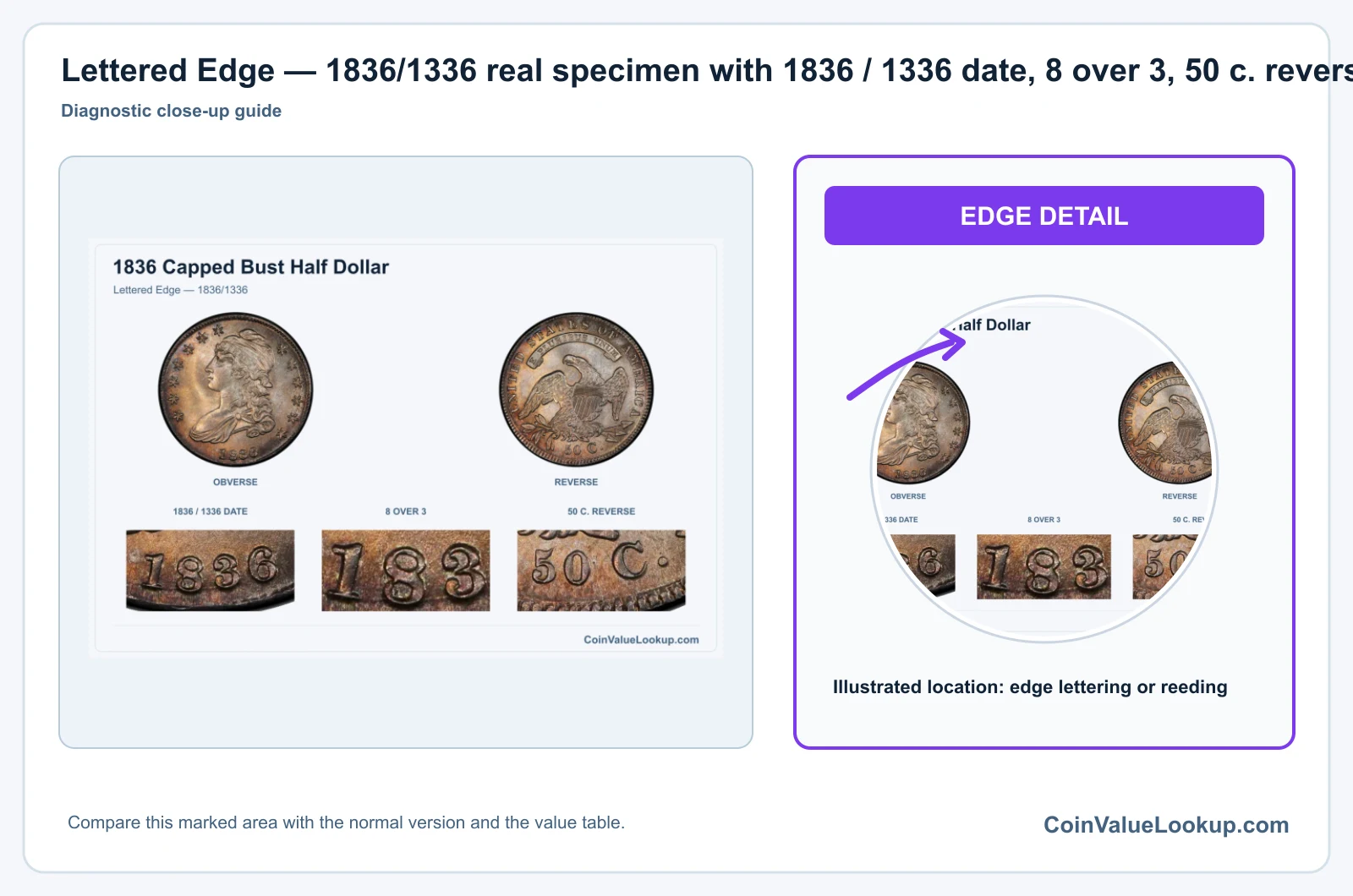
The 1836/1336 overdate shows a remnant "3" beneath the "8" in the date. The die was originally punched with an incorrect digit and then corrected, leaving a ghostly "3" that is most visible at the lower portion of the "8."
This is one of the more recognizable Capped Bust overdates. Guide estimates from USA Coin Book run about $119 in G4, $182 in VF20, and $604 in AU50.
The clarity of the underlying "3" varies from coin to coin depending on die state and wear, so a well-attributed example with a strong remnant will typically draw stronger collector interest.
Range Grade
Price Auction Records Appraisal PO PO 1
—
Coin Identifier FR FR 2
—
Coin Identifier AG AG 3
—
Coin Identifier G G 4
—
Coin Identifier
G 6
—
Coin Identifier VG VG 8
—
Coin Identifier
VG 10
—
Coin Identifier F F 12
—
Coin Identifier
F 15
—
Coin Identifier VF VF 20
—
Coin Identifier
VF 25
—
Coin Identifier
VF 30
—
Coin Identifier
VF 35
Coin Identifier XF XF 40
Coin Identifier
XF 45
Coin Identifier AU AU 50
Coin Identifier
AU 53
Coin Identifier
AU 55
—
Coin Identifier
AU 58
—
Coin Identifier MS MS 60
—
Coin Identifier
MS 61
—
Coin Identifier
MS 62
—
Coin Identifier
MS 63
Coin Identifier
MS 64
—
Coin Identifier
MS 65
—
—
—
MS 66
—
—
—
MS 67
—
—
—
MS 68
—
—
—
MS 69
—
—
—
MS 70
—
—
—
1836 Capped Bust Half Dollar — Lettered Edge — Beaded Reverse Border
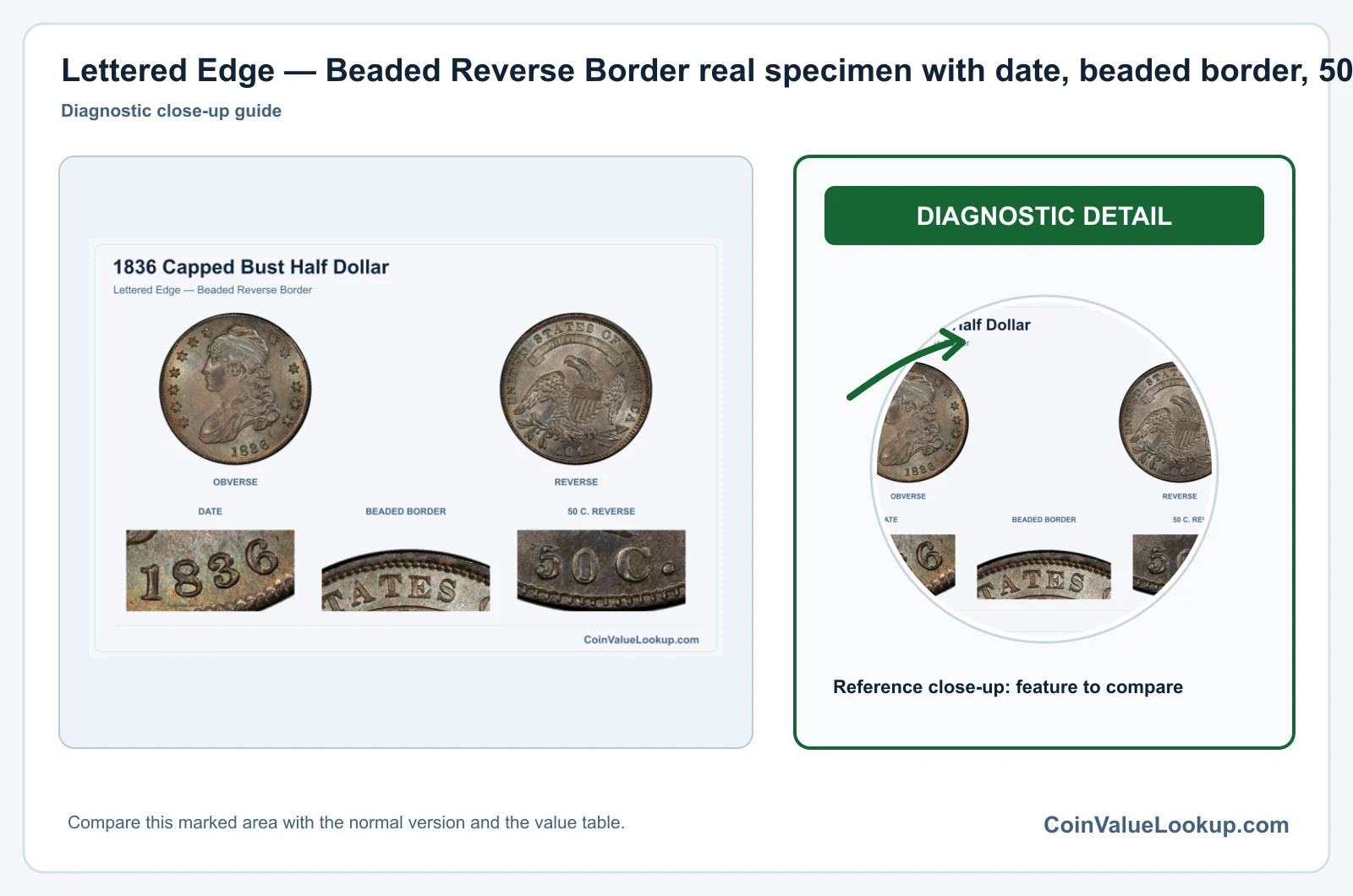
This lettered-edge variety is identified by its reverse border treatment. Instead of the usual pointed denticles around the rim, you will see distinct round beads forming the border.
Look at the full rim context on the reverse, not just a small section, to confirm this diagnostic.
It remains a lettered-edge coin with "50 C." on the reverse and the same approximate 89.24% silver composition. USA Coin Book guide estimates are around $122 in G4, $194 in VF20, and about $659 in AU50.
The premium over the normal date is modest in lower grades but grows as condition improves.
Coin Value Lookup is a handy starting point if you are sorting through multiple Capped Bust dates and want quick access to value guides for each year.
Ordinary-issue reference: Ordinary-issue reference only: The table below shows prices for the 1836 Capped Bust Half Dollar (regular strike). It does not represent the value of the specific Lettered Edge — Beaded Reverse Border variety or its variety premium. Year, mint, metal and strike type are matched; the specific variety is not priced by this table.
Range Grade
Price Auction Records Appraisal PO PO 1
—
Coin Identifier FR FR 2
—
Coin Identifier AG AG 3
Coin Identifier G G 4
Coin Identifier
G 6
—
Coin Identifier VG VG 8
Coin Identifier
VG 10
Coin Identifier F F 12
—
Coin Identifier
F 15
Coin Identifier VF VF 20
Coin Identifier
VF 25
Coin Identifier
VF 30
Coin Identifier
VF 35
Coin Identifier XF XF 40
Coin Identifier
XF 45
Coin Identifier AU AU 50
Coin Identifier
AU 53
Coin Identifier
AU 55
Coin Identifier
AU 58
Coin Identifier MS MS 60
—
Coin Identifier
MS 61
Coin Identifier
MS 62
Coin Identifier
MS 63
Coin Identifier
MS 64
Coin Identifier
MS 65
Coin Identifier
MS 66
—
—
—
MS 67
—
—
—
MS 68
—
—
—
MS 69
—
—
—
MS 70
—
—
—
1836 Capped Bust Half Dollar — Reeded Edge — 50 CENTS
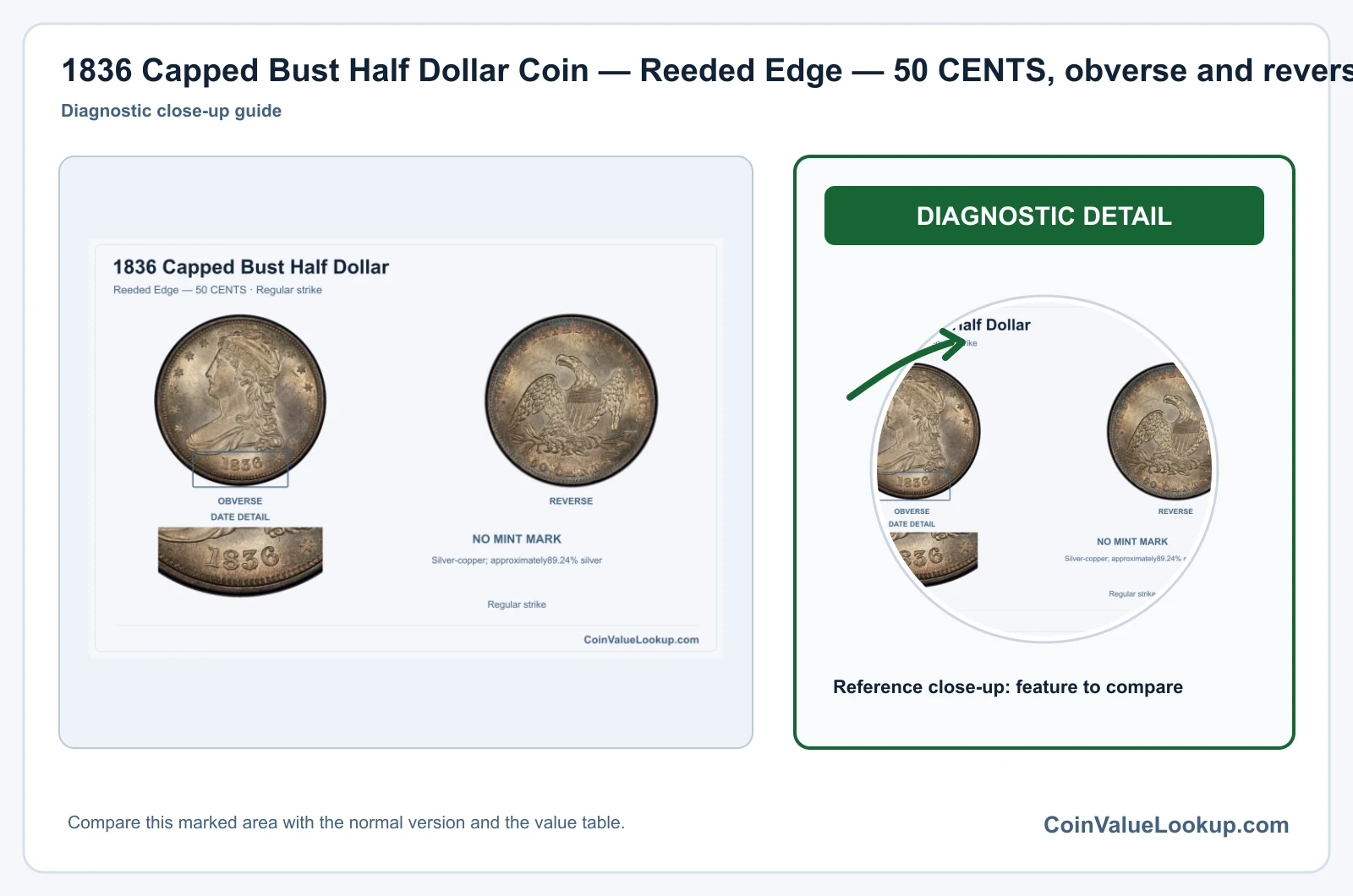
This is a genuinely different coin type, not just a variety. At roughly 30 mm in diameter and 13.48 grams, it is noticeably smaller and lighter than the lettered-edge version.
The edge carries fine vertical reeding instead of lettering, and the reverse spells out "50 CENTS" rather than "50 C."
Do not mistake this for an error. The reeded edge was the new standard format introduced mid-year in 1836 under engraver Christian Gobrecht.
Production numbers were limited, which is why values run dramatically higher: USA Coin Book estimates about $1,146 in G4, $2,516 in VF20, and around $5,640 in AU50. Confirming the edge is the essential first step in identifying this type.
Ordinary-issue reference: Ordinary-issue reference only: The table below shows prices for the 1836 Capped Bust Half Dollar (regular strike). It does not represent the value of the specific Reeded Edge — 50 CENTS variety or its variety premium. Year, mint, metal and strike type are matched; the specific variety is not priced by this table.
Range Grade
Price Auction Records Appraisal PO PO 1
—
Coin Identifier FR FR 2
—
Coin Identifier AG AG 3
Coin Identifier G G 4
Coin Identifier
G 6
—
Coin Identifier VG VG 8
Coin Identifier
VG 10
Coin Identifier F F 12
—
Coin Identifier
F 15
Coin Identifier VF VF 20
Coin Identifier
VF 25
Coin Identifier
VF 30
Coin Identifier
VF 35
Coin Identifier XF XF 40
Coin Identifier
XF 45
Coin Identifier AU AU 50
Coin Identifier
AU 53
Coin Identifier
AU 55
Coin Identifier
AU 58
Coin Identifier MS MS 60
—
Coin Identifier
MS 61
Coin Identifier
MS 62
Coin Identifier
MS 63
Coin Identifier
MS 64
Coin Identifier
MS 65
Coin Identifier
MS 66
—
—
—
MS 67
—
—
—
MS 68
—
—
—
MS 69
—
—
—
MS 70
—
—
—
1836 Capped Bust Half Dollar — Lettered Edge Proof — Normal Denomination
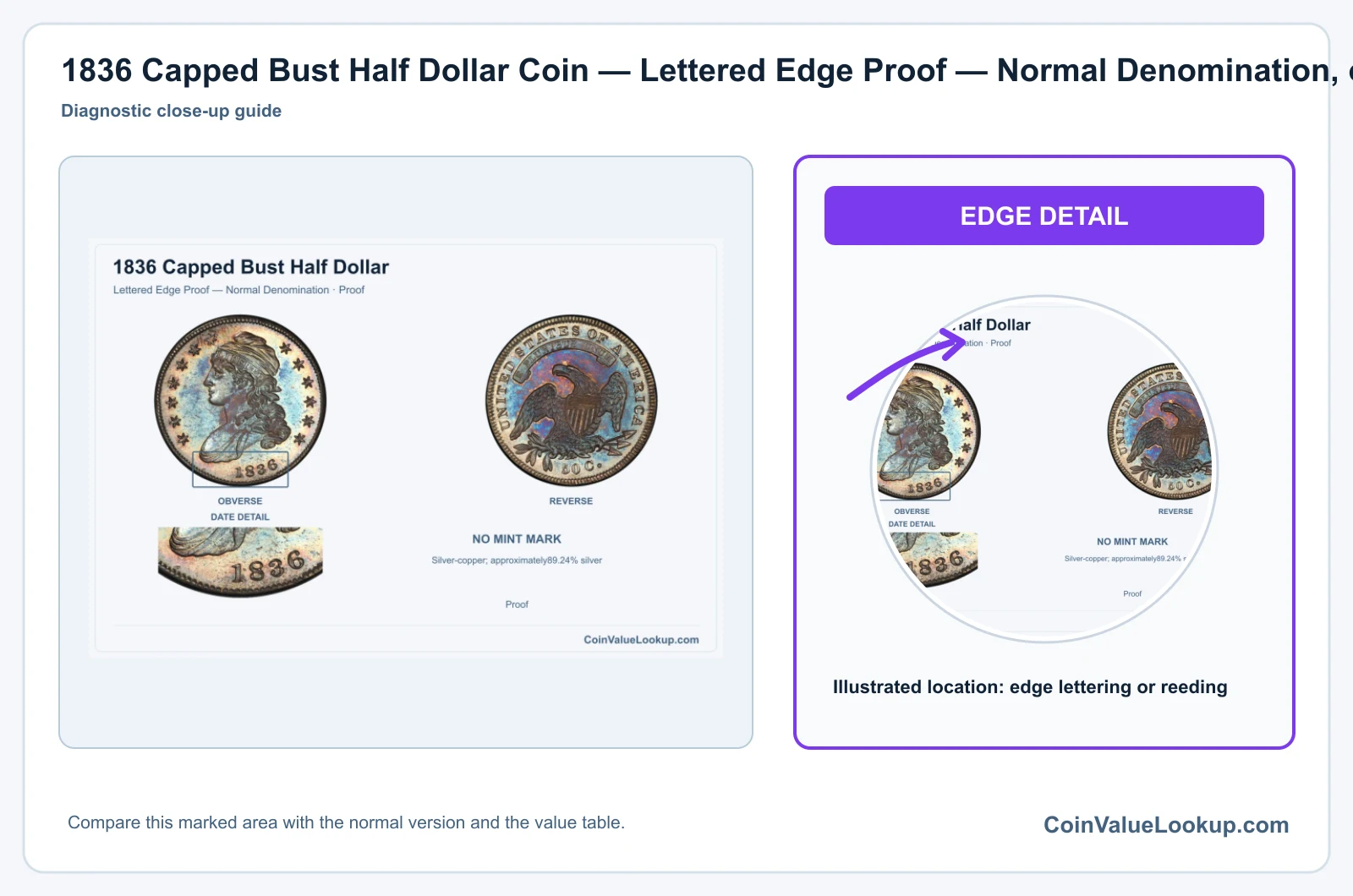
Lettered Edge Proofs of the normal denomination type are extremely rare early Philadelphia Mint issues. A genuine Proof will show specially prepared surfaces with sharp, squared rims and mirror-like fields, quite different from a regular strike that happens to be shiny or lightly circulated.
No reliable numerical price range is available for this version. Each authenticated example is assessed individually based on its certified condition, surface quality, and provenance.
Professional grading service attribution is essential; polished or prooflike regular strikes are a common lookalike. If you suspect you have one, a third-party grading service is your necessary next step.
Ordinary-issue reference: Ordinary-issue reference only: The table below shows prices for the 1836 Capped Bust Half Dollar (proof). It does not represent the value of the specific Lettered Edge Proof — Normal Denomination variety or its variety premium. Year, mint, metal and strike type are matched; the specific variety is not priced by this table.
Range Grade
Price Auction Records Appraisal PR PR 1
—
Coin Identifier
PR 2
—
Coin Identifier
PR 3
—
Coin Identifier
PR 4
—
Coin Identifier
PR 6
—
Coin Identifier
PR 8
—
Coin Identifier
PR 10
—
Coin Identifier
PR 12
—
Coin Identifier
PR 15
—
Coin Identifier
PR 20
—
Coin Identifier
PR 25
—
Coin Identifier
PR 30
—
Coin Identifier
PR 35
—
Coin Identifier
PR 40
—
Coin Identifier
PR 45
—
Coin Identifier
PR 50
—
Coin Identifier
PR 53
—
Coin Identifier
PR 55
—
Coin Identifier
PR 58
—
Coin Identifier
PR 60
—
Coin Identifier
PR 61
—
Coin Identifier
PR 62
—
Coin Identifier
PR 63
Coin Identifier
PR 64
Coin Identifier
PR 65
Coin Identifier
PR 66
Coin Identifier
PR 67
Coin Identifier
PR 68
—
—
—
PR 69
—
—
—
PR 70
—
—
—
1836 Capped Bust Half Dollar — Lettered Edge Proof — 1836/1336
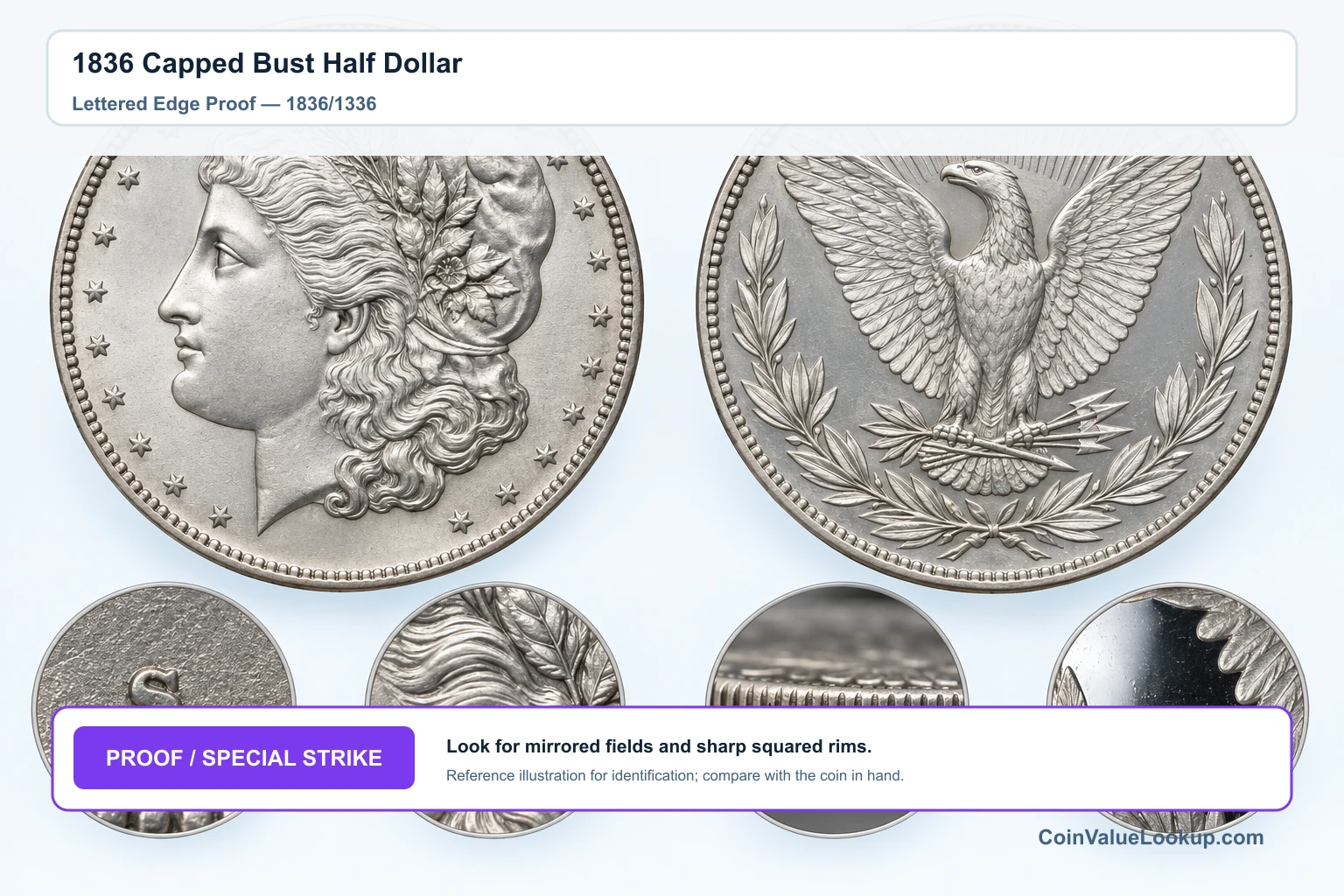
This combines the 1836/1336 overdate die variety with authenticated Proof manufacture on a lettered-edge coin. Both attributes must be confirmed together by a professional grading service.
The remnant "3" beneath the "8" should be present alongside genuine Proof surface characteristics.
No supported numerical price range is available. Value depends entirely on authenticated identity, the coin's condition on the PR grading scale, and individual assessment at the time of sale.
These are deeply rare specialist coins, and any example that surfaces would likely be evaluated on its own merits at a major auction house.
Ordinary-issue reference: Ordinary-issue reference only: The table below shows prices for the 1836 Capped Bust Half Dollar (proof). It does not represent the value of the specific Lettered Edge Proof — 1836/1336 variety or its variety premium. Year, mint, metal and strike type are matched; the specific variety is not priced by this table.
Range Grade
Price Auction Records Appraisal PR PR 1
—
Coin Identifier
PR 2
—
Coin Identifier
PR 3
—
Coin Identifier
PR 4
—
Coin Identifier
PR 6
—
Coin Identifier
PR 8
—
Coin Identifier
PR 10
—
Coin Identifier
PR 12
—
Coin Identifier
PR 15
—
Coin Identifier
PR 20
—
Coin Identifier
PR 25
—
Coin Identifier
PR 30
—
Coin Identifier
PR 35
—
Coin Identifier
PR 40
—
Coin Identifier
PR 45
—
Coin Identifier
PR 50
—
Coin Identifier
PR 53
—
Coin Identifier
PR 55
—
Coin Identifier
PR 58
—
Coin Identifier
PR 60
—
Coin Identifier
PR 61
—
Coin Identifier
PR 62
—
Coin Identifier
PR 63
Coin Identifier
PR 64
Coin Identifier
PR 65
Coin Identifier
PR 66
Coin Identifier
PR 67
Coin Identifier
PR 68
—
—
—
PR 69
—
—
—
PR 70
—
—
—
1836 Capped Bust Half Dollar — Lettered Edge Proof — 50/00
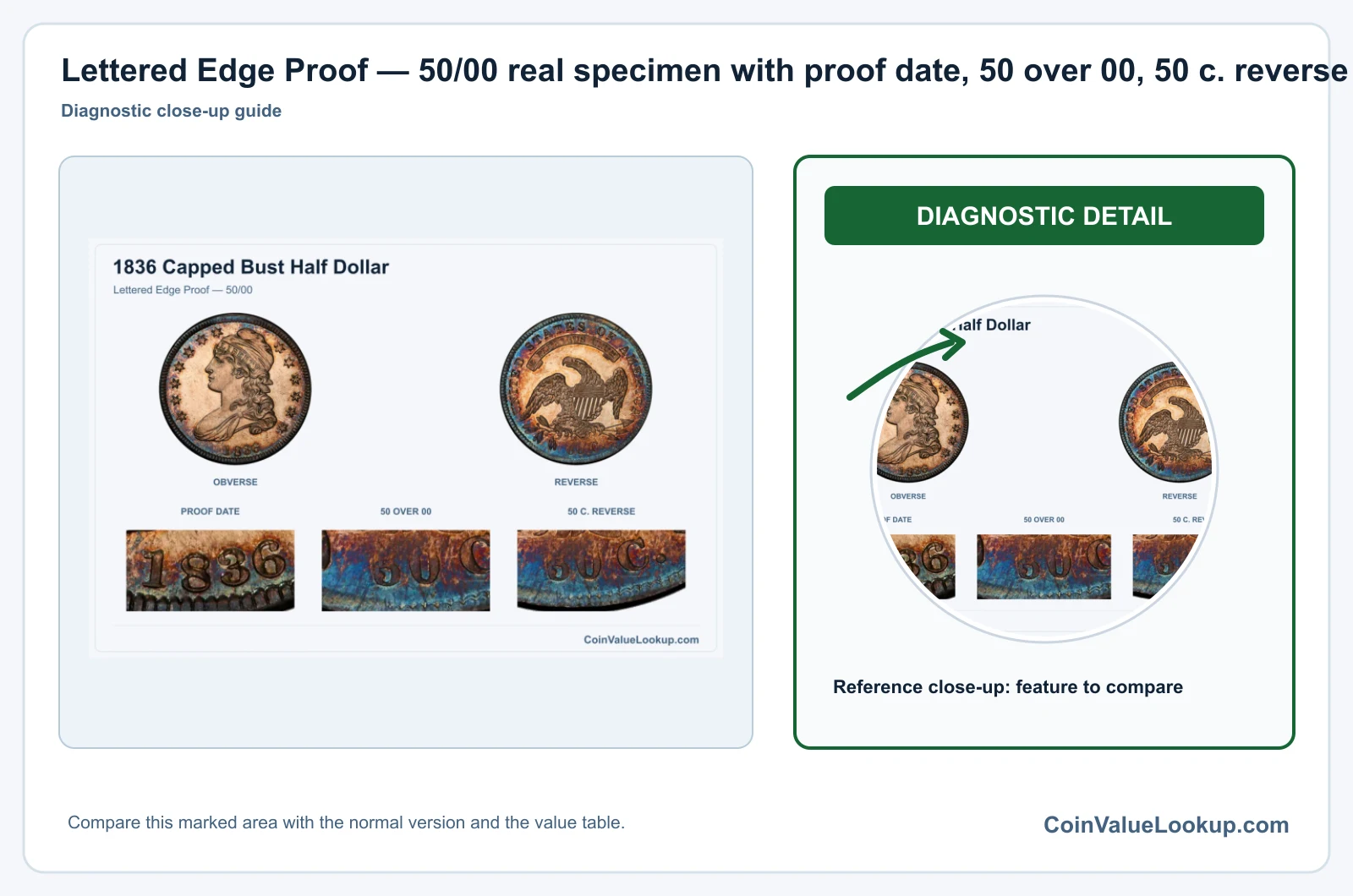
This variety pairs the 50/00 denomination correction with confirmed Proof manufacture on a lettered-edge coin. You need to see both the underlying "0" beneath the "5" in the denomination and genuine Proof surface and rim characteristics, verified by a professional grading service.
No supported price range is available for this combination. Each example would be individually assessed based on its certified grade, surface preservation, and the visibility of the denomination correction.
Like all early Proof Capped Bust halves, these are rare enough that market value is essentially set coin by coin at auction.
Range Grade
Price Auction Records Appraisal PR PR 1
—
Coin Identifier
PR 2
—
Coin Identifier
PR 3
—
Coin Identifier
PR 4
—
Coin Identifier
PR 6
—
Coin Identifier
PR 8
—
Coin Identifier
PR 10
—
Coin Identifier
PR 12
—
Coin Identifier
PR 15
—
Coin Identifier
PR 20
—
Coin Identifier
PR 25
—
Coin Identifier
PR 30
—
Coin Identifier
PR 35
—
Coin Identifier
PR 40
—
Coin Identifier
PR 45
—
Coin Identifier
PR 50
—
Coin Identifier
PR 53
—
Coin Identifier
PR 55
—
Coin Identifier
PR 58
—
Coin Identifier
PR 60
—
Coin Identifier
PR 61
—
Coin Identifier
PR 62
—
Coin Identifier
PR 63
—
Coin Identifier
PR 64
Coin Identifier
PR 65
—
Coin Identifier
PR 66
—
Coin Identifier
PR 67
—
—
—
PR 68
—
—
—
PR 69
—
—
—
PR 70
—
—
—
1836 Capped Bust Half Dollar — Reeded Edge Proof — 50 CENTS
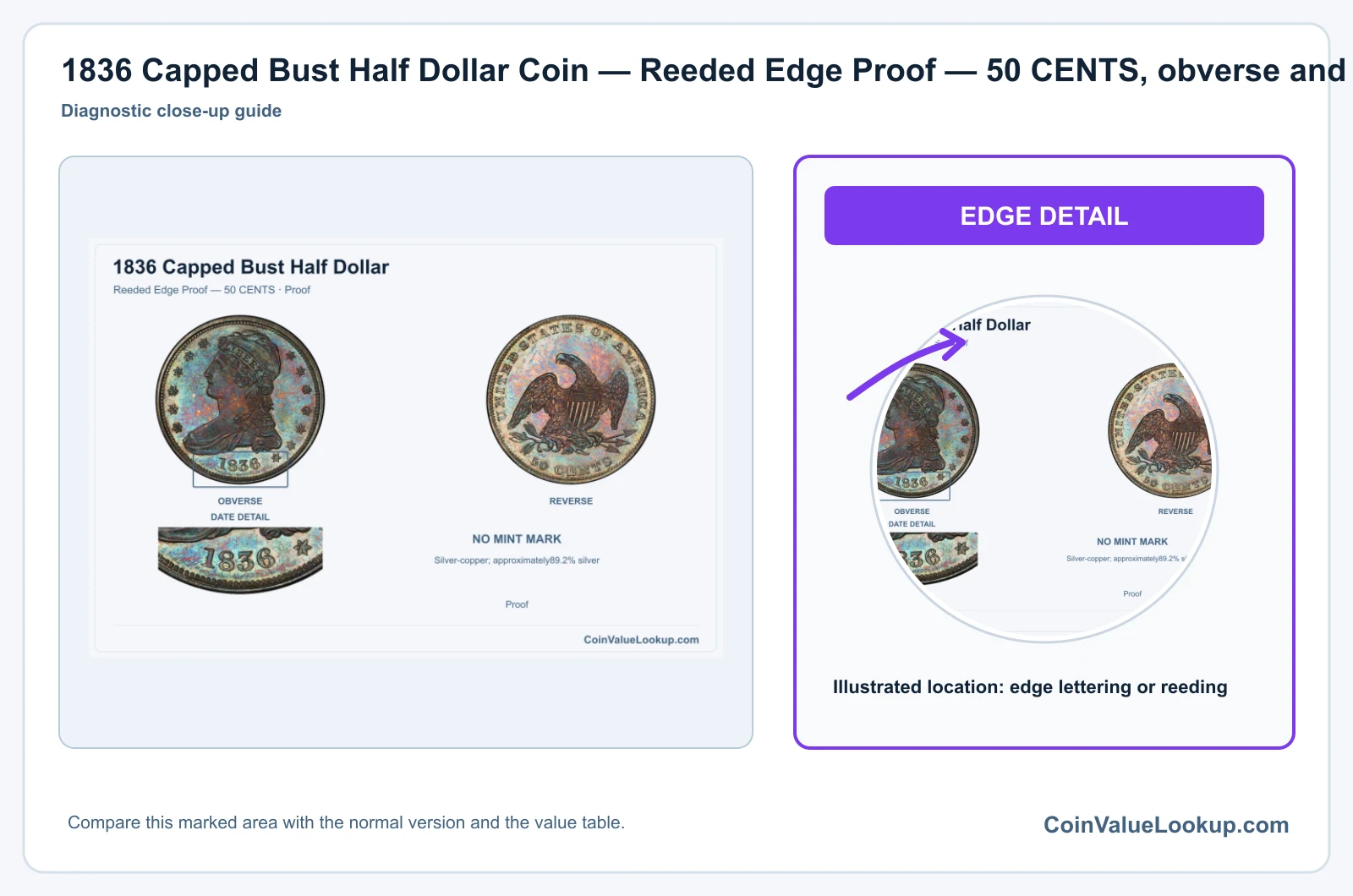
The Reeded Edge Proof is a separate category from all lettered-edge Proofs. It features the smaller 30 mm format, reeded edge, and "50 CENTS" reverse, all produced with Proof finishing techniques.
These are not patterns; they are a recognized Proof issue of the production type.
A single recorded sale provides a historical anchor: a PR66 example brought $88,125 at a May 2016 Stack's Bowers auction. That is one coin at one moment, not a current market range.
Professional certification confirming both the reeded-edge type and Proof manufacture is absolutely required before applying any comparable value.
Ordinary-issue reference: Ordinary-issue reference only: The table below shows prices for the 1836 Capped Bust Half Dollar (proof). It does not represent the value of the specific Reeded Edge Proof — 50 CENTS variety or its variety premium. Year, mint, metal and strike type are matched; the specific variety is not priced by this table.
Range Grade
Price Auction Records Appraisal PR PR 1
—
Coin Identifier
PR 2
—
Coin Identifier
PR 3
—
Coin Identifier
PR 4
—
Coin Identifier
PR 6
—
Coin Identifier
PR 8
—
Coin Identifier
PR 10
—
Coin Identifier
PR 12
—
Coin Identifier
PR 15
—
Coin Identifier
PR 20
—
Coin Identifier
PR 25
—
Coin Identifier
PR 30
—
Coin Identifier
PR 35
—
Coin Identifier
PR 40
—
Coin Identifier
PR 45
—
Coin Identifier
PR 50
—
Coin Identifier
PR 53
—
Coin Identifier
PR 55
—
Coin Identifier
PR 58
—
Coin Identifier
PR 60
—
Coin Identifier
PR 61
—
Coin Identifier
PR 62
—
Coin Identifier
PR 63
Coin Identifier
PR 64
Coin Identifier
PR 65
Coin Identifier
PR 66
Coin Identifier
PR 67
Coin Identifier
PR 68
—
—
—
PR 69
—
—
—
PR 70
—
—
—
1836 Capped Bust Half Dollar Error List
1. 1836 Capped Bust Half Dollar — Doubled Edge Lettering
Doubled Edge Lettering occurs when the lettered-edge inscription is struck more than once or with visible overlap, producing duplicated or strongly overlapping letters around the edge. This has been documented on 1836 lettered-edge half dollars, and the duplication can be quite dramatic, with entire letters clearly doubled.
To check, carefully examine the edge under good lighting, rotating the coin slowly. You are looking for two distinct impressions of letters rather than the single clean impression of a normal coin.
This error applies only to the lettered-edge type; reeded-edge coins have no edge lettering to double.
Ordinary wear, post-mint damage, or slight mushiness from a worn edge die can mimic this error. Compare against an attributed same-year example under equal lighting conditions before drawing conclusions.
No numerical price range is available; value depends on the strength of the doubling, overall coin condition, and the specific error's visibility.
2. 1836 Capped Bust Half Dollar — Double / Multiple Strike
A double or multiple strike occurs when the coin receives two or more impressions from the dies, typically with slight displacement between strikes. This produces a ghosted or shifted second image visible across part or all of the design.
The error has been documented for the 1836 half dollar date.
The displacement and its direction vary from coin to coin, so there is no single diagnostic pattern to describe. What you are looking for is a clearly repeated design element that is offset from the primary impression, not just a fuzzy or spread image.
Do not confuse this with a doubled die, which is a different category caused during die manufacture rather than during striking. Post-mint damage from being hit or squeezed can also create misleading impressions.
No numerical price is available; value depends on the visibility and extent of the extra strike, plus the coin's overall condition.