1883 Morgan Silver Dollar Coin Value: How Much Is It Worth?
The 1883 Morgan Silver Dollar is a coin that rewards careful identification. Guide estimates range from about $74.00 in well-worn condition up to $37,294.00 for a top-grade example of the scarcer San Francisco mint issue.
That spread depends entirely on which mint struck your coin, its condition, and whether it has original surfaces. Before you guess at a number, figure out the mint, finish, and design branch you actually have.
Fast Way to Identify Your 1883 Morgan Silver Dollar
The quickest way to start figuring out what your 1883 Morgan Dollar is worth is to upload clear photos of the front and back. That gives us enough for a preliminary identification of your coin's mint and general condition.
Sharp, well-lit images help distinguish mintmarks and surface quality, so grab your phone and snap both sides.
1883 Morgan Silver Dollar Value
Upload both sides of your 1883 Morgan Silver Dollar.
Front Obverse
Upload photo
Back Reverse
Upload photo
Which 1883 Morgan Silver Dollar Versions Are Worth Money?
- 1883-S in gem Mint State condition is the standout, with a guide estimate around $37,294.00 at MS65 — the jump from lower grades is dramatic because high-grade survivors are scarce.
- 1883-CC carries a premium even in circulated grades (around $169.00 at G4), reflecting Carson City's collector following and limited mintages.
- 1883 Proof (PR) coins require authenticated identification; individual assessment of condition determines their value.
- Broadstrike errors on 1883-O dollars have appeared at major auctions and can command attention from error collectors when properly attributed.
Step 1: Identify Your 1883 Morgan Silver Dollar Mint Mark and Version
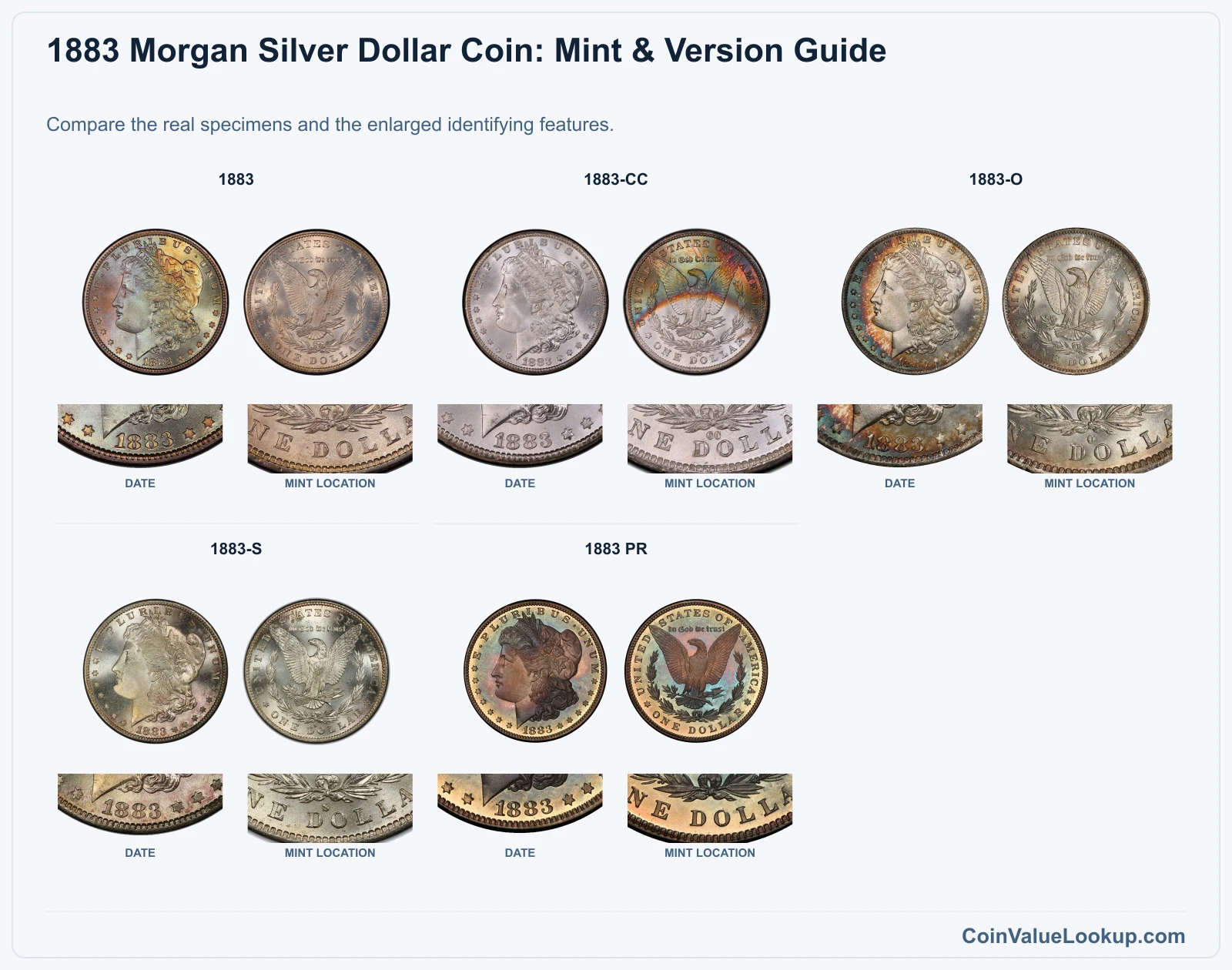
Flip the coin to the reverse (eagle side) and look directly below the bow that ties the wreath together. That is where the mintmark lives.
No letter means Philadelphia. A "CC" means Carson City.
An "O" is New Orleans, and an "S" is San Francisco. Only those four mints produced Morgan Dollars in 1883, plus Philadelphia struck a small number of proof coins.
The coin should weigh 26.73 grams and be composed of 90% silver and 10% copper. It has a reeded edge, which means those tiny grooves around the rim.
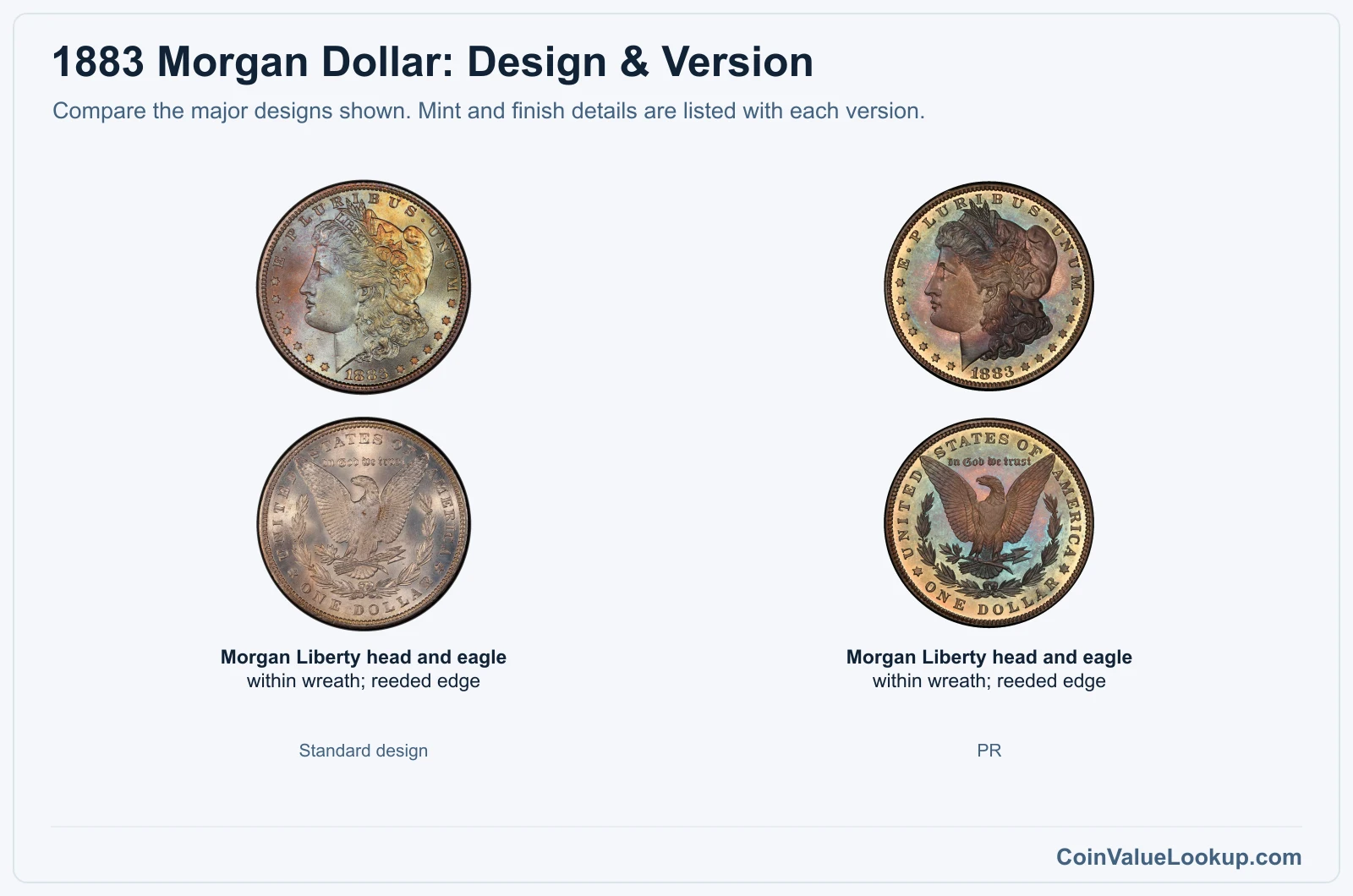
The obverse shows the Morgan Liberty head, and the reverse features an eagle within a wreath.
Do not confuse a shiny business strike with a proof. Proofs were made with a specific manufacturing process, not just a high grade or nice luster.
Similarly, Prooflike (PL) and Deep Mirror Prooflike (DMPL) are surface designations applied to eligible business strikes. They are not proof coins.
A coin that looks reflective from bag storage or cleaning is not automatically PL or DMPL either.
Coin Value Lookup is a good place to look up guides for Morgan Dollars and other U.S. coins when you need a quick reference for different years and denominations.
Step 2: Check Your 1883 Morgan Silver Dollar Grade
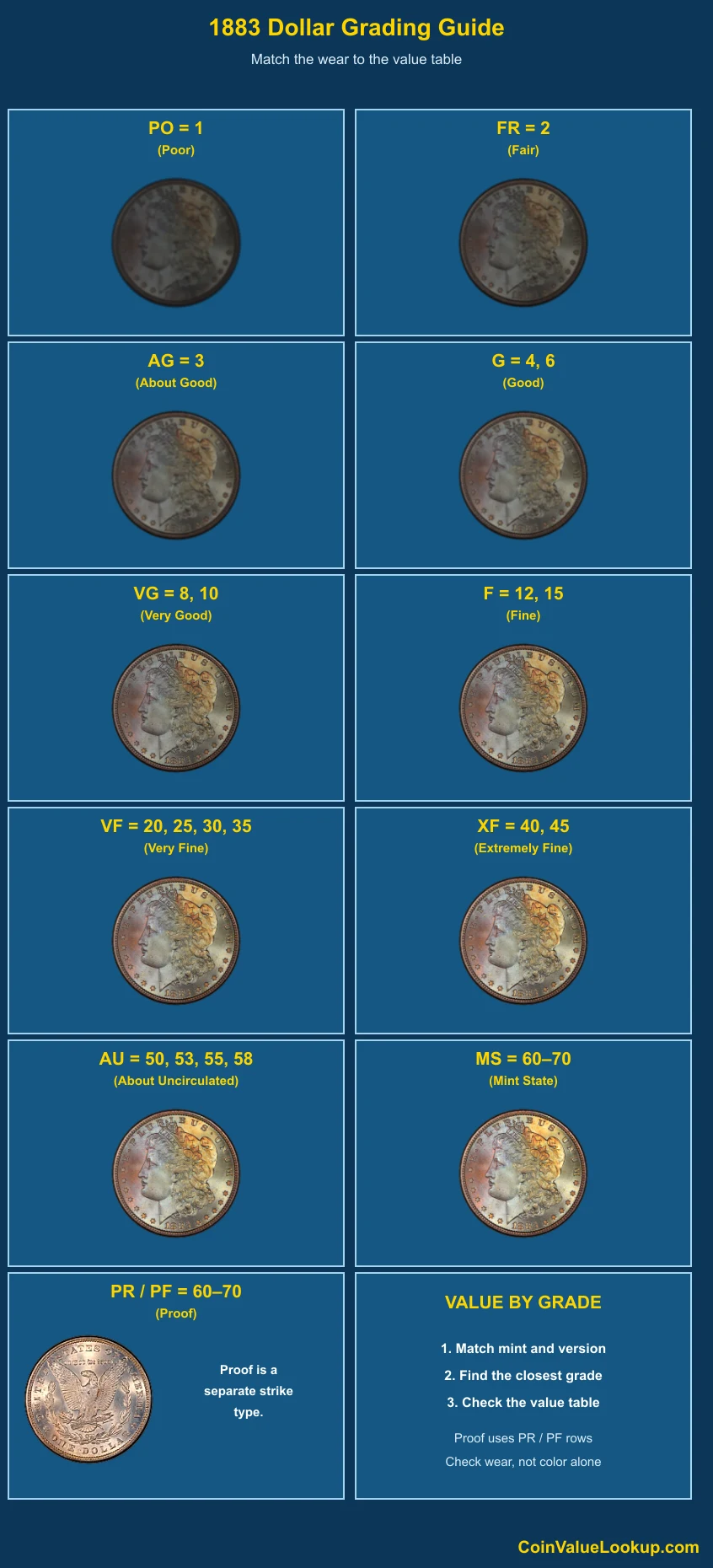
Start by examining the hair above Liberty's ear and the flatness of her cheek. Those are the first areas to show wear.
The cap detail and the eagle's breast feathers on the reverse lose definition next.
Bag marks are a constant headache with Morgan Dollars. These are contact marks from coins bouncing around in mint bags, and they can make a technically uncirculated coin look rough.
They lower the Mint State grade but are not the same as circulation wear.
Use the comparison image to see the difference between a circulated coin (where the high points are visibly flattened), an About Uncirculated coin (faint friction on the highest points only), and a true Mint State example (no wear, just possible bag marks). Proof coins should be evaluated separately from business strikes since the surfaces and manufacturing differ.
Step 3: Check 1883 Morgan Silver Dollar Value by Mint and Version
1883 Morgan Silver Dollar
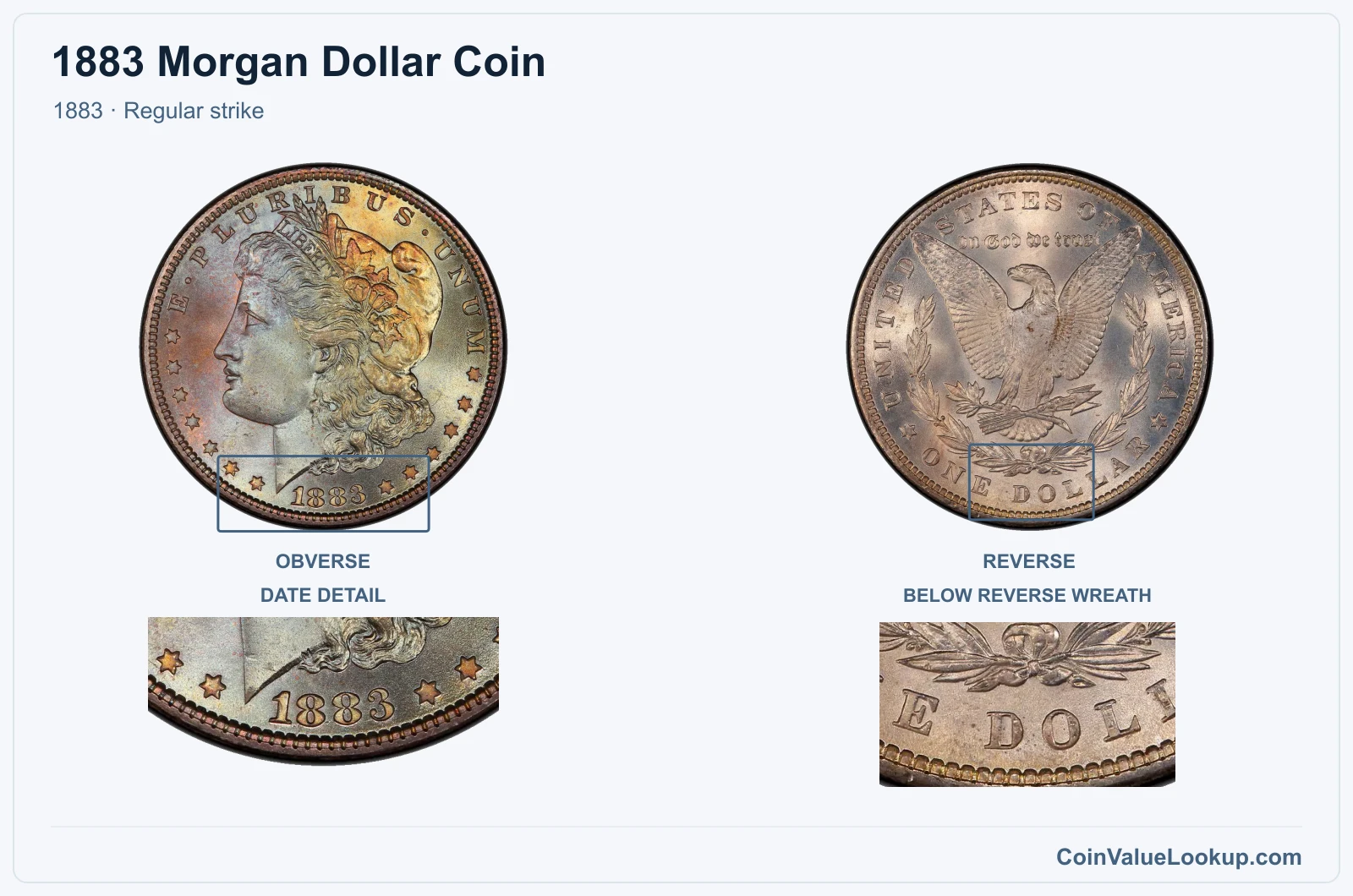
The 1883 Philadelphia Morgan Dollar has no mintmark below the wreath bow. It is the most commonly encountered version of this date.
Guide estimates place a well-worn G4 example around $74.00 and a gem MS65 around $367.00, per USA Coin Book. Original, uncleaned surfaces matter for value at every grade.
Coins that have been polished, dipped, or cleaned will not compare evenly to examples with natural toning or original luster.
If you see mirror-like reflectivity on your business strike, it could qualify for PL or DMPL designations, which are price filters rather than separate coin types. These surface designations apply only to eligible business strikes and require professional attribution.
Range Grade
Price Auction Records Appraisal PO PO 1
—
Coin Identifier FR FR 2
Coin Identifier AG AG 3
—
Coin Identifier G G 4
—
Coin Identifier
G 6
—
Coin Identifier VG VG 8
—
Coin Identifier
VG 10
—
Coin Identifier F F 12
Coin Identifier
F 15
—
Coin Identifier VF VF 20
—
Coin Identifier
VF 25
Coin Identifier
VF 30
Coin Identifier
VF 35
Coin Identifier XF XF 40
—
Coin Identifier
XF 45
Coin Identifier AU AU 50
Coin Identifier
AU 53
Coin Identifier
AU 55
Coin Identifier
AU 58
Coin Identifier MS MS 60
Coin Identifier
MS 61
Coin Identifier
MS 62
Coin Identifier
MS 63
Coin Identifier
MS 64
Coin Identifier
MS 65
Coin Identifier
MS 66
Coin Identifier
MS 67
Coin Identifier
MS 68
Coin Identifier
MS 69
—
—
—
MS 70
—
—
—
1883 Morgan Silver Dollar — CC
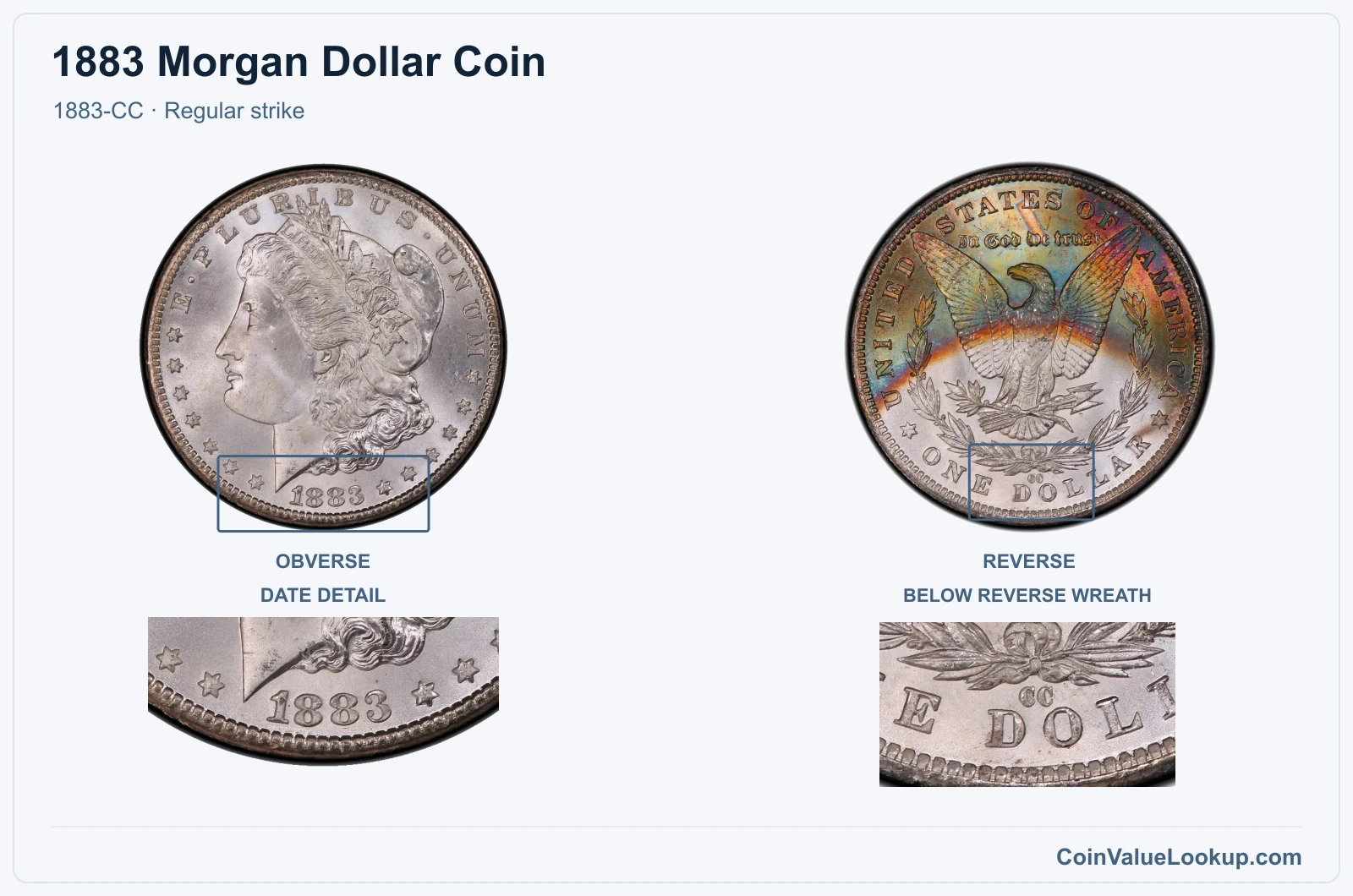
The 1883-CC Morgan Dollar was struck at Carson City, Nevada. Look for the small "CC" mintmark below the wreath bow on the reverse.
Carson City dollars are popular with collectors because the mint had a relatively short operational life and lower production volumes.
Even a heavily circulated G4 grades around $169.00 according to USA Coin Book, and a clean MS65 carries a guide estimate near $758.00. That G4 premium over Philadelphia and New Orleans tells you the CC mintmark itself adds significant value.
Many 1883-CC dollars survived in government storage and were released decades later, so uncirculated examples do turn up. Still, confirm the mintmark carefully — a worn or filled "CC" sometimes gets misread.
Range Grade
Price Auction Records Appraisal PO PO 1
—
Coin Identifier FR FR 2
Coin Identifier AG AG 3
Coin Identifier G G 4
Coin Identifier
G 6
Coin Identifier VG VG 8
Coin Identifier
VG 10
Coin Identifier F F 12
Coin Identifier
F 15
Coin Identifier VF VF 20
Coin Identifier
VF 25
Coin Identifier
VF 30
Coin Identifier
VF 35
Coin Identifier XF XF 40
Coin Identifier
XF 45
Coin Identifier AU AU 50
Coin Identifier
AU 53
Coin Identifier
AU 55
Coin Identifier
AU 58
Coin Identifier MS MS 60
Coin Identifier
MS 61
Coin Identifier
MS 62
Coin Identifier
MS 63
Coin Identifier
MS 64
Coin Identifier
MS 65
Coin Identifier
MS 66
Coin Identifier
MS 67
Coin Identifier
MS 68
Coin Identifier
MS 69
—
—
—
MS 70
—
—
—
1883 Morgan Silver Dollar — O
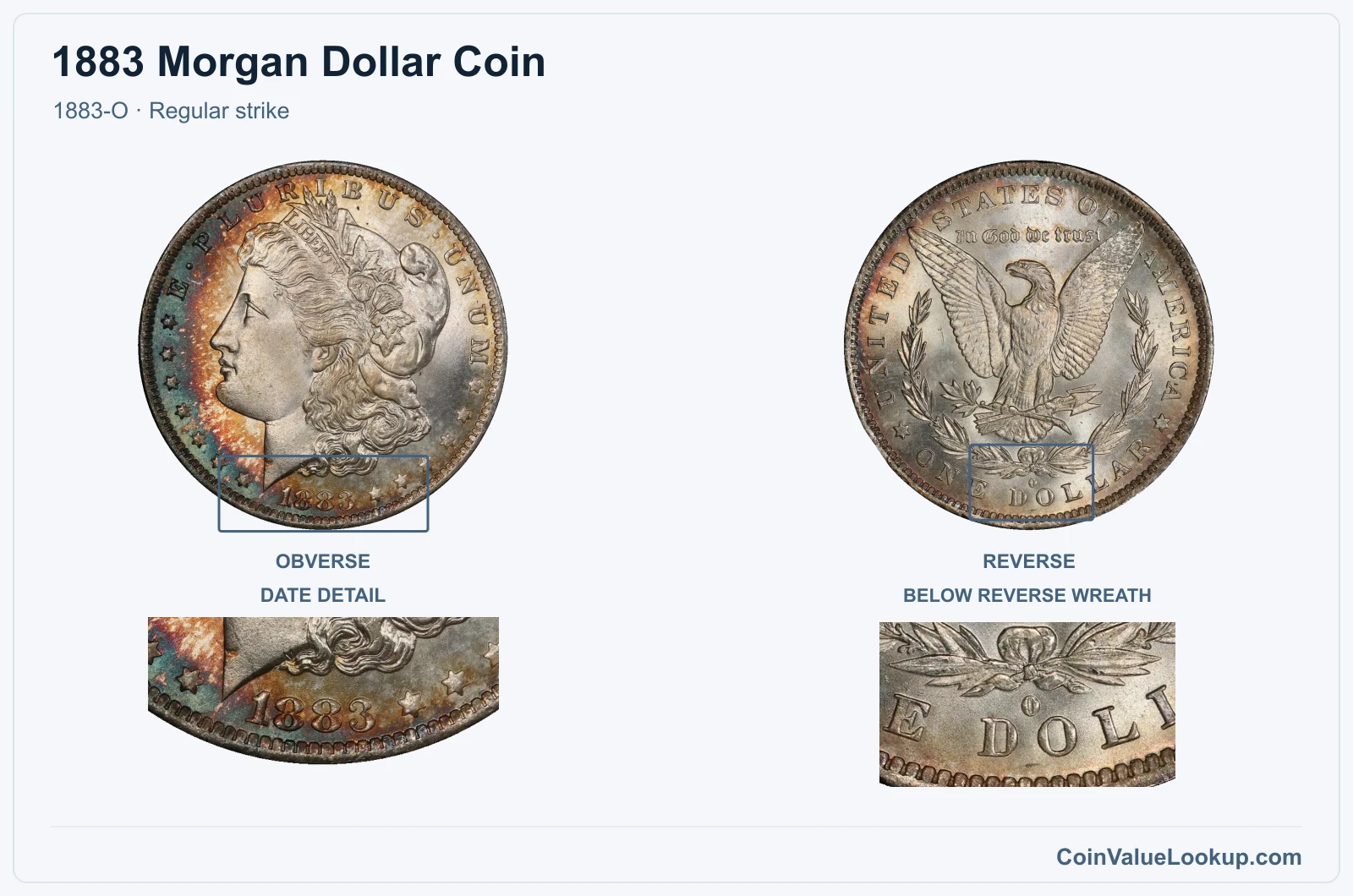
The 1883-O was struck at the New Orleans Mint. You will find a small "O" below the wreath bow on the reverse.
This issue is plentiful in most grades. Guide estimates run about $74.00 at G4 and $318.00 at MS65, per USA Coin Book.
Large quantities survived in treasury vaults, so finding one in uncirculated condition is not unusual. The value gap between a circulated piece and a gem example is real, but nothing like the spread on the San Francisco version.
As always, original surfaces make the difference. A cleaned coin that looks shiny is not the same as a properly graded Mint State piece.
Range Grade
Price Auction Records Appraisal PO PO 1
—
Coin Identifier FR FR 2
Coin Identifier AG AG 3
—
Coin Identifier G G 4
—
Coin Identifier
G 6
—
Coin Identifier VG VG 8
—
Coin Identifier
VG 10
—
Coin Identifier F F 12
Coin Identifier
F 15
—
Coin Identifier VF VF 20
Coin Identifier
VF 25
—
Coin Identifier
VF 30
—
Coin Identifier
VF 35
—
Coin Identifier XF XF 40
—
Coin Identifier
XF 45
Coin Identifier AU AU 50
Coin Identifier
AU 53
Coin Identifier
AU 55
Coin Identifier
AU 58
Coin Identifier MS MS 60
Coin Identifier
MS 61
Coin Identifier
MS 62
Coin Identifier
MS 63
Coin Identifier
MS 64
Coin Identifier
MS 65
Coin Identifier
MS 66
Coin Identifier
MS 67
Coin Identifier
MS 68
Coin Identifier
MS 69
—
—
—
MS 70
—
—
—
1883 Morgan Silver Dollar — S
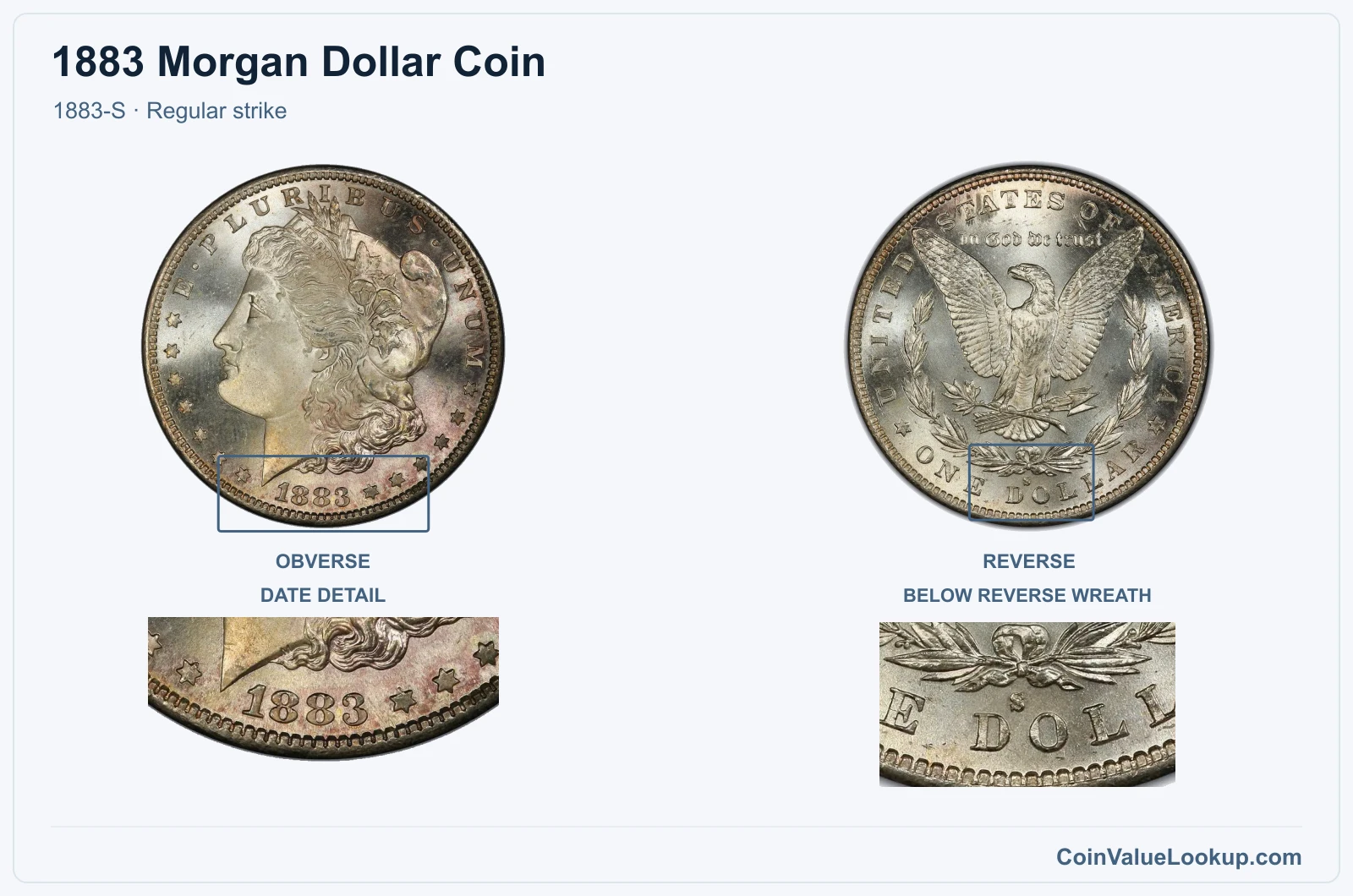
The 1883-S Morgan Dollar was minted in San Francisco. The mintmark is a small "S" below the wreath bow.
Here is where things get interesting in a wallet-thinning way. At G4, the guide estimate sits at $74.00, which looks ordinary.
At MS65, it jumps to $37,294.00. That enormous gap exists because very few 1883-S dollars survived in gem uncirculated condition.
Most saw heavy circulation or were melted.
This means condition is everything with this coin. A well-worn 1883-S is a common coin worth its silver content plus a modest premium.
A truly gem example is a different animal entirely. Do not assume your coin is high grade just because it is shiny — bag marks, light wear, or cleaning can knock it down several grade levels.
Professional grading is strongly recommended for any 1883-S that appears to be Mint State.
Range Grade
Price Auction Records Appraisal PO PO 1
—
Coin Identifier FR FR 2
—
Coin Identifier AG AG 3
—
Coin Identifier G G 4
—
Coin Identifier
G 6
—
Coin Identifier VG VG 8
Coin Identifier
VG 10
—
Coin Identifier F F 12
—
Coin Identifier
F 15
Coin Identifier VF VF 20
—
Coin Identifier
VF 25
Coin Identifier
VF 30
Coin Identifier
VF 35
Coin Identifier XF XF 40
Coin Identifier
XF 45
Coin Identifier AU AU 50
Coin Identifier
AU 53
Coin Identifier
AU 55
Coin Identifier
AU 58
Coin Identifier MS MS 60
Coin Identifier
MS 61
Coin Identifier
MS 62
Coin Identifier
MS 63
Coin Identifier
MS 64
Coin Identifier
MS 65
Coin Identifier
MS 66
Coin Identifier
MS 67
Coin Identifier
MS 68
—
—
—
MS 69
—
—
—
MS 70
—
—
—
1883 Morgan Silver Dollar — PR
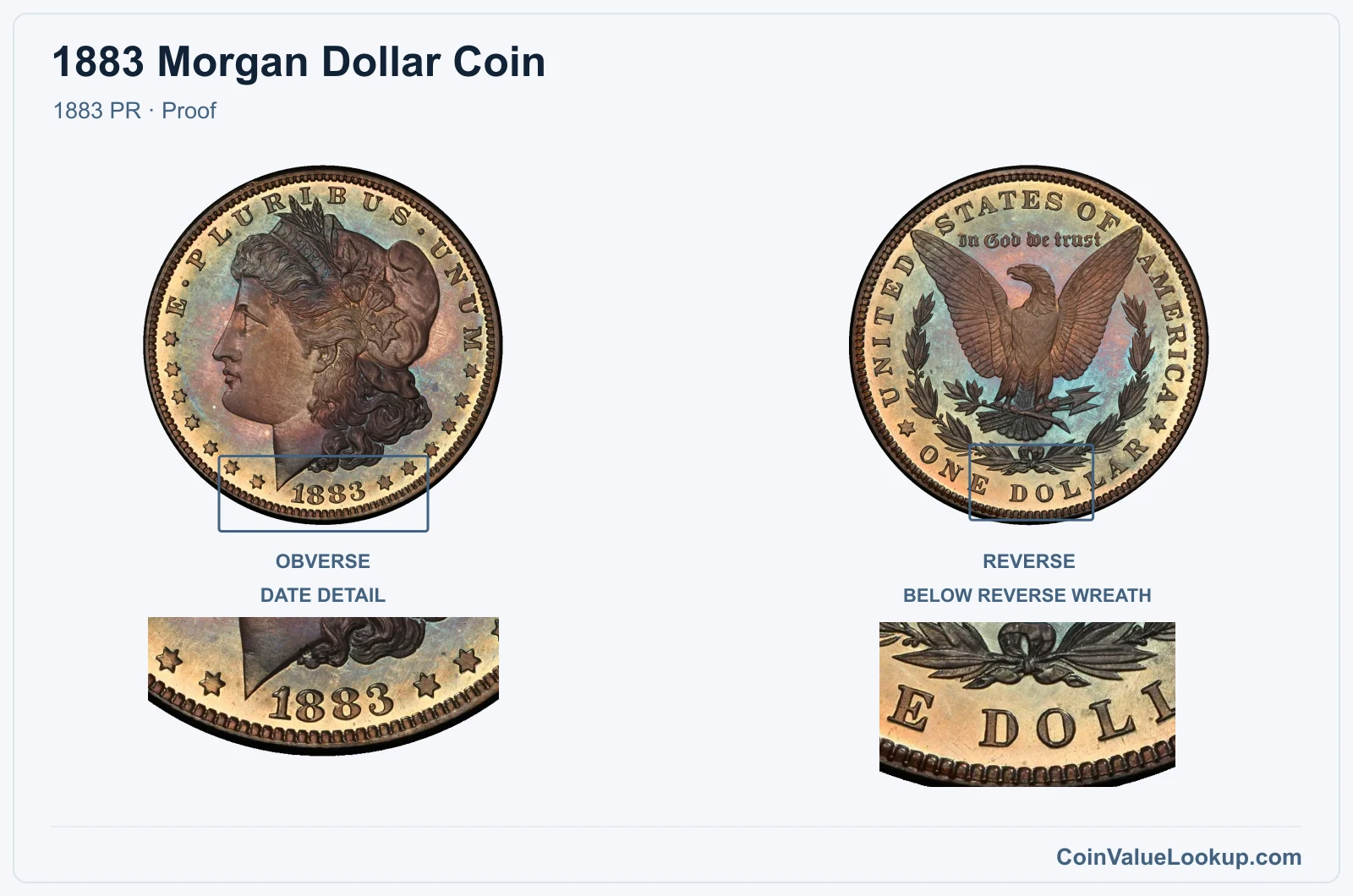
The 1883 Proof Morgan Dollar was struck at Philadelphia using specially prepared dies and planchets. It carries no mintmark.
Proof is a manufacturing finish, not simply a grade above Mint State. These coins were made in small quantities for collectors.
No supported numeric price range is available for this version. Value depends on authenticated identity and individual condition, including the quality of mirror fields, any hairlines, and toning characteristics.
Because business strikes can sometimes look reflective, professional authentication is important before treating any 1883 Morgan Dollar as a proof.
Do not confuse Prooflike (PL) or Deep Mirror Prooflike (DMPL) business strikes with actual proofs. They are different manufacturing processes with different values.
Range Grade
Price Auction Records Appraisal PR PR 1
—
Coin Identifier
PR 2
—
Coin Identifier
PR 3
—
Coin Identifier
PR 4
—
Coin Identifier
PR 6
—
Coin Identifier
PR 8
—
Coin Identifier
PR 10
—
Coin Identifier
PR 12
—
Coin Identifier
PR 15
—
Coin Identifier
PR 20
—
Coin Identifier
PR 25
—
Coin Identifier
PR 30
—
Coin Identifier
PR 35
—
Coin Identifier
PR 40
—
Coin Identifier
PR 45
—
Coin Identifier
PR 50
—
Coin Identifier
PR 53
—
Coin Identifier
PR 55
Coin Identifier
PR 58
Coin Identifier
PR 60
Coin Identifier
PR 61
Coin Identifier
PR 62
Coin Identifier
PR 63
Coin Identifier
PR 64
Coin Identifier
PR 65
Coin Identifier
PR 66
Coin Identifier
PR 67
Coin Identifier
PR 68
Coin Identifier
PR 69
—
—
—
PR 70
—
—
—
1883 Morgan Silver Dollar Error List
1. 1883 Morgan Silver Dollar — Broadstrike
A broadstrike occurs when the coin is struck without the normal restraining collar that forms the reeded edge and keeps the design properly centered. The result is a coin with outward metal spread — the design elements push toward the rim, and the edge profile differs from a normal piece.
The overall diameter may be slightly larger than standard.
Heritage Auctions has listed an 1883-O Morgan Dollar broadstruck error graded MS62 by NGC. That specific lot confirms this error exists on 1883-O strikes, but it does not automatically apply to coins from other mints this year.
Do not confuse a broadstrike with an off-center strike, which shifts the design and leaves a blank crescent. Also watch out for coins that were flattened or damaged after leaving the mint — post-mint damage can mimic the spread but lacks the uniform metal flow of a genuine broadstrike.
Condition, visibility of the error, and professional attribution all affect what an error like this is worth.