1776 to 1976 Kennedy Half Dollar Coin Value: How Much Is It Worth?
Most 1976 Kennedy half dollars — the Bicentennial issue with the dual 1776–1976 date and Independence Hall reverse — are worth face value in circulated condition. A USA Coin Book guide estimate places a typical uncirculated clad example at about $3.62 in MS63.
Silver versions, collector proofs and authenticated error coins carry separate, sometimes significantly higher values.
Fast Way to Identify Your 1976 Kennedy Half Dollar
Snap clear photos of both sides of your coin and upload them here for a preliminary identification. This can help you figure out which of the five normal Bicentennial branches you have and whether your coin shows any obvious variety or error features worth investigating further.
1776 to 1976 Kennedy Half Dollar Value
Upload both sides of your 1776 to 1976 Kennedy Half Dollar.
Front Obverse
Upload photo
Back Reverse
Upload photo
Which 1976 Kennedy Half Dollar Versions Are Worth Money?
- The 1976-S 40% Silver Proof in PR65 carries a guide estimate around $22, making it the highest-valued normal branch at that grade level.
- The 1976-S 40% Silver Uncirculated version has a guide estimate of about $17 at MS63, well above the clad issues at the same grade.
- A recognized Doubled Die Obverse exists on the silver uncirculated S issue, with historical sales recorded between $39 and $405 depending on grade.
- Dramatic mint errors — such as a half dollar struck on a quarter blank, a 50% off-center strike, or a triple-struck silver piece — have been certified and auctioned, though each must be individually assessed.
- The 1976-S Clad Proof at PR65 is estimated around $4.96, a modest step above the clad business strikes.
Step 1: Identify Your 1976 Kennedy Half Dollar Mint Mark and Version
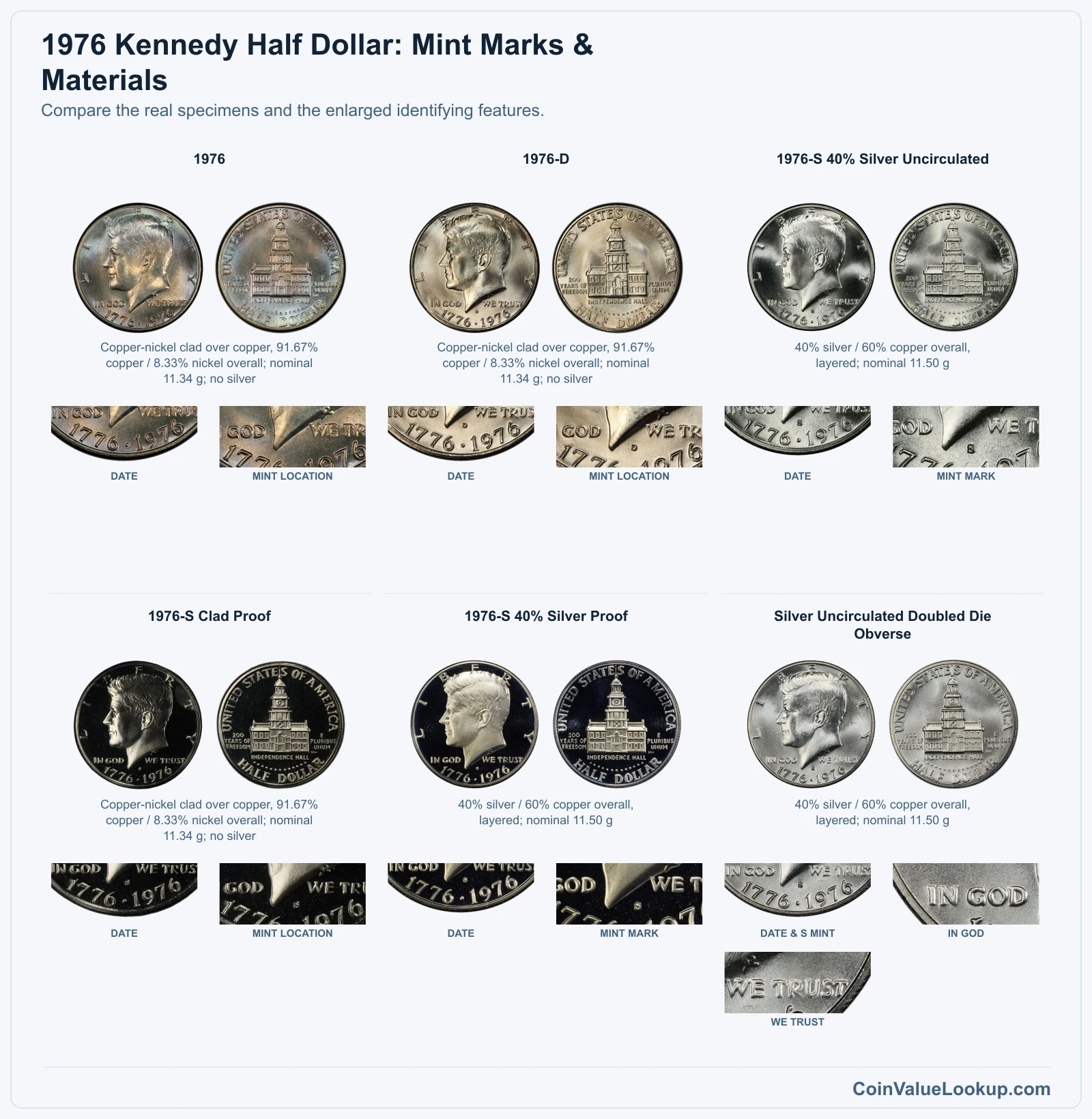
The 1976 Kennedy half dollar exists in five normal branches: Philadelphia clad (no mintmark), Denver clad (D mintmark), San Francisco clad proof (S mintmark), San Francisco 40% silver uncirculated (S mintmark) and San Francisco 40% silver proof (S mintmark). The mintmark sits below Kennedy's neck, just above the date.
An S mintmark alone does not mean your coin is silver. Both clad proofs and silver versions were struck at San Francisco.
To tell them apart, weigh your coin: clad pieces run about 11.34 grams while silver versions weigh roughly 11.50 grams. Edge color helps too — a clad coin shows a visible copper-colored stripe along the edge, while a silver version does not.
All five branches share the same Bicentennial design: Kennedy's portrait on the obverse with the dual 1776–1976 date, and Seth Huntington's Independence Hall on the reverse. No half dollar carries a 1975 date; coins struck during 1975 received the Bicentennial dual date as well.
The diameter across all versions is approximately 30.61 mm.
If you want to quickly check values across Kennedy half dollars and other series, Coin Value Lookup is a useful starting point for finding coin guides organized by year and denomination.
Step 2: Check Your 1976 Kennedy Half Dollar Grade
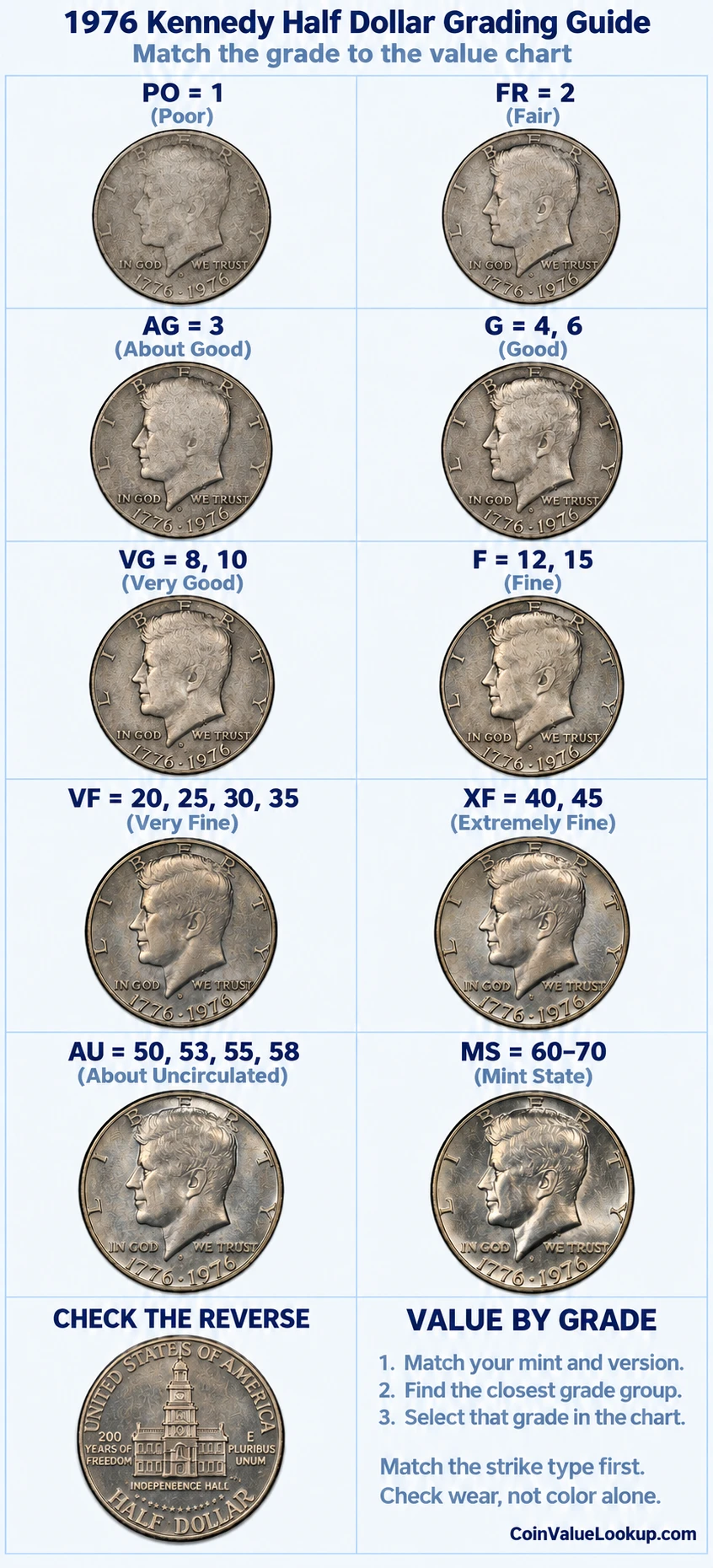
Start with the hair above Kennedy's ear and the cheek and jawline. On a well-circulated coin these areas show flat, smooth patches where luster has been rubbed away.
Compare your coin side-by-side with the same-type grading image to see how much detail remains.
The reverse uses Independence Hall rather than the usual eagle, so look at the building's columns, windows and roofline for sharpness. Some Bicentennial halves came weakly struck from the factory, so soft details are not always wear.
Contact marks and hairlines are different from circulation rub — marks are random nicks, while wear follows the highest relief points in a pattern.
Proof finish is a manufacturing method, not a grade above Mint State. A proof can have hairlines, haze or handling marks that lower its grade.
Cameo or deep cameo contrast describes the frosted devices against mirrored fields; it does not tell you whether the coin is silver or clad.
Step 3: Check 1976 Kennedy Half Dollar Value by Mint and Version
1976 Kennedy Half Dollar
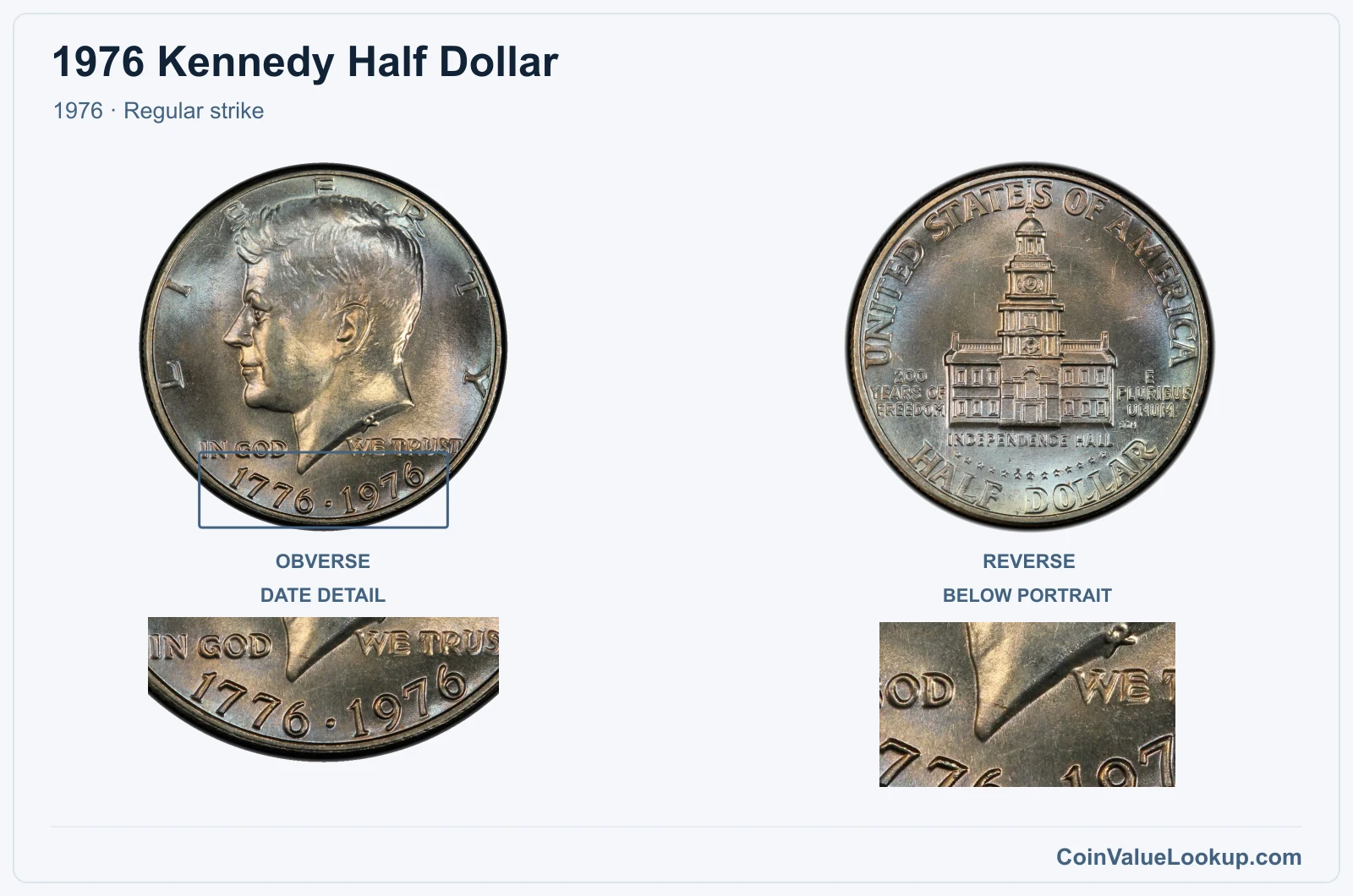
The 1976 Philadelphia half dollar has no mintmark. It is a copper-nickel clad coin weighing about 11.34 grams with no silver content.
This is the most common Bicentennial half you will find in pocket change or bank rolls.
A USA Coin Book guide estimate puts the MS63 value at roughly $3.62. Circulated examples are worth face value.
Look for original luster and minimal bag marks if you are hoping to find one in collectible condition.
| Range | Grade | Price | Auction Records | Appraisal |
|---|---|---|---|---|
| PO | PO 1 | — | Coin Identifier | |
| FR | FR 2 | — | Coin Identifier | |
| AG | AG 3 | Coin Identifier | ||
| G | G 4 | — | Coin Identifier | |
| G 6 | — | Coin Identifier | ||
| VG | VG 8 | — | Coin Identifier | |
| VG 10 | — | Coin Identifier | ||
| F | F 12 | — | Coin Identifier | |
| F 15 | — | Coin Identifier | ||
| VF | VF 20 | — | Coin Identifier | |
| VF 25 | — | Coin Identifier | ||
| VF 30 | — | Coin Identifier | ||
| VF 35 | — | Coin Identifier | ||
| XF | XF 40 | — | Coin Identifier | |
| XF 45 | — | Coin Identifier | ||
| AU | AU 50 | — | Coin Identifier | |
| AU 53 | — | Coin Identifier | ||
| AU 55 | Coin Identifier | |||
| AU 58 | Coin Identifier | |||
| MS | MS 60 | — | Coin Identifier | |
| MS 61 | Coin Identifier | |||
| MS 62 | Coin Identifier | |||
| MS 63 | Coin Identifier | |||
| MS 64 | Coin Identifier | |||
| MS 65 | Coin Identifier | |||
| MS 66 | Coin Identifier | |||
| MS 67 | Coin Identifier | |||
| MS 68 | — | — | — | |
| MS 69 | — | — | — | |
| MS 70 | — | — | — |
1976 Kennedy Half Dollar — D
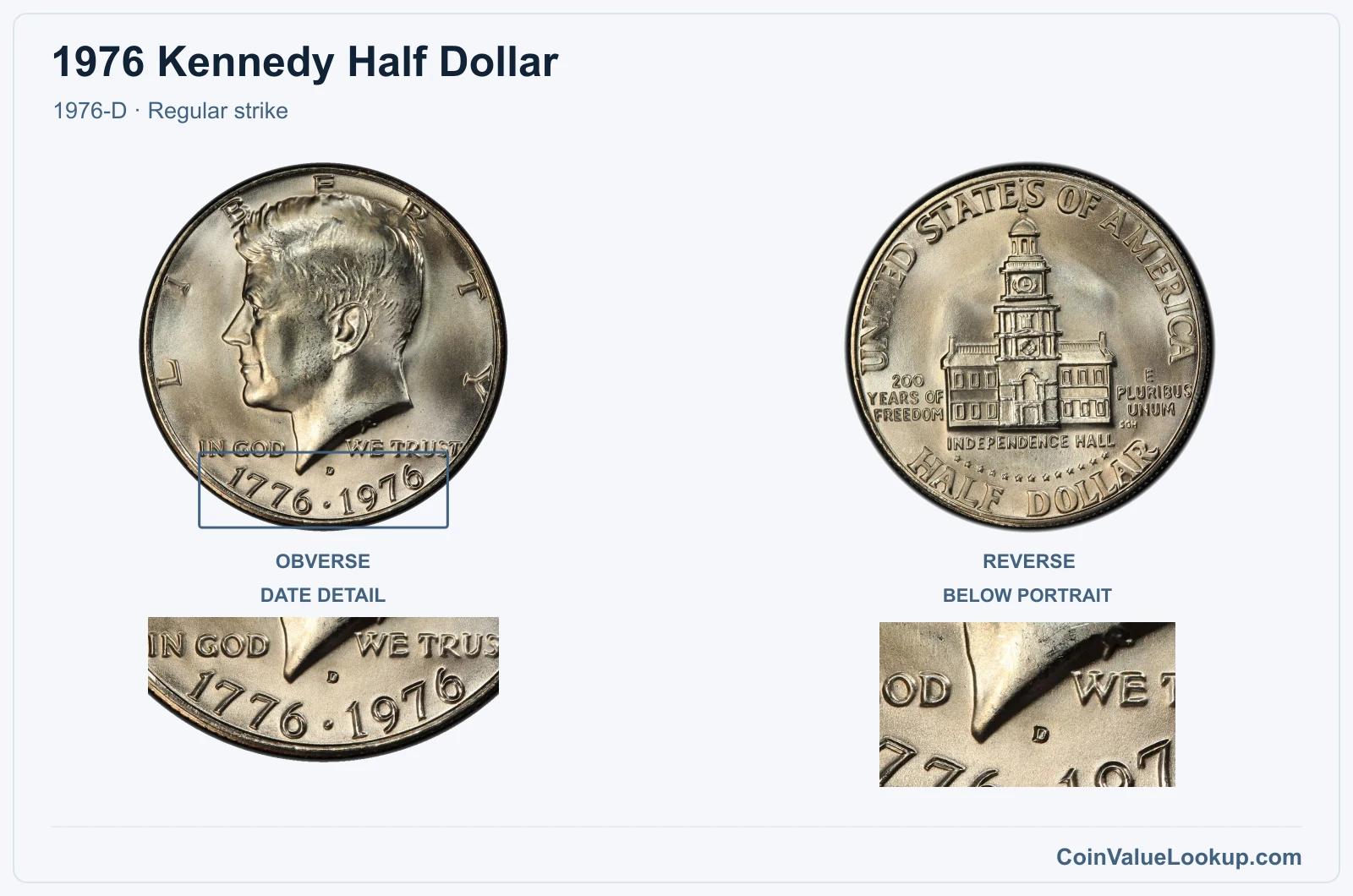
The 1976-D carries a small D mintmark below Kennedy's neck and was struck at the Denver Mint. Same copper-nickel clad composition, same 11.34-gram weight, no silver.
The MS63 guide estimate is also about $3.62. Like its Philadelphia counterpart, most 1976-D halves turn up well-circulated and are worth fifty cents.
A piece with strong original surfaces and few marks is needed to reach collectible grades.
| Range | Grade | Price | Auction Records | Appraisal |
|---|---|---|---|---|
| PO | PO 1 | — | Coin Identifier | |
| FR | FR 2 | — | Coin Identifier | |
| AG | AG 3 | — | Coin Identifier | |
| G | G 4 | — | Coin Identifier | |
| G 6 | — | Coin Identifier | ||
| VG | VG 8 | — | Coin Identifier | |
| VG 10 | — | Coin Identifier | ||
| F | F 12 | — | Coin Identifier | |
| F 15 | — | Coin Identifier | ||
| VF | VF 20 | — | Coin Identifier | |
| VF 25 | — | Coin Identifier | ||
| VF 30 | — | Coin Identifier | ||
| VF 35 | — | Coin Identifier | ||
| XF | XF 40 | — | Coin Identifier | |
| XF 45 | — | Coin Identifier | ||
| AU | AU 50 | — | Coin Identifier | |
| AU 53 | — | Coin Identifier | ||
| AU 55 | Coin Identifier | |||
| AU 58 | Coin Identifier | |||
| MS | MS 60 | Coin Identifier | ||
| MS 61 | Coin Identifier | |||
| MS 62 | Coin Identifier | |||
| MS 63 | Coin Identifier | |||
| MS 64 | Coin Identifier | |||
| MS 65 | Coin Identifier | |||
| MS 66 | Coin Identifier | |||
| MS 67 | Coin Identifier | |||
| MS 68 | — | — | — | |
| MS 69 | — | — | — | |
| MS 70 | — | — | — |
1976 Kennedy Half Dollar — S 40% Silver Uncirculated
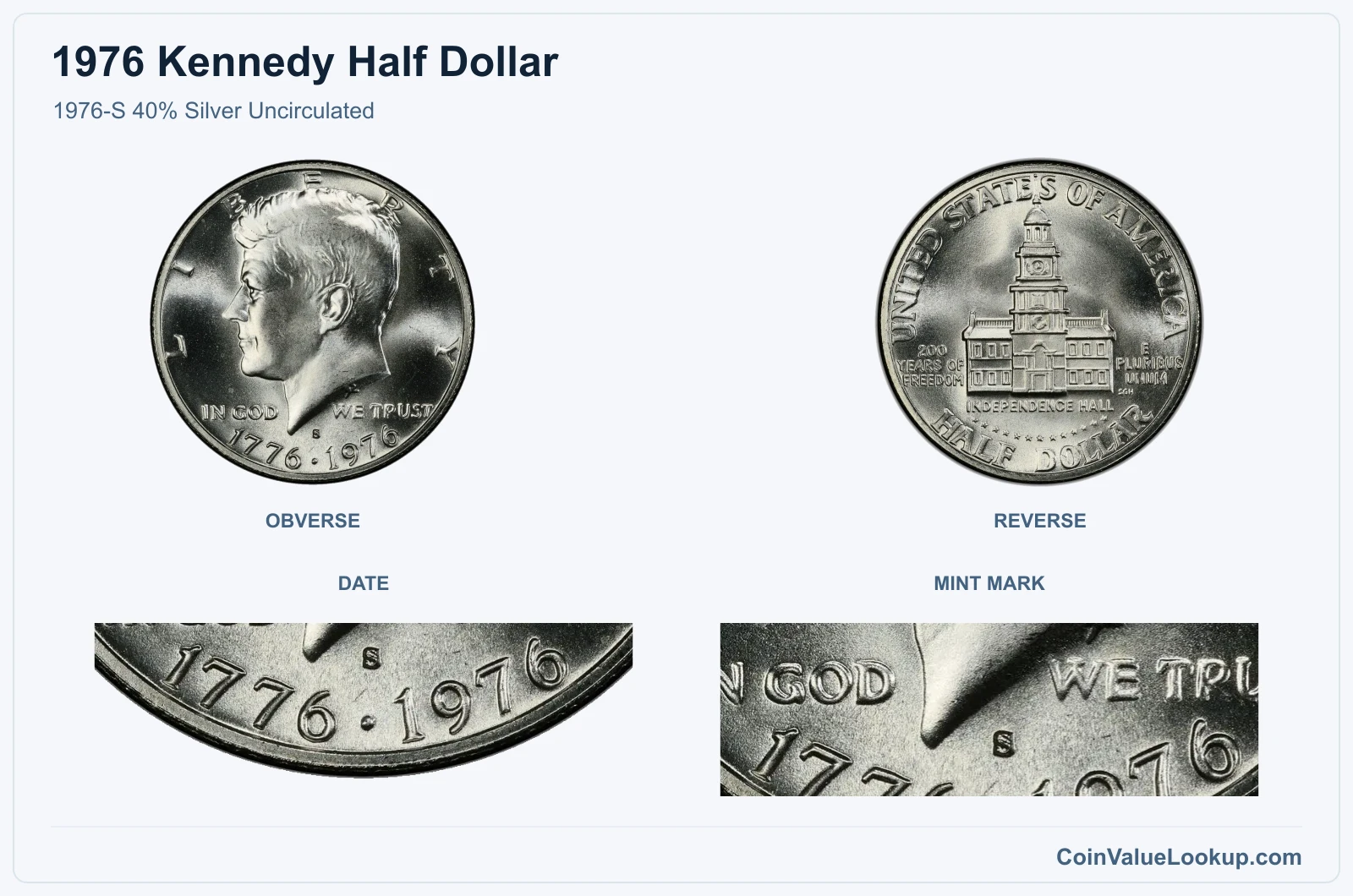
This is the San Francisco 40% silver uncirculated half dollar, and it is not the same as the S clad proof. The layered construction uses outer layers of 80% silver over an inner layer of roughly 20.9% silver, for an overall 40% silver content.
Weight is about 11.50 grams, slightly heavier than the clad versions.
The USA Coin Book guide estimate is around $17 at MS63. That silver content alone gives it intrinsic metal value, and the collector premium adds to it.
Check the edge — no copper stripe — and weigh it to confirm you have the silver version rather than the clad proof.
| Range | Grade | Price | Auction Records | Appraisal |
|---|---|---|---|---|
| PO | PO 1 | — | Coin Identifier | |
| FR | FR 2 | — | Coin Identifier | |
| AG | AG 3 | — | Coin Identifier | |
| G | G 4 | — | Coin Identifier | |
| G 6 | — | Coin Identifier | ||
| VG | VG 8 | — | Coin Identifier | |
| VG 10 | — | Coin Identifier | ||
| F | F 12 | — | Coin Identifier | |
| F 15 | — | Coin Identifier | ||
| VF | VF 20 | — | Coin Identifier | |
| VF 25 | — | Coin Identifier | ||
| VF 30 | — | Coin Identifier | ||
| VF 35 | — | Coin Identifier | ||
| XF | XF 40 | — | Coin Identifier | |
| XF 45 | — | Coin Identifier | ||
| AU | AU 50 | — | Coin Identifier | |
| AU 53 | — | Coin Identifier | ||
| AU 55 | — | Coin Identifier | ||
| AU 58 | — | Coin Identifier | ||
| MS | MS 60 | Coin Identifier | ||
| MS 61 | — | Coin Identifier | ||
| MS 62 | — | Coin Identifier | ||
| MS 63 | — | Coin Identifier | ||
| MS 64 | Coin Identifier | |||
| MS 65 | Coin Identifier | |||
| MS 66 | Coin Identifier | |||
| MS 67 | Coin Identifier | |||
| MS 68 | Coin Identifier | |||
| MS 69 | Coin Identifier | |||
| MS 70 | — | — | — |
1976 Kennedy Half Dollar — S Clad Proof
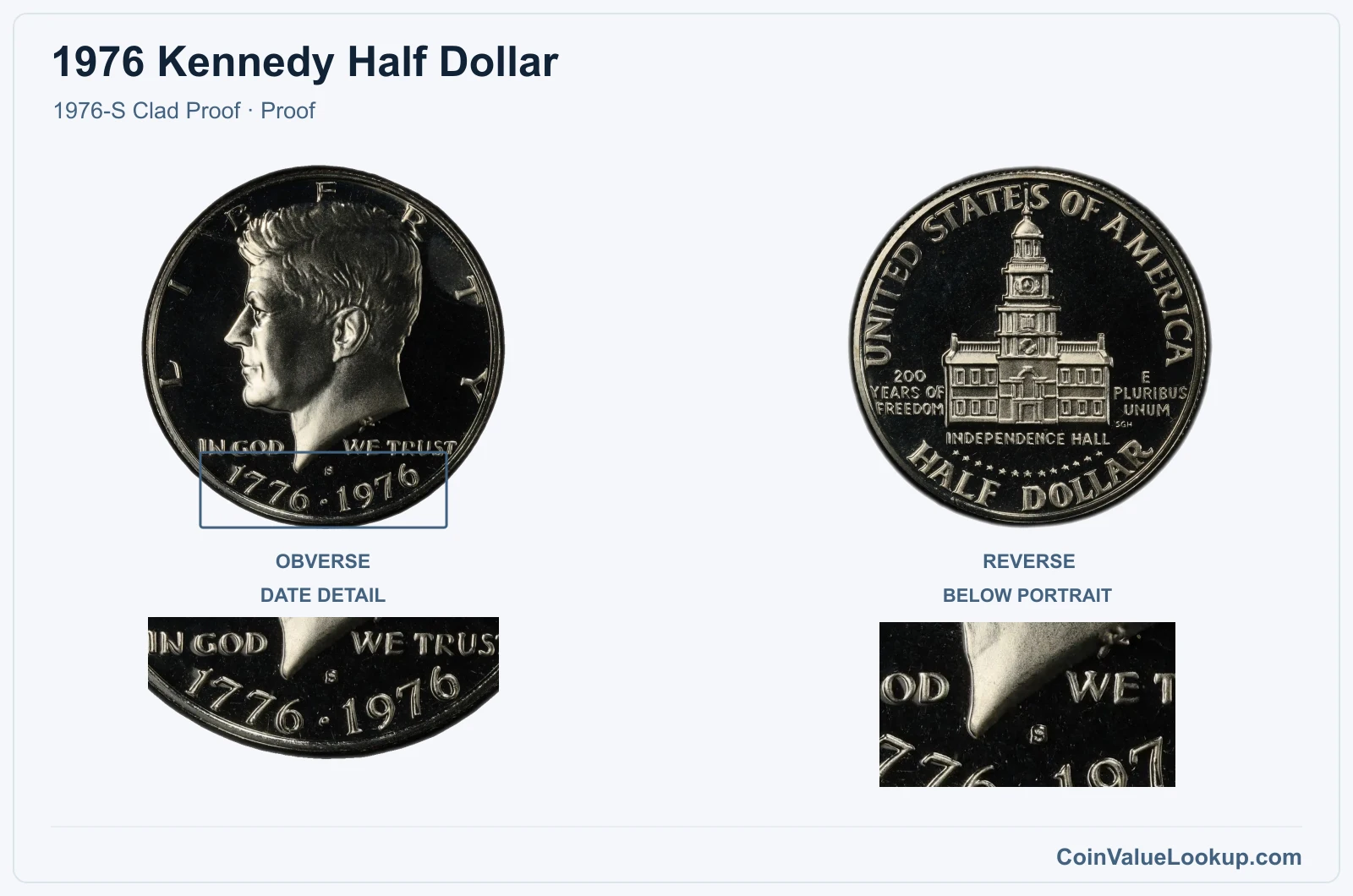
The 1976-S Clad Proof was struck at San Francisco using the same copper-nickel clad composition as the Philadelphia and Denver business strikes. It weighs about 11.34 grams.
The mirrored fields and sharp strike identify it as a proof, but the clad edge stripe confirms it is not silver.
A guide estimate from USA Coin Book places the PR65 value at roughly $4.96. These came in government proof sets and are common in high grades.
Hairlines and haze from mishandling are the main grade limiters.
| Range | Grade | Price | Auction Records | Appraisal |
|---|---|---|---|---|
| PR | PR 1 | — | Coin Identifier | |
| PR 2 | — | Coin Identifier | ||
| PR 3 | — | Coin Identifier | ||
| PR 4 | — | Coin Identifier | ||
| PR 6 | — | Coin Identifier | ||
| PR 8 | — | Coin Identifier | ||
| PR 10 | — | Coin Identifier | ||
| PR 12 | — | Coin Identifier | ||
| PR 15 | — | Coin Identifier | ||
| PR 20 | — | Coin Identifier | ||
| PR 25 | — | Coin Identifier | ||
| PR 30 | — | Coin Identifier | ||
| PR 35 | — | Coin Identifier | ||
| PR 40 | — | Coin Identifier | ||
| PR 45 | — | Coin Identifier | ||
| PR 50 | — | Coin Identifier | ||
| PR 53 | — | Coin Identifier | ||
| PR 55 | — | Coin Identifier | ||
| PR 58 | — | Coin Identifier | ||
| PR 60 | — | Coin Identifier | ||
| PR 61 | — | Coin Identifier | ||
| PR 62 | — | Coin Identifier | ||
| PR 63 | — | Coin Identifier | ||
| PR 64 | — | Coin Identifier | ||
| PR 65 | Coin Identifier | |||
| PR 66 | — | Coin Identifier | ||
| PR 67 | Coin Identifier | |||
| PR 68 | Coin Identifier | |||
| PR 69 | Coin Identifier | |||
| PR 70 | — | — | — |
1976 Kennedy Half Dollar — S 40% Silver Proof
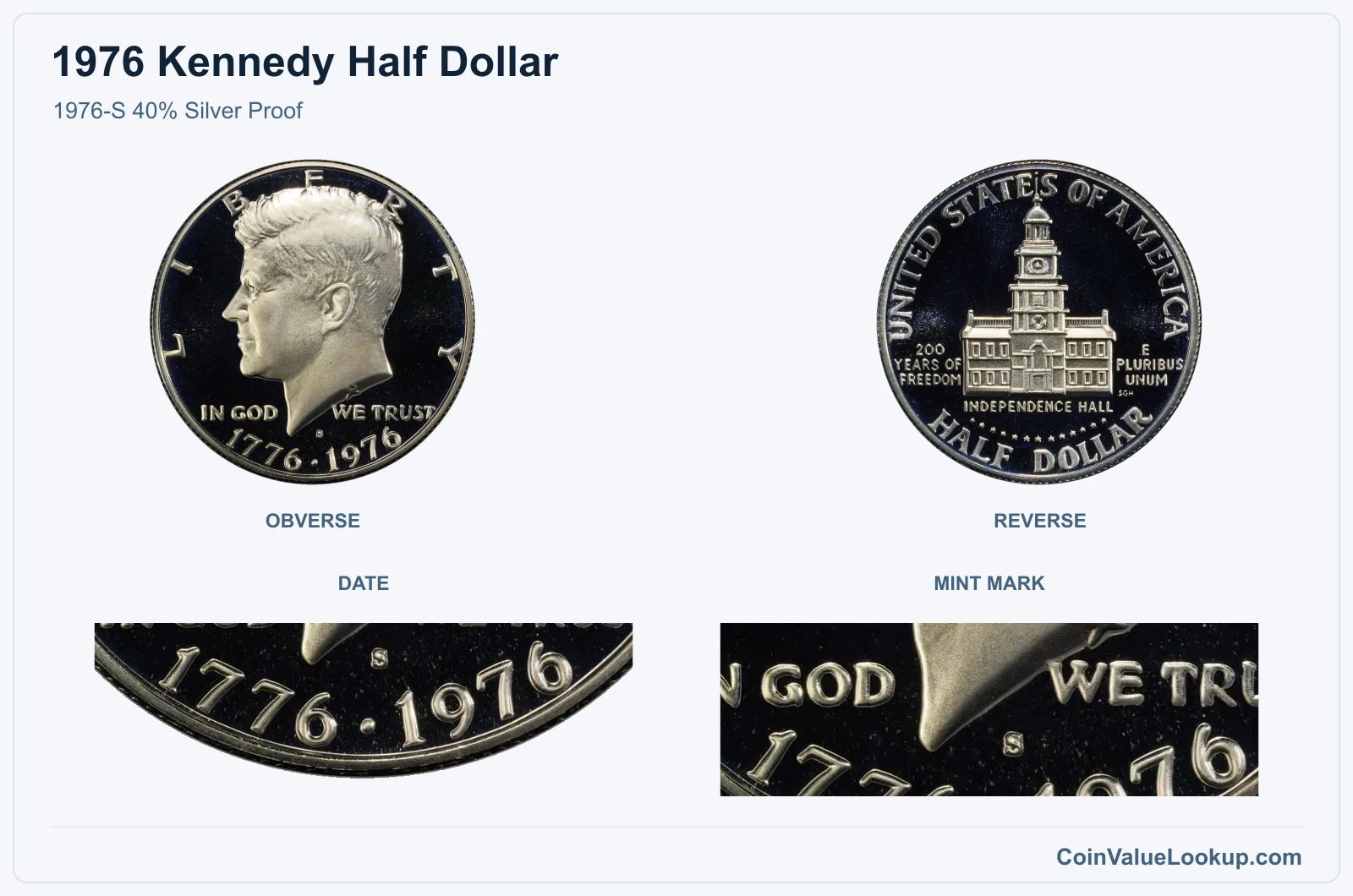
The 1976-S 40% Silver Proof combines the proof finish — mirrored fields, sharp frosted devices — with the 40% silver layered composition. It weighs approximately 11.50 grams.
These were sold in special three-coin silver proof sets by the U.S. Mint.
The USA Coin Book guide estimate is about $22 at PR65, the highest among the five normal branches at their respective listed grades. Deep cameo contrast examples may command additional interest, but cameo appearance alone does not prove silver content.
Always verify with weight and edge inspection.
Range Grade
Price Auction Records Appraisal PR PR 1
—
Coin Identifier
PR 2
—
Coin Identifier
PR 3
—
Coin Identifier
PR 4
—
Coin Identifier
PR 6
—
Coin Identifier
PR 8
—
Coin Identifier
PR 10
—
Coin Identifier
PR 12
—
Coin Identifier
PR 15
—
Coin Identifier
PR 20
—
Coin Identifier
PR 25
—
Coin Identifier
PR 30
—
Coin Identifier
PR 35
—
Coin Identifier
PR 40
—
Coin Identifier
PR 45
—
Coin Identifier
PR 50
—
Coin Identifier
PR 53
—
Coin Identifier
PR 55
—
Coin Identifier
PR 58
—
Coin Identifier
PR 60
—
Coin Identifier
PR 61
—
Coin Identifier
PR 62
—
Coin Identifier
PR 63
—
Coin Identifier
PR 64
—
Coin Identifier
PR 65
—
Coin Identifier
PR 66
Coin Identifier
PR 67
Coin Identifier
PR 68
Coin Identifier
PR 69
Coin Identifier
PR 70
Coin Identifier
Grade-by-grade pricing for the 1976-S silver proof is currently unavailable.
1976 Kennedy Half Dollar — Silver Uncirculated Doubled Die Obverse
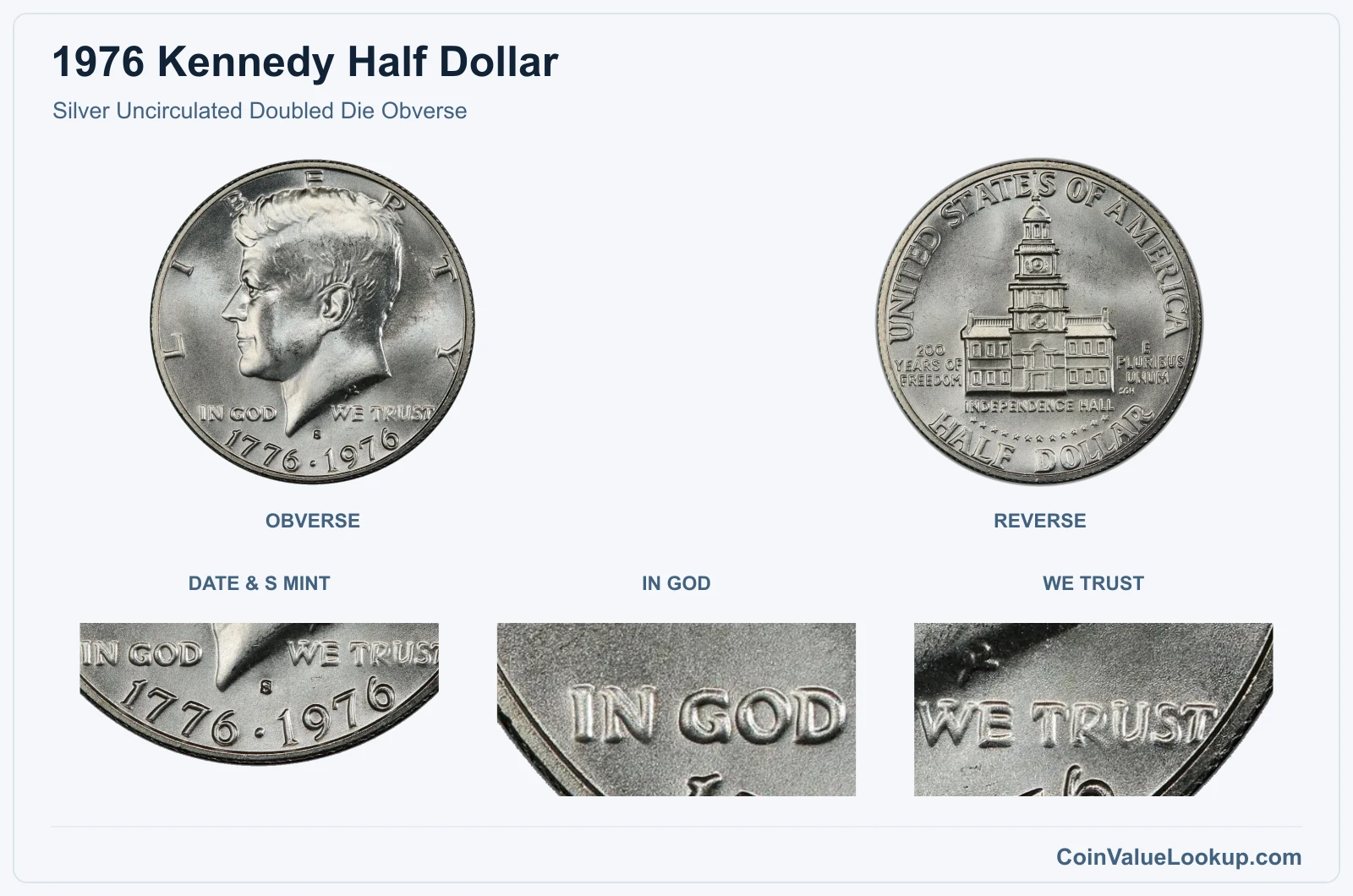
A recognized Doubled Die Obverse variety exists specifically on the 1976-S 40% silver uncirculated half dollar. The doubling is a relatively light, rounded spread most visible on the letters WE TRUST.
Do not assume every S-mint coin has this variety — it applies only to the silver uncirculated issue, not to clad proofs or silver proofs.
Historical sales recorded in the GreatCollections archive range from $39 to $405 across MS65 to MS67 grades. That is a past mixed-grade range, not a current quote for every specimen.
To check for this variety, compare your coin's WE TRUST lettering closely against a normal silver uncirculated example; the spread is subtle and requires magnification.
| Range | Grade | Price | Auction Records | Appraisal |
|---|---|---|---|---|
| PO | PO 1 | — | Coin Identifier | |
| FR | FR 2 | — | Coin Identifier | |
| AG | AG 3 | — | Coin Identifier | |
| G | G 4 | — | Coin Identifier | |
| G 6 | — | Coin Identifier | ||
| VG | VG 8 | — | Coin Identifier | |
| VG 10 | — | Coin Identifier | ||
| F | F 12 | — | Coin Identifier | |
| F 15 | — | Coin Identifier | ||
| VF | VF 20 | — | Coin Identifier | |
| VF 25 | — | Coin Identifier | ||
| VF 30 | — | Coin Identifier | ||
| VF 35 | — | Coin Identifier | ||
| XF | XF 40 | — | Coin Identifier | |
| XF 45 | — | Coin Identifier | ||
| AU | AU 50 | — | Coin Identifier | |
| AU 53 | — | Coin Identifier | ||
| AU 55 | — | Coin Identifier | ||
| AU 58 | — | Coin Identifier | ||
| MS | MS 60 | — | Coin Identifier | |
| MS 61 | — | Coin Identifier | ||
| MS 62 | — | Coin Identifier | ||
| MS 63 | — | Coin Identifier | ||
| MS 64 | — | Coin Identifier | ||
| MS 65 | — | Coin Identifier | ||
| MS 66 | Coin Identifier | |||
| MS 67 | Coin Identifier | |||
| MS 68 | Coin Identifier | |||
| MS 69 | — | — | — | |
| MS 70 | — | — | — |
1976 Kennedy Half Dollar Error List
1. 1976 Kennedy Half Dollar — Silver Uncirculated Doubled Die Obverse
This Doubled Die Obverse belongs to the 1976-S 40% silver uncirculated Kennedy half dollar. The hub doubling produces a light, rounded spread that is most visible on the motto WE TRUST.
You will need magnification to see it clearly.
Do not confuse this with machine doubling, which leaves flat, shelf-like secondary images rather than rounded spread. Glare, post-mint damage and separately double-struck coins can also mimic doubling at first glance.
The exact spread pattern must match the attributed variety.
Historical auction results at GreatCollections have ranged from $39 at MS65 to $405 at MS67. Those figures represent individual past sales across different grades, not a guaranteed price for any given coin.
Authentication by a third-party grading service is the standard way to confirm this variety.
2. 1976 Kennedy Half Dollar — Struck on a Quarter Blank
A documented example exists of a 1976 Bicentennial Kennedy half dollar struck on a quarter-sized blank planchet. The NGC-graded MS63 specimen weighs just 5.6 grams — far below the normal 11.34-gram clad half.
It carries the full dual-date 1776–1976 design and Independence Hall reverse, but with significant peripheral loss because the blank was too small.
This is not a Bicentennial quarter. The design is unmistakably the Kennedy half dollar, just squeezed onto the wrong planchet.
Watch out for coins that have been filed down, cut or plated after leaving the mint. Authenticated wrong-planchet errors show genuine struck surfaces with correct design elements.
Value depends on condition, visibility and authenticated identity, so individual assessment is necessary.
3. 1976 Kennedy Half Dollar — Off-Center Strike
A certified 1976-D Kennedy half dollar struck 50% off center has been documented, graded PCGS MS66. Half the coin shows the normal Bicentennial design while the other half is blank, unstruck planchet.
The D mintmark and dual date are visible on the struck portion.
This is not a slightly misaligned die impression or a broadstrike — 50% off center means a dramatic displacement. Post-mint cutting, filing or other alteration can create a similar look, so compare edge surfaces carefully.
Genuine off-center strikes retain full metal flow and undisturbed struck detail adjacent to the blank area. Each piece requires individual assessment based on the percentage of displacement, condition and how much identifying design remains visible.
4. 1976 Kennedy Half Dollar — Clipped Planchet
A 1976-D Kennedy half dollar with a 20% curved clip has been certified by a major grading service. The clip is a pre-strike defect — a crescent-shaped piece of the planchet was missing before the coin was struck.
You can see the metal flow and weakness near the clip boundary where the design fades.
A genuine curved clip has a smooth arc and often a corresponding area of weakness called the Blakesley effect on the opposite rim. Coins that have been cut, filed or damaged after minting will show tool marks, sharp edges or inconsistent metal flow.
Clip percentage alone does not set a price. Value depends on the size of the clip, overall condition and authenticated identity.
5. 1976 Kennedy Half Dollar — Struck Through Cloth
A 1976-D half dollar with a 60% obverse struck-through-cloth error has been certified PCGS MS65. About 60% of the obverse shows an impressed fabric texture where cloth was trapped between the die and the planchet during striking.
The remaining 40% displays normal design detail, and the transition between the two zones is visible.
Look closely with magnification: a genuine struck-through-cloth impression shows a regular woven pattern embedded into the coin's surface at the time of striking. Random scratches, abrasion or a textured impact after minting will not produce a consistent weave.
Value depends on the extent of the obstruction, condition and confirmed attribution through professional grading.
6. 1976 Kennedy Half Dollar — Triple Strike with Displaced Later Strikes
A 1976-S 40% silver uncirculated Kennedy half dollar struck three times has been cataloged, with the second and third strikes each displaced about 20% off center. The result is three overlapping impressions of Kennedy's portrait, the dual date and Independence Hall.
The S mintmark and silver composition are confirmed on this PCGS MS65 specimen.
Do not confuse this with the multiple aligned strikes used to manufacture proof coins — that is normal production. A genuine triple-strike error shows clear displacement between each impression.
Post-mint pressing or damage can mimic extra strikes, so authenticated examples with distinct design positions are the standard. Individual assessment based on displacement, clarity and condition determines value.
7. 1976 Kennedy Half Dollar — Brockage
A first-strike full brockage error has been reported on a 1976-D Kennedy half dollar. In a brockage, a previously struck coin sticks to a die and impresses its design in incuse mirror image onto the next coin struck.
One side shows a normal design while the other displays a sunken, reversed version.
Do not confuse a brockage with a die clash, which leaves faint ghost-like impressions without the full incuse relief. Coins pressed together outside the mint can also look similar but lack the characteristic metal flow of a genuine strike.
Condition, visibility of the brockage and authenticated identity all affect value, so each piece needs individual evaluation.
8. 1976 Kennedy Half Dollar — Lamination / Split Planchet
A reverse lamination error has been reported on a 1976-S silver Kennedy half dollar. A lamination occurs when layers within the planchet metal separate, creating a peeling flap, a missing chunk or a visible split.
On the silver version, this separation happens within the layered 40% silver alloy.
Photograph the edge alongside the affected reverse face to show the split clearly. This is different from surface scraping, corrosion or intentional cutting — a genuine lamination follows the metal's internal structure and typically has a ragged, natural appearance.
Value depends on the size and visibility of the lamination, the overall coin condition and confirmed attribution by a professional service.
9. 1976 Kennedy Half Dollar — Broadstrike
A broadstruck-out-of-collar error has been reported on a 1976 Kennedy half dollar. Normally the collar die constrains the coin during striking, forming the rim and maintaining diameter.
When the collar fails, the metal spreads outward freely, producing a coin that is wider than normal with a weakened or absent rim.
The full design is still present — this is not the same as an off-center strike where part of the design is missing. A coin flattened after minting may look spread out, but it will show distorted details and damage inconsistent with a single-moment strike event.
Authentic broadstrikes retain sharp design elements despite the wider profile. Condition, degree of spread and authenticated identity determine value.
10. 1976 Kennedy Half Dollar — Missing Clad Layer
A 1976-D Kennedy half dollar with the obverse clad layer missing has been reported. On a normal clad coin, copper-nickel layers cover a copper core.
When one layer is absent before striking, the exposed side may show a distinctly different color — typically a copper tone — and the coin will weigh less than the standard 11.34 grams.
Compare your coin's obverse color and edge carefully against a normal example. Toning, corrosion and after-market plating can mimic the appearance of an exposed core.
A genuine missing-clad error will show the weight difference and a clean, struck surface on the affected face. Condition, visibility and professional authentication all factor into value.
11. 1976 Kennedy Half Dollar — Die-Adjustment / Low-Pressure Strike
A die-adjustment strike error has been reported on a 1976 Kennedy half dollar. These occur during press setup when test strikes are made at reduced pressure, resulting in an overall weak impression on both faces.
The surfaces may appear unworn yet show incomplete design detail across the entire coin.
This looks a lot like a heavily worn coin or one struck through grease-filled dies. The key difference is that a die-adjustment strike shows uniformly weak detail on unworn, lustrous surfaces.
Circulation wear follows the highest points first, and grease fills tend to affect localized areas. Weak detail alone is not proof of an adjustment strike.
Value depends on condition, professional attribution and the specific characteristics of the piece.
12. 1976 Kennedy Half Dollar — Doubled Die Reverse
A Doubled Die Reverse variety has been reported on the 1976 Bicentennial Kennedy half dollar. This involves hub doubling on the reverse die, producing visible spread or doubling on the Independence Hall design and surrounding legends.
Compare your coin's reverse lettering and architectural details closely against a normal example.
Machine doubling — a common and much less valuable occurrence — creates flat, shelf-like secondary images rather than the rounded, separated profiles of true hub doubling. Reflections and random nicks can also fool the eye.
Use magnification and compare specific areas of the reverse legend. Value depends on the strength and visibility of the doubling, coin condition and professional authentication.