1858 Liberty Seated Half Dollar Coin Value: How Much Is It Worth?
The 1858 Liberty Seated Half Dollar is a 90% silver coin struck at up to three mints. Guide estimates for ordinary Philadelphia or New Orleans circulation strikes run from about $79 in G4 to $456 in AU50.
San Francisco pieces carry slightly higher guides, and Proofs occupy their own tier. Your coin's actual worth depends on its mint, reverse type, grade and surface condition.
Fast Way to Identify Your 1858 Liberty Seated Half Dollar
Snap a clear photo of the front and back of your 1858 half dollar and upload both images here. This gives you a preliminary identification of mint, reverse type and approximate condition.
It is not a substitute for professional authentication or certified grading, but it is a solid starting point before you dig deeper.
1858 Liberty Seated Half Dollar Value
Upload both sides of your 1858 Liberty Seated Half Dollar.
Front Obverse
Upload photo
Back Reverse
Upload photo
Which 1858 Liberty Seated Half Dollar Versions Are Worth Money?
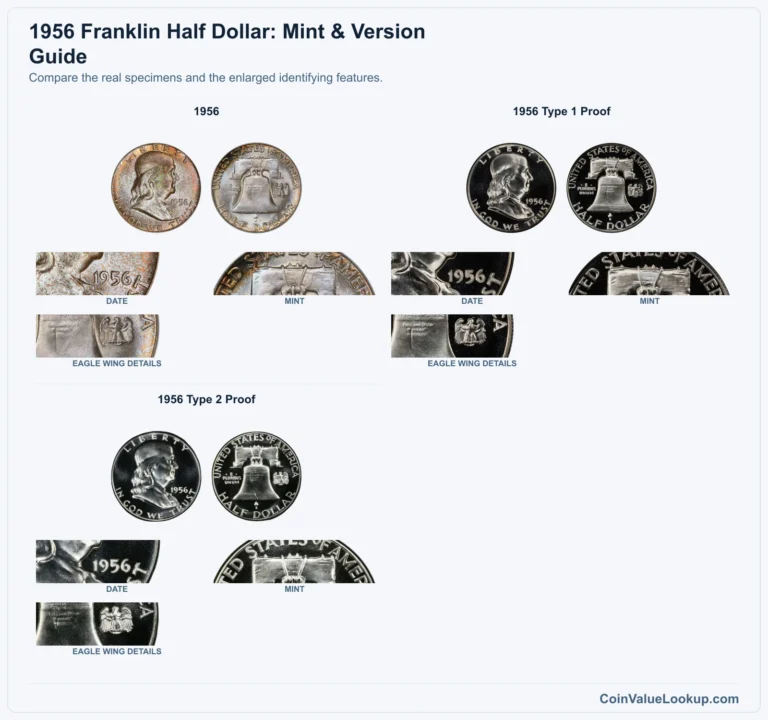
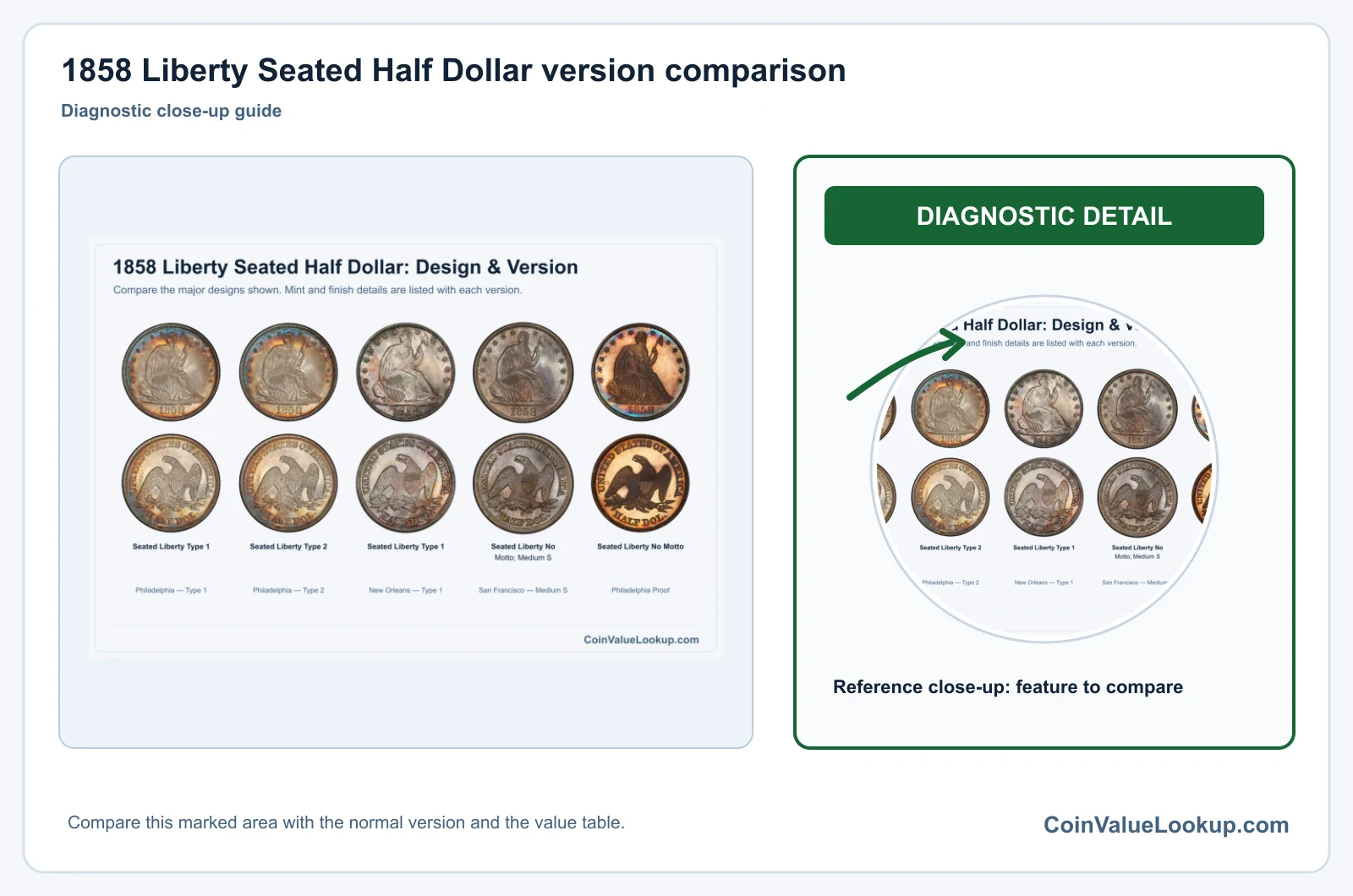
- Philadelphia coins exist with two reverse hub types (Type 1 and Type 2); check the base of the L in HALF and the eagle's left leg area.
- San Francisco issues with the Medium S mintmark carry higher guide estimates than Philadelphia or New Orleans at every grade level surveyed.
- Proofs are rare survivors struck on polished planchets; a confirmed PR63 example carries a guide value around $2,786.
- Several die errors are reported for 1858, including doubled die obverse, repunched date, misplaced date and lamination flaws, each of which can affect value depending on visibility and condition.
Step 1: Identify Your 1858 Liberty Seated Half Dollar Mint Mark and Version
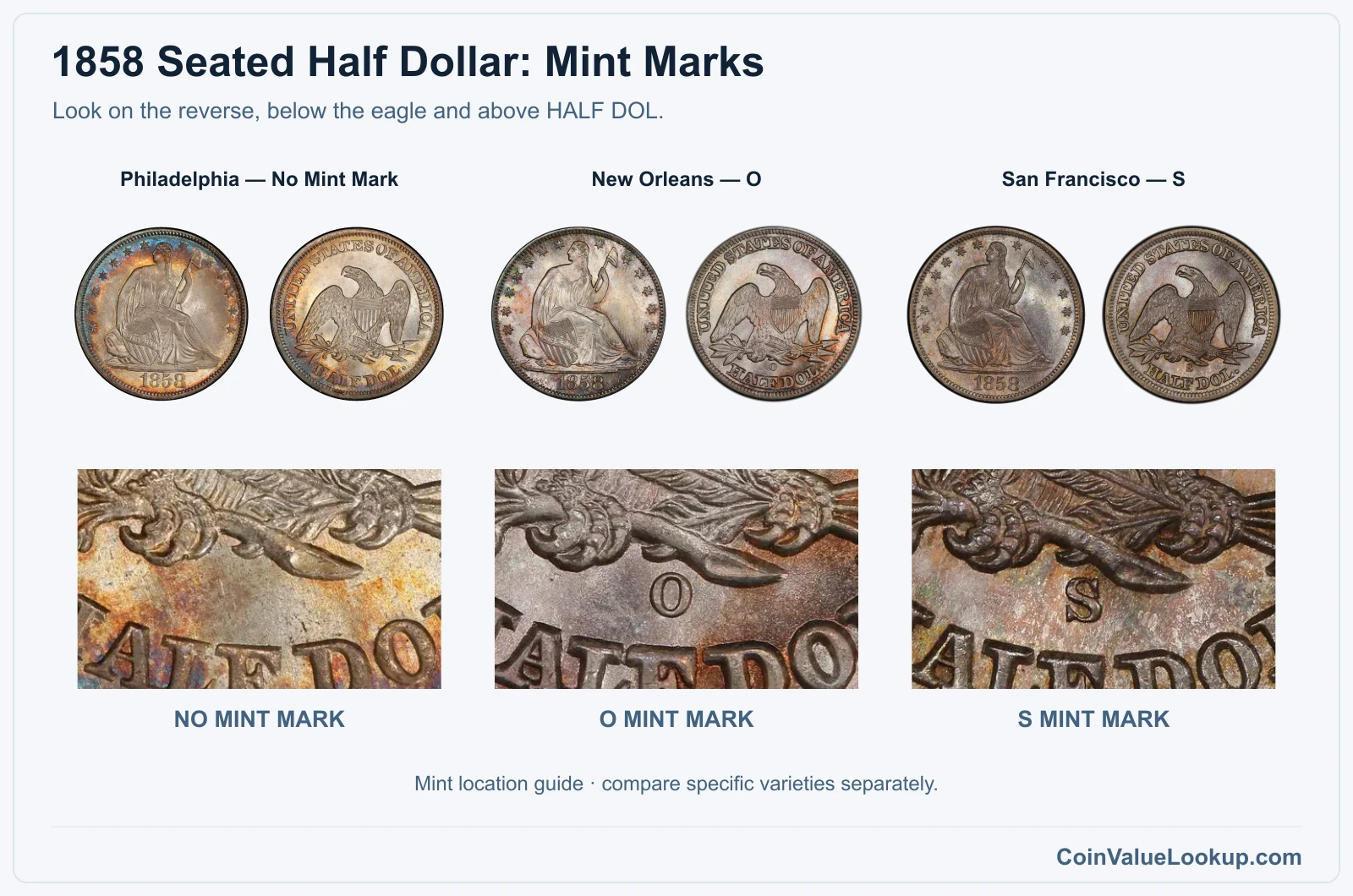
First, confirm you are looking at a half dollar by reading HALF DOL. on the reverse.
Half dimes, quarters and dollars from this era share the Seated Liberty design and can fool you at a glance.
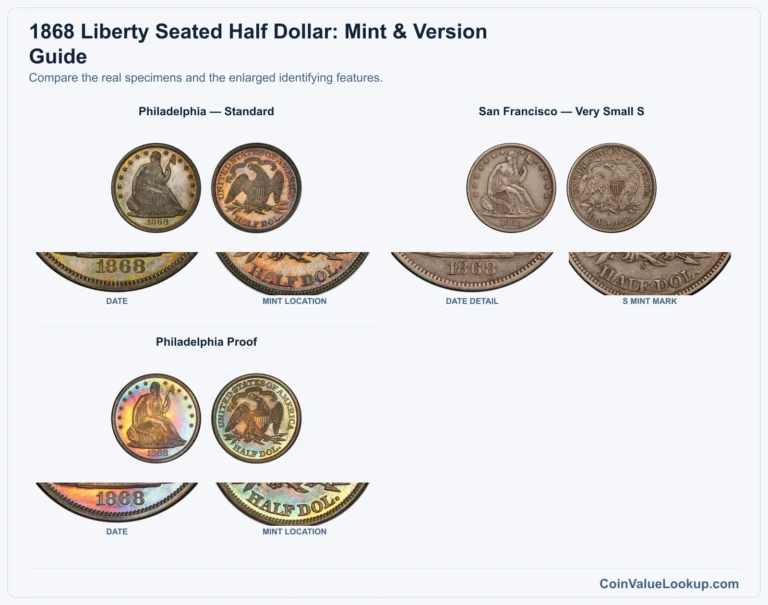
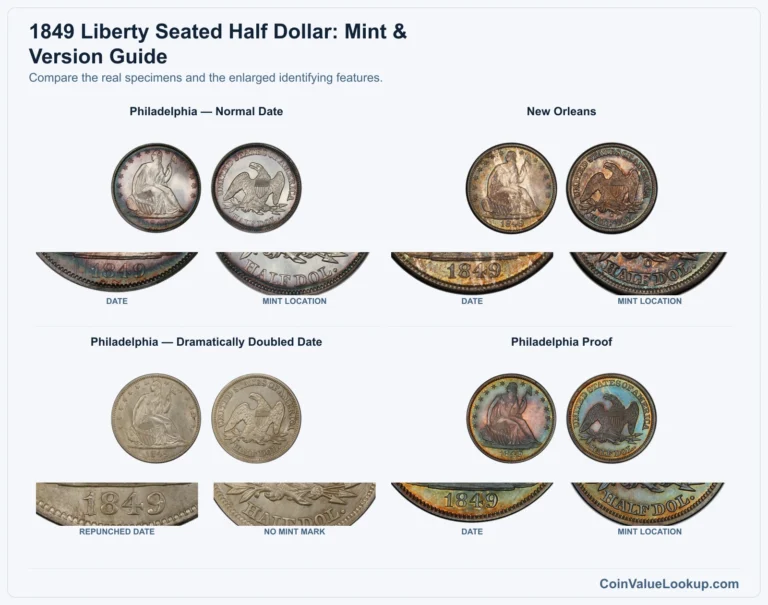
Flip the coin over and look below the eagle. No mintmark means Philadelphia.
An "O" means New Orleans. An "S" means San Francisco.
All 1858 half dollars are struck in 90% silver and 10% copper, weigh about 12.44 grams and have a reeded edge. There is no motto above the eagle; that feature did not appear until 1866.
Philadelphia produced two reverse hub types this year. Type 1 has a short base on the letter L in HALF and no lump near the eagle's left leg.
Type 2 shows a longer L base and a small lump beside the eagle's left leg. Neither is an error; they are simply different hubs used during the same production year.
Proof and Specimen are manufacturing finishes, not grades above Mint State. A bright coin is not automatically a Proof.
Step 2: Check Your 1858 Liberty Seated Half Dollar Grade
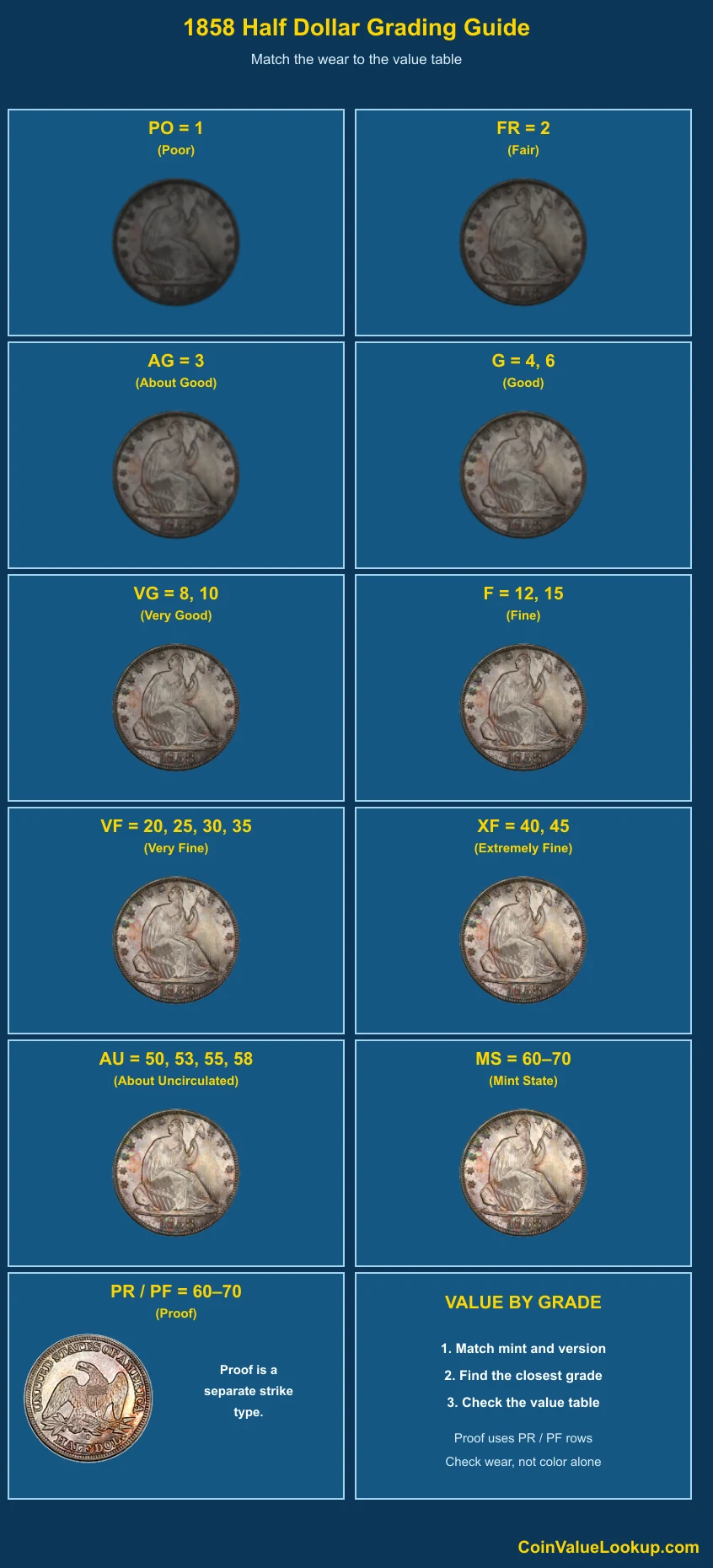
Start with Liberty's head on the obverse. Hair detail above the ear and along the cap disappears early.
Next check the breast, the knee and the horizontal lines on the shield; these are the first high points to show wear.
On the reverse, look at the eagle's head, neck feathers and wing tips. Flat spots there confirm circulation.
Do not confuse a weak strike with wear. A weakly struck coin may still show original mint luster in protected areas, while a worn coin loses that sheen uniformly.
Compare your coin to the grading image provided; surface texture and remaining luster across both faces tell the story better than any single detail.
Always examine the edge and fields under good light. Cleaning, whizzing, scratches and environmental damage all reduce a coin's value regardless of remaining detail.
Step 3: Check 1858 Liberty Seated Half Dollar Value by Mint and Version
1858 Liberty Seated Half Dollar — Philadelphia — Type 1
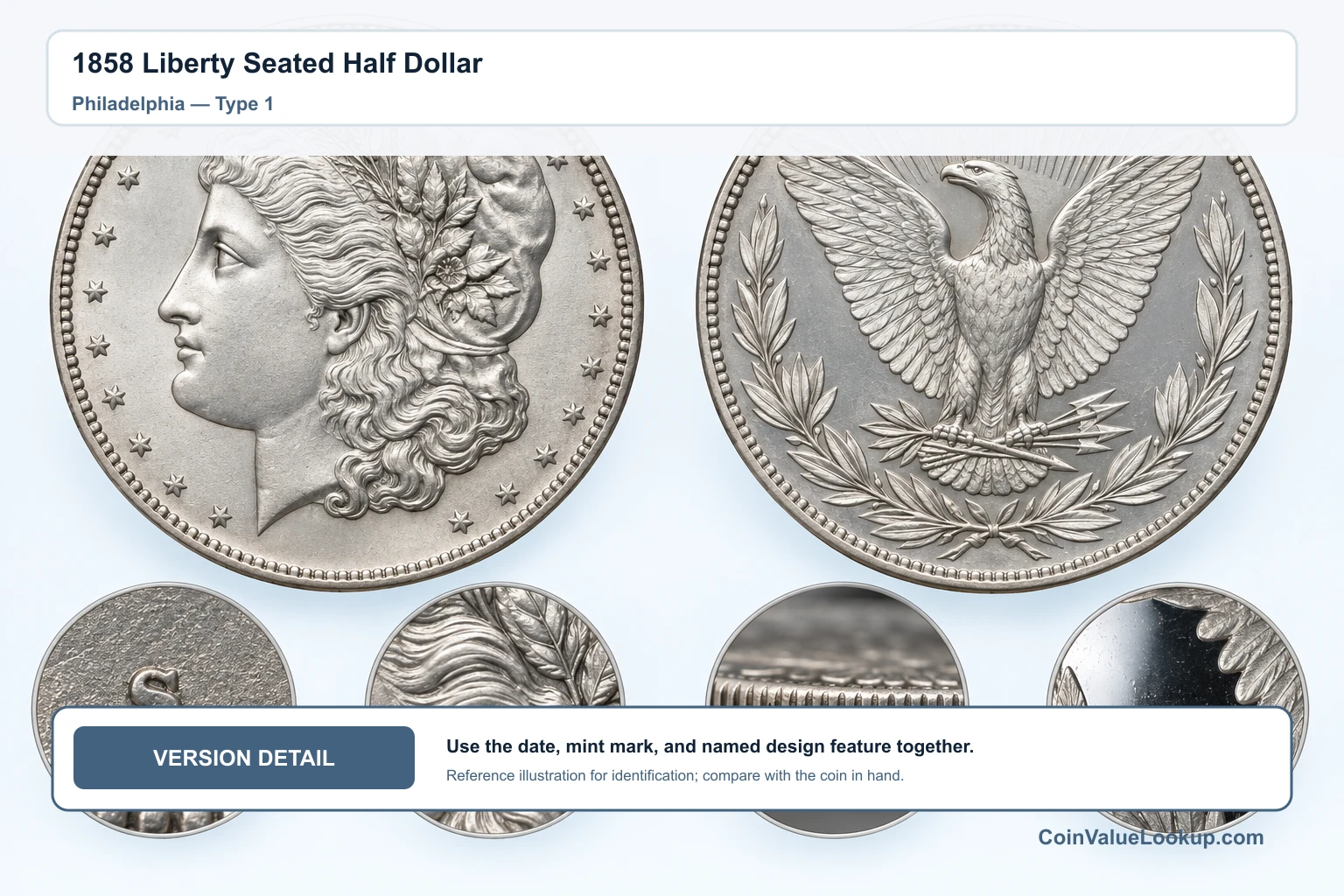
The Philadelphia Type 1 uses the older reverse hub with a short base on the L in HALF and no extra lump near the eagle's left leg. Because both hubs were used at Philadelphia in 1858, you need to examine the reverse carefully.
USA Coin Book guide estimates for aggregate Philadelphia strikes are about $79 in G4, $236 in VF20 and $456 in AU50. No separate premium for Type 1 versus Type 2 is adopted in the current guide data, so these figures cover both hubs equally.
A coin with full shield lines and original toning will always command more attention than a cleaned example at the same technical grade.
Ordinary-issue reference: Ordinary-issue reference only: The table below shows prices for the 1858 Liberty Seated Half Dollar (regular strike). It does not represent the value of the specific Philadelphia — Type 1 variety or its variety premium. Year, mint, metal and strike type are matched; the specific variety is not priced by this table.
Range Grade
Price Auction Records Appraisal PO PO 1
—
Coin Identifier FR FR 2
—
Coin Identifier AG AG 3
—
Coin Identifier G G 4
—
Coin Identifier
G 6
—
Coin Identifier VG VG 8
—
Coin Identifier
VG 10
Coin Identifier F F 12
—
Coin Identifier
F 15
Coin Identifier VF VF 20
Coin Identifier
VF 25
Coin Identifier
VF 30
Coin Identifier
VF 35
Coin Identifier XF XF 40
Coin Identifier
XF 45
Coin Identifier AU AU 50
Coin Identifier
AU 53
Coin Identifier
AU 55
Coin Identifier
AU 58
Coin Identifier MS MS 60
Coin Identifier
MS 61
Coin Identifier
MS 62
Coin Identifier
MS 63
Coin Identifier
MS 64
Coin Identifier
MS 65
Coin Identifier
MS 66
Coin Identifier
MS 67
—
—
—
MS 68
—
—
—
MS 69
—
—
—
MS 70
—
—
—
1858 Liberty Seated Half Dollar — Philadelphia — Type 2
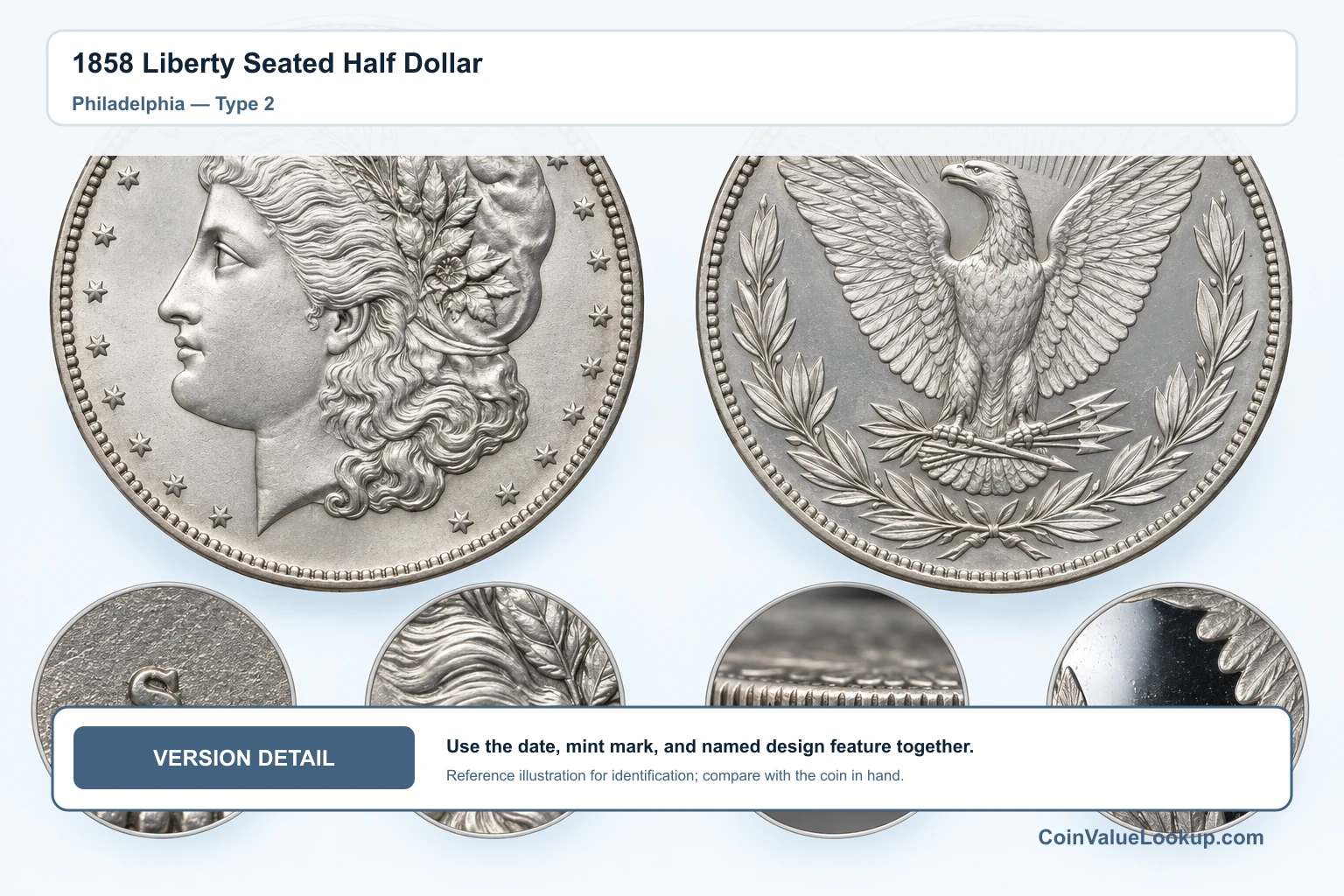
The Philadelphia Type 2 reverse is identified by a longer base on the L in HALF and a small lump of metal beside the eagle's left leg. Both details are visible under moderate magnification, and comparing the two hub types side by side makes the distinction obvious.
Guide estimates are shared with the Type 1: roughly $79 at G4, $236 at VF20 and $456 at AU50 per USA Coin Book. No subtype-specific premium has been adopted.
If you are building a type set, owning one of each hub from 1858 Philadelphia is a clean way to represent the transition year.
Coin Value Lookup is a good place to start when you want to look up guides for other Seated Liberty dates or denominations across the series.
Ordinary-issue reference: Ordinary-issue reference only: The table below shows prices for the 1858 Liberty Seated Half Dollar (regular strike). It does not represent the value of the specific Philadelphia — Type 2 variety or its variety premium. Year, mint, metal and strike type are matched; the specific variety is not priced by this table.
Range Grade
Price Auction Records Appraisal PO PO 1
—
Coin Identifier FR FR 2
—
Coin Identifier AG AG 3
—
Coin Identifier G G 4
—
Coin Identifier
G 6
—
Coin Identifier VG VG 8
—
Coin Identifier
VG 10
Coin Identifier F F 12
—
Coin Identifier
F 15
Coin Identifier VF VF 20
Coin Identifier
VF 25
Coin Identifier
VF 30
Coin Identifier
VF 35
Coin Identifier XF XF 40
Coin Identifier
XF 45
Coin Identifier AU AU 50
Coin Identifier
AU 53
Coin Identifier
AU 55
Coin Identifier
AU 58
Coin Identifier MS MS 60
Coin Identifier
MS 61
Coin Identifier
MS 62
Coin Identifier
MS 63
Coin Identifier
MS 64
Coin Identifier
MS 65
Coin Identifier
MS 66
Coin Identifier
MS 67
—
—
—
MS 68
—
—
—
MS 69
—
—
—
MS 70
—
—
—
1858 Liberty Seated Half Dollar — New Orleans — Type 1
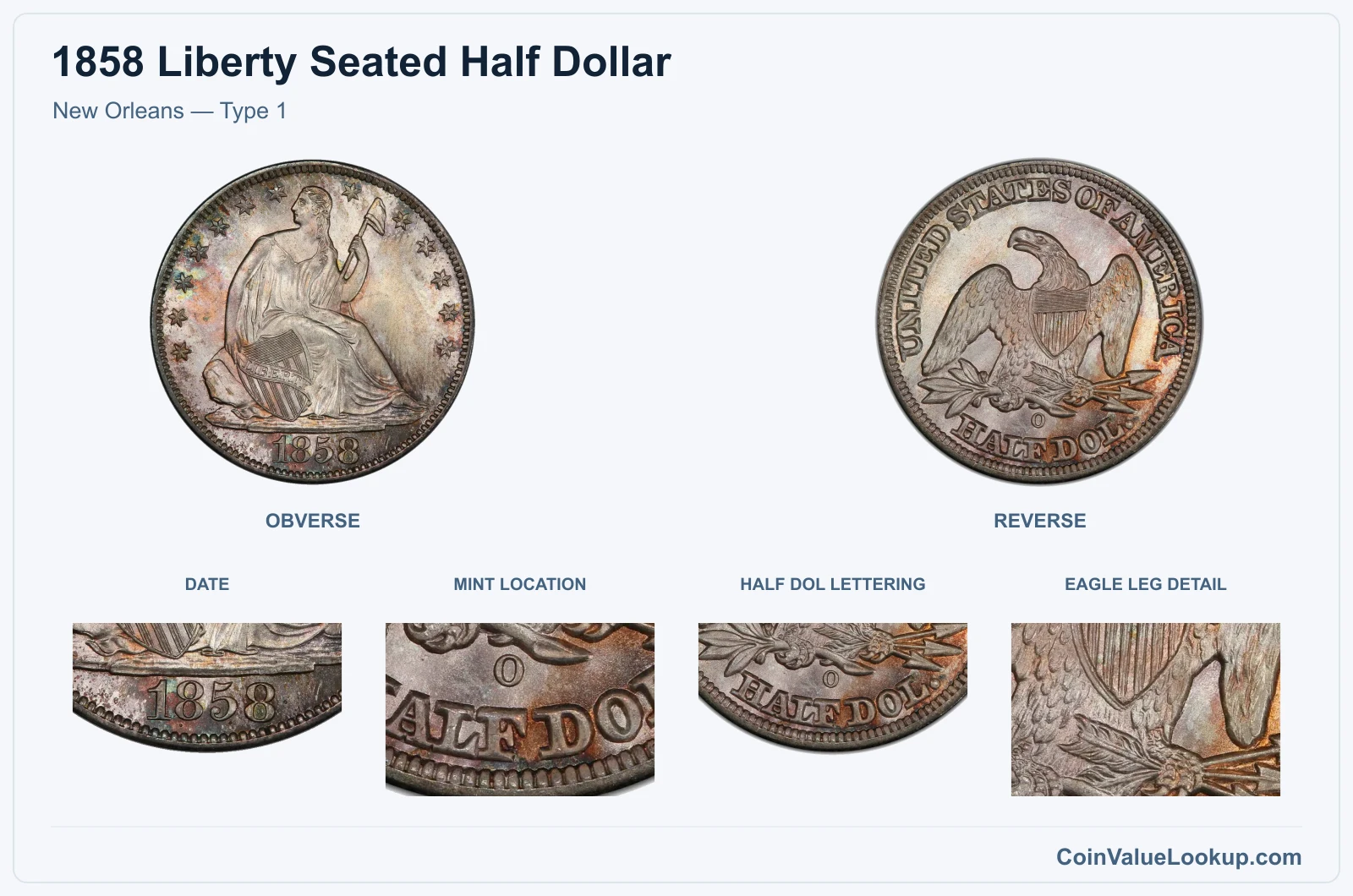
New Orleans coins carry a small "O" mintmark below the eagle on the reverse. Only Type 1 reverses are documented for the 1858-O in the supplied references.
Guide estimates from USA Coin Book align with Philadelphia aggregate figures: about $79 in G4, $236 in VF20 and $456 in AU50. No subtype premium is adopted.
Some 1858-O half dollars surface from shipwreck recoveries, which affects their surfaces and provenance story but does not change the metal composition or finish classification. Corrosion, salt deposits or conservation treatment should be evaluated on its own terms rather than treated as normal wear.
Ordinary-issue reference: Ordinary-issue reference only: The table below shows prices for the 1858-O Liberty Seated Half Dollar (regular strike). It does not represent the value of the specific New Orleans — Type 1 variety or its variety premium. Year, mint, metal and strike type are matched; the specific variety is not priced by this table.
Range Grade
Price Auction Records Appraisal PO PO 1
—
Coin Identifier FR FR 2
—
Coin Identifier AG AG 3
Coin Identifier G G 4
—
Coin Identifier
G 6
—
Coin Identifier VG VG 8
—
Coin Identifier
VG 10
Coin Identifier F F 12
Coin Identifier
F 15
Coin Identifier VF VF 20
Coin Identifier
VF 25
Coin Identifier
VF 30
Coin Identifier
VF 35
Coin Identifier XF XF 40
Coin Identifier
XF 45
Coin Identifier AU AU 50
Coin Identifier
AU 53
Coin Identifier
AU 55
Coin Identifier
AU 58
Coin Identifier MS MS 60
Coin Identifier
MS 61
Coin Identifier
MS 62
Coin Identifier
MS 63
Coin Identifier
MS 64
Coin Identifier
MS 65
Coin Identifier
MS 66
Coin Identifier
MS 67
—
—
—
MS 68
—
—
—
MS 69
—
—
—
MS 70
—
—
—
1858 Liberty Seated Half Dollar — San Francisco — Medium S
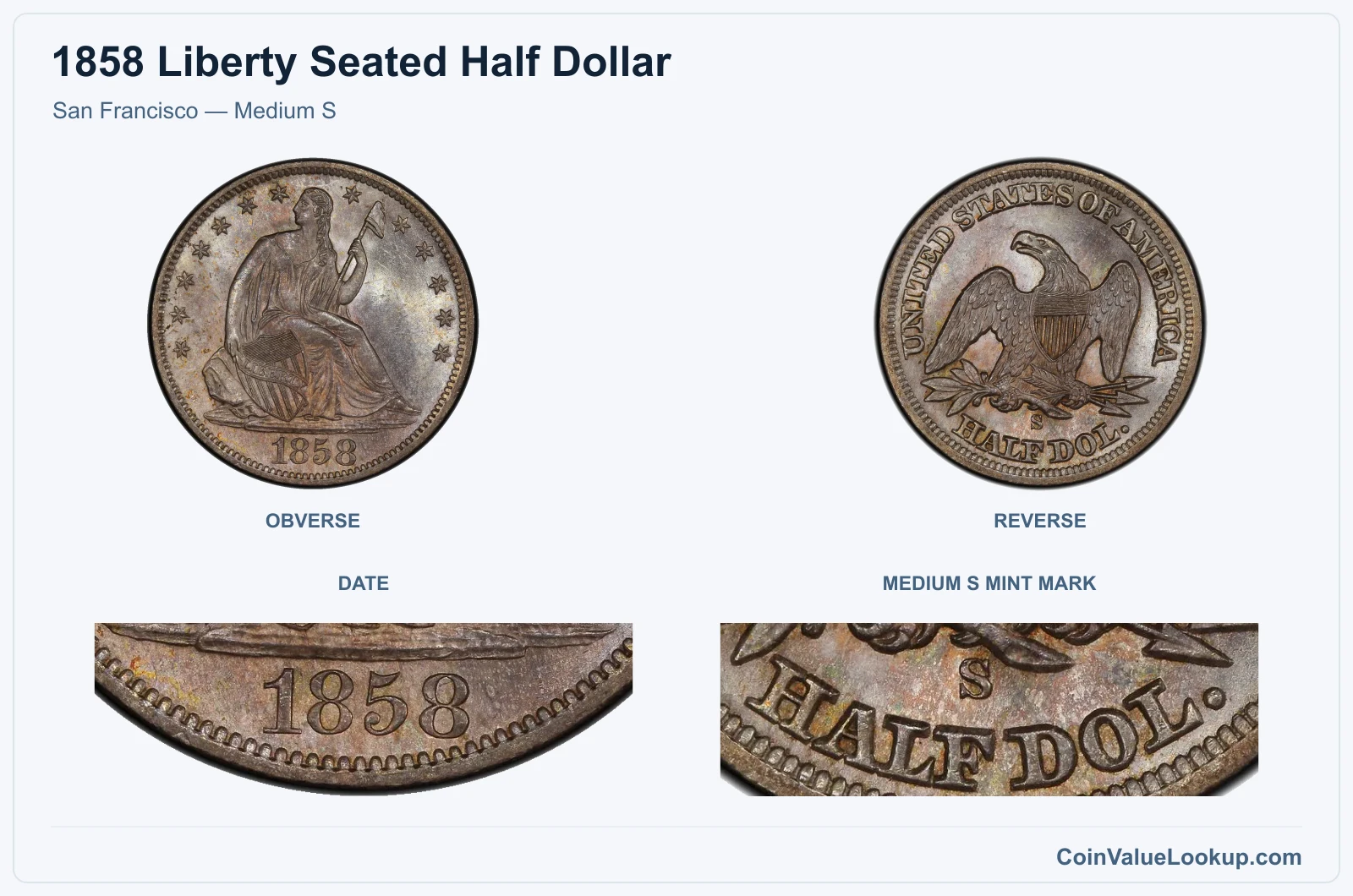
San Francisco struck 1858 half dollars with a Medium S mintmark positioned below the eagle. A small or slightly broken punch is a mintmark style, not evidence of a removed or altered mark.
The S-mint carries higher guide estimates than Philadelphia or New Orleans this year. USA Coin Book lists approximately $91 at G4, $267 at VF20 and $739 at AU50.
These are aggregate S-mint figures, not subtype-specific quotes. The jump at AU50 reflects lower survival rates in upper grades, which makes original, problem-free examples particularly appealing to collectors who specialize in San Francisco issues from this period.
Ordinary-issue reference: Ordinary-issue reference only: The table below shows prices for the 1858-S Liberty Seated Half Dollar (regular strike). It does not represent the value of the specific San Francisco — Medium S variety or its variety premium. Year, mint, metal and strike type are matched; the specific variety is not priced by this table.
Range Grade
Price Auction Records Appraisal PO PO 1
—
Coin Identifier FR FR 2
—
Coin Identifier AG AG 3
—
Coin Identifier G G 4
—
Coin Identifier
G 6
—
Coin Identifier VG VG 8
Coin Identifier
VG 10
Coin Identifier F F 12
Coin Identifier
F 15
Coin Identifier VF VF 20
Coin Identifier
VF 25
Coin Identifier
VF 30
Coin Identifier
VF 35
Coin Identifier XF XF 40
Coin Identifier
XF 45
Coin Identifier AU AU 50
Coin Identifier
AU 53
Coin Identifier
AU 55
Coin Identifier
AU 58
Coin Identifier MS MS 60
—
Coin Identifier
MS 61
Coin Identifier
MS 62
Coin Identifier
MS 63
Coin Identifier
MS 64
Coin Identifier
MS 65
Coin Identifier
MS 66
Coin Identifier
MS 67
—
—
—
MS 68
—
—
—
MS 69
—
—
—
MS 70
—
—
—
1858 Liberty Seated Half Dollar — Philadelphia Proof
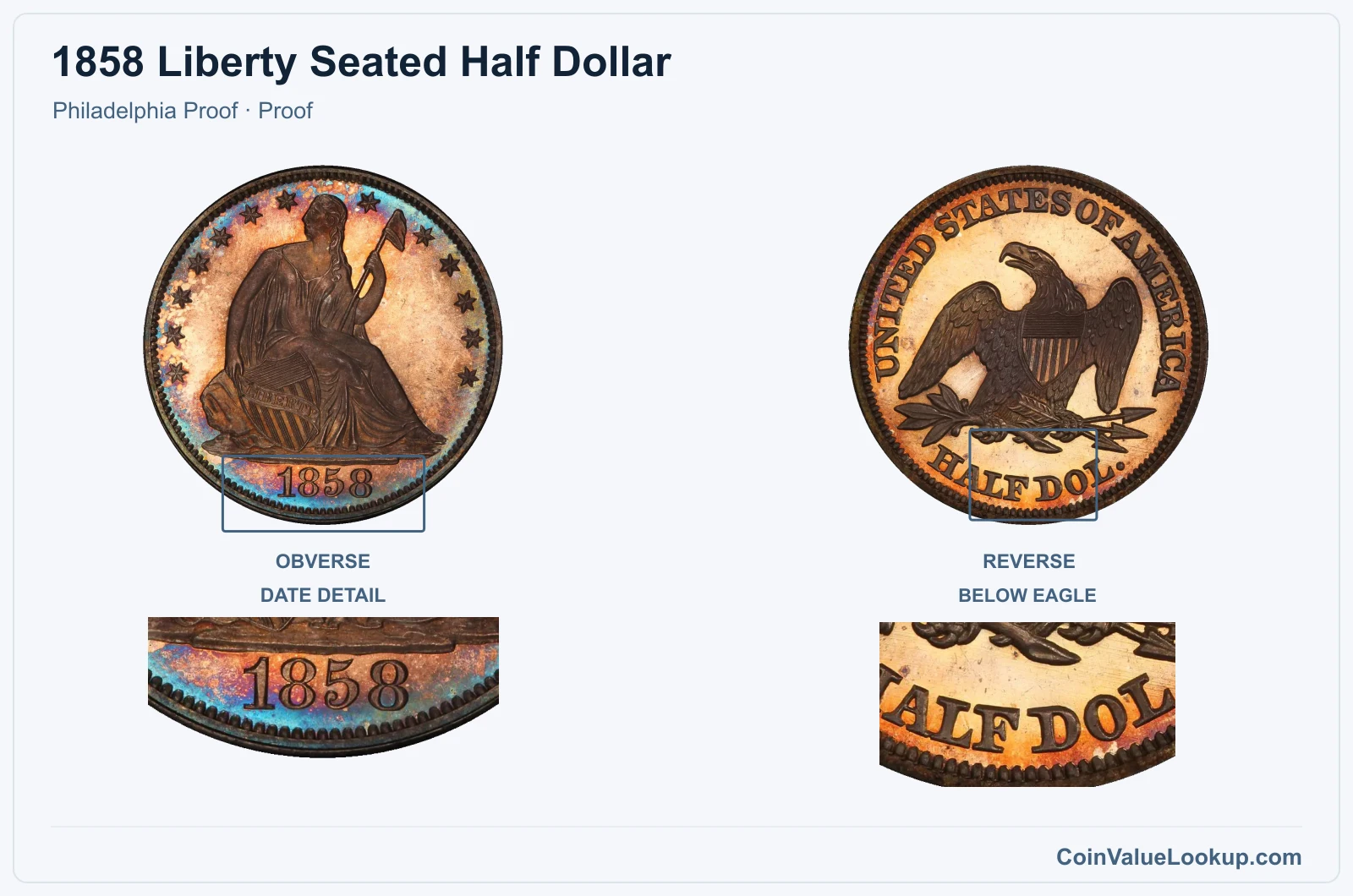
Philadelphia Proof half dollars from 1858 were struck in very small quantities on polished planchets with specially prepared dies. Genuine Proofs show mirror-like fields, sharp squared rims and full detail on every device.
Do not assume brightness alone means Proof; lightly cleaned circulation strikes can mimic reflective surfaces under casual inspection.
A guide estimate from USA Coin Book places a PR63 example at around $2,786. Cameo and deep cameo designations exist within the Proof branch but do not represent separate design types.
Because so few were made, any confirmed 1858 Proof half dollar is a significant coin, and professional certification is essential before paying Proof-level prices.
Range Grade
Price Auction Records Appraisal PR PR 1
—
Coin Identifier
PR 2
—
Coin Identifier
PR 3
—
Coin Identifier
PR 4
—
Coin Identifier
PR 6
—
Coin Identifier
PR 8
—
Coin Identifier
PR 10
—
Coin Identifier
PR 12
—
Coin Identifier
PR 15
—
Coin Identifier
PR 20
—
Coin Identifier
PR 25
—
Coin Identifier
PR 30
—
Coin Identifier
PR 35
—
Coin Identifier
PR 40
—
Coin Identifier
PR 45
—
Coin Identifier
PR 50
—
Coin Identifier
PR 53
—
Coin Identifier
PR 55
—
Coin Identifier
PR 58
—
Coin Identifier
PR 60
Coin Identifier
PR 61
Coin Identifier
PR 62
Coin Identifier
PR 63
Coin Identifier
PR 64
Coin Identifier
PR 65
Coin Identifier
PR 66
Coin Identifier
PR 67
Coin Identifier
PR 68
—
—
—
PR 69
—
—
—
PR 70
—
—
—
1858 Liberty Seated Half Dollar Error List
1. 1858 Liberty Seated Half Dollar — Doubled Die Obverse
A doubled die obverse has been reported for the 1858 half dollar. The Philadelphia example shows doubling on the left outline of the shield, the ribbon end, the left rock base and the lower portion of Liberty's dress.
These are the areas to examine under at least 5x magnification.
Machine doubling and die reflections can create similar-looking shelf marks, but true hub doubling is raised and follows the contour of the original design element rather than appearing as flat, shelf-like displacement. Compare your coin to a confirmed example before drawing conclusions.
No specific price range has been adopted for this variety. Value depends on the clarity of the doubling, the coin's overall grade and surface preservation.
Professional attribution adds confidence for both buyer and seller.
2. 1858 Liberty Seated Half Dollar — Repunched Date
Repunched dates are recorded for the 1858 Philadelphia half dollar. Look for remnants of a previous date punch position visible as extra lines, curves or shadows near one or more of the numerals 1, 8, 5 or 8.
These remnants sit slightly offset from the final digits.
Do not confuse a repunched date with an overdate. An overdate involves a different numeral entirely, while a repunched date is the same digit struck in a slightly different position.
Damaged dates and machine doubling can also mimic repunching, so compare carefully against documented examples.
No adopted price range exists for this variety. The value a repunched date adds depends on how visible the extra impression is, which numerals are affected and the coin's condition.
3. 1858 Liberty Seated Half Dollar — Misplaced Date
Misplaced date varieties are documented for the 1858 half dollar. On certain dies, a partial digit — reported as part of an "8" on the New Orleans issue — appears embedded in the rock below Liberty rather than confined to the date area.
This happens when the date punch first strikes in the wrong location before being repositioned correctly.
Be careful not to confuse scratches, die polish lines, tooling marks or worn surfaces with a genuine misplaced digit. The remnant should match the curve or serif of one of the date numerals.
No price data has been adopted for this variety. How much it adds depends on which digit is misplaced, how clearly it shows and the coin's overall grade.
Always compare against a documented specimen from the same mint.
4. 1858 Liberty Seated Half Dollar — Lamination / Split Planchet
Lamination or split planchet flaws have been reported for the 1858 half dollar. These occur when a layer of the silver alloy separates from the rest of the planchet, leaving a raised flap, a missing patch of metal or a crack-like seam on the surface.
Genuine lamination flaws show smooth underlying metal where the layer lifted. They are distinct from post-mint scrapes, corrosion pits or deliberate cuts, all of which leave rougher, more irregular surfaces.
Look at the edge of the affected area: a true lamination peels away in a thin sheet rather than gouging into the coin.
No numerical price range has been adopted for this error. Value hinges on the size and location of the flaw, the coin's grade and whether the separated layer is still attached or missing entirely.