1988 Kennedy Half Dollar Coin Value: How Much Is It Worth?
The 1988 Kennedy half dollar carries a face value of 50 cents, and most circulated clad examples are worth exactly that. Before you toss one in a jar, though, it pays to check the mint, finish and condition.
Collector guide estimates for well-preserved or proof examples range from roughly $4.96 to $6.25 at specific grades, depending on the mint and finish. Proofs, high-grade originals and mint-made errors each follow their own pricing path, so identifying what you actually have is the first step.
Fast Way to Identify Your 1988 Kennedy Half Dollar
The quickest way to start figuring out what your 1988 Kennedy half is worth is to upload clear photos of both sides of the coin. A front-and-back image lets us provide a preliminary identification of the mint, finish and general condition.
Snap the photos in even lighting, avoid glare, and try to keep the coin flat and centered in the frame.
1988 Kennedy Half Dollar Value
Upload both sides of your 1988 Kennedy Half Dollar.
Front Obverse
Upload photo
Back Reverse
Upload photo
Which 1988 Kennedy Half Dollar Versions Are Worth Money?
- Check the mintmark first: P, D and S versions each have their own value track at different grades.
- San Francisco proof coins with clean, hairline-free surfaces tend to be the most collectible 1988 half dollar finish.
- Well-preserved Philadelphia business strikes graded MS65 carry a USA Coin Book guide estimate of $6.25, higher than the Denver or proof counterparts at the same listed grades.
- Reported mint errors such as doubled dies, off-center strikes and missing FG initials can affect value, but condition, visibility and authentication all matter.
Step 1: Identify Your 1988 Kennedy Half Dollar Mint Mark and Version
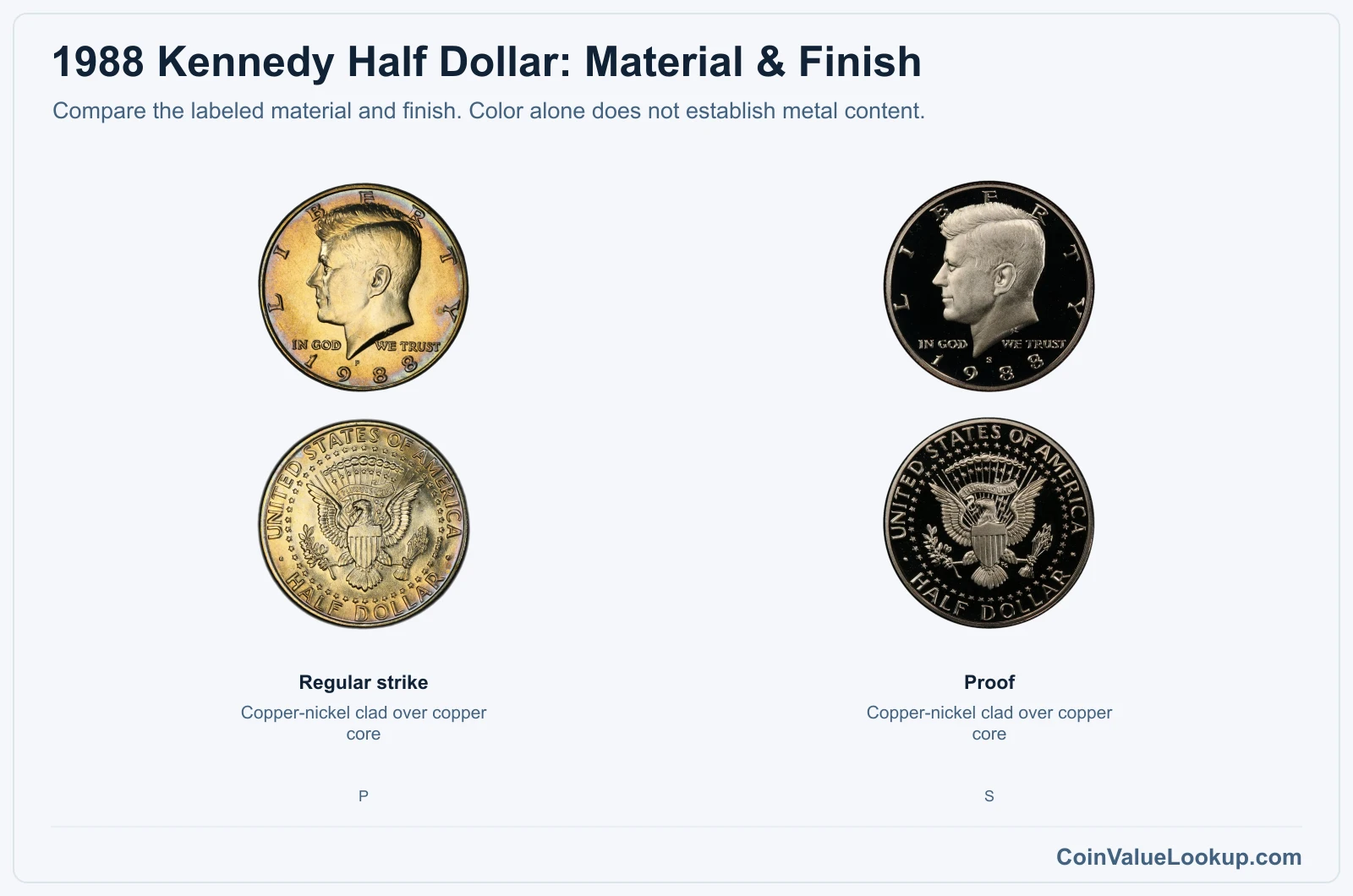
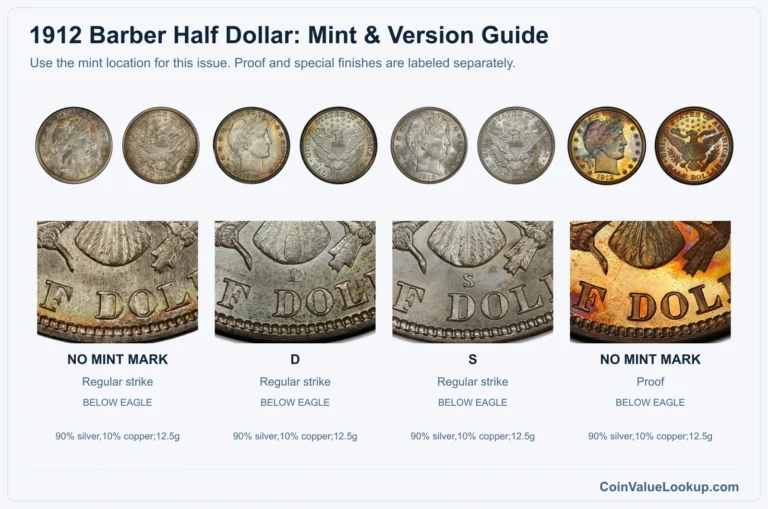
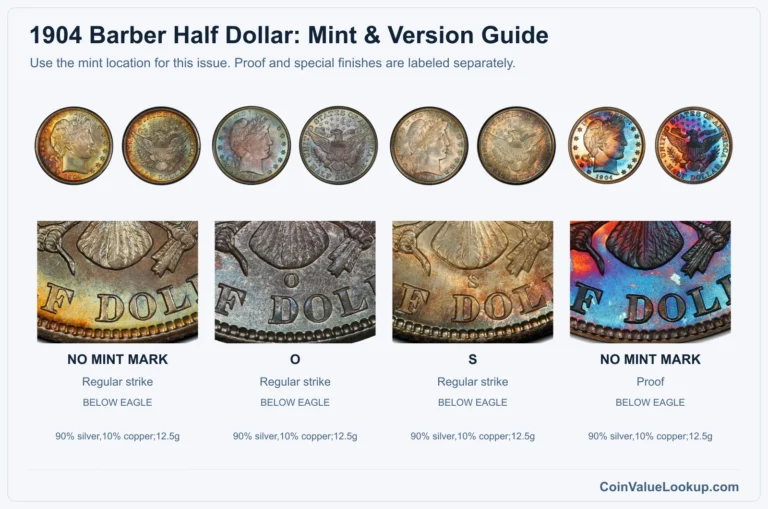
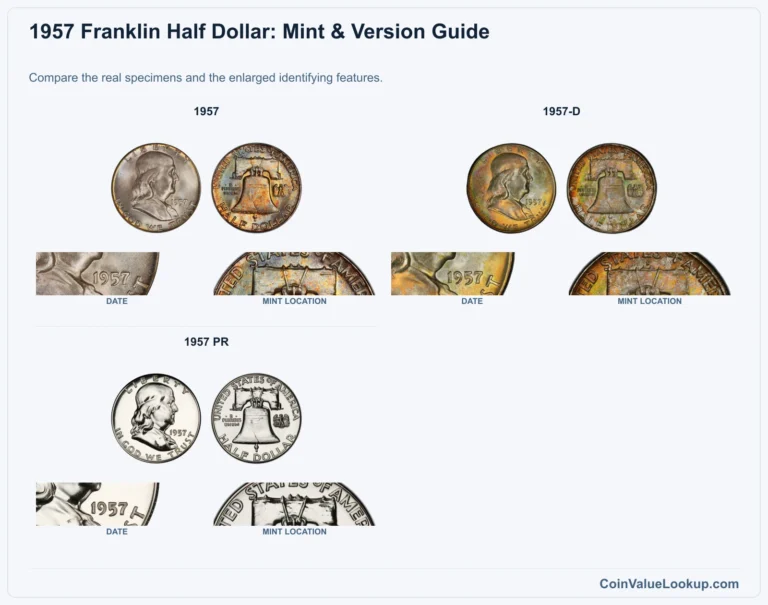
Look beneath Kennedy's portrait on the obverse, just above the date. A small "P" means Philadelphia, "D" means Denver, and "S" means San Francisco.
Starting in 1980, Philadelphia coins carry a P mintmark, so an unmarked 1988 half dollar would be unusual and worth investigating further.
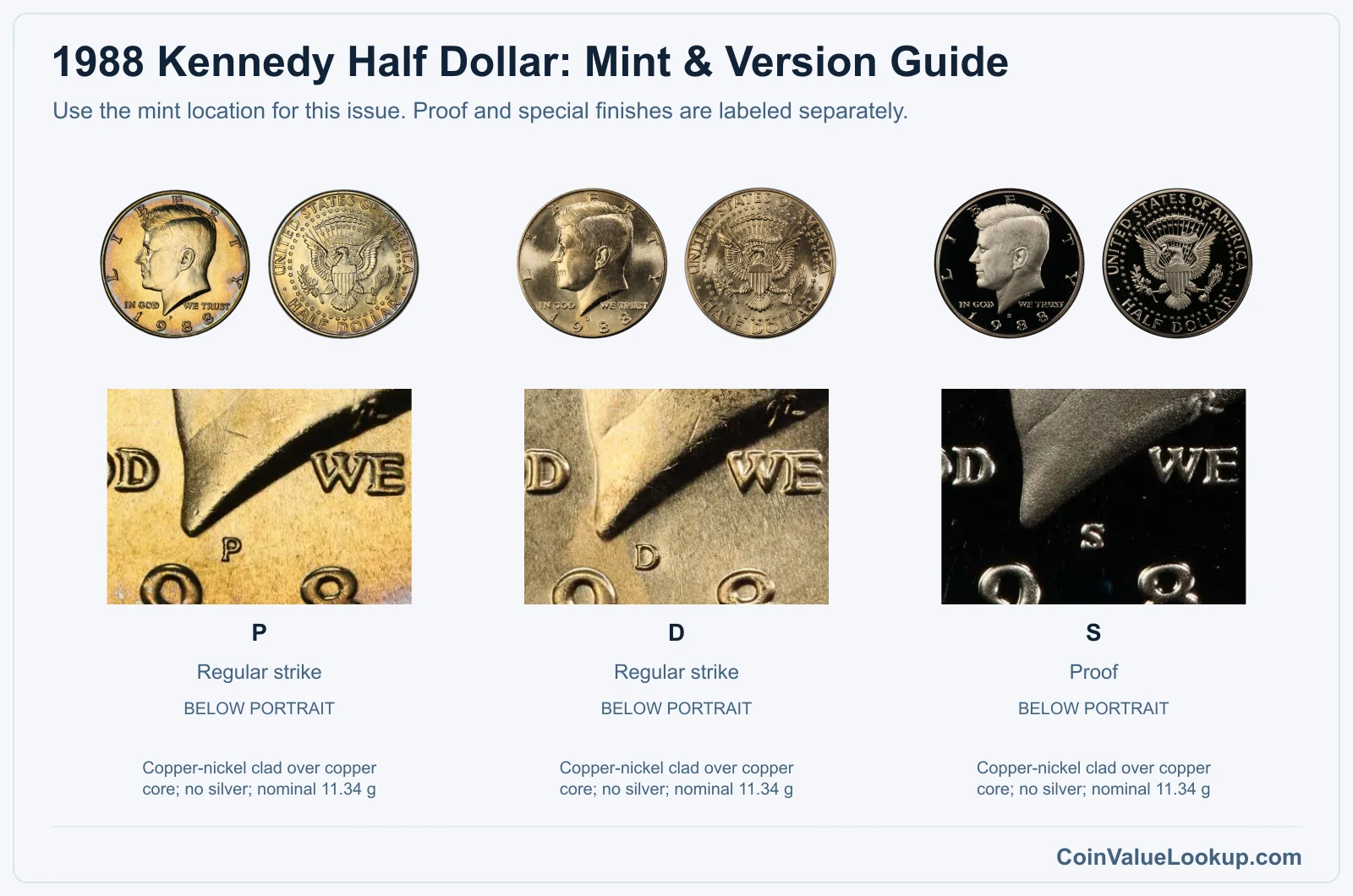
All three 1988 issues are copper-nickel clad. None contain silver.
Do not assume a half dollar is silver just because it looks grey or has attractive toning; lighting and surface patina can fool you.
If you suspect silver, compare the edge. A clad coin shows a visible copper-colored stripe sandwiched between the outer layers.
Weight can also help: a standard clad half runs about 11.34 grams. Original government packaging, if present, will confirm whether you have a proof set or a mint set coin.
The reverse carries the initials "FG" near the eagle's tail feathers, for designer Frank Gasparro. Faint or missing initials from normal wear are not automatically the recognized No FG variety, which is addressed in the error section below.
Step 2: Check Your 1988 Kennedy Half Dollar Grade
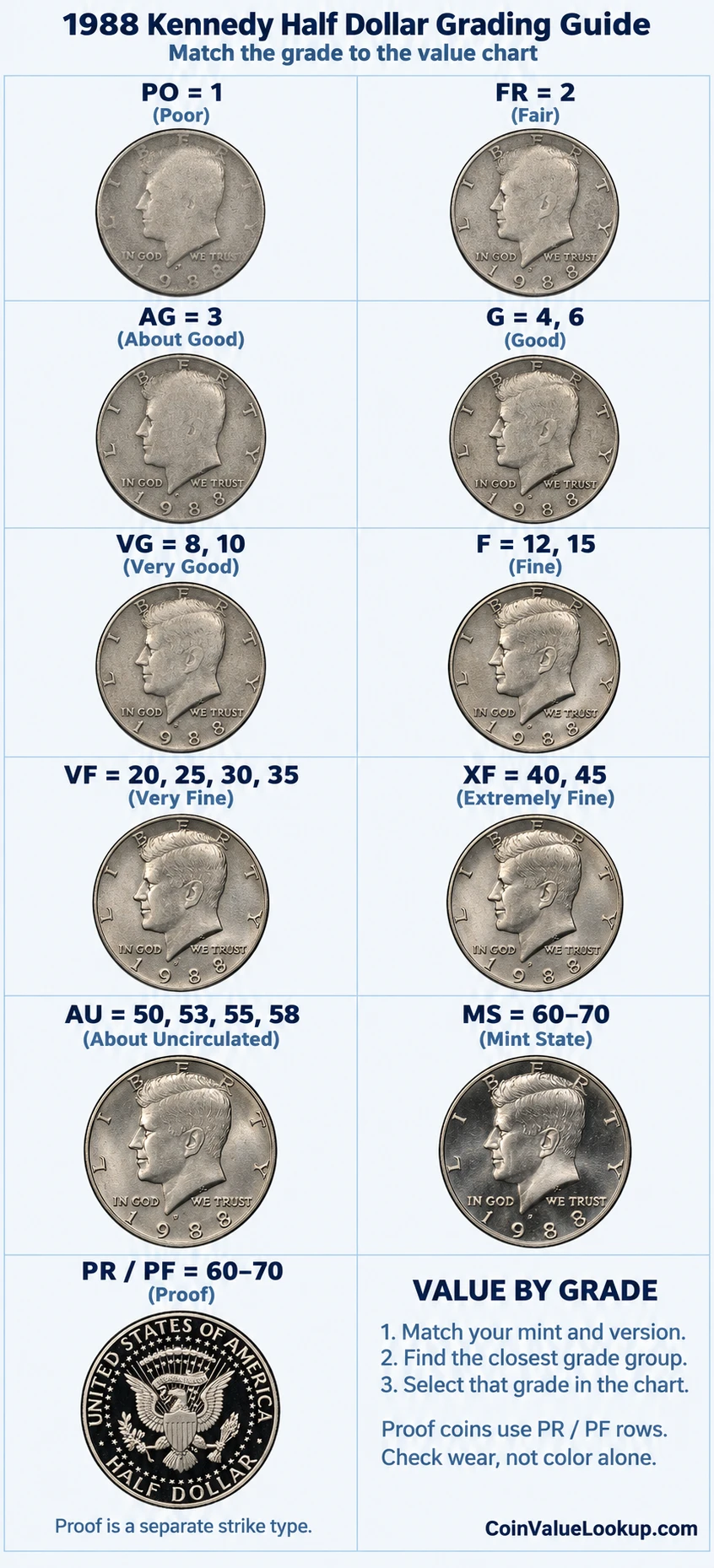
Start with Kennedy's cheek and jawline on the obverse. On a fresh Mint State coin, you will see fine texture across the entire cheek with no smooth, flat spots.
As wear begins, the high point of the cheek flattens first, followed by the hair above the ear.
Flip the coin over and check the eagle's breast feathers and the tops of the wings. These are the reverse high points and will show friction before anything else.
Bag marks are a separate problem. Two coins can both be uncirculated, yet one looks beat up from bouncing around in a mint bag.
Those contact marks lower the grade without being true circulation wear. Use the comparison image to gauge where your coin falls.
Proofs get graded on a different scale. Look for hairlines from handling, haze from improper storage, and contact marks.
A proof's mirror fields show every flaw, so even light fingerprint residue matters. Grade proofs on their own terms, not against business strikes.
Step 3: Check 1988 Kennedy Half Dollar Value by Mint and Version
1988 Kennedy Half Dollar — P — clad business
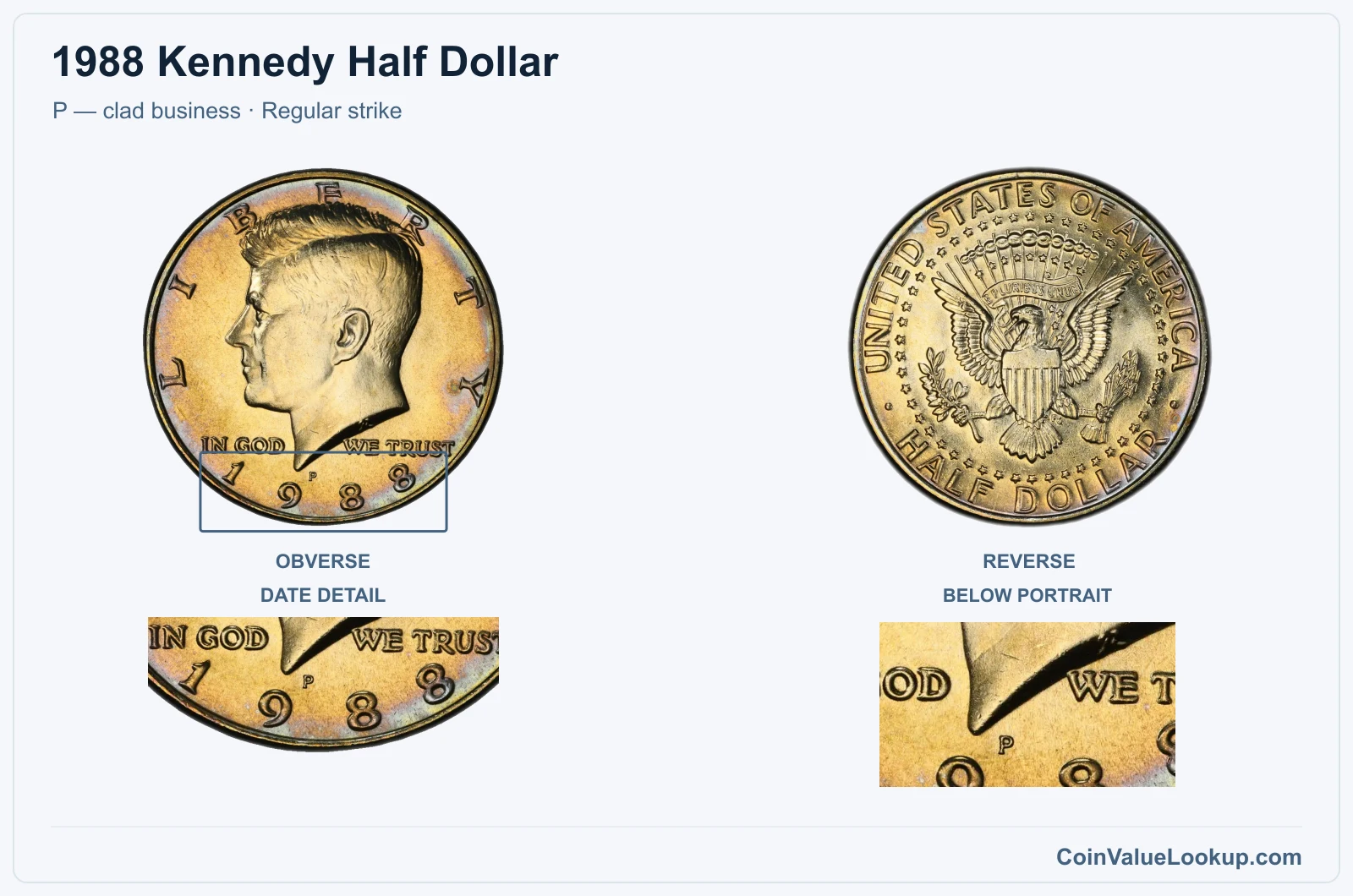
The 1988-P is a copper-nickel clad business strike from Philadelphia, weighing about 11.34 grams. You will find a small "P" mintmark beneath Kennedy's portrait.
Most circulated examples trade at face value, plain and simple.
Where things get interesting is at the upper grades. A USA Coin Book guide estimate places an MS65 example at around $6.25.
That makes a well-preserved Philadelphia coin the highest-listed branch at that grade among the three 1988 issues. To reach MS65, the coin needs minimal bag marks and strong original luster, which is uncommon for a coin that spent decades in pocket change or bank rolls.
Range Grade
Price Auction Records Appraisal PO PO 1
—
Coin Identifier FR FR 2
—
Coin Identifier AG AG 3
—
Coin Identifier G G 4
—
Coin Identifier
G 6
—
Coin Identifier VG VG 8
—
Coin Identifier
VG 10
—
Coin Identifier F F 12
—
Coin Identifier
F 15
—
Coin Identifier VF VF 20
—
Coin Identifier
VF 25
—
Coin Identifier
VF 30
—
Coin Identifier
VF 35
—
Coin Identifier XF XF 40
—
Coin Identifier
XF 45
—
Coin Identifier AU AU 50
—
Coin Identifier
AU 53
—
Coin Identifier
AU 55
—
Coin Identifier
AU 58
—
Coin Identifier MS MS 60
—
Coin Identifier
MS 61
—
Coin Identifier
MS 62
—
Coin Identifier
MS 63
Coin Identifier
MS 64
Coin Identifier
MS 65
Coin Identifier
MS 66
Coin Identifier
MS 67
Coin Identifier
MS 68
—
—
—
MS 69
—
—
—
MS 70
—
—
—
1988 Kennedy Half Dollar — D — clad business
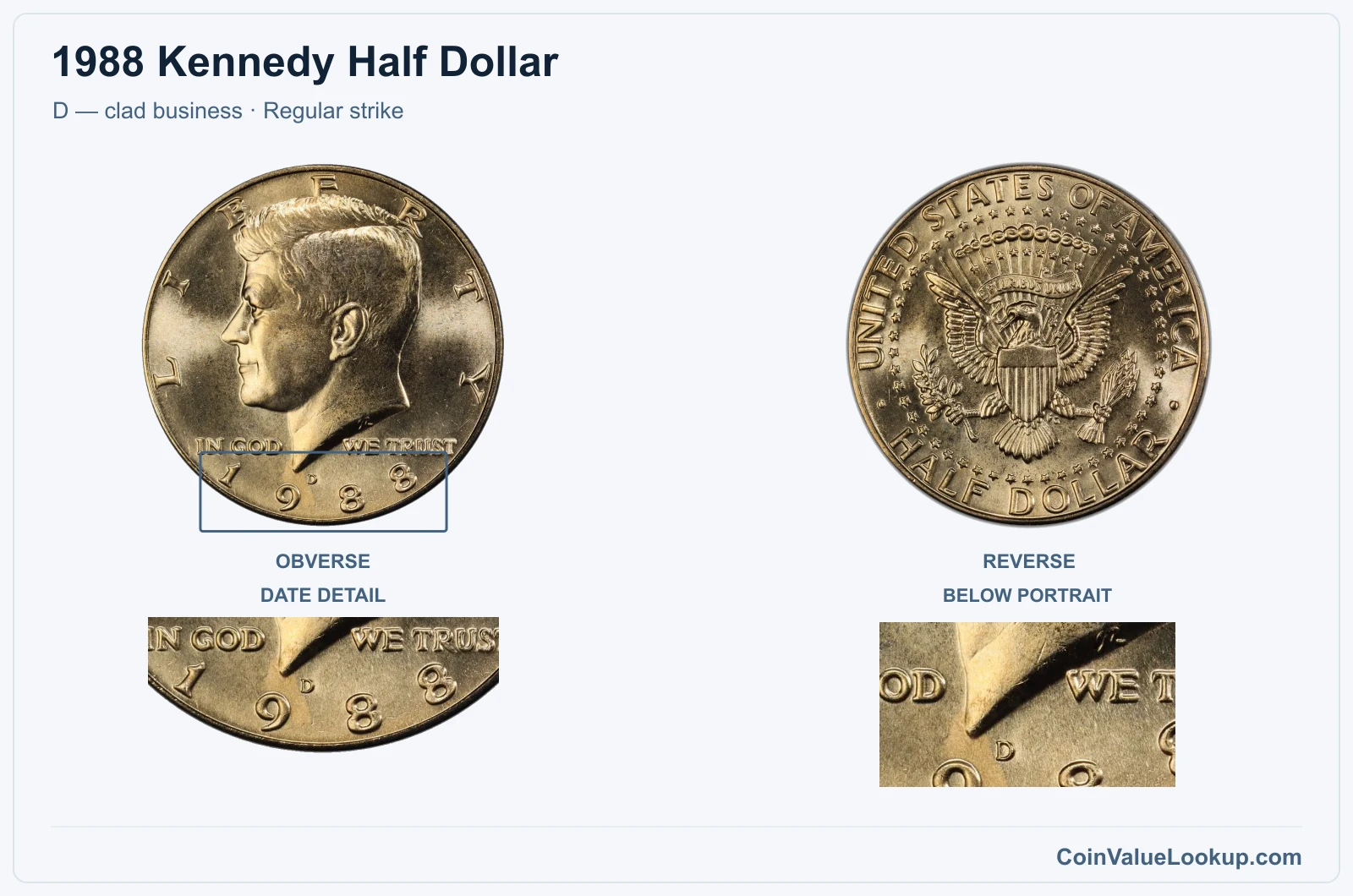
The 1988-D comes from Denver and shares the same copper-nickel clad composition as its Philadelphia sibling. Look for the "D" mintmark beneath Kennedy's portrait on the obverse.
Circulated pieces are face-value coins. At MS65, the USA Coin Book guide estimate is about $4.96.
That is a bit lower than the Philadelphia issue at the same grade. Finding one in true MS65 condition means clean fields, full luster and only light, scattered contact marks.
Most survivors show enough bag marks or handling to keep them well below that level.
Coin Value Lookup is a handy starting point if you want to look up guide values for other Kennedy half dollar dates or denominations while you are sorting through your collection.
Range Grade
Price Auction Records Appraisal PO PO 1
—
Coin Identifier FR FR 2
—
Coin Identifier AG AG 3
—
Coin Identifier G G 4
—
Coin Identifier
G 6
—
Coin Identifier VG VG 8
—
Coin Identifier
VG 10
—
Coin Identifier F F 12
—
Coin Identifier
F 15
—
Coin Identifier VF VF 20
—
Coin Identifier
VF 25
—
Coin Identifier
VF 30
—
Coin Identifier
VF 35
—
Coin Identifier XF XF 40
—
Coin Identifier
XF 45
—
Coin Identifier AU AU 50
—
Coin Identifier
AU 53
—
Coin Identifier
AU 55
—
Coin Identifier
AU 58
—
Coin Identifier MS MS 60
—
Coin Identifier
MS 61
—
Coin Identifier
MS 62
—
Coin Identifier
MS 63
—
Coin Identifier
MS 64
—
Coin Identifier
MS 65
Coin Identifier
MS 66
Coin Identifier
MS 67
Coin Identifier
MS 68
—
Coin Identifier
MS 69
—
—
—
MS 70
—
—
—
1988 Kennedy Half Dollar — S — clad proof
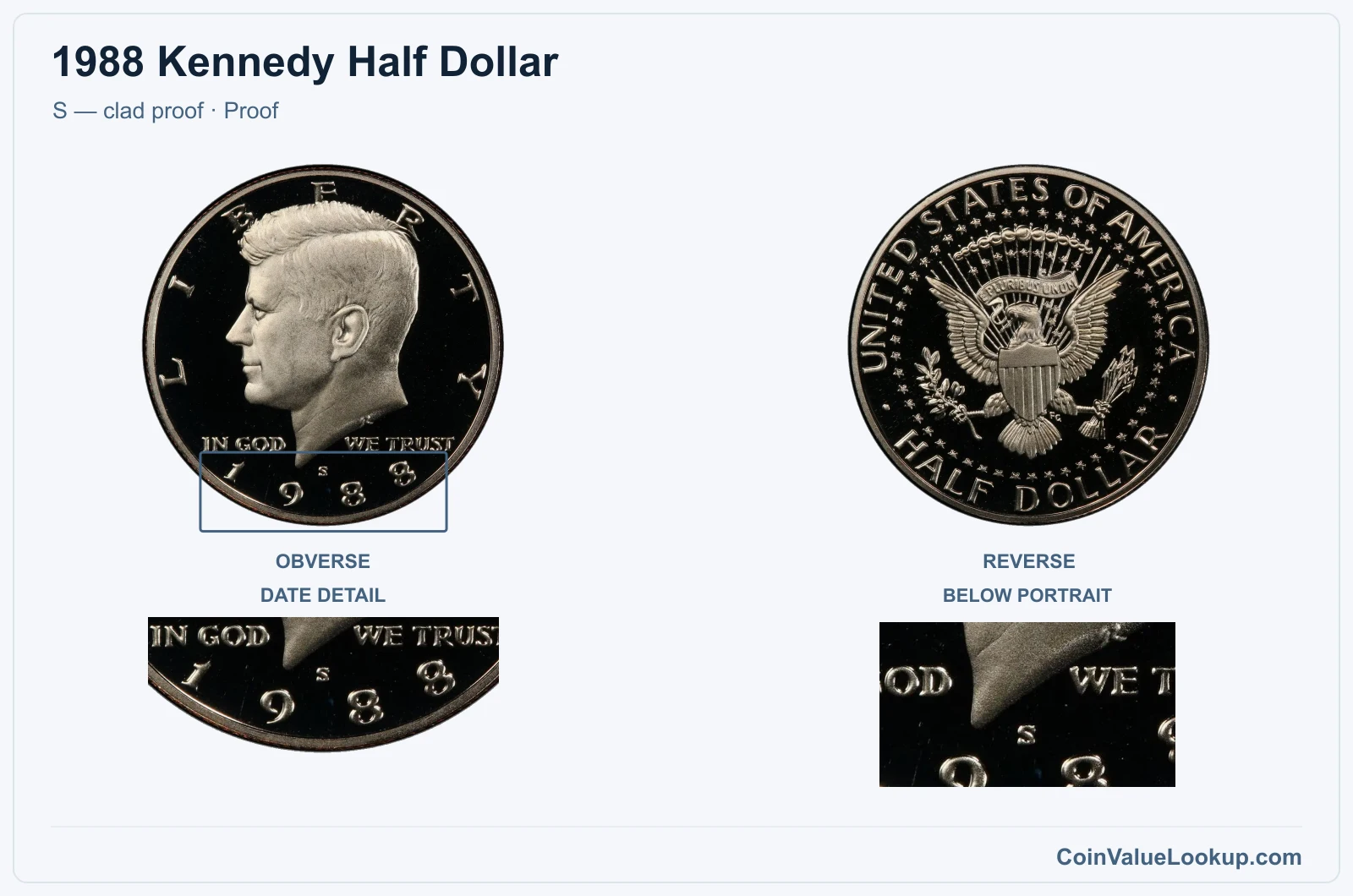
The 1988-S is a clad proof struck at San Francisco. It is not silver.
The composition is the same copper-nickel clad as the business strikes, just manufactured with polished dies and specially prepared planchets to produce mirror-like fields and frosted raised devices.
At PR65, the USA Coin Book guide estimate is $4.96. Proof grading hinges on hairlines, haze and contact marks rather than wear.
A proof that was removed from its original government packaging and handled carelessly will show fine lines across those mirror fields almost immediately.
If you still have the original mint proof set holder, leave the coin in it. That plastic case is the best protection the coin has, and removing it invites the kind of surface damage that drops the grade.
Range Grade
Price Auction Records Appraisal PR PR 1
—
Coin Identifier
PR 2
—
Coin Identifier
PR 3
—
Coin Identifier
PR 4
—
Coin Identifier
PR 6
—
Coin Identifier
PR 8
—
Coin Identifier
PR 10
—
Coin Identifier
PR 12
—
Coin Identifier
PR 15
—
Coin Identifier
PR 20
—
Coin Identifier
PR 25
—
Coin Identifier
PR 30
—
Coin Identifier
PR 35
—
Coin Identifier
PR 40
—
Coin Identifier
PR 45
—
Coin Identifier
PR 50
—
Coin Identifier
PR 53
—
Coin Identifier
PR 55
—
Coin Identifier
PR 58
—
Coin Identifier
PR 60
—
Coin Identifier
PR 61
—
Coin Identifier
PR 62
—
Coin Identifier
PR 63
—
Coin Identifier
PR 64
—
Coin Identifier
PR 65
—
Coin Identifier
PR 66
—
Coin Identifier
PR 67
—
Coin Identifier
PR 68
Coin Identifier
PR 69
Coin Identifier
PR 70
Coin Identifier
1988 Kennedy Half Dollar Error List
1. 1988 Kennedy Half Dollar — Doubled Die Obverse
A doubled die obverse on the 1988-S Kennedy half dollar has been reported. This type of error shows consistent doubling on obverse lettering or design elements, not random distortion.
Under magnification, look for clear separation or notching on letters such as "IN GOD WE TRUST" or the date.
The key distinction is consistency. Genuine hub doubling produces the same offset on every affected element in the same direction.
Machine doubling, by contrast, tends to create flat, shelf-like distortion that lacks the sharp, raised secondary image. Reflections from proof surfaces can also mimic doubling under certain lighting angles, so tilt the coin and compare carefully.
No specific price range is available for this variety. Value depends on the strength of the doubling, overall condition and third-party authentication.
2. 1988 Kennedy Half Dollar — Off-Center Strike
Off-center strikes occur when the planchet is not seated properly between the dies at the moment of impact. The result is a design shifted to one side with an unstruck crescent of blank metal on the opposite edge.
The more dramatic the shift, the more eye-catching the coin.
A date that remains fully visible generally adds to desirability. Compare your coin to known examples: a genuine off-center strike will show the design cleanly displaced, not just a slightly misaligned rim.
Post-mint damage such as a vise squeeze or dryer-machine hit can flatten one side and mimic the look, but it will lack the characteristic blank crescent.
No numerical price range is available. Value depends on the percentage of off-center displacement, date visibility and overall condition.
3. 1988 Kennedy Half Dollar — Clipped Planchet
A clipped planchet error happens when the blank is punched from strip metal that overlaps a previously punched hole, or from the edge of the strip. The result is a missing curved, straight or irregular section of the coin.
Look at the edge where the clip appears. On a genuine clip, you will often see the Blakesley effect: a zone of weakness on the rim directly opposite the missing area, caused by reduced metal flow during striking.
The edge at the clip itself will show a natural, unfinished texture rather than tool marks.
Filed notches, deliberate cuts and corrosion can all look similar at first glance. If the edge shows file lines, sharp angles or pitting, it is likely post-mint damage.
No specific price range is adopted for this variety. Size, shape and the coin's overall condition all factor into value.
4. 1988 Kennedy Half Dollar — Broadstrike
A broadstrike results when a coin is struck without the retaining collar that normally constrains the metal and forms the reeded or smooth edge. The coin spreads outward, appearing slightly wider than normal with a distorted rim profile.
The full design is still present, which is what separates a broadstrike from an off-center strike. Look at the edge: it should appear spread and rounded rather than sharply defined.
The rim lettering or reeding, if any, will be absent or heavily distorted.
A coin that was flattened after leaving the mint, such as on railroad tracks, can look somewhat similar. The difference is that a broadstrike retains proper strike detail across the design, while post-mint flattening tends to distort or flatten design elements unevenly.
No adopted price range is available; value depends on the degree of spread and condition.
5. 1988 Kennedy Half Dollar — Clashed Dies
Die clash marks appear when the obverse and reverse dies strike each other without a planchet between them. The impact transfers faint traces of each die's design onto the opposite die.
Later coins struck from those damaged dies carry ghost-like impressions of the wrong side's design.
On a Kennedy half, look for faint outlines of the eagle on the obverse fields around Kennedy's portrait, or hints of the portrait in the reverse fields near the eagle. The ghost images will align with where the opposite design would contact the die face.
Do not confuse clash marks with random scratches, raised lines from die polishing or brockage errors. Clash marks follow the geometry of the opposing design, not random directions.
No numerical price range is adopted. Value depends on the clarity of the clash impression, the coin's condition and collector demand for that specific variety.
6. 1988 Kennedy Half Dollar — Die Crack / Die Chip
Die cracks and die chips are raised features caused by a failing die. A crack appears as a thin raised line running across the coin's surface, sometimes connecting design elements to the rim.
A die chip shows up as a small raised blob, often inside a letter or near a design detail.
A crack that reaches the rim and produces a larger raised area of unstruck metal is sometimes called a cud. Interior cracks that stay within the design field are more common and generally less dramatic.
These are easy to confuse with incuse scratches, but the distinction is simple: die cracks are raised, scratches are recessed. Corrosion or foreign material stuck to the surface can also create bumps, but those lack the clean, linear character of a true die crack.
No numerical price is adopted for these varieties. Value depends on size, location and overall condition.
7. 1988 Kennedy Half Dollar — Missing FG Initials
The missing FG initials variety has been reported on the 1988-P Kennedy half dollar specifically. "FG" stands for Frank Gasparro, whose initials normally appear near the eagle's right leg on the reverse.
On the recognized variety, the initials are absent due to die polishing at the mint, not ordinary wear.
To check, compare the area between the eagle's tail feathers and right leg with a normal 1988 reverse under the same magnification and lighting. On a genuine No FG coin, the surrounding design details remain sharp and well-defined even though the initials are gone.
If the entire area looks mushy or worn down, you are probably seeing circulation wear rather than a die variety.
Grease-filled dies and deliberate removal can also erase the initials. No adopted price range is available; value depends on the coin's condition and proper attribution.