1982 Kennedy Half Dollar Coin Value: How Much Is It Worth?
The 1982 Kennedy half dollar carries a face value of fifty cents, and most circulated clad examples are worth exactly that. Collector guide estimates for higher-grade or proof examples range from roughly $4.96 to $8.64, depending on the mint, finish and condition.
Before you check a price chart, you need to know whether your coin is a Philadelphia or Denver business strike or a San Francisco proof, because each version has its own value track.
Fast Way to Identify Your 1982 Kennedy Half Dollar
The quickest way to start figuring out what you have is to upload clear photos of both the front and back of your coin. Our identifier can give you a preliminary read on the mint, finish and general condition so you know which version to research further.
Snap both sides in good light and avoid glare if you can.
1982 Kennedy Half Dollar Value
Upload both sides of your 1982 Kennedy Half Dollar.
Front Obverse
Upload photo
Back Reverse
Upload photo
Which 1982 Kennedy Half Dollar Versions Are Worth Money?
- Identify your mintmark first: P, D or S each follow a different value path.
- San Francisco proofs (S mint) are struck for collectors and graded differently from business strikes.
- Well-preserved Philadelphia or Denver coins in MS65 or better condition carry a modest premium over face value.
- Certain mint-made anomalies such as a missing FG, off-center strike, struck-through or doubled die have been reported for this year and are worth examining.
Step 1: Identify Your 1982 Kennedy Half Dollar Mint Mark and Version
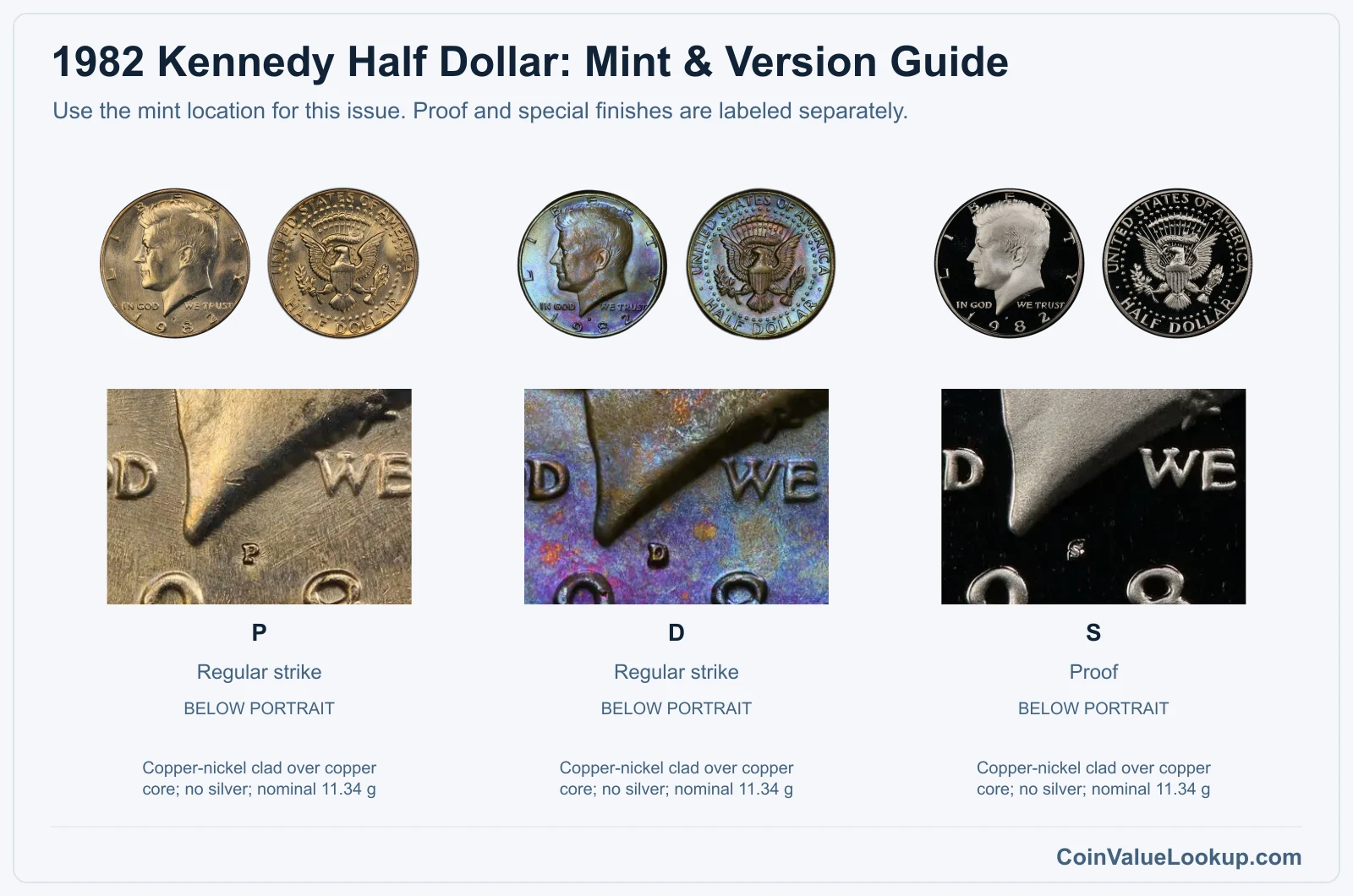
Flip your coin to the obverse and look just beneath Kennedy's portrait, above the date. A "P" means Philadelphia, a "D" means Denver, and an "S" means San Francisco.
Before 1980, Philadelphia coins carried no mintmark at all, but by 1982 the P was standard.
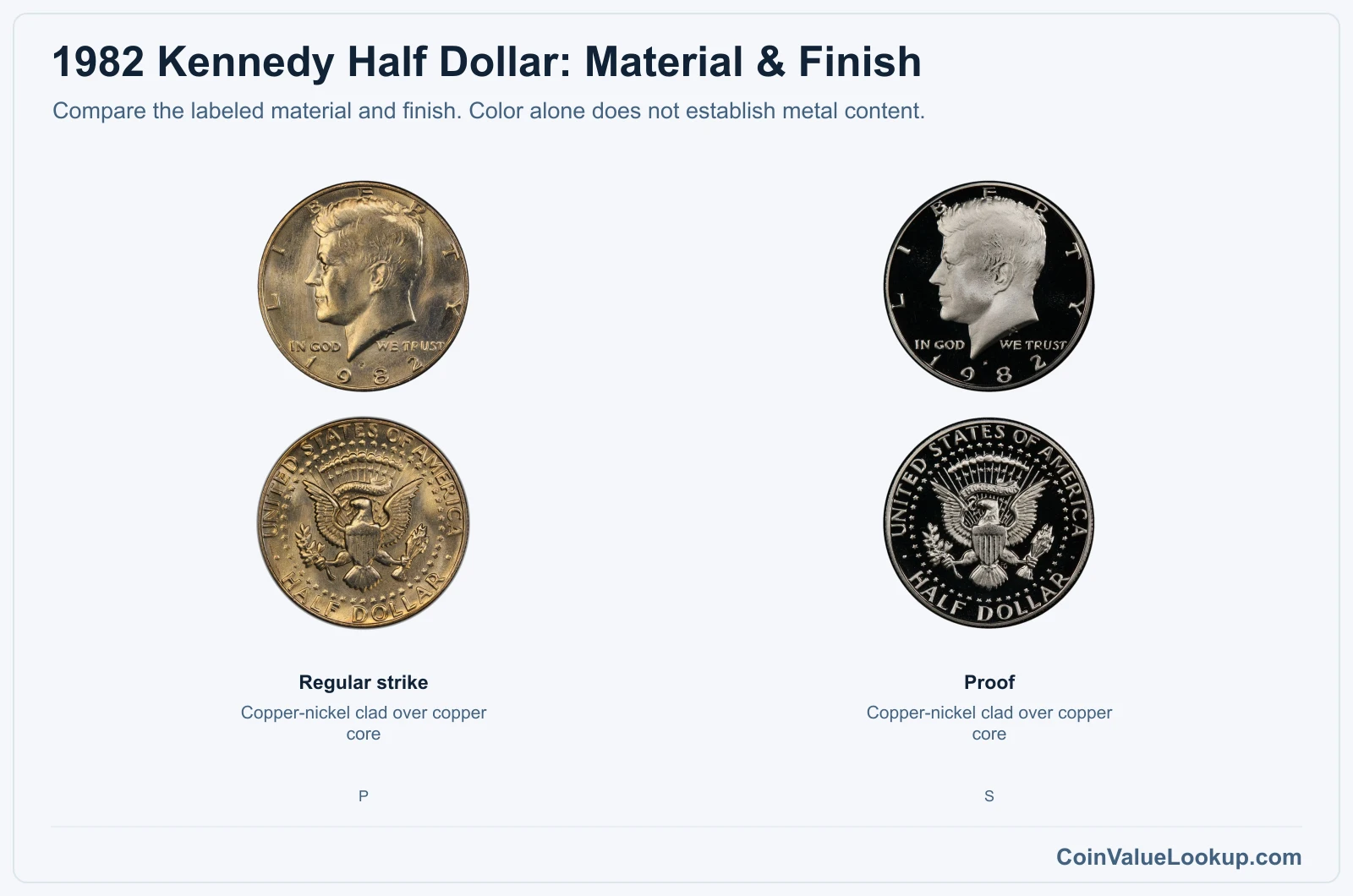
All three 1982 versions are copper-nickel clad. None contain silver.
This is a common assumption people make with half dollars, especially when toning gives the surface a silvery look.
If you are unsure about composition, check the edge. A clad coin shows a visible copper-colored stripe sandwiched between the outer layers.
Weight should be close to 11.34 grams. Original government packaging for a proof also confirms the San Francisco origin and clad composition.
On the reverse, the small letters "FG" near the eagle's tail feathers are designer Frank Gasparro's initials. Faint or missing initials from normal wear or die obstruction are not automatically the same thing as an authenticated No FG variety, so keep that distinction in mind.
Step 2: Check Your 1982 Kennedy Half Dollar Grade
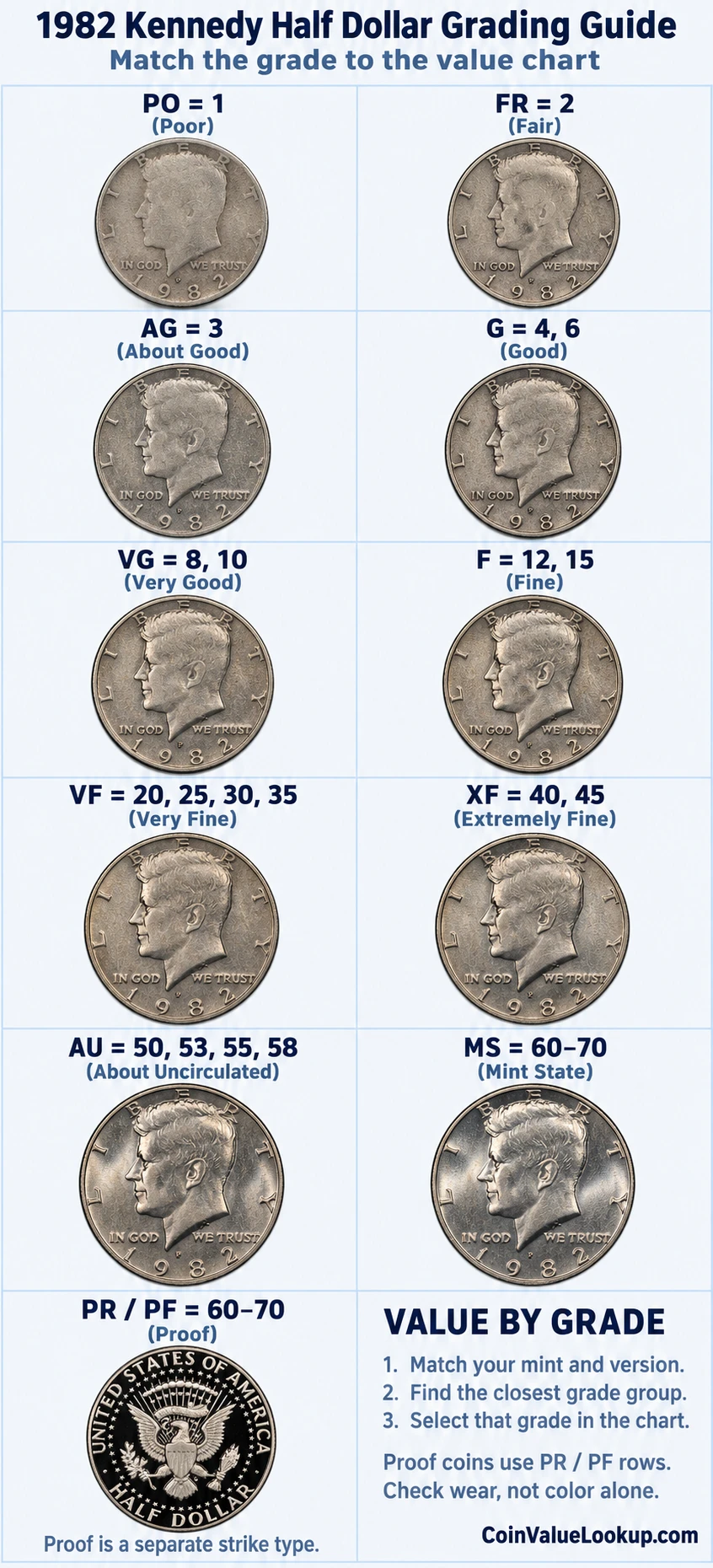
Start with Kennedy's cheek and jawline on the obverse. On a well-worn coin these areas go flat first, losing the fine skin texture that a fresh strike shows.
Next check the hair above and behind the ear; individual strands should be visible on higher-grade pieces.
On the reverse, the eagle's breast feathers and the tops of the wings pick up wear quickly. If those details are sharp and complete, you are likely looking at a coin that saw little or no circulation.
Bag marks are the enemy of Mint State grades. Two coins can both be uncirculated, yet one scores much lower because of heavy contact marks from bouncing around in a mint bag.
Use the comparison image to see how marks and luster loss translate into different grade levels.
Proofs are graded on a separate scale. Look for hairlines from mishandling, haze across the mirror fields, and any contact marks on the frosted portrait.
A proof with clean, deep mirrors and no hairlines grades significantly higher than one that has been removed from its case and handled.
Step 3: Check 1982 Kennedy Half Dollar Value by Mint and Version
1982 Kennedy Half Dollar — P — clad business
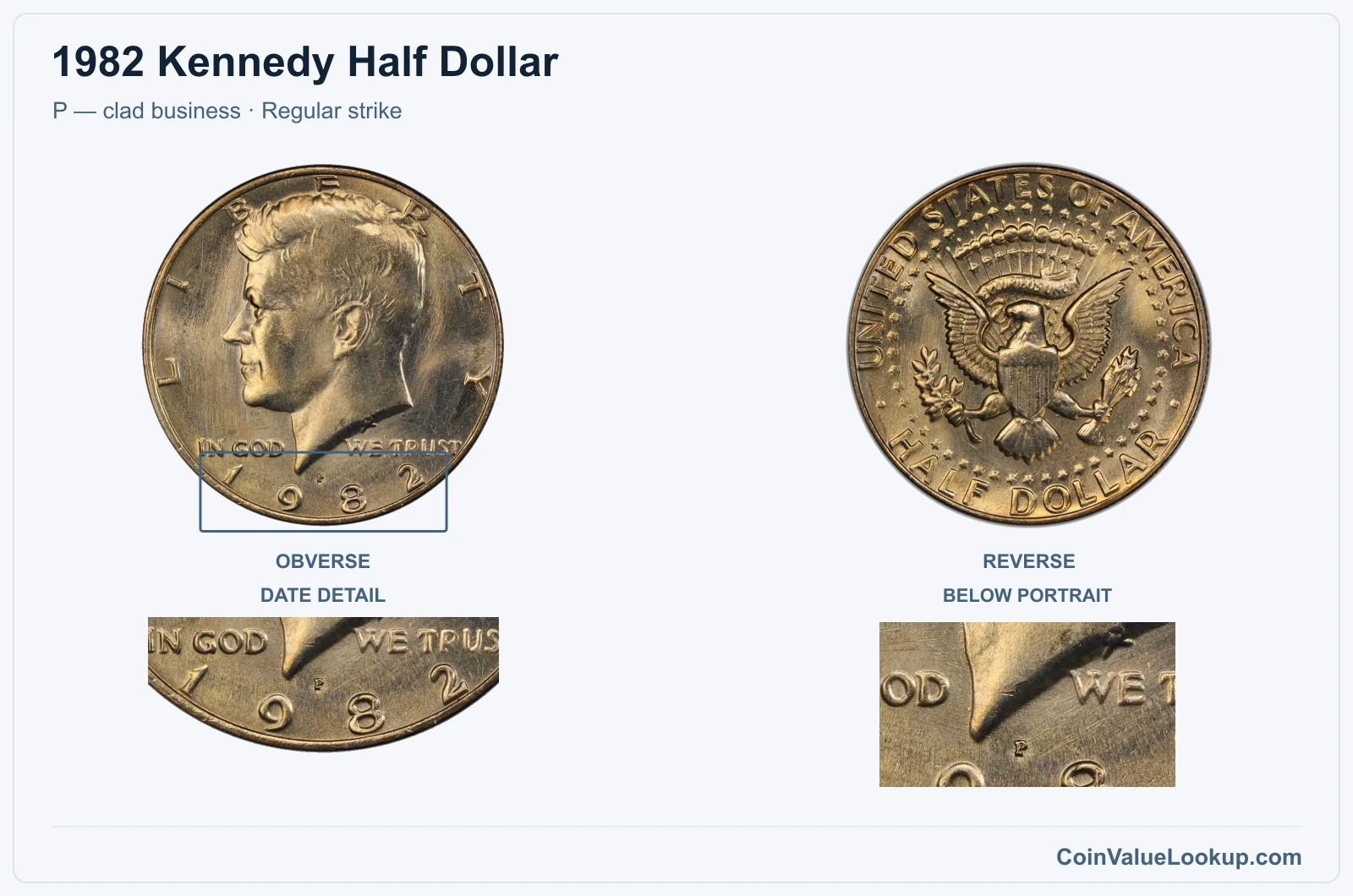
The 1982-P is the Philadelphia business strike. Look for the small "P" mintmark on the obverse beneath Kennedy's neck.
It is copper-nickel clad, not silver, and weighs about 11.34 grams.
Most circulated examples trade at face value. In well-preserved condition, a USA Coin Book guide estimate places an MS65 example at roughly $8.64.
That is a guide figure, not a guaranteed offer, and your actual coin's value depends on its specific condition and eye appeal.
If you find one in original rolls or sets with sharp luster and minimal bag marks, it is worth a closer look.
Range Grade
Price Auction Records Appraisal PO PO 1
—
Coin Identifier FR FR 2
—
Coin Identifier AG AG 3
—
Coin Identifier G G 4
—
Coin Identifier
G 6
—
Coin Identifier VG VG 8
—
Coin Identifier
VG 10
—
Coin Identifier F F 12
—
Coin Identifier
F 15
—
Coin Identifier VF VF 20
—
Coin Identifier
VF 25
—
Coin Identifier
VF 30
—
Coin Identifier
VF 35
—
Coin Identifier XF XF 40
—
Coin Identifier
XF 45
—
Coin Identifier AU AU 50
—
Coin Identifier
AU 53
—
Coin Identifier
AU 55
Coin Identifier
AU 58
Coin Identifier MS MS 60
—
Coin Identifier
MS 61
—
Coin Identifier
MS 62
Coin Identifier
MS 63
Coin Identifier
MS 64
Coin Identifier
MS 65
Coin Identifier
MS 66
Coin Identifier
MS 67
Coin Identifier
MS 68
—
—
—
MS 69
—
—
—
MS 70
—
—
—
1982 Kennedy Half Dollar — D — clad business
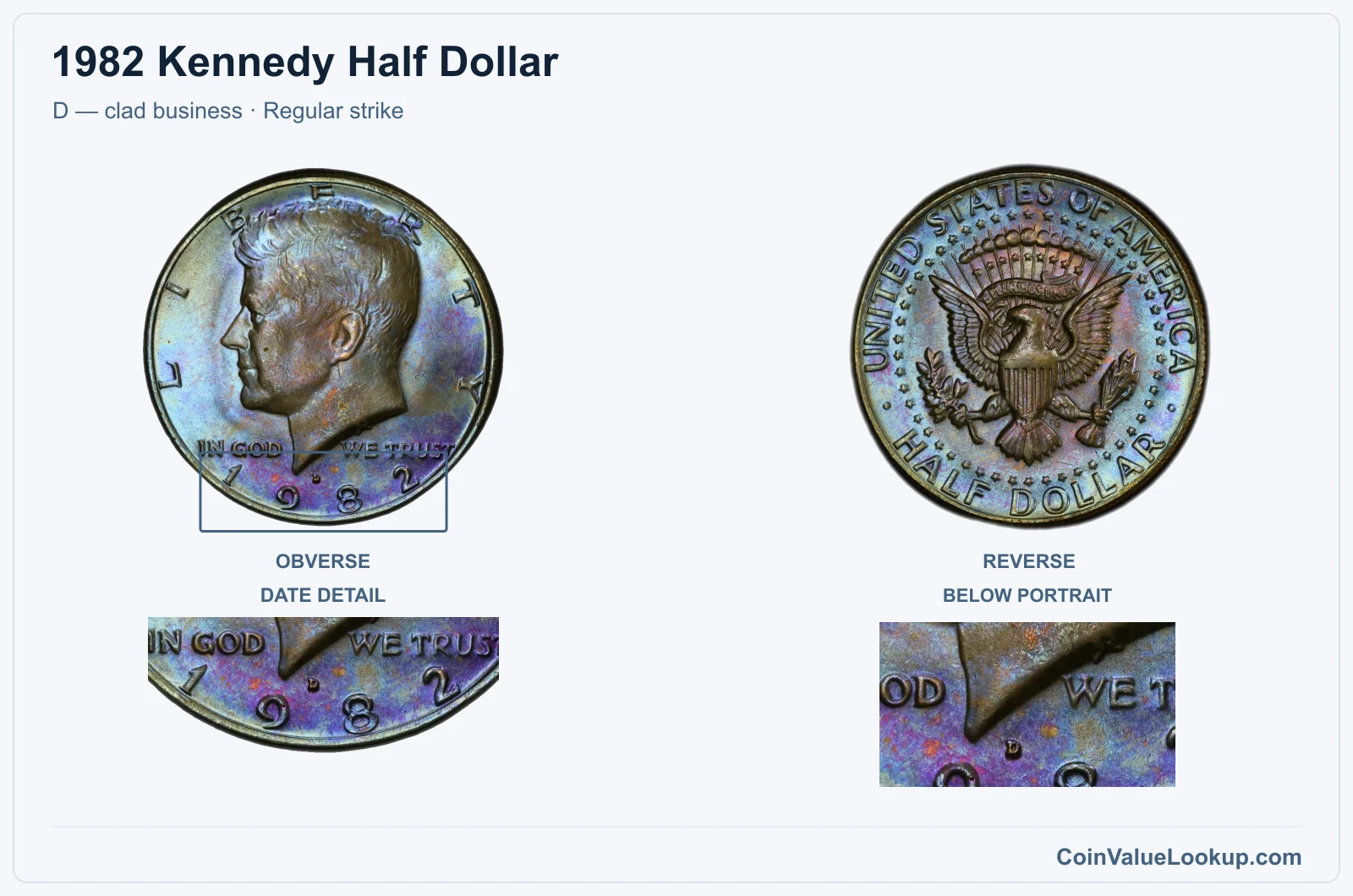
The 1982-D comes from Denver and shows a "D" mintmark in the same location beneath Kennedy's portrait. Same clad composition, same weight, same design.
Circulated pieces are face-value coins. At MS65, the USA Coin Book guide estimate is about $8.64, identical to its Philadelphia counterpart.
Condition makes the difference here. A coin pulled from a well-stored original roll with clean surfaces and strong luster will always outperform one that spent decades in a jar.
Coin Value Lookup is a good starting point if you want to compare this coin with other Kennedy half dollar years and quickly see where the premiums actually sit.
Range Grade
Price Auction Records Appraisal PO PO 1
—
Coin Identifier FR FR 2
—
Coin Identifier AG AG 3
—
Coin Identifier G G 4
—
Coin Identifier
G 6
—
Coin Identifier VG VG 8
—
Coin Identifier
VG 10
—
Coin Identifier F F 12
—
Coin Identifier
F 15
—
Coin Identifier VF VF 20
—
Coin Identifier
VF 25
—
Coin Identifier
VF 30
—
Coin Identifier
VF 35
—
Coin Identifier XF XF 40
—
Coin Identifier
XF 45
—
Coin Identifier AU AU 50
—
Coin Identifier
AU 53
—
Coin Identifier
AU 55
—
Coin Identifier
AU 58
—
Coin Identifier MS MS 60
—
Coin Identifier
MS 61
—
Coin Identifier
MS 62
—
Coin Identifier
MS 63
—
Coin Identifier
MS 64
—
Coin Identifier
MS 65
Coin Identifier
MS 66
Coin Identifier
MS 67
Coin Identifier
MS 68
—
—
—
MS 69
—
—
—
MS 70
—
—
—
1982 Kennedy Half Dollar — S — clad proof
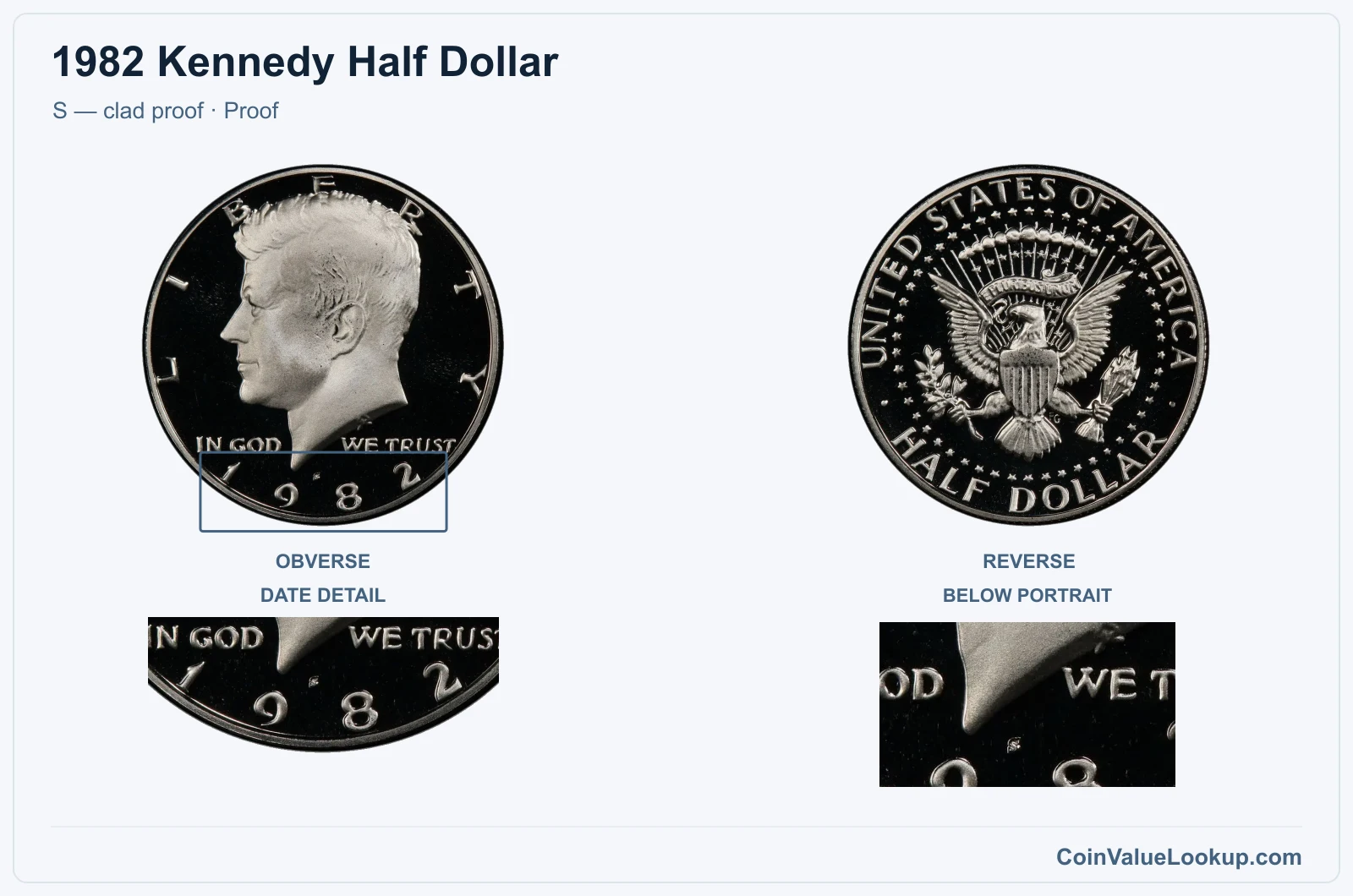
The 1982-S is a clad proof struck at San Francisco. It was sold in annual proof sets, not released into circulation.
The surfaces should show mirror-like fields with frosted, raised design elements.
At PR65, the USA Coin Book guide estimate is around $4.96. That is lower than the business-strike MS65 figures because large quantities of proof sets were produced and many survive in excellent condition.
Supply matters.
Grade a proof by checking for hairlines across those mirror fields, any haze or milkiness, and contact marks on Kennedy's portrait. A clean, deeply mirrored example with strong frost contrast will always command more attention than a hazy, hairlined one.
Range Grade
Price Auction Records Appraisal PR PR 1
—
Coin Identifier
PR 2
—
Coin Identifier
PR 3
—
Coin Identifier
PR 4
—
Coin Identifier
PR 6
—
Coin Identifier
PR 8
—
Coin Identifier
PR 10
—
Coin Identifier
PR 12
—
Coin Identifier
PR 15
—
Coin Identifier
PR 20
—
Coin Identifier
PR 25
—
Coin Identifier
PR 30
—
Coin Identifier
PR 35
—
Coin Identifier
PR 40
—
Coin Identifier
PR 45
—
Coin Identifier
PR 50
—
Coin Identifier
PR 53
—
Coin Identifier
PR 55
—
Coin Identifier
PR 58
—
Coin Identifier
PR 60
—
Coin Identifier
PR 61
—
Coin Identifier
PR 62
—
Coin Identifier
PR 63
—
Coin Identifier
PR 64
Coin Identifier
PR 65
—
Coin Identifier
PR 66
—
Coin Identifier
PR 67
Coin Identifier
PR 68
Coin Identifier
PR 69
Coin Identifier
PR 70
Coin Identifier
1982 Kennedy Half Dollar Error List
1. 1982 Kennedy Half Dollar — Missing FG Initials
The 1982-P No FG variety refers to coins where Frank Gasparro's initials, normally found near the eagle's right leg on the reverse, are absent or nearly invisible. This has been attributed to die polishing at the mint that removed the shallow initials from the working die before coins were struck.
To check, compare your coin's reverse to a normal 1982-P under magnification. On a genuine No FG coin, the surrounding feather detail remains sharp while the initials are cleanly gone.
If the feathers are also mushy or flat, ordinary wear or a grease-filled die is the more likely explanation.
Look out for coins where someone has physically scraped or buffed the initials away. Tool marks, disturbed metal flow and unnatural surface texture around that area are red flags.
No specific price range is available for this variety in the supplied data, so value depends on the individual coin's condition, the clarity of the missing detail, and professional verification.
2. 1982 Kennedy Half Dollar — Off-Center Strike
An off-center strike happens when the coin blank is not properly seated between the dies. The result is a design that is visibly shifted to one side, leaving an unstruck crescent of blank metal on the opposite edge.
The degree of off-center displacement and whether the date remains visible are the two biggest factors in determining collector interest. A 5% shift is minor; a 20%+ shift with a full date is far more dramatic and desirable.
Do not confuse an off-center strike with a clipped planchet, which removes a curved bite from the edge, or with post-mint damage like a coin that was flattened unevenly after leaving the press. A genuine off-center strike shows consistent design displacement across the entire surface.
No numerical price range is available here, so the value of any individual off-center 1982 Kennedy half depends on the percentage of misalignment, overall condition, and independent authentication.
3. 1982 Kennedy Half Dollar — Struck-Through Error
A struck-through error occurs when foreign material, such as grease, a thread, a metal fragment or debris, sits between the die and the planchet during striking. The result is a localized depression or incomplete area in the design where the obstruction blocked the full impression.
On a 1982 Kennedy half, look for a clearly defined impression or sunken area that does not match normal wear. Grease fill-ins tend to produce soft, undefined patches, while a retained foreign object can leave a sharp outline or texture.
The key distinction from ordinary wear or cleaning damage is that a struck-through area sits below the coin's normal surface plane in a way that looks like something was physically in the way, not rubbed off afterward. Scratches, polishing lines and general weakness from a tired die are common lookalikes.
No specific price data is available for this error on the 1982 date. Value depends on the size and visual impact of the struck-through area, the type of obstruction, and the coin's overall condition.
4. 1982 Kennedy Half Dollar — Doubled Die
A doubled die occurs during die manufacture when a misalignment in the hubbing process creates a second, slightly offset impression of the design on the die itself. Every coin struck from that die then shows consistent doubling in the same location.
On a 1982 Kennedy half, check lettering, the date, and Kennedy's profile for any separation, shelf-like notching or shadowing that repeats on every affected element. True die doubling is consistent and directional.
The biggest trap is machine doubling, which is flat, shelf-like displacement caused by die bounce during the strike. Machine doubling tends to look mushy and lacks the raised, distinct separation of a genuine doubled die.
Reflections under certain lighting and post-mint impressions from contact with other coins can also mimic the effect.
No numerical price is available for a 1982 doubled die Kennedy half in the supplied data. The value of any example depends on the strength and location of the doubling, the coin's condition, and professional confirmation of the variety.