1968 Kennedy Half Dollar Coin Value: How Much Is It Worth?
A 1968 Kennedy half dollar is a 40% silver coin, and even well-worn examples carry a baseline melt value that shifts with the silver market — around $13.31 at the time of one recent guide snapshot. In higher grades, a 1968-D in MS65 condition can reach roughly $45 according to USA Coin Book estimates.
The 1968-S proof, several documented die varieties, and dramatic mint errors push values considerably higher for the right coin.
Fast Way to Identify Your 1968 Kennedy Half Dollar
Snap a clear photo of the front and back of your 1968 half dollar and upload both images. The preliminary identifier can help you determine which mint version you have — Philadelphia (no mintmark), Denver (D), or San Francisco (S) proof — based on what it sees.
That first step saves time before you dig into details.
1968 Kennedy Half Dollar Value
Upload both sides of your 1968 Kennedy Half Dollar.
Front Obverse
Upload photo
Back Reverse
Upload photo
Which 1968 Kennedy Half Dollar Versions Are Worth Money?
- The 1968-D Tripled Die Obverse shows visible separation in TRUST, split serifs on the Y of LIBERTY, and spread date digits — one MS65 example brought $281.25 at GreatCollections.
- A 1968-S proof struck on a magnetic 125-grain planchet is a major error; PCGS PR62 examples sold for $4,200 in 2024 and $9,000 in 2025 at Heritage Auctions.
- The 1968-S proof double struck on a quarter planchet is dramatically undersized, with an NGC PR66 selling for $2,640 at Heritage in October 2022.
- A 1968-D missing obverse silver layer error in PCGS MS63 sold for $120 at Heritage in April 2020.
- The 1968-S Inverted Mintmark and 1968-S Doubled Die Reverse are documented die varieties worth checking under magnification.
Step 1: Identify Your 1968 Kennedy Half Dollar Mint Mark and Version
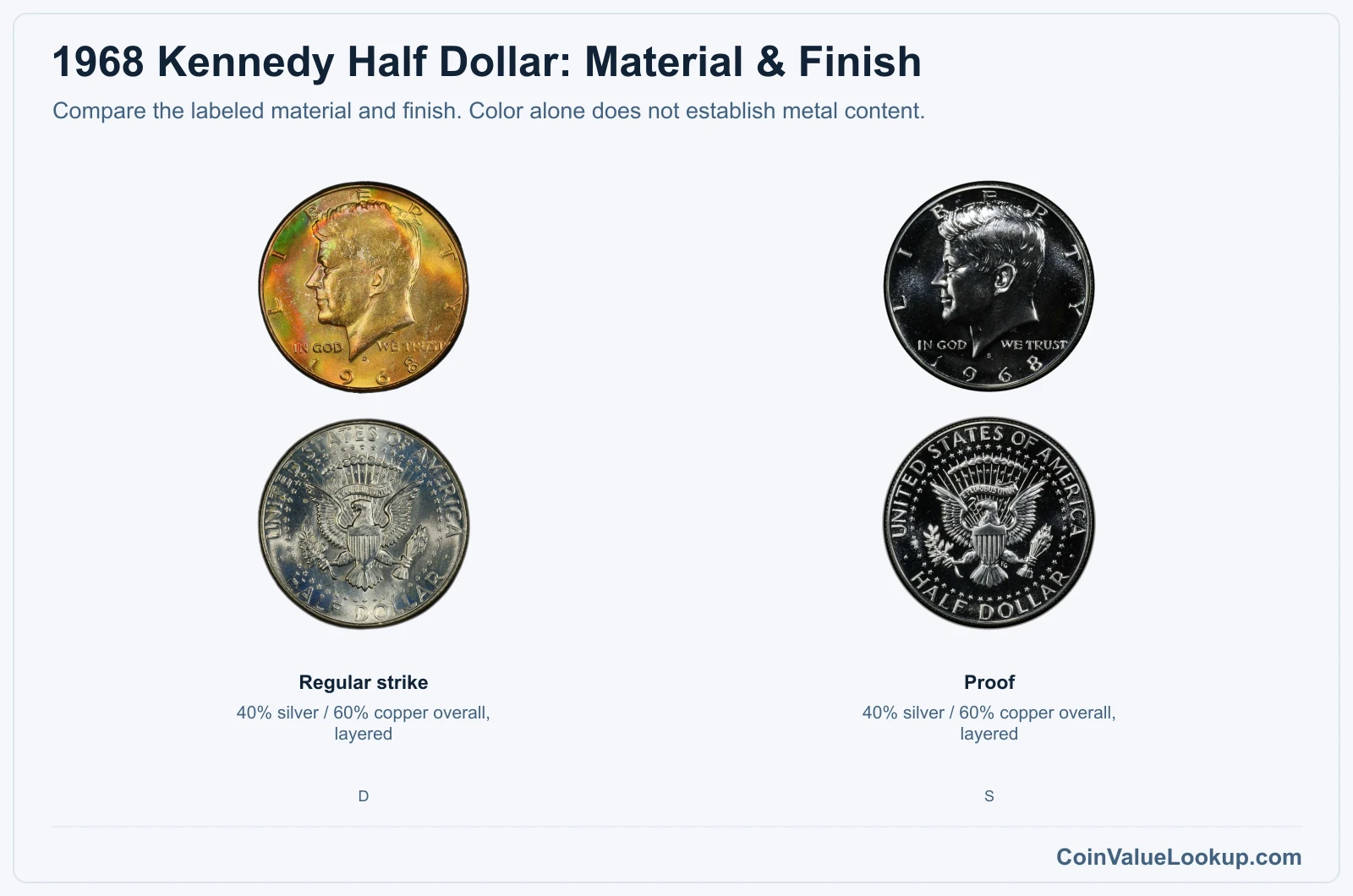
All 1968 Kennedy half dollars are struck in 40% silver, regardless of mintmark. The alloy uses outer layers of 80% silver bonded to an inner layer containing about 20.9% silver, for a total weight of approximately 11.50 grams and a diameter of about 30.61 mm.
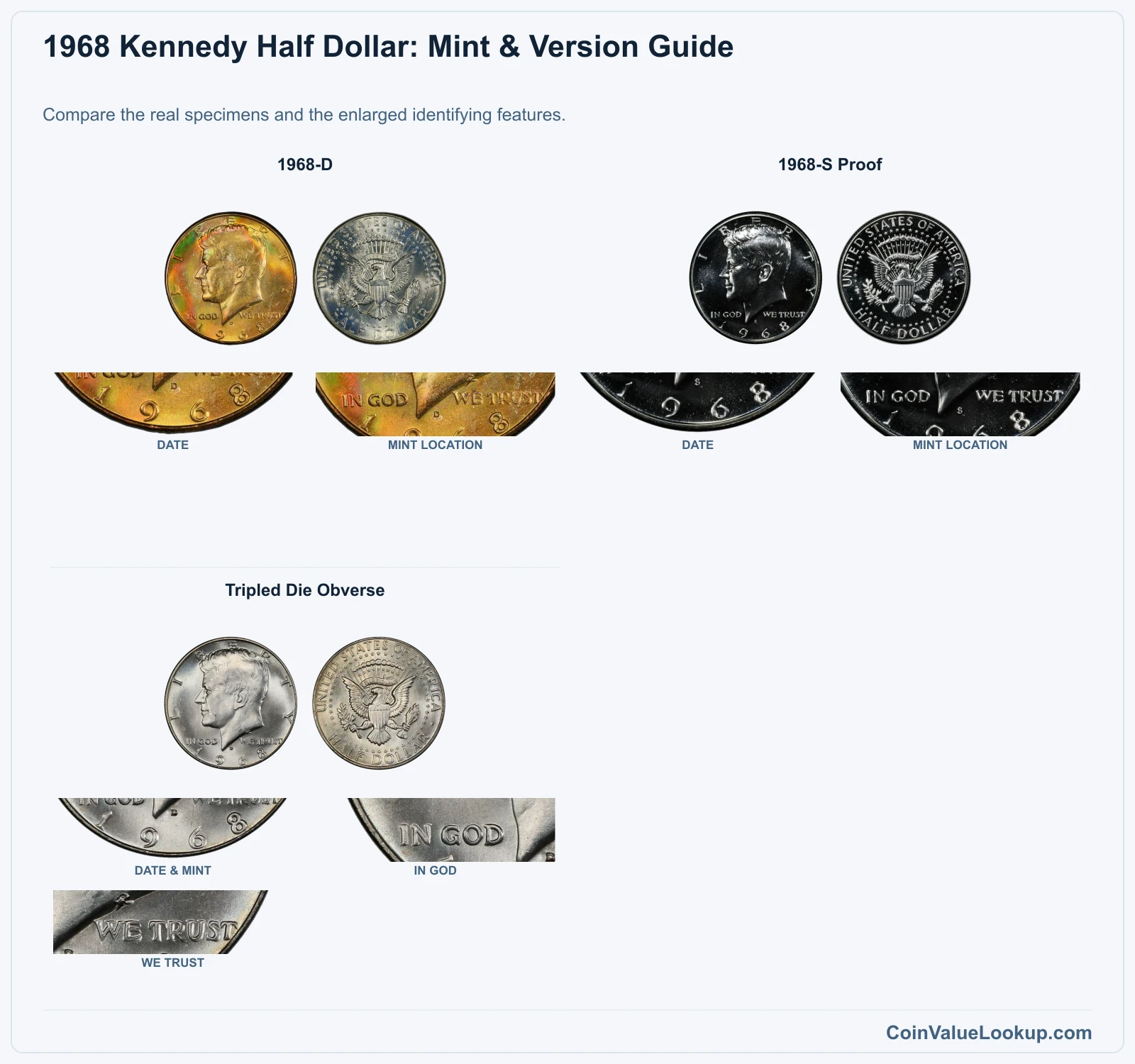
This is the first year mintmarks returned after being absent from 1965 through 1967. Look below the neck truncation, just above the date, on the obverse.
A "D" means Denver; an "S" means the San Francisco proof. No mintmark at all would indicate Philadelphia, though no Philadelphia business-strike version carries a separate guide listing for this year.
Do not confuse the 1966–67 coins (which never had mintmarks) with a 1968 "missing mintmark" variety. The earlier dates simply were not marked.
If your coin says 1968 and has no letter, it is a Philadelphia strike.
Coin Value Lookup is a handy starting point when you want to look up values for Kennedy halves or other U.S. coins by year and denomination. Bookmark it and come back whenever you pull something interesting out of a roll or collection.
Step 2: Check Your 1968 Kennedy Half Dollar Grade
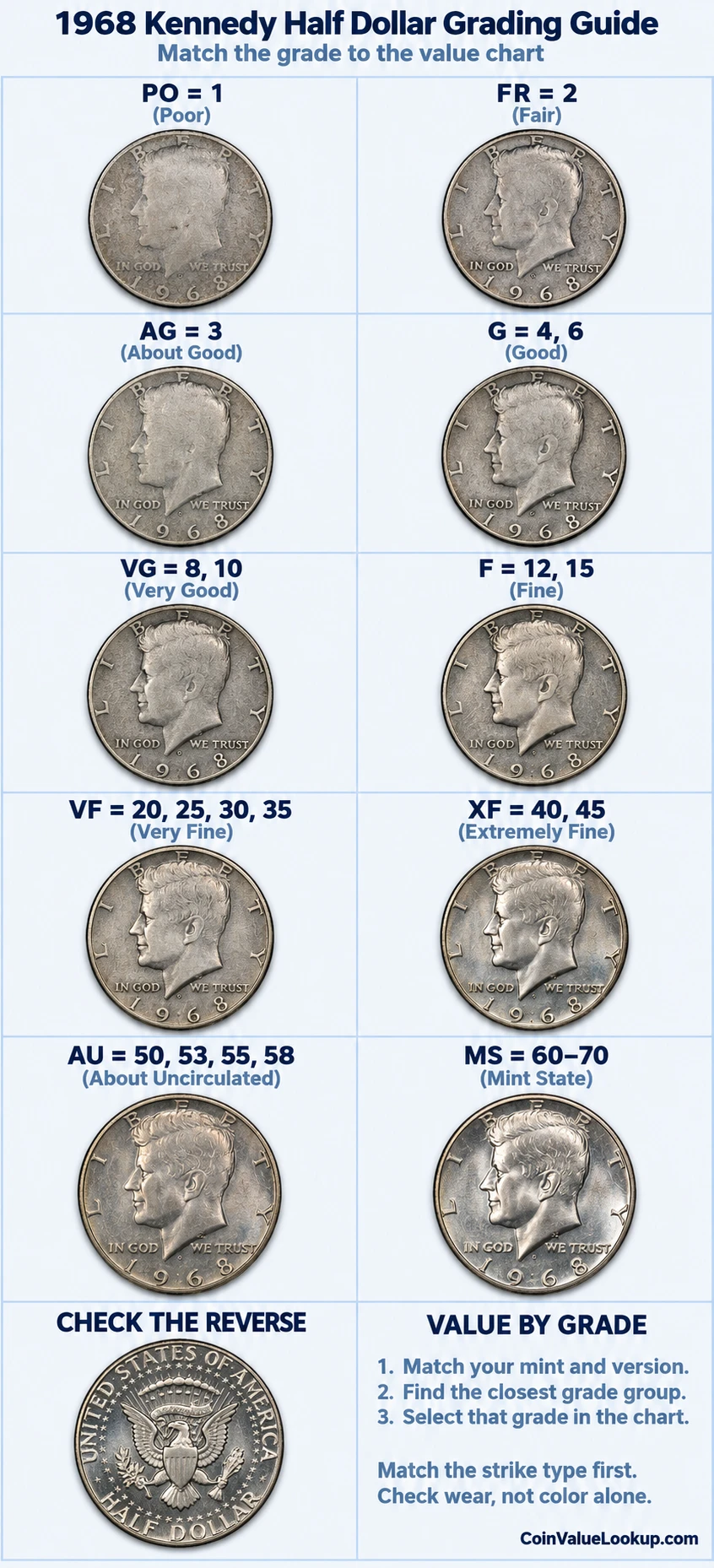
Start on the obverse. The hair just above Kennedy's ear and the cheekbone are the first places to lose detail from circulation wear.
A coin with full luster and no rub across those high points is a candidate for Mint State grading.
Flip the coin over. Check the eagle's breast feathers, tail feathers, and the horizontal lines on the shield.
Weak detail here can come from a soft strike rather than wear, so compare your coin to the same-type reference image to tell the difference.
Hairlines and bag marks are not the same as circulation wear. Tiny parallel scratches usually indicate cleaning or mishandling, while scattered contact marks come from coins banging together in mint bags.
Both reduce the grade but in different ways than honest wear.
Proof coins have a mirror-like finish from specially prepared dies. That finish is a manufacturing method, not a grade above Mint State.
A proof can still show hairlines, haze, or contact marks that lower its assigned grade.
Step 3: Check 1968 Kennedy Half Dollar Value by Mint and Version
1968 Kennedy Half Dollar — D
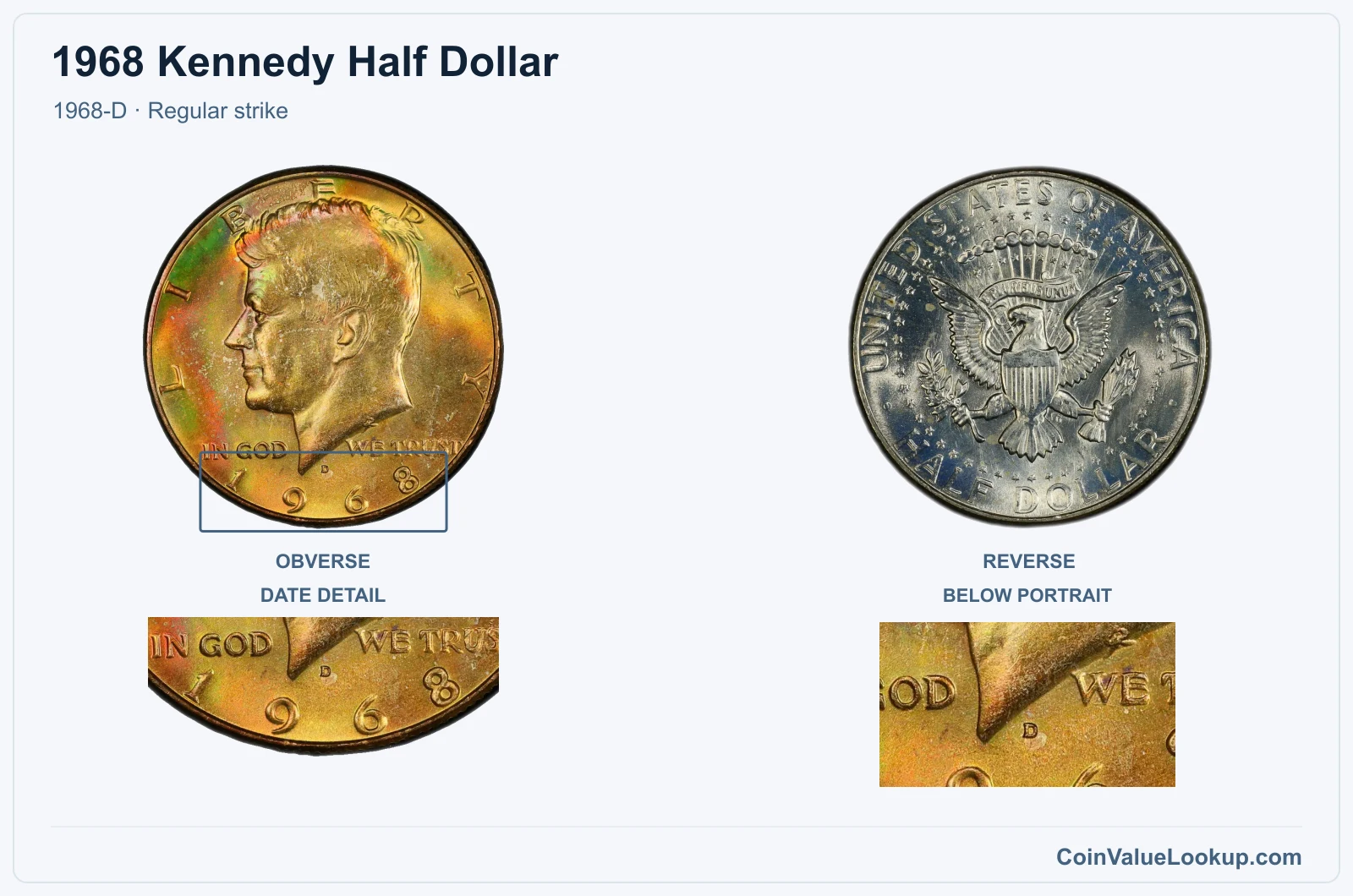
The 1968-D is the standard circulation-strike Kennedy half. It weighs about 11.50 grams in its 40% silver composition and carries a small "D" mintmark on the obverse below Kennedy's neck.
USA Coin Book lists it at roughly $14.35 in MS60 and about $45 in MS65.
Most 1968-D halves you encounter will show moderate to heavy wear because people spent these freely. The silver content gives every example a floor value tied to the metal market, but the real upside comes from finding one in well-preserved mint condition with original luster and minimal bag marks.
| Range | Grade | Price | Auction Records | Appraisal |
|---|---|---|---|---|
| PO | PO 1 | — | Coin Identifier | |
| FR | FR 2 | Coin Identifier | ||
| AG | AG 3 | — | Coin Identifier | |
| G | G 4 | — | Coin Identifier | |
| G 6 | — | Coin Identifier | ||
| VG | VG 8 | — | Coin Identifier | |
| VG 10 | — | Coin Identifier | ||
| F | F 12 | — | Coin Identifier | |
| F 15 | — | Coin Identifier | ||
| VF | VF 20 | — | Coin Identifier | |
| VF 25 | — | Coin Identifier | ||
| VF 30 | — | Coin Identifier | ||
| VF 35 | — | Coin Identifier | ||
| XF | XF 40 | — | Coin Identifier | |
| XF 45 | — | Coin Identifier | ||
| AU | AU 50 | — | Coin Identifier | |
| AU 53 | — | Coin Identifier | ||
| AU 55 | — | Coin Identifier | ||
| AU 58 | Coin Identifier | |||
| MS | MS 60 | — | Coin Identifier | |
| MS 61 | — | Coin Identifier | ||
| MS 62 | Coin Identifier | |||
| MS 63 | Coin Identifier | |||
| MS 64 | Coin Identifier | |||
| MS 65 | Coin Identifier | |||
| MS 66 | Coin Identifier | |||
| MS 67 | Coin Identifier | |||
| MS 68 | — | — | — | |
| MS 69 | — | — | — | |
| MS 70 | — | — | — |
1968 Kennedy Half Dollar — S Proof
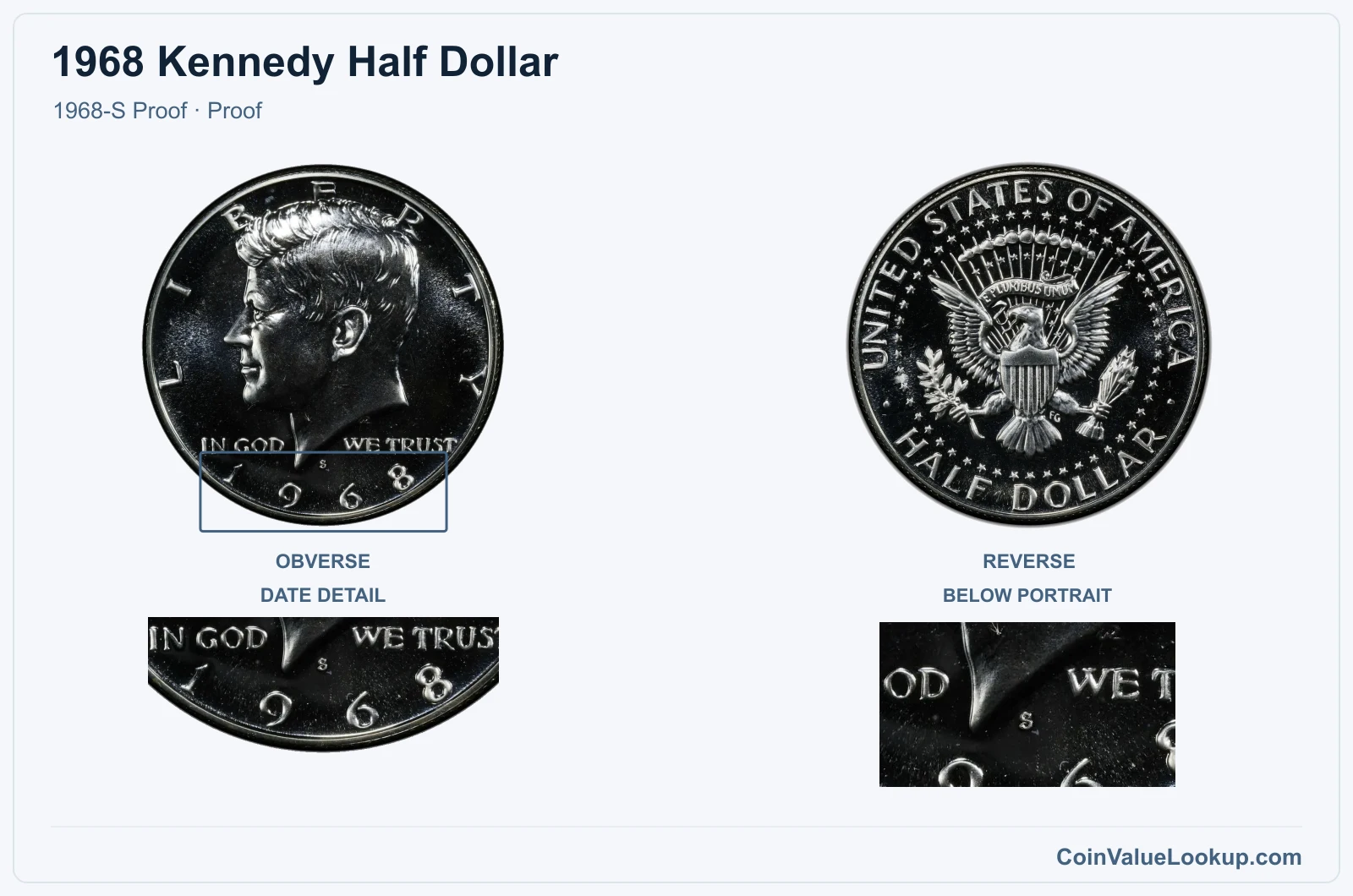
The 1968-S is a proof-only issue, struck at San Francisco for collectors. It shares the same 40% silver composition as its Denver counterpart.
Look for the "S" mintmark on the obverse below the neck.
USA Coin Book estimates about $17 for a PR65 example. Most were sold in proof sets and handled carefully, so finding one in high grade is not unusual.
That also means the premium over melt is modest unless you have an exceptional cameo contrast piece or one of the documented die varieties from this mint.
| Range | Grade | Price | Auction Records | Appraisal |
|---|---|---|---|---|
| PR | PR 1 | — | Coin Identifier | |
| PR 2 | — | Coin Identifier | ||
| PR 3 | — | Coin Identifier | ||
| PR 4 | — | Coin Identifier | ||
| PR 6 | — | Coin Identifier | ||
| PR 8 | — | Coin Identifier | ||
| PR 10 | — | Coin Identifier | ||
| PR 12 | — | Coin Identifier | ||
| PR 15 | — | Coin Identifier | ||
| PR 20 | — | Coin Identifier | ||
| PR 25 | — | Coin Identifier | ||
| PR 30 | — | Coin Identifier | ||
| PR 35 | — | Coin Identifier | ||
| PR 40 | — | Coin Identifier | ||
| PR 45 | — | Coin Identifier | ||
| PR 50 | — | Coin Identifier | ||
| PR 53 | — | Coin Identifier | ||
| PR 55 | — | Coin Identifier | ||
| PR 58 | — | Coin Identifier | ||
| PR 60 | — | Coin Identifier | ||
| PR 61 | — | Coin Identifier | ||
| PR 62 | Coin Identifier | |||
| PR 63 | Coin Identifier | |||
| PR 64 | Coin Identifier | |||
| PR 65 | Coin Identifier | |||
| PR 66 | Coin Identifier | |||
| PR 67 | Coin Identifier | |||
| PR 68 | Coin Identifier | |||
| PR 69 | Coin Identifier | |||
| PR 70 | — | — | — |
1968 Kennedy Half Dollar — Tripled Die Obverse
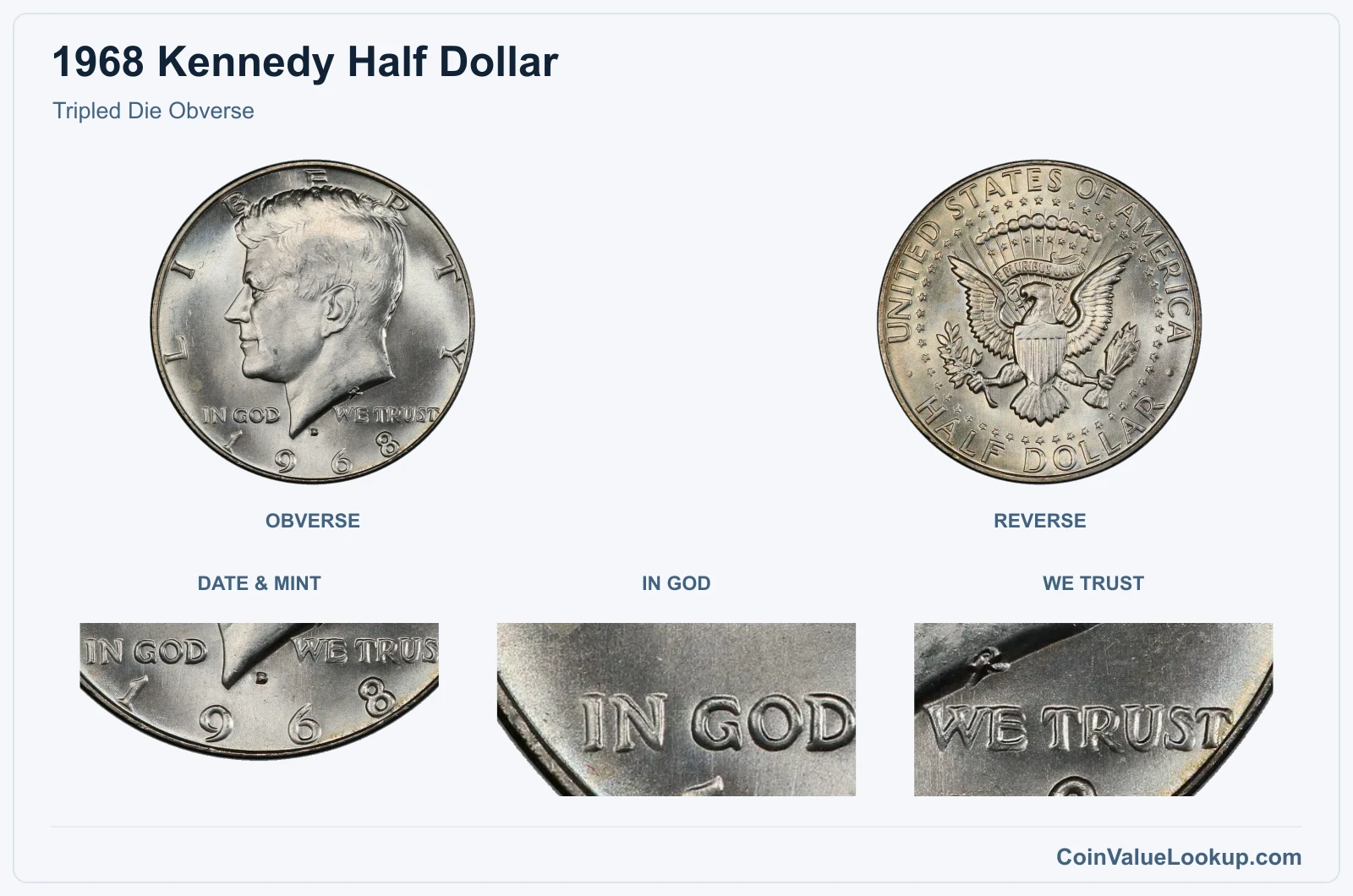
This is the 1968-D Tripled Die Obverse, a recognized hub-doubling variety. The diagnostics are specific: look at TRUST for separated tripling of the letter forms, check the corners of the letters I and N for notching, examine the upper serifs of the Y in LIBERTY for splitting, and inspect all four digits of the date for a matching directional spread.
All of these markers should be present and consistent. If only one area looks off, you may be seeing machine doubling or damage instead.
The coin is still the normal 40% silver alloy — the error is in the die, not the metal.
One MS65 example in the GreatCollections archive showed a price of $281.25. That is a single recorded result, not a broad market quote, but it gives you an idea of the premium this variety commands over a normal 1968-D in comparable condition.
Range Grade
Price Auction Records Appraisal PO PO 1
—
Coin Identifier FR FR 2
—
Coin Identifier AG AG 3
—
Coin Identifier G G 4
—
Coin Identifier
G 6
—
Coin Identifier VG VG 8
—
Coin Identifier
VG 10
—
Coin Identifier F F 12
—
Coin Identifier
F 15
—
Coin Identifier VF VF 20
—
Coin Identifier
VF 25
—
Coin Identifier
VF 30
—
Coin Identifier
VF 35
—
Coin Identifier XF XF 40
—
Coin Identifier
XF 45
—
Coin Identifier AU AU 50
—
Coin Identifier
AU 53
—
Coin Identifier
AU 55
—
Coin Identifier
AU 58
—
Coin Identifier MS MS 60
—
Coin Identifier
MS 61
—
Coin Identifier
MS 62
Coin Identifier
MS 63
—
Coin Identifier
MS 64
Coin Identifier
MS 65
Coin Identifier
MS 66
—
Coin Identifier
MS 67
—
—
—
MS 68
—
—
—
MS 69
—
—
—
MS 70
—
—
—
1968 Kennedy Half Dollar Error List
1. 1968 Kennedy Half Dollar — Tripled Die Obverse
The 1968-D Tripled Die Obverse is a die variety where the hub impression was applied multiple times with slight misalignment, leaving three overlapping images on the obverse die. To identify it, examine TRUST for clearly separated tripling of the letters, the corners of IN for notching, the upper serifs of the Y in LIBERTY for splits, and all four date digits for a matching spread direction.
Every diagnostic should line up consistently. Machine doubling produces flat, shelf-like distortion without the raised separation you see on a genuine tripled die.
Glare, post-mint scratches, and actual double-struck coins are other lookalikes to rule out.
A single MS65 example displayed in the GreatCollections archive carried a price of $281.25. That is one recorded result for one grade, not a market-wide range.
2. 1968 Kennedy Half Dollar — Missing Obverse Silver Layer
On the 1968-D Missing Obverse Silver Layer error, the outer silver-rich cladding on the front of the coin is absent, exposing the inner layer. The inner core itself still contains about 20.9% silver, so do not mistake its appearance for pure copper.
When examining a candidate, show both sides and the edge. The obverse will have a distinctly different color and texture compared to the normal reverse.
Genuine examples display properly struck design details on an unusual surface — not the rough, uneven look of acid stripping, staining, or filing.
Post-mint damage, plating removal, or environmental corrosion can all mimic a missing layer at first glance. A PCGS MS63 example sold for $120 at Heritage Auctions in April 2020, giving a reference point for this specific error and grade.
3. 1968 Kennedy Half Dollar — Struck on a Magnetic 125-Grain Planchet
The 1968-S Proof Struck on a Magnetic 125-Grain Planchet is one of the more dramatic wrong-planchet errors for this date. A normal 40% silver half dollar is not magnetic, so if your 1968-S proof sticks to a magnet, that is the first and most obvious clue.
Confirm the coin displays genuine proof characteristics — mirrored fields, sharp strike, and the S mintmark. The weight should correspond to approximately 125 grains rather than the standard half-dollar specification.
Post-mint alterations like plating or inserted metal cores can sometimes fool a magnet test, so authenticated surfaces and correct die details matter.
Two PCGS PR62 examples have sold at Heritage Auctions: one brought $4,200 in September 2024, and another realized $9,000 in August 2025. These are individual historical results, not a stable price range.
4. 1968 Kennedy Half Dollar — Proof Double Struck on a Quarter Planchet
This error is a 1968-S proof Kennedy half dollar struck on a quarter-sized clad planchet. The result is a noticeably smaller coin where the central Kennedy portrait, date, and S mintmark may survive, but outer legends like HALF DOLLAR are cut off by the edge of the undersized blank.
The clad edge of the quarter planchet is visible and distinct from the silver-clad edge of a normal half. Weight will be far below the standard 11.50 grams.
Do not confuse this with a filed-down or damaged coin — the struck surfaces should be sharp where the die made contact, with a clean unstruck crescent or truncation at the rim.
An NGC PR66 example sold for $2,640 at Heritage Auctions in October 2022, lot 4162. That gives you a benchmark, though condition and eye appeal always affect what any individual piece brings.
5. 1968 Kennedy Half Dollar — Inverted Mintmark
The 1968-S Inverted Mintmark is a reported variety where the S punch was placed into the die in an upside-down orientation. To check for it, compare your coin's S mintmark at magnification against a normal 1968-S at the same scale.
The curves and serifs of an inverted S will appear flipped relative to the standard positioning.
Do not confuse a slightly tilted or repunched mintmark with a true inversion. An ordinary S that looks a bit crooked is not the same thing.
Damage or wear around the mintmark area can also create misleading shapes.
Condition, the clarity of the inversion, and the specific attribution all affect what this variety is worth. No specific price range is available here, so individual assessment based on grade and eye appeal is the way to go.
6. 1968 Kennedy Half Dollar — Doubled Die Reverse
The 1968-S Doubled Die Reverse is a reported die variety affecting the reverse of the San Francisco proof issue. To identify it, compare the reverse legends and design contours of your coin closely against a normal 1968-S proof at the same magnification.
Genuine hub doubling will show consistent separation or thickening in specific areas of the design.
Machine doubling is the most common lookalike. It produces flat, shelf-like displacement rather than the raised, separated profiles of a true doubled die.
Reflections on proof surfaces can also trick the eye, and random nicks or scratches sometimes mimic doubling at a quick glance.
Value depends on condition, the strength of the doubling visible to the naked eye, and the specific attribution. No adopted price is available for this variety, so each coin needs to be evaluated on its own merits.
7. 1968 Kennedy Half Dollar — Struck-Through Error
A struck-through error on a 1968 Kennedy half dollar occurs when foreign material — grease, cloth fibers, a metal fragment, or other debris — sits between the die and the planchet during striking. The result is a localized depression, a textured impression, or an area of incomplete design where the obstruction blocked the die's full contact.
Grease-filled dies tend to produce soft, blobby voids, while a retained foreign object can leave a sharper outline or embedded fragment. Both are genuine strike errors, but they look quite different from each other.
Do not confuse struck-through areas with ordinary wear, scratches from circulation, cleaning damage, or a weakly struck area from low die pressure. The depression should be recessed below the surrounding design, not just flat.
Value varies widely depending on the size, location, and type of obstruction, so individual assessment is essential.
8. 1968 Kennedy Half Dollar — Off-Center Strike
An off-center strike happens when the planchet is not properly seated in the collar during striking, so the design lands shifted to one side, leaving a blank crescent of unstruck metal on the opposite edge. On a 1968 Kennedy half dollar, the key collector feature is whether the date remains fully visible despite the misalignment.
The percentage of off-center shift and the presence of a readable date are the two biggest factors driving interest. A coin that is 5% off-center looks like a minor curiosity; one that is 25–50% off-center with a clear date is far more dramatic.
Do not mistake a clipped planchet, a broadstrike, or post-mint flattening for an off-center strike. A genuine off-center coin shows a complete design impression that is simply displaced, with an unstruck area that has a smooth planchet surface.
Value depends on condition, the degree of misalignment, and date visibility.