1982 Lincoln Penny Coin Value: How Much Is It Worth?
Most 1982 Lincoln pennies you pull from a jar are worth one cent. In uncirculated condition around MS65, guide estimates for the seven business-strike varieties range from about $0.36 to $2.50, and the S proof runs around $3.08 at PR65.
The rare exception is the 1982-D Small Date bronze transition error, which is a different animal entirely and requires professional authentication.
Fast Way to Identify Your 1982 Lincoln Penny
Snap a clear photo of the front and back of your 1982 penny and upload both images. The identifier can give you a preliminary read on the mint mark, date size, and general version, which helps narrow down what you have before you weigh it or send it to a grading service.
It is not a substitute for authentication or certification.
1982 Penny Value
Upload both sides of your 1982 Lincoln Penny.
Front Obverse
Upload photo
Back Reverse
Upload photo
Which 1982 Lincoln Penny Versions Are Worth Money?
- The 1982-D Small Date bronze cent is a rare transition error struck on a copper-alloy planchet at Denver; it requires weight verification near 3.1 grams and professional authentication.
- Separate date size and metal before assigning any value; a Small Date zinc cent from Denver is common and worth far less than the bronze error.
- Uncirculated business strikes and S proofs carry small premiums, with the no-mint-mark copper Small Date guiding highest among regular issues at about $2.50 in MS65.
- Red or Red-Brown color designations on copper cents are grading attributes that affect value; they do not indicate a different metal.
Step 1: Identify Your 1982 Lincoln Penny Mint Mark and Version
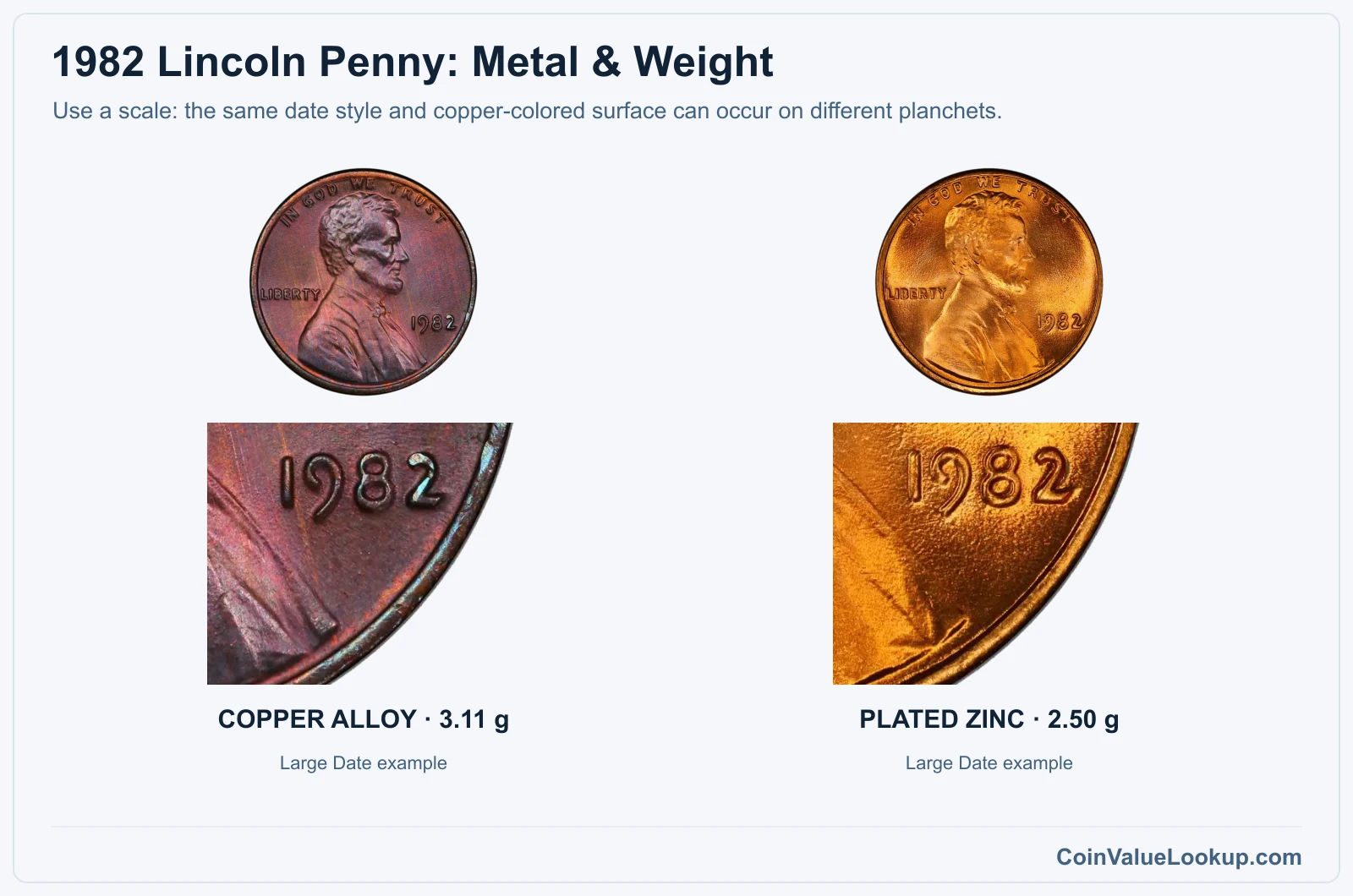
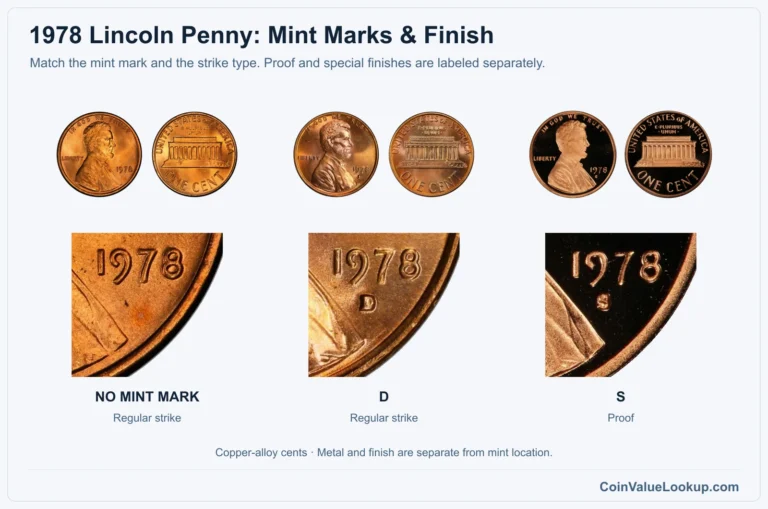
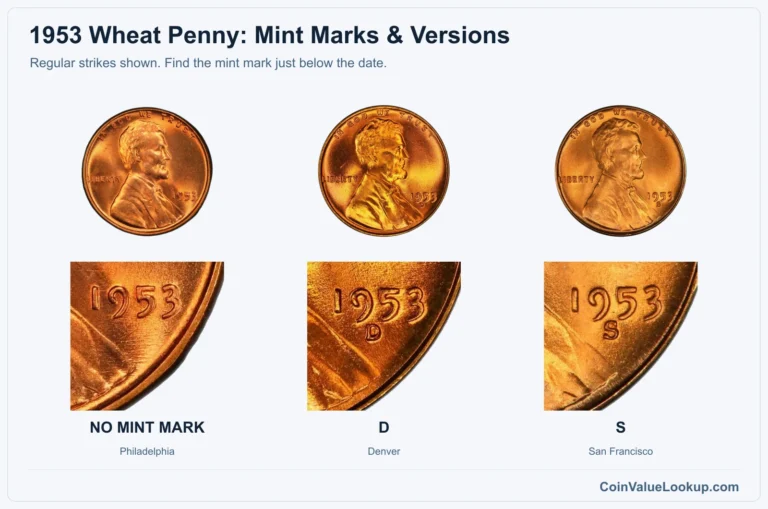
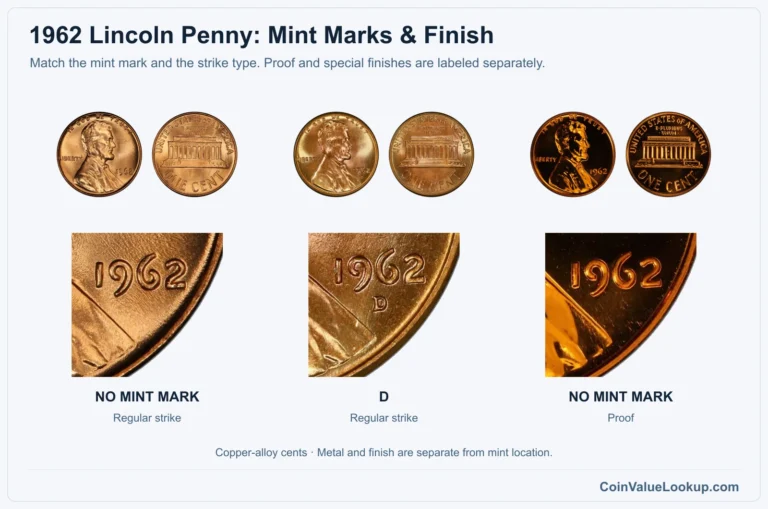
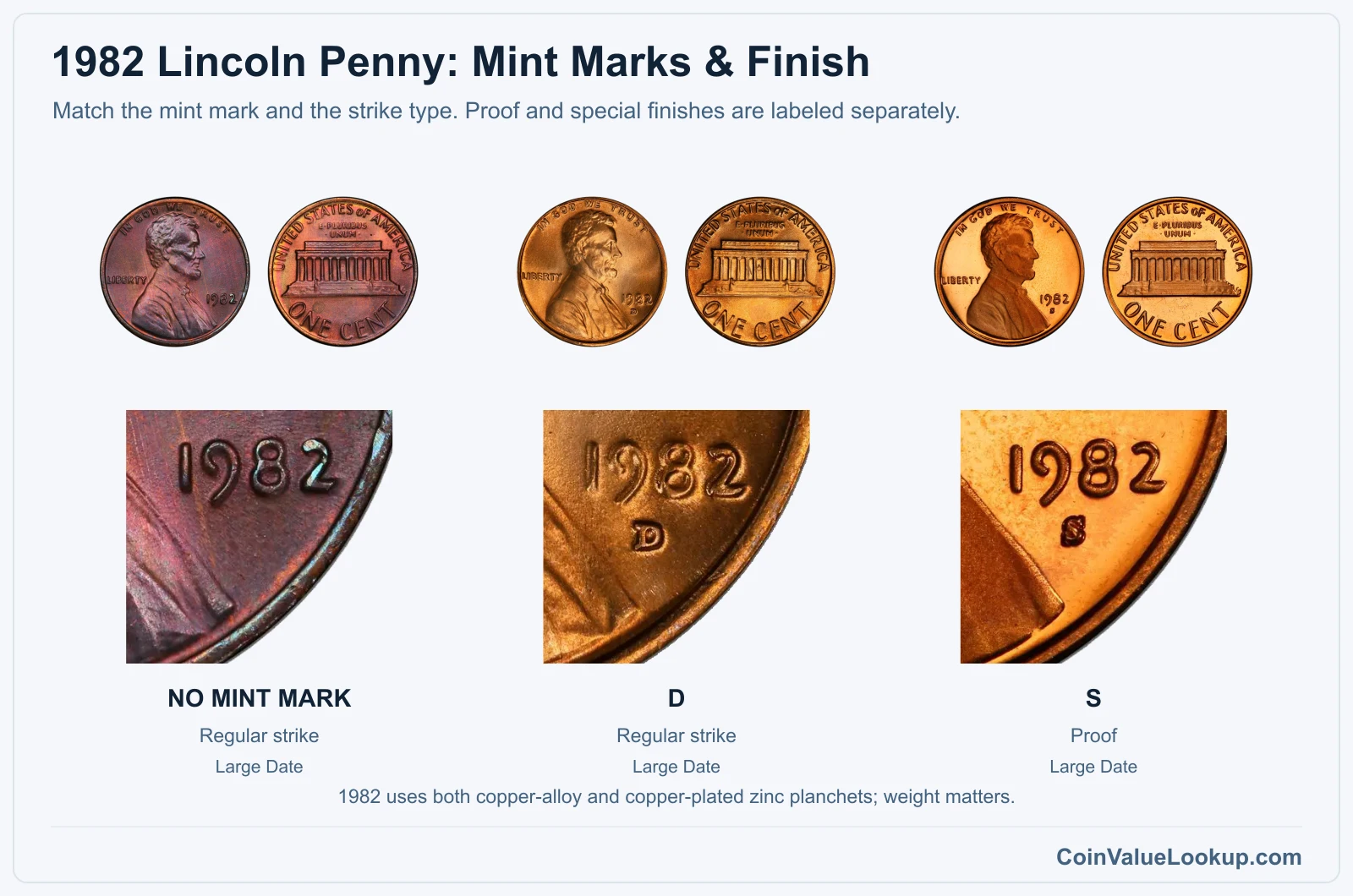
Start by flipping the coin over so the obverse faces you. Look below the date for a mint mark: D means Denver, S means San Francisco proof, and no letter means Philadelphia.
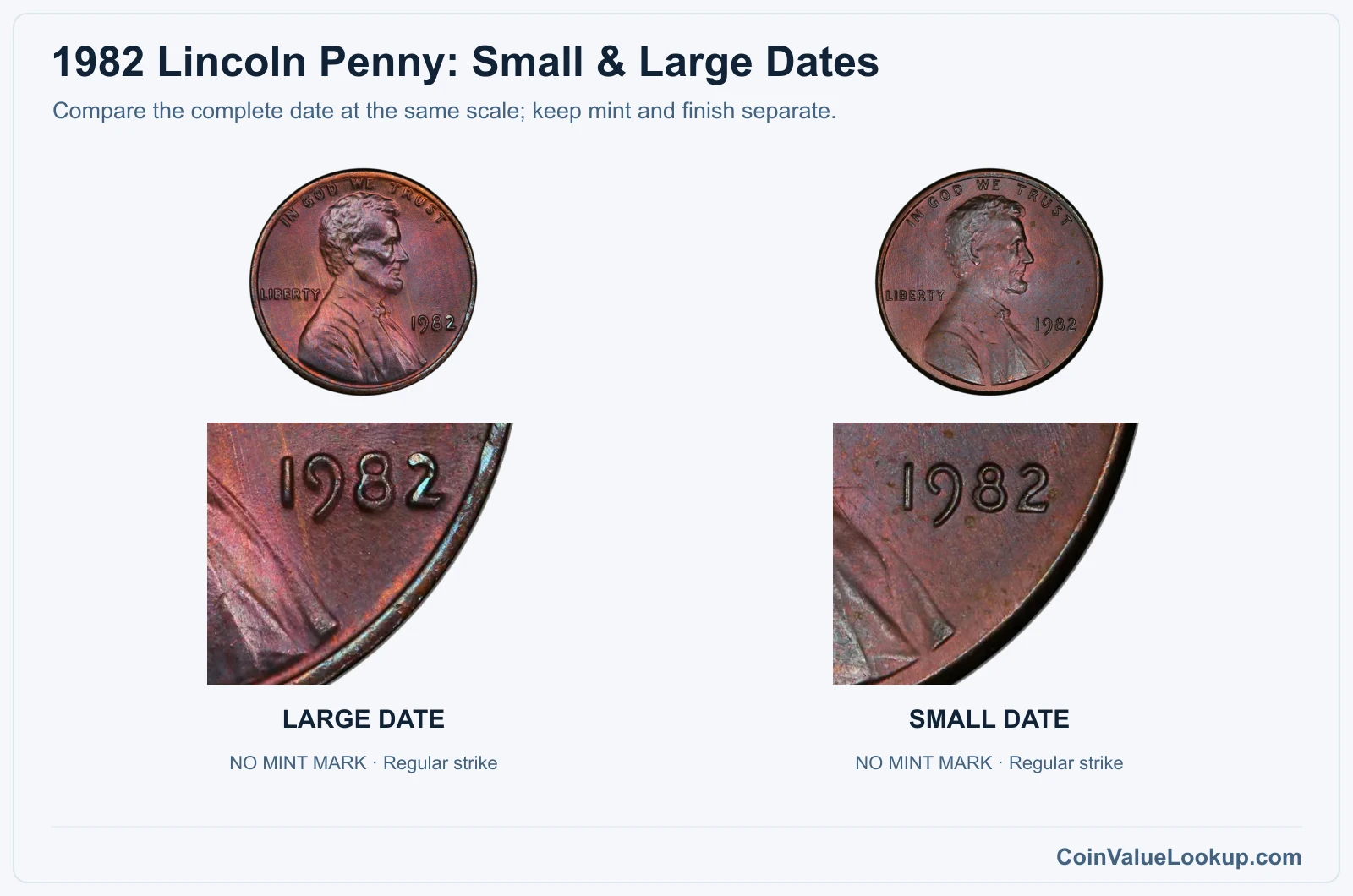
Next, look at the numeral 2 in the date. A Large Date 2 has a thicker stroke and a flatter, straighter base.
The Small Date 2 is noticeably slimmer with a curved foot. Use a side-by-side reference at the same magnification, because your brain will trick you if you eyeball it cold.
Now weigh the coin on a scale accurate to 0.01 grams. A 95% copper-alloy cent should land near 3.11 grams; a copper-plated zinc cent sits around 2.50 grams.
Color alone will fool you, especially on worn coins, so trust the scale.
Combining mint mark, date size, and weight gives you seven normal business-strike varieties plus the S copper Large Date proof. The so-called eighth combination, a D Small Date in copper alloy, is not a routine issue.
It is a rare transition error that needs third-party authentication.
Step 2: Check Your 1982 Lincoln Penny Grade
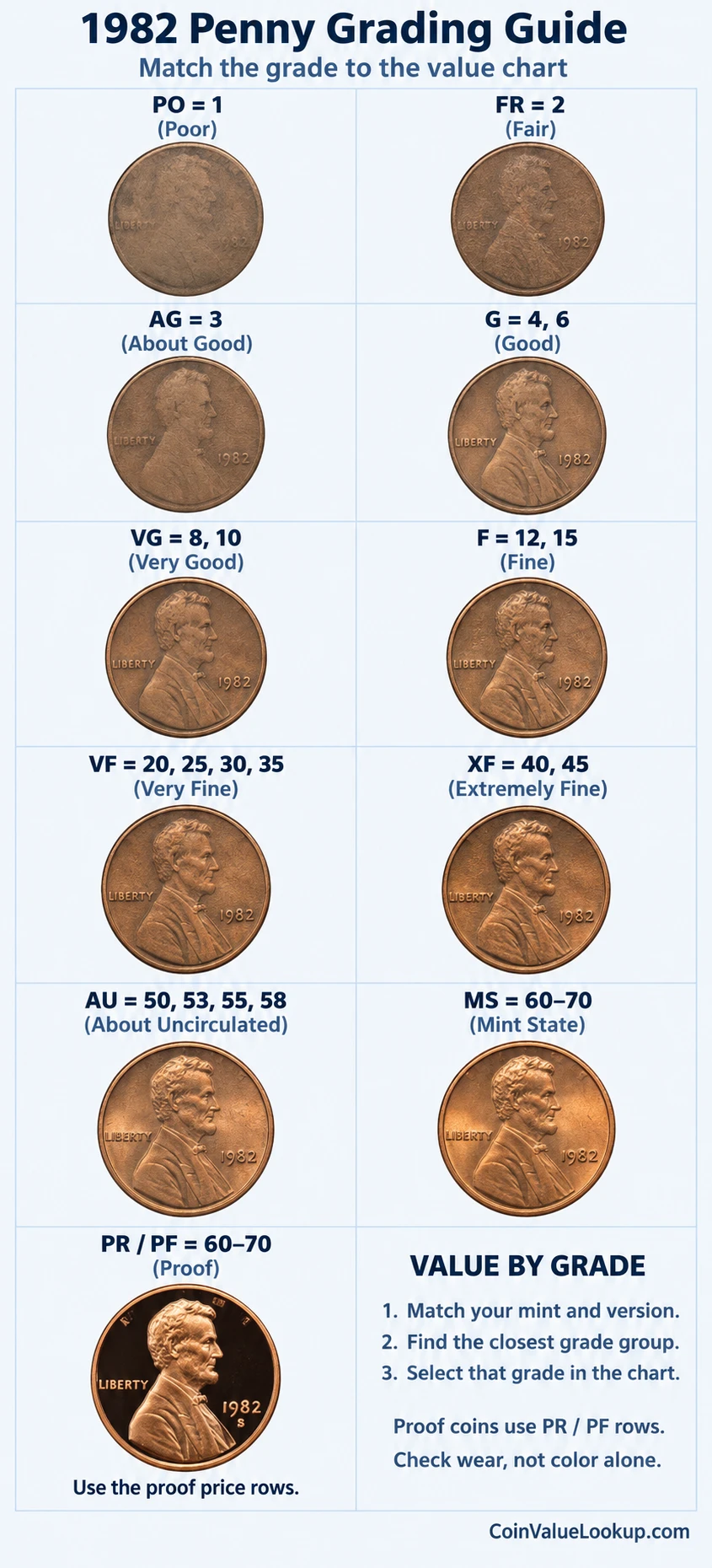
Check Lincoln's cheekbone and the fine hair detail above his ear. On a well-circulated coin those areas flatten first, while the jaw and coat remain sharper longer.
On the reverse, the Lincoln Memorial columns and the tiny statue inside lose definition as wear increases.
A mint-state coin shows no wear on any high point and retains original luster across both sides. For copper-alloy cents, you may see color grades like Brown, Red-Brown, or Red.
Those describe toning, not composition. A bright, polished coin is not automatically high grade; in fact, cleaning destroys luster and lowers the grade.
Use the comparison image to match your coin's wear against known grade examples. This gives you a ballpark, not a certified grade.
Professional grading services assign the final number.
Step 3: Check 1982 Lincoln Penny Value by Mint and Version
1982 Lincoln Penny — No Mint Mark, Copper Large Date
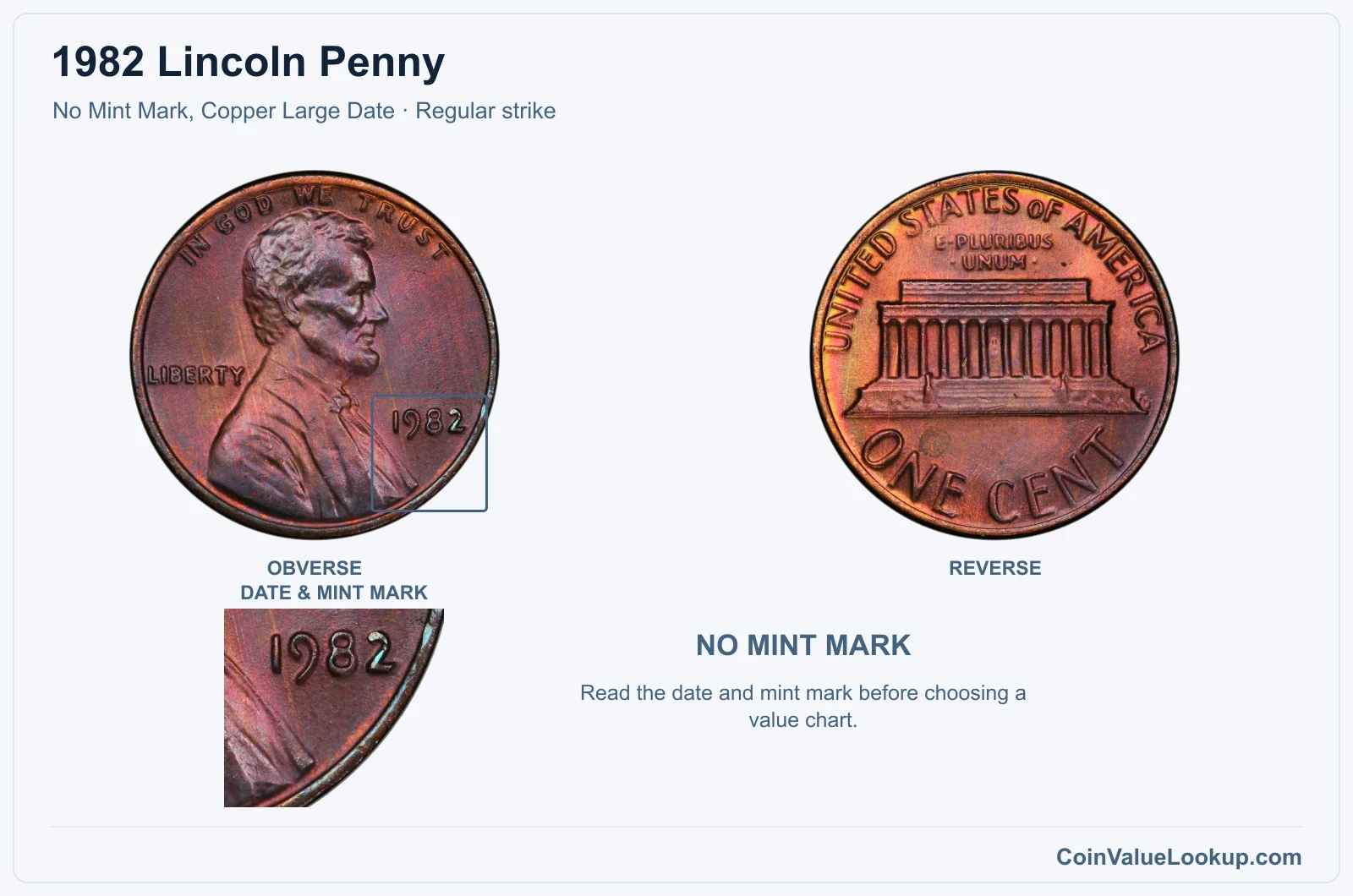
This is the Philadelphia-struck cent on a 95% copper-alloy planchet with the Large Date. No mint mark appears below the date.
The Large Date 2 has a broad, flat base and thicker strokes compared to its Small Date sibling.
A guide estimate places this version at about $1.24 in MS65. In circulated grades it trades at face value.
This was one of the last copper-alloy cents Philadelphia produced before the mid-year changeover to zinc, so nice uncirculated examples do turn up in original rolls from early 1982.
Range Grade
Price1982 No Mint Mark, Copper Large Date (BN) Price1982 No Mint Mark, Copper Large Date (RB) Price1982 No Mint Mark, Copper Large Date (RD) Auction Records Appraisal PO PO 1
—
Coin Identifier FR FR 2
—
Coin Identifier AG AG 3
—
Coin Identifier G G 4
—
Coin Identifier
G 6
—
Coin Identifier VG VG 8
—
Coin Identifier
VG 10
—
Coin Identifier F F 12
—
Coin Identifier
F 15
—
Coin Identifier VF VF 20
—
Coin Identifier
VF 25
—
Coin Identifier
VF 30
—
Coin Identifier
VF 35
—
Coin Identifier XF XF 40
—
Coin Identifier
XF 45
—
Coin Identifier AU AU 50
—
Coin Identifier
AU 53
—
Coin Identifier
AU 55
—
Coin Identifier
AU 58
—
Coin Identifier MS MS 60
—
Coin Identifier
MS 61
—
Coin Identifier
MS 62
—
Coin Identifier
MS 63
Coin Identifier
MS 64
Coin Identifier
MS 65
Coin Identifier
MS 66
Coin Identifier
MS 67
—
Coin Identifier
MS 68
—
—
—
—
—
MS 69
—
—
—
—
—
MS 70
—
—
—
—
—
1982 Lincoln Penny — No Mint Mark, Copper Small Date
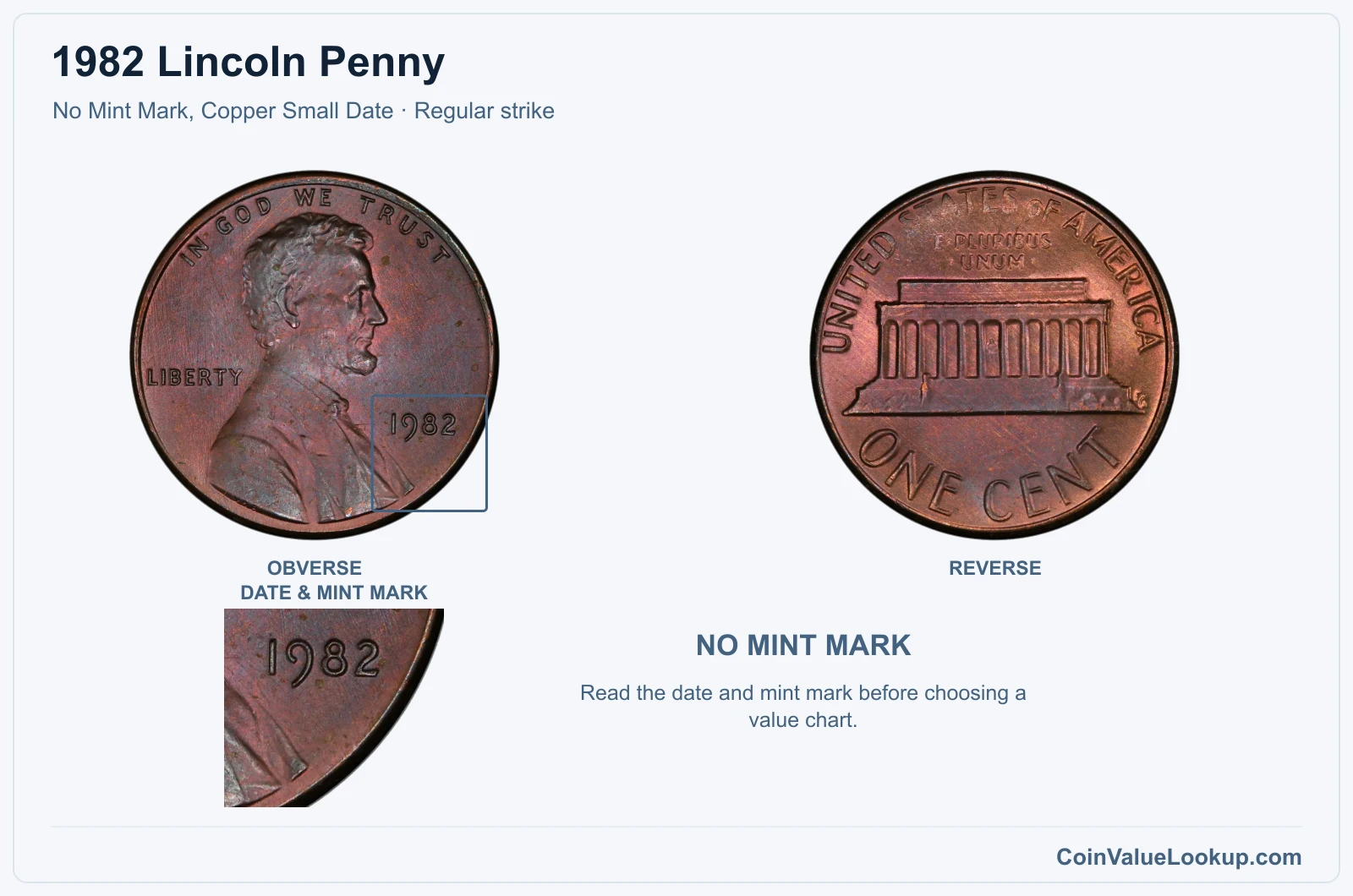
Same Philadelphia mint, same 95% copper alloy, but now with the Small Date. Look for the slimmer 2 with a distinctly curved base.
This is the highest-valued regular business issue among the seven, with a USA Coin Book guide estimate near $2.50 at MS65. That modest premium likely reflects the combination of copper composition and smaller production window for the Small Date dies at Philadelphia.
Circulated pieces still spend as one cent, but a clean uncirculated example is worth setting aside.
Coin Value Lookup is a good starting point if you are sorting through multiple years and need quick access to guides for other dates in the Lincoln series.
Range Grade
Price1982 No Mint Mark, Copper Small Date (BN) Price1982 No Mint Mark, Copper Small Date (RB) Price1982 No Mint Mark, Copper Small Date (RD) Auction Records Appraisal PO PO 1
—
Coin Identifier FR FR 2
—
Coin Identifier AG AG 3
—
Coin Identifier G G 4
—
Coin Identifier
G 6
—
Coin Identifier VG VG 8
—
Coin Identifier
VG 10
—
Coin Identifier F F 12
—
Coin Identifier
F 15
—
Coin Identifier VF VF 20
—
Coin Identifier
VF 25
—
Coin Identifier
VF 30
—
Coin Identifier
VF 35
—
Coin Identifier XF XF 40
—
Coin Identifier
XF 45
—
Coin Identifier AU AU 50
—
Coin Identifier
AU 53
—
Coin Identifier
AU 55
—
Coin Identifier
AU 58
—
Coin Identifier MS MS 60
—
Coin Identifier
MS 61
—
Coin Identifier
MS 62
—
Coin Identifier
MS 63
Coin Identifier
MS 64
Coin Identifier
MS 65
Coin Identifier
MS 66
Coin Identifier
MS 67
—
Coin Identifier
MS 68
—
—
Coin Identifier
MS 69
—
—
—
—
—
MS 70
—
—
—
—
—
1982 Lincoln Penny — D, Copper Large Date
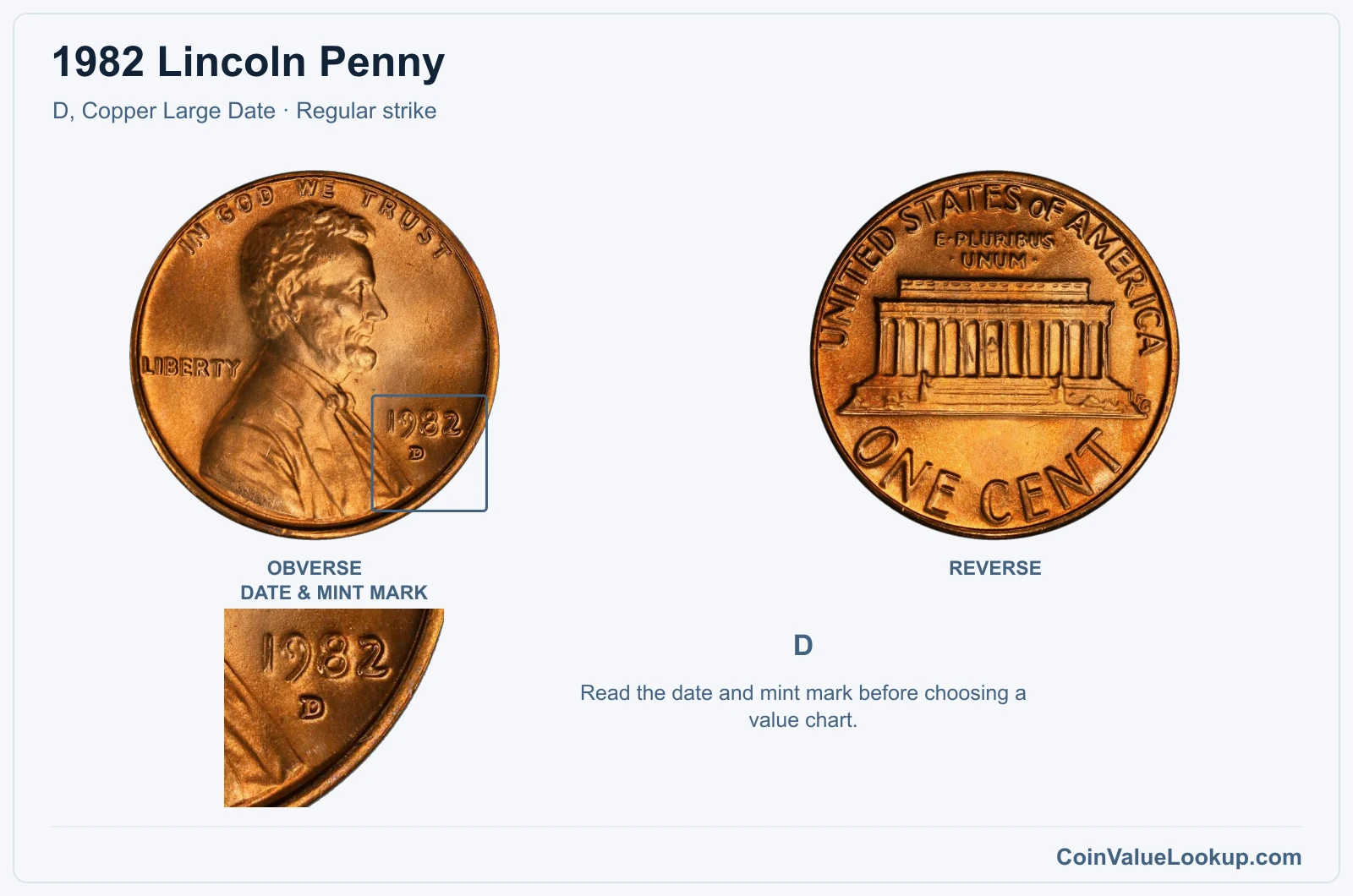
Denver struck this version on a copper-alloy planchet using Large Date dies. You will see a D mint mark below the date.
Confirm the weight is near 3.11 grams to separate it from the zinc Large Date also made at Denver.
The guide estimate is about $1.24 at MS65. In worn condition it is a one-cent coin.
Do not confuse this common variety with the rare D Small Date bronze error; the date size matters enormously here.
Range Grade
Price1982 D, Copper Large Date (BN) Price1982 D, Copper Large Date (RB) Price1982 D, Copper Large Date (RD) Auction Records Appraisal PO PO 1
—
Coin Identifier FR FR 2
—
Coin Identifier AG AG 3
—
Coin Identifier G G 4
—
Coin Identifier
G 6
—
Coin Identifier VG VG 8
—
Coin Identifier
VG 10
—
Coin Identifier F F 12
—
Coin Identifier
F 15
—
Coin Identifier VF VF 20
—
Coin Identifier
VF 25
—
Coin Identifier
VF 30
—
Coin Identifier
VF 35
—
Coin Identifier XF XF 40
—
Coin Identifier
XF 45
—
Coin Identifier AU AU 50
—
Coin Identifier
AU 53
—
Coin Identifier
AU 55
—
Coin Identifier
AU 58
—
Coin Identifier MS MS 60
—
—
—
Coin Identifier
MS 61
—
Coin Identifier
MS 62
—
Coin Identifier
MS 63
—
Coin Identifier
MS 64
Coin Identifier
MS 65
—
Coin Identifier
MS 66
Coin Identifier
MS 67
—
—
Coin Identifier
MS 68
—
—
—
—
—
MS 69
—
—
—
—
—
MS 70
—
—
—
—
—
1982 Lincoln Penny — No Mint Mark, Zinc Large Date
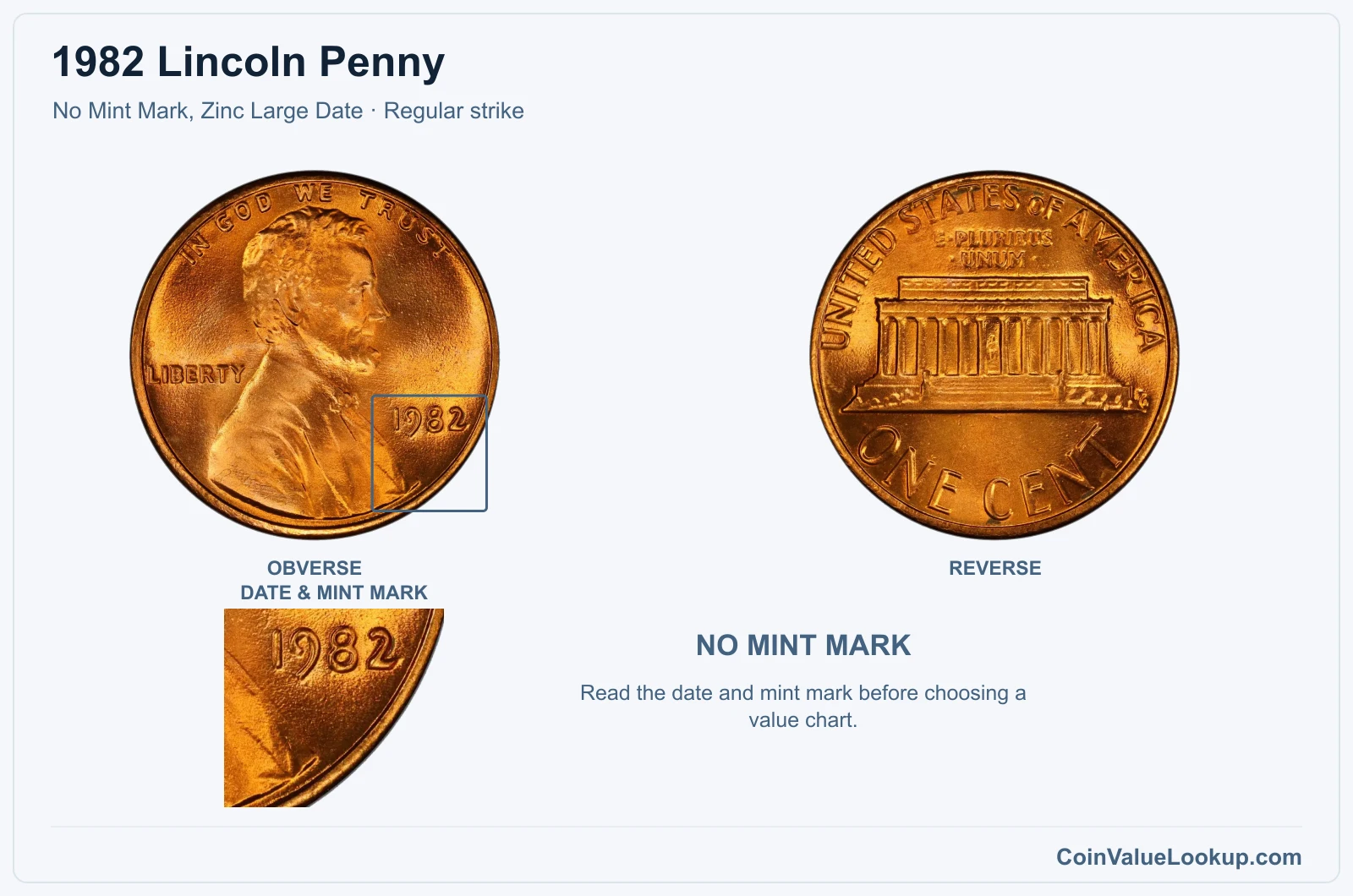
When you weigh a no-mint-mark Large Date and the scale reads around 2.50 grams, you have the copper-plated zinc version from Philadelphia. This was part of the mid-year transition to the cheaper zinc core.
At MS65, the guide estimate is roughly $0.61. These are abundant in change and in rolls.
Zinc cents are more vulnerable to corrosion, so genuinely clean uncirculated examples in original copper plating can still be worth pulling from a pile.
Range Grade
Price1982 No Mint Mark, Zinc Large Date (BN) Price1982 No Mint Mark, Zinc Large Date (RB) Price1982 No Mint Mark, Zinc Large Date (RD) Auction Records Appraisal PO PO 1
—
Coin Identifier FR FR 2
—
Coin Identifier AG AG 3
—
Coin Identifier G G 4
—
Coin Identifier
G 6
—
Coin Identifier VG VG 8
—
Coin Identifier
VG 10
—
Coin Identifier F F 12
—
Coin Identifier
F 15
—
Coin Identifier VF VF 20
—
Coin Identifier
VF 25
—
Coin Identifier
VF 30
—
Coin Identifier
VF 35
—
Coin Identifier XF XF 40
—
Coin Identifier
XF 45
—
Coin Identifier AU AU 50
—
Coin Identifier
AU 53
—
Coin Identifier
AU 55
—
Coin Identifier
AU 58
—
Coin Identifier MS MS 60
—
—
Coin Identifier
MS 61
—
—
Coin Identifier
MS 62
—
Coin Identifier
MS 63
Coin Identifier
MS 64
Coin Identifier
MS 65
—
Coin Identifier
MS 66
Coin Identifier
MS 67
—
Coin Identifier
MS 68
—
—
Coin Identifier
MS 69
—
—
Coin Identifier
MS 70
—
—
—
—
—
1982 Lincoln Penny — No Mint Mark, Zinc Small Date
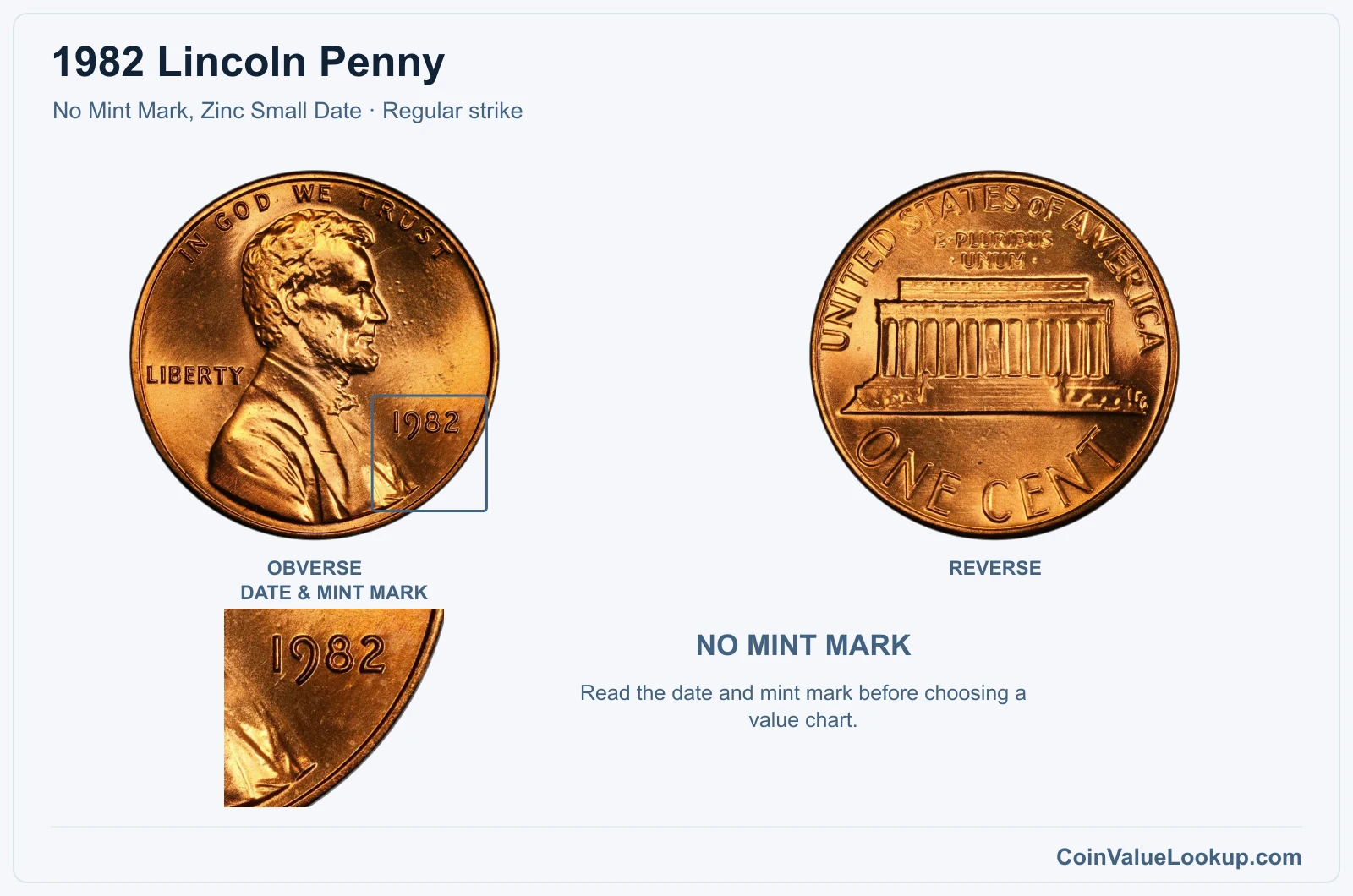
Philadelphia's zinc Small Date cent weighs about 2.50 grams and shows the slimmer numeral 2. It is more common than the copper Small Date from the same mint.
The guide estimate is approximately $1.05 at MS65. In circulated condition it is worth face value.
Because it shares a date size with the doubled-reverse variety reported for this year, it is worth inspecting the reverse lettering before tossing it back in the jar.
Range Grade
Price1982 No Mint Mark, Zinc Small Date (BN) Price1982 No Mint Mark, Zinc Small Date (RB) Price1982 No Mint Mark, Zinc Small Date (RD) Auction Records Appraisal PO PO 1
—
Coin Identifier FR FR 2
—
Coin Identifier AG AG 3
—
Coin Identifier G G 4
—
Coin Identifier
G 6
—
Coin Identifier VG VG 8
—
Coin Identifier
VG 10
—
Coin Identifier F F 12
—
Coin Identifier
F 15
—
Coin Identifier VF VF 20
—
Coin Identifier
VF 25
—
Coin Identifier
VF 30
—
Coin Identifier
VF 35
—
Coin Identifier XF XF 40
—
Coin Identifier
XF 45
—
Coin Identifier AU AU 50
—
Coin Identifier
AU 53
—
—
Coin Identifier
AU 55
—
Coin Identifier
AU 58
—
Coin Identifier MS MS 60
—
—
Coin Identifier
MS 61
—
—
Coin Identifier
MS 62
—
Coin Identifier
MS 63
—
Coin Identifier
MS 64
Coin Identifier
MS 65
—
Coin Identifier
MS 66
Coin Identifier
MS 67
—
Coin Identifier
MS 68
—
—
Coin Identifier
MS 69
—
—
Coin Identifier
MS 70
—
—
—
—
—
1982 Lincoln Penny — D, Zinc Large Date
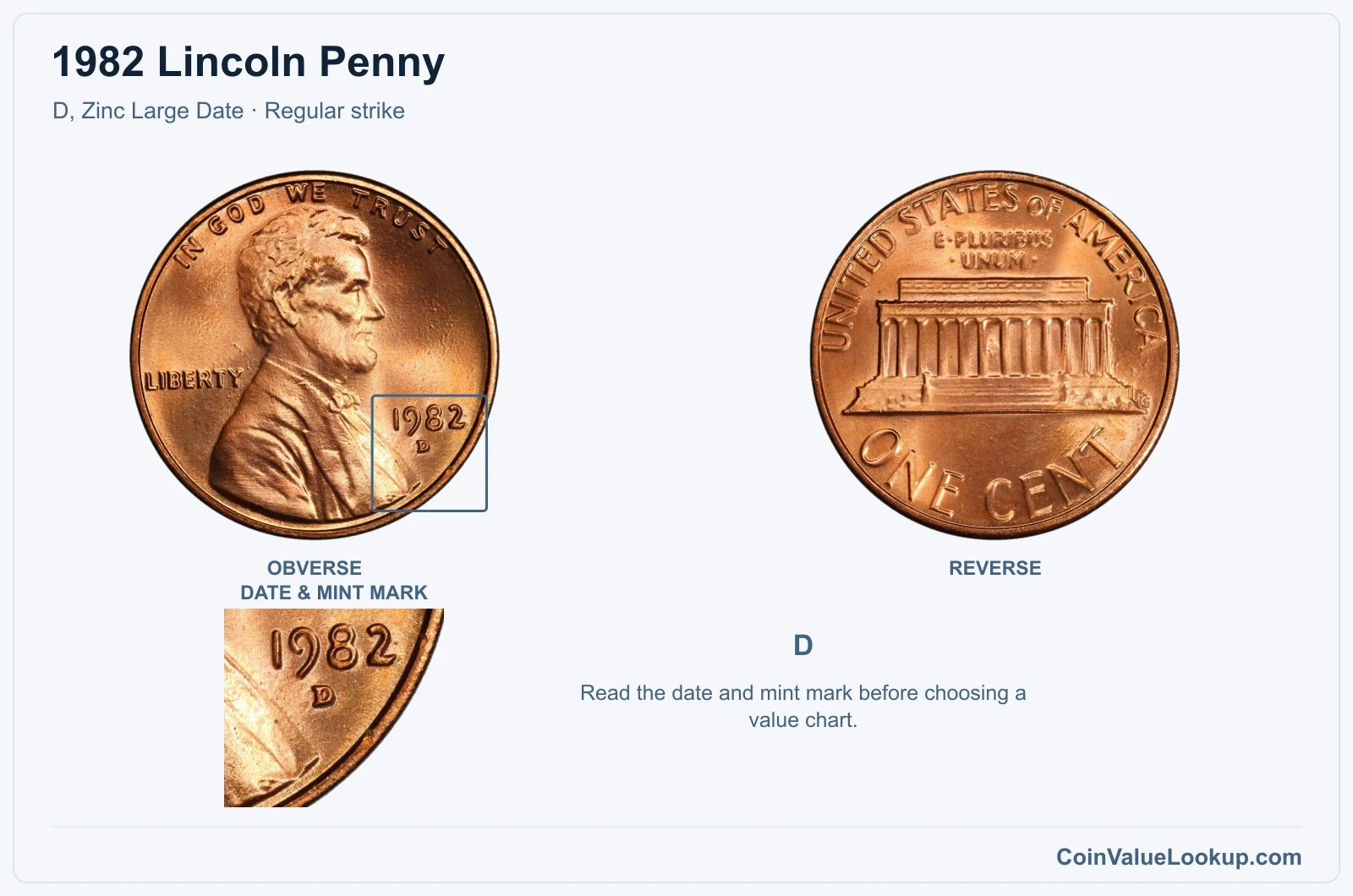
Denver's zinc Large Date is the workhorse of the 1982 cent family. The D mint mark sits below the date, the weight lands near 2.50 grams, and the 2 has the broad, flat-base profile of the Large Date.
At MS65 the guide estimate is about $0.49. Circulated examples are face-value coins.
You will find these by the handful in almost any bag of mixed-date cents.
Range Grade
Price1982 D, Zinc Large Date (BN) Price1982 D, Zinc Large Date (RB) Price1982 D, Zinc Large Date (RD) Auction Records Appraisal PO PO 1
—
Coin Identifier FR FR 2
—
Coin Identifier AG AG 3
—
Coin Identifier G G 4
—
Coin Identifier
G 6
—
Coin Identifier VG VG 8
—
Coin Identifier
VG 10
—
Coin Identifier F F 12
—
Coin Identifier
F 15
—
Coin Identifier VF VF 20
—
Coin Identifier
VF 25
—
Coin Identifier
VF 30
—
Coin Identifier
VF 35
—
Coin Identifier XF XF 40
—
Coin Identifier
XF 45
—
Coin Identifier AU AU 50
—
—
Coin Identifier
AU 53
—
Coin Identifier
AU 55
—
Coin Identifier
AU 58
—
Coin Identifier MS MS 60
—
—
Coin Identifier
MS 61
—
Coin Identifier
MS 62
Coin Identifier
MS 63
—
Coin Identifier
MS 64
—
—
Coin Identifier
MS 65
—
Coin Identifier
MS 66
Coin Identifier
MS 67
Coin Identifier
MS 68
—
—
Coin Identifier
MS 69
—
—
—
Coin Identifier
MS 70
—
—
—
—
—
1982 Lincoln Penny — D, Zinc Small Date
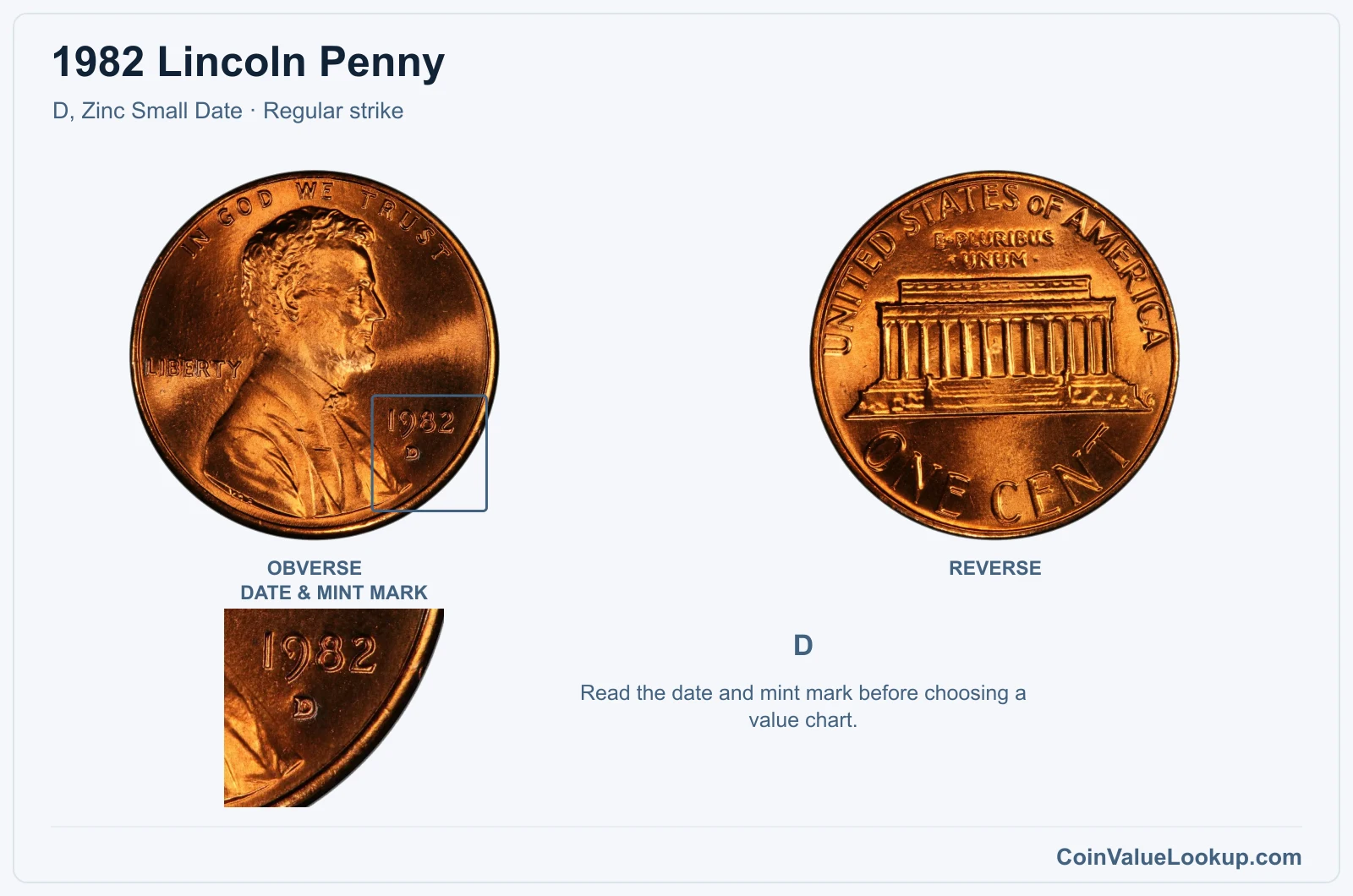
This is the Denver zinc Small Date, the lowest-valued of the seven business strikes at roughly $0.36 in MS65 per the guide. It weighs around 2.50 grams and shows the slim, curved-base 2.
Do not mistake this for the rare D Small Date bronze error. The weight test is decisive: 2.50 grams means zinc, and zinc means common.
If your scale reads near 3.1 grams, stop and get the coin professionally authenticated.
Range Grade
Price1982 D, Zinc Small Date (BN) Price1982 D, Zinc Small Date (RB) Price1982 D, Zinc Small Date (RD) Auction Records Appraisal PO PO 1
—
Coin Identifier FR FR 2
—
Coin Identifier AG AG 3
—
Coin Identifier G G 4
—
Coin Identifier
G 6
—
Coin Identifier VG VG 8
—
Coin Identifier
VG 10
—
Coin Identifier F F 12
—
Coin Identifier
F 15
—
Coin Identifier VF VF 20
—
Coin Identifier
VF 25
—
Coin Identifier
VF 30
—
Coin Identifier
VF 35
—
Coin Identifier XF XF 40
—
Coin Identifier
XF 45
—
Coin Identifier AU AU 50
—
Coin Identifier
AU 53
—
Coin Identifier
AU 55
—
Coin Identifier
AU 58
Coin Identifier MS MS 60
—
—
Coin Identifier
MS 61
—
—
Coin Identifier
MS 62
—
Coin Identifier
MS 63
Coin Identifier
MS 64
—
Coin Identifier
MS 65
—
Coin Identifier
MS 66
—
Coin Identifier
MS 67
—
—
Coin Identifier
MS 68
—
—
Coin Identifier
MS 69
—
—
—
—
—
MS 70
—
—
—
—
—
1982 Lincoln Penny — S, Copper Large Date Proof
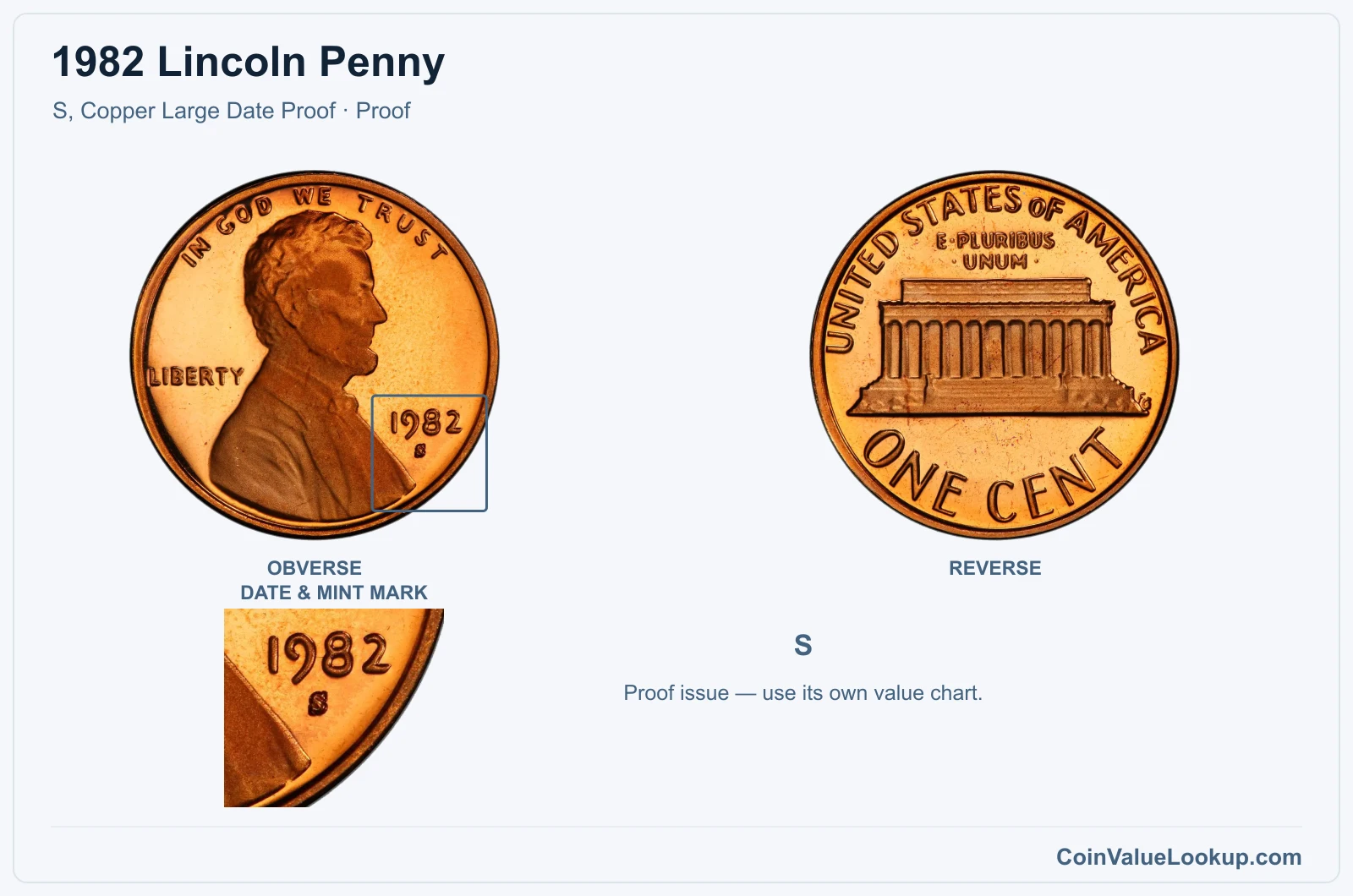
San Francisco produced a proof-finish cent on a 95% copper-alloy planchet using Large Date dies. Proofs are struck with polished dies on specially prepared blanks, giving them sharp detail and mirror-like fields.
This is a manufacturing process, not a grade above mint state.
The guide estimate is about $3.08 at PR65. These came in the 1982 proof set and are not found in circulation.
There is no routine S zinc cent in this year's lineup, so if your coin carries an S mint mark it should be this copper proof.
Range Grade
Price Auction Records Appraisal PR PR 1
—
Coin Identifier
PR 2
—
Coin Identifier
PR 3
—
Coin Identifier
PR 4
—
Coin Identifier
PR 6
—
Coin Identifier
PR 8
—
Coin Identifier
PR 10
—
Coin Identifier
PR 12
—
Coin Identifier
PR 15
—
Coin Identifier
PR 20
—
Coin Identifier
PR 25
—
Coin Identifier
PR 30
—
Coin Identifier
PR 35
—
Coin Identifier
PR 40
—
Coin Identifier
PR 45
—
Coin Identifier
PR 50
—
Coin Identifier
PR 53
—
Coin Identifier
PR 55
—
Coin Identifier
PR 58
—
Coin Identifier
PR 60
Coin Identifier
PR 61
—
Coin Identifier
PR 62
—
Coin Identifier
PR 63
—
Coin Identifier
PR 64
—
Coin Identifier
PR 65
—
Coin Identifier
PR 66
Coin Identifier
PR 67
Coin Identifier
PR 68
Coin Identifier
PR 69
Coin Identifier
PR 70
Coin Identifier
1982 Lincoln Penny Error List
1. 1982 Lincoln Penny — D Small Date Bronze Error
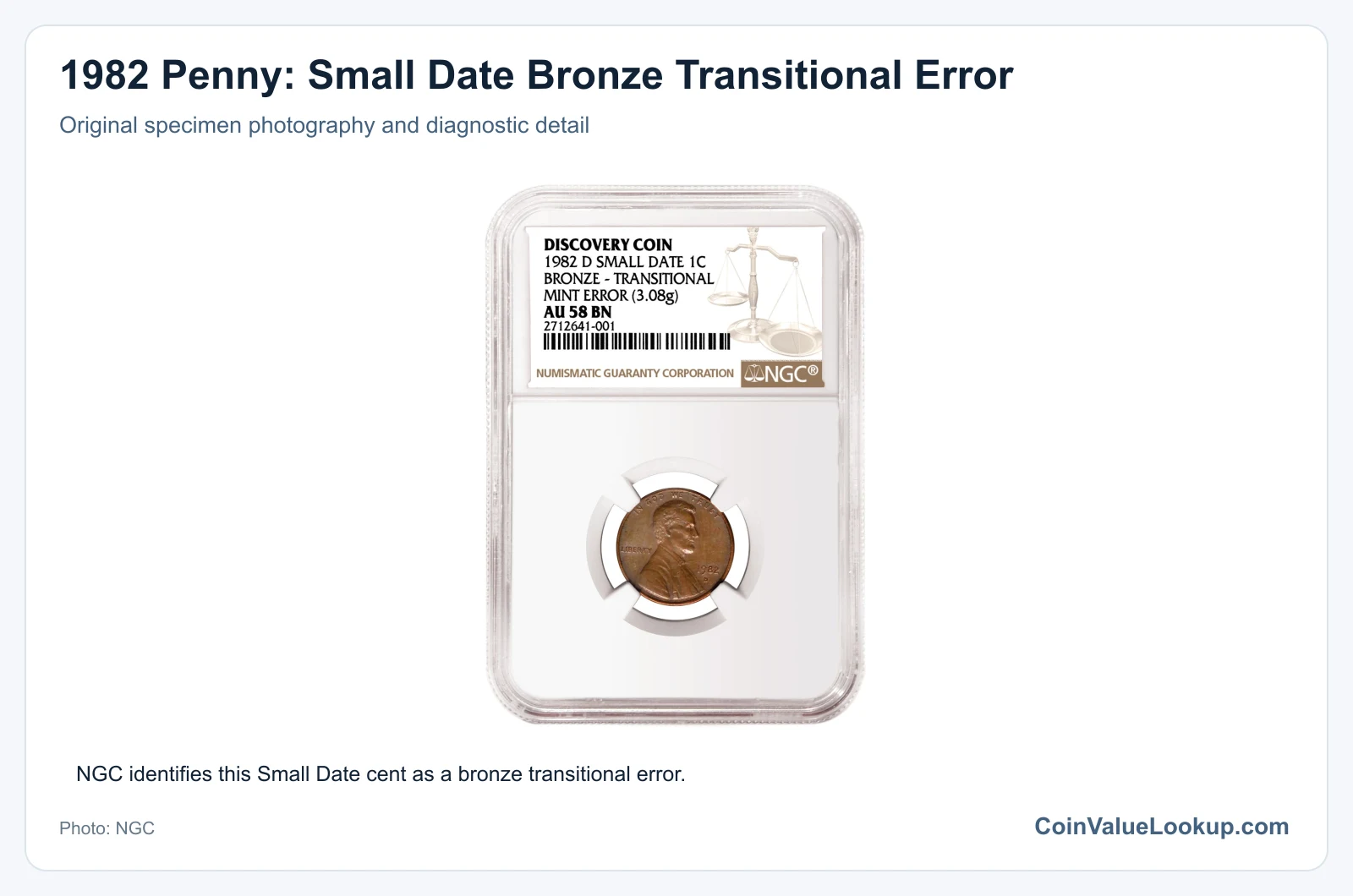
This is the famous 1982-D Small Date bronze transition error. During Denver's changeover from copper-alloy to zinc planchets, at least one Small Date cent was struck on a leftover copper blank.
Three things must all check out: a D mint mark, a genuine Small Date, and a weight near 3.1 grams.
The authenticated example graded NGC AU58 BN weighed 3.08 grams and sold for a reported $18,800 at Stack's Bowers in August 2017. That is one recorded sale, not a current market range.
Common lookalikes include the normal 2.50-gram D Small Date zinc cent and the ordinary 3.11-gram D Large Date copper cent. Altered dates and inaccurate scales also generate false positives.
If your coin passes the weight and date-size checks, send it to a third-party grading service before drawing conclusions.
2. 1982 Lincoln Penny — Doubled Reverse Lettering
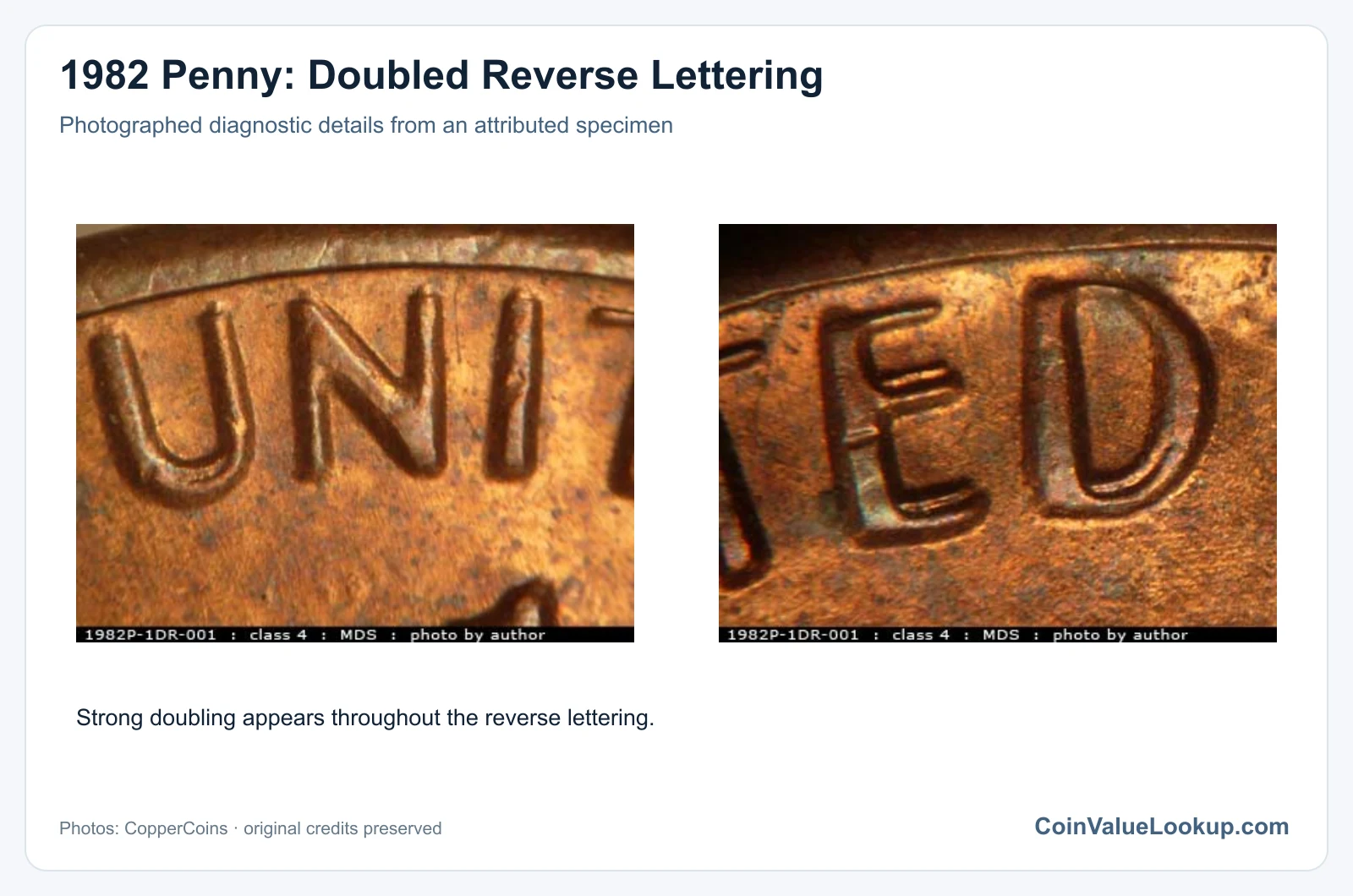
A doubled reverse has been reported on the 1982 no-mint-mark Small Date zinc cent. The doubling appears on the reverse lettering, including UNITED STATES OF AMERICA, E PLURIBUS UNUM, and ONE CENT.
Look for a consistent second image that is separated from the primary letters.
Do not confuse this with flat machine doubling, which produces shelf-like distortion in one direction without true separation. Plating disturbance and corrosion on zinc cents can also mimic doubling under low magnification.
Compare your coin to an attributed reference at the same scale.
Value depends on the authenticated type, severity of the doubling, and overall condition of the coin. Individual assessment by a grading service is the reliable path here.
3. 1982 Lincoln Penny — Off-Center Strike
An off-center strike happens when the planchet is not seated properly between the dies. Part of the design is pushed to one side, and an intact blank crescent appears where the dies never reached the metal.
A 1982-D cent struck 50% off-center, graded NGC MS62 Brown, sold for a reported $99 at Heritage in September 2019. That is one historical example, not a standing price.
The date and D mint mark must remain visible for the coin to be attributable to this year and mint. Watch out for lookalikes: a coin that was cut, filed on the edge, or struck with a misaligned die.
A misaligned die shifts the image slightly but still covers the full planchet.
4. 1982 Lincoln Penny — Double Strike
A double-struck cent received two impressions from the dies, with the second strike displaced from the first. You can see overlapping design elements and two distinct outlines of part of the coin.
A 1982-D example graded PCGS MS62 Brown sold for a reported $79 at Heritage in May 2021. That is one sale, not a general price.
The key distinction is that a doubled die shows doubling within the design from a single strike, while a double strike produces two clearly separate impressions. Damage from pressing two coins together in a vise can also mimic a second strike, but the metal flow and strike characteristics differ under magnification.
5. 1982 Lincoln Penny — Broadstrike and Clipped Planchet
This error combines two problems on one coin. A broadstrike occurs when the collar die fails to contain the planchet, allowing the metal to spread beyond normal diameter while retaining the full design.
A straight clip means a section of the blank was sheared off before striking, leaving a flat missing edge.
A 1982-D bronze Large Date cent with both a broadstrike and straight clip, graded ANACS MS60 Brown, sold for a reported $69 at Heritage in December 2020. That price reflects the combined error, not either feature alone.
Lookalikes include coins with sanded edges or deliberately flattened rims. Genuine clips show a consistent blank area and often a weakness in the strike opposite the missing section.
6. 1982 Lincoln Penny — Missing or Incomplete Copper Plating
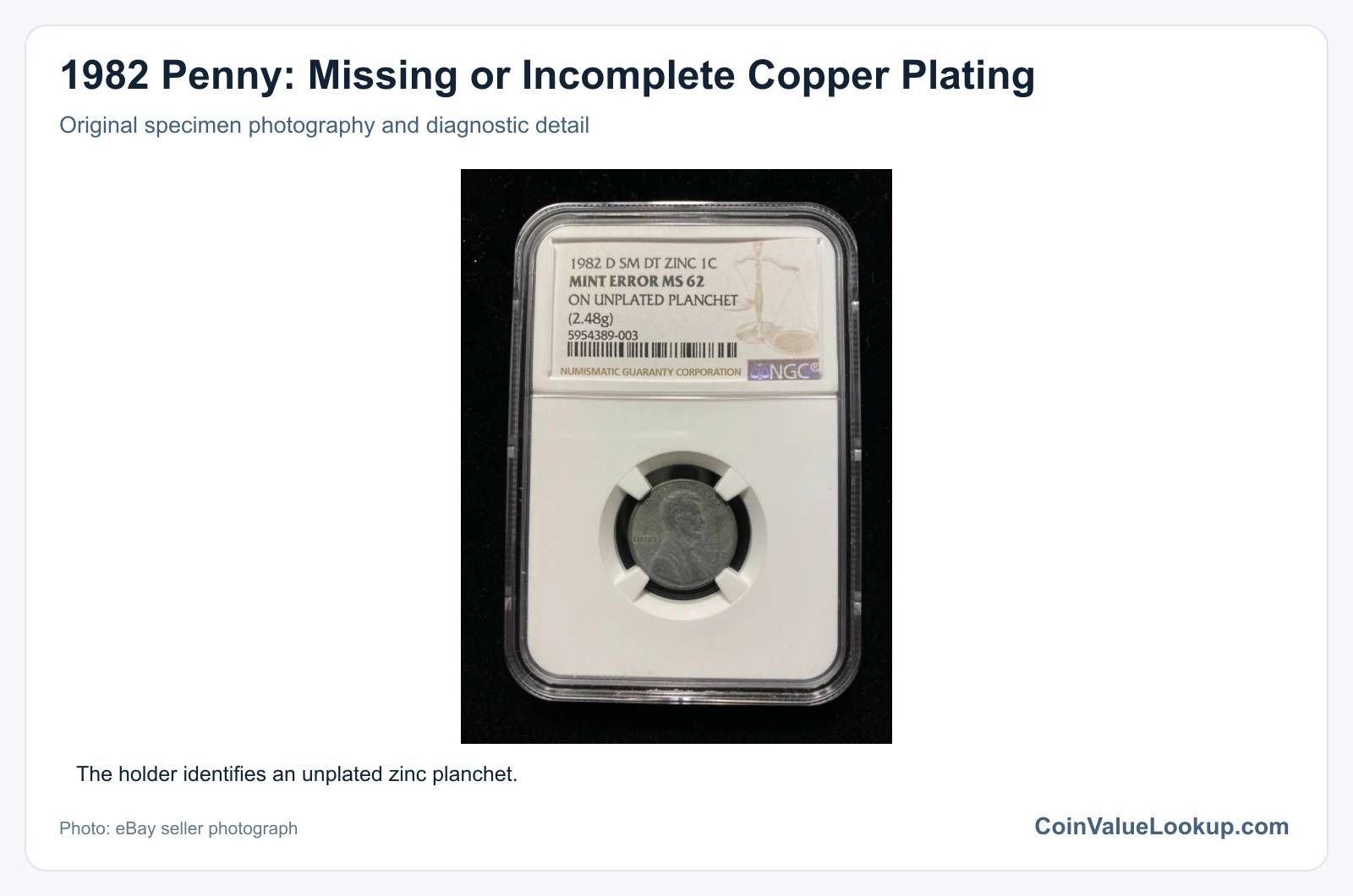
Zinc cents from 1982 were supposed to receive a copper plating layer. When the plating was omitted or incomplete at the mint, the exposed zinc surface appears gray or silvery rather than copper-colored.
A 1982-D unplated cent graded NGC MS64 sold for a reported $132 at Heritage in October 2021. Partial plating, where some original copper coverage remains, has also been cataloged for this year.
The tricky part is separating a genuine mint error from post-mint damage. Acid stripping, environmental corrosion, and deliberate removal of plating can all produce a gray surface.
Check both faces and the edge for original struck surfaces. Professional attribution is important here because gray color alone does not prove the mint left the plating off.
7. 1982 Lincoln Penny — Struck on a Dime Planchet
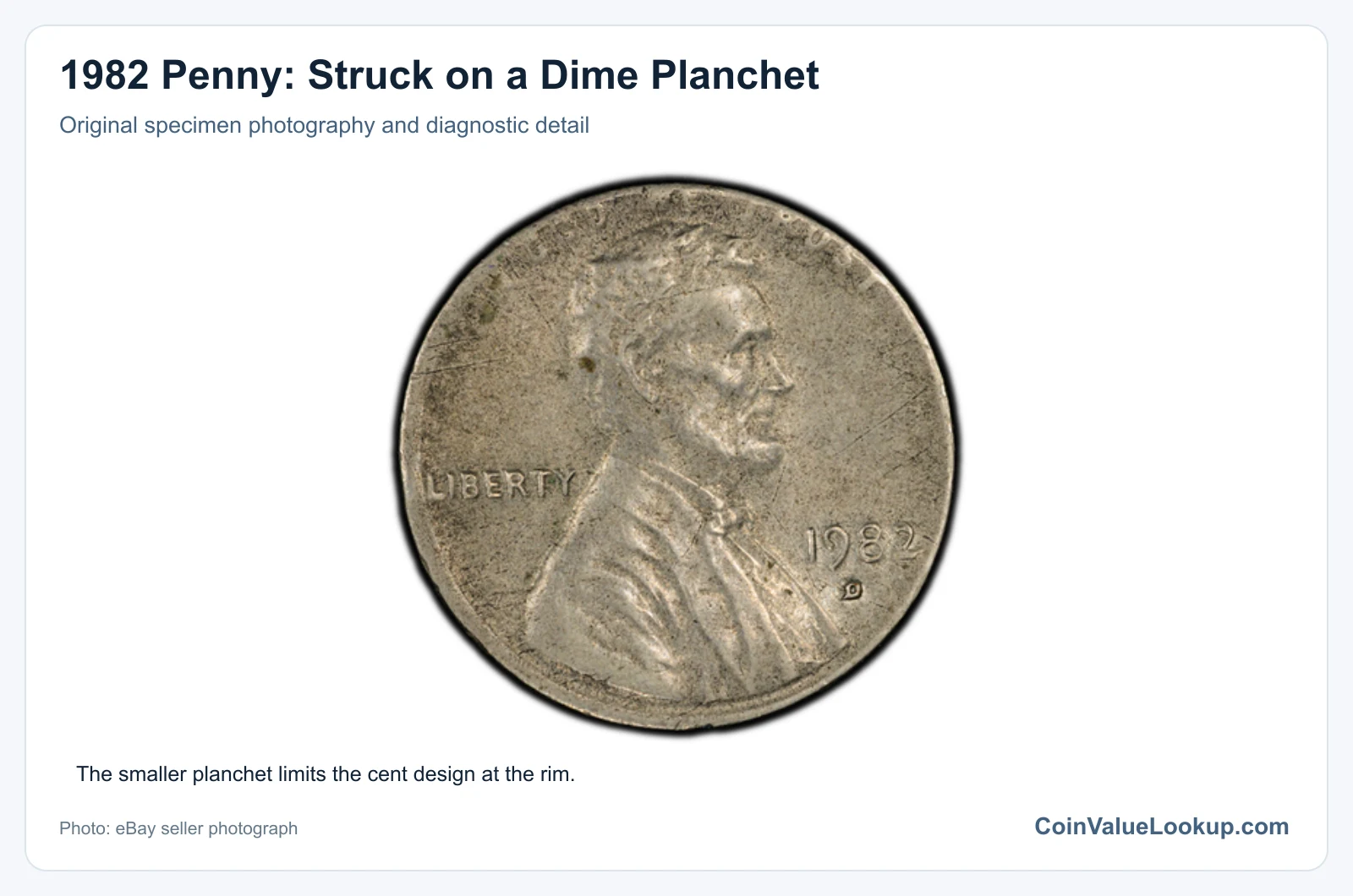
A 1982 Small Date cent was struck on a clad dime planchet, producing a smaller-than-normal coin with a silvery appearance. Parts of TRUST and AMERICA are missing at the edges because the dime blank is smaller than a cent planchet.
Graded PCGS MS64, it sold for a reported $431.25 at Heritage in May 2005. That is a single historical sale.
A normal cent that has lost its plating or been plated after the fact can look silvery, but the diameter and weight will match a standard cent, not a dime. Attribution must confirm the host planchet through professional evaluation rather than a visual guess.
8. 1982 Lincoln Penny — Strike-Through
A strike-through occurs when foreign material sits between the die and the planchet during striking. On a reported 1982 cent, three broad arcs cross the upper obverse, creating recessed areas where the obstruction blocked the die's impression.
The affected area follows the shape of whatever was caught in the press, so it does not look like a second design image. That distinguishes it from a doubled die.
Scrapes, abrasions, and plating blisters from post-mint handling can create similar-looking depressions, but they lack the sharp die-struck boundaries of a genuine strike-through.
Value depends on the severity, location, and condition. No specific price was adopted for this type.
Individual assessment is the way to go.
9. 1982 Lincoln Penny — Doubled Die Obverse
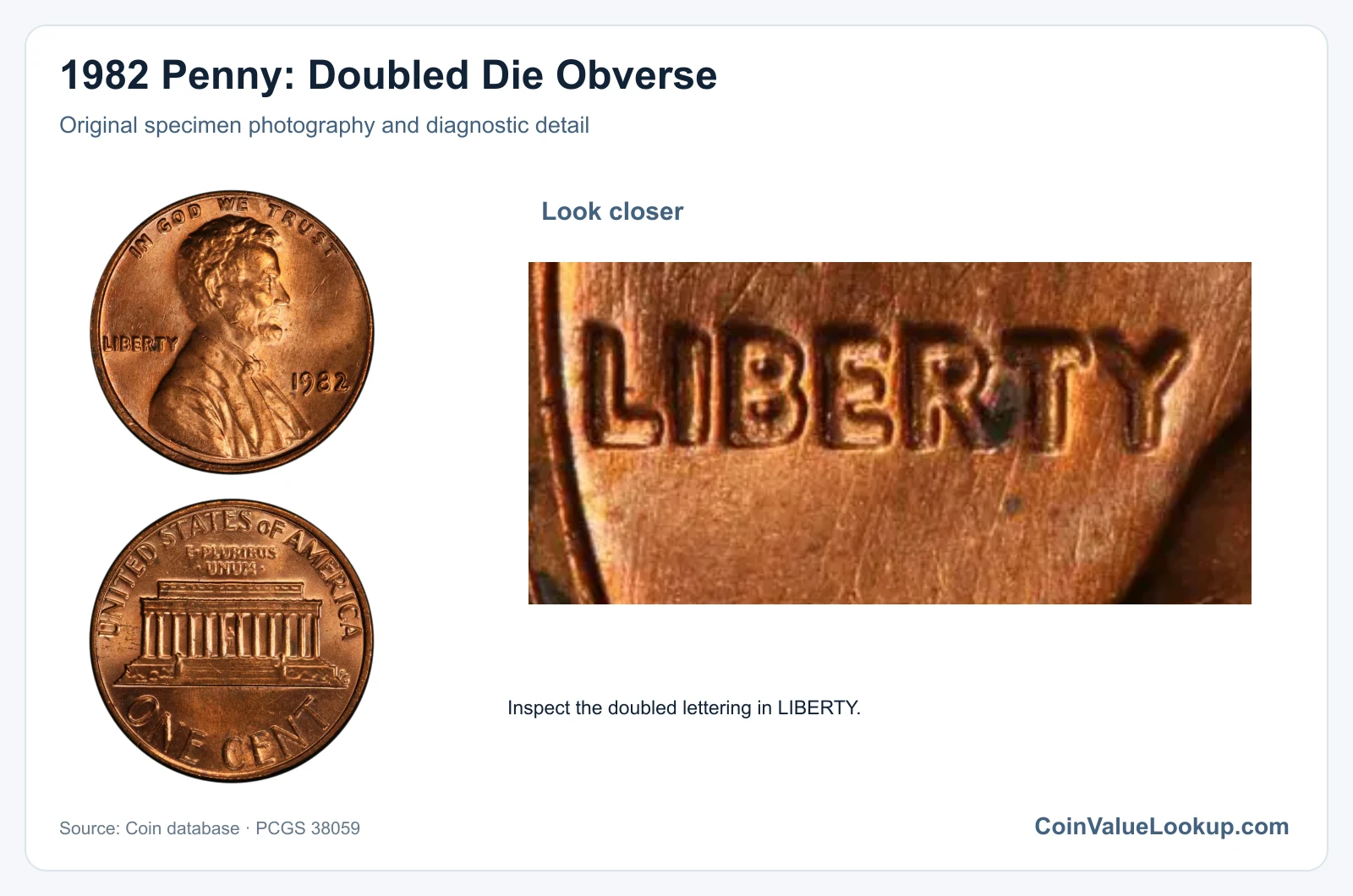
A doubled die obverse on a 1982 cent shows consistent separation or notching on obverse design elements such as letters or date numerals. The doubling originates during die production, so every coin struck by that die carries the same feature in the same position.
Under magnification, look for true separation between the doubled images rather than a flat, shelf-like distortion. Machine doubling pushes metal in one direction during ejection and typically has a mushy, flattened look.
Reflections from lighting angles and worn die contours can also mimic doubling to the untrained eye.
Value depends on the specific variety, how visible the doubling is, and the coin's overall condition. No numerical price range is established here, so individual assessment by a grading service is recommended.
10. 1982 Lincoln Penny — Repunched Mintmark
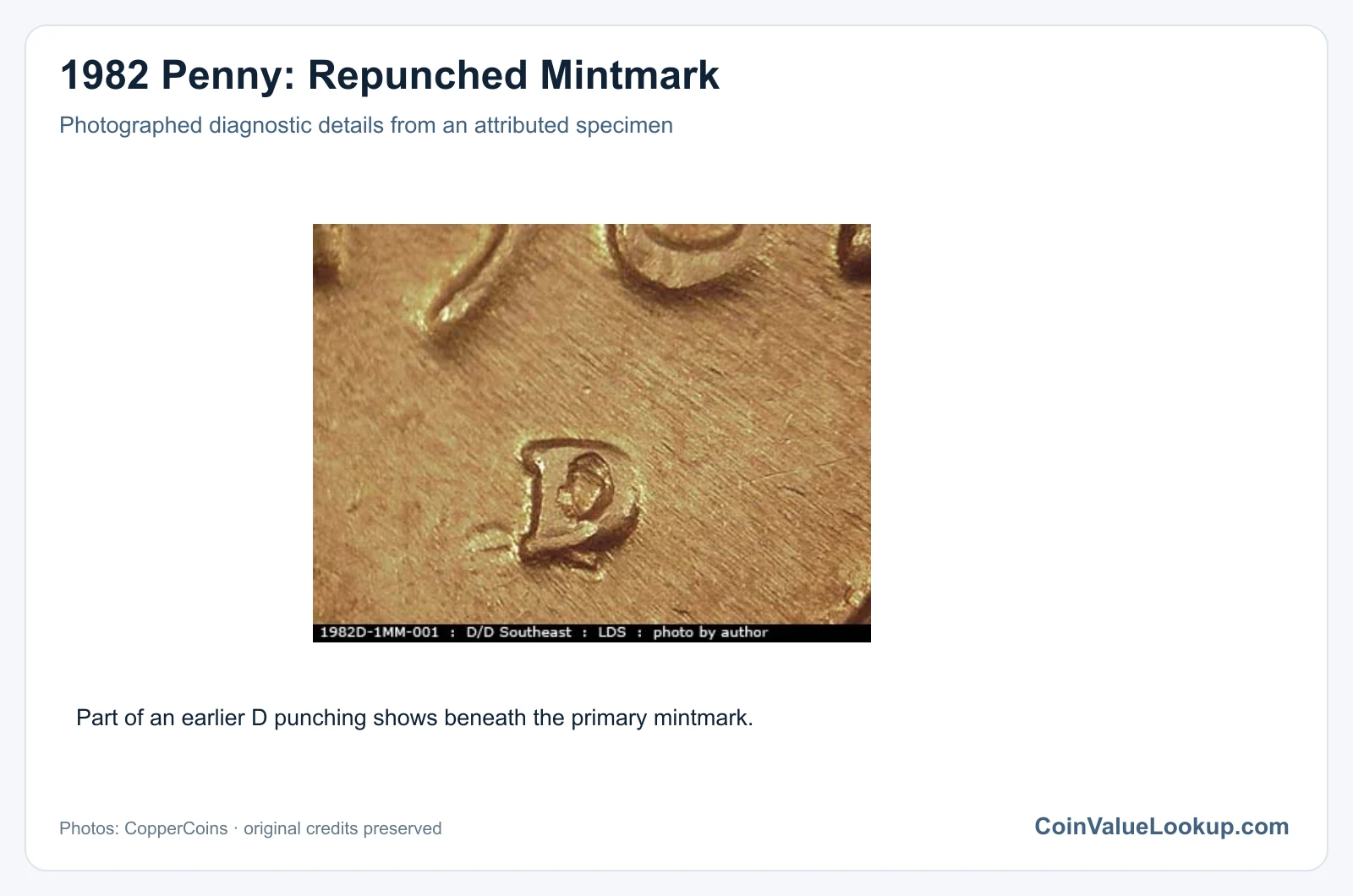
A repunched mint mark on a 1982 cent shows traces of a second position beneath or beside the primary D mint mark. During die preparation, the mint mark punch was applied more than once in slightly different positions, leaving a visible remnant.
Inspect the D below the date at moderate magnification. You are looking for a partial outline, a notch, or a secondary serif that does not belong to the primary letter.
Compare to a normal D at the same magnification and lighting angle.
Machine doubling near the mint mark, a small die chip, and corrosion can all create marks that look like a second punch. Value depends on clarity and condition.
No numerical price range is established, so have the coin evaluated individually.
11. 1982 Lincoln Penny — BIE Die Break
A BIE die break is a specific type of die crack that creates a raised vertical line between the letters B and E in LIBERTY. It resembles a capital I squeezed into the gap, hence the name.
The raised material is actually metal forced into a crack in the die face. It sits above the field surface and has a slightly irregular shape, unlike an engraved letter.
Check the area between B and E under magnification.
Dirt lodged between the letters, a thin scratch, or a piece of glue can mimic a BIE at first glance, but those will be recessed or loose rather than raised and struck into the surface. Value depends on definition and condition.
No numerical price is established for this category.
12. 1982 Lincoln Penny — Die Crack / Die Chip
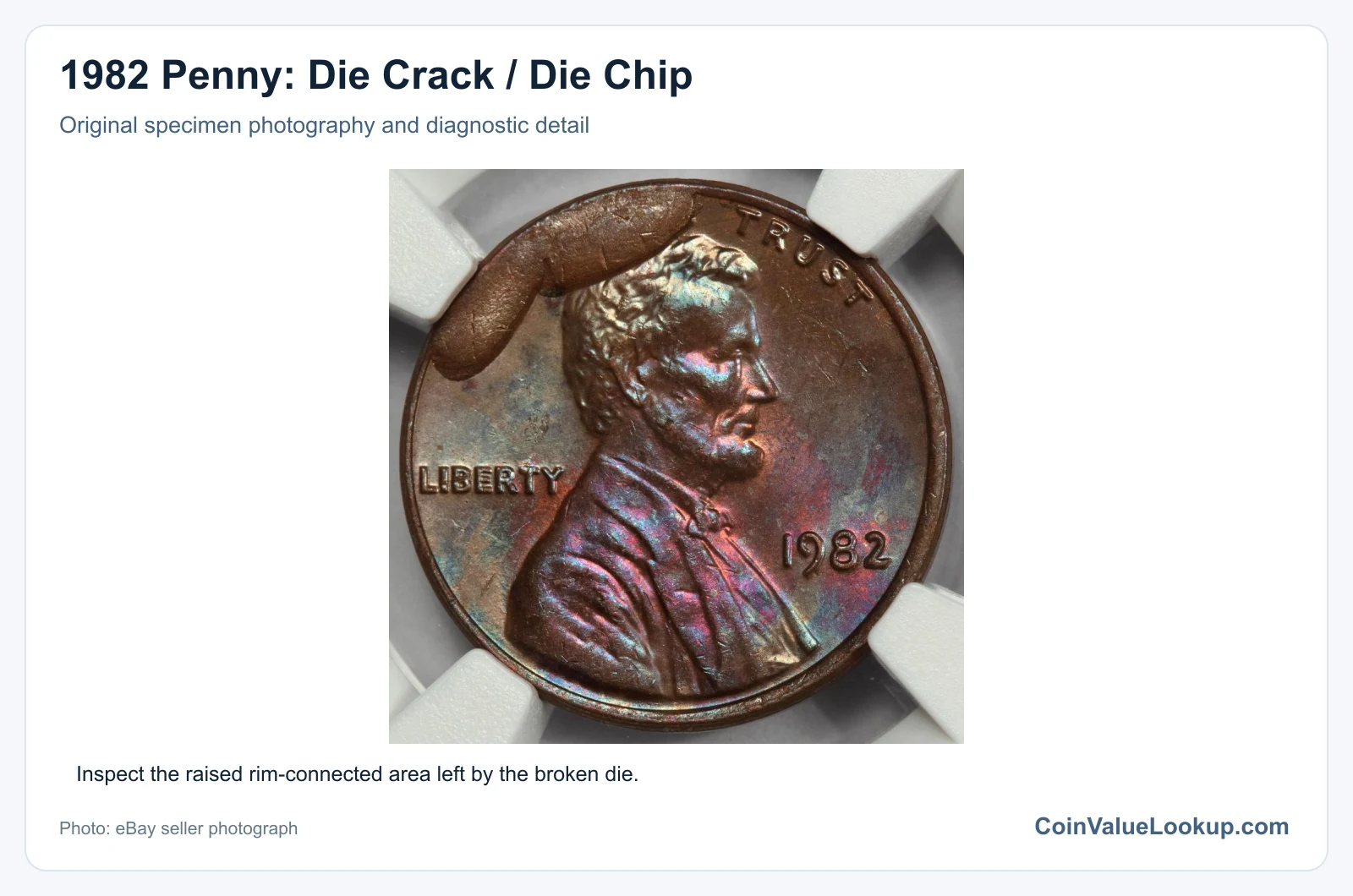
Die cracks appear as thin raised lines running across a coin's surface, formed when the hardened die develops stress fractures during production. Small raised blobs from chipped-out sections of the die are called die chips.
A larger break that reaches the rim and displaces a section of the design is called a cud.
On a 1982 cent, look for raised irregular lines that cross design elements and field areas alike. They follow the die's damage pattern, not the coin's design.
Incuse scratches, surface corrosion, and foreign material stuck to the coin sit below or on the surface rather than being raised. Genuine die cracks are part of the struck surface.
Value depends on the size, location, and condition, with no numerical price adopted here.
13. 1982 Lincoln Penny — Lamination / Split Planchet
A lamination error on a 1982 copper-alloy cent appears as peeling metal, a retained flap, or visible separation within the alloy layers. This happens when impurities or gas pockets in the planchet cause the metal to delaminate during or after striking.
Photograph the edge and the affected face together, since the separation is often easiest to see from the side. The peeled area should show original metal underneath, not a bright or chemically altered surface.
Scraping, environmental corrosion, and deliberately cut coins can look similar. A genuine lamination has a natural contour that follows the metal's internal structure.
For zinc cents, plating faults are a separate category covered under the missing-plating section. Value depends on severity and condition, with no numerical price range established.