2008 Kennedy Half Dollar Coin Value: How Much Is It Worth?
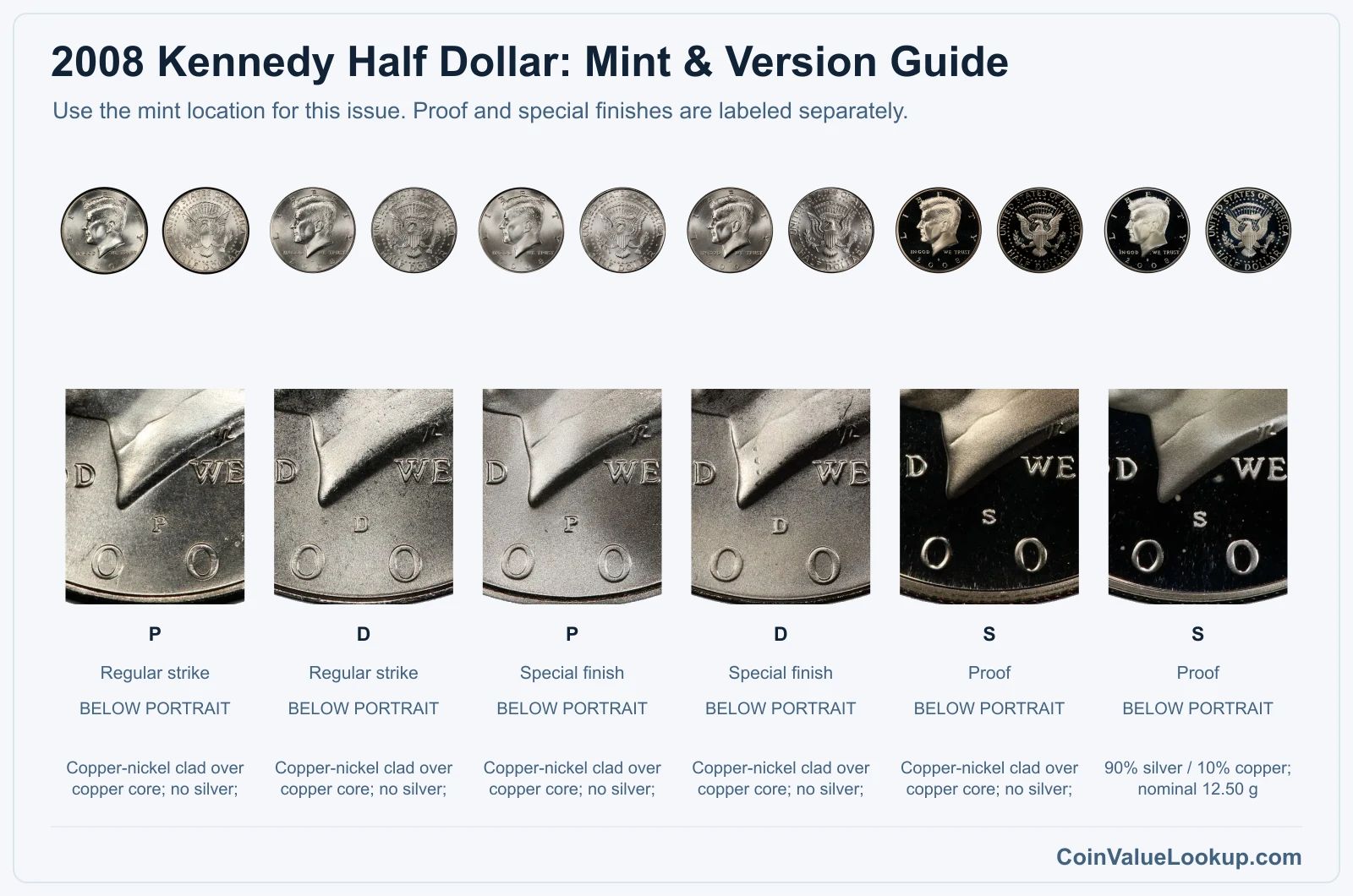
The 2008 Kennedy half dollar carries a face value of 50 cents, and most ordinary clad examples you pull from a bag or roll are worth exactly that. Collector guide estimates for specific mint, finish and grade combinations range from about $2.50 to $35.00.
Before you check a price chart, you need to figure out whether your coin is a standard business strike, a satin-finish specimen from a mint set, a clad proof or a silver proof — because each one lands on a different value track.
Fast Way to Identify Your 2008 Kennedy Half Dollar
Upload clear photos of both the front and back of your 2008 Kennedy half dollar for a preliminary identification. The tool can help you sort out the mintmark, finish type and general condition so you know which branch of the value chart applies.
Good lighting and a steady shot make a real difference.
2008 Kennedy Half Dollar Value
Upload both sides of your 2008 Kennedy Half Dollar.
Front Obverse
Upload photo
Back Reverse
Upload photo
Which 2008 Kennedy Half Dollar Versions Are Worth Money?
- The 2008-S silver proof (90% silver, PR65) carries a USA Coin Book guide estimate of $35.00 — the highest listed branch this year, driven by its precious-metal content and proof finish.
- The 2008-S clad proof at PR65 is estimated around $6.25, well above face value but far below the silver version; confirm which alloy you actually have.
- Satin-finish specimens from 2008 P and D mint sets are a distinct collector finish that should not be priced on regular business-strike charts; value depends on authenticated identity and condition.
- Mint-made errors such as off-center strikes, die breaks, and clipped planchets have been reported for this year and can carry premiums that depend on visibility and severity.
Step 1: Identify Your 2008 Kennedy Half Dollar Mint Mark and Version
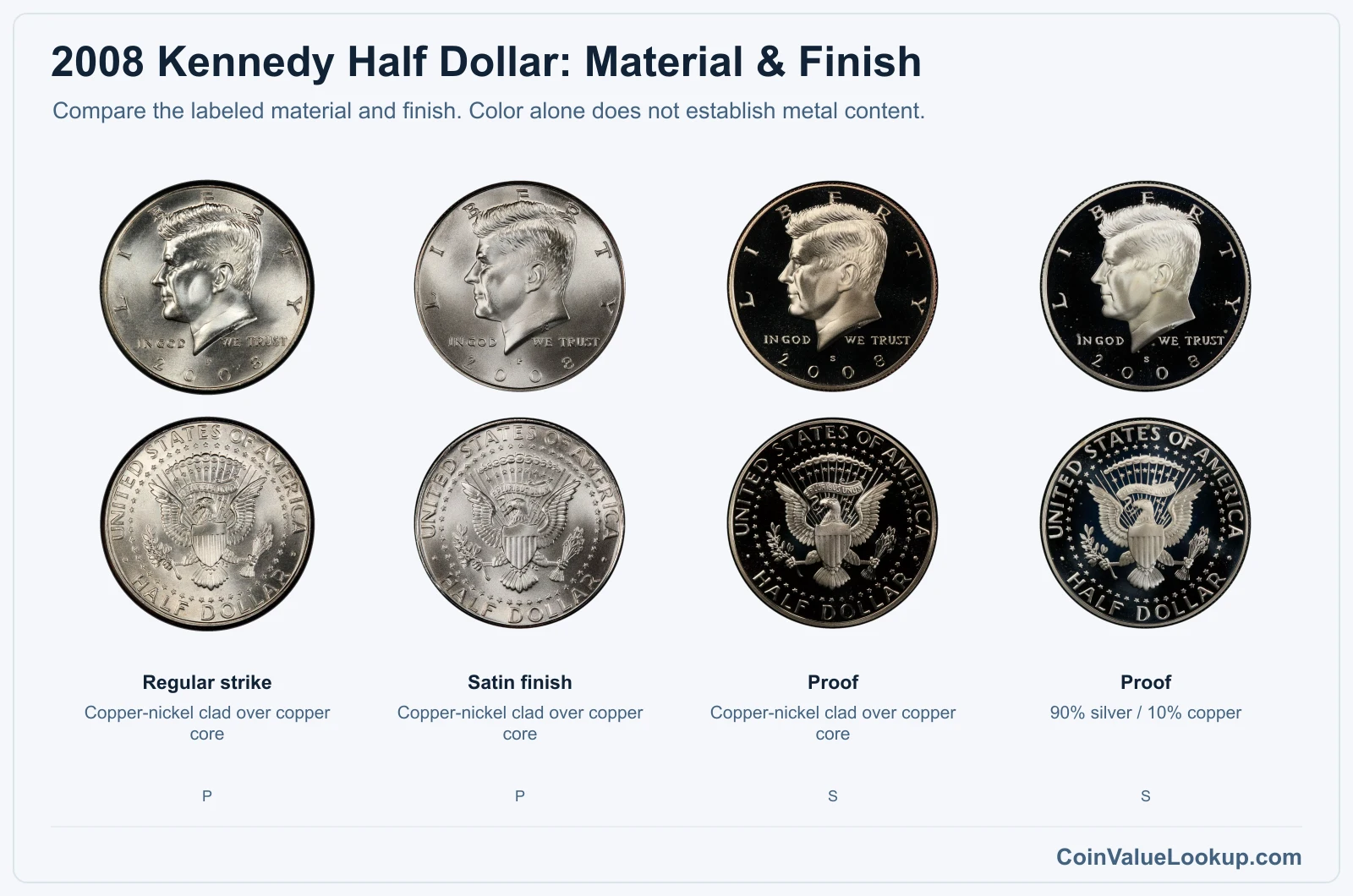
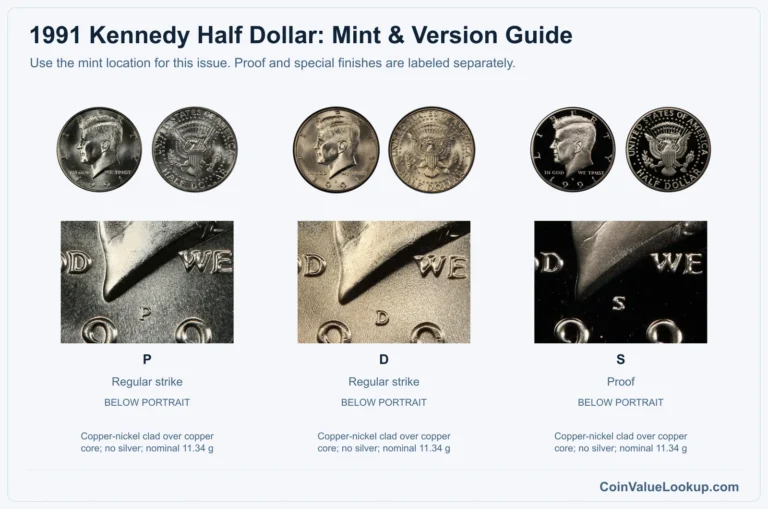
Flip your coin to the obverse and look just below Kennedy's portrait, above the date. That small letter is the mintmark: P for Philadelphia, D for Denver, S for San Francisco.
No letter at all on a modern Kennedy means it was struck before 1980; every 2008 issue should show a mintmark.
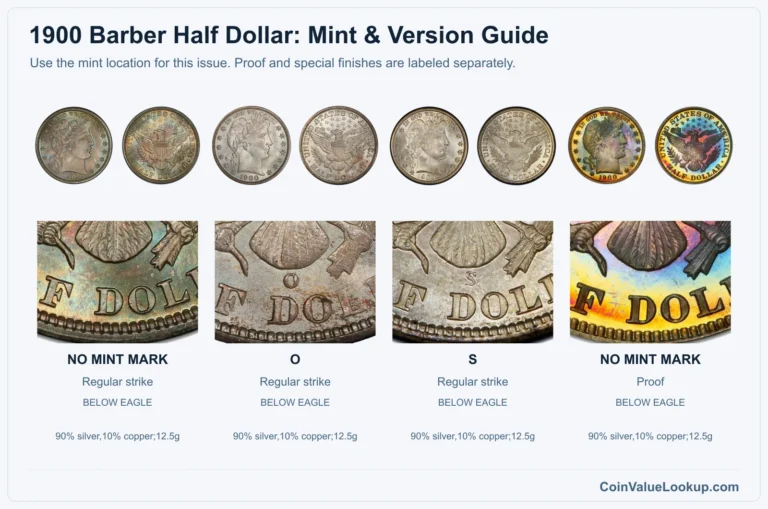
The P and D business strikes and the S clad proof are all copper-nickel clad over a copper core, weighing about 11.34 grams. The S silver proof is 90% silver and 10% copper, coming in heavier at roughly 12.50 grams.
Both S-mint proofs carry the same mintmark, so the letter alone does not tell you which alloy you have.
Compare edge color, weight, and original packaging to tell alloys apart. Plating, toning, and odd lighting can fool your eyes into seeing silver or even gold where there is none.
A kitchen scale accurate to a tenth of a gram is your friend here.
The reverse bears the initials FG for designer Frank Gasparro near the eagle's tail feathers. Faint or missing initials caused by normal die wear or grease are not automatically a recognized variety — that distinction requires professional authentication.
Step 2: Check Your 2008 Kennedy Half Dollar Grade
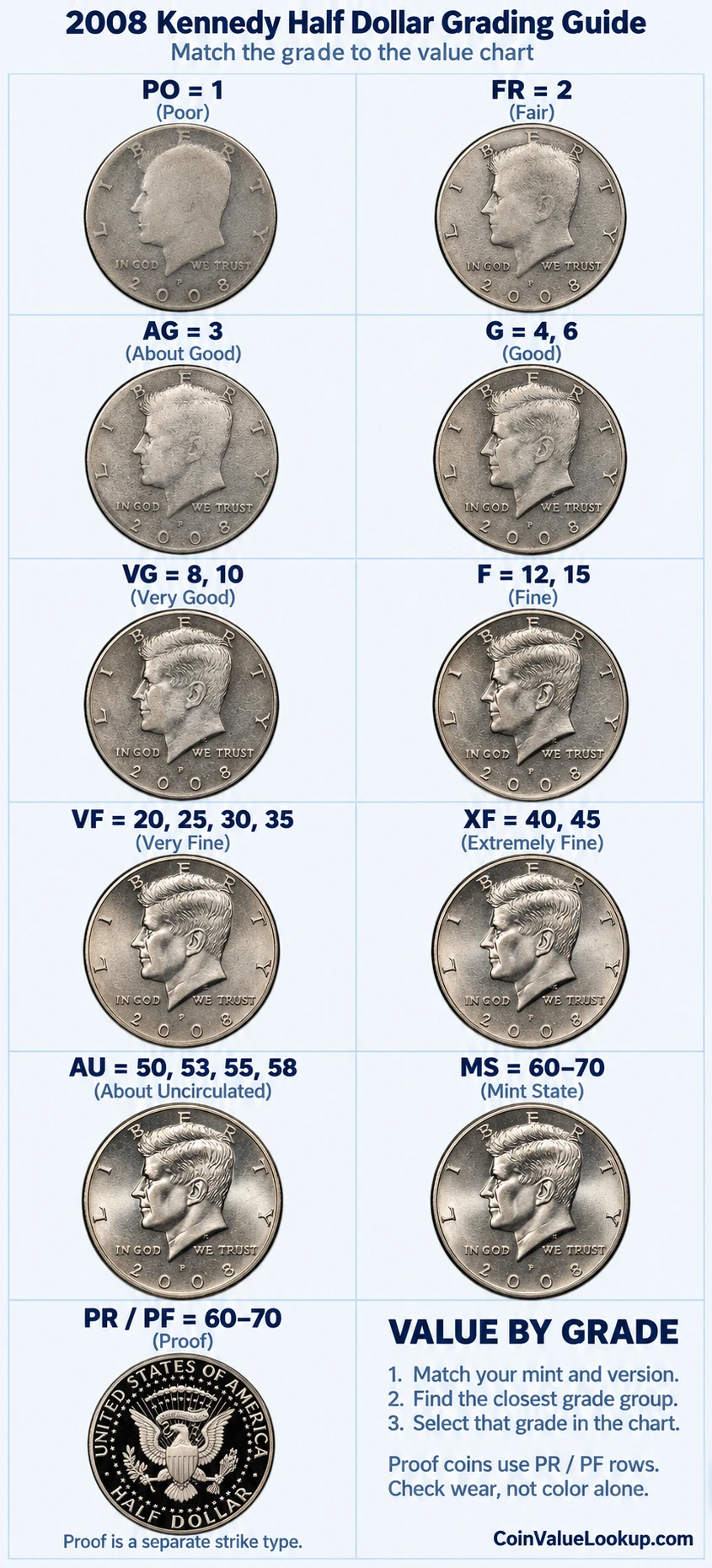
Start with Kennedy's cheek and jawline on the obverse. On a well-worn coin these areas go flat and smooth first, followed by the hair above the ear.
Flip to the reverse and check the eagle's breast feathers and the tops of the wings — those high points lose detail early.
Mint State coins can still look rough. Bag marks — tiny dings from coins banging together in bulk storage — lower the technical grade even though the coin never circulated.
A coin covered in contact marks is not the same as an MS65.
Proofs get their own grading lane. Look for hairlines from wiping, haze from improper storage, and any contact marks on the mirror fields.
A proof with heavy hairlines grades much lower than a clean one, regardless of how sharp the devices look.
Use the comparison image to match your coin's wear pattern against known grade benchmarks for the Kennedy series. Side-by-side comparison beats guesswork every time.
Step 3: Check 2008 Kennedy Half Dollar Value by Mint and Version
2008 Kennedy Half Dollar — P — clad business
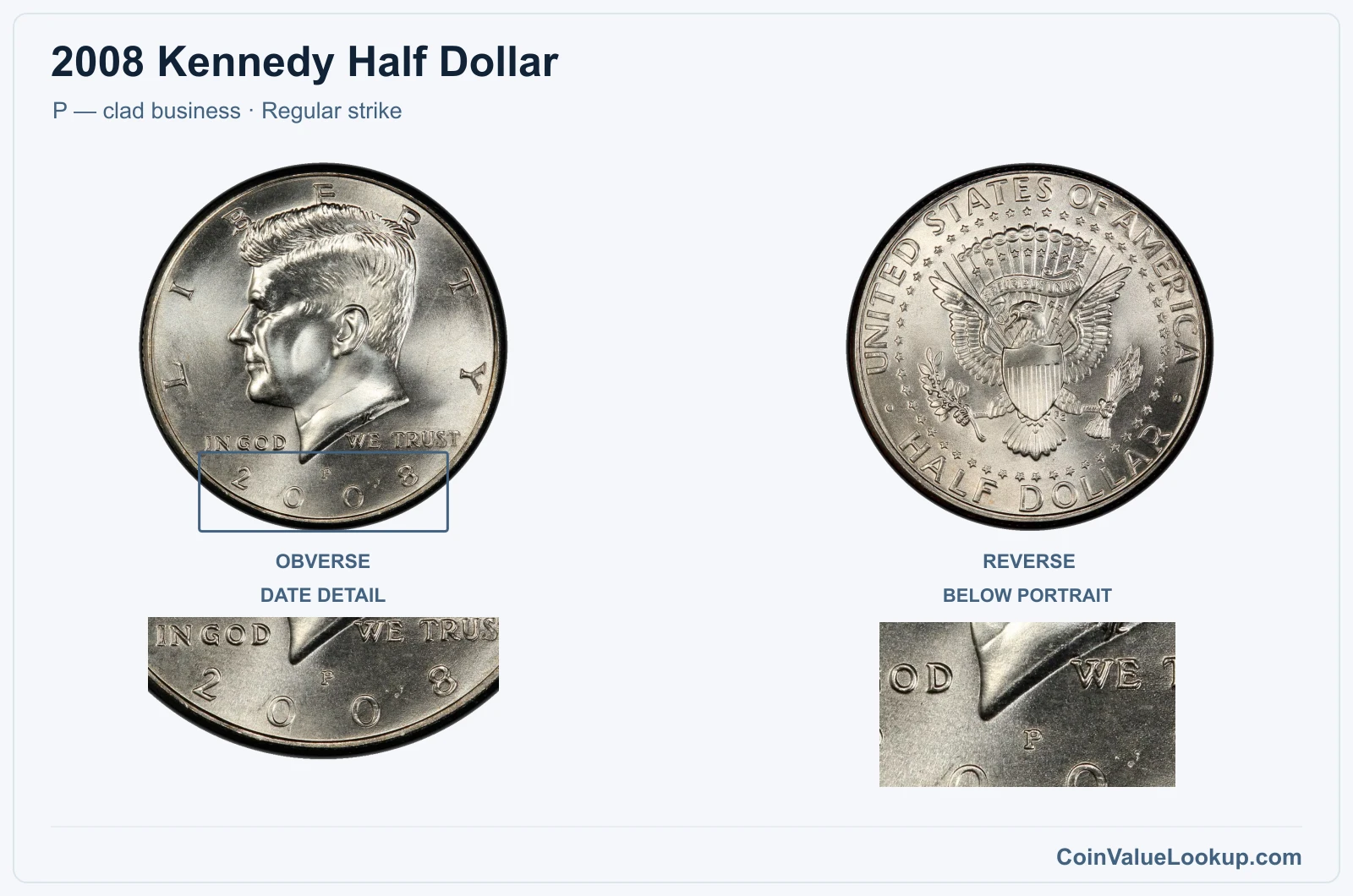
The 2008-P business strike is a copper-nickel clad half dollar you would find in a standard bank roll or collector bag. Look for the P mintmark beneath Kennedy's portrait.
Most of these saw little actual pocket circulation because half dollars were not widely distributed for everyday use by 2008; many went straight into collector channels.
Worn examples are typically face-value coins. At MS65, the USA Coin Book guide estimate is about $2.50.
Higher grades may command a bit more, but this is a common modern issue. Distinguish mint-set quality pieces from coins that were broken out and spent — original surfaces matter.
Range Grade
Price Auction Records Appraisal PO PO 1
—
Coin Identifier FR FR 2
—
Coin Identifier AG AG 3
—
Coin Identifier G G 4
—
Coin Identifier
G 6
—
Coin Identifier VG VG 8
—
Coin Identifier
VG 10
—
Coin Identifier F F 12
—
Coin Identifier
F 15
—
Coin Identifier VF VF 20
—
Coin Identifier
VF 25
—
Coin Identifier
VF 30
—
Coin Identifier
VF 35
—
Coin Identifier XF XF 40
—
Coin Identifier
XF 45
—
Coin Identifier AU AU 50
—
Coin Identifier
AU 53
—
Coin Identifier
AU 55
—
Coin Identifier
AU 58
—
Coin Identifier MS MS 60
—
Coin Identifier
MS 61
—
Coin Identifier
MS 62
—
Coin Identifier
MS 63
—
Coin Identifier
MS 64
—
Coin Identifier
MS 65
—
Coin Identifier
MS 66
Coin Identifier
MS 67
Coin Identifier
MS 68
Coin Identifier
MS 69
—
—
—
MS 70
—
—
—
2008 Kennedy Half Dollar — P — clad satin specimen
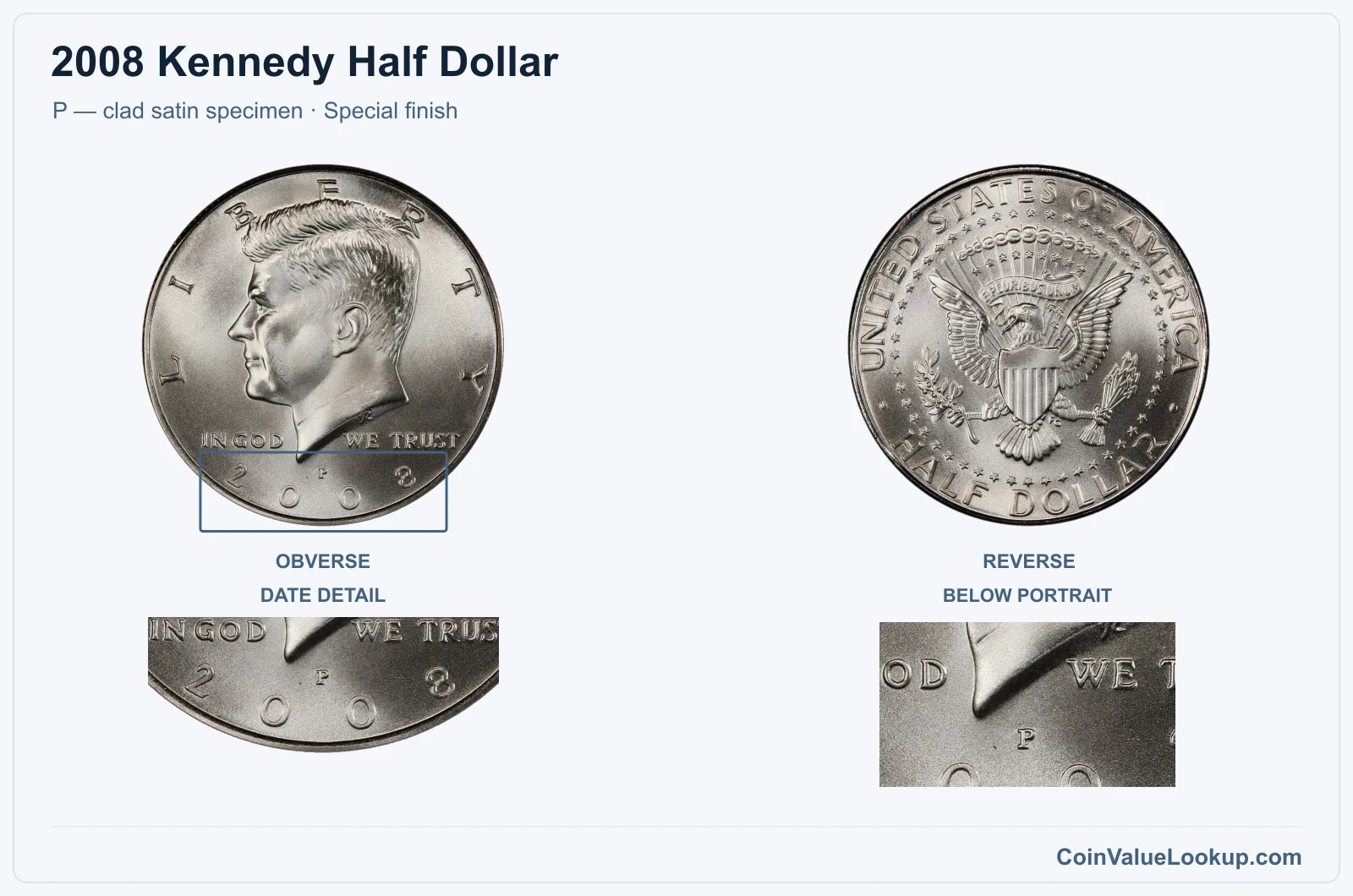
The 2008-P satin specimen came in that year's official U.S. Mint uncirculated set. It has a distinctive soft, matte-like surface texture that differs from the cartwheel luster of a normal business strike.
Do not identify a coin as satin just because it looks dull — actual satin specimens were produced with a specific manufacturing process.
Because this finish is its own category, pricing it on a regular MS scale gives the wrong answer. Value depends on the coin's authenticated identity, surface preservation and any errors present.
If your coin came from an original mint set and still has clean surfaces, it is worth having assessed individually rather than lumped in with ordinary strikes.
Range Grade
Price Auction Records Appraisal SP SP 1
—
Coin Identifier
SP 2
—
Coin Identifier
SP 3
—
Coin Identifier
SP 4
—
Coin Identifier
SP 6
—
Coin Identifier
SP 8
—
Coin Identifier
SP 10
—
Coin Identifier
SP 12
—
Coin Identifier
SP 15
—
Coin Identifier
SP 20
—
Coin Identifier
SP 25
—
Coin Identifier
SP 30
—
Coin Identifier
SP 35
—
Coin Identifier
SP 40
—
Coin Identifier
SP 45
—
Coin Identifier
SP 50
—
Coin Identifier
SP 53
—
Coin Identifier
SP 55
—
Coin Identifier
SP 58
—
Coin Identifier
SP 60
—
Coin Identifier
SP 61
—
Coin Identifier
SP 62
—
Coin Identifier
SP 63
—
Coin Identifier
SP 64
—
Coin Identifier
SP 65
—
Coin Identifier
SP 66
—
Coin Identifier
SP 67
Coin Identifier
SP 68
Coin Identifier
SP 69
Coin Identifier
SP 70
—
—
—
2008 Kennedy Half Dollar — D — clad business
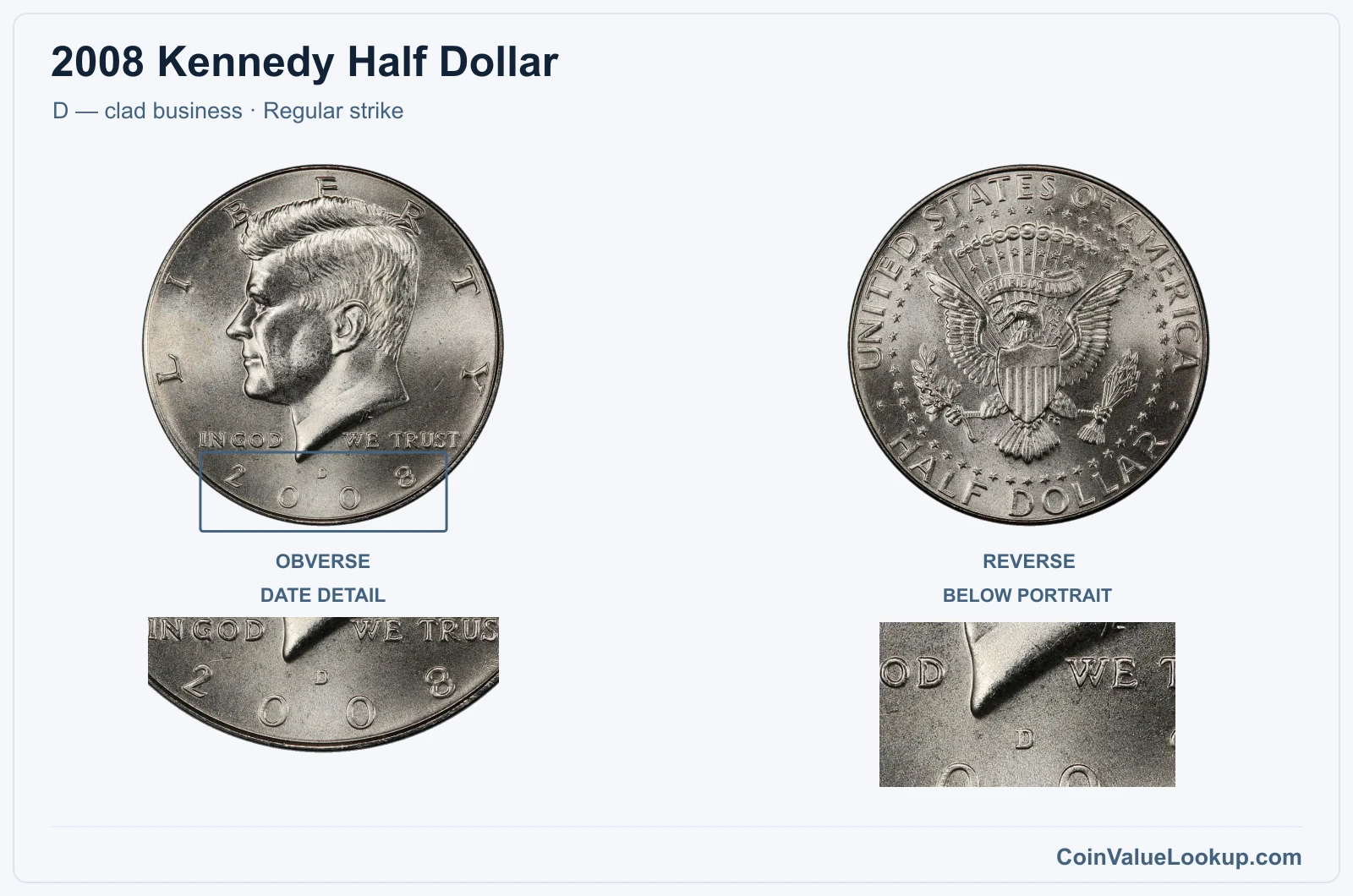
The 2008-D business strike is the Denver Mint's copper-nickel clad half dollar. A clear D mintmark sits below Kennedy's portrait.
Like its Philadelphia sibling, this coin was produced mainly for collector distribution rather than everyday commerce.
At MS65, the USA Coin Book guide estimate is about $2.50. Worn or heavily marked examples rarely exceed face value.
If yours came from a roll and has clean, lustrous surfaces with minimal bag marks, it is in the running for a respectable grade — but do not expect big premiums from a common modern clad half.
Coin Value Lookup is a handy starting point if you are sorting through other dates and denominations in the Kennedy series. You can look up guides for different years, mints and finishes in one place.
Range Grade
Price Auction Records Appraisal PO PO 1
—
Coin Identifier FR FR 2
—
Coin Identifier AG AG 3
—
Coin Identifier G G 4
—
Coin Identifier
G 6
—
Coin Identifier VG VG 8
—
Coin Identifier
VG 10
—
Coin Identifier F F 12
—
Coin Identifier
F 15
—
Coin Identifier VF VF 20
—
Coin Identifier
VF 25
—
Coin Identifier
VF 30
—
Coin Identifier
VF 35
—
Coin Identifier XF XF 40
—
Coin Identifier
XF 45
—
Coin Identifier AU AU 50
—
Coin Identifier
AU 53
—
Coin Identifier
AU 55
—
Coin Identifier
AU 58
—
Coin Identifier MS MS 60
—
Coin Identifier
MS 61
—
Coin Identifier
MS 62
—
Coin Identifier
MS 63
—
Coin Identifier
MS 64
—
Coin Identifier
MS 65
Coin Identifier
MS 66
—
Coin Identifier
MS 67
Coin Identifier
MS 68
—
—
—
MS 69
—
—
—
MS 70
—
—
—
2008 Kennedy Half Dollar — D — clad satin specimen
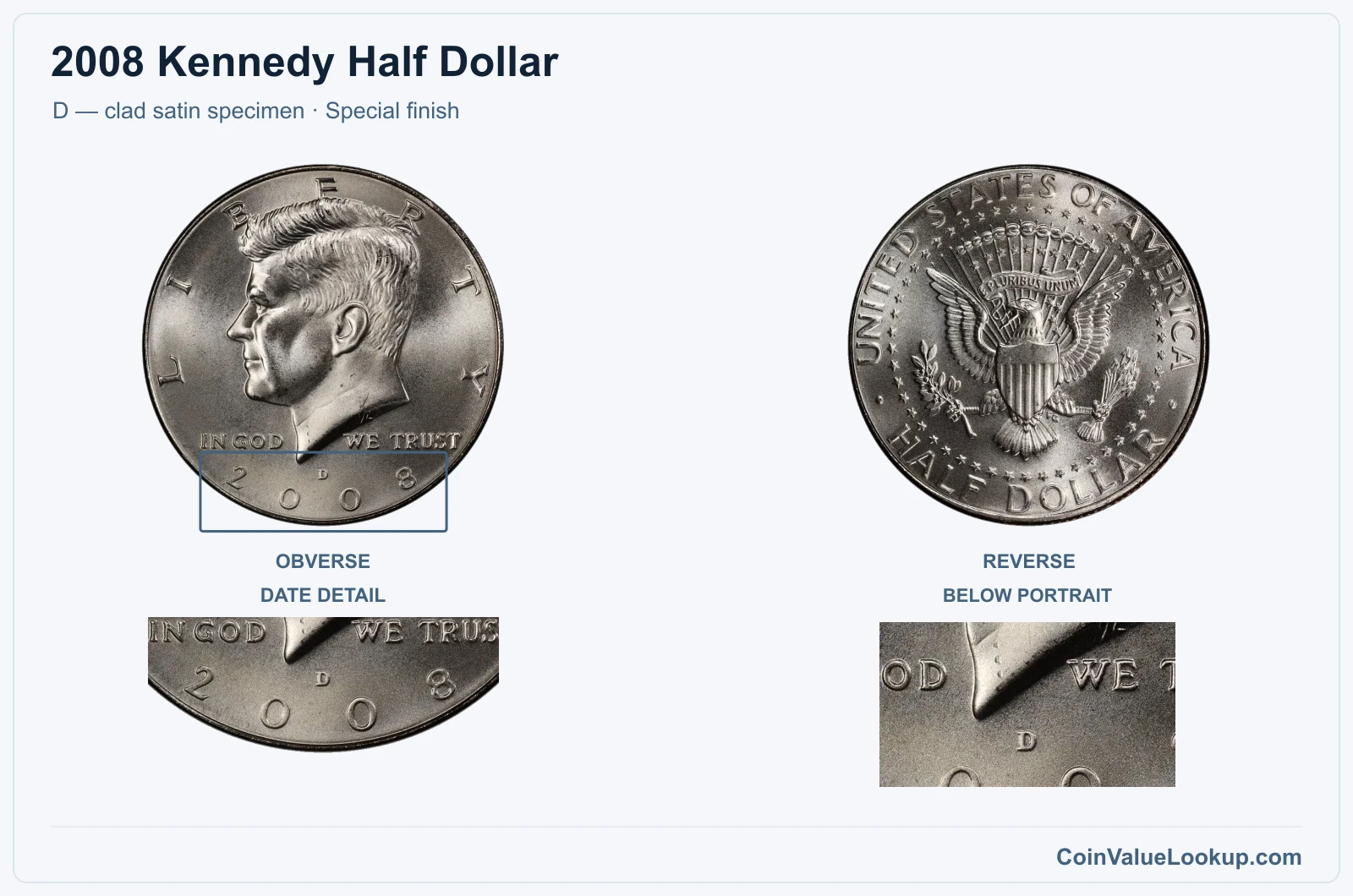
The 2008-D satin specimen was included in that year's mint set alongside the P version. It carries the D mintmark and the same soft, even surface texture that sets satin strikes apart from regular business strikes.
The finish is intentional, not the result of wear or cleaning.
No supported price range is available for this specific branch, so its value comes down to individual assessment based on authenticated identity, surface quality and any mint-made anomalies. If you have one still in its original mint-set holder with pristine surfaces, that is the best starting point for a meaningful evaluation.
Range Grade
Price Auction Records Appraisal SP SP 1
—
Coin Identifier
SP 2
—
Coin Identifier
SP 3
—
Coin Identifier
SP 4
—
Coin Identifier
SP 6
—
Coin Identifier
SP 8
—
Coin Identifier
SP 10
—
Coin Identifier
SP 12
—
Coin Identifier
SP 15
—
Coin Identifier
SP 20
—
Coin Identifier
SP 25
—
Coin Identifier
SP 30
—
Coin Identifier
SP 35
—
Coin Identifier
SP 40
—
Coin Identifier
SP 45
—
Coin Identifier
SP 50
—
Coin Identifier
SP 53
—
Coin Identifier
SP 55
—
Coin Identifier
SP 58
—
Coin Identifier
SP 60
—
Coin Identifier
SP 61
—
Coin Identifier
SP 62
—
Coin Identifier
SP 63
—
Coin Identifier
SP 64
—
Coin Identifier
SP 65
—
Coin Identifier
SP 66
—
Coin Identifier
SP 67
Coin Identifier
SP 68
Coin Identifier
SP 69
Coin Identifier
SP 70
—
—
—
2008 Kennedy Half Dollar — S — clad proof
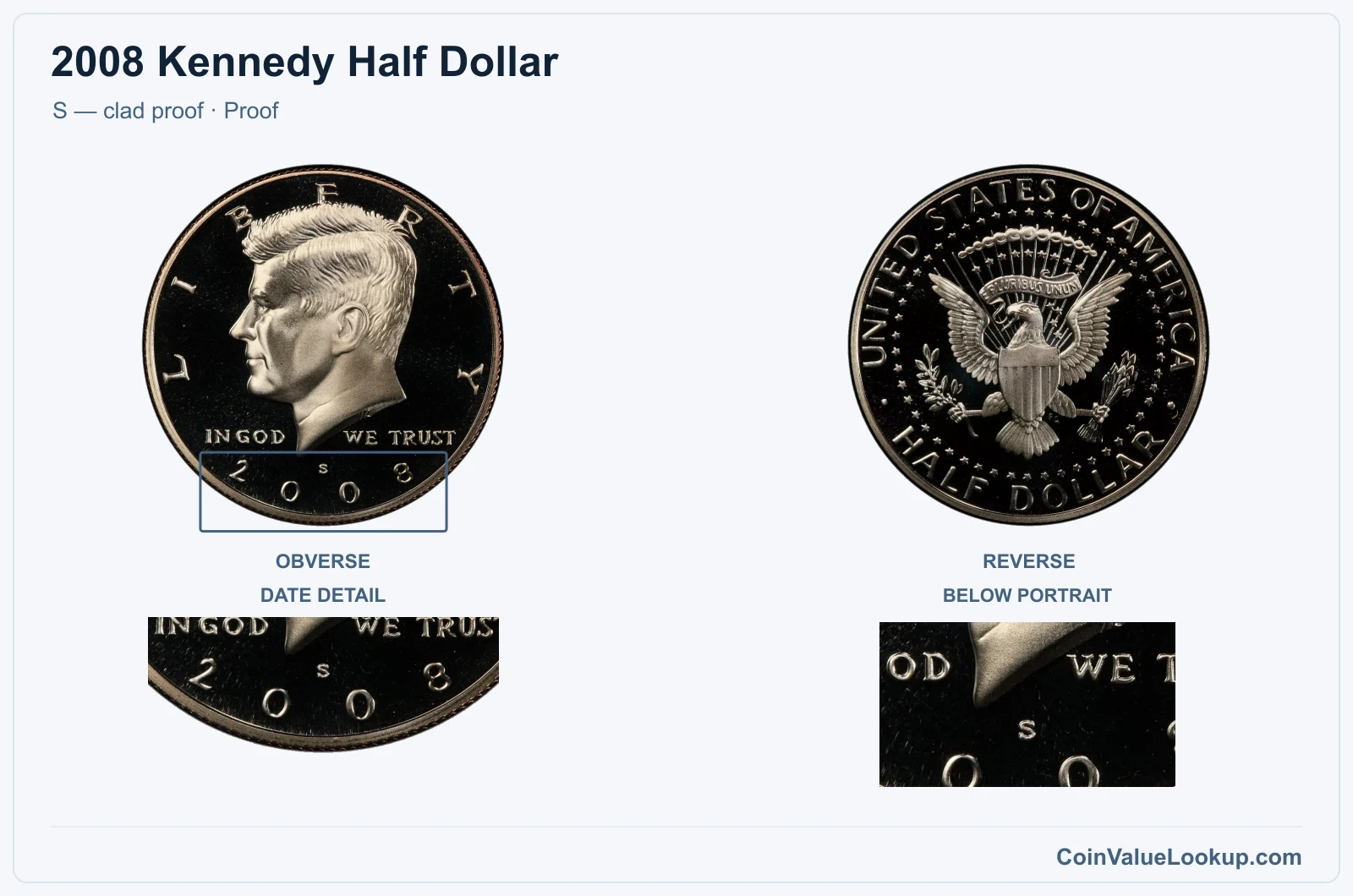
The 2008-S clad proof was struck at San Francisco using specially prepared dies and planchets. It is copper-nickel clad — not silver — despite the S mintmark.
Mirror-like fields and frosted raised devices are the hallmarks of a proof finish.
At PR65, the USA Coin Book guide estimate is about $6.25. Inspect the mirror fields under good light for hairlines and haze, which are the biggest grade killers on proofs.
Contact marks on those glassy surfaces are easy to spot and hard to ignore. Most of these came in annual proof sets, so original government packaging is common.
Range Grade
Price Auction Records Appraisal PR PR 1
—
Coin Identifier
PR 2
—
Coin Identifier
PR 3
—
Coin Identifier
PR 4
—
Coin Identifier
PR 6
—
Coin Identifier
PR 8
—
Coin Identifier
PR 10
—
Coin Identifier
PR 12
—
Coin Identifier
PR 15
—
Coin Identifier
PR 20
—
Coin Identifier
PR 25
—
Coin Identifier
PR 30
—
Coin Identifier
PR 35
—
Coin Identifier
PR 40
—
Coin Identifier
PR 45
—
Coin Identifier
PR 50
—
Coin Identifier
PR 53
—
Coin Identifier
PR 55
—
Coin Identifier
PR 58
—
Coin Identifier
PR 60
—
Coin Identifier
PR 61
—
Coin Identifier
PR 62
—
Coin Identifier
PR 63
—
Coin Identifier
PR 64
—
Coin Identifier
PR 65
—
Coin Identifier
PR 66
—
Coin Identifier
PR 67
—
Coin Identifier
PR 68
—
Coin Identifier
PR 69
Coin Identifier
PR 70
Coin Identifier
2008 Kennedy Half Dollar — S — silver proof
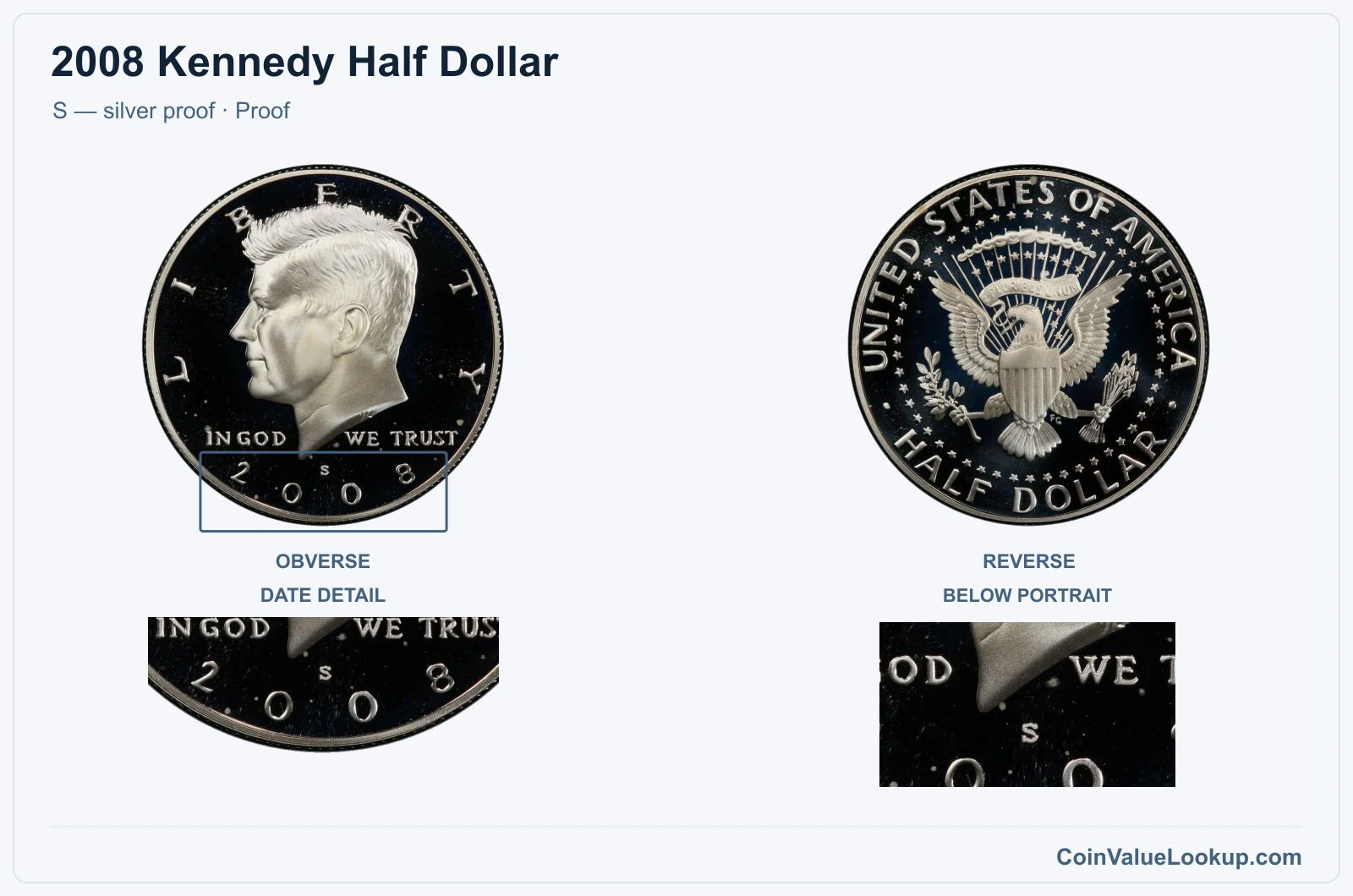
The 2008-S silver proof is the top-value regular issue for this date. It is struck in 90% silver and 10% copper, weighing approximately 12.50 grams — noticeably heavier than the 11.34-gram clad version.
Both carry an S mintmark, so the letter alone does not confirm silver content. Weigh the coin or check original packaging.
At PR65, the USA Coin Book guide estimate is $35.00. That premium comes from both the silver content and the proof finish.
Keep surfaces clean and store them properly — fingerprints and PVC film from old holders can wreck proof surfaces fast. For reference, the silver fineness on Kennedy proofs changes to .999 starting in 2019, but the 2008 remains the traditional 90/10 alloy.
Range Grade
Price Auction Records Appraisal PR PR 1
—
Coin Identifier
PR 2
—
Coin Identifier
PR 3
—
Coin Identifier
PR 4
—
Coin Identifier
PR 6
—
Coin Identifier
PR 8
—
Coin Identifier
PR 10
—
Coin Identifier
PR 12
—
Coin Identifier
PR 15
—
Coin Identifier
PR 20
—
Coin Identifier
PR 25
—
Coin Identifier
PR 30
—
Coin Identifier
PR 35
—
Coin Identifier
PR 40
—
Coin Identifier
PR 45
—
Coin Identifier
PR 50
—
Coin Identifier
PR 53
—
Coin Identifier
PR 55
—
Coin Identifier
PR 58
—
Coin Identifier
PR 60
—
Coin Identifier
PR 61
—
Coin Identifier
PR 62
—
Coin Identifier
PR 63
—
Coin Identifier
PR 64
—
Coin Identifier
PR 65
—
Coin Identifier
PR 66
—
Coin Identifier
PR 67
—
Coin Identifier
PR 68
—
Coin Identifier
PR 69
Coin Identifier
PR 70
Coin Identifier
2008 Kennedy Half Dollar Error List
1. 2008 Kennedy Half Dollar — Double / Multiple Strike
A multiple-strike error on a 2008 Kennedy half dollar shows two or more separate impressions of the design, displaced or rotated from each other. You are looking for an obviously doubled or shifted image — not just slightly thickened lettering, which could be a doubled die or die deterioration instead.
The key diagnostic is seeing distinct, separated outlines of major design elements such as Kennedy's profile or the eagle, where the coin was clearly struck more than once with the planchet in a different position each time. Post-mint damage from a vise or hammer can mimic this, so check whether the extra impression follows the coin's full design consistently.
No specific price data is available for this error on the 2008 date. Value depends on how dramatic and visible the displacement is, the coin's overall condition, and which mint produced it.
2. 2008 Kennedy Half Dollar — Struck-Through Error
A struck-through error happens when foreign material — grease, a fragment of metal, cloth or debris — sits between the die and the planchet during striking. On a 2008 Kennedy half, look for a localized area where the design is incomplete, mushy or shows an impression of the obstruction itself.
Grease-filled dies produce soft, washed-out spots, often on high-relief areas like Kennedy's hair or the eagle's feathers. A retained foreign object can leave a more defined shape pressed into the surface.
Do not confuse normal wear, cleaning scratches or weak strikes with a struck-through error — wear removes metal gradually across high points, while a struck-through area affects a specific patch regardless of relief.
No numerical price is available for this error on the 2008 date. Larger, more visible obstructions on otherwise high-grade coins tend to attract more collector interest.
3. 2008 Kennedy Half Dollar — Die Break / Cud
A die break or cud on a 2008 Kennedy half dollar appears as a raised, shapeless blob of metal on the coin's surface. A true cud connects to the rim — it forms when a chunk of the die breaks away at the edge, leaving an unstruck lump where design detail should be.
Look for a smooth, raised area that interrupts the normal rim and adjacent design. The boundary between the cud and the surviving design is usually sharp on one side and blends into the rim on the other.
Do not confuse a rim dent, corrosion buildup, or a tiny interior die chip with a cud — dents are recessed, corrosion has a rough texture, and interior chips are small raised dots away from the rim.
No specific price data is available. Larger cuds that obscure significant portions of the design generally command more attention from error collectors.
4. 2008 Kennedy Half Dollar — Die Crack / Die Chip
Die cracks show up as thin, raised lines running across the coin's surface. On a 2008 Kennedy half, these lines follow the path of a fracture in the steel die — they are raised because metal flows into the crack during striking.
Die chips are small raised blobs, usually circular, from a tiny piece of die surface flaking away.
To confirm a die crack, run your fingernail across it — it should be raised, not incised. Scratches from handling are cut into the surface, the opposite of a die crack.
Corrosion lines tend to be irregular and rough, while die cracks are relatively smooth and consistent in width along their path.
An interior die chip that does not reach the rim is different from a cud. No price data is available for die cracks on the 2008 issue.
Dramatic cracks spanning the full coin or affecting major design elements are more collectible than hairline fractures.
5. 2008 Kennedy Half Dollar — Off-Center Strike
An off-center strike on a 2008 Kennedy half dollar means the planchet was not properly seated between the dies when the press fired. The result is a design shifted to one side with a blank, unstruck crescent on the opposite edge.
The percentage off-center matters a lot. A 5% shift is barely noticeable; a 50% shift with the date still visible is the sweet spot collectors chase.
Check that the blank area has a natural, unstruck edge — not a filed or cut edge, which would indicate post-mint alteration. Also rule out a clipped planchet, which removes a piece of the blank before striking rather than shifting the whole design.
No numerical price is available for this error on the 2008 date. Value depends on the degree of displacement, whether the date remains readable, and the coin's overall condition.
6. 2008 Kennedy Half Dollar — Clipped Planchet
A clipped planchet error on a 2008 Kennedy half means a portion of the metal blank was missing before the coin was struck. The clip can be curved, straight or irregular, depending on what went wrong during blank production.
Look for a section of the coin's edge that is visibly absent, with the adjacent design showing weakness or distortion from the missing metal.
A genuine clip often produces a characteristic area of weakness on the opposite side of the coin, called the Blakesley effect, where metal could not flow fully during striking. Compare the edge texture at the clip to the rest of the rim — a real clip will show a different finish than the normal reeded edge.
Do not confuse a filed notch, a deliberate edge cut, or corrosion damage with a mint-produced clip. No price data is available for this error on the 2008 date.
Larger clips that affect more of the design tend to draw stronger collector interest.