1988 Lincoln Penny Coin Value: How Much Is It Worth?
Most 1988 Lincoln pennies you pull from a jar are worth face value, and that is perfectly normal for a coin produced in the hundreds of millions. A guide estimate for an ordinary example in MS65 condition is about $0.36, while the 1988-S proof sits around $11.00 in PR65.
The real action comes from a handful of varieties and mint errors that can turn a one-cent coin into something worth a closer look.
Fast Way to Identify Your 1988 Lincoln Penny
Snap a clear photo of the front and back of your 1988 penny and upload both images using the identifier on this page. It will give you a preliminary identification of your coin's version, mint mark and general type.
From there you can compare what you have against the detailed descriptions below. This is not authentication or certified grading, just a solid starting point.
1988 Penny Value
Upload both sides of your 1988 Lincoln Penny.
Front Obverse
Upload photo
Back Reverse
Upload photo
Which 1988 Lincoln Penny Versions Are Worth Money?
- The Doubled Ear variety on no-mark 1988 cents has a second raised earlobe contour that collectors actively seek; value depends on authenticated identity and condition.
- The Reverse of 1989 (Flared G) appears on both no-mark and D-mint 1988 cents, making it worth checking the FG initials on any business strike you find.
- A 1988 cent struck over a 1988-P dime is a dramatic error; one NGC MS66 example sold for $1,092.50 in February 2006.
- Off-center strikes with a visible date carry a premium; an NGC MS64 Red example at roughly 30% off-center brought $55.
- Proof 1988-S cents in PR65 guide around $11.00, and higher grades or deep cameo contrast can increase appeal.
Step 1: Identify Your 1988 Lincoln Penny Mint Mark and Version
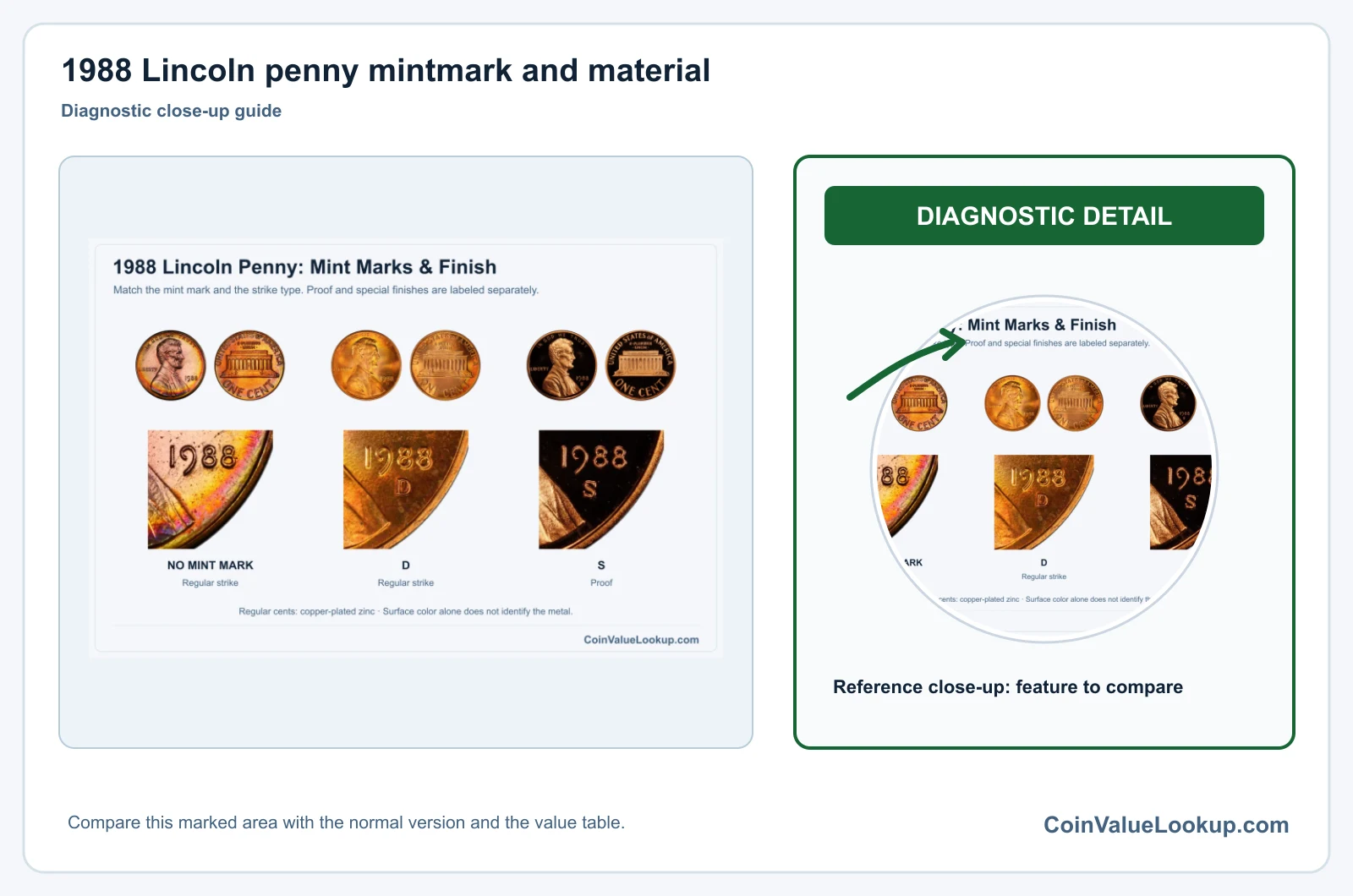
The 1988 Lincoln cent is a copper-plated zinc coin weighing about 2.50 grams, with a plain edge, Lincoln's portrait on the front and the Memorial on the back. A copper color does not mean it is solid copper; all regular 1988 cents are 97.5% zinc with a thin copper plating.
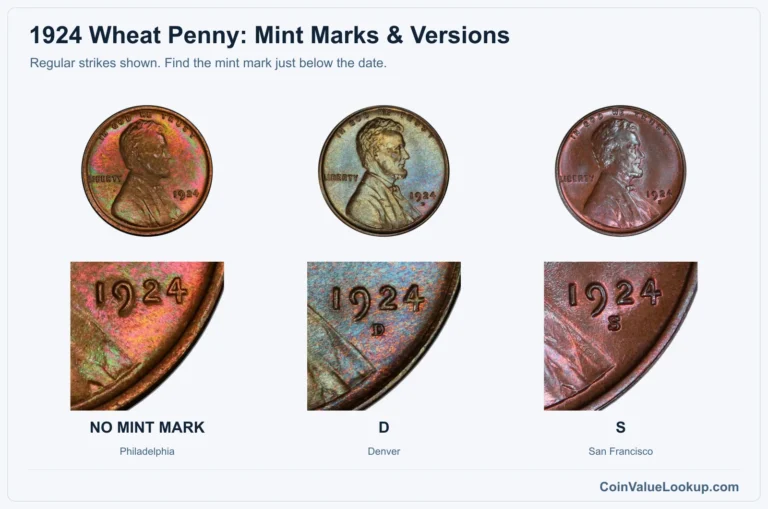
Three normal branches exist: the Philadelphia issue (no mint mark), the Denver issue (D below the date), and the San Francisco proof (S below the date). There is no P mint mark on cents this year, and no S-mint circulation strike.
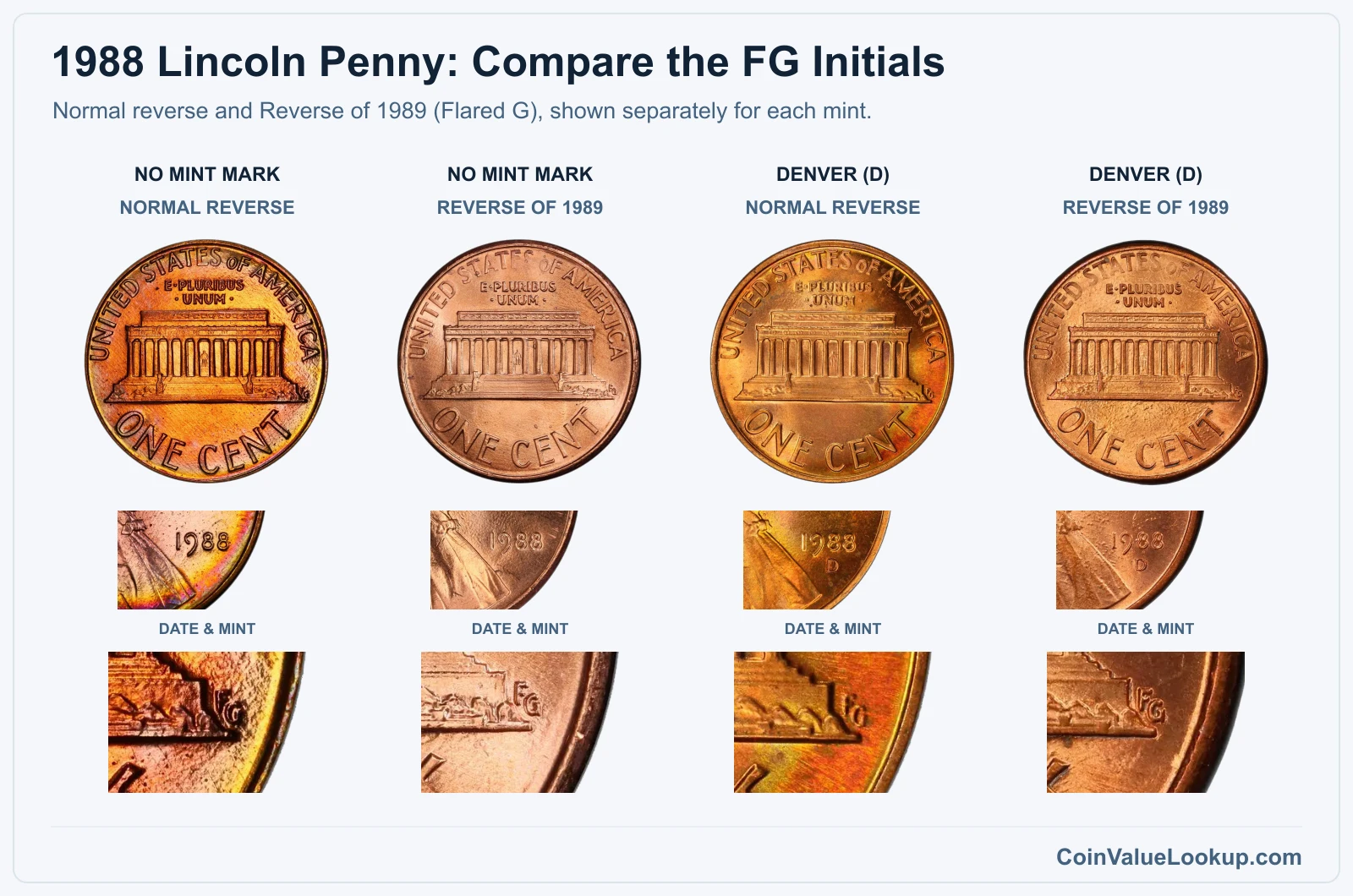
Two attributed varieties deserve your attention on no-mark coins. The Doubled Ear shows an extra raised contour along Lincoln's earlobe.
The Reverse of 1989, found on both no-mark and D coins, is identified by looking at the G in the designer's initials FG near the Memorial base. A normal 1988 reverse has a straight G; the transitional variety has flared or serifed terminals on the upper and lower ends of the G.
Do not rely on AM spacing alone to identify this variety.
When comparing values, keep finish, copper color designation (BN, RB, RD), and contrast labels (CAM, DCAM) separate. These are filters for condition, not different alloys.
Step 2: Check Your 1988 Lincoln Penny Grade
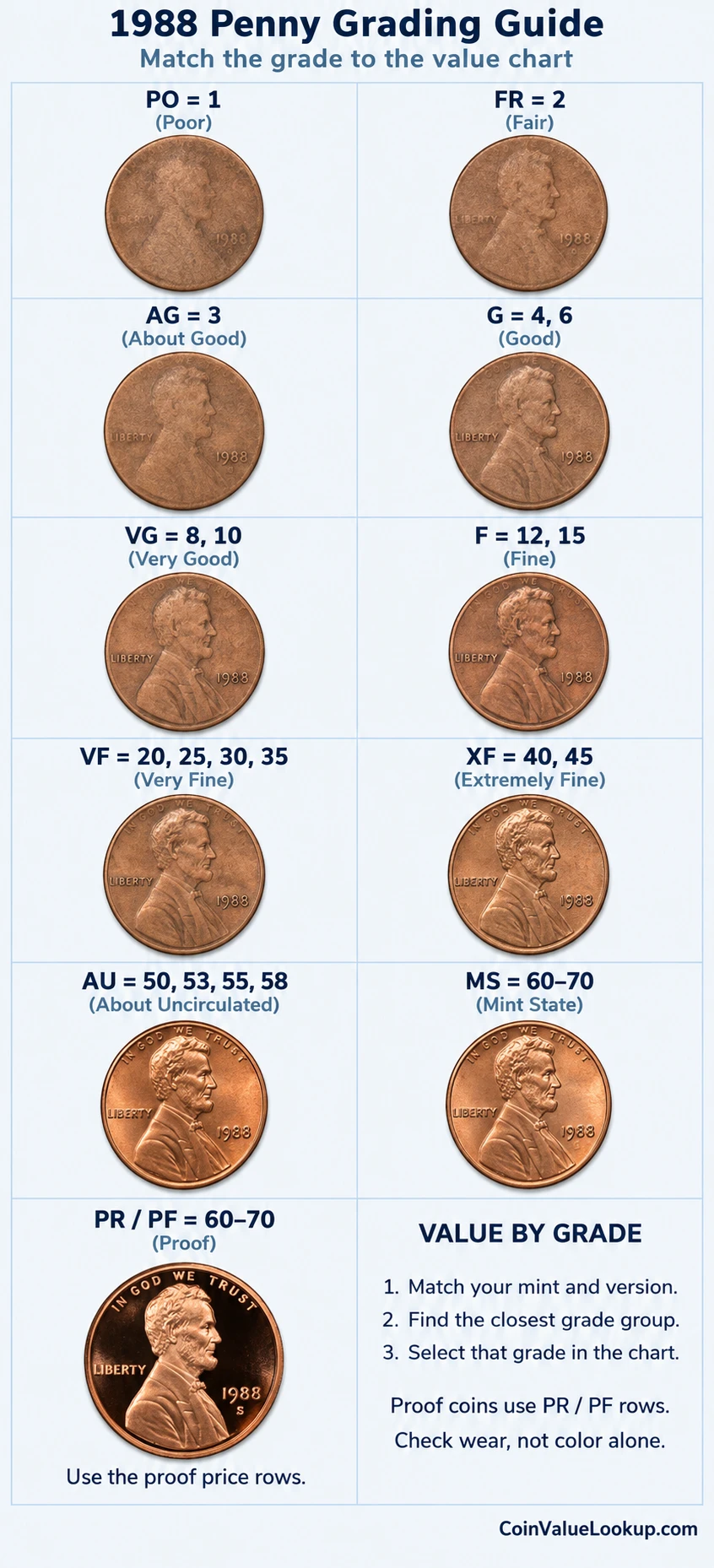
Start with the high points: Lincoln's cheekbone, jaw and hair detail on the front, plus the Memorial roof and column lines on the back. That is where wear shows up first.
A coin with full original luster and no contact marks grades higher than one that has been rattling around in a coffee can since 1988.
Grade through remaining luster and surface quality, not redness alone. A bright red coin with bag marks is not automatically better than a lightly toned coin with clean fields.
Use the comparison image alongside your coin to gauge where it falls.
Watch for plating issues. Bubbles, splits and exposed zinc patches are surface problems, not rare errors.
Corrosion and cleaning also hurt the grade. Do not assume every odd-looking surface means a valuable error.
Step 3: Check 1988 Lincoln Penny Value by Mint and Version
1988 Lincoln Penny
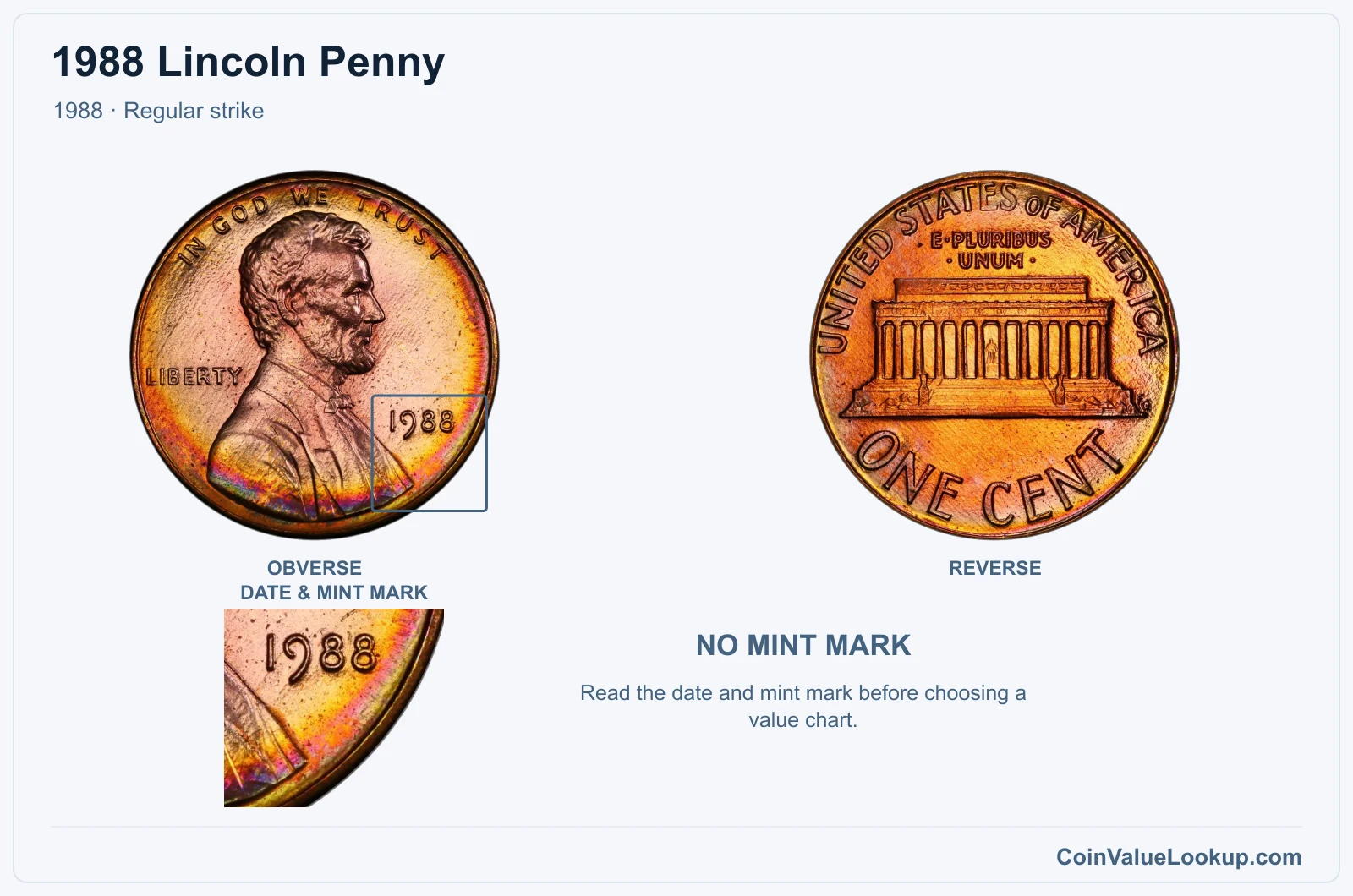
The 1988 Philadelphia cent has no mint mark below the date. It is a copper-plated zinc business strike weighing about 2.50 grams.
In circulated condition this coin is worth one cent, full stop.
A guide estimate places an MS65 example at roughly $0.36. To get any premium you need original surfaces, strong luster and minimal marks.
Check the ear area and the FG initials on the reverse before filing this one as ordinary.
| Range | Grade | Price | Auction Records | Appraisal |
|---|---|---|---|---|
| PO | PO 1 | — | Coin Identifier | |
| FR | FR 2 | — | Coin Identifier | |
| AG | AG 3 | — | Coin Identifier | |
| G | G 4 | — | Coin Identifier | |
| G 6 | — | Coin Identifier | ||
| VG | VG 8 | — | Coin Identifier | |
| VG 10 | — | Coin Identifier | ||
| F | F 12 | — | Coin Identifier | |
| F 15 | — | Coin Identifier | ||
| VF | VF 20 | — | Coin Identifier | |
| VF 25 | — | Coin Identifier | ||
| VF 30 | — | Coin Identifier | ||
| VF 35 | — | Coin Identifier | ||
| XF | XF 40 | — | Coin Identifier | |
| XF 45 | — | Coin Identifier | ||
| AU | AU 50 | — | Coin Identifier | |
| AU 53 | — | Coin Identifier | ||
| AU 55 | — | Coin Identifier | ||
| AU 58 | — | Coin Identifier | ||
| MS | MS 60 | — | Coin Identifier | |
| MS 61 | — | Coin Identifier | ||
| MS 62 | — | Coin Identifier | ||
| MS 63 | — | Coin Identifier | ||
| MS 64 | — | Coin Identifier | ||
| MS 65 | — | Coin Identifier | ||
| MS 66 | — | Coin Identifier | ||
| MS 67 | — | — | — | |
| MS 68 | — | — | — | |
| MS 69 | — | — | — | |
| MS 70 | — | — | — |
1988 Lincoln Penny — D
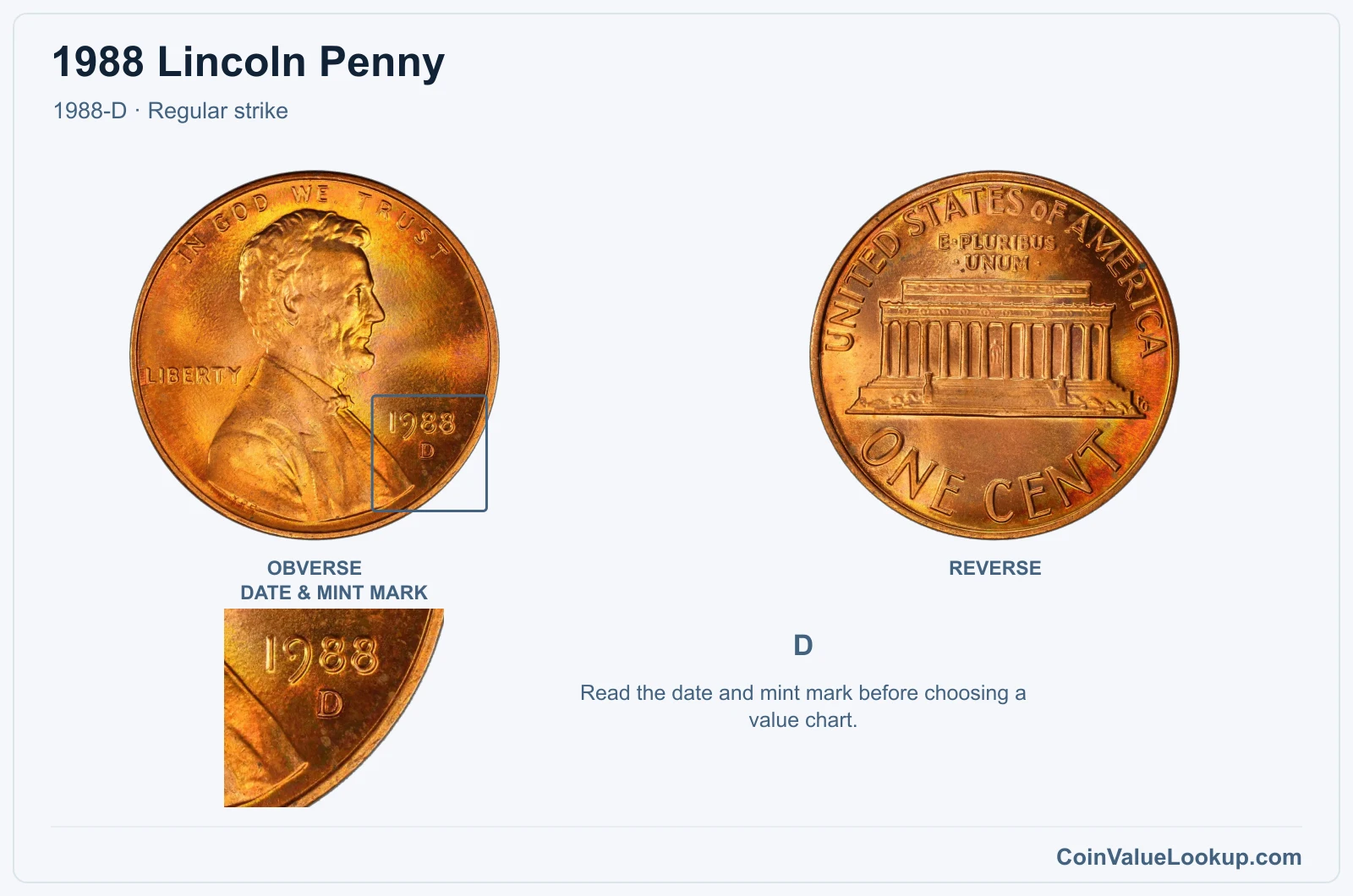
Denver struck its share of 1988 cents, each carrying a small D below the date. Same copper-plated zinc composition, same 2.50-gram weight, same guide value of about $0.36 in MS65.
Condition and copper color matter for any collector premium. Also inspect the FG initials on the reverse for the Flared G variety and look at the D itself under magnification for possible repunching.
A worn D-mint cent in your pocket change is still worth one cent.
| Range | Grade | Price | Auction Records | Appraisal |
|---|---|---|---|---|
| PO | PO 1 | — | Coin Identifier | |
| FR | FR 2 | — | Coin Identifier | |
| AG | AG 3 | — | Coin Identifier | |
| G | G 4 | — | Coin Identifier | |
| G 6 | — | Coin Identifier | ||
| VG | VG 8 | — | Coin Identifier | |
| VG 10 | — | Coin Identifier | ||
| F | F 12 | — | Coin Identifier | |
| F 15 | — | Coin Identifier | ||
| VF | VF 20 | — | Coin Identifier | |
| VF 25 | — | Coin Identifier | ||
| VF 30 | — | Coin Identifier | ||
| VF 35 | — | Coin Identifier | ||
| XF | XF 40 | — | Coin Identifier | |
| XF 45 | — | Coin Identifier | ||
| AU | AU 50 | — | Coin Identifier | |
| AU 53 | — | Coin Identifier | ||
| AU 55 | — | Coin Identifier | ||
| AU 58 | — | Coin Identifier | ||
| MS | MS 60 | — | Coin Identifier | |
| MS 61 | — | Coin Identifier | ||
| MS 62 | — | Coin Identifier | ||
| MS 63 | — | Coin Identifier | ||
| MS 64 | — | Coin Identifier | ||
| MS 65 | — | Coin Identifier | ||
| MS 66 | — | Coin Identifier | ||
| MS 67 | — | Coin Identifier | ||
| MS 68 | — | — | — | |
| MS 69 | — | — | — | |
| MS 70 | — | — | — |
1988 Lincoln Penny — S PR
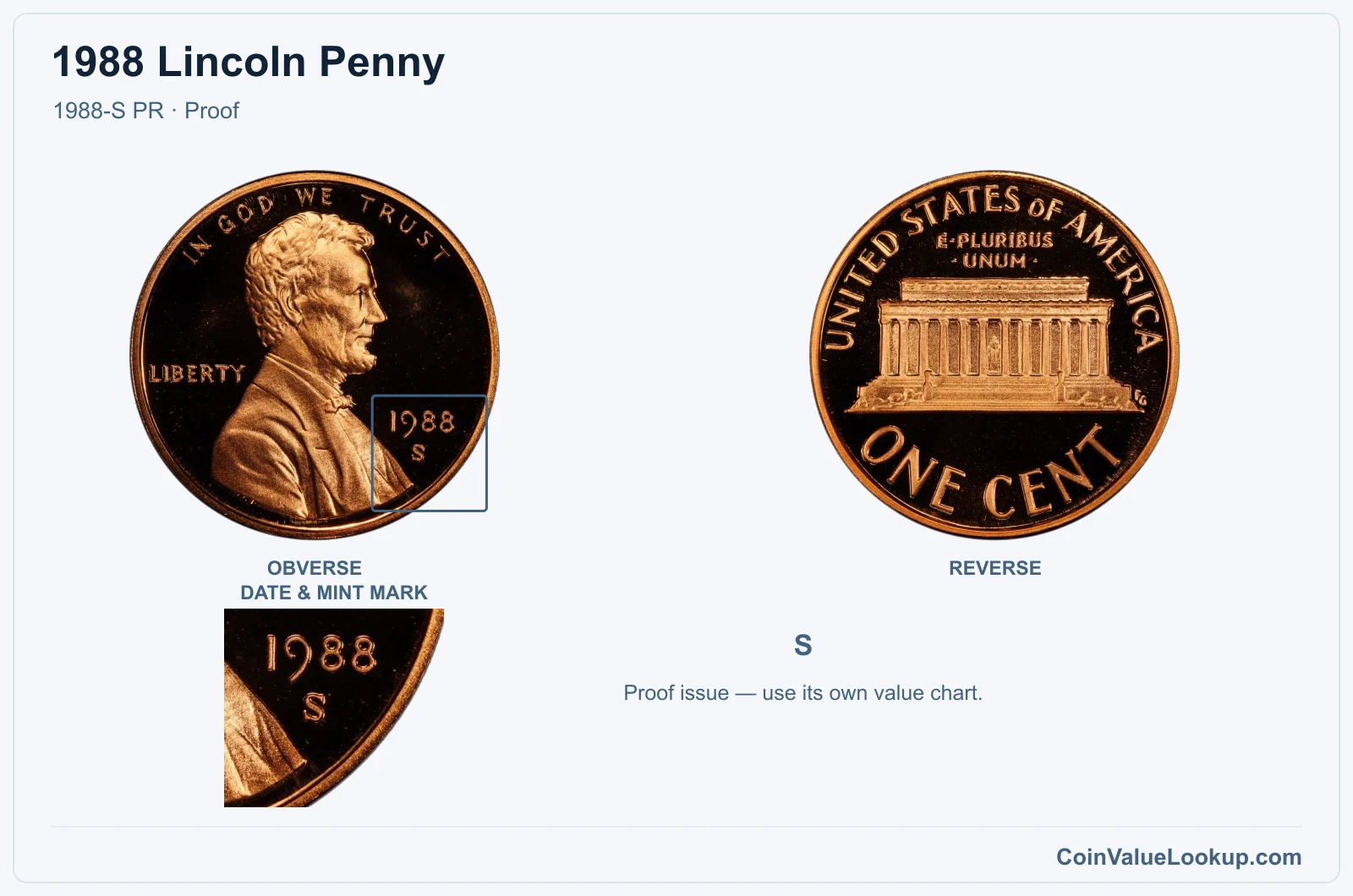
The 1988-S proof was struck at San Francisco for collectors, not for circulation. It carries an S mint mark and has the mirror-like finish typical of proof production.
A proof is a manufacturing method, not a grade above Mint State.
A guide estimate puts PR65 around $11.00. Keep contrast designations like Cameo or Deep Cameo separate from the numerical grade when comparing values.
Surface quality, absence of haze and original packaging condition all affect desirability. These are copper-plated zinc like the business strikes, not solid copper.
| Range | Grade | Price | Auction Records | Appraisal |
|---|---|---|---|---|
| PR | PR 1 | — | Coin Identifier | |
| PR 2 | — | Coin Identifier | ||
| PR 3 | — | Coin Identifier | ||
| PR 4 | — | Coin Identifier | ||
| PR 6 | — | Coin Identifier | ||
| PR 8 | — | Coin Identifier | ||
| PR 10 | — | Coin Identifier | ||
| PR 12 | — | Coin Identifier | ||
| PR 15 | — | Coin Identifier | ||
| PR 20 | — | Coin Identifier | ||
| PR 25 | — | Coin Identifier | ||
| PR 30 | — | Coin Identifier | ||
| PR 35 | — | Coin Identifier | ||
| PR 40 | — | Coin Identifier | ||
| PR 45 | — | Coin Identifier | ||
| PR 50 | — | Coin Identifier | ||
| PR 53 | — | Coin Identifier | ||
| PR 55 | — | Coin Identifier | ||
| PR 58 | — | Coin Identifier | ||
| PR 60 | — | Coin Identifier | ||
| PR 61 | — | Coin Identifier | ||
| PR 62 | — | Coin Identifier | ||
| PR 63 | — | Coin Identifier | ||
| PR 64 | — | Coin Identifier | ||
| PR 65 | — | Coin Identifier | ||
| PR 66 | — | Coin Identifier | ||
| PR 67 | — | Coin Identifier | ||
| PR 68 | Coin Identifier | |||
| PR 69 | Coin Identifier | |||
| PR 70 | Coin Identifier |
1988 Lincoln Penny — No Mint Mark — Reverse of1989 (Flared G)
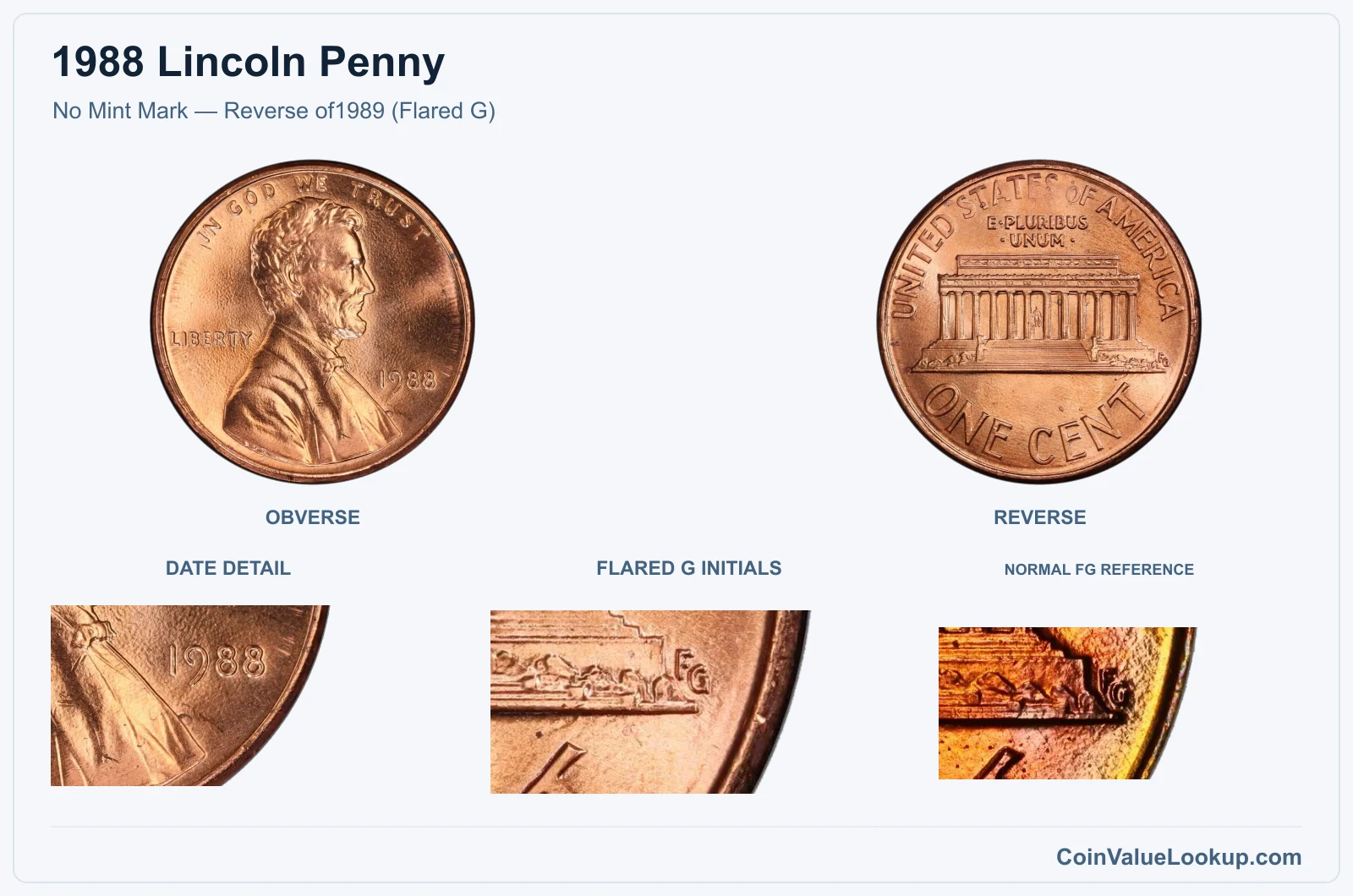
This is the no-mint-mark 1988 cent struck with the reverse die intended for 1989 production. The diagnostic is the G in the FG designer initials near the base of the Memorial.
On a normal 1988 reverse the G is straight and plain. On the Reverse of 1989, the G has flared or serifed terminals at the top and bottom.
Do not identify this variety by AM spacing alone; that shortcut does not reliably separate 1988 reverses. You need a clear, magnified look at the G compared side by side with a known normal example at the same scale.
Value depends on authenticated identity and the coin's condition. No standard guide price is adopted for this variety, so individual assessment by a grading service is the path forward.
Range Grade
Price1988 No Mint Mark — Reverse of1989 (Flared G) (BN) Price1988 No Mint Mark — Reverse of1989 (Flared G) (RB) Price1988 No Mint Mark — Reverse of1989 (Flared G) (RD) Auction Records Appraisal PO PO 1
—
Coin Identifier FR FR 2
—
Coin Identifier AG AG 3
—
Coin Identifier G G 4
—
Coin Identifier
G 6
—
Coin Identifier VG VG 8
—
Coin Identifier
VG 10
—
Coin Identifier F F 12
—
Coin Identifier
F 15
—
Coin Identifier VF VF 20
—
Coin Identifier
VF 25
—
Coin Identifier
VF 30
—
Coin Identifier
VF 35
—
Coin Identifier XF XF 40
—
Coin Identifier
XF 45
—
Coin Identifier AU AU 50
—
Coin Identifier
AU 53
—
Coin Identifier
AU 55
—
Coin Identifier
AU 58
—
Coin Identifier MS MS 60
—
Coin Identifier
MS 61
—
Coin Identifier
MS 62
—
Coin Identifier
MS 63
Coin Identifier
MS 64
—
Coin Identifier
MS 65
—
Coin Identifier
MS 66
—
—
—
Coin Identifier
MS 67
—
—
—
Coin Identifier
MS 68
—
—
—
—
—
MS 69
—
—
—
—
—
MS 70
—
—
—
—
—
1988 Lincoln Penny — D — Reverse of1989 (Flared G)
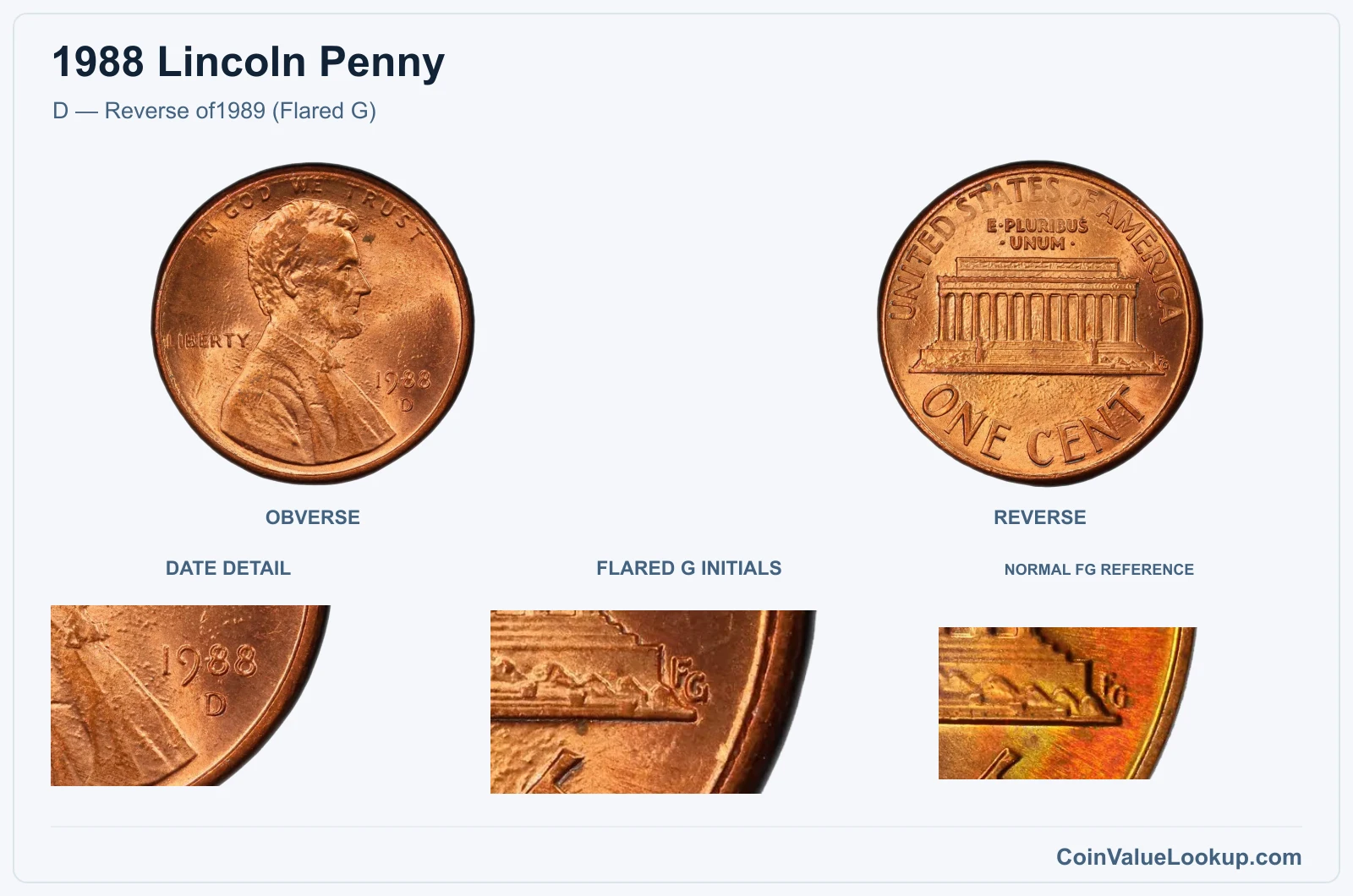
The same Reverse of 1989 transitional die pairing also appears on 1988-D cents from Denver. Identification is identical: look for flared terminals on the G in FG rather than the straight form.
Coin Value Lookup is a good place to start when you want to compare your find against other Lincoln cent years and varieties. Each guide covers what to look for and the values that apply.
Do not transfer no-mint-mark pricing or rarity assumptions to the D-mint version. These are separate die pairings at separate facilities.
Value depends on authenticated identity and condition, with no standard guide price currently adopted.
Range Grade
Price1988 D — Reverse of1989 (Flared G) (BN) Price1988 D — Reverse of1989 (Flared G) (RB) Price1988 D — Reverse of1989 (Flared G) (RD) Auction Records Appraisal PO PO 1
—
Coin Identifier FR FR 2
—
Coin Identifier AG AG 3
—
Coin Identifier G G 4
—
Coin Identifier
G 6
—
Coin Identifier VG VG 8
—
Coin Identifier
VG 10
—
Coin Identifier F F 12
—
Coin Identifier
F 15
—
Coin Identifier VF VF 20
—
Coin Identifier
VF 25
—
Coin Identifier
VF 30
—
Coin Identifier
VF 35
—
Coin Identifier XF XF 40
—
Coin Identifier
XF 45
—
Coin Identifier AU AU 50
—
Coin Identifier
AU 53
—
Coin Identifier
AU 55
—
Coin Identifier
AU 58
—
Coin Identifier MS MS 60
—
Coin Identifier
MS 61
—
Coin Identifier
MS 62
—
Coin Identifier
MS 63
Coin Identifier
MS 64
—
Coin Identifier
MS 65
—
Coin Identifier
MS 66
—
—
Coin Identifier
MS 67
—
—
—
Coin Identifier
MS 68
—
—
—
—
—
MS 69
—
—
—
—
—
MS 70
—
—
—
—
—
1988 Lincoln Penny — No Mint Mark — Doubled Ear
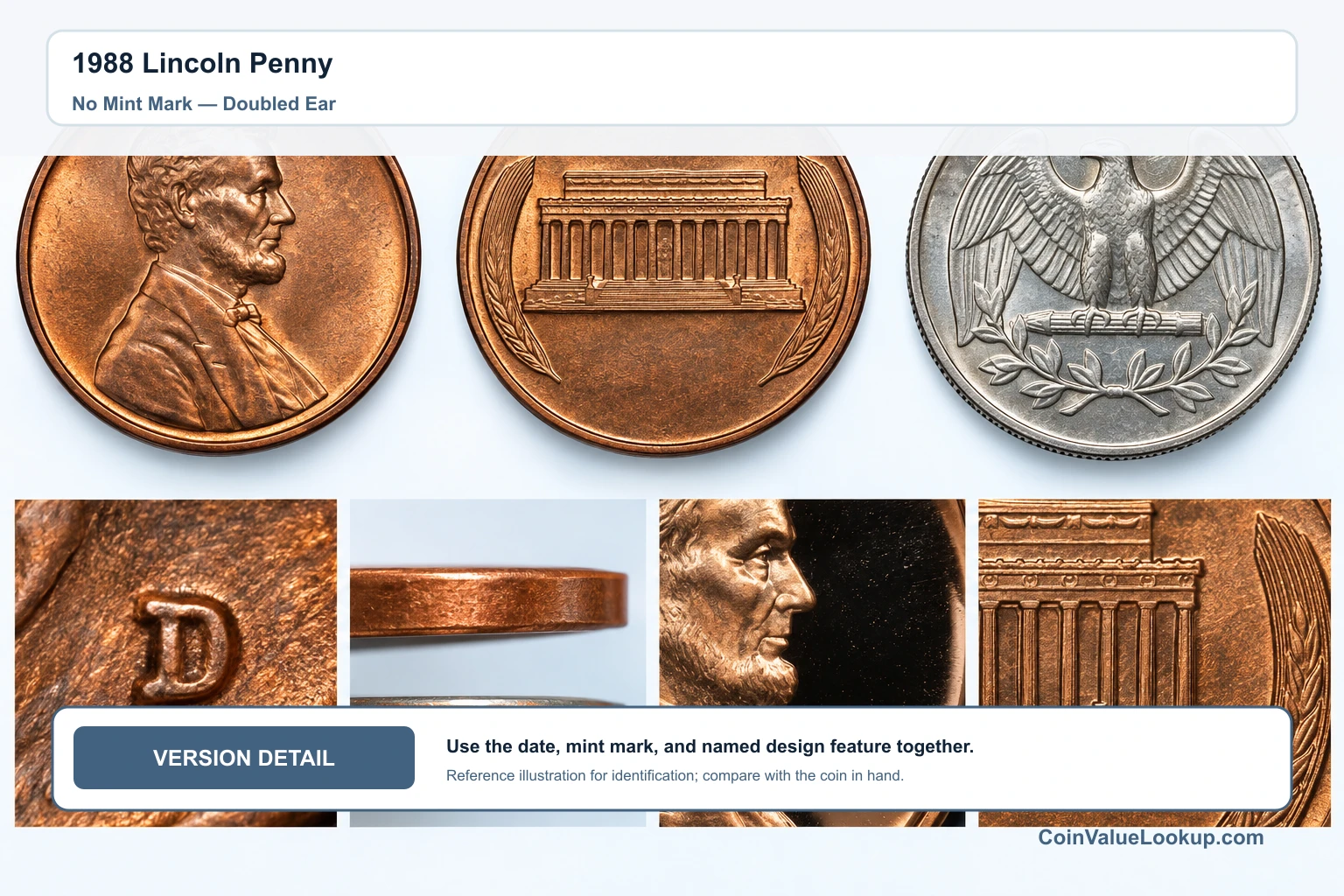
The 1988 Doubled Ear is a no-mint-mark Philadelphia business strike showing a second raised contour along Lincoln's earlobe. This is a cataloged variety, distinct from the better-known 1984 and 1997 doubled ears on other Lincoln cents.
To identify it, compare your coin's ear area at magnification against a normal 1988 cent. The doubling appears as an extra ridge or shelf of metal along the lobe.
No standard guide price is adopted for this variety, so value depends on authenticated identity, the strength of the doubling and overall coin condition. A grading service attribution helps establish what you have.
Range Grade
Price1988 No Mint Mark — Doubled Ear (RB) Price1988 No Mint Mark — Doubled Ear (RD) Auction Records Appraisal PO PO 1
—
Coin Identifier FR FR 2
—
Coin Identifier AG AG 3
—
Coin Identifier G G 4
—
Coin Identifier
G 6
—
Coin Identifier VG VG 8
—
Coin Identifier
VG 10
—
Coin Identifier F F 12
—
Coin Identifier
F 15
—
Coin Identifier VF VF 20
—
Coin Identifier
VF 25
—
Coin Identifier
VF 30
—
Coin Identifier
VF 35
—
Coin Identifier XF XF 40
—
Coin Identifier
XF 45
—
Coin Identifier AU AU 50
—
Coin Identifier
AU 53
—
Coin Identifier
AU 55
—
Coin Identifier
AU 58
—
Coin Identifier MS MS 60
—
Coin Identifier
MS 61
—
Coin Identifier
MS 62
—
Coin Identifier
MS 63
—
Coin Identifier
MS 64
—
—
Coin Identifier
MS 65
—
—
Coin Identifier
MS 66
—
Coin Identifier
MS 67
—
—
—
—
MS 68
—
—
—
—
MS 69
—
—
—
—
MS 70
—
—
—
—
1988 Lincoln Penny Error List
1. 1988 Lincoln Penny — Doubled Ear
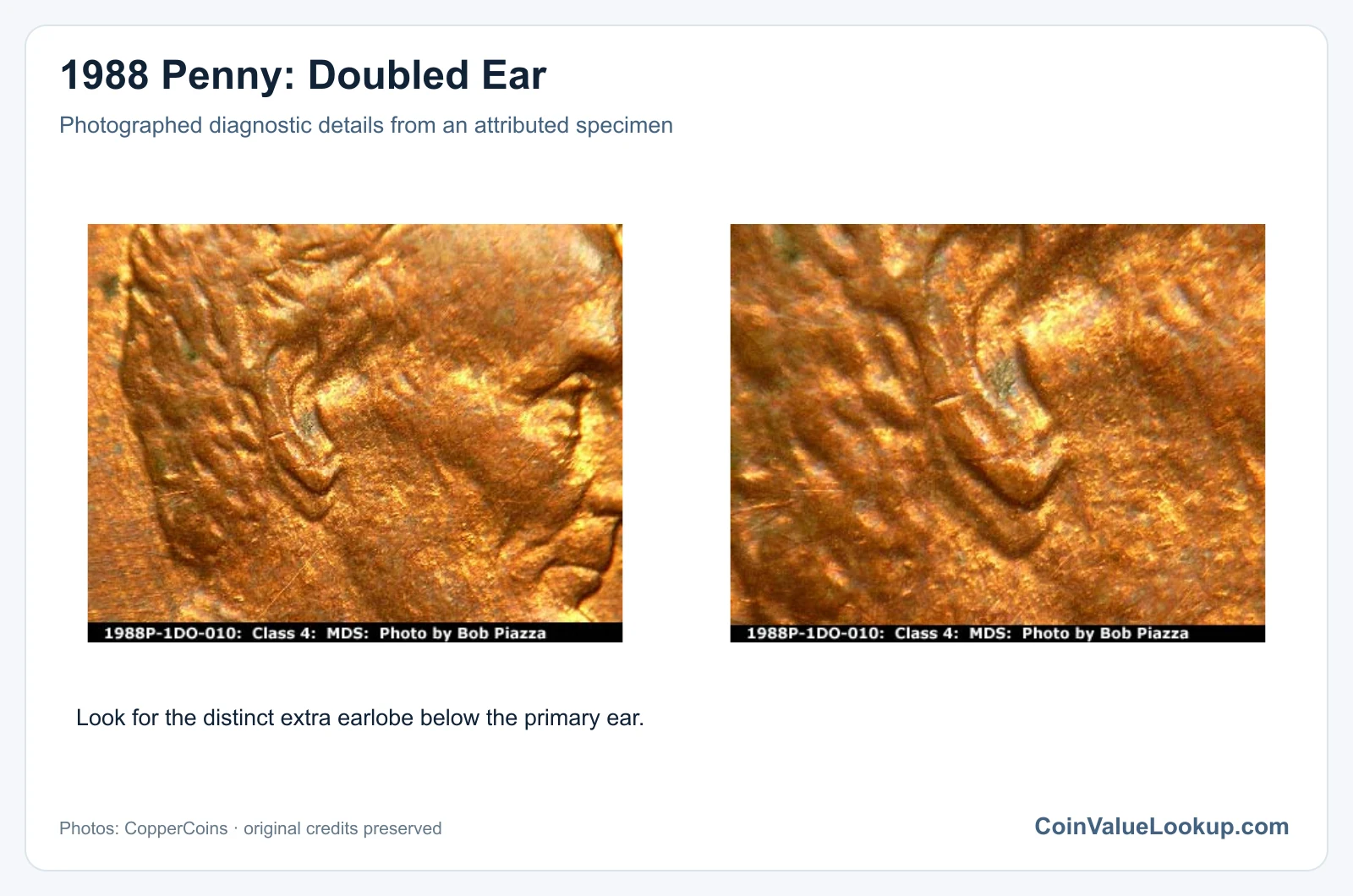
The 1988 Doubled Ear appears on no-mint-mark business strikes. Look for a second raised contour running along Lincoln's earlobe, creating a shelf or extra ridge that does not appear on normal 1988 cents.
Under magnification, compare your coin's ear to a known normal example at the same scale. The doubling should be consistent and raised, not flat or irregular.
Die chips, contact marks and damage from circulation can mimic doubling to the untrained eye, so take your time.
This is not the same variety as the 1984 or 1997 doubled ear. No standard price range is adopted; value depends on authenticated identity, doubling strength and overall condition.
Professional attribution is the reliable way to confirm this one.
2. 1988 Lincoln Penny — Reverse of1989 / Flared G
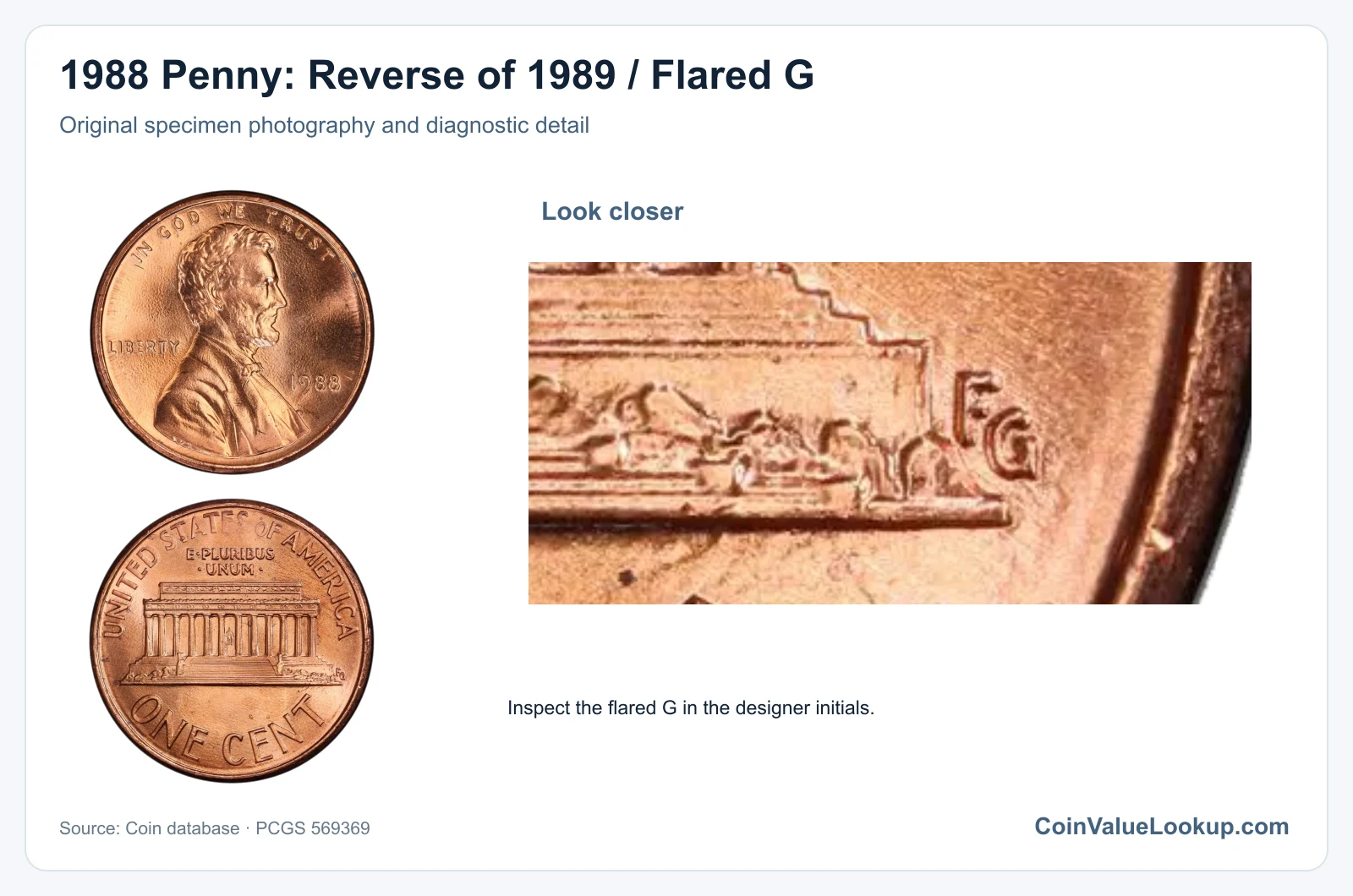
The Reverse of 1989 variety exists on both 1988 no-mint-mark and 1988-D cents. The key diagnostic is the letter G in the designer's FG initials near the Memorial base.
On a normal 1988 reverse, the G has straight, clean terminals. On the transitional reverse, those terminals flare outward with visible serifs.
Do not rely on AM spacing to identify this variety. Wide AM alone does not confirm a Reverse of 1989 on a 1988 cent.
You need a clear, magnified comparison of the G against a known normal coin at the same scale. Digital sharpening or wear can create misleading impressions.
No standard price range is adopted. Each coin's value depends on authenticated identity and condition, assessed individually.
Keep no-mint-mark and D-mint examples as separate items when evaluating.
3. 1988 Lincoln Penny — Cent Struck over a Dime
A 1988 cent struck over an already-struck 1988-P Roosevelt dime is one of the more dramatic errors from this year. Both the cent design and traces of the original dime survive on the finished coin, including remnants of Roosevelt's portrait and the torch.
This is different from a coin struck on a blank dime planchet. The host coin was already a fully struck dime before receiving the cent impression.
Look for both dates and surviving design elements from each denomination. One NGC MS66 example sold for $1,092.50 at auction in February 2006.
That is a single historical sale, not a market range, but it gives a sense of the level of collector interest in confirmed over-denomination errors.
4. 1988 Lincoln Penny — Off-Center Strike
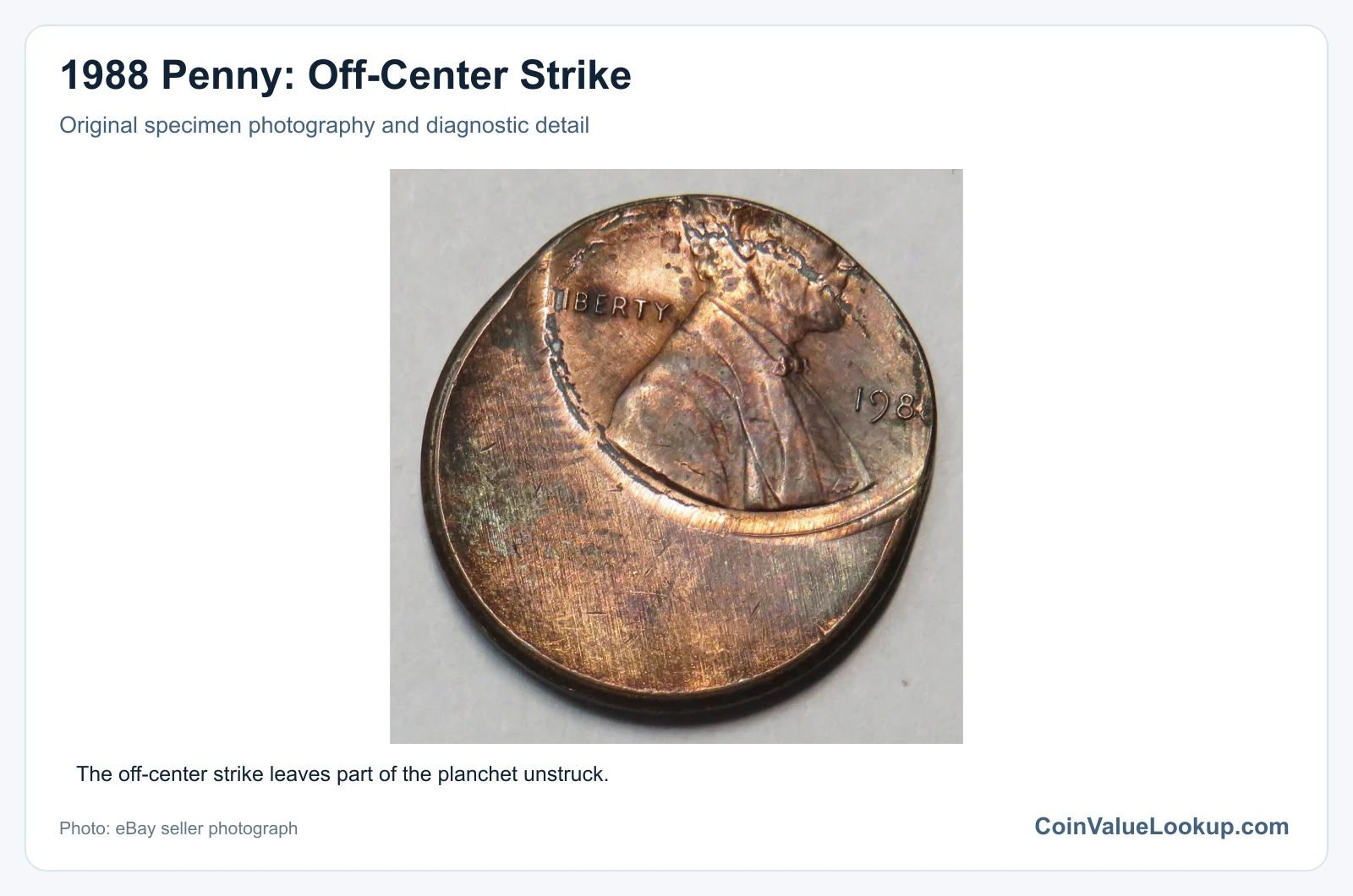
Off-center 1988 cents occur when the planchet is not properly seated in the collar during striking. The design shifts toward one side, leaving a blank crescent on the opposite edge.
The key requirement for value is that the date and, ideally, the mint mark remain visible.
Estimate the shift percentage by looking at how far the design has moved from center. Use both faces and the full outline of the coin.
A roughly 30% off-center 1988 cent graded NGC MS64 Red sold for $55. Other examples may have no established price, depending on severity and preservation.
Do not confuse an off-center strike with a broadstrike, which shows a complete design but an expanded rim. Post-mint edge damage and clipped planchets also look different under close inspection.
5. 1988 Lincoln Penny — Double Struck / Overlapping Off-Center
A double-struck 1988 cent received two impressions from the dies, with the second strike displaced from the first. This leaves overlapping design elements and possibly a uniface area where only one strike reached the metal.
The diagnostic is two distinct, shifted impressions of the Lincoln or Memorial design. Both strike positions should be visible, along with a readable date.
This is a striking event at the press, not hub doubling from die production.
Machine doubling, which produces flat shelf-like distortion, is not the same thing. A single off-center strike also lacks the second overlapping impression.
No standard price range is adopted; the exact strike sequence, shift distance and preservation all influence value individually.
6. 1988 Lincoln Penny — Partial Brockage with Broadstrike
A partial brockage on a 1988 cent happens when a previously struck coin sticks to a die and impresses its design into the next coin in an incuse, mirror-image form. On this error you will see an expanded, reversed Memorial or Lincoln impression alongside the normal struck design, often with a broadstrike expanding the rim.
Look for the incuse design fragment and the expanded rim together. A vise-made counterfeit incuse impression or a simple die clash will not show the same characteristics.
A PCGS MS63 example sold for $24 in 2004. That is one historical sale, not a broad market range, but it confirms collector interest even in modest examples.
7. 1988 Lincoln Penny — Reverse Cud / Major Die Break
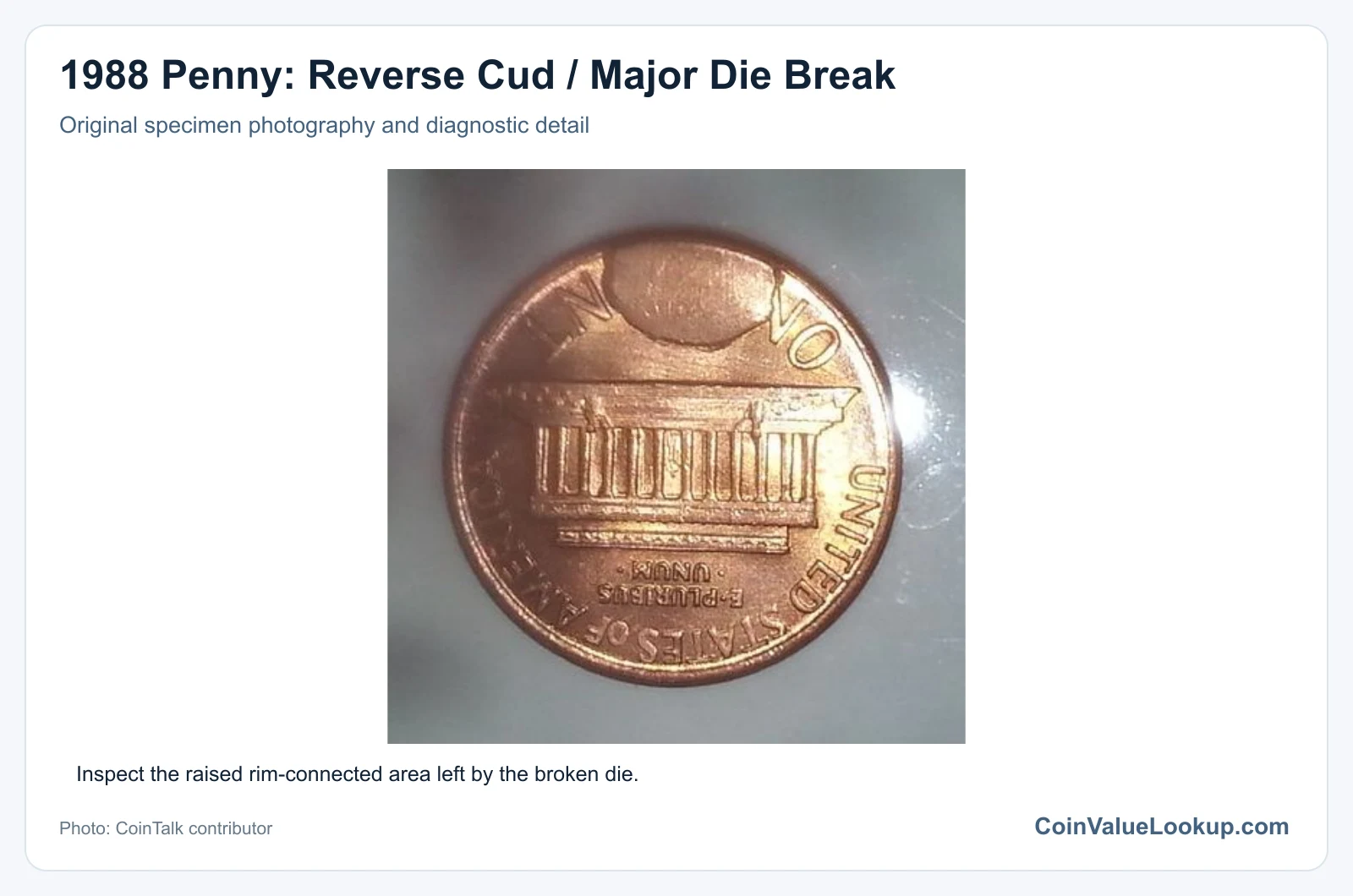
A cud is a raised, irregular blob of metal along the rim where a piece of the reverse die broke away. The die break means that area no longer imparts a design, so the metal flows into the void and creates a raised lump.
On the opposite face you may see a corresponding flat or depressed area. The cud must reach the rim to be a true cud; a die chip in the middle of the field is a different category.
Post-mint damage and plating blisters can look superficially similar but lack the consistent raised profile and rim connection.
No standard price range is adopted for 1988 cuds. Size, position on the design and third-party authentication all affect what a specific example is worth.
8. 1988 Lincoln Penny — Struck Through Wire
This error on a 1988 Philadelphia cent shows a thin, incuse line running from the L of LIBERTY toward Lincoln's shoulder. A piece of wire was trapped between the die and the planchet during striking, leaving its impression in the coin's surface.
Under magnification the line should appear recessed with a mint-made texture, not a bright scratch from post-mint contact. A cleaning scratch or bag mark typically has a different surface finish and direction pattern.
Weak strikes can also create odd linear features, but they lack the distinct incuse wire profile.
No standard price range is adopted. Confirmed identity through professional attribution matters more than generic struck-through quotes found online.
9. 1988 Lincoln Penny — Repunched D Mintmark
A repunched mint mark on the 1988-D cent shows overlapping D impressions from the mint mark punch being applied more than once to the working die. Under magnification you can see traces of an earlier D position beneath or beside the primary D.
Not every wonky-looking D qualifies. Machine doubling on the mint mark produces flat, shelf-like distortion rather than a true second punch.
Die chips and plating splits near the mint mark can also create misleading shapes. Use an attributed comparison image rather than assuming any doubled appearance is an RPM.
No standard price range is adopted. Clarity of the repunching and third-party attribution determine collector value.
10. 1988 Lincoln Penny — Unplated / Partly Unplated Planchet
An unplated 1988 cent went through the striking process without its copper plating, leaving the zinc core fully exposed. The coin appears silver-gray rather than copper-colored and typically weighs slightly less than a normal plated example.
The important distinction is between a coin that was never plated at the mint and one that lost its plating after leaving. Chemical stripping, corrosion and environmental damage can all remove copper plating from a zinc cent over time.
Look for consistent zinc coverage across the entire surface, including protected areas in the design recesses, and compare the edge.
No standard price range is adopted. Value depends on the visibility and authenticity of the missing plating, along with overall condition.
11. 1988 Lincoln Penny — Clipped Planchet
A clipped planchet error on a 1988 cent means the blank was cut incorrectly before striking, leaving a missing curved, straight or ragged section along the edge. The clip is part of the original blank, not something removed afterward.
Look for a corresponding area of design weakness opposite the clip, known as the Blakesley effect, where metal did not flow fully during striking. The edge texture at the clip should match the coin's original surface, not show file marks or cut marks.
Post-mint edge damage, filed notches and corrosion all mimic clips but lack that opposite-side weakness.
No standard price range is adopted. The clip's size, shape and the coin's overall preservation all factor into what it might be worth.
12. 1988 Lincoln Penny — Partial Collar Strike
A partial collar strike on a 1988 cent creates a stepped or irregular edge where only part of the planchet was confined by the collar die during striking. One portion of the rim looks normal while the other side is expanded or tilted.
To identify this error, examine the edge profile all the way around. A normal cent has a uniform, reeded-free edge with consistent rim height.
A partial collar will show a distinct transition from normal to expanded. Compare it against a complete broadstrike, which has expansion all around, and against simple edge damage, which lacks the mint-made stepped profile.
No standard price range is adopted. The degree of misalignment and the coin's authenticated condition determine individual value.