2001 Sacagawea Dollar Coin Value: How Much Is It Worth?
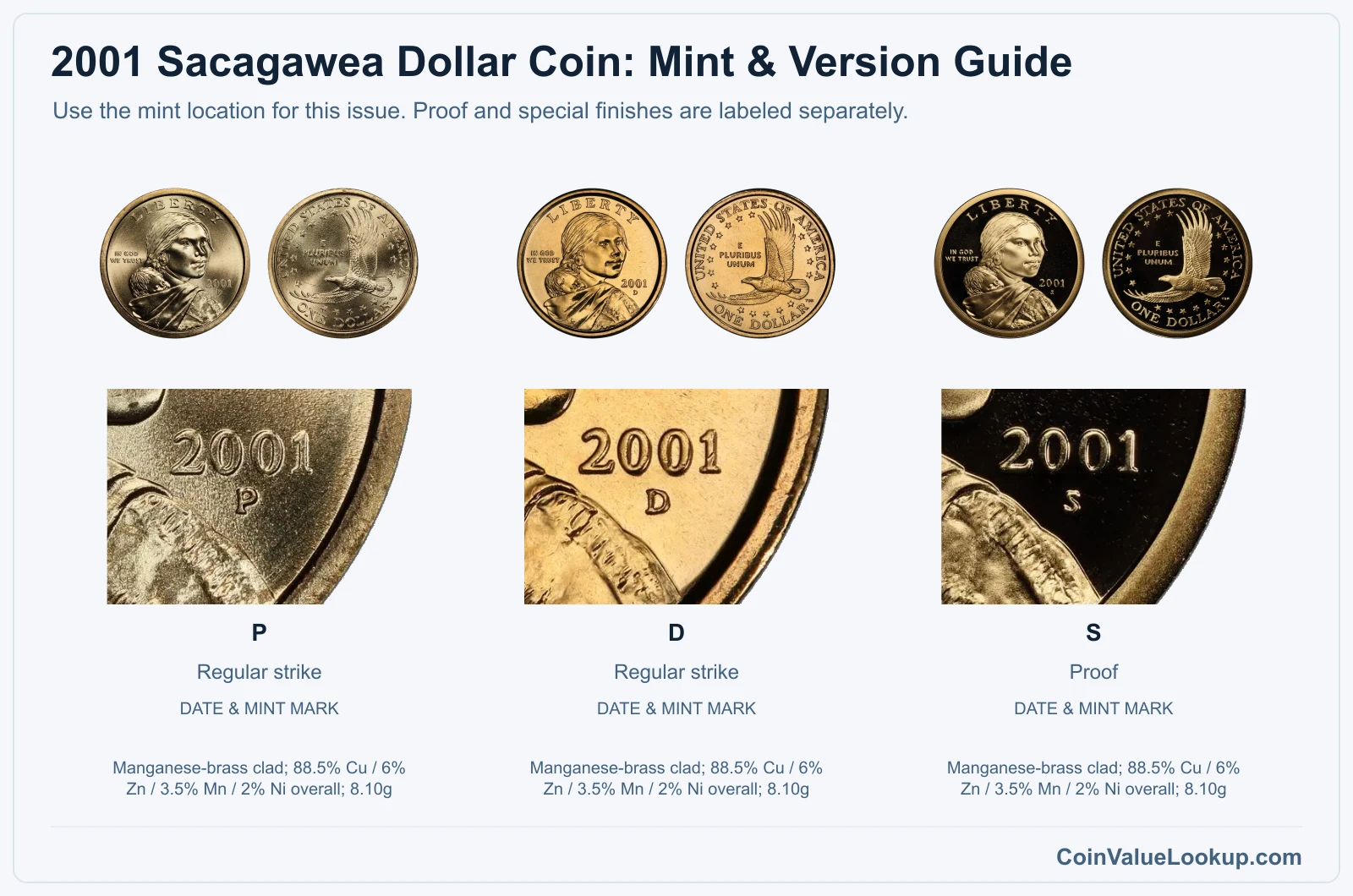
The 2001 Sacagawea Dollar is a common modern dollar coin, but certain versions and errors still deserve a closer look. Adopted guide estimates range from about $6.25 to $12.00 depending on the mint, finish and grade — these are not guaranteed offers.
Most circulated examples are worth face value, so identifying your coin's specific mint and finish matters before assuming any premium.
Fast Way to Identify Your 2001 Sacagawea Dollar
The quickest way to start is to upload clear photos of both the front and back of your coin. This gives a preliminary identification of the mint, design and condition.
Snap your pictures in even lighting — avoid glare on that golden surface — and make sure the mintmark area below the date is visible.
2001 Sacagawea Dollar Value
Upload both sides of your 2001 Sacagawea Dollar.
Front Obverse
Upload photo
Back Reverse
Upload photo
Which 2001 Sacagawea Dollar Versions Are Worth Money?
- S-mint proof finish — the only collector-grade version this year, with a guide estimate of $12.00 at PR65.
- P and D business strikes in high Mint State grades (MS65) carry a modest guide value around $6.25 each — still above face value if genuinely uncirculated.
Step 1: Identify Your 2001 Sacagawea Dollar Mint Mark and Version
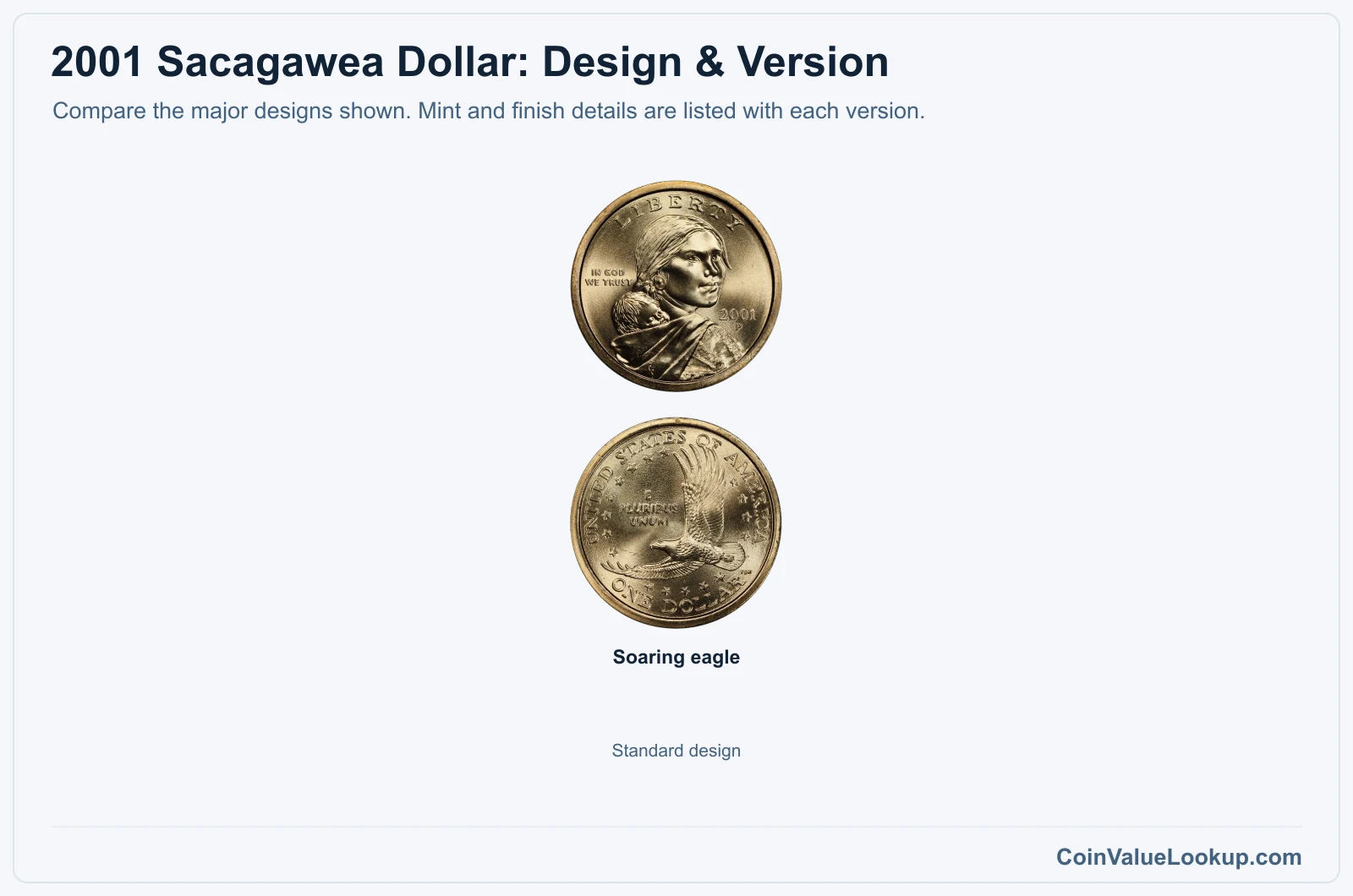
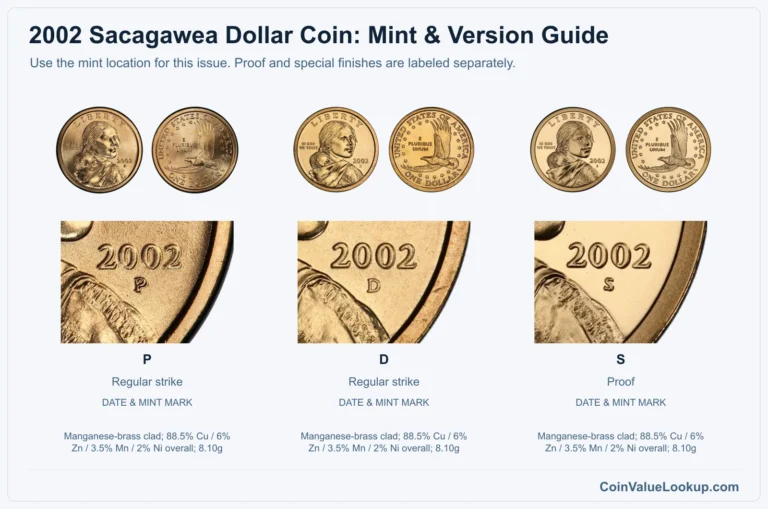
On the 2001 Sacagawea Dollar, the date and mintmark appear on the obverse (front) below the portrait. Look for a small "P" for Philadelphia, "D" for Denver, or "S" for San Francisco.
The "S" mint version was produced only as a proof for collectors.
All three share the same manganese-brass clad composition: 88.5% copper, 6% zinc, 3.5% manganese and 2% nickel, weighing 8.10 grams. The golden color comes from the manganese-brass surface, not actual gold content.
The obverse depicts Sacagawea carrying her infant son Jean-Baptiste. The reverse shows a soaring eagle design, which was used from 2000 through 2008.
Do not confuse this with the later Native American reverse designs introduced in 2009.
If your coin lacks a visible mintmark, it is the Philadelphia issue — the P mintmark on this series is small and sometimes weakly struck. A magnifying glass helps.
Step 2: Check Your 2001 Sacagawea Dollar Grade
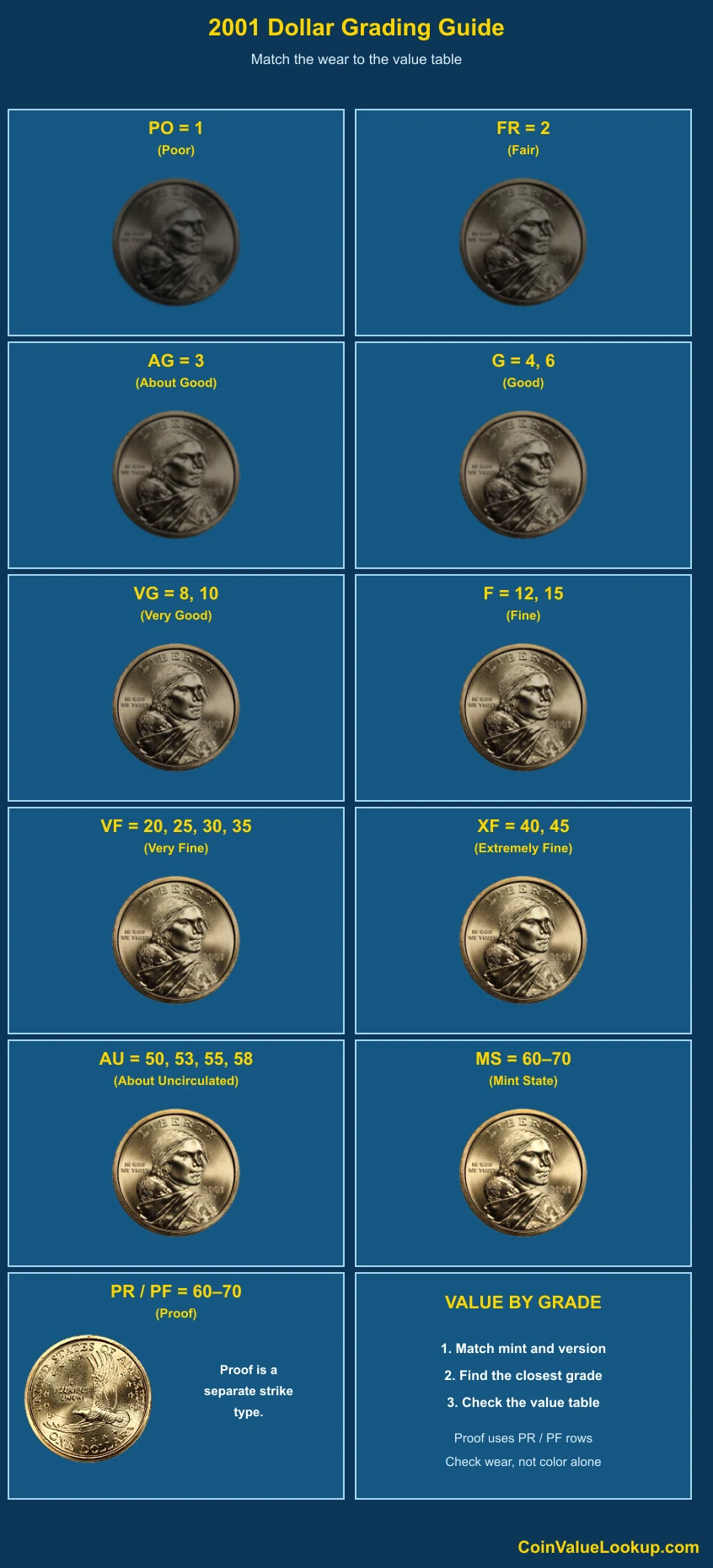
On a circulated 2001 Sacagawea Dollar, wear shows first on the cheekbone and hair detail of Sacagawea, and on the baby's features. The eagle's breast feathers on the reverse lose definition early too.
At About Uncirculated, you will see only the faintest friction on those high points, with most luster intact. A true Mint State coin has no wear at all — just varying degrees of contact marks and luster quality that separate MS60 from MS65 and above.
Proof coins from San Francisco are a different animal. They have mirrored fields and sharply struck devices, so grading proofs means looking at handling marks and haze rather than circulation wear.
Compare your proof against a same-type proof image, not a business-strike example.
Use the comparison image to check your coin's condition against known grade benchmarks. Focus on the specific wear points mentioned above rather than overall "shininess," which can be misleading on these golden-toned coins.
Step 3: Check 2001 Sacagawea Dollar Value by Mint and Version
2001 Sacagawea Dollar — P — Soaring eagle
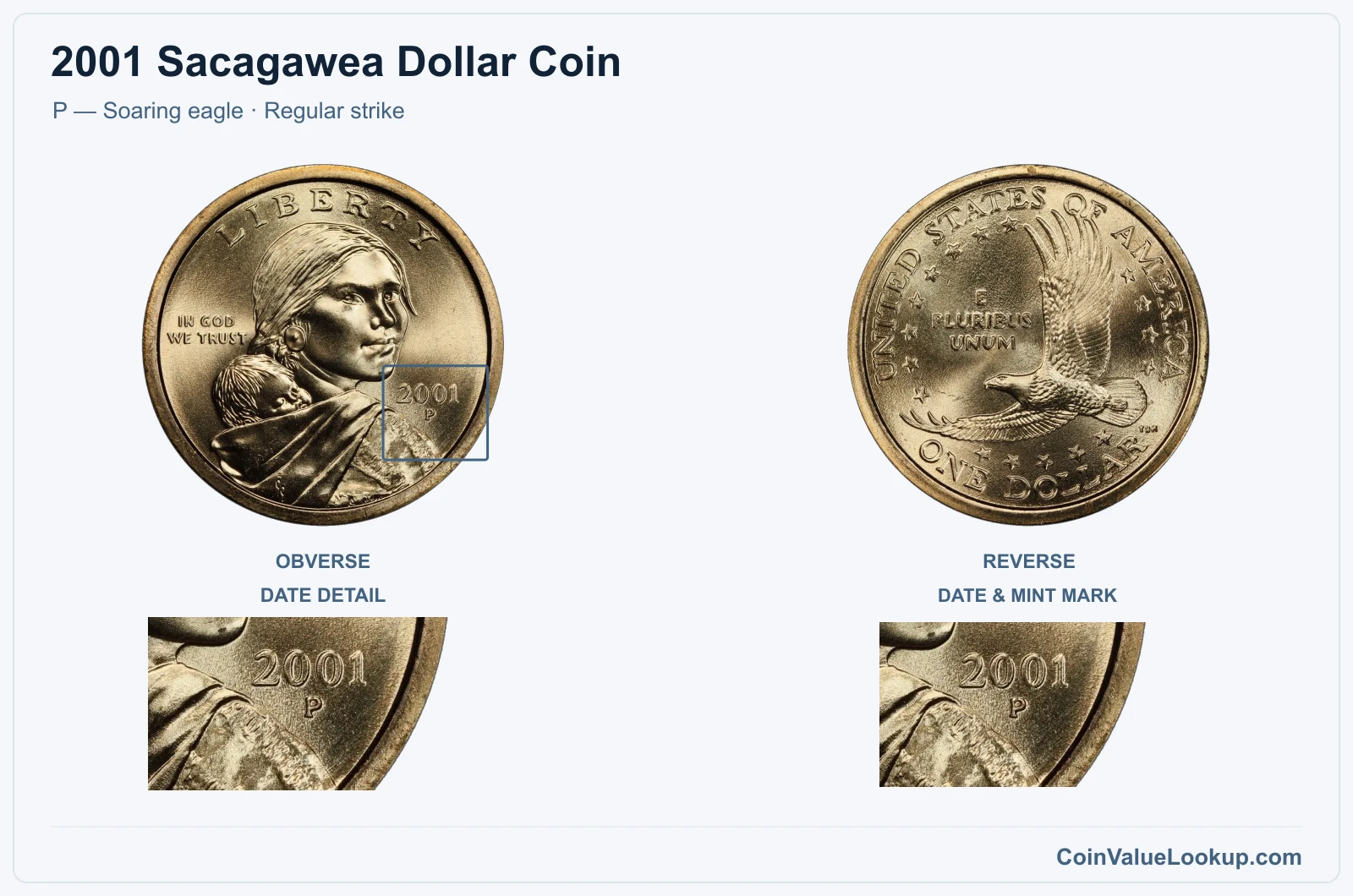
The 2001-P Sacagawea Dollar was struck at the Philadelphia Mint for general circulation. It features the standard soaring eagle reverse used throughout the early series years.
Look for the small "P" mintmark on the obverse beneath the date.
At MS65, USA Coin Book estimates this coin at about $6.25. That is a guide figure, not a guaranteed sale price.
Most examples pulled from change will grade well below MS65, making them worth face value. A crisp, bag-fresh roll coin is your best bet for a higher-grade piece.
Range Grade
Price Auction Records Appraisal PO PO 1
—
Coin Identifier FR FR 2
—
Coin Identifier AG AG 3
—
Coin Identifier G G 4
—
Coin Identifier
G 6
—
Coin Identifier VG VG 8
—
Coin Identifier
VG 10
—
Coin Identifier F F 12
—
Coin Identifier
F 15
—
Coin Identifier VF VF 20
—
Coin Identifier
VF 25
—
Coin Identifier
VF 30
—
Coin Identifier
VF 35
—
Coin Identifier XF XF 40
—
Coin Identifier
XF 45
—
Coin Identifier AU AU 50
—
Coin Identifier
AU 53
—
Coin Identifier
AU 55
—
Coin Identifier
AU 58
—
Coin Identifier MS MS 60
—
Coin Identifier
MS 61
—
Coin Identifier
MS 62
—
Coin Identifier
MS 63
—
Coin Identifier
MS 64
Coin Identifier
MS 65
Coin Identifier
MS 66
Coin Identifier
MS 67
Coin Identifier
MS 68
Coin Identifier
MS 69
Coin Identifier
MS 70
—
—
—
2001 Sacagawea Dollar — D — Soaring eagle
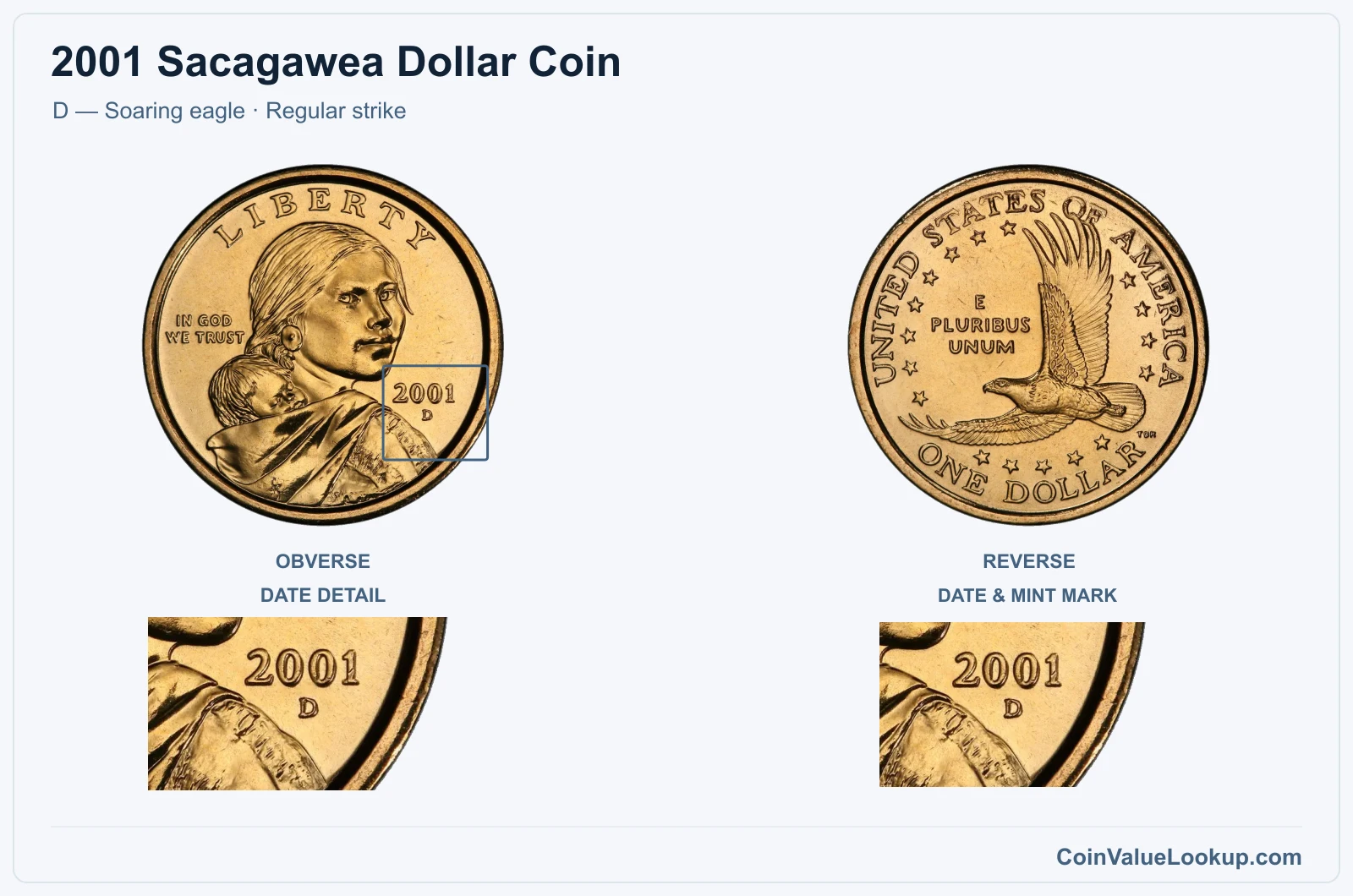
The 2001-D came from the Denver Mint. Same soaring eagle reverse, same manganese-brass composition, different mintmark — look for the "D" below the date on the obverse.
USA Coin Book lists this at roughly $6.25 in MS65 as a guide estimate. Denver and Philadelphia strikes from this year are roughly comparable in availability.
Circulated pieces are common and worth a dollar. An original-roll example with clean fields and sharp details is where the small premium lives.
Coin Value Lookup is a handy starting point if you are sorting through other dates and denominations in your collection. You can look up guides for different coins without hunting across multiple sites.
Range Grade
Price Auction Records Appraisal PO PO 1
—
Coin Identifier FR FR 2
—
Coin Identifier AG AG 3
—
Coin Identifier G G 4
—
Coin Identifier
G 6
—
Coin Identifier VG VG 8
—
Coin Identifier
VG 10
—
Coin Identifier F F 12
—
Coin Identifier
F 15
—
Coin Identifier VF VF 20
—
Coin Identifier
VF 25
—
Coin Identifier
VF 30
—
Coin Identifier
VF 35
—
Coin Identifier XF XF 40
—
Coin Identifier
XF 45
—
Coin Identifier AU AU 50
—
Coin Identifier
AU 53
—
Coin Identifier
AU 55
—
Coin Identifier
AU 58
—
Coin Identifier MS MS 60
—
Coin Identifier
MS 61
—
Coin Identifier
MS 62
—
Coin Identifier
MS 63
—
Coin Identifier
MS 64
Coin Identifier
MS 65
—
Coin Identifier
MS 66
Coin Identifier
MS 67
Coin Identifier
MS 68
Coin Identifier
MS 69
—
—
—
MS 70
—
—
—
2001 Sacagawea Dollar — S — Soaring eagle — proof
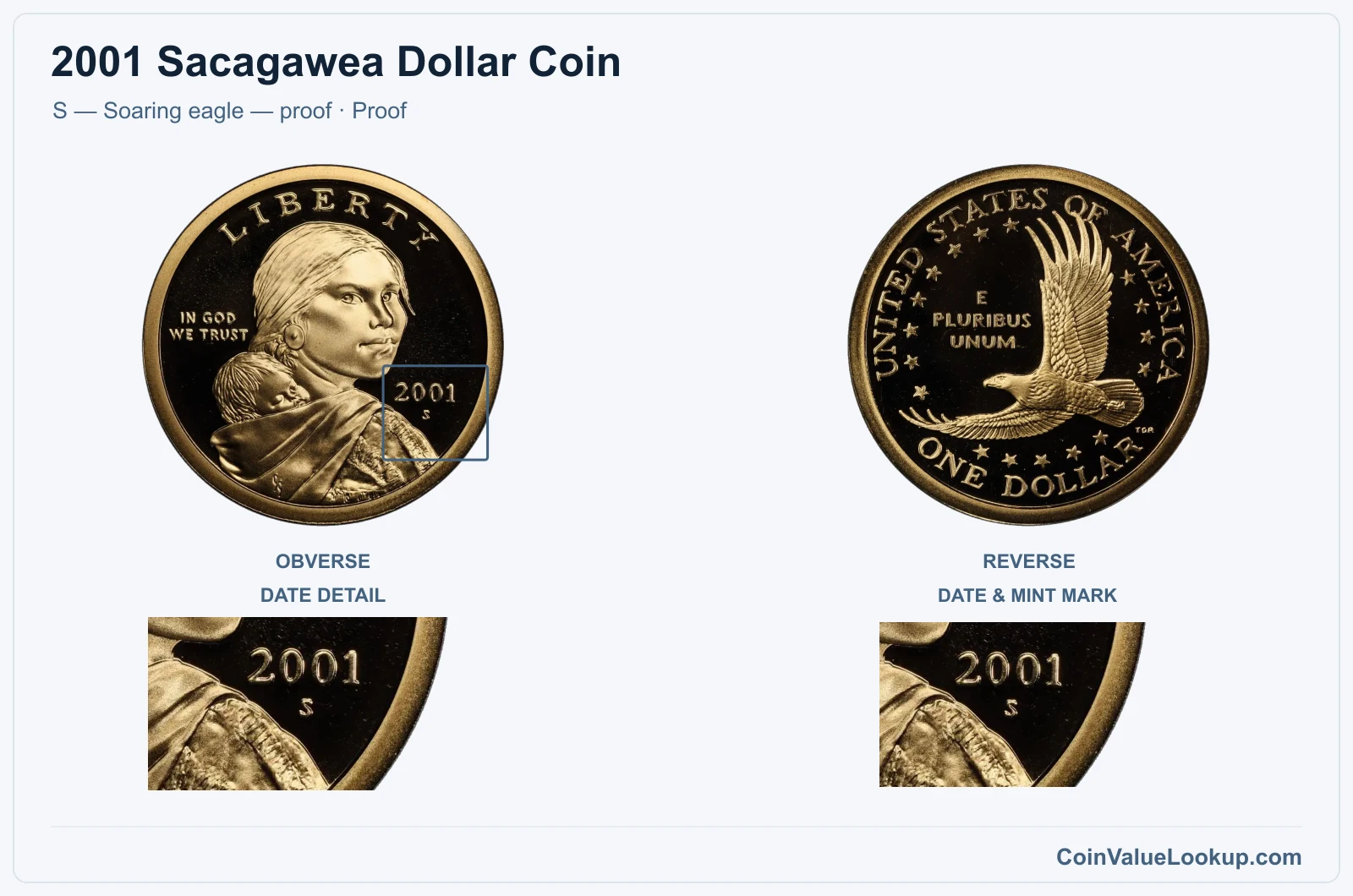
The 2001-S is the proof version, struck at the San Francisco Mint exclusively for collector sets. It was not released into circulation.
These coins have mirrored fields and crisp, frosted devices that give them a distinct visual contrast compared to business strikes.
USA Coin Book places this at about $12.00 in PR65 — a guide estimate, not a locked-in market price. One common mistake: if your coin came from a Silver Proof Set, the dollar itself is still manganese-brass clad, not silver.
The dimes, quarters and half dollars in those sets are silver, but the Sacagawea dollar is not.
Look for the "S" mintmark and the characteristic mirror finish to confirm you have the proof rather than a polished circulation coin.
Range Grade
Price Auction Records Appraisal PR PR 1
—
Coin Identifier
PR 2
—
Coin Identifier
PR 3
—
Coin Identifier
PR 4
—
Coin Identifier
PR 6
—
Coin Identifier
PR 8
—
Coin Identifier
PR 10
—
Coin Identifier
PR 12
—
Coin Identifier
PR 15
—
Coin Identifier
PR 20
—
Coin Identifier
PR 25
—
Coin Identifier
PR 30
—
Coin Identifier
PR 35
—
Coin Identifier
PR 40
—
Coin Identifier
PR 45
—
Coin Identifier
PR 50
—
Coin Identifier
PR 53
—
Coin Identifier
PR 55
—
Coin Identifier
PR 58
—
Coin Identifier
PR 60
—
Coin Identifier
PR 61
—
Coin Identifier
PR 62
—
Coin Identifier
PR 63
—
Coin Identifier
PR 64
—
Coin Identifier
PR 65
—
Coin Identifier
PR 66
Coin Identifier
PR 67
Coin Identifier
PR 68
Coin Identifier
PR 69
Coin Identifier
PR 70
Coin Identifier
2001 Sacagawea Dollar Error List
1. 2001 Sacagawea Dollar — Improper Annealing
An improperly annealed (sometimes called sintered planchet) error has been reported for the 2001-P Sacagawea Dollar. This happens when the blank is not heated correctly before striking, leaving an abnormal surface texture or discoloration that is visibly different from a normal coin.
What to look for: the surface may appear rough, granular or blotchy in a way that covers a broad area rather than a single spot. Compare the texture and edge to a normal 2001-P side by side.
The discoloration tends to be built into the metal, not sitting on top of it.
Be careful with lookalikes. Environmental toning, corrosion from moisture, or heat damage applied after the coin left the mint can all mimic this appearance.
Surface appearance is a screening clue, not proof of the manufacturing cause. Condition, visibility and the specific nature of the error all affect value — professional authentication is advisable before assuming a premium.
2. 2001 Sacagawea Dollar — Off-Center Strike
Off-center strikes have been reported on the 2001 Sacagawea Dollar. This error occurs when the planchet is not properly seated in the press, so the design is displaced to one side, leaving an unstruck crescent of blank metal on the opposite edge.
The key diagnostic is that shifted crescent — part of the coin's rim will be missing entirely, and the design shifts in one direction. Coins retaining a visible date are generally more collectible.
Do not confuse an off-center strike with a clipped planchet (which removes a bite-shaped piece), a misaligned die (which shifts only one side), or post-mint damage like a vice squeeze that flattens part of the coin unevenly. The value depends on the percentage of misalignment, whether the date is visible, and overall condition.
No specific price range is adopted here, so individual assessment is appropriate.
3. 2001 Sacagawea Dollar — Missing Clad Layer
Missing clad layer errors have been reported for the 2001 Sacagawea Dollar. On a normal coin, the manganese-brass outer layers cover both faces.
When one layer is missing before striking, one side of the coin may look distinctly different in color and the coin will weigh less than the standard 8.10 grams.
To check, compare the suspect face and the edge profile against a normal example. On the edge, you may see an uneven layer structure where the missing clad would normally appear.
Weight is a strong secondary diagnostic — grab a precise scale.
Lookalikes are common. Toning, environmental corrosion, acid treatment or deliberate removal of surface metal after minting can all change a coin's appearance in ways that look superficially similar.
If the edge layers appear normal and the weight is correct, the discoloration is more likely post-mint damage. Professional evaluation is recommended before assuming a premium.
4. 2001 Sacagawea Dollar — Wrong Planchet / Off-Metal Strike
A 2001-P Sacagawea Dollar struck on a State Quarter planchet has been reported as a wrong-planchet error. This means the dollar dies struck a blank intended for a quarter, producing a coin with Sacagawea's design on a planchet of the wrong size, weight and possibly composition.
The diagnostic starts with measurement. Compare the suspect coin's weight and diameter against both a normal Sacagawea Dollar and a normal State Quarter.
The design may appear incomplete or weakly struck at the edges because the smaller or thinner blank could not fill the dollar dies fully.
This is not the same as a coin that has been plated, corroded, acid-treated or intentionally altered to look unusual. Deliberate modifications typically show tool marks, uneven surfaces or chemical residue under magnification.
Given the rarity and complexity of wrong-planchet errors, professional authentication is strongly recommended. Value depends on the specific blank, condition and completeness of the strike.