2013 Sacagawea Dollar Coin Value: How Much Is It Worth?
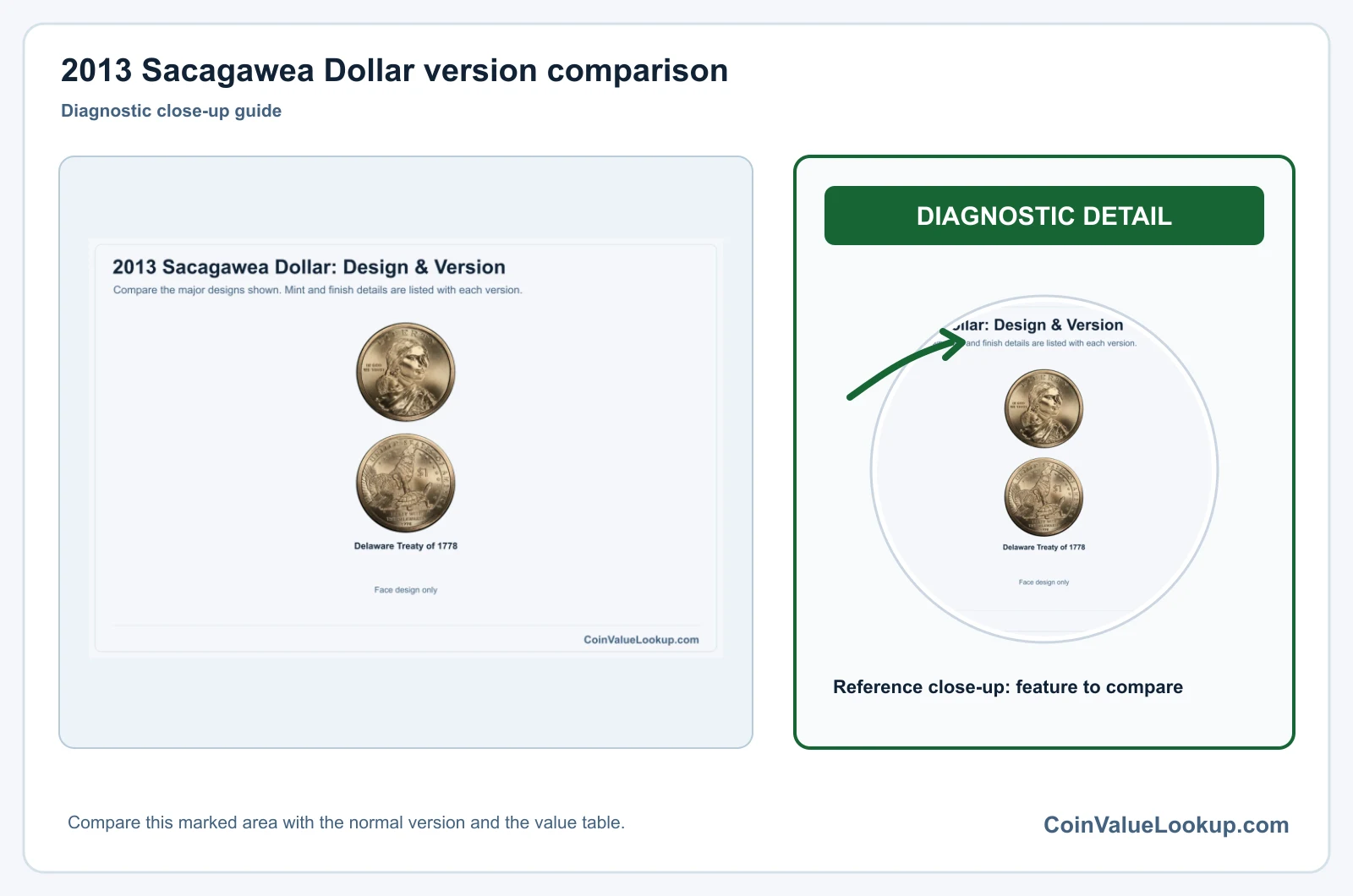
The 2013 Sacagawea Dollar features the Delaware Treaty of 1778 reverse design and comes in several distinct versions across the Philadelphia, Denver, and San Francisco mints. Guide estimates for explicitly listed grades range from about $6.25 to $10.00, depending on mint, finish, and condition.
Most circulated examples spend at face value, so identifying your specific version matters before assuming any premium.
Fast Way to Identify Your 2013 Sacagawea Dollar
Snap clear photos of your coin's front and back, then upload them for a preliminary identification. This can help you figure out which mint and version you have.
Edge details matter too, so a well-lit shot of the rim is useful if you can manage one.
2013 Sacagawea Dollar Value
Upload both sides of your 2013 Sacagawea Dollar.
Front Obverse
Upload photo
Back Reverse
Upload photo
Which 2013 Sacagawea Dollar Versions Are Worth Money?
- S-mint proof finish commands the highest listed guide estimate at $10.00 in PR65, struck only for collector sets.
- Position A and Position B edge-lettering variants exist for both P and D mints — check orientation before assuming they are identical.
Step 1: Identify Your 2013 Sacagawea Dollar Mint Mark and Version
Start by checking the edge of your coin. From 2009 onward, the date, mintmark, and motto moved to the incuse (pressed-in) lettering around the rim, so you will not find them on the face.
Look for "2013" and either a "P," "D," or "S" mintmark there.
The golden color does not mean gold. These are manganese-brass clad coins weighing 8.10 grams, composed of 88.5% copper, 6% zinc, 3.5% manganese, and 2% nickel overall.
All 2013 dollars share the same obverse portrait of Sacagawea and child, with the reverse depicting the Delaware Treaty of 1778 — a turkey, howling wolf, and turtle representing the three clans of the Delaware tribe.
Business strikes from Philadelphia (P) and Denver (D) each come in two edge-lettering orientations called Position A and Position B. If you hold the obverse facing you and the edge lettering reads normally from left to right, that is Position A.
If the lettering is upside down relative to the obverse, that is Position B. The San Francisco mint produced proof-finish coins exclusively for collector sets.
Coin Value Lookup is a handy starting point when you want to look up guides for other dates or denominations in the Sacagawea series.
Step 2: Check Your 2013 Sacagawea Dollar Grade
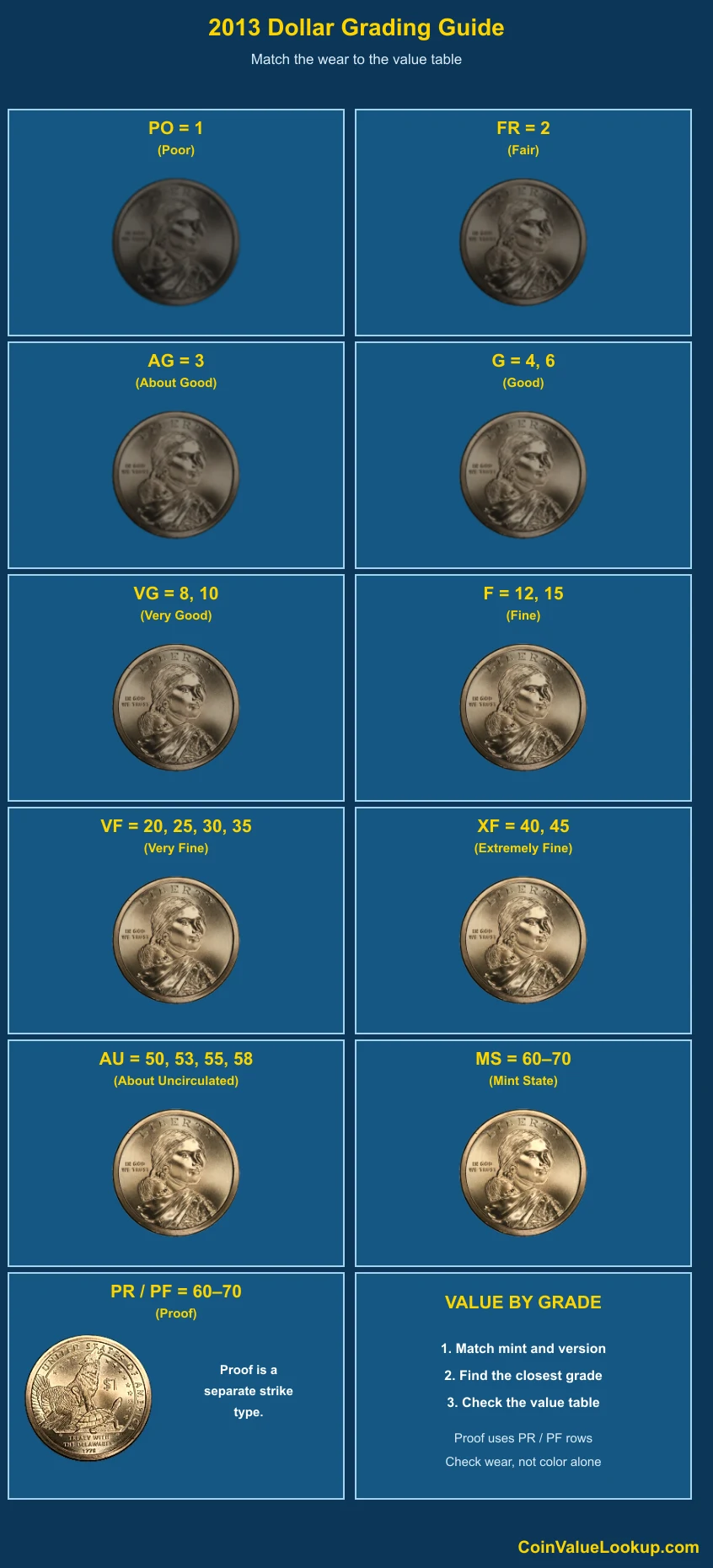
Focus on Sacagawea's cheek and the fine hair detail above her forehead — these are the first areas to show friction. The infant on her back and the high points of the reverse design lose sharpness next.
A circulated coin will have flat spots on the cheek and dulled hair strands. An About Uncirculated piece retains most luster but shows a trace of rub on those same high points.
A Mint State coin has full original luster with no wear, though contact marks from rolling around in bags are normal and affect the grade.
Proof coins from San Francisco should not be graded the same way as business strikes. Look for the intended contrast between mirrored fields and frosted devices rather than simple brightness.
Compare your coin against the same type and finish in the reference image to judge where it falls.
Step 3: Check 2013 Sacagawea Dollar Value by Mint and Version
2013 Sacagawea Dollar — P — Delaware Treaty of 1778 — Position A
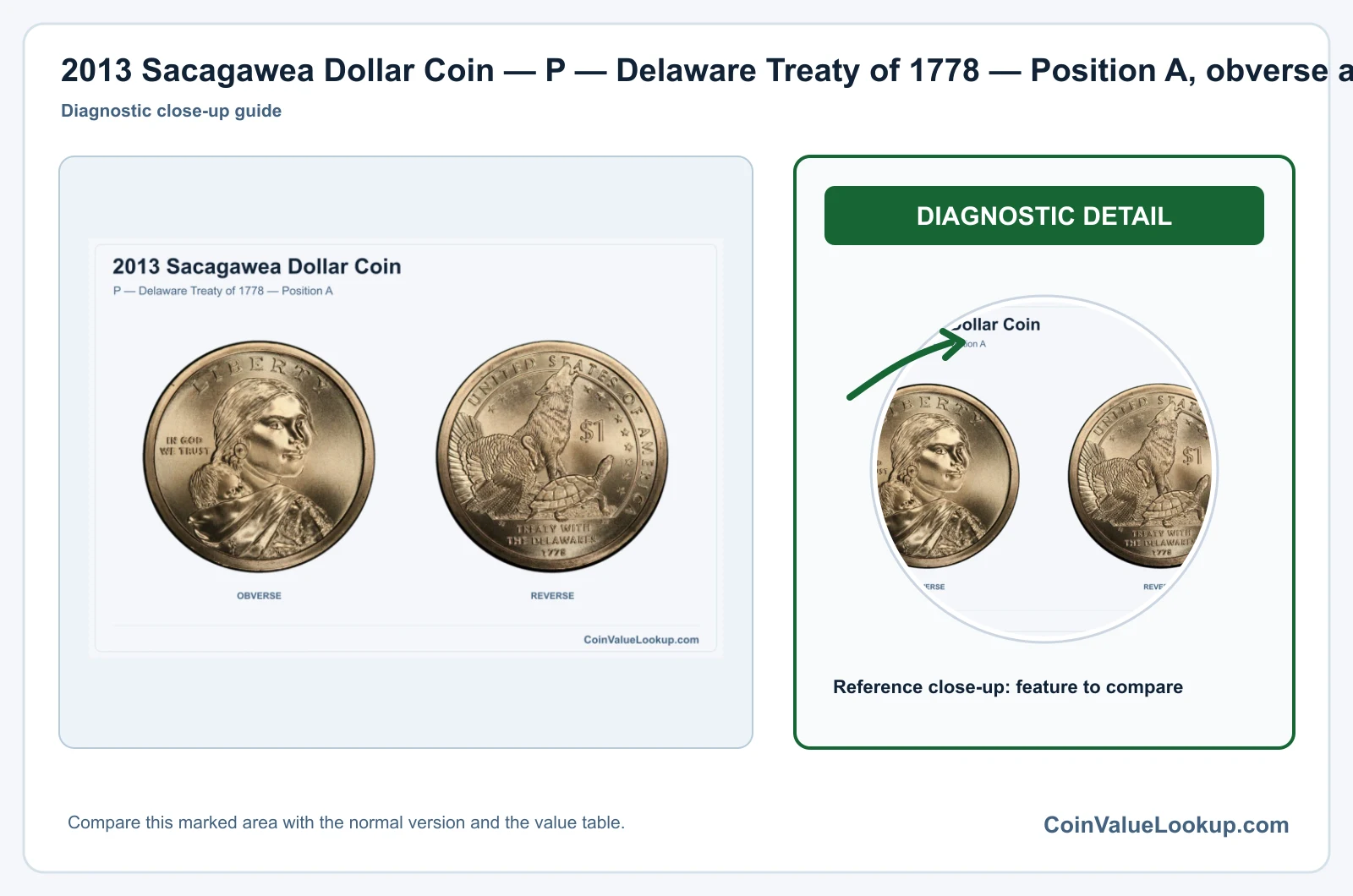
This is the Philadelphia mint business strike with Position A edge lettering. Hold the obverse facing you and check the incuse rim text: if it reads normally left to right, you have Position A.
A guide estimate places this version at about $6.25 in MS65. Most examples entered circulation or were distributed in mint rolls, so uncirculated pieces with clean surfaces carry the premium.
Range Grade
Price Auction Records Appraisal PO PO 1
—
Coin Identifier FR FR 2
—
Coin Identifier AG AG 3
—
Coin Identifier G G 4
—
Coin Identifier
G 6
—
Coin Identifier VG VG 8
—
Coin Identifier
VG 10
—
Coin Identifier F F 12
—
Coin Identifier
F 15
—
Coin Identifier VF VF 20
—
Coin Identifier
VF 25
—
Coin Identifier
VF 30
—
Coin Identifier
VF 35
—
Coin Identifier XF XF 40
—
Coin Identifier
XF 45
—
Coin Identifier AU AU 50
—
Coin Identifier
AU 53
—
Coin Identifier
AU 55
—
Coin Identifier
AU 58
—
Coin Identifier MS MS 60
—
Coin Identifier
MS 61
—
Coin Identifier
MS 62
—
Coin Identifier
MS 63
—
Coin Identifier
MS 64
—
Coin Identifier
MS 65
—
Coin Identifier
MS 66
—
Coin Identifier
MS 67
Coin Identifier
MS 68
Coin Identifier
MS 69
—
Coin Identifier
MS 70
—
—
—
2013 Sacagawea Dollar — P — Delaware Treaty of 1778 — Position B
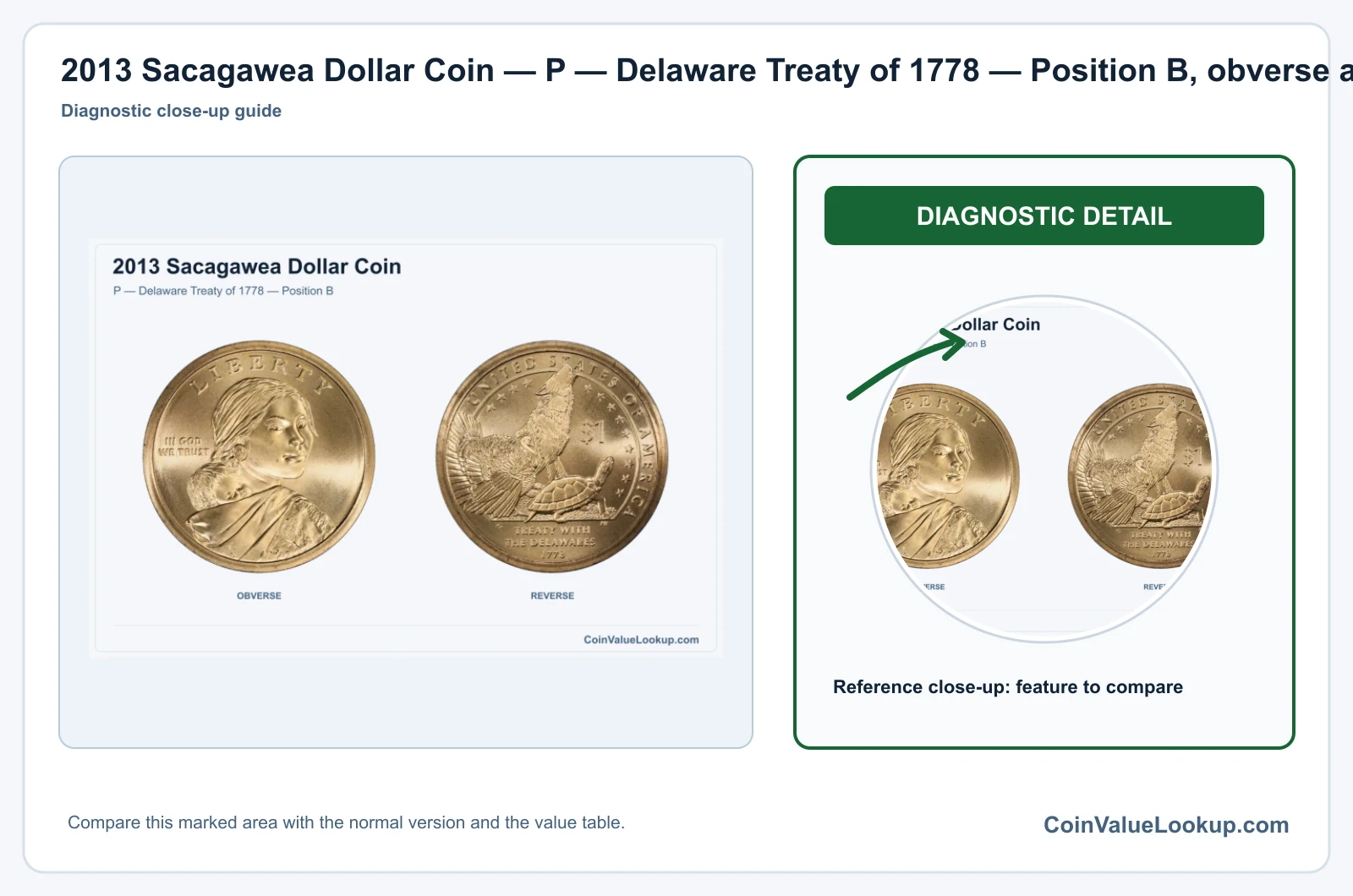
Same Philadelphia mint business strike, but with Position B edge lettering. Flip the coin so the obverse faces you — if the incuse edge text is upside down relative to the portrait, that is Position B.
The guide estimate is also around $6.25 at MS65. Neither position is considered scarcer than the other for this date, so condition drives the difference.
Range Grade
Price Auction Records Appraisal PO PO 1
—
Coin Identifier FR FR 2
—
Coin Identifier AG AG 3
—
Coin Identifier G G 4
—
Coin Identifier
G 6
—
Coin Identifier VG VG 8
—
Coin Identifier
VG 10
—
Coin Identifier F F 12
—
Coin Identifier
F 15
—
Coin Identifier VF VF 20
—
Coin Identifier
VF 25
—
Coin Identifier
VF 30
—
Coin Identifier
VF 35
—
Coin Identifier XF XF 40
—
Coin Identifier
XF 45
—
Coin Identifier AU AU 50
—
Coin Identifier
AU 53
—
Coin Identifier
AU 55
—
Coin Identifier
AU 58
—
Coin Identifier MS MS 60
—
Coin Identifier
MS 61
—
Coin Identifier
MS 62
—
Coin Identifier
MS 63
—
Coin Identifier
MS 64
—
Coin Identifier
MS 65
—
Coin Identifier
MS 66
Coin Identifier
MS 67
Coin Identifier
MS 68
—
Coin Identifier
MS 69
—
—
—
MS 70
—
—
—
2013 Sacagawea Dollar — D — Delaware Treaty of 1778 — Position A
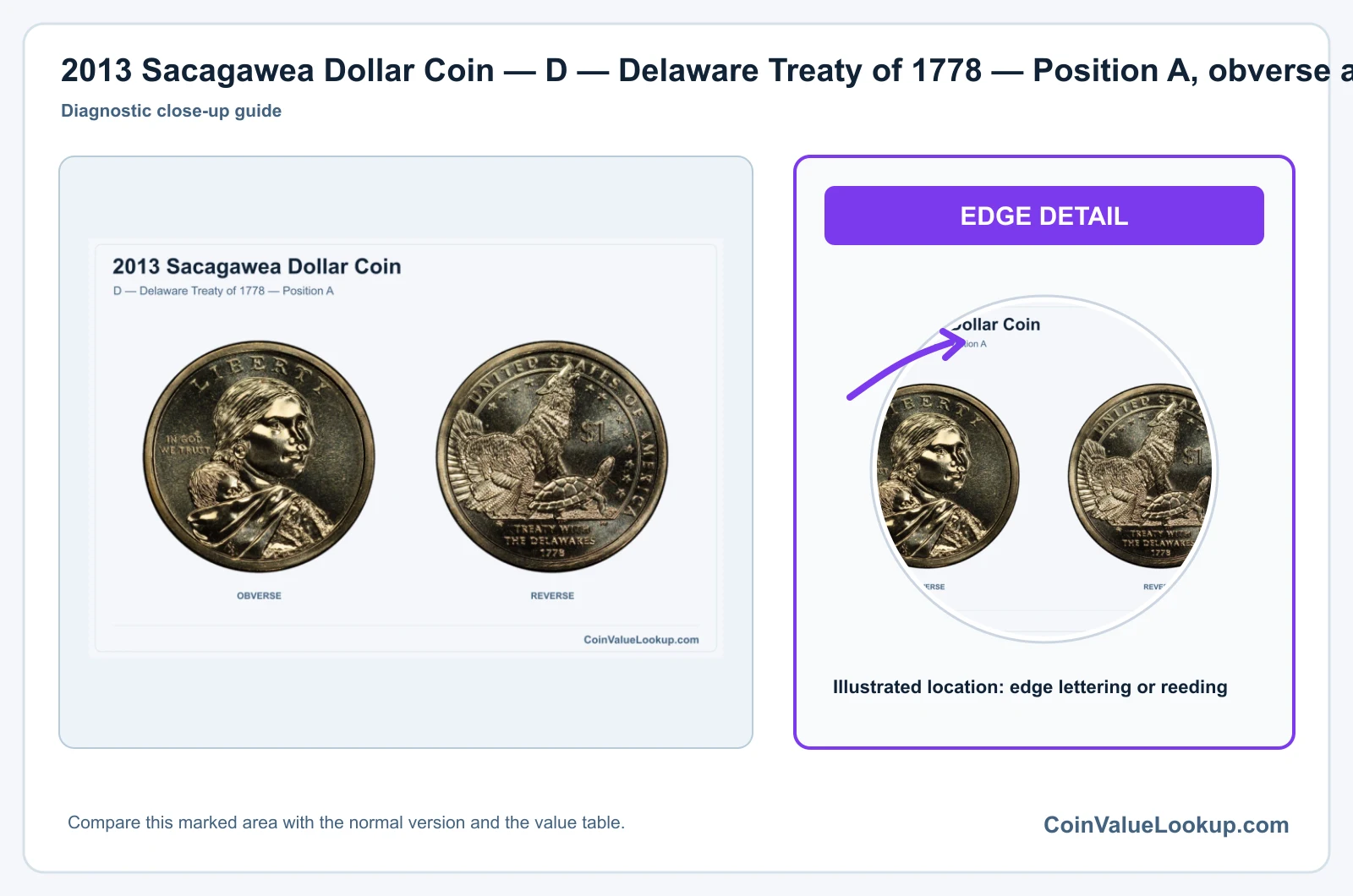
Denver mint business strike, Position A edge lettering. Identify the "D" mintmark on the rim and confirm the lettering reads normally when the obverse faces you.
Guide estimate sits at roughly $6.25 in MS65. Like its Philadelphia counterpart, most went straight into commerce, and a well-preserved example from an original roll is the typical collector source.
Range Grade
Price Auction Records Appraisal PO PO 1
—
Coin Identifier FR FR 2
—
Coin Identifier AG AG 3
—
Coin Identifier G G 4
—
Coin Identifier
G 6
—
Coin Identifier VG VG 8
—
Coin Identifier
VG 10
—
Coin Identifier F F 12
—
Coin Identifier
F 15
—
Coin Identifier VF VF 20
—
Coin Identifier
VF 25
—
Coin Identifier
VF 30
—
Coin Identifier
VF 35
—
Coin Identifier XF XF 40
—
Coin Identifier
XF 45
—
Coin Identifier AU AU 50
—
Coin Identifier
AU 53
—
Coin Identifier
AU 55
—
Coin Identifier
AU 58
—
Coin Identifier MS MS 60
—
Coin Identifier
MS 61
—
Coin Identifier
MS 62
—
Coin Identifier
MS 63
—
Coin Identifier
MS 64
—
Coin Identifier
MS 65
—
Coin Identifier
MS 66
—
Coin Identifier
MS 67
Coin Identifier
MS 68
—
Coin Identifier
MS 69
—
—
—
MS 70
—
—
—
2013 Sacagawea Dollar — D — Delaware Treaty of 1778 — Position B
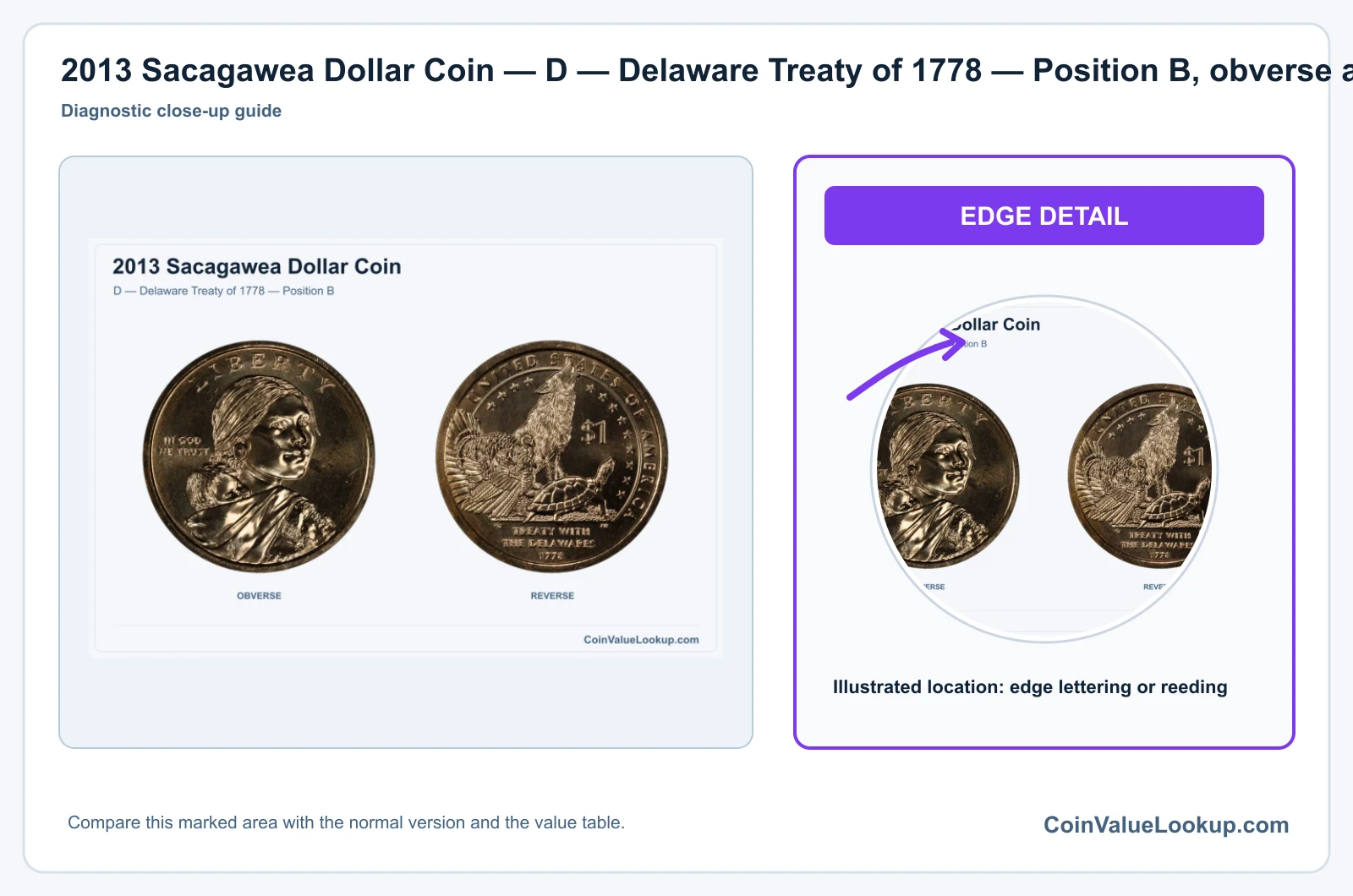
Denver mint business strike with Position B edge lettering. The "D" mintmark still appears on the rim, but the incuse text is inverted relative to the obverse.
Valued at about $6.25 in MS65 per guide estimates. Again, condition and surface quality matter more than the lettering orientation for this particular date.
Range Grade
Price Auction Records Appraisal PO PO 1
—
Coin Identifier FR FR 2
—
Coin Identifier AG AG 3
—
Coin Identifier G G 4
—
Coin Identifier
G 6
—
Coin Identifier VG VG 8
—
Coin Identifier
VG 10
—
Coin Identifier F F 12
—
Coin Identifier
F 15
—
Coin Identifier VF VF 20
—
Coin Identifier
VF 25
—
Coin Identifier
VF 30
—
Coin Identifier
VF 35
—
Coin Identifier XF XF 40
—
Coin Identifier
XF 45
—
Coin Identifier AU AU 50
—
Coin Identifier
AU 53
—
Coin Identifier
AU 55
—
Coin Identifier
AU 58
—
Coin Identifier MS MS 60
—
Coin Identifier
MS 61
—
Coin Identifier
MS 62
—
Coin Identifier
MS 63
—
Coin Identifier
MS 64
—
Coin Identifier
MS 65
—
Coin Identifier
MS 66
—
Coin Identifier
MS 67
Coin Identifier
MS 68
Coin Identifier
MS 69
—
—
—
MS 70
—
—
—
2013 Sacagawea Dollar — S — Delaware Treaty of 1778 — proof
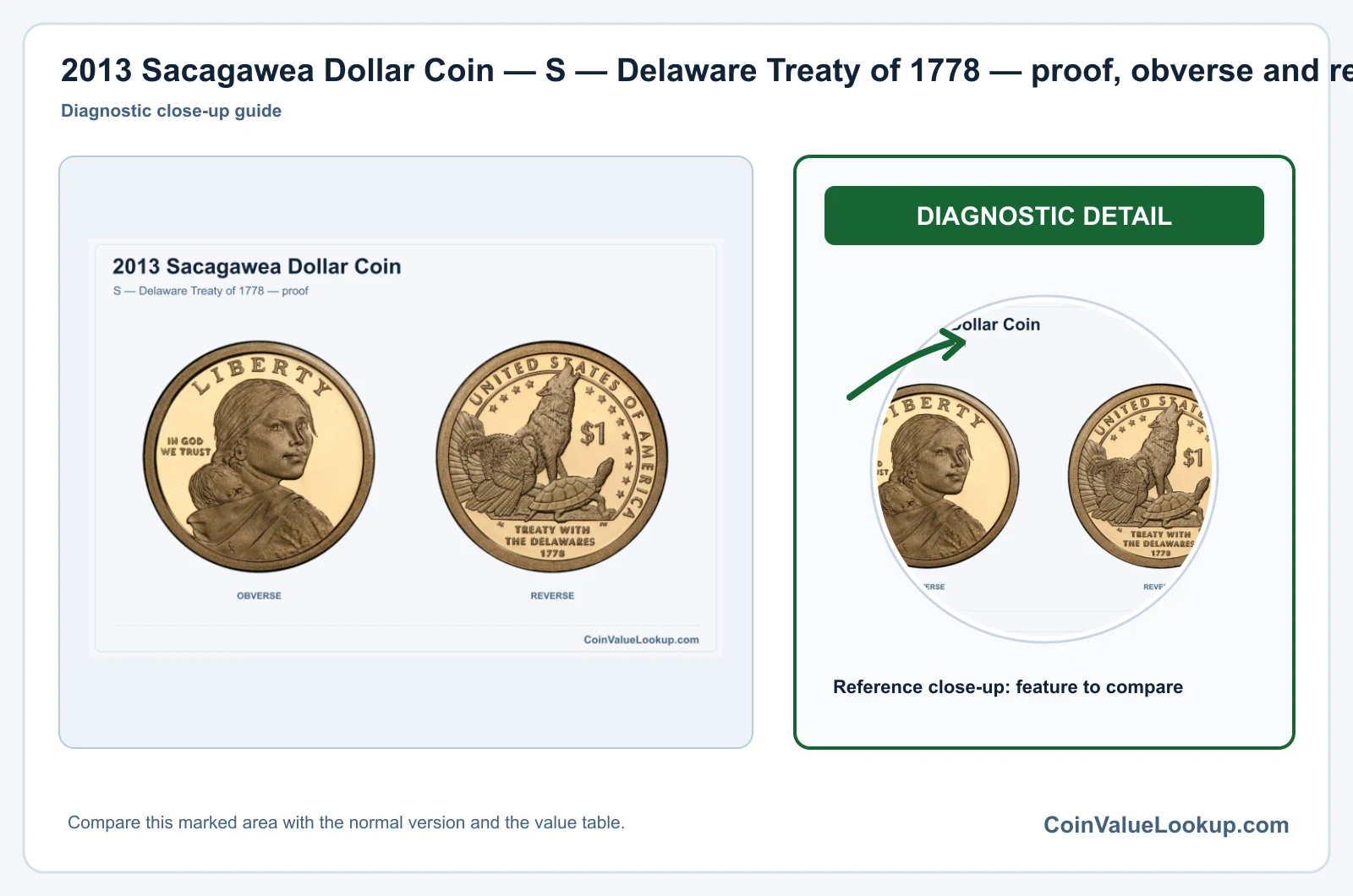
The San Francisco proof is the collector-oriented version, struck with polished dies and specially prepared planchets to produce mirrored fields and frosted raised devices. It was available only through United States Mint proof sets — you would not find one in pocket change.
A guide estimate places it at about $10.00 in PR65. One important note: even if your proof came in a set labeled "Silver Proof Set," this dollar is still manganese-brass clad, not silver.
The silver designation applies to the dimes, quarters, and half dollars in that set, not the Sacagawea dollar.
Range Grade
Price Auction Records Appraisal PR PR 1
—
Coin Identifier
PR 2
—
Coin Identifier
PR 3
—
Coin Identifier
PR 4
—
Coin Identifier
PR 6
—
Coin Identifier
PR 8
—
Coin Identifier
PR 10
—
Coin Identifier
PR 12
—
Coin Identifier
PR 15
—
Coin Identifier
PR 20
—
Coin Identifier
PR 25
—
Coin Identifier
PR 30
—
Coin Identifier
PR 35
—
Coin Identifier
PR 40
—
Coin Identifier
PR 45
—
Coin Identifier
PR 50
—
Coin Identifier
PR 53
—
Coin Identifier
PR 55
—
Coin Identifier
PR 58
—
Coin Identifier
PR 60
—
Coin Identifier
PR 61
—
Coin Identifier
PR 62
—
Coin Identifier
PR 63
—
Coin Identifier
PR 64
—
Coin Identifier
PR 65
—
Coin Identifier
PR 66
—
Coin Identifier
PR 67
—
Coin Identifier
PR 68
—
Coin Identifier
PR 69
Coin Identifier
PR 70
Coin Identifier
2013 Sacagawea Dollar Error List
1. 2013 Sacagawea Dollar — Weak / Partial Edge Lettering
This error has been reported specifically on the 2013-P Native American dollar in Position A. The incuse edge lettering — date, mintmark, and motto — appears unusually faint, partially missing, or interrupted along portions of the rim.
To check, roll the coin slowly under good light and examine the full circumference for sections where the letters fade out or are noticeably shallower than normal.
Be careful with lookalikes. Normal wear, deliberate sanding, or cleaning can make edge lettering appear weak without any mint-caused error being present.
Genuine weak edge lettering results from the minting process and should show consistent characteristics rather than random abrasion marks. The value of this error depends on the severity, visibility, and the coin's overall condition.
No specific price range is established here, so individual assessment is needed.
2. 2013 Sacagawea Dollar — Doubled Edge Lettering
This error has been reported on the 2013-P Native American dollar in Position B. It involves two overlapping sets of incuse edge inscriptions visible around the circumference, where the letters appear doubled or offset from each other.
The coin essentially received its edge lettering twice, and the two impressions do not align perfectly.
To identify it, examine the edge closely — you should see overlapping or slightly shifted text rather than a single clean impression. Do not confuse this with the normal difference between Position A and Position B, which is simply an orientation change.
Also, reflections or photographic angles can mimic doubling in pictures, so inspect the actual coin in hand. Value depends on how prominent the overlap is and the coin's condition, but no specific price range is adopted for this variety.