1803 Draped Bust Dollar Coin Value: How Much Is It Worth?
The 1803 Draped Bust Dollar is one of the earliest silver dollars struck by the United States Mint in Philadelphia. Guide estimates for this year range from approximately $1,334.00 in well-worn grades up to $1,217,527.00 for top-condition or proof examples, depending on the specific version and grade.
Those are guide figures, not guaranteed offers. Before you start dreaming about six figures, you need to identify which branch you actually have — Small 3, Large 3, or the rare Proof — and honestly assess its condition.
Fast Way to Identify Your 1803 Draped Bust Dollar
Upload clear photos of both the front and back of your 1803 Draped Bust Dollar for a preliminary identification. Good lighting and a straight-on angle help distinguish design details like the size of the "3" in the date.
This step won't authenticate or certify your coin, but it can point you toward the right version and narrow your research.
1803 Draped Bust Dollar Value
Upload both sides of your 1803 Draped Bust Dollar.
Front Obverse
Upload photo
Back Reverse
Upload photo
Which 1803 Draped Bust Dollar Versions Are Worth Money?
- 1803 Small 3: The most commonly encountered business-strike version; guide estimates run from $1,334.00 at G4 up to $937,465.00 at MS65.
- 1803 Large 3: Distinguished by a larger numeral "3" in the date; a guide estimate of $1,217,527.00 is listed at MS65.
- 1803 Proof: A rare proof-finish striking with mirror fields; guide estimate of $1,217,527.00 at PR65. Date on coin does not confirm the actual year of striking.
- Check for original, uncleaned surfaces on any version — cleaning or polishing sharply reduces value and collector interest.
Step 1: Identify Your 1803 Draped Bust Dollar Mint Mark and Version
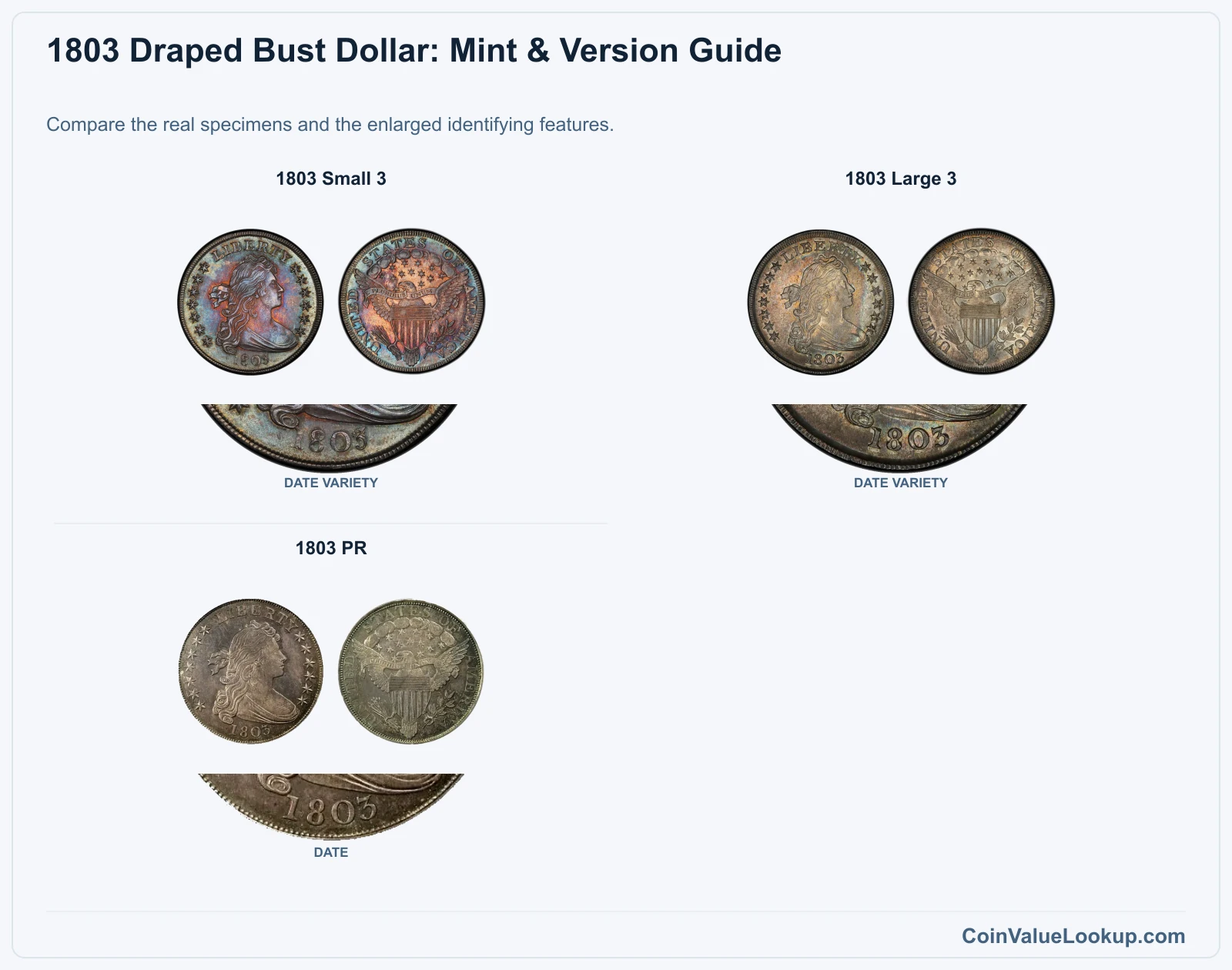
Every 1803 Draped Bust Dollar was struck at the Philadelphia Mint, so there is no mintmark to hunt for. The coin is a silver-copper alloy at a nominal weight of 26.96 grams, with a Draped Bust Liberty on the obverse and a Heraldic Eagle on the reverse, plus a lettered edge.
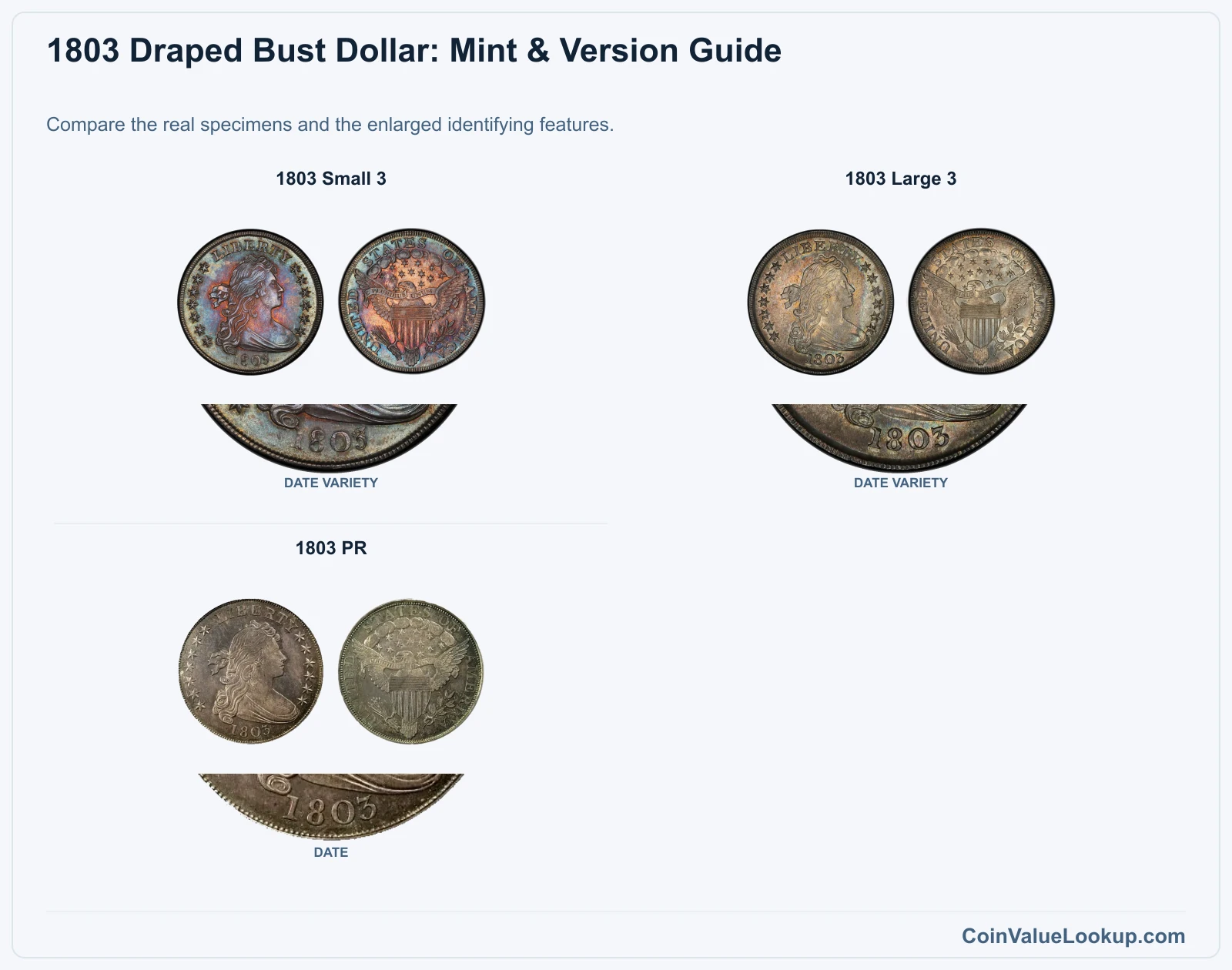
The critical identification step is the size of the numeral "3" in the date. A Small 3 is noticeably more compact and sits differently relative to the bust than the Large 3 variant.
Compare yours side by side with known examples — the difference is real but subtle if you have never looked for it.
The third branch is the Proof, which is a special manufacturing finish involving polished dies and planchets. A proof is not just a shiny coin; it has mirror-like fields and sharp detail produced intentionally.
The date on a proof does not necessarily mean it was struck in 1803 — original versus restrike attribution and pedigree history matter for this rare branch. If you think you have one, professional authentication is essential.
Step 2: Check Your 1803 Draped Bust Dollar Grade
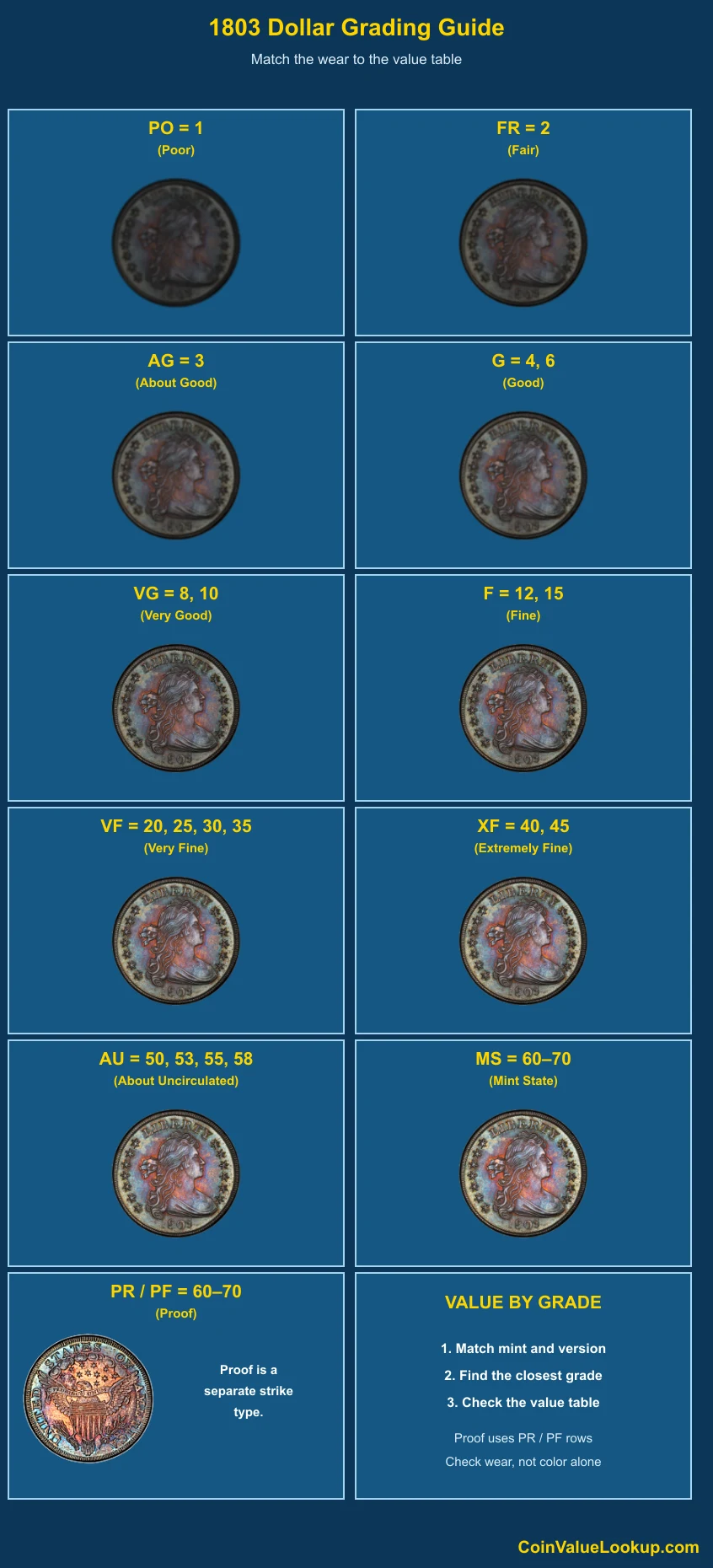
Focus on the hair detail above Liberty's forehead and around her ear. On a well-circulated coin, those curls flatten into smooth, undefined areas first.
The drapery across Liberty's chest loses its fine lines next. Flip the coin over and check the eagle's breast feathers — strike weakness can mimic wear here, so look at the surrounding devices for context.
A coin grading around Good (G4) will show a clear outline of Liberty with very little interior detail. At About Uncirculated, you will see just a trace of friction on the highest points with most luster intact.
A Mint State piece retains full luster and no wear, though bag marks and contact marks still affect the grade.
Use the comparison image to see these wear stages on the same coin type. Proof coins are graded on a separate scale that evaluates hairlines, haze and surface quality rather than circulation wear.
Cleaned or polished coins — even well-preserved ones — grade lower or receive a details designation, which significantly reduces their market comparability.
Step 3: Check 1803 Draped Bust Dollar Value by Mint and Version
1803 Draped Bust Dollar — Small 3
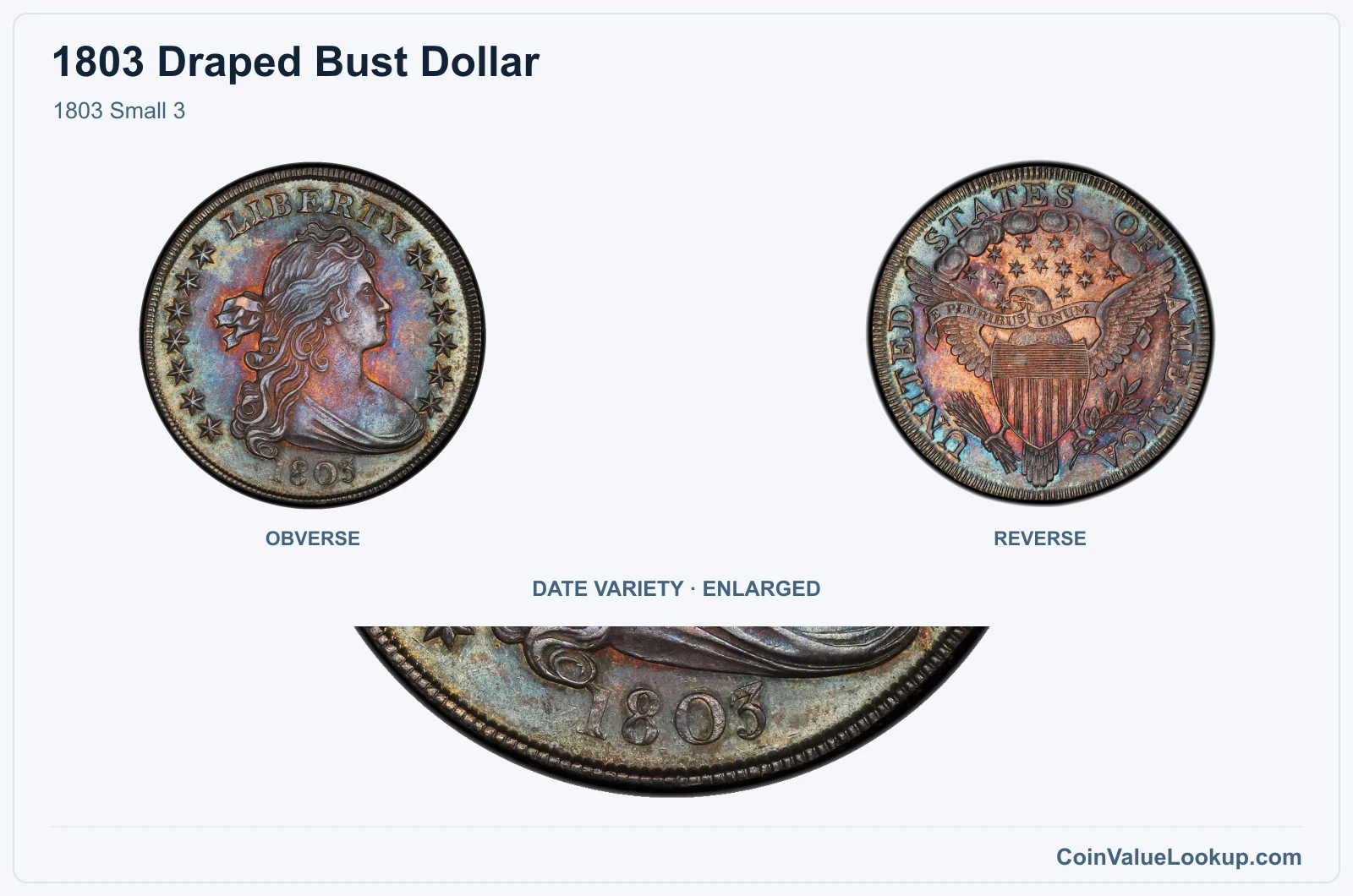
The 1803 Small 3 is the business-strike version with a noticeably compact "3" in the date. It was struck at Philadelphia in a silver-copper alloy at the early federal dollar standard of about 26.96 grams.
The obverse shows the Draped Bust Liberty and the reverse features the Heraldic Eagle.
USA Coin Book guide estimates place this version at roughly $1,334.00 in G4 and up to $937,465.00 in MS65. Those are guide figures, not sale guarantees — actual value depends on your coin's exact grade, surface quality and eye appeal.
Cleaned or polished examples lose much of their comparability to these benchmarks. Before pricing, confirm the small size of the "3" relative to the other date numerals.
Range Grade
Price Auction Records Appraisal PO PO 1
—
Coin Identifier FR FR 2
—
Coin Identifier AG AG 3
Coin Identifier G G 4
Coin Identifier
G 6
Coin Identifier VG VG 8
Coin Identifier
VG 10
Coin Identifier F F 12
Coin Identifier
F 15
Coin Identifier VF VF 20
Coin Identifier
VF 25
Coin Identifier
VF 30
Coin Identifier
VF 35
Coin Identifier XF XF 40
Coin Identifier
XF 45
Coin Identifier AU AU 50
Coin Identifier
AU 53
Coin Identifier
AU 55
Coin Identifier
AU 58
Coin Identifier MS MS 60
—
Coin Identifier
MS 61
Coin Identifier
MS 62
—
Coin Identifier
MS 63
Coin Identifier
MS 64
Coin Identifier
MS 65
—
—
—
MS 66
—
—
—
MS 67
—
—
—
MS 68
—
—
—
MS 69
—
—
—
MS 70
—
—
—
1803 Draped Bust Dollar — Large 3
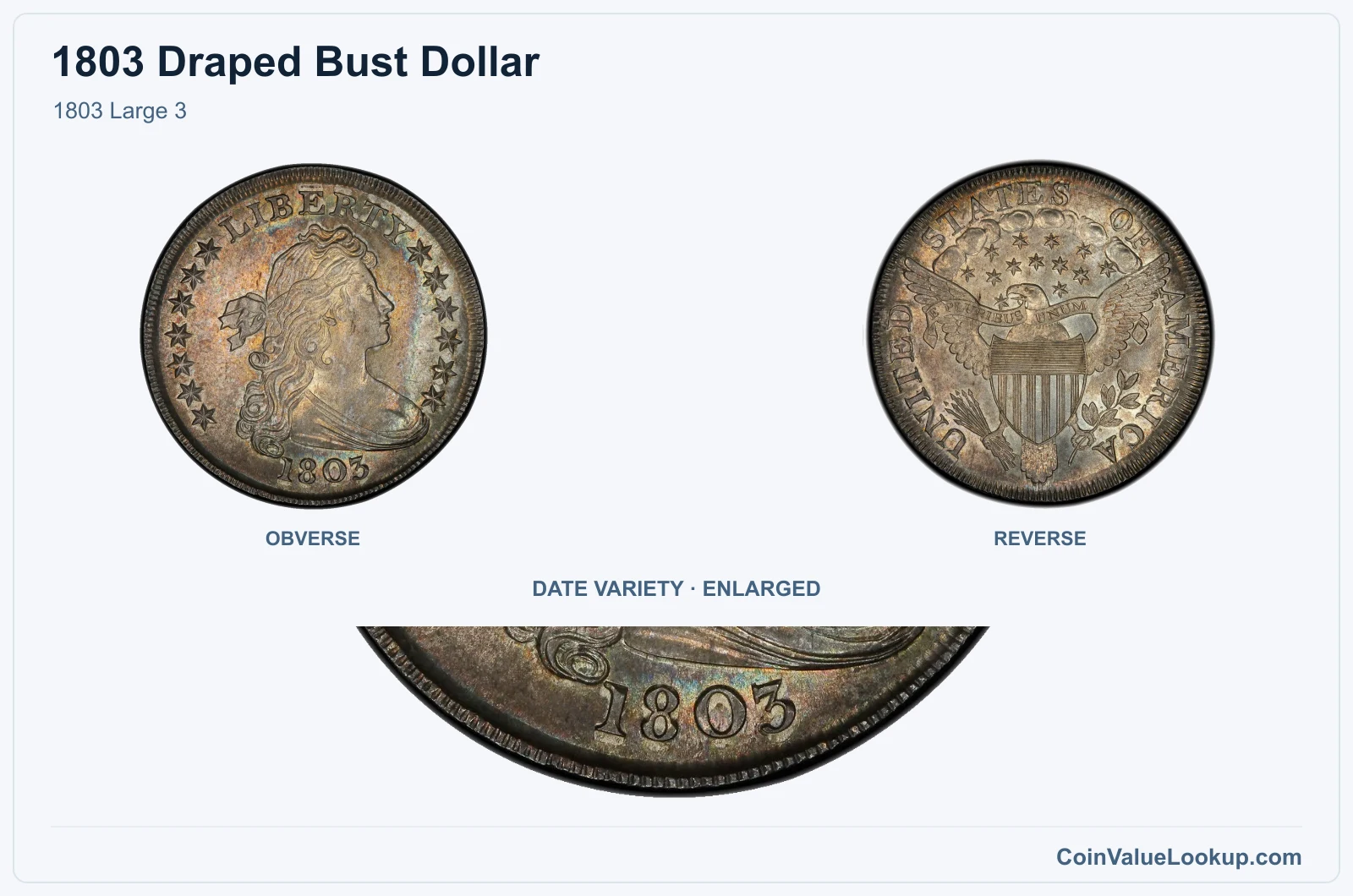
The 1803 Large 3 business strike is identified by a visibly bigger "3" in the date compared to the Small 3 version. Same mint, same alloy, same design — the difference is strictly in that one numeral.
You need a side-by-side comparison or a good reference image to be sure which you have, because the distinction is easy to miss.
A guide estimate of $1,217,527.00 at MS65 is listed for this version by USA Coin Book. No lower-grade guide price was adopted here, so if your coin is circulated, individual assessment by a professional service or dealer is the practical route.
Original surfaces matter enormously on any early dollar — even light cleaning can move a coin from one pricing tier to a very different one.
Coin Value Lookup is a good starting point if you want to look up guides for other early U.S. dollar dates and denominations. It can help you compare across years and series as you research.
Range Grade
Price Auction Records Appraisal PO PO 1
Coin Identifier FR FR 2
—
Coin Identifier AG AG 3
Coin Identifier G G 4
Coin Identifier
G 6
Coin Identifier VG VG 8
Coin Identifier
VG 10
Coin Identifier F F 12
Coin Identifier
F 15
Coin Identifier VF VF 20
Coin Identifier
VF 25
Coin Identifier
VF 30
Coin Identifier
VF 35
Coin Identifier XF XF 40
Coin Identifier
XF 45
Coin Identifier AU AU 50
Coin Identifier
AU 53
Coin Identifier
AU 55
Coin Identifier
AU 58
Coin Identifier MS MS 60
—
Coin Identifier
MS 61
Coin Identifier
MS 62
Coin Identifier
MS 63
Coin Identifier
MS 64
—
Coin Identifier
MS 65
—
Coin Identifier
MS 66
—
—
—
MS 67
—
—
—
MS 68
—
—
—
MS 69
—
—
—
MS 70
—
—
—
1803 Draped Bust Dollar — PR
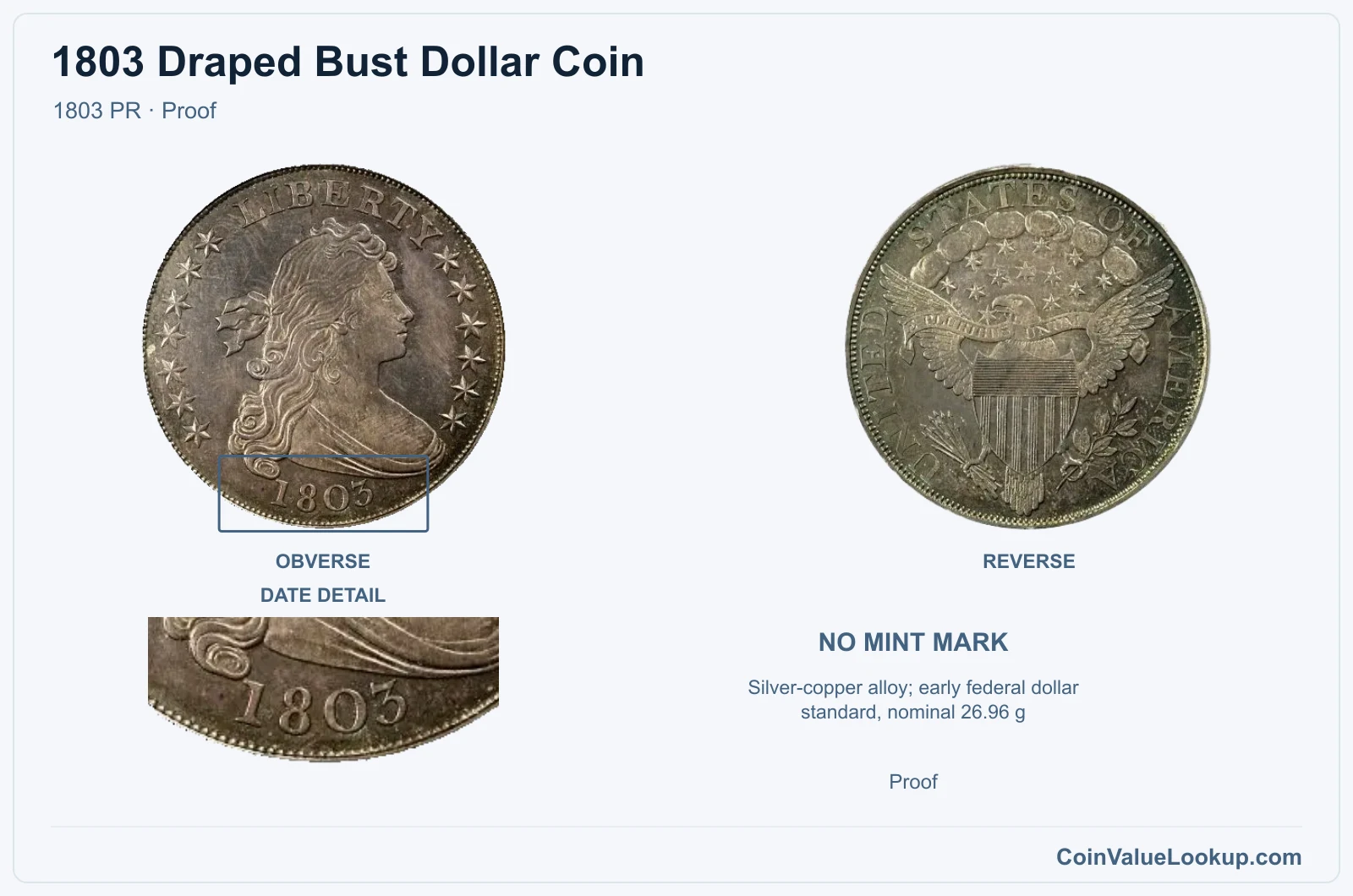
The 1803 Proof is a completely different animal from the business strikes. Proof here means the coin was manufactured with specially prepared dies and polished planchets, producing mirror-like fields and exceptionally sharp detail.
This is not simply a well-preserved regular coin — it is a deliberate, limited production method.
An important detail: the date on the coin does not necessarily mean it was actually struck in 1803. Some proof-dated early dollars are restrikes produced later using original or re-engraved dies.
Pedigree and attribution history are essential for this branch, and professional authentication is non-negotiable.
The USA Coin Book guide estimate lists $1,217,527.00 at PR65 for this version. That reflects extreme rarity and collector demand for confirmed, well-pedigreed examples.
If you believe you have a proof 1803 dollar, do not clean it, do not handle it without gloves, and get it to a recognized third-party grading service.
Range Grade
Price Auction Records Appraisal PR PR 1
—
Coin Identifier
PR 2
—
Coin Identifier
PR 3
—
Coin Identifier
PR 4
—
Coin Identifier
PR 6
—
Coin Identifier
PR 8
—
Coin Identifier
PR 10
—
Coin Identifier
PR 12
—
Coin Identifier
PR 15
—
Coin Identifier
PR 20
—
Coin Identifier
PR 25
—
Coin Identifier
PR 30
—
Coin Identifier
PR 35
—
Coin Identifier
PR 40
—
Coin Identifier
PR 45
—
Coin Identifier
PR 50
—
Coin Identifier
PR 53
—
Coin Identifier
PR 55
—
Coin Identifier
PR 58
—
Coin Identifier
PR 60
—
Coin Identifier
PR 61
—
Coin Identifier
PR 62
—
Coin Identifier
PR 63
—
Coin Identifier
PR 64
—
Coin Identifier
PR 65
Coin Identifier
PR 66
Coin Identifier
PR 67
—
—
—
PR 68
—
—
—
PR 69
—
—
—
PR 70
—
—
—
1803 Draped Bust Dollar Error List
1. 1803 Draped Bust Dollar — Rotated Dies
A rotated die error on an 1803 Draped Bust Dollar means the obverse and reverse designs are misaligned from the normal orientation. To check, hold the obverse upright and rotate the coin top-to-bottom like turning a page.
On a normally struck U.S. coin, the reverse eagle should appear upright. If it is tilted at an angle, you may have a die rotation.
The degree of rotation matters. A slight tilt of a few degrees is less notable than a dramatic shift of 30 degrees or more.
No specific price was adopted for this error on the 1803 dollar — value depends on the severity of the rotation, the coin's overall condition, and collector demand for the specific variety.
Be careful not to confuse a rotated die with a photograph taken at an angle or a coin simply turned sideways in a holder. The misalignment must be consistent and inherent to the strike itself.
Professional verification is recommended before paying any premium.
2. 1803 Draped Bust Dollar — Off-Center Strike
An off-center strike occurs when the planchet is not properly seated between the dies at the moment of striking. The result is a displaced design with an unstruck crescent of blank metal along one edge.
On an 1803 Draped Bust Dollar, this would be a dramatic and rare occurrence.
The value of an off-center error depends on how far off-center the strike landed, whether the full date remains visible, and the coin's overall preservation. No numerical price was adopted for this error on the 1803 dollar, so individual assessment is necessary.
Do not confuse an off-center strike with a clipped planchet, which shows a curved bite out of the edge rather than a displaced design. Post-mint damage like flattening from a vice or hammer can also mimic misalignment.
A genuine off-center strike will show the design cleanly shifted in one direction with undisturbed metal in the blank crescent area. Authentication by a third-party grading service is strongly recommended for any early dollar claiming this error.