1796 Draped Bust Half Dollar Coin Value: How Much Is It Worth?
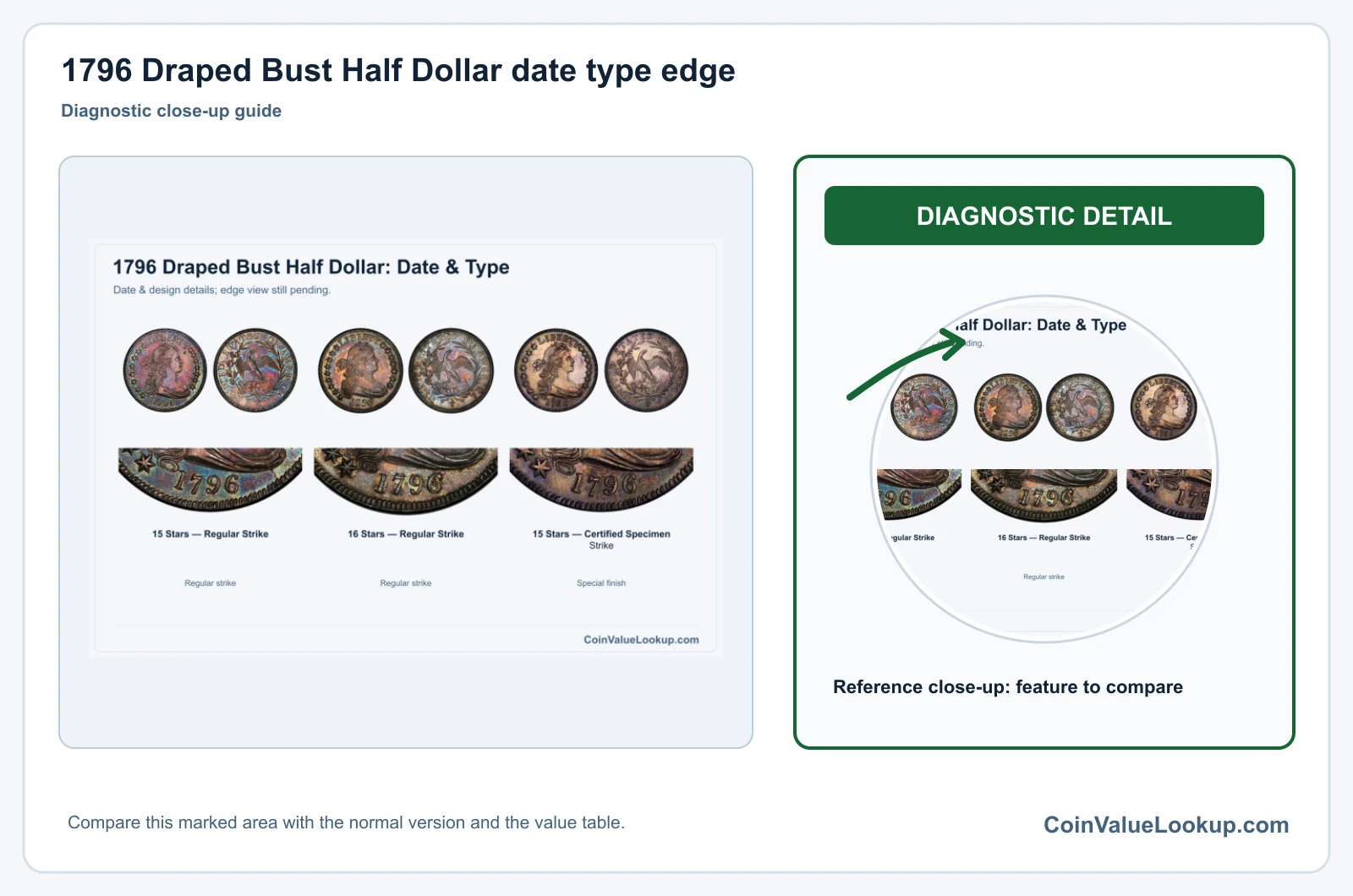
A 1796 Draped Bust Half Dollar is one of the earliest half dollars struck by the United States Mint. Guide estimates for ordinary circulated examples range from approximately $42,843 at G4 to $201,339 at AU50, depending on variety and condition.
Collector value far exceeds both face value and silver content, and special varieties or higher grades may differ substantially.
Fast Way to Identify Your 1796 Draped Bust Half Dollar
The quickest way to start figuring out what you have is to upload clear photos of the front and back of your coin. Our identifier can give you a preliminary read on the variety and general condition.
That first step helps you decide whether to pursue professional authentication, which matters a lot on a coin this old and valuable.
1796 Draped Bust Half Dollar Value
Upload both sides of your 1796 Draped Bust Half Dollar.
Front Obverse
Upload photo
Back Reverse
Upload photo
Which 1796 Draped Bust Half Dollar Versions Are Worth Money?
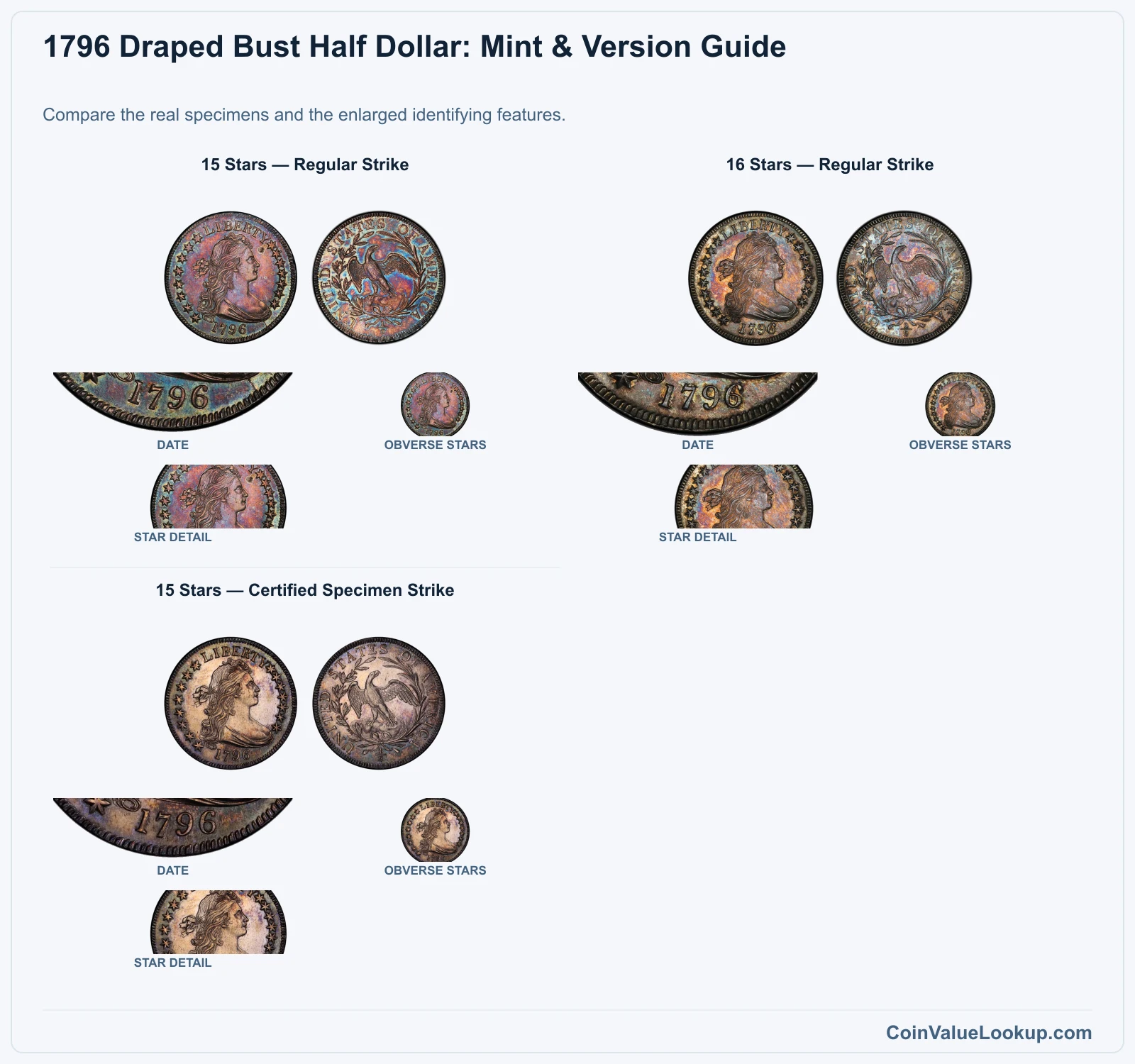
- 15 Stars Regular Strike — the more common variety, with guide values from about $42,843 at G4 to $201,339 at AU50; count all fifteen obverse stars to confirm.
- 16 Stars Regular Strike — carries a slight premium over the 15-star version, with guides near $45,378 at G4 to $211,410 at AU50; count nine stars left and seven right.
- 15 Stars Certified Specimen Strike — an attribution-dependent rarity requiring specialist provenance; no standard price range applies, and individual assessment is essential.
- Die Break / Cud on the 16-star variety — a retained cud reported at stars 1 through 4 adds collector interest; value depends on visibility and overall condition.
Step 1: Identify Your 1796 Draped Bust Half Dollar Mint Mark and Version
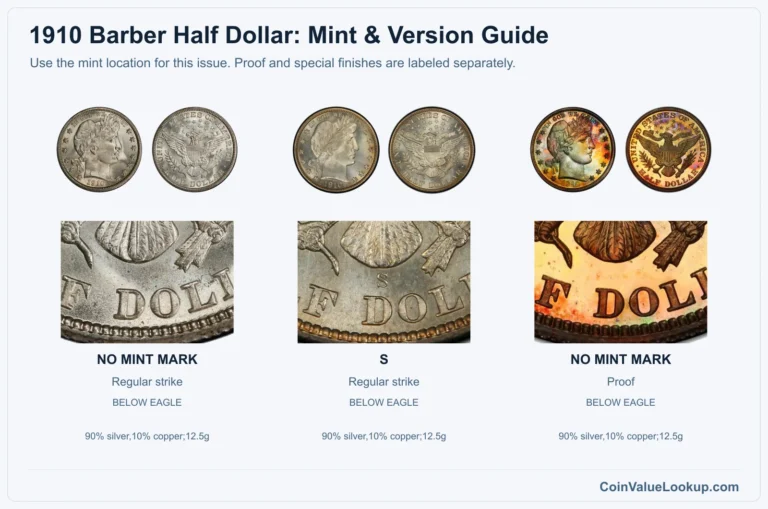
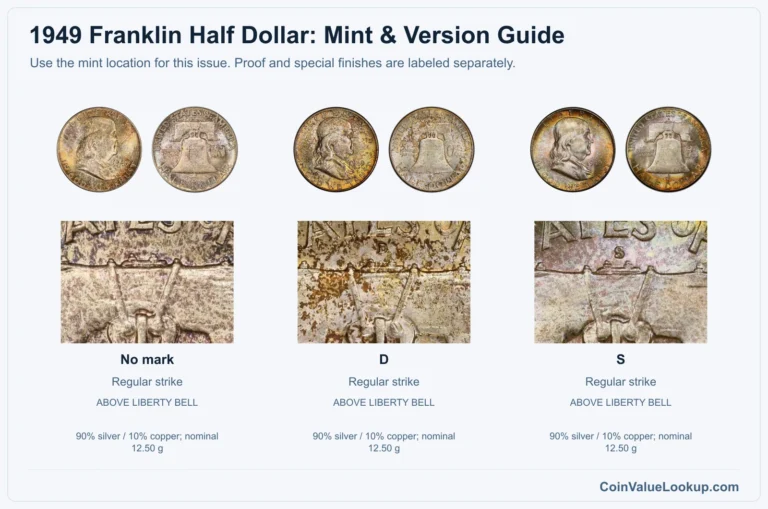
Every 1796 Half Dollar was struck at Philadelphia. There is no mintmark, and that is completely normal — do not look for one.
Confirm the denomination by checking the lettered edge, which reads FIFTY CENTS OR HALF A DOLLAR. The design is the Draped Bust obverse paired with the Small Eagle reverse, with a nominal diameter of about 32.5 mm and weight near 13.48 grams.
Weight can help screen out obvious fakes, but it is not a substitute for authentication.
The critical identification step is counting the stars on the obverse. The 15 Stars variety has fifteen stars arranged around Liberty's portrait.
The 16 Stars variety has nine stars to the left and seven to the right — sixteen total. Count carefully, because wear can make a star hard to see, and you do not want to confuse a worn star with a missing one.
A third identity exists: the 15 Stars Certified Specimen Strike. This is not something you can self-diagnose.
It requires specialist attribution based on provenance and surface characteristics, not just a bright or mirrorlike appearance.
Step 2: Check Your 1796 Draped Bust Half Dollar Grade
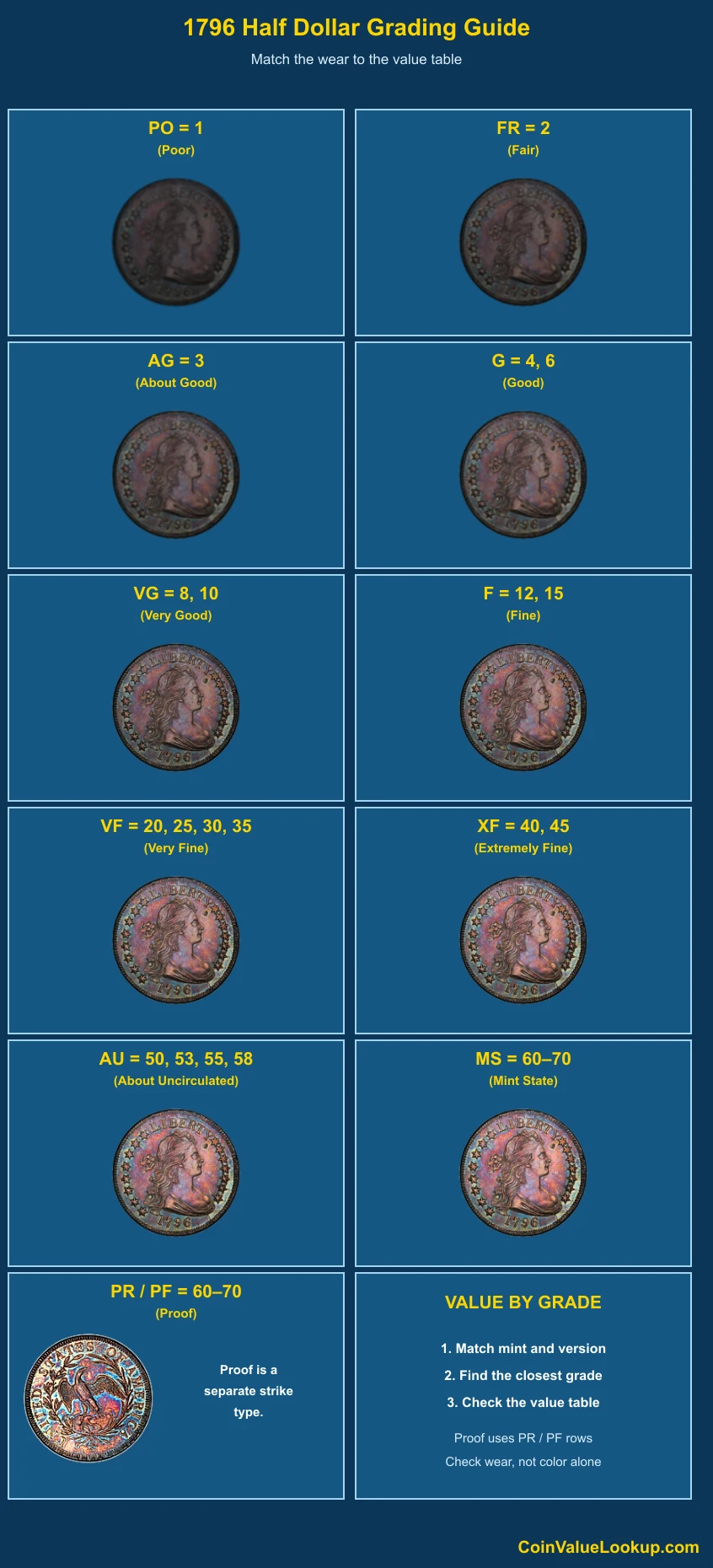
Start by examining Liberty's hair above the forehead. On a well-circulated piece, those strands merge into a flat area quickly.
A coin with visible individual curls above the brow and across the cheek still retains significant detail.
Check the drapery over Liberty's shoulder next. Sharp folds indicate less wear; a smooth, featureless shoulder area means heavy circulation.
Use the comparison image of the same Draped Bust / Small Eagle type — comparing to a modern Kennedy half dollar will mislead you completely.
On the reverse, look at the eagle's breast feathers and wing detail. Some weakness here is normal from the original strike, so do not automatically downgrade a coin just because the eagle looks soft.
The key is distinguishing flatness from wear versus flatness from an incomplete strike — worn areas lose their luster, while strike weakness still shows original surface texture.
Cleaning, holes, plugs, tooling, and heavy scratches push a coin into "Details" territory. A Details-graded coin does not follow the same price curve as a straight-graded example, so note these issues separately when evaluating your piece.
Step 3: Check 1796 Draped Bust Half Dollar Value by Mint and Version
1796 Draped Bust Half Dollar — 15 Stars — Regular Strike
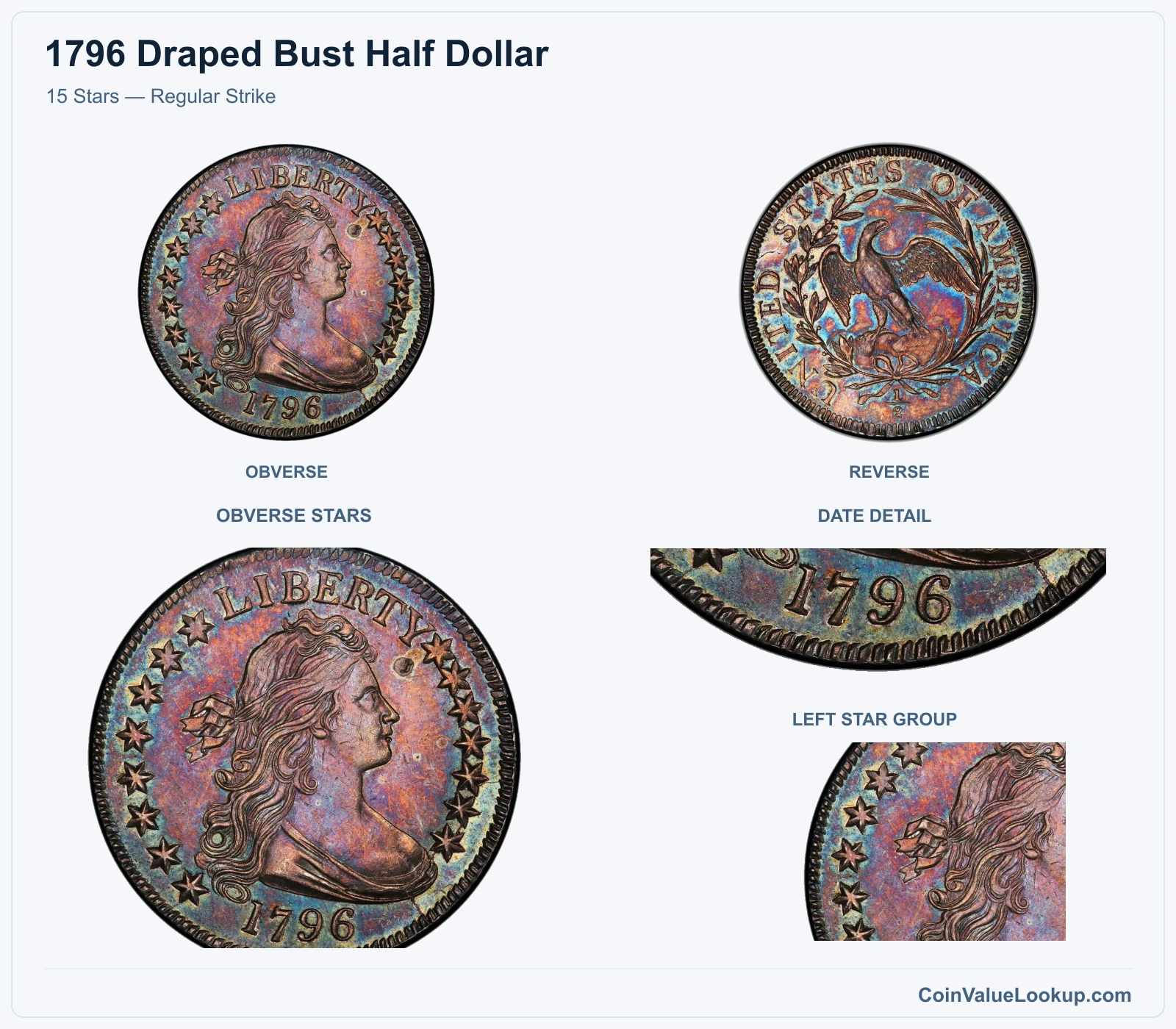
The 15 Stars Regular Strike is the variety most collectors encounter first. Count all fifteen stars carefully around Liberty's portrait — if one is worn nearly flat, you might miscount and confuse it with a different variety entirely.
All examples were struck at Philadelphia in a silver-copper alloy of approximately 89% silver, using the Draped Bust obverse and Small Eagle reverse. Guide estimates from USA Coin Book place this version at roughly $42,843 in G4, $74,990 in VF20, and $201,339 in AU50.
These are retail guide figures, not guaranteed sale prices, and actual results depend on the individual coin's surfaces, eye appeal, and authentication status.
Range Grade
Price Auction Records Appraisal PO PO 1
—
Coin Identifier FR FR 2
—
Coin Identifier AG AG 3
—
Coin Identifier G G 4
—
Coin Identifier
G 6
—
Coin Identifier VG VG 8
—
Coin Identifier
VG 10
—
Coin Identifier F F 12
Coin Identifier
F 15
Coin Identifier VF VF 20
—
Coin Identifier
VF 25
Coin Identifier
VF 30
Coin Identifier
VF 35
Coin Identifier XF XF 40
Coin Identifier
XF 45
Coin Identifier AU AU 50
—
Coin Identifier
AU 53
Coin Identifier
AU 55
Coin Identifier
AU 58
Coin Identifier MS MS 60
—
Coin Identifier
MS 61
—
Coin Identifier
MS 62
Coin Identifier
MS 63
Coin Identifier
MS 64
Coin Identifier
MS 65
—
—
—
MS 66
—
—
—
MS 67
—
—
—
MS 68
—
—
—
MS 69
—
—
—
MS 70
—
—
—
1796 Draped Bust Half Dollar — 16 Stars — Regular Strike
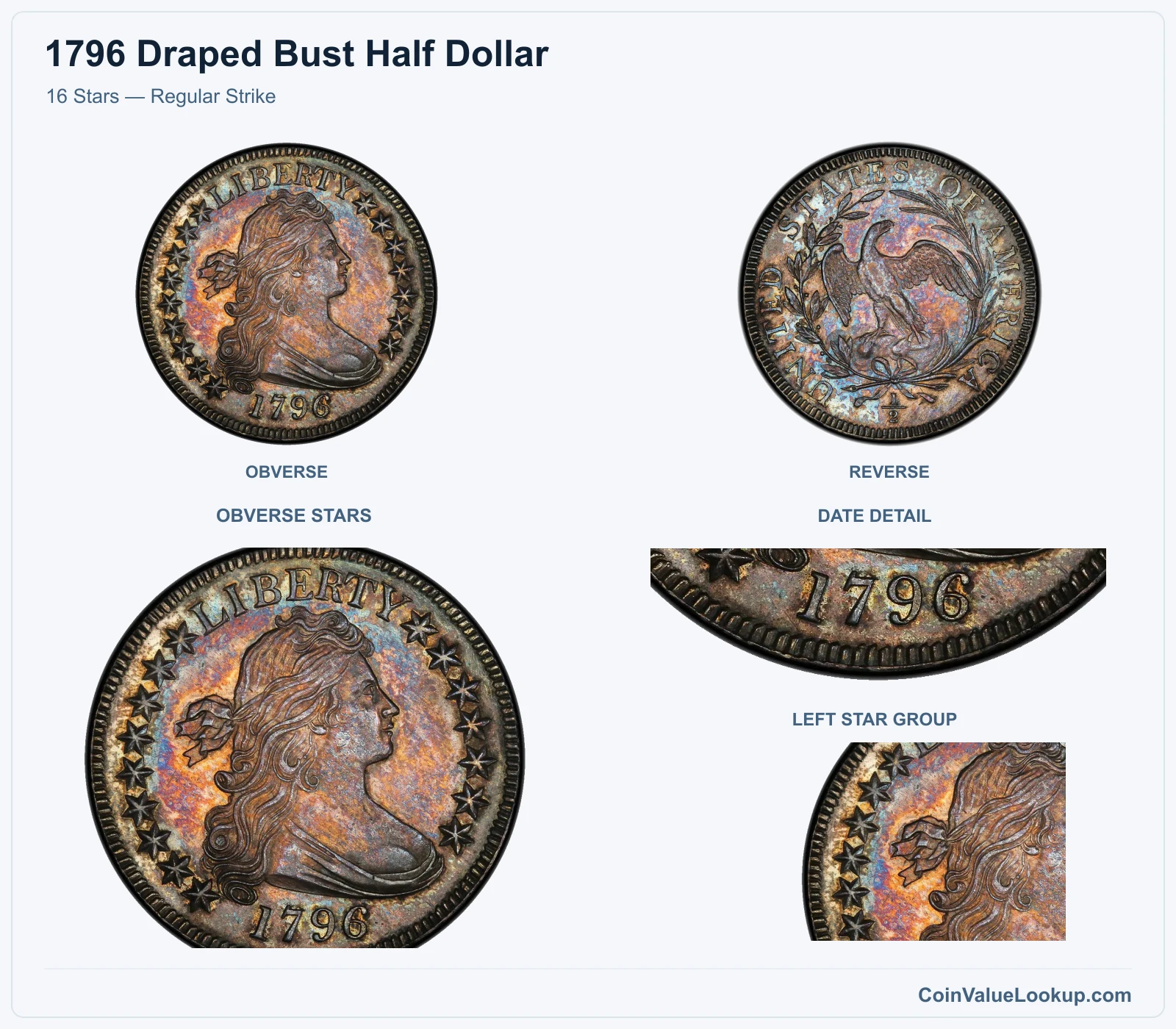
The 16 Stars Regular Strike is the variety with an extra star on the obverse. Count nine stars to the left of Liberty and seven to the right — that is your confirmation.
The additional star is believed to correspond to Tennessee's admission to the Union, making this a distinct major variety rather than an error.
Struck at Philadelphia in the same approximately 89% silver alloy, this version carries slightly higher guide estimates: about $45,378 at G4, $77,974 at VF20, and $211,410 at AU50 per USA Coin Book. The premium over the 15-star version is modest but consistent across grades.
As with all early half dollars, straight-graded, problem-free examples command stronger prices than coins with surface issues.
Coin Value Lookup is a useful starting point if you want to compare this half dollar against other early U.S. denominations. You can look up guides across different series without hunting through dozens of separate references.
Range Grade
Price Auction Records Appraisal PO PO 1
—
Coin Identifier FR FR 2
—
Coin Identifier AG AG 3
—
Coin Identifier G G 4
—
Coin Identifier
G 6
—
Coin Identifier VG VG 8
Coin Identifier
VG 10
Coin Identifier F F 12
Coin Identifier
F 15
Coin Identifier VF VF 20
—
Coin Identifier
VF 25
Coin Identifier
VF 30
Coin Identifier
VF 35
Coin Identifier XF XF 40
—
Coin Identifier
XF 45
Coin Identifier AU AU 50
—
Coin Identifier
AU 53
—
Coin Identifier
AU 55
Coin Identifier
AU 58
—
Coin Identifier MS MS 60
—
Coin Identifier
MS 61
—
Coin Identifier
MS 62
—
Coin Identifier
MS 63
Coin Identifier
MS 64
Coin Identifier
MS 65
—
Coin Identifier
MS 66
Coin Identifier
MS 67
—
—
—
MS 68
—
—
—
MS 69
—
—
—
MS 70
—
—
—
1796 Draped Bust Half Dollar — 15 Stars — Certified Specimen Strike
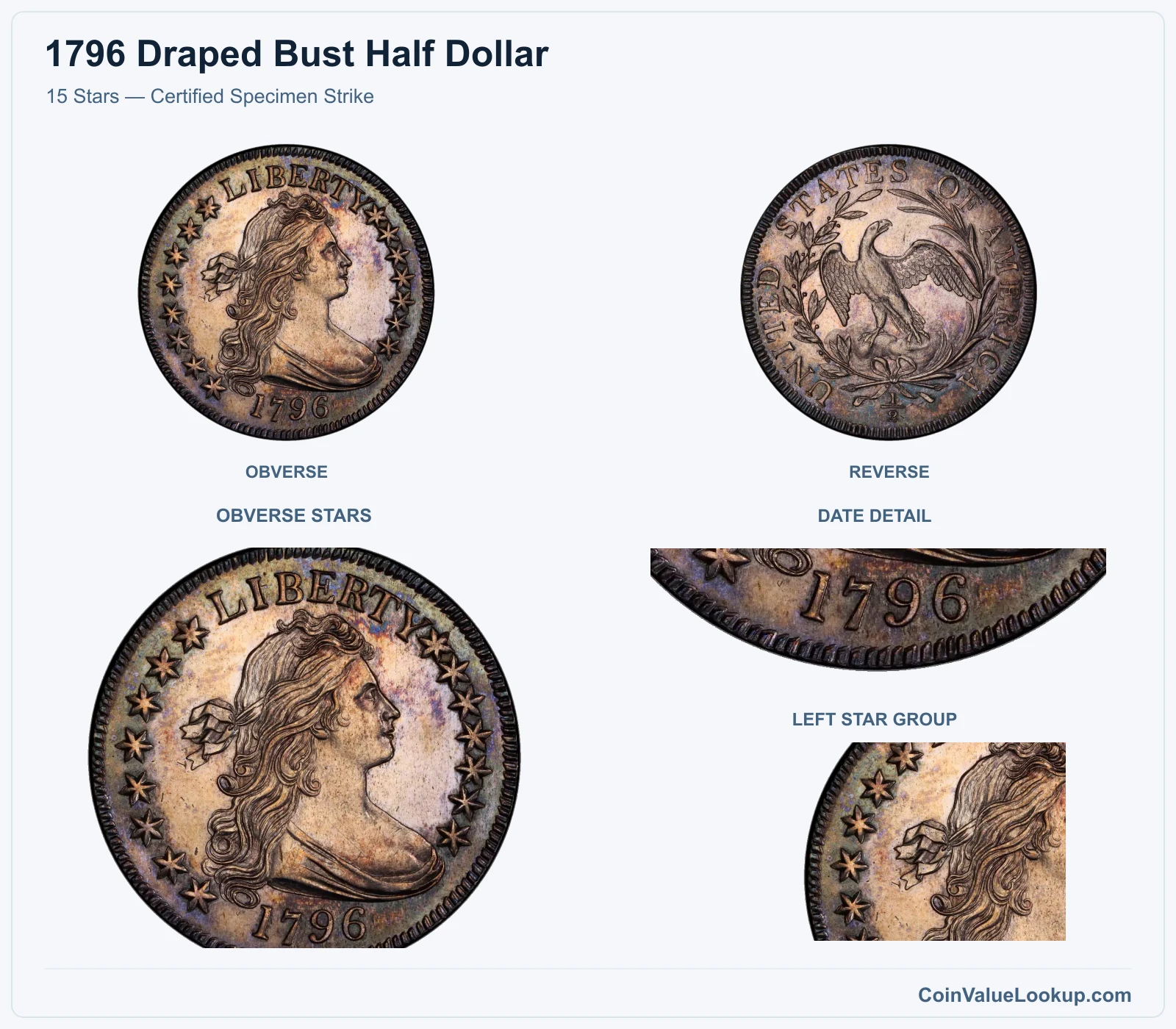
The 15 Stars Certified Specimen Strike is not a coin you identify at home. This attribution depends on specialist provenance and documented handling history, not simply on how shiny or mirrorlike a coin appears.
A cleaned early half dollar can look bright and reflective without being a specimen strike in any meaningful sense.
The known reference example is a Specimen 63 graded by PCGS, with its presentation attribution resting on specialist provenance rather than surface appearance alone. No standard retail price range applies here — this is a coin whose value requires individual assessment by experts familiar with the specific piece, its condition, and its documented history.
If you believe you have something unusual beyond a normal circulation strike, professional authentication is the only responsible next step.
Range Grade
Price Auction Records Appraisal SP SP 1
—
Coin Identifier
SP 2
—
Coin Identifier
SP 3
—
Coin Identifier
SP 4
—
Coin Identifier
SP 6
—
Coin Identifier
SP 8
—
Coin Identifier
SP 10
—
Coin Identifier
SP 12
—
Coin Identifier
SP 15
—
Coin Identifier
SP 20
—
Coin Identifier
SP 25
—
Coin Identifier
SP 30
—
Coin Identifier
SP 35
—
Coin Identifier
SP 40
—
Coin Identifier
SP 45
—
Coin Identifier
SP 50
—
Coin Identifier
SP 53
—
Coin Identifier
SP 55
—
Coin Identifier
SP 58
—
Coin Identifier
SP 60
—
Coin Identifier
SP 61
—
Coin Identifier
SP 62
—
Coin Identifier
SP 63
Coin Identifier
SP 64
—
—
—
SP 65
—
Coin Identifier
SP 66
—
—
—
SP 67
—
—
—
SP 68
—
—
—
SP 69
—
—
—
SP 70
—
—
—
1796 Draped Bust Half Dollar Error List
1. 1796 Draped Bust Half Dollar — Die Crack / Die Chip
A die crack on the 1796 Half Dollar appears as a thin, raised line running continuously across the coin's surface. On the documented 15-star example, the crack travels from the right rim through the nearby stars and into the drapery on Liberty's bust.
That continuous raised path is the key diagnostic — it follows a logical line from rim inward because it originated as a fracture in the steel die itself.
Do not confuse this with incuse scratches, surface corrosion, or foreign material stuck to the coin. Scratches are pressed into the surface rather than raised above it.
Corrosion tends to be irregular and pitted rather than linear. A genuine die crack stands up from the field in a clean, connected line.
No specific price premium can be quoted here, because value depends on the crack's visibility, the coin's overall condition, and the specific die variety involved. A dramatic crack on an otherwise attractive coin draws more interest than a faint hairline on a heavily worn example.
2. 1796 Draped Bust Half Dollar — Die Break / Cud
A die break or retained cud on the 1796 Half Dollar has been reported on the sixteen-star variety, located at stars 1 through 4 on the obverse. It shows as a raised, blobby area along those first four stars where a chunk of the die broke away but the broken piece was held in place during striking.
The result is a distinctly lumpy, elevated mass rather than the sharp individual star points you would normally see.
Look at the full sixteen-star obverse to confirm you are on the right variety before diagnosing the cud. A rim dent creates a depression, not a raised area.
Corrosion is typically pitted and uneven across the surface rather than confined to one specific section. An interior die chip is smaller and isolated, not spanning multiple design elements the way this cud does.
No specific price premium is adopted for this error. Value depends on the cud's size, the stage of the break, and the coin's overall grade and surfaces.