1846 Liberty Seated Dollar Coin Value: How Much Is It Worth?
The 1846 Liberty Seated Dollar is a classic pre-Civil War silver dollar struck in a period when these large coins actually circulated. Guide estimates for the year range from roughly $508 in well-worn Good-4 condition up to about $18,737 for a choice Mint State example, depending on mint and grade.
Those figures are guide estimates from USA Coin Book, not guaranteed offers. Before you assign a value, you need to pin down the mint, finish and condition of your specific coin, because the three distinct branches of 1846 dollar carry very different premiums.
Fast Way to Identify Your 1846 Liberty Seated Dollar
The quickest first step is to upload clear photos of both the front and back of your coin. Our identifier can give you a preliminary read on which 1846 branch you hold, whether it left Philadelphia or New Orleans, and whether it is a business strike or proof.
Snap both sides in good light and submit them for a starting point.
1846 Liberty Seated Dollar Value
Upload both sides of your 1846 Liberty Seated Dollar.
Front Obverse
Upload photo
Back Reverse
Upload photo
Which 1846 Liberty Seated Dollar Versions Are Worth Money?
- The 1846-O (New Orleans) in high grade commands the largest guide values, with an MS63 estimate around $18,737, reflecting how few survived in top condition.
- The 1846 Proof is a separate finish worth individual expert assessment; no standard guide price is adopted for this rare branch.
Step 1: Identify Your 1846 Liberty Seated Dollar Mint Mark and Version
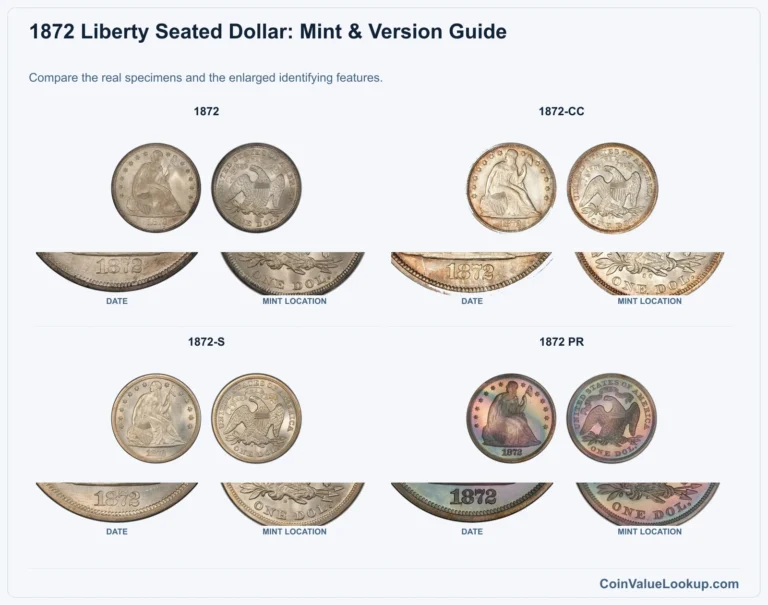
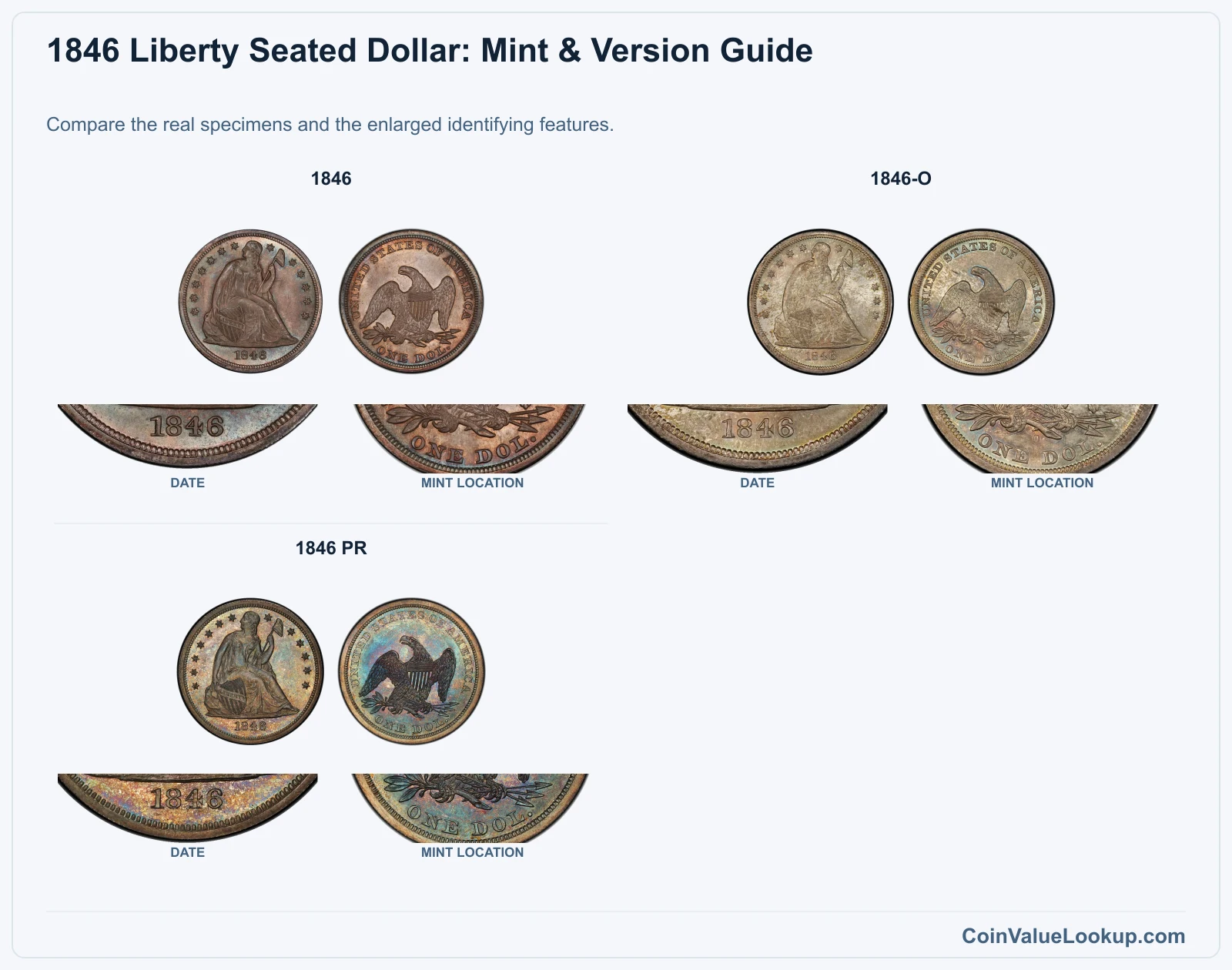
The 1846 Liberty Seated Dollar comes in three branches: the Philadelphia business strike (no mintmark), the New Orleans issue (small "O" mintmark), and a proof finish struck at Philadelphia. To find the mintmark, flip to the reverse and look below the eagle, just above the words ONE DOL.
If you see a small "O" there, you have the New Orleans coin. No letter at all means Philadelphia.
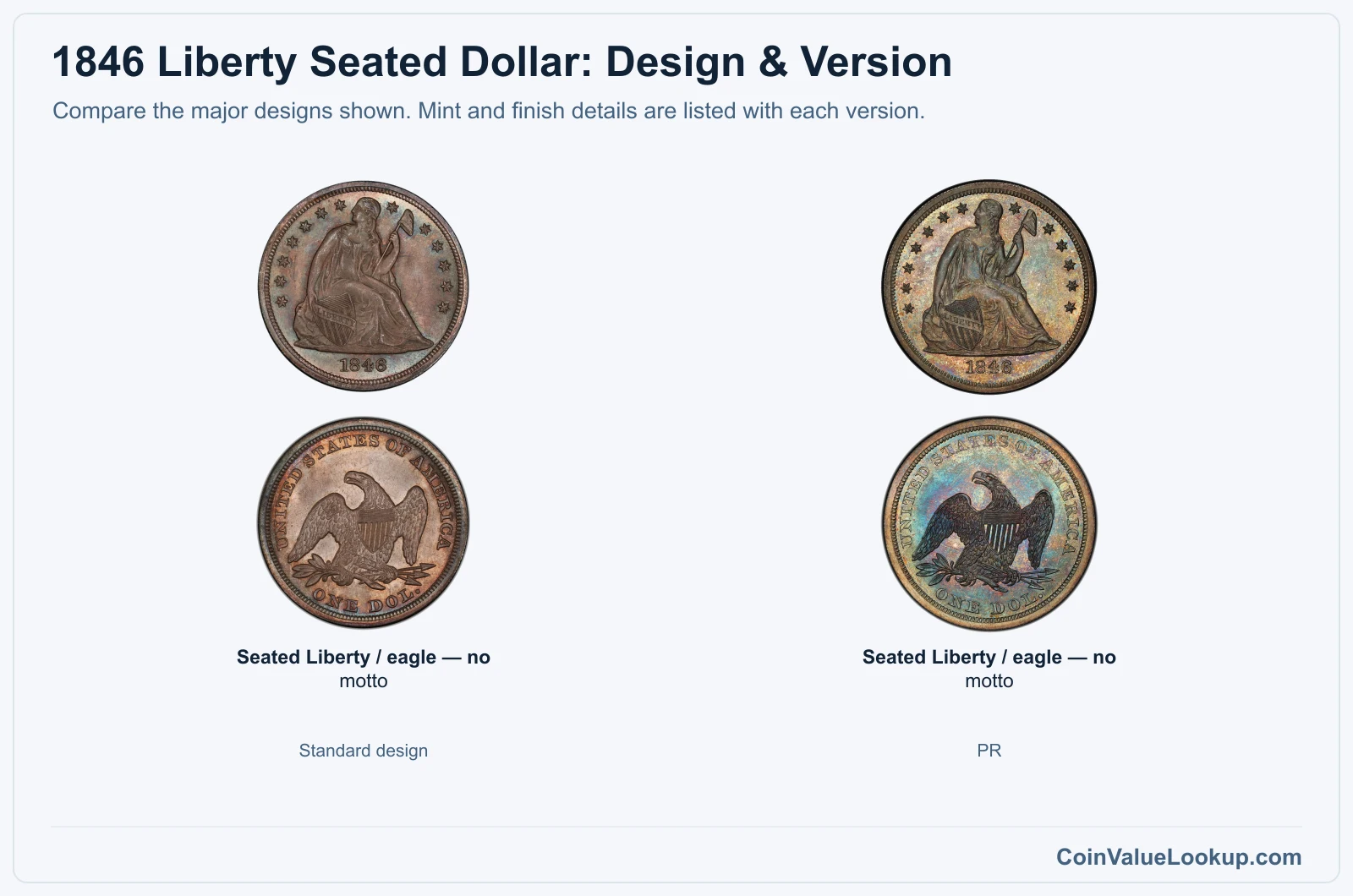
All three are 90% silver and 10% copper, with a nominal weight of 26.73 grams. The design shows a seated Liberty figure on the obverse and an eagle on the reverse, with no motto above the eagle on this year's issue.
That no-motto detail matters because later dates added IN GOD WE TRUST, and you do not want to confuse the two types.
Do not assume a shiny or well-preserved coin is a proof. Proofs are a specific manufacturing finish with squared rims and mirror-like fields, not simply a high-grade regular strike.
Confirm the branch first, then move on to grading.
Step 2: Check Your 1846 Liberty Seated Dollar Grade
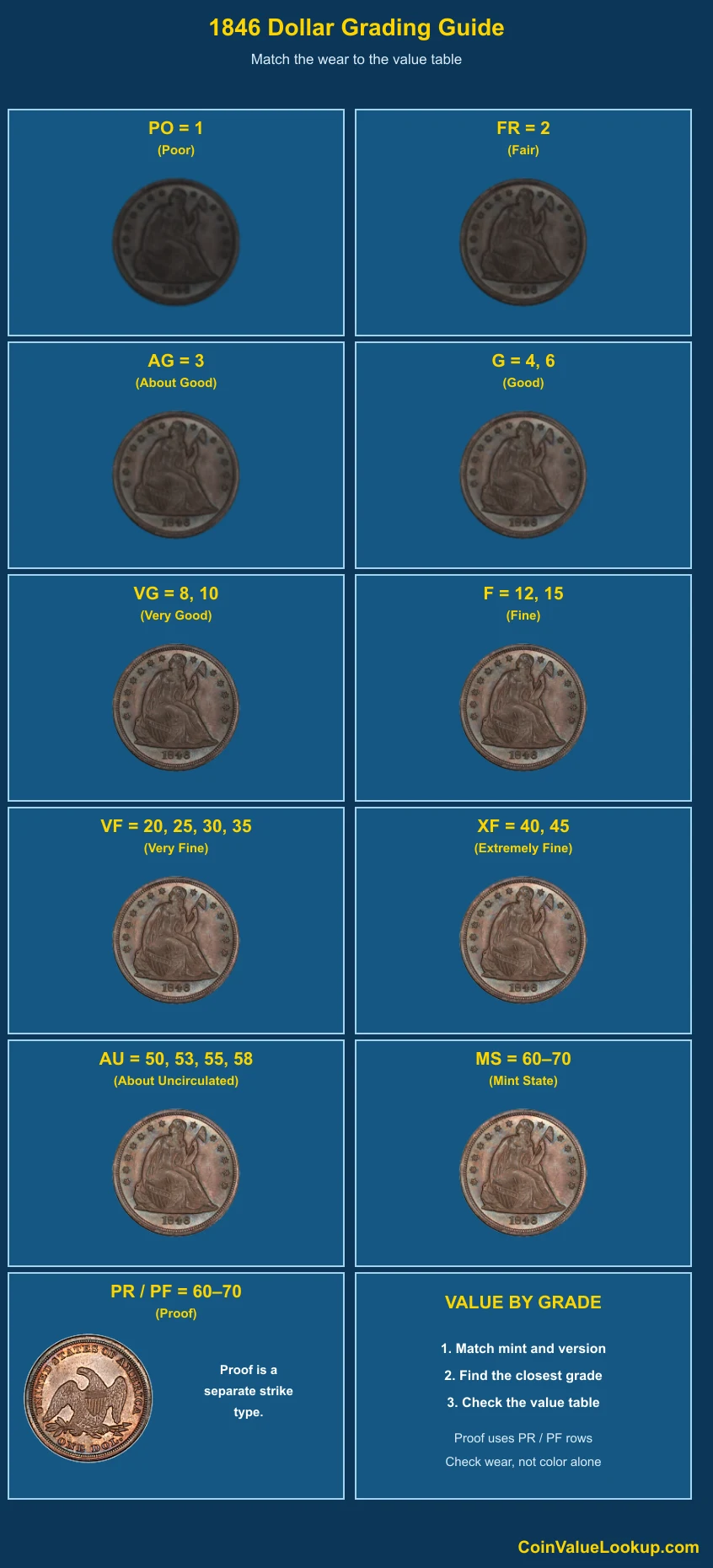
Start with the obverse. Liberty's head, her breast area, her knee and the horizontal lines on her shield are the first spots to lose detail as the coin wears.
On the reverse, check the eagle's breast feathers and the tips of the wings. A coin in Good-4 will show a clear outline of Liberty but almost no interior detail, while a Mint State piece retains full luster and sharp design elements.
Do not grade a weakly struck head the same as a worn one. Some 1846 dollars, especially New Orleans strikes, left the press with softer detail in spots.
Compare your coin against a genuine same-type grading image that separates circulated, About Uncirculated and Mint State examples. Cleaned or polished coins lose their natural surface texture and trade at a discount even if the design detail looks sharp.
Step 3: Check 1846 Liberty Seated Dollar Value by Mint and Version
1846 Liberty Seated Dollar
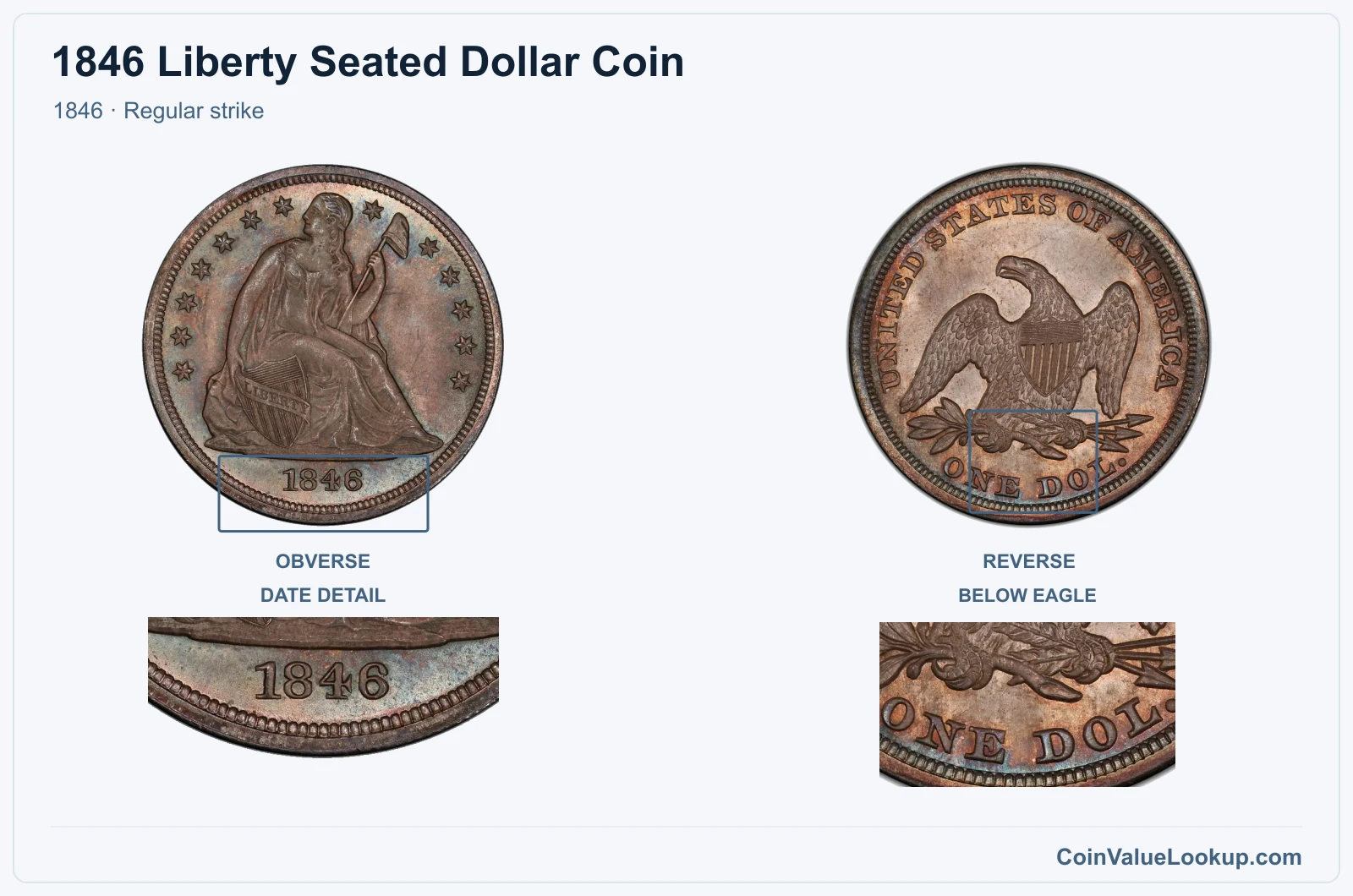
The 1846 Philadelphia dollar carries no mintmark. It is a business-strike coin with the no-motto Seated Liberty and eagle design.
In heavily worn Good-4 condition, USA Coin Book estimates about $508, while a choice MS63 reaches roughly $6,297. Those are guide figures, not sale guarantees.
Original, unaltered surfaces matter a great deal. A coin that has been cleaned, polished or whizzed will not compare fairly to these benchmarks.
Look for even gray or blue-gray toning and undisturbed luster in the protected areas around the stars and letters.
Range Grade
Price Auction Records Appraisal PO PO 1
Coin Identifier FR FR 2
—
Coin Identifier AG AG 3
Coin Identifier G G 4
Coin Identifier
G 6
—
Coin Identifier VG VG 8
Coin Identifier
VG 10
Coin Identifier F F 12
Coin Identifier
F 15
Coin Identifier VF VF 20
Coin Identifier
VF 25
Coin Identifier
VF 30
Coin Identifier
VF 35
Coin Identifier XF XF 40
Coin Identifier
XF 45
Coin Identifier AU AU 50
Coin Identifier
AU 53
Coin Identifier
AU 55
Coin Identifier
AU 58
Coin Identifier MS MS 60
Coin Identifier
MS 61
Coin Identifier
MS 62
Coin Identifier
MS 63
Coin Identifier
MS 64
Coin Identifier
MS 65
Coin Identifier
MS 66
—
—
—
MS 67
—
—
—
MS 68
—
—
—
MS 69
—
—
—
MS 70
—
—
—
1846 Liberty Seated Dollar — O
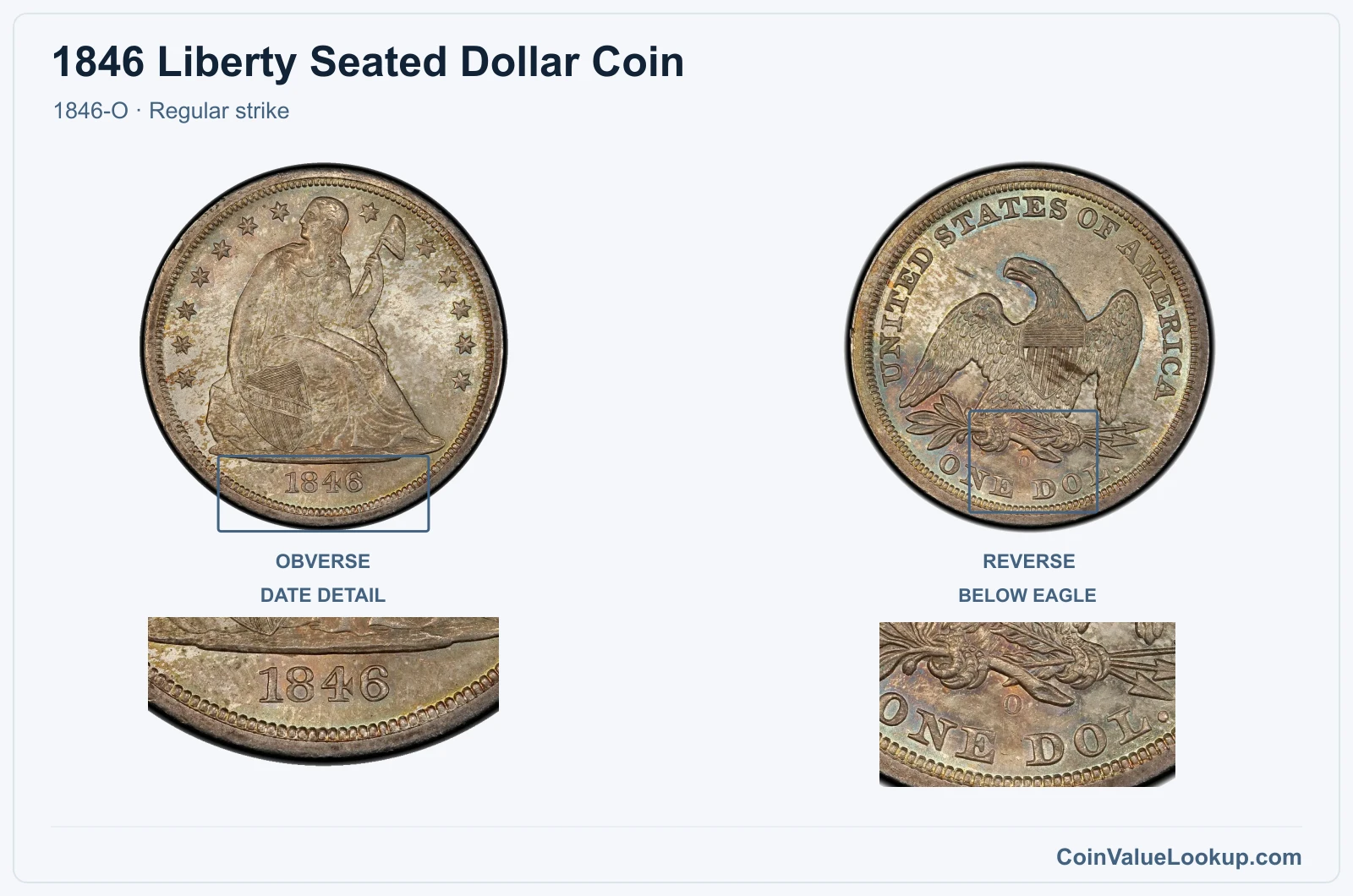
The 1846-O was struck at the New Orleans Mint. Look for the small "O" below the eagle on the reverse.
In Good-4 grade, the USA Coin Book guide estimate sits at about $538, only slightly above the Philadelphia issue. But jump to MS63 and the gap widens dramatically, with a guide estimate around $18,737.
That spread tells you something: plenty survived in circulated grades, but original uncirculated examples are genuinely scarce. New Orleans strikes of this era often show softer detail on the obverse, so do not confuse a weak strike for heavy wear.
Confirm the mintmark, assess the surfaces honestly, and compare against graded examples of the same branch.
Coin Value Lookup is a good place to look up guides for other dates and mints in the Seated Liberty Dollar series, so you can put your coin in context.
Range Grade
Price Auction Records Appraisal PO PO 1
—
Coin Identifier FR FR 2
Coin Identifier AG AG 3
—
Coin Identifier G G 4
Coin Identifier
G 6
Coin Identifier VG VG 8
Coin Identifier
VG 10
Coin Identifier F F 12
Coin Identifier
F 15
Coin Identifier VF VF 20
Coin Identifier
VF 25
Coin Identifier
VF 30
Coin Identifier
VF 35
Coin Identifier XF XF 40
Coin Identifier
XF 45
Coin Identifier AU AU 50
Coin Identifier
AU 53
Coin Identifier
AU 55
Coin Identifier
AU 58
Coin Identifier MS MS 60
Coin Identifier
MS 61
Coin Identifier
MS 62
Coin Identifier
MS 63
Coin Identifier
MS 64
Coin Identifier
MS 65
Coin Identifier
MS 66
—
—
—
MS 67
—
—
—
MS 68
—
—
—
MS 69
—
—
—
MS 70
—
—
—
1846 Liberty Seated Dollar — PR
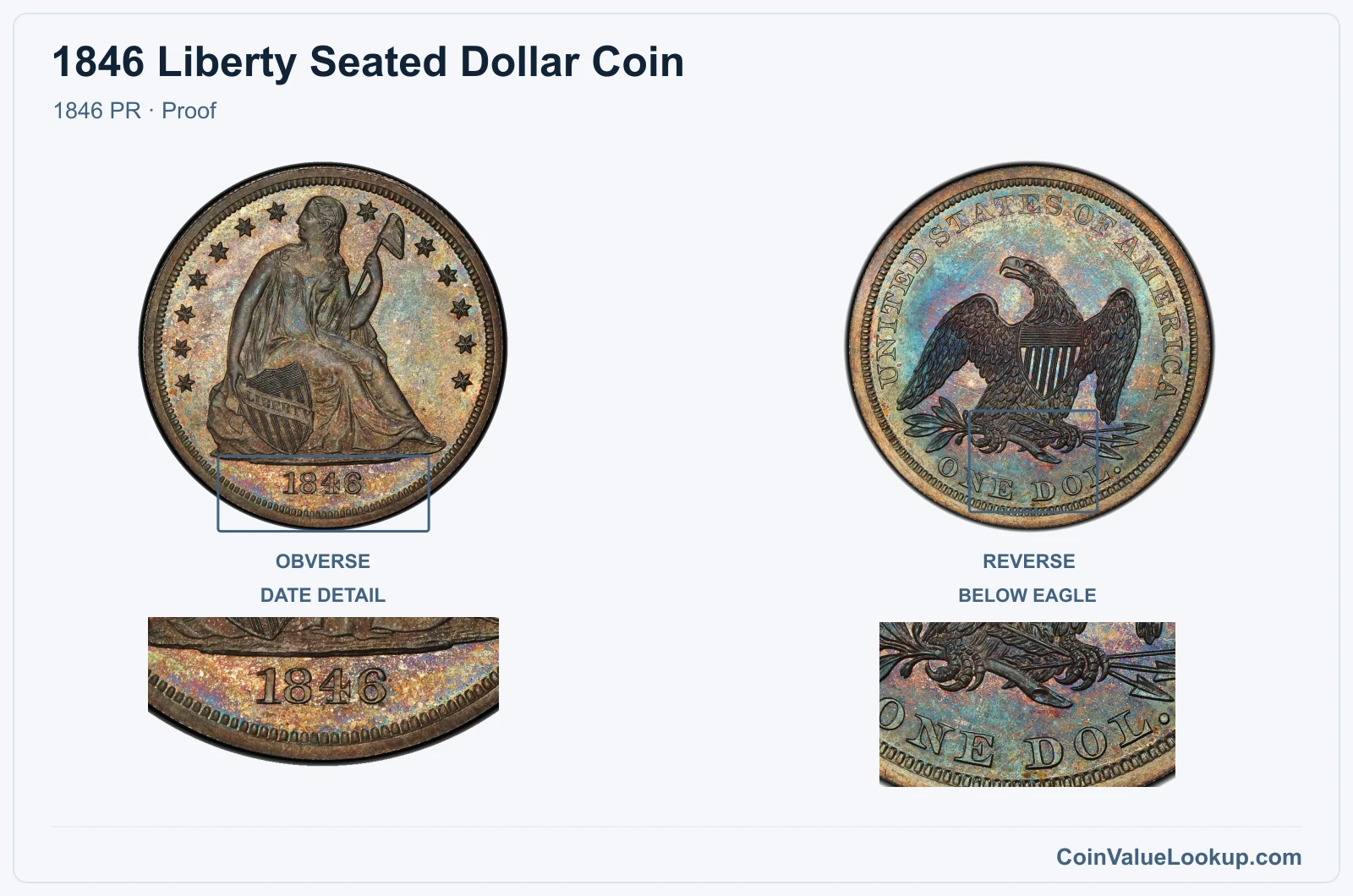
The 1846 Proof is a Philadelphia product made with specially prepared dies and polished planchets. It carries no mintmark, just like the regular Philadelphia strike, so the distinction is in the surfaces, not the location.
Proof coins show mirror-like fields, squared-off rims and exceptionally sharp design elements that differ from even a pristine business strike.
No standard guide price is adopted for this branch. Value depends on the coin's authenticated identity and individual condition, including the depth of any hairlines or toning.
If you believe you have one, professional authentication is the right next step. A shiny circulated coin or a lightly cleaned business strike is not a proof, no matter how good it looks under a desk lamp.
Range Grade
Price Auction Records Appraisal PR PR 1
—
Coin Identifier
PR 2
—
Coin Identifier
PR 3
—
Coin Identifier
PR 4
—
Coin Identifier
PR 6
—
Coin Identifier
PR 8
—
Coin Identifier
PR 10
—
Coin Identifier
PR 12
—
Coin Identifier
PR 15
—
Coin Identifier
PR 20
—
Coin Identifier
PR 25
—
Coin Identifier
PR 30
—
Coin Identifier
PR 35
—
Coin Identifier
PR 40
—
Coin Identifier
PR 45
—
Coin Identifier
PR 50
—
Coin Identifier
PR 53
—
Coin Identifier
PR 55
Coin Identifier
PR 58
Coin Identifier
PR 60
—
Coin Identifier
PR 61
—
Coin Identifier
PR 62
Coin Identifier
PR 63
Coin Identifier
PR 64
Coin Identifier
PR 65
Coin Identifier
PR 66
Coin Identifier
PR 67
—
—
—
PR 68
—
—
—
PR 69
—
—
—
PR 70
—
—
—
1846 Liberty Seated Dollar Error List
1. 1846 Liberty Seated Dollar — Rotated Dies
A rotated die error occurs when one of the two dies shifts out of normal alignment during striking. On standard US coins, if you hold the obverse upright and flip the coin top-to-bottom, the reverse should also appear upright.
If the reverse is tilted, you may have a rotated die.
This error has been reported specifically on the 1846-O. The degree of rotation matters: a slight tilt of a few degrees is less significant than a dramatic 90- or 180-degree shift.
Before getting excited, make sure your photograph was not simply taken at an angle, and that you are flipping the coin on its vertical axis, not spinning it. No specific price data is adopted for this error; value depends on the degree of rotation, the coin's overall condition and buyer interest.
2. 1846 Liberty Seated Dollar — Die Break / Cud
A die break or cud error results from a piece of the die cracking or breaking away entirely. When this happens, the coin shows a raised irregular blob, typically connected to the rim, where metal filled the gap left by the missing die fragment.
A retained cud means the broken piece stayed partially attached, leaving a distinctive raised area without fully separating.
This type of error has been reported on the 1846 Seated Dollar, with at least one example graded Good-6 by ANACS appearing at Heritage Auctions. Do not confuse a cud with a rim dent, corrosion bump or a small interior die chip, which are far more common and less collectible.
No specific price data is adopted; the size, location and visibility of the break all influence what a collector will pay.
3. 1846 Liberty Seated Dollar — Repunched Date
A repunched date occurs when the date numerals were punched into the working die more than once, with the second impression slightly offset from the first. On the 1846, this has been reported as the OC-P1 variety.
You will see traces of an earlier punch position alongside the final date digits, often visible as shadowing or doubling confined to one or more numerals.
This is different from machine doubling, which produces flat, shelf-like distortion across the whole design. It is also different from date damage caused by a hit or scratch after the coin left the mint.
Use magnification and look specifically at the bases and tops of the numerals 1, 8, 4 and 6 for remnants of the first punch. No specific price data is adopted for this variety; the clarity of the repunching and the coin's overall grade both affect desirability.