1803 Draped Bust Dime Coin Value: How Much Is It Worth?
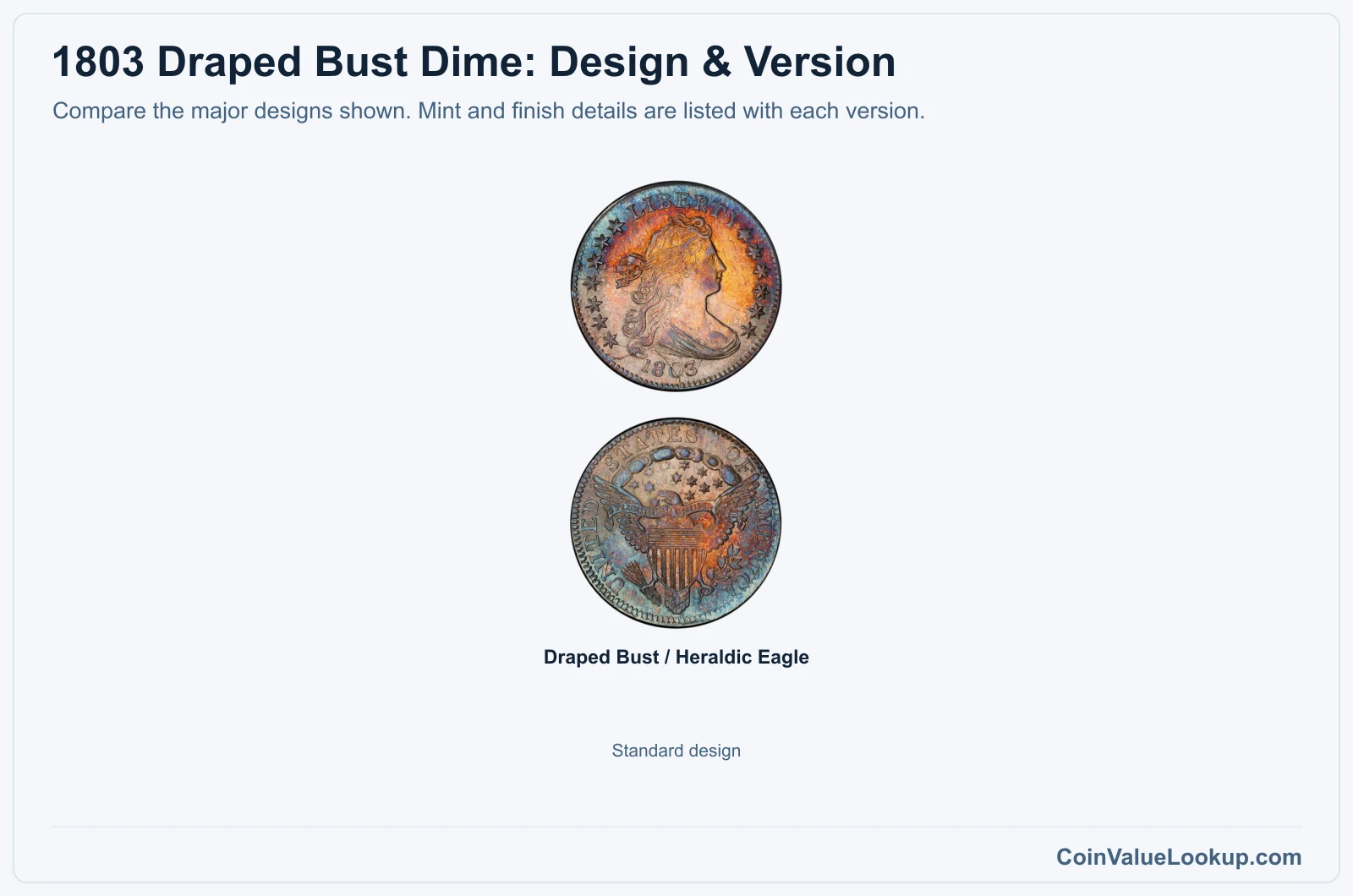
The 1803 Draped Bust Dime is one of the earliest silver dimes struck at the Philadelphia Mint, and surviving examples are genuinely scarce. Guide estimates for this date range from about $1,348.00 in Good-4 condition to around $105,853.00 at the MS63 level, based on USA Coin Book figures.
These are reference anchors for specific grades, not guaranteed offers, and your coin's actual design variety, wear and surface condition determine where it falls.
Fast Way to Identify Your 1803 Draped Bust Dime
Want a quick read on what you have? Upload clear photos of the front and back of your coin using the identifier on this page.
It will give you a preliminary identification of the design type, date and general category so you know which branch to research further. This is not a certification or exact grade assignment, just a helpful starting point.
1803 Draped Bust Dime Value
Upload both sides of your 1803 Draped Bust Dime.
Front Obverse
Upload photo
Back Reverse
Upload photo
Which 1803 Draped Bust Dime Versions Are Worth Money?
- The 1803 Philadelphia issue is the sole branch for this date; confirm the Draped Bust obverse and Heraldic Eagle reverse before pricing.
- Original, uncleared surfaces with natural toning carry significantly more collector appeal than cleaned or brightened examples.
- Well-preserved specimens at the MS63 level carry a guide estimate around $105,853.00, reflecting genuine rarity in high grades.
- Even a well-worn example in Good-4 condition anchors near $1,348.00, so any authentic survivor holds meaningful value.
- Cleaning, scratches or corrosion reduce a coin's comparability to published guide figures, so surface quality is critical to assess.
Step 1: Identify Your 1803 Draped Bust Dime Mint Mark and Version
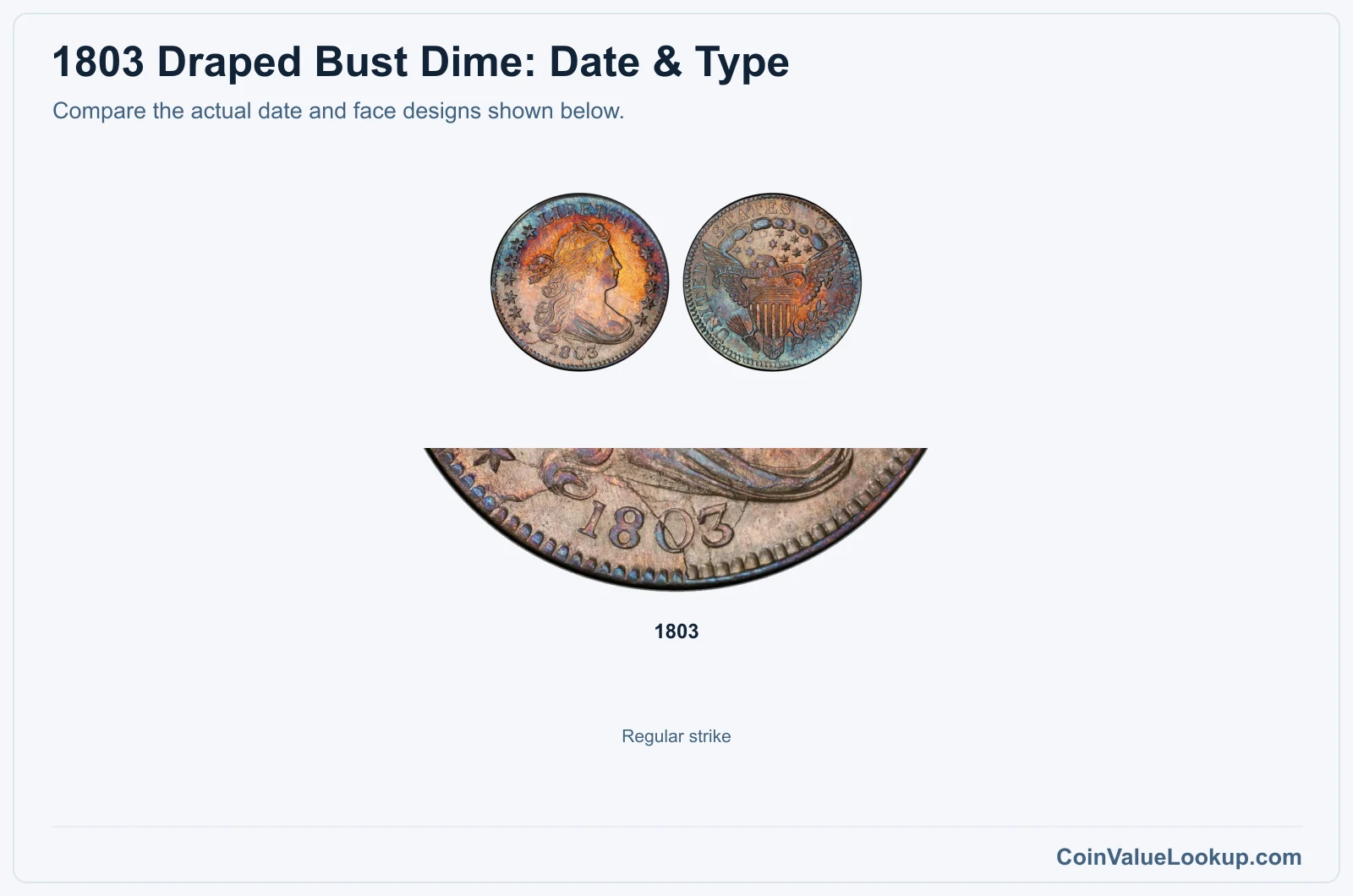
All 1803 dimes were struck at Philadelphia. There is no mintmark to look for on this coin.
The design pairs the Draped Bust portrait of Liberty on the front with the Heraldic Eagle on the reverse. This is a silver-copper alloy coin, roughly 89.24% silver by weight.
It does not display a "10C" denomination anywhere on the coin, which trips people up.
Before you get excited, confirm you actually have a dime and not a half dime or a small dollar with a similar bust design. Size matters here.
A Draped Bust dime is noticeably smaller than a dollar and slightly larger than a half dime. If the coin is tiny, you may be holding the wrong denomination entirely.
There is one main branch for this year: the 1803 Philadelphia issue. Match the date, the Draped Bust obverse and the Heraldic Eagle reverse before you start comparing values.
Step 2: Check Your 1803 Draped Bust Dime Grade
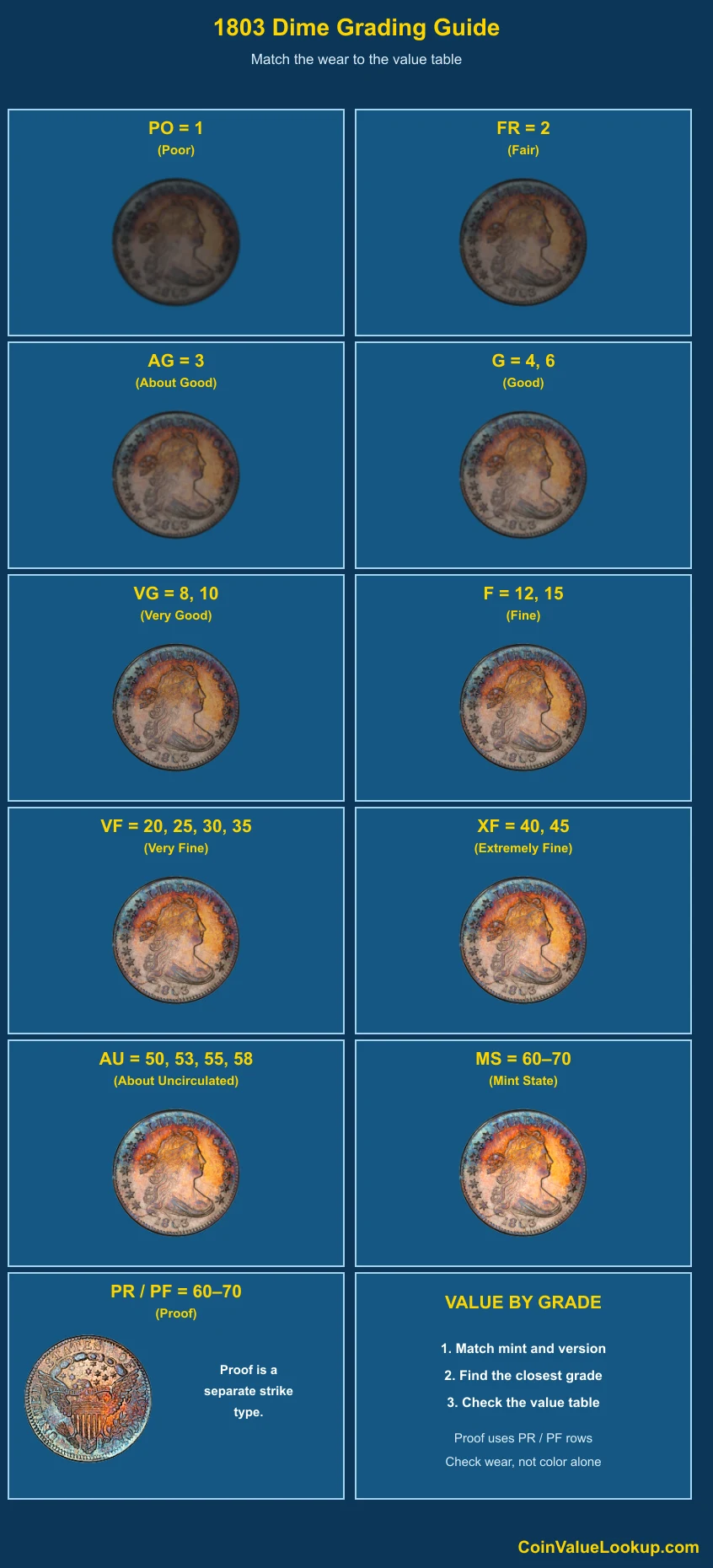
When grading an 1803 Draped Bust Dime, focus on Liberty's hair detail above the forehead, the smoothness of her cheek, and the condition of the drapery at the bust line. On the reverse, check the eagle's breast feathers and wing tips for wear.
Here is the tricky part with early dimes: these were made on hand-operated presses. Even a freshly struck coin can show uneven or weakly impressed details.
That is manufacturing reality, not circulation wear.
Look at the coin's overall luster and surface quality alongside the high-point wear. A coin with soft original luster and light contact marks is a very different animal from one that has been cleaned to look shiny.
Never clean or polish these coins; doing so destroys originality and tanks the value.
Use the comparison image on this page to see how wear progresses across the same design type. Check luster in protected areas around the letters and stars, and compare what you see to the reference points at each grade level.
Step 3: Check 1803 Draped Bust Dime Value by Mint and Version
1803 Draped Bust Dime
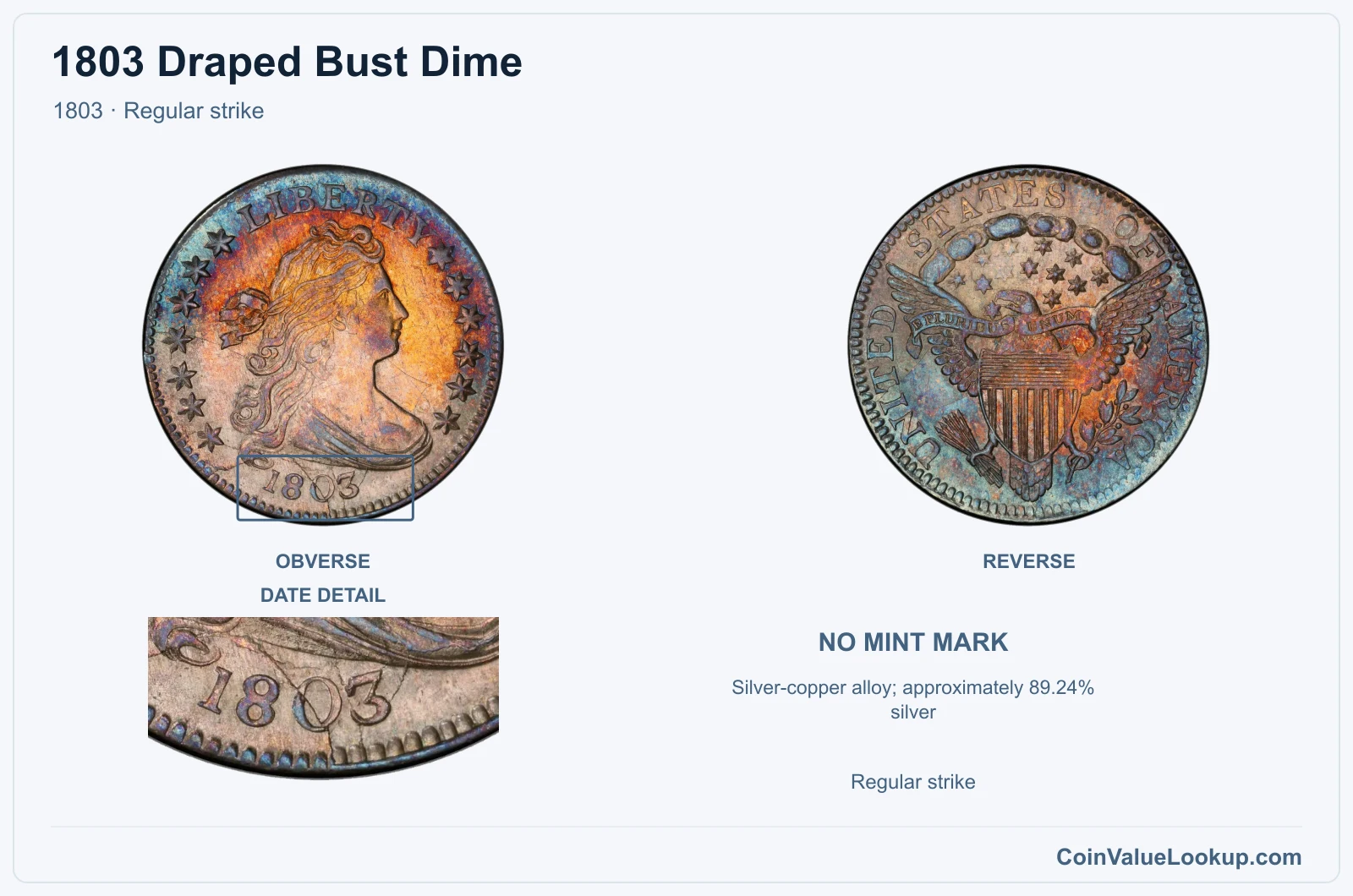
The 1803 Draped Bust Dime was struck only at Philadelphia with no mintmark. It features the classic Draped Bust of Liberty on the obverse and the Heraldic Eagle on the reverse, produced in a silver-copper alloy of about 89.24% silver.
USA Coin Book guide estimates place this date at approximately $1,348.00 in Good-4 and around $105,853.00 in MS63. That is a wide spread, and most survivors fall somewhere on the lower end.
High-grade pieces are extremely rare for a coin this old.
Original surfaces matter far more than brightness. A naturally toned example with honest wear will always outperform a cleaned coin of similar technical grade.
Match the date and both sides of the design before comparing your coin to any published figure.
Coin Value Lookup is a good place to look up guides for other early U.S. coin types if you are working through a collection or inheritance.
Range Grade
Price Auction Records Appraisal PO PO 1
Coin Identifier FR FR 2
Coin Identifier AG AG 3
Coin Identifier G G 4
Coin Identifier
G 6
Coin Identifier VG VG 8
Coin Identifier
VG 10
Coin Identifier F F 12
Coin Identifier
F 15
Coin Identifier VF VF 20
—
Coin Identifier
VF 25
Coin Identifier
VF 30
Coin Identifier
VF 35
Coin Identifier XF XF 40
Coin Identifier
XF 45
Coin Identifier AU AU 50
Coin Identifier
AU 53
Coin Identifier
AU 55
Coin Identifier
AU 58
Coin Identifier MS MS 60
—
Coin Identifier
MS 61
Coin Identifier
MS 62
—
Coin Identifier
MS 63
—
Coin Identifier
MS 64
—
Coin Identifier
MS 65
—
—
—
MS 66
—
—
—
MS 67
—
—
—
MS 68
—
—
—
MS 69
—
—
—
MS 70
—
—
—