2013 Lincoln Penny Coin Value: How Much Is It Worth?
A 2013 Lincoln cent in worn, circulated condition is worth about one cent — face value, nothing more. In higher uncirculated grades the picture changes slightly: a guide estimate for an MS65 example is around $0.36, and a San Francisco proof in PR65 carries a guide estimate near $6.25.
Collector finishes, recognized varieties and genuine mint errors each occupy their own pricing lane, so the first step is figuring out exactly what you have.
Fast Way to Identify Your 2013 Lincoln Penny
The quickest way to start is to upload clear photos of both the front and back of your 2013 penny. Our identifier can provide a preliminary identification of the mint, finish and general version based on those images.
It is not a substitute for professional authentication or certified grading, but it points you in the right direction fast.
2013 Penny Value
Upload both sides of your 2013 Lincoln Penny.
Front Obverse
Upload photo
Back Reverse
Upload photo
Which 2013 Lincoln Penny Versions Are Worth Money?
- Philadelphia and Denver business strikes are common in all circulated grades; look for original bright surfaces and minimal marks to find the small premium MS65 tier.
- San Francisco proof cents, struck for collector sets, carry a PR65 guide estimate of about $6.25 — separate them from business strikes before comparing value.
Step 1: Identify Your 2013 Lincoln Penny Mint Mark and Version
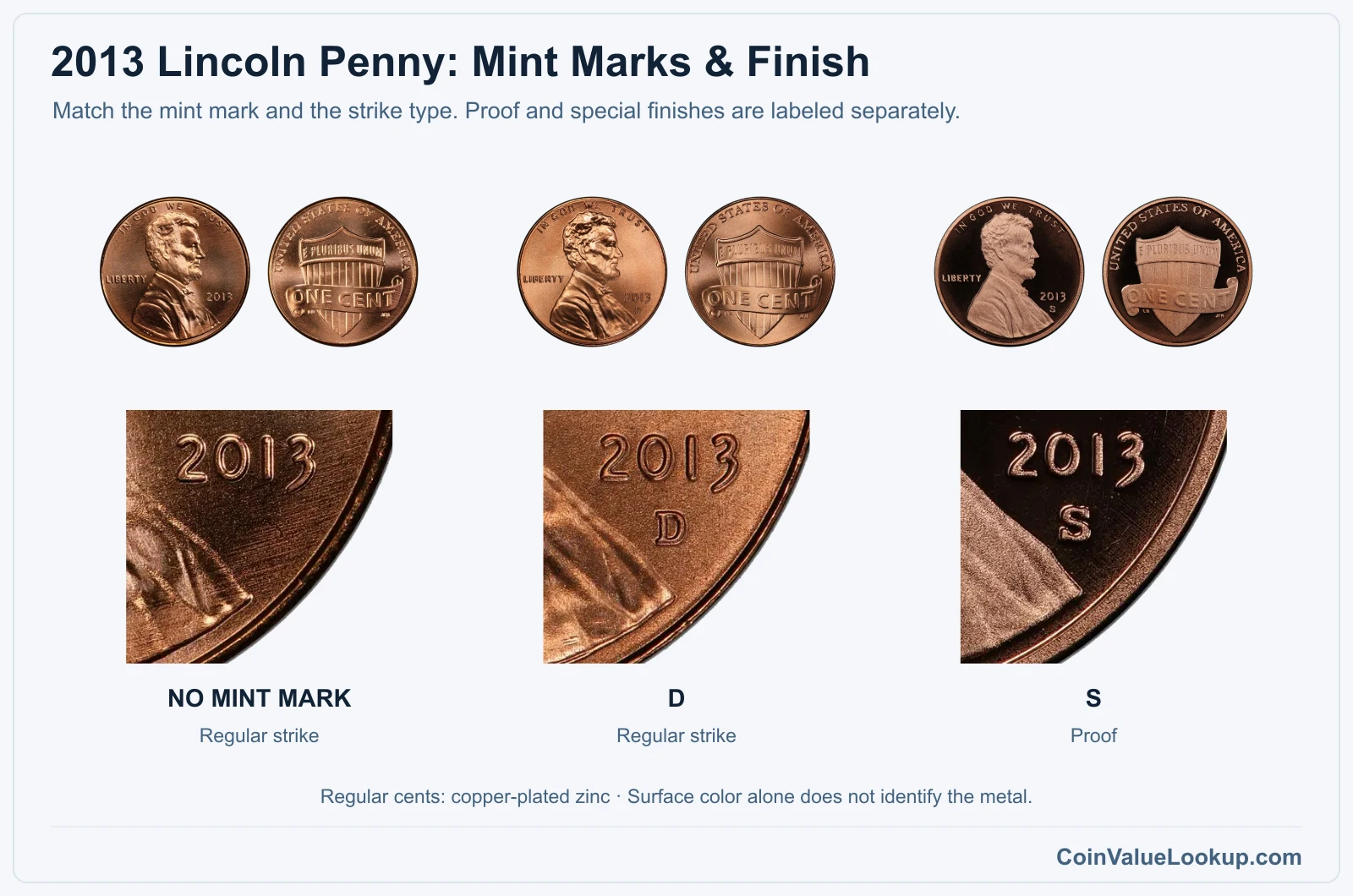
Flip your coin to the obverse and look just below the date. No letter at all means Philadelphia.
A small "D" means Denver. An "S" means San Francisco, and those are proof strikes sold in collector sets — they were never released into pocket change.
The reverse should show the Union Shield design, which has been used on Lincoln cents since 2010. If your reverse has a different design, you may have a different year or a very unusual error.
Standard 2013 cents are copper-plated zinc, weighing a nominal 2.50 grams. The copper color is just a thin plating over a zinc core.
Appearance alone cannot confirm an off-metal error; you need an accurate scale and ideally a caliper to compare weight and diameter against the 2.50 g and 19.05 mm specifications.
Step 2: Check Your 2013 Lincoln Penny Grade
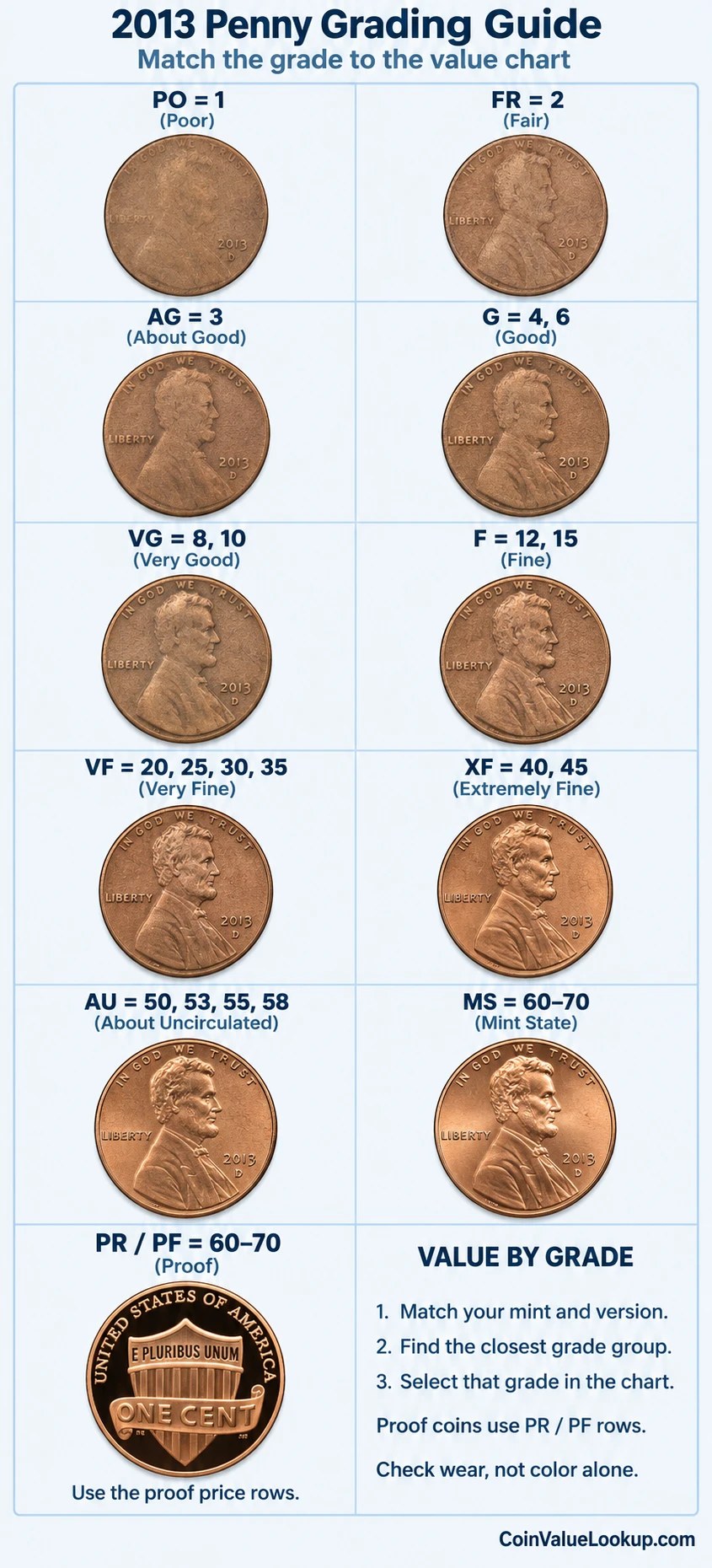
Start with Lincoln's cheek and jawline on the obverse — that is where wear shows up first. On a lightly circulated coin, the high points of his hair and beard will look flat compared to the protected areas around his ear.
On the reverse, check the horizontal lines across the Union Shield. On a well-preserved coin every line is sharp and distinct; on a worn one they blur together, especially at the center.
Luster matters. A coin that still has its original mint bloom across the fields grades higher than a dull, handled piece even if the design details look similar.
Compare your coin to the reference image to calibrate your eye.
Color designations — RD (red), RB (red-brown) and BN (brown) — describe how much original copper tone remains. They are graded alongside the wear grade but are separate from it.
A coin can be MS65 BN or MS65 RD; same wear, different eye appeal and often different price.
Proof is a manufacturing finish involving specially prepared dies and planchets. It is not a grade above Mint State.
Proof coins receive PR grades, not MS grades.
Step 3: Check 2013 Lincoln Penny Value by Mint and Version
2013 Lincoln Penny — Shield
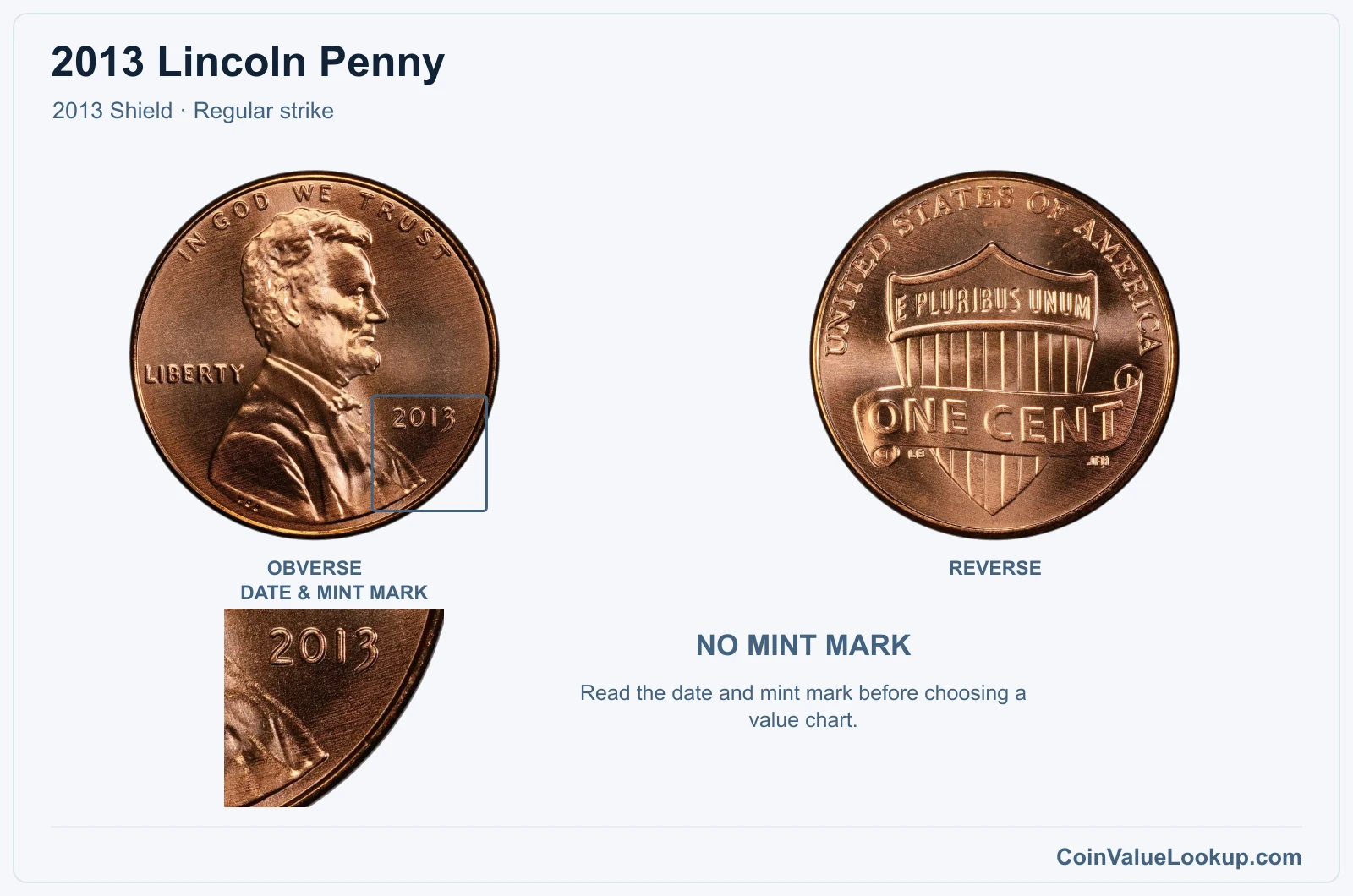
The 2013 Philadelphia cent has no mintmark below the date. Billions were struck, so circulated examples are worth face value and will stay that way for a long time.
In gem uncirculated condition — MS65 with clean fields and good luster — a guide estimate is about $0.36. That is not a typo; modern Philly cents are not scarce.
To reach that guide figure your coin needs full, undisturbed surfaces with no nicks, spots or fingerprints. Look for complete hair detail and sharp shield lines on the reverse.
| Range | Grade | Price | Auction Records | Appraisal |
|---|---|---|---|---|
| PO | PO 1 | — | Coin Identifier | |
| FR | FR 2 | — | Coin Identifier | |
| AG | AG 3 | — | Coin Identifier | |
| G | G 4 | — | Coin Identifier | |
| G 6 | — | Coin Identifier | ||
| VG | VG 8 | — | Coin Identifier | |
| VG 10 | — | Coin Identifier | ||
| F | F 12 | — | Coin Identifier | |
| F 15 | — | Coin Identifier | ||
| VF | VF 20 | — | Coin Identifier | |
| VF 25 | — | Coin Identifier | ||
| VF 30 | — | Coin Identifier | ||
| VF 35 | — | Coin Identifier | ||
| XF | XF 40 | — | Coin Identifier | |
| XF 45 | — | Coin Identifier | ||
| AU | AU 50 | — | Coin Identifier | |
| AU 53 | — | Coin Identifier | ||
| AU 55 | — | Coin Identifier | ||
| AU 58 | — | Coin Identifier | ||
| MS | MS 60 | — | Coin Identifier | |
| MS 61 | — | Coin Identifier | ||
| MS 62 | — | Coin Identifier | ||
| MS 63 | — | Coin Identifier | ||
| MS 64 | — | Coin Identifier | ||
| MS 65 | — | Coin Identifier | ||
| MS 66 | Coin Identifier | |||
| MS 67 | Coin Identifier | |||
| MS 68 | Coin Identifier | |||
| MS 69 | — | Coin Identifier | ||
| MS 70 | — | — | — |
2013 Lincoln Penny — D Shield
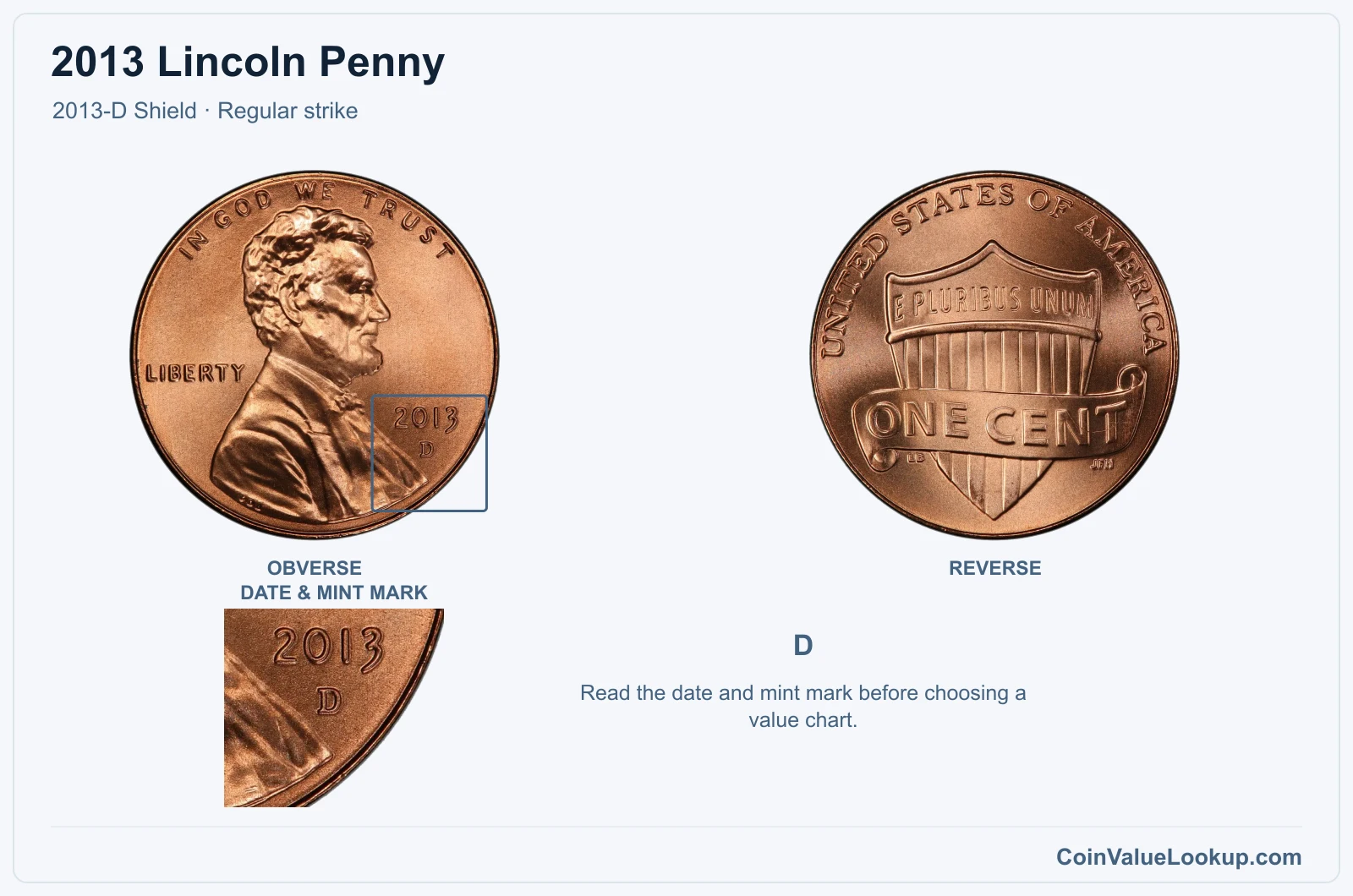
The 2013-D carries a small "D" mintmark below the date, struck at the Denver facility. Like its Philadelphia sibling, this is a high-mintage business strike worth one cent in your pocket.
A guide estimate at MS65 is around $0.36. The same grading criteria apply: full original luster, sharp design details and minimal contact marks.
Color matters too — a full red (RD) example will generally attract more attention than a brown-toned piece at the same technical grade.
Coin Value Lookup is a handy starting point if you want to look up values for other dates and denominations in the Lincoln cent series.
| Range | Grade | Price | Auction Records | Appraisal |
|---|---|---|---|---|
| PO | PO 1 | — | Coin Identifier | |
| FR | FR 2 | — | Coin Identifier | |
| AG | AG 3 | — | Coin Identifier | |
| G | G 4 | — | Coin Identifier | |
| G 6 | — | Coin Identifier | ||
| VG | VG 8 | — | Coin Identifier | |
| VG 10 | — | Coin Identifier | ||
| F | F 12 | — | Coin Identifier | |
| F 15 | — | Coin Identifier | ||
| VF | VF 20 | — | Coin Identifier | |
| VF 25 | — | Coin Identifier | ||
| VF 30 | — | Coin Identifier | ||
| VF 35 | — | Coin Identifier | ||
| XF | XF 40 | — | Coin Identifier | |
| XF 45 | — | Coin Identifier | ||
| AU | AU 50 | — | Coin Identifier | |
| AU 53 | — | Coin Identifier | ||
| AU 55 | — | Coin Identifier | ||
| AU 58 | — | Coin Identifier | ||
| MS | MS 60 | — | Coin Identifier | |
| MS 61 | — | Coin Identifier | ||
| MS 62 | — | Coin Identifier | ||
| MS 63 | — | Coin Identifier | ||
| MS 64 | — | Coin Identifier | ||
| MS 65 | Coin Identifier | |||
| MS 66 | Coin Identifier | |||
| MS 67 | Coin Identifier | |||
| MS 68 | Coin Identifier | |||
| MS 69 | — | — | — | |
| MS 70 | — | — | — |
2013 Lincoln Penny — S Shield PR
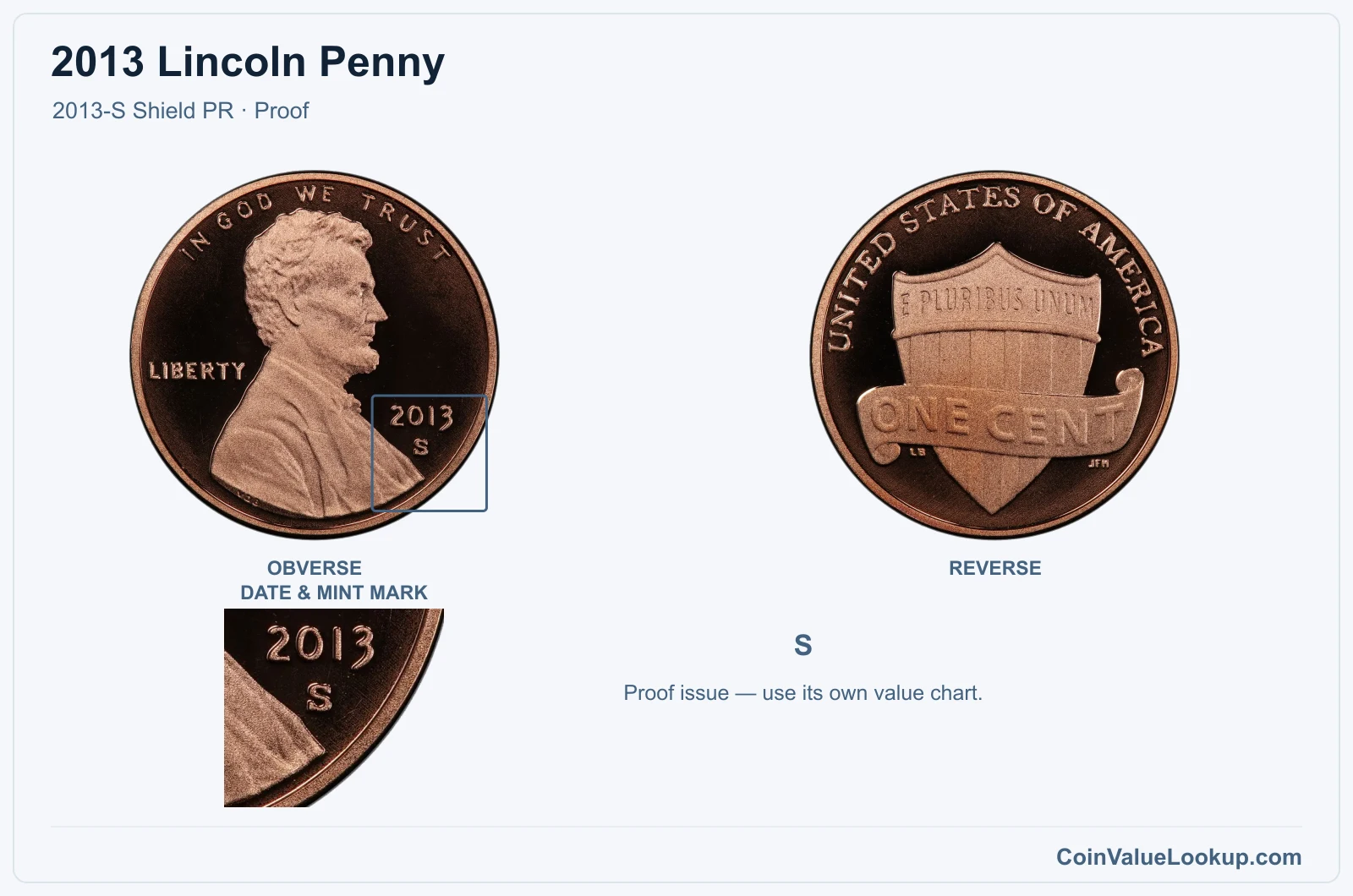
The 2013-S proof cent was produced at San Francisco exclusively for collector sets and bears a small "S" mintmark. It was struck on specially prepared dies, giving it mirror-like fields and sharply frosted design elements.
You will not find these in circulation.
A PR65 guide estimate sits at about $6.25, making it the priciest standard-issue 2013 cent by a wide margin. That said, most surviving proofs grade well above PR65 because they were handled carefully from the start.
Examine the fields under good light: hairlines, haze or fingerprints will limit the grade. Cameo or deep cameo contrast designations, where the frosted devices stand out sharply against the mirror fields, can affect desirability separately from the numeric grade.
| Range | Grade | Price | Auction Records | Appraisal |
|---|---|---|---|---|
| PR | PR 1 | — | Coin Identifier | |
| PR 2 | — | Coin Identifier | ||
| PR 3 | — | Coin Identifier | ||
| PR 4 | — | Coin Identifier | ||
| PR 6 | — | Coin Identifier | ||
| PR 8 | — | Coin Identifier | ||
| PR 10 | — | Coin Identifier | ||
| PR 12 | — | Coin Identifier | ||
| PR 15 | — | Coin Identifier | ||
| PR 20 | — | Coin Identifier | ||
| PR 25 | — | Coin Identifier | ||
| PR 30 | — | Coin Identifier | ||
| PR 35 | — | Coin Identifier | ||
| PR 40 | — | Coin Identifier | ||
| PR 45 | — | Coin Identifier | ||
| PR 50 | — | Coin Identifier | ||
| PR 53 | — | Coin Identifier | ||
| PR 55 | — | Coin Identifier | ||
| PR 58 | — | Coin Identifier | ||
| PR 60 | — | Coin Identifier | ||
| PR 61 | — | Coin Identifier | ||
| PR 62 | — | Coin Identifier | ||
| PR 63 | — | Coin Identifier | ||
| PR 64 | — | Coin Identifier | ||
| PR 65 | — | Coin Identifier | ||
| PR 66 | — | Coin Identifier | ||
| PR 67 | — | Coin Identifier | ||
| PR 68 | — | Coin Identifier | ||
| PR 69 | Coin Identifier | |||
| PR 70 | Coin Identifier |
2013 Lincoln Penny Error List
1. 2013 Lincoln Penny — BIE Die Break
A BIE die break shows up as a small raised vertical line or blob sitting between the letters B and E in LIBERTY on the obverse. It is caused by a crack or chip in the die surface.
The raised area will have the same metal tone as the surrounding coin because it formed during striking, not afterward.
Look closely with magnification. Dirt, scratches or glue residue can mimic this error, but those are usually recessed or sit on top of the surface rather than being raised from within it.
A genuine BIE will appear on every coin struck by that particular damaged die, so consistency is the hallmark.
No specific price range is adopted for this error on a 2013 cent. Value depends on the size and clarity of the break, the coin's overall grade, and third-party authentication.
2. 2013 Lincoln Penny — Clipped Planchet
A clipped planchet error means the blank was incomplete before the coin was struck. You will see a missing curved, straight or irregular section along the edge where metal simply is not there.
Genuine clips often show a corresponding area of design weakness on the opposite side of the coin, called the Blakesley effect, because the incomplete blank did not fill the die fully.
Check the edge carefully. A filed notch, a cut made with pliers, or corrosion eating away the rim are common lookalikes.
Post-mint damage tends to leave tool marks, sharp edges or exposed zinc underneath the copper plating.
Pricing for clipped 2013 cents is not established here. Each example is assessed individually based on clip size, shape, and the coin's authenticated condition.
3. 2013 Lincoln Penny — Struck-Through Error
A struck-through error happens when something — grease, a thread, a metal fragment — gets caught between the die and the planchet during striking. The result is a localized depression or an impression of the foreign object pressed into the coin's surface, with the normal design missing or distorted in that spot.
Grease fill-ins tend to produce smooth, featureless patches. Retained foreign objects leave a more distinct outline.
Both differ from ordinary wear, which removes detail gradually and evenly across high points.
Scratches, cleaning marks and post-mint damage are common imposters. Genuine struck-through areas are flush with or slightly below the surrounding surface and lack the sharp, directional grooves of a scratch.
No adopted price range exists for this error on 2013 cents; individual assessment by an authentication service is the way to determine value.
4. 2013 Lincoln Penny — Doubled Die
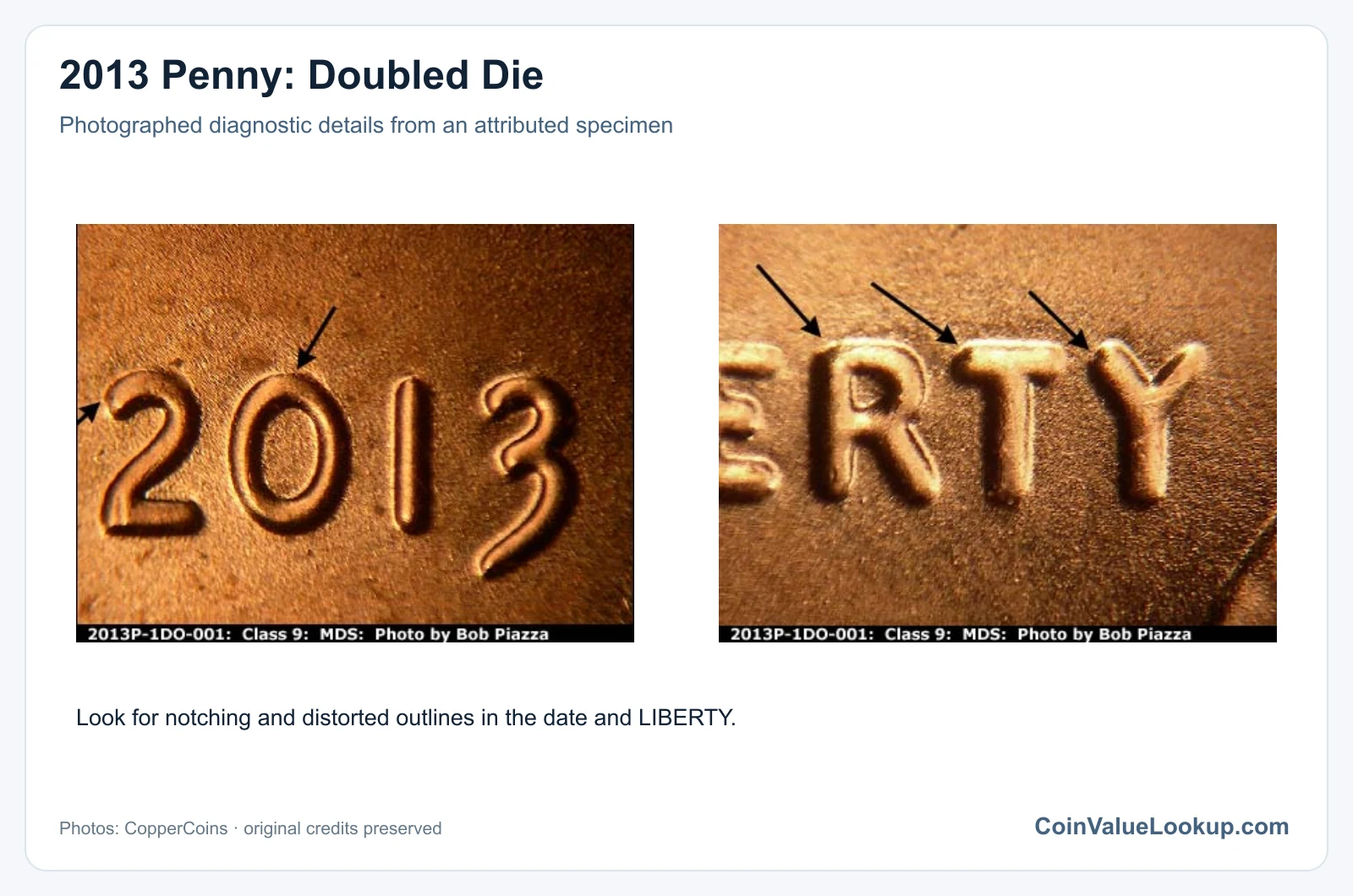
A doubled die on a 2013 Lincoln cent will show consistent doubling — a visible second impression — on design elements like lettering, the date, or Lincoln's profile. The separation or notching will repeat in the same direction across multiple features because the doubling originated in the die itself, not during ejection.
The most common lookalike is machine doubling (also called mechanical or strike doubling), which produces flat, shelf-like distortion rather than the rounded, separated profiles of a true doubled die. Reflections under certain lighting and post-mint impressions from contact with other coins can also fool you.
Compare suspect areas against a known normal 2013 cent under magnification. No specific price data is adopted here; a doubled-die cent's value depends on the prominence and location of the doubling, plus certified grade and authentication.
5. 2013 Lincoln Penny — Die Break / Cud
A die break or cud error appears as a raised, featureless lump on the coin's surface. A true cud specifically connects to the rim — it forms when a piece of the die breaks away at the edge, leaving nothing to press the planchet flat in that area.
Interior die breaks that do not reach the rim are sometimes called retained die breaks.
Look at the boundary: a cud has a defined edge where normal design abruptly stops and the raised blob begins. A rim dent or corrosion buildup will look different — dents are concave, and corrosion is typically rough and discolored.
No adopted price exists for cud errors on 2013 cents. Larger cuds and those disrupting a recognizable design element tend to attract more collector interest, but authentication and individual assessment determine the final value.
6. 2013 Lincoln Penny — Die Crack / Die Chip
Die cracks show up as thin, raised lines running across the coin's surface. Die chips appear as small raised blobs, often inside letters or design elements.
Both result from damage to the steel die, and because the flaw is in the die, every coin struck after the damage will carry the same mark in the same position.
An interior chip stays within the field or design area. If a crack extends to the rim and a chunk of die is missing, that crosses into cud territory.
Lookalikes include incuse scratches (which are recessed, not raised), corrosion spots and bits of foreign material stuck to the surface. Run a fingernail or a needle across the line — a genuine die crack is raised above the field.
No specific pricing is adopted for die cracks on 2013 cents; severity and location drive the individual assessment.
7. 2013 Lincoln Penny — Off-Center Strike
An off-center strike means the planchet was not seated properly in the collar when the dies came together. The result is a design that is shifted to one side, leaving an unstruck crescent of blank metal on the opposite edge.
The more dramatic the shift, the more obvious the error.
Collectors prize off-center strikes that still show a readable date, since that confirms the year. A coin shifted so far that the date disappears is harder to attribute and generally less desirable.
Do not confuse an off-center strike with a clipped planchet or post-mint flattening. Off-center coins have a complete, round planchet — the design is simply misaligned.
No adopted price range exists for 2013 off-center cents; value depends on the percentage of off-center shift, date visibility, and authenticated condition.
8. 2013 Lincoln Penny — Improper Annealing
Improper annealing produces unusual surface discoloration or a strange texture that differs from a normal coin's appearance. The planchet may look streaked, blotchy or unevenly toned in ways that do not match typical environmental damage.
This is a tricky one. Surface appearance alone is a screening clue, not proof that annealing was the cause.
Environmental toning from years in a jar, corrosion from moisture, and heat damage applied after minting can all mimic the look.
Compare the suspect coin's edge and overall surface against a known normal 2013 cent. If the oddness is consistent across the entire planchet and the coin's weight and dimensions are correct, it may warrant professional examination.
No price data is adopted for this error on 2013 cents; each example needs individual evaluation.
9. 2013 Lincoln Penny — Broadstrike
A broadstrike occurs when the coin is struck outside or without the normal retaining collar. The metal spreads outward beyond the standard 19.05 mm diameter, and the rim will be missing or poorly formed.
The full design is typically present — just spread wider and thinner than normal.
This is different from an off-center strike, where the design itself is shifted. On a broadstrike the design stays roughly centered but the coin is physically larger.
It also differs from a coin that was flattened after leaving the mint; post-mint damage usually shows uneven distortion and surface scratches inconsistent with a single press event.
Check the edge profile. A genuine broadstrike has a smooth, tapered edge rather than a defined rim.
No adopted pricing is available for broadstruck 2013 cents; authentication and the degree of spread determine individual value.
10. 2013 Lincoln Penny — Wrong Planchet / Off-Metal Strike
A wrong planchet or off-metal error means the Lincoln cent design was struck onto a blank intended for a different denomination or even a different country's coin. The giveaway is unusual weight, diameter or edge characteristics that do not match the standard 2.50 g and 19.05 mm specifications.
You need a precise scale and caliper to evaluate this. Compare your measurements against known planchet specs for other denominations.
Do not assume a metal identity just from color — plating loss, corrosion and acid treatments can dramatically change a normal cent's appearance.
Genuine wrong-planchet errors are rare and can be quite valuable, but they absolutely require professional authentication. No price data is adopted here.
Each confirmed example is evaluated based on the specific planchet involved, design completeness and certified condition.