1875 Trade Dollar Coin Value: How Much Is It Worth?
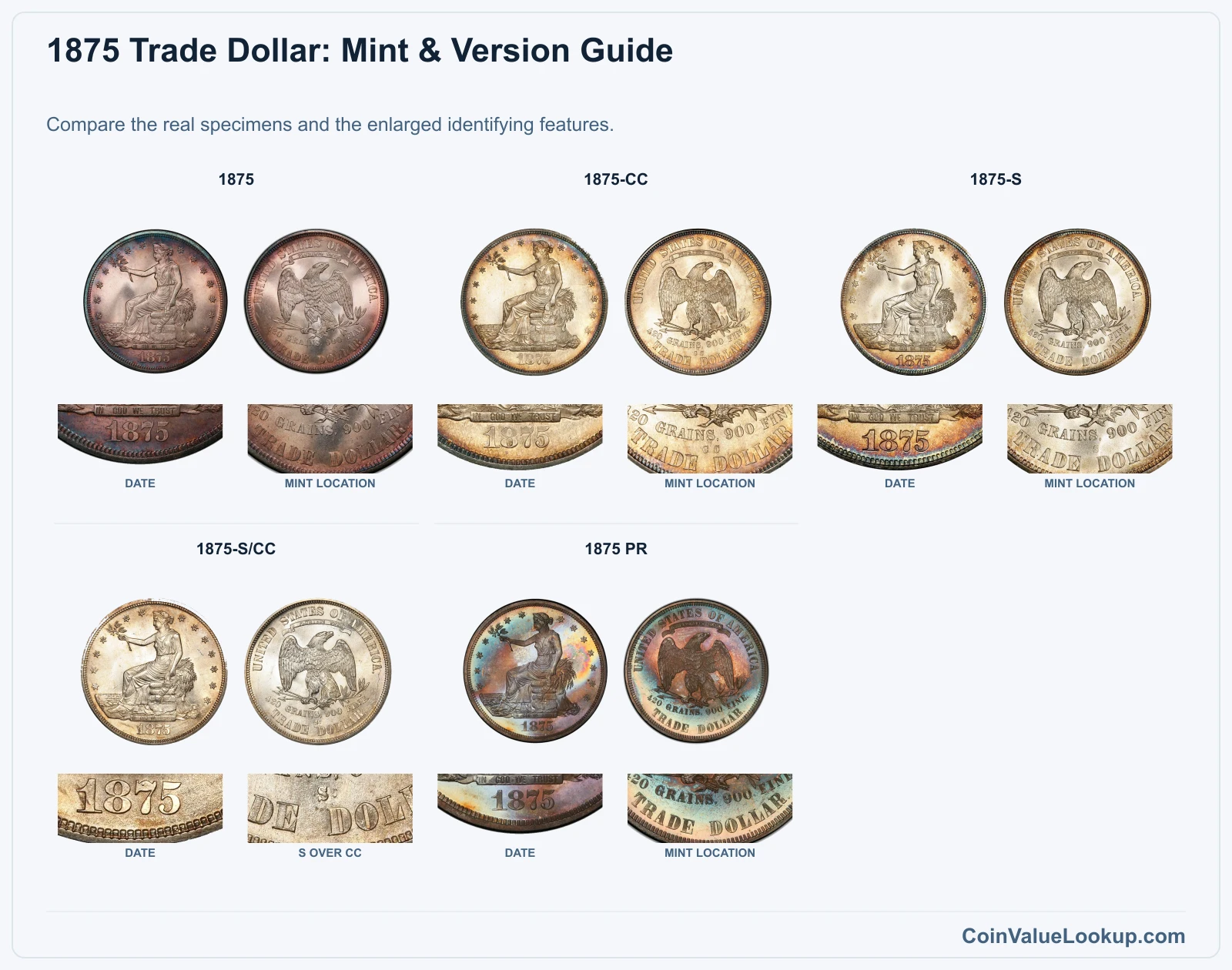
The 1875 Trade Dollar is a solid collectible with guide estimates ranging from about $414 in well-worn condition up to $19,341 for the right version in choice uncirculated grade. Those numbers are not guaranteed offers — they depend entirely on which mint struck your coin, its finish, and its actual condition.
Before you start dreaming about top dollar, you need to figure out whether you have a plain Philadelphia strike, a Carson City piece, a San Francisco coin, or the much more interesting S/CC overmintmark variety. A proof finish changes the picture entirely.
Fast Way to Identify Your 1875 Trade Dollar
Snap clear photos of the front and back of your 1875 Trade Dollar and upload them for a preliminary identification. Good lighting and a steady hand make all the difference.
This step helps sort out your mintmark, general condition, and whether you might have a proof or a notable variety — though it is not a substitute for professional authentication or certified grading.
1875 Trade Dollar Value
Upload both sides of your 1875 Trade Dollar.
Front Obverse
Upload photo
Back Reverse
Upload photo
Which 1875 Trade Dollar Versions Are Worth Money?
- The 1875-S/CC overmintmark shows traces of a CC mintmark beneath the S — guide estimates run from $476 in G4 up to $19,341 in MS63, making it the version to look for.
- The 1875 Proof (PR63 guide estimate: $4,285) is a special manufacturing finish, not just a high-grade business strike — confirm mirror fields and squared rims before assuming you have one.
Step 1: Identify Your 1875 Trade Dollar Mint Mark and Version
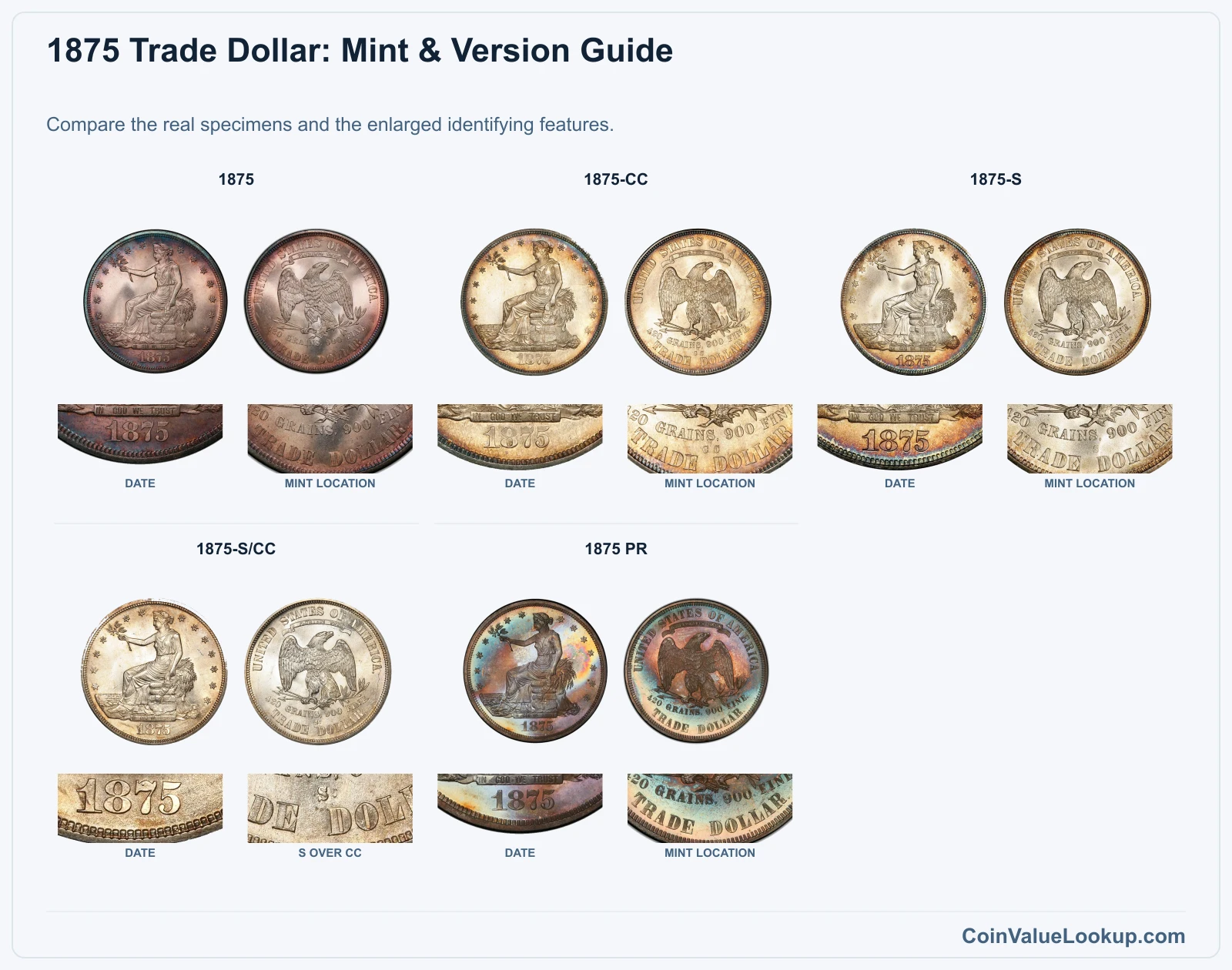
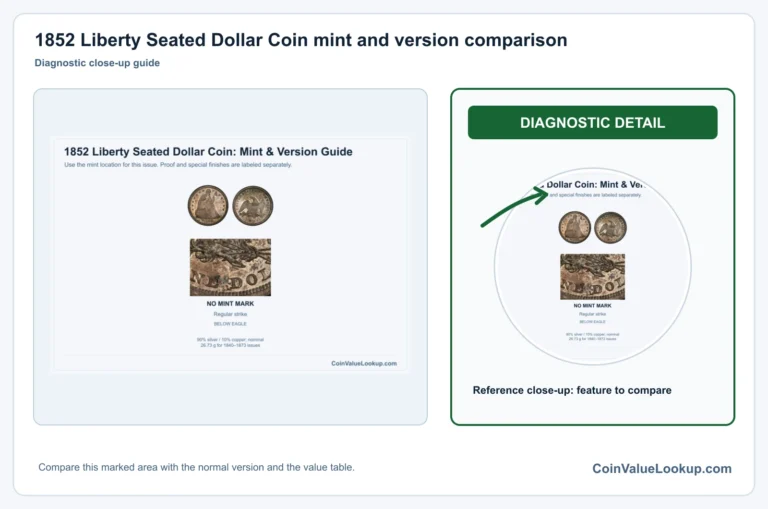
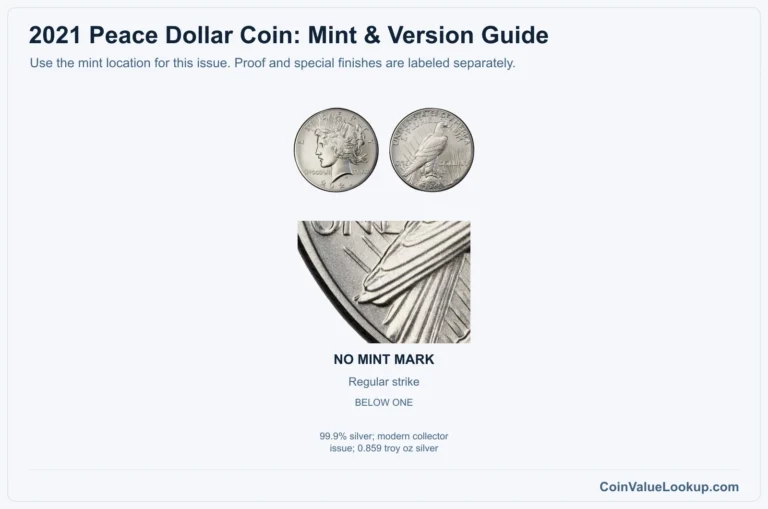
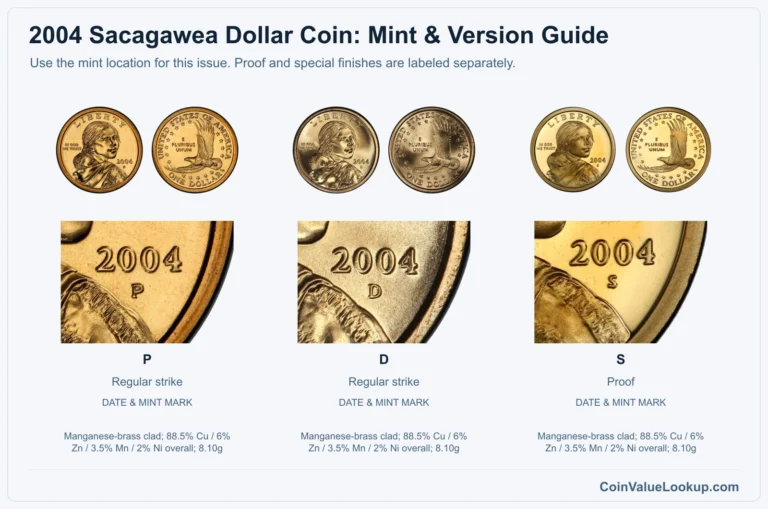
Flip the coin to the reverse and look below the eagle's tail feathers for a mintmark. Philadelphia coins carry no mark.
A small "CC" means Carson City. An "S" means San Francisco — but look closer, because some S-mint coins hide remnants of a CC punch underneath, making them the 1875-S/CC overmintmark variety.
The design is consistent across all mints: Seated Liberty faces left on the obverse, holding an olive branch and grain. The eagle reverse reads 420 GRAINS and 900 FINE.
The edge is reeded.
The coin is 90% silver and 10% copper, weighing 27.22 grams. If yours feels light or doesn't respond to a magnet test properly, question its authenticity before worrying about value.
Chopmarks — small stamps or punches on the surface — are merchant verification marks applied in Asian trade. They are not mint errors.
They do affect value, but they are a separate consideration from the coin's grade.
Step 2: Check Your 1875 Trade Dollar Grade
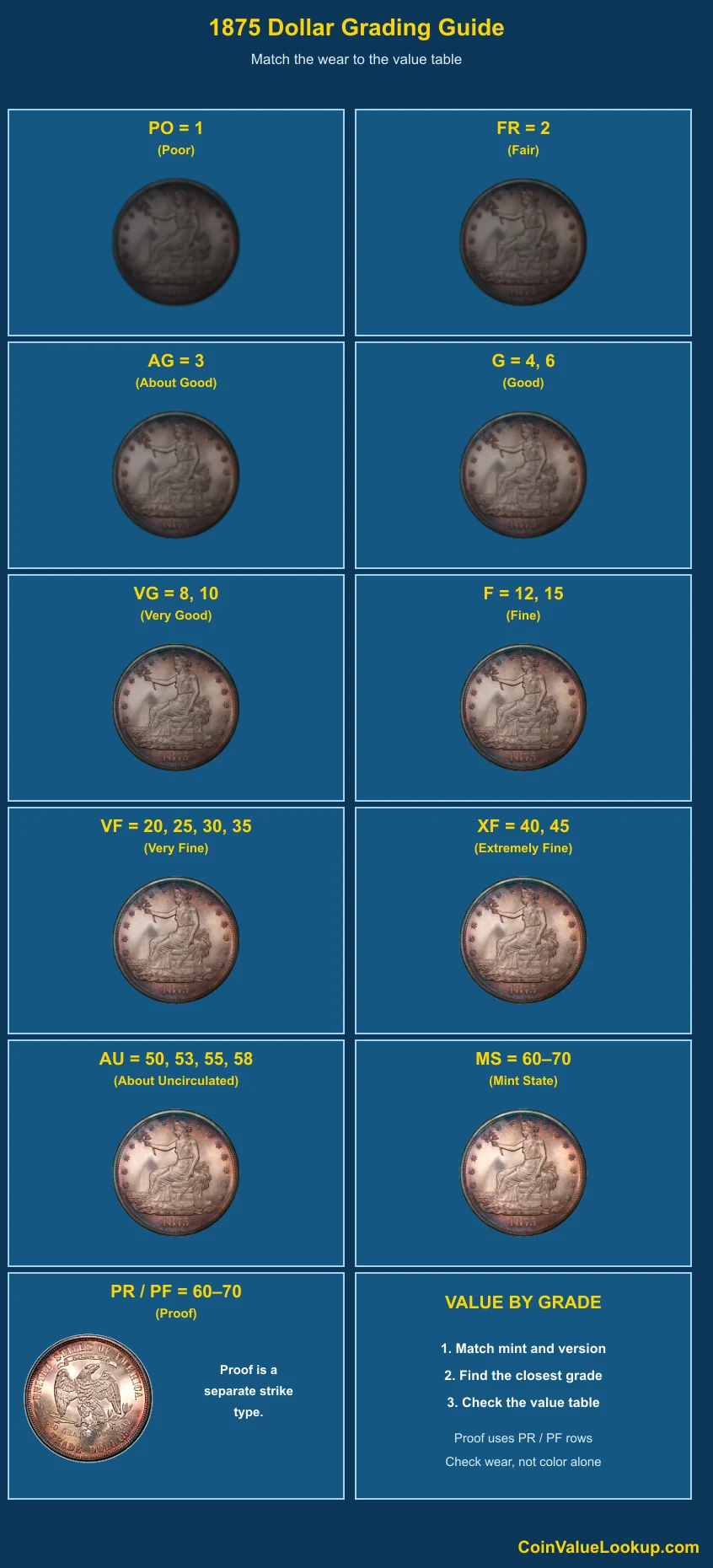
Focus on Liberty's head, her shoulder, and her forward knee on the obverse. These are the first areas to show wear.
On the reverse, check the eagle's breast feathers and the tops of the wings.
A coin in Good (G4) condition will have a flat, mostly outline-only Liberty. An About Uncirculated piece retains most detail with only slight friction on the highest points.
A Mint State coin shows no wear at all, just possible contact marks from other coins.
Use the comparison image to judge your coin against examples in circulated, AU, and Mint State condition. Proof coins are a different animal — they were struck with polished dies on polished planchets, producing mirror-like fields, and should be evaluated separately from business strikes.
Cleaning, polishing, or environmental damage can wreck a coin's market value even if the underlying detail looks sharp. If you see hairlines under a light or an unnatural shine, that matters.
Step 3: Check 1875 Trade Dollar Value by Mint and Version
1875 Trade Dollar
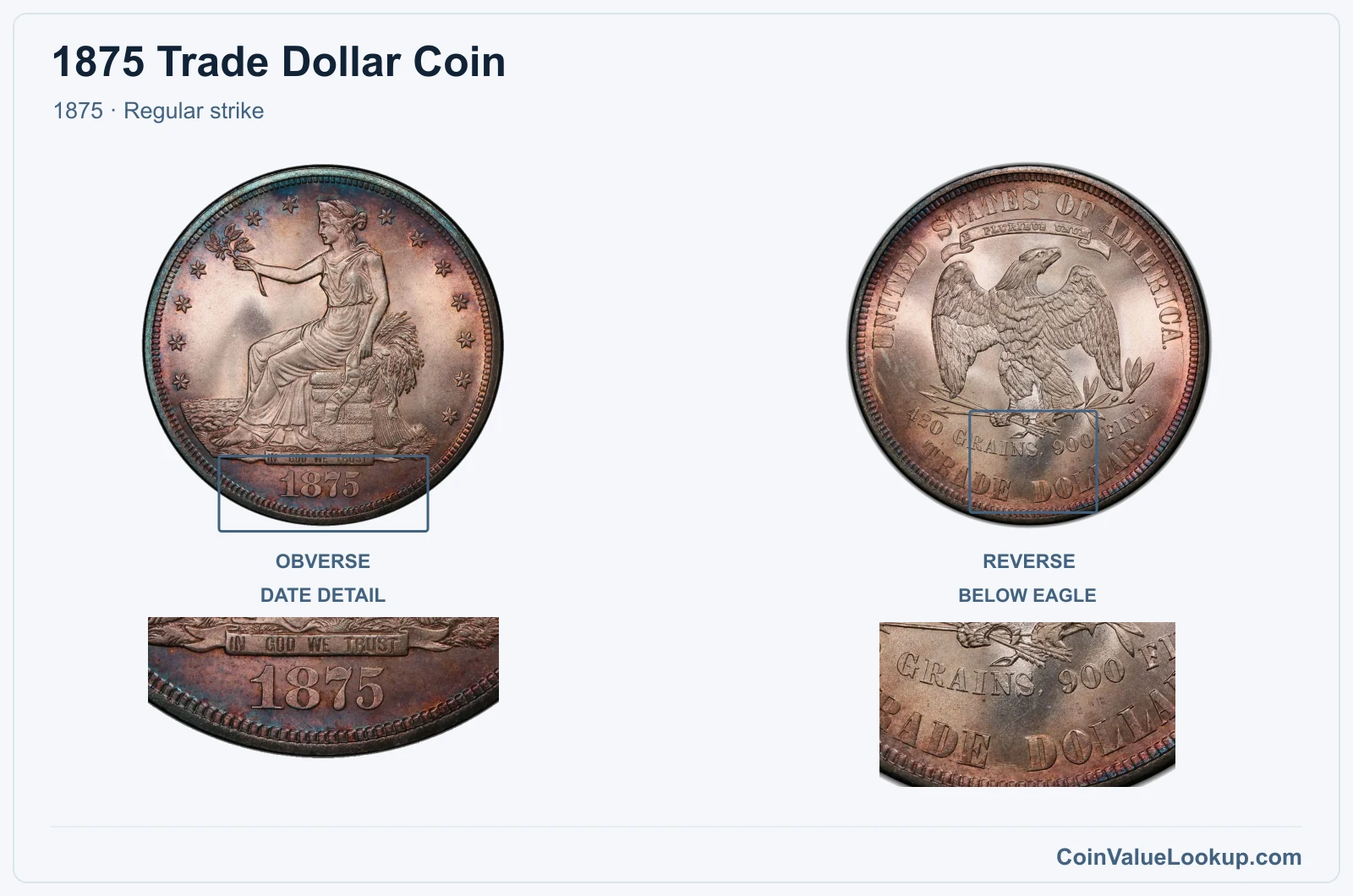
The 1875 Philadelphia Trade Dollar has no mintmark below the eagle. Guide estimates from USA Coin Book place it at roughly $414 in G4 and $5,661 in MS63.
These are not sale guarantees.
Original, uncleaned surfaces matter a great deal with this series. A coin that has been polished or dipped will not compare favorably to one with natural toning and original luster.
When attributing your coin, check the ribbon ends in Liberty's hand and the arrangement of arrows in the eagle's talons against a confirmed Type I reverse example.
Range Grade
Price Auction Records Appraisal PO PO 1
—
Coin Identifier FR FR 2
—
Coin Identifier AG AG 3
—
Coin Identifier G G 4
Coin Identifier
G 6
—
Coin Identifier VG VG 8
—
Coin Identifier
VG 10
—
Coin Identifier F F 12
Coin Identifier
F 15
—
Coin Identifier VF VF 20
Coin Identifier
VF 25
—
Coin Identifier
VF 30
Coin Identifier
VF 35
Coin Identifier XF XF 40
Coin Identifier
XF 45
Coin Identifier AU AU 50
Coin Identifier
AU 53
Coin Identifier
AU 55
Coin Identifier
AU 58
Coin Identifier MS MS 60
—
Coin Identifier
MS 61
Coin Identifier
MS 62
Coin Identifier
MS 63
Coin Identifier
MS 64
Coin Identifier
MS 65
Coin Identifier
MS 66
Coin Identifier
MS 67
—
Coin Identifier
MS 68
Coin Identifier
MS 69
—
—
—
MS 70
—
—
—
1875 Trade Dollar — CC
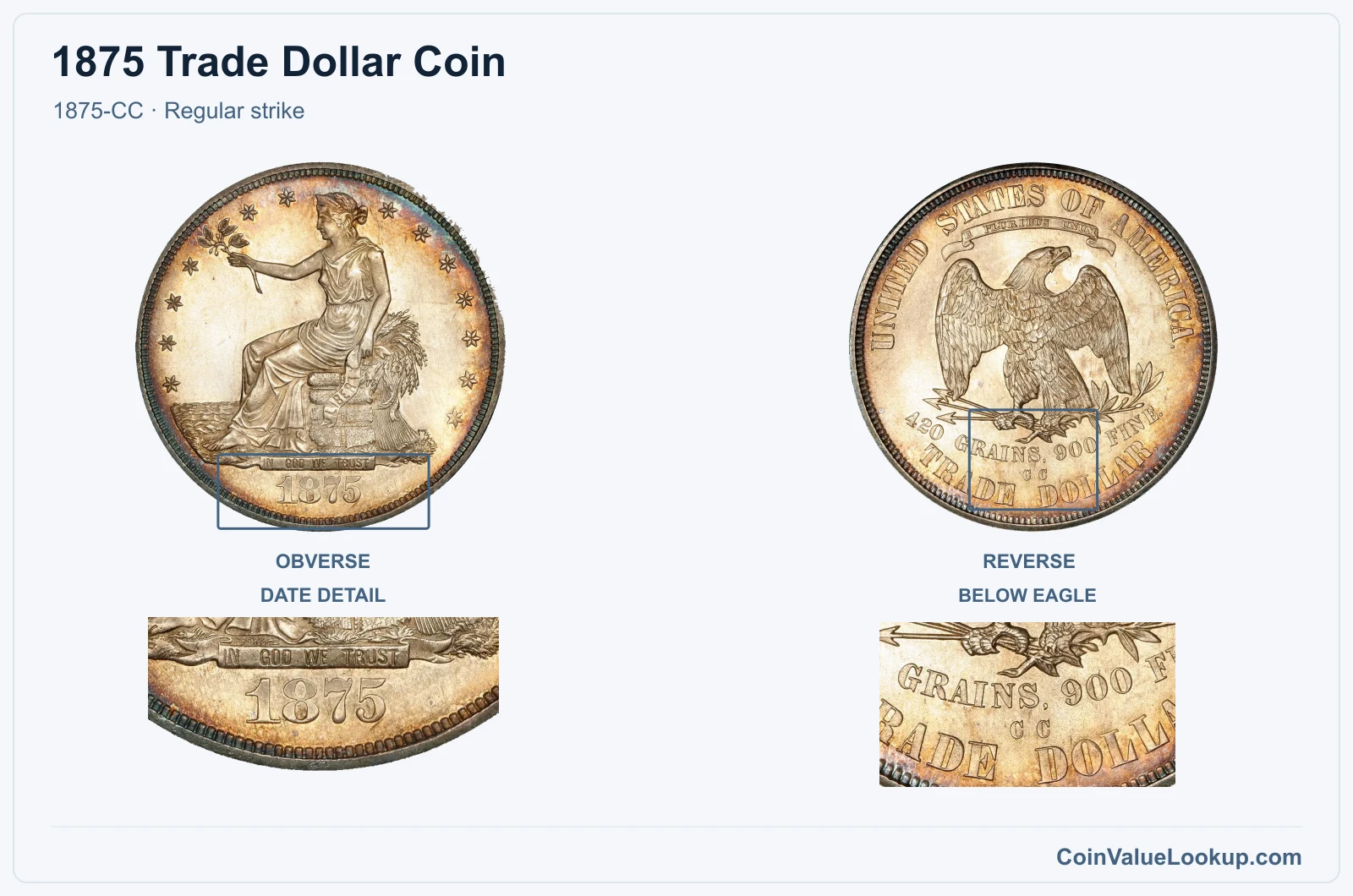
The 1875-CC was struck at the Carson City Mint. Look for the small "CC" below the eagle on the reverse.
Guide estimates start around $507 in G4 and reach about $5,758 in MS63.
Carson City coins carry a collector premium partly because the mint's output was smaller and its operational life was short. As always, original surfaces beat a cleaned coin every time.
Match your coin's reverse type carefully — examine the eagle's arrows and the ribbon details against an attributed image to confirm a Type I reverse.
Range Grade
Price Auction Records Appraisal PO PO 1
—
Coin Identifier FR FR 2
—
Coin Identifier AG AG 3
—
Coin Identifier G G 4
Coin Identifier
G 6
—
Coin Identifier VG VG 8
Coin Identifier
VG 10
—
Coin Identifier F F 12
Coin Identifier
F 15
—
Coin Identifier VF VF 20
Coin Identifier
VF 25
Coin Identifier
VF 30
Coin Identifier
VF 35
Coin Identifier XF XF 40
Coin Identifier
XF 45
Coin Identifier AU AU 50
Coin Identifier
AU 53
Coin Identifier
AU 55
Coin Identifier
AU 58
Coin Identifier MS MS 60
Coin Identifier
MS 61
Coin Identifier
MS 62
Coin Identifier
MS 63
Coin Identifier
MS 64
Coin Identifier
MS 65
Coin Identifier
MS 66
—
Coin Identifier
MS 67
—
—
—
MS 68
—
—
—
MS 69
—
—
—
MS 70
—
—
—
1875 Trade Dollar — S
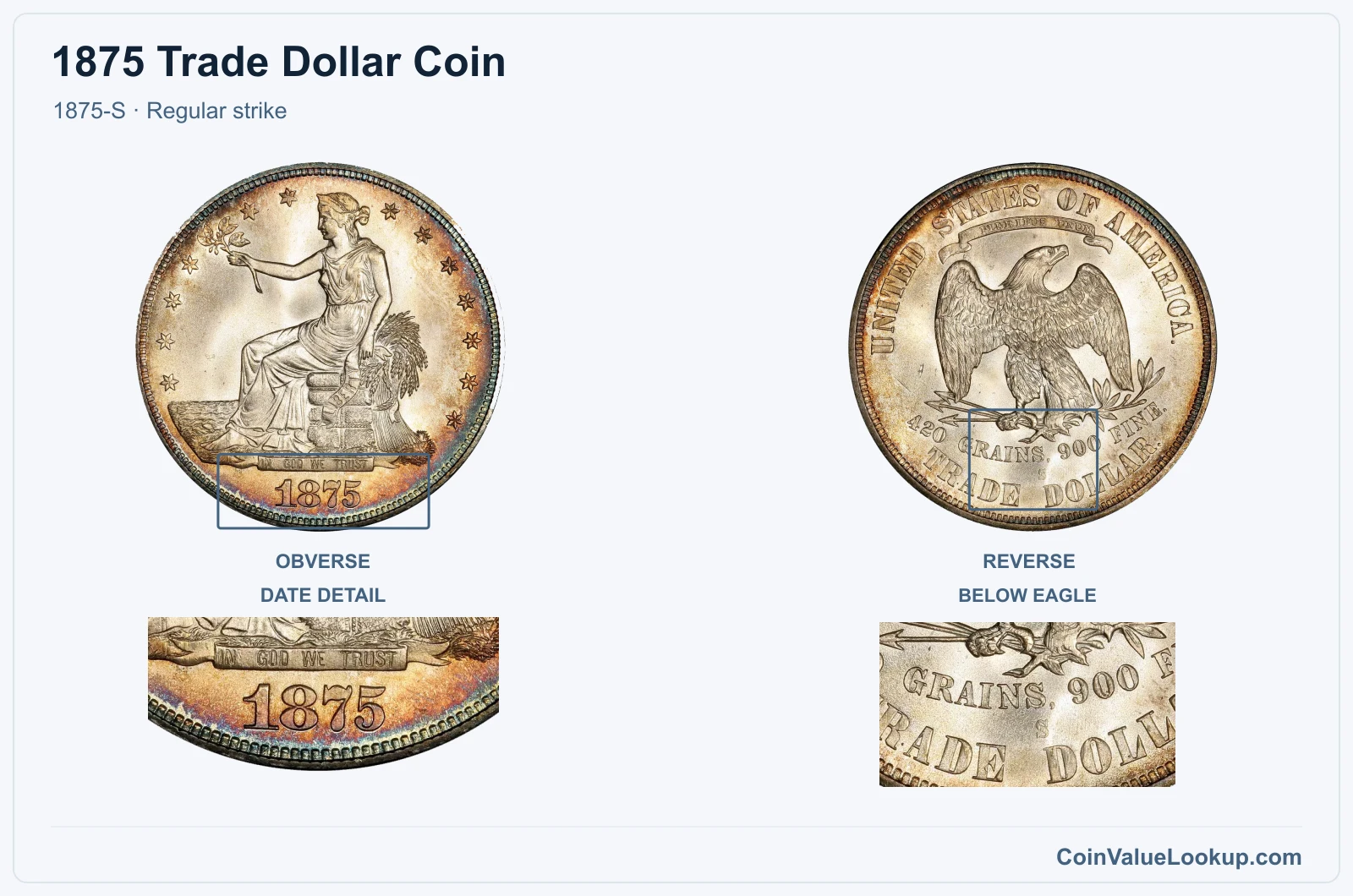
The 1875-S carries a small "S" mintmark below the eagle, indicating the San Francisco Mint. Guide estimates from USA Coin Book list $476 at G4 and $19,341 at MS63.
That high-end number reflects the S/CC overmintmark variety sharing the same table identity. Before assuming your S-mint coin commands that premium, you need to determine whether traces of a CC punch exist beneath the S.
A plain S-mint coin without the overmintmark is still a collectible piece, but the distinction is critical to value.
Coin Value Lookup is a handy starting point if you want to look up other coin guides in this series or compare related years side by side.
Range Grade
Price Auction Records Appraisal PO PO 1
—
Coin Identifier FR FR 2
—
Coin Identifier AG AG 3
—
Coin Identifier G G 4
—
Coin Identifier
G 6
—
Coin Identifier VG VG 8
Coin Identifier
VG 10
—
Coin Identifier F F 12
—
Coin Identifier
F 15
Coin Identifier VF VF 20
Coin Identifier
VF 25
Coin Identifier
VF 30
Coin Identifier
VF 35
Coin Identifier XF XF 40
Coin Identifier
XF 45
Coin Identifier AU AU 50
Coin Identifier
AU 53
Coin Identifier
AU 55
Coin Identifier
AU 58
Coin Identifier MS MS 60
Coin Identifier
MS 61
Coin Identifier
MS 62
Coin Identifier
MS 63
Coin Identifier
MS 64
Coin Identifier
MS 65
Coin Identifier
MS 66
Coin Identifier
MS 67
Coin Identifier
MS 68
—
Coin Identifier
MS 69
—
—
—
MS 70
—
—
—
1875 Trade Dollar — S/CC
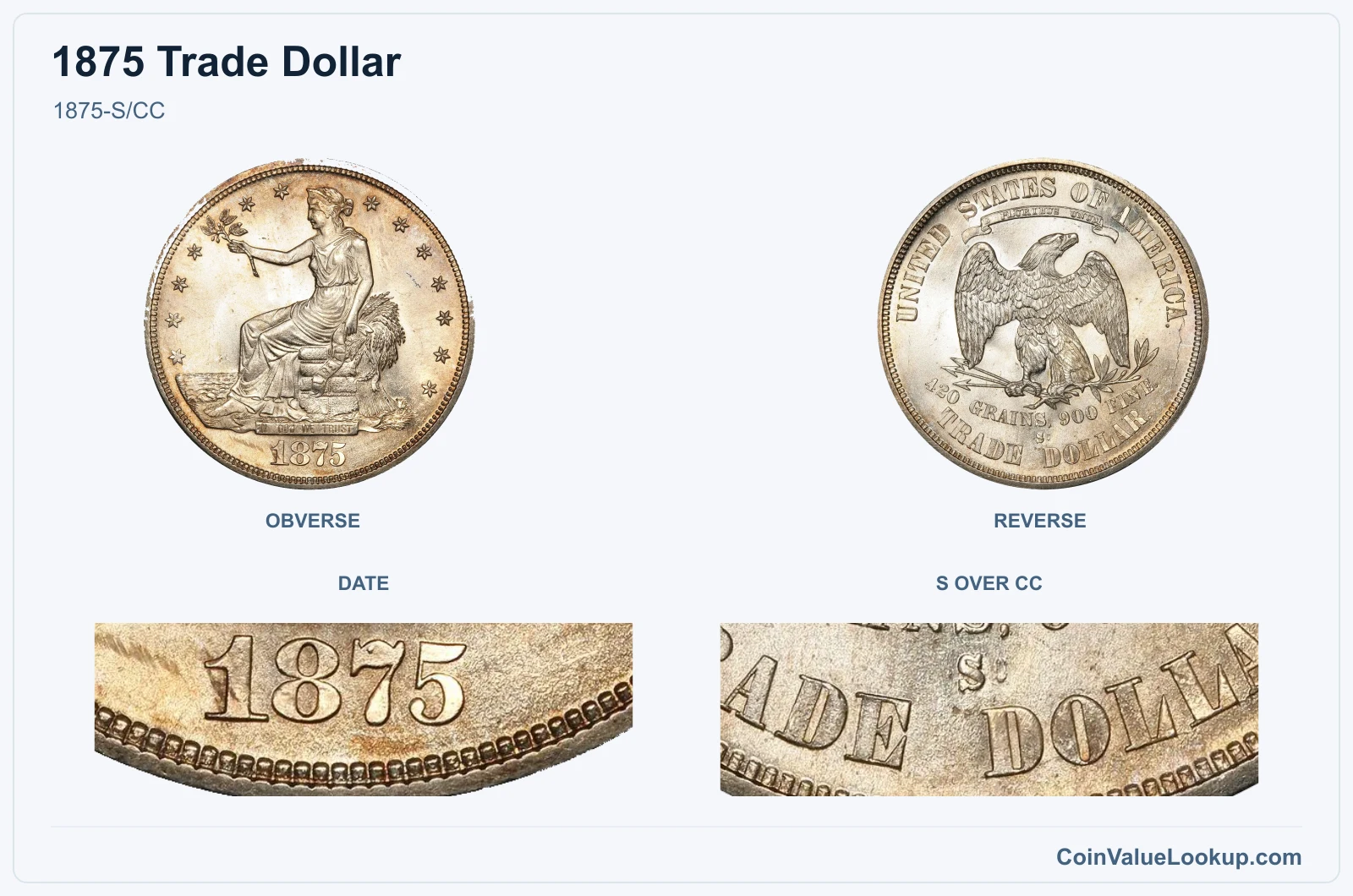
This is the one everyone wants to find. The 1875-S/CC shows a San Francisco "S" mintmark punched over the remnants of a Carson City "CC" mintmark.
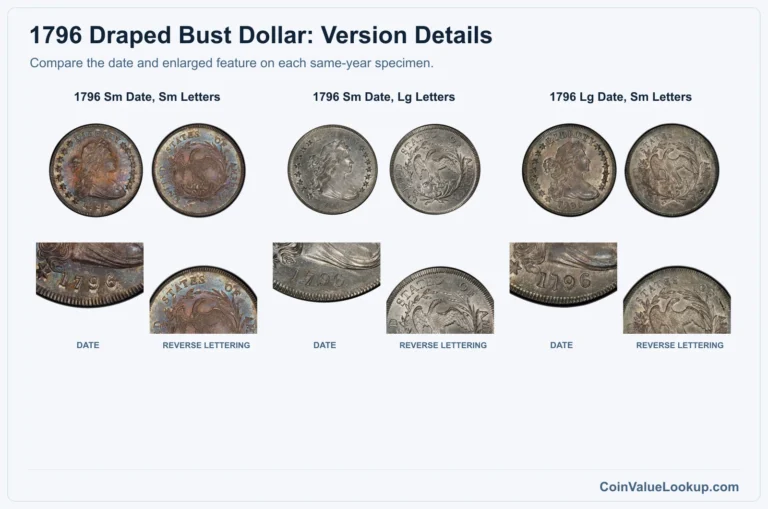
You need magnification to confirm it — look for the ghostly outlines of the CC beneath and slightly offset from the S.
Guide estimates match the S-mint table at $476 in G4 and $19,341 in MS63, but the overmintmark is the specific reason collectors pay attention. This variety exists because a die originally prepared for Carson City was repurposed by the San Francisco Mint.
Do not confuse this with a simple repunched mintmark where the same letter was struck twice. The key diagnostic is two distinctly different letter forms — an S over CC.
Professional authentication is strongly recommended for this variety, since the premium depends on confirmed attribution.
Range Grade
Price Auction Records Appraisal PO PO 1
—
Coin Identifier FR FR 2
—
Coin Identifier AG AG 3
—
Coin Identifier G G 4
—
Coin Identifier
G 6
—
Coin Identifier VG VG 8
—
Coin Identifier
VG 10
—
Coin Identifier F F 12
—
Coin Identifier
F 15
—
Coin Identifier VF VF 20
—
Coin Identifier
VF 25
Coin Identifier
VF 30
—
Coin Identifier
VF 35
—
Coin Identifier XF XF 40
Coin Identifier
XF 45
Coin Identifier AU AU 50
Coin Identifier
AU 53
Coin Identifier
AU 55
Coin Identifier
AU 58
Coin Identifier MS MS 60
Coin Identifier
MS 61
Coin Identifier
MS 62
Coin Identifier
MS 63
Coin Identifier
MS 64
Coin Identifier
MS 65
Coin Identifier
MS 66
—
—
—
MS 67
—
—
—
MS 68
—
—
—
MS 69
—
—
—
MS 70
—
—
—
1875 Trade Dollar — PR
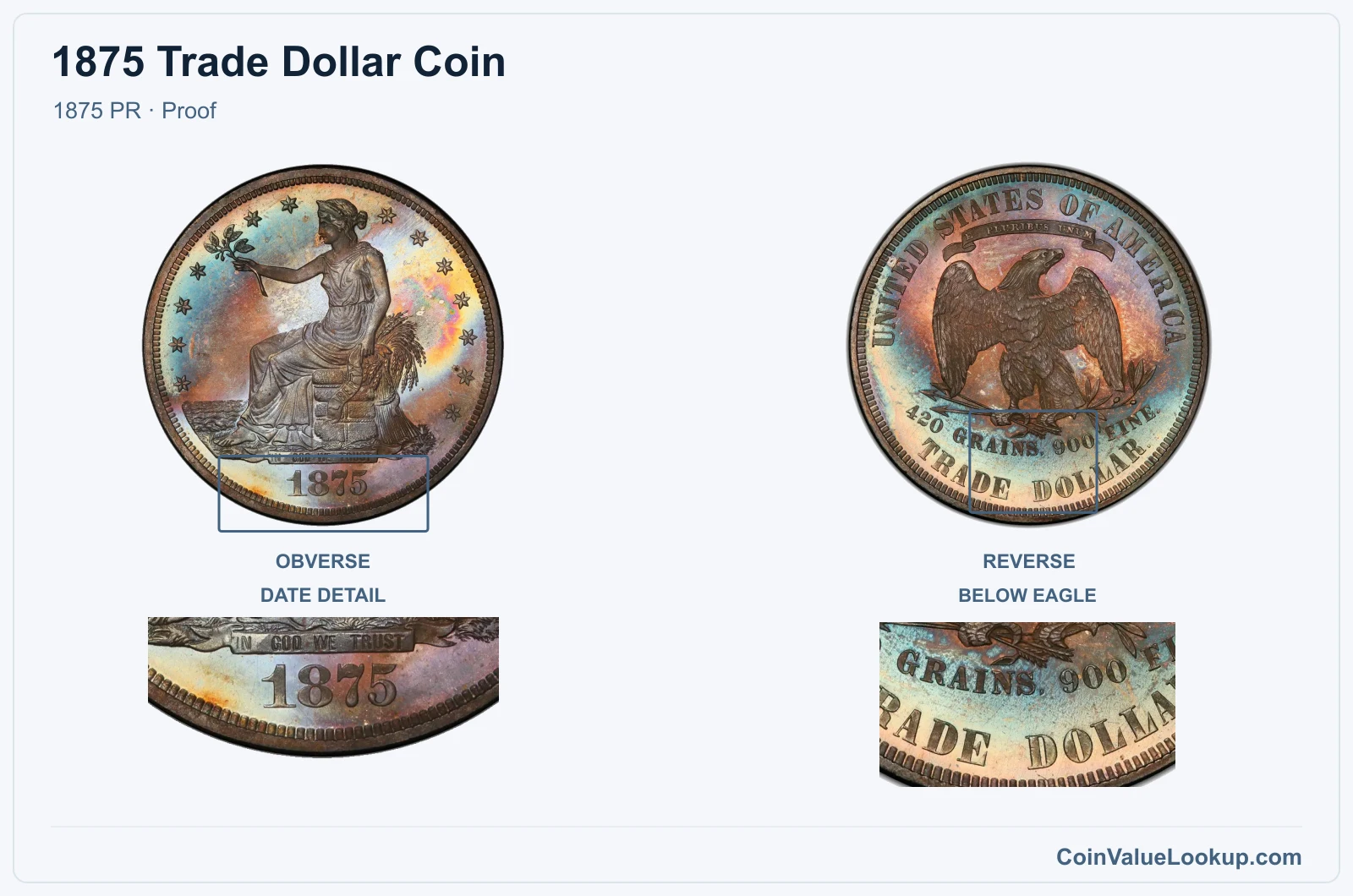
The 1875 Proof Trade Dollar was struck at Philadelphia using polished dies and polished planchets, producing deeply mirrored fields. A proof is a manufacturing method, not simply a shiny coin or a grade above Mint State.
Look for squared-off rims and exceptionally sharp detail in Liberty's hair and the eagle's feathers.
The guide estimate for a PR63 example is about $4,285. Proof Trade Dollars were made in small quantities for collectors, not for commerce.
If your coin has mirror-like surfaces but also bag marks, friction, or rounded rims, it is more likely a well-preserved business strike than a proof. Confirmation from a grading service is the safest route.
Range Grade
Price Auction Records Appraisal PR PR 1
—
Coin Identifier
PR 2
—
Coin Identifier
PR 3
—
Coin Identifier
PR 4
—
Coin Identifier
PR 6
—
Coin Identifier
PR 8
—
Coin Identifier
PR 10
—
Coin Identifier
PR 12
—
Coin Identifier
PR 15
—
Coin Identifier
PR 20
—
Coin Identifier
PR 25
—
Coin Identifier
PR 30
—
Coin Identifier
PR 35
—
Coin Identifier
PR 40
—
Coin Identifier
PR 45
—
Coin Identifier
PR 50
—
Coin Identifier
PR 53
—
Coin Identifier
PR 55
Coin Identifier
PR 58
Coin Identifier
PR 60
Coin Identifier
PR 61
Coin Identifier
PR 62
Coin Identifier
PR 63
Coin Identifier
PR 64
Coin Identifier
PR 65
Coin Identifier
PR 66
Coin Identifier
PR 67
Coin Identifier
PR 68
—
—
—
PR 69
—
—
—
PR 70
—
—
—
1875 Trade Dollar Error List
1. 1875 Trade Dollar — Over-Mintmark
An over-mintmark on the 1875 Trade Dollar means one mint's letter was punched over a different mint's letter on the same die. The confirmed example for this year is the 1875-S/CC, where traces of the Carson City CC appear beneath the San Francisco S.
Heritage Auctions has cataloged an MS65 NGC example of this variety.
To spot it, use at least 5x magnification and examine the mintmark area below the eagle. You are looking for outlines of the CC that do not align with the final S punch.
The remnants are subtle on well-worn coins and more obvious on higher-grade pieces.
Do not confuse this with a repunched mintmark, where the same letter was simply struck twice in slightly different positions. Likewise, a die chip or surface damage near the mintmark can mimic an underlying letter.
Value depends on condition and how clearly the underlying CC is visible, but no specific price range is adopted here — professional attribution is the right first step.
2. 1875 Trade Dollar — Die Crack / Die Chip
Die cracks on 1875 Trade Dollars appear as thin raised lines running across the coin's surface. They form when a working die develops a fracture from repeated use, and the crack fills with metal during striking.
A die chip is a small raised blob where a piece of the die face has broken away.
To identify a genuine die crack, look for a raised line that is continuous and follows no logical design element. Rim-to-rim cracks and cracks connecting design elements are both possible.
A cud — where a die chunk breaks away at the rim — is a related but distinct category.
Do not confuse die cracks with incuse scratches (which are recessed into the surface), corrosion lines, or foreign material stuck to the coin. A scratch cuts into metal; a die crack sits above it.
Value depends on the crack's size, location, and the coin's overall condition. No specific price range is adopted for this category.
3. 1875 Trade Dollar — Clashed Dies
Clashed dies occur when the obverse and reverse dies strike each other without a planchet between them. The impact transfers a ghostly impression of each die's design onto the opposing die.
Every coin struck afterward carries faint traces of the wrong design in its fields.
On a clashed 1875 Trade Dollar, you might see partial outlines of the eagle's wings in Liberty's field, or traces of Liberty's head and arm in the open areas around the eagle. The transferred elements will be correctly oriented relative to the opposing die's layout — this alignment is your best confirmation.
Scratches, random raised lines, and surface contamination can look similar at first glance. A brockage — where a previously struck coin acts as a die — produces a different effect entirely.
True clash marks are consistent across multiple coins from the same die pair. Value depends on how visible the clash is and the coin's grade, but no numerical range is adopted here.