1850 Liberty Seated Dollar Coin Value: How Much Is It Worth?
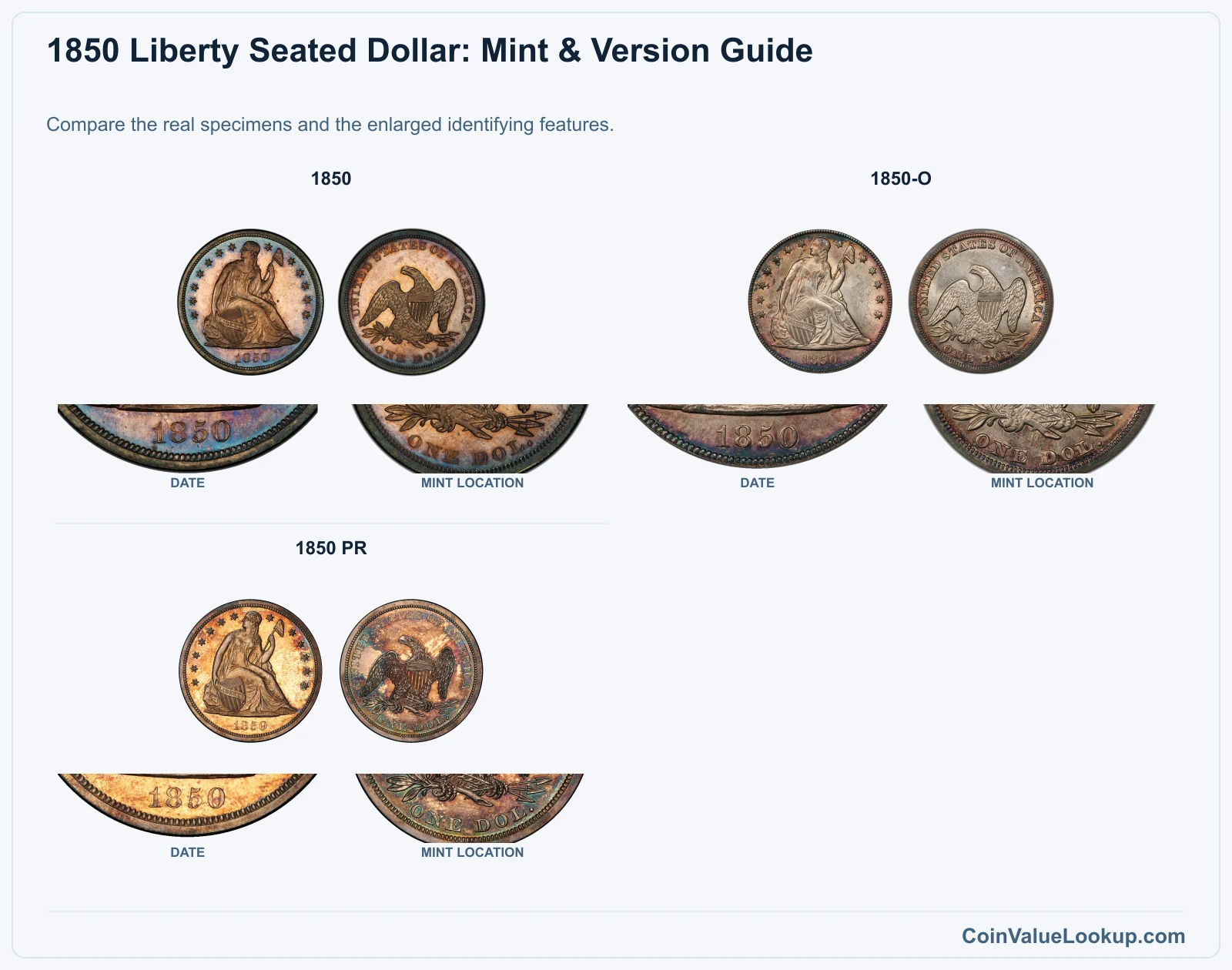
The 1850 Liberty Seated Dollar is a collectible silver coin with guide estimates ranging from about $679 in well-worn condition up to roughly $33,724 in choice uncirculated grades, depending on mint and version. Those figures are guide estimates, not guaranteed offers.
Before you assign any value, you need to identify the exact mint, finish, and design branch of your specific coin.
Fast Way to Identify Your 1850 Liberty Seated Dollar
The quickest way to start figuring out what you have is to upload clear photos of the front and back of your coin. Our identifier can provide a preliminary identification of the mint, design type, and general condition.
It will not authenticate errors or assign a precise grade, but it gives you a solid starting point for further research.
1850 Liberty Seated Dollar Value
Upload both sides of your 1850 Liberty Seated Dollar.
Front Obverse
Upload photo
Back Reverse
Upload photo
Which 1850 Liberty Seated Dollar Versions Are Worth Money?
- The 1850-O (New Orleans) in MS63 condition carries a guide estimate of about $33,724, making it the highest-valued business strike branch listed for this year at that grade.
- The 1850 Proof is a separate finish that requires individual assessment by authenticated identity and condition, since no standard guide price is adopted here.
Step 1: Identify Your 1850 Liberty Seated Dollar Mint Mark and Version
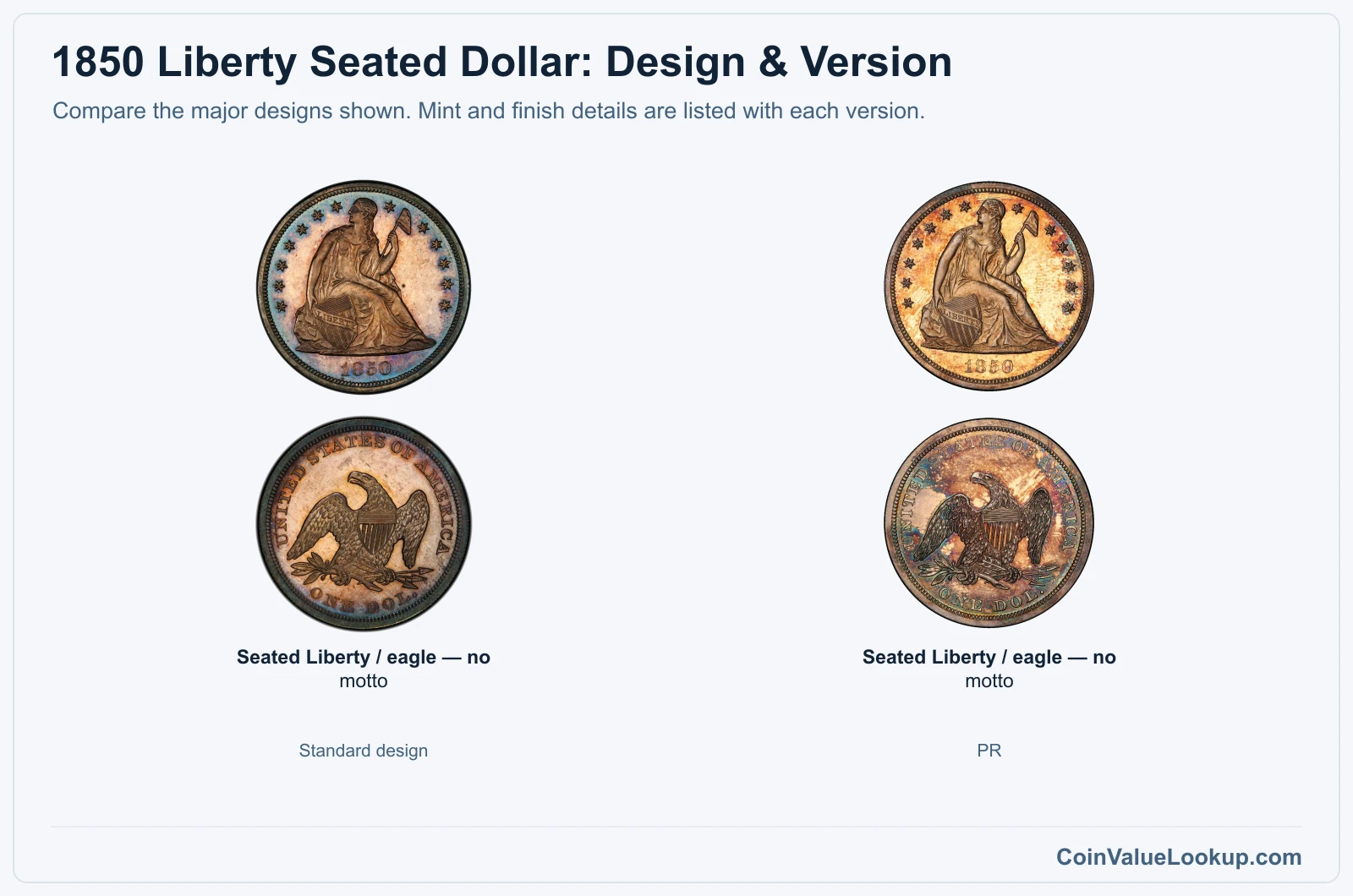
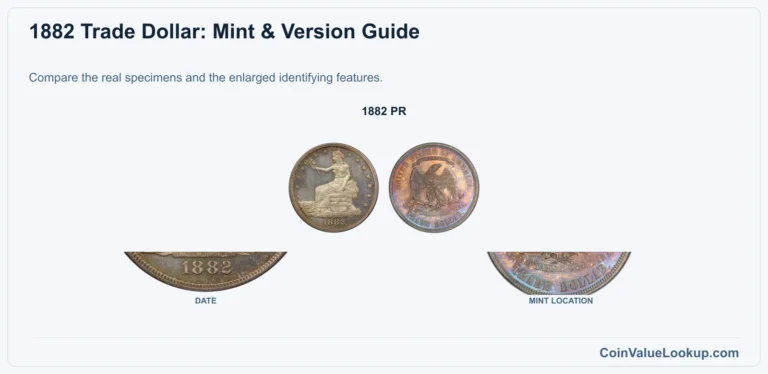
The 1850 Liberty Seated Dollar comes in three distinct branches: the Philadelphia business strike (no mintmark), the New Orleans issue (small "O" mintmark on the reverse below the eagle and above the ONE DOL. legend), and the Philadelphia proof.
Philadelphia coins carry no mintmark at all, so the absence of a letter does not automatically mean it is rare or special. If you see an "O" on the reverse, you have the New Orleans version.
All three are struck in 90% silver and 10% copper at a nominal weight of 26.73 grams. The design features the Seated Liberty figure on the obverse and an eagle on the reverse, with no motto above the eagle for this year.
Proofs are a manufacturing finish, not simply a shiny or high-grade regular coin. A true proof will have squared rims, mirror-like fields, and sharp detail that differs from even the best business strikes.
If you are unsure, professional authentication is the safest route.
Step 2: Check Your 1850 Liberty Seated Dollar Grade
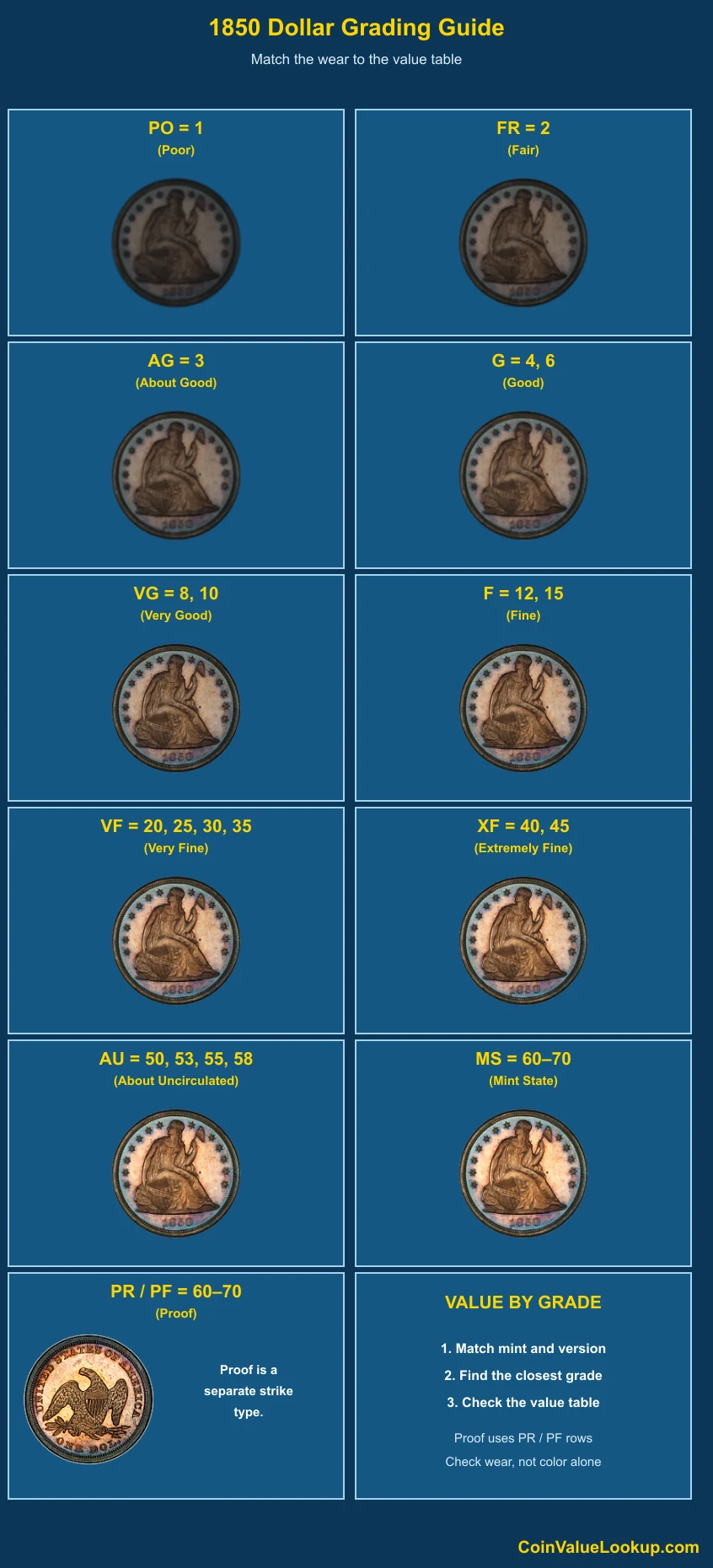
When grading a Liberty Seated Dollar, focus on the high points that wear first. On the obverse, check Liberty's head, the breast area, the knee, and the details on the shield she holds.
On the reverse, examine the eagle's breast feathers and wing tips.
Do not grade a weakly struck head in isolation. Some coins left the mint with soft strikes on Liberty's head, and that is not the same as circulation wear.
Look for flat, smooth patches versus sharp but shallow detail.
A coin in Good condition (G4) will show a clear outline of Liberty but most interior detail is gone. At About Uncirculated, only the highest points show slight friction, and full luster should remain in protected areas.
Mint State coins have no wear at all.
Use the comparison image to see these differences side by side. Original surfaces matter: polished or cleaned coins lose the natural toning and luster that graders look for, and their market value drops accordingly.
Step 3: Check 1850 Liberty Seated Dollar Value by Mint and Version
1850 Liberty Seated Dollar
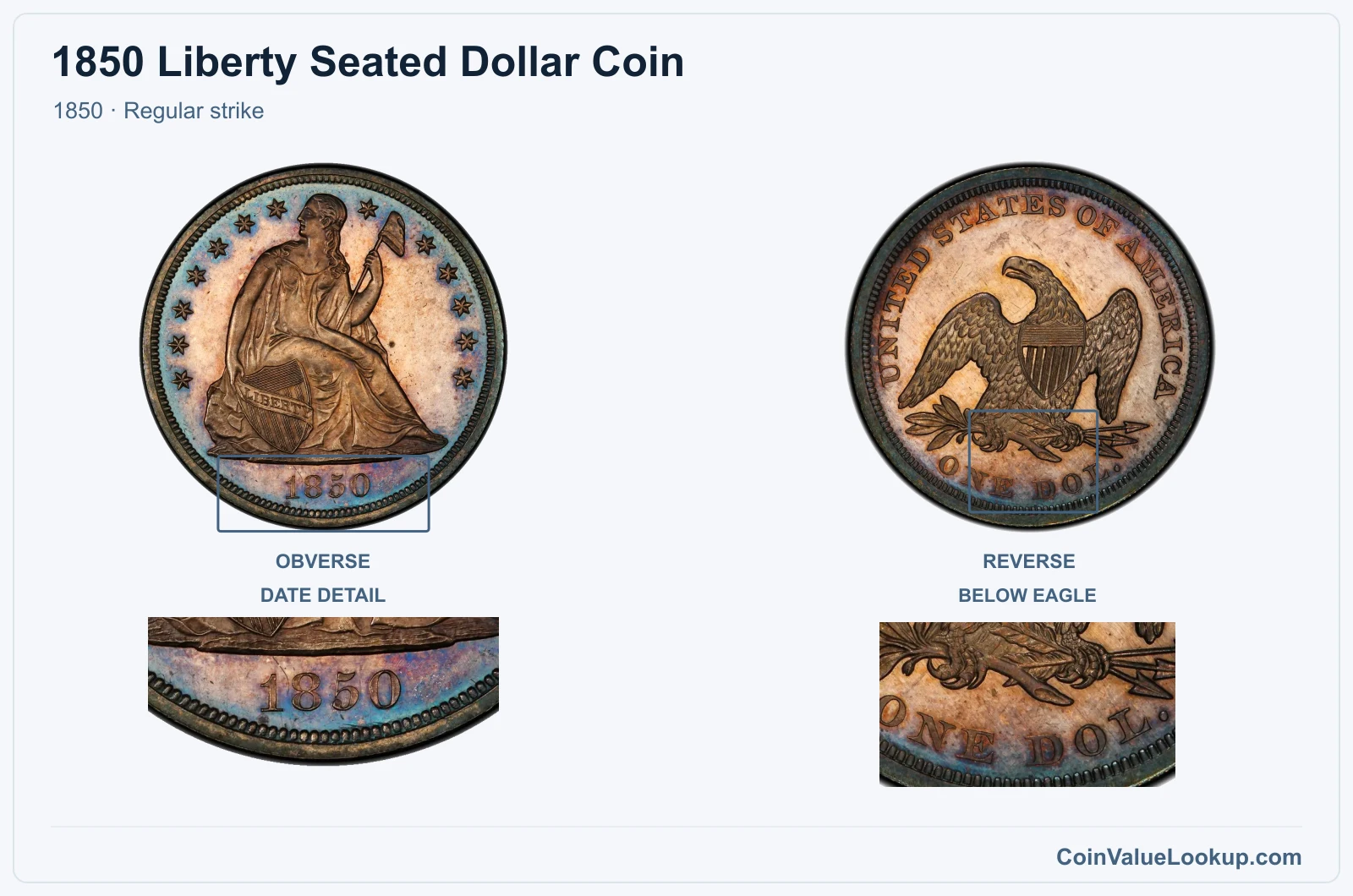
The 1850 Philadelphia dollar has no mintmark. It is a business strike with the no-motto Seated Liberty and eagle design.
In Good-4 condition, the USA Coin Book guide estimate is about $761. Jump to MS63, and that figure climbs to roughly $17,210.
Those are guide estimates, not offers to buy. Original surfaces and accurate grading matter enormously at every level.
A cleaned or polished coin will not command the same price as one with natural toning and undisturbed luster. Confirm the mint and design before comparing your coin to any price table.
Range Grade
Price Auction Records Appraisal PO PO 1
—
Coin Identifier FR FR 2
—
Coin Identifier AG AG 3
—
Coin Identifier G G 4
—
Coin Identifier
G 6
—
Coin Identifier VG VG 8
Coin Identifier
VG 10
—
Coin Identifier F F 12
Coin Identifier
F 15
—
Coin Identifier VF VF 20
Coin Identifier
VF 25
Coin Identifier
VF 30
Coin Identifier
VF 35
Coin Identifier XF XF 40
Coin Identifier
XF 45
Coin Identifier AU AU 50
Coin Identifier
AU 53
Coin Identifier
AU 55
Coin Identifier
AU 58
Coin Identifier MS MS 60
Coin Identifier
MS 61
Coin Identifier
MS 62
Coin Identifier
MS 63
Coin Identifier
MS 64
Coin Identifier
MS 65
—
—
—
MS 66
—
—
—
MS 67
—
—
—
MS 68
—
—
—
MS 69
—
—
—
MS 70
—
—
—
1850 Liberty Seated Dollar — O
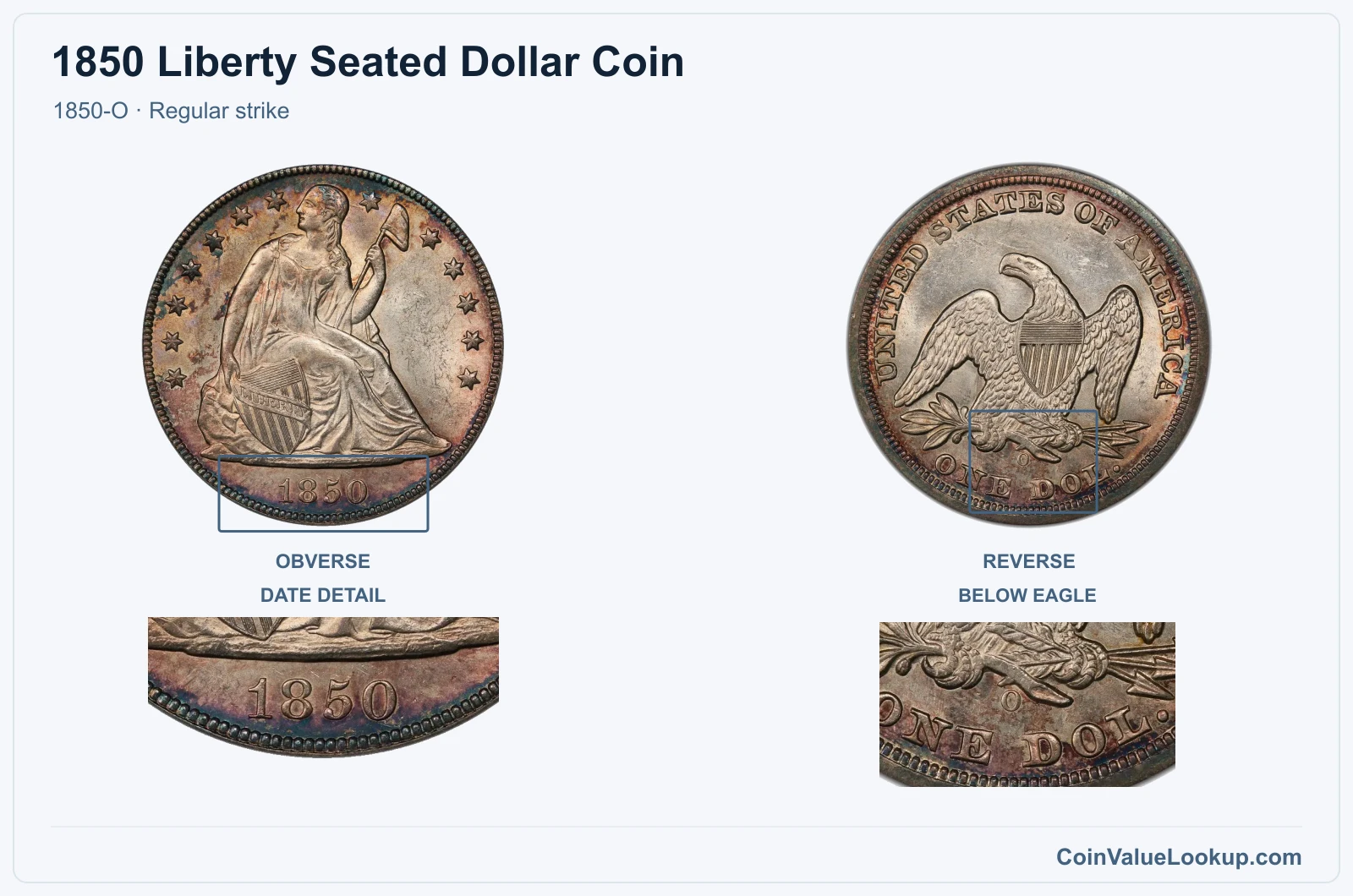
The 1850-O was struck at the New Orleans Mint. Look for a small "O" on the reverse, positioned below the eagle and above ONE DOL.
In Good-4, this version carries a guide estimate of about $679, the lowest entry point among this year's branches.
At MS63, however, the estimate jumps to around $33,724 according to USA Coin Book. That steep climb reflects how few New Orleans dollars survived in high grades.
Cleaning or damage will significantly reduce what any example is worth, so original surfaces are critical. Match your coin's mintmark and condition carefully before drawing conclusions.
Coin Value Lookup is a good place to look up guides for other dates and mints in the Liberty Seated Dollar series if you want to compare across years.
Range Grade
Price Auction Records Appraisal PO PO 1
—
Coin Identifier FR FR 2
—
Coin Identifier AG AG 3
—
Coin Identifier G G 4
Coin Identifier
G 6
Coin Identifier VG VG 8
Coin Identifier
VG 10
Coin Identifier F F 12
Coin Identifier
F 15
Coin Identifier VF VF 20
Coin Identifier
VF 25
Coin Identifier
VF 30
Coin Identifier
VF 35
Coin Identifier XF XF 40
Coin Identifier
XF 45
Coin Identifier AU AU 50
Coin Identifier
AU 53
Coin Identifier
AU 55
Coin Identifier
AU 58
Coin Identifier MS MS 60
—
Coin Identifier
MS 61
Coin Identifier
MS 62
Coin Identifier
MS 63
Coin Identifier
MS 64
Coin Identifier
MS 65
—
—
—
MS 66
—
—
—
MS 67
—
—
—
MS 68
—
—
—
MS 69
—
—
—
MS 70
—
—
—
1850 Liberty Seated Dollar — PR
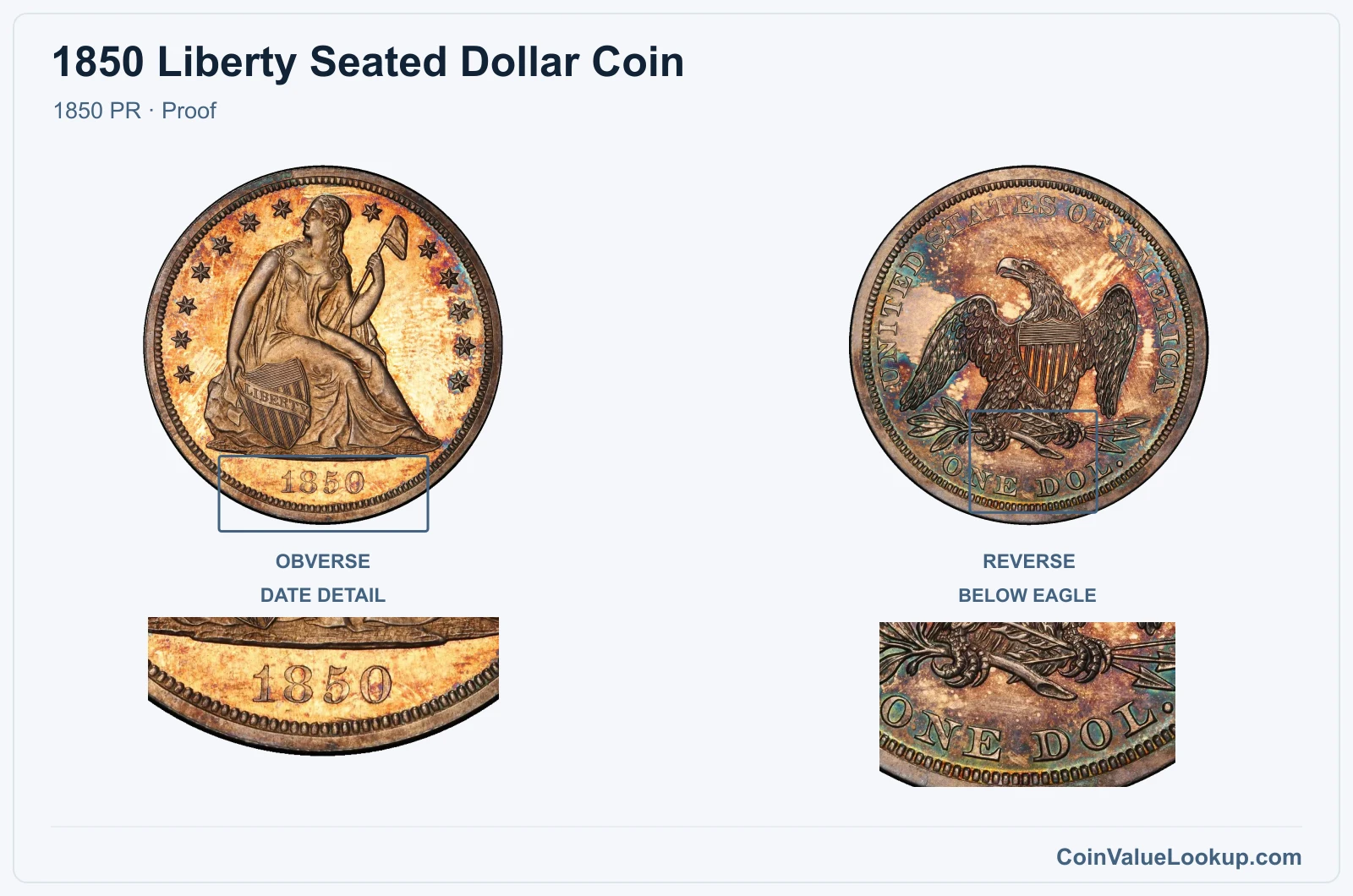
The 1850 Proof is a Philadelphia issue struck with specially prepared dies on polished planchets. There is no mintmark.
A proof is a manufacturing finish, not simply a shiny or high-grade regular coin. True proofs display mirror-like fields, sharply squared rims, and exceptional detail that business strikes do not replicate.
No standard guide price is adopted for this version. Value depends on the coin's authenticated identity, its condition, and whether any errors are present.
Professional certification is strongly recommended before buying or selling an 1850 proof dollar, because the difference between a genuine proof and a prooflike business strike can be worth a great deal of money.
Range Grade
Price Auction Records Appraisal PR PR 1
—
Coin Identifier
PR 2
—
Coin Identifier
PR 3
—
Coin Identifier
PR 4
—
Coin Identifier
PR 6
—
Coin Identifier
PR 8
—
Coin Identifier
PR 10
—
Coin Identifier
PR 12
—
Coin Identifier
PR 15
—
Coin Identifier
PR 20
—
Coin Identifier
PR 25
—
Coin Identifier
PR 30
—
Coin Identifier
PR 35
—
Coin Identifier
PR 40
—
Coin Identifier
PR 45
—
Coin Identifier
PR 50
—
Coin Identifier
PR 53
—
Coin Identifier
PR 55
Coin Identifier
PR 60
—
Coin Identifier
PR 61
Coin Identifier
PR 62
Coin Identifier
PR 63
Coin Identifier
PR 64
Coin Identifier
PR 65
Coin Identifier
PR 66
Coin Identifier
PR 67
—
—
—
PR 68
—
—
—
PR 69
—
—
—
PR 70
—
—
—
1850 Liberty Seated Dollar Error List
1. 1850 Liberty Seated Dollar — Die Crack / Die Chip
Die cracks appear as thin raised lines on the coin's surface, caused by fractures in the steel die during production. A die chip is a small raised blob where a piece of the die face broke away.
If the crack reaches the rim and a chunk of metal fills in, that is called a cud.
On the 1850 Liberty Seated Dollar from Philadelphia, die cracks have been reported. Look carefully at both sides under good lighting and magnification.
The lines will be raised above the surface, following no logical design element.
Do not confuse die cracks with incuse scratches, corrosion lines, or foreign material stuck to the surface. Scratches are recessed into the metal, while cracks are raised.
No specific price data is adopted for this error; value depends on the crack's size, location, visibility, and the coin's overall condition.
2. 1850 Liberty Seated Dollar — Repunched Date
A repunched date occurs when the date numerals were punched into the die more than once in slightly different positions. On the coin, you will see faint remnants of an earlier punch beside or overlapping the final digits of 1850.
This is distinct from doubling of the entire design, which has a different cause.
The reported repunched date variety for the 1850 Liberty Seated Dollar has been noted in proof format and is considered a scarce variety. Do not confuse it with a damaged date, where post-strike hits distort the numerals, or with machine doubling, which produces flat shelf-like traces rather than the rounded secondary images of a repunched date.
No specific price is adopted for this error. Value depends on the clarity of the repunching, the coin's authenticated grade, and overall condition.