1850 Liberty Seated Half Dollar Coin Value: How Much Is It Worth?
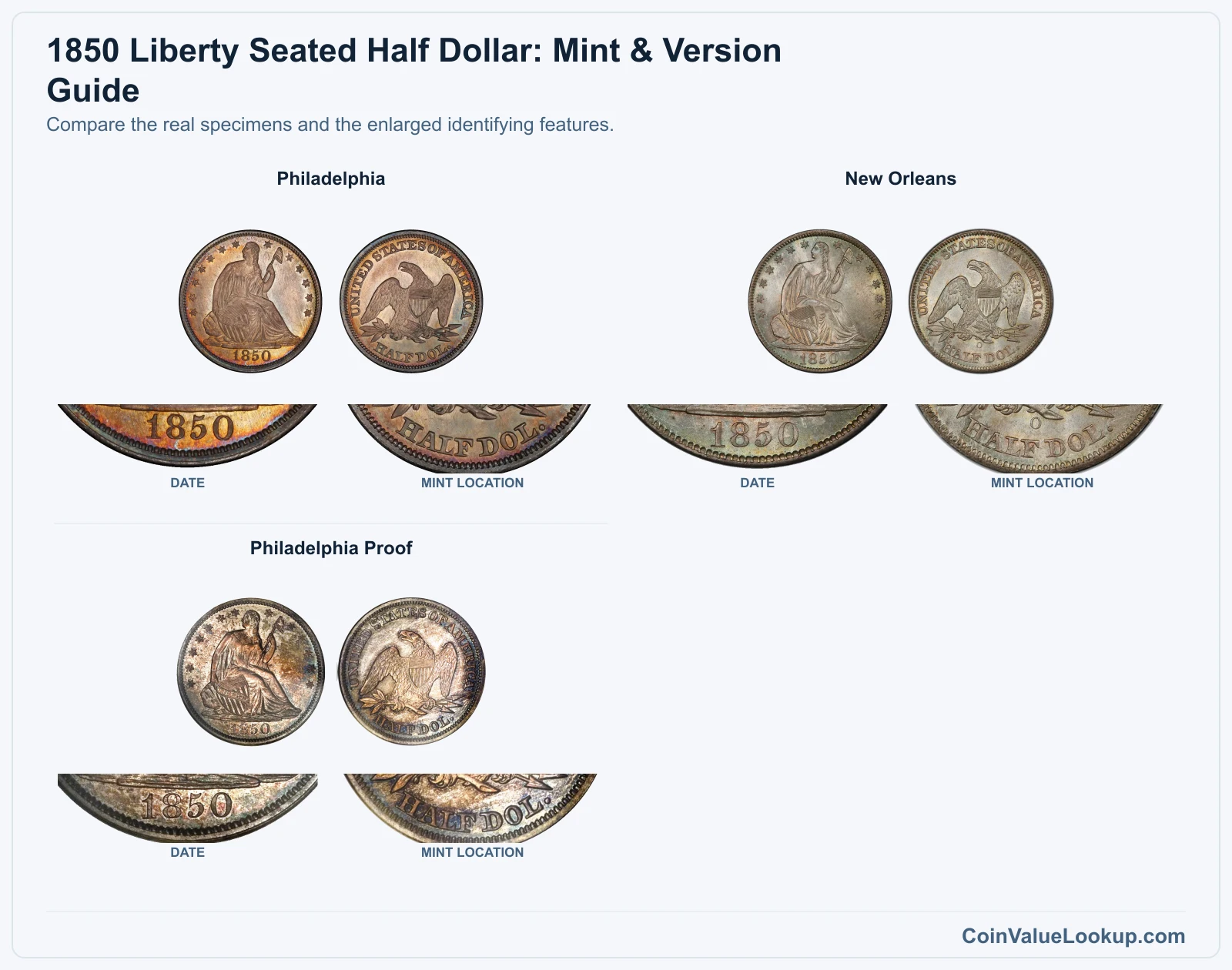
The 1850 Liberty Seated Half Dollar carries real weight — literally and figuratively. Philadelphia strikes range from roughly $364 in Good condition to about $1,834 near About Uncirculated, per guide estimates.
New Orleans coins and Proof strikes follow their own pricing paths. Grade, mintmark and version are the three factors that decide what yours is actually worth.
Fast Way to Identify Your 1850 Liberty Seated Half Dollar
Snap a clear photo of the front and back of your 1850 half dollar and upload both images here. Our identifier can give you a preliminary read on the mintmark, design type and general condition.
That head start helps you figure out which version you have before digging deeper into value.
1850 Liberty Seated Half Dollar Value
Upload both sides of your 1850 Liberty Seated Half Dollar.
Front Obverse
Upload photo
Back Reverse
Upload photo
Which 1850 Liberty Seated Half Dollar Versions Are Worth Money?
- The 1850 Philadelphia half dollar is a scarcer date in the series, with guide values from $364 (G4) to $1,834 (AU50) — significantly higher than common New Orleans examples.
- New Orleans (O mintmark) coins are the more available version, with guide estimates from around $80 (G4) to $517 (AU50), making mint identification essential.
- Proof 1850 Philadelphia strikes are genuinely rare collector pieces; a single PR66 example sold for $161,000 at Heritage Auctions in 2008.
- Repunched Date and Repunched Mintmark varieties have been reported for 1850 and may carry a premium depending on visibility and condition.
Step 1: Identify Your 1850 Liberty Seated Half Dollar Mint Mark and Version
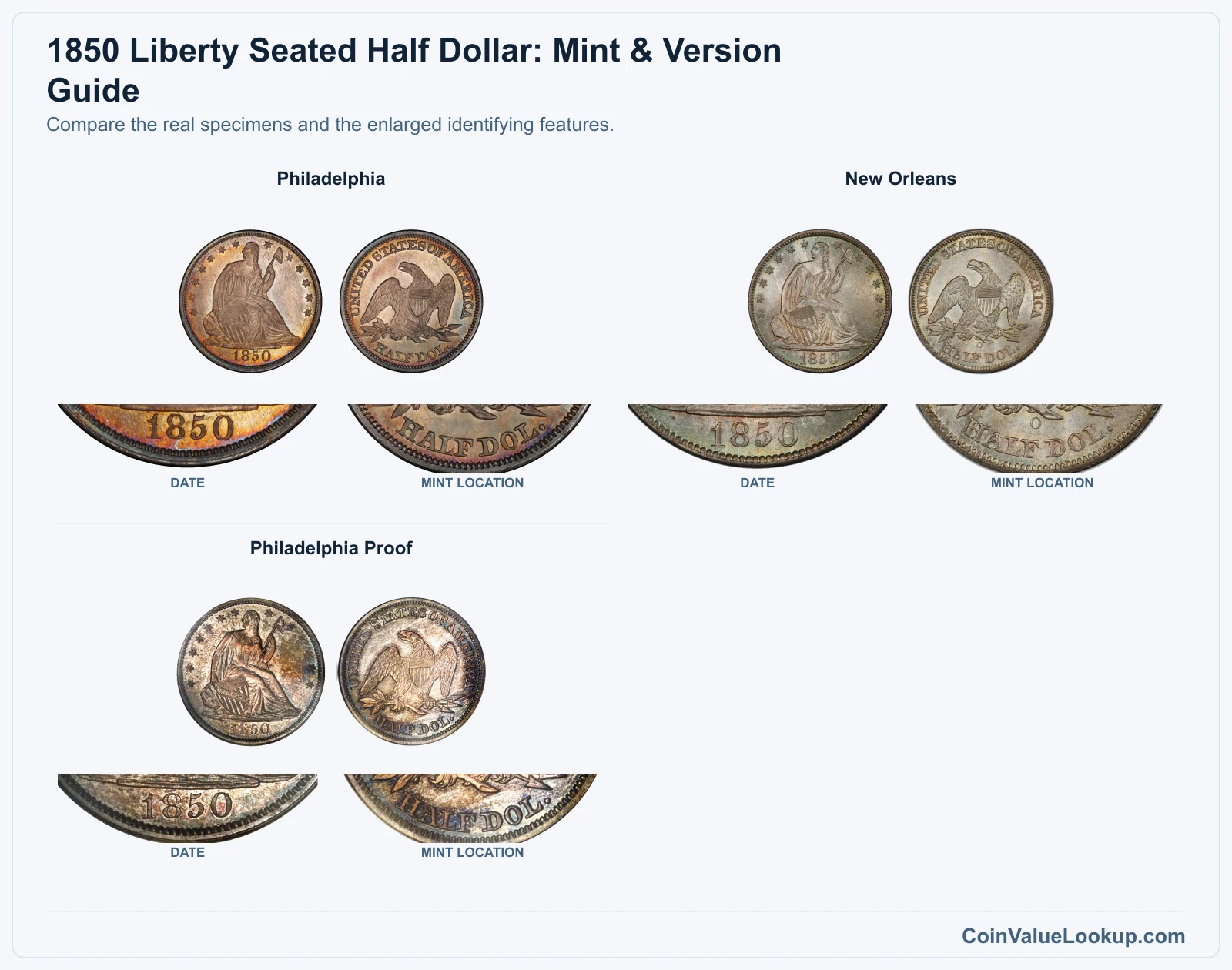
The 1850 half dollar uses the Seated Liberty No Motto design — Liberty sits on a rock holding a pole and cap, with no banner reading IN GOD WE TRUST above the eagle on the reverse. The reverse legend reads HALF DOL.
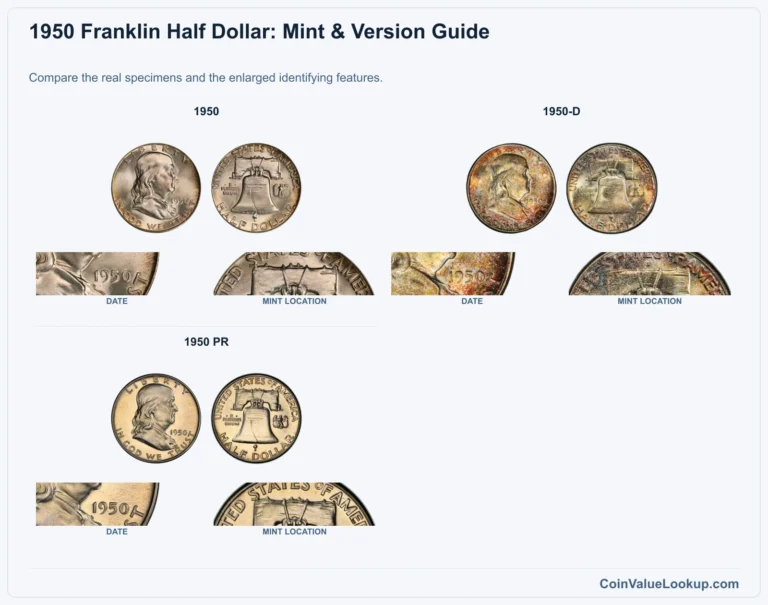
Flip the coin over and look directly below the eagle. A blank space means Philadelphia.
A small "O" means New Orleans. That single letter changes the value dramatically.
The coin is struck in 90% silver and 10% copper, weighing 13.36 grams under the old pre-1853 standard. Later Seated halves weigh less due to the 1853 weight reduction, which was marked by arrowheads at the date and rays on the reverse — your 1850 has neither.
Proof 1850 half dollars also exist from Philadelphia. These are a separate manufacturing type with mirror-like fields, not simply high-grade circulation coins.
A cleaned regular strike can mimic mirror surfaces, so Proof status requires careful professional verification — mirror fields alone are not enough.
Step 2: Check Your 1850 Liberty Seated Half Dollar Grade
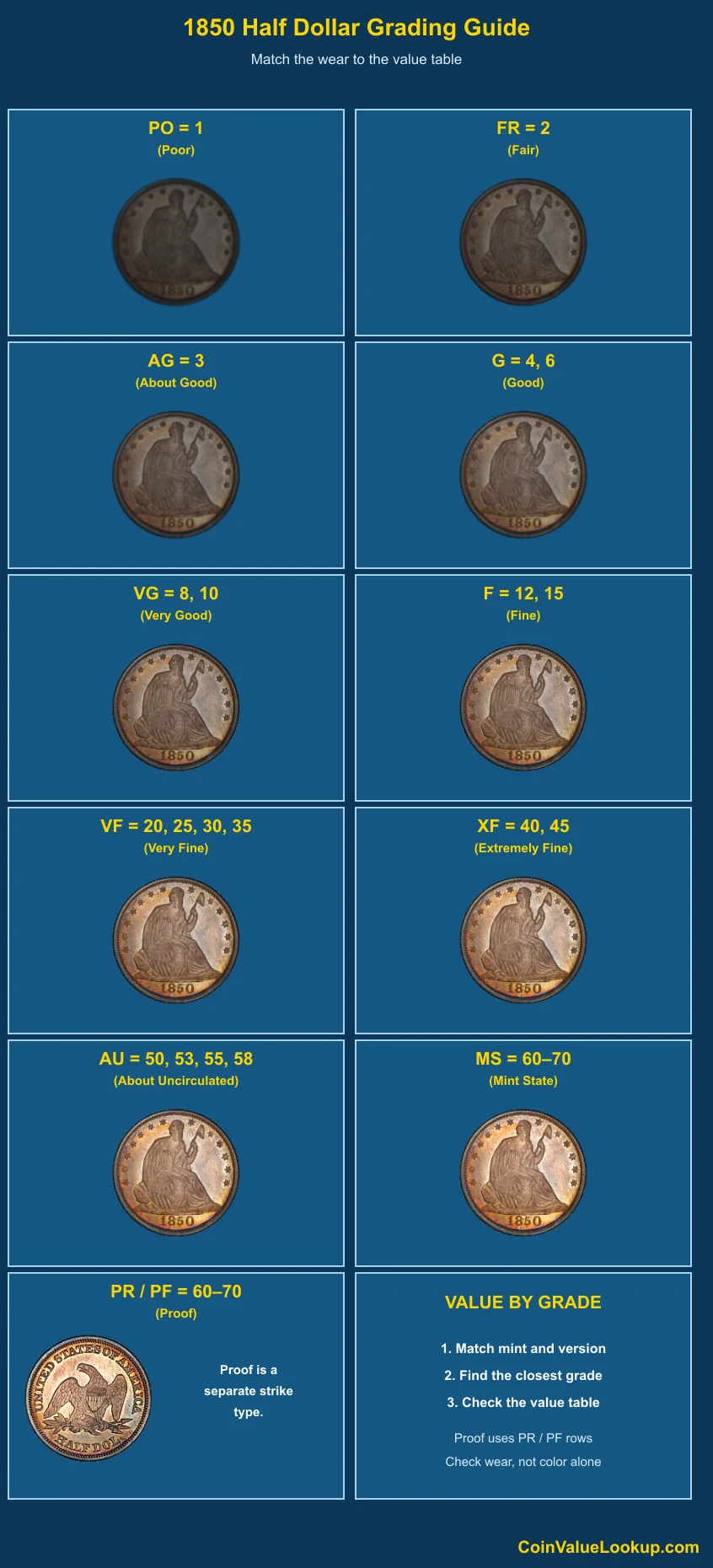
Focus on four landmarks when judging wear: Liberty's head and hair detail, the breast area, the knee, and the lines inside the shield on the obverse. Then flip and check the eagle's breast feathers, wing tips and claws.
A coin in Good condition (G4) will show a smooth outline of Liberty with almost no interior detail. By Very Fine (VF20), you should see clear shield lines and partial hair strands.
At About Uncirculated (AU50), only the highest points show slight friction, and original luster remains in protected areas.
Here is where it gets tricky: flat centers do not always mean heavy wear. The 1850 half dollar can come weakly struck from the dies, leaving mushy detail even on a coin that never circulated.
The difference is luster — a weak strike still shows mint luster in the flat zone, while genuine wear breaks that luster and leaves a dull, smooth surface.
Compare your coin carefully against the grading image. Photograph both sides and the edge in good light, and never clean the coin — even gentle cleaning destroys original surfaces and drops value.
Step 3: Check 1850 Liberty Seated Half Dollar Value by Mint and Version
1850 Liberty Seated Half Dollar — Philadelphia
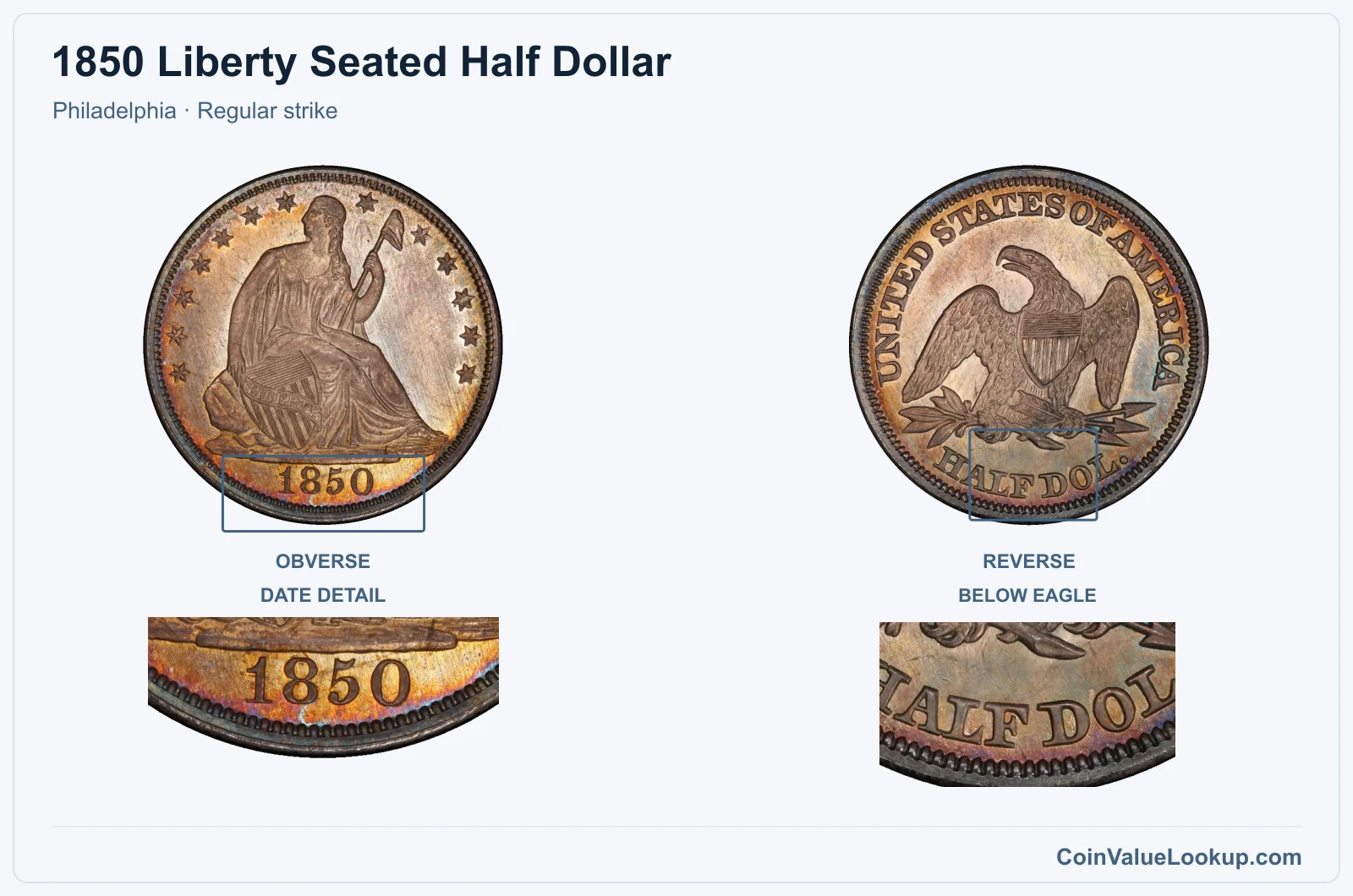
The 1850 Philadelphia half dollar has no mintmark — just an empty space below the reverse eagle. This is the scarcer of the two mint issues for the year, and you should not assume it carries the same modest values as the far more common 1850-O.
Guide estimates place this coin at roughly $364 in Good (G4), $1,017 in Very Fine (VF20), and $1,834 in About Uncirculated (AU50). Those figures are publisher estimates from USA Coin Book, not guaranteed sale prices, but they give you a solid baseline.
Even well-worn examples hold meaningful value. If your coin lacks a mintmark, take the time to get it properly assessed.
Range Grade
Price Auction Records Appraisal PO PO 1
—
Coin Identifier FR FR 2
—
Coin Identifier AG AG 3
Coin Identifier G G 4
—
Coin Identifier
G 6
Coin Identifier VG VG 8
—
Coin Identifier
VG 10
Coin Identifier F F 12
Coin Identifier
F 15
Coin Identifier VF VF 20
Coin Identifier
VF 25
Coin Identifier
VF 30
Coin Identifier
VF 35
—
Coin Identifier XF XF 40
Coin Identifier
XF 45
Coin Identifier AU AU 50
Coin Identifier
AU 53
Coin Identifier
AU 55
Coin Identifier
AU 58
Coin Identifier MS MS 60
Coin Identifier
MS 61
Coin Identifier
MS 62
Coin Identifier
MS 63
Coin Identifier
MS 64
Coin Identifier
MS 65
Coin Identifier
MS 66
—
Coin Identifier
MS 67
Coin Identifier
MS 68
—
—
—
MS 69
—
—
—
MS 70
—
—
—
1850 Liberty Seated Half Dollar — New Orleans
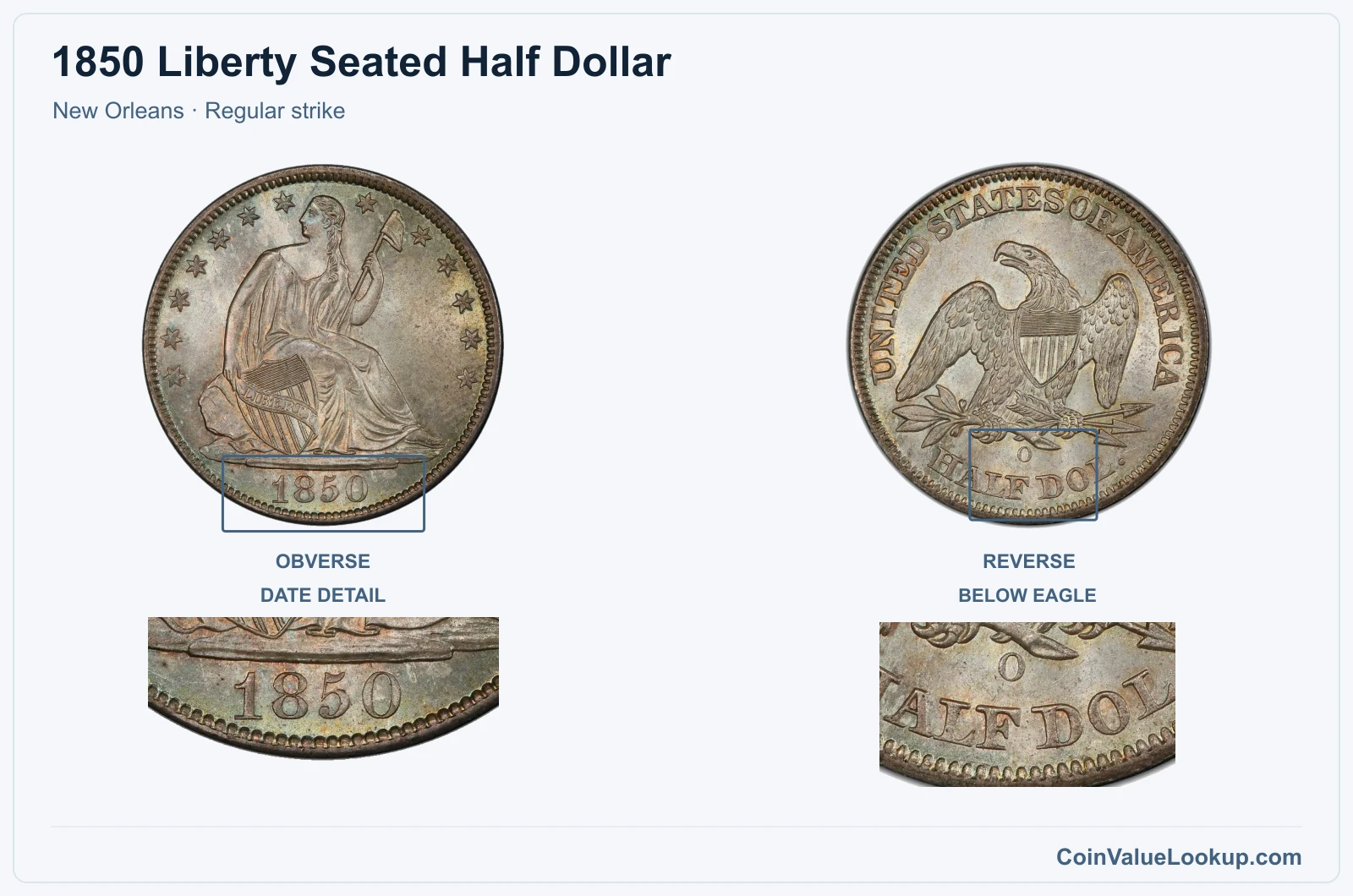
Look below the reverse eagle for a small "O" — that confirms your coin was struck at the New Orleans Mint. This is the more commonly encountered 1850 half dollar by a wide margin, so it trades for considerably less than the Philadelphia version.
Guide estimates run about $80 in Good (G4), $269 in Very Fine (VF20), and $517 near About Uncirculated (AU50). Even at these lower figures, remember you are holding a 90% silver coin over 170 years old.
Condition matters a lot here, so a sharp example with clear detail is worth pursuing a proper grade for.
Coin Value Lookup is a useful starting point if you want to look up guides for other dates and denominations in the Seated Liberty series.
Range Grade
Price Auction Records Appraisal PO PO 1
—
Coin Identifier FR FR 2
—
Coin Identifier AG AG 3
—
Coin Identifier G G 4
—
Coin Identifier
G 6
—
Coin Identifier VG VG 8
Coin Identifier
VG 10
—
Coin Identifier F F 12
—
Coin Identifier
F 15
—
Coin Identifier VF VF 20
Coin Identifier
VF 25
Coin Identifier
VF 30
Coin Identifier
VF 35
Coin Identifier XF XF 40
Coin Identifier
XF 45
Coin Identifier AU AU 50
Coin Identifier
AU 53
Coin Identifier
AU 55
Coin Identifier
AU 58
Coin Identifier MS MS 60
Coin Identifier
MS 61
Coin Identifier
MS 62
Coin Identifier
MS 63
Coin Identifier
MS 64
Coin Identifier
MS 65
Coin Identifier
MS 66
Coin Identifier
MS 67
—
—
—
MS 68
—
—
—
MS 69
—
—
—
MS 70
—
—
—
1850 Liberty Seated Half Dollar — Philadelphia Proof
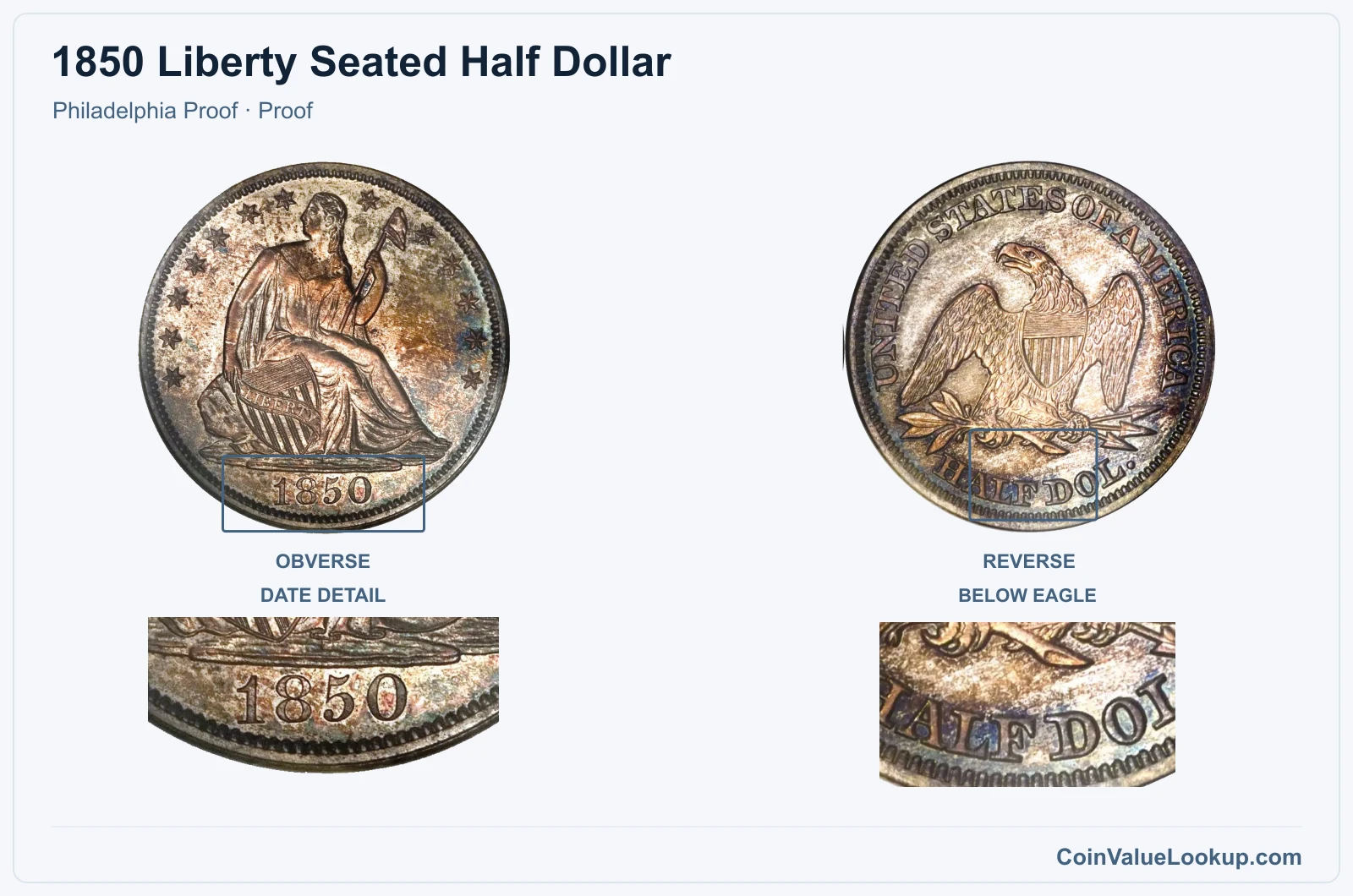
Philadelphia Proof 1850 half dollars are a separate beast entirely. These were made with specially prepared dies and polished planchets, producing deep mirror fields on both sides.
They were struck for collectors, not commerce, and very few survive.
Do not confuse a cleaned or lightly circulated regular strike with a Proof. Cleaning can produce a shiny, reflective look, but genuine Proofs show razor-sharp rims and a specific quality of reflection that extends uniformly across the fields.
Professional authentication is essential for any coin claimed to be a Proof of this era.
A single PR66 example sold for $161,000 through Heritage Auctions in 2008. That is one historical result at a very high grade, not a current market curve.
Cameo and Deep Cameo designations may apply based on contrast between the frosted devices and mirror fields, but these are surface-contrast labels within the Proof category, not separate versions.
Range Grade
Price Auction Records Appraisal PR PR 1
—
Coin Identifier
PR 2
—
Coin Identifier
PR 3
—
Coin Identifier
PR 4
—
Coin Identifier
PR 6
—
Coin Identifier
PR 8
—
Coin Identifier
PR 10
—
Coin Identifier
PR 12
—
Coin Identifier
PR 15
—
Coin Identifier
PR 20
—
Coin Identifier
PR 25
—
Coin Identifier
PR 30
—
Coin Identifier
PR 35
—
Coin Identifier
PR 40
—
Coin Identifier
PR 45
—
Coin Identifier
PR 50
—
Coin Identifier
PR 53
—
Coin Identifier
PR 55
—
Coin Identifier
PR 58
—
Coin Identifier
PR 60
—
Coin Identifier
PR 61
Coin Identifier
PR 62
—
Coin Identifier
PR 63
Coin Identifier
PR 64
Coin Identifier
PR 65
—
Coin Identifier
PR 66
Coin Identifier
PR 67
—
—
—
PR 68
—
—
—
PR 69
—
—
—
PR 70
—
—
—
1850 Liberty Seated Half Dollar Error List
1. 1850 Liberty Seated Half Dollar — Repunched Date
Repunched Date varieties are reported for the 1850 Philadelphia half dollar. On one documented example, repunching is visible at the flag of the 5 and along the lower-right edge of the 0.
Another shows a remnant of the 0 displaced to the southeast. These are die varieties where the date was punched into the working die more than once in slightly different positions, leaving overlapping digit impressions.
To check yours, use a loupe at 5x or higher and examine each digit carefully. Look for secondary outlines, displaced serifs, or shadow impressions near the edges of individual numbers.
Do not confuse this with an overdate, which involves different year digits. Also watch out for machine doubling — a flat, shelf-like distortion created during striking that lacks the raised, sharply defined secondary image of a true repunched date.
Post-strike damage to the date area is another common lookalike.
No specific pricing data is available for these varieties. Value depends on the visibility of the repunching, the coin's overall condition, and buyer demand for the specific variety.
2. 1850 Liberty Seated Half Dollar — Repunched Mintmark
A Repunched Mintmark variety is reported for the 1850-O half dollar. In this case, the O mintmark below the reverse eagle was entered into the die more than once, leaving traces of an earlier position visible alongside the final placement.
To spot it, examine the mintmark under magnification and look for a secondary outline, a doubled edge, or a displaced ghost of the O near the primary mark. The effect should be consistent and raised — part of the die, not a post-strike anomaly.
Several things can mimic a repunched mintmark. Machine doubling produces a flat, shelf-like distortion without the sharp secondary outline.
Small die chips inside or beside the O can look like extra metal, and corrosion around the mintmark can blur its edges into something that resembles doubling. All of these lack the distinctive overlapping letter form of a genuine repunched mark.
No specific price data has been adopted for this variety. Its premium depends on how visible the repunching is, the coin's grade, and collector interest in the particular die marriage.