1844 Liberty Seated Dollar Coin Value: How Much Is It Worth?
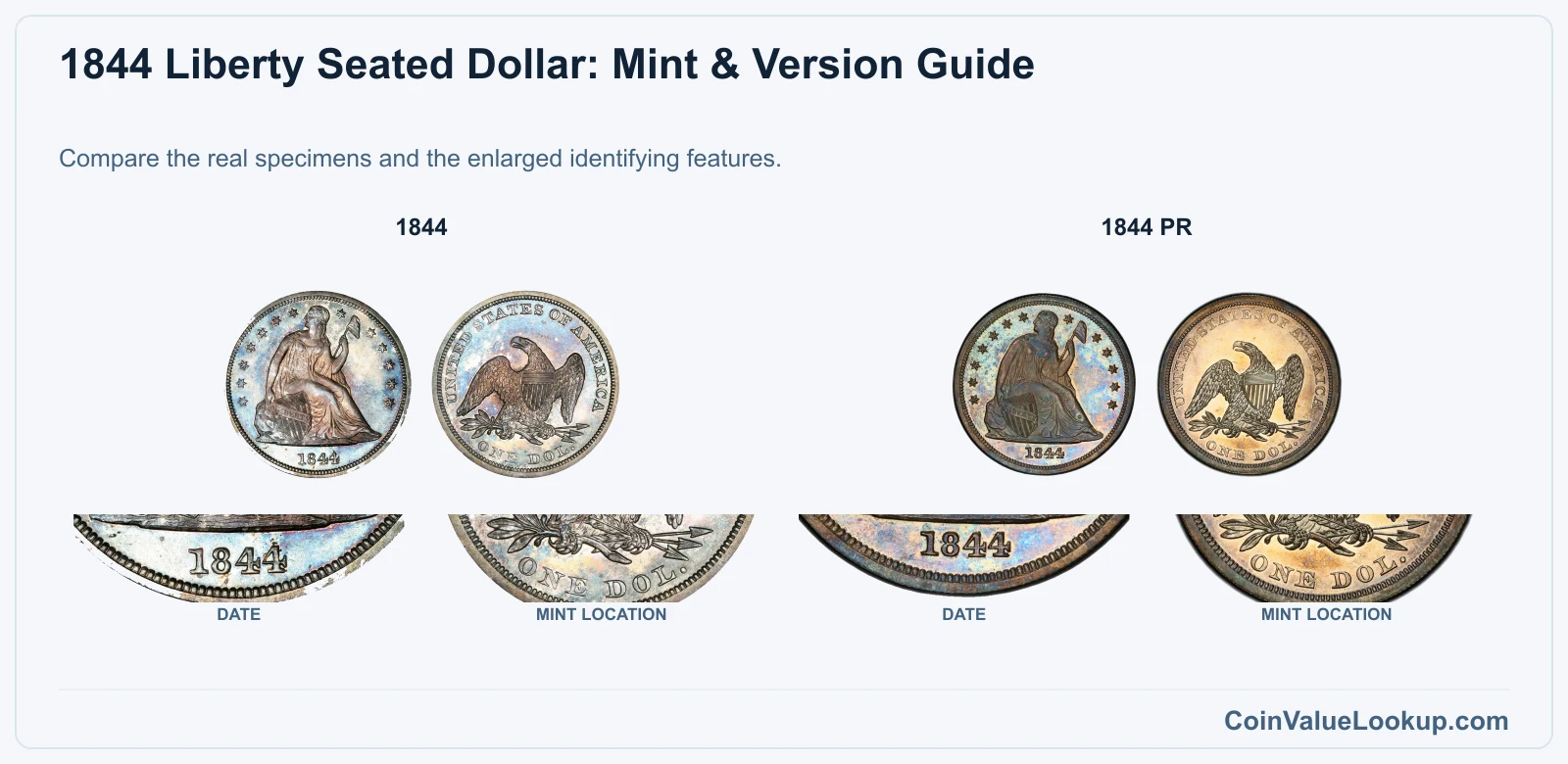
The 1844 Liberty Seated Dollar is a classic early American silver dollar struck at the Philadelphia Mint. Guide estimates for this date range from roughly $596 in well-worn Good-4 condition up to about $21,924 for a choice Mint State-63 example, according to USA Coin Book.
A separate proof finish also exists. Before you settle on a value, you need to confirm which version you actually have — business strike or proof — because they are assessed very differently.
Fast Way to Identify Your 1844 Liberty Seated Dollar
The quickest way to start figuring out what your 1844 Liberty Seated Dollar is worth is to upload clear photos of both the front and back of the coin. Our identifier can provide a preliminary identification based on those images, helping you determine the mint, finish and general condition.
From there, you can dig deeper into grading and varieties.
1844 Liberty Seated Dollar Value
Upload both sides of your 1844 Liberty Seated Dollar.
Front Obverse
Upload photo
Back Reverse
Upload photo
Which 1844 Liberty Seated Dollar Versions Are Worth Money?
- 1844 Proof (PR): Proof Seated Dollars from 1844 are extremely scarce, and authentication is critical before assigning any premium value.
- 1844 Business Strike in MS63: Guide estimates reach approximately $21,924 at this grade, reflecting how few survive in choice uncirculated condition.
Step 1: Identify Your 1844 Liberty Seated Dollar Mint Mark and Version
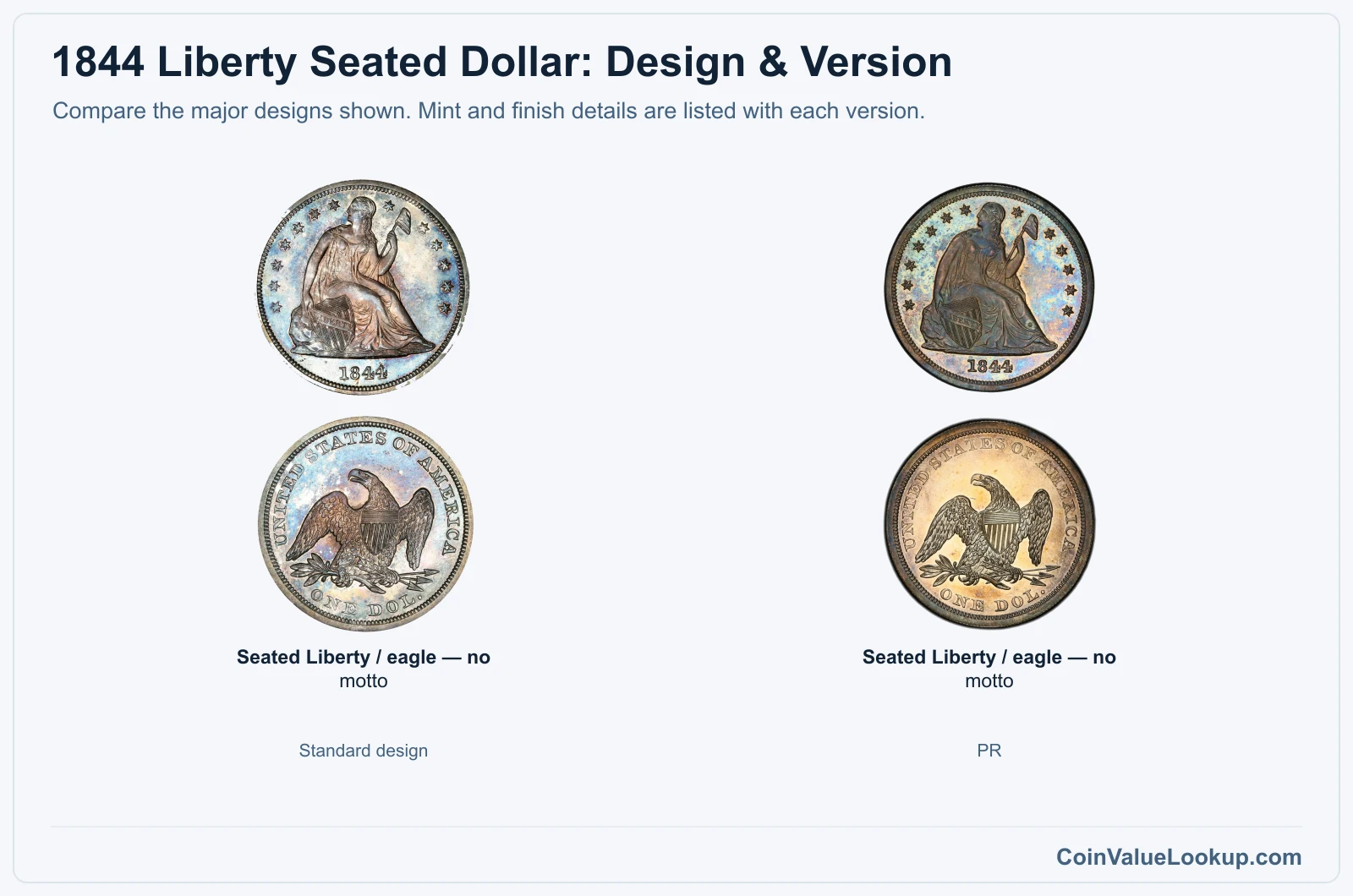
Every 1844 Liberty Seated Dollar was struck at the Philadelphia Mint, so there is no mintmark to look for. On branch-mint Seated Dollars from other years, you would check the reverse below the eagle and above the ONE DOL.
inscription, but for 1844 that spot should be blank.
The design shows a seated figure of Liberty on the obverse, holding a liberty pole and cap, with 13 stars and the date. The reverse displays an eagle with a shield, olive branch and arrows, plus the legend UNITED STATES OF AMERICA and ONE DOL.
There is no motto above the eagle on this date's reverse.
The coin is composed of 90% silver and 10% copper, with a nominal weight of 26.73 grams. If your coin feels unusually light or does not pass a basic silver test, it may be a counterfeit or a plated copy.
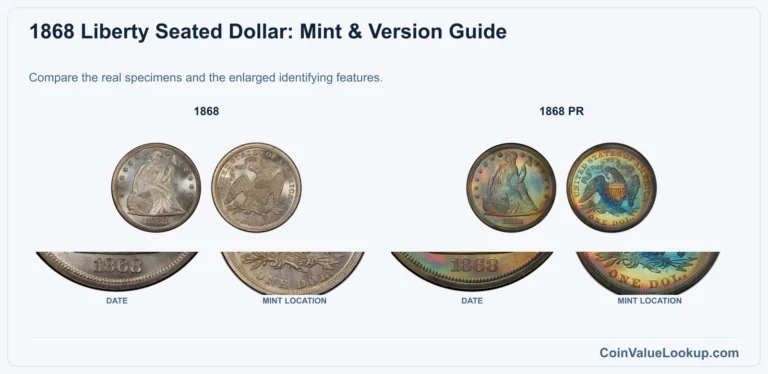
Two versions exist for 1844: the standard business strike and the proof. A proof is a special manufacturing finish — mirror-like fields, squared rims, sharp detail — not simply a coin that looks shiny or grades high.
If your coin has been cleaned, polished, or is just well-preserved, that does not make it a proof. Authentication by a third-party grading service is essential before assuming you hold a proof example.
Step 2: Check Your 1844 Liberty Seated Dollar Grade
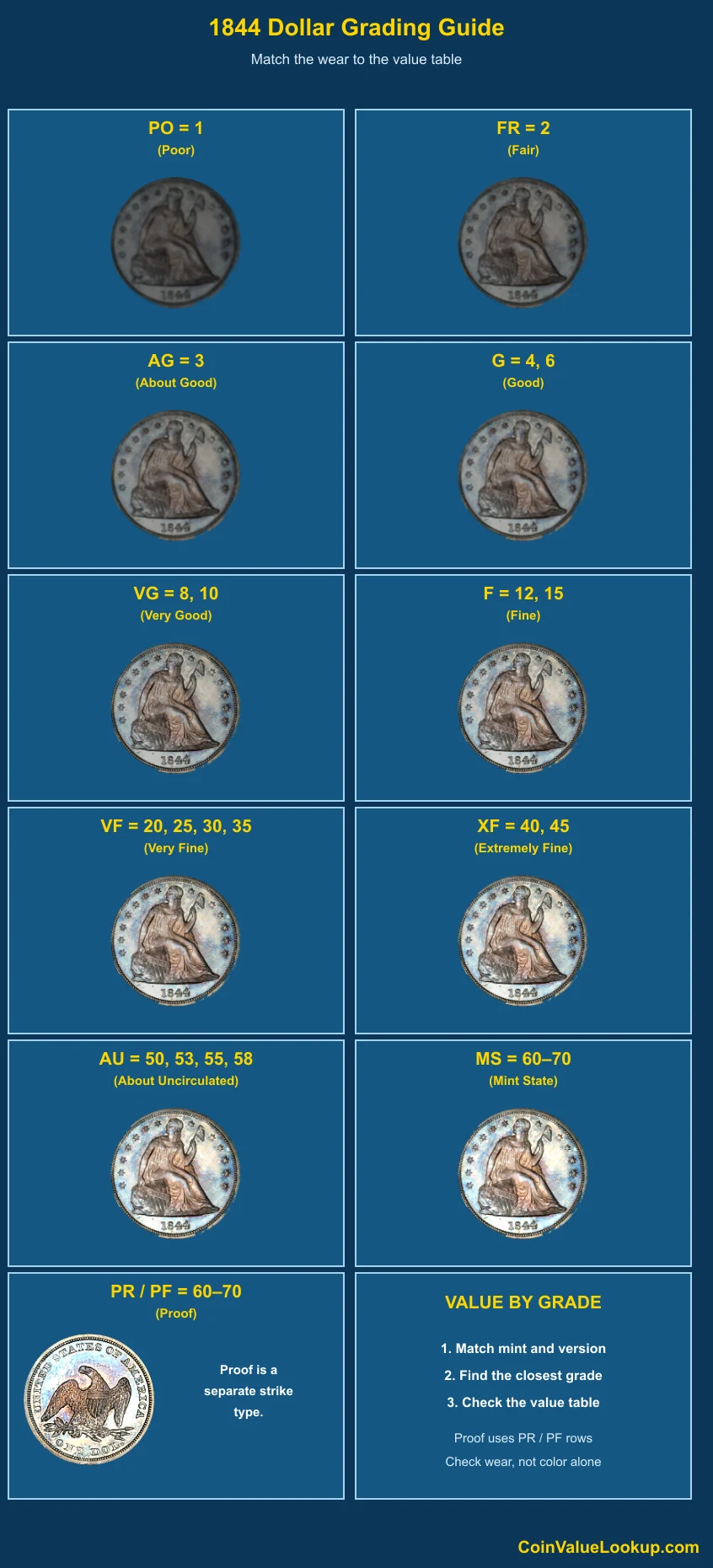
When grading an 1844 Liberty Seated Dollar, focus on a few key high points. On the obverse, check Liberty's head, the area across her breast and knee, and the horizontal lines on the shield.
These spots lose detail first as the coin circulates.
On the reverse, look at the eagle's breast feathers and the tips of the wings. Wear shows up there before almost anywhere else.
One common trap: the head of Liberty can be weakly struck from the die itself, not just from wear. Do not downgrade a coin solely because Liberty's head looks soft — compare it against other areas.
If the knee and shield still show strong detail but the head is mushy, the strike may be the culprit.
Use the comparison image to study the differences between a circulated example, an About Uncirculated piece and a full Mint State coin side by side. Proof coins should be evaluated separately, since their flat mirrored fields and sharp devices follow different standards than business strikes.
Cleaning, whizzing and artificial toning all reduce a coin's grade and desirability, even if the underlying detail is strong.
Step 3: Check 1844 Liberty Seated Dollar Value by Mint and Version
1844 Liberty Seated Dollar
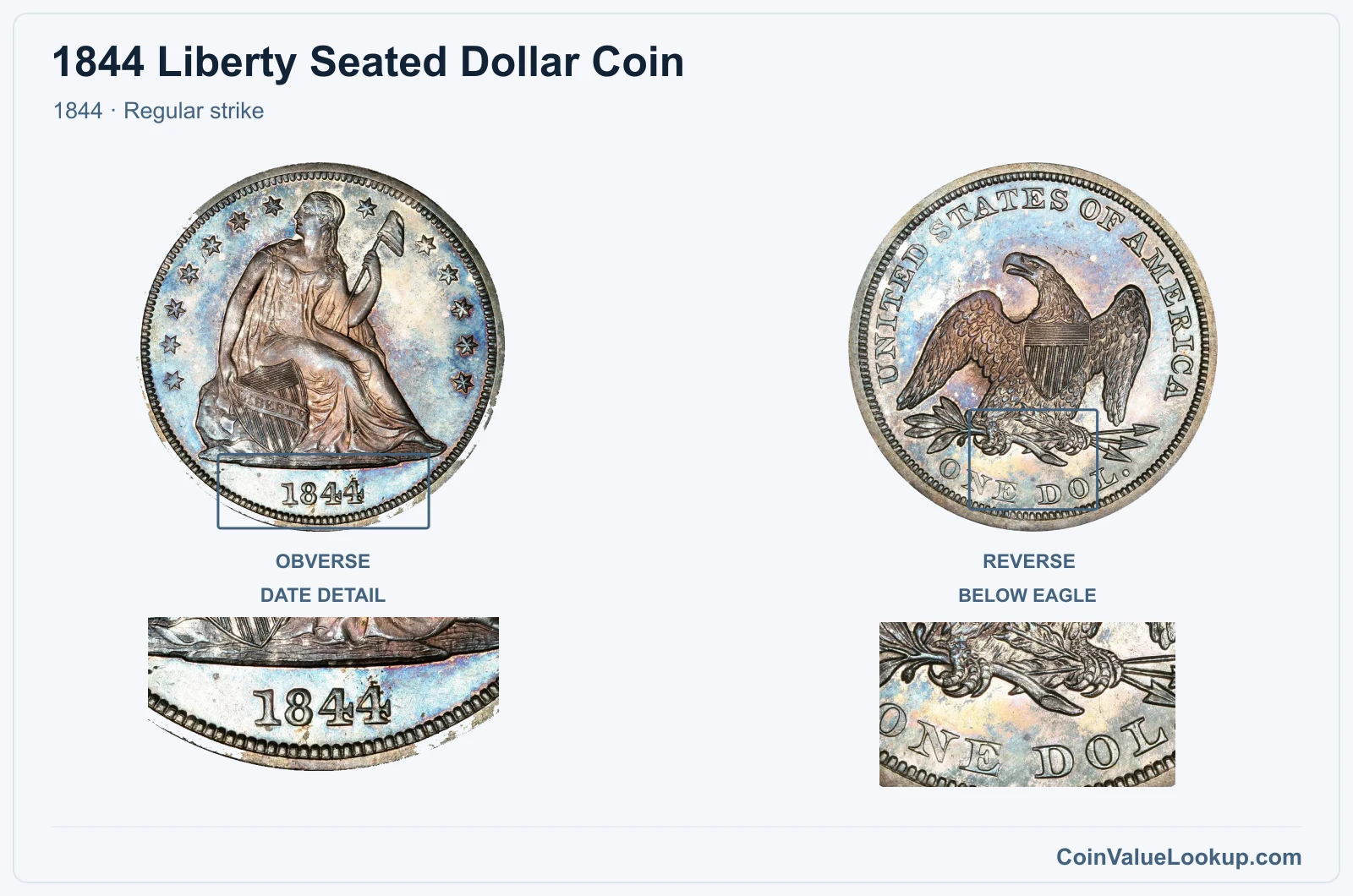
The standard 1844 Liberty Seated Dollar is a Philadelphia business strike with no mintmark. It features the no-motto reverse design used throughout the early Seated Dollar series.
USA Coin Book guide estimates place this coin at about $596 in Good-4 and around $21,924 in MS63. That is a huge spread, and it reflects how scarce truly uncirculated survivors are.
Original surfaces matter a lot with this type. Coins that have been cleaned, polished, or artificially toned will not command the same prices as examples with natural patina and luster.
Always confirm the grade and surface quality before comparing to guide figures. These estimates are not guaranteed offers — they are reference points.
Coin Value Lookup is a useful starting point if you want to look up guides for other dates in the Seated Dollar series or compare across denominations.
Range Grade
Price Auction Records Appraisal PO PO 1
—
Coin Identifier FR FR 2
—
Coin Identifier AG AG 3
—
Coin Identifier G G 4
Coin Identifier
G 6
—
Coin Identifier VG VG 8
Coin Identifier
VG 10
Coin Identifier F F 12
Coin Identifier
F 15
Coin Identifier VF VF 20
Coin Identifier
VF 25
Coin Identifier
VF 30
Coin Identifier
VF 35
Coin Identifier XF XF 40
Coin Identifier
XF 45
Coin Identifier AU AU 50
Coin Identifier
AU 53
Coin Identifier
AU 55
Coin Identifier
AU 58
Coin Identifier MS MS 60
Coin Identifier
MS 61
Coin Identifier
MS 62
Coin Identifier
MS 63
Coin Identifier
MS 64
Coin Identifier
MS 65
—
Coin Identifier
MS 66
—
—
—
MS 67
—
—
—
MS 68
—
—
—
MS 69
—
—
—
MS 70
—
—
—
1844 Liberty Seated Dollar — PR
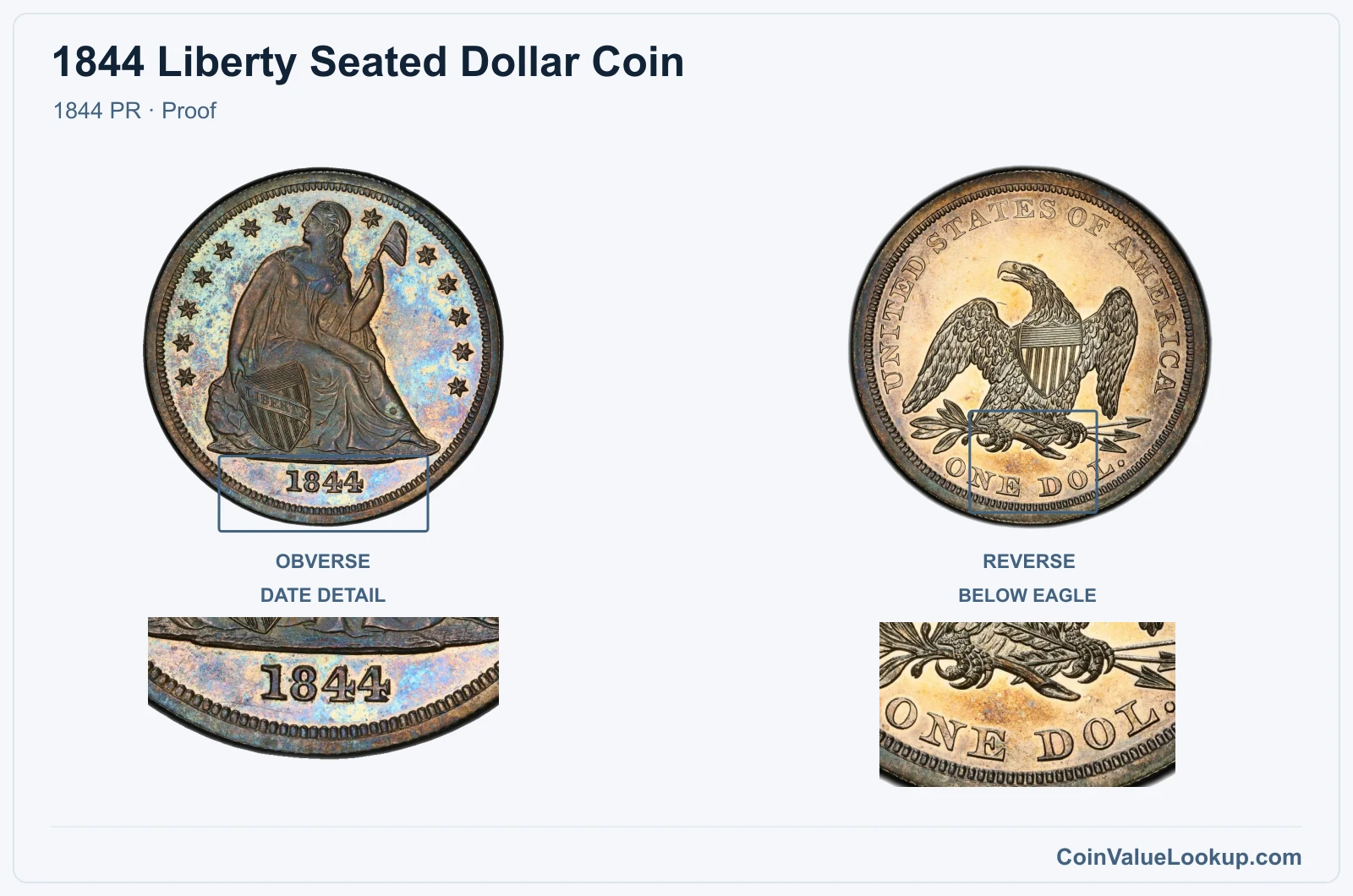
The 1844 Proof is a separate manufacturing finish, not a higher grade of the regular business strike. Proof Seated Dollars from this era were made in very small quantities for collectors, using polished dies and specially prepared planchets.
The result is a coin with deeply mirrored fields and exceptionally sharp detail.
No supported numeric price range is available for this version. Value depends entirely on authenticated identity and the coin's individual condition.
If you suspect you have a proof, third-party certification from a recognized grading service is the only reliable path forward. Many coins that look proof-like are actually well-preserved business strikes or cleaned examples — the difference in value is enormous.
Range Grade
Price Auction Records Appraisal PR PR 1
—
Coin Identifier
PR 2
—
Coin Identifier
PR 3
—
Coin Identifier
PR 4
—
Coin Identifier
PR 6
—
Coin Identifier
PR 8
—
Coin Identifier
PR 10
—
Coin Identifier
PR 12
—
Coin Identifier
PR 15
—
Coin Identifier
PR 20
—
Coin Identifier
PR 25
—
Coin Identifier
PR 30
—
Coin Identifier
PR 35
—
Coin Identifier
PR 40
—
Coin Identifier
PR 50
—
Coin Identifier
PR 53
—
Coin Identifier
PR 55
—
Coin Identifier
PR 58
—
Coin Identifier
PR 60
—
Coin Identifier
PR 61
Coin Identifier
PR 62
Coin Identifier
PR 63
Coin Identifier
PR 64
Coin Identifier
PR 65
Coin Identifier
PR 66
—
—
—
PR 67
—
—
—
PR 68
—
—
—
PR 69
—
—
—
PR 70
—
—
—
1844 Liberty Seated Dollar Error List
1. 1844 Liberty Seated Dollar — Doubled Die Obverse
A Doubled Die Obverse variety has been reported for the 1844 Liberty Seated Dollar. On this type of error, elements on the obverse — such as lettering, stars, or parts of the date — show a consistent doubled impression from a misaligned die hub during manufacture.
To check for it, compare your coin's obverse lettering and design elements against a normal 1844 dollar under the same lighting. Look for even, consistent separation or notching on affected features.
The doubling should appear uniform and directional, not random.
Be careful not to confuse this with machine doubling, which produces flat, shelf-like distortion rather than the rounded, raised separation of a true doubled die. Reflections and worn die contours can also mimic doubling under certain angles.
No specific price data is available for this variety; value depends on condition, the strength of the visible doubling, and authentication by a recognized grading service.
2. 1844 Liberty Seated Dollar — Misplaced Date
A Misplaced Date variety has also been reported for the 1844 Liberty Seated Dollar. This error occurs when remnants of a date punch appear in an unintended position on the die — typically traces of one or more digits visible in the denticles or nearby field, in addition to the correctly placed date.
Look carefully around and below the normal date area for faint outlines or partial impressions of numerals where they should not be. The normal date will still be present in its standard location, so you are searching for extra, out-of-place traces.
Do not confuse a misplaced date with scratches, small die cracks, or random contact marks, which can look similar at first glance. A true misplaced date will show recognizable digit shapes, not random lines.
No numerical price range is available for this variety, so value will depend on the coin's condition, how visible the misplacement is, and whether it has been authenticated.