1844 Braided Hair Cent Coin Value: How Much Is It Worth?
The 1844 Braided Hair Cent spans a wide value range depending on variety and condition. Guide estimates run from about $30 in Good-4 for a normal date up to $6,257 in MS-63 for the scarce 1844/81 overdate.
This is not the entire market range, and rare proofs or major errors require separate evaluation.
Identifying your exact variety matters more than anything else with this date. A normal 1844 and a 1844/81 blundered date are very different coins in the marketplace.
Fast Way to Identify Your 1844 Braided Hair Cent
The quickest way to start figuring out what you have is to upload clear photos of both the front and back of your coin. Our identifier can offer a preliminary identification based on your images, helping you determine which variety and approximate condition you're looking at.
Sharp, well-lit photos make a real difference.
1844 Braided Hair Cent Value
Upload both sides of your 1844 Braided Hair Cent.
Front Obverse
Upload photo
Back Reverse
Upload photo
Which 1844 Braided Hair Cent Versions Are Worth Money?
- The 1844/81 overdate variety commands a significant premium, with guide estimates from $91 in G-4 to $6,257 in MS-63, compared to $30 to $1,522 for the normal date in the same grades.
- Proof 1844 Braided Hair Cents exist but require expert attribution of die characteristics, surfaces and rims; value depends on authenticated identity and condition.
- Mint errors such as off-center strikes, die cracks, cuds and repunched dates on this date are reported categories that deserve closer inspection from a specialist.
Step 1: Identify Your 1844 Braided Hair Cent Mint Mark and Version
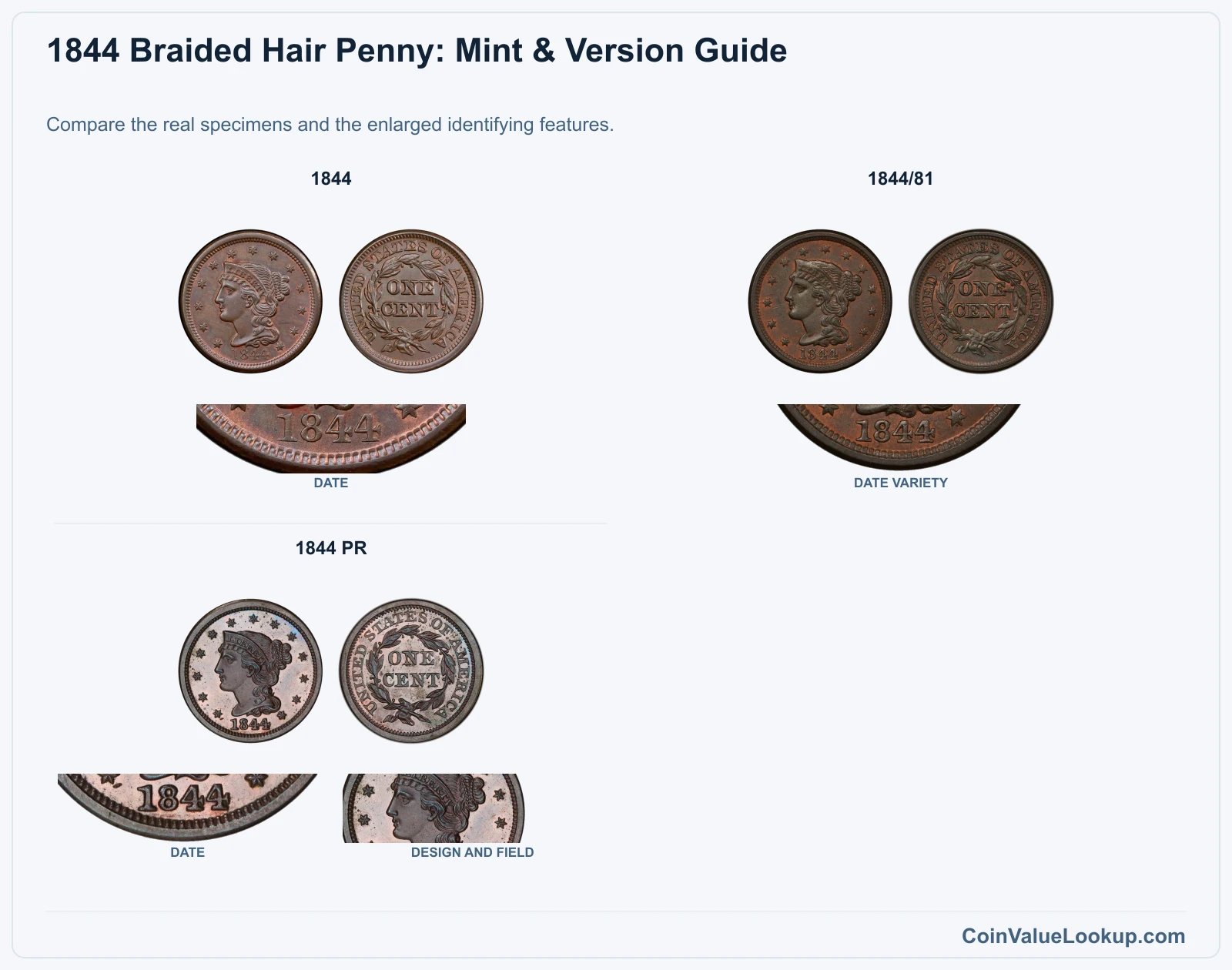
Every 1844 Braided Hair Cent was struck at the Philadelphia Mint, so there is no mintmark to hunt for. If someone tells you they have a 1844-D or 1844-S large cent, that coin does not exist.
The critical fork in the road is the date. Look closely at the "44" in 1844.
On the 1844/81 overdate, you can see traces of an inverted "81" beneath the final two digits. This happened because an initial date punch was placed in the wrong orientation before the correct date was applied.
It is a genuine die variety, not a coin struck in 1881.
Beyond the date, check both sides carefully. The obverse should show the Braided Hair Liberty portrait with stars and date; the reverse displays "ONE CENT" inside a wreath.
Legend wording, wreath details and the overall style should be consistent with the Braided Hair series produced from 1839 to 1857.
Weight can offer supporting evidence. The nominal weight is 10.89 grams in copper.
But wear, corrosion and period production tolerances mean weight alone cannot prove or disprove authenticity.
Step 2: Check Your 1844 Braided Hair Cent Grade
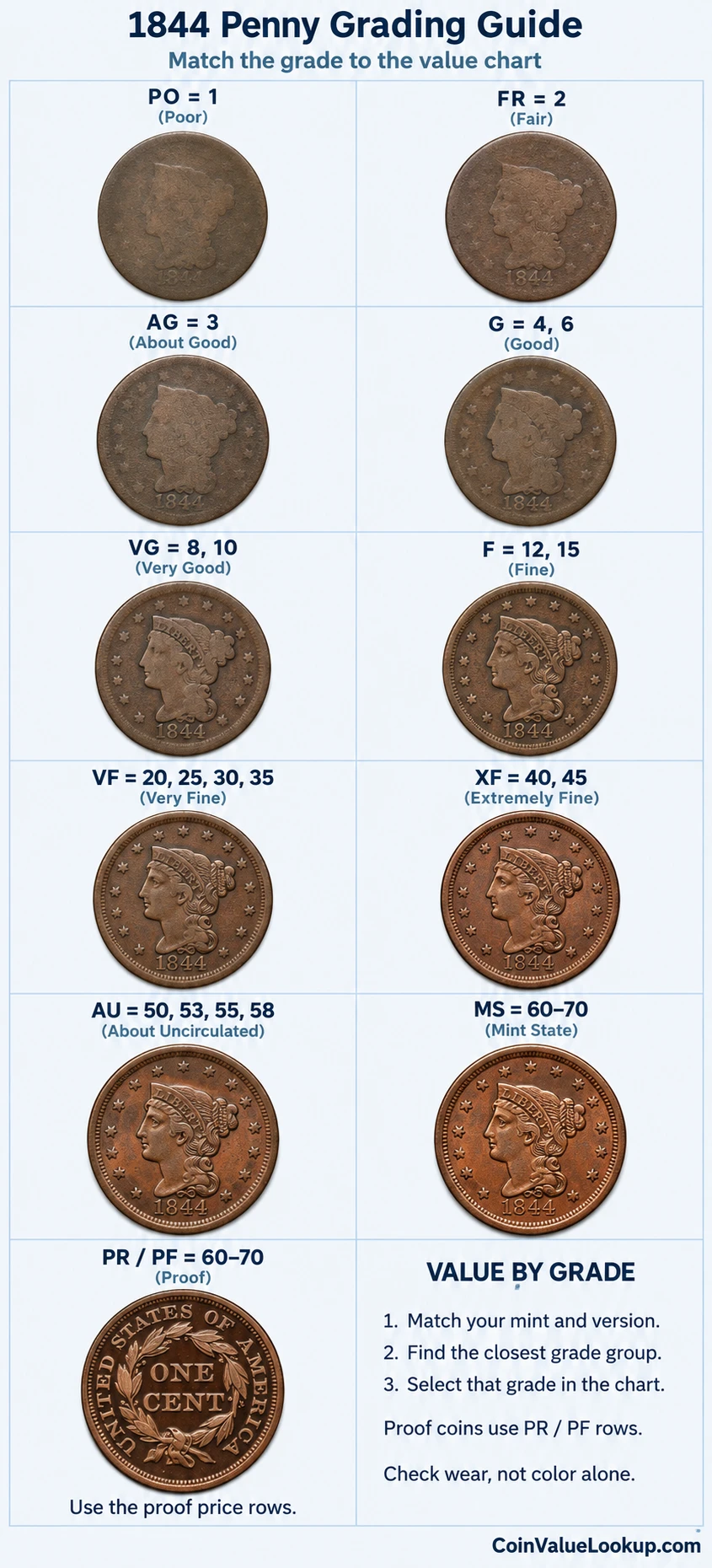
Start by examining the hair detail on Liberty's portrait. In lower grades the braid above the ear and the individual curls along the neck flatten first.
The cheek also loses definition early.
Flip the coin over and study the wreath leaves. On a well-preserved example the leaf veins are crisp and distinct.
As the grade drops, these details merge into smooth lumps.
Compare your coin against the reference image showing different wear stages for this type. Pay attention to the lettering sharpness on both sides as well, since soft letters can indicate honest wear or a weak original strike.
Do not confuse circulation wear with surface problems. Corrosion pitting, old cleaning and porosity all reduce a coin's appeal and market value, sometimes dramatically, even if the underlying detail looks decent.
These issues are separate from normal grade.
On copper coins you will see color descriptions like BN (brown), RB (red-brown) and RD (red). These describe the remaining original surface color, not different metals.
Most surviving 1844 cents are solidly brown at this point, so any meaningful red is unusual and adds value. Proof is a method of manufacture with specially prepared dies and planchets, not a grade above Mint State.
Step 3: Check 1844 Braided Hair Cent Value by Mint and Version
1844 Braided Hair Cent
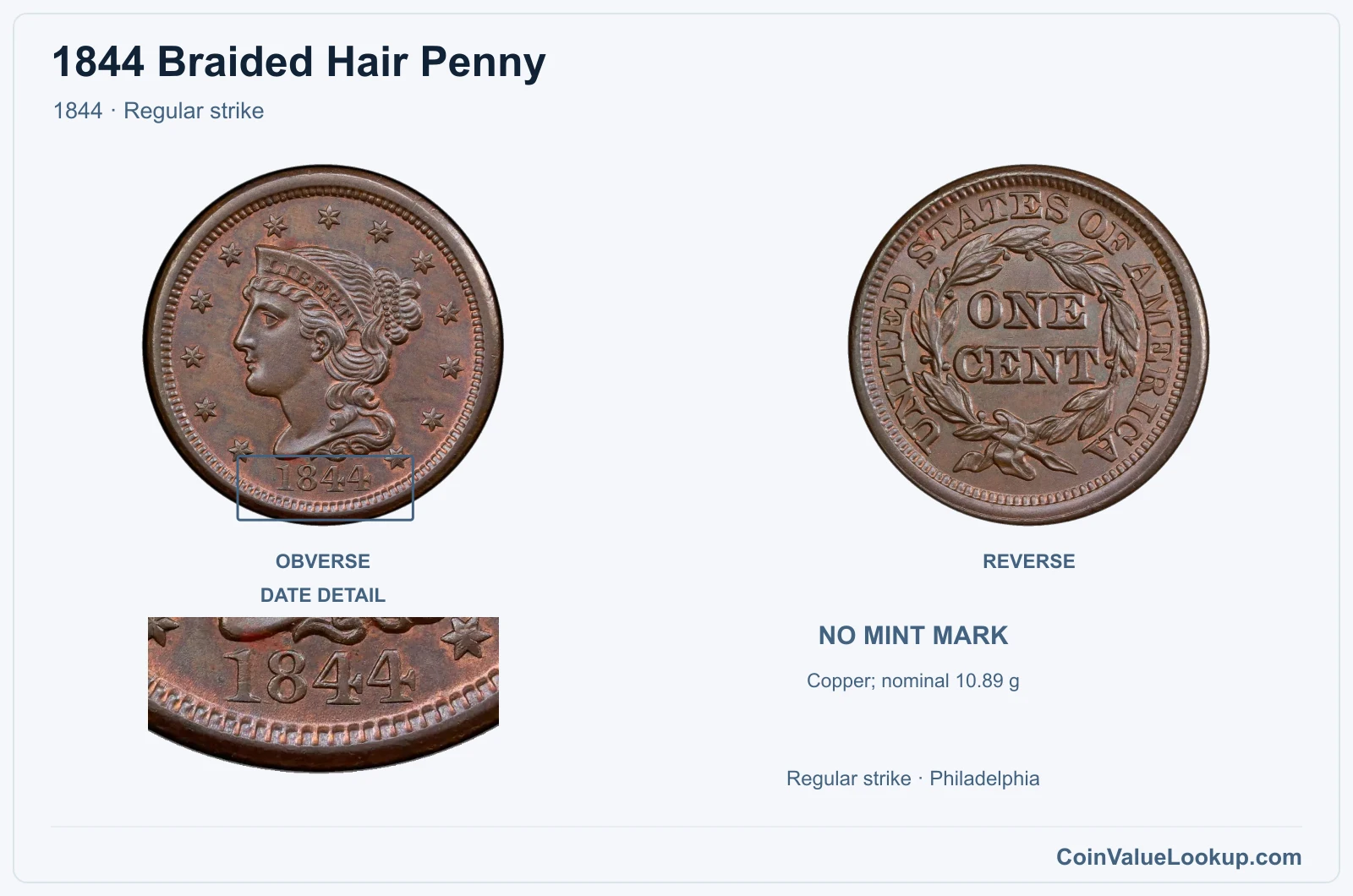
The normal date 1844 Braided Hair Cent is the variety most collectors will encounter. Struck at Philadelphia with no mintmark, it weighs a nominal 10.89 grams in copper.
The obverse features the Braided Hair Liberty with thirteen stars and the date; the reverse shows ONE CENT within a laurel wreath.
Guide estimates from USA Coin Book place this coin at roughly $30 in Good-4 and around $1,522 in MS-63. That is a big spread, but surviving mint-state large cents from the 1840s are genuinely scarce.
Most examples you find in the wild will be well-circulated and brown, landing somewhere in the lower portion of that range.
If you are browsing Coin Value Lookup for information on other dates and denominations, the same approach applies: pin down the exact variety before worrying about value.
| Range | Grade | Price | Auction Records | Appraisal |
|---|---|---|---|---|
| PO | PO 1 | — | Coin Identifier | |
| FR | FR 2 | — | Coin Identifier | |
| AG | AG 3 | — | Coin Identifier | |
| G | G 4 | — | Coin Identifier | |
| G 6 | — | Coin Identifier | ||
| VG | VG 8 | — | Coin Identifier | |
| VG 10 | — | Coin Identifier | ||
| F | F 12 | Coin Identifier | ||
| F 15 | — | Coin Identifier | ||
| VF | VF 20 | — | Coin Identifier | |
| VF 25 | — | Coin Identifier | ||
| VF 30 | Coin Identifier | |||
| VF 35 | Coin Identifier | |||
| XF | XF 40 | Coin Identifier | ||
| XF 45 | Coin Identifier | |||
| AU | AU 50 | Coin Identifier | ||
| AU 53 | Coin Identifier | |||
| AU 55 | Coin Identifier | |||
| AU 58 | Coin Identifier | |||
| MS | MS 60 | — | Coin Identifier | |
| MS 61 | Coin Identifier | |||
| MS 62 | Coin Identifier | |||
| MS 63 | Coin Identifier | |||
| MS 64 | Coin Identifier | |||
| MS 65 | Coin Identifier | |||
| MS 66 | — | Coin Identifier | ||
| MS 67 | — | — | — | |
| MS 68 | — | — | — | |
| MS 69 | — | — | — | |
| MS 70 | — | — | — |
1844 Braided Hair Cent — /81
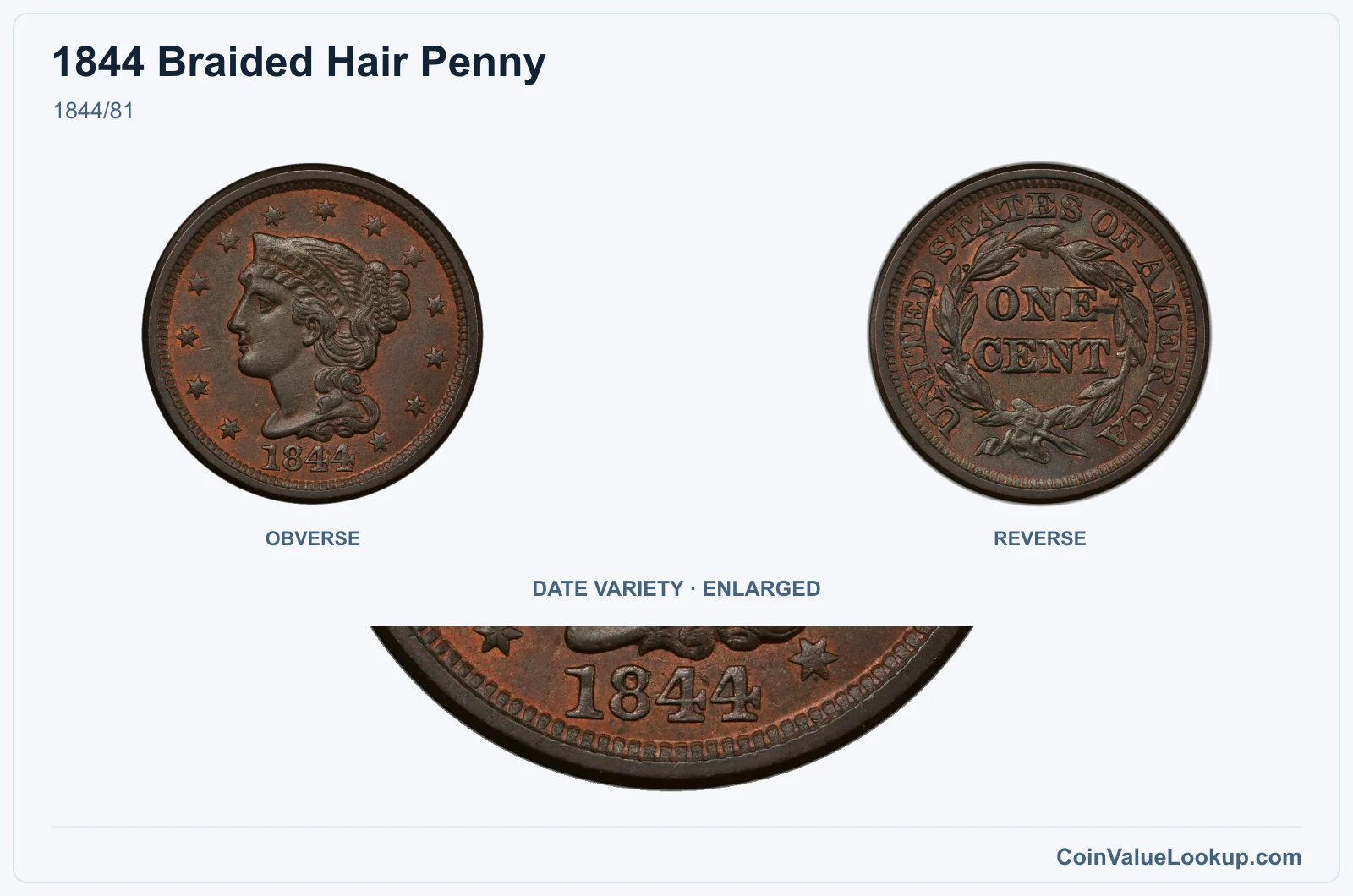
The 1844/81 is one of the more dramatic blundered dates in the large cent series. What happened is straightforward: a date punch reading "81" was initially impressed into the die in the wrong orientation, and then the correct "44" was punched over it.
The remnants of the misoriented digits are visible beneath the final two numerals.
This is not a coin made in 1881. It is an 1844-dated die with a production mistake that was corrected but not erased.
Under magnification you can see traces of the underlying digits, especially in the lower loops of the 4s.
USA Coin Book guide estimates run from about $91 in Good-4 to $6,257 in MS-63. Even in lower circulated grades this variety commands roughly three times the price of a normal date 1844.
The premium grows substantially in higher grades, where the overdate detail is sharper and more visually striking. Authentication by a recognized grading service is strongly recommended before paying overdate money.
| Range | Grade | Price | Auction Records | Appraisal |
|---|---|---|---|---|
| PO | PO 1 | — | Coin Identifier | |
| FR | FR 2 | — | Coin Identifier | |
| AG | AG 3 | — | Coin Identifier | |
| G | G 4 | — | Coin Identifier | |
| G 6 | Coin Identifier | |||
| VG | VG 8 | Coin Identifier | ||
| VG 10 | Coin Identifier | |||
| F | F 12 | Coin Identifier | ||
| F 15 | Coin Identifier | |||
| VF | VF 20 | Coin Identifier | ||
| VF 25 | Coin Identifier | |||
| VF 30 | Coin Identifier | |||
| VF 35 | — | Coin Identifier | ||
| XF | XF 40 | Coin Identifier | ||
| XF 45 | Coin Identifier | |||
| AU | AU 50 | Coin Identifier | ||
| AU 53 | Coin Identifier | |||
| AU 55 | Coin Identifier | |||
| AU 58 | Coin Identifier | |||
| MS | MS 60 | Coin Identifier | ||
| MS 61 | Coin Identifier | |||
| MS 62 | Coin Identifier | |||
| MS 63 | — | Coin Identifier | ||
| MS 64 | Coin Identifier | |||
| MS 65 | — | — | — | |
| MS 66 | — | — | — | |
| MS 67 | — | — | — | |
| MS 68 | — | — | — | |
| MS 69 | — | — | — | |
| MS 70 | — | — | — |
1844 Braided Hair Cent — PR
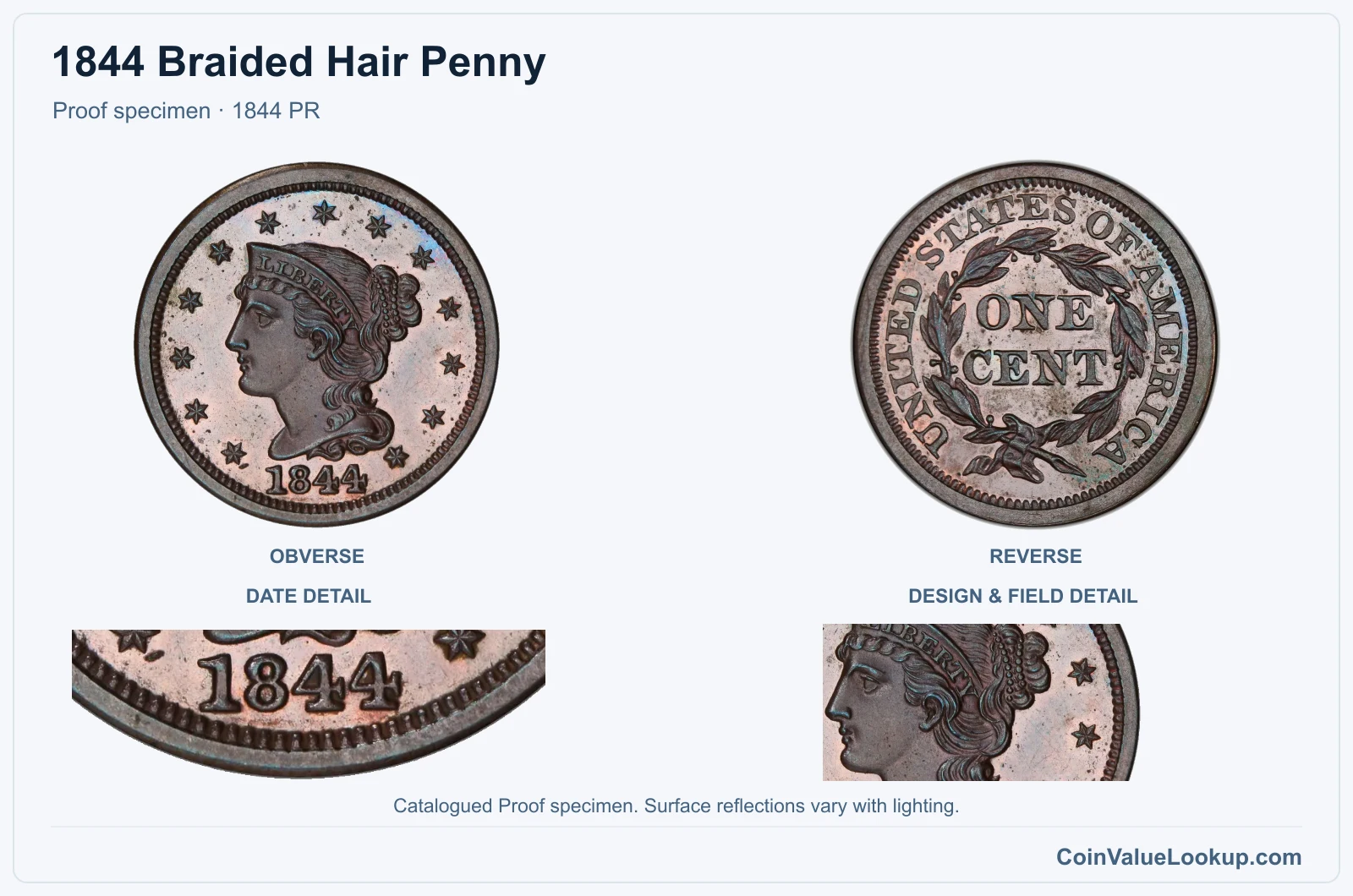
Proof 1844 Braided Hair Cents are rare early copper proofs that were struck with specially prepared dies and polished planchets at the Philadelphia Mint. They were not made for circulation.
Identifying a genuine proof requires careful attribution. You need to examine the die characteristics, rim finish, surface quality and overall sharpness.
A coin that has been polished to a shine is not a proof; the manufacturing process produces distinctive squared rims, mirrored fields and sharp device edges that cleaning cannot replicate.
No supported numeric price range has been adopted for this issue. Each proof example needs individual assessment based on its authenticated identity, surface preservation and any die variety present.
A recognized third-party grading service is essential here, because the difference between a genuine proof and a polished business strike is worth a great deal of money.
| Range | Grade | Price | Auction Records | Appraisal |
|---|---|---|---|---|
| PR | PR 1 | — | Coin Identifier | |
| PR 2 | — | Coin Identifier | ||
| PR 3 | — | Coin Identifier | ||
| PR 4 | — | Coin Identifier | ||
| PR 6 | — | Coin Identifier | ||
| PR 8 | — | Coin Identifier | ||
| PR 10 | — | Coin Identifier | ||
| PR 12 | — | Coin Identifier | ||
| PR 15 | — | Coin Identifier | ||
| PR 20 | — | Coin Identifier | ||
| PR 25 | — | Coin Identifier | ||
| PR 30 | — | Coin Identifier | ||
| PR 35 | — | Coin Identifier | ||
| PR 40 | — | Coin Identifier | ||
| PR 45 | — | Coin Identifier | ||
| PR 50 | — | Coin Identifier | ||
| PR 53 | — | Coin Identifier | ||
| PR 55 | — | Coin Identifier | ||
| PR 58 | — | Coin Identifier | ||
| PR 60 | — | Coin Identifier | ||
| PR 61 | — | Coin Identifier | ||
| PR 62 | — | Coin Identifier | ||
| PR 63 | — | Coin Identifier | ||
| PR 64 | Coin Identifier | |||
| PR 65 | — | — | — | |
| PR 66 | — | — | — | |
| PR 67 | — | — | — | |
| PR 68 | — | — | — | |
| PR 69 | — | — | — | |
| PR 70 | — | — | — |
1844 Braided Hair Cent Error List
1. 1844 Braided Hair Cent — Off-Center Strike
An off-center strike happens when the planchet is not properly seated between the dies at the moment of impact. The result is a displaced design with a blank, unstruck crescent on one side of the coin.
The farther off-center the strike, the more dramatic the visual effect.
On an 1844 Braided Hair Cent, the key diagnostic is that crescent of blank copper paired with a shifted design. The date must remain visible for the coin to be attributable to 1844 at all, so look for that first.
Do not confuse an off-center strike with a clipped planchet, a one-sided die misalignment, or post-mint damage where someone flattened or bent the coin. Clips typically show a curved bite out of the edge, and post-mint flattening lacks the characteristic unstruck area.
No specific price range has been adopted for this error; each example needs individual evaluation based on the degree of offset, date visibility and overall condition.
2. 1844 Braided Hair Cent — Die Crack
Die cracks appear as thin, raised lines running across the coin's surface. They form when the steel die develops a fracture from repeated use, and the crack fills with metal during striking.
The result is a fine ridge that can cross open fields, cut through lettering or run along devices.
On an 1844 cent, look for these raised lines under good lighting and some magnification. They follow irregular paths and feel slightly raised to the touch if the coin is in decent preservation.
The main lookalikes are incuse scratches, corrosion lines and tool marks. Scratches are cut into the surface rather than raised above it.
Corrosion can create linear patterns but typically has a rough, pitted texture rather than a smooth ridge. No supported price range is adopted for die-crack examples on this date; value depends on the crack's prominence, location and the coin's overall grade and surfaces.
3. 1844 Braided Hair Cent — Die Break / Cud
A die break occurs when a piece of the die actually chips away. On the struck coin this missing section appears as a raised, featureless blob of metal.
When that blob connects to the rim, collectors call it a cud. It is one of the more visually obvious error types.
On an 1844 Braided Hair Cent, look for a raised lump along the rim area that displaces part of the normal design, whether that is a star, part of the legend or a section of the wreath. The boundary between the normal design and the raised area should be relatively sharp.
Do not mistake a rim dent or heavy corrosion for a cud. Rim damage is typically depressed or irregular, not a smooth raised feature.
Interior die chips that do not reach the rim are related but considered a different category. No specific price has been adopted; each cud needs evaluation based on size, location and coin condition.
4. 1844 Braided Hair Cent — Repunched Date
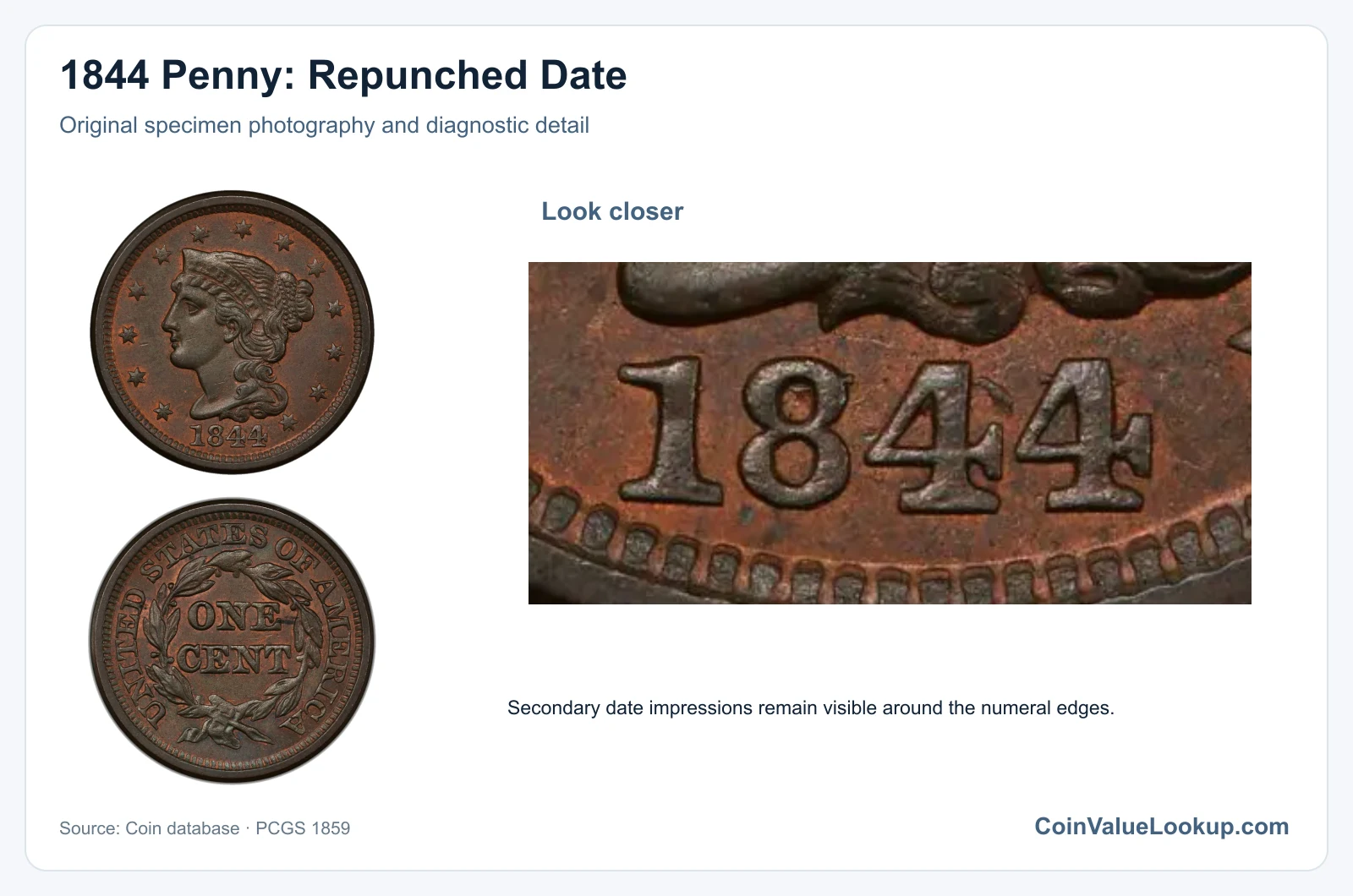
Before the era of hubbed dates, individual numerals on large cents were punched into the die by hand. Sometimes the punch landed slightly off position and had to be corrected with a second impression.
The result is a repunched date, where ghostly remnants of the first placement appear beside or beneath the final digits.
On an 1844 cent, examine each numeral under magnification for doubled serifs, offset bases or shadow digits. The traces are usually subtle and may appear on just one or two of the four numerals.
This is different from the 1844/81 overdate, which involves a completely different misoriented punch, and different from machine doubling, which produces flat, shelf-like distortion on the design. Damage to the date area can also mimic repunching but will typically show displaced metal or scratches rather than clean doubled outlines.
No supported price range has been adopted for repunched date varieties on this issue; each example requires individual assessment.