1816 Coronet Head Cent Coin Value: How Much Is It Worth?
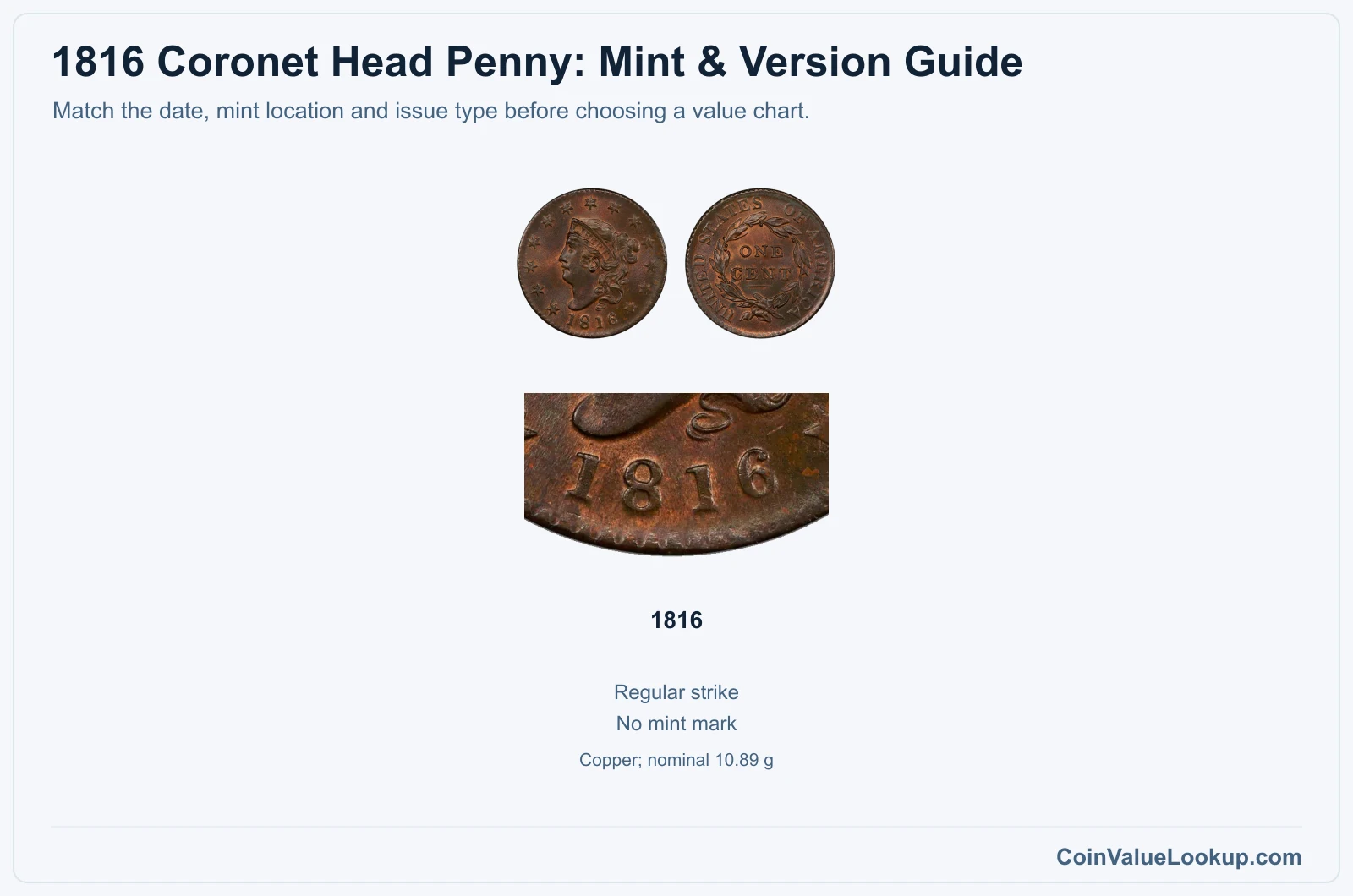
The 1816 Coronet Head Cent marks the first year of a design that replaced the Classic Head series. Guide estimates for an ordinary business strike range from about $43 in G4 to $1,344 in MS63, according to USA Coin Book.
Your actual coin's value depends on its exact variety, surface quality and grade, so identification comes first.
Fast Way to Identify Your 1816 Coronet Head Cent
Upload clear photos of the front and back of your 1816 cent and our identifier will provide a preliminary identification of the coin's type and variety. Good lighting and a straight-on angle help the most.
This is not authentication or formal grading, but it is a solid first step toward understanding what you have.
1816 Coronet Head Cent Value
Upload both sides of your 1816 Coronet Head Cent.
Front Obverse
Upload photo
Back Reverse
Upload photo
Which 1816 Coronet Head Cent Versions Are Worth Money?
- The 1816 business strike ranges from roughly $43 in G4 to $1,344 in MS63 per USA Coin Book, making higher-grade survivors the primary target for value.
- Original surfaces without cleaning or corrosion significantly affect market appeal on early copper cents, even in lower grades.
- Cataloged proof examples or recognized restrikes of this date require separate pricing outside the ordinary guide range.
- Prominent mint errors such as off-center strikes, double strikes, laminations or die breaks can add substantial value but need individual evaluation.
Step 1: Identify Your 1816 Coronet Head Cent Mint Mark and Version
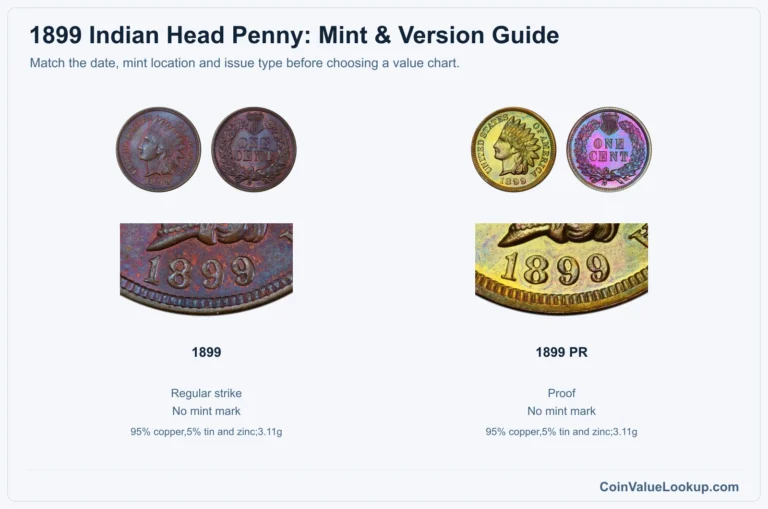
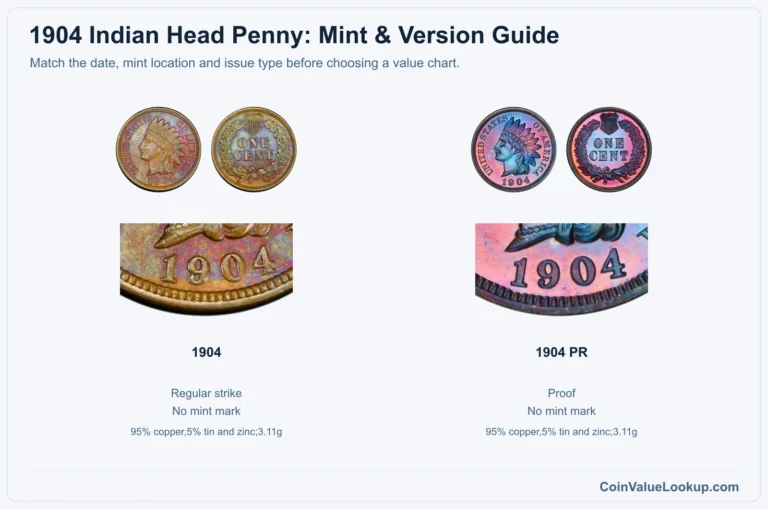
The Coronet Head cent shows Liberty wearing a coronet inscribed LIBERTY on the obverse, with a wreath and denomination on the reverse. All 1816 cents were struck at Philadelphia, so there is no mintmark to look for.
Do not assume a branch-mint version exists for this date.
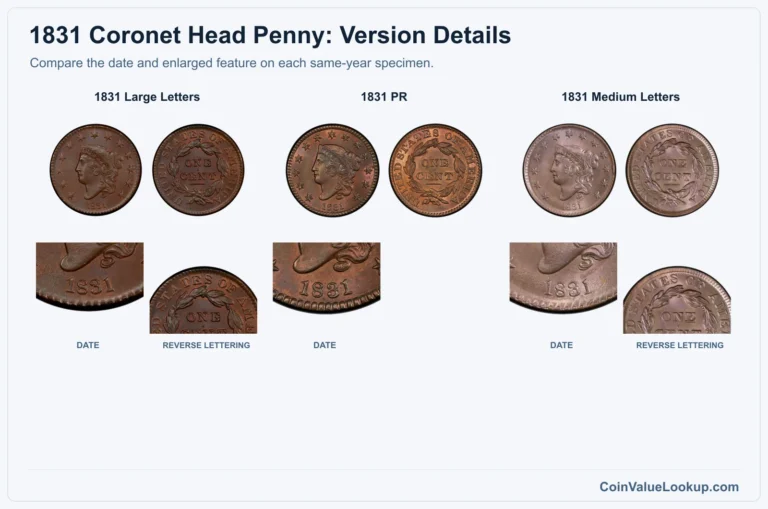
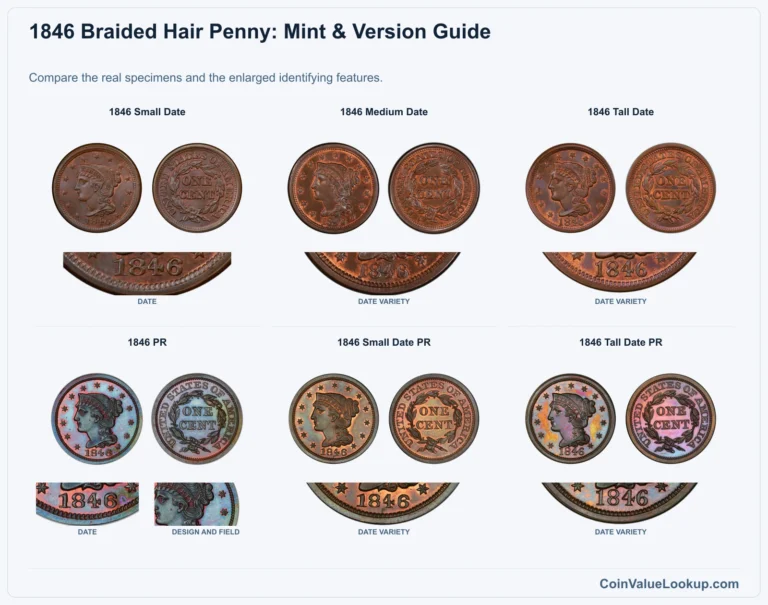
Check both sides carefully. The date-punch shape, legend wording and wreath details help confirm you have the correct series and not a neighboring type like the Classic Head or Braided Hair.
Edge inspection matters too, since damage there can masquerade as a variety.
Weight should be close to the nominal 10.89 grams for a copper cent of this era. But wear, corrosion and the production tolerances of early-nineteenth-century coining mean weight alone cannot prove authenticity.
Use it as supporting evidence alongside the visual match.
Original surfaces and legible detail matter more than brightness. A dark, evenly worn coin with original surfaces often holds more appeal than a harshly cleaned bright one.
Step 2: Check Your 1816 Coronet Head Cent Grade
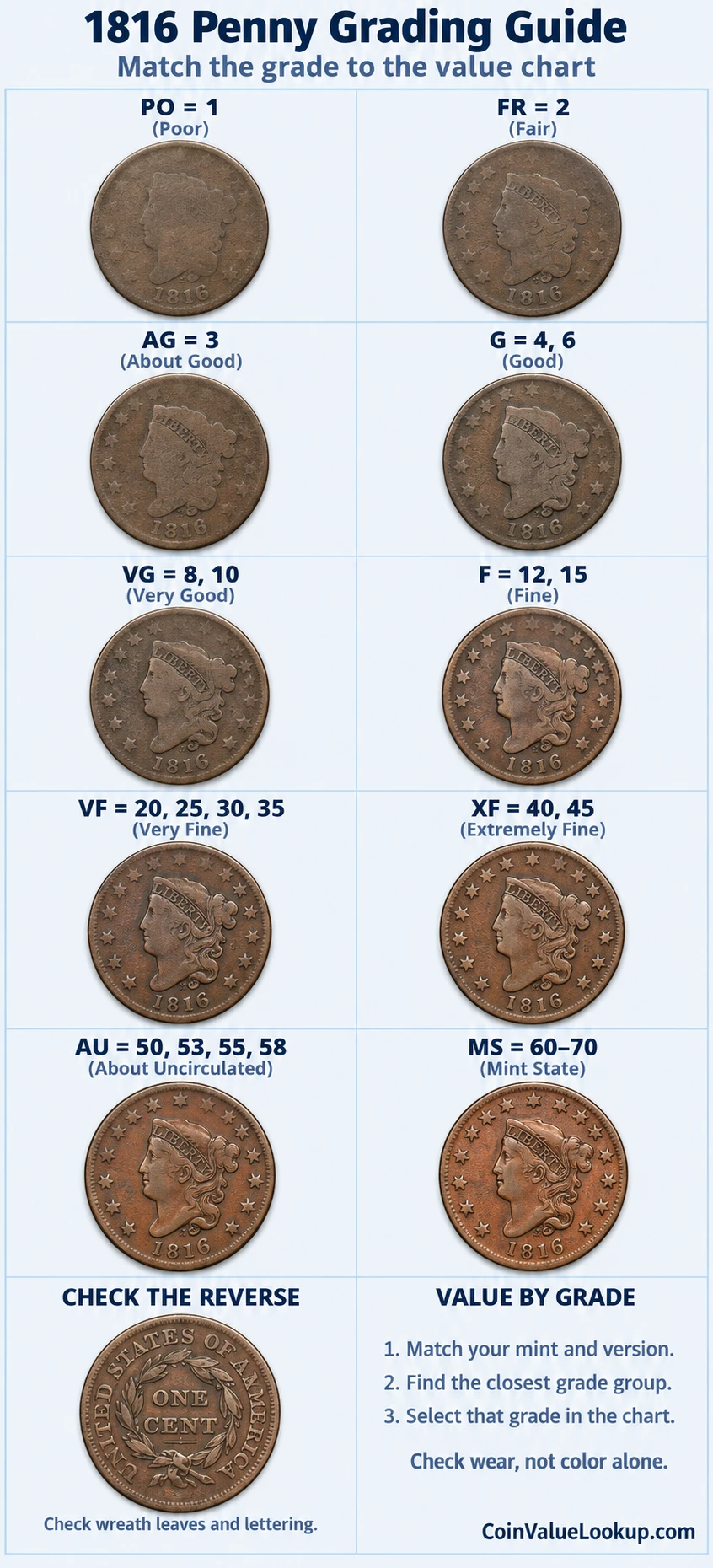
Compare the hair detail above Liberty's ear and across her cheek with known grade examples of the same type. Wreath leaf relief and sharpness of the lettering are equally important checkpoints.
Use the comparison image to see how these areas change from well-worn to mint state.
Separate honest circulation wear from weak strike or surface problems. Porosity, corrosion and old cleaning can look like wear but actually represent a different kind of loss.
Coins with these issues typically sell below the guide estimate for their apparent grade.
On copper cents, you may see color descriptions like BN, RB or RD. These refer to how much original red color survives versus natural brown toning.
They are color attributes, not separate alloys or materials. A Proof designation means the coin was made using a special manufacturing process, not that it grades higher than a mint-state coin.
Coin Value Lookup is a handy place to look up value guides for early copper cents and many other U.S. coin series. If you are sorting through a collection, it can save you a lot of flipping through catalogs.
Step 3: Check 1816 Coronet Head Cent Value by Mint and Version
1816 Coronet Head Cent
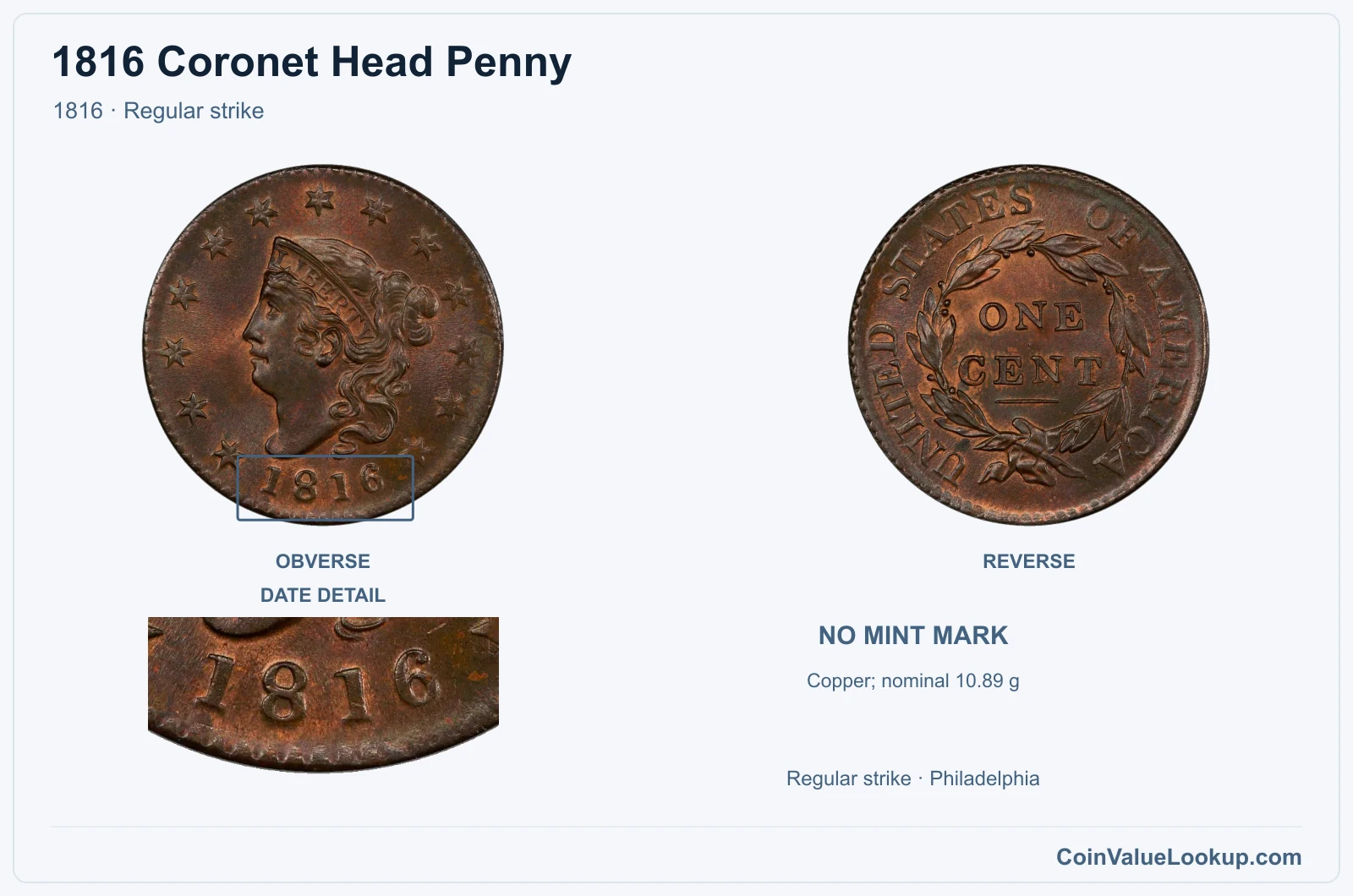
The 1816 Coronet Head Cent was struck at Philadelphia in copper, with a nominal weight of 10.89 grams. No mintmark appears on this coin.
USA Coin Book lists guide estimates from about $43 in G4 up to $1,344 in MS63 for a business strike.
Look for the Coronet-style Liberty portrait on the obverse and the wreath enclosing the denomination on the reverse. Confirm the date is clearly 1816 and that the overall style matches the Coronet Head series rather than an earlier or later type.
Original surfaces with natural brown toning are typical for survivors of this age, and coins retaining more detail through the hair curls and wreath leaves will grade higher.
| Range | Grade | Price | Auction Records | Appraisal |
|---|---|---|---|---|
| PO | PO 1 | — | Coin Identifier | |
| FR | FR 2 | — | Coin Identifier | |
| AG | AG 3 | — | Coin Identifier | |
| G | G 4 | Coin Identifier | ||
| G 6 | Coin Identifier | |||
| VG | VG 8 | — | Coin Identifier | |
| VG 10 | Coin Identifier | |||
| F | F 12 | — | Coin Identifier | |
| F 15 | Coin Identifier | |||
| VF | VF 20 | Coin Identifier | ||
| VF 25 | Coin Identifier | |||
| VF 30 | Coin Identifier | |||
| VF 35 | Coin Identifier | |||
| XF | XF 40 | Coin Identifier | ||
| XF 45 | Coin Identifier | |||
| AU | AU 50 | Coin Identifier | ||
| AU 53 | Coin Identifier | |||
| AU 55 | Coin Identifier | |||
| AU 58 | Coin Identifier | |||
| MS | MS 60 | Coin Identifier | ||
| MS 61 | Coin Identifier | |||
| MS 62 | Coin Identifier | |||
| MS 63 | Coin Identifier | |||
| MS 64 | Coin Identifier | |||
| MS 65 | Coin Identifier | |||
| MS 66 | Coin Identifier | |||
| MS 67 | — | — | — | |
| MS 68 | — | — | — | |
| MS 69 | — | — | — | |
| MS 70 | — | — | — |
1816 Coronet Head Cent Error List
1. 1816 Coronet Head Cent — Off-Center Strike
An off-center strike happens when the planchet is not properly seated between the dies at the moment of striking. On an 1816 Coronet Head Cent, this shows up as a displaced design with an unstruck crescent of blank metal on one side.
The more off-center the strike, the more dramatic the visual effect.
The date needs to remain visible for the coin to be positively identified and valued. A coin struck far off center but missing the date is much harder to attribute and less desirable.
No specific price range is adopted for this error on the 1816 cent; value depends on the severity of the misalignment, overall condition and authenticated identity.
Do not confuse an off-center strike with a clipped planchet, one-sided die misalignment or post-mint flattening from damage. Each of those produces a different visual signature.
2. 1816 Coronet Head Cent — Double / Multiple Strike
A double or multiple strike occurs when the coin receives two or more impressions from the dies, typically with the planchet shifting or rotating between strikes. On an 1816 cent, look for distinctly separate or overlapping design images rather than just slightly thickened lettering.
The key diagnostic is seeing two clearly displaced sets of design elements, such as two portraits or two wreaths at different angles. This is different from a doubled die, where the doubling originates in the die itself and appears identically on every coin struck from that die.
It also differs from impressions added after the coin left the mint, which lack the sharp metal-flow characteristics of a genuine second strike.
No numeric price range is adopted for this error. Individual assessment based on authenticated identity, condition and the degree of separation between strikes determines value.
3. 1816 Coronet Head Cent — Lamination / Split Planchet
Lamination errors on an 1816 copper cent appear as peeling metal, a retained flap or visible separation within the copper. These result from impurities or gas pockets trapped in the planchet during production.
Photograph the edge alongside the affected face to document the split clearly.
Look for a distinct layer separating from the coin's body. The flap, if still attached, may lift slightly or sit flush.
This differs from surface scraping, corrosion pitting or a deliberately shaved coin. Corrosion tends to be granular and uneven, while a lamination follows the metal's internal structure.
No specific price range is adopted for lamination errors on this date. Value depends on how dramatic the separation is, whether it affects a key design area and the coin's overall authenticated condition.
4. 1816 Coronet Head Cent — Die Break / Cud
A die break or cud on an 1816 Coronet Head Cent appears as a raised, featureless blob of metal where a piece of the die broke away. A true cud connects to the rim, while interior die breaks sit within the design field.
Both result from stress fractures in the steel die during production.
Look for a clearly raised area that displaces or obscures part of the normal design. The boundary between the cud and the surviving design should be distinct.
Compare this to rim dents, which are concave rather than raised, and to corrosion bumps, which tend to be irregular and lack a sharp boundary. Interior die chips are smaller and rarely obliterate significant design elements.
No numeric price range is adopted for this error. Assessment depends on the cud's size, location, sharpness and the coin's authenticated grade.