1831 Coronet Head Cent Coin Value: How Much Is It Worth?
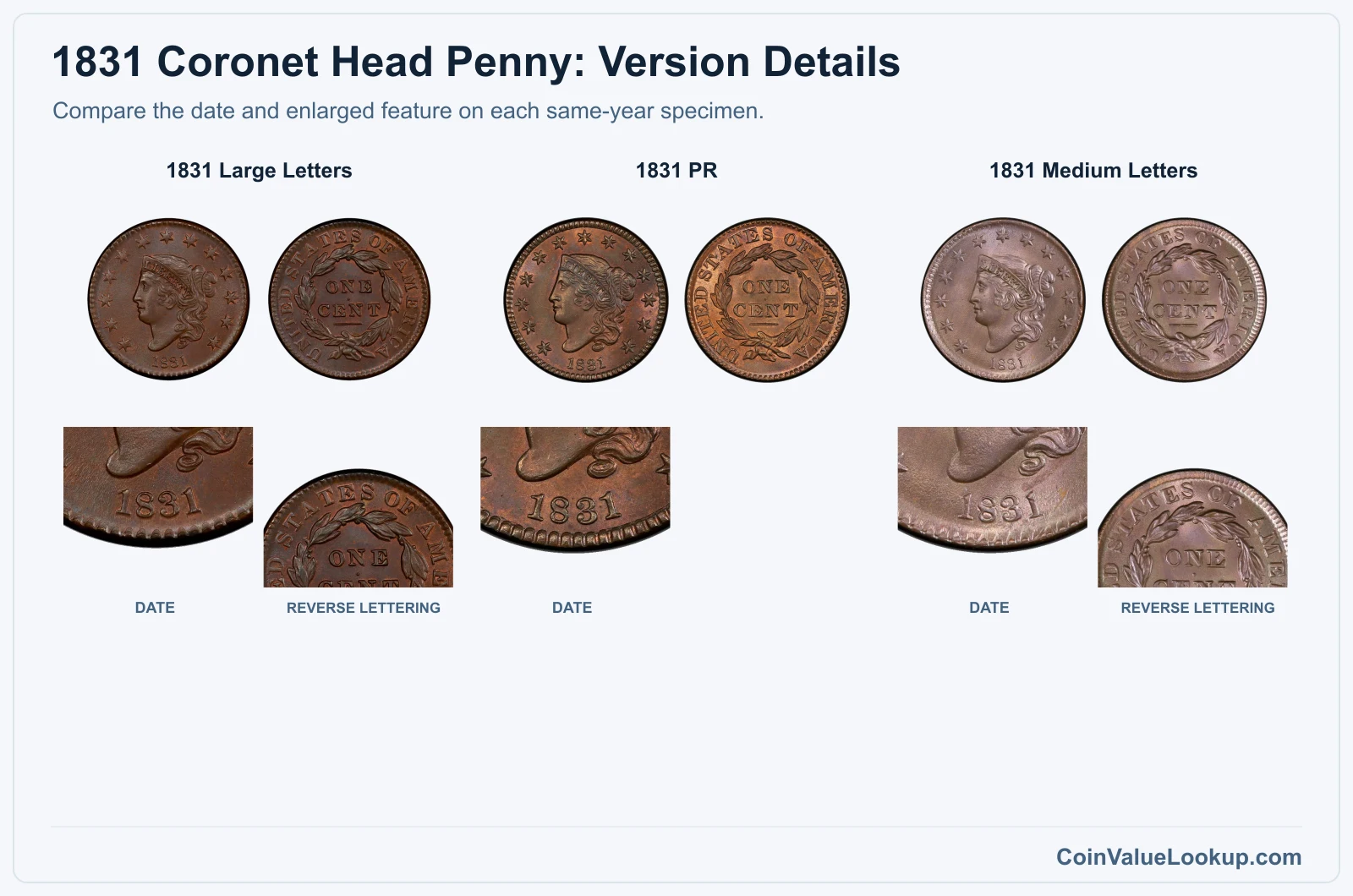
The 1831 Coronet Head Cent comes in two main business-strike varieties — Large Letters and Medium Letters — plus a separate Proof finish. Guide estimates range from about $38 in G4 to $1,986 in MS63, depending on the exact variety and condition.
Identify your specific branch before drawing any price conclusions, because proofs, restrikes and major errors fall outside those ordinary figures.
Fast Way to Identify Your 1831 Coronet Head Cent
The quickest way to start figuring out what you have is to upload clear photos of both the front and back of your coin. Our identifier can give you a preliminary read on the variety and general condition.
It is not a substitute for professional authentication, but it will point you in the right direction before you dig deeper.
1831 Coronet Head Cent Value
Upload both sides of your 1831 Coronet Head Cent.
Front Obverse
Upload photo
Back Reverse
Upload photo
Which 1831 Coronet Head Cent Versions Are Worth Money?
- The 1831 Medium Letters variety reaches about $1,986 in MS63 — the highest listed guide figure among business strikes for this date.
- The 1831 Large Letters variety lists up to roughly $1,127 in MS63, making high-grade examples well worth identifying.
- Proof 1831 cents require professional authentication of die characteristics, surfaces and rims; values depend entirely on the individual coin's verified identity and condition.
- Recognized mint errors such as off-center strikes, uniface strikes and clipped planchets on 1831 cents warrant closer examination and professional assessment.
Step 1: Identify Your 1831 Coronet Head Cent Mint Mark and Version
Every 1831 Coronet Head Cent was struck at Philadelphia, so there is no mintmark to look for. The key split is on the reverse: Large Letters versus Medium Letters.
Compare the size and spacing of the words UNITED STATES OF AMERICA around the wreath — the difference is visible once you know where to look.
A Proof 1831 cent is a manufacturing category, not simply a high-grade coin. Proof surfaces show specific die characteristics, sharp rims and a distinctive finish that polishing alone cannot replicate.
If someone tells you a shiny coin is a proof, get it authenticated.
Also check the date punch shape, legend wording and wreath details carefully. Weight should be around 10.89 grams for genuine copper examples, but wear, corrosion and original production tolerances mean weight alone is not proof of authenticity.
Use it as supporting evidence alongside visual inspection.
Step 2: Check Your 1831 Coronet Head Cent Grade
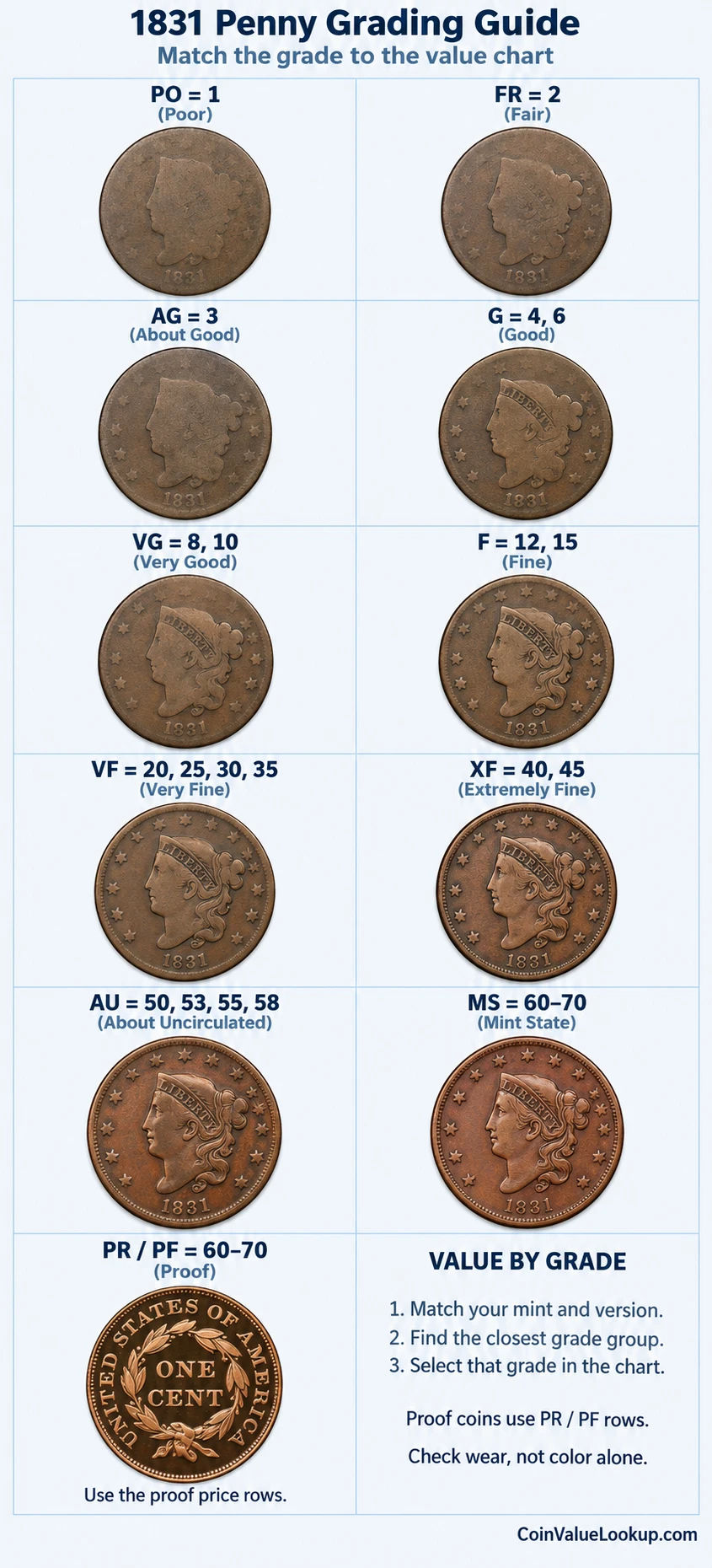
Focus on the portrait first. Hair detail above the ear and along the forehead band wears away earliest on the Coronet Head design.
On well-circulated pieces the cheek flattens and individual curls merge into a smooth mass. The wreath on the reverse loses leaf veining before the lettering shows significant wear.
Separate honest circulation wear from other problems. Weak strikes, porosity and old corrosion can mimic wear but are different conditions entirely.
Surface issues like cleaning, scratches or environmental damage can push a coin's market value well below what the grade number alone suggests.
Copper cents come in color designations: BN (brown), RB (red-brown) and RD (red). These describe the remaining original color, not different metals.
Most survivors from 1831 are brown.
Use the comparison image to match your coin's detail level against known grade benchmarks. A coin that looks sharp but has been harshly cleaned may still trade for less than a naturally worn example with original surfaces.
Step 3: Check 1831 Coronet Head Cent Value by Mint and Version
1831 Coronet Head Cent — Large Letters
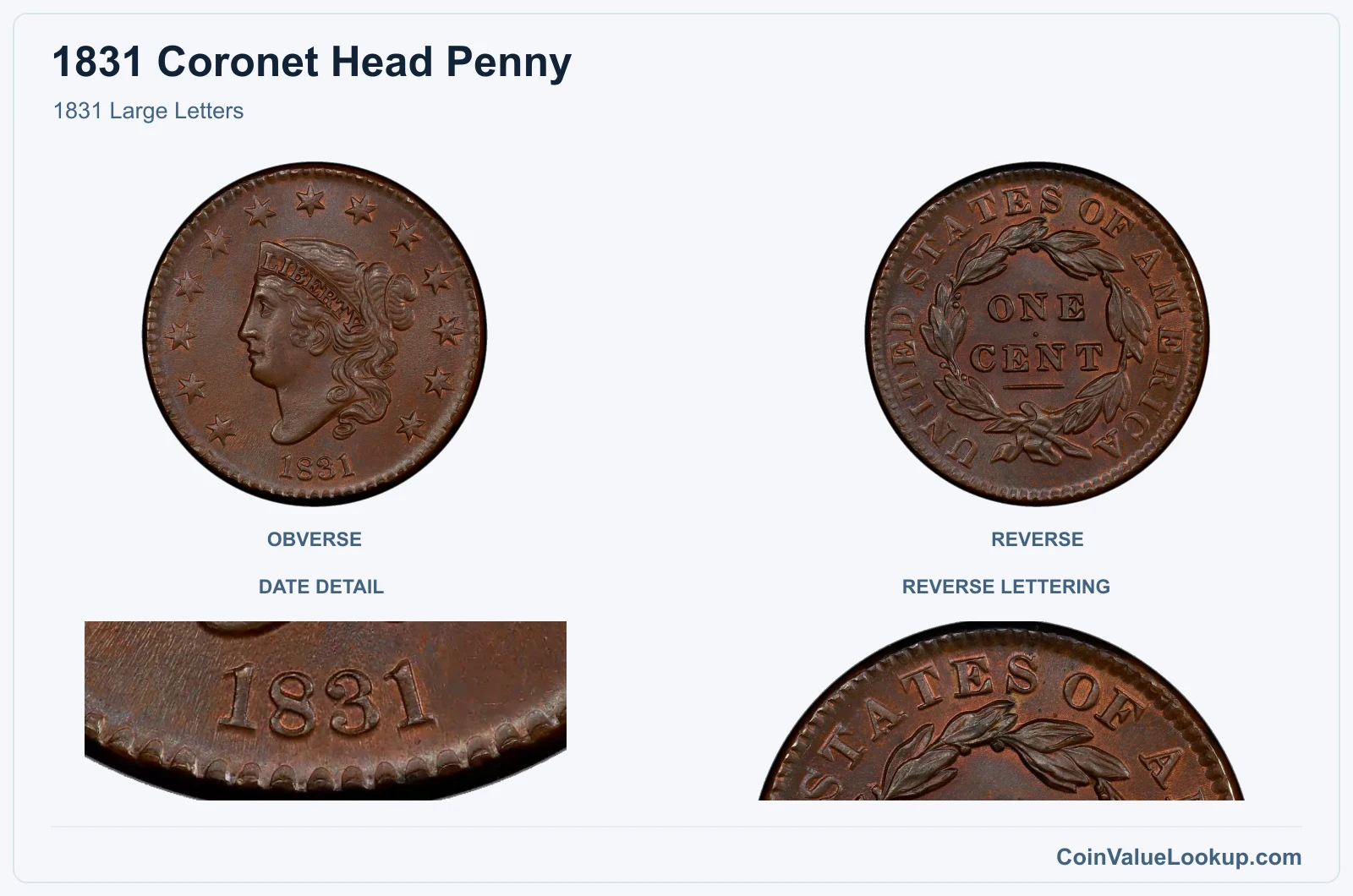
The 1831 Large Letters cent was struck at Philadelphia in copper, weighing nominally 10.89 grams. "Large Letters" refers to the size of the reverse legend — compare your coin's lettering directly against a known Medium Letters example if you are unsure.
Guide estimates from USA Coin Book place this variety at about $38 in G4 and around $1,127 in MS63. Most surviving examples fall well below mint state, so finding one with strong detail and original surfaces is the real challenge.
If you are exploring values across the full Coronet Head series, Coin Value Lookup is a useful starting point for looking up other dates and denominations.
| Range | Grade | Price | Auction Records | Appraisal |
|---|---|---|---|---|
| PO | PO 1 | — | Coin Identifier | |
| FR | FR 2 | — | Coin Identifier | |
| AG | AG 3 | Coin Identifier | ||
| G | G 4 | Coin Identifier | ||
| G 6 | Coin Identifier | |||
| VG | VG 8 | Coin Identifier | ||
| VG 10 | Coin Identifier | |||
| F | F 12 | — | Coin Identifier | |
| F 15 | — | Coin Identifier | ||
| VF | VF 20 | Coin Identifier | ||
| VF 25 | Coin Identifier | |||
| VF 30 | Coin Identifier | |||
| VF 35 | Coin Identifier | |||
| XF | XF 40 | Coin Identifier | ||
| XF 45 | Coin Identifier | |||
| AU | AU 50 | Coin Identifier | ||
| AU 53 | Coin Identifier | |||
| AU 55 | Coin Identifier | |||
| AU 58 | Coin Identifier | |||
| MS | MS 60 | Coin Identifier | ||
| MS 61 | Coin Identifier | |||
| MS 62 | Coin Identifier | |||
| MS 63 | Coin Identifier | |||
| MS 64 | Coin Identifier | |||
| MS 65 | Coin Identifier | |||
| MS 66 | Coin Identifier | |||
| MS 67 | — | — | — | |
| MS 68 | — | — | — | |
| MS 69 | — | — | — | |
| MS 70 | — | — | — |
1831 Coronet Head Cent — PR
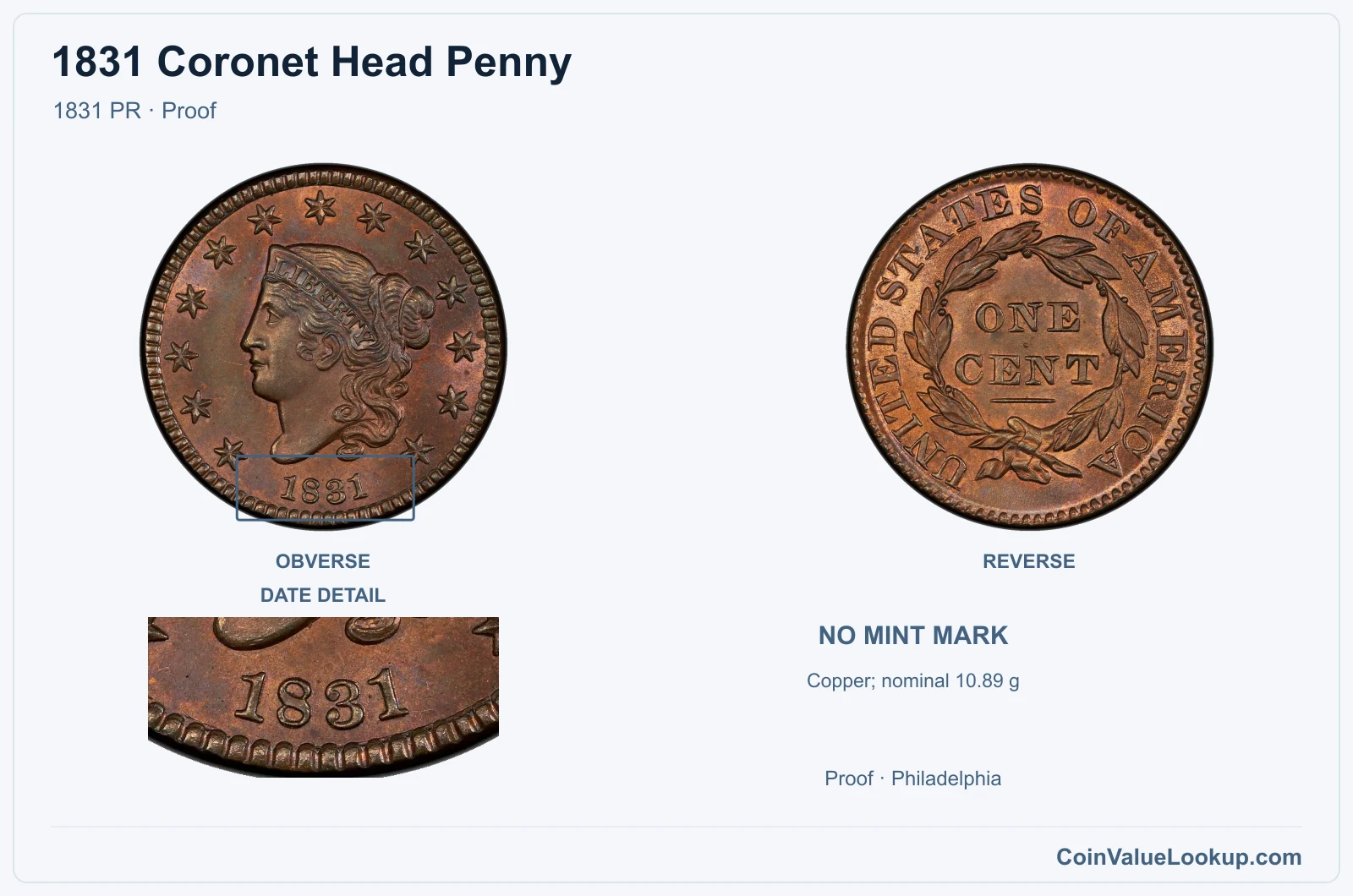
The 1831 Proof cent is a copper issue struck with specially prepared dies and planchets at Philadelphia. This is not just a pretty coin — genuine early proofs show specific die polish lines, squared rims and distinctive surface quality that set them apart from any business strike, no matter how well preserved.
No numeric price range is adopted here because each proof's value depends on its individually authenticated identity, surface preservation and any die characteristics confirmed by a professional grading service. Polishing a business strike does not create a proof.
If you suspect you have one, third-party certification is essential before assigning any value. Beware of cleaned or doctored coins marketed as proofs.
| Range | Grade | Price | Auction Records | Appraisal |
|---|---|---|---|---|
| PR | PR 1 | — | Coin Identifier | |
| PR 2 | — | Coin Identifier | ||
| PR 3 | — | Coin Identifier | ||
| PR 4 | — | Coin Identifier | ||
| PR 6 | — | Coin Identifier | ||
| PR 8 | — | Coin Identifier | ||
| PR 10 | — | Coin Identifier | ||
| PR 12 | — | Coin Identifier | ||
| PR 15 | — | Coin Identifier | ||
| PR 20 | — | Coin Identifier | ||
| PR 25 | — | Coin Identifier | ||
| PR 30 | — | Coin Identifier | ||
| PR 35 | — | Coin Identifier | ||
| PR 40 | — | Coin Identifier | ||
| PR 45 | — | Coin Identifier | ||
| PR 50 | — | Coin Identifier | ||
| PR 53 | — | Coin Identifier | ||
| PR 55 | — | Coin Identifier | ||
| PR 58 | — | Coin Identifier | ||
| PR 60 | — | Coin Identifier | ||
| PR 61 | — | Coin Identifier | ||
| PR 62 | Coin Identifier | |||
| PR 63 | Coin Identifier | |||
| PR 64 | Coin Identifier | |||
| PR 65 | Coin Identifier | |||
| PR 66 | — | Coin Identifier | ||
| PR 67 | — | — | — | |
| PR 68 | — | — | — | |
| PR 69 | — | — | — | |
| PR 70 | — | — | — |
1831 Coronet Head Cent — Medium Letters
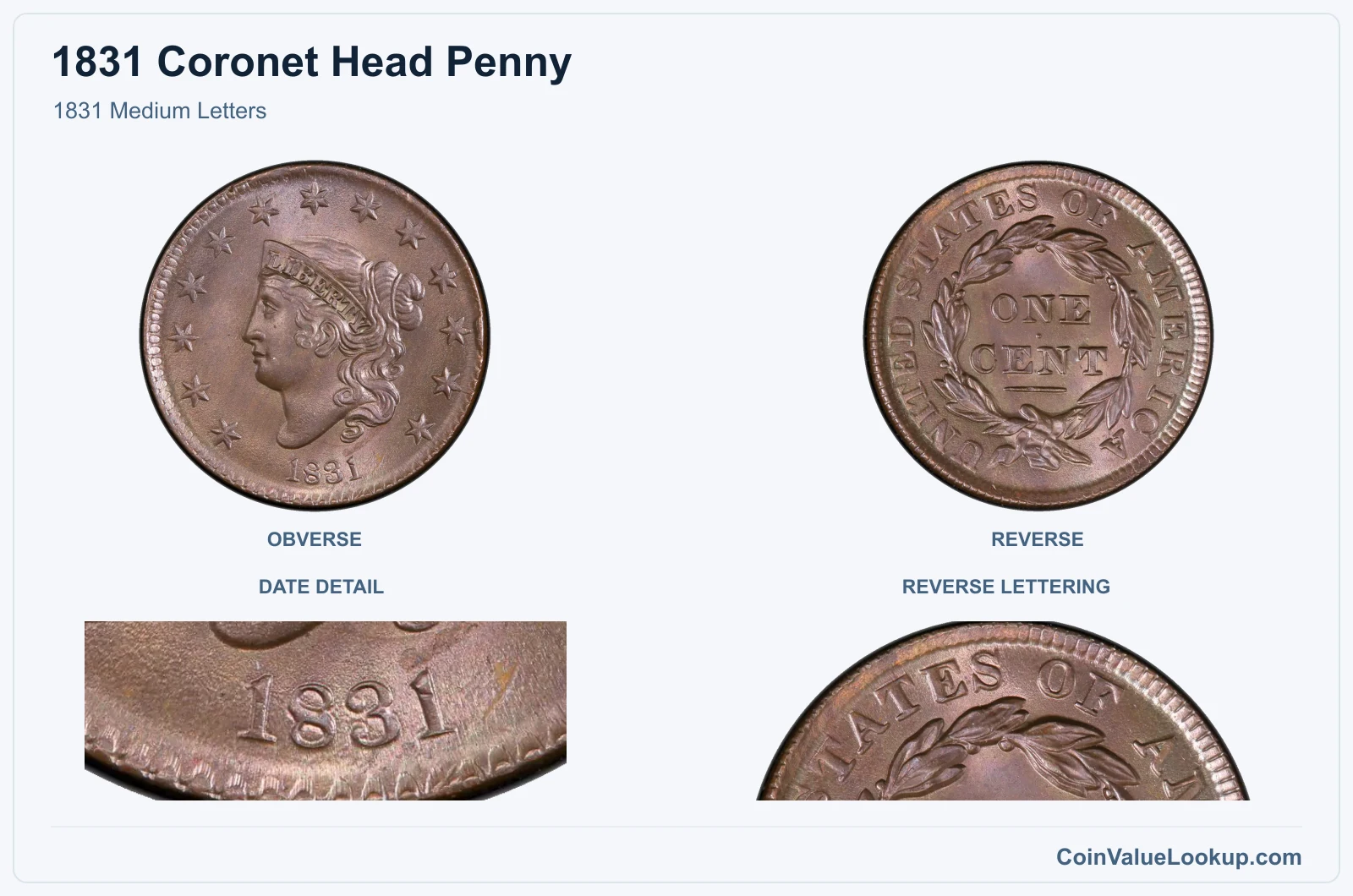
The 1831 Medium Letters cent is the other main business-strike variety for this year, also struck in copper at Philadelphia. The reverse lettering is noticeably smaller and more closely spaced than on the Large Letters version.
Guide estimates from USA Coin Book run from about $38 in G4 up to roughly $1,986 in MS63 — the highest listed anchor among 1831 business strikes.
That top figure applies to a solidly graded MS63 example with acceptable surfaces. Coins with problems like porosity, tooling or old cleaning will trade for less regardless of apparent sharpness.
Check both sides carefully and compare the letter sizing before deciding which branch you hold.
| Range | Grade | Price | Auction Records | Appraisal |
|---|---|---|---|---|
| PO | PO 1 | — | Coin Identifier | |
| FR | FR 2 | — | Coin Identifier | |
| AG | AG 3 | — | Coin Identifier | |
| G | G 4 | Coin Identifier | ||
| G 6 | — | Coin Identifier | ||
| VG | VG 8 | — | Coin Identifier | |
| VG 10 | — | Coin Identifier | ||
| F | F 12 | — | Coin Identifier | |
| F 15 | Coin Identifier | |||
| VF | VF 20 | Coin Identifier | ||
| VF 25 | Coin Identifier | |||
| VF 30 | Coin Identifier | |||
| VF 35 | Coin Identifier | |||
| XF | XF 40 | Coin Identifier | ||
| XF 45 | Coin Identifier | |||
| AU | AU 50 | Coin Identifier | ||
| AU 53 | Coin Identifier | |||
| AU 55 | Coin Identifier | |||
| AU 58 | Coin Identifier | |||
| MS | MS 60 | — | Coin Identifier | |
| MS 61 | Coin Identifier | |||
| MS 62 | Coin Identifier | |||
| MS 63 | Coin Identifier | |||
| MS 64 | Coin Identifier | |||
| MS 65 | Coin Identifier | |||
| MS 66 | — | — | — | |
| MS 67 | — | — | — | |
| MS 68 | — | — | — | |
| MS 69 | — | — | — | |
| MS 70 | — | — | — |
1831 Coronet Head Cent Error List
1. 1831 Coronet Head Cent — Uniface Strike
A uniface strike means one side of your coin is blank or nearly blank while the other carries a normal impression. This happens when another planchet or obstruction sits between the die and the blank during striking, so one face never contacts the die directly.
On an 1831 cent, you would see the full Coronet Head portrait or wreath on one side and a flat, featureless surface on the other.
The lookalike to watch for is a coin that has been ground down on one face or is so severely worn that detail has vanished. Genuine uniface errors show a smooth, slightly dished blank surface — not scratches, file marks or uneven metal loss.
No specific price range is adopted for this error; value depends on authenticated identity and the coin's overall condition.
2. 1831 Coronet Head Cent — Off-Center Strike
An off-center strike occurs when the planchet is not properly seated between the dies, producing a displaced design with an unstruck crescent of blank metal along one edge. On an 1831 cent, the most collectible examples retain a readable date even with significant misalignment.
A small percentage off-center may be subtle; larger shifts are obvious.
Do not confuse this with a clipped planchet, a one-sided die misalignment or post-mint damage like flattening from a vice. Genuine off-center errors show design elements that simply end where the die coverage stopped — there is no squished or distorted continuation.
No adopted price range exists for this error on the 1831 cent; individual assessment based on the degree of shift, date visibility and authenticated condition determines value.
3. 1831 Coronet Head Cent — Clipped Planchet
A clipped planchet error means part of the original blank was missing before the coin was struck. You might see a curved bite (from overlapping punch cuts on the strip), a straight edge or even a ragged portion.
On an 1831 Coronet Head Cent, look for design weakness opposite the clip — metal flow during striking often creates a soft spot on the far side.
Compare edge texture carefully. A genuine clip shows consistent metal flow and a natural transition at the missing area, not sharp cuts, file marks or corrosion pitting.
Post-mint damage like someone cutting a notch for jewelry use is a common lookalike. No numeric price is adopted; value depends on clip size, visual impact, authentication and overall coin condition.
4. 1831 Coronet Head Cent — Lamination / Split Planchet
Lamination errors on copper cents show up as peeling flaps, retained metal layers or visible separation within the planchet. On an 1831 cent, you might see a thin sheet of copper lifting away from the surface or a split visible along the edge.
Photograph the edge and the affected face together — that edge view often tells the story.
The tricky part is distinguishing a genuine lamination from post-mint scraping, corrosion damage or someone deliberately peeling metal off the coin. A true lamination follows the contour of the planchet and typically has a smooth underside where the layers separated during the original rolling or striking process.
No specific price range is adopted for this error; value hinges on the size and character of the flaw, plus authenticated condition.
5. 1831 Coronet Head Cent — Struck-Through Error
A struck-through error happens when foreign material — grease, a thread, a metal fragment — sits on the die or planchet during striking. The result is a localized depression, a textured impression or an area of incomplete design on your 1831 cent.
Grease fills tend to produce soft, rounded depressions, while a retained foreign object might leave a sharper, more defined shape.
Do not mistake ordinary wear, cleaning scratches or weak-strike areas for a struck-through error. Genuine examples show an impression that is below the normal surface plane and does not follow the pattern of circulation wear.
No adopted price range exists here; the error's value depends on how dramatic the impression is, what caused it and the coin's authenticated overall condition.
6. 1831 Coronet Head Cent — Rotated Dies
Rotated dies mean the obverse and reverse are not aligned in the standard orientation. On a normal US coin, if you hold the obverse upright and flip the coin top to bottom, the reverse should also appear upright.
If the reverse is tilted — say 30, 90 or even 180 degrees off — you have a die rotation error.
Before you get excited, make sure you are not just looking at a photograph taken at a weird angle or holding the coin sideways. Physically flip the coin along a vertical axis and check.
Minor rotations of a few degrees are less remarkable than dramatic shifts. No numeric price is adopted for rotated-die 1831 cents; value depends on the degree of rotation, visual impact and the coin's authenticated condition.