1888 Indian Head Penny Coin Value: How Much Is It Worth?
The 1888 Indian Head penny is a Philadelphia-only issue struck in bronze. Guide estimates for an ordinary business strike range from about $4.96 in G4 (a well-worn but readable coin) to around $186 in MS63 (a nice uncirculated example).
Proofs, the recognized 1888/7 overdate variety, and mint errors each carry separate valuations not captured by those anchors.
Fast Way to Identify Your 1888 Indian Head Penny
Want a quick read on what you have? Upload clear photos of both the front and back of your 1888 Indian Head penny.
Our identifier can give you a preliminary identification based on those images, helping you figure out which version you're holding and what to research next. It works best with good lighting and a steady shot.
1888 Indian Head Penny Value
Upload both sides of your 1888 Indian Head Penny.
Front Obverse
Upload photo
Back Reverse
Upload photo
Which 1888 Indian Head Penny Versions Are Worth Money?
- The 1888/7 overdate shows remnants of a 7 under the final 8 in the date, with guide values starting around $2,033 in G4 and reaching roughly $79,458 in MS63.
- An ordinary 1888 in high-grade uncirculated condition (MS63) guides around $186, far above the $4.96 entry point at G4.
- Proof 1888 Indian Head cents, verified by manufacturing characteristics and not just a shiny surface, guide near $313 at PR63.
- Coins with original, problem-free surfaces and strong remaining red color are more marketable than cleaned or corroded examples at the same apparent sharpness.
Step 1: Identify Your 1888 Indian Head Penny Mint Mark and Version
Every regular 1888 Indian Head cent was struck at Philadelphia, so there is no mintmark to look for. The small "L" you might spot on the ribbon behind the neck is the engraver's initial, not a mint identifier.
The obverse features the Indian portrait with a feathered headdress and the headband reading LIBERTY. The reverse shows an oak wreath surrounding the denomination, topped by a shield.
If your coin has a wheat-ear reverse or a plain flying eagle, you're looking at a different series entirely.
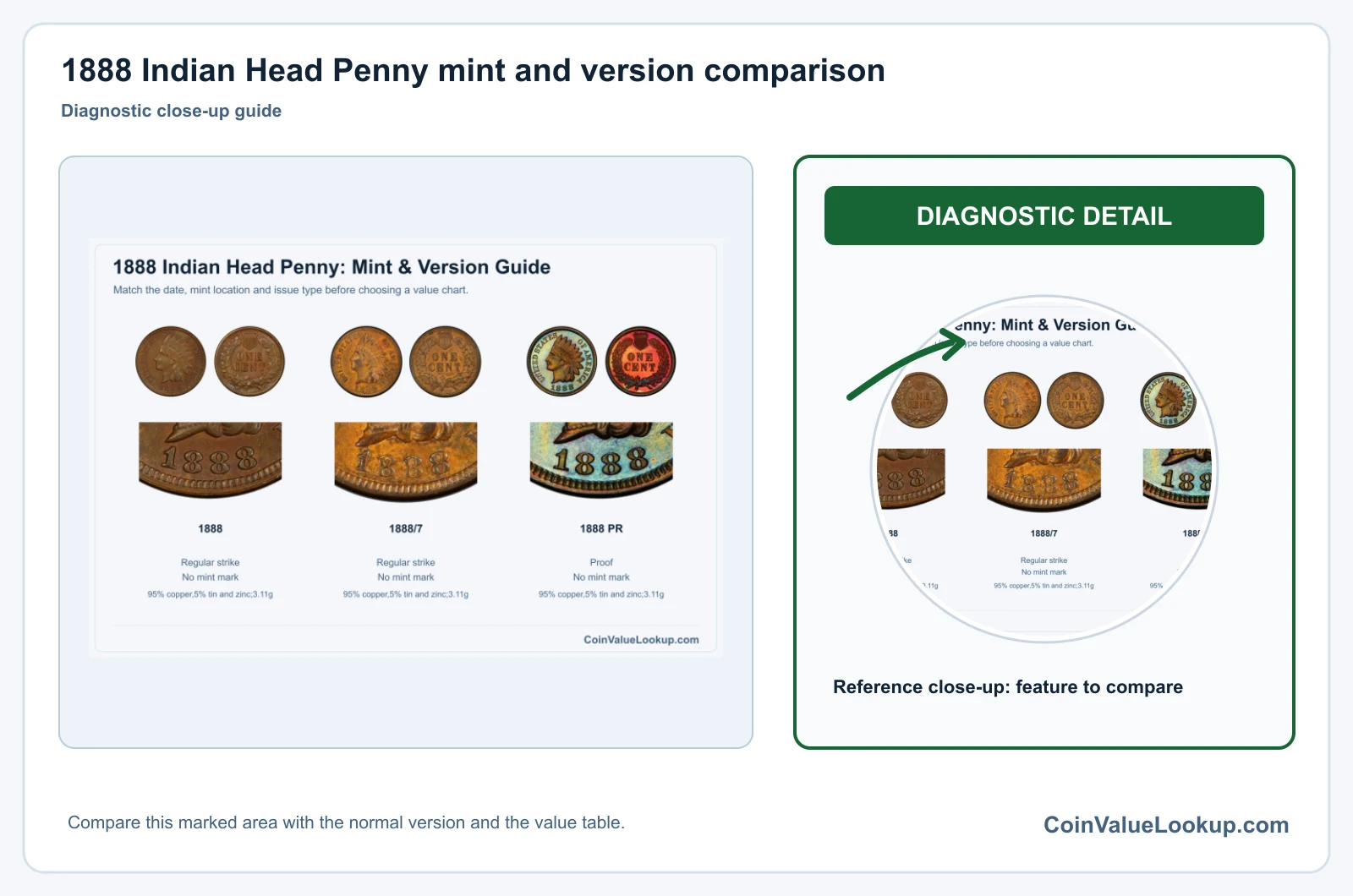
The big variety question for 1888 is the overdate. On a genuine 1888/7, remnants of an underlying 7 are visible beneath the final 8 in the date.
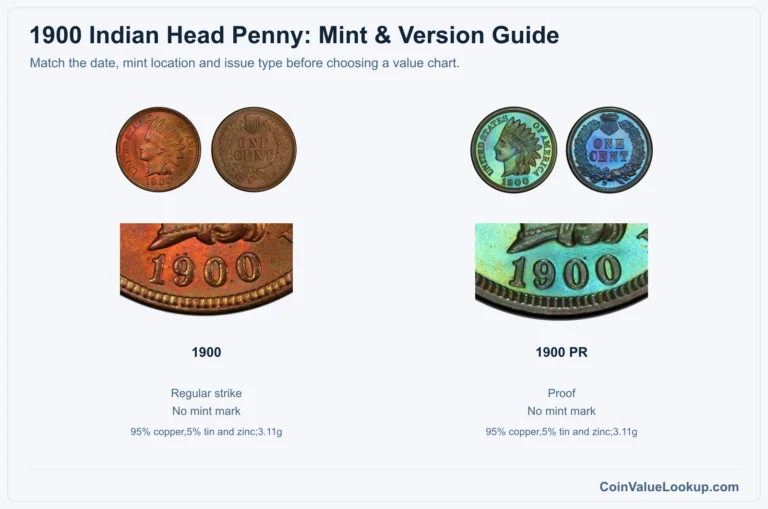
This is a completely different market from the ordinary 1888, so get the identification right before you start pricing. Proof coins have mirrored surfaces and squared-off rims from a different manufacturing process; a polished business strike is not a proof regardless of how shiny it looks.
Step 2: Check Your 1888 Indian Head Penny Grade
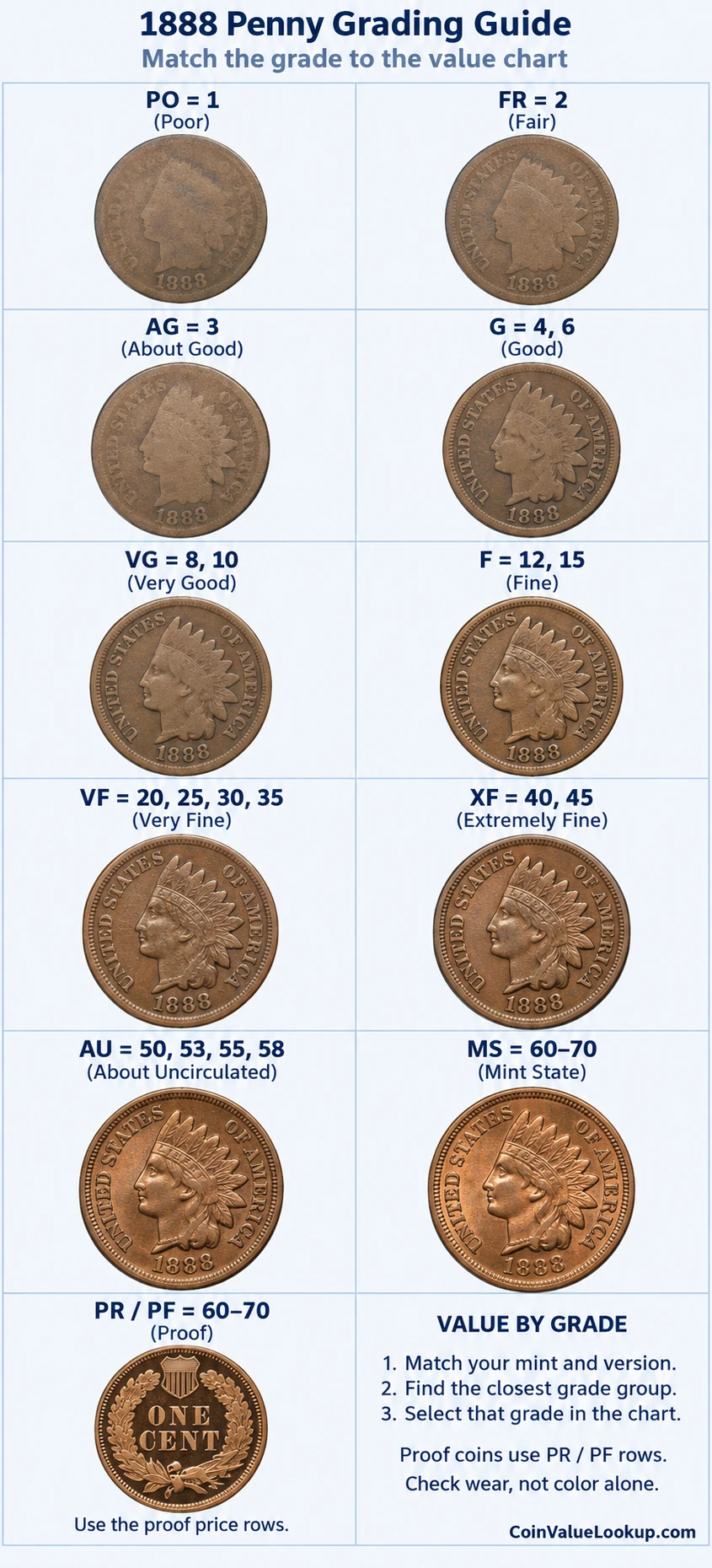
Start with the headband. On a well-worn coin the word LIBERTY will be partially or fully gone, and that's your first clue to the grade range.
In G4, you'll see a smooth portrait outline with little interior detail. As grades climb, feather tips sharpen, the hair above the ear gains definition, and diamonds on the ribbon become distinct.
Don't rely on one spot alone. Some 1888 cents were softly struck at the mint, which can leave weak feathers or hair even on an uncirculated coin.
Check luster across the whole surface and look at the wreath leaves on the reverse for matching wear patterns.
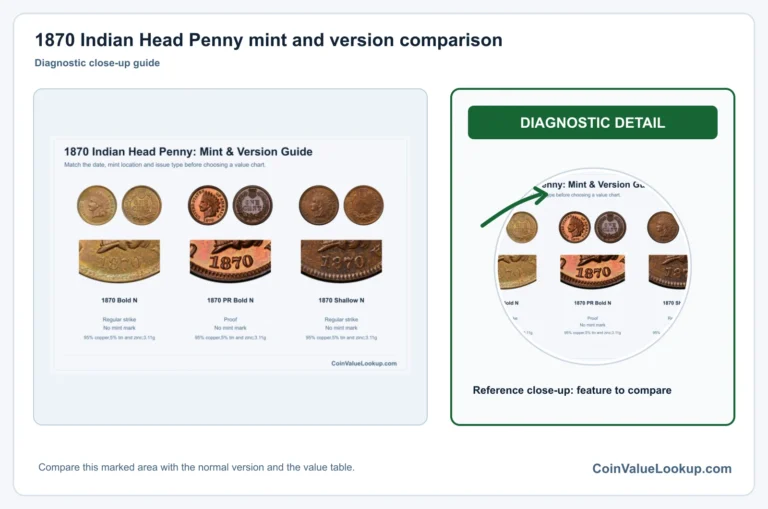
The comparison image is your friend here. Hold your coin next to it under even lighting and match the overall sharpness, not just one letter.
Surface color on bronze Indian cents is described as BN (brown), RB (red-brown), or RD (red), which refers to remaining original copper color, not a different metal. Cleaning, corrosion, and scratches will lower a coin's market appeal regardless of how sharp the design looks.
Step 3: Check 1888 Indian Head Penny Value by Mint and Version
1888 Indian Head Penny
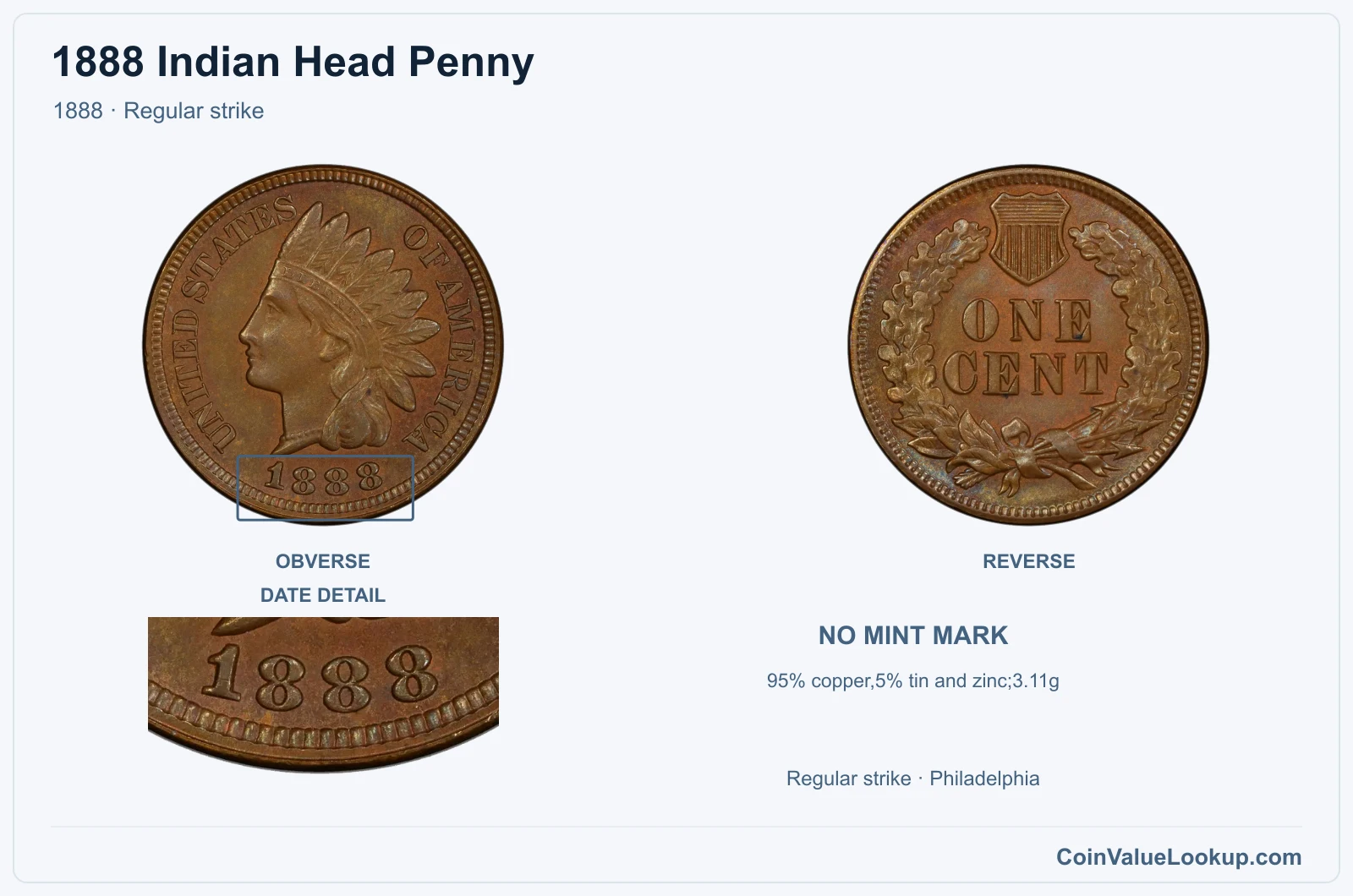
This is the standard 1888 Indian Head cent from Philadelphia, struck in bronze (95% copper, 5% tin and zinc) at 3.11 grams. No mintmark.
Guide values run from about $4.96 at G4 to around $186 at MS63, per USA Coin Book.
Before getting excited about pricing, make sure you're looking at a plain 1888 and not the 1888/7 overdate, which is a completely different animal. Check the last digit of the date carefully for any trace of an underlying 7.
If it's clean, you have the regular issue. Original surfaces matter here; a cleaned or damaged coin won't bring guide-level money even if the design detail looks sharp.
| Range | Grade | Price | Auction Records | Appraisal |
|---|---|---|---|---|
| PO | PO 1 | — | Coin Identifier | |
| FR | FR 2 | — | Coin Identifier | |
| AG | AG 3 | — | Coin Identifier | |
| G | G 4 | — | Coin Identifier | |
| G 6 | — | Coin Identifier | ||
| VG | VG 8 | — | Coin Identifier | |
| VG 10 | — | Coin Identifier | ||
| F | F 12 | — | Coin Identifier | |
| F 15 | — | Coin Identifier | ||
| VF | VF 20 | — | Coin Identifier | |
| VF 25 | — | Coin Identifier | ||
| VF 30 | — | Coin Identifier | ||
| VF 35 | — | Coin Identifier | ||
| XF | XF 40 | — | Coin Identifier | |
| XF 45 | Coin Identifier | |||
| AU | AU 50 | Coin Identifier | ||
| AU 53 | — | Coin Identifier | ||
| AU 55 | Coin Identifier | |||
| AU 58 | Coin Identifier | |||
| MS | MS 60 | — | Coin Identifier | |
| MS 61 | Coin Identifier | |||
| MS 62 | Coin Identifier | |||
| MS 63 | Coin Identifier | |||
| MS 64 | Coin Identifier | |||
| MS 65 | Coin Identifier | |||
| MS 66 | — | — | — | |
| MS 67 | — | — | — | |
| MS 68 | — | — | — | |
| MS 69 | — | — | — | |
| MS 70 | — | — | — |
1888 Indian Head Penny — /7
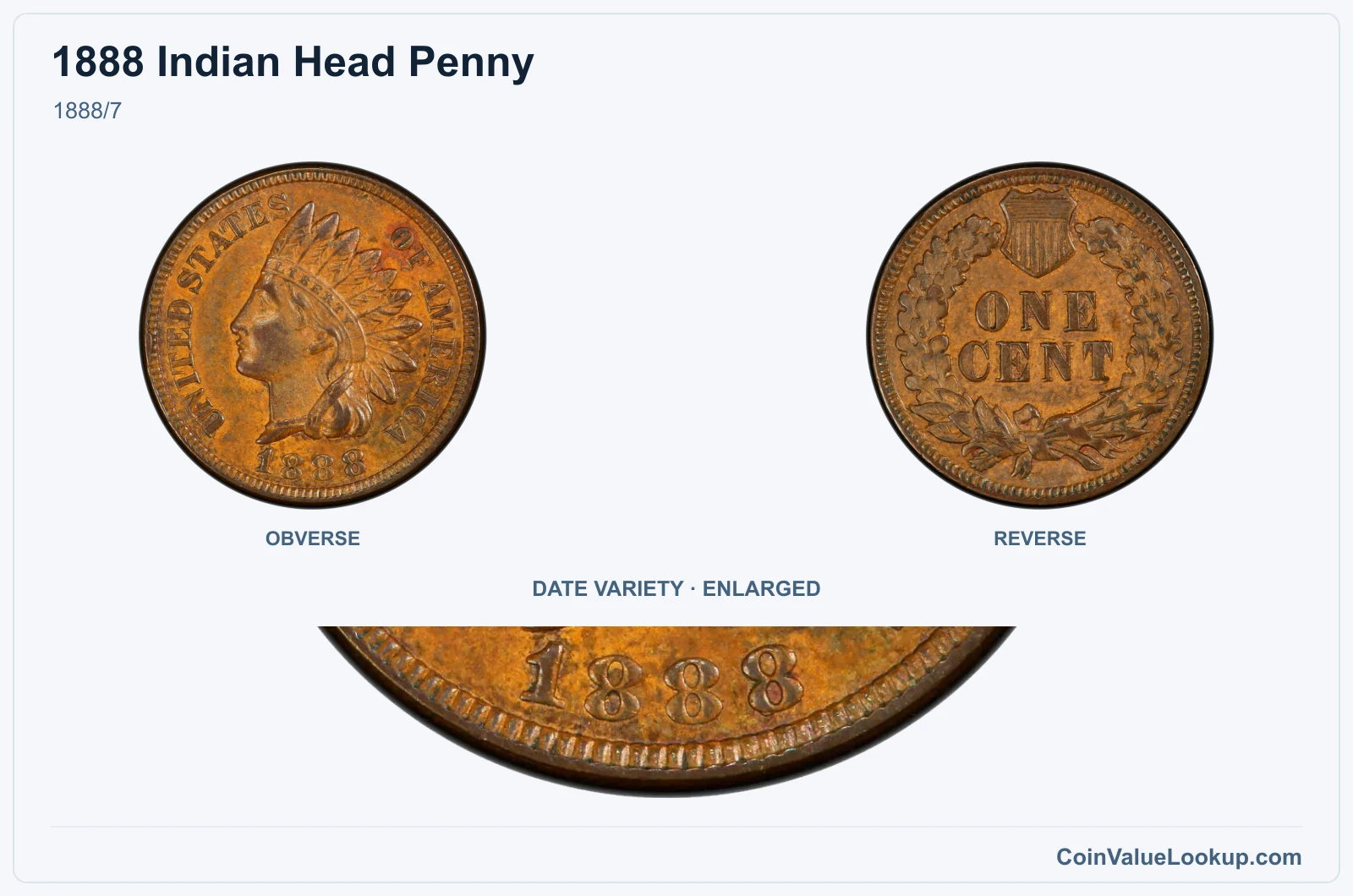
The 1888/7 overdate is the headline variety for this year. It was created when an 1887-dated die was re-entered with an 1888 hub, leaving visible remnants of the original 7 beneath the final 8.
You need magnification to confirm it; look for the curved lower portion of a 7 peeking out from under the last 8.
This is not a subtle market difference. USA Coin Book guides the 1888/7 at roughly $2,033 in G4, compared to under $5 for an ordinary 1888 in the same grade.
At MS63 the guide reaches approximately $79,458. Those numbers reflect the variety's genuine scarcity, not hype.
Coin Value Lookup is a good starting point if you want to compare this variety's context with other Indian Head cent years. You can look up guides for different dates and denominations in one place.
Do not borrow these overdate prices for a regular 1888. Authentication by a recognized grading service is the standard way to confirm the variety and unlock this kind of value.
| Range | Grade | Price | Auction Records | Appraisal |
|---|---|---|---|---|
| PO | PO 1 | — | Coin Identifier | |
| FR | FR 2 | — | Coin Identifier | |
| AG | AG 3 | — | Coin Identifier | |
| G | G 4 | Coin Identifier | ||
| G 6 | Coin Identifier | |||
| VG | VG 8 | Coin Identifier | ||
| VG 10 | Coin Identifier | |||
| F | F 12 | — | Coin Identifier | |
| F 15 | Coin Identifier | |||
| VF | VF 20 | Coin Identifier | ||
| VF 25 | — | Coin Identifier | ||
| VF 30 | Coin Identifier | |||
| VF 35 | — | Coin Identifier | ||
| XF | XF 40 | Coin Identifier | ||
| XF 45 | Coin Identifier | |||
| AU | AU 50 | Coin Identifier | ||
| AU 53 | Coin Identifier | |||
| AU 55 | — | Coin Identifier | ||
| AU 58 | Coin Identifier | |||
| MS | MS 60 | — | — | — |
| MS 61 | — | — | — | |
| MS 62 | — | — | — | |
| MS 63 | Coin Identifier | |||
| MS 64 | — | — | — | |
| MS 65 | — | — | — | |
| MS 66 | — | — | — | |
| MS 67 | — | — | — | |
| MS 68 | — | — | — | |
| MS 69 | — | — | — | |
| MS 70 | — | — | — |
1888 Indian Head Penny — PR
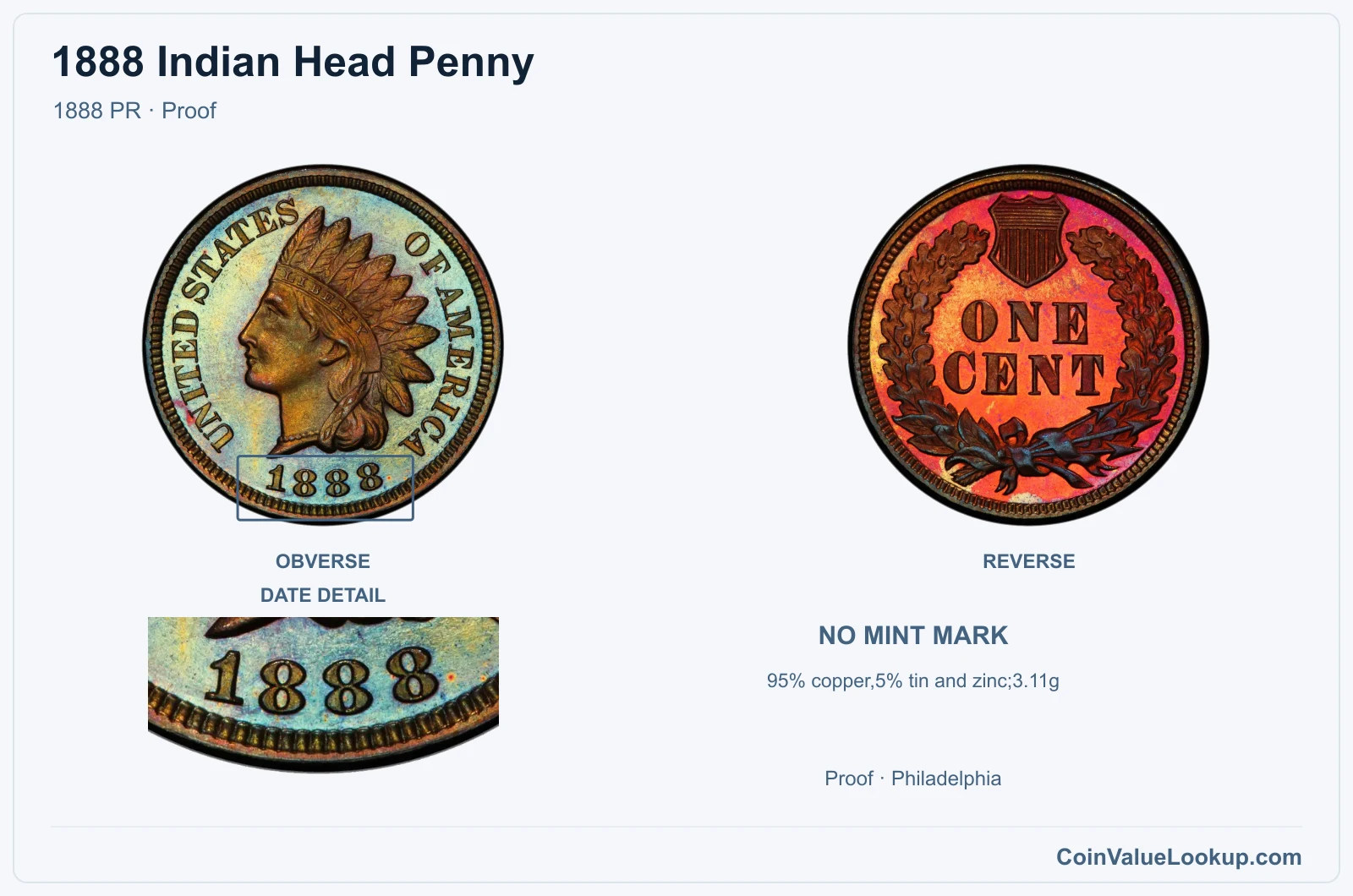
Proof 1888 Indian Head cents were made for collectors using specially prepared dies and planchets at Philadelphia. Same bronze composition, same weight, but the surfaces show mirror-like fields and the rims tend to be sharper and more squared than on a business strike.
The USA Coin Book guide places a PR63 example at about $313. That's a meaningful step above the business-strike MS63 value, but proof status has to be real.
A polished circulated coin is not a proof. Look for consistent mirrored reflectivity in the fields, not just a shiny high point, and examine the rim geometry.
If you suspect you have a proof, professional authentication is the practical next step.
| Range | Grade | Price | Auction Records | Appraisal |
|---|---|---|---|---|
| PR | PR 1 | — | Coin Identifier | |
| PR 2 | — | Coin Identifier | ||
| PR 3 | — | Coin Identifier | ||
| PR 4 | — | Coin Identifier | ||
| PR 6 | — | Coin Identifier | ||
| PR 8 | — | Coin Identifier | ||
| PR 10 | — | Coin Identifier | ||
| PR 12 | — | Coin Identifier | ||
| PR 15 | — | Coin Identifier | ||
| PR 20 | — | Coin Identifier | ||
| PR 25 | — | Coin Identifier | ||
| PR 30 | — | Coin Identifier | ||
| PR 35 | — | Coin Identifier | ||
| PR 40 | — | Coin Identifier | ||
| PR 45 | — | Coin Identifier | ||
| PR 50 | — | Coin Identifier | ||
| PR 53 | — | Coin Identifier | ||
| PR 55 | — | Coin Identifier | ||
| PR 58 | — | Coin Identifier | ||
| PR 60 | — | Coin Identifier | ||
| PR 61 | — | Coin Identifier | ||
| PR 62 | Coin Identifier | |||
| PR 63 | Coin Identifier | |||
| PR 64 | Coin Identifier | |||
| PR 65 | Coin Identifier | |||
| PR 66 | Coin Identifier | |||
| PR 67 | Coin Identifier | |||
| PR 68 | — | — | — | |
| PR 69 | — | — | — | |
| PR 70 | — | — | — |
1888 Indian Head Penny Error List
1. 1888 Indian Head Penny — Die Break / Cud
A cud on an 1888 Indian Head cent appears as a raised, featureless blob connected to the rim, created when a chunk of the die broke away. The missing die metal means that area of the coin receives no design impression; instead you get a smooth, raised lump that merges into the rim edge.
To confirm a cud, check that the raised area touches the rim and that normal design detail is absent within it. A rim dent pushed inward, surface corrosion, or an interior die chip that doesn't reach the rim are common lookalikes.
Corrosion tends to have a rough or pitted texture, while a genuine cud is smooth and uniform.
No specific price range is supported for this error on the 1888 date. Value depends on the size, location, and visual impact of the cud, along with the coin's overall condition and authenticated identity.
2. 1888 Indian Head Penny — Misplaced Date
A misplaced date on an 1888 Indian Head cent means partial outlines of one or more date digits appear somewhere they shouldn't, typically embedded in the denticles below the date or partially hidden near the portrait. This happened when a date punch struck the die in the wrong spot before the final, correct date was applied.
You're looking for recognizable numeral shapes, not random lumps. Die chips, scratches, and corrosion can create bumps in the same area, but they won't match the specific contours of an 1, 8, or other digit.
Compare your coin under magnification against a known example to see if the shape truly replicates part of a numeral.
No specific price range is adopted for this error. Assessment depends on the clarity of the misplaced digits, the coin's grade, and authenticated confirmation of the variety.
3. 1888 Indian Head Penny — Repunched Date
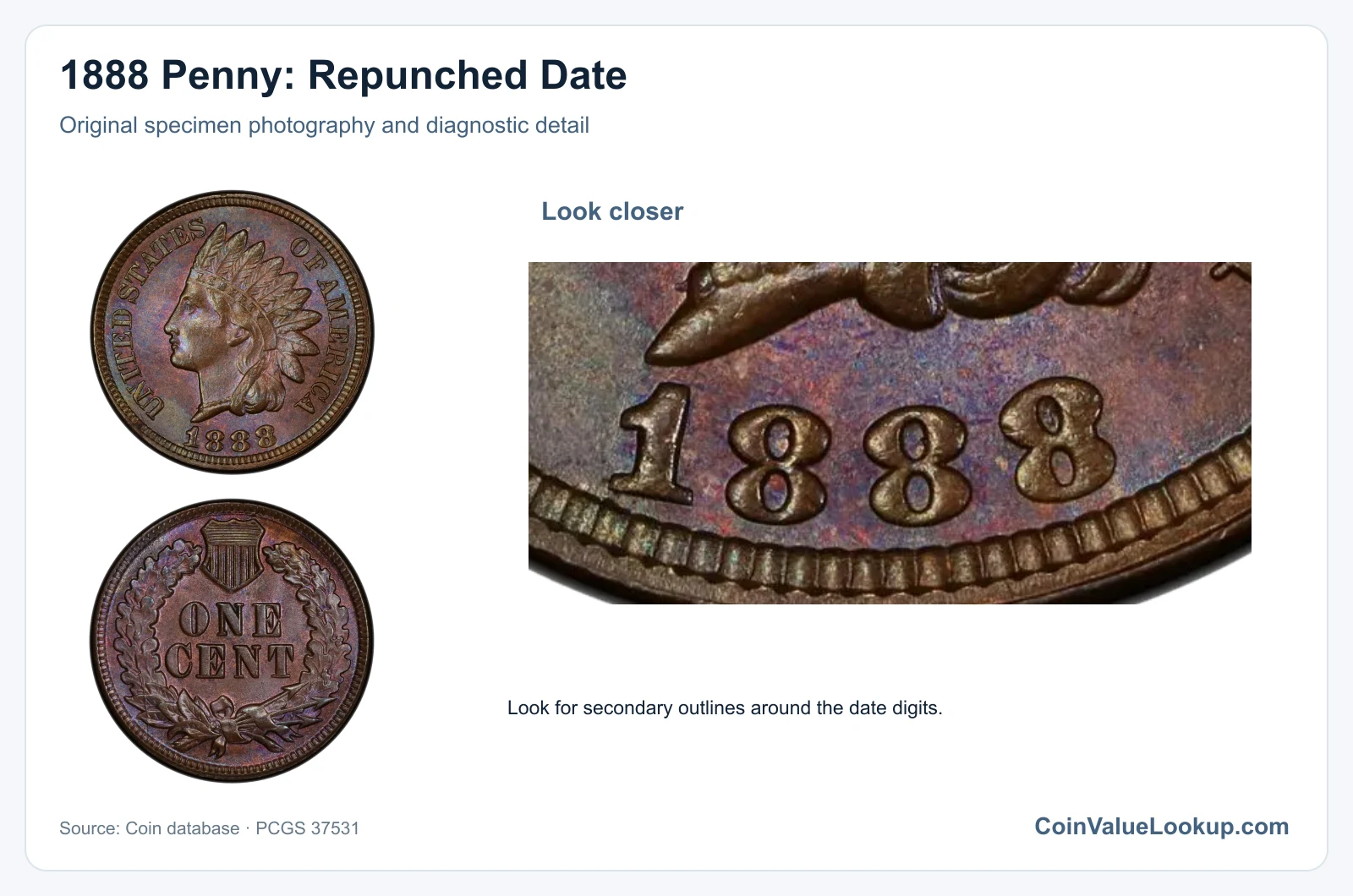
A repunched date on an 1888 Indian Head cent shows traces of an earlier punch position next to or overlapping the final date numerals. During manufacturing, the date was hand-punched into working dies, and if the first impression landed slightly off, a second punch corrected the position but left remnants of the first.
Look for doubled or shifted serifs, extra curves, or shadow outlines beside the digits. This is different from machine doubling, which tends to produce flat, shelf-like distortion across the entire design rather than isolated displacement at specific numerals.
A damaged or worn date can also mimic repunching, so magnification and comparison with known examples are essential.
No supported price range exists for this variety on the 1888 date. Value hinges on the strength and visibility of the repunching, the coin's condition, and professional authentication.
4. 1888 Indian Head Penny — Die Crack
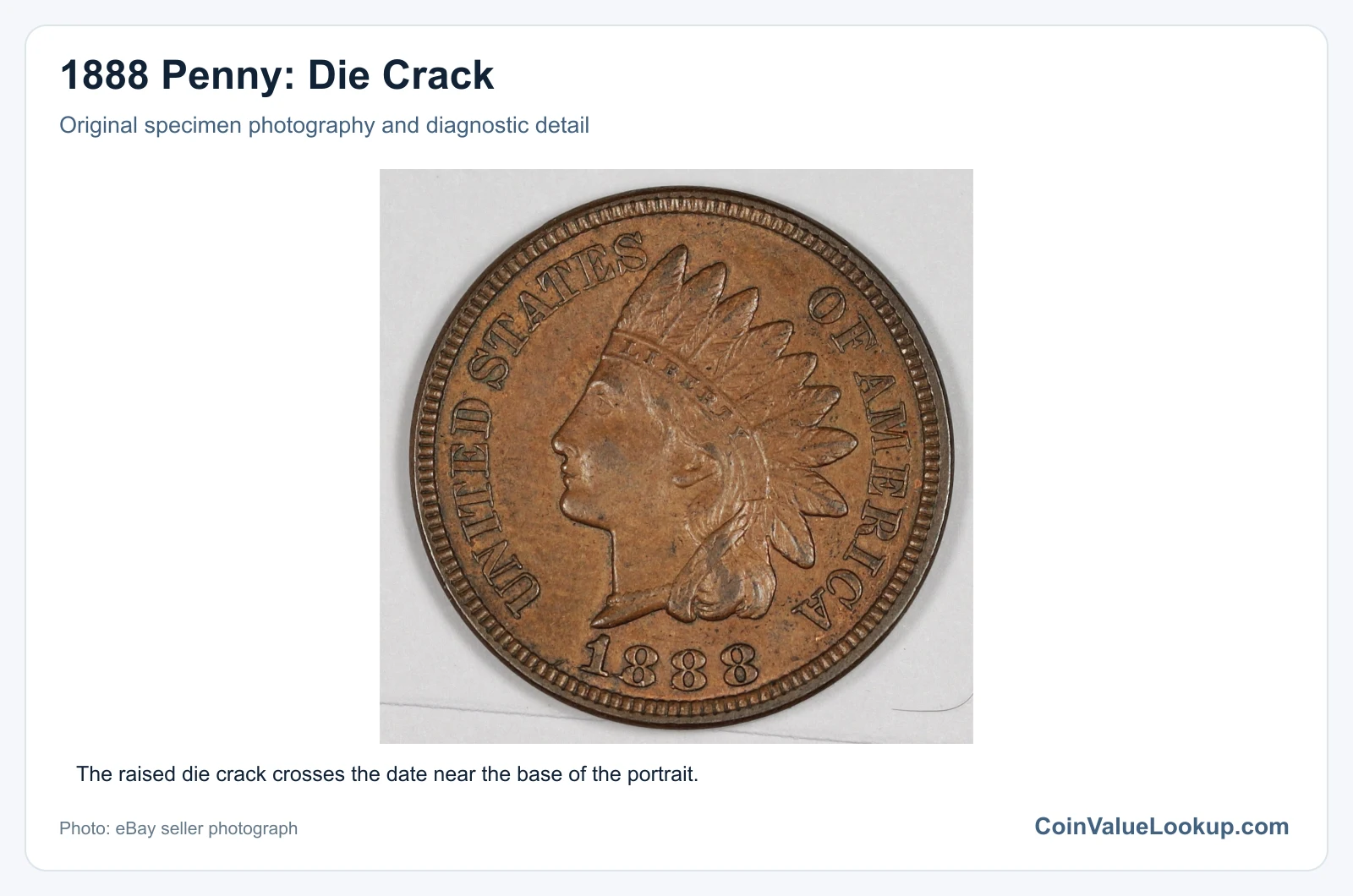
Die cracks on 1888 Indian Head cents appear as thin, raised lines running across the coin's surface. They form when the steel die develops a fracture from repeated use, and that crack transfers as a raised ridge onto every coin struck afterward.
The key diagnostic is that die cracks are raised, not incised. A scratch cuts into the surface and usually has a sharper, more irregular profile.
Corrosion lines tend to be rough and pitted, while displaced-metal scrapes show directional metal flow. A genuine die crack runs smoothly and may cross both field and design elements in a continuous line.
Note where the crack begins and ends; longer cracks or those in prominent locations tend to attract more collector interest. No specific price range is adopted for die cracks on this date.
Individual value depends on severity, location, and the coin's authenticated condition.
5. 1888 Indian Head Penny — Die Chip
A die chip on an 1888 Indian Head cent shows up as a small, raised lump, usually inside or adjacent to a letter, numeral, or design element. It forms when a tiny piece of the die surface flakes away, leaving a void that fills with metal during striking.
The lump is smooth and blends into the surrounding struck detail. Compare this with a gouge or impact mark, which typically has sharp edges and disturbed metal flow around it.
Glued debris or foreign material will usually sit on top of the surface rather than merging with the design.
Die chips are common on well-used dies and most are minor. No supported price range is adopted for this category on the 1888 Indian cent.
A chip's collectibility depends on its size, visibility, and location, plus the coin's overall grade and authenticated identity.
6. 1888 Indian Head Penny — Overdate
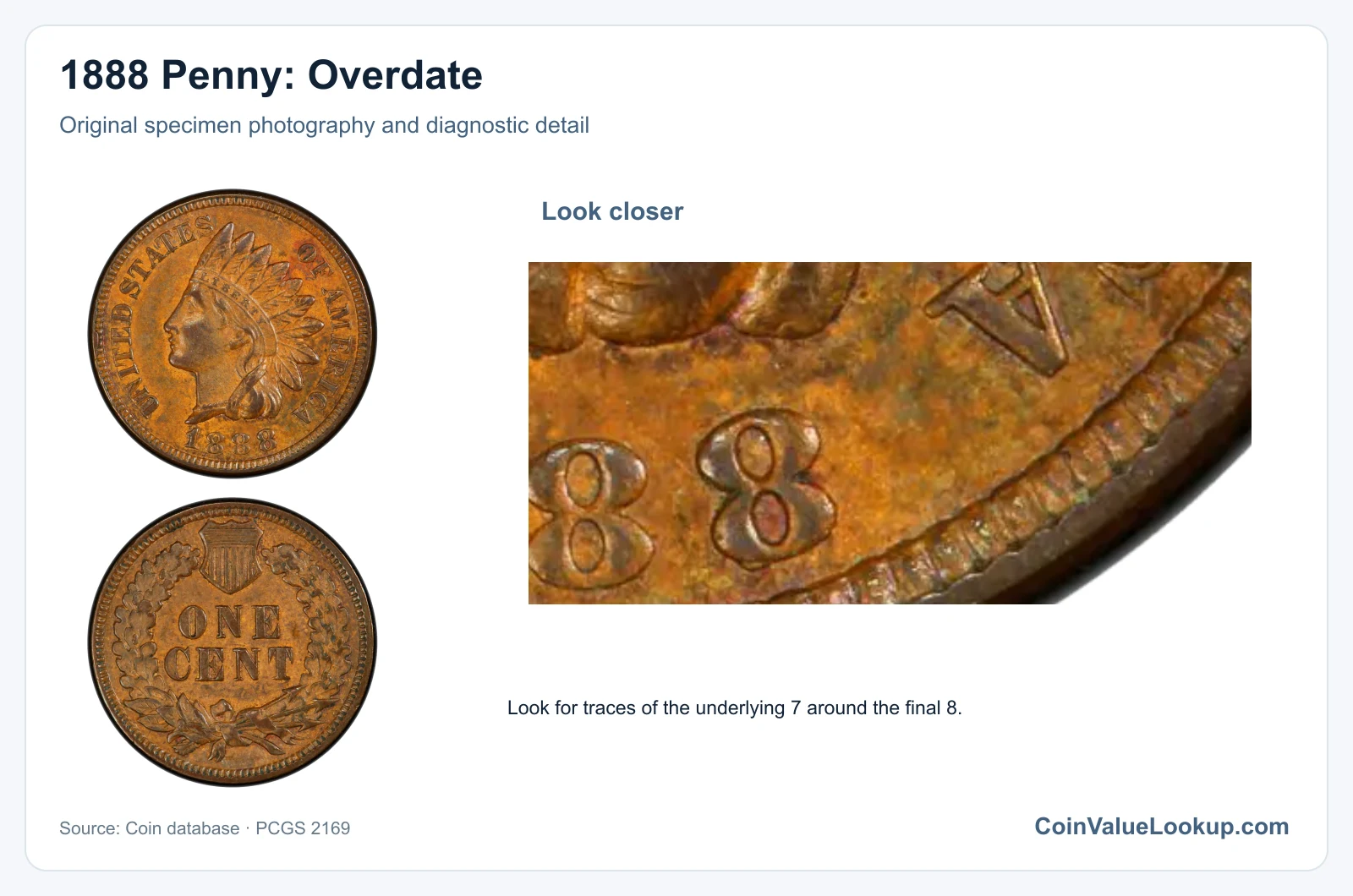
The overdate on the 1888 Indian Head cent is the well-known 1888/7 variety. Surviving contours of the earlier 7 are visible beneath the final 8 in the date, because the die was initially prepared with an 1887 date before being corrected to 1888.
Under magnification, look for the distinctive curved lower stroke of the 7 emerging from behind the bottom loop of the last 8. This is a die variety, not a striking anomaly, so it should appear consistently on every coin made from that particular die.
Don't confuse this with a damaged date, where post-strike hits can distort a digit into something that vaguely resembles another number. Machine doubling produces flat, shelf-like images rather than the clearly different numeral shape you see on a true overdate.
No separate error-category price range is adopted here; the 1888/7 overdate is covered in its own version listing with guide values that reflect its recognized scarcity.