2020 Lincoln Penny Coin Value: How Much Is It Worth?
Most 2020 Lincoln pennies you pull from a jar are worth one cent, plain and simple. A well-preserved example graded MS65 carries a guide estimate around $0.36, while a standard San Francisco proof at PR65 sits near $6.26.
Those are guide estimates, not guaranteed sale prices. Collector finishes, major varieties, and striking errors each occupy their own corner of the market and can push values in different directions.
Fast Way to Identify Your 2020 Lincoln Penny
The quickest way to start sorting out what you have is to upload clear photos of the front and back of your coin. That gives us a shot at preliminary identification, including the mint, finish, and any obvious varieties.
Snap both sides in good light with a steady hand, and you will have a solid starting point.
2020 Penny Value
Upload both sides of your 2020 Lincoln Penny.
Front Obverse
Upload photo
Back Reverse
Upload photo
Which 2020 Lincoln Penny Versions Are Worth Money?
- Uncirculated Philadelphia and Denver cents with full original red luster can sell above face value, especially at MS65 or higher.
- San Francisco proof cents are collector issues with mirror fields, carrying a PR65 guide estimate of about $6.26, well above the cost of a circulated cent.
Step 1: Identify Your 2020 Lincoln Penny Mint Mark and Version
First, check the date. It should read 2020, obviously.
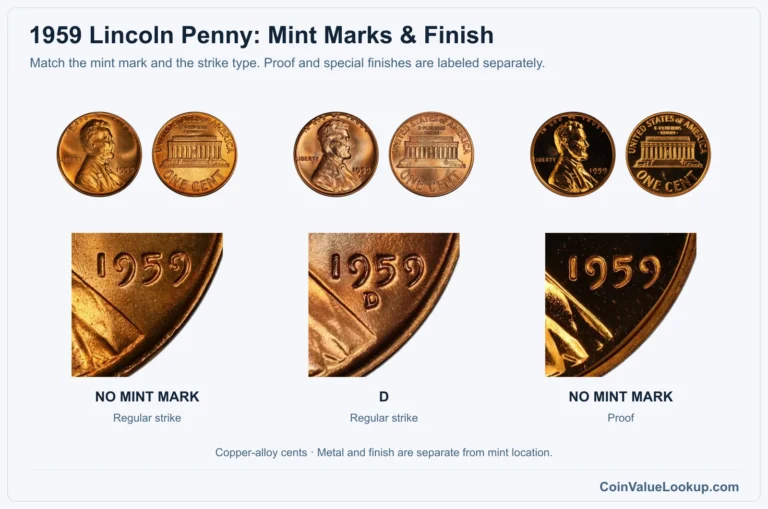
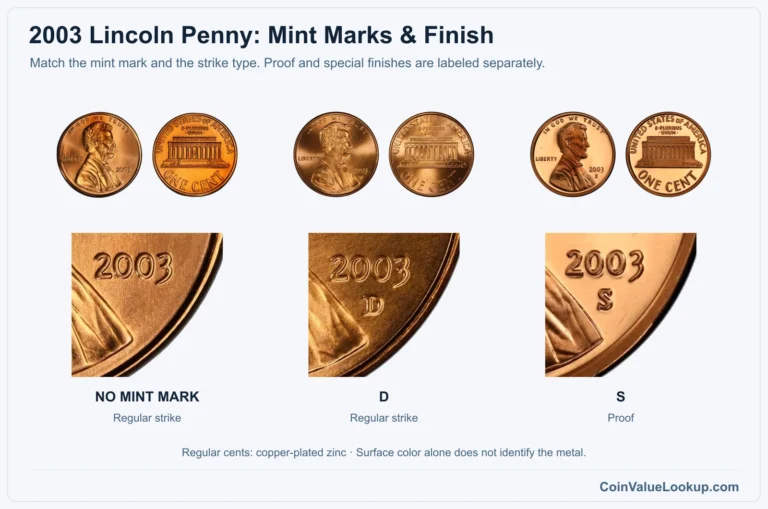
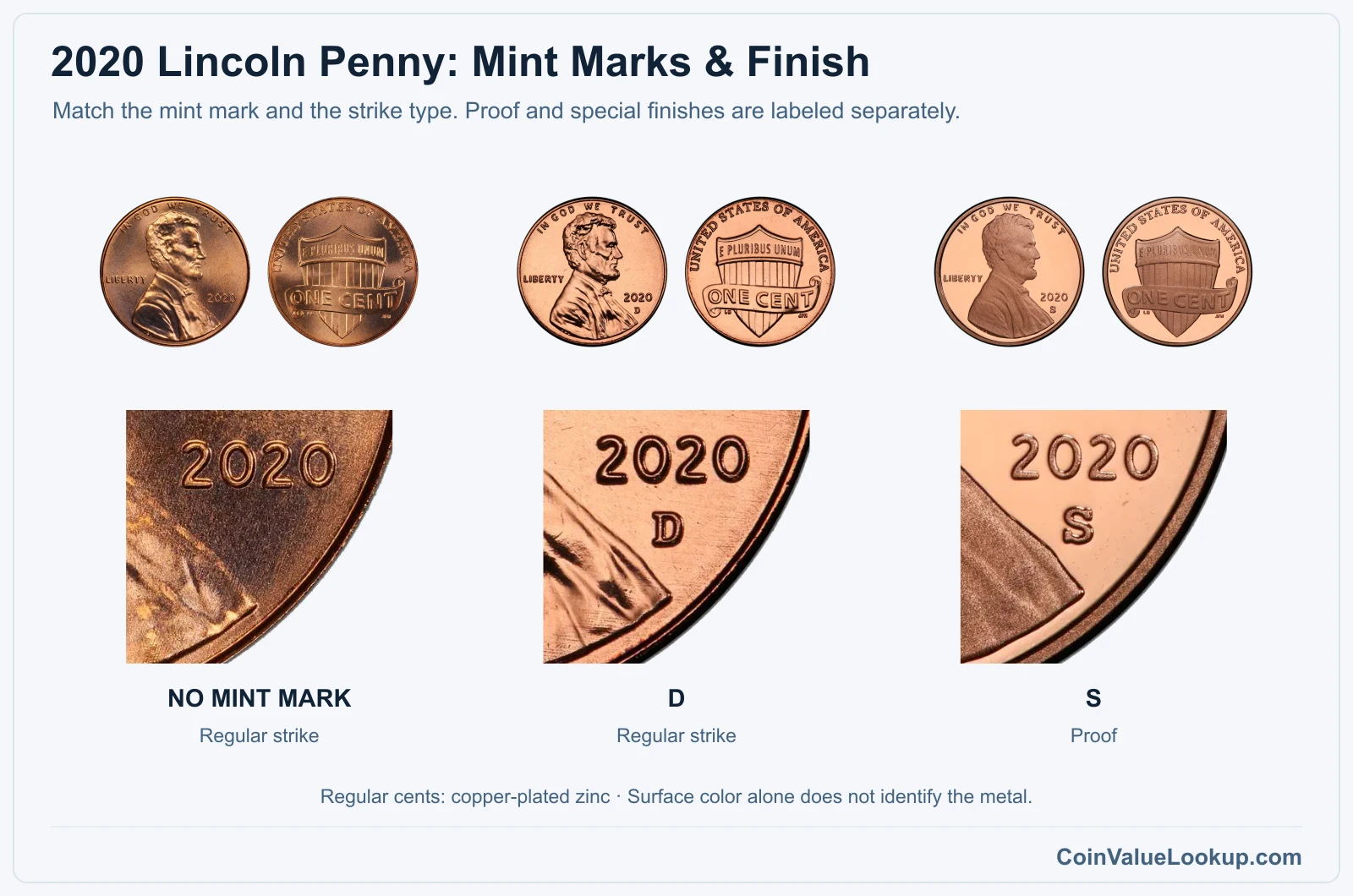
Right below the date, look for a small letter: no letter means Philadelphia, a D means Denver, and an S means San Francisco.
Next, confirm the reverse design. The 2020 cent carries the Union Shield on the back, paired with Lincoln's portrait on the front.
If you see a different reverse, such as the Lincoln Memorial or one of the 2009 bicentennial designs, you have a different coin entirely.
The standard composition is copper-plated zinc, weighing about 2.50 grams. The copper is a thin plating over a zinc core.
You cannot reliably identify an off-metal error by appearance alone; weight and diameter measurements matter.
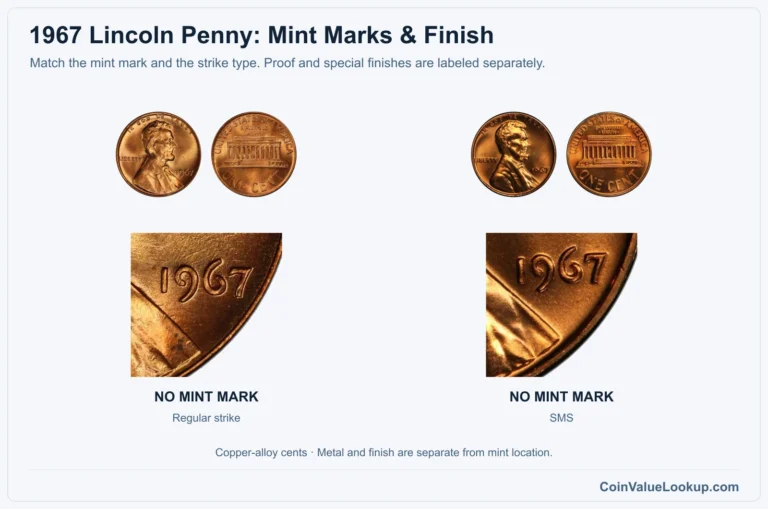
San Francisco issues are proofs, struck with a different process than the business-strike coins from Philadelphia and Denver. Mirror-like fields and sharp details distinguish a proof from a regular strike.
Separate S proofs from P and D coins before you start comparing grades and prices.
Step 2: Check Your 2020 Lincoln Penny Grade
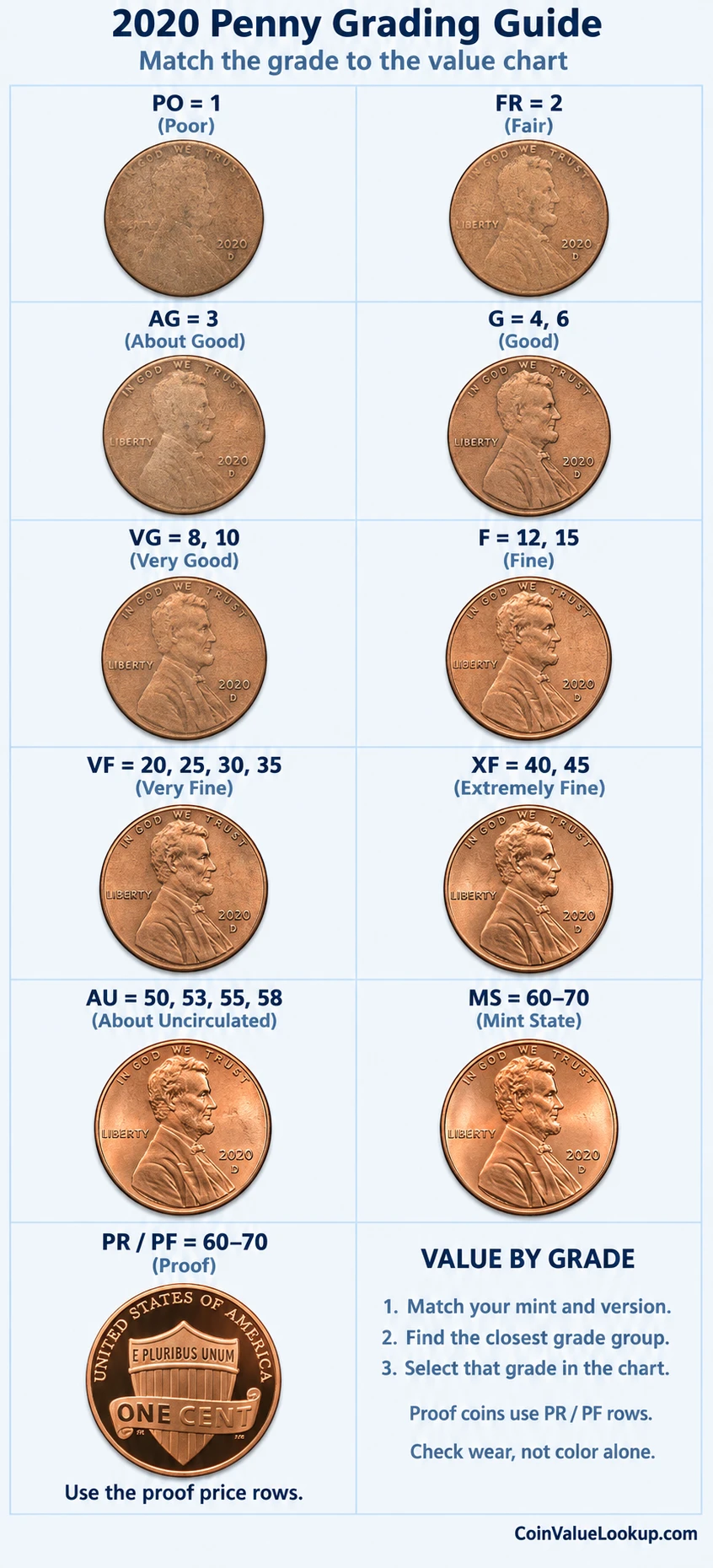
Start with Lincoln's cheekbone and jawline. On a fresh, uncirculated coin these areas show full original detail and luster.
As the coin circulates, the cheek flattens first, then the jaw softens, and finally the hair above the ear loses its fine lines.
Flip it over. The horizontal lines on the Union Shield wear down in order of exposure, so check them against a known example.
Color designations like RD (full red), RB (red-brown), and BN (brown) describe how much original copper tone remains. They are separate from the wear grade.
A coin can be uncirculated and still brown if it has toned over time.
Proof describes how a coin was manufactured, not a grade above Mint State. A proof can still have contact marks or haze that lowers its numeric grade.
Use the comparison image to match your coin's surface quality against known grade benchmarks.
Step 3: Check 2020 Lincoln Penny Value by Mint and Version
2020 Lincoln Penny — Shield
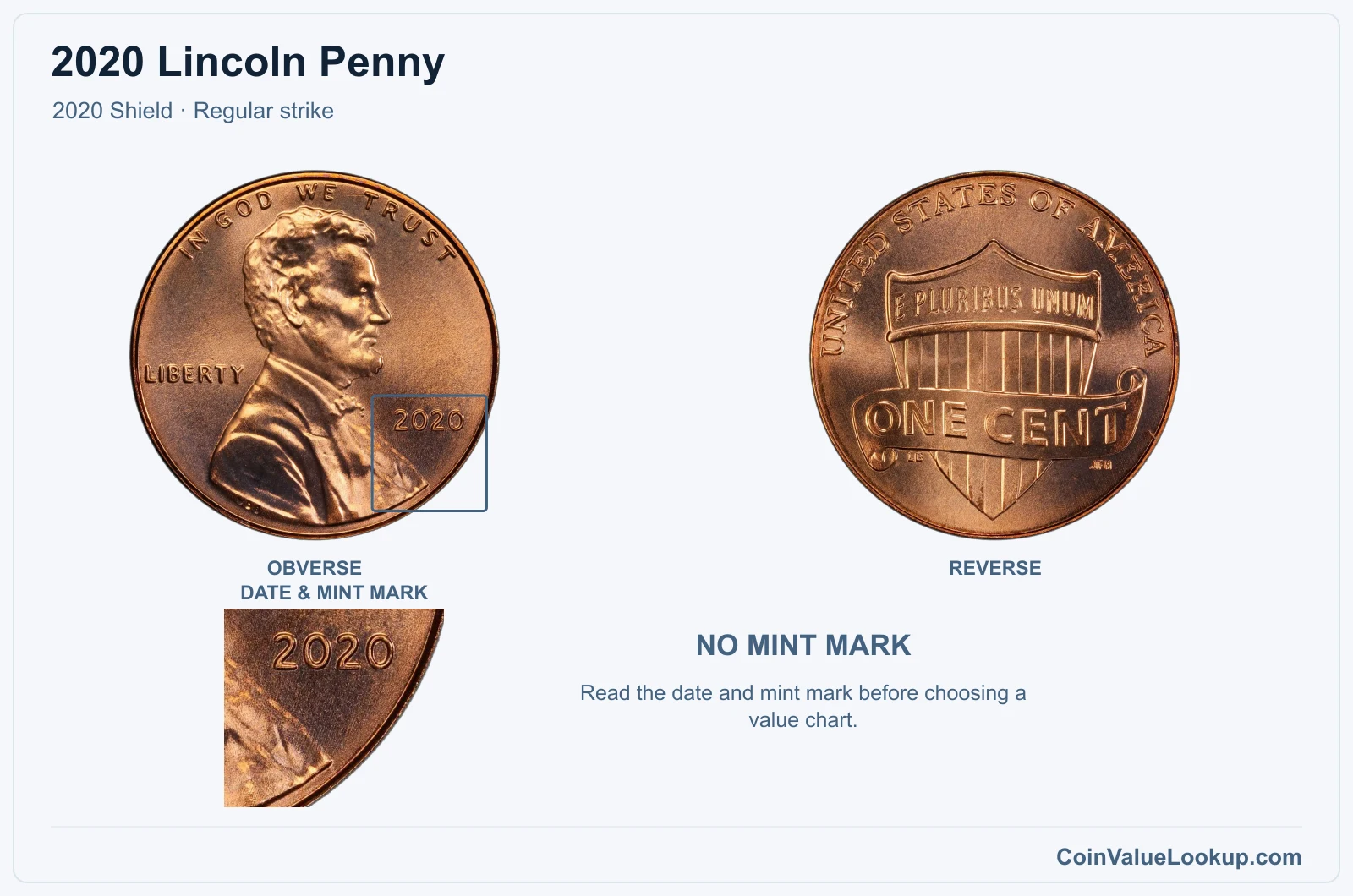
The 2020 Philadelphia cent has no mintmark below the date. It is a standard business strike on a copper-plated zinc planchet weighing about 2.50 grams, with Lincoln on the obverse and the Union Shield on the reverse.
Worn examples are worth face value. At MS65, a guide estimate places this coin around $0.36.
To reach that grade, the coin needs full detail, minimal contact marks, and strong luster. Full original red color (RD) is the most desirable surface designation at this level.
| Range | Grade | Price | Auction Records | Appraisal |
|---|---|---|---|---|
| PO | PO 1 | — | Coin Identifier | |
| FR | FR 2 | — | Coin Identifier | |
| AG | AG 3 | — | Coin Identifier | |
| G | G 4 | — | Coin Identifier | |
| G 6 | — | Coin Identifier | ||
| VG | VG 8 | — | Coin Identifier | |
| VG 10 | — | Coin Identifier | ||
| F | F 12 | — | Coin Identifier | |
| F 15 | — | Coin Identifier | ||
| VF | VF 20 | — | Coin Identifier | |
| VF 25 | — | Coin Identifier | ||
| VF 30 | — | Coin Identifier | ||
| VF 35 | — | Coin Identifier | ||
| XF | XF 40 | — | Coin Identifier | |
| XF 45 | — | Coin Identifier | ||
| AU | AU 50 | — | Coin Identifier | |
| AU 53 | — | Coin Identifier | ||
| AU 55 | — | Coin Identifier | ||
| AU 58 | — | Coin Identifier | ||
| MS | MS 60 | — | Coin Identifier | |
| MS 61 | — | Coin Identifier | ||
| MS 62 | — | Coin Identifier | ||
| MS 63 | — | Coin Identifier | ||
| MS 64 | — | Coin Identifier | ||
| MS 65 | — | Coin Identifier | ||
| MS 66 | — | Coin Identifier | ||
| MS 67 | — | Coin Identifier | ||
| MS 68 | — | — | — | |
| MS 69 | — | — | — | |
| MS 70 | — | — | — |
2020 Lincoln Penny — D Shield
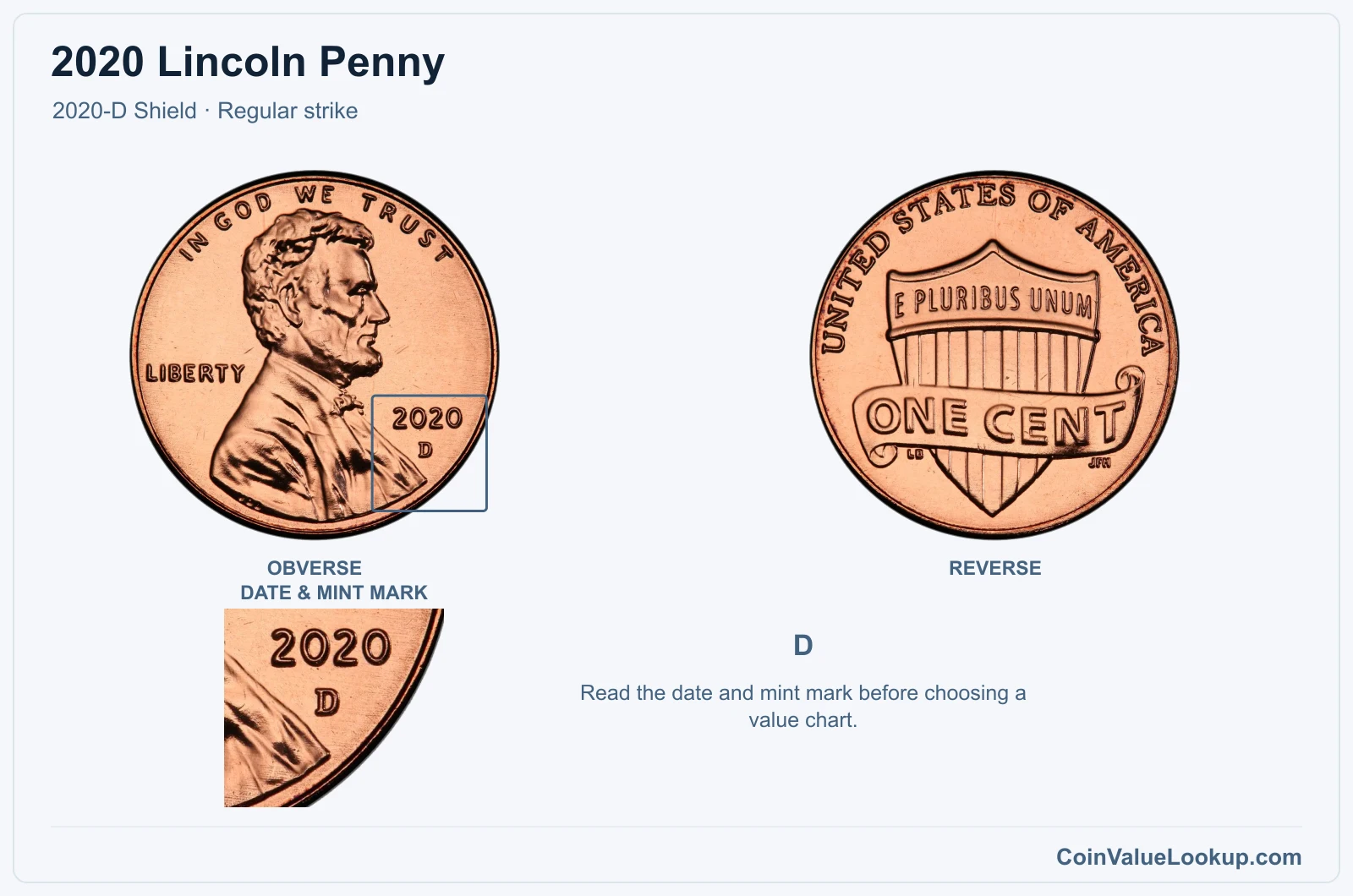
Look for the small D mintmark below the date to confirm a Denver strike. Same composition and design as the Philadelphia issue: copper-plated zinc, 2.50 grams, Lincoln portrait over Union Shield.
Circulated pieces trade at one cent. The MS65 guide estimate is also about $0.36.
No meaningful premium separates Denver from Philadelphia in this year for ordinary examples, so grade and eye appeal matter more than which mint struck it.
| Range | Grade | Price | Auction Records | Appraisal |
|---|---|---|---|---|
| PO | PO 1 | — | Coin Identifier | |
| FR | FR 2 | — | Coin Identifier | |
| AG | AG 3 | — | Coin Identifier | |
| G | G 4 | — | Coin Identifier | |
| G 6 | — | Coin Identifier | ||
| VG | VG 8 | — | Coin Identifier | |
| VG 10 | — | Coin Identifier | ||
| F | F 12 | — | Coin Identifier | |
| F 15 | — | Coin Identifier | ||
| VF | VF 20 | — | Coin Identifier | |
| VF 25 | — | Coin Identifier | ||
| VF 30 | — | Coin Identifier | ||
| VF 35 | — | Coin Identifier | ||
| XF | XF 40 | — | Coin Identifier | |
| XF 45 | — | Coin Identifier | ||
| AU | AU 50 | — | Coin Identifier | |
| AU 53 | — | Coin Identifier | ||
| AU 55 | — | Coin Identifier | ||
| AU 58 | — | Coin Identifier | ||
| MS | MS 60 | — | Coin Identifier | |
| MS 61 | — | Coin Identifier | ||
| MS 62 | — | Coin Identifier | ||
| MS 63 | — | Coin Identifier | ||
| MS 64 | — | Coin Identifier | ||
| MS 65 | — | Coin Identifier | ||
| MS 66 | — | Coin Identifier | ||
| MS 67 | — | Coin Identifier | ||
| MS 68 | — | — | — | |
| MS 69 | — | — | — | |
| MS 70 | — | — | — |
2020 Lincoln Penny — S Shield PR
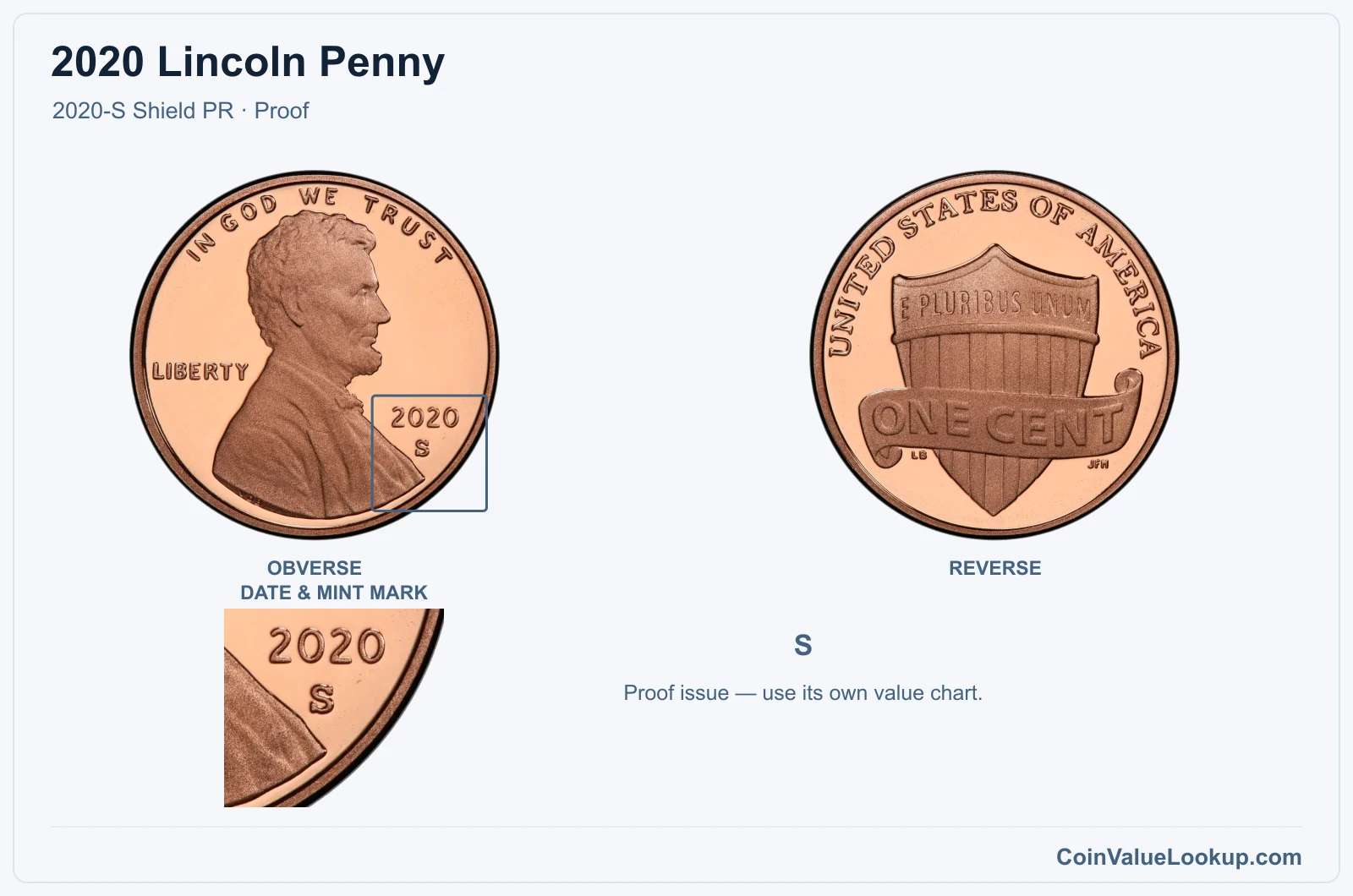
The 2020-S proof cent was struck at San Francisco for collector sets and carries the S mintmark below the date. It shares the same copper-plated zinc composition as the business strikes but was produced with polished dies and specially prepared planchets, giving it mirror-like fields and sharply defined devices.
Coin Value Lookup is a handy place to look up current guide information for coins like this one alongside other dates and denominations in the Lincoln series.
At PR65, the guide estimate is approximately $6.26. When evaluating a proof, compare the mirror fields and any cameo contrast separately from the numeric grade.
Hairlines and haze are the main enemies of a high proof grade.
| Range | Grade | Price | Auction Records | Appraisal |
|---|---|---|---|---|
| PR | PR 1 | — | Coin Identifier | |
| PR 2 | — | Coin Identifier | ||
| PR 3 | — | Coin Identifier | ||
| PR 4 | — | Coin Identifier | ||
| PR 6 | — | Coin Identifier | ||
| PR 8 | — | Coin Identifier | ||
| PR 10 | — | Coin Identifier | ||
| PR 12 | — | Coin Identifier | ||
| PR 15 | — | Coin Identifier | ||
| PR 20 | — | Coin Identifier | ||
| PR 25 | — | Coin Identifier | ||
| PR 30 | — | Coin Identifier | ||
| PR 35 | — | Coin Identifier | ||
| PR 40 | — | Coin Identifier | ||
| PR 45 | — | Coin Identifier | ||
| PR 50 | — | Coin Identifier | ||
| PR 53 | — | Coin Identifier | ||
| PR 55 | — | Coin Identifier | ||
| PR 58 | — | Coin Identifier | ||
| PR 60 | — | Coin Identifier | ||
| PR 61 | — | Coin Identifier | ||
| PR 62 | — | Coin Identifier | ||
| PR 63 | — | Coin Identifier | ||
| PR 64 | — | Coin Identifier | ||
| PR 65 | — | Coin Identifier | ||
| PR 66 | — | Coin Identifier | ||
| PR 67 | — | Coin Identifier | ||
| PR 68 | — | Coin Identifier | ||
| PR 69 | — | Coin Identifier | ||
| PR 70 | — | Coin Identifier |
2020 Lincoln Penny Error List
1. 2020 Lincoln Penny — BIE Die Break
A BIE die break shows up as a small raised vertical line or blob between the letters B and E in LIBERTY on the obverse. It is caused by a crack or chip in the die in that specific location, and the resulting raised metal on the coin fills what should be empty space between those two letters.
To check, look at LIBERTY under magnification. The extra raised material should be consistent with the coin's surface, not sitting on top like glue or dirt.
Scratches, debris, and added material can mimic a BIE, so compare the texture of the suspected feature to the surrounding field.
Pricing depends on the authenticated identity, the severity of the break, and the coin's overall condition. No standard price range is adopted for this error on the 2020 cent.
2. 2020 Lincoln Penny — Clipped Planchet
A clipped planchet error means a portion of the original blank was missing before the coin was struck. You will see a curved, straight, or irregular section of the coin's edge that is absent, with the design trailing off into nothing at that boundary.
Often, the strike is slightly weak on the side directly opposite the clip because the metal could not flow normally during striking.
Compare the edge texture carefully. A genuine clip shows metal flow consistent with the strike, not the sharp or rough edge left by a file, pliers, or corrosion.
Post-mint damage is the most common lookalike.
Value depends on the size and type of clip, the coin's condition, and third-party authentication. No standard price range is adopted here.
3. 2020 Lincoln Penny — Clashed Dies
Clashed dies happen when the obverse and reverse dies strike each other without a planchet between them. The result is faint, ghostly traces of the opposite design transferred onto each side of every coin struck afterward until the dies are replaced or resurfaced.
On a 2020 cent, look for portions of the Union Shield faintly visible in the obverse field, or Lincoln's profile ghosted onto the reverse. The transferred elements should align with where the opposite die would have contacted.
Do not confuse random scratches, raised lines from other damage, or brockage impressions with a true die clash. Clash marks are consistent across multiple coins from the same die pair.
Individual assessment by a grading service determines value.
4. 2020 Lincoln Penny — Broadstrike
A broadstrike occurs when the collar die that normally constrains the coin's edge is missing or malfunctioning during the strike. The planchet spreads outward under pressure, producing a coin that is wider than normal with a rounded, undefined edge.
The full design is still present, just expanded.
Check the edge profile. A genuine broadstrike has an even, spread appearance all around, and the design elements are slightly farther from the rim than usual.
If large sections of the design are missing, you may have an off-center strike instead. Coins flattened after minting by a hammer or vise can look similar but lack the characteristic metal flow of a genuine broadstrike.
No adopted price range exists for this error on the 2020 cent.
5. 2020 Lincoln Penny — Rotated Dies
US coins are normally struck in medal alignment: hold the obverse upright, rotate the coin top-to-bottom along a vertical axis, and the reverse should also appear upright. A rotated die error means the reverse is turned some number of degrees away from that standard orientation.
To test, hold Lincoln right-side up, flip the coin on its vertical axis, and see if the shield is also right-side up. Minor rotations of a few degrees are common and less notable.
Larger rotations are scarcer and more collectible.
Be careful with photographs. A rotated image is not a rotated die.
You need the physical coin in hand or very clear paired images with a reference point. Value is assessed individually based on degree of rotation and condition.
6. 2020 Lincoln Penny — Doubled Die Reverse
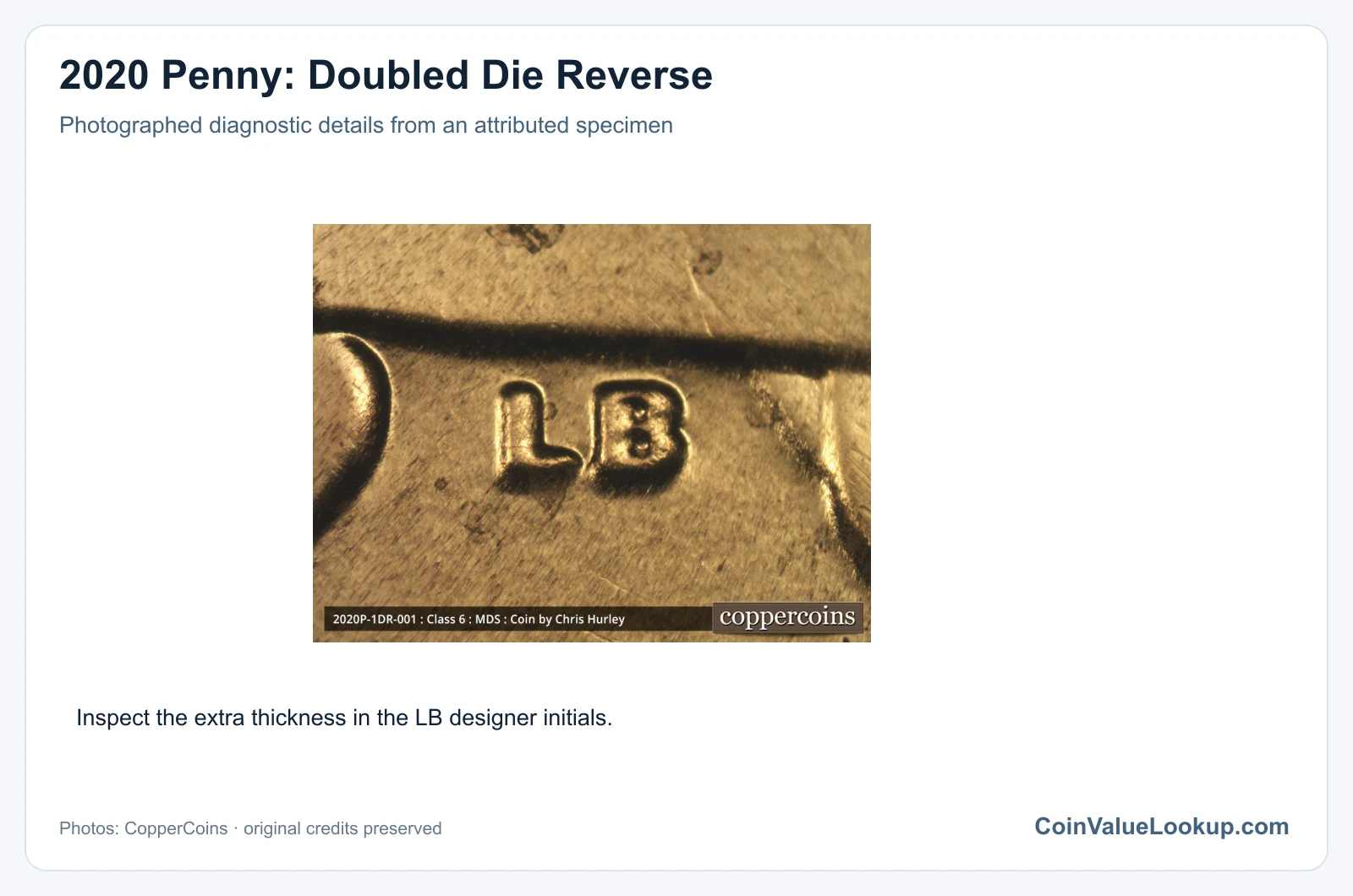
A doubled die reverse shows consistent doubling on the reverse design elements, caused by a misalignment during the die-making process. On the 2020 cent, compare the lettering and shield details on your coin to a normal example under the same lighting.
Genuine doubled dies produce separation, notching, or thickening that repeats on every coin struck from that die. The doubling is part of the design, not a flat shelf along one side of the letters.
Machine doubling, which is flat and shelf-like, is the most common lookalike and carries little to no premium.
No specific price range is adopted for this category. Authentication and the particular die involved determine collector interest and value.
7. 2020 Lincoln Penny — Doubled Die Obverse
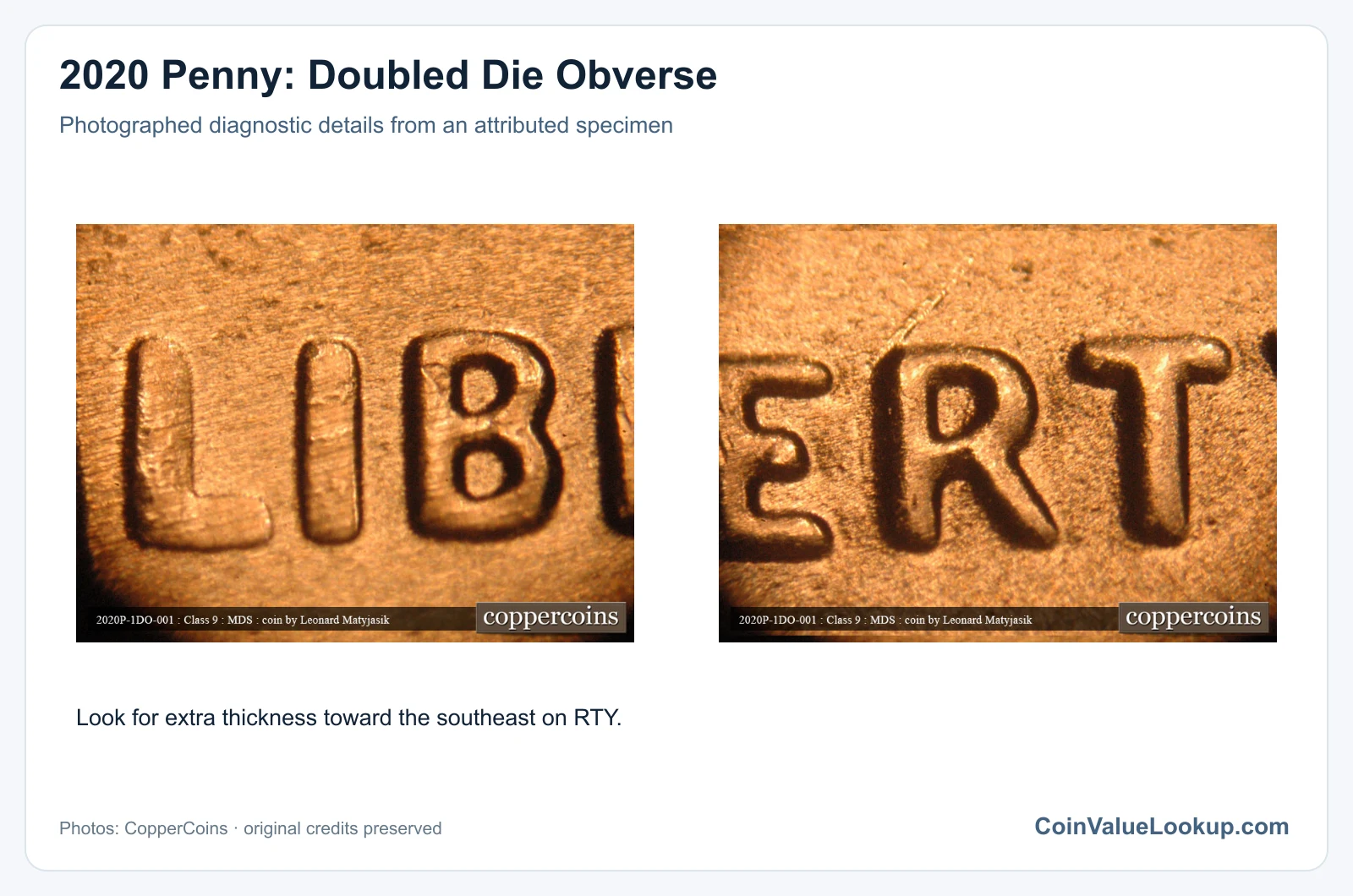
A doubled die obverse affects the front of the coin. Look at the date, LIBERTY, and IN GOD WE TRUST for signs of consistent separation, notching, or extra thickness compared to a normal 2020 cent under matching light conditions.
The key distinction is between hub doubling, which is a true variety, and machine doubling, which is mechanical damage during striking. Hub doubling shows raised, rounded extra profiles.
Machine doubling typically shows a flat, shelf-like displacement to one side with reduced detail.
Worn die contours and reflections under strong lighting can also mimic doubling to the untrained eye. A side-by-side comparison with a confirmed normal coin under magnification is the best first step.
No adopted price range exists; individual assessment is needed.
8. 2020 Lincoln Penny — Struck-Through Error
A struck-through error occurs when foreign material, such as grease, cloth fibers, or a small fragment of metal, sits between the die and the planchet during striking. The result is a localized depression, an impression of the obstruction, or an area of incomplete design.
Grease-filled dies produce soft, mushy detail in specific areas. Retained foreign objects may leave a distinct outline or texture that does not match the coin's normal surface.
Compare the affected area to the same spot on a normal coin.
Ordinary wear, cleaning marks, and weak strikes from a tired die can all look similar. A genuine struck-through usually has clean, well-defined boundaries.
No standard price range is adopted; value depends on what caused the obstruction, the size of the affected area, and the coin's grade.
9. 2020 Lincoln Penny — Off-Center Strike
An off-center strike happens when the planchet is not properly seated between the dies, so part of the design is struck onto the blank while a crescent-shaped area remains unstruck. The percentage of off-center displacement determines how dramatic the error looks.
For a 2020 cent, collectors generally want the date still visible. A 5% off-center coin is mildly interesting; a 50% off-center coin with a readable date is far more collectible.
If the entire design is present but just shifted, you may be looking at a broadstrike or die misalignment instead.
Post-mint flattening or a clipped planchet can resemble an off-center strike at first glance. Check for the characteristic unstruck crescent and the normal thickness of the struck portion.
No adopted price range is available for this error.
10. 2020 Lincoln Penny — Die Crack / Die Chip
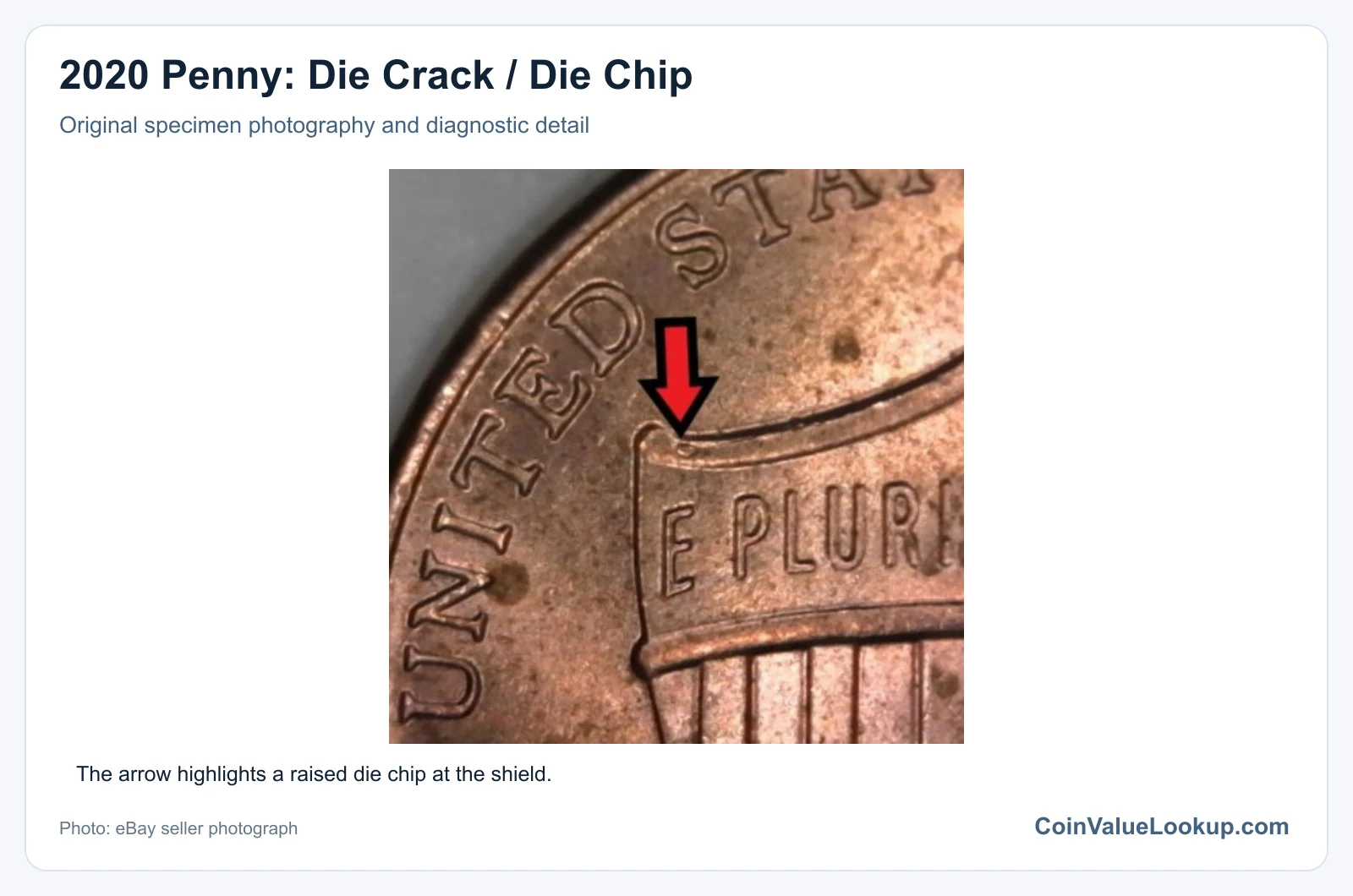
Die cracks appear as raised lines on the coin's surface, running anywhere from short hairlines to long arcs across the design. They result from stress fractures in the steel die.
Die chips are small raised blobs caused by tiny pieces of the die breaking away, leaving a void that fills with metal during striking.
To identify a die crack, look for a thin raised line that follows no logical design path. It should be raised above the field, not incused like a scratch.
Interior die chips appear as small bumps, usually in open field areas or within letters.
A crack that connects to the rim and displaces a larger area of design becomes a cud, which is a separate category. Corrosion and foreign material stuck to the surface are the usual lookalikes.
No adopted price range is listed for die cracks on the 2020 cent.
11. 2020 Lincoln Penny — Die Break / Cud
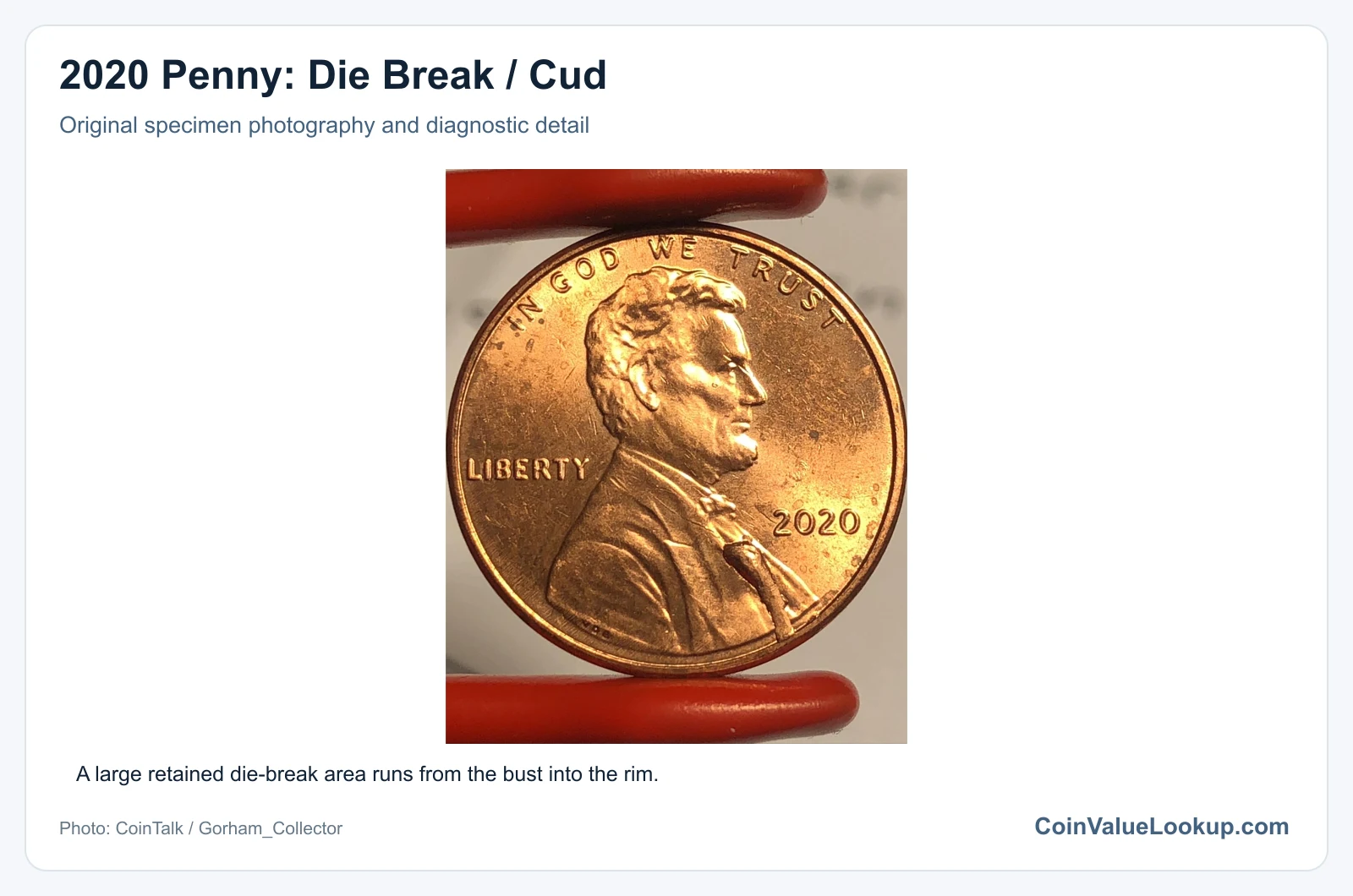
A cud is a major die break that connects to the rim. When a section of the die breaks away entirely, the corresponding area on the coin shows a raised, featureless blob that merges with the rim, replacing whatever design was there.
The boundary between the cud and the remaining design is usually sharp and visible. The raised area itself is flat or slightly rounded and lacks any normal design detail.
Larger cuds that obliterate recognizable portions of the design tend to attract more collector attention.
Do not confuse a cud with a rim dent, which is damage after striking, or with an interior die chip, which does not connect to the rim. Corrosion buildup along the edge can also look suspicious.
Value varies by size, location, and condition; no standard price range is adopted for 2020 cent cuds.
12. 2020 Lincoln Penny — Wrong Planchet / Off-Metal Strike
A wrong planchet error means the coin was struck on a blank intended for a different denomination or even a different country's coin. On a 2020 cent, this would mean Lincoln's design appears on a planchet that does not match the standard 2.50-gram copper-plated zinc specification.
To check, weigh the coin and measure its diameter. Compare both to the normal 19.05 mm diameter and 2.50 g weight.
If either measurement is significantly off and the design is fully or partially struck, you may have something worth investigating further.
Plating loss, corrosion, acid exposure, and deliberate alteration can all change a coin's appearance and weight enough to fool a casual observer. Genuine wrong-planchet errors are rare and require professional authentication.
No adopted price range is available; value depends entirely on the specific planchet and the coin's authenticated identity.