1854 Braided Hair Cent Coin Value: How Much Is It Worth?
An 1854 Braided Hair Cent in well-worn condition starts around $30 at a G4 grade, while a nice uncirculated example in MS63 can reach about $437 according to USA Coin Book guide estimates. These are not guaranteed sale prices, and rare proofs or significant mint errors fall outside that ordinary range entirely.
Identifying your exact variety is the first step to understanding what your coin might be worth.
Fast Way to Identify Your 1854 Braided Hair Cent
The quickest way to start figuring out what you have is to snap clear photos of both the front and back of your coin and upload them here for a preliminary identification. Good lighting and a steady hand help.
This won't replace professional authentication, but it can point you in the right direction for the correct variety and approximate grade.
1854 Braided Hair Cent Value
Upload both sides of your 1854 Braided Hair Cent.
Front Obverse
Upload photo
Back Reverse
Upload photo
Which 1854 Braided Hair Cent Versions Are Worth Money?
- Business strikes range from about $30 in G4 to $437 in MS63 per USA Coin Book; original surfaces without cleaning make the biggest difference in this range.
- Proof 1854 cents are cataloged but very rare; they require professional attribution of die characteristics, surfaces, and rims, and no ordinary price applies.
- Mint errors such as off-center strikes, rotated dies, lamination flaws, and defective planchets are reported for this date and can add significant value when authenticated.
- Uncirculated examples with original red or red-brown color are scarce and command premiums over brown examples at the same technical grade.
Step 1: Identify Your 1854 Braided Hair Cent Mint Mark and Version
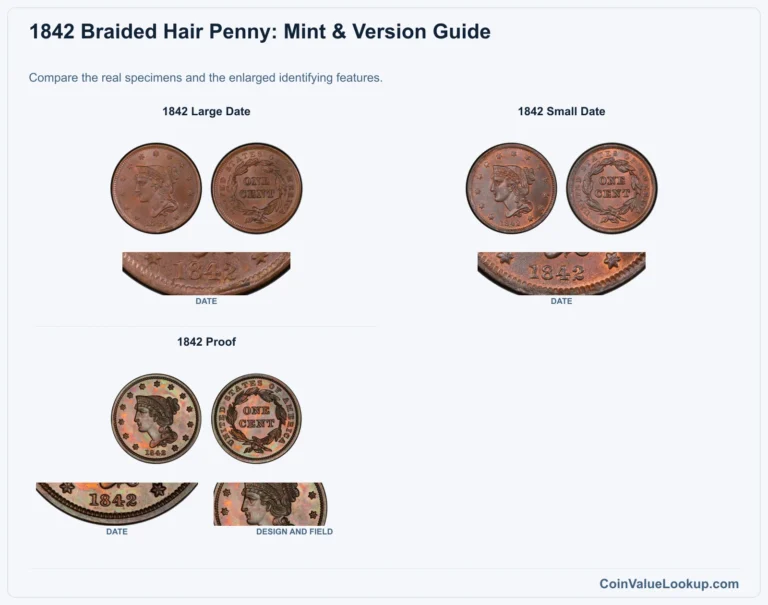
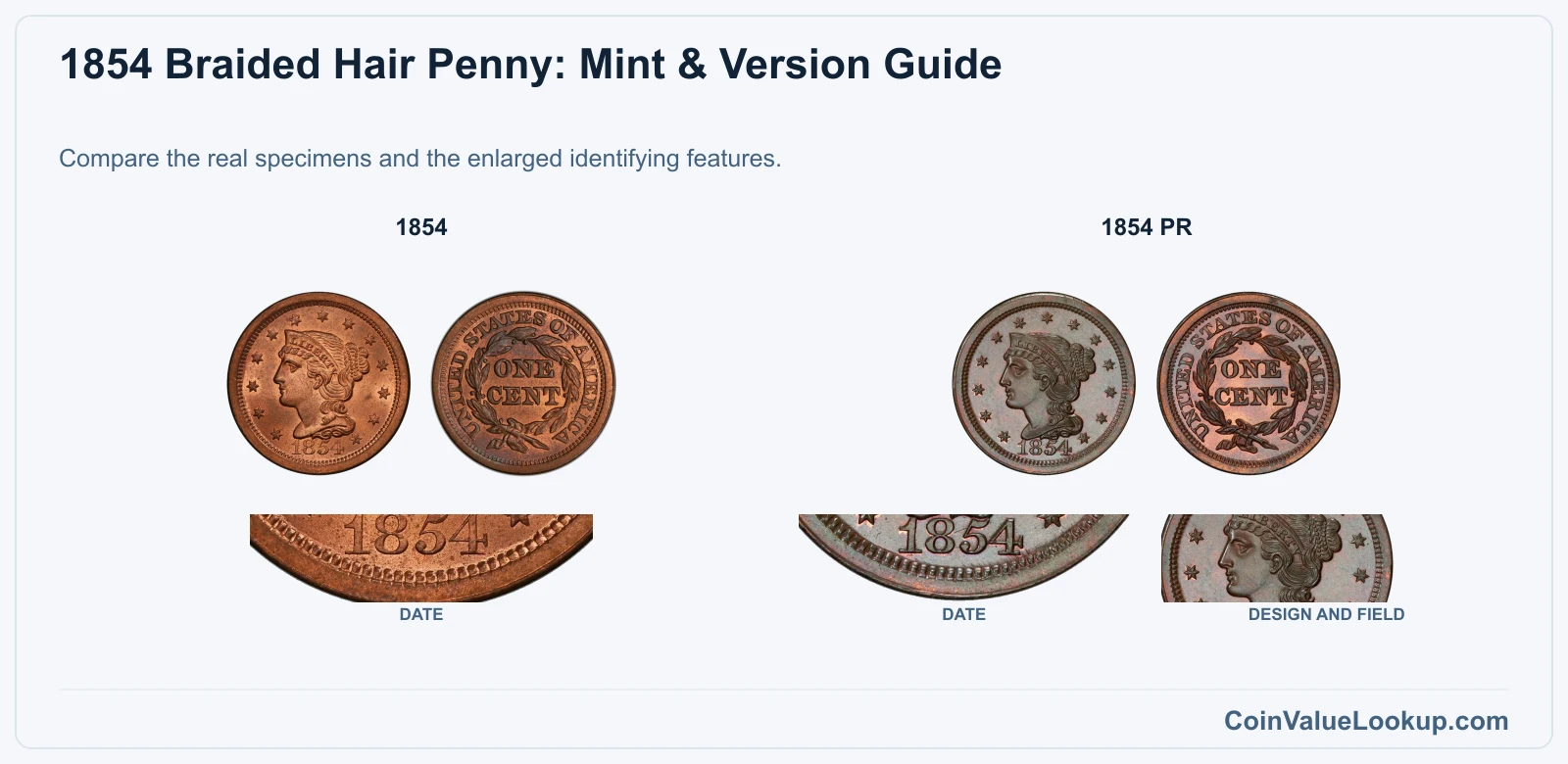
The 1854 Braided Hair Cent features a left-facing Liberty portrait with braided hair on the obverse, surrounded by stars, with the date below. The reverse shows the denomination "ONE CENT" inside a laurel wreath.
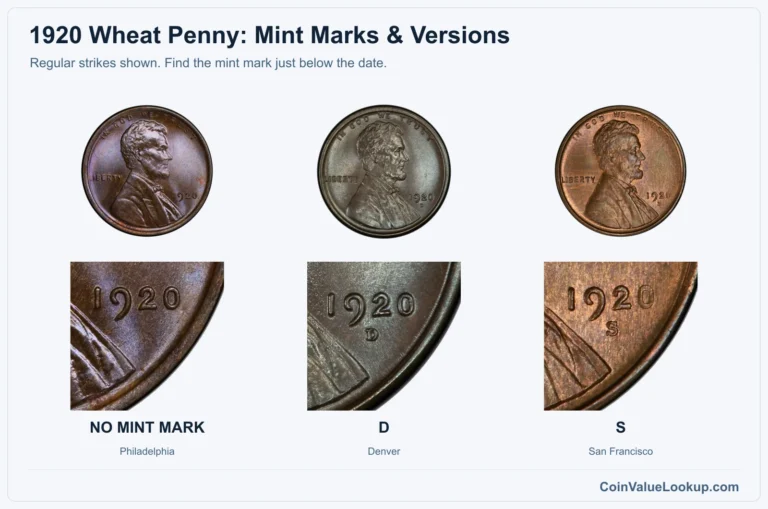
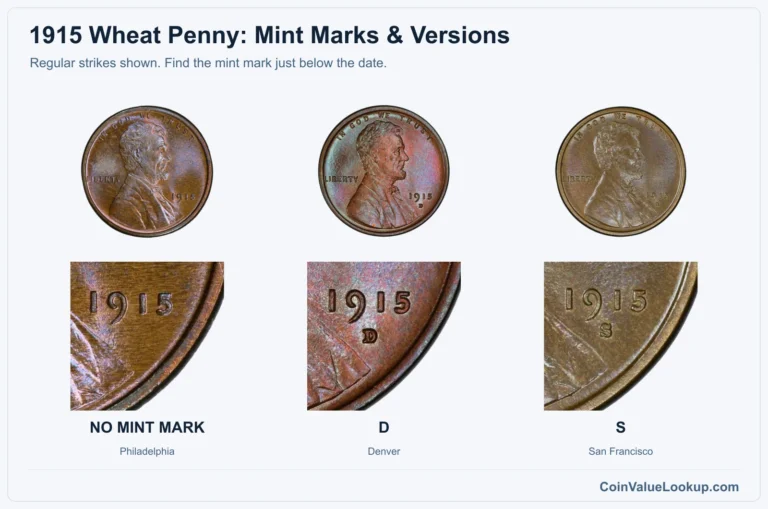
All 1854 cents were struck at Philadelphia, so there is no mintmark to look for.
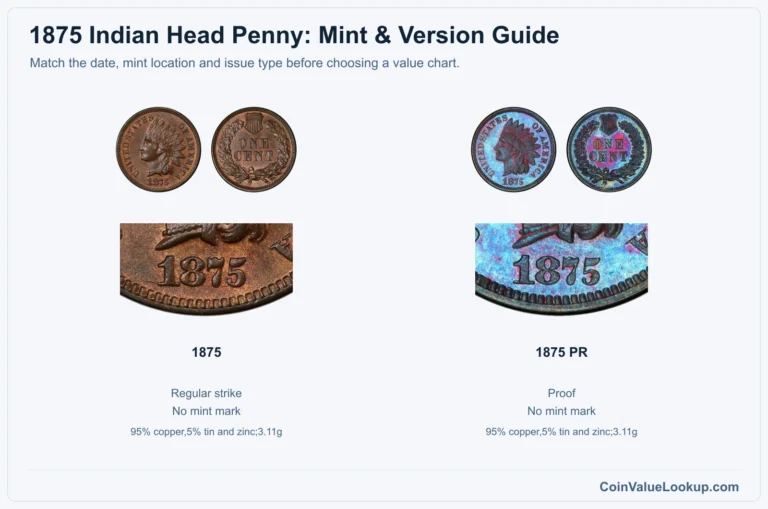
The main distinction you need to make is whether your coin is an ordinary business strike or a proof. Business strikes were made for circulation and will typically show contact marks and wear consistent with use.
Proofs were made with specially prepared dies and planchets and exhibit mirror-like fields and sharp rims.
Do not assume a shiny or cleaned coin is a proof. Polishing does not create a proof; the difference is in manufacture, not appearance.
Check the rims, die characteristics, and surface quality. Weight should be around 10.89 grams in copper, though wear and production tolerances mean weight alone cannot confirm authenticity.
Original brown or red-brown surfaces and legible detail matter more than brightness when it comes to collector appeal.
Step 2: Check Your 1854 Braided Hair Cent Grade
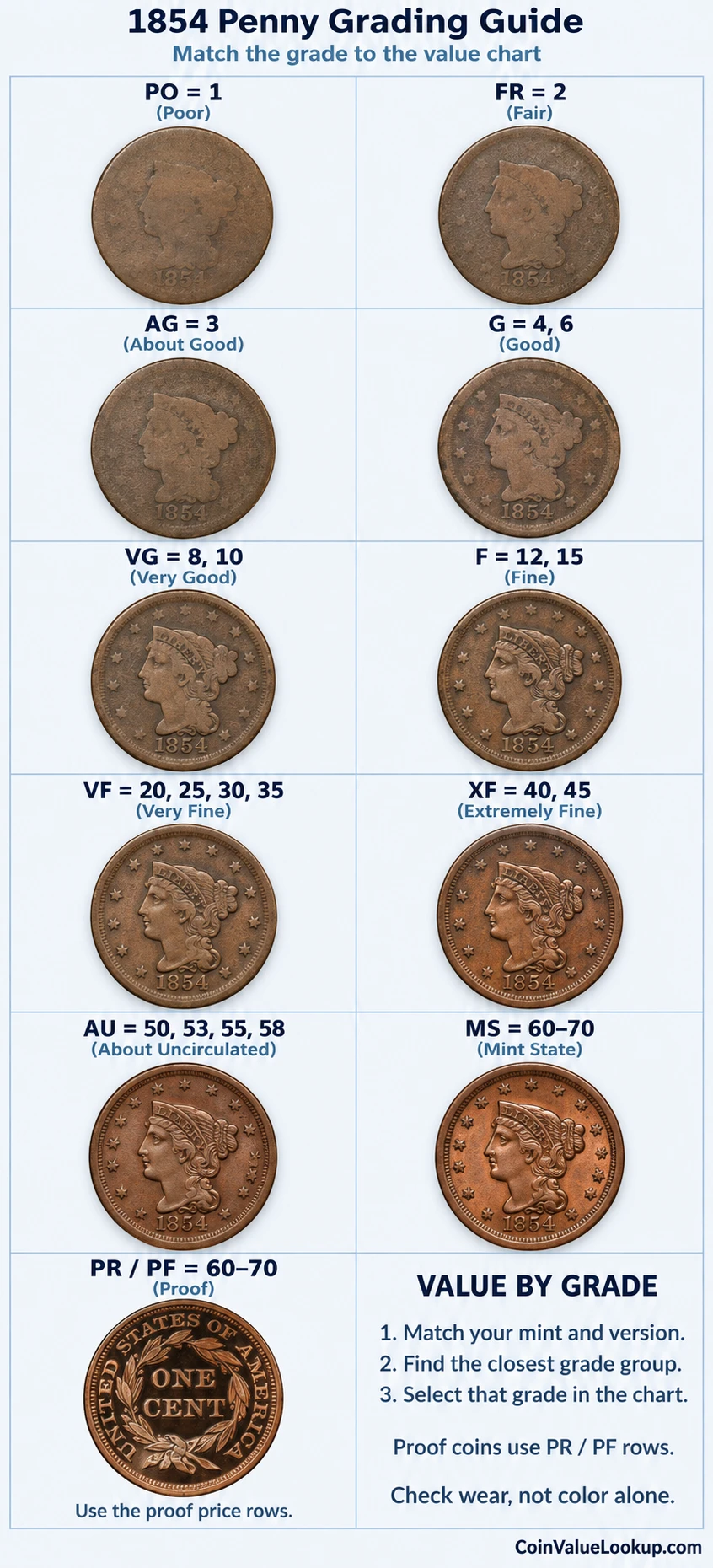
Start with the portrait. On a well-worn coin (around G4), Liberty's outline and the date will be visible but most hair detail is gone.
As you move up to Fine and Very Fine, the individual braids above the ear become distinct, and the cheek retains some roundness.
At Extremely Fine, nearly all hair strands are sharp, and the wreath leaves on the reverse show clear veining. Mint State coins (MS60 and above) have no wear at all, though bag marks and contact marks are normal.
Copper coins carry color designations: BN (brown), RB (red-brown), and RD (red). These describe the surface color, not different metals.
More original red color generally commands higher prices in uncirculated grades.
Use the comparison image to check your coin's hair detail, cheek flatness, and wreath sharpness against known grade examples. Surface problems like corrosion, porosity, or old cleaning can lower a coin's market value well below what the grade number alone might suggest.
A coin with original, problem-free surfaces will almost always sell better than a higher-detail coin that has been harshly cleaned.
Step 3: Check 1854 Braided Hair Cent Value by Mint and Version
1854 Braided Hair Cent
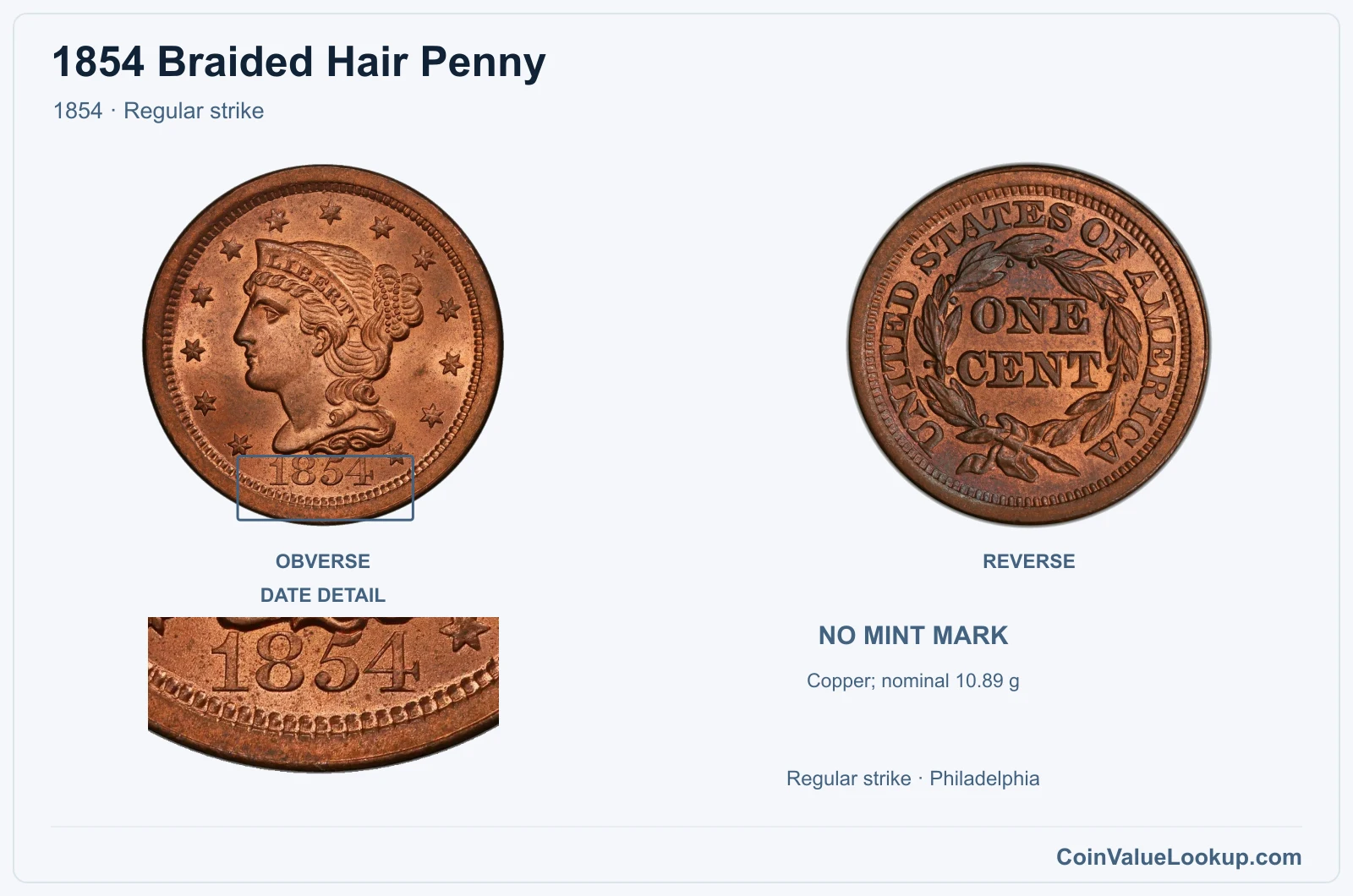
The standard 1854 Braided Hair Cent is a Philadelphia business strike in copper, weighing roughly 10.89 grams. These are the coins you will encounter most often.
In heavily worn G4 condition, USA Coin Book lists a guide value of about $30. A solidly uncirculated MS63 example jumps to around $437.
The spread between those grades is significant, so accurate grading matters. Look for sharp hair braids, full wreath detail, and original brown or red-brown surfaces.
Cleaned coins or those with corrosion will trade below guide estimates regardless of remaining detail. If you are exploring values across the Braided Hair series or other classic U.S. coins, Coin Value Lookup is a useful starting point for finding the right guide for your date and denomination.
| Range | Grade | Price | Auction Records | Appraisal |
|---|---|---|---|---|
| PO | PO 1 | — | Coin Identifier | |
| FR | FR 2 | — | Coin Identifier | |
| AG | AG 3 | — | Coin Identifier | |
| G | G 4 | — | Coin Identifier | |
| G 6 | — | Coin Identifier | ||
| VG | VG 8 | — | Coin Identifier | |
| VG 10 | — | Coin Identifier | ||
| F | F 12 | — | Coin Identifier | |
| F 15 | — | Coin Identifier | ||
| VF | VF 20 | — | Coin Identifier | |
| VF 25 | — | Coin Identifier | ||
| VF 30 | — | Coin Identifier | ||
| VF 35 | — | Coin Identifier | ||
| XF | XF 40 | — | Coin Identifier | |
| XF 45 | — | Coin Identifier | ||
| AU | AU 50 | — | Coin Identifier | |
| AU 53 | — | Coin Identifier | ||
| AU 55 | — | Coin Identifier | ||
| AU 58 | — | Coin Identifier | ||
| MS | MS 60 | — | Coin Identifier | |
| MS 61 | — | Coin Identifier | ||
| MS 62 | — | Coin Identifier | ||
| MS 63 | Coin Identifier | |||
| MS 64 | Coin Identifier | |||
| MS 65 | Coin Identifier | |||
| MS 66 | Coin Identifier | |||
| MS 67 | — | — | — | |
| MS 68 | — | — | — | |
| MS 69 | — | — | — | |
| MS 70 | — | — | — |
1854 Braided Hair Cent — PR
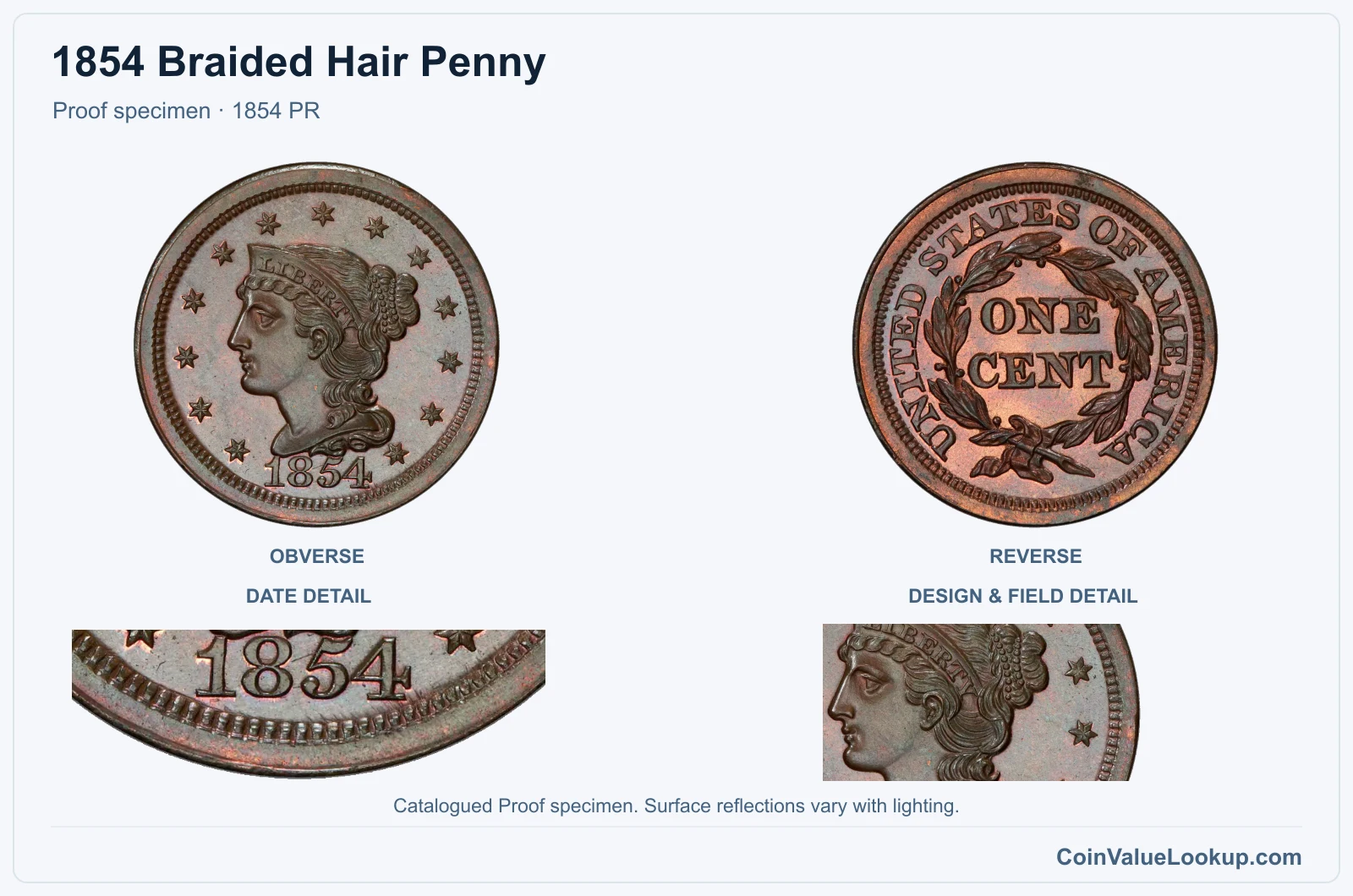
The 1854 Proof Braided Hair Cent is a cataloged variety, but it is genuinely rare. These were produced in very small numbers at the Philadelphia Mint using specially prepared dies.
A true proof will have squared, well-defined rims, deeply mirrored fields, and exceptionally sharp design elements that no amount of polishing can replicate on a business strike.
No ordinary business-strike price applies here. Each proof must be evaluated individually based on its authenticated identity, surface preservation, and overall condition.
Third-party certification from a major grading service is essentially mandatory for a coin claimed to be a proof of this era. Many coins offered as proofs turn out to be nicely preserved or polished business strikes, so skepticism is healthy.
If you believe you have one, professional attribution is the only reliable path to confirming it.
| Range | Grade | Price | Auction Records | Appraisal |
|---|---|---|---|---|
| PR | PR 1 | — | Coin Identifier | |
| PR 2 | — | Coin Identifier | ||
| PR 3 | — | Coin Identifier | ||
| PR 4 | — | Coin Identifier | ||
| PR 6 | — | Coin Identifier | ||
| PR 8 | — | Coin Identifier | ||
| PR 10 | — | Coin Identifier | ||
| PR 12 | — | Coin Identifier | ||
| PR 15 | — | Coin Identifier | ||
| PR 20 | — | Coin Identifier | ||
| PR 25 | — | Coin Identifier | ||
| PR 30 | — | Coin Identifier | ||
| PR 35 | — | Coin Identifier | ||
| PR 40 | — | Coin Identifier | ||
| PR 45 | — | Coin Identifier | ||
| PR 50 | — | Coin Identifier | ||
| PR 53 | — | Coin Identifier | ||
| PR 55 | — | Coin Identifier | ||
| PR 58 | — | Coin Identifier | ||
| PR 60 | — | Coin Identifier | ||
| PR 61 | — | Coin Identifier | ||
| PR 62 | — | Coin Identifier | ||
| PR 63 | Coin Identifier | |||
| PR 64 | Coin Identifier | |||
| PR 65 | — | Coin Identifier | ||
| PR 66 | Coin Identifier | |||
| PR 67 | — | — | — | |
| PR 68 | — | — | — | |
| PR 69 | — | — | — | |
| PR 70 | — | — | — |
1854 Braided Hair Cent Error List
1. 1854 Braided Hair Cent — Rotated Dies
A rotated die error occurs when the obverse and reverse dies are misaligned in their normal orientation. To check, hold your coin with Liberty upright, then flip it top to bottom.
On a normal U.S. coin, the reverse design should also appear upright. If the wreath and lettering are tilted at an angle, you may have a rotation error.
The degree of rotation matters. Minor rotations of a few degrees are common production tolerances and usually not considered collectible errors.
Significant rotations of 45 degrees or more attract more attention. Be careful with photographs: a picture taken at an angle can make a normal coin look rotated.
Always verify in hand. No specific price range is adopted for this error on the 1854 cent; value depends on the degree of rotation, the coin's grade, and authentication.
2. 1854 Braided Hair Cent — Lamination / Split Planchet
Lamination errors on copper large cents appear as peeling or flaking metal, a retained flap lifting from the surface, or an outright split within the planchet. These result from impurities or trapped gas in the copper blank before striking.
Photograph the edge and the affected face together to document the flaw clearly.
Do not confuse this with post-mint damage. Scrapes from tools, deep corrosion pitting, or deliberately shaved coins can look superficially similar.
The key difference is that a genuine lamination follows the contour of the coin's surface and is typically visible at the edge as a distinct layer separation. No specific price is adopted for lamination errors on the 1854 Braided Hair Cent; each example needs individual assessment based on size, visibility, and overall coin condition.
3. 1854 Braided Hair Cent — Off-Center Strike
An off-center strike happens when the planchet is not properly seated between the dies, resulting in part of the design being struck off to one side and a blank crescent of unstruck metal on the opposite side. On an 1854 Braided Hair Cent, the most desirable off-center errors still show the full date, since that confirms the year.
Do not confuse an off-center strike with a clipped planchet, which has a curved missing section but the design is centered. Post-mint flattening can also distort a coin in ways that mimic misalignment.
A genuine off-center error will have a smooth, unstruck area with no design impression. Value depends heavily on the percentage off-center and whether the date is readable, but no specific price range is adopted for this error on the 1854 cent.
4. 1854 Braided Hair Cent — Defective Planchet
A defective planchet error means the copper blank itself had a flaw before it was struck. This can show up as voids, irregular edges, cracks, or areas of missing metal within the body of the coin.
The struck design will typically wrap around or conform to the defect, which is what separates it from post-mint damage.
Gouges, corrosion holes, and deliberate metal removal are common lookalikes. The distinction is that a genuine planchet defect is present before striking, so the coin's design elements will flow into or around the flaw naturally.
Photograph both faces and the edge to document the full extent. No price range is adopted for this category on the 1854 Braided Hair Cent; each coin requires individual evaluation based on the nature of the defect, overall condition, and professional authentication.