1799 Draped Bust Cent Coin Value: How Much Is It Worth?
The 1799 Draped Bust Cent is one of the scarcest dates in all of early American copper coinage. Guide estimates for the two listed varieties range from roughly $7,329 in G4 to about $278,817 in EF40, depending on which variety you hold and its condition.
Identify your exact variety first, because altered dates and misattributed coins are common pitfalls with this issue.
Fast Way to Identify Your 1799 Draped Bust Cent
Upload clear photos of both the front and back of your coin for a preliminary identification. Good lighting and a straight-on angle help distinguish the date digits, wreath style, and any unusual die features.
This step is not a substitute for professional authentication, but it can point you in the right direction before investing in a formal opinion.
1799 Draped Bust Cent Value
Upload both sides of your 1799 Draped Bust Cent.
Front Obverse
Upload photo
Back Reverse
Upload photo
Which 1799 Draped Bust Cent Versions Are Worth Money?
- The 1799/8 overdate variety carries guide estimates from about $8,966 in G4 to roughly $278,817 in EF40, making it the higher-valued of the two listed branches at those grades.
- The Normal Date 1799 is itself very scarce, with guide estimates near $7,329 in G4 and approximately $240,553 in EF40.
- Altered 1798 dates are frequently offered as genuine 1799 cents; confirming the correct variety is essential before assuming high value.
- Certain mint errors such as die cracks, clashed dies, and misaligned dies have been reported on 1799 cents and may attract additional collector interest on authenticated examples.
Step 1: Identify Your 1799 Draped Bust Cent Mint Mark and Version
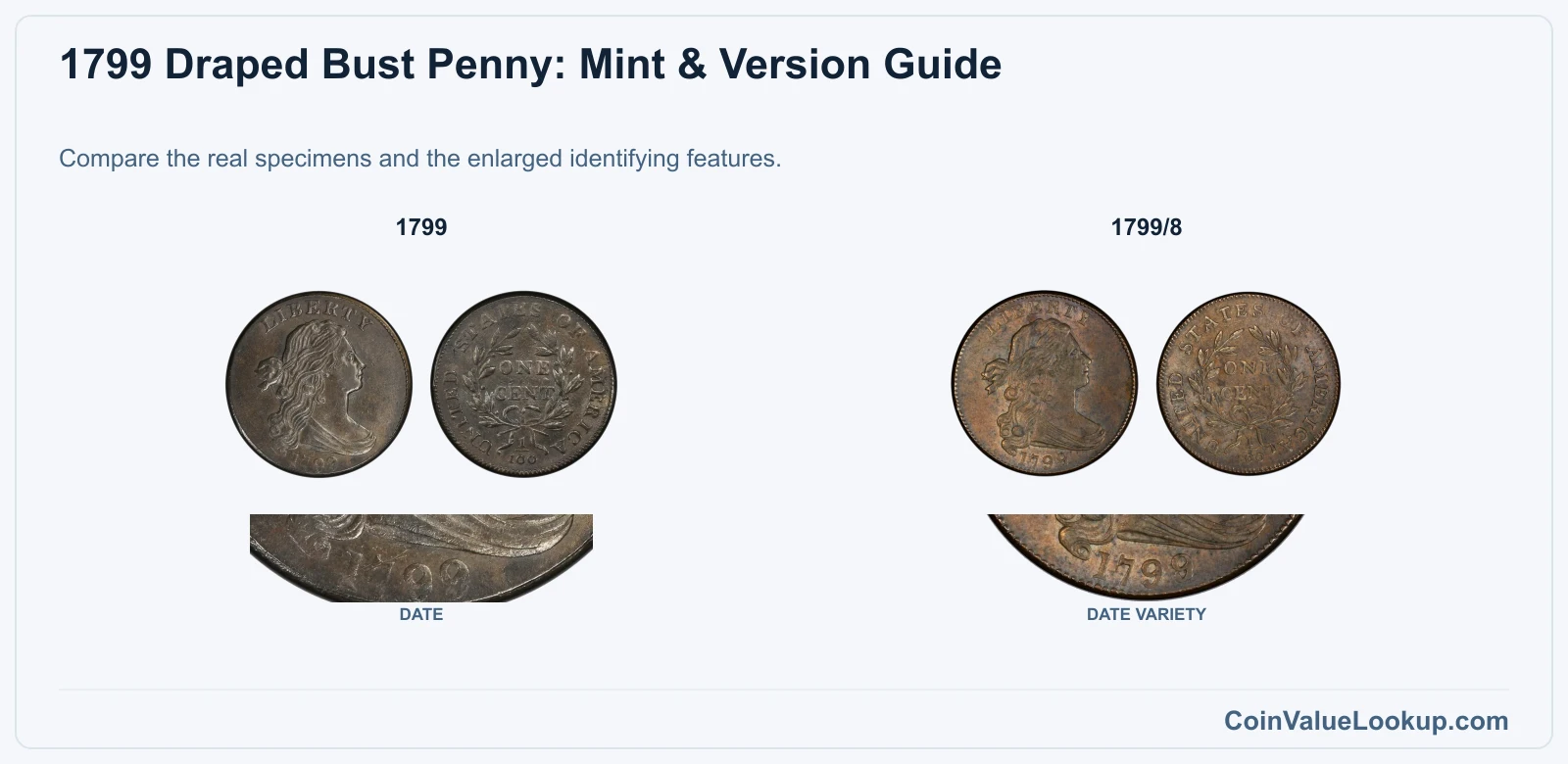
Every 1799 cent was struck at Philadelphia, so there is no mintmark to look for. Two main varieties exist: the Normal Date and the 1799/8 overdate, where the final 9 was punched over an earlier 8.
Study the last digit of the date carefully under magnification. On a genuine 1799/8, remnants of the underlying 8 should be visible beneath the 9, especially in the lower loop area.
A plain 9 with no traces of an earlier digit points to the Normal Date variety.
Be cautious about altered dates. Some 1798 cents have had their final digit tooled to look like a 9, and these fakes can be convincing at first glance.
Compare the overall style of the date numerals, the spacing, and the wreath and legend details against known genuine examples rather than relying on the date alone.
Weight can offer supporting evidence. The nominal specification is 10.89 grams in copper.
But wear, corrosion, and the wide production tolerances of the era mean weight by itself cannot prove or disprove authenticity. Combine it with a full examination of both faces and the edge.
Step 2: Check Your 1799 Draped Bust Cent Grade
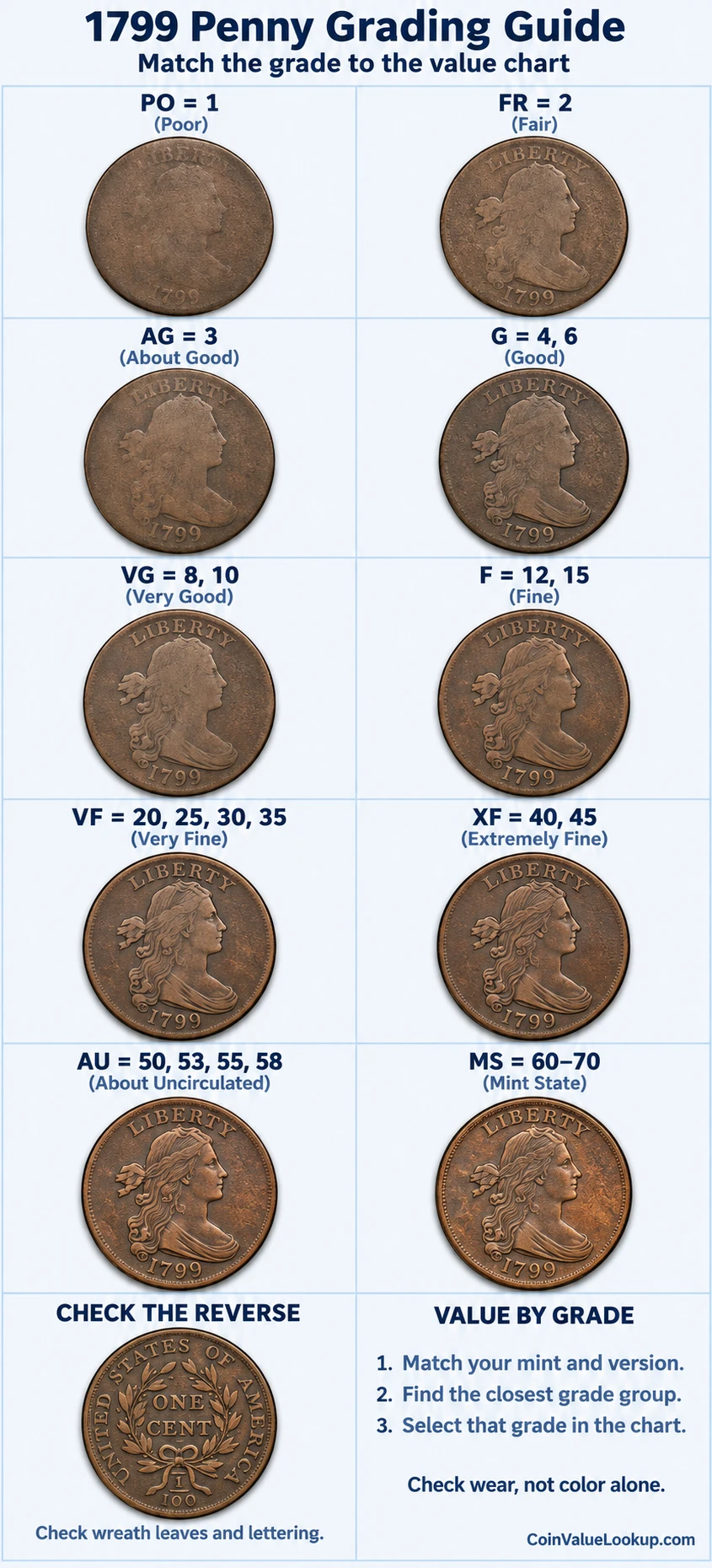
Focus on the portrait first. On higher-grade examples, you can see fine strands of hair above Liberty's forehead and along the shoulder.
As the coin wears, these strands merge into flat areas, and the cheek loses its rounded contour.
Flip it over. The wreath leaves lose their individual vein detail early in circulation, and the lettering around the rim softens progressively.
Compare your coin's sharpness against the reference image of like-type grade examples to place it on the scale.
Do not confuse wear from circulation with a weak strike. Some 1799 cents left the press with soft areas that were never sharp to begin with.
Porosity, corrosion, and old cleaning are separate surface problems that can reduce the market value well below what the remaining detail might otherwise suggest.
Color designations like BN, RB, and RD describe how much original red copper color survives. They are not different alloys or separate coin types.
Step 3: Check 1799 Draped Bust Cent Value by Mint and Version
1799 Draped Bust Cent
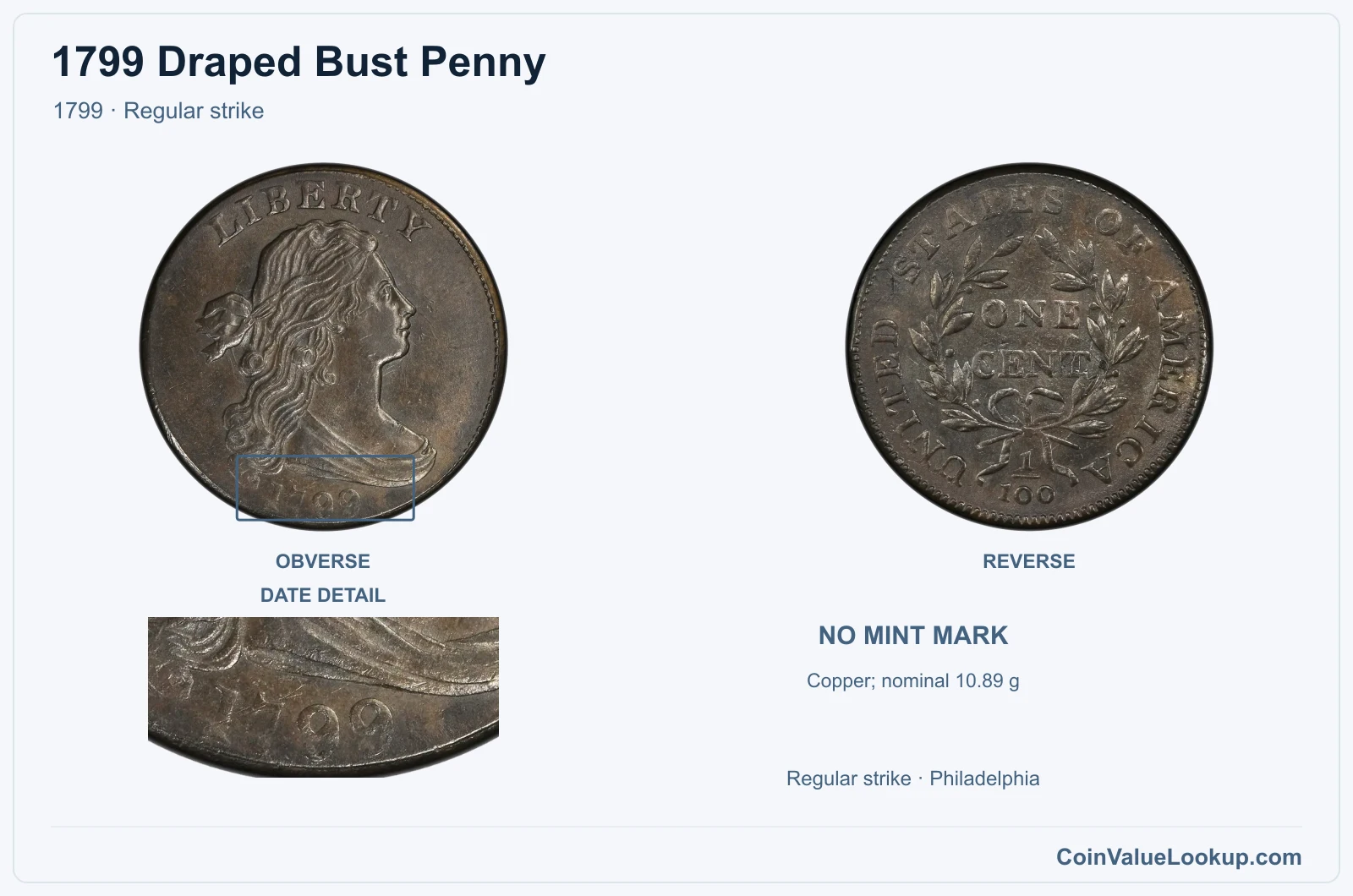
The Normal Date 1799 Draped Bust Cent was struck in copper at Philadelphia with no mintmark. Its obverse shows Liberty facing right with draped bust and flowing hair; the reverse features a denomination within a wreath.
Guide estimates from USA Coin Book place this variety at approximately $7,329 in G4 and around $240,553 in EF40.
Even at a well-worn G4 grade, this is a four-figure coin. The 1799 is a genuinely low-population date, not just a conditionally rare one.
Confirm that the final digit is a clean 9 with no traces of an underlying numeral, and watch for tooled or altered 1798 cents masquerading as this date. Die characteristics, letter spacing, and wreath details all help separate the real thing from a fake.
| Range | Grade | Price | Auction Records | Appraisal |
|---|---|---|---|---|
| PO | PO 1 | Coin Identifier | ||
| FR | FR 2 | Coin Identifier | ||
| AG | AG 3 | Coin Identifier | ||
| G | G 4 | Coin Identifier | ||
| G 6 | Coin Identifier | |||
| VG | VG 8 | Coin Identifier | ||
| VG 10 | Coin Identifier | |||
| F | F 12 | Coin Identifier | ||
| F 15 | Coin Identifier | |||
| VF | VF 20 | Coin Identifier | ||
| VF 25 | Coin Identifier | |||
| VF 30 | Coin Identifier | |||
| VF 35 | Coin Identifier | |||
| XF | XF 40 | — | Coin Identifier | |
| XF 45 | Coin Identifier | |||
| AU | AU 50 | — | Coin Identifier | |
| AU 53 | — | Coin Identifier | ||
| AU 55 | — | Coin Identifier | ||
| AU 58 | — | Coin Identifier | ||
| MS | MS 60 | — | Coin Identifier | |
| MS 61 | — | Coin Identifier | ||
| MS 62 | — | Coin Identifier | ||
| MS 63 | — | — | — | |
| MS 64 | — | — | — | |
| MS 65 | — | — | — | |
| MS 66 | — | — | — | |
| MS 67 | — | — | — | |
| MS 68 | — | — | — | |
| MS 69 | — | — | — | |
| MS 70 | — | — | — |
1799 Draped Bust Cent — /8
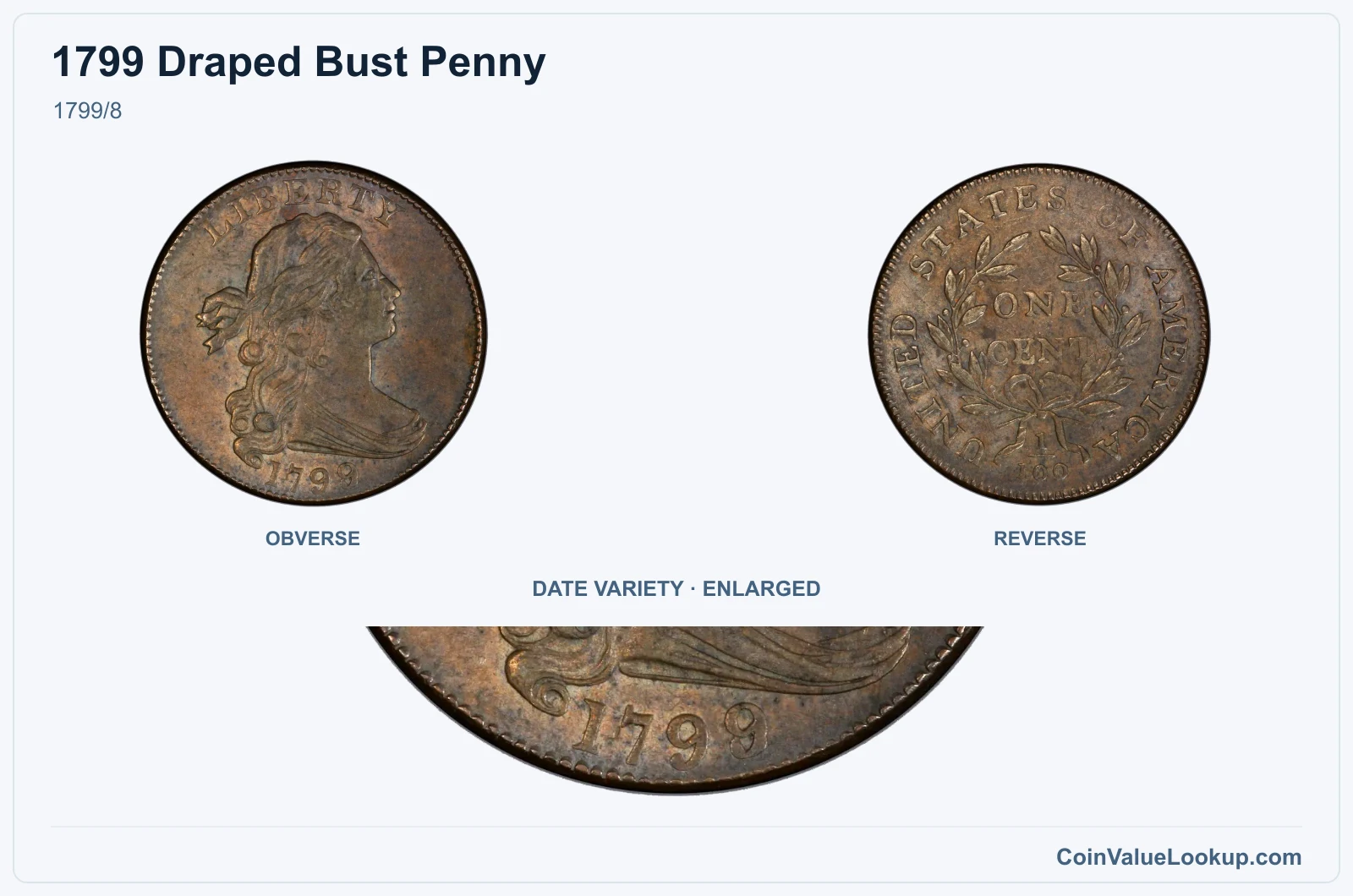
The 1799/8 overdate is a die variety where the Mint punched a 9 over a previously entered 8 in the date. Under magnification the lower loop of the old 8 is visible beneath the final 9.
This variety was also struck in copper at Philadelphia.
USA Coin Book guide estimates run from about $8,966 in G4 to roughly $278,817 in EF40. Those figures sit above the Normal Date at the same grades, reflecting the added collector demand for the overdate feature.
If you are researching other early copper dates and denominations alongside this one, Coin Value Lookup can help you compare guide values across different series. It is a handy starting point for building context around what these old large cents typically bring.
Authentication matters here more than usual. A tooled 1798 can mimic an overdate at a casual glance.
Look for consistent die flow around the repunched area rather than sharp, irregular scratches that suggest hand alteration.
| Range | Grade | Price | Auction Records | Appraisal |
|---|---|---|---|---|
| PO | PO 1 | — | Coin Identifier | |
| FR | FR 2 | Coin Identifier | ||
| AG | AG 3 | Coin Identifier | ||
| G | G 4 | Coin Identifier | ||
| G 6 | Coin Identifier | |||
| VG | VG 8 | Coin Identifier | ||
| VG 10 | Coin Identifier | |||
| F | F 12 | Coin Identifier | ||
| F 15 | Coin Identifier | |||
| VF | VF 20 | Coin Identifier | ||
| VF 25 | Coin Identifier | |||
| VF 30 | — | Coin Identifier | ||
| VF 35 | — | Coin Identifier | ||
| XF | XF 40 | — | Coin Identifier | |
| XF 45 | — | Coin Identifier | ||
| AU | AU 50 | — | Coin Identifier | |
| AU 53 | — | Coin Identifier | ||
| AU 55 | — | Coin Identifier | ||
| AU 58 | — | Coin Identifier | ||
| MS | MS 60 | — | — | — |
| MS 61 | — | — | — | |
| MS 62 | — | — | — | |
| MS 63 | — | — | — | |
| MS 64 | — | — | — | |
| MS 65 | — | — | — | |
| MS 66 | — | — | — | |
| MS 67 | — | — | — | |
| MS 68 | — | — | — | |
| MS 69 | — | — | — | |
| MS 70 | — | — | — |
1799 Draped Bust Cent Error List
1. 1799 Draped Bust Cent — Die Crack
A die crack shows up as a thin raised line running across the coin's surface, cutting through fields, devices, or both. These lines formed when the steel die developed a fracture during use, and the crack filled with metal during each subsequent strike.
To confirm one on a 1799 cent, look for a continuous raised line that follows a consistent path. Tilt the coin under a light source and trace the line from end to end.
A genuine die crack will be raised above the surrounding surface.
Do not confuse it with an incuse scratch, a corrosion track, or a tooling mark. Scratches are typically recessed into the surface, and corrosion lines tend to be irregular and pitted rather than sharply raised.
No specific pricing data is available for die-crack examples of this date; value depends on the authenticated variety, the coin's overall condition, and the severity and visual appeal of the crack itself.
2. 1799 Draped Bust Cent — Clashed Dies
Clashed dies occur when the obverse and reverse dies strike each other without a planchet between them. The impact transfers faint ghost images of each die's design onto the opposing die, and those traces then appear on subsequent coins as shallow, misplaced design elements.
On a 1799 cent, look for faint outlines of wreath leaves in the obverse fields near Liberty's portrait, or hints of Liberty's hair or bust on the reverse side. The transferred images should align with where the opposite design would naturally fall.
Random scratches, raised corrosion lines, and brockage strikes can mimic a clash at first glance, so compare the suspicious marks against the expected position of the opposing design. Pricing for clashed-die examples of this date is not established in the available guides; each coin's value depends on its authenticated identity, surface condition, and how prominently the clash shows.
3. 1799 Draped Bust Cent — Misaligned Die
A misaligned die error happens when one die shifts laterally out of its normal centered position relative to the planchet or the opposing die. The result is a coin where one side's design appears offset, with an uneven rim that is wider on one side and narrower or missing on the opposite side.
This is different from an off-center strike, where the planchet itself is displaced, and different from a rotated die, where the alignment is angular rather than lateral. Compare both sides carefully: if only one face is shifted while the other is properly centered on the flan, you are likely looking at a misaligned die.
Watch out for lookalikes. A tilted photograph, post-mint rim damage, or uneven wear can all create the illusion of misalignment.
No adopted price range exists for this error on the 1799 cent; assessment depends on the degree of displacement, the coin's authenticated variety, and overall condition.
4. 1799 Draped Bust Cent — Overdate
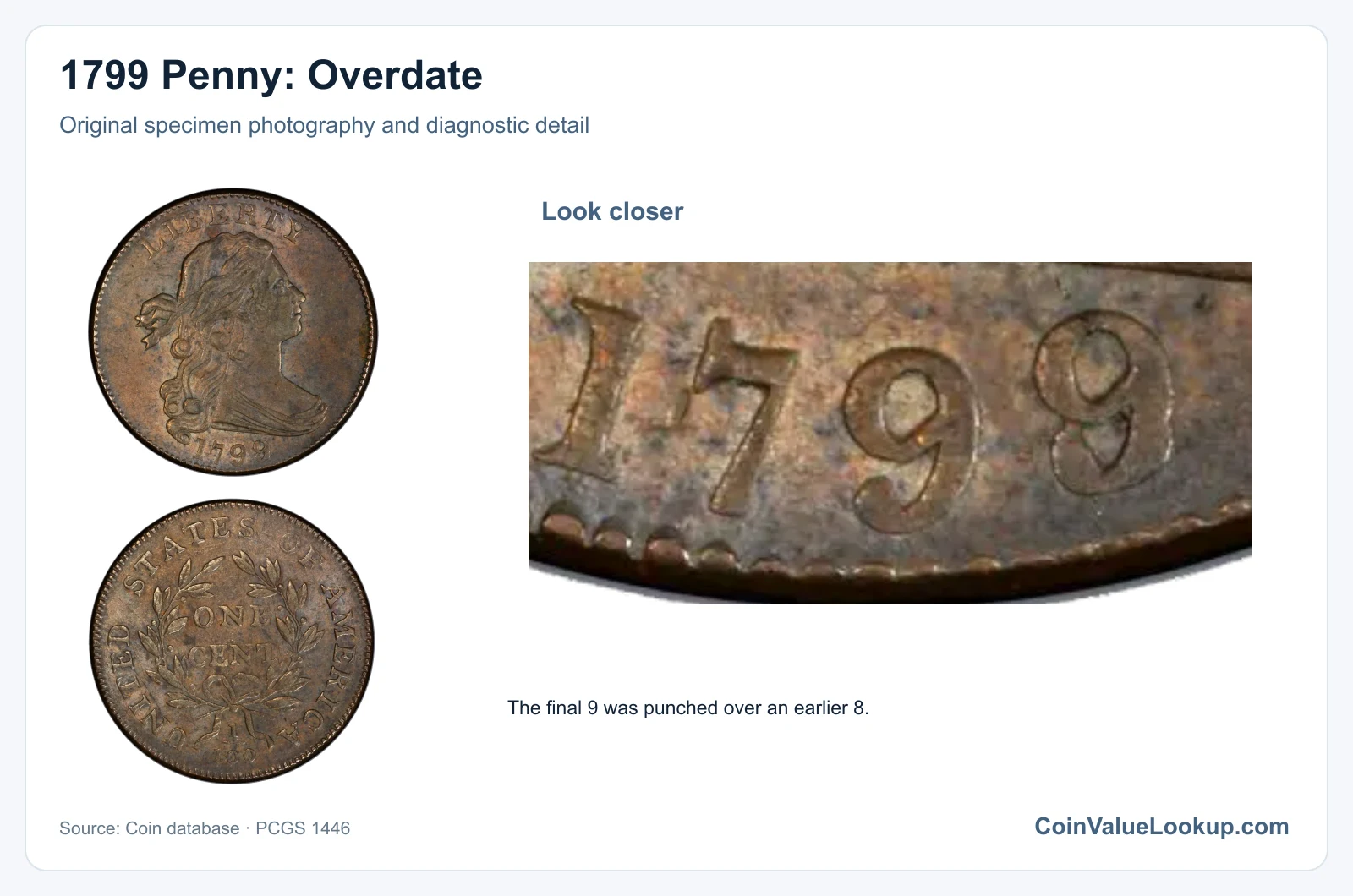
An overdate is a die variety, not a post-mint error, but it originates from a mistake at the Mint. On the 1799/8, the engraver punched a 9 over a previously placed 8 in the final digit of the date.
Surviving contours of the 8's lower loop remain visible beneath the 9.
Examine the last digit under at least 5x magnification. The underlying 8 is easiest to spot in the lower portion of the numeral, where its rounded loop differs from the 9's tail.
On a genuine overdate the remnants blend smoothly into the surrounding metal because both punches entered the die before hardening.
Do not mistake a damaged or corroded date for an overdate. Impact damage can distort a digit, and ordinary machine doubling produces shelf-like outlines rather than a clearly different numeral shape.
The 1799/8 overdate already appears in the version listings above with its own guide estimates, so pricing depends on which authenticated die marriage your coin represents and its actual grade.