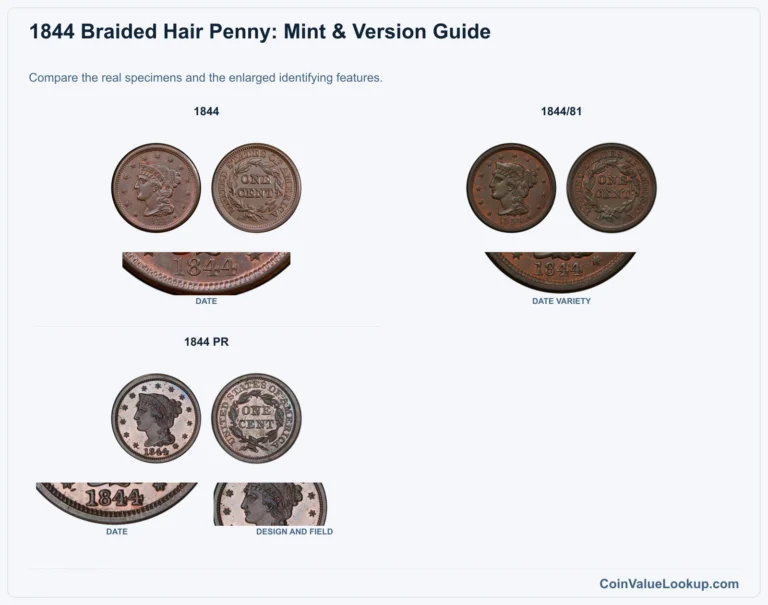
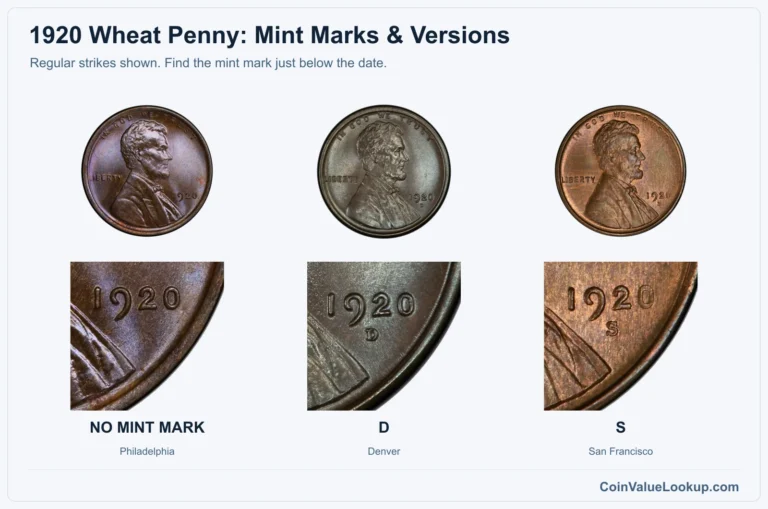
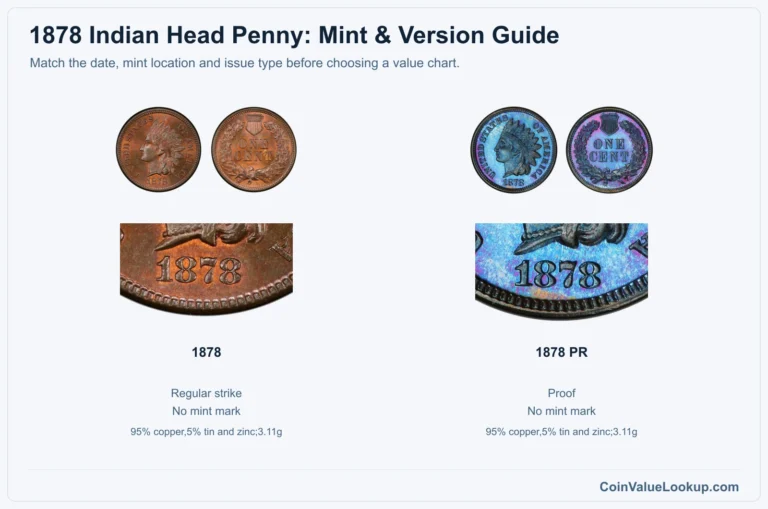
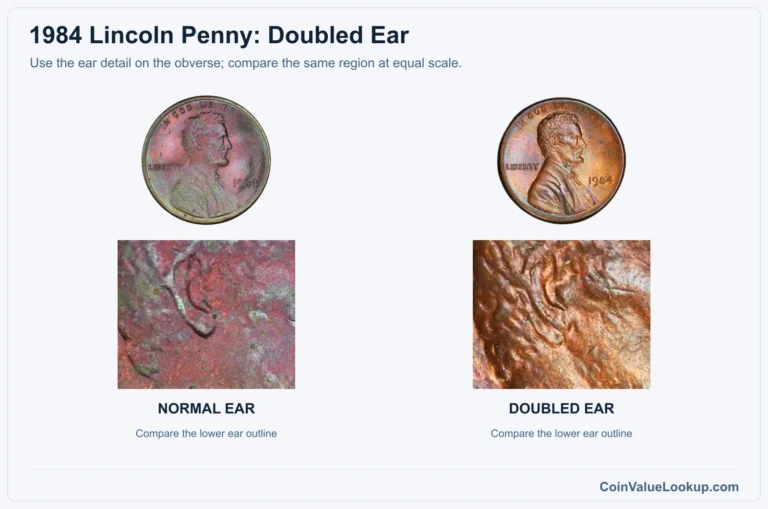
1800 Draped Bust Cent Coin Value: How Much Is It Worth?
The 1800 Draped Bust Cent is a copper large cent struck at the Philadelphia Mint over two centuries ago. Guide estimates for the three listed varieties range from about $154 in Good-4 to $4,819 in Extremely Fine-40, depending on which variety you hold.
Overdates exist for this year and carry different premiums, so pinning down your exact coin matters before you price it.
Fast Way to Identify Your 1800 Draped Bust Cent
The quickest way to start figuring out what you have is to upload clear photos of both the front and back of your coin. A preliminary identification from those images can help sort out whether you have a normal date, an 1800/1798 overdate, or an 1800/79 overdate — each of which falls into a different value bracket.
Sharp, well-lit images make all the difference.
1800 Draped Bust Cent Value
Upload both sides of your 1800 Draped Bust Cent.
Front Obverse
Upload photo
Back Reverse
Upload photo
Which 1800 Draped Bust Cent Versions Are Worth Money?
- The 1800/1798 overdate (Style 1 Hair) carries the highest listed guide anchor at $4,819 in EF-40, making it the premium variety to watch for among the three branches.
- The 1800/79 overdate (Style 2 Hair) and Normal Date share the same EF-40 guide figure of $3,083, but the overdate starts slightly higher at the G-4 level ($175 vs. $154).
- Confirm the underlying digits on any suspected overdate before assuming a premium — damage or corrosion near the date can mimic overdate traces.
Step 1: Identify Your 1800 Draped Bust Cent Mint Mark and Version
All 1800 Draped Bust Cents were struck at Philadelphia. There is no mintmark on any of them, so do not go hunting for one.
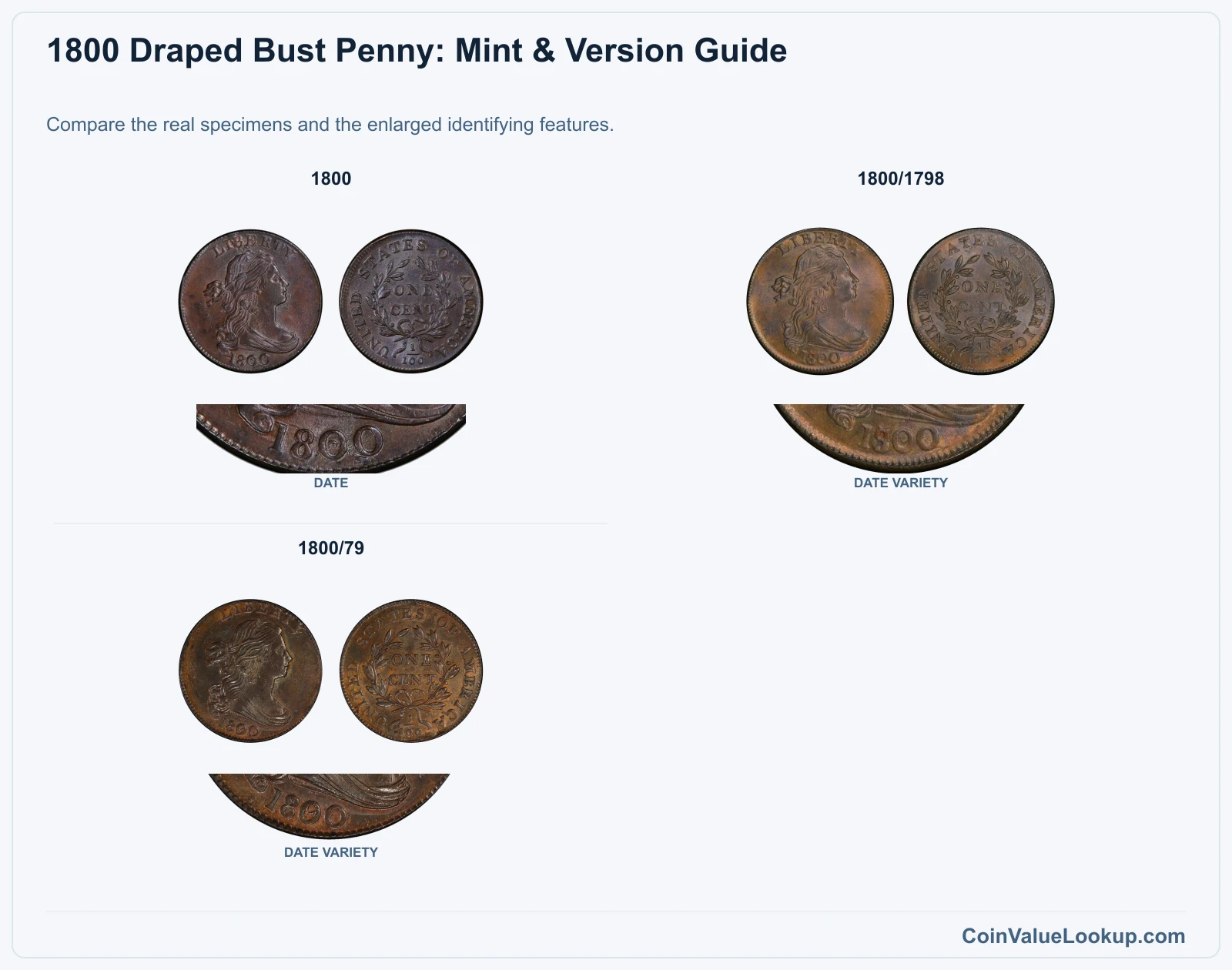
Three distinct varieties exist: the Normal Date, the 1800 Over 1798, and the 1800 Over 79. Each uses a different hair style on Liberty, and the overdates show traces of earlier digits beneath the final date punches.
To tell the overdates apart, look closely at the last two digits. On the 1800/1798, remnants of a "98" appear under the "00." The 1800/79 shows traces of "79" instead.
The hair style on Liberty also differs between these two overdates — one uses what collectors call a Style 1 hair arrangement, the other Style 2.
Weight can offer supporting evidence: the nominal spec is about 10.89 grams of copper. But wear, corrosion, and the production tolerances of that era mean weight alone cannot prove authenticity.
Examine the date-punch shapes, legend wording, and wreath details on both sides carefully before settling on a variety.
Step 2: Check Your 1800 Draped Bust Cent Grade
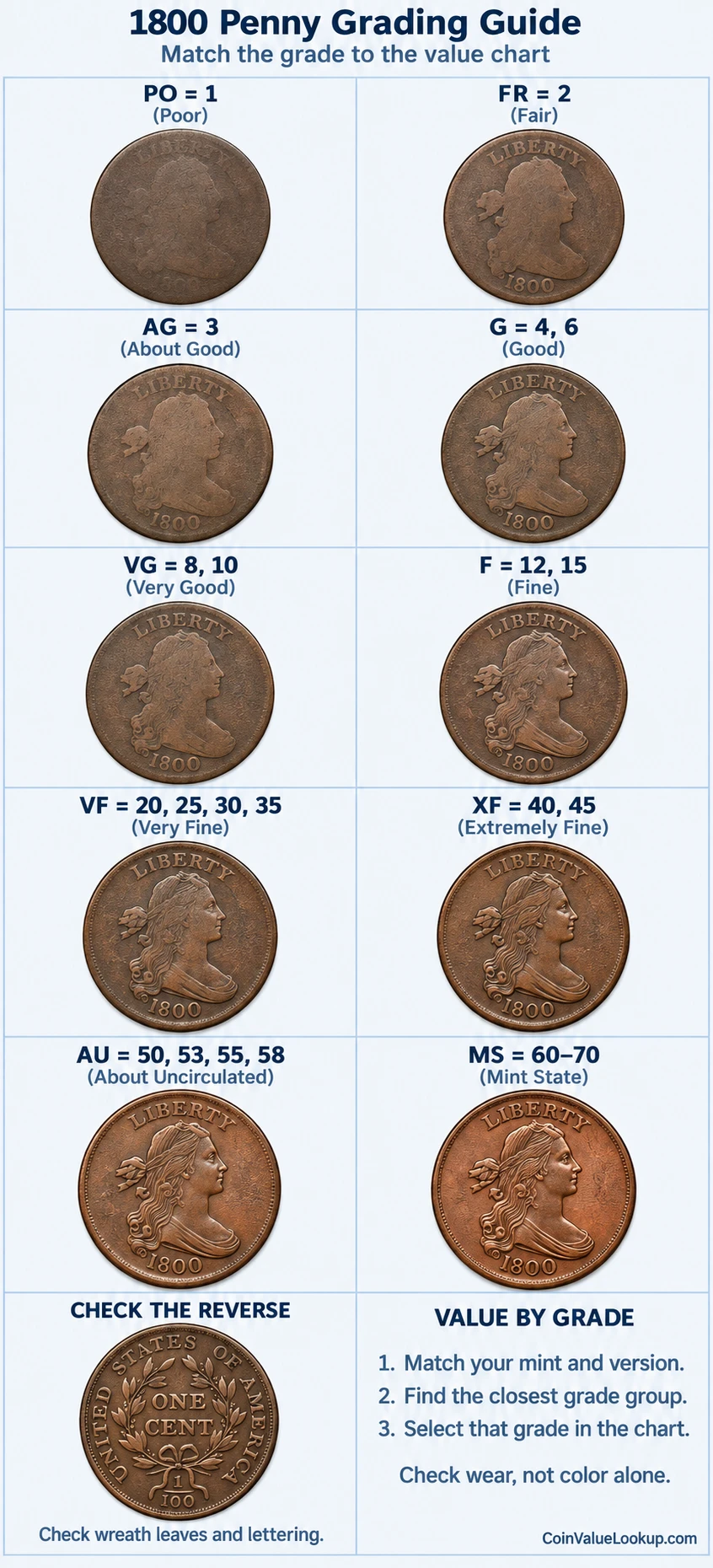
Focus on Liberty's hair and cheek on the obverse and the wreath leaf relief on the reverse. In lower grades, the hair strands above the forehead merge and the cheek flattens.
A coin grading Good-4 will show a readable date and basic outline but very little interior detail.
At Extremely Fine-40, most hair strands separate clearly and the wreath leaves retain sharp edges. Use the comparison image to gauge where your coin falls between those poles.
Do not confuse a weak strike with heavy wear. Early copper cents often came off the press with soft spots, especially near the rims.
Corrosion and porosity are surface problems, not the same as honest circulation wear, and they can lower market value substantially even on a coin with otherwise decent detail.
Color designations like BN (brown), RB (red-brown), and RD (red) describe the copper's surface tone, not different metals. Most surviving 1800 cents are solidly brown.
Cleaning, whether obvious or old, also affects desirability — a cleaned coin in a higher technical grade can sell for less than an original-surface coin in a lower grade.
Step 3: Check 1800 Draped Bust Cent Value by Mint and Version
1800 Draped Bust Cent
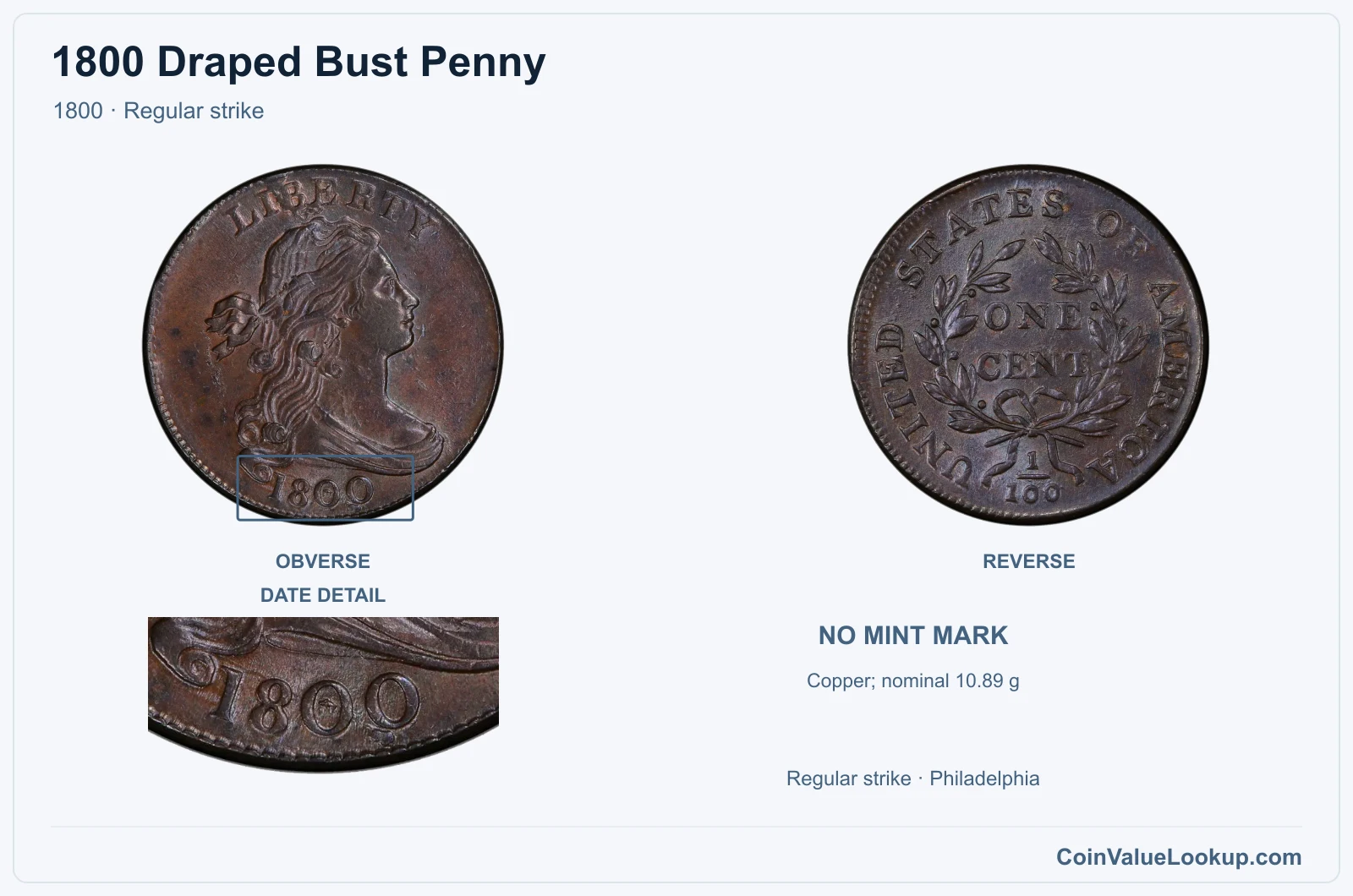
This is the straight 1800 Normal Date cent, the most commonly encountered of the three listed varieties. It was struck in copper at Philadelphia with a nominal weight of about 10.89 grams.
The obverse features the Draped Bust of Liberty; the reverse shows a denomination inside a wreath.
Guide estimates from USA Coin Book place this version at roughly $154 in Good-4 and $3,083 in Extremely Fine-40. Those are reference anchors, not guaranteed sale prices.
Condition, surface quality, and originality all influence what a specific coin actually brings.
Coin Value Lookup is a handy starting point if you are sorting through other dates or denominations in the Draped Bust series. You can look up guides for many U.S. coin types there.
| Range | Grade | Price | Auction Records | Appraisal |
|---|---|---|---|---|
| PO | PO 1 | Coin Identifier | ||
| FR | FR 2 | Coin Identifier | ||
| AG | AG 3 | Coin Identifier | ||
| G | G 4 | Coin Identifier | ||
| G 6 | Coin Identifier | |||
| VG | VG 8 | Coin Identifier | ||
| VG 10 | Coin Identifier | |||
| F | F 12 | Coin Identifier | ||
| F 15 | Coin Identifier | |||
| VF | VF 20 | Coin Identifier | ||
| VF 25 | Coin Identifier | |||
| VF 30 | Coin Identifier | |||
| VF 35 | Coin Identifier | |||
| XF | XF 40 | Coin Identifier | ||
| XF 45 | Coin Identifier | |||
| AU | AU 50 | Coin Identifier | ||
| AU 53 | Coin Identifier | |||
| AU 55 | Coin Identifier | |||
| AU 58 | Coin Identifier | |||
| MS | MS 60 | — | Coin Identifier | |
| MS 61 | Coin Identifier | |||
| MS 62 | Coin Identifier | |||
| MS 63 | Coin Identifier | |||
| MS 64 | Coin Identifier | |||
| MS 65 | Coin Identifier | |||
| MS 66 | — | — | — | |
| MS 67 | — | — | — | |
| MS 68 | — | — | — | |
| MS 69 | — | — | — | |
| MS 70 | — | — | — |
1800 Draped Bust Cent — /1798
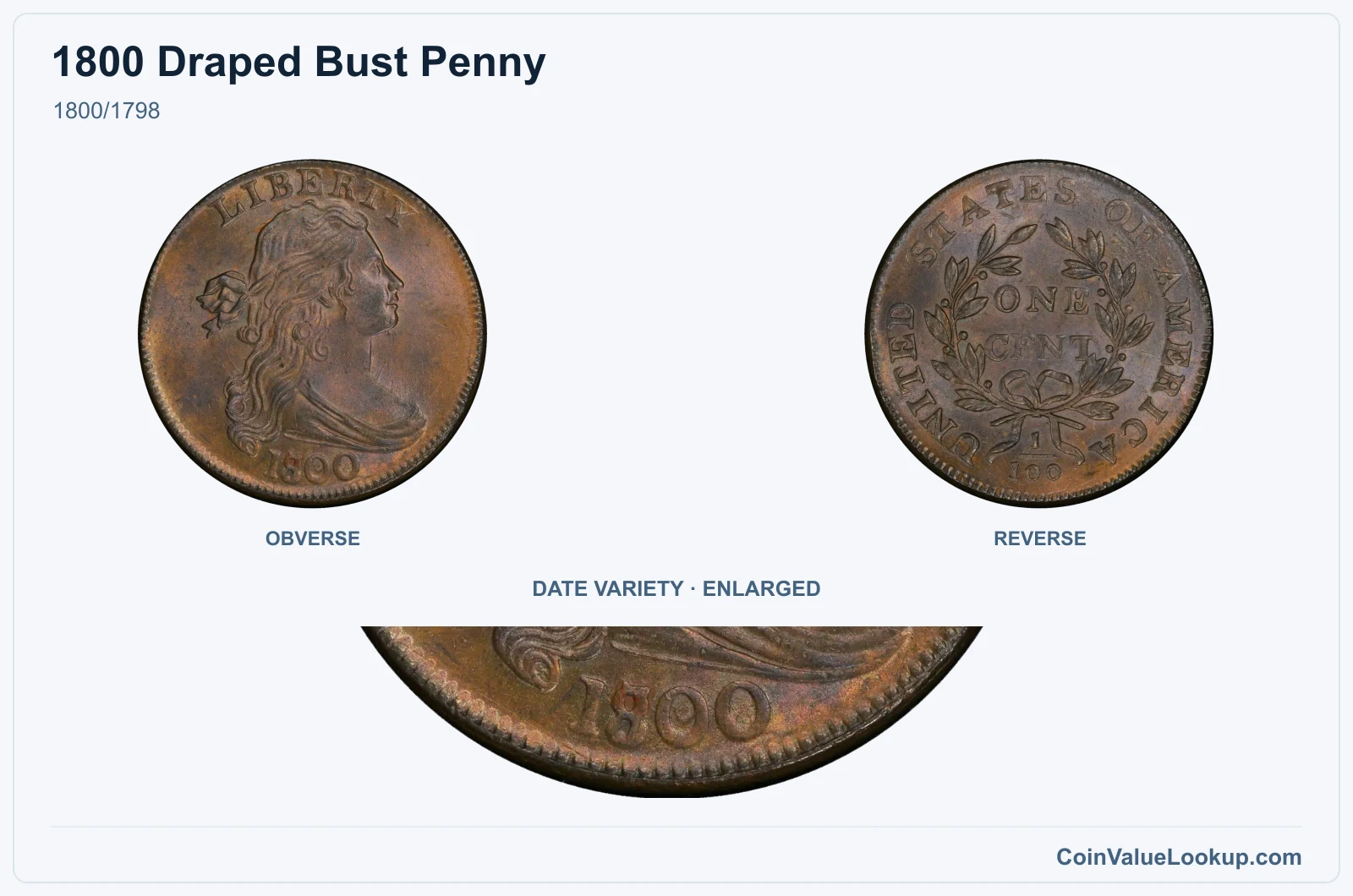
The 1800/1798 overdate uses the Style 1 Hair arrangement on Liberty, which matches the earlier 1798 die. Under the final "00" of the date, you should be able to see remnants of "98" from the original punch.
This is the diagnostic you need to confirm before claiming the premium.
Guide estimates run from about $186 in Good-4 to $4,819 in Extremely Fine-40, the highest listed anchor among the three 1800 cent varieties at that grade. The spread between the normal date and this overdate widens as condition improves, so higher-grade examples reward identification the most.
Struck in copper at Philadelphia with no mintmark, this variety shares the standard Draped Bust obverse and wreath reverse. Authenticating the overdate typically requires magnification and good lighting — worn or corroded examples can make the underlying digits hard to read.
| Range | Grade | Price | Auction Records | Appraisal |
|---|---|---|---|---|
| PO | PO 1 | — | Coin Identifier | |
| FR | FR 2 | Coin Identifier | ||
| AG | AG 3 | Coin Identifier | ||
| G | G 4 | Coin Identifier | ||
| G 6 | Coin Identifier | |||
| VG | VG 8 | Coin Identifier | ||
| VG 10 | Coin Identifier | |||
| F | F 12 | Coin Identifier | ||
| F 15 | Coin Identifier | |||
| VF | VF 20 | Coin Identifier | ||
| VF 25 | Coin Identifier | |||
| VF 30 | Coin Identifier | |||
| VF 35 | Coin Identifier | |||
| XF | XF 40 | Coin Identifier | ||
| XF 45 | Coin Identifier | |||
| AU | AU 50 | — | Coin Identifier | |
| AU 53 | Coin Identifier | |||
| AU 55 | Coin Identifier | |||
| AU 58 | — | Coin Identifier | ||
| MS | MS 60 | — | Coin Identifier | |
| MS 61 | — | Coin Identifier | ||
| MS 62 | — | Coin Identifier | ||
| MS 63 | Coin Identifier | |||
| MS 64 | — | Coin Identifier | ||
| MS 65 | — | Coin Identifier | ||
| MS 66 | — | — | — | |
| MS 67 | — | — | — | |
| MS 68 | — | — | — | |
| MS 69 | — | — | — | |
| MS 70 | — | — | — |
1800 Draped Bust Cent — /79
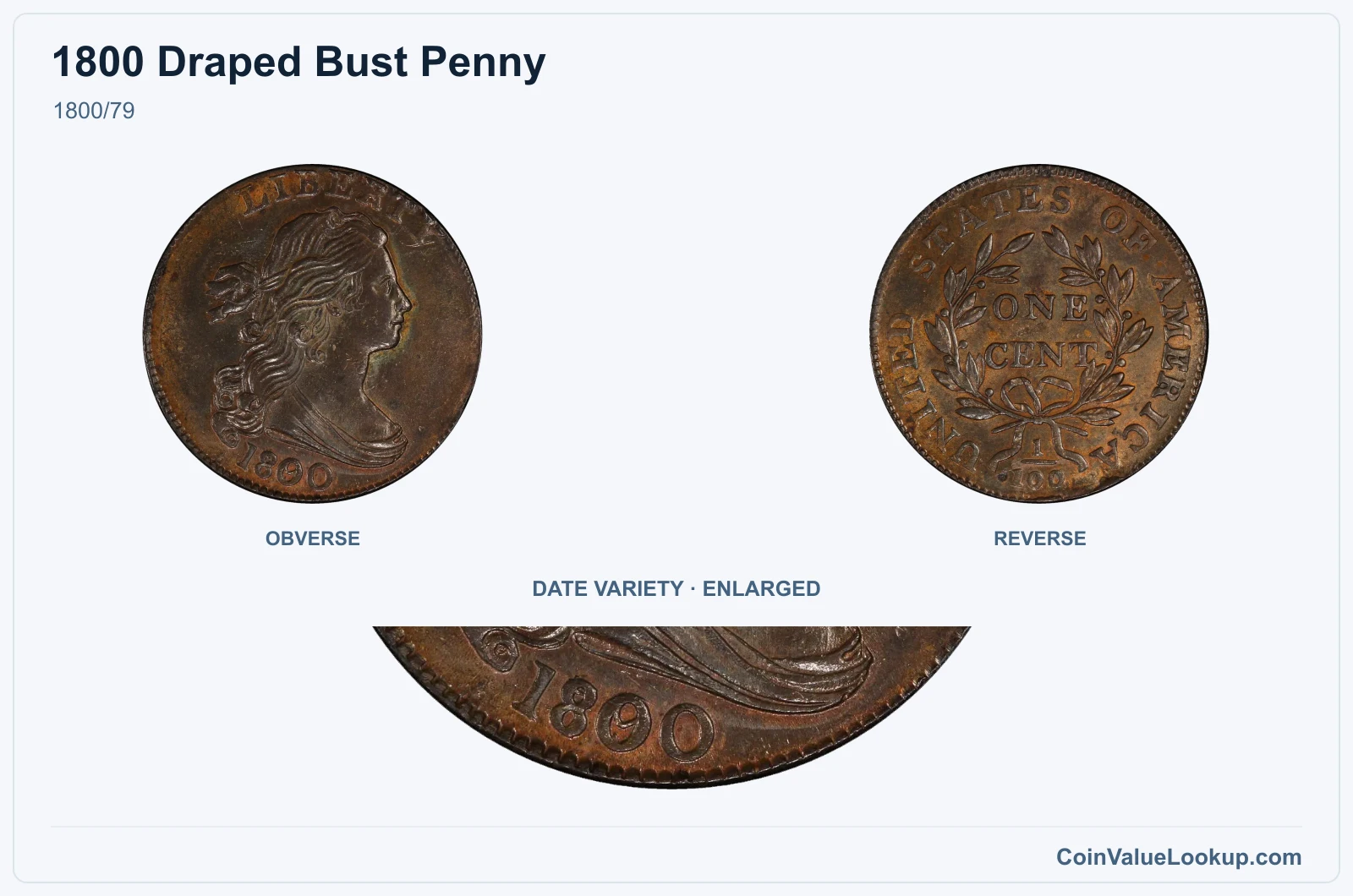
The 1800/79 overdate shows traces of "79" beneath the final two digits of the date, paired with the Style 2 Hair arrangement on Liberty. That hair style difference is a quick first check: if the hair matches Style 2, you are looking at this variety rather than the 1800/1798.
Guide estimates sit at about $175 in Good-4 and $3,083 in Extremely Fine-40. At the lower grade it carries a slight premium over the Normal Date ($175 vs. $154), though by EF-40 both share the same anchor.
This is another Philadelphia copper cent at the standard 10.89-gram nominal weight. As with all early overdates, confirming the underlying digits is essential.
A loupe at 5x or 10x will usually reveal whether genuine overdate traces exist or whether you are just seeing wear patterns.
| Range | Grade | Price | Auction Records | Appraisal |
|---|---|---|---|---|
| PO | PO 1 | Coin Identifier | ||
| FR | FR 2 | — | Coin Identifier | |
| AG | AG 3 | Coin Identifier | ||
| G | G 4 | Coin Identifier | ||
| G 6 | Coin Identifier | |||
| VG | VG 8 | Coin Identifier | ||
| VG 10 | Coin Identifier | |||
| F | F 12 | Coin Identifier | ||
| F 15 | Coin Identifier | |||
| VF | VF 20 | Coin Identifier | ||
| VF 25 | Coin Identifier | |||
| VF 30 | Coin Identifier | |||
| VF 35 | Coin Identifier | |||
| XF | XF 40 | Coin Identifier | ||
| XF 45 | Coin Identifier | |||
| AU | AU 50 | Coin Identifier | ||
| AU 53 | — | Coin Identifier | ||
| AU 55 | Coin Identifier | |||
| AU 58 | Coin Identifier | |||
| MS | MS 60 | — | Coin Identifier | |
| MS 61 | Coin Identifier | |||
| MS 62 | Coin Identifier | |||
| MS 63 | Coin Identifier | |||
| MS 64 | Coin Identifier | |||
| MS 65 | — | — | — | |
| MS 66 | — | — | — | |
| MS 67 | — | — | — | |
| MS 68 | — | — | — | |
| MS 69 | — | — | — | |
| MS 70 | — | — | — |
1800 Draped Bust Cent Error List
1. 1800 Draped Bust Cent — Off-Center Strike
An off-center strike happens when the planchet is not seated properly between the dies, shifting the entire design to one side and leaving an unstruck crescent of blank copper. On an 1800 Draped Bust Cent, the value of such an error depends heavily on how much of the date remains visible — a coin missing its date loses most collector interest.
Look for a design that is clearly displaced from center with a smooth, unstruck area along part of the rim. The struck portion should still show normal detail consistent with the die.
Do not confuse an off-center strike with a clipped planchet, one-sided die misalignment, or post-mint flattening from damage. No supported price range is available for this error on the 1800 cent; value depends on the authenticated variety, severity of the misalignment, and overall condition.
2. 1800 Draped Bust Cent — Clipped Planchet
A clipped planchet occurs when the blank is punched from the copper strip incorrectly, leaving a missing curved, straight, or ragged section. On an 1800 cent, look at the edge carefully: a genuine clip typically shows a smooth, consistent edge contour where metal is absent, and you may notice design weakness on the opposite side of the coin from the clip — that is called the Blakesley effect.
Compare edge texture around the clip to the rest of the rim. Filed notches, deliberate edge cuts, and corrosion can all mimic a clip, but these post-mint alterations lack the flow-related weakness and characteristic edge profile of a genuine planchet error.
No adopted price range exists for clipped 1800 cents. Each piece needs individual assessment based on the authenticated variety, clip size, and the coin's overall condition.
3. 1800 Draped Bust Cent — Die Break / Cud
A die break or cud appears as a raised, irregular blob of metal on the coin's surface, caused by a chunk of the die breaking away. A true cud connects to the rim and displaces part of the normal design; interior breaks that do not reach the rim are sometimes called retained die breaks.
On an 1800 Draped Bust Cent, examine the rim area for any raised lump that interrupts the lettering or design border. The boundary between the cud and the normal surface should be fairly sharp and consistent with a fracture, not a gradual slope.
Rim dents from post-mint damage, corrosion buildup, and small interior die chips can all look similar at first glance. A cud will match the coin's overall surface level and will not show the displaced-metal characteristics of a hit.
No supported price data is available for cuds on this date; value depends on size, location, and authenticated condition.
4. 1800 Draped Bust Cent — Brockage
A brockage occurs when a previously struck coin sticks to a die and acts as the die for the next strike, imprinting an incuse, mirror-image version of one side's design onto the opposite side of the new coin. The result is dramatic: one side looks normal while the other shows a sunken, reversed image.
On an 1800 Draped Bust Cent, check whether the incuse image is a true mirror of the obverse or reverse design. The relief should be consistent — pressed into the surface, not raised — and oriented as a reversed impression of the companion face.
Die clashes, which leave faint ghost impressions, and coins that were pressed together after leaving the mint can both create similar-looking effects. A genuine brockage from this era is quite scarce.
No numeric price range is adopted for this category; individual assessment by an authentication service is the practical path for any suspected example.
5. 1800 Draped Bust Cent — Overdate
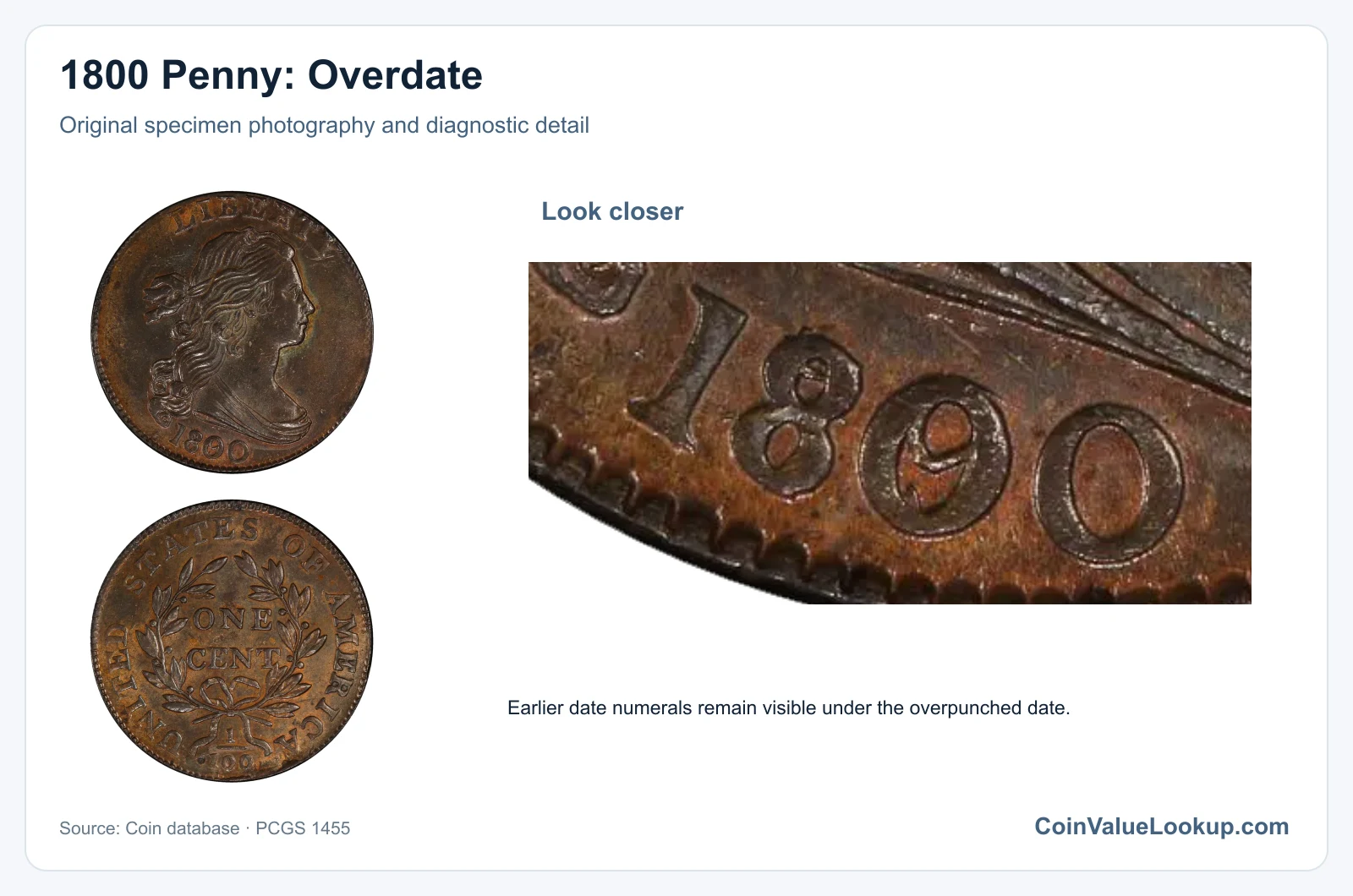
Overdate varieties on 1800 Draped Bust Cents are well-documented: the 1800/1798 and 1800/79 are both listed as regular varieties with their own guide estimates. However, the overdate category also appears in error listings, covering any instance where surviving contours of an earlier date are visible beneath the final numerals.
To identify an overdate, examine the last two digits of the date under magnification. You should see the outlines of earlier numbers — "98" or "79" — partially visible beneath the "00." Compare what you see against known examples of each specific overdate branch.
Ordinary machine doubling on the date numerals and damage to the date area can both mimic overdate traces. Genuine overdates show the earlier digits at a consistent depth and position relative to the final punch.
No separate error-category price is adopted here; instead, refer to the specific overdate branches listed for this year, where guide values are provided by grade.