1844 Liberty Seated Quarter Coin Value: How Much Is It Worth?
A regular 1844 Liberty Seated quarter starts around $70 in G4 condition according to the USA Coin Book guide, with selected mint-state examples reaching as high as $3,093 at MS63. That spread depends entirely on which mint struck your coin, what condition it survived in, and whether it belongs to one of several scarce varieties.
Philadelphia and New Orleans both produced quarters this year, and the New Orleans issues hide a few surprises worth investigating.
Fast Way to Identify Your 1844 Liberty Seated Quarter
Upload clear photos of both the front and back of your 1844 quarter for a preliminary identification. The tool can help sort out whether you have a Philadelphia or New Orleans issue and flag visible features worth a closer look.
It does not authenticate, certify, or assign an exact grade, but it gives you a useful starting point before seeking professional evaluation.
1844 Liberty Seated Quarter Value
Upload both sides of your 1844 Liberty Seated Quarter.
Front Obverse
Upload photo
Back Reverse
Upload photo
Which 1844 Liberty Seated Quarter Versions Are Worth Money?
- Philadelphia business strikes in original, problem-free high grades command strong premiums over circulated examples.
- Authenticated 1844 Philadelphia proofs are rare specialist issues priced individually, completely separate from circulation values.
- The 1844-O with a reused reverse of 1843 is a scarce named variety requiring specific die diagnostics beyond just having a large O mintmark.
- An extraordinary PCGS-recognized 1844-O proof exists as a provenance-sensitive branch; expert authentication is essential.
- Rotated reverse and heavy die crack examples on the reused 1843 reverse are documented error features worth checking.
Step 1: Identify Your 1844 Liberty Seated Quarter Mint Mark and Version
Start by confirming the date reads 1844, with a seated Liberty on the obverse and an eagle on the reverse. No motto appears above the eagle on this date.
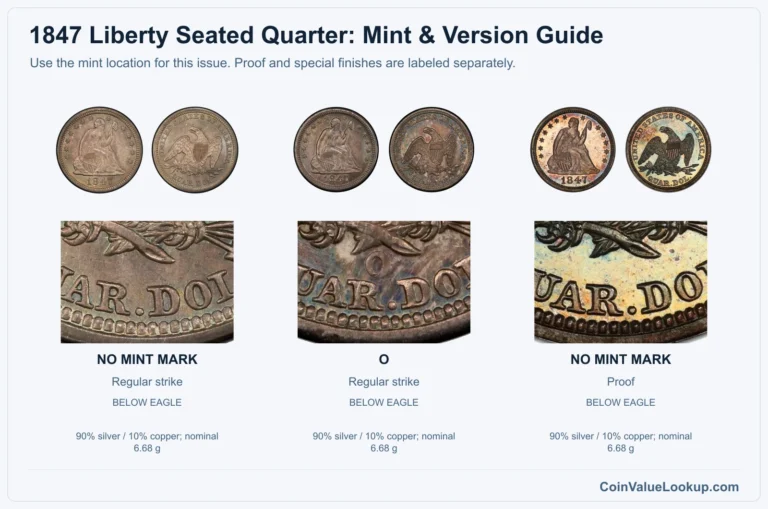
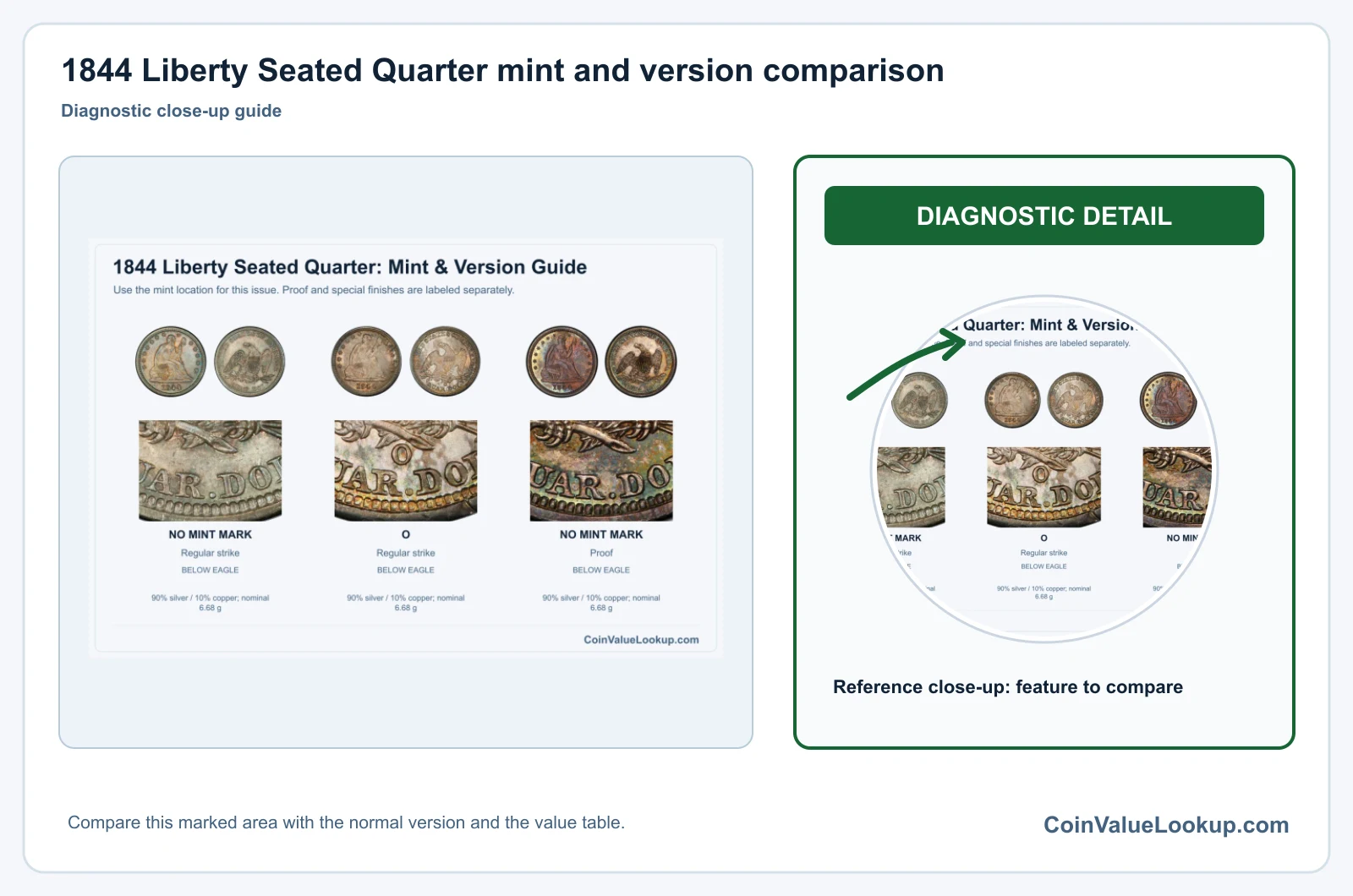
Philadelphia coins carry no mintmark. New Orleans coins show an "O" on the reverse, positioned below the eagle.
Every known 1844-O uses a large O mintmark, so mintmark size alone does not separate the ordinary issue from the scarce reused-reverse variety.
The coin is struck in 90% silver and 10% copper, with a nominal weight of 6.68 grams and a diameter of about 24.3 mm. Wear can reduce the weight, so a slightly light coin is not automatically suspect.
To distinguish the scarce 1844-O with a reused reverse of 1843 from the ordinary 1844-O, you need to compare the mintmark position and look for specific reverse die lumps documented in specialist references. Simply having a large O is not enough.
An extraordinary proof striking from New Orleans is also recognized, but that requires expert authentication and solid provenance, not just a reflective surface.
Step 2: Check Your 1844 Liberty Seated Quarter Grade
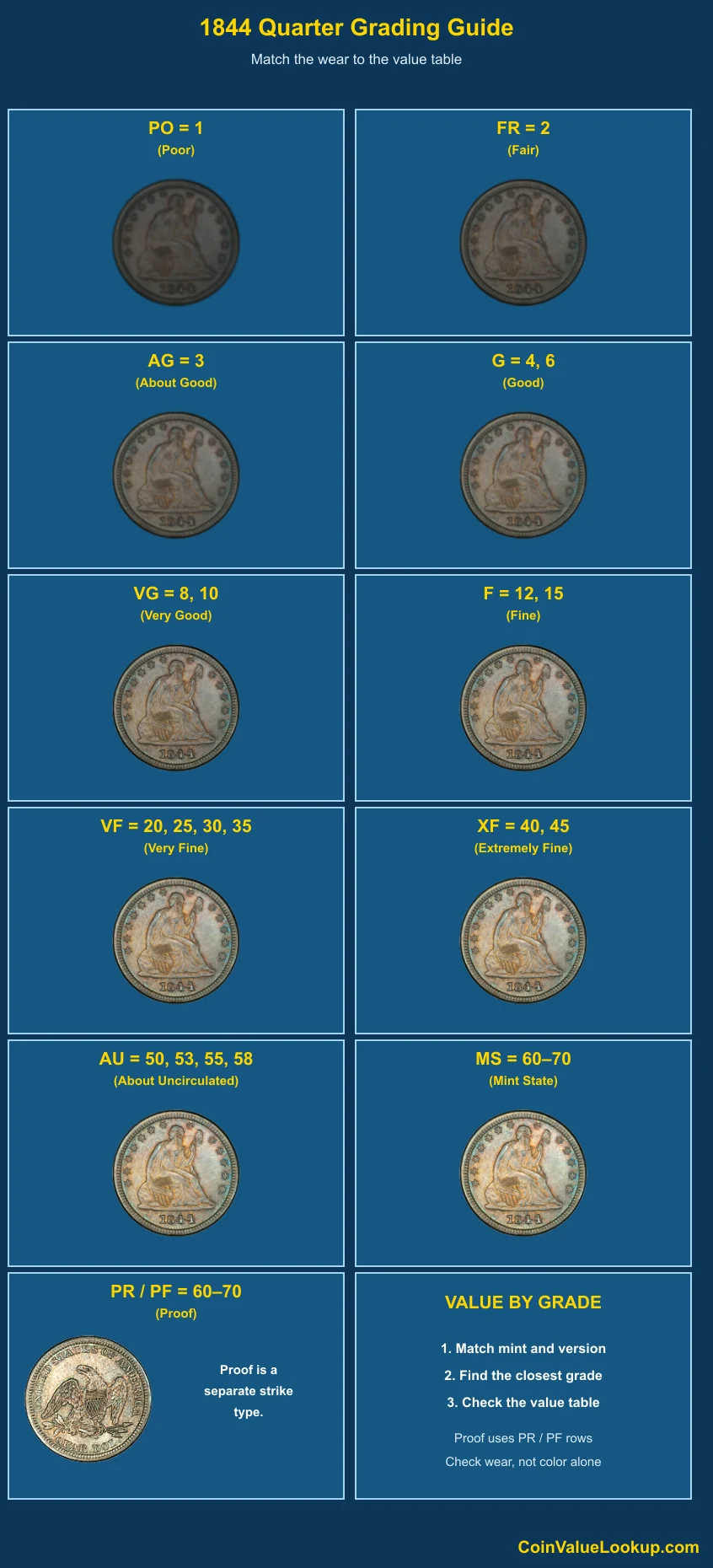
On the obverse, check Liberty's head, the drapery across her breast, her knee, and the individual letters on the shield. These wear at different rates and tell you a lot about the grade.
Flip to the reverse and examine the eagle's breast feathers, wing details, and claws. Remaining original luster and unbroken surface flow help separate a weakly struck coin from a genuinely worn one.
Shield letters fading alone do not lock in a specific numerical grade.
The comparison image nearby shows progressive stages of wear. Match your coin against it honestly.
Hairlines from old cleanings, smoothed surfaces, holes, and green or brown environmental damage all reduce value even if the underlying detail looks decent.
For proof attribution on either the Philadelphia or New Orleans issue, a shiny coin is not sufficient. Proofs require expert die-state comparison, surface analysis, and ideally traceable provenance.
A polished business strike is still a business strike.
Coin Value Lookup is a good place to start when you want to look up guides for other dates and denominations in this series. Bookmark it and come back whenever a new coin lands in your hands.
Step 3: Check 1844 Liberty Seated Quarter Value by Mint and Version
1844 Liberty Seated Quarter — Philadelphia Business Strike
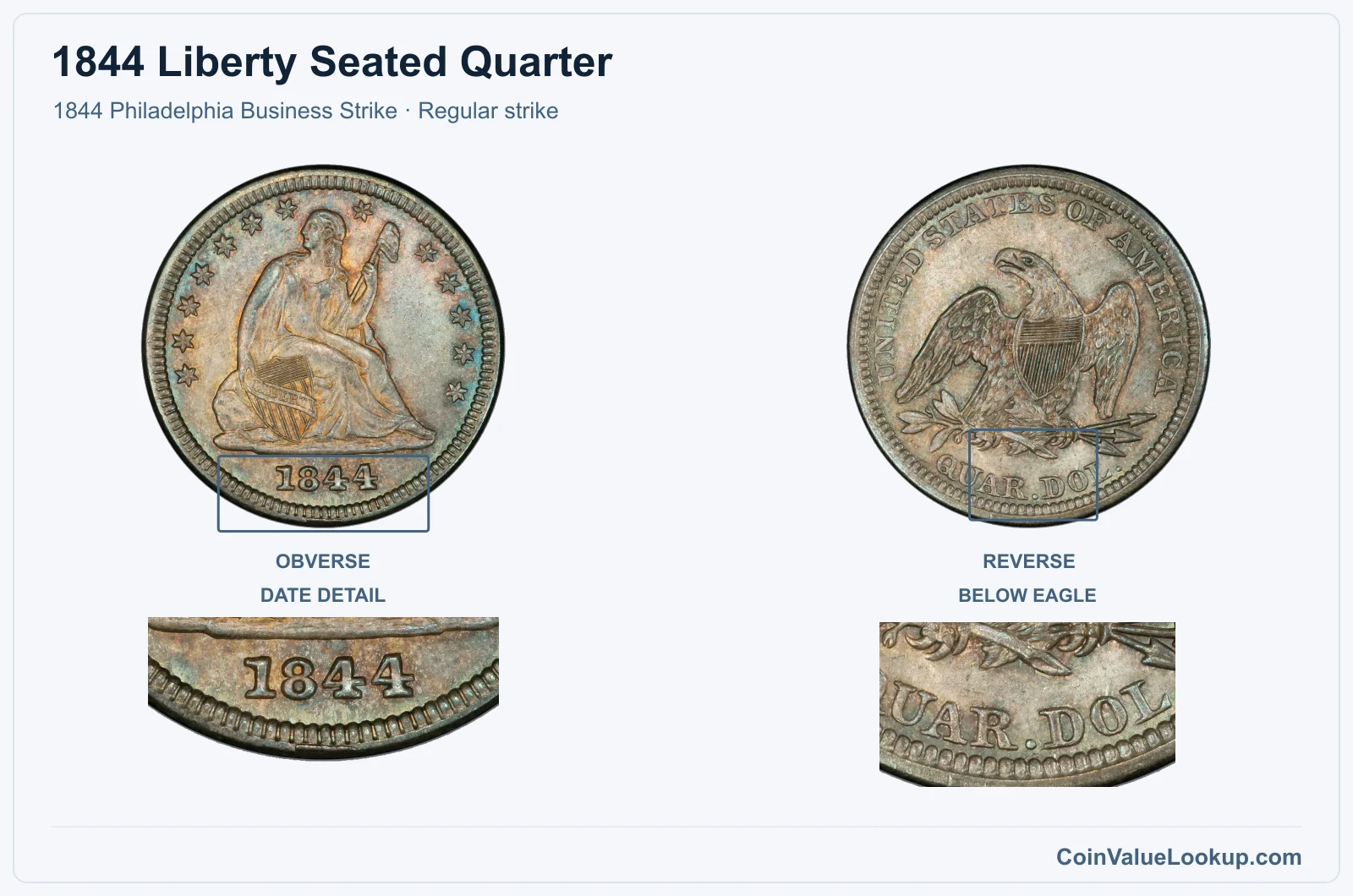
The standard 1844 Philadelphia quarter has no mintmark and features the With Drapery design type. It is struck in 90% silver.
The USA Coin Book guide places this version at about $70 in G4, $109 in VF20, and $2,042 in MS63. That jump from mid-grade to mint state is steep, which tells you original, undamaged survivors in high grades are genuinely scarce.
Most examples you encounter will be circulated. Look for even, honest wear and original surfaces rather than a cleaned coin masquerading as a higher grade.
| Range | Grade | Price | Auction Records | Appraisal |
|---|---|---|---|---|
| PO | PO 1 | — | Coin Identifier | |
| FR | FR 2 | — | Coin Identifier | |
| AG | AG 3 | — | Coin Identifier | |
| G | G 4 | — | Coin Identifier | |
| G 6 | — | Coin Identifier | ||
| VG | VG 8 | Coin Identifier | ||
| VG 10 | — | Coin Identifier | ||
| F | F 12 | — | Coin Identifier | |
| F 15 | — | Coin Identifier | ||
| VF | VF 20 | — | Coin Identifier | |
| VF 25 | — | Coin Identifier | ||
| VF 30 | — | Coin Identifier | ||
| VF 35 | Coin Identifier | |||
| XF | XF 40 | Coin Identifier | ||
| XF 45 | Coin Identifier | |||
| AU | AU 50 | Coin Identifier | ||
| AU 53 | Coin Identifier | |||
| AU 55 | Coin Identifier | |||
| AU 58 | Coin Identifier | |||
| MS | MS 60 | — | Coin Identifier | |
| MS 61 | Coin Identifier | |||
| MS 62 | Coin Identifier | |||
| MS 63 | Coin Identifier | |||
| MS 64 | Coin Identifier | |||
| MS 65 | Coin Identifier | |||
| MS 66 | — | — | — | |
| MS 67 | — | — | — | |
| MS 68 | — | — | — | |
| MS 69 | — | — | — | |
| MS 70 | — | — | — |
1844 Liberty Seated Quarter — Proof Philadelphia
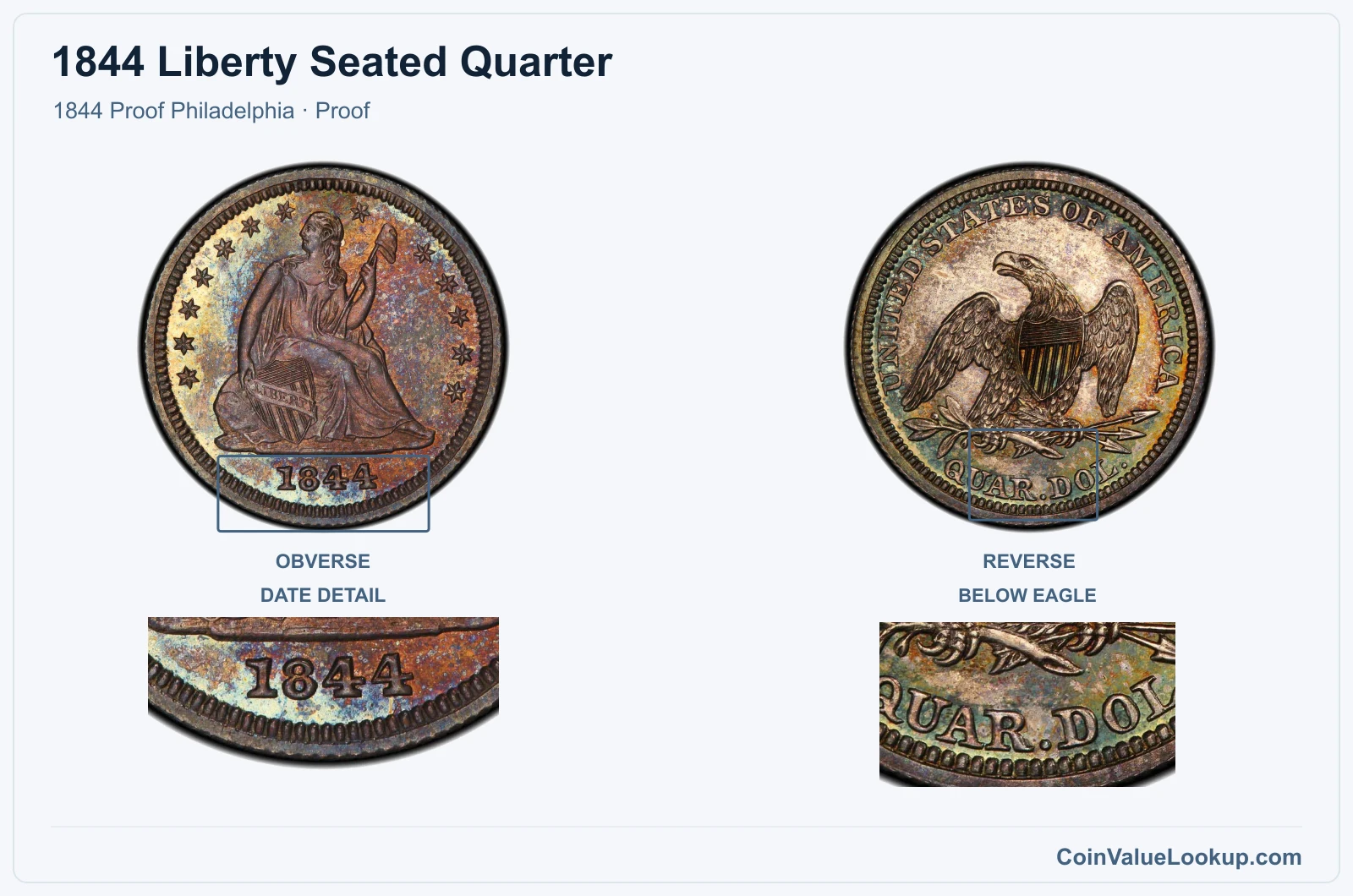
Philadelphia also produced a small number of proof quarters in 1844, but these are rare specialist coins. No supported numeric price range is adopted here because each authenticated example must be evaluated individually based on its condition, provenance, and surface quality.
A reflective or prooflike business strike is not a proof. True proof attribution for this date requires expert die-state comparison and documented ownership history.
If you suspect you have one, send it to a major grading service rather than relying on visual impression alone. These almost never appear outside advanced collections.
| Range | Grade | Price | Auction Records | Appraisal |
|---|---|---|---|---|
| PR | PR 1 | — | Coin Identifier | |
| PR 2 | — | Coin Identifier | ||
| PR 3 | — | Coin Identifier | ||
| PR 4 | — | Coin Identifier | ||
| PR 6 | — | Coin Identifier | ||
| PR 8 | — | Coin Identifier | ||
| PR 10 | — | Coin Identifier | ||
| PR 12 | — | Coin Identifier | ||
| PR 15 | — | Coin Identifier | ||
| PR 20 | — | Coin Identifier | ||
| PR 25 | — | Coin Identifier | ||
| PR 30 | — | Coin Identifier | ||
| PR 35 | — | Coin Identifier | ||
| PR 40 | — | Coin Identifier | ||
| PR 45 | — | Coin Identifier | ||
| PR 50 | — | Coin Identifier | ||
| PR 53 | — | Coin Identifier | ||
| PR 55 | — | Coin Identifier | ||
| PR 58 | — | Coin Identifier | ||
| PR 60 | — | Coin Identifier | ||
| PR 61 | — | Coin Identifier | ||
| PR 62 | — | Coin Identifier | ||
| PR 63 | — | Coin Identifier | ||
| PR 64 | — | Coin Identifier | ||
| PR 65 | Coin Identifier | |||
| PR 66 | Coin Identifier | |||
| PR 67 | — | — | — | |
| PR 68 | — | — | — | |
| PR 69 | — | — | — | |
| PR 70 | — | — | — |
1844 Liberty Seated Quarter — O Business Strike
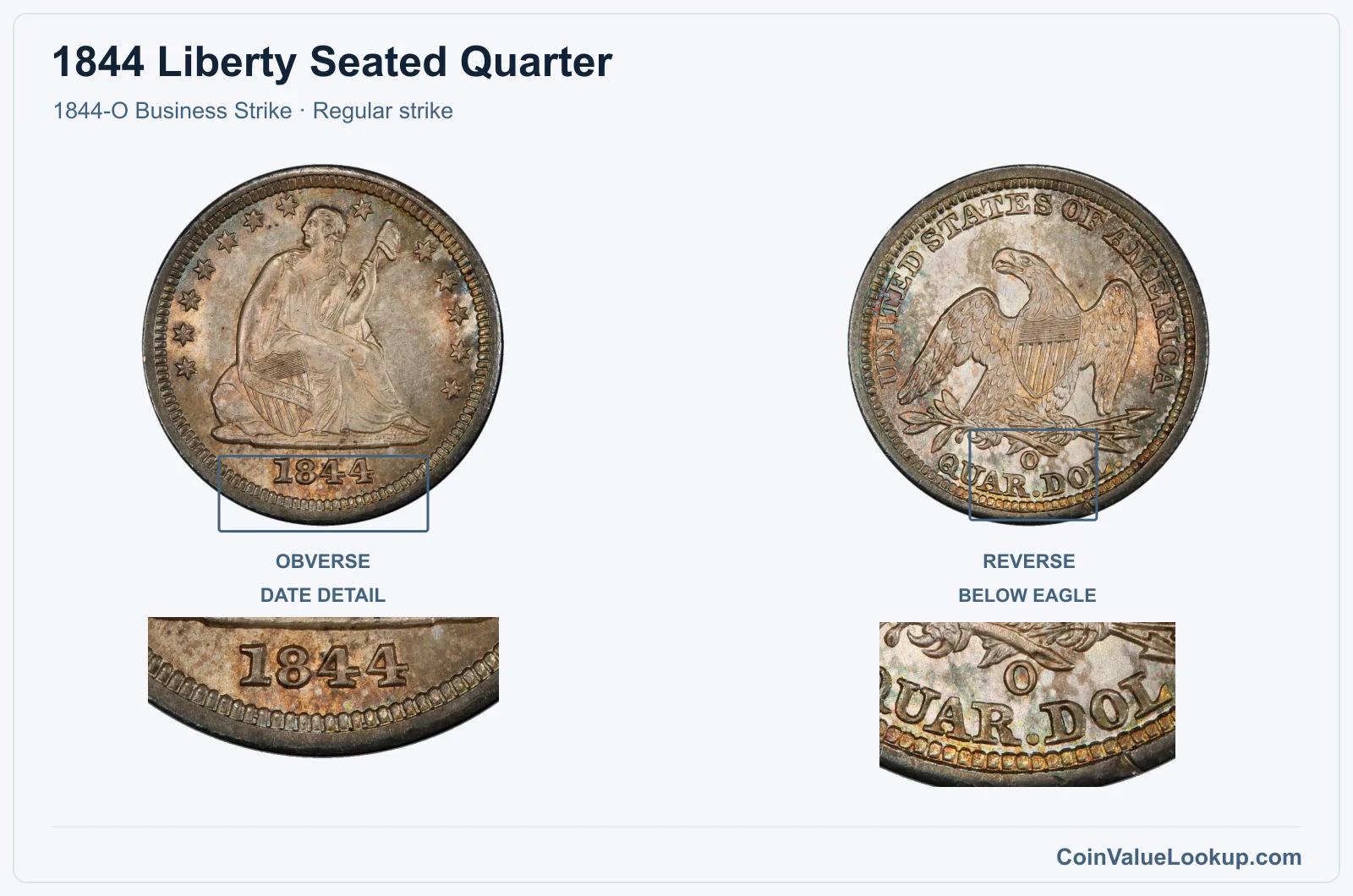
The ordinary 1844-O carries a large O mintmark on the reverse below the eagle. It was struck in New Orleans in 90% silver at a nominal 6.68 grams.
Guide values from the USA Coin Book sit at roughly $70 in G4, $153 in VF20, and $3,093 in MS63. The VF20 price runs noticeably higher than the Philadelphia equivalent, and the MS63 figure is the highest adopted guide point for this date.
Survivors in upper grades are tough to find with clean, original surfaces.
| Range | Grade | Price | Auction Records | Appraisal |
|---|---|---|---|---|
| PO | PO 1 | — | Coin Identifier | |
| FR | FR 2 | — | Coin Identifier | |
| AG | AG 3 | — | Coin Identifier | |
| G | G 4 | Coin Identifier | ||
| G 6 | — | Coin Identifier | ||
| VG | VG 8 | Coin Identifier | ||
| VG 10 | Coin Identifier | |||
| F | F 12 | Coin Identifier | ||
| F 15 | Coin Identifier | |||
| VF | VF 20 | Coin Identifier | ||
| VF 25 | Coin Identifier | |||
| VF 30 | Coin Identifier | |||
| VF 35 | Coin Identifier | |||
| XF | XF 40 | Coin Identifier | ||
| XF 45 | Coin Identifier | |||
| AU | AU 50 | Coin Identifier | ||
| AU 53 | Coin Identifier | |||
| AU 55 | Coin Identifier | |||
| AU 58 | Coin Identifier | |||
| MS | MS 60 | Coin Identifier | ||
| MS 61 | Coin Identifier | |||
| MS 62 | Coin Identifier | |||
| MS 63 | Coin Identifier | |||
| MS 64 | Coin Identifier | |||
| MS 65 | Coin Identifier | |||
| MS 66 | — | — | — | |
| MS 67 | — | — | — | |
| MS 68 | — | — | — | |
| MS 69 | — | — | — | |
| MS 70 | — | — | — |
1844 Liberty Seated Quarter — O Reverse of 1843
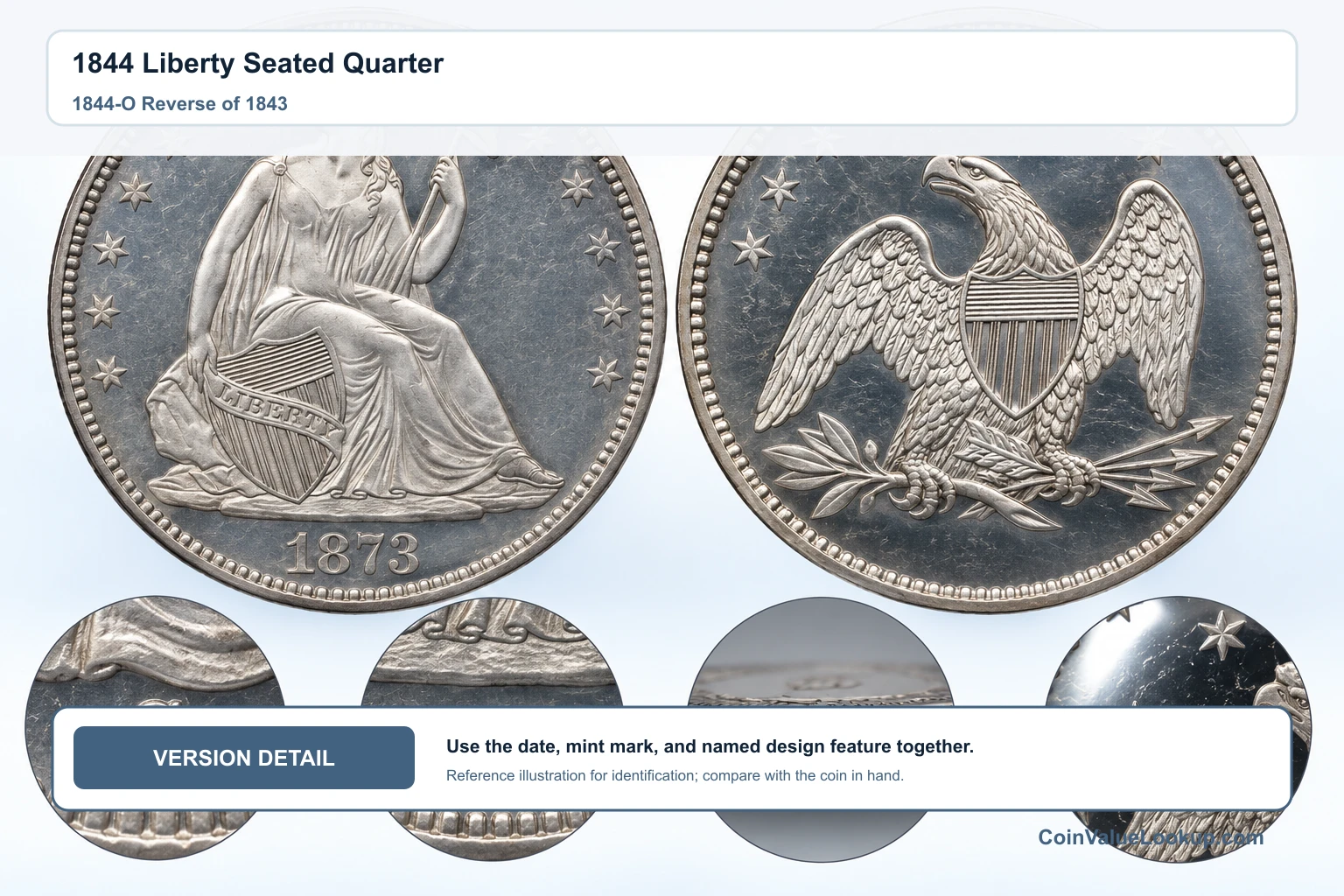
This is the variety collectors actually hunt: an 1844-O struck with a reverse die originally used in 1843. All 1844-O quarters have large mintmarks, so that feature alone does not confirm this variety.
You need to match the exact mintmark position and identify specific die lumps on the reverse that correspond to documented specialist references.
No supported numeric price range is adopted for this version. Each coin must be assessed individually based on its authenticated identity, condition, and any associated error features like rotation or die cracks.
The reused die went through multiple states, so later examples may show additional deterioration. Professional attribution is strongly recommended before assuming you have the scarce reverse.
Range Grade
Price Auction Records Appraisal PO PO 1
—
Coin Identifier FR FR 2
—
Coin Identifier AG AG 3
—
Coin Identifier G G 4
Coin Identifier
G 6
—
Coin Identifier VG VG 8
Coin Identifier
VG 10
Coin Identifier F F 12
Coin Identifier
F 15
Coin Identifier VF VF 20
Coin Identifier
VF 25
Coin Identifier
VF 30
Coin Identifier
VF 35
Coin Identifier XF XF 40
Coin Identifier
XF 45
Coin Identifier AU AU 50
Coin Identifier
AU 53
Coin Identifier
AU 55
Coin Identifier
AU 58
Coin Identifier MS MS 60
Coin Identifier
MS 61
Coin Identifier
MS 62
Coin Identifier
MS 63
Coin Identifier
MS 64
Coin Identifier
MS 65
Coin Identifier
MS 66
—
—
—
MS 67
—
—
—
MS 68
—
—
—
MS 69
—
—
—
MS 70
—
—
—
1844 Liberty Seated Quarter — O Proof
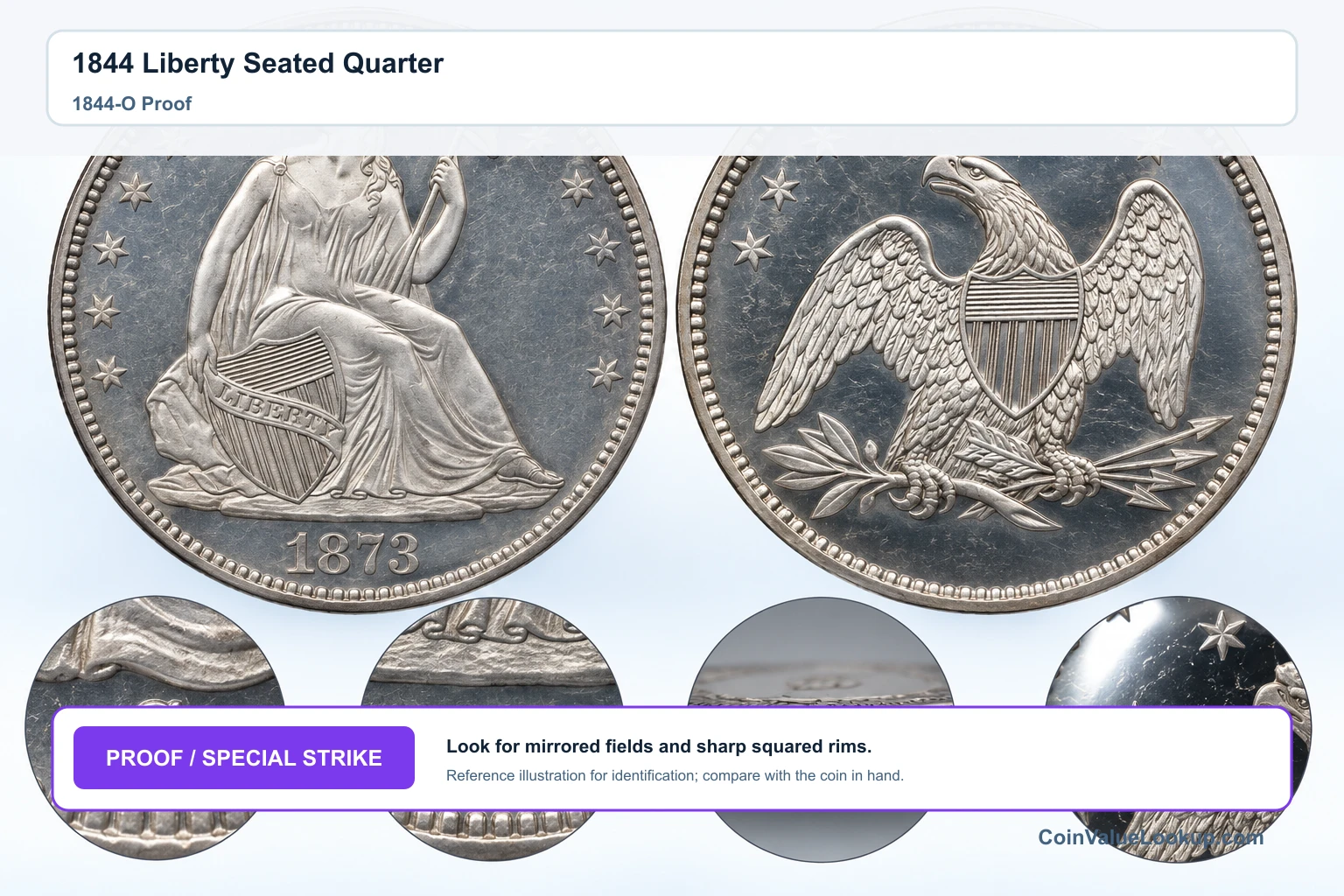
PCGS recognizes an 1844-O proof quarter as an extraordinary, provenance-sensitive branch. This is not something you stumble across in a junk silver bin.
Do not call a shiny ordinary 1844-O a proof.
No supported numeric price is adopted here. Any genuine example would be evaluated entirely on its own merits: authenticated identity, surface preservation, and documented ownership history.
Expert authentication is non-negotiable. If you genuinely believe you hold one, the path runs through a major third-party grading service, not an online forum opinion.
1844-O Liberty Seated Quarter Proof Value by Grade
Reliable grade-by-grade prices are not currently available. The confirmed branch-mint Proof catalogue entry has no usable grade-by-grade values in the current price feed. Ordinary 1844-O circulation strikes are not a pricing substitute.
1844 Liberty Seated Quarter Error List
1. 1844 Liberty Seated Quarter — Rotated Reverse
On a normally struck U.S. coin, if you hold the obverse upright and flip it top-to-bottom, the reverse also appears upright. The documented rotated reverse on the 1844-O reused-reverse-of-1843 variety shows a full 180-degree medal alignment instead, so the eagle appears upside-down when you flip it that way.
This error is specific to the reused 1843 reverse die and is documented in specialist studies of actual specimens. The same die can appear in both normal and medal alignment states.
Be careful with the flip test. Simply rotating a loose coin in your hand the wrong way mimics the appearance.
Hold the obverse firmly at 12 o'clock and flip along the vertical axis every time. No supported price range is adopted; value depends on authenticated identity, condition, and whether other die features like cracks are also present.
2. 1844 Liberty Seated Quarter — Heavy Reverse Die Cracks
Late-state examples of the 1844-O reused-reverse-of-1843 die show two prominent crack paths on the reverse. These are heavy, raised lines visible without magnification on well-preserved specimens, and they appear alongside mintmark position details and die rust lumps that confirm the specific die identity.
Do not confuse die cracks with post-strike scratches or a physically split planchet. Die cracks are raised ridges on the coin's surface because metal filled the crack in the die during striking.
Scratches are incuse, and a split coin separates into layers.
The same coin may also exhibit the rotated reverse, so avoid mechanically adding premiums for both features as though they are independent. No supported price range is adopted for this error.
Individual assessment based on authenticated identity, condition, and overall eye appeal determines what a particular specimen is worth.