1857 Liberty Seated Quarter Coin Value: How Much Is It Worth?
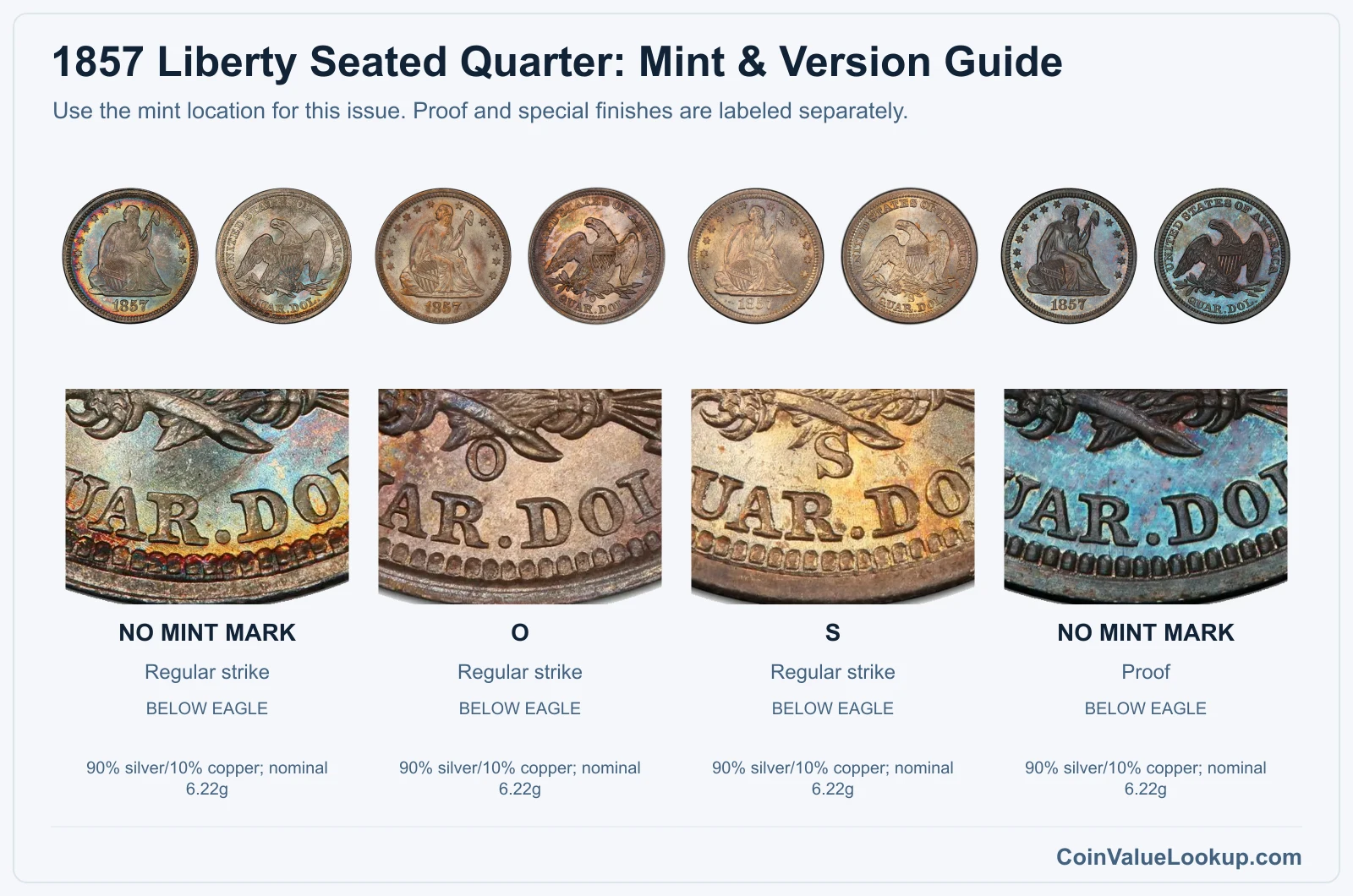
The 1857 Liberty Seated quarter spans three mints and a scarce proof issue, so values depend heavily on which version you hold. Guide estimates begin around $46 for a well-worn Philadelphia strike in G4 and climb to $7,340 at MS63 for the San Francisco issue.
Original, undamaged surfaces are key to preserving value across every grade.
Fast Way to Identify Your 1857 Liberty Seated Quarter
Snap a clear photo of both sides of your quarter and upload them here for a preliminary identification. The tool can help you figure out which mint produced your coin and narrow down its version, giving you a starting point before any professional evaluation.
It works best with sharp, evenly lit images.
1857 Liberty Seated Quarter Value
Upload both sides of your 1857 Liberty Seated Quarter.
Front Obverse
Upload photo
Back Reverse
Upload photo
Which 1857 Liberty Seated Quarter Versions Are Worth Money?
- The 1857-S business strike carries the highest guide estimates, reaching $7,340 at MS63 and $938 even at VF20, reflecting its lower original availability from San Francisco.
- The 1857-O from New Orleans lists at $3,437 in MS63 and $194 in VF20, well above the Philadelphia issue at the same grades.
- Philadelphia proofs are listed at $4,950 in PR63; very few were made and they require careful authentication.
- The Smoking Liberty die break and Flying Eagle cent die clash are recognized anomalies on Philadelphia strikes that attract specialist interest; values depend on individual assessment.
Step 1: Identify Your 1857 Liberty Seated Quarter Mint Mark and Version
All 1857 Seated Liberty quarters share the same basic design: Liberty seated on the obverse and an eagle without a motto on the reverse. No arrows flank the date, and no rays surround the eagle; those features belong to the 1853 issue.
The mintmark sits on the reverse, below the eagle. No mintmark means Philadelphia.
An "O" means New Orleans, and an "S" means San Francisco.
Every regular-issue 1857 quarter is struck in 90% silver and 10% copper, weighs nominally 6.22 grams, and measures about 24.3 mm across. If yours is noticeably lighter, heavier, or a different diameter, something unusual may be going on and professional examination is worthwhile.
Philadelphia produced business strikes and a small number of proofs. New Orleans and San Francisco produced only business strikes.
Two die anomalies, the Smoking Liberty die break and a Flying Eagle cent die clash, are documented on Philadelphia strikes and are discussed separately below.
Step 2: Check Your 1857 Liberty Seated Quarter Grade
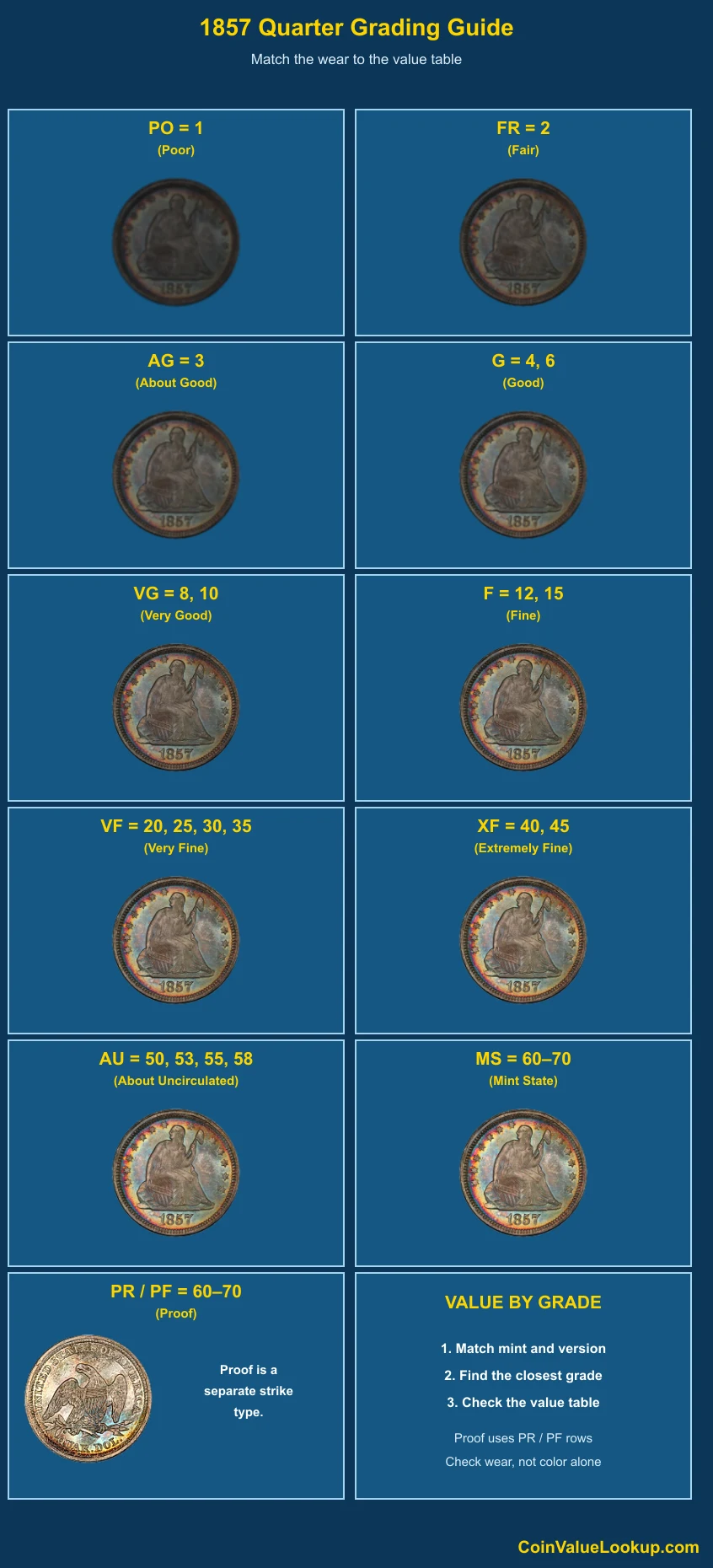
Start with the high points of Liberty: her head, breast, knee, and the lettering on the shield. These are the first areas to lose detail as a coin circulates.
Then flip it over and check the eagle's breast feathers, wing tips, and claws.
A coin that still shows full luster with sharp design elements is a candidate for Mint State grades. Rounded or flattened high points signal wear.
But be careful: a weakly struck star or soft head does not always mean wear. Seated quarters are notorious for uneven strikes, especially from branch mints.
Use the comparison image to match your coin's wear pattern against known grade benchmarks. Look past surface brightness.
Hairlines from old cleaning, rim dings, and corrosion all reduce a coin's grade and its market appeal, even if design detail is otherwise sharp.
Proof attribution requires more than a shiny surface. Genuine proofs show specific manufacturing characteristics that need comparison against authenticated specimens.
Step 3: Check 1857 Liberty Seated Quarter Value by Mint and Version
1857 Liberty Seated Quarter — Business Strike
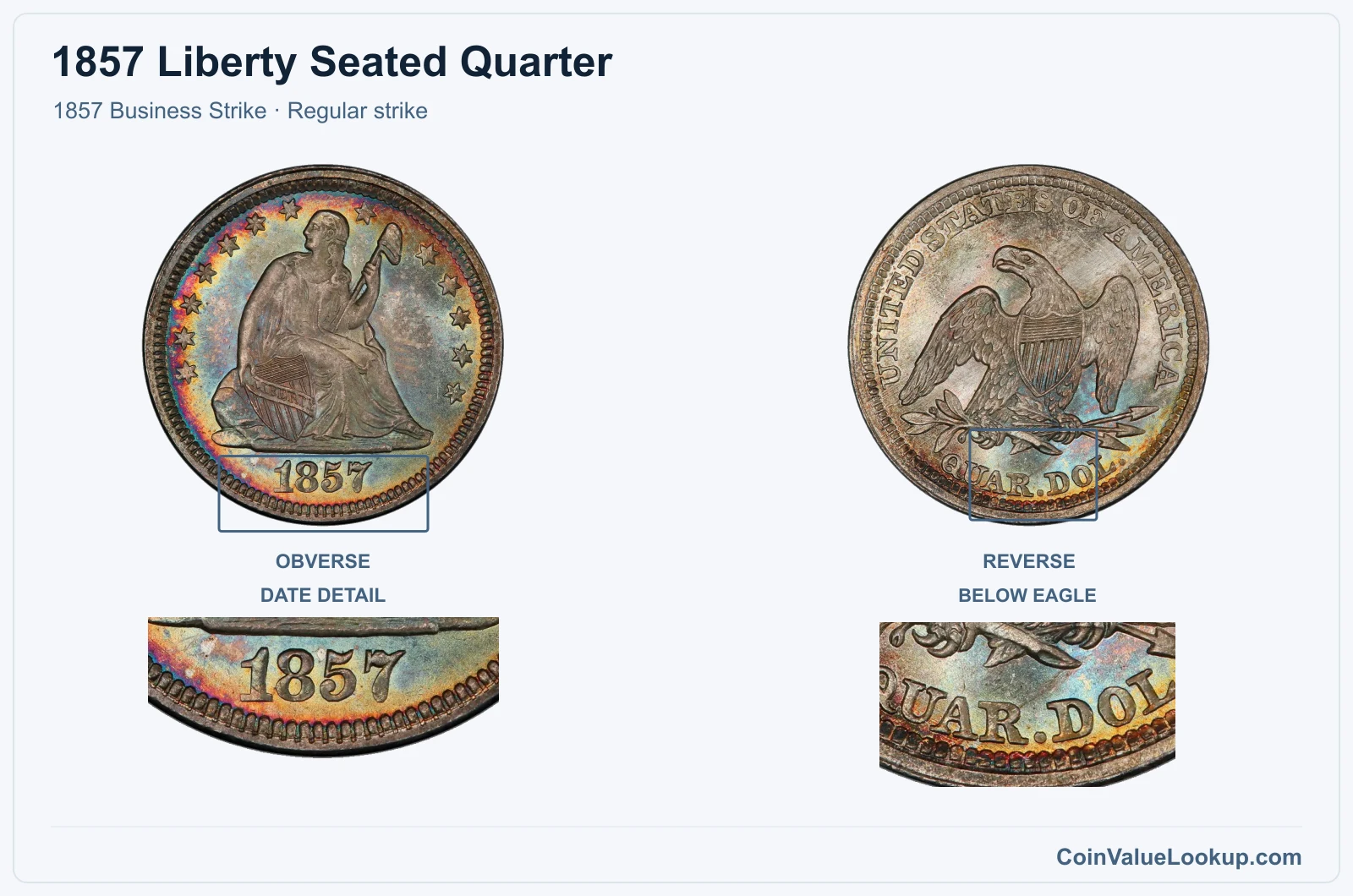
The 1857 Philadelphia business strike is the most available version. It carries no mintmark on the reverse.
Guide estimates place it around $46 in G4, $65 in VF20, and $730 in MS63.
Most survivors show moderate to heavy wear, so finding one in true uncirculated condition with original luster takes patience. Watch for old cleanings, which are common on silver coins of this era.
A cleaned coin in otherwise sharp detail will trade below these guide figures.
| Range | Grade | Price | Auction Records | Appraisal |
|---|---|---|---|---|
| PO | PO 1 | — | Coin Identifier | |
| FR | FR 2 | — | Coin Identifier | |
| AG | AG 3 | — | Coin Identifier | |
| G | G 4 | — | Coin Identifier | |
| G 6 | — | Coin Identifier | ||
| VG | VG 8 | — | Coin Identifier | |
| VG 10 | Coin Identifier | |||
| F | F 12 | — | Coin Identifier | |
| F 15 | — | Coin Identifier | ||
| VF | VF 20 | Coin Identifier | ||
| VF 25 | Coin Identifier | |||
| VF 30 | Coin Identifier | |||
| VF 35 | Coin Identifier | |||
| XF | XF 40 | Coin Identifier | ||
| XF 45 | Coin Identifier | |||
| AU | AU 50 | Coin Identifier | ||
| AU 53 | Coin Identifier | |||
| AU 55 | Coin Identifier | |||
| AU 58 | Coin Identifier | |||
| MS | MS 60 | — | Coin Identifier | |
| MS 61 | Coin Identifier | |||
| MS 62 | Coin Identifier | |||
| MS 63 | Coin Identifier | |||
| MS 64 | Coin Identifier | |||
| MS 65 | Coin Identifier | |||
| MS 66 | Coin Identifier | |||
| MS 67 | Coin Identifier | |||
| MS 68 | Coin Identifier | |||
| MS 69 | — | — | — | |
| MS 70 | — | — | — |
1857 Liberty Seated Quarter — Proof
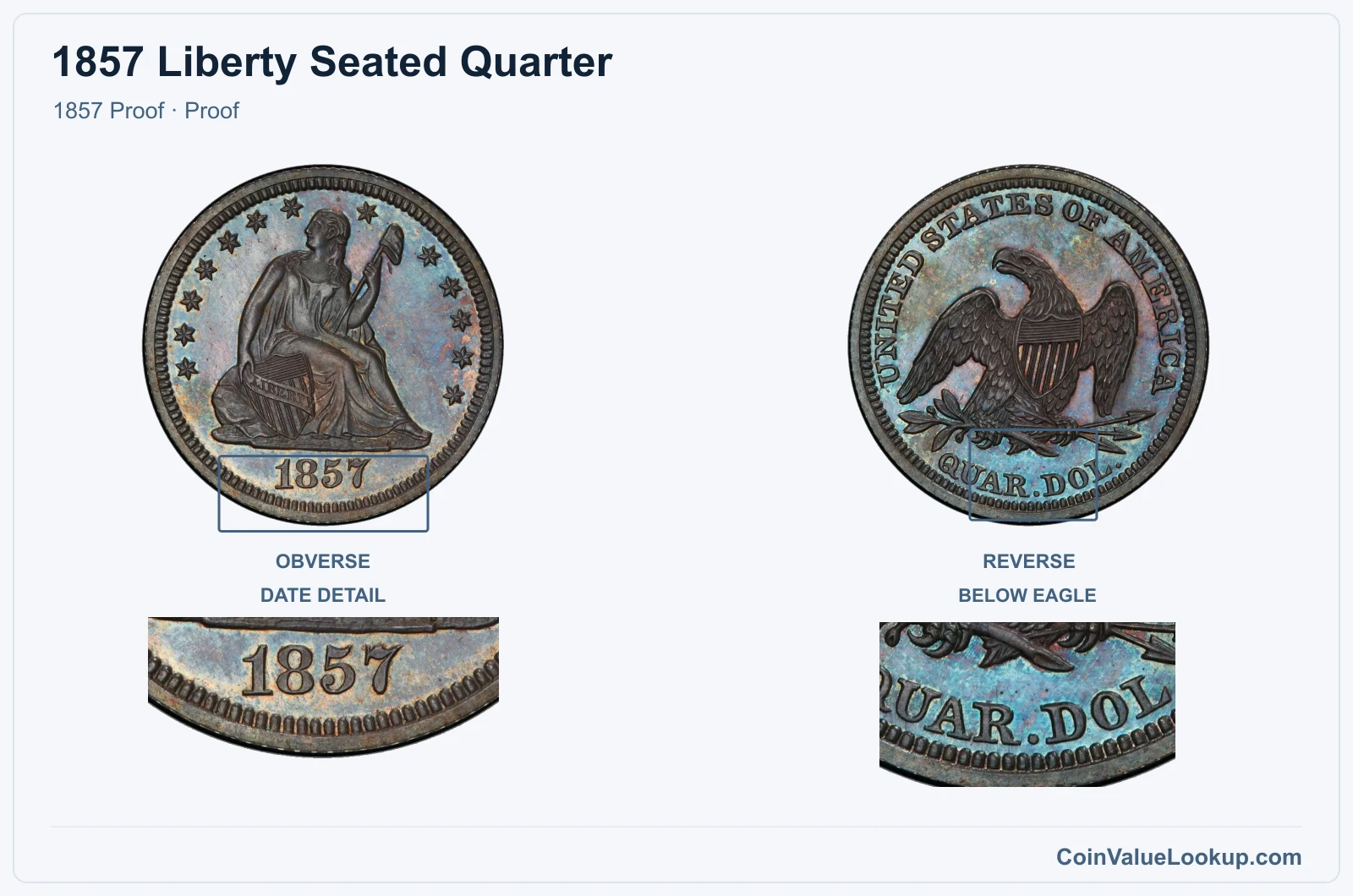
Philadelphia also struck a small number of proofs in 1857, and these are genuinely scarce. The guide estimate is $4,950 at PR63.
Like the business strike, the proof carries no mintmark.
Do not assume a shiny quarter is a proof. Proof identification requires comparing your coin against authenticated examples, looking for specific die and surface characteristics rather than relying on reflectivity alone.
Polished or lightly circulated business strikes can mimic proof appearance to an untrained eye, so professional attribution is important before assigning proof status.
Coin Value Lookup is a good starting point if you want to look up guide values for other dates and denominations in the Seated Liberty series before consulting a specialist.
| Range | Grade | Price | Auction Records | Appraisal |
|---|---|---|---|---|
| PR | PR 1 | — | Coin Identifier | |
| PR 2 | — | Coin Identifier | ||
| PR 3 | — | Coin Identifier | ||
| PR 4 | — | Coin Identifier | ||
| PR 6 | — | Coin Identifier | ||
| PR 8 | — | Coin Identifier | ||
| PR 10 | — | Coin Identifier | ||
| PR 12 | — | Coin Identifier | ||
| PR 15 | — | Coin Identifier | ||
| PR 20 | — | Coin Identifier | ||
| PR 25 | — | Coin Identifier | ||
| PR 30 | — | Coin Identifier | ||
| PR 35 | — | Coin Identifier | ||
| PR 40 | — | Coin Identifier | ||
| PR 45 | — | Coin Identifier | ||
| PR 50 | — | Coin Identifier | ||
| PR 53 | — | Coin Identifier | ||
| PR 55 | — | Coin Identifier | ||
| PR 58 | — | Coin Identifier | ||
| PR 60 | — | Coin Identifier | ||
| PR 61 | Coin Identifier | |||
| PR 62 | Coin Identifier | |||
| PR 63 | Coin Identifier | |||
| PR 64 | Coin Identifier | |||
| PR 65 | Coin Identifier | |||
| PR 66 | Coin Identifier | |||
| PR 67 | — | — | — | |
| PR 68 | — | — | — | |
| PR 69 | — | — | — | |
| PR 70 | — | — | — |
1857 Liberty Seated Quarter — O Business Strike
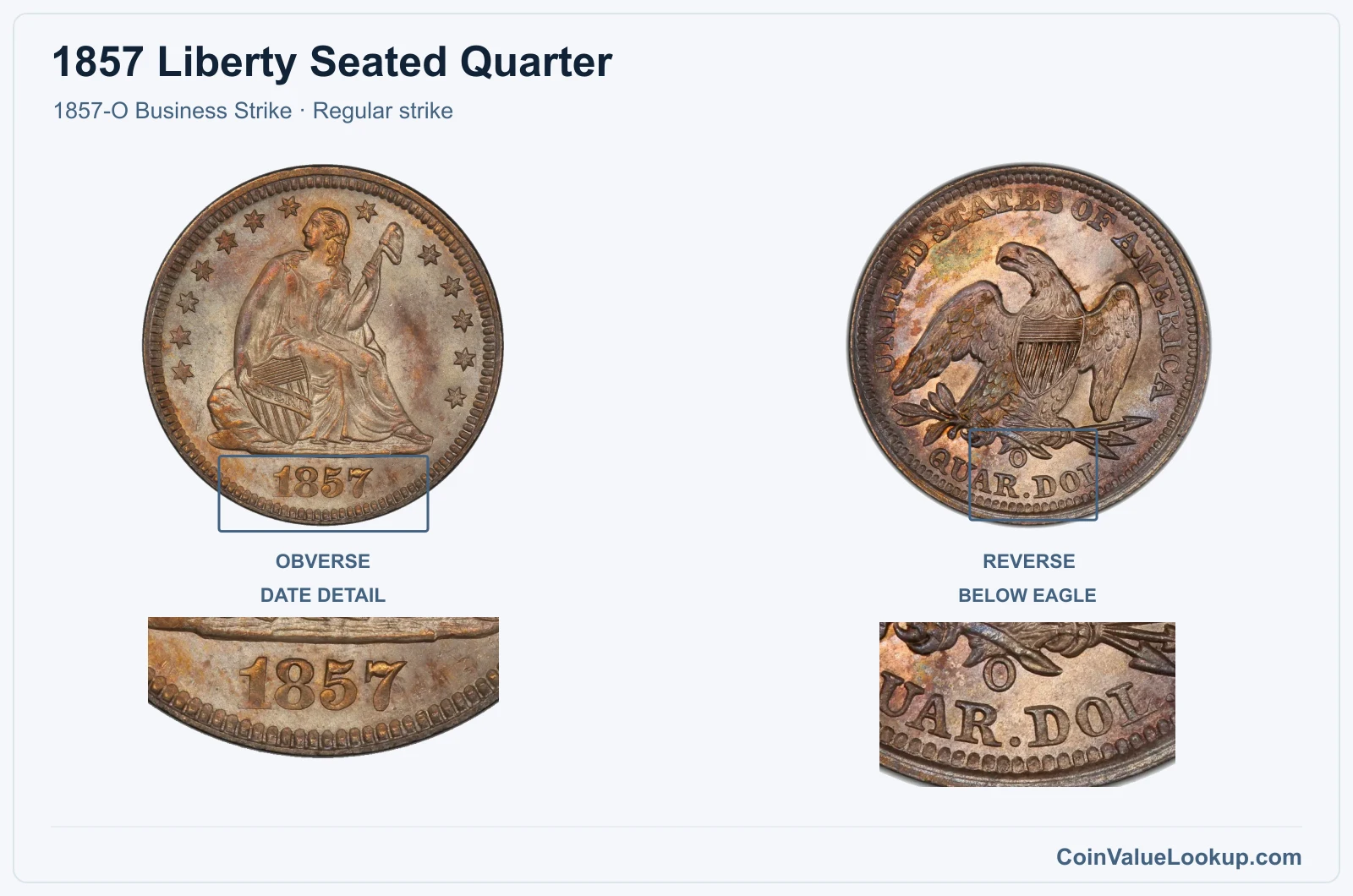
The 1857-O was struck in New Orleans and carries an "O" mintmark on the reverse beneath the eagle. Guide estimates are $65 in G4, $194 in VF20, and $3,437 in MS63.
That jump between VF20 and MS63 tells you something: plenty survived in circulated grades, but uncirculated examples are tough. New Orleans strikes often come with softer detail than Philadelphia coins, so distinguishing genuine wear from a weak strike matters here.
Original surfaces without cleaning are especially important for maximizing value on this mint.
| Range | Grade | Price | Auction Records | Appraisal |
|---|---|---|---|---|
| PO | PO 1 | — | Coin Identifier | |
| FR | FR 2 | — | Coin Identifier | |
| AG | AG 3 | — | Coin Identifier | |
| G | G 4 | — | Coin Identifier | |
| G 6 | — | Coin Identifier | ||
| VG | VG 8 | — | Coin Identifier | |
| VG 10 | — | Coin Identifier | ||
| F | F 12 | — | Coin Identifier | |
| F 15 | Coin Identifier | |||
| VF | VF 20 | Coin Identifier | ||
| VF 25 | Coin Identifier | |||
| VF 30 | Coin Identifier | |||
| VF 35 | Coin Identifier | |||
| XF | XF 40 | Coin Identifier | ||
| XF 45 | Coin Identifier | |||
| AU | AU 50 | Coin Identifier | ||
| AU 53 | Coin Identifier | |||
| AU 55 | Coin Identifier | |||
| AU 58 | Coin Identifier | |||
| MS | MS 60 | — | Coin Identifier | |
| MS 61 | Coin Identifier | |||
| MS 62 | Coin Identifier | |||
| MS 63 | Coin Identifier | |||
| MS 64 | Coin Identifier | |||
| MS 65 | Coin Identifier | |||
| MS 66 | — | — | — | |
| MS 67 | — | — | — | |
| MS 68 | — | — | — | |
| MS 69 | — | — | — | |
| MS 70 | — | — | — |
1857 Liberty Seated Quarter — S Business Strike
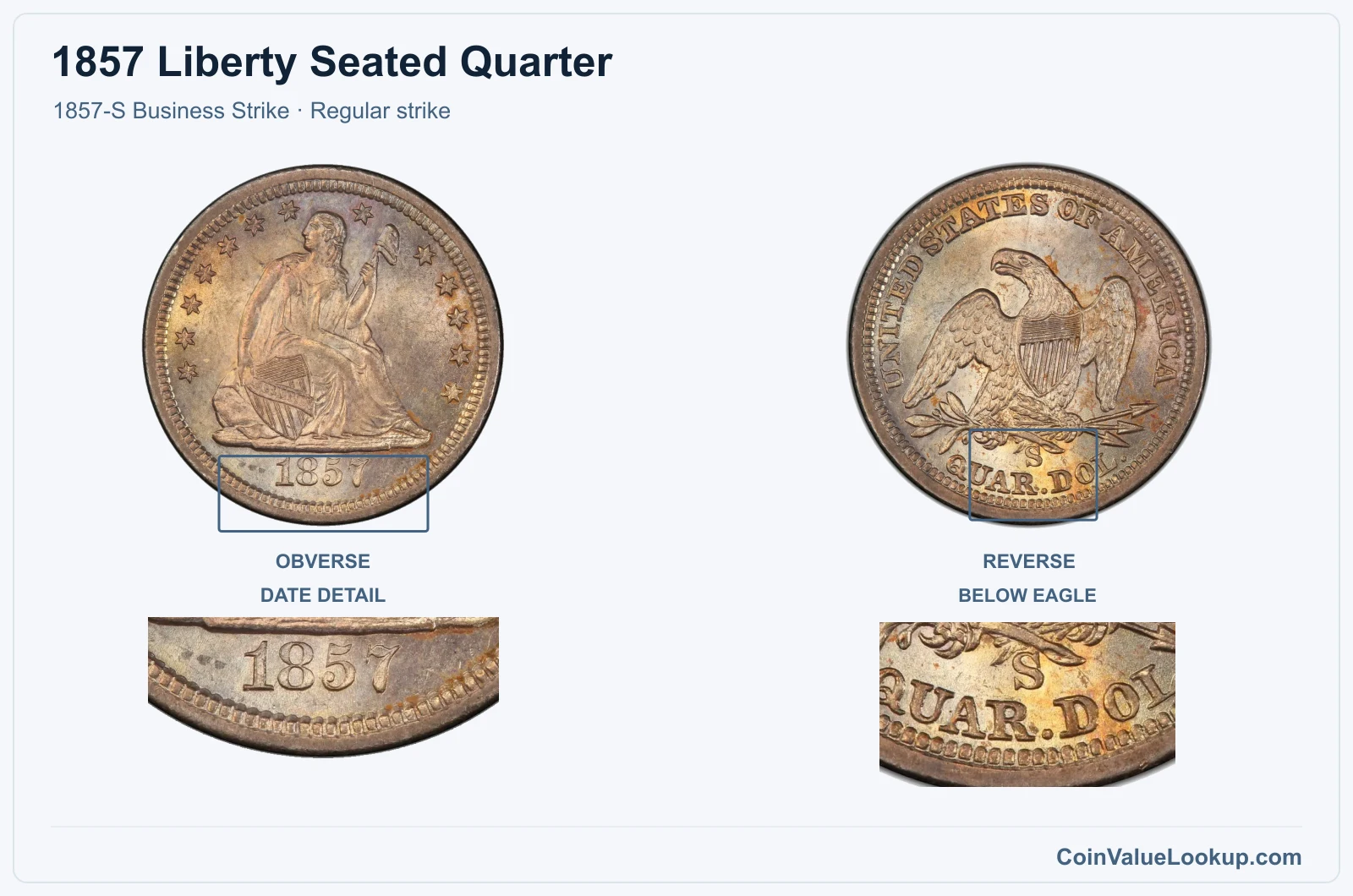
San Francisco's 1857-S quarter is the scarcest regular business strike of the three mints, and guide prices reflect it: $258 in G4, $938 in VF20, and $7,340 at MS63. The "S" mintmark appears on the reverse below the eagle.
Even in well-worn condition this coin commands real money. In higher grades it is genuinely difficult to locate.
San Francisco quarter production was still relatively new in 1857, having begun only in 1855, so surviving populations are smaller across the board. Confirm the mintmark carefully, because a misread "O" or absent mark means a very different value.
| Range | Grade | Price | Auction Records | Appraisal |
|---|---|---|---|---|
| PO | PO 1 | — | Coin Identifier | |
| FR | FR 2 | — | Coin Identifier | |
| AG | AG 3 | Coin Identifier | ||
| G | G 4 | Coin Identifier | ||
| G 6 | Coin Identifier | |||
| VG | VG 8 | Coin Identifier | ||
| VG 10 | Coin Identifier | |||
| F | F 12 | — | Coin Identifier | |
| F 15 | — | Coin Identifier | ||
| VF | VF 20 | — | Coin Identifier | |
| VF 25 | Coin Identifier | |||
| VF 30 | Coin Identifier | |||
| VF 35 | Coin Identifier | |||
| XF | XF 40 | Coin Identifier | ||
| XF 45 | Coin Identifier | |||
| AU | AU 50 | Coin Identifier | ||
| AU 53 | Coin Identifier | |||
| AU 55 | Coin Identifier | |||
| AU 58 | Coin Identifier | |||
| MS | MS 60 | — | Coin Identifier | |
| MS 61 | Coin Identifier | |||
| MS 62 | Coin Identifier | |||
| MS 63 | Coin Identifier | |||
| MS 64 | Coin Identifier | |||
| MS 65 | — | — | — | |
| MS 66 | — | — | — | |
| MS 67 | — | — | — | |
| MS 68 | — | — | — | |
| MS 69 | — | — | — | |
| MS 70 | — | — | — |
1857 Liberty Seated Quarter Error List
1. 1857 Liberty Seated Quarter — Smoking Liberty Die Break
The Smoking Liberty die break is a recognized anomaly found on 1857 Philadelphia business strikes. A raised die-break projection extends from Liberty's left-facing hand, creating what looks remarkably like a cigarette dangling from her fingers.
It is a die crack that grew into a small cud or retained break, not an intentional design element.
To identify it, examine the area around Liberty's hand closely under magnification. The projection should be raised metal, continuous with the surrounding design, not an incised scratch or tooling mark.
A scratch will typically cut into the surface rather than sitting above it.
No adopted price range exists for this variety. Value depends on the individual coin's authenticated identity, overall condition, and how pronounced the die break appears.
Professional attribution is recommended before assuming a premium.
2. 1857 Liberty Seated Quarter — Flying Eagle Cent Die Clash
A Flying Eagle cent die clash has been documented on 1857 Philadelphia business strikes. During production, quarter dies apparently clashed with impressions transferred from a Flying Eagle cent die, leaving faint outlines visible near the eagle's wing and neck area on the reverse.
Detecting this clash requires careful examination under angled light. Look for transferred design outlines above or below the left-facing wing and to the right of the eagle's neck.
On lower-grade examples or faint clashes, attribution can be difficult. Published reference images sometimes include drawn enhancements to highlight the transferred lines, so be aware that those overlays are not unaltered photographs of the coin itself.
Do not confuse this with a wrong-planchet strike, ordinary shield lines, or surface scratches. No adopted price range is available; each example needs individual assessment based on authenticated identity, clash visibility, and overall coin condition.