1976 Washington Quarter Coin Value: How Much Is It Worth?
Most 1976 Bicentennial quarters you pull from pocket change are worth face value. Uncirculated examples graded MS65 carry USA Coin Book guide estimates around $7.29 for the Philadelphia issue and $10 for the Denver.
San Francisco struck three distinct versions, including 40%-silver pieces that guide near $12–$14 depending on finish. The real money, though, sits with authenticated mint errors and the silver variants most people overlook.
Fast Way to Identify Your 1976 Washington Quarter
Snap a clear photo of the front and back of your 1976 quarter and upload both images here. Our identifier can give you a preliminary read on which mint, metal and finish version you likely have.
It is not a substitute for professional authentication or grading, but it is a solid first step before you dig deeper.
1976 Washington Quarter Value
Upload both sides of your 1976 Washington Quarter.
Front Obverse
Upload photo
Back Reverse
Upload photo
Which 1976 Washington Quarter Versions Are Worth Money?
- San Francisco 40%-silver proof quarters guide around $14 at PR65 per USA Coin Book — confirm the S mintmark and silver composition before assuming value.
- San Francisco 40%-silver uncirculated pieces guide about $12.34 at MS65; they look different from proofs and must be identified separately.
- A 1976 quarter struck on a nickel planchet sold for $1,020 at auction in PCGS MS62 — a wrong-planchet error requiring professional attribution.
- A Philadelphia quarter missing its reverse clad layer sold for $423 in NGC MS63; look for copper-colored drummer detail and reduced weight.
- A 1976-S proof quarter struck over a 1967 dime brought $15,000 at auction in NGC PR67 — an extraordinary double-denomination error.
- Documented doubled die obverse varieties exist on 1976-D quarters; exact value depends on the specific die, visibility and condition.
Step 1: Identify Your 1976 Washington Quarter Mint Mark and Version
Every 1976 quarter carries the dual date 1776–1976 and a colonial drummer on the reverse. No 1975-dated quarter exists; the Bicentennial design replaced normal production for both years.
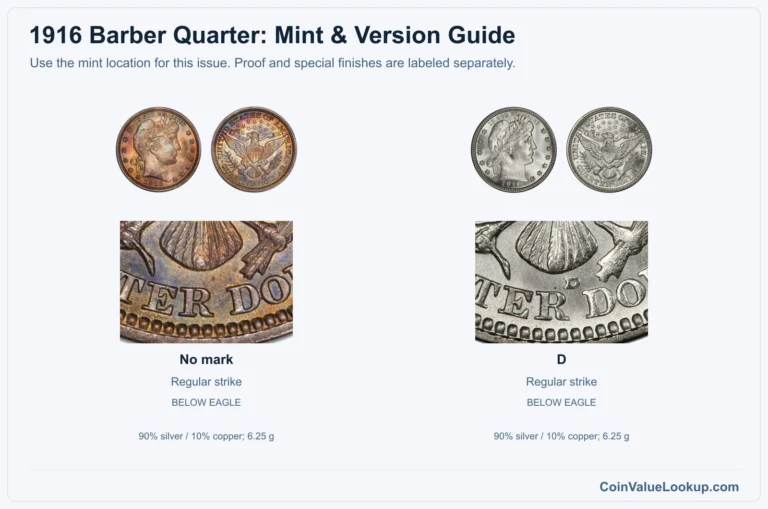
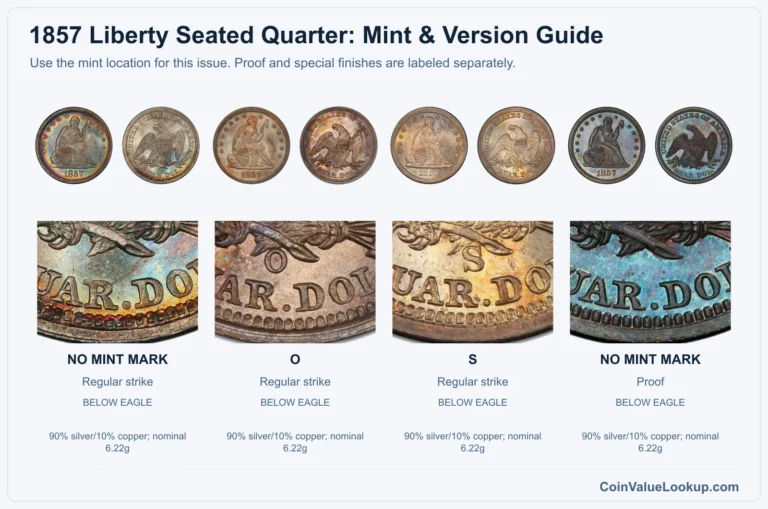
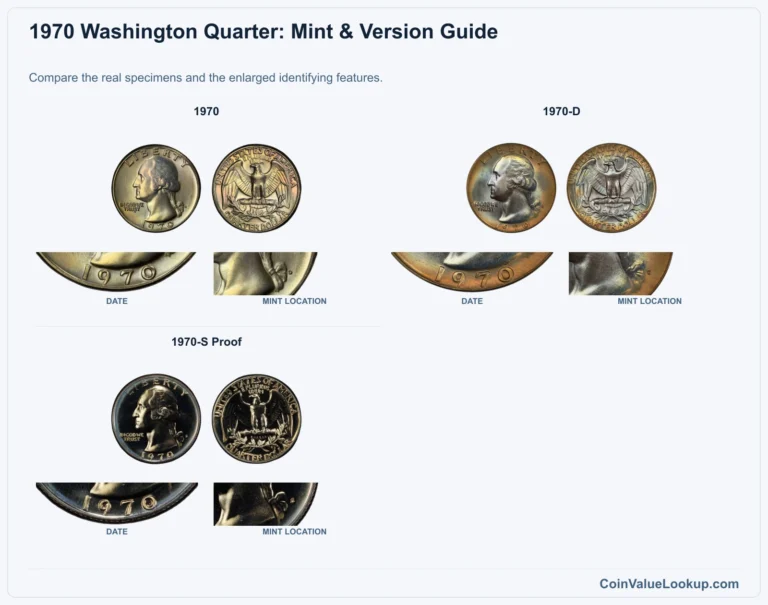
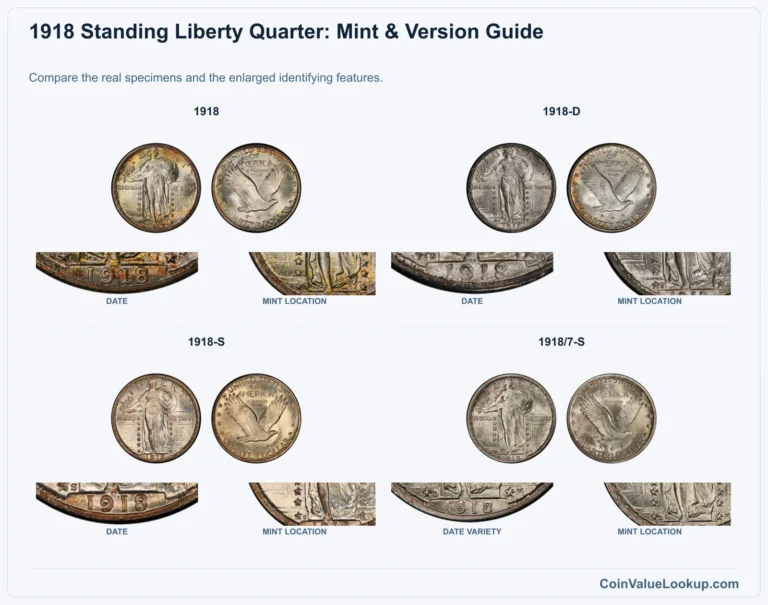
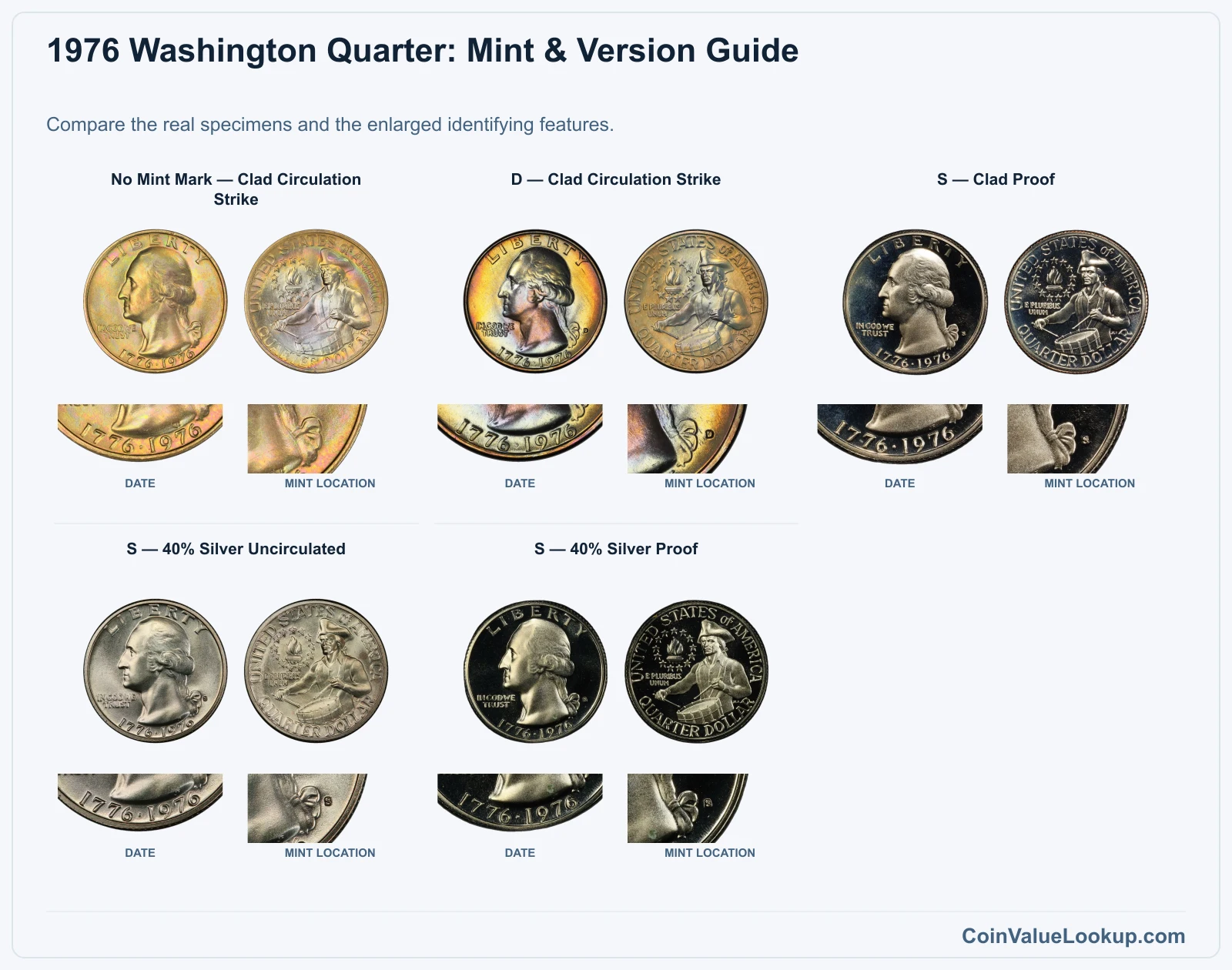
Look to the right of Washington's bust for the mintmark. No letter means Philadelphia.
A "D" means Denver. An "S" means San Francisco.
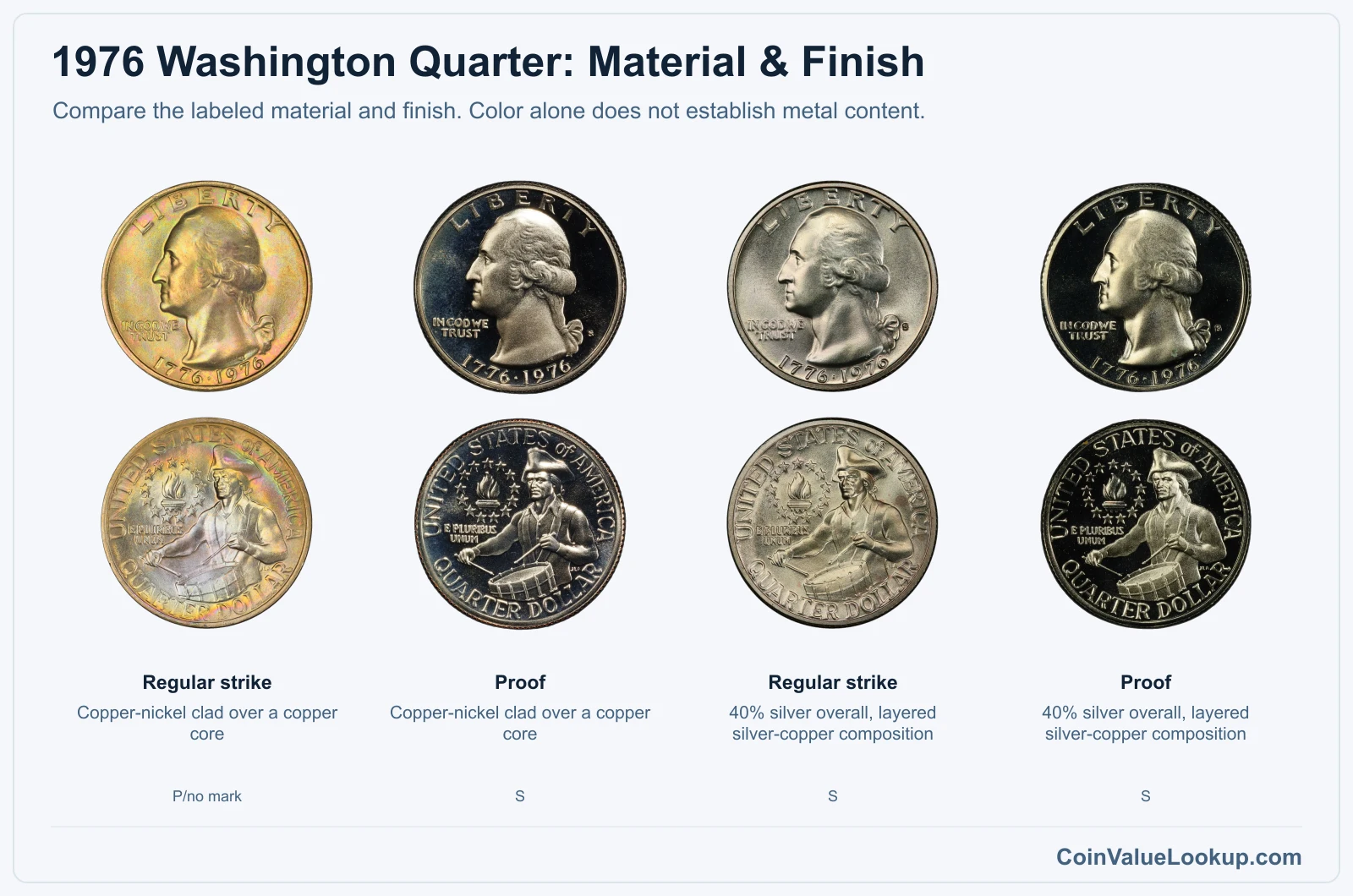
Here is where it gets tricky. Philadelphia and Denver coins are always copper-nickel clad.
San Francisco coins come in three flavors: clad proof, 40%-silver uncirculated and 40%-silver proof. The S mintmark alone does not tell you which one you have.
A normal clad quarter weighs about 5.67 grams; a silver version about 5.75 grams. That gap is tiny, so you need a precise scale and other clues like finish and packaging history to confirm the metal.
Do not assume silver just because the coin looks shiny or came from a relative's drawer.
Step 2: Check Your 1976 Washington Quarter Grade
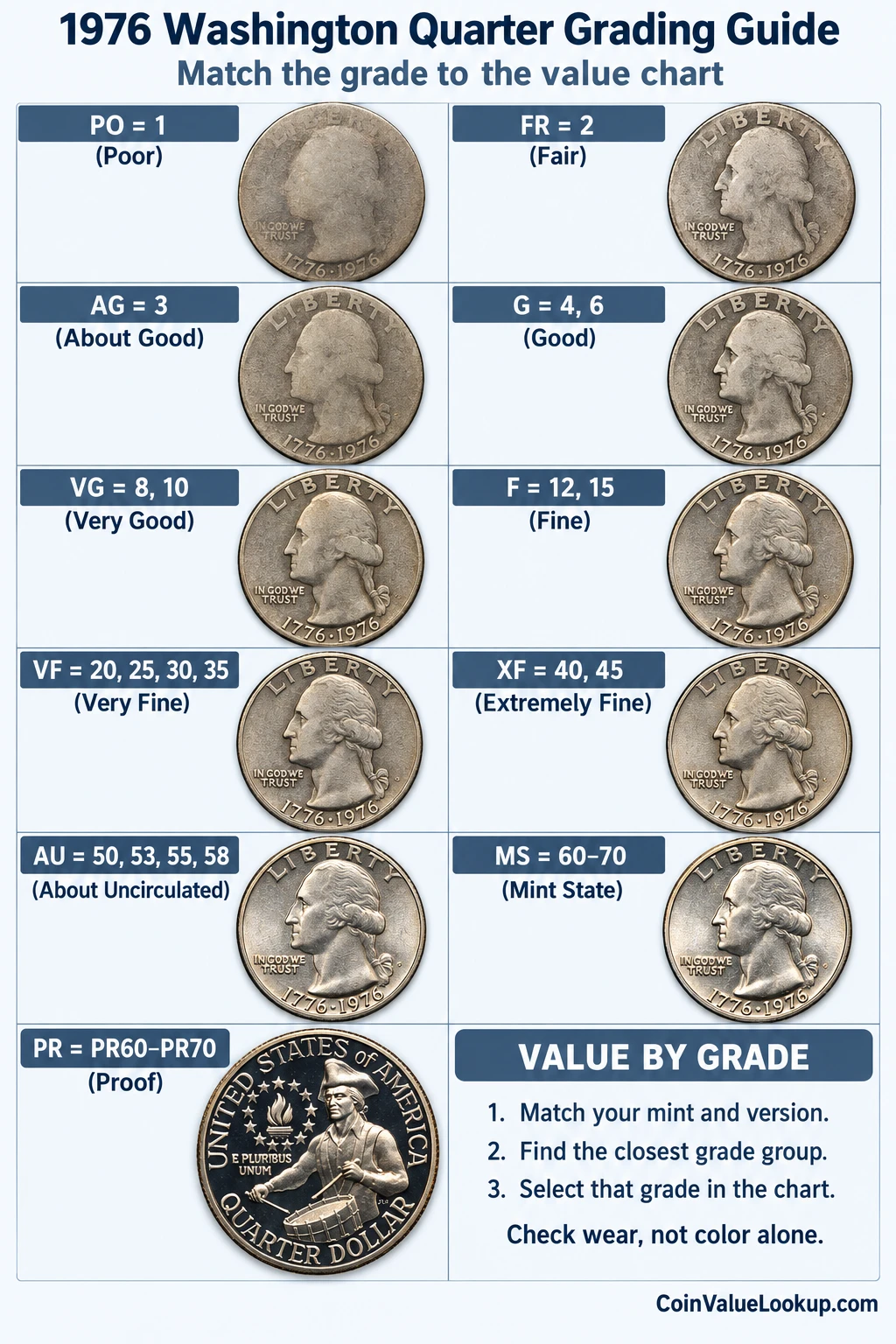
Focus on Washington's hair detail over the ear and across the cheek. On the reverse, check the drummer's coat, arms and drum for sharpness.
These are the first areas to soften with wear.
Original mint luster matters more than brightness. A coin can be cleaned to look shiny yet still show flat, worn surfaces under magnification.
Bag marks and contact scratches pull down the grade on otherwise sharp coins.
Compare your coin to the grading reference image. A true MS65 will show full luster with only minor, scattered marks not in prime focal areas.
Proof coins get their own PR scale, so do not mix the two when evaluating an S-mint piece.
Weak drummer detail by itself does not mean you have a doubled die or a major error. Some coins simply received a softer strike or saw light circulation.
Separate strike quality from actual die variety evidence before jumping to conclusions.
Step 3: Check 1976 Washington Quarter Value by Mint and Version
1976 Washington Quarter — No Mint Mark — Clad Circulation Strike
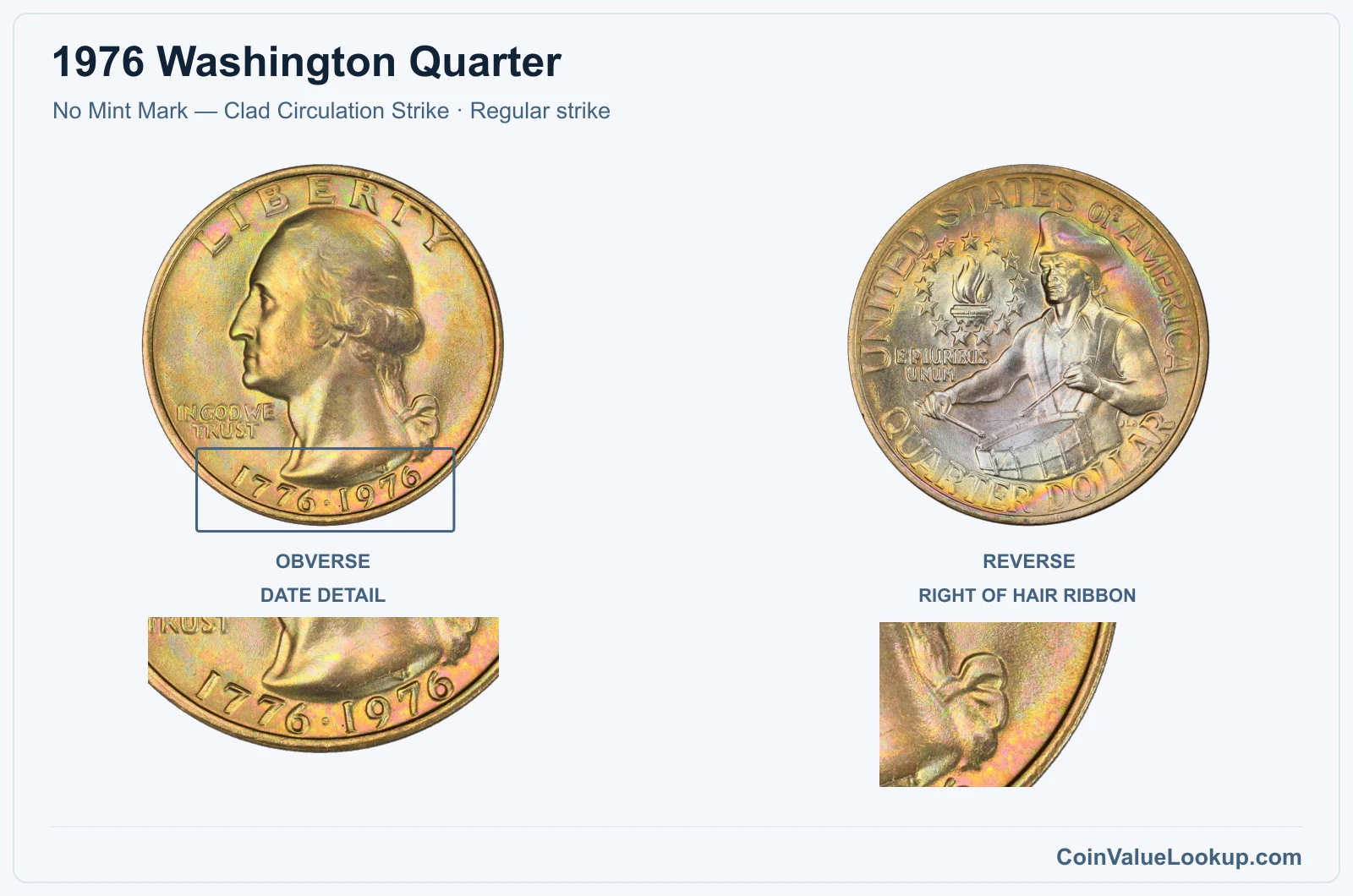
The no-mintmark Philadelphia Bicentennial quarter is the most common version. It is copper-nickel clad over a copper core and contains no silver.
USA Coin Book guides an MS65 example at $7.29. Circulated pieces are worth 25 cents.
To be worth pursuing, a Philadelphia coin needs strong original luster, sharp drummer details and minimal contact marks — basically a coin that went straight from the mint into storage.
Confirm there is no mintmark to the right of Washington's bust. If you see any letter there, you have a different version entirely.
Range Grade
Price Auction Records Appraisal PO PO 1
—
Coin Identifier FR FR 2
—
Coin Identifier AG AG 3
—
Coin Identifier G G 4
—
Coin Identifier
G 6
—
Coin Identifier VG VG 8
—
Coin Identifier
VG 10
—
Coin Identifier F F 12
—
Coin Identifier
F 15
—
Coin Identifier VF VF 20
—
Coin Identifier
VF 25
—
Coin Identifier
VF 30
—
Coin Identifier
VF 35
—
Coin Identifier XF XF 40
—
Coin Identifier
XF 45
—
Coin Identifier AU AU 50
—
Coin Identifier
AU 53
—
Coin Identifier
AU 55
—
Coin Identifier
AU 58
—
Coin Identifier MS MS 60
—
Coin Identifier
MS 61
—
Coin Identifier
MS 62
—
Coin Identifier
MS 63
Coin Identifier
MS 64
Coin Identifier
MS 65
Coin Identifier
MS 66
Coin Identifier
MS 67
Coin Identifier
MS 68
—
Coin Identifier
MS 69
—
—
—
MS 70
—
—
—
1976 Washington Quarter — D — Clad Circulation Strike
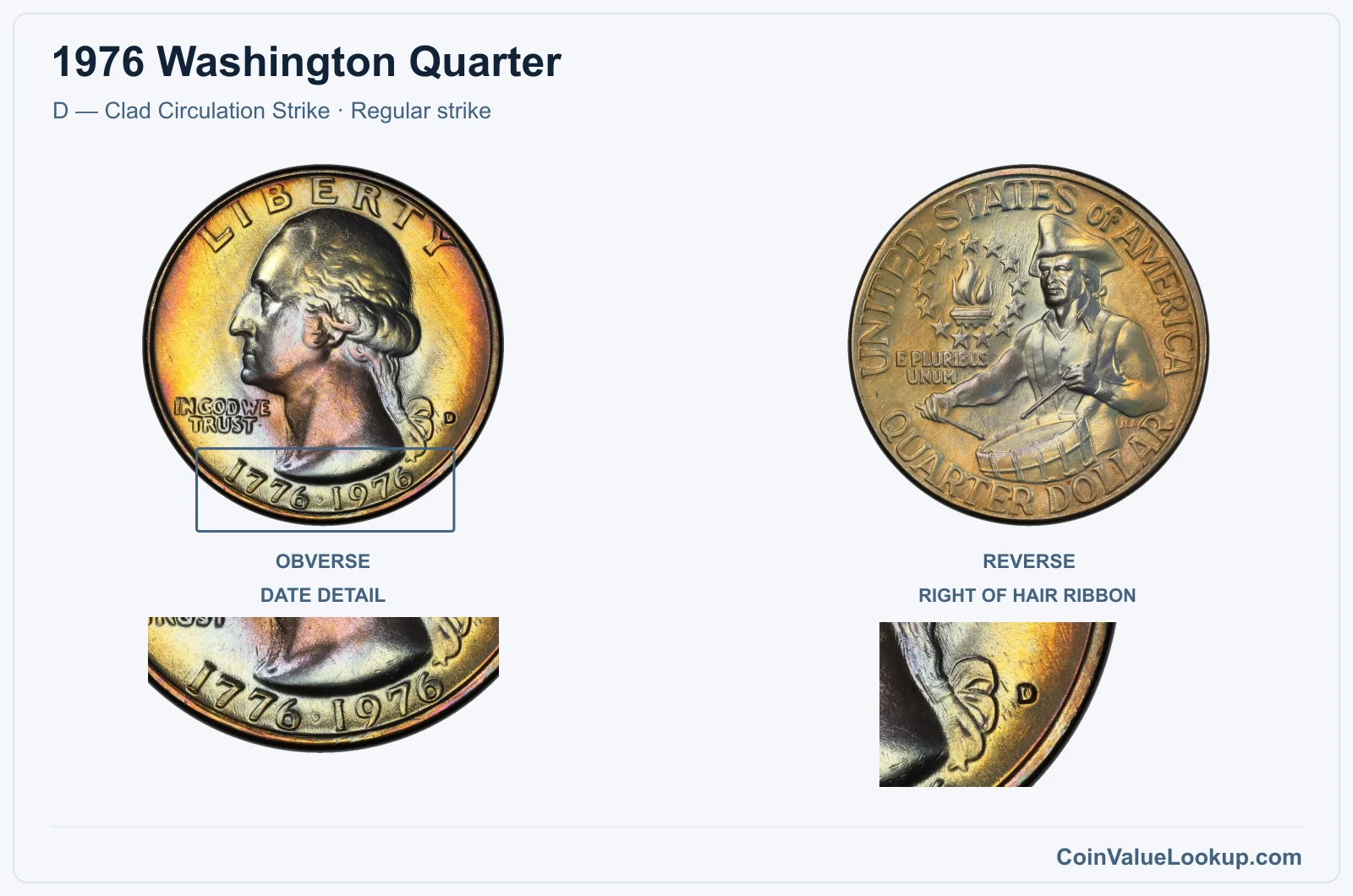
Denver's Bicentennial quarter carries a small "D" mintmark to the right of Washington's portrait. Same copper-nickel clad composition as Philadelphia, no silver content.
USA Coin Book guides an MS65 at $10, a bit above the Philadelphia issue. Circulated examples remain at face value.
A nice uncirculated D-mint coin is not rare, but a well-preserved one with clean fields and full drummer detail is always worth setting aside.
Coin Value Lookup can help you look up value guides for Washington quarters and other series if you are sorting through a collection or a coin jar.
Range Grade
Price Auction Records Appraisal PO PO 1
—
Coin Identifier FR FR 2
—
Coin Identifier AG AG 3
—
Coin Identifier G G 4
—
Coin Identifier
G 6
—
Coin Identifier VG VG 8
—
Coin Identifier
VG 10
—
Coin Identifier F F 12
—
Coin Identifier
F 15
—
Coin Identifier VF VF 20
—
Coin Identifier
VF 25
—
Coin Identifier
VF 30
—
Coin Identifier
VF 35
—
Coin Identifier XF XF 40
—
Coin Identifier
XF 45
—
Coin Identifier AU AU 50
—
Coin Identifier
AU 53
—
Coin Identifier
AU 55
—
Coin Identifier
AU 58
—
Coin Identifier MS MS 60
—
Coin Identifier
MS 61
—
Coin Identifier
MS 62
—
Coin Identifier
MS 63
Coin Identifier
MS 64
Coin Identifier
MS 65
Coin Identifier
MS 66
Coin Identifier
MS 67
Coin Identifier
MS 68
Coin Identifier
MS 69
—
—
—
MS 70
—
—
—
1976 Washington Quarter — S — Clad Proof
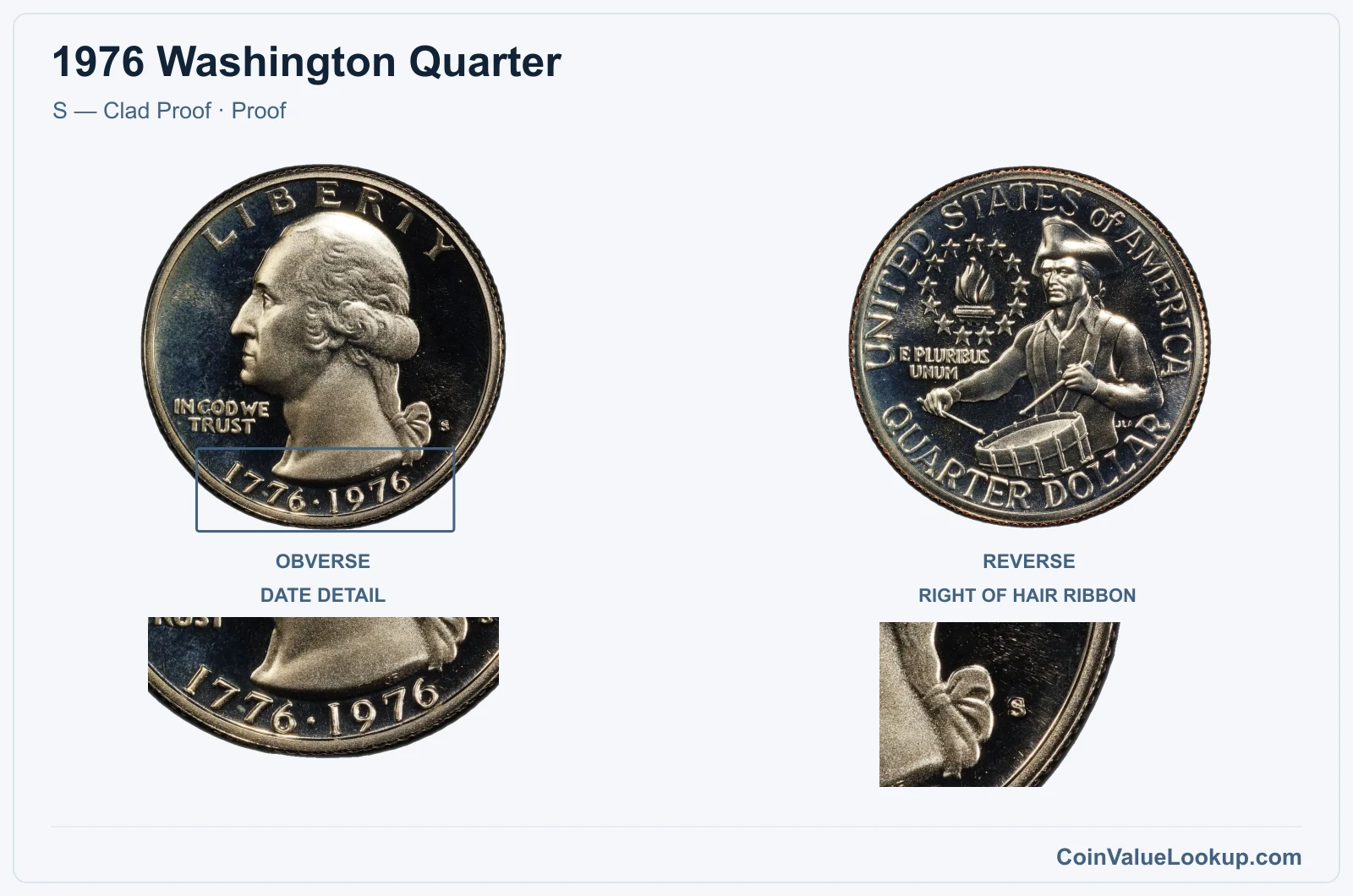
The S clad proof was struck at San Francisco specifically for collector proof sets. It is copper-nickel clad — not silver — despite the S mintmark.
USA Coin Book guides a PR65 at $6.25. These coins have mirror-like fields and sharp frosted devices when well preserved.
Most come from sealed proof sets, so you will rarely find one in the wild.
Do not assume an S-mint coin is silver. If it came from a standard 1976 proof set rather than a special silver set, it is clad.
Weight alone is nearly useless here; packaging and purchase history are your best allies.
Range Grade
Price1976 S — Clad Proof (CAM) Price1976 S — Clad Proof (DCAM) Auction Records Appraisal PR PR 1
—
Coin Identifier
PR 2
—
Coin Identifier
PR 3
—
Coin Identifier
PR 4
—
Coin Identifier
PR 6
—
Coin Identifier
PR 8
—
Coin Identifier
PR 10
—
Coin Identifier
PR 12
—
Coin Identifier
PR 15
—
Coin Identifier
PR 20
—
Coin Identifier
PR 25
—
Coin Identifier
PR 30
—
Coin Identifier
PR 35
—
Coin Identifier
PR 40
—
Coin Identifier
PR 45
—
Coin Identifier
PR 50
—
Coin Identifier
PR 53
—
Coin Identifier
PR 55
—
Coin Identifier
PR 58
—
Coin Identifier
PR 60
—
Coin Identifier
PR 61
—
Coin Identifier
PR 62
—
Coin Identifier
PR 63
—
Coin Identifier
PR 64
—
Coin Identifier
PR 65
Coin Identifier
PR 66
Coin Identifier
PR 67
Coin Identifier
PR 68
Coin Identifier
PR 69
Coin Identifier
PR 70
Coin Identifier
1976 Washington Quarter — S — 40% Silver Uncirculated
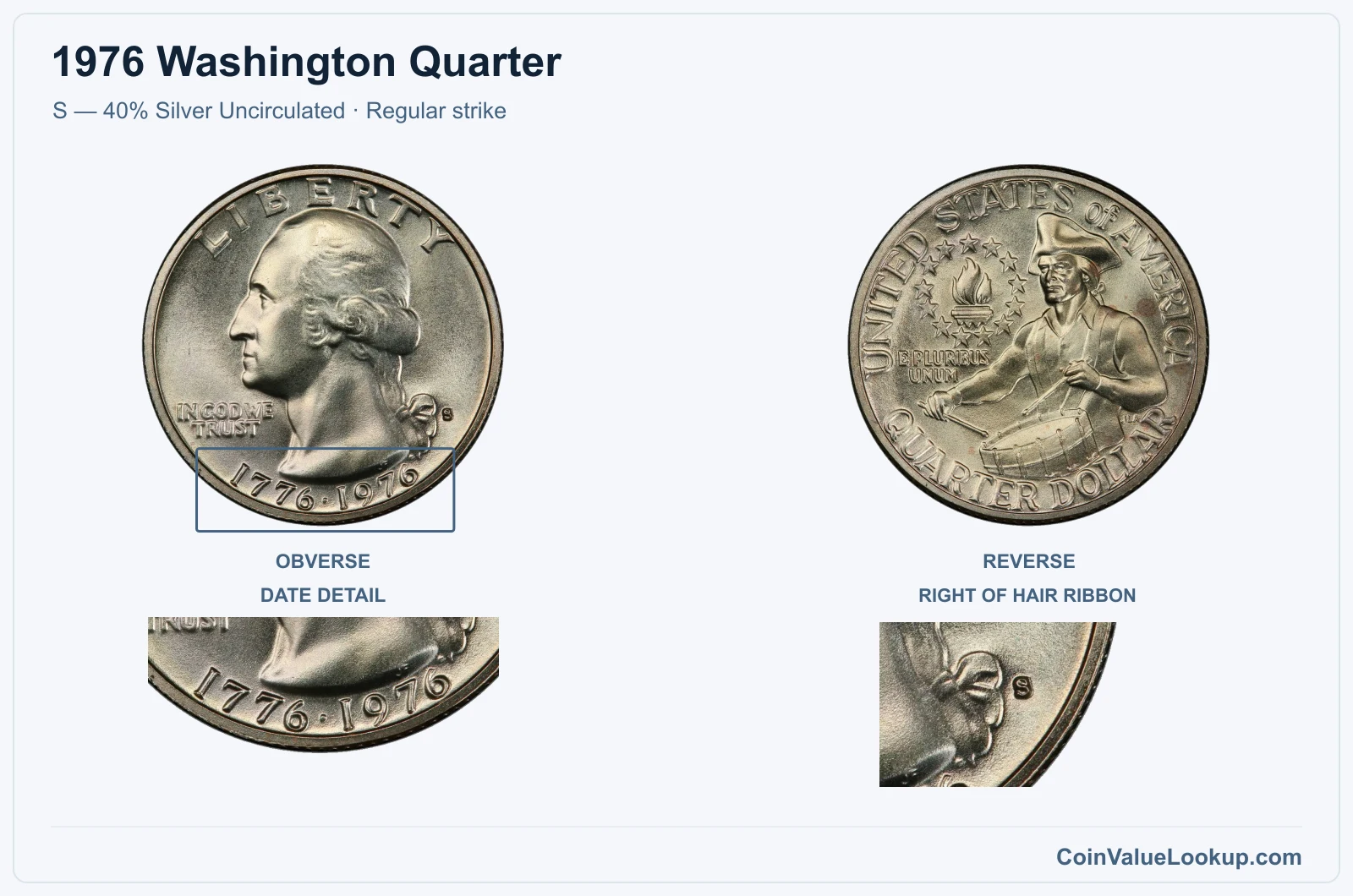
San Francisco also produced a 40%-silver uncirculated Bicentennial quarter intended for special three-coin mint sets, not proof sets. This is a business-strike collector issue, not a proof.
USA Coin Book guides MS65 at $12.34. The coin has a slightly different look from proofs — no mirror fields, just a satiny luster similar to a well-struck circulation coin.
It weighs approximately 5.75 grams versus 5.67 grams for clad, but that difference is small enough to require a quality scale.
These came in special government packaging. If your coin is loose, confirming the 40%-silver composition without a precise scale or professional evaluation is difficult.
The S mintmark is necessary but not sufficient.
Range Grade
Price Auction Records Appraisal PO PO 1
—
Coin Identifier FR FR 2
—
Coin Identifier AG AG 3
—
Coin Identifier G G 4
—
Coin Identifier
G 6
—
Coin Identifier VG VG 8
—
Coin Identifier
VG 10
—
Coin Identifier F F 12
—
Coin Identifier
F 15
—
Coin Identifier VF VF 20
—
Coin Identifier
VF 25
—
Coin Identifier
VF 30
—
Coin Identifier
VF 35
—
Coin Identifier XF XF 40
—
Coin Identifier
XF 45
—
Coin Identifier AU AU 50
—
Coin Identifier
AU 53
—
Coin Identifier
AU 55
—
Coin Identifier
AU 58
—
Coin Identifier MS MS 60
—
Coin Identifier
MS 61
—
Coin Identifier
MS 62
—
Coin Identifier
MS 63
—
Coin Identifier
MS 64
Coin Identifier
MS 65
Coin Identifier
MS 66
Coin Identifier
MS 67
Coin Identifier
MS 68
Coin Identifier
MS 69
Coin Identifier
MS 70
—
—
—
1976 Washington Quarter — S — 40% Silver Proof
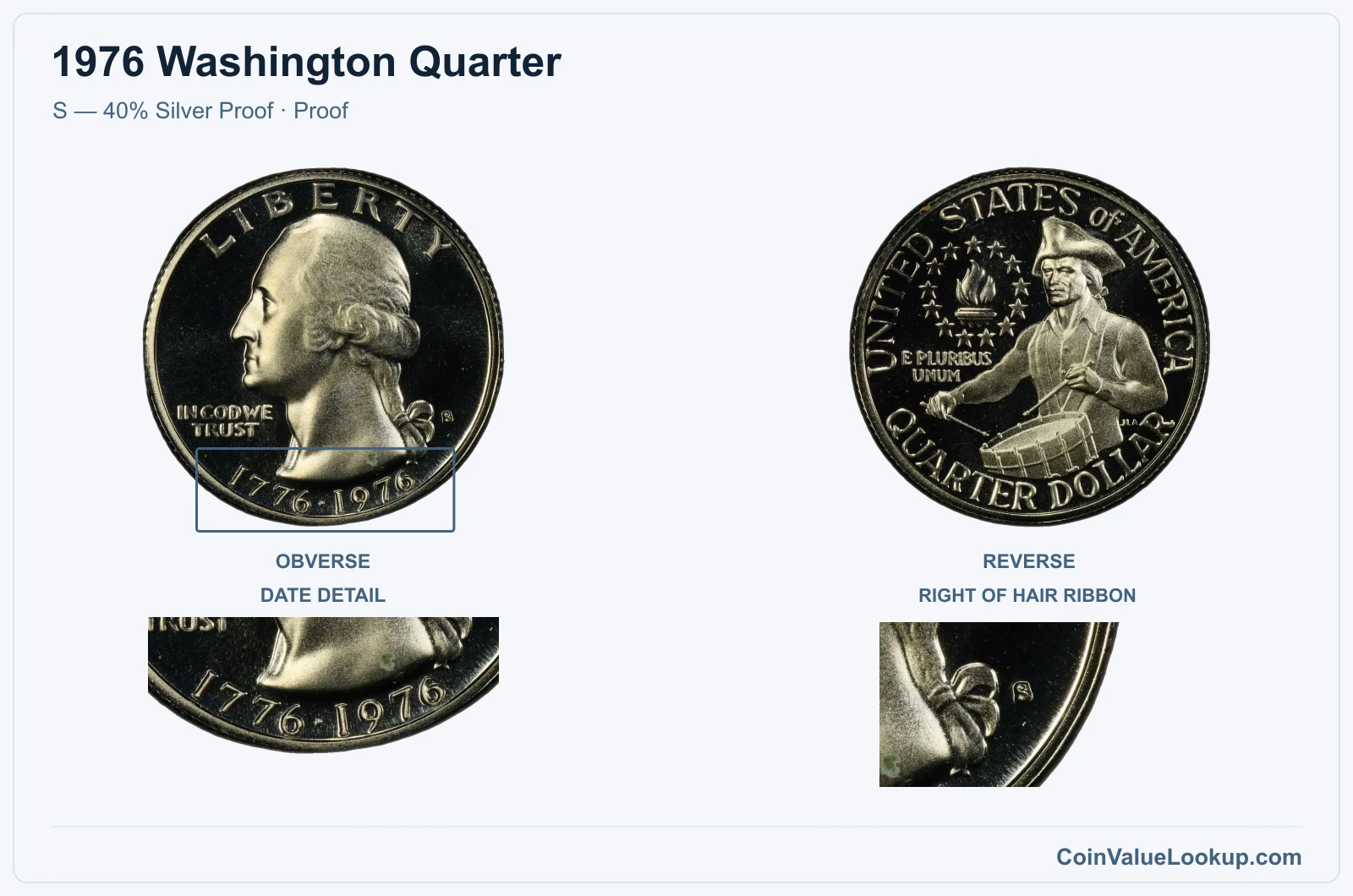
This is the top regular-issue version by guide value: a 40%-silver proof from San Francisco. USA Coin Book places PR65 at $14.
Silver proofs have deeply mirrored fields and crisp frosted design elements. They came in dedicated silver proof sets sold by the U.S. Mint.
The coin weighs about 5.75 grams and carries the S mintmark.
Before calling your coin a silver proof, verify it actually came from a silver set or has been professionally attributed. A clad proof looks very similar to the naked eye, and calling it silver without evidence is a common mistake.
When in doubt, a certified grading service can confirm composition.
Range Grade
Price1976 S — 40% Silver Proof (CAM) Price1976 S — 40% Silver Proof (DCAM) Auction Records Appraisal PR PR 1
—
Coin Identifier
PR 2
—
Coin Identifier
PR 3
—
Coin Identifier
PR 4
—
Coin Identifier
PR 6
—
Coin Identifier
PR 8
—
Coin Identifier
PR 10
—
Coin Identifier
PR 12
—
Coin Identifier
PR 15
—
Coin Identifier
PR 20
—
Coin Identifier
PR 25
—
Coin Identifier
PR 30
—
Coin Identifier
PR 35
—
Coin Identifier
PR 40
—
Coin Identifier
PR 45
—
Coin Identifier
PR 50
—
Coin Identifier
PR 53
—
Coin Identifier
PR 55
—
Coin Identifier
PR 58
—
Coin Identifier
PR 60
—
Coin Identifier
PR 61
—
Coin Identifier
PR 62
—
Coin Identifier
PR 63
—
Coin Identifier
PR 64
—
Coin Identifier
PR 65
Coin Identifier
PR 66
Coin Identifier
PR 67
Coin Identifier
PR 68
Coin Identifier
PR 69
Coin Identifier
PR 70
—
Coin Identifier
1976 Washington Quarter Error List
1. 1976 Washington Quarter — Doubled Die Obverse
Doubled die obverse varieties have been documented on 1976-D clad quarters. On a genuine DDO, you will see raised, separated contours on certain obverse lettering — a true doubling from a misaligned die impression, not surface damage.
Compare suspect lettering against a normal 1976-D coin at the same magnification. Machine doubling is flat and shelf-like, while a doubled die produces distinct raised outlines.
Damage, wear and die deterioration can also mimic doubling to an untrained eye.
Value depends entirely on the specific die variety, how visible the doubling is, and the coin's overall condition. Not every doubled coin carries the same premium, and professional attribution is essential before assuming significant value.
2. 1976 Washington Quarter — Missing Clad Layer
A 1976 Philadelphia quarter with its reverse clad layer missing before striking will show a copper-colored drummer side while the obverse looks normal. One NGC MS63 example weighing 4.7 grams sold at Heritage Auctions in January 2017 for $423.
The reduced weight is a key diagnostic — a normal clad quarter is about 5.67 grams. You also want to see proper struck texture on the copper surface, not a rough or pitted look that suggests post-mint stripping.
Watch out for lookalikes. Environmental toning can turn a coin brownish, and acid stripping removes the outer layer after minting.
Neither is a mint error. Also, do not confuse a normal 40%-silver S-mint coin with a missing clad layer issue; different mint, different metal, different story entirely.
3. 1976 Washington Quarter — Struck on a Nickel Planchet
A Bicentennial quarter struck on a nickel-sized planchet is a wrong-planchet error — the quarter dies hit a blank intended for a five-cent piece. A PCGS MS62 example sold at Heritage Auctions in August 2024 for $1,020.
You will notice the coin is smaller than a normal quarter, with design elements running off the edge because the planchet could not contain the full impression. The metal is a nickel alloy rather than clad, and measurements will differ from a standard quarter.
Do not confuse this with a normal quarter that has been cut down or filed after leaving the mint. Post-mint alteration leaves tool marks and uneven edges.
A genuine wrong-planchet strike shows proper die impressions on a smaller, coherent blank. Professional certification is necessary to confirm this error.
4. 1976 Washington Quarter — Double Strike and Rotation
A double-struck 1976-S silver proof quarter shows two separate impressions where the coin was struck, shifted or rotated, then struck again while still in the press. A PCGS PR64 example sold at Heritage Auctions in July 2021 for $1,920.
On the reported coin, both faces show overlapping but distinctly rotated design elements within the collar. The two impressions are visibly offset from each other.
Here is the critical distinction: proof coins are normally struck more than once to achieve their deep, sharp finish. That standard multi-blow process does not move the coin between strikes.
A genuine double-strike error involves actual displacement or rotation of the planchet. If both impressions align perfectly, you just have a regular proof doing its job.
Professional attribution is a must before claiming this error.
5. 1976 Washington Quarter — Quarter Struck Over a Dime
This is the headline piece: a 1976-S proof Bicentennial quarter struck over a 1967 Roosevelt dime. An NGC PR67 example sold at Heritage Auctions in January 2021 for $15,000.
The diagnostic is surviving undertype from the original dime visible beneath the quarter's design. The reported coin shows traces of a 1967 date within Washington's hair area and remnants of dime legends peeking through.
Both the quarter and dime designs coexist on one coin.
Do not confuse this with a quarter simply struck on a blank dime planchet, which is a different error category. And novelty pieces made outside the mint by pressing two coins together are worthless fakes.
A genuine double-denomination coin requires the undertype to be struck into the metal by mint equipment, not glued or pressed on. This kind of error demands professional authentication — no exceptions.
6. 1976 Washington Quarter — Doubled Die Reverse
Doubled die reverse varieties have been reported for 1976 quarters. On a genuine DDR, reverse legends or design elements like the drummer's outline show raised, separated doubling from a misaligned die hub impression.
Compare your coin's reverse lettering and design contours against a normal example at matching magnification. Machine doubling looks flat and shelf-like and carries little premium.
Reflections in proof surfaces can also create the illusion of doubling where none exists.
Value depends on the specific die, how pronounced the doubling is and the coin's condition. Not all doubled die reverses are equal.
If you spot something suspicious, professional attribution will tell you whether it is a recognized variety or just wishful thinking.
7. 1976 Washington Quarter — Off-Center Strike
Off-center strikes happen when the planchet is not properly seated between the dies. The result is a displaced design with an unstruck crescent of blank metal along part of the rim.
The key factor for value is how far off center the strike landed — and whether the date remains visible. A 5% off-center coin is a curiosity; a 50% off-center coin with a readable 1776–1976 date is a different conversation entirely.
Do not confuse an off-center strike with a clipped planchet or a coin that was flattened or bent after leaving the mint. Off-center coins have a complete, undamaged planchet edge on the blank portion.
Value depends on the percentage of displacement, the condition and the visibility of key design elements.
8. 1976 Washington Quarter — Repunched Mintmark
Repunched mintmark varieties occur when the mintmark punch was applied more than once in slightly different positions, leaving traces of the earlier placement. On a 1976 quarter, look at the mintmark to the right of Washington's bust under magnification.
A genuine RPM shows remnants of a secondary mintmark position — a partial letter slightly offset from the final one. Compare it to a normal coin's mintmark at the same magnification to see the difference.
Die chips filling part of the letter, corrosion around the mark and machine doubling can all mimic an RPM. Value depends on the specific variety, its visibility and the coin's overall grade.
Professional attribution confirms whether you have a recognized repunched mintmark or ordinary die wear.
9. 1976 Washington Quarter — Broadstrike
A broadstrike occurs when a coin is struck without the retaining collar that normally forms its edge and controls its diameter. The result is a coin that spreads outward, slightly larger than normal, with a smooth or malformed rim instead of the usual reeded edge.
The full design should still be present — just expanded. If major design elements are missing on one side, you may be looking at an off-center strike instead.
Coins flattened after minting by machinery, vehicles or deliberate pressure can mimic broadstrikes. Check the edge profile carefully: a genuine broadstrike shows uniform metal flow outward, not compression damage.
Value depends on how dramatic the spread is and the coin's condition. Professional certification strengthens any broadstrike claim.
10. 1976 Washington Quarter — Struck-Through Error
A struck-through error happens when foreign material — grease, a fragment of metal, cloth or other debris — sits between the die and the planchet during striking. The result is a localized depression, an impression of the obstruction or an area of incomplete design.
Grease-filled dies tend to create smooth, rounded depressions where details are simply absent. A retained foreign object can leave a distinct shape or texture in the coin's surface.
Do not confuse struck-through errors with ordinary wear, scratches from handling or cleaning damage. A genuine struck-through area is recessed into an otherwise properly struck surface.
The value depends on the size, location and visual impact of the obstruction impression, plus the coin's overall grade.
11. 1976 Washington Quarter — Clipped Planchet
A clipped planchet error means part of the metal blank was missing before the coin was struck. Clips can be curved, straight or irregular, depending on how the blank-cutting machinery malfunctioned.
Look for a missing portion of the coin's edge with smooth, undamaged metal at the clip boundary. A helpful secondary diagnostic is design weakness on the opposite side of the coin from the clip, caused by uneven metal flow during striking.
Filed edges, deliberate cuts and corrosion damage are common lookalikes. Post-mint damage typically shows tool marks, rough surfaces or sharp unnatural angles.
A genuine clip has consistent metal texture and a flow pattern that matches the strike. Value depends on clip size, type and the coin's overall condition.
12. 1976 Washington Quarter — Die Crack / Die Chip
Die cracks appear as raised lines on a coin's surface, formed when a crack in the steel die transfers as a ridge of metal during striking. A die chip creates a small raised blob.
When a crack extends to the rim and a chunk of the die breaks away, the result is called a cud — a raised, featureless lump at the edge.
These are easy to spot with a loupe. Raised lines or blobs are the key — incuse scratches are damage to the coin, not die cracks.
Corrosion, foreign material stuck to the surface and lamination flaws can look similar at a glance. Die cracks follow consistent paths and will appear on other coins struck from the same die.
Value depends on the size, location and visual impact of the crack or cud, plus the coin's condition.