1970 Washington Quarter Coin Value: How Much Is It Worth?
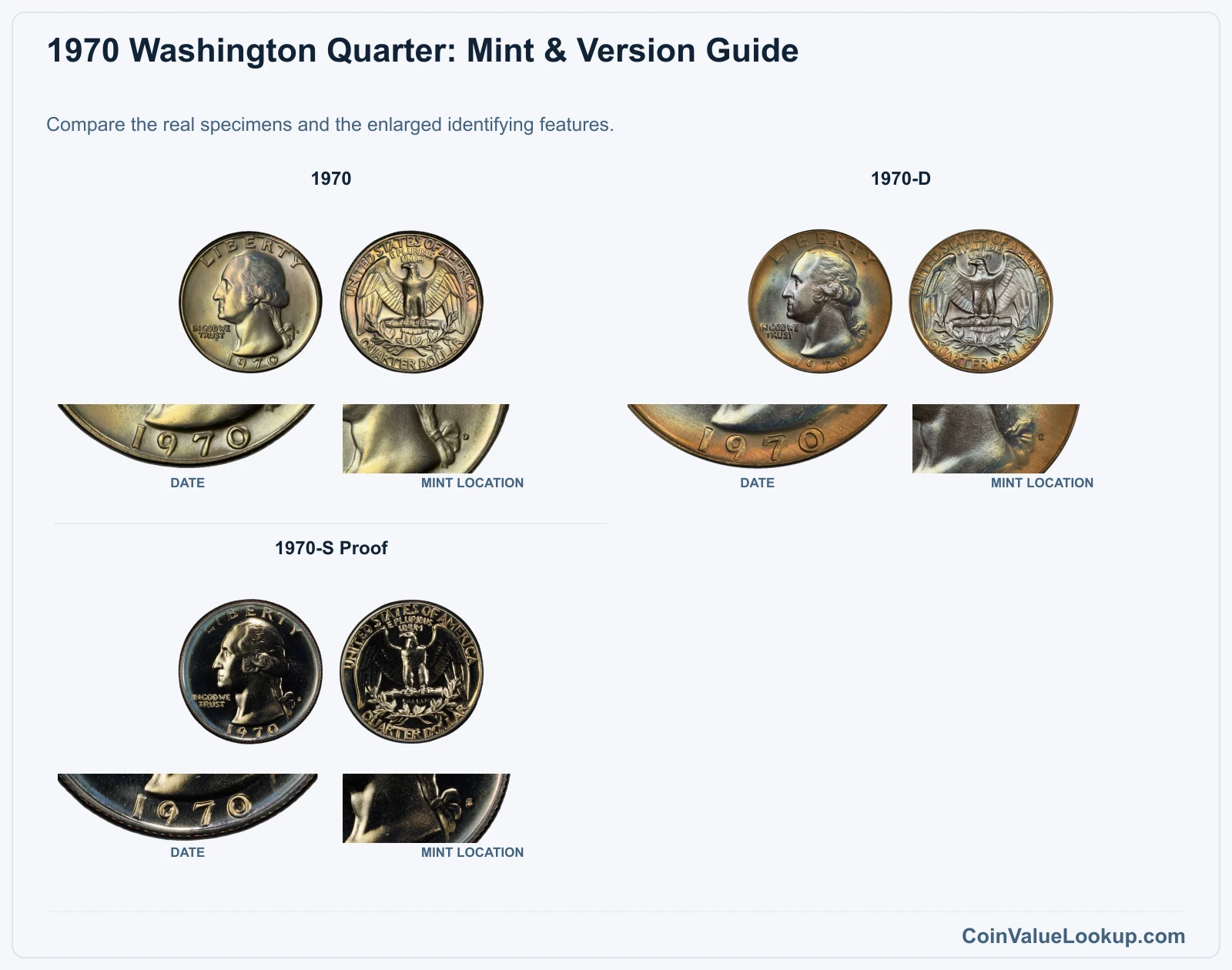
Most 1970 Washington quarters you find in change are worth face value — 25 cents. These copper-nickel clad coins were produced at Philadelphia, Denver, and San Francisco (proof only).
In higher uncirculated grades, guide estimates reach up to about $12 at MS65 for the Philadelphia issue. The real collector interest starts with genuine mint errors and scarce varieties, so those are worth checking carefully.
Fast Way to Identify Your 1970 Washington Quarter
The quickest way to figure out what you have is to upload clear photos of both sides of your coin. A front and back image lets us help with preliminary identification of the mint, finish, and any visible variety or error.
Snap the photos in good light and try to keep the coin in focus edge to edge.
1970 Washington Quarter Value
Upload both sides of your 1970 Washington Quarter.
Front Obverse
Upload photo
Back Reverse
Upload photo
Which 1970 Washington Quarter Versions Are Worth Money?
- The 1970 Philadelphia quarter can reach around $12 at MS65 according to a retail guide estimate — worth checking your pocket change for sharp, lustrous examples.
- The 1970-D struck on dime-thickness stock is a genuine mint error with quarter diameter but reduced thickness; one graded MS63 sold for $74.75 at Heritage in 2005.
- A 1970-D missing clad layer quarter sold for $104 in AU58 at Heritage in 2011 — look for exposed copper color on one face and reduced weight.
- The 1970-S proof double struck in collar is a dramatic error; a PCGS PR67 Cameo example brought $960 at Heritage in August 2024.
- Doubled die obverse and doubled die reverse varieties have been reported for the 1970 quarter and carry premiums tied to condition and visibility of the doubling.
Step 1: Identify Your 1970 Washington Quarter Mint Mark and Version
The 1970 Washington quarter uses a copper-nickel clad composition over a copper core, weighing about 5.67 grams with a diameter of roughly 24.3 mm. If you look at a normal clad edge, you will see the copper core sandwiched between nickel layers.
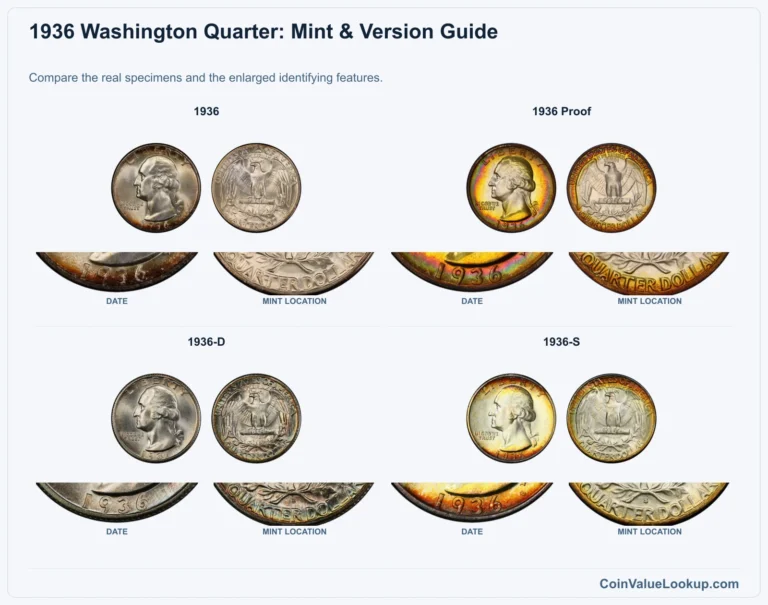
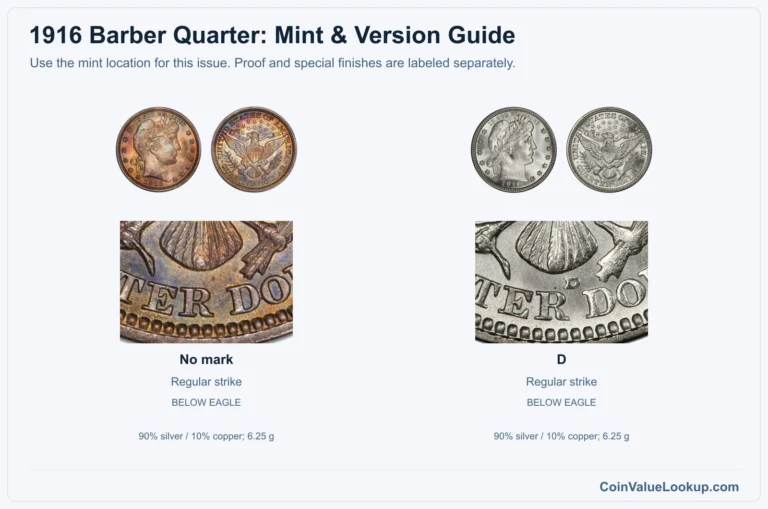
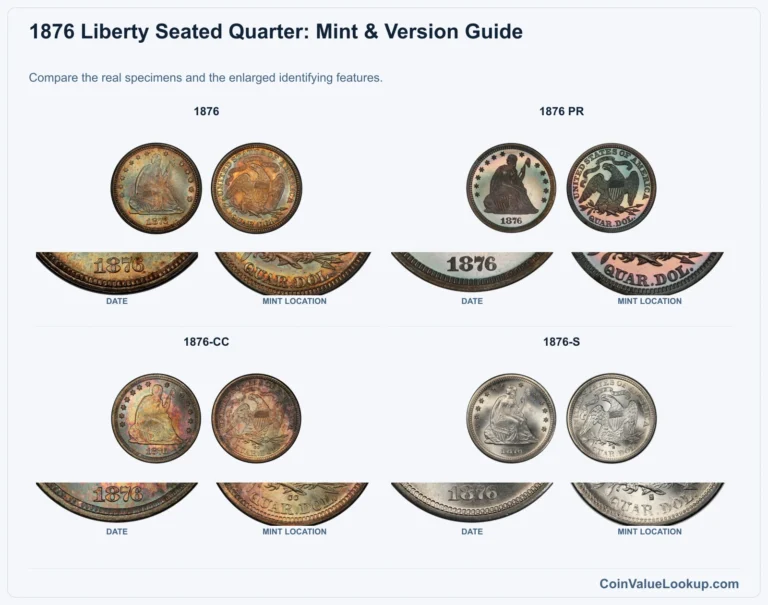
To identify the mint, check the obverse near the date. Philadelphia coins have no mintmark.
Denver coins show a small "D," and San Francisco coins carry an "S" — though the 1970-S was only struck in proof finish.
One thing that trips people up: thin dime-stock quarters exist for this year. These have full quarter diameter but are noticeably thinner.
They are not the same as a quarter struck on a small dime-sized planchet, and they are not just worn-down coins. Compare thickness and weight against a known normal quarter if yours seems unusually thin.
Also note that during 1965–1967, mintmarks were suppressed entirely, so a blank spot where a mintmark would go does not indicate a "missing mintmark error" on coins from those years. By 1970, mintmarks were back in use, so the absence of a letter on a 1970 quarter simply means Philadelphia.
Step 2: Check Your 1970 Washington Quarter Grade
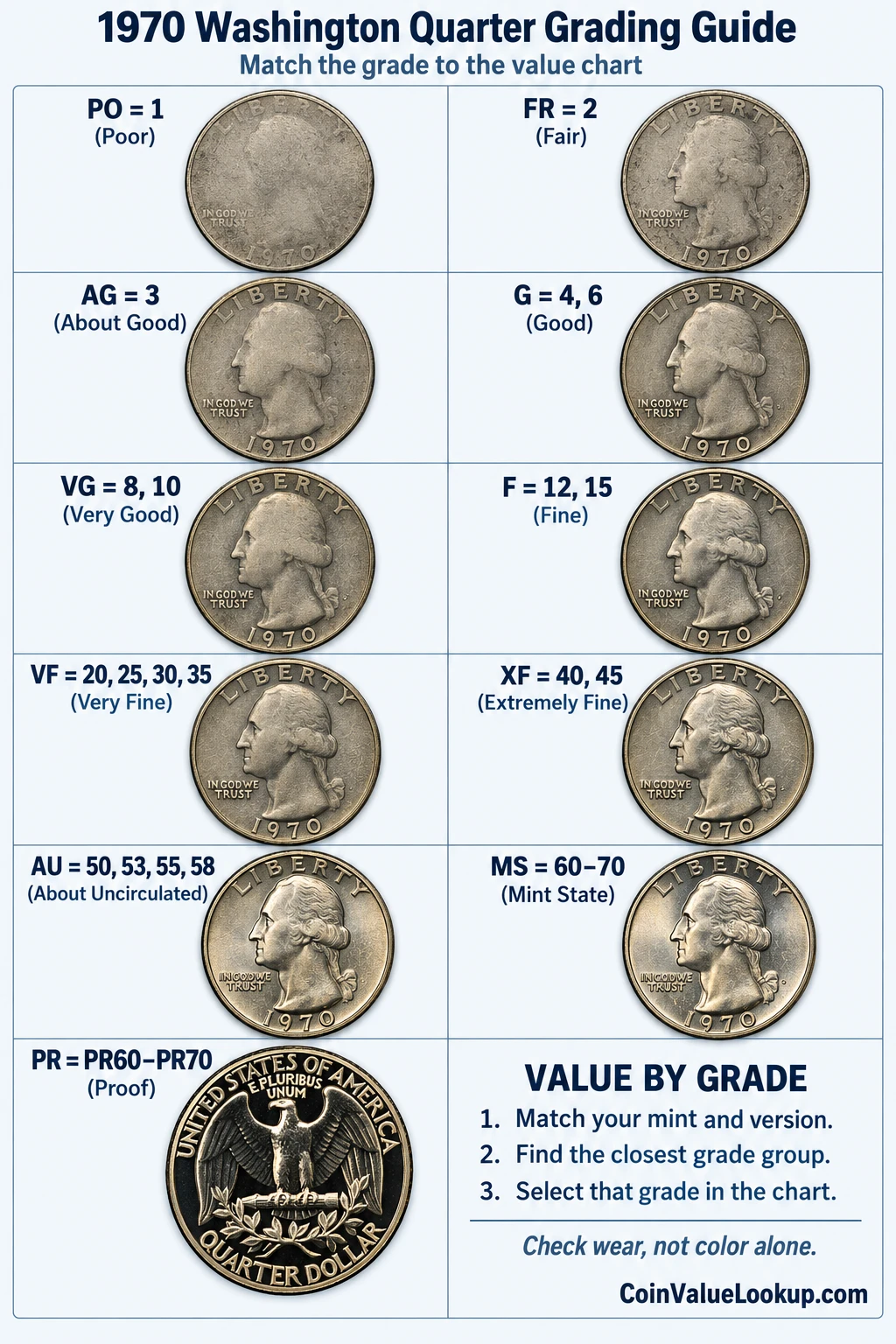
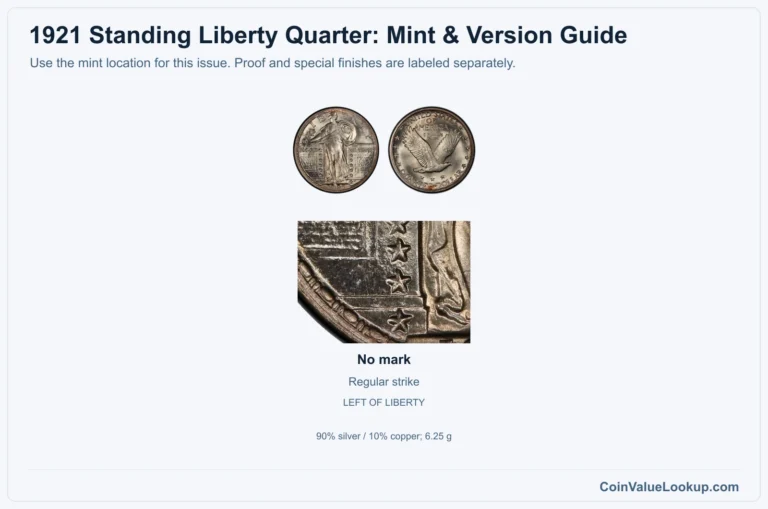
Start by examining the hair detail above Washington's ear and along the cheek and jawline. These are the first areas to show friction on a circulated coin.
On the reverse, the eagle's breast feathers lose definition early.
Compare your coin's luster to the reference image. Unbroken, cartwheel luster across the fields points toward mint state.
If you see breaks only in the highest relief, your coin may grade AU (About Uncirculated).
Surface marks, hairlines, and rim dings all pull the grade down, even on an otherwise sharp coin. On proofs, look for contact marks in the mirrored fields — those show up easily.
A coin that has been cleaned or polished cannot be reclassified as proof or SMS; finish and grade are separate things.
Step 3: Check 1970 Washington Quarter Value by Mint and Version
1970 Washington Quarter
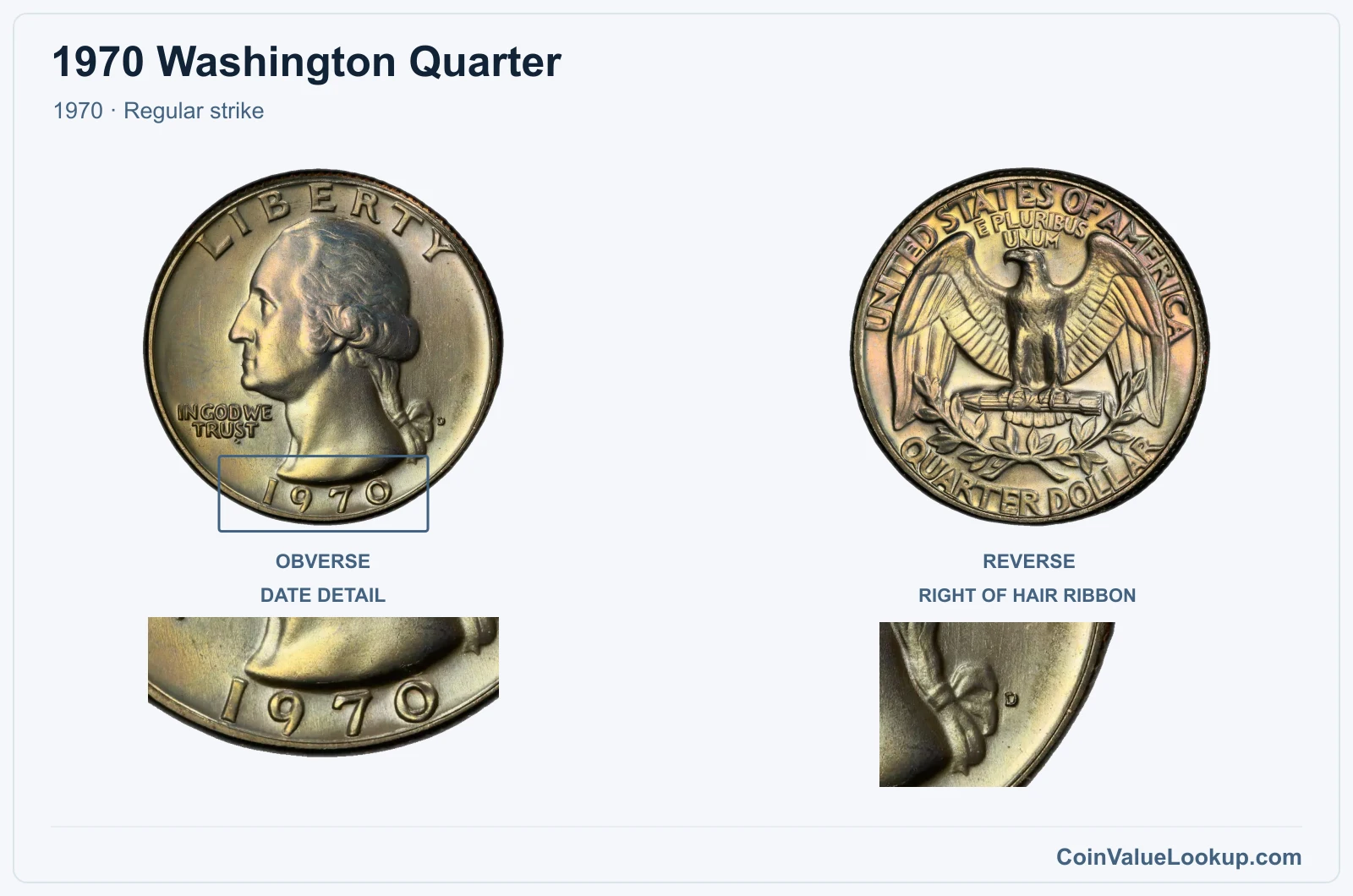
The 1970 Philadelphia quarter has no mintmark on the obverse. It is a copper-nickel clad business strike, the standard issue for circulation that year.
In typical worn condition, these trade at face value.
A USA Coin Book retail guide estimate places the MS65 value at about $12. That is a coin with full original luster, minimal bag marks, and sharp hair and eagle detail.
Below that grade, values taper off quickly toward face.
Coin Value Lookup is a handy starting point if you want to look up guides for other dates and denominations in the Washington quarter series.
| Range | Grade | Price | Auction Records | Appraisal |
|---|---|---|---|---|
| PO | PO 1 | — | Coin Identifier | |
| FR | FR 2 | — | Coin Identifier | |
| AG | AG 3 | — | Coin Identifier | |
| G | G 4 | — | Coin Identifier | |
| G 6 | — | Coin Identifier | ||
| VG | VG 8 | — | Coin Identifier | |
| VG 10 | — | Coin Identifier | ||
| F | F 12 | — | Coin Identifier | |
| F 15 | — | Coin Identifier | ||
| VF | VF 20 | — | Coin Identifier | |
| VF 25 | — | Coin Identifier | ||
| VF 30 | — | Coin Identifier | ||
| VF 35 | — | Coin Identifier | ||
| XF | XF 40 | — | Coin Identifier | |
| XF 45 | — | Coin Identifier | ||
| AU | AU 50 | — | Coin Identifier | |
| AU 53 | — | Coin Identifier | ||
| AU 55 | — | Coin Identifier | ||
| AU 58 | — | Coin Identifier | ||
| MS | MS 60 | — | Coin Identifier | |
| MS 61 | — | Coin Identifier | ||
| MS 62 | — | Coin Identifier | ||
| MS 63 | — | Coin Identifier | ||
| MS 64 | Coin Identifier | |||
| MS 65 | Coin Identifier | |||
| MS 66 | Coin Identifier | |||
| MS 67 | Coin Identifier | |||
| MS 68 | — | — | — | |
| MS 69 | — | — | — | |
| MS 70 | — | — | — |
1970 Washington Quarter — D
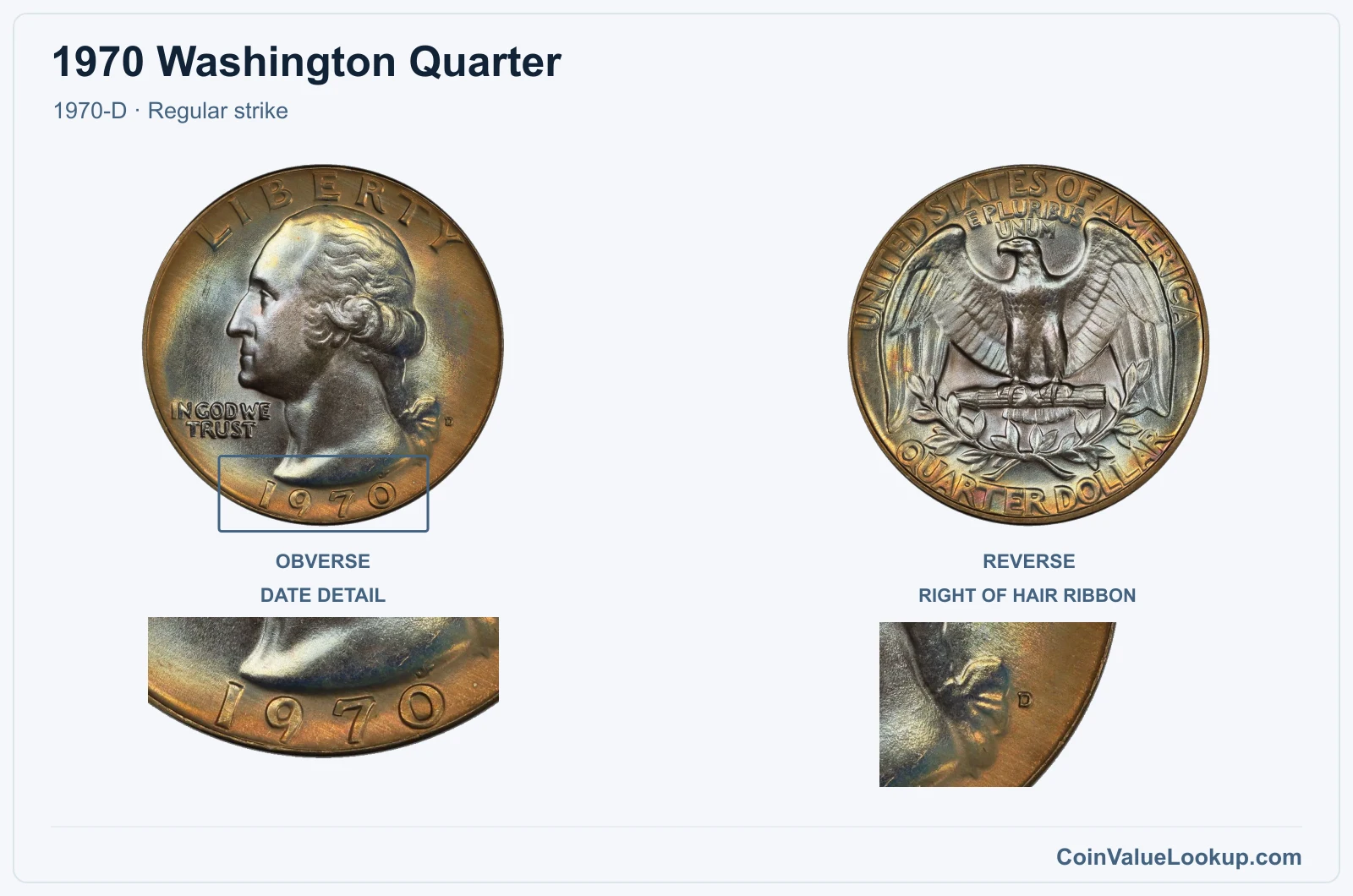
The 1970-D quarter carries a small "D" mintmark near the date on the obverse. Like its Philadelphia counterpart, it is a copper-nickel clad business strike intended for everyday commerce.
A retail guide estimate puts the MS65 value at roughly $7.29. Circulated pieces are face-value coins.
What makes the 1970-D interesting is that several documented mint errors originate from the Denver facility this year, including the thin dime-stock strike and missing clad layer varieties, so it is worth giving your Denver coins a second look.
| Range | Grade | Price | Auction Records | Appraisal |
|---|---|---|---|---|
| PO | PO 1 | — | Coin Identifier | |
| FR | FR 2 | — | Coin Identifier | |
| AG | AG 3 | — | Coin Identifier | |
| G | G 4 | — | Coin Identifier | |
| G 6 | — | Coin Identifier | ||
| VG | VG 8 | — | Coin Identifier | |
| VG 10 | — | Coin Identifier | ||
| F | F 12 | — | Coin Identifier | |
| F 15 | — | Coin Identifier | ||
| VF | VF 20 | — | Coin Identifier | |
| VF 25 | — | Coin Identifier | ||
| VF 30 | — | Coin Identifier | ||
| VF 35 | — | Coin Identifier | ||
| XF | XF 40 | — | Coin Identifier | |
| XF 45 | — | Coin Identifier | ||
| AU | AU 50 | — | Coin Identifier | |
| AU 53 | — | Coin Identifier | ||
| AU 55 | — | Coin Identifier | ||
| AU 58 | — | Coin Identifier | ||
| MS | MS 60 | — | Coin Identifier | |
| MS 61 | Coin Identifier | |||
| MS 62 | — | Coin Identifier | ||
| MS 63 | — | Coin Identifier | ||
| MS 64 | Coin Identifier | |||
| MS 65 | Coin Identifier | |||
| MS 66 | Coin Identifier | |||
| MS 67 | Coin Identifier | |||
| MS 68 | Coin Identifier | |||
| MS 69 | — | — | — | |
| MS 70 | — | — | — |
1970 Washington Quarter — S Proof
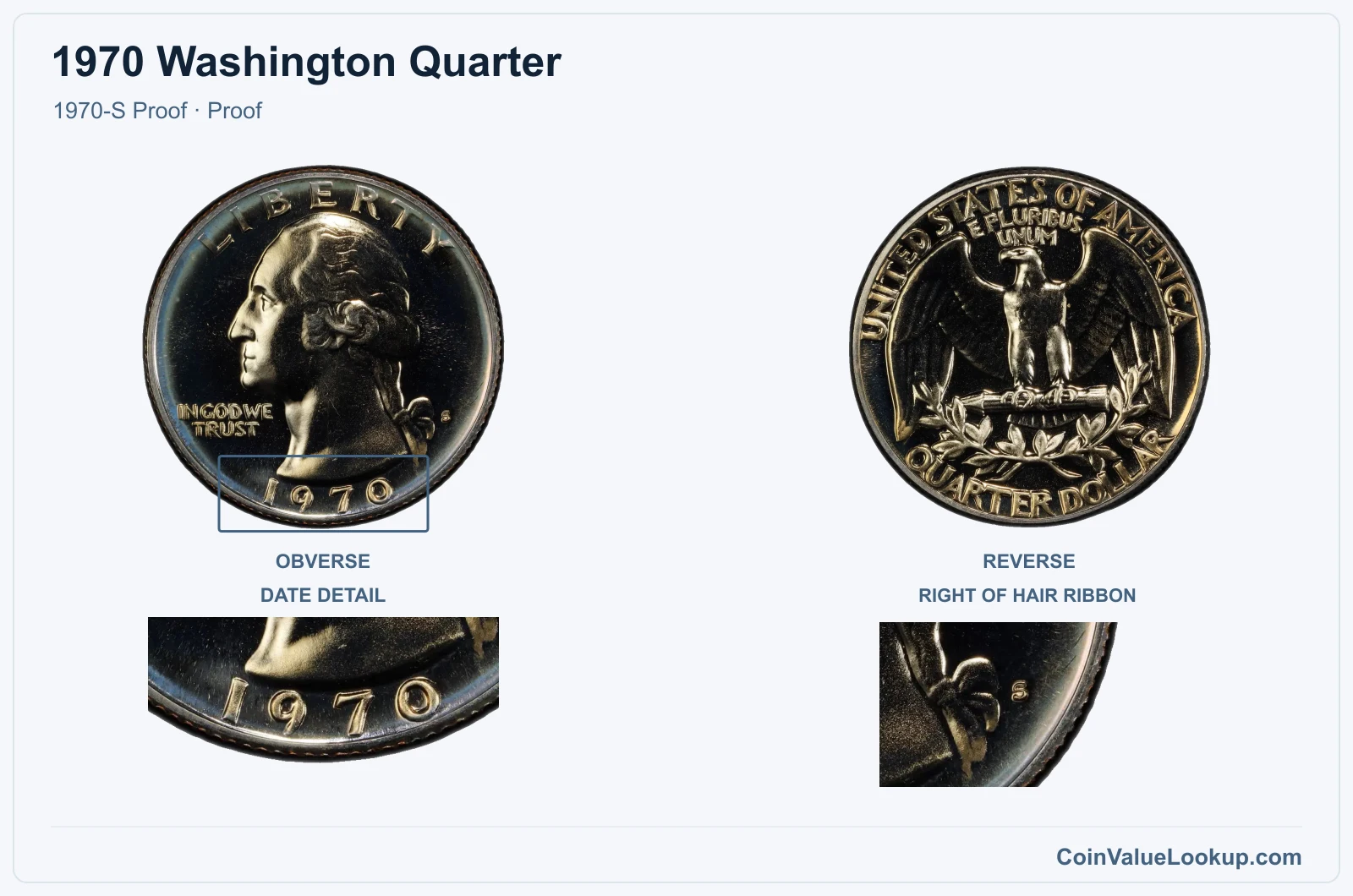
The 1970-S proof quarter was struck at San Francisco exclusively in proof finish. You will find the "S" mintmark on the obverse near the date.
These were sold in proof sets, not released into circulation.
At PR65, a retail guide estimate is about $6.25. Proofs should display mirrored fields and sharply frosted devices when well preserved.
Contact marks in the mirror fields, haze, or toning will affect the grade and eye appeal. If yours came loose rather than in an original government case, inspect it carefully for handling damage.
| Range | Grade | Price | Auction Records | Appraisal |
|---|---|---|---|---|
| PR | PR 1 | — | Coin Identifier | |
| PR 2 | — | Coin Identifier | ||
| PR 3 | — | Coin Identifier | ||
| PR 4 | — | Coin Identifier | ||
| PR 6 | — | Coin Identifier | ||
| PR 8 | — | Coin Identifier | ||
| PR 10 | — | Coin Identifier | ||
| PR 12 | — | Coin Identifier | ||
| PR 15 | — | Coin Identifier | ||
| PR 20 | — | Coin Identifier | ||
| PR 25 | — | Coin Identifier | ||
| PR 30 | — | Coin Identifier | ||
| PR 35 | — | Coin Identifier | ||
| PR 40 | — | Coin Identifier | ||
| PR 45 | — | Coin Identifier | ||
| PR 50 | — | Coin Identifier | ||
| PR 53 | — | Coin Identifier | ||
| PR 55 | — | Coin Identifier | ||
| PR 58 | — | Coin Identifier | ||
| PR 60 | — | Coin Identifier | ||
| PR 61 | — | Coin Identifier | ||
| PR 62 | — | Coin Identifier | ||
| PR 63 | — | Coin Identifier | ||
| PR 64 | — | Coin Identifier | ||
| PR 65 | — | Coin Identifier | ||
| PR 66 | Coin Identifier | |||
| PR 67 | Coin Identifier | |||
| PR 68 | Coin Identifier | |||
| PR 69 | Coin Identifier | |||
| PR 70 | — | — | — |
1970 Washington Quarter Error List
1. 1970 Washington Quarter — Struck on Dime-Thickness Stock
A 1970-D quarter struck on dime-thickness stock has the full quarter diameter of about 24.3 mm but is noticeably thinner and lighter than a normal quarter. The thin blank could not fill the dies completely, so the strike appears weak or mushy compared to a properly struck coin.
Do not confuse this with a quarter struck on a small dime-sized planchet — that would be a different diameter entirely. And do not mistake post-mint filing, corrosion, or ordinary wear for genuine thin stock.
Measure diameter, thickness, and weight together.
One certified example, graded NGC MS63, sold for $74.75 at Heritage Auctions in February 2005. Third-party certification is important here because the differences are subtle enough that visual inspection alone can be misleading.
2. 1970 Washington Quarter — Missing Clad Layer
A 1970-D quarter with a missing clad layer is missing the nickel-clad strip from one face, exposing the copper core underneath. The coin will weigh less than the normal 5.67 grams and will be visibly thinner on the affected side.
The copper surface has a distinctive warm brown or reddish tone, but color alone is not proof — chemical stripping, environmental damage, and post-mint plating can all mimic the look. Genuine examples show proper strike detail on the exposed copper surface without tool marks or acid etching.
An ANACS AU58 specimen sold for $104 at Heritage Auctions in December 2011. Professional attribution matters because the lookalikes are common and easy to mistake for the real thing.
3. 1970 Washington Quarter — Obverse Double Struck in Collar
This is a 1970-S proof quarter that received two separate strikes while remaining inside the collar. The result is a doubled image on the obverse where the second impression is offset from the first, while the reeded edge stays normal because the collar held the planchet in place throughout.
This is different from a doubled die, which shows doubling from a single strike using an improperly made die. Here you can see two distinct, complete impressions overlapping.
Look carefully at the lettering and portrait for that telltale second ghost image.
A PCGS PR67 Cameo example sold for $960 at Heritage Auctions on August 18, 2024. That strong price reflects both the dramatic visual and the rarity of proof mint errors in general.
4. 1970 Washington Quarter — Doubled Die Obverse
A doubled die obverse variety has been reported for the 1970-D quarter. On this type of error, the die itself carried a doubled image, which means every coin struck from that die shows the same consistent doubling.
Look at the obverse lettering and date under magnification. Genuine hub doubling produces separation or notching that is consistent from one affected element to the next.
Machine doubling — which is common and worth very little — tends to show a flat, shelf-like displacement rather than distinct raised separation.
No specific price data is available here, but value depends on the visibility of the doubling, the coin's overall condition, and third-party attribution of the specific die variety.
5. 1970 Washington Quarter — Doubled Die Reverse
A doubled die reverse error has been reported for the 1970 quarter. This involves doubling on the reverse design elements caused during the die-making process, not during the strike itself.
Examine the reverse legends and the eagle's detail under magnification. Compare what you see against a normal 1970 quarter in similar lighting.
Genuine die doubling will be consistent and repeatable across the affected areas, while machine doubling tends to look mushy and flat.
Random nicks, reflections, or worn-die softness can also fool the eye, so take your time. No specific price data is available, but the value of any doubled die depends on the degree of doubling, overall condition, and professional attribution.
6. 1970 Washington Quarter — Off-Center Strike
Off-center strike errors have been reported for the 1970 quarter. An off-center coin shows a displaced design with a blank crescent where the planchet was not covered by the dies.
The most collectible off-center errors still show a readable date, since that confirms the year and makes attribution possible. Coins struck significantly off center without a visible date are harder to sell.
Do not confuse this with a straight clip, a misaligned die that still struck a full-diameter coin, or post-mint damage that flattened one side. Genuine off-center strikes show an unstruck area with the original planchet surface intact.
No specific price is available, but value depends on the percentage off center, date visibility, and overall condition.