1857 Flying Eagle Cent Coin Value: How Much Is It Worth?
The 1857 Flying Eagle cent marks a turning point in American coinage — the first small cent struck for general circulation. Guide estimates for ordinary business strikes range from about $38 in G4 to $1,295 in MS63, while proofs and scarce hub varieties require separate evaluation.
Identifying your exact variety is the critical first step.
Fast Way to Identify Your 1857 Flying Eagle Cent
Want a quick read on what you have? Upload clear photos of the front and back of your 1857 cent, and our identifier can offer a preliminary take on the variety and condition.
It will not authenticate, certify, or give you a final grade, but it is a solid starting point before you dig deeper.
1857 Flying Eagle Cent Value
Upload both sides of your 1857 Flying Eagle Cent.
Front Obverse
Upload photo
Back Reverse
Upload photo
Which 1857 Flying Eagle Cent Versions Are Worth Money?
- The 1857 Proof Flying Eagle cent is cataloged with a guide value around $10,016 at PR63 — genuine proofs require expert attribution of surfaces, rims, and die characteristics.
- The 1857 business strike ranges from roughly $38 in G4 to $1,295 in MS63, making even well-worn examples worth checking.
- An "Obverse of 1856" hub variety exists and is identified by a distinctive squared O in OF; no standard numeric price is adopted, so value depends on authenticated identity and condition.
- Several mint error categories — doubled die obverse, repunched date, clashed dies, broadstrike, and clipped planchet — are reported for this date and can add premium when properly attributed.
Step 1: Identify Your 1857 Flying Eagle Cent Mint Mark and Version
The year 1857 saw two very different United States cent types in production: the old Large Cent and the brand-new Flying Eagle small cent. They are easy to tell apart — the Large Cent is roughly 28 mm and all copper, while the Flying Eagle is 19 mm and struck in 88% copper / 12% nickel.
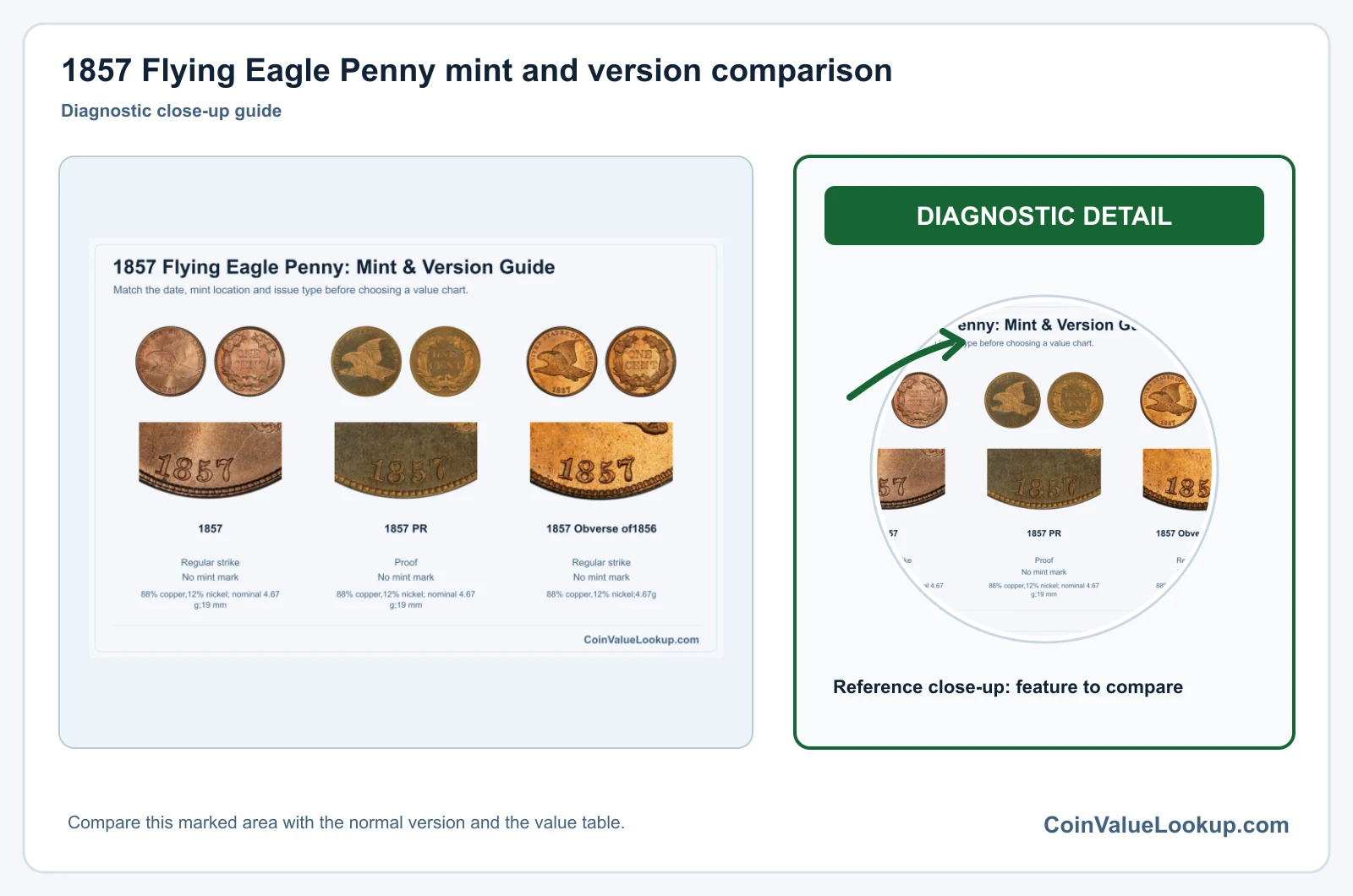
All 1857 Flying Eagle cents were made at Philadelphia. There is no mintmark on a genuine example, and you should not expect one.
Look carefully at both sides and the edge. The obverse shows a flying eagle with the date below; the reverse features a wreath enclosing ONE CENT.
Date-punch shape and letter style matter — an "Obverse of 1856" hub variety exists and is identified by a squared inner opening on the letter O in OF on the obverse, compared to the normal rounded O.
Weight can support your identification — the nominal spec is 4.67 grams — but wear, corrosion, and production tolerances mean weight alone cannot prove authenticity. Always cross-check the design details.
Step 2: Check Your 1857 Flying Eagle Cent Grade
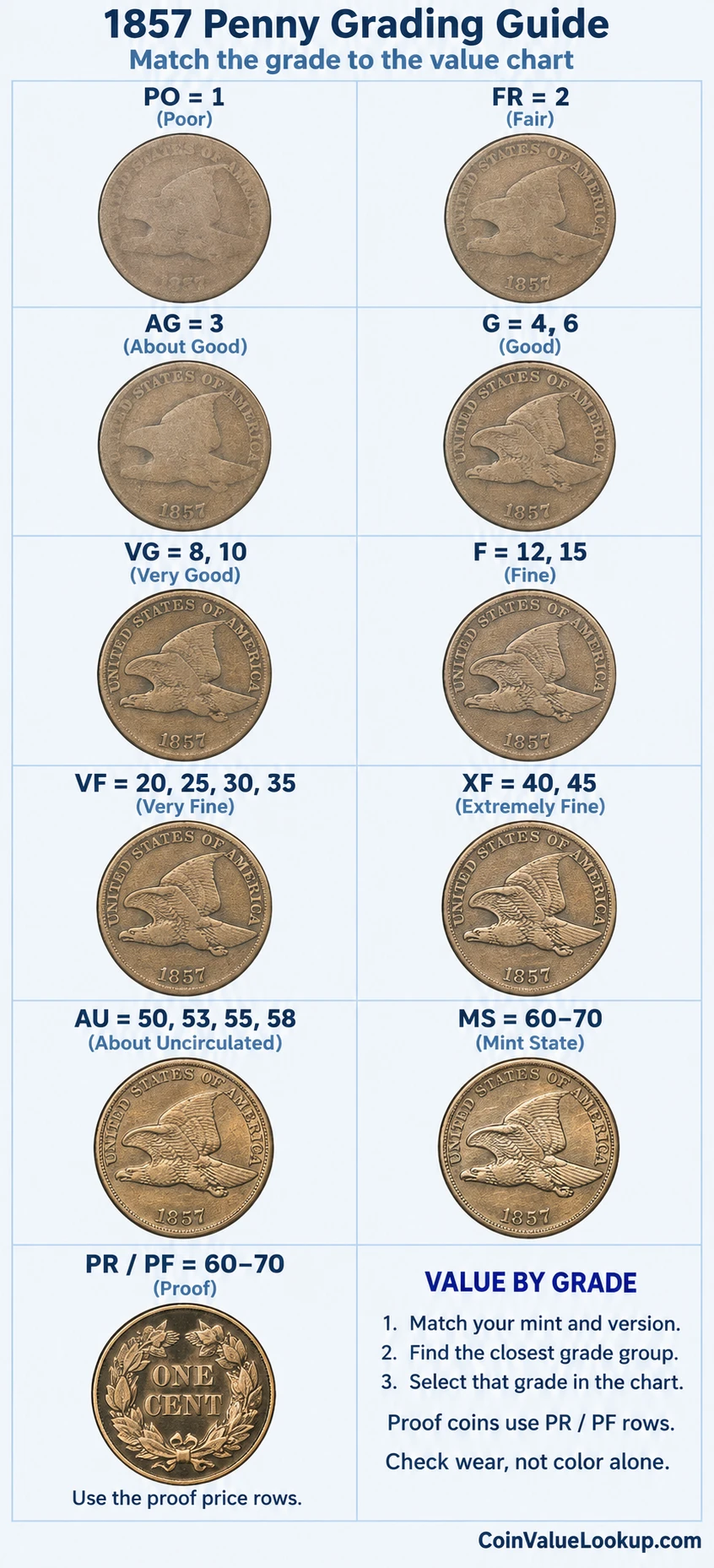
For a Flying Eagle cent, start with the eagle's head and breast feathers on the obverse. In lower grades these merge into a flat mass; by AU most individual feathers should be visible with only slight highpoint wear.
The wing tips lose detail quickly in circulation, so partial feather separation there is normal even in VF.
On the reverse, check the wreath leaves. Sharp veins and distinct leaf edges indicate a higher grade.
Letters in ONE CENT and UNITED STATES OF AMERICA wear down progressively from the highpoints.
Be careful to separate honest circulation wear from a weak strike, which was common on this type. A weakly struck coin may look lower-grade than it actually is.
Corrosion, porosity, and old cleaning will also reduce market appeal regardless of the remaining detail.
Color designations like BN (brown), RB (red-brown), and RD (red) describe the surface color of the copper-nickel alloy, not different metals. And remember: Proof is a method of manufacture, not a grade above Mint State.
Use the comparison image alongside your coin under consistent lighting to judge where it falls.
Step 3: Check 1857 Flying Eagle Cent Value by Mint and Version
1857 Flying Eagle Cent
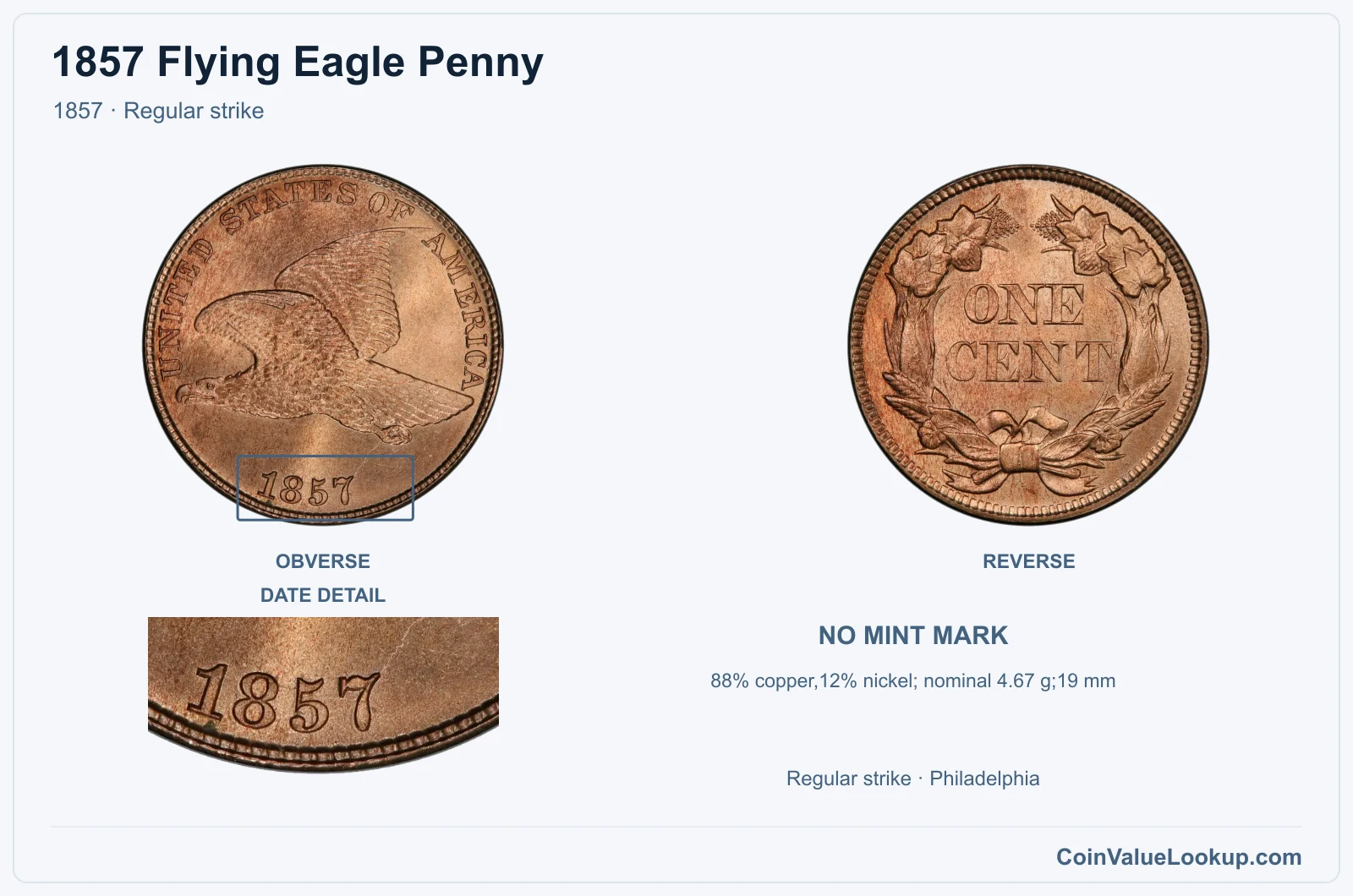
This is the standard 1857 Flying Eagle cent struck for circulation at Philadelphia. It uses an 88% copper, 12% nickel alloy at a nominal 4.67 grams and 19 mm diameter — a dramatic size reduction from the old Large Cent it replaced.
Guide estimates from USA Coin Book place this coin at about $38 in G4 and around $1,295 in MS63. Even heavily worn examples carry a baseline collectible value because the series ran for only two regular-issue years (1857–1858).
Mint-state pieces with strong strikes and clean surfaces command the upper end of that range.
| Range | Grade | Price | Auction Records | Appraisal |
|---|---|---|---|---|
| PO | PO 1 | — | Coin Identifier | |
| FR | FR 2 | — | Coin Identifier | |
| AG | AG 3 | Coin Identifier | ||
| G | G 4 | Coin Identifier | ||
| G 6 | Coin Identifier | |||
| VG | VG 8 | Coin Identifier | ||
| VG 10 | Coin Identifier | |||
| F | F 12 | Coin Identifier | ||
| F 15 | Coin Identifier | |||
| VF | VF 20 | Coin Identifier | ||
| VF 25 | Coin Identifier | |||
| VF 30 | Coin Identifier | |||
| VF 35 | Coin Identifier | |||
| XF | XF 40 | Coin Identifier | ||
| XF 45 | Coin Identifier | |||
| AU | AU 50 | Coin Identifier | ||
| AU 53 | Coin Identifier | |||
| AU 55 | Coin Identifier | |||
| AU 58 | Coin Identifier | |||
| MS | MS 60 | Coin Identifier | ||
| MS 61 | Coin Identifier | |||
| MS 62 | Coin Identifier | |||
| MS 63 | Coin Identifier | |||
| MS 64 | Coin Identifier | |||
| MS 65 | Coin Identifier | |||
| MS 66 | Coin Identifier | |||
| MS 67 | — | — | — | |
| MS 68 | — | — | — | |
| MS 69 | — | — | — | |
| MS 70 | — | — | — |
1857 Flying Eagle Cent — PR
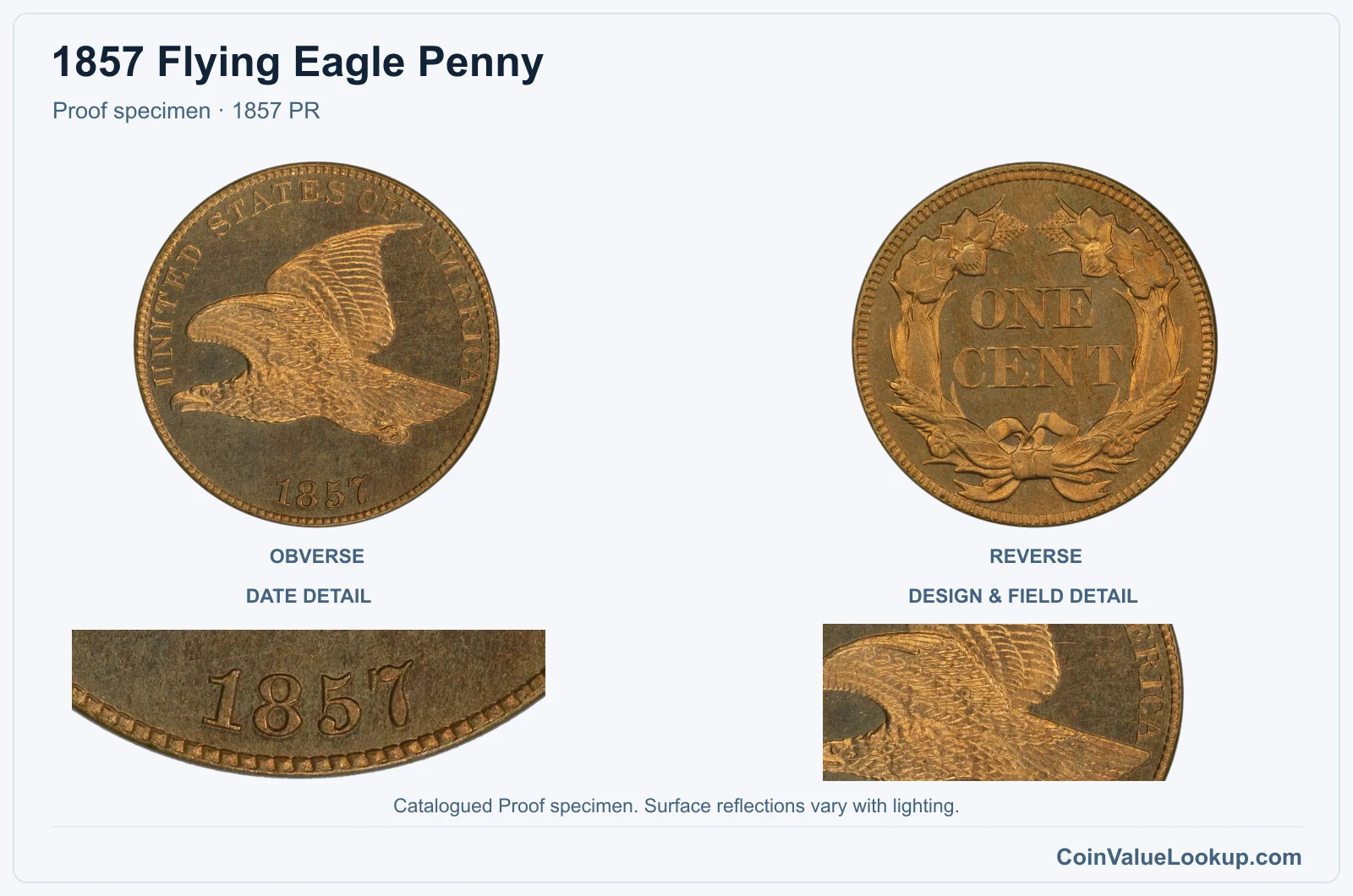
Philadelphia also produced proof 1857 Flying Eagle cents, and these are genuinely rare. A guide estimate of approximately $10,016 at PR63 gives you a sense of the tier, but the real challenge is confirming you actually have one.
A proof is defined by its method of manufacture — specially prepared dies, carefully fed planchets, and typically multiple strikes producing sharp detail and mirror-like fields. Polishing a business strike does not create a proof.
Authentic examples require attribution of die characteristics, rim finish, and surface quality, ideally by a recognized grading service. No ordinary business-strike price should be applied to a proof, and vice versa.
Coin Value Lookup is a useful place to browse guides for this and other early cent series when you are narrowing down what you have.
| Range | Grade | Price | Auction Records | Appraisal |
|---|---|---|---|---|
| PR | PR 1 | — | Coin Identifier | |
| PR 2 | — | Coin Identifier | ||
| PR 3 | — | Coin Identifier | ||
| PR 4 | — | Coin Identifier | ||
| PR 6 | — | Coin Identifier | ||
| PR 8 | — | Coin Identifier | ||
| PR 10 | — | Coin Identifier | ||
| PR 12 | — | Coin Identifier | ||
| PR 15 | — | Coin Identifier | ||
| PR 20 | — | Coin Identifier | ||
| PR 25 | — | Coin Identifier | ||
| PR 30 | — | Coin Identifier | ||
| PR 35 | — | Coin Identifier | ||
| PR 40 | — | Coin Identifier | ||
| PR 45 | — | Coin Identifier | ||
| PR 50 | — | Coin Identifier | ||
| PR 53 | — | Coin Identifier | ||
| PR 55 | — | Coin Identifier | ||
| PR 58 | — | Coin Identifier | ||
| PR 60 | Coin Identifier | |||
| PR 61 | Coin Identifier | |||
| PR 62 | Coin Identifier | |||
| PR 63 | Coin Identifier | |||
| PR 64 | Coin Identifier | |||
| PR 65 | Coin Identifier | |||
| PR 66 | Coin Identifier | |||
| PR 67 | — | — | — | |
| PR 68 | — | — | — | |
| PR 69 | — | — | — | |
| PR 70 | — | — | — |
1857 Flying Eagle Cent — Obverse of1856
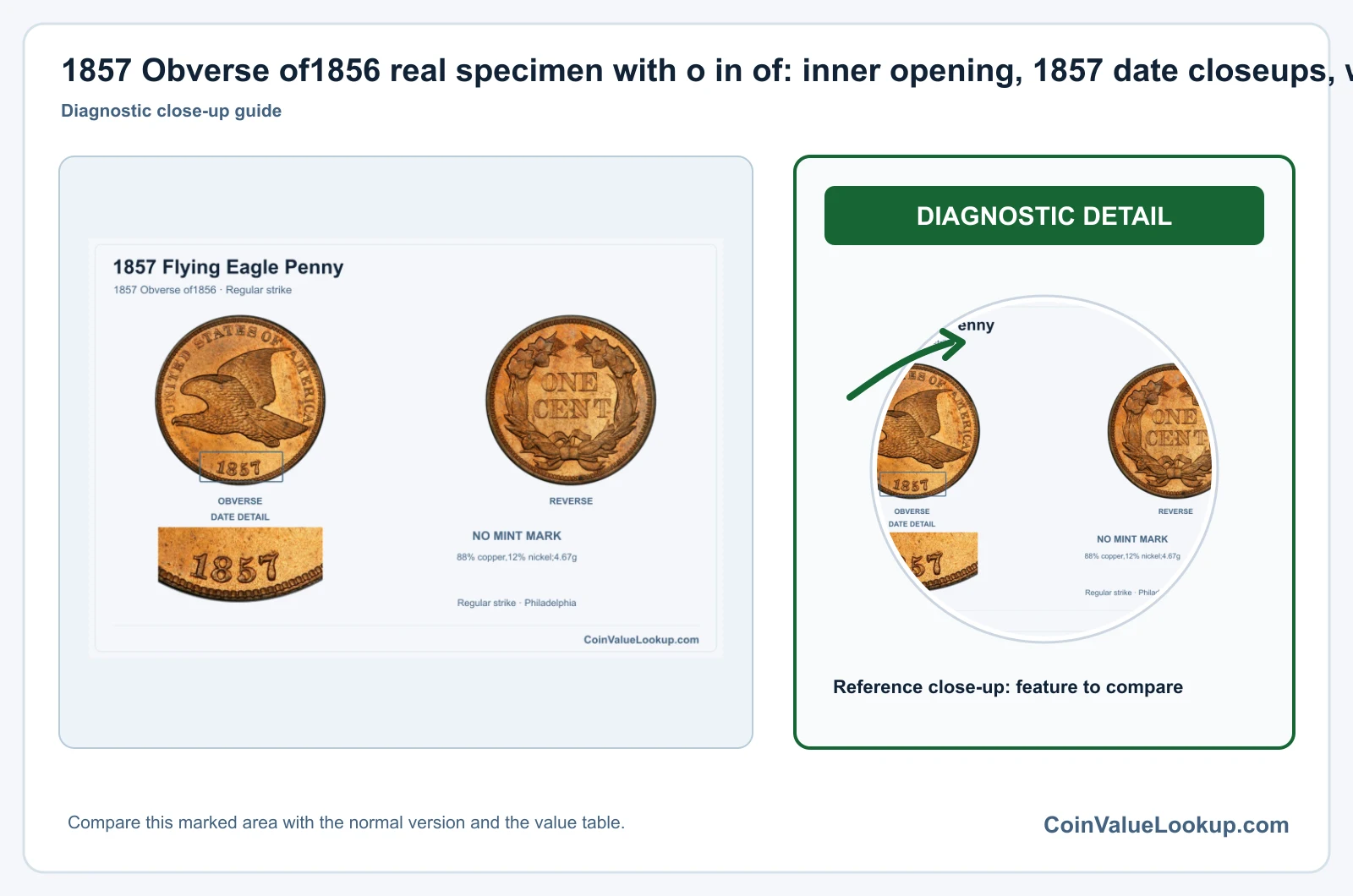
This variety uses an obverse hub originally prepared for the 1856 pattern Flying Eagle cent. The key diagnostic is the letter O in OF on the obverse: on the Obverse of 1856 hub, that O has a distinctly squared inner opening, while the standard 1857 hub shows a rounded O.
This is a hub variety, not an overdate — the date itself reads 1857. Compare the O in OF side by side with a normal example and the difference is clear under modest magnification.
No standard numeric price range is adopted for this variety. Value depends on authenticated identity and condition assessed individually.
Because it ties directly to the famous 1856 pattern, collectors of the series pay close attention to it.
Ordinary-issue reference: Ordinary-issue reference only: The table below shows prices for the 1857 Flying Eagle Cent (regular strike). It does not represent the value of the specific 1857 Obverse of1856 variety or its variety premium. Year, mint, metal and strike type are matched; the specific variety is not priced by this table.
Range Grade
Price Auction Records Appraisal PO PO 1
—
Coin Identifier FR FR 2
—
Coin Identifier AG AG 3
Coin Identifier G G 4
Coin Identifier
G 6
Coin Identifier VG VG 8
Coin Identifier
VG 10
Coin Identifier F F 12
Coin Identifier
F 15
Coin Identifier VF VF 20
Coin Identifier
VF 25
Coin Identifier
VF 30
Coin Identifier
VF 35
Coin Identifier XF XF 40
Coin Identifier
XF 45
Coin Identifier AU AU 50
Coin Identifier
AU 53
Coin Identifier
AU 55
Coin Identifier
AU 58
Coin Identifier MS MS 60
Coin Identifier
MS 61
Coin Identifier
MS 62
Coin Identifier
MS 63
Coin Identifier
MS 64
Coin Identifier
MS 65
Coin Identifier
MS 66
Coin Identifier
MS 67
—
—
—
MS 68
—
—
—
MS 69
—
—
—
MS 70
—
—
—
1857 Flying Eagle Cent Error List
1. 1857 Flying Eagle Cent — Doubled Die Obverse
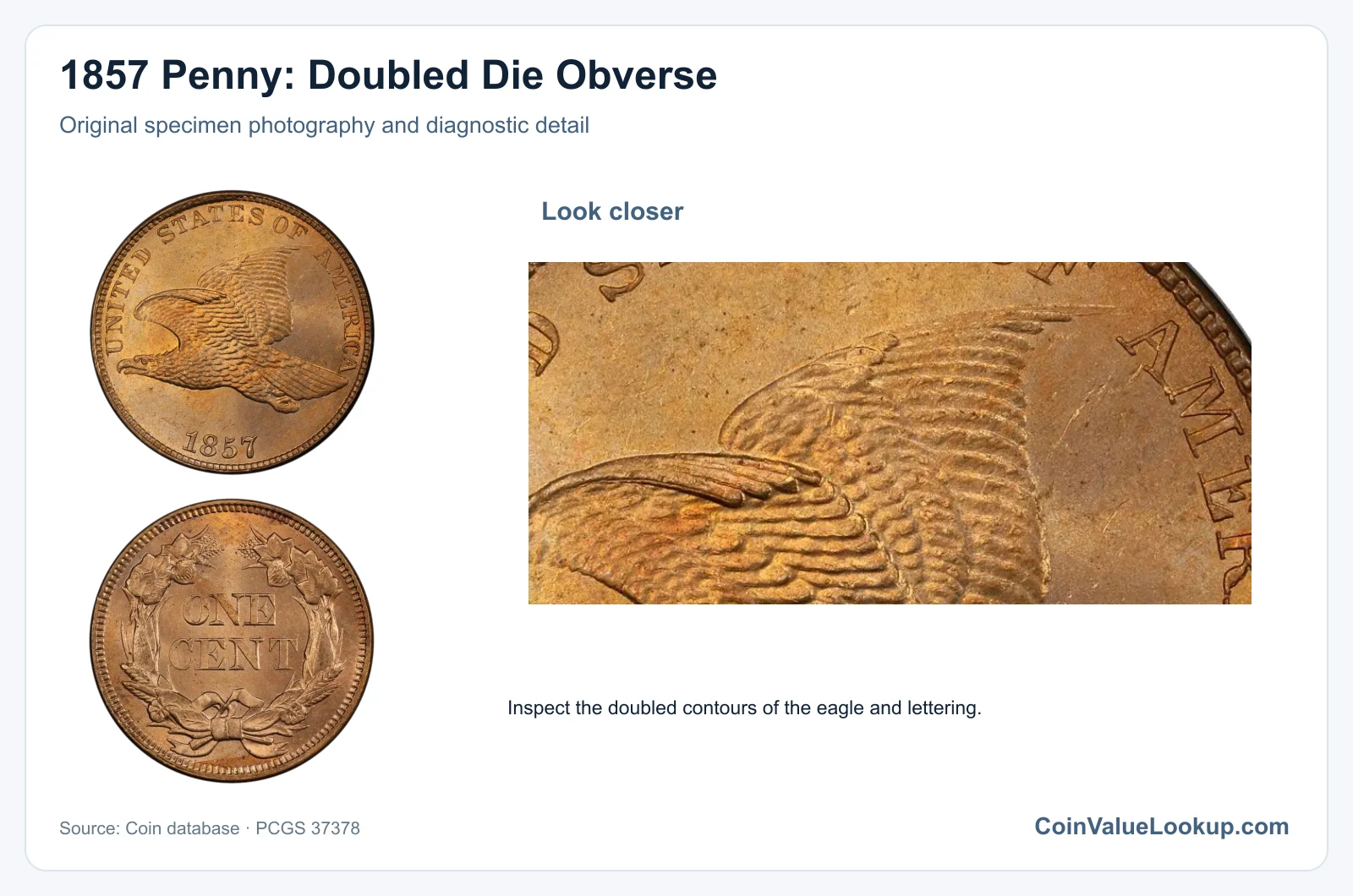
A doubled die obverse on an 1857 Flying Eagle cent shows consistent doubling of the obverse design elements — typically visible in the lettering or the date. Under magnification, look for a secondary image that shows uniform separation or notching on letter edges.
The doubling should be consistent across multiple elements, not isolated to one spot.
The main lookalike is machine doubling (also called strike doubling), which produces a flat shelf next to the design rather than a rounded secondary image. Worn die contours and reflections under certain lighting can also mimic true hub doubling.
No standard numeric price is adopted for this category. Value depends on the strength of the doubling, the coin's authenticated identity, and its overall condition.
Professional attribution is the safest route.
2. 1857 Flying Eagle Cent — Repunched Date
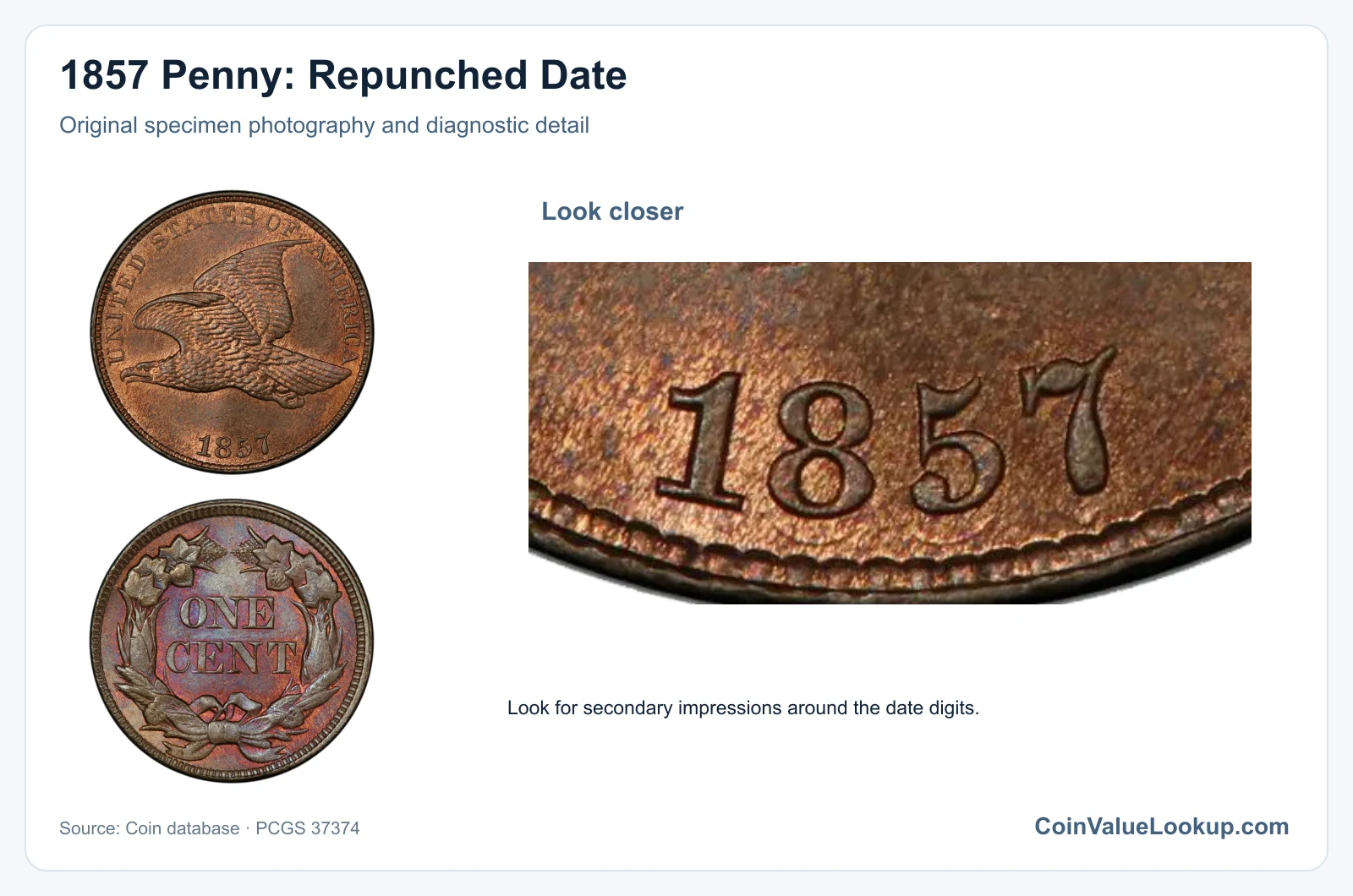
Repunched date varieties on 1857 Flying Eagle cents show remnants of an earlier punch position beside the final date numerals. You might see a faint shadow of the 1, 8, 5, or 7 slightly offset from where the final digit sits.
This happened when the date punch was applied more than once during die preparation.
Do not confuse this with doubled die varieties, which affect the entire obverse design through a hub error. A repunched date is strictly a date-punch anomaly.
Also watch out for damage to the date area or machine doubling, which can create misleading secondary images.
No specific numeric price is adopted for this error. The premium depends on the clarity and visibility of the repunching, authenticated identity, and the coin's grade and surface quality.
3. 1857 Flying Eagle Cent — Clashed Dies
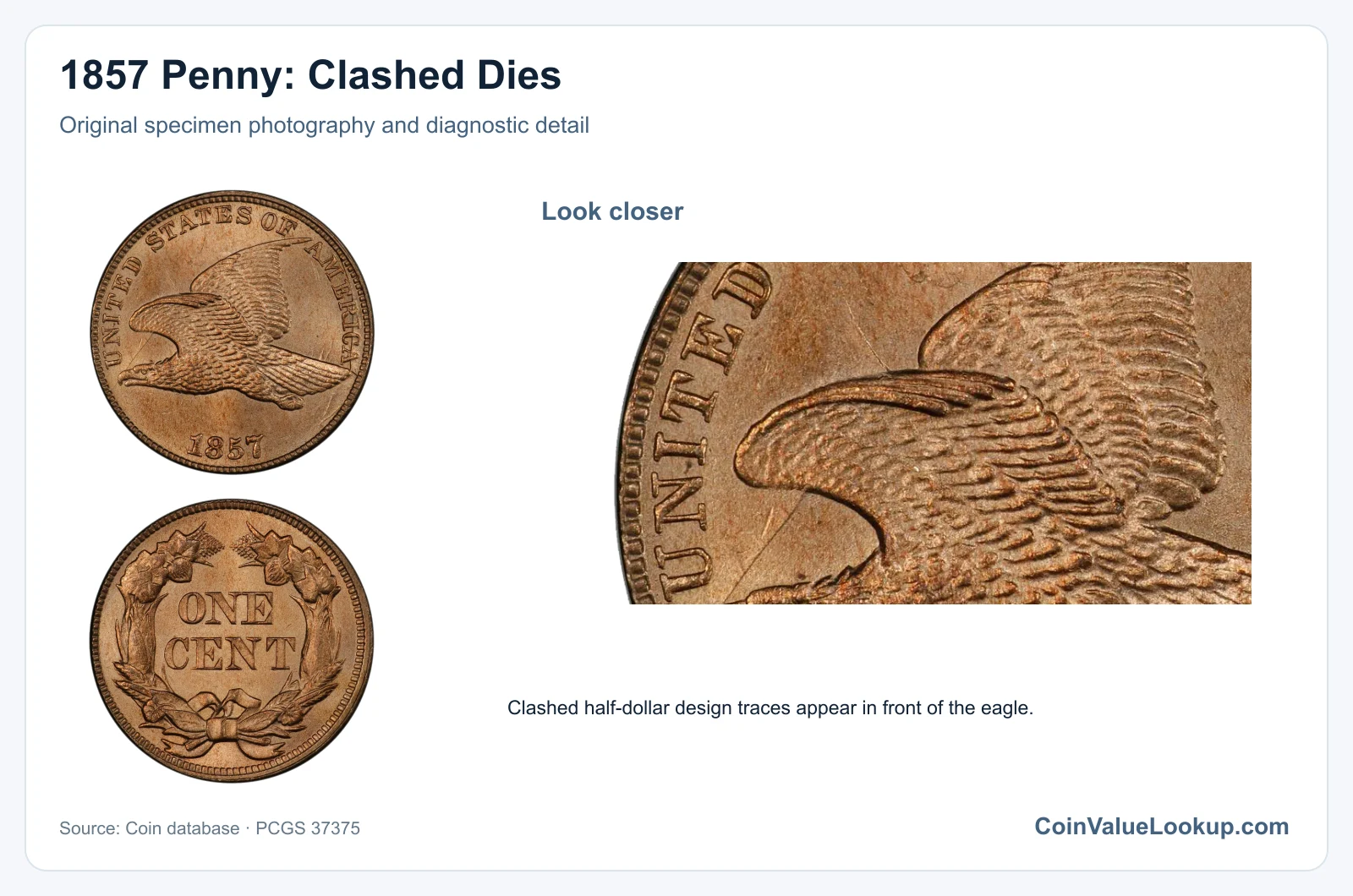
Clashed dies occur when the obverse and reverse dies strike each other without a planchet between them. The result is a transfer of design elements — you may see faint traces of the wreath on the obverse or outlines of the eagle on the reverse, positioned where the opposing die's features would align.
Look for these ghost images in the open fields of each side, away from the main design. They tend to follow the geometry of the opposite face.
Scratches, random raised lines, or post-mint damage can look similar but will not align consistently with the opposing design.
No adopted numeric price exists for this category on the 1857 Flying Eagle cent. Individual value depends on how dramatic the clash is, the coin's authenticated identity, and its condition.
4. 1857 Flying Eagle Cent — Broadstrike
A broadstrike happens when a coin is struck without the retaining collar that normally limits its spread and forms the edge. The result is a coin that is wider than normal with a complete but slightly expanded design.
The rim may be weak, missing, or irregular.
The full design should still be present — that is what separates a broadstrike from an off-center strike, where part of the design is missing entirely. Also distinguish it from a coin that was flattened or damaged after leaving the mint; post-mint flattening will not show the natural metal flow patterns of a genuine broadstrike.
Check the edge profile carefully. No numeric price is adopted for this error.
Value is assessed individually based on authenticated identity, the degree of spread, and overall condition.
5. 1857 Flying Eagle Cent — Clipped Planchet
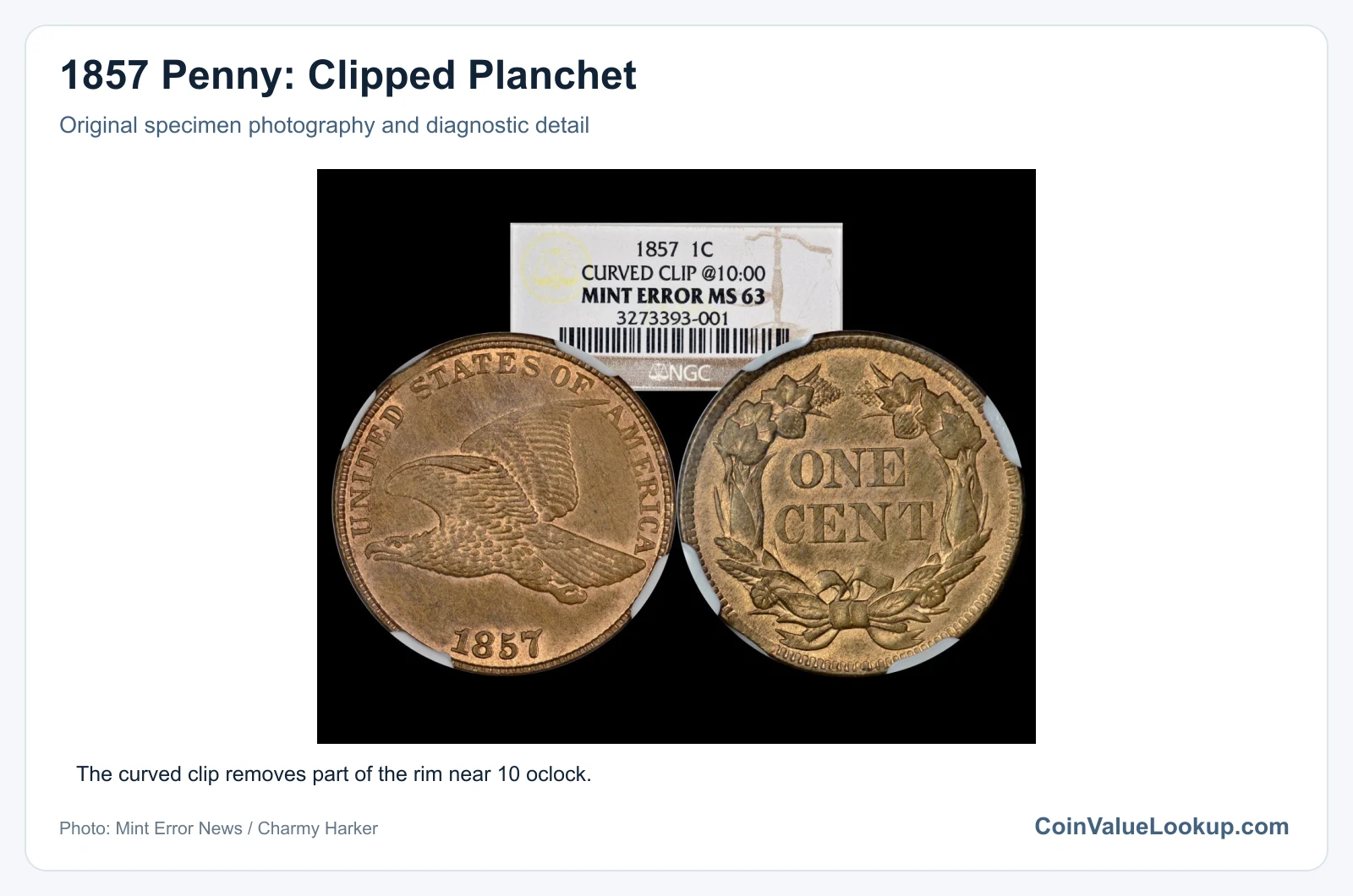
A clipped planchet error means the blank was incomplete before it was struck. You will see a missing portion of the coin — it can be curved (from overlapping punches in the blanking process), straight, or ragged.
The clip typically leaves a characteristic area of weakness on the opposite side of the coin, called the Blakesley effect, where metal did not flow completely during the strike.
Do not confuse a genuine clip with post-mint damage such as a filed edge, a deliberate cut, or corrosion eating away part of the rim. A real clip will show natural metal flow at the boundary and the design will fade toward the missing area rather than stopping abruptly.
No specific numeric price is adopted. Value depends on clip size, type, the coin's authenticated identity, and condition.