1900 Barber Quarter Coin Value: How Much Is It Worth?
The 1900 Barber Quarter is a 90% silver coin that still turns up in collections, junk-silver lots, and the occasional pocket change jar. Guide estimates for this year range from about $21.00 to $1,454.00 depending on the specific mint, finish, and condition.
That is not one price for every coin. Where yours falls depends on whether it came from Philadelphia, New Orleans, or San Francisco, plus how much wear it has taken over the past century-plus.
Fast Way to Identify Your 1900 Barber Quarter
The quickest way to start figuring out what you have is to snap clear photos of both sides of the coin. Upload images of the front (obverse) and back (reverse) for a preliminary identification.
Good lighting at a slight angle helps capture surface detail and any mintmark. This step alone can narrow things down before you dig deeper into condition and version.
1900 Barber Quarter Value
Upload both sides of your 1900 Barber Quarter.
Front Obverse
Upload photo
Back Reverse
Upload photo
Which 1900 Barber Quarter Versions Are Worth Money?
- 1900-S quarters carry the highest guide value in upper grades, with an MS63 estimate around $1,454.00 per USA Coin Book.
- 1900-O quarters follow closely, estimated at $1,354.00 in MS63 condition, making the New Orleans mint worth checking.
- 1900 PR (proof) quarters are listed at $799.00 in PR63, a distinct collector finish separate from high-grade business strikes.
- Even a well-worn 1900 Philadelphia quarter starts around $21.00 in G4 because of its silver content and age.
- Check mint and finish first; damage, cleaning, or a bright polished surface does not make a coin rare or valuable.
Step 1: Identify Your 1900 Barber Quarter Mint Mark and Version
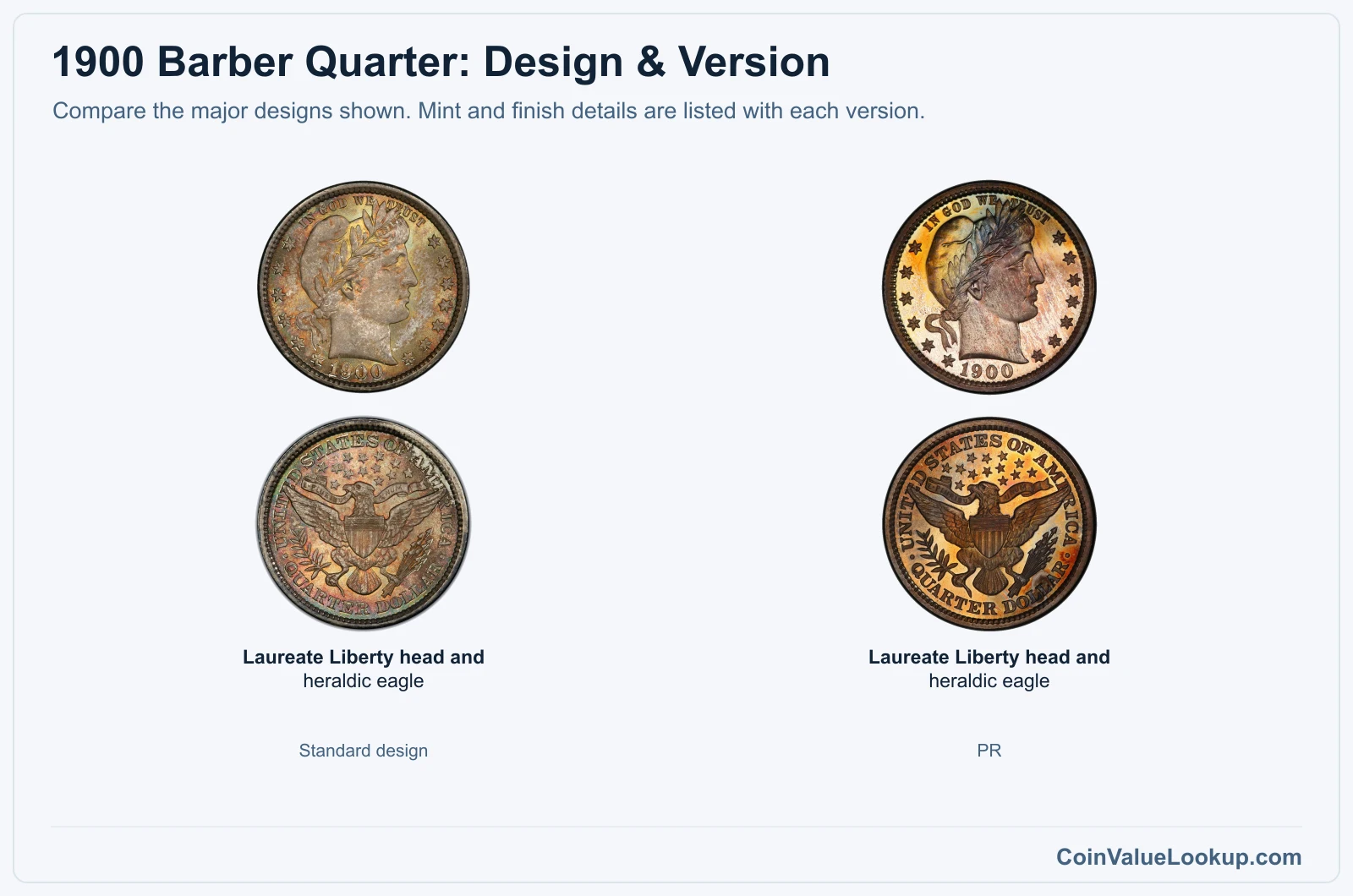
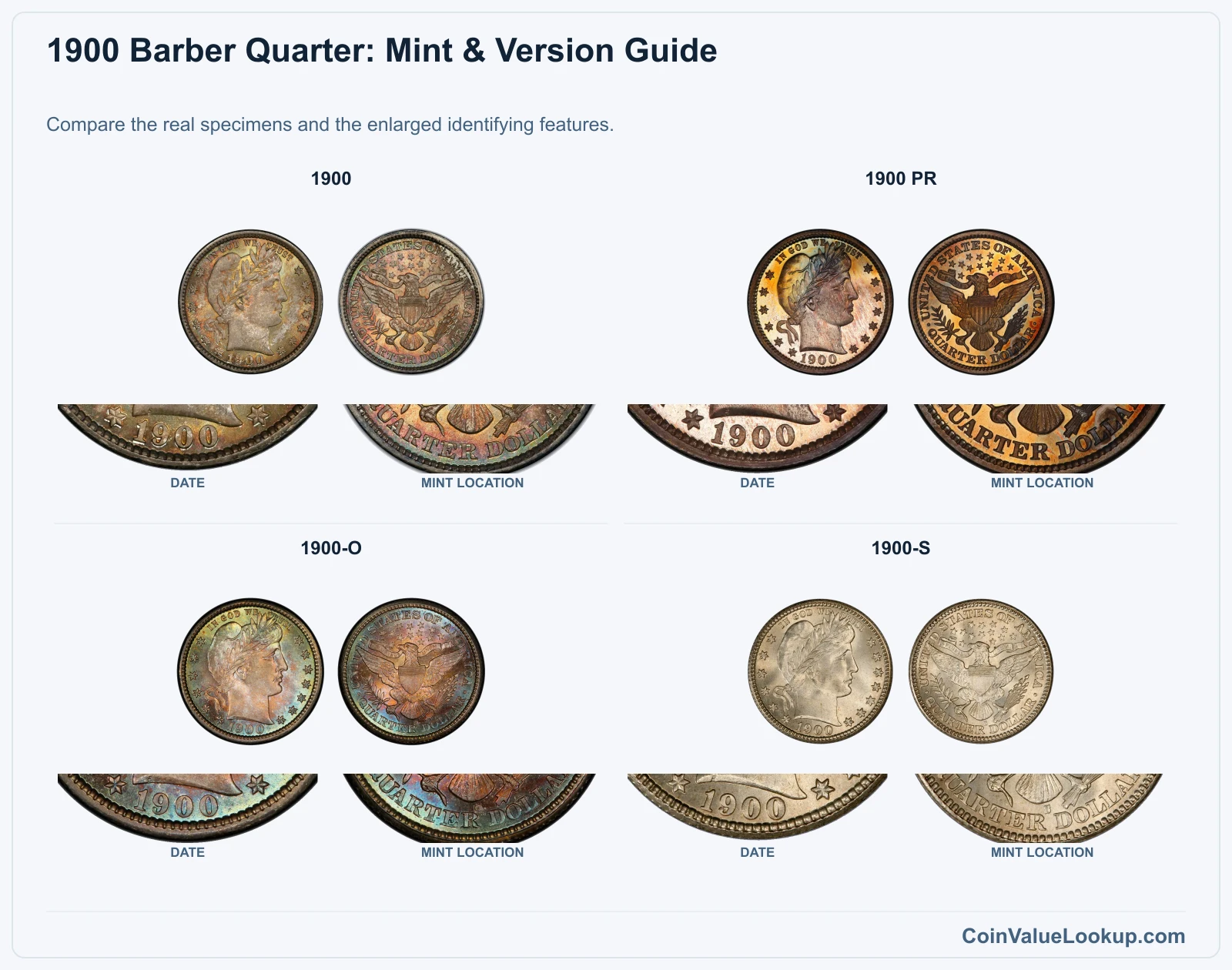
The 1900 Barber Quarter comes in four versions: 1900 (Philadelphia business strike), 1900 PR (Philadelphia proof), 1900-O (New Orleans), and 1900-S (San Francisco). Finding the mint is step one.
Flip your coin to the reverse. Look below the eagle's tail feathers and above the words "QUARTER DOLLAR." If you see an O, that is New Orleans.
An S means San Francisco. No letter at all means Philadelphia.
All business strikes share the same composition: 90% silver, 10% copper, weighing 6.25 grams. The obverse shows Liberty wearing a laureate cap, while the reverse features a heraldic eagle with a shield.
The proof version was also struck at Philadelphia but with polished dies and specially prepared planchets. It looks different from a regular strike, mirror-like surfaces being the hallmark.
A shiny, cleaned circulation coin is not a proof. If you are unsure, professional authentication is the safe route.
Step 2: Check Your 1900 Barber Quarter Grade
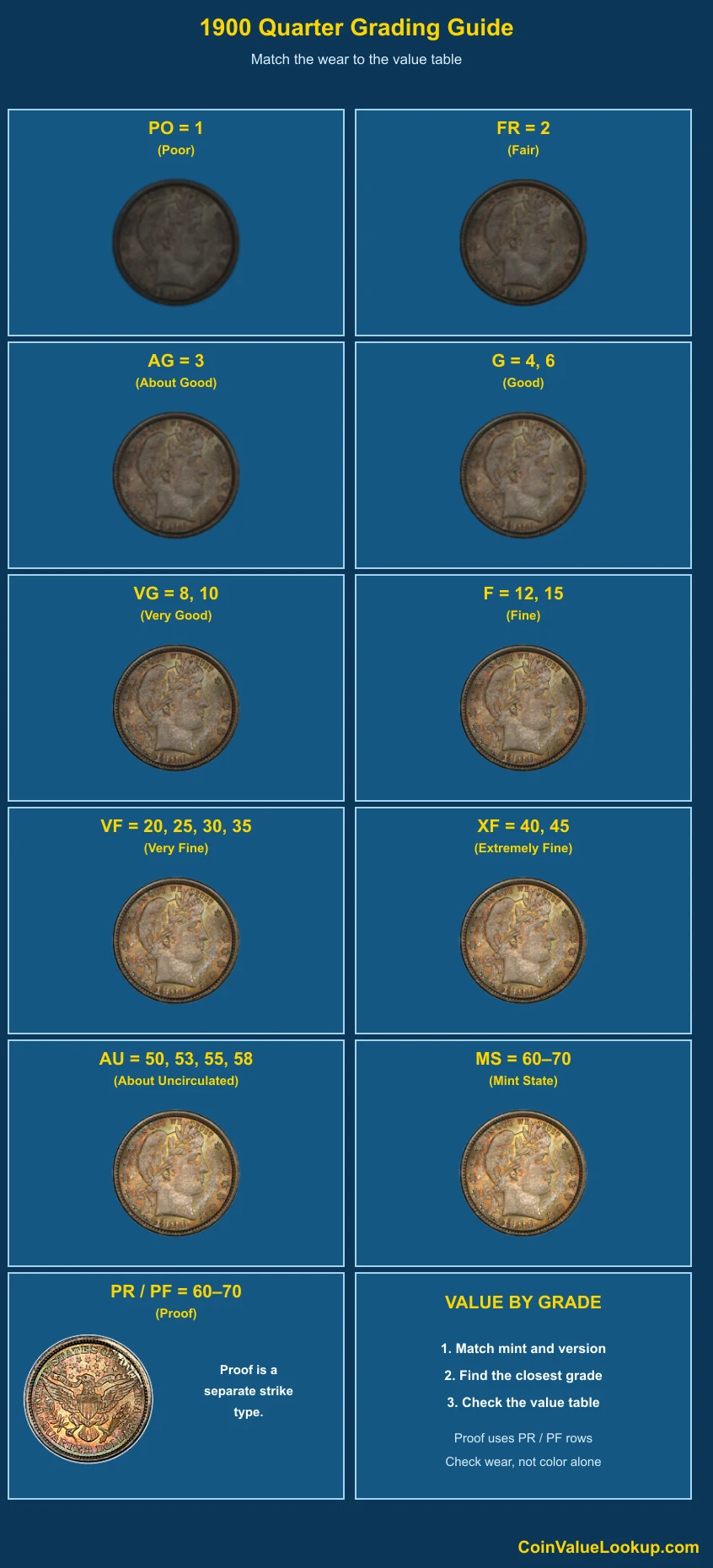
Start with Liberty's head on the obverse. The hair just above the forehead and along the cheek wears first, followed by the wreath detail.
On the reverse, check the eagle's breast feathers, wing tops, and tail.
The word LIBERTY appears on the headband, and its letters are a useful wear gauge. In lower grades some or all letters are missing.
But do not use LIBERTY alone, look at overall surface wear and remaining luster together.
A weakly struck coin can fool you. Some 1900 quarters left the press with soft detail, especially on high points, even though the coin was never circulated.
A weak strike is not the same as wear. Wear smooths and flattens metal in a directional way; a weak strike leaves the surface texture intact but with less design relief.
Use the comparison image to match your coin's condition against known grade benchmarks. Check both sides under consistent light and resist the urge to assign a grade based on the best-looking area alone.
Step 3: Check 1900 Barber Quarter Value by Mint and Version
1900 Barber Quarter
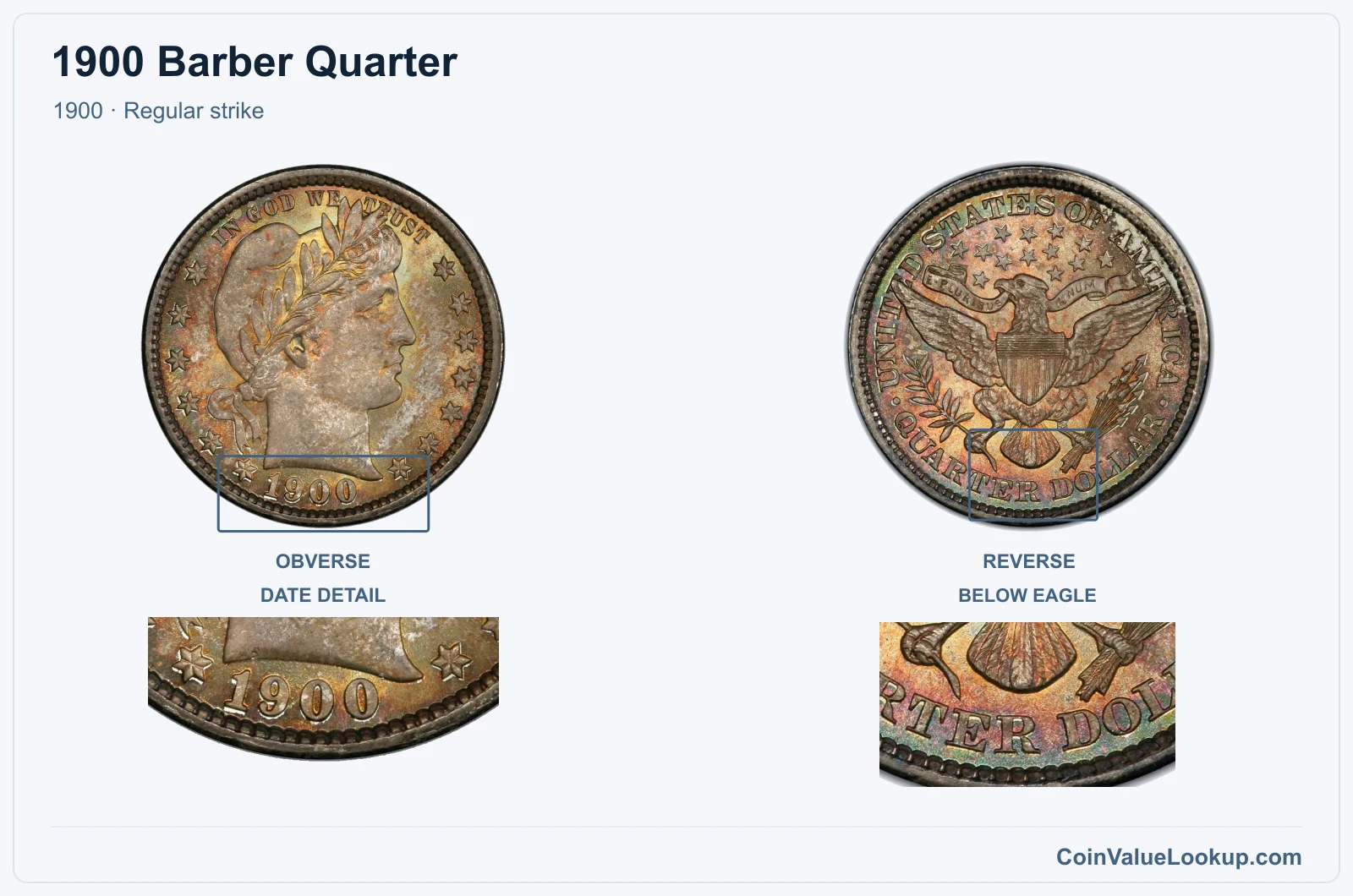
The 1900 Philadelphia quarter has no mintmark on the reverse. It is the most common version of this date.
In well-worn G4 condition, USA Coin Book estimates it at $21.00. Move up to Mint State and the numbers climb: about $309.00 at MS60 and $477.00 at MS63.
Before comparing your coin to these figures, confirm it has original surfaces. Cleaning strips away natural toning and luster, and a cleaned coin will trade below guide values even if the detail looks sharp.
Strike quality matters too. A soft strike does not equal a lower grade.
Range Grade
Price Auction Records Appraisal PO PO 1
—
Coin Identifier FR FR 2
—
Coin Identifier AG AG 3
—
Coin Identifier G G 4
—
Coin Identifier
G 6
—
Coin Identifier VG VG 8
—
Coin Identifier
VG 10
—
Coin Identifier F F 12
—
Coin Identifier
F 15
—
Coin Identifier VF VF 20
Coin Identifier
VF 25
—
Coin Identifier
VF 30
Coin Identifier
VF 35
Coin Identifier XF XF 40
Coin Identifier
XF 45
Coin Identifier AU AU 50
Coin Identifier
AU 53
Coin Identifier
AU 55
Coin Identifier
AU 58
Coin Identifier MS MS 60
—
Coin Identifier
MS 61
Coin Identifier
MS 62
Coin Identifier
MS 63
Coin Identifier
MS 64
Coin Identifier
MS 65
Coin Identifier
MS 66
Coin Identifier
MS 67
Coin Identifier
MS 68
—
—
—
MS 69
—
—
—
MS 70
—
—
—
1900 Barber Quarter — PR
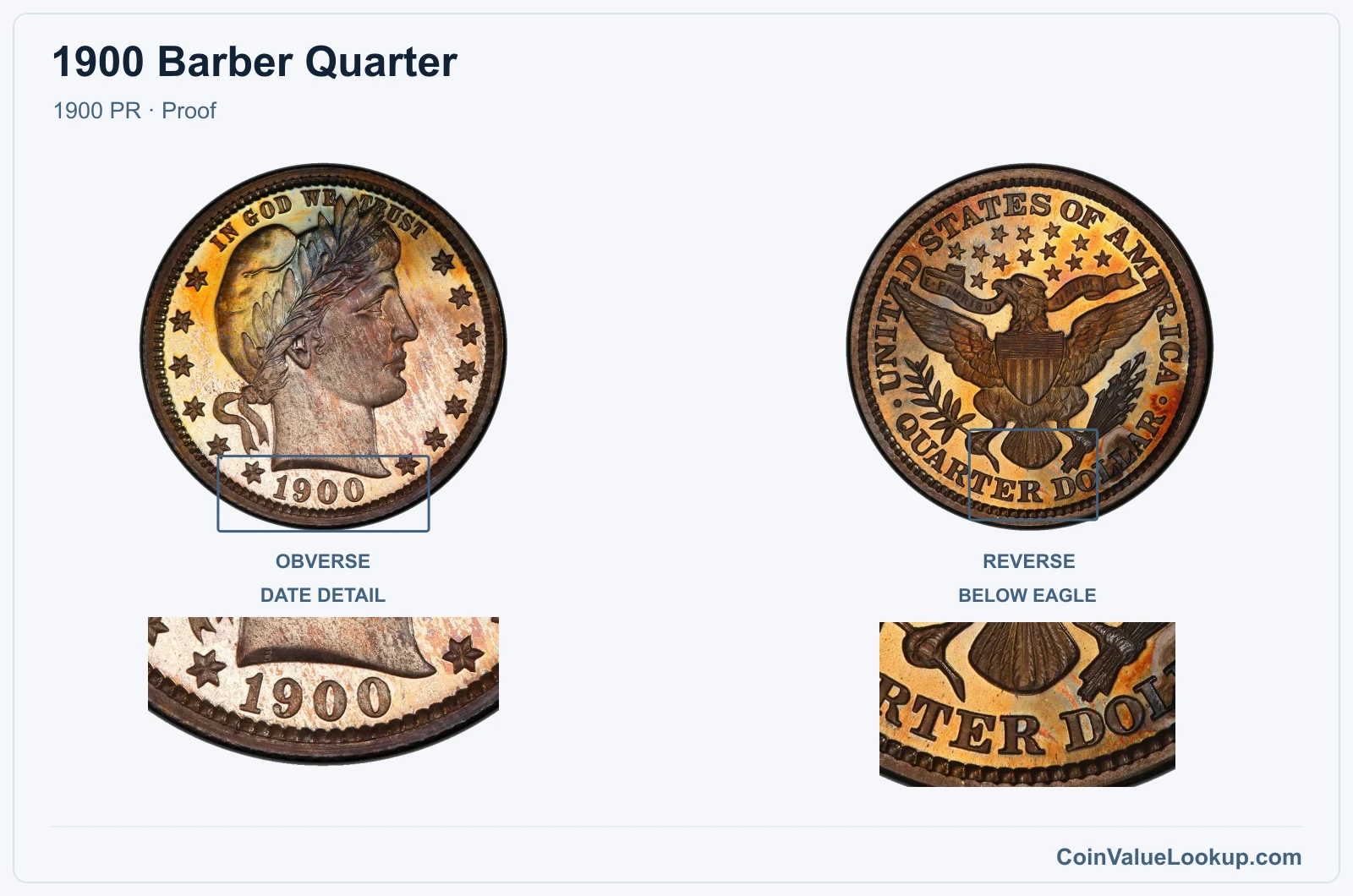
The 1900 PR is the proof version, also struck at Philadelphia with no mintmark. These were made for collectors using polished dies and specially handled planchets, producing mirror-like fields distinct from a regular business strike.
A proof is a method of manufacture, not a grade above Mint State. Surface haze, hairlines from handling, and spots from improper storage all affect the collector value.
USA Coin Book lists this version at $799.00 in PR63.
Coin Value Lookup is a good starting point if you want to compare this proof issue against other Barber Quarter years and versions. It can help you identify which dates and mints carry the strongest collector premiums.
Range Grade
Price Auction Records Appraisal PR PR 1
—
Coin Identifier
PR 2
—
Coin Identifier
PR 3
—
Coin Identifier
PR 4
—
Coin Identifier
PR 6
—
Coin Identifier
PR 8
—
Coin Identifier
PR 10
—
Coin Identifier
PR 12
—
Coin Identifier
PR 15
—
Coin Identifier
PR 20
—
Coin Identifier
PR 25
—
Coin Identifier
PR 30
—
Coin Identifier
PR 35
—
Coin Identifier
PR 40
—
Coin Identifier
PR 45
—
Coin Identifier
PR 50
—
Coin Identifier
PR 53
—
Coin Identifier
PR 55
—
Coin Identifier
PR 58
—
Coin Identifier
PR 60
Coin Identifier
PR 61
Coin Identifier
PR 62
Coin Identifier
PR 63
Coin Identifier
PR 64
Coin Identifier
PR 65
Coin Identifier
PR 66
Coin Identifier
PR 67
Coin Identifier
PR 68
Coin Identifier
PR 69
—
—
—
PR 70
—
—
—
1900 Barber Quarter — O
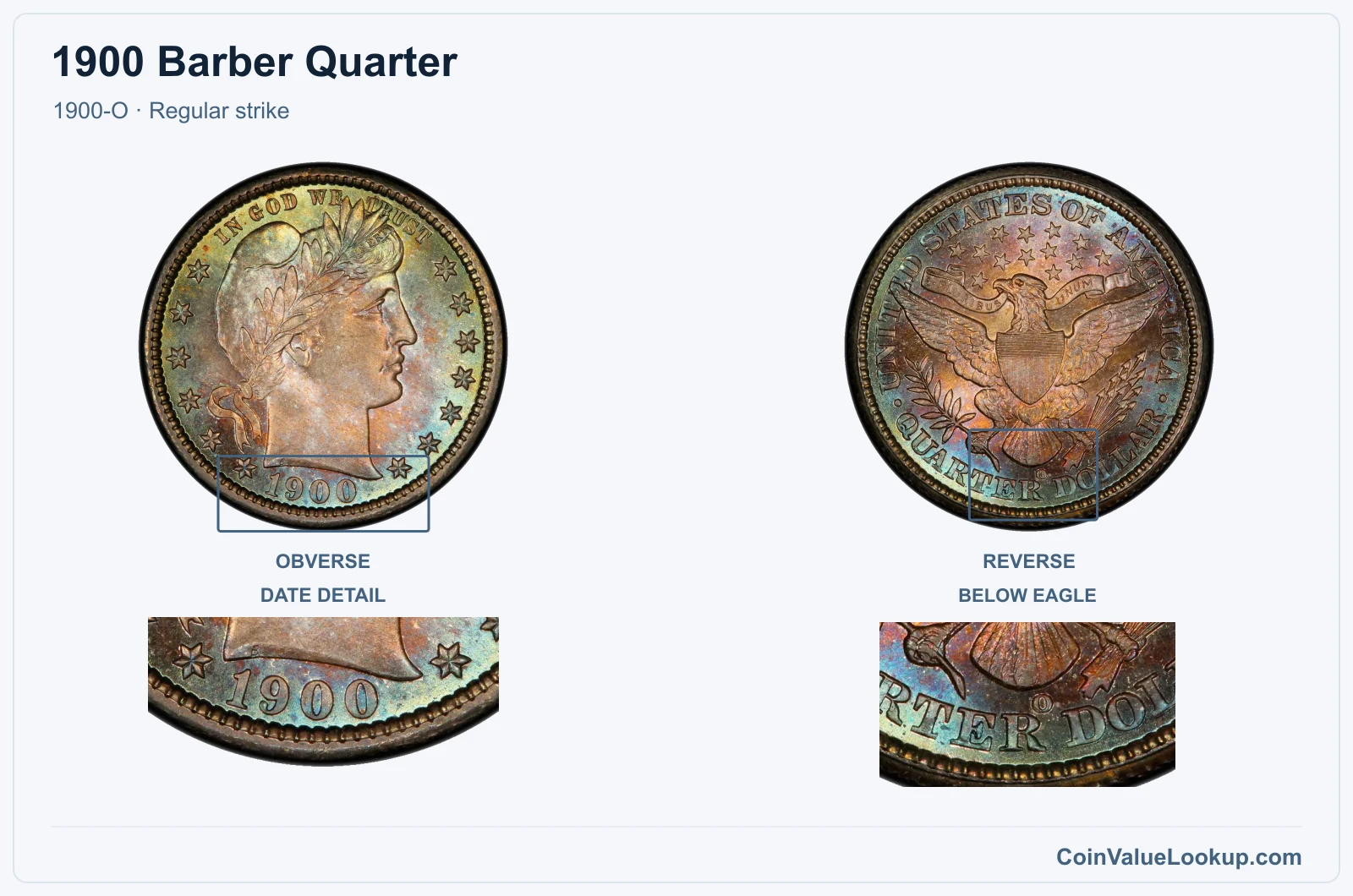
Look for an O mintmark on the reverse, centered below the eagle's tail. That confirms your quarter was struck at the New Orleans Mint.
The 1900-O carries strong collector interest in higher grades. USA Coin Book places it at $28.00 in G4, $938.00 at MS60, and $1,354.00 at MS63.
The jump from circulated to uncirculated is steep because most surviving examples saw heavy use.
Original surfaces matter here. A coin that has been cleaned or damaged loses the premium these guide figures assume, even if it retains good detail.
Range Grade
Price Auction Records Appraisal PO PO 1
—
Coin Identifier FR FR 2
—
Coin Identifier AG AG 3
—
Coin Identifier G G 4
—
Coin Identifier
G 6
—
Coin Identifier VG VG 8
—
Coin Identifier
VG 10
—
Coin Identifier F F 12
—
Coin Identifier
F 15
Coin Identifier VF VF 20
Coin Identifier
VF 25
Coin Identifier
VF 30
Coin Identifier
VF 35
Coin Identifier XF XF 40
Coin Identifier
XF 45
Coin Identifier AU AU 50
Coin Identifier
AU 53
Coin Identifier
AU 55
Coin Identifier
AU 58
Coin Identifier MS MS 60
Coin Identifier
MS 61
Coin Identifier
MS 62
Coin Identifier
MS 63
Coin Identifier
MS 64
Coin Identifier
MS 65
Coin Identifier
MS 66
Coin Identifier
MS 67
Coin Identifier
MS 68
Coin Identifier
MS 69
—
—
—
MS 70
—
—
—
1900 Barber Quarter — S
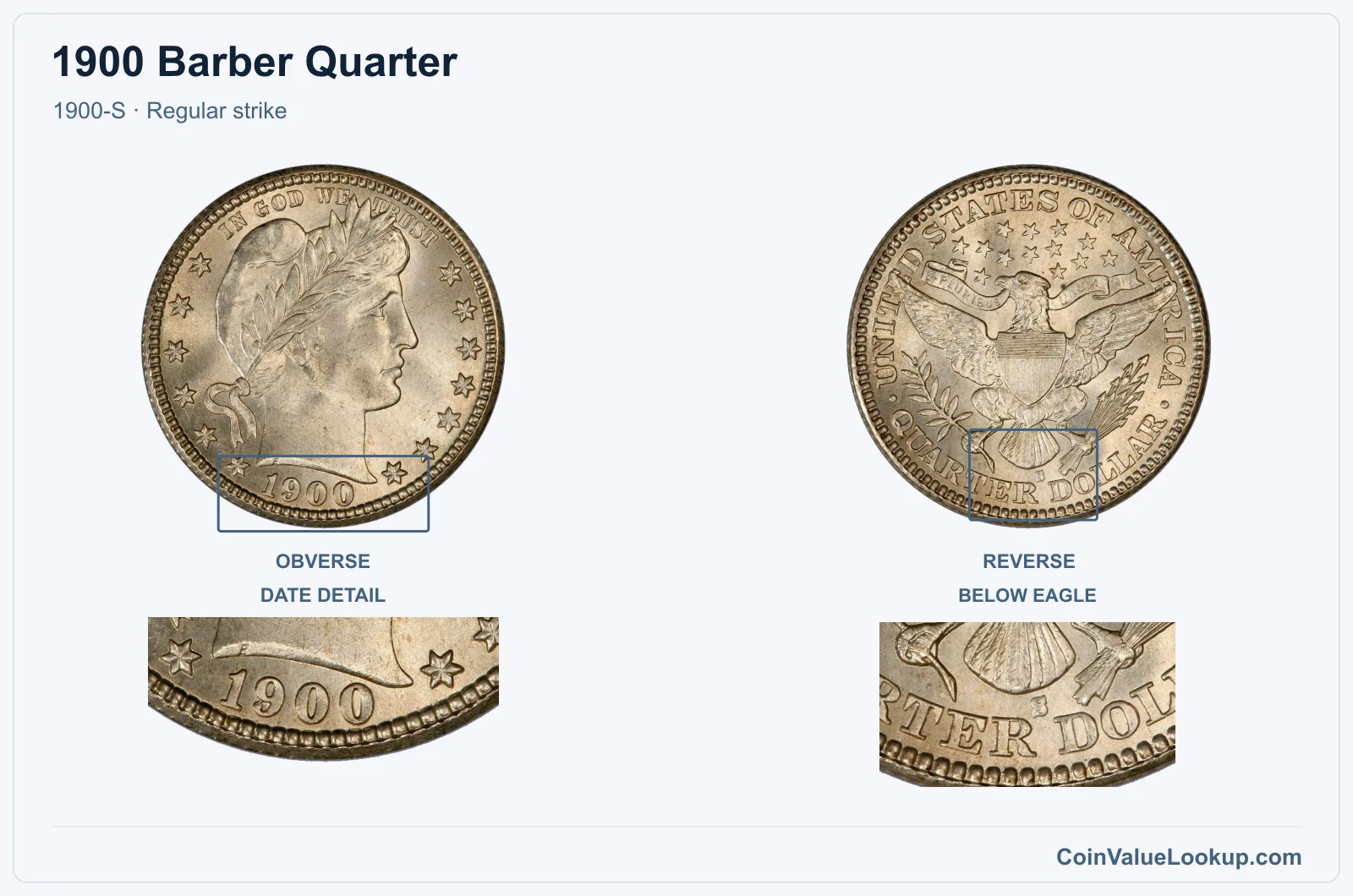
The 1900-S was struck at the San Francisco Mint and carries an S mintmark on the reverse below the eagle's tail. This version reaches the highest guide estimates for 1900 Barber Quarters in upper grades.
USA Coin Book lists the 1900-S at $24.00 in G4, $799.00 at MS60, and $1,454.00 at MS63. Like the New Orleans issue, the gap between worn and Mint State is wide.
Surviving uncirculated examples with original luster are scarce compared to lower-grade survivors.
Confirm both the mintmark and the coin's surface condition before assuming top-grade value. Cleaning, environmental damage, or old scratches will pull any Barber Quarter well below guide estimates regardless of how crisp the design looks.
Range Grade
Price Auction Records Appraisal PO PO 1
—
Coin Identifier FR FR 2
—
Coin Identifier AG AG 3
—
Coin Identifier G G 4
—
Coin Identifier
G 6
—
Coin Identifier VG VG 8
—
Coin Identifier
VG 10
—
Coin Identifier F F 12
—
Coin Identifier
F 15
Coin Identifier VF VF 20
—
Coin Identifier
VF 25
—
Coin Identifier
VF 30
Coin Identifier
VF 35
Coin Identifier XF XF 40
Coin Identifier
XF 45
Coin Identifier AU AU 50
Coin Identifier
AU 53
Coin Identifier
AU 55
Coin Identifier
AU 58
Coin Identifier MS MS 60
—
Coin Identifier
MS 61
Coin Identifier
MS 62
Coin Identifier
MS 63
Coin Identifier
MS 64
Coin Identifier
MS 65
Coin Identifier
MS 66
Coin Identifier
MS 67
Coin Identifier
MS 68
—
—
—
MS 69
—
—
—
MS 70
—
—
—
1900 Barber Quarter Error List
1. 1900 Barber Quarter — Off-Center Strike
An off-center strike happens when the planchet is not seated properly in the press. The result is a displaced design with an unstruck crescent of blank metal along one edge.
On a 1900 Barber Quarter, you want the date to remain visible, otherwise collector interest drops sharply.
The percentage of off-center shift and the date's visibility both drive value, but no specific price range is available for this year. Each piece needs individual assessment based on condition and how dramatic the misalignment is.
Do not confuse an off-center strike with a clipped planchet, a one-sided die misalignment, or post-mint damage like a vice squeeze. The off-center coin will show a consistent shift of the entire design, not just edge distortion.
2. 1900 Barber Quarter — Double / Multiple Strike
A double-struck 1900 Barber Quarter shows two separate impressions of the design, one displaced or rotated from the other. This is different from a doubled die, where the doubling is within the die itself and repeated identically on every coin struck by that die.
On a genuine double strike you will see the full design repeated, sometimes at a visible angle or offset. The second strike can partially obscure the first, creating a dramatic overlapping effect rather than merely thickened or spread lettering.
No specific price is available for this error on the 1900 quarter. Value depends on how visible and dramatic the second impression is, plus the coin's overall condition.
Watch out for post-mint impressions or tooling marks that can mimic the look at first glance.
3. 1900 Barber Quarter — Struck-Through Error
A struck-through error on a 1900 Barber Quarter occurs when foreign material sits between the die and the planchet during striking. This leaves a localized depression, an impression of the obstruction, or an area where the design is incomplete.
Grease fill-ins are one common type, producing a smooth, flat area where detail should be. A retained foreign object, like a thread or metal fragment, leaves a more distinctive impression.
The two look quite different and each has its own collector following.
No adopted price is available for this error on the 1900 quarter. Condition, size and clarity of the obstruction impression all matter.
Ordinary wear, scratches from circulation, cleaning marks, and weak strike detail can all mimic a struck-through at first glance, so careful comparison is important.
4. 1900 Barber Quarter — Clipped Planchet
A clipped planchet means the blank was incomplete before it was struck. On a 1900 Barber Quarter, look for a missing curved, straight, or irregular section along the edge.
The clip's shape tells you what happened during the blanking process.
A genuine clip often shows a characteristic area of weakness on the opposite side of the coin, called the Blakesley effect. The metal flow near the clip will look natural and undisturbed, not sharp or filed.
No specific price is available for this error on the 1900 quarter. Value depends on the size and type of clip plus the coin's grade.
Be careful not to mistake a filed edge, a deliberate cut, or corrosion damage for a mint-made clip. Post-mint alterations leave tool marks and unnatural edges that a genuine clip does not.
5. 1900 Barber Quarter — Die Crack / Die Chip
Die cracks show up as raised lines on the coin's surface because the cracked die transfers its damage in reverse. On a 1900 Barber Quarter, look for thin raised lines running across the design or connecting to the rim.
A die chip appears as a small raised blob, often near letters or stars.
A major crack that reaches the rim and produces a raised lump of extra metal is called a cud. Interior cracks are more common and usually smaller.
No specific price is available for die cracks on the 1900 quarter. Larger, more prominent cracks and cuds typically draw more collector interest than fine hairline cracks.
Do not confuse die cracks with incuse scratches, corrosion lines, or foreign material stuck to the surface. Die cracks are always raised above the coin's field, never recessed.